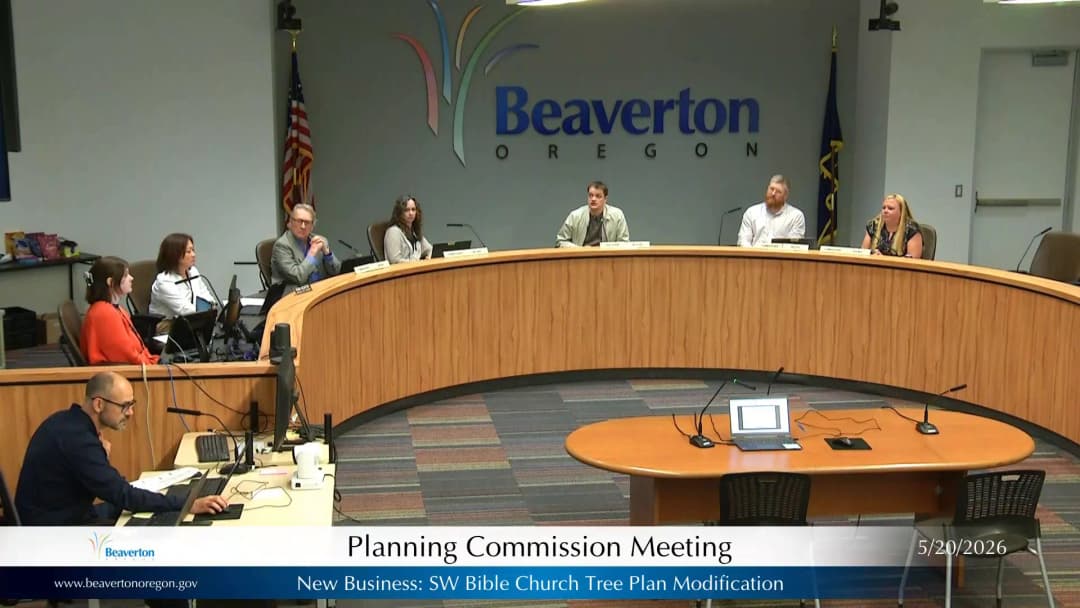
The Beaverton Planning Commission held a public hearing on May 20, 2026, to consider a request from Southwest Bible Church to modify a previously approved land use decision (LU 30 32026 00182). The modification sought to remove a condition of approval that required a conservation easement over a significant natural resource area (SNRA) on the church campus. Staff recommended approval, citing a mistake of fact regarding the 1995 master plan. The commission unanimously approved the modification. Public Comments & Testimony - Morgan Harrington (neither in favor nor opposed) asked for clarification about whether the northwest corner of the site (the 1.06-acre tree preservation tract) was planned for development. The applicant clarified that the tree tract is protected and will not be developed. - No testimony was offered in favor or opposition to the application. Discussion Items - Staff Presentation (Steve Regner, Senior Planner): The original 2025 approval required a conservation easement over the SNRA when six trees were removed for a new building. However, the 1995 master plan for the site had already authorized tree removal in the SNRA for future phases, subject to certain conditions. A 1999 case file supported that interpretation. Staff concluded that a mistake of fact occurred and that the conservation easement condition was improperly applied. The only change if approved would be removal of the easement condition; the building and all other conditions remain unchanged. - Commissioner Questions: Commissioners asked about the difference between a preservation tract and conservation easement, how the city handles conflicts between master plans and current code, and the extent of remaining development. Staff explained that the master plan is vested and that the 1.06-acre tree tract (northwest corner) is permanently protected. The SNRA boundary is approximate, but the Clean Water Services easement covers 60–70% of the SNRA and is already in place. - Applicant Presentation (Garrett Stevenson, attorney, and Gary Dozier, pastor): The applicant argued that the 1995 master plan was a thoughtful compromise that included a dedicated tree preservation tract. Removing six trees does not warrant a conservation easement over nine acres, which would preclude future development authorized by the master plan. The code includes discretion (Section 60.15.2C.5) to allow alternative approaches. The applicant also noted that the master plan is vested under Oregon law, and the church has no intention of developing the tree tract. Key Outcomes - Motion: Commissioner Winter moved to approve LU 3 2026 00182, Southwest Bible Church Tree Plan Modification of a Decision, based on the facts and findings in the staff report dated May 13, 2026, and incorporating all associated memoranda. Commissioner McAvoy seconded. - Vote: The motion passed unanimously (4–0; Commissioners Speck and Adams were excused). - Effect: The condition of approval requiring a conservation easement over the SNRA is removed. The 2025 development approval (12,000-square-foot building) and all other conditions remain in effect. - Next Steps: The decision will be memorialized in a land use order. Appeals must be filed per Beaverton Development Code and LUBA rules.
Public Meetings - Beaverton, Oregon
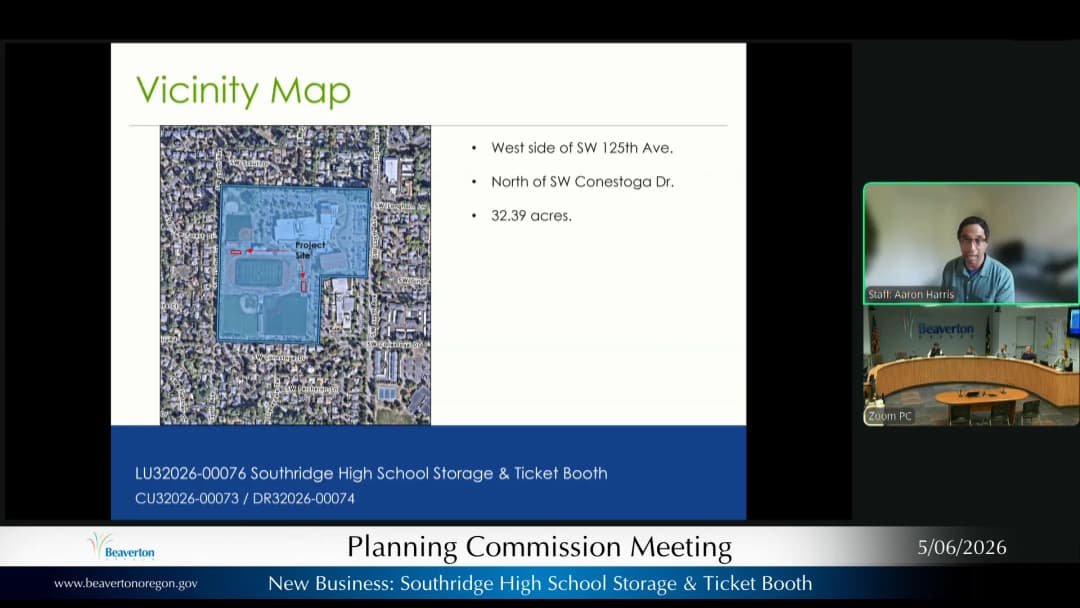
Public Meetings - Beaverton, OregonThe Beaverton Planning Commission met on May 6, 2026, adjourning at 6:54 PM. The meeting included a public hearing for a land use application to construct a storage and ticket booth at South Ridge High School, a work session on the commission’s work plan, and staff announcements. Staff Communications - Planning Division Manager Anna Statinski announced upcoming events: Beaverton Volunteer Fair on Saturday, June 6 (10 AM-1 PM) at the Beaverton City Library; National Public Works Week (May 17-23); National Police Week (May 10-16); and Public Service Recognition Week. Public Hearing: South Ridge High School Storage and Ticket Booth (LU 32026-00076, CU 32026-00073, DR 32026-00074) - Staff presentation by Senior Planner Aaron Harris. The applicant (Beaverton School District) proposes an 1,800 sq ft building for athletic equipment storage and event ticket booth (150-200 sq ft), plus relocation of the shot put field. - Staff noted two discrepancies in the report: correct neighborhood association is South Beaverton NAC (not Greenway); and retaining wall details – wall is 3 ft high and 66 ft long, behind a berm, not visible from the street. - The application requires a major conditional use modification (increase in floor area over 1,000 sq ft) and design review three (deviations from standards). - Commissioner McCann recused due to a conflict of interest (consulting for the Beaverton School District). No public testimony was offered (none in favor, opposed, or neutral). - The commission voted 5-0 to approve the application subject to conditions in the April 29, 2026 staff report. Voting aye: Chair Adams, Commissioners Holmes, McAvoy, Mettler, Speck. Commissioner McCann was absent. Work Session: Planning Commission Work Plan - Staff presented a draft work plan for the current calendar year, focusing on the commission’s role as a decision-maker and policy advisor. - Commissioners expressed interest in additional training topics: statewide land use goals, legal aspects of land use planning, connections to Beaverton’s Climate Action Plan, and major project updates (e.g., Allen Boulevard project). Interest was also noted in housing development and affordable housing initiatives. - The work plan will be presented to the City Council on July 7, 2026, alongside work plans from other boards and commissions. Key Outcomes - Approved the South Ridge High School storage and ticket booth application (LU 32026-00076, CU 32026-00073, DR 32026-00074) subject to staff conditions. Vote: 5-0. - Next Steps: Staff will incorporate commissioner feedback into the work plan calendar and schedule presentations. The work plan will go to Council on July 7, 2026. - Meeting adjourned at 6:54 PM.
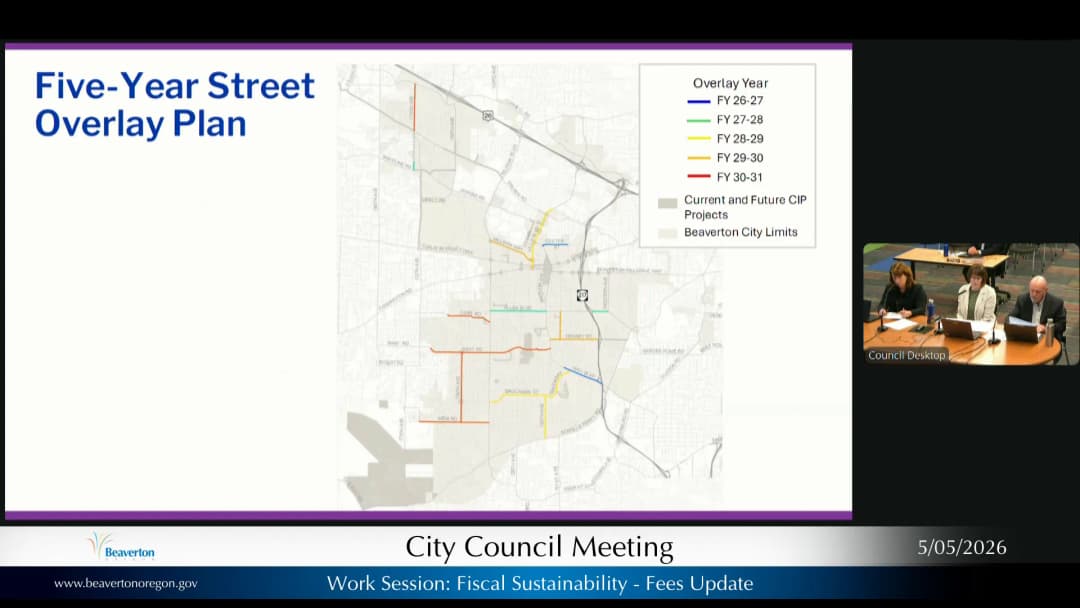
This summary covers the Beaverton City Council meeting held on May 5, 2026, which included proclamations, public comment, a presentation from the Washington County Sheriff’s Office, a consent agenda, a discussion and vote on parking enforcement, work sessions on the interim city manager’s work plan, the city library strategic plan, and fiscal recovery including potential new fees. The meeting also included new business updates. Proclamations - May 2026 was proclaimed Asian American, Native Hawaiian and Pacific Islander Heritage Month. Beaverton is one of the most diverse cities in Oregon (1 in 3 residents is a person of color; 1 in 5 was born outside the U.S.), with AANHPI communities representing over 16% of the population. - May 2026 was proclaimed Building Safety Month. The theme “Built to Last” focuses on homeowner actions to improve safety. - May 15, 2026 was proclaimed Police Memorial Day and the week of May 10–16, 2026 as Police Week. The ceremony included Beaverton police officers for a photo. Public Comments & Testimony - Evelyn Cocher addressed the council. She expressed support for alternative options to fix the city’s budget deficit, including a transportation utility fee implemented by neighboring cities (e.g., Portland). She encouraged a progressive structure that is cheaper for apartments to incentivize denser development. She also welcomed the inclusion of immigration enforcement on the interim city manager’s agenda and looked forward to direction from council. She noted that Councilor Duggar had previously proposed an ordinance prohibiting the city from doing business with companies contracting with DHS/ICE. Washington County Sheriff’s Office Presentation - Sheriff Massey and staff presented an update on public safety collaboration, countywide services, and future plans. Key points: - Washington County Jail is fully staffed as of June 1, 2026, with all housing units open and booking restrictions removed. - The jail provides medical/behavioral health care; last year Beaverton Police brought 2,206 custodies to the jail. - A jail expansion project is underway (need to nearly double current 572 beds by 2050). - Technology investments include body-worn cameras (including for jail staff), drone as first responder (DFR) program, and AI-assisted report writing (with deliberate errors to force scrutiny). Drones do not carry weapons. - Interagency teams (crisis negotiation, CART, mental health response, mobile field force) are shared countywide. - Council questions addressed: DHS/ICE access to the PS WebGo database (not granted); data security for Axon AI tools; training for neurodiverse communities (included in CIT and scenario training). Consent Calendar - The consent agenda was approved 7-0 with the exception of agenda item 7.2 (parking enforcement contract), which was pulled for separate discussion. Parking Enforcement Contract (Agenda Item 7.2) - Councilor Duggar pulled the item, expressing reluctance to vote for a parking enforcement contract without a comprehensive parking plan. He noted $6.5 million spent on parking over 10 years with little improvement, pointed to city-owned lots (library, city hall) that remain underutilized, and called for a community-centered approach. He voted no. - Council debate centered on whether enforcement is a necessary first step. Several councilors (Council President, Councilor Tivnon) wanted a broader parking management strategy before enforcement. Councilor Teeter proposed a delayed start time (e.g., enforcement starting at 1 p.m.) to help evening turnover. - Councilor Kimmy and Councilor Hassan supported enforcement as a critical piece of the puzzle, arguing that lack of enforcement is harming businesses and that longer parking is detrimental. - Staff clarified that the revised contract (option 2, combining two previous options) offers flexibility on start time and cost (lower than prior contract). The contract is “not to exceed” and allows negotiation on hours. The city plans a May 26 work session on the broader parking plan. - Vote: 4-3 in favor (Councilors Hassan, Kimmy, Teeter, Hartmeyer-Prigg yes; Councilors Duggar, Tivnon, Mayor Beatty no). The contract was approved. Interim City Manager Work Plan - Interim City Manager Elizabeth Coffey presented a draft work plan focused on three themes: aligning around strategy (citywide strategic plan); advancing council priorities (fiscal sustainability, sanctuary city implementation, strategic activation of inactive sites); and organizational health (communications, community engagement, transparency). - Council feedback was generally supportive. Councilors emphasized the need for clear communication about the budget and levy. Mayor Beatty highlighted the importance of storytelling and communication. Councilor Tivnon requested clarity on deliverables for the strategic plan. Councilor Husan noted the multicultural gap analysis recommendations and asked that equity be kept in mind. The plan will return for adoption on a future consent agenda. Beaverton City Library Strategic Plan - Library Director Kim Carroll presented the updated strategic plan, developed with Caragio Group based on input from nearly 1,800 community survey responses, 38 staff surveys, 12 stakeholder interviews, and 6 focus groups. - The plan is organized around three imperatives: broaden community participation (reach non-users, underserved), expand the welcoming human-centered experience (inclusion, cultural relevance, evening hours), and invest in staff resilience and capacity (support through change, training). - Council feedback: Several councilors praised the community input and metrics. Mayor Beatty questioned whether expanding participation is realistic given budget constraints and suggested fortifying hours instead. Councilor Duggar noted the absence of disability inclusion and called for staff safety considerations. Councilor Husan asked how community organizations can engage. Councilor Tivnon raised implementation questions. Councilor Kimmy urged planning for budget shortfall. The plan will be further refined and brought back. Fiscal Recovery and Potential Fees (General Services Fee & Street Maintenance Fee) - The city faces a structural deficit; absent action, an operational deficit of $31.8 million is projected by FY 2030. The city has already made $9 million in reductions and eliminated 32 positions. - General Services Fee: Staff recommended a $6 million annual target with two fee structures: flat fee per EDU ($9.50/month for single-family) or tiered by EDU ($13.75/month for single-family). An annual escalator of 8–9% was recommended to keep pace with expense trends. Most councilors (Mayor, Tivnon, Hartmeyer-Prigg, Teeter, Kimmy) supported the flat fee (option 1) and a percentage escalator. Councilor Duggar leaned toward option 1 and noted the need for strong communication. - Street Maintenance Fee: Staff recommended a $5/month fee for single-family residential in year 1, phasing to $10 in year 2 and $15 in year 3 (no escalator during phase-in). After phasing, the fee would escalate per the Engineering News Record construction cost index for Seattle. The fee would generate $3.6 million in year 1, slowing street deterioration. Councilors were generally supportive of the phased approach. Councilor Husan asked about including sidewalks; staff had previously been directed not to include them. Councilor Teeter and Councilor Duggar expressed openness to a small addition for bike/pedestrian infrastructure. Councilor Tivnon strongly supported getting ahead of street degradation. - Outreach and communication: A comprehensive plan was presented, including a new social media approach, content-driven website, project site signs, neighborhood tours, and utility bill redesign. Councilors emphasized the need for urgency and proactive storytelling. - Next steps: Staff will draft ordinances and resolutions. A first reading is targeted for June 16, with public hearing and adoption on July 7. Council New Business - Councilor Hartmeyer-Prigg gave brief updates: (1) on the TV Highway rapid transit committee budget discussions, promising to keep council better informed; (2) on MYAB (youth advisory board) road cleanup of Alan Boulevard. Key Outcomes - Parking enforcement contract approved 4-3 (effective after May 26 work session). - Interim city manager work plan received feedback; will return for approval. - Library strategic plan received feedback; will be refined. - Direction to staff on fees: council expressed preference for flat per-EDU general services fee, percentage escalator, $6 million target; for street maintenance fee, support for $5/$10/$15 phase-in and ENR index escalator after phase-in. Staff will proceed with drafting and public hearing. - Conflict of interest declaration by all councilors regarding fees (as residents and service users).
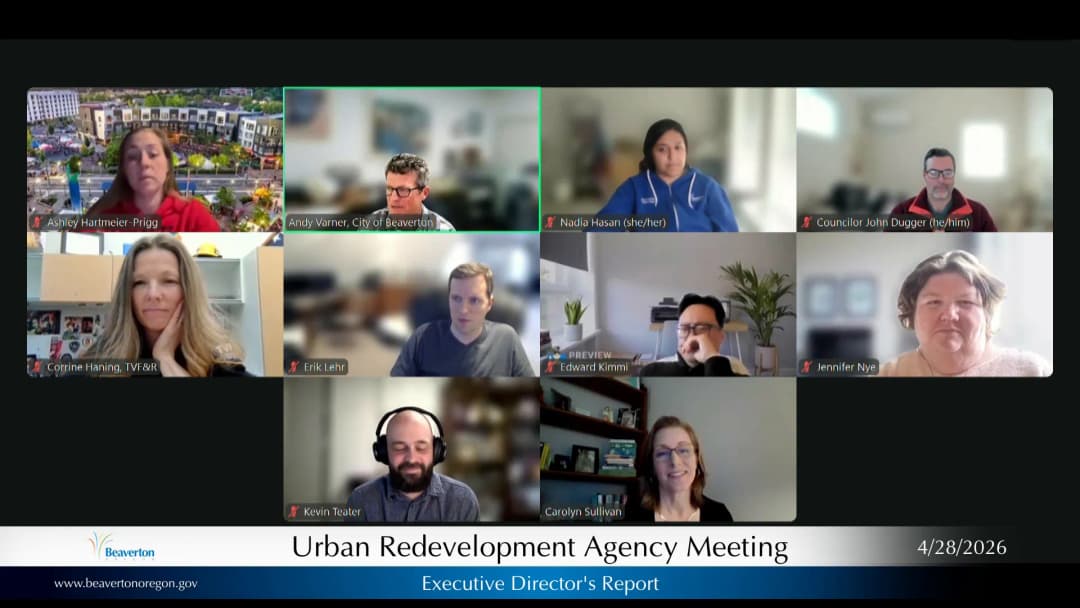
The Beaverton Urban Redevelopment Agency (BURA) Board met on April 28, 2026, in regular session with an executive session first. The board approved a motion to direct staff to negotiate a new exclusive negotiations agreement for the Hallbus Center site, approved the consent agenda, and received updates on grant applications, opportunity zones, property acquisitions, and a new city CFO. The meeting lasted from the call to order at 7:00 PM through adjournment. Executive Session - The Board entered executive session under ORS 192.660(2)(e) to conduct deliberations with persons designated to negotiate real property transactions. No action was taken during the closed session; all decisions were made in open session afterward. Consent Calendar - The Board unanimously approved two consent items: The minutes of the January 2026 BURA meeting. Bureau Bill 2026-13 authorizing a letter of support for the City of Beaverton’s Creekside Connections Project and an application for a Metro large‑scale community visions grant. - Motion by Board Member Hassan, seconded by Hartmeyer Prigg; vote: 9‑0‑2 (excused: Baity, Walton). Public Comments & Testimony - No members of the public addressed the Board. Discussion Items - Hallbus Center Site Exclusive Negotiations Agreement (ENA): Upon return from executive session, the Board considered a motion to direct staff to negotiate a six‑month exclusive negotiations agreement for the Hallbus Center site (12570 SW Center Street) with Mill Creek Residential, the second‑ranked proposer. The new ENA would commence upon the expiration of the current ENA with Security Properties on April 30, 2026. The motion passed 9‑0‑2 (excused: Baity, Walton). - Executive Director’s Report: Creekside Connections Grant: Executive Director Andy reported details on the large‑scale community visions grant from Metro’s 2019 Parks and Nature Bond. The city is requesting the maximum $8 million. Funds would secure property along downtown creek corridors, enhance creek conditions, expand stormwater capacity, and construct natural park elements for the Lombard West affordable housing development. Matching funds include $1.5 million budgeted in FY27 and contributions from other projects like the Beaverton Creek Trail. The grant cycle is highly competitive; Metro has not yet awarded any such grant in Washington County. Opportunity Zones 2.0: Staff is working to identify preferred census tracts for submission to the governor by May 22, 2026. The state (Business Oregon) will make final decisions in July or later in the fall. BURA properties are not eligible, but other city opportunities exist. Property Acquisitions: The agency has closed on two of the Beaver Dam properties authorized for purchase and expects to close on a third this week. Next BURA Meetings: Scheduled for May 26, 2026, and June 16, 2026 (held in reserve if needed for ENA adoption). New City CFO: Andy introduced Carolyn Sullivan, who started April 27. She previously served as Chief Administrative Officer at ODOT and spent most of her career in private industry. - Board Communications: Board Member Hassan noted he and Councilor Kimmy are working with community members on a multicultural center concept. They will continue to update staff and the board as the concept evolves. Key Outcomes - Motion (Hallbus Center ENA): Directed staff to negotiate a six‑month exclusive negotiations agreement with Mill Creek Residential upon expiration of the Security Properties ENA on April 30, 2026. Vote: 9 yeas, 0 nays, 2 excused (Baity, Walton). - Consent Agenda Approved: Unanimous approval of January 2026 minutes and Bureau Bill 2026‑13 (Creekside Connections support letter). Vote: 9‑0‑2. - Creekside Connections Grant: The letter of support is approved; application due at the end of May 2026. The city will request $8 million, with $1.5 million in FY27 budget as matching funds. - Next Meeting: The next BURA meeting is scheduled for May 26, 2026.
The Beaverton City Council met on April 21, 2026, to discuss downtown parking enforcement, a nonprofit loan program, and the library advisory board's annual report. The meeting began with public comments urging protection for non-traditional family structures, followed by a work session on parking, consent agenda, a debated loan bill, a library presentation, and council reports. Consent Calendar - Remaining items on the consent agenda (agenda bills 26073, 26074, 26075, 26076, and 2607) were approved unanimously. Public Comments & Testimony - Sandra Elliott, a Beaverton resident practicing ethical non-monogamy, requested the council bring forward protections for expansive relationship structures and blended/multi-generational families. She cited research showing 60% of non-monogamous people experience stigma and discrimination, and noted that eight cities (including Portland, Astoria, Cambridge, Somerville, Berkeley, and Oakland) have passed similar ordinances without legal challenges. - David Carlson, campaign coordinator for Open (organization for polyamory and ethical non-monogamy), urged the council to proceed with a family and relationship structure non-discrimination ordinance. He stated that only 18% of households are traditional nuclear families and that one in five Americans live in multi-generational households. He shared that Portland, Olympia, Astoria, and West Hollywood passed similar policies in the last two months, and that over 100 Beaverton residents signed a petition in support. - Emily Techmas Koons, a Beaverton resident, expressed hope that the council would protect all family structures, including blended and chosen families. She reiterated that the eight cities that passed the exact language faced zero legal challenges or controversy. Downtown Parking Program Work Session - Community Development Director Andy Varner, Development Division Manager Tyler Ryerson, and Parking Manager Molly Rabinovitz presented a work session on the downtown parking enforcement pilot program. Key findings from the pilot (July 2023–July 2025) included: over 10,000 hours worked by a third-party vendor, 11,000+ warnings and citations (two-thirds warnings), a 9–10% increase in parking utilization, and a reduction in average stay in two-hour spaces from over two hours to approximately 1.5 hours. The pilot also highlighted the need for updated permit programs (currently unchanged since 2002), improved signage and branding, curb management adjustments, and consistent enforcement hours. Staff presented three contract options with a third-party vendor (LAS Parking LLC) at different service levels and costs. Mayor Beatty opposed moving forward without a more robust parking plan and expressed reservations about the ambassador program and license plate readers. Other councilors (Hussen, Kimmy, Teeter, Tivnan) supported continuing enforcement, with Councilor Hussen favoring Option 2 for consistency during peak hours, Councilor Kimmy emphasizing the need for quick action and more painful tickets to change behavior, Councilor Teeter open to Option 2 or 3 but wanting consistency, and Councilor Tivnan advocating for prioritization of wayfinding and focusing on Broadway. The council did not vote, but the city manager summarized that the majority of council is interested in moving forward with an enforcement contract blending options 2 and 3, with overlapping coverage during peak hours. Staff will return with a draft contract. Agenda Bill 26078: Nonprofit Loan Program - Councilor Kimmy pulled this item from consent for discussion. The bill would provide $100,000 to the Oregon Startup Center (OSC) to establish a bridge loan program for nonprofits through a loan loss reserve, potentially leveraging $250,000–$300,000 in loans. Councilor Kimmy and Councilor Hussen opposed, arguing that the program would primarily benefit established nonprofits and not the small, community-based organizations (especially those serving immigrant and refugee communities) that lack capacity to take on loans. Councilor Teeter, Mayor Beatty, Councilor Tivnan, and Councilor Hartmeyer Prigg supported, noting the program's sustainability, amplification of funds, and the existence of other direct grant funding (e.g., $532,000 in CDBG grants). The motion passed 4–2, with Councilor Hussen and Councilor Kimmy voting no. Library Advisory Board Annual Report - Library Director Kim Carroll, along with Library Advisory Board Chair Kathleen Perry and Vice Chair Sarah Blatner, presented the 2025 annual report. Highlights included: over 10,000 new library card holders, the popularity of the Design and Make space (capacity limited due to high demand), 1.6 million visits to the Murray Scholls branch since 2015, 5,400 hours of volunteer service (equivalent to 7.5 months of full-time work), and services such as shelter assistance, bus tickets, and ID support. The library supports council goals like advancing diversity through multilingual story times and cultural programs. Councilors expressed strong appreciation for the library's role as a community hub. Council Reports and Other Items - City Manager Elizabeth reported on: the launch of Beaverton Community Assistance Grants (applications due May 1), fiscal year 2026–27 budget development (May 28 committee meeting, June 16 adoption), the May 19 election and voters' forum, and various community events (bike ride, Earth Day recycling, child abuse prevention month). Councilor Teeter suggested that when items are pulled from the consent agenda, staff should give a brief presentation first. Councilors agreed and also requested advance notice of pulls. Councilor Hussen shared concerns about anti-Muslim rhetoric and its impact on the community. Councilor Kimmy noted attending the Revolutionary War Memorial rededication event. Key Outcomes - Downtown Parking Enforcement: Council gave direction to proceed with a permanent enforcement contract blending options 2 and 3, with overlapping coverage during peak hours. Staff will return with a draft contract. - Consent Agenda: Adopted unanimously, excluding agenda bill 26078. - Agenda Bill 26078: Passed 4–2 (Mayor Beatty, Councilors Teeter, Tivnan, Hartmeyer Prigg in favor; Councilors Hussen and Kimmy opposed). - General Practice: Council agreed to request presentations when items are pulled from the consent agenda and to provide advance notice of pulls.
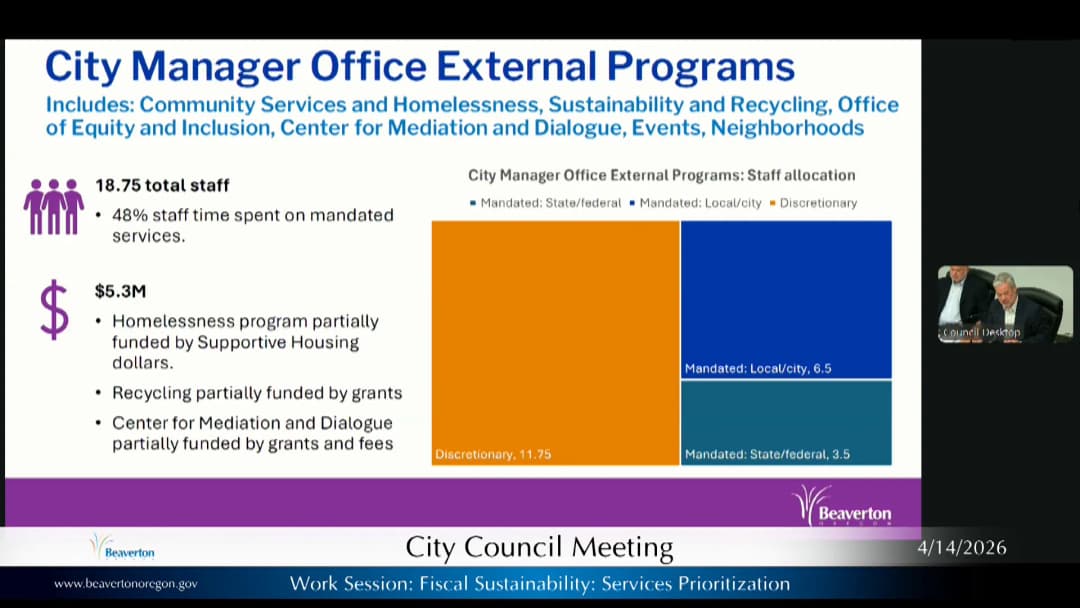
On April 14, 2026, the Beaverton City Council held a special work session focused on the city's fiscal sustainability action plan. The meeting was called to order by Mayor Beatty, with no public comment taken. Assistant City Manager Elizabeth Coffey presented an overview of the city's services evaluation exercise, which examines how general fund services are classified, funded, and what impacts would result from future reductions. The council discussed key takeaways across multiple departments, including police, municipal court, community development, public works, library, external programs, and support services. The goal was to inform council about service choices and to identify topics for deeper future work sessions. Discussion Items - Service Evaluation Overview: Coffey explained that 67% of staff time is spent on mandated or operationally necessary services. Discretionary services, while logical targets for reduction, have significant community and organizational impacts. Additional reductions risk lowering service levels below current standards. Efficiencies are possible but often require initial investment and may not eliminate staff positions. - Police Department: Chief Jepson noted that 71% of police time is mandated. Discretionary services include criminal investigations (450 serious crimes/year, 17% involving children), bike team (200+ contacts/year), and specialized one-FTE programs (violence reduction, family violence reduction, victim services). Reductions to detectives would shift workload to patrol, potentially slowing response times. Proactive policing (e.g., bike team) helps reduce larger problems and supports other departments like code compliance and homeless outreach. - Municipal Court: Court Administrator Katrina and Judge Britton reported that 71% of staff time is mandated, with a $6.6 million program budget and $1.9 million general fund impact after revenue/grants. Discretionary specialty courts (Be Sober DUII program, behavioral health) achieve 90% and 92% non-reconviction rates within three years, respectively. New photo enforcement cameras on TV Highway (expected May 2026) could generate at least $1.3 million annually in fines. A grant-funded assessment recommends modernization, better scheduling, and exploring restorative justice programs. Eliminating the local court would reduce access for defendants and victims, increase police overtime, and lose treatment programs not offered at county circuit court. - Community Development: Dan Weinhammer presented that community development (CDD) has 57.75 general fund staff and a $13.5 million budget. 14.3 FTE (25%) are discretionary, driven by council and community priorities. Examples include sidewalk repair grants (oversubscribed), graffiti removal, business retention/recruitment, affordable housing support, arts programs (e.g., 1,700 attendees at Tiny Dances), and event coordination. Revenue recovery from fees is $3.5 million, leaving a gap of $10 million. Councilors noted the need for more precise cost recovery and questioned service level estimates (e.g., 0.2 FTE for 8 sidewalk grants). Mayor Beatty emphasized that enterprise zone abatements and fee studies need to align with council’s cost recovery direction. - Public Works: Public works general fund portion includes 33.9 staff, 96% mandated or operationally necessary. Services like graffiti removal (300 tags/year), shopping cart removal (1,250 hours/year), flower baskets, and facility maintenance are highly visible. The city is below industry standard for facility maintenance (1 per 75,000 sq ft vs. 1 per 50,000). Deferred maintenance is costly long-term. Councilors discussed shifting shopping cart responsibility back to stores via fees or mechanisms. - Library: 55.18 staff, 84% mandated. The library is funded 55% by county IGA and 42% by general fund ($5 million). Discretionary services (makerspace, early literacy, outreach) are loved but vulnerable. A strategic plan will come in May 2026. Centralization through the cooperative is expected to save some staff time, but the library still faces a significant deficit. Mayor Beatty expressed disappointment in the cooperative negotiation and urged council to advocate with county commissioners. - City Manager's Office External Programs: Includes community services (homelessness response), sustainability/recycling, Office of Equity and Inclusion, Center for Mediation and Dialogue, Events, and Neighborhoods. 18.75 staff, 48% mandated. Programs are partially funded by grants. There is potential to increase cost recovery through event sponsorships/participation fees and mediation training fees. Council discussed insourcing services to smaller cities as a revenue model. - Support Services: Finance, IT, City Attorney, HR, City Recorder, Community Engagement. 87.9 staff, 58% mandated or operationally necessary. Reductions here create operational fragility, as many roles are thinly staffed with single experts. Cuts shift work to operational departments, degrading service quality and increasing risk (e.g., compliance, cybersecurity). Key Outcomes - Councilors expressed the need for more precise data to make budgetary decisions, particularly around FTE estimates and cost recovery gaps. - Several councilors indicated interest in deeper dives into specific topics (e.g., police investigations, municipal court photo enforcement, community development cost recovery). The city manager noted that a municipal court deep dive is planned for fall 2026 after new cameras are operational. - No formal votes were taken. The session was informational to prepare council for upcoming budget discussions and a potential levy. - Councilor Tivnon raised the challenge of communicating service reductions to the public, suggesting that visible cuts (e.g., flower baskets, graffiti response) might help tell the story of fiscal strain. Mayor Beatty countered that the city must first communicate the value of existing services before cutting them. - The recording of this session will be shared with budget committee members to aid their understanding of the fiscal landscape.
The Beaverton City Council met on April 7, 2026, for a regular meeting that included a proclamation for Fair Housing Month, public comments on worker wage theft and immigration enforcement, a presentation from Tualatin Valley Fire and Rescue, approval of the consent agenda, and discussions on parking enforcement contracts and the need for more work sessions. Proclamation: Fair Housing Month - Mayor Lacey Beatty read a proclamation declaring April 2026 as Fair Housing Month in Beaverton, marking the 58th anniversary of the Fair Housing Act. - Shell Reuter (Fair Housing Council of Oregon) and Lisa Getzmutchler (Housing Technical Advisory Group) expressed appreciation for the proclamation and invited the community to the April 14 housing resource event at the downtown library. Public Comments & Testimony - David Whitter (President, Lewis and Clark Chapter of the Sons of the American Revolution) announced installation of a revolutionary war memorial at Veterans Memorial Park on April 7-8, with a dedication ceremony on April 19 (Patriots Day, 251st anniversary of the Battle of Lexington and Concord). - Tino (Metal Art Place project) expressed concerns about wage theft and lack of accountability for subcontractors on publicly funded projects, urging the council to take action before projects begin. - Lakota Tao (worker in Beaverton) echoed Tino's concerns, citing misclassification, cash payments, falsified payroll, and urged stronger enforcement, audits, and real consequences for violators. - Evelyn Coacher (lifelong Beavertonian) criticized the city for insufficient action on immigration enforcement, noting the March 28 protest and memorial for Paulino Martin, who died after ICE detention. She called for stronger measures like those in Hillsboro and Portland. Presentation: Tualatin Valley Fire and Rescue – State of the District - Corinne Haining (Public Affairs Officer) and Deputy Chief Fail presented an overview of 2025 calls for service, wildland fire outlook, EMS challenges, bond-funded station projects, and the Struggle Well program for post-traumatic growth. - Key statistics: 86% of calls dispatched as medical, 70% found to be medical; fire station 67 is the busiest; station rebuilds for 62, 67, 17, 19 underway; 40% of staff have completed Struggle Well workshops. - Council members praised the partnership, recruitment efforts (600 applicants in latest round), and the shift to four shifts for improved wellness. Consent Calendar - Council approved the consent and contract agenda (7-0). Items included Meadowlark funding, an arts agreement with THPRD for the Willow Creek Greenway and Beaverton Creek Trail, a state grant for the housing production strategy, and the Beaverton downtown subbasin strategy. Discussion Items - Parking enforcement contract: Mayor Beatty requested a work session to review the entire parking plan, citing the contentious prior meeting. The contract expired March 31, and no new contract is in place. Council discussed the need for clearer policy direction and more collaborative work sessions. - Contractor wage theft: Councilor Hartmeyer Prigg requested a work session on how the city can use its contracts to ensure fair wages and accountability, referencing public comments. Councilors expressed support for exploring stronger enforcement mechanisms, including potential ordinances. Key Outcomes - Proclamation adopted. - Consent agenda approved unanimously. - No formal vote on parking or contract work sessions, but consensus to schedule work sessions on parking enforcement and contractor accountability. Interim City Manager Elizabeth will coordinate with council and staff.
The Beaverton Traffic Commission met on April 2, 2026, with six commissioners present (Commissioners Miranda, Friedler, Moore, Vice Chair Bobadia, Commissioner Bansky, and Chair Conway; Commissioner McLean excused). The meeting included approval of the consent agenda, a public hearing on a parking restriction request for refuse collection, and a presentation on the Downtown Parking Plan update. Consent Calendar - The commission unanimously approved the meeting minutes from February 5, 2026 (no meeting was held in March). Motion by Chair Conway, seconded by Commissioner Moore; passed 6-0. Public Hearing: TC 871 – Parking Restrictions at Southwest Pacific Avenue for Refuse Collection - Proposal: New London West L.C. (owner/developer Rich Hannah) requested a parking restriction of approximately 15 feet (less than one space) on the east side of Southwest Pacific Avenue, along the frontage of a new 13-unit apartment building at 4920 SW Pacific Avenue, to ensure access for refuse collection vehicles. The restriction would apply Thursdays from 6:00 a.m. to 5:00 p.m. (amended from an initial Monday-Friday proposal). - Staff Report (Jabra Cashou): The street was widened from 24 to 28 feet as part of development. Only one crash (involving a parked vehicle) occurred on the street between 2020-2025. Staff recommended approval, finding the restriction would meet code criteria 6.02.060A to accommodate parking needs safely and equitably. The final order would authorize the traffic engineer to adjust the length if needed. - Testimony – Rich Hannah (applicant): Expressed full support for the proposal. He presented photos showing the space is short (4-6 feet) and unlikely to be used for general parking. He stated waste management will collect five trash, five recycling, and one glass receptacle every Thursday and is satisfied with the arrangement. The property will be managed by an off-site management company. Hannah confirmed the building has four studios, six one-bedrooms (including one live/work unit), and three two-bedrooms, with no on-site parking (as Oregon does not require it). A bike room is provided. - Commissioner Questions: Commissioner Biansky raised a concern about holiday schedules (e.g., Thanksgiving falling on Thursday), but staff and Hannah believed the space would be available most of the time. Commissioner Moore asked about extra trash during move-in/out, which the property manager handles. Vice Chair Bobadia inquired about possible condo conversion (not planned) and occupancy estimates. Chair Conway noted the restricted area is small and the request is reasonable. - Decision: Motion to approve TC 871 as written by Chair Conway, seconded by Vice Chair Bobadia. Passed 6-0. Presentation: Downtown Parking Plan Update - Presenter: Molly Rabinovitz, City Parking Manager, provided an update on the Downtown Parking Management and Action Plan (DP Map), now called the Downtown Parking Plan. The plan is designed as a "choose your own adventure" framework, emphasizing data-driven decisions, community engagement, and integration with other downtown activities. - Nine Strategies: 1. Establish a permanent downtown compliance program (the pilot sunset on April 2, 2026; a proposed permanent program was paused by City Council on March 17, pending additional information). 2. Create a parking brand (e.g., adopt the Parking Kitty app for consistency and signage). 3. Implement paid parking (an option depending on council policy; pilot showed proactive enforcement improves turnover). 4. Update the residential on-street parking permit program (current program is free with unlimited permits, established in 1997/2002; needs revision). 5. Enhance employee permit options (separate from residential permits; encourage use of underutilized lots like Third and Washington). 6. Improve curb space management (loading zones, delivery, transit, micromobility, ADA). 7. Optimize off-street parking assets (e.g., Third and Washington Library lot is officially being reclassified as public parking; currently only 50% utilized). 8. Strategize additional supply (current downtown utilization is 65%, below the 85% threshold; consider partnerships with developers). 9. Manage construction activity and temporary curb use (require parking plans for construction). - Discussion: Commissioners raised several points: - Commissioner Biansky questioned enforcement technology (license plate readers) for motorcycles and potential traffic issues. - Vice Chair Bobadia advocated for incentivizing developers to include parking in new housing, noting liability concerns with private shared parking. He also suggested long-range planning for paid parking adoption. - Commissioner Friedler noted drivers leave too much space between cars, reducing capacity; he suggested education. - Chair Conway appreciated that the strategies are divided and interrelated, and asked about the overall target (customers vs. residents vs. employees). - Rabinovitz responded that each strategy identifies primary beneficiaries (residents, businesses, customers/visitors, employees). The Third and Washington lot will be renamed to increase public awareness. - Next Steps: Continued community engagement in April/May; Bureau Board work session on May 26; City Council presentation and adoption target June 16. Key Outcomes - Approved TC 871: Parking restriction for refuse collection at 4920 SW Pacific Avenue, Thursday 6 a.m.-5 p.m., approximately 15 feet, with flexibility for staff to adjust length. Vote: 6-0. - Downtown Parking Plan: No vote required; presentation was informational. The plan will be further refined and presented to Council in June. The permanent compliance program remains on hold pending council decision. - Next Meeting: No meeting scheduled for May 2026 due to lack of agenda items.
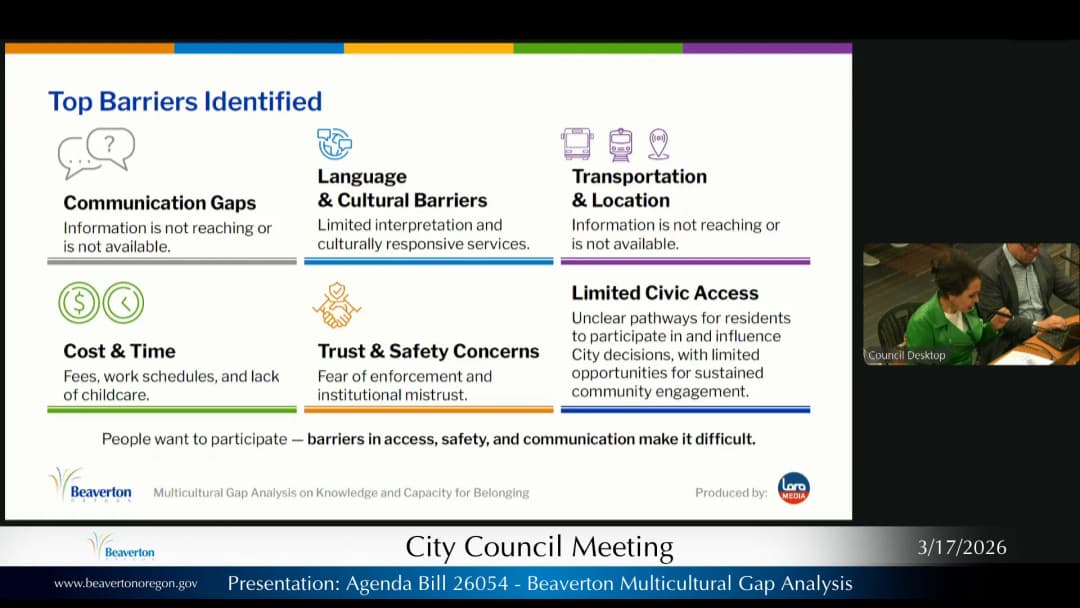
The meeting began with the Beaverton Urban Redevelopment Agency (BURA) board considering property acquisitions and then transitioned to a regular city council session featuring a proclamation, public testimony, a multicultural gap analysis presentation, a city manager’s report, contract approvals, and council discussion on downtown parking enforcement. BURA – Property Acquisitions & Urban Renewal Plan Amendment - Staff presented Resolution 2026-073 authorizing acquisition of five properties (two on SW Canyon Road, three on SW Beaverdam Road) and amending the Central Beaverton Urban Renewal Plan to include them. The acquisitions implement the Creekside District Master Plan and the Bureau Portfolio Redevelopment Strategy approved in 2023. - Board members expressed strong support, noting the acquisitions will consolidate properties for future redevelopment and reduce obstacles. Mayor Bauti and board members Hartmeyer-Prigg and Teeter all spoke in favor. - Vote: 8‑0 (three absent). Resolution adopted. Proclamation - Councillor Hartmeyer-Prigg read a proclamation declaring March 31, 2026 as Transgender Day of Visibility in Beaverton. The council adopted it unanimously. Public Comments & Testimony - Juliette spoke about the Shen Yun performing arts company, highlighting its origins, its 20th anniversary, and opposition from the Chinese government. She invited council members to attend performances and provided informational materials. - Evelyn Cocher (lifelong Beaverton resident) thanked the council for allocating $25,000 in excess budget to support the immigrant community. She cited a sharp increase in ICE and DHS arrests in Washington County (from under 50 to over 300 per quarter) and noted that Hillsboro had allocated $200,000 and adopted policies similar to those proposed in Beaverton. She urged the city to improve communication, create an FAQ page, and take stronger protective measures. - Antonia (self‑described Latino community leader) criticized the council for not moving quickly enough. She stated she had met with over 24 Beaverton businesses and questioned why it took the city over a month longer than Hillsboro and Washington County to declare a state of emergency. She demanded a plan to help businesses affected by ICE activity and documentation of ICE actions by the police department. Discussion Items 1. Multicultural Gap Analysis Findings (Lara Media Presentation) - Dr. Kenya Williams (Chief Equity Officer) introduced the study, which aimed to understand barriers to belonging for diverse communities. Victoria Lara and Antonio Lara from Lara Media presented key findings: - Community members love Beaverton but feel institutional connection is uneven. - Top barriers: communication gaps, language and cultural barriers, transportation, cost, trust/safety concerns. - Residents want clear multilingual communication, youth and family support, events across neighborhoods, real representation in decision‑making, and accessible multicultural spaces. - Recommendations included creating a community navigator program, a centralized information hub, a multicultural hub, equitable funding for community‑led organizations, non‑police safety responses (e.g., Portland Street Response), and public equity accountability dashboards. - Council members responded positively. Councillor Kimmy noted the need to deliver services in ways communities can receive them. Councillor Tivnon connected findings to neighborhood associations. Councillor Duggar highlighted the importance of compensating community advisory members to avoid skewed voices. Mayor Bauti emphasized communication and getting out of City Hall to serve neighborhoods. 2. City Manager’s Report & Federal Activities Update - City Manager Meredith Smith announced upcoming events (State of the City, ‘your city’ newsletter, belonging speaker series) and reminded the public how to identify city employees. - She provided an update on legal and operational responses to federal immigration and anti‑DEI actions: - Streamlined utility billing assistance (13 residents benefited from cap removal). - Ratified a state of emergency related to immigration activities. - Codified Oregon’s Sanctuary Promise Law into city code. - Adopted a legal framework to expedite participation in litigation; joined four cases (against military deployment, ICE invasions, and anti‑DEI grant conditions). - Published flyers in English/Spanish on identifying police officers. - Hosted staff training sessions and provided economic development support to impacted businesses. - Partnered with Centro Cultural, Portland Immigrant Rights Coalition, and ACLU for community training. - Worked with Representative Thuy Tran to pass HB 4138 (limits police mask use, allows state injunctions against federal immigration violations). - Washington County Consolidated Communications Agency (WACA) will now provide monthly reports to the city on dispatch calls involving federal activity. - A policy resolution refining the city’s immigration enforcement stance is being developed with police and union leadership, using Hillsboro’s ordinance as a model. - Staff are scoping mutual aid services to get financial help to the community by end of fiscal year. - Council members thanked staff and requested regular updates. Councillor Teeter noted that joining the Fresno lawsuit protected $600,000 annually for low‑income housing. Councillor Tivnon and Councillor Duggar emphasized the need for better communication to the public about these efforts. 3. Downtown Parking Enforcement Contract (Pulled from Consent) - The council considered a three‑year, $1.3 million contract for downtown parking enforcement. The new contract would increase enforcement ambassadors from 2.5 to 4 FTE and include office space for customer service. - Debate: Mayor Bauti led opposition, calling the cost “astronomical” and noting parking issues persist. He cited feedback from a downtown business roundtable and said the city had not acted on many suggestions (e.g., wayfinding signs, shared parking agreements, paid parking). He argued the money could be better spent on infrastructure or lighting. Councillor Hartmeyer-Prigg questioned the return on investment. Councillor Duggar noted that parking tickets brought in only $50,000 annually while warnings were issued for two‑thirds of citations. Councillor Teeter and Councillor Tivnon expressed concerns and said they preferred to explore alternative solutions before committing to a multi‑year contract. Councillor Kimmy supported enforcement, arguing that without it, long‑term parking would worsen for downtown businesses. - Staff (Andy Barner, Molly Rabinovitz, Casey Ratto) answered questions: enforcement reduced average stay from over 2 hours to 1.5 hours and increased occupancy from 55% to 67%. If the contract were not approved, proactive consistent enforcement would stop, but the city could reassess. Paid parking remains an option but would require capital investment. - Vote: Motion to approve the contract failed 1‑5 (Councillor Kimmy in favor; all others opposed). The contract was not approved, and staff will bring back alternatives. Consent Calendar - The consent agenda (Resolution CRB‑26061 and other items) was approved unanimously (6‑0) after pulling the parking contract. Approved items included: - Contract for interim city manager. - Lease agreement for Community Action (Head Start) at a city‑owned building. - Property tax waivers for 14 housing complexes (Barcelona, Bridge Meadows, Cedar Grove, El Monica, Furcrest, Altar, Altura, Menlo, Amenity, Spencer, Mary Ann, Henry, and others) built in the last six years, supporting affordable housing for seniors, families, and foster families. Council Items - Councillors offered heartfelt tributes to outgoing City Manager Jenny (Smith), acknowledging her leadership, mentorship, and role in establishing the council‑manager form of government. They noted her work on budgeting, staff hiring, and guiding six new councillors. A farewell gift (a beaver‑shaped art piece with words representing her accomplishments) was presented. Key Outcomes - BURA Resolution 2026‑073: Adopted (8‑0). Authorizes acquisition of five properties and amends the Central Beaverton Urban Renewal Plan. - Proclamation: Adopted. March 31, 2026 is Transgender Day of Visibility in Beaverton. - Multicultural Gap Analysis: Received and discussed. Council directed staff to use findings to improve communication, expand community navigators, and consider policy changes. - Downtown Parking Enforcement Contract: Not approved (1‑5). Staff to return with alternative strategies. - Consent Agenda: Approved (6‑0) with one item (parking contract) removed. - City Manager’s Federal Response Update: Noted. Council requested regular updates and improved community communication. - City Manager Transition: Council expressed gratitude and will hold a public farewell event in two weeks.
This meeting of the Beaverton City Council on March 3, 2026, included proclamations for Women's History Month and International Women's Day, public comments on budget deficits, police funding, ICE enforcement, traffic calming, and sanctuary city protections. The council approved an interim city manager appointment, adopted comprehensive plan and development code amendments for walkable places, approved a liquor license process change, and held a work session on a potential fiscal sustainability service fee. Council also directed $25,000 from its travel budget to support community organizations aiding families impacted by federal immigration enforcement. Consent Calendar - The council approved the council consent agenda and the contract review board consent agenda unanimously (7-0). Public Comments & Testimony - Jennifer Croft (Beaverton resident) criticized the city's budget priorities, noting that $48.2 million from the general fund was allocated to the police department in FY2025-2026 despite the police department having its own public safety tax. She stated that police have not been doing their jobs regarding ICE agents in the city, and urged the council to stop seeking additional revenue until promised services are reliably provided. - Ken and John (neighborhood representatives from the Alpenrose/Raleigh Crest area) testified about a development in Portland that will add a new connection through their neighborhood. They requested that the city withdraw the current survey, ensure meaningful neighborhood engagement, and require a robust traffic calming plan that goes beyond four speed humps as proposed by the developer, citing the hearings officer's requirement that the plan "shall mitigate impacts." - Evelyn Cocher (lifelong Beaverton resident) expressed frustration that the council has not taken concrete action on immigration enforcement since passing a state of emergency in January. She noted that the January 20 proposal to codify sanctuary city laws was unanimously voted down by council members not from immigrant backgrounds and referred to a subcommittee that has not reported progress. She called for public town halls in English and Spanish and urged the city to set aside funds (like other cities have done) to support families affected by ICE operations. - David Kearns (Beaverton resident) asked the council to strengthen sanctuary city protections by ensuring police department policy prohibits access to data collected through third-party platforms like Axon Evidence, and to explore ways to allow residents who fear federal law enforcement to speak at public meetings without requiring their name and address. Discussion Items - Interim City Manager Appointment: The city manager recruitment subcommittee recommended appointing Elizabeth Coffee as interim city manager for a one-year term, citing her strong background as assistant city manager and previous leadership roles in Gresham. Councilor Hussen questioned the one-year term, suggesting a six-month term with possible extension. Other councilors supported the year for stability, especially during budget season and the need for a thoughtful national search. The council voted unanimously (7-0) to approve the recommendation, with formal terms to be finalized at the March 17, 2026 meeting. - Microtransit Pilot Project (Spot): Washington County and Ride Connection presented the Spot (Shared Public On-Demand Transit) microtransit pilot serving southwest Beaverton, funded through a STIF grant through June 2027. The service area covers 7 square miles, with 20,000 residents and 4,000 jobs in Beaverton. In the first six weeks, 585 trips were completed, with over 600 customer accounts created. The service is free, operates Monday-Friday 6:30am-9:30pm, and connects to Washington Square Transit Center. Councilors expressed excitement and asked about demographics, app features, and potential expansion to Beaverton Transit Center. Staff will continue outreach and explore permanent funding. - Fiscal Sustainability Service Fee Work Session: Staff presented options for a new service fee on utility bills to address the general fund deficit. The fee would be charged per equivalent dwelling unit (EDU) or by account type, with a target revenue of $5.8 million annually. Four fee structures were discussed: flat fee per EDU, tiered fees by EDU, fee by customer type, and flat fee per account. Councilors generally agreed on the purpose (general services) and the revenue target, and most favored removing options three and four. Mayor Beatty and several councilors preferred option one (flat fee per EDU) for its simplicity and proportionality, while Councilor Tivnon favored option two (tiered) to balance impacts. Council directed staff to refine options one and two (without a cap on option one) and to develop messaging strategies, with a follow-up work session in April. The fee is being considered alongside a potential transportation utility fee. - Council Items: - Public Works Director Tim provided an update on the Alpenrose/Raleigh Crest traffic calming issue, stating that the city will work with the neighborhood to develop a traffic management plan, and that the previous survey process has been voided. The developer must construct traffic calming measures before opening the new connection. - Mayor Beatty acknowledged Councilor Hussen's advocacy on data sharing, noting that the city's contract with Axon ensures no law enforcement data sharing with federal agencies. - Council President moved to direct the city manager to identify an efficient process to allocate $25,000 from the council's travel budget (which has been underutilized) to a community organization providing mutual aid to Beaverton families impacted by federal immigration enforcement. The motion passed with support from multiple councilors, emphasizing it is a one-time seed funding. Council also encouraged special districts to contribute. - Mayor Beatty honored Paulino Martin San Pedro, a Beavertonian who was abducted in November and recently passed away, expressing condolences to his family and noting the importance of humanizing violence locally and globally. Key Outcomes - Interim City Manager: Approved recommendation to appoint Elizabeth Coffee as interim city manager for a one-year term, with formal terms to be finalized at the March 17, 2026 meeting. Vote: 7-0. - Walkable Places Code Amendments: Adopted Ordinance No. 4879, amending the comprehensive plan and development code (LU 42025-00608, CPTA 42025-00615, TA 42025-00607) with amendments from the planning commission and supplemental memo. Vote: 7-0. - Liquor License Process: Adopted Ordinance No. 4880, amending Beaverton Code Chapter 5.02 related to the local liquor license review process. Vote: 7-0. - Fiscal Sustainability Fee: Council directed staff to refine options one (flat fee per EDU) and two (tiered fees by EDU) for the service fee, with no cap on option one, and to develop messaging and impact analysis for a follow-up work session in April. The revenue target remains $5.8 million annually. - Immigration Mutual Aid Funding: Council directed the city manager to allocate $25,000 from the council travel budget for a one-time grant to a community organization supporting Beaverton families affected by federal immigration enforcement. Process to be efficient and timely. - Traffic Calming: The city will work with the Alpenrose/Raleigh Crest neighborhood to develop a traffic management plan, voiding the previous survey, with the developer required to construct measures before opening the new connection.