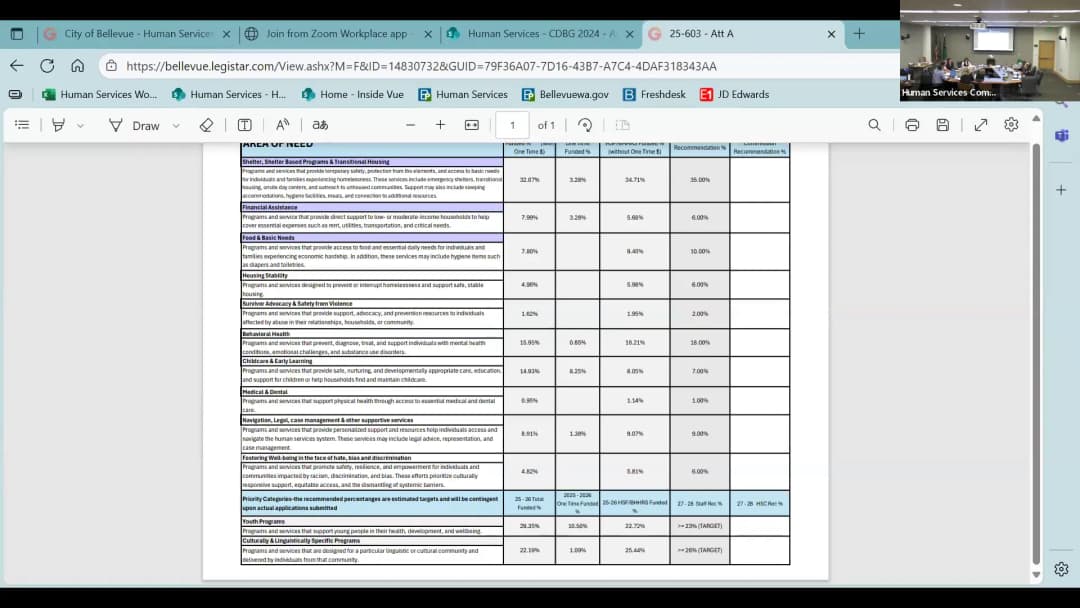
The Bellevue Human Services Commission convened on October 29, 2025, to approve September minutes, receive public comments on critical service needs, review preliminary Community Development Block Grant (CDBG) funding recommendations for 2026, and initiate the development of funding percentages for the 2027-2028 Human Services funding cycle. The meeting featured extensive discussion regarding the allocation of resources between immediate crisis needs (shelter, food, financial assistance) and preventative/upstream measures (youth mentoring, early childhood), as well as questions regarding the transparency and flexibility of the proposed funding categories. Consent Calendar - Approved the September 8th minutes. - Approved the September 15th minutes with an amendment to add Commissioner Perman's name to the attendance record. Public Comments & Testimony Support for Funding Priorities: - Tim Motz (Boys and Girls Club of Bellevue): Expressed full support for increased after-school and child care funding, noting that federal cuts leaving $500,000 in grants "in the air" exacerbate the widening economic gap. He highlighted that over 30% of their youth are on subsidy and 70% identify as BIPOC. - Tara Hakam (Family Law CASA): Stated strong support for funding navigation, legal case management, and advocacy services for families involved in high-risk custody cases, emphasizing that over half of parents cannot afford legal representation in King County. - Griffin Cole (Catholic Community Services): Expressed support for volunteer services for older adults, citing over 600 hours of help provided in the first half of 2025 to keep residents independent. - Jesse Franklin (Rainier Athletes): Urged the commission to prioritize prevention and intervention over crisis response. He expressed full support for mentoring programs as an "upstream approach to behavioral health," especially given the Bellevue School District's cuts to mental health counselors. - Mallory Gustav & Chris Greer (Hope Link): Expressed full support for continued investment, noting serving 5,600 Bellevue residents. They highlighted a 3.7 million dollar budget reduction in 2025 and stated that city funding covers only 25% of their programs. - Christina Mendietta (Kindering): Urged consideration of expanding case management for families in transition and ensuring access to equitable early learning services, particularly given new barriers caused by federal immigration changes. Opposition and Protests: - Alex Zimmerman: Expressed violent opposition and hostility toward the commission and Mayor Robinson, labeling the two-line communication rule as "fascism" and "junta" control. He aggressively questioned the mayor's tenure and lack of "QA" (Quality Assurance), referencing national political figures. Community Invitations: - Akira Sharma (Youth Link): Extended an invitation to commissioners for the annual Youth Link Gumbo Night. Discussion Items CDBG 2026 Funding Allocation: - Staff presented preliminary recommendations for CDBG funding, noting an invitation-only application process due to federal funding uncertainty. The total estimated funding is $1,000,000 ($850k entitlement + $150k program income). - Microenterprise Assistance: Staff recommended flat funding for Tomorrow ($83,000) and Centro Cultural Mexicano (CCM) ($83,000), despite their requests of $150,000 and $200,000 respectively, citing these as the minimums required to sustain programs. Staff recommended the full request of $50,000 for Indian American Community Services and $48,000 for Upward Boost. - Home Repair Program: Staff recommended the full request of $396,000 for the Housing Authority. - Commissioner Concerns: Commissioner White questioned the lack of spending data for Tomorrow, which still had $81,847 remaining from its 2024 contract, while other agencies had spent down funds. Commissioner Perlman questioned the rigid adherence to flat funding, suggesting potential reallocation of funds from Tomorrow to CCM (specifically proposing a move of $40,000 to $50,000) to better match need, but noted a lack of data on why Tomorrow had not spent down their 2024 allocation. - Staff Response: Staff clarified that agencies have the capacity to serve more people with the requested funds but are operating on minimum viable funding levels. A plan to gather specific data on spending delays and service units is to be completed before the October 20th meeting. 2027-2028 Human Services Funding Priorities: - Staff presented a worksheet for setting funding percentages, with the Mayor noting a Council priority for youth funding (target: 23% of total budget) and a target for culturally and linguistically specific programs (target: 26% of total budget). - Commissioner Hayes: Expressed concern that the current categories are too fragmented (e.g., medical and dental at 1%), suggesting that combining categories (e.g., survivor advocacy with legal case management) would provide more flexibility and ensure critical programs receive adequate funding. - Commissioner Perlman: Proposed combining Financial Assistance (currently 6%) with Housing Stability, and combining Survivor Advocacy with Legal/Case Management to create a larger, more resilient funding bucket (proposing a 9% combined target). He suggested moving funds from Medical/Dental to Food and Basic Needs. - Commissioner Rashid: Counter-argued that combining categories might create rigidity due to existing funding source restrictions (e.g., BHHRS for behavioral health) and emphasized that the three highest-priority needs (Shelter, Financial Assistance, Food) must be reflected in the percentages. However, she acknowledged the Mayor's point on prevention and the potential for youth components within those top categories. - Staff Clarification: Staff explained that behavioral health was separated from medical/dental due to distinct funding streams. A contingency plan (±2% flexibility) will be drafted to allow the Commission to adjust percentages based on actual applications received, addressing Commissioner Perlman's concerns about the risk of categories with few applicants. Key Outcomes - Minutes Approved: September 8th and 15th minutes approved (with amendment). - CDBG Action: Commission agreed to defer final CDBG recommendations until the next meeting (October 20th) to allow staff to gather data on Tomorrow's spending delays and CCM's capacity for additional funding. - Next Steps: - Staff to distribute application details and answer specific commissioner questions regarding microenterprise programs and spending data. - Staff to draft a contingency plan for funding percentages to be reviewed before the October 20th public hearing. - Commissioners to draft proposals for combining categories (e.g., Financial Assistance/Housing Stability) to be discussed at the next meeting. - Mandatory OPM/PRA training scheduled for October 16th. - Next Commission Meeting and Public Hearing: October 20, 2025.
Public Meetings - Bellevue, Washington
Public Meetings - Bellevue, WashingtonThe October 28, 2025, Bellevue City Council meeting began with the adoption of two proclamations: Dutch American Heritage Day and Veterans Day. The meeting then proceeded to public comments, where residents raised concerns regarding human services funding for immigrant communities, sewer capacity for Overlake Farm, and local parking regulations. A significant portion of the evening was dedicated to a study session on the city's brand identity, followed by a detailed presentation on financial status and proposed fee adjustments for 2026. The council voted to direct staff to return with legislation to adopt the proposed utility and development fee changes. Consent Calendar - The agenda was approved unanimously by voice vote. - The consent calendar (routine administrative approvals) was approved unanimously by voice vote. Public Comments & Testimony - Debbie Lacey (East Side for All): Expressed full support for increasing human services grants in the mid-biennial budget update. She highlighted a deepening crisis involving increased federal immigration enforcement, arguing that the city's current appropriation lacks necessary adjustments despite the urgent needs of first-generation immigrant residents. She urged the council to allocate funding similar to the 166,000 USD provided by Kirkland and 250,000 USD by Redmond. - Lalita Upala (Indian American Community Services): Urged the council to increase human services funding to support emergency crisis services across BIPOC communities. She stated that the community feels unsafe due to immigration-related crisis cases and emphasized the need for the city to collaborate with grassroots non-profits to provide linguistically and culturally relevant assistance. - Christina D'Goney (Overlake Farm Representative): Stated a strong request for the Utility Department to provide a reservation of capacity for Overlake Farm. She argued that while current capacity appears sufficient, future upzoning within the 20 years would drastically draw down capacity, necessitating a reservation to ensure their development plans can proceed. - Sue Mercer: Expressed support for charging ICE agents who violate the Constitution. She requested a review of parking laws to allow free parking in front of homes for residents who purchased before 1990. She also raised concerns about a clogged culvert and a dangerous driveway slope requiring city intervention. - Alex Zimmerman: Stated strong opposition to the city council allowing dual citizenship for council members and described the demographic shifts as a critical issue. His comments were interrupted by the presiding officer due to the use of profanity and unproductive repetition, resulting in him being asked to leave the meeting. Discussion Items Brand Identity & Community Feedback Report - Presentation: Michelle de Grand, Megan Hathaway, and Ian Hansen presented findings from community outreach regarding the city's brand identity. - Key Findings: Residents perceive Bellevue as clean, safe, and green but noted a gap between these perceptions and community values of high-quality services and a caring community. Feedback indicated that city communications are often viewed as "sterile," "too dense," and lacking visual representation of the city's diversity. - Council Positions: - Councilmember Newenhouse: Expressed support for the work but questioned how the "sterile" feedback would be translated into behavioral changes and engagement strategies to close the perception gap. - Councilmember Lee: Emphasized that engagement must be relational, not transactional, and highlighted the importance of "trusted messengers" to build long-term relationships rather than one-off transactions. - Councilmember Sumadoria: Expressed strong support for the findings and requested clarification on how visuals would represent diversity and how small businesses could be elevated within the brand strategy. - Councilmember Bargava: Supported the move from dense to simple communications and praised the focus on co-creation and early engagement to improve the brand's behavioral aspect. - Councilmember Hamilton: Appreciated the thoroughness of the work and requested options for broader automated communication alerts for residents. - Deputy Mayor Malicudian: Highlighted the need for trusted communication, proactive outreach, and transparency. She questioned the baseline metrics for tracking perception changes and asked for clarification on the benefits of extending brand assessment to regional stakeholders. - Staff Response: Staff confirmed that trust-building will involve leveraging community-based organizations, moving from transactional to relational engagement, and developing metrics to track perception changes against the baseline established by this outreach. They noted that external regional assessments are a potential future step but prioritized internal consensus first. Mid-Biennial Budget Overview - Presentation: City Manager and Finance Director John Risha presented the mid-biennial budget, describing it as a technical adjustment to re-appropriate funds rather than a change in policy or service levels. The presentation included details on the 1% property tax adjustment and health benefit rate updates. - Council Positions: - Councilmember Hamilton: Expressed concern regarding the financial constraints imposed by the economic downturn. He explicitly directed staff to explore using the council contingency fund to support the immigrant and refugee community, suggesting options like community navigators or a rapid response fund. - Councilmember Lee: Acknowledged the tight financial position and the need to avoid bank capacity. He suggested exploring partnerships with businesses like Amazon to support vulnerable communities rather than direct city appropriations. - Councilmember Newenhouse: Clarified the procedural requirement for a separate vote on the property tax adjustment later in the month. He requested a discussion on implementing an automatic cost-of-living adjustment for council salaries. - Councilmember Bargava: Expressed support for directing contingency funds toward human services but sought clarity on the financial implications of not increasing utility rates. Fee Adjustments (Water, Sewer, Development, Wireless) - Presentation: Directors from Utilities, Development Services, and Transportation presented proposed 2026 rate and fee adjustments. - Utilities: Proposed a 0.3% increase in the sewer rate (from 7.6% to 7.9%) solely to pass through higher King County wholesale wastewater costs. - Development Services: Proposed hourly rate increases ranging from 7.1% to 9.6% and flat fee adjustments to maintain full cost recovery, citing rising personnel and overhead costs. - School Impact Fees: Announced that Renton and Issaquas School Districts will not charge impact fees in 2026 due to a lack of growth-related capital facility needs. - Transportation: Proposed formalizing existing telecommunication wireless lease fees. - Council Positions: - Councilmember Hamilton: Expressed support for the sewer rate increase as a necessary pass-through but emphasized the need for continued rate assistance for low-income residents. - Councilmember Newenhouse: Supported the permitting improvements but requested confirmation that Development Services has sufficient funding. He also raised concerns about wireless fees potentially violating state law regarding short facility heights. - Councilmember Lee: Supported the rate increases as a necessity of cost recovery but emphasized the need to standardize requirements across departments to reduce misunderstandings and delays for developers. - Deputy Mayor Malicudian: Questioned the regional benchmarking methodology (citing subsidized vs. non-subsidized jurisdictions) and requested transparency in the calculation of King County's pass-through costs. - Councilmember Sumadoria: Inquired about integrating public resources and navigation help into the Bellevue app to aid residents with utility assistance. Key Outcomes - Motion Approved: The council moved to direct staff to return with legislation to adopt fee and rate adjustments pertaining to utilities (sewer rates), development services permits, school impact fees, and transportation wireless fees for council consideration at a future meeting (November 18, 2025). - Appeal Ruled Denied: The Council, by voice vote (Aye: Aye, Opposed: None), denied the appeal filed by Alex Zimmerman regarding his exclusion order from planning commission meetings issued by Chair Conlu on October 22, 2025. The exclusion order (60 days) remains in effect. - Deferred Items: - The council agreed to discuss using contingency funds for human services and currency assistance programs in future sessions. - A separate vote on the 2026 property tax adjustment was scheduled for November 18, 2025. - A study session on the effectiveness of the Eastside Campus of Porch Light and Plymothy Crossing actions is scheduled for early January 2026. - Future Directives: Staff was directed to explore expanding utility rate assistance eligibility and to develop metrics for the brand identity project to track perception changes over time.
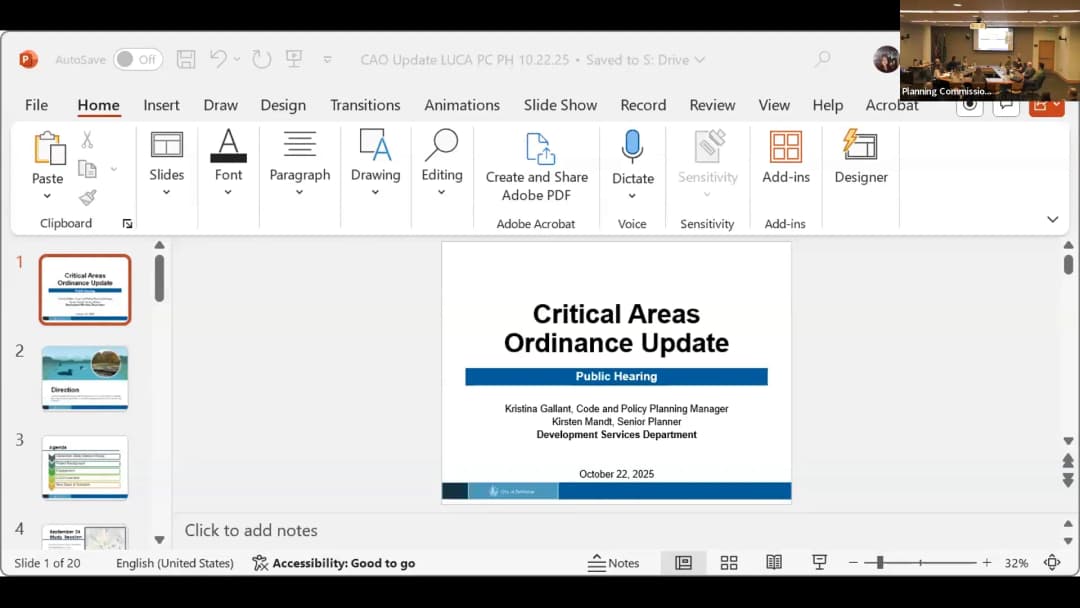
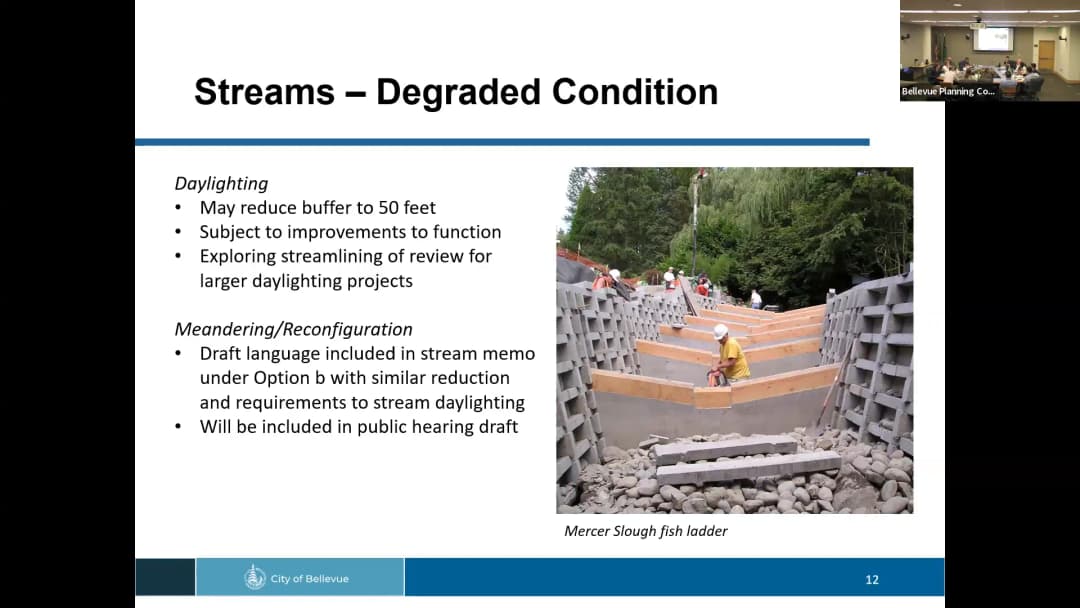
The Planning Commission of the City of Bellevue convened on October 22, 2025, to hold a public hearing on the draft Critical Areas Ordinance Land Use Code Amendment. The meeting featured an introductory presentation by the Utilities Department on the ecological value of local streams, followed by staff presentation of the proposed code amendments, extensive public testimony, and commissioner deliberation regarding buffer widths and wetland mitigation flexibility. The commission unanimously recommended the amendments to the City Council with a directive to consider wetland flexibility in future reviews or through the Shoreline Master Program update. Consent Calendar - No items discussed for the consent calendar; the item to approve the minutes for September was discussed separately at the conclusion of the meeting. Public Comments & Testimony - Morgan Krugner (Washington Department of Fish and Wildlife): Expressed strong concern that the proposed buffer widths (50 feet for Type NS streams and 75 feet for Type NP streams) are insufficient to protect water quality. Stated that best available science indicates a minimum 100-foot vegetated buffer is necessary for effective filtration and urged the commission to adopt this standard to ensure ecological resilience. - Sahar Amini (Habitat for Humanity): Expressed full support for staff's proposed updates, stating they reflect a balanced approach between environmental stewardship and responsible development. - Joe Cantrell (Collins Pacific Advisors): Expressed strong support for the updated regulations, noting they incentivize stream daylighting projects and allow for habitat enhancement to occur in concert with urban growth goals. - Tim Hay (Resident): Expressed opposition to the reduction of buffers based on FACET engineering recommendations and the current treatment of beavers blocking salmon access in Gulf Creek. Urged the commission to enforce precise ecological recommendations and designate Gulf Creek as fish-bearing to protect salmon and orcas. - Chase Prepul (Trammell Crow Residential): Requested support for minor code revisions to allow impacts to degraded Category 3 wetlands in the East Main TOD zone to unlock 321 housing units while providing net ecological gain through off-site restoration. - Kramer Kenup (Sound B Consultants/Trammell Crow): Expressed support for the developer's request, arguing that impacts to low-functioning Category 3 wetlands should be permitted if a net ecological gain is achieved, citing best available science and Department of Ecology guidance. - Jessica Rowe (McCullough Hill): Expressed support for the staff's updates and urged the commission to consider a proposed small wetland exemption amendment for TOD zones that would result in housing and net ecological gain. - Charlie Bauman (Resident/Developer): Expressed full support for the draft, commending the flexibility for degraded stream corridors and the innovative mitigation options available for the Bell Red area. - Martin Seelig (Resident): Commended staff for incentives and flexibility, particularly regarding stream daylighting, and suggested economic or non-monetary incentives to encourage innovation. - Neil Molnick (Property Owner): Expressed support for the code's nuanced, balanced approach to development in degraded states, noting it is key to unlocking housing development in the Wilburton and Bell Red areas. - Unidentified Speaker: Expressed general support for the staff's draft, noting it successfully balances environmental protection with the city's housing needs. Discussion Items - Stream Buffers and WDFW Comments: Commissioners and staff discussed the discrepancy between WDFW's recommendation for a 100-foot buffer and the commission's proposal of 50-75 feet for non-fish-bearing streams. Staff explained that the proposed widths represent a balance for an urban environment, utilizing the FEMAT curve (150 feet for fish-bearing) as an anchor for higher-functioning sites, while relying on enhancement provisions for lower-functioning streams. - Category 3 vs. Category 4 Wetlands: Commissioners questioned the distinction between Category 3 and Category 4 wetlands and the proposal to allow impact to Category 3 wetlands for a specific East Main project. Staff clarified that Category 4 wetlands are low-functioning and isolated, justifying the exemption, whereas Category 3 wetlands have higher functional value and are generally not recommended for fill under current state guidance. Staff noted that the "innovative mitigation pathway" in the code allows for flexibility in buffer edges but does not currently provide a blanket allowance for wetland fill. - Trammell Crow East Main Project: Commissioners debated whether the specific request by Trammell Crow to impact Category 3 wetlands should be granted or if the existing mitigation sequencing pathways in the code are sufficient. Commissioner Gelph expressed concern that a blanket exemption for Category 3 wetlands is too broad and could lead to unintended consequences citywide, while others noted the project's potential for net gain. Staff emphasized that mitigation sequencing is available for site-specific review but a new code amendment for a blanket exemption raises concerns about deviating from best available science. - Process and Timing: The commission discussed the urgency of meeting the year-end deadline to remain in compliance with the Growth Management Act. It was noted that a separate review of wetland exemptions could be incorporated into the upcoming Shoreline Master Program update or future critical areas code review rather than being added to the current recommendation. Key Outcomes - Motion Made: The Planning Commission voted to recommend the Critical Areas Ordinance Land Use Code Amendment to the City Council. - Vote Tally: The motion passed unanimously (Aye votes from all commissioners). - Referral/Next Steps: The recommendation is set to be presented to the City Council. Commissioners directed that the issue regarding specific wetland exemptions (Category 3) be addressed in future discussions, potentially within the scope of the Shoreline Master Program update or a future code review, rather than including site-specific language in the current resolution. The commission also requested that the City Attorney review the Shoreline Code reference to the old Critical Areas code in that future update.
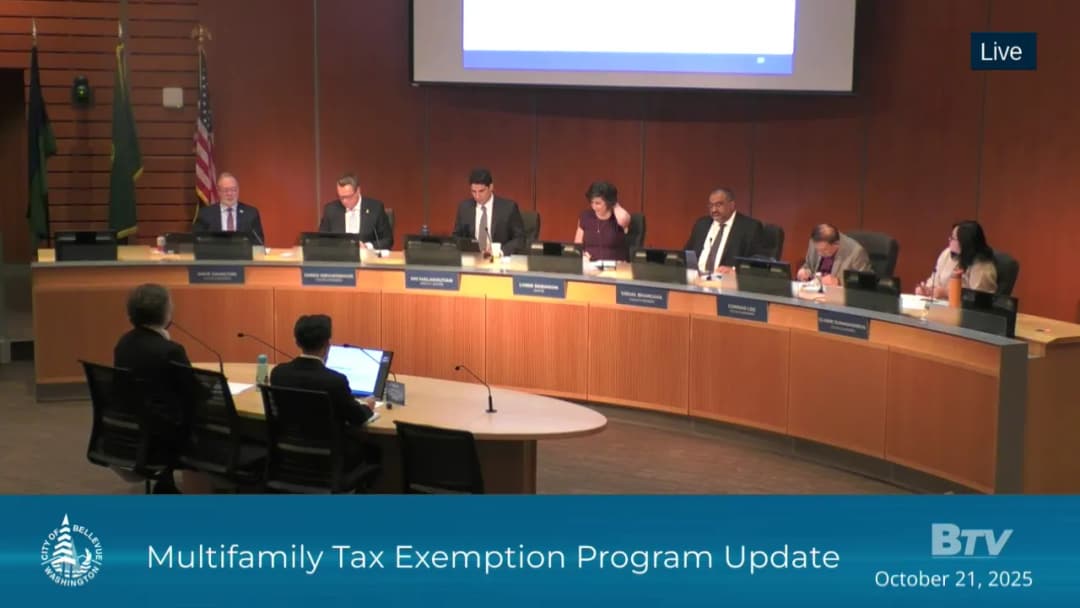
The Bellevue City Council convened to address the 2025 Affordable Housing Strategy update and proposed modifications to the Multifamily Tax Exemption (MFTE) program. The meeting featured significant public testimony regarding the MFTE program, the Bellevue College Parent Education Program, and regional housing policies. Council deliberations focused on balancing housing production targets with affordability levels, fiscal impacts, and the specific mechanisms needed to achieve a 5,700-unit target over the next decade. The Council also celebrated the Parks and Community Services Department achieving perfect re-accreditation scores. Consent Calendar - The Council unanimously approved the consent calendar to approve the agenda and the Parks and Community Services Department's perfect re-accreditation status. Public Comments & Testimony - Jesse Clausen (Developer Representative): Expressed full support for extending the MFTE program's 12-year exemption to 24 years (via a new extension option) and advocated for a citywide "supercharger" program to balance mandatory housing requirements with incentives. - Valentina Veniva (Community Facilitator): Expressed concern regarding affordable housing without supporting services; argued that affordability extends beyond unit count to require access to transit, groceries, medical services, and community spaces for immigrants. - Jodi Alberts (Bellevue Chamber of Commerce): Expressed strong support for a 12-year MFTE extension and proposed removal of the parking subsidy requirement near high-frequency transit, viewing the current policy as outdated. - Sahara Amini (Habitat for Humanity): Expressed full support for a two-to-four-year look back, a 20-year homeownership extension, citywide MFTE for conversions, and the Wilburton supercharger, provided it is part of a comprehensive system. - Annika Zimbrunin (Parent): Expressed deep concern and opposition to the proposed budget elimination of the Bellevue College Parent Education Program, calling it a cornerstone of the community. - Pamela Johnston: Expressed support for sending the public benefits waiting list system issues back to King County for system improvements. - Joe Kunsler: Expressed opposition to the conduct of a former local politician and called for his exclusion from council proceedings. - Alex Zimmerman: Expressed extreme opposition, using inflammatory rhetoric (including terms like "Nazi fascist junta" and "killer") to critique local government officials and transportation fatality rates; was asked to cease disrupting the meeting. Discussion Items 2025 Affordable Housing Strategy Update - Staff Presentation: Director Bianca Siegel and Senior Planner Hannah Bondmiller presented a strategy to meet a newly set 10-year target of 5,700 affordable units. A gap analysis indicated that current tools only project 3,700 units (approx. 65% of the goal), with a significant deficit in units below 50% AMI. - Councilmember Lee: Expressed concern that current outreach failed to reach decision-makers in immigrant families; urged ensuring input is accurate and actionable before adopting the strategy in January. - Councilmember Hamilton: Asked for examples of leveraging city resources and requested time to review the detailed plan before implementation. - Councilmember Bargada: Highlighted the need to clarify trade-offs between increasing total unit counts versus achieving deeper affordability levels (sub-50% AMI). - Councilmember Newman House: Requested transparency on the 25 organizations involved in engagement and asked for specific details on the internal processes required to expedite housing acquisition. - Councilmember Sumadouria: Emphasized the need for intentional engagement of renters, youth, and underserved workers, suggesting workforce development ties to construction trades. - Deputy Mayor Malikuti: Questioned the tone shift regarding the feasibility of the 5,700-unit target; requested metrics tracking homeownership by demographic categories to address housing equity. Multifamily Tax Exemption (MFTE) Update - Staff Presentation: Staff recommended adopting a 20-year homeownership program and extending MFTE to conversion projects citywide. They recommended a "supercharger" policy (allowing unit stacking without deeper affordability) only for the Wilburton district with a four-year look-back, alongside a new eight-year MFTE option to encourage deeper affordability. They declined to recommend a 12-year extension at this time due to insufficient data on long-term benefits. - Councilmember Hamilton: Expressed strong support for the supercharger in Wilburton but argued for a faster review period (catalyst-based) and questioned why the program is restricted to Wilburton given the housing crisis. Also requested exploring apprenticeship program linkages, though staff noted the current program is for public works. - Councilmember Bargada: Supported the supercharger in Wilburton and the 20-year homeownership option. Supported the 8-year option for flexibility. Expressed strong support for a citywide extension of the supercharger model coupled with mandatory affordability, though staff noted this is currently limited to Wilburton due to fiscal balances. - Councilmember Hamilton (Rebuttal/Clarification): Reiterated support for the 12-year extension, arguing it preserves units cost-effectively. Suggested setting deeper AMI levels for the extension if adopted. - Councilmember Lee: Stated support for the 20-year homeownership and conversion projects citywide. Expressed conditional support for the 12-year extension and the 8-year option, emphasizing that the program must remain an incentive that developers accept, with a flexible review schedule if market conditions change. Key Outcomes - Agreement on Next Steps: The Council voted to bring back draft code language for the MFTE updates at the next study session on December 2nd. There is no final vote tonight; discussions are informational and for staff refinement. - Data Verification: Council requested staff follow up to verify the specific statistics (2,158 units, 368 affordable units) cited by public speaker Jesse Clausen regarding Wilburton development. - Research Required: Staff were directed to provide further details on the fiscal implications of the supercharger versus the 8-year option, the metrics for measuring the new program's performance, and the potential for including workforce development elements in future housing strategies. - Outreach Review: The Council acknowledged the successful use of community facilitators and requested a list of the 25 organizations that participated in the Affordable Housing Strategy engagement for transparency.
The October Parks and Community Services Board meeting convened at 10:45 AM (local time based on context) with a quorum present. The Board approved the agenda and September 2025 minutes unanimously. The meeting featured a public comment segment resulting in the removal of a disruptive speaker who refused to adhere to ordinances regarding relevant topics and offensive speech. Key discussion points included a celebratory report on the city's re-accreditation with a perfect score, the presentation of new park naming guidelines aiming for greater diversity and equity, and general board communications highlighting upcoming community events. Councilmember Hamilton reported on recent city activities and upcoming calendar items. Consent Calendar - Approvals were unanimously granted for the October 20, 2025 agenda. - Approvals were unanimously granted for the minutes from the September 2025 regular meeting. Public Comments & Testimony - Alex Simmerman: A single speaker signed up attempted to address the Board regarding a federal law concerning dual citizenship for government officials and made unsubstantiated personal attacks against Councilmember Hamilton (referring to them as a "Nazi pig"). - Board Response: The Chair issued multiple warnings to the speaker to adhere to City Ordinance 6752 and speak only on matters within the Board's power and duties (Parks and Community Services). When the speaker refused to stop discussing dual citizenship laws and refused to address the Parks Board, the Chair asked the speaker to leave. The Board subsequently noted the refusal to follow rules constituted a disruption and stated the Board does not condone hateful or offensive speech, while acknowledging First Amendment rights for lawful expression. Discussion Items Park and Community Services Accreditation (Tony Esparza, Assistant Director) - Overview: The Department of Parks and Community Services successfully achieved re-accreditation from the Commission for the Accreditation of Park and Recreation Agencies (CAPRA) for a perfect score. - Key Statistics: - The process covers 154 standards across 10 operational areas. - The submission package included over 150 pages of narrative and over 750 pieces of documentation, totaling thousands of pages. - Bellevue is one of only three agencies in Washington State and one of 231 nationally to hold this accreditation. - The Department has been accredited continuously since 2005 (20 years). - Speaker Positions: - Tony Esparza/Staff: Expressed pride in the staff's continuous effort, noting that accreditation is not mandated but represents an "elite standard" and a demonstration of being a national leader. - Director Shisaki: Emphasized the accreditation serves as an "insurance policy" for the city, ensuring safety, well-being, and accountability, while noting the process takes significant resources but yields high value. - Councilmember Hamilton: Supported the achievement as a demonstration of good stewardship of public funds and a "worry-free park experience" for residents. - Eric (Board Member): Expressed concern/lack of knowledge regarding insurance discounts for accreditation and questioned if there were tangible financial benefits beyond reputation. - Michelle (Board Member): Expressed interest in how the Board can support other park systems given their perfect score. - Updates: A new standard regarding concussion policy and protocol was implemented for this cycle. Park Naming Process and Guidelines (Betsy Anderson, Senior Planner) - Background: Staff reviewed the current naming policy (Resolution 10151) and analyzed nearly 100 existing park names. - Current State Analysis: - Nearly two-thirds of names are naturalistic or place-based. - Individual/Family names are predominantly Anglo-European. - There is a noted lack of Indigenous names and very few names honoring women (only one identified in the dataset). - Some names have "unknown provenance." - Proposed Modifications: - Process: Staff will request more detailed background information from community members when names are proposed. - Diversity: Future naming will actively seek names that reflect the diverse cultural histories of the land (including Indigenous names) and community groups, aligning with City goals of diversity, equity, and inclusion. - Research: Staff will consult with cultural groups and subject matter experts before presentations to the Board. - Transparency: Consideration of providing historical context on park signs or websites for names honoring individuals. - Renaming: While not a primary focus, the Board discussed the need to eventually develop protocols for renaming existing parks. - Speaker Positions: - Steve (Board Member): Expressed interest in the historical context of names and suggested making data about existing names available to the public. - Elizabeth (Board Member): Expressed that community input is vital but suggested providing current name lists to the public to prevent repetition and ensuring phonetic guides for foreign languages. - Eric (Board Member): Expressed that the community's desire to name parks should be respected, but noted the need for objectivity and historical verification to avoid future confusion (citing a recent example of a common name leading to search results issues). - Eileen (Board Member): Expressed that the guidelines should apply primarily to forward-looking naming, not immediate renaming, but suggested adding informational signage for parks named after individuals. - Rena (Board Member): Suggested that if foreign languages are adopted, they should include phonetic pronunciations on signs, similar to University of Washington practices. Key Outcomes - Accreditation: The Parks and Community Services Department has been officially re-accredited by CAPRA with a perfect score for 2025, a status valid for five years. - Naming Guidelines: Staff will incorporate Board feedback into the development of new park naming guidelines, with a focus on diversity, equity, inclusion, and enhanced historical research before future name recommendations. - Upcoming Agenda: The Board will discuss a report on the 2022 levy and potentially a naming-related item at the November 19, 2025, meeting. - Adjournment: The meeting was adjourned with no further actions required.
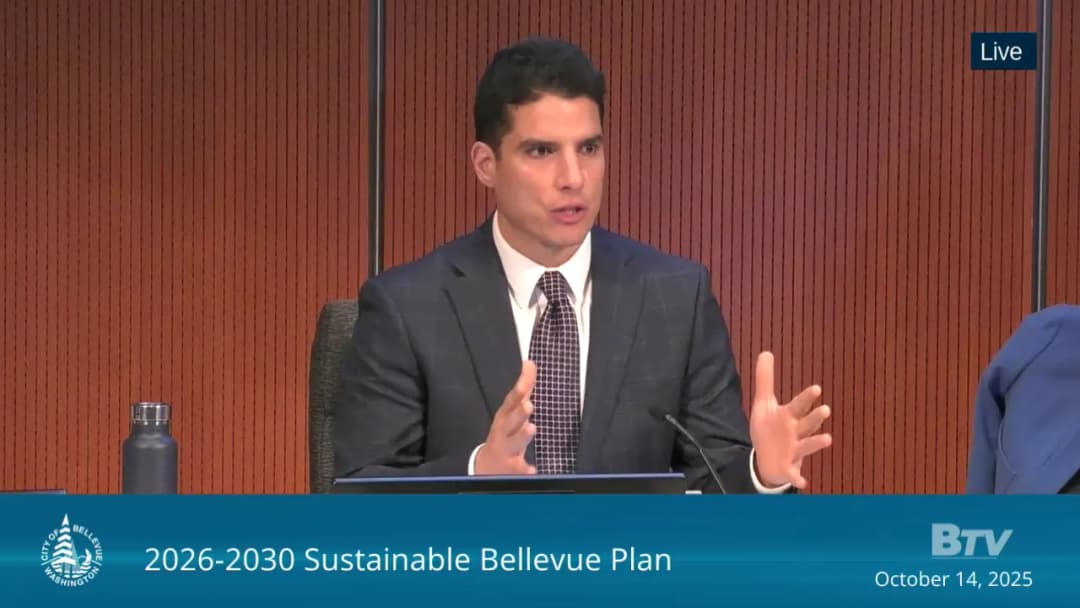
The Bellevue City Council held a regular meeting on October 14, 2025, beginning at 6:00 PM. The meeting included proclamations, oral communications, a consent calendar, a public hearing on a property tax classification application, and study sessions on the 2026-2030 Sustainable Bellevue Plan and the 2026 State Legislative Agenda. All major actions were approved by voice vote. Proclamations - Hindu American Awareness and Appreciation Month: Councilmember Bargava read the proclamation, received by Suchil Kumar (representing a Hindu non-profit). Kumar thanked the council and noted that during the 2024 Seva Diwali nationwide food drive, over 700,000 pounds of food were donated to local food banks. - Arbor Day: Councilmember Sumadower read the proclamation declaring October 18, 2025, as Arbor Day in Bellevue. Longtime volunteer naturalist Sally Lawrence accepted and encouraged community members to attend the Arbor Day event at Lewis Creek Park. Consent Calendar - Motion to approve the consent calendar, including RES 10548 (declaring a public utility easement at 707 96th Ave NE surplus and setting a public hearing date), passed unanimously. Oral Communications & Testimony - Victor Bishop (50-year resident) expressed support for funding an I-405 southbound on-ramp from Lake Hills Connector and suggested consideration of a new southbound off-ramp to NE 10th Street as a standalone early project. - Maria Frost (Vice President, Government Affairs, Kemper Development) urged removal of the city's request to expand property tax levy lid lift options and real estate excise tax authority, stating that higher taxes hinder housing affordability. She supported inclusion of autonomous vehicle policy language and asked for congestion reduction and AV to be moved to the key priorities section. - Mason G. (Board Director, Friends of Bellevue Cross Cultural Center) reported strong community support from a recent survey for a physical cross-cultural center and urged the council to include it in the Bellevue 2020-2044 plan. - Paul Reed presented decibel measurements of yard equipment (e.g., gas leaf blower 116 dB, electric 105 dB) and argued the city's noise regulations are outdated and need objective criteria for small equipment. - Unidentified speaker (public safety advocate) requested the council to reach out to King County about equitable funding for the prosecuting attorney's office versus public defender's office, citing a 50-defender gap. - Sam Gumjin voiced concerns about homelessness and low-income housing programs leading to nuisances, crime, and safety issues in neighborhoods, and criticized the code compliance department's inaction. - Alex Zimmerman made statements about dual citizenship, alleged that some council members cannot hold office, and was warned by the mayor for not following rules. Joe Kunzler (online) supported the mayor's intervention and condemned the remarks. - Unnamed speaker (Dustin, a Bellevue native) urged the city to leverage the upcoming World Cup to promote local businesses. City Manager Report: Mini City Hall Update - Staff (Mike McCormick, Ying Carlson, Ramu Auru) presented the Mini City Hall program, which serves about 20,000 residents annually with 50,000 service requests. A 2024 expansion to a larger facility, supported by a state grant, allowed new partnerships (e.g., PIM Savvy, Africans on the East Side, King County Metro Orca events) and enhanced multilingual services (staff speak Arabic, Chinese, Spanish, Somali, Russian, Ukrainian, Hindi, Tamil, Telugu). Emerging issues include increased questions about federal funding cuts and immigration enforcement. The report was informational; no action required. Public Hearing & Action: RES 10549 – Timiri Property PBRS Open Space Classification - Staff (Tara Johnson, Katie White) recommended denial of the application to enroll 1.33 acres at 4277 137th Ave NE in the Public Benefit Rating System. The King County Hearing Examiner also recommended denial. Public testimony: - Barbara Hughes (President, Bridal Trails Community Club) opposed the application, stating there is no public benefit and the land is already constrained by easements; granting a tax reduction would shift taxes to other residents. - Ms. Johnston (online) echoed opposition, arguing the act should not be abused for non-public-benefit purposes, and asked the council to urge King County to strengthen PBRS provisions. - Council discussion: Members noted the applicant failed to provide evidence of significant wildlife habitat (pileated woodpeckers) and that easements already limit developability. Motion to adopt Resolution 10549 denying the application passed unanimously. Study Session: 2026-2030 Sustainable Bellevue Plan - Staff (Tara Johnson, Jennifer Ewing, Anna Hagara) presented the final draft plan, which includes updated goals, priority/catalyst/resilience strategies, cost ranges, and implementation metrics. Community engagement involved 700 survey responses, over 300 students, and 200 participants at events. Top priorities included accelerating climate action, enhancing resilience, and ensuring equitable access to programs. The plan aims for 50% GHG reduction by 2035 (deferred from 2030) and carbon neutrality by 2050, dependent on state and federal policies. - Council discussion: Members generally supported the plan, emphasizing cost-effectiveness, tracking metrics beyond implementation, and focusing on controllable local actions. Councilmember Newenhouse requested better cost-benefit analysis before adoption; Councilmember Bargava suggested exploring foundational investments like district energy. Councilmember Lee advocated for prioritizing municipal operations and demonstrating achievable results. - Key Outcome: Council voted unanimously to direct staff to prepare the plan for adoption at a future meeting (by consent calendar). Study Session: 2026 State Legislative Agenda - Katie Halsey (Assistant Director for Government Relations) presented the draft agenda, including key legislative priorities (housing/permit streamlining, transportation projects like I-405/167 and Grand Connection, and a new economic prosperity section) and broader policy statements. Association of Washington Cities (AWC) priorities include indigent defense, housing, transportation, and state-shared revenues. - Council members proposed and discussed eight amendments: 1. Under transportation: Add language that the city plans to request future ongoing state partnerships for the Bellevue Grand Connection (Hamilton). Accepted. 2. Under thriving people/communities: Strengthen human services language to request strong state partnership (Hamilton). Accepted. 3. Under transportation: Add line expressing concerns about a potential retail delivery fee (Newenhouse). Accepted. 4. Under community safety/health: Remove reference to CJTC and revise training funding language to “state funding” (Newenhouse). Accepted with friendly amendment. 5. Under high performance government: Add encouragement for state to preserve local flexibility when state policies are achieving goals (Mayor). Accepted. 6. Under high quality built/natural environment: Expand SEPA categorical exemptions to support residential conversions (Mayor). Accepted. 7. Under economic prosperity: Revised phrasing to “Bellevue strongly urges the legislature to avoid tax proposals that could create a direct impact on our employment base and may put Washington at a competitive disadvantage” after debate (staff recommended vs. stronger “will not support”). Consensus reached on “strongly urges.” 8. Under high performance government: Remove the second half of bullet 4 (after “revenue decisions”) to avoid appearing to advocate for specific tax increases (Newenhouse). Accepted. - Key Outcome: Motion to adopt the 2026 state legislative agenda as amended passed unanimously. Key Outcomes 1. Approved consent calendar (RES 10548). 2. Denied Timiri property PBRS application (RES 10549). 3. Directed staff to prepare the 2026-2030 Sustainable Bellevue Plan for adoption. 4. Adopted the 2026 State Legislative Agenda with the eight amendments noted above. 5. Meeting adjourned at approximately 10:15 PM.
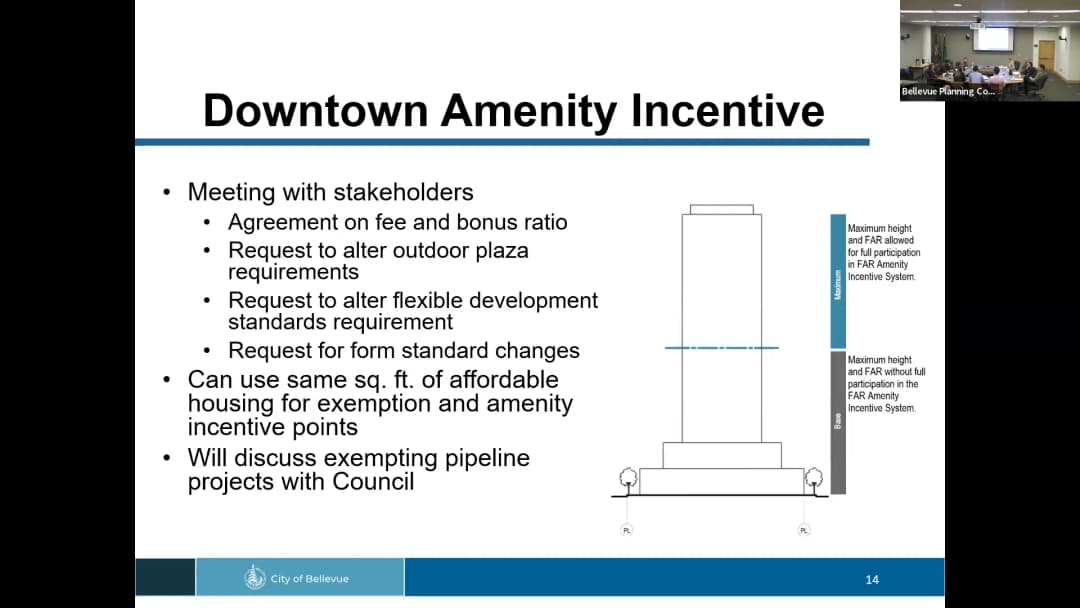
The Bellevue Planning Commission held a hybrid meeting on October 9, 2025, with three study sessions: updates to the Eastgate and Factoria Neighborhood Area Plans, the Housing Opportunity in Mixed-Use Areas (HOMA) land use code amendment, and an update on the Affordable Housing Strategy. The meeting also included public comments and a vote to schedule a public hearing for HOMA. Public Comments & Testimony - Leslie Geller (Eastgate Community Association) commented on the Eastgate/Factoria neighborhood scan, criticizing the simultaneous scheduling and the presence of high school students incentivized by extra credit and volunteer hours. She disagreed with giving equal weight to those who live, work, play, or study in the neighborhoods. - Layla Kadami (attorney, Hillis Clark Martin & Peterson) expressed support for HOMA's removal of limits on structures and dwelling units per acre, but urged removing suburban standards like impervious surface/lot coverage, providing flexibility for ground-floor commercial, and thoughtful mandatory affordability requirements. - Ruth Lipscomb (Newport Community Coalition) voiced enthusiastic support for a bold HOMA plan to allow housing in mixed-use areas, citing housing costs and underutilized shopping centers. She advocated 3-5 stories for Newport Hills Shopping Center and opposed infeasible requirements. - Edmund Rittenhouse (Newport Hills resident) opposed HOMA's height changes, citing existing parking and traffic congestion, and called the 60-foot height increase unacceptable without infrastructure upgrades. - Sean Thorson (American Capital Group) strongly supported HOMA Option A but criticized building coverage caps at 65% and mandatory retail requirements, urging flexibility for site-specific conditions. - Alex Zimmerman made rambling, unrelated comments and was eventually cut off after violating meeting rules. - Ann Rittenhouse (Newport Hills resident) opposed HOMA, citing cumulative density changes (middle housing, ADUs, lot splits) and insufficient infrastructure (topography, transit, sidewalks) in Newport Hills. She urged against overdevelopment. - Jack McCullough (downtown stakeholders) urged taking downtown out of HOMA due to a mandatory housing tax without upzones, and asked staff to reach out to downtown stakeholders (provided a list). - Sandra Valstar (Newport Hills resident) supported HOMA, envisioning shops with housing above. She questioned the reduction of retail frontage from 100% to 50% and suggested connecting adjacent lots with pathways. - Kevin Wallace requested that the HOMA draft allow payment of the fee in lieu as an amenity option, not mandate it, and apply the same benefits as Wilburton/Luca (e.g., eliminating build-to-line trigger height and visitor parking) to downtown. - Jody Alberts (Bellevue Chamber of Commerce) presented two paths: limited technical corrections without affordability provisions, or broader downtown reforms to fix longstanding housing issues. He offered the chamber's support. - Additional written comments included support for HOMA with changes, support for Option A, and opposition to requiring first 25% of amenity points from affordable housing. Discussion Items Eastgate and Factoria Neighborhood Area Plans Staff (Tara Johnson, Justin, Zach) presented the Great Neighborhoods Program, outlining the four-phase process (discover, define, refine, adopt) for updating the Eastgate and Factoria plans. Scope includes land use, urban design, and community engagement. Commissioners commended youth involvement, emphasized diverse engagement (including businesses and underrepresented groups), and requested data on participant demographics to ensure balanced outreach. Staff noted ongoing tabling at Bellevue College and business listening sessions. Housing Opportunity in Mixed-Use Areas (HOMA) Staff (Christina Gallins, Matthew Maynard, Robbie Speller) presented the fourth study session on the draft LUCA. Key topics: - Economic Analysis of Option A (mandatory affordable housing): Under current market conditions (high construction costs, interest rates, tariffs), feasibility is poor except for low-rise with surface parking. The 4:1 density bonus improves residual land value. - Transition Standards: Proposed 25-foot setback from residential districts, with a 15-foot stepback for buildings over 80 feet. Staff argued existing vegetative buffers mitigate impacts and stricter standards could reduce housing yield. - Downtown Provisions: Staff agreed with stakeholders on $13 fee-in-lieu, 4:1 bonus, and aligning outdoor plaza requirements with Wilburton's open space standards (7%). They committed to revising the draft to allow flexible development standard credit per the Interim Ordinance (IOC). Other form standard changes were deferred to the Downtown Livability 2.0 process. - Non-Conforming Provisions (presented by Robbie Speller): Proposed consolidation of seven existing sections into a new code based on Wilburton. Key changes: allow transfer of up to 50% FAR from future phases without triggering improvements; require improvements only if change value exceeds $242,000; cap required investment at 20% of the change value. Commissioners requested real-world examples and input from developers. - Encouraging Third Places and Bike Parking: Staff noted existing FAR exemptions for affordable commercial space and requirements for pedestrian-oriented uses (50-66% frontage) and indoor/outdoor bike parking. Affordable Housing Strategy Update Staff (Bianca Siegel, Hannah Bon Miller) provided a progress update on updating the 2024 strategy, driven by the Comprehensive Plan and a new target of 5,700 affordable units in 10 years (of which 85% are expected at 50-80% AMI). Engagement phases included a film festival, community facilitator program reaching 150+ residents, and surveys. Draft strategies (27 total) were presented, including expanding the C1 program to mixed-income projects, banking land for affordable housing near light rail, and prioritizing transit-oriented development. Commissioners discussed the challenge of balancing unit count vs. deeper affordability and innovative building methods. Key Outcomes - The Planning Commission voted unanimously to direct staff to schedule a public hearing for the HOMA land use code amendment (motion made by Commissioner Ferris, seconded, passed). The public hearing is expected in early December 2025. - The meeting was extended to 10:30 PM to accommodate the agenda. - Commissioner Ferris's resignation, effective end of November, was acknowledged with tribute from Chair Hon Liu and Deputy Mayor Malakoutian. - Staff will release an updated HOMA strike draft incorporating downtown stakeholder agreements and non-conforming language before the public hearing.
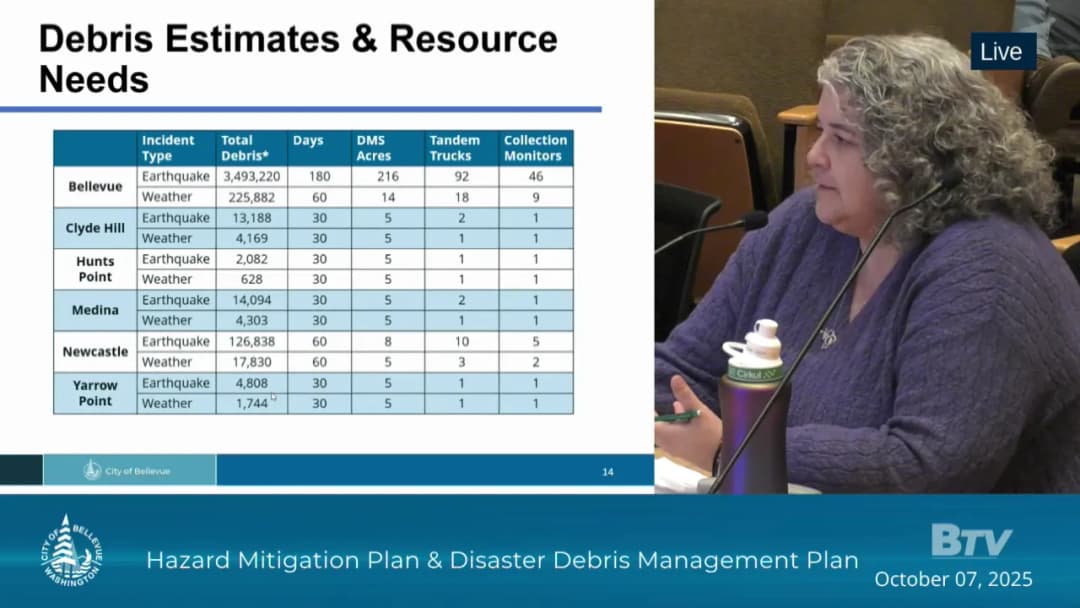
The Bellevue City Council met on Tuesday, October 7, 2025, at 6:00 PM in Council Chambers. The meeting included three proclamations, oral communications, approval of a consent calendar, two study session items (the 2026 FIFA World Cup strategy and hazard mitigation/disaster debris management plans), and adoption of an ordinance imposing repeat offender sentence enhancements for certain theft crimes. Consent Calendar - The council unanimously approved the consent calendar, which included: the minutes of September 16 and September 23, 2025; a resolution authorizing an interagency connection agreement with King County for AFIS; a resolution authorizing Amendment 7 to the Conservation Futures program interlocal agreement (providing $1,565,881 for a completed property acquisition in the Coal Creek/Lakemont neighborhood); and a resolution authorizing amendments for project management and funding upgrades at the Bellevue Aquatic Center (adding $38,300 for project management and $689,189 for construction upgrades). Public Comments & Testimony - Joe Kunzler (virtual): Expressed concern about the King County District Court's failure to restore competency for certain misdemeanor crimes (citing a trespass violation case). He urged the council to ensure that the new repeat offender ordinance would not be undermined by court procedures, and he praised the Bellevue City Attorney and defense counsel for their work. - Alex Zimmerman (in-person): Accused the council of antisemitism, Nazism, and changing rules specifically to target him. He claimed he had been trespassed five times over 35 years and had prevailed each time. He called the council "Nazi Gestapo pig" and "anti-Semite." The mayor interjected to stop the speech, but Mr. Zimmerman continued briefly. - Lee Sargent (in-person): Expressed appreciation for the council's work over the past three years, stating that despite disagreements, the council focuses helpfully on behalf of the city. Discussion Items - Study Session Item 1: 2026 FIFA World Cup Strategy (Information Only) - Emil King (Community Development Director) and Liz Flores (Cultural Tourism Specialist) presented the city's game plan for the World Cup, which will be held June–July 2026. Seattle will host six matches at Lumen Field. Key points: an estimated 145,000 additional visitors to King County (based on a Deloitte/Tourism Economics/CoStar study), with 15,000 expected in Bellevue, generating a projected $23 million economic impact. Activations will focus on the two-line light rail stations (South Bellevue, Downtown, Spring District, BellRed). A public information session and call for station activations is scheduled for October 22, 2025. The city is working with regional partners on anti-human trafficking training, streamlined block-party processes, and a permanent mural in the BellRed Arts District. Councilmembers asked about coordination with eastside jurisdictions, public safety, traffic, light rail contingency (possible delay), business readiness, and the need for metrics to measure legacy impact. The mayor requested improved bike connectivity and alternative parking arrangements. - Study Session Item 2: Overview of Hazard Mitigation Plan and Disaster Debris Management Plan (Direction) - Carl Lunek (Emergency Preparedness Manager) and Christy Osterveen (Transportation) presented two plans. The Hazard Mitigation Plan identifies severe weather as the top natural hazard (followed by earthquake scenarios from the Cascadia and Seattle fault lines, wildfire, volcano, and flood). For every dollar spent on mitigation, the city saves $6 to $13 in response and recovery costs. The plan has been submitted to FEMA and the state for approval; the council directed staff to return with a resolution adopting the plan. The Disaster Debris Management Plan covers roles, priority routes, and temporary debris management sites. A major earthquake could generate 3.5 million cubic yards of debris, requiring 180 days to clear and 216 acres of temporary staging. Five neighboring cities (Clyde Hill, Hunts Point, Newcastle, Medina, and Yarrow Point) are participating; Redmond, Kirkland, and Beaux Arts declined at this time. Councilmembers discussed social vulnerability mapping, coordination with smaller cities, and the need for public education. The mayor questioned why flood was ranked low (eighth) and noted the severe impacts on low-income residents; staff agreed to reexamine the scoring. The mayor also asked about FEMA reimbursement for the 2024 bomb cyclone—staff confirmed the state rejected the appeal—and about emergency water well assessments, which utilities is addressing. Key Outcomes - The consent calendar was approved unanimously. - The council directed staff to return with a resolution adopting the City of Bellevue Hazard Mitigation Plan at a future meeting, with the resolution expected to be placed on the consent calendar (motion passed unanimously). - Ordinance 6866 (adding a new Section 1.16.030 to impose repeat offender sentence enhancements for certain theft crimes) was adopted on a vote of 6-1. The ordinance includes a 30-day minimum sentence for repeat offenders (18 or older, two or more theft convictions in Washington in the past two years) and discretionary provisions including an inpatient treatment alternative, electronic home monitoring for substantial risk of harm, and eligibility for diversion programs such as community court.
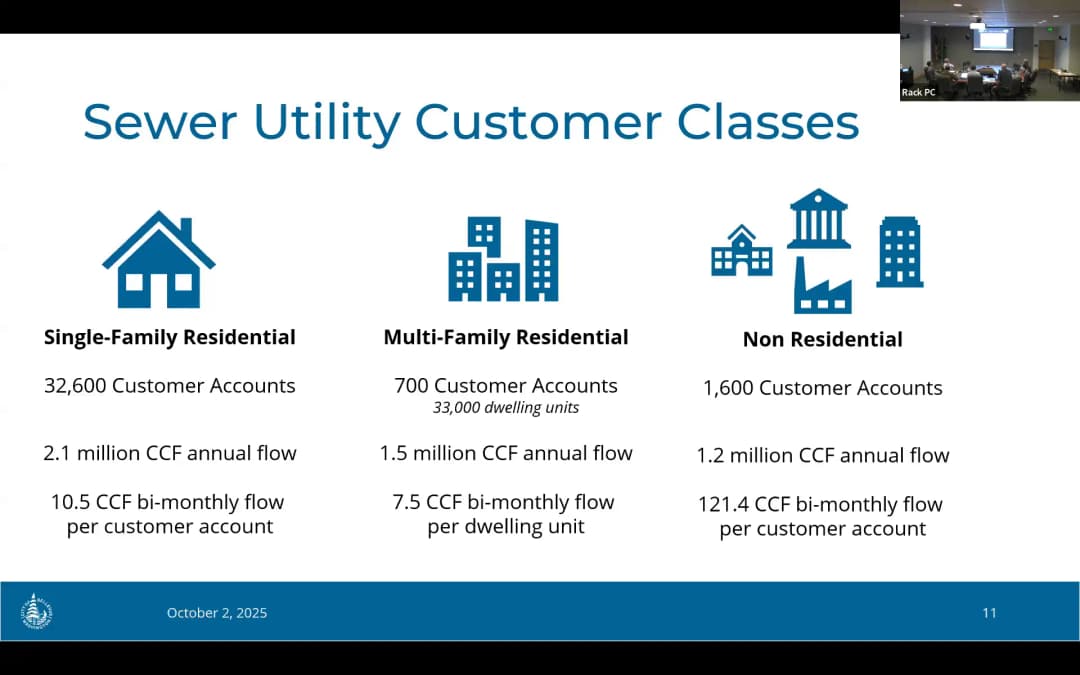
The Environmental Services Commission met on October 3, 2025, to discuss proposed bylaw updates and review the draft results of the sewer cost of service analysis. The commission also heard public comments and received updates from staff and city council. Consent Calendar - Approved the agenda as presented. - Approved the September 4, 2025, meeting minutes as motioned. Public Comments & Testimony - Alex Zimmerman spoke at length, making hateful and offensive remarks. The commission stated it does not condone such speech but respects First Amendment rights. - Ashi Mishra, a Bellevue Youth Link Adult Board member, invited commissioners to the annual Youth Link Gumbo Night on October 22, 2025, at Crossroads Community Center from 6-8 p.m. Discussion Items - Proposed ESC Bylaw Updates: Staff presented updates to align with recently adopted city ordinances (6864 and 6865). Key changes included limiting service to two consecutive terms on any advisory board or commission and extending the maximum exclusion period for decorum violations from 60 to 180 days, with a clarified appeal process. Commissioner Kurt noted a discrepancy between the draft ("the commission") and the intent ("any commission") regarding term limits. Staff agreed to follow up with the city attorney. A motion was made and seconded to bring the updated bylaws back for final approval at the November meeting. - Sewer Cost of Service Analysis: Matt Thurber and Matt Hobson presented draft results. The analysis uses 2027 as the test year. Key findings: Single-family residential and non-residential classes each recover 91% of their cost of service, while multifamily recovers 123%, resulting in an unintentional subsidy from multifamily. Staff recommended incremental improvement over 3-5 years rather than an immediate correction. Options shown: a 5-year phase-in would raise single-family rates 13-14% annually (vs. the average 11% across all classes); a 3-year phase-in would raise them 15-16%. Multifamily increases would be lower: 4-7% under either option. Commissioners discussed longer phase-ins (e.g., 7 years) and the need to consider the total utility bill impact (sewer, water, stormwater). Staff will return in November with rate design options and additional analysis. Key Outcomes - Motion passed to bring the revised ESC bylaws to the November meeting for final approval (moved, seconded, approved unanimously). - No final decision on sewer cost of service; staff will present further options in November, including rate design and intra-class equity improvements. - Next meeting date: November 6, 2025, with agenda items including bylaw adoption, solid waste program update, cost of service rate design, and utility bill assistance program. - The commission adjourned at 7:52 p.m.
The City of Bellevue Planning Commission held a hybrid meeting on September 29, 2025, at 6:30 PM. The meeting included two study sessions: a training on planning commission roles and responsibilities, and a review of the proposed Critical Areas Ordinance (CAO) land use code amendments. The public provided comments on the CAO draft. The commission voted to schedule a public hearing on the CAO for October 22, 2025. Note: The raw transcript states the meeting occurred on September 24, 2025, but the provided date for this summary is September 29, 2025. This discrepancy is noted. Consent Calendar The commission approved the agenda and heard reports from Deputy Mayor Momala Cotean, who congratulated Commissioner Neilshawn on passing the bar exam, and staff liaison Caithness, who announced a survey for the upcoming retreat. These items were approved without dissent. Public Comments & Testimony The public comment period lasted 30 minutes, with seven registered speakers and additional online participants. All comments addressed the proposed Critical Areas Ordinance amendments. - Jessica Clausen (in person) discussed the Growth Management Act requirements for no net loss of environmental function and best available science. She expressed concern that expanding buffers could lock in degraded non-conforming sites and asked the commission to consider incentives for daylighting piped creeks and allowing redevelopment of paved areas adjacent to streams. - Katie Kendall (online, speaking for Gaw Capital Partners, owner of Bellfield Office Park) requested clarity on repair, maintenance, and improvements of non-conforming structures and developed portions outside such structures. She proposed modest changes to ensure predictability. - Rebecca Bloom (in person, Chief Investment Officer at Columbia Pacific Advisors) presented a case study of a site near a light rail station with a piped creek. She argued that the draft ordinance’s 100-foot buffer for daylighted creeks is a disincentive, and requested more visual case studies to illustrate impacts. - Mark Hoyt (in person, Tramell Crow Residential) described a housing project in the East Main TOD zone that faces feasibility challenges due to the CAO. He requested minor amendments to align with Department of Ecology guidance, allowing mitigation of degraded wetlands. - Kramer Knupp (in person, Soundview Consultants, supporting Tramell Crow) emphasized the opportunity to add 321 housing units near the East Main light rail station while restoring a degraded Category II wetland and Sturdivant Creek. He recommended including wetland buffer interruptions for paved commercial parking lots and allowing impacts to Category III and IV wetlands. - Charlie Bauman (in person, Bellevue resident and aspiring developer) advocated for broader stream daylighting incentives, clearer flexibility tools, and coordination between the CAO and the Bell Red land use code update. He warned that buffer increases could render much of Bell Red unbuildable. - Alex Zimmerman (online) made rambling, offensive remarks about city officials and called for a “new American revolution.” Chair Conlu thanked him and moved on. - Gabriela (online, age 17) spoke in favor of transit-oriented development, citing housing affordability, safety, and environmental benefits of reducing car dependency. - Nicole Myers (online) highlighted comments from the Washington Department of Fish and Wildlife, recommending retention of the development intensity section, larger setbacks for underground streams, and protections for trees and salmon. Discussion Items Study Session 1: Planning Commission Roles and Responsibilities Training Assistant City Attorneys Matt McFord and Heather Jones presented a training covering: - The commission’s role as citizen advisors to the city council, focusing on comprehensive plan amendments (CPAs) and land use code amendments (LUCAs). - Legal guardrails: the commission is a “creature of statute,” must follow processes in city code, and does not represent the public. - The Growth Management Act framework, consistency requirements, and the SEPA process. - Open Public Meetings Act (OPMA) and Public Records Act obligations. - Best practices for serving on the commission. Commissioners asked questions about the standard of review for council consideration of PC recommendations; staff clarified that council may accept or modify recommendations but typically defers to the commission’s work. Study Session 2: Critical Areas Ordinance (CAO) Land Use Code Amendment Senior Planner Kirsten Mant and Code and Policy Planning Manager Christina Gallett presented the full draft of the CAO update. Key elements: - Buffers: Standard stream buffers are expanded based on best available science (e.g., Type F streams to 150 feet), but the draft provides smaller buffers for daylighted, armored, or straightened streams (50 feet with averaging to 37.5 feet). Wetland buffers were updated for habitat scores, with some exemptions for low-quality wetlands. - Flexibility: The draft removes density intensity and lot coverage restrictions, opens parcels to middle housing, and expands reasonable use exceptions. A new “innovative mitigation” section allows site-specific alternatives to standard buffers, subject to compensatory mitigation (on-site, off-site, or mitigation banking). - Setbacks: The draft proposes a uniform 20-foot setback from the buffer edge for structures, with the option to reduce to 15 or 10 feet (the commission later indicated preference for 15 feet). - Steep Slopes: Minor revisions including a single buffer for health and safety and a geotechnical assessment pathway. Commissioners discussed: - The need to balance environmental protection with housing development, especially in areas like Bell Red. - Concerns that standard buffers may not be appropriate for degraded sites, and that the 50-foot reduction for daylighting may still be insufficient. - The importance of making the innovative mitigation pathway clear and accessible. - The interplay between the CAO and upcoming neighborhood plans (Bell Red, etc.). Chair Conlu suggested the commission request case studies and best/worst practices for buffers and setbacks to inform decision-making. She personally expressed a need for solid evidence to avoid unintended negative impacts on water quality. Commissioner Kennedy asked about the process for developers to navigate multiple exceptions. Commissioner Geppel questioned the rationale for increasing Type N stream buffers and the heavy requirements for degraded streams. Commissioner Velavesis advocated for a performance-based approach allowing developers to demonstrate net gain, rather than prescribed buffers. Key Outcomes - The commission unanimously approved a motion (by Commissioner Ferris, seconded) to direct staff to prepare the proposed CAO land use code amendment for a public hearing at the October 22, 2025 meeting. This timeline is necessary to meet the December 31, 2025 state compliance deadline. - The commission also informally reached consensus on a 15-foot building setback from critical area buffers, with further refinement expected. - The meeting was extended until 10:30 PM to allow full discussion. - The meeting was adjourned after the vote.