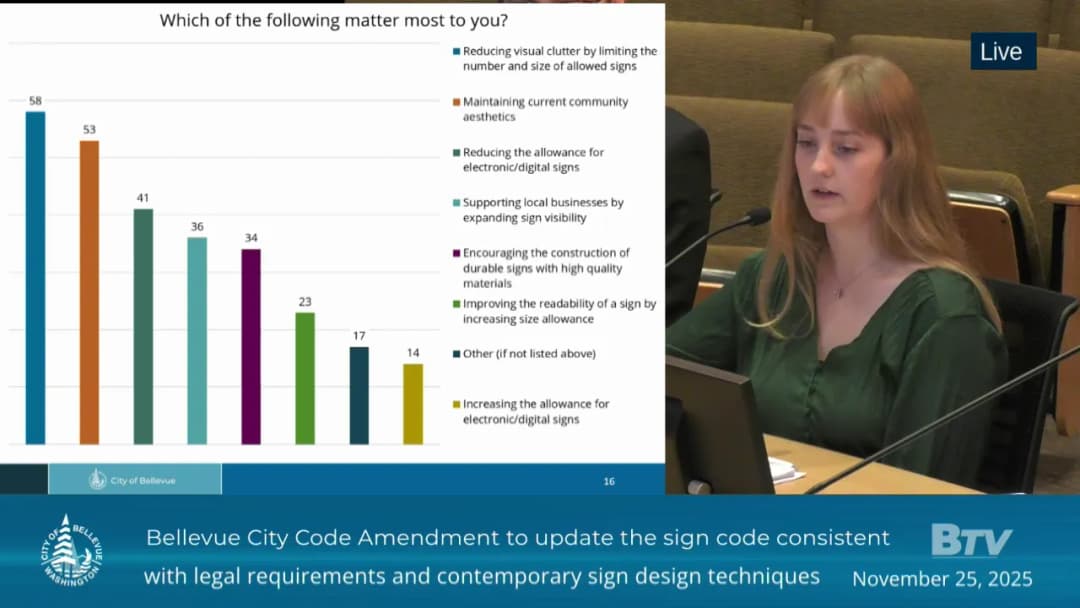
The November 25, 2025, regular Bellevue City Council meeting began with the approval of the agenda and a Small Business Saturday proclamation, followed by public testimony on sign code updates, gas-powered lawn equipment, and local lawfare concerns. The primary study sessions focused on the presentation of the updated Diversity Advantage Plan 2035 and a progress report on the city-wide sign code rewrite. Council members engaged in detailed discussion regarding community engagement strategies, procurement equity, the potential for a cross-cultural center, and enforcement mechanisms for temporary signage. Consent Calendar - The agenda was approved unanimously by motion and vote (Aye, Aye). - The Consent Calendar was approved unanimously by motion and vote (Aye, Aye). Public Comments & Testimony - Jasmine Donovan (Dixie's Restaurant): Expressed strong support for the sign code update process; articulated concern regarding the lack of clarity regarding their iconic rotating pylon sign at Crossroads, stating that current misinterpretations have prevented necessary business visibility despite prior assurances. - Paul Root: Expressed full support for a ban on gas-powered lawn equipment; argued that small engine yard equipment is disproportionately responsible for VOC and carbon monoxide emissions and noise pollution compared to electric alternatives, citing it as a "low-hanging fruit" for the city's sustainability goals. - Maria Hudson: Expressed severe opposition against the Bellevue Police Department and School District; claimed they are engaging in "lawfare," malicious compliance, and conspiring with other jurisdictions to criminalize her and impact her daughter's safety regarding child sex trafficking allegations. Discussion Items Diversity Advantage Plan 2035 Study Session - City Staff Presentation: Dr. Linda Whitehead and Sarah Boyle presented the 2035 update, highlighting the shift from a 60-goal framework to 41 equity objectives with a new focus on measurement, accountability, and short-term strategic equity plans. - Centering Communities of Color (Triple C) Recommendations: Dr. Elba Moyes and Regina Glenn presented five operational recommendations: 1. Developing a transparent system for tracking progress with community review. 2. Investing in trusted resource hubs for immigrant and refugee communities. 3. Expanding culturally and linguistically responsive mental health services. 4. Supporting women-owned and minority-owned businesses through procurement reform. 5. Creating policies to assess AI technologies for equity and safety. - Councilmember Lee: Expressed full support for the plan but strongly advocated for the inclusion of a physical cross-cultural center as a specific, funded goal rather than just programming; noted that the current focus on "without walls" does not sufficiently address the need for shared community space to build capacity. - Councilmember NewHouse: Expressed support for the work; inquired about the inclusion of nonprofits in business support and sought clarification on the 2024 procurement update and metrics for cost burden regarding housing vs. other essentials. - Councilmember Sumaduria: Expressed deep appreciation for the community engagement methods; highlighted the personal challenges of navigating city contracts as a minority business owner and supported the inclusion of equity objectives in procurement. - Councilmember Bargada: Expressed strong support for the equity lens and accountability measures; suggested adding digital access, belonging, and workforce development pathways as additional considerations. - Councilmember Hamilton: Expressed hope and support for the plan's forward-looking nature; emphasized the importance of the Triple C recommendations and transparent accountability. - Staff Response: Clarified that the Triple C recommendations are aligned with the plan's equity objectives but will be operationalized through short-term strategic equity plans; confirmed existing funding for cross-cultural programming and site feasibility assessments. Sign Code Update Study Session - Project Overview: Staff presented the update driven by the US Supreme Court ruling in Reed v. Town of Gilbert, which prohibits regulations that require reading a sign to understand restrictions. - Community Findings: Data from 130 questionnaire responses highlighted a tension between the desire to reduce visual clutter (particularly temporary signs in medians) and the need for business visibility (especially for small businesses). - Proposed Changes: Discussion covered the shift to location-based approvals, consolidating standards across districts, and addressing the enforcement of temporary signs (potentially through registry and labeling systems). - Councilmember Hamilton: Expressed support for the simplification and streamlined approach. - Councilmember Bargada: Suggested adding design guidelines for specific areas like Old Bellevue and asked for clarity on the enforcement process and coordination with historic preservation. - Councilmember NewHouse: Expressed concern about the enforcement of faded signs and the need to honor previous approvals, specifically regarding the Dixie's Drive-In case where they signed a lease based on prior signage approvals that were later disputed. - Councilmember Lee: Expressed caution regarding multilingual content on signs to ensure no derogatory messaging occurs; asked about the status of grandfathered billboards in Factoria. - Staff Response: Confirmed that billboards are generally prohibited; noted that content approval is not within the city's scope unless it violates obscenity laws; assured that the redesign aims to accommodate iconic signs through location-based approvals and that staff will investigate the Factoria billboard case.
Public Meetings - Bellevue, Washington
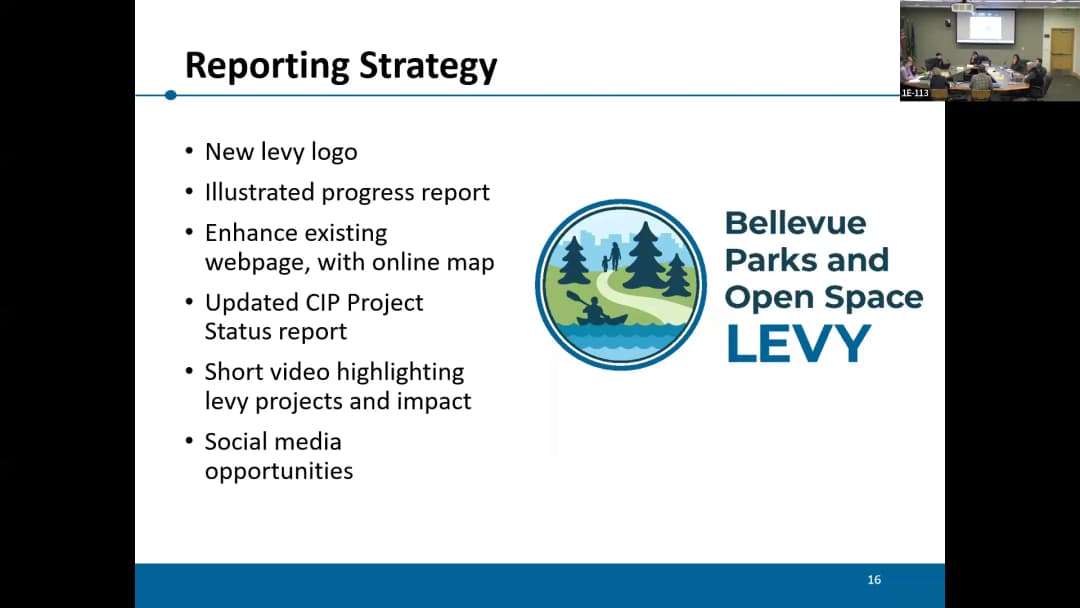
Public Meetings - Bellevue, WashingtonThe Parks and Community Services Board convened on November 20, 2025, with a quorum present to approve the agenda and minutes, hear public comments, and discuss director reports, program updates, and policy changes. A notable highlight of the meeting was Director Michael Shia Azaki's announcement of his retirement, effective at the end of January 2026. The board also reviewed significant updates on community center programming, levy project status, and proposed bylaw amendments regarding term limits and public comment protocols. Consent Calendar - Agenda Approval: The November 2025 agenda was unanimously approved without discussion. - Minutes Approval: The minutes from the October 2025 regular meeting were unanimously approved. Public Comments & Testimony - Jaden Jung (SCAM Member, Troop 600): Expressed strong support for expanding the "Well-Kept" intern program and community involvement in invasive species removal. Proposed positions included: creating online educational content for youth via social media, improving volunteer sign-up accessibility, and implementing online reporting tools with signage to help residents identify and report invasive species like English ivy and oxalis weed. - Alex Zimmerman: Expressed deep frustration and opposition regarding his repeated inability to speak at board meetings over the last two years. He claimed he was prevented from speaking due to alleged "trespass" orders by Mayor Robinson and a consultant, despite having a misdemeanor case dismissed. He argued that the board was incorrectly citing campaign rules to silence him regarding election-related grievances and expressed concern that his public statement regarding election results was cut significantly. He stated he has been "fired" from his role as public defender seven times and criticized the legal proceedings as a "criminal conspiracy prejudgment." Board Chair Klima warned that Zimmerman's comments violated campaign laws and topic restrictions, leading to the exclusion of his second attempt to speak. Discussion Items - Director's Report (Michael Shia Azaki): - Announced the hiring of Wyatt Thompson as the new Planning and Development Manager, replacing Pam Fairman. - Congratulated the Eastgate Neighborhood Park team (Cameron Parker, Zaryan Smith, Chair Klima) on the City Council's approval of the park name "Eastgate Commons." Director Azaki noted the Council spoke positively about the design and public engagement process. - Announced Retirement: Director Azaki stated he will retire at the end of January 2026, after 36 years in the parks field (including 36 years in Bellevue) and 400+ projects. He expressed that the work is about building community and praised the staff's dedication. - Shared that he still plans to hike on Tuesdays, Wednesdays, and Thursdays. - Board Communications: - Eric: Shared experiences planting a tree at Arboretum Harbor and attending Arbor Day (171 volunteers planted trees at Lewis Creek Park). Expressed concern about noise disruption in neighborhoods from youth events. - Steve: Reflected on "Gumbo Night," noting the high level of passion and dedication among Bellevue youth to their community and schools. Expressed support for the educational system and city support systems. - Eileen: Highlighted the need for long-term, supported project outcomes from youth programs (like Youth Link). Shared an observation of "outdoor library" concepts in South Korea where mobile carts allow public reading in open spaces. Expressed interest in seeing more joint efforts to highlight student success stories. - Elizabeth: Noted that students at Gumbo Night were concerned with park maintenance reporting and the lack of composting/recycling awareness. Expressed concern about the littering of allegedly compostable materials (like dog poop bags and orange peels) and suggested better signage. - Paul: Discussed youth mental health challenges, specifically related to technological hyperconnectivity and the competitive school environment. Shared observations of improved leash compliance at Ashwood Park and noted a high community demand for new trails. Congratulated Director Azaki and noted the value of "Crossroads" programs. - Caitlin (Board Member): Updated on the Eastgate Council meeting, confirming the "Eastgate Commons" name and design concept were well-received. Mentioned a potential ribbon-cutting ceremony in 2028-2029. - Crossroads Community Center Overview (Ugo Cuellar): - Presented a detailed report on programs including the spray park, dog off-leash areas, games room, pickleball, self-defense, and the only park-staff preschool. - Highlighted new programs such as "Girls Who Write," "Rainbow Elder Play and Connect," "Indoor Kite Flying" (described as a popular activity taught specially by instructors), and the upcoming "Winterfest" event. - Discussed partnerships with Youth ESI Services, Transcend United, and dance groups (Hawaiian and Aztec). - Questions: Board members asked about the mechanics of indoor kite flying, outreach strategies for the adjacent Crossroads Mall, and the process for evaluating new partnerships that might displace popular programs (like pickleball) due to limited space. - 2022 Parks and Open Space Levy Update (Betsy Anderson & Cameron Parker): - Reviewed the 2022 Levy structure (20 cents/1000 assessed value, split between 75% development and 25% maintenance). - Provided status updates on projects across eight focus areas, including the Bellevue Airfield Park Master Plan, Ashwood Park Master Plan, and the retrofitting of 32 courts for pickleball. - Announced a new levy reporting strategy including a logo, illustrated progress reports, an interactive map, and enhanced social media content to increase transparency. - Discussion: Board members discussed the Vasa Upland acquisition (conservation/trails), the prioritization methodology for emerging sports, and the potential for permanent signage acknowledging levy funding. Paul raised the issue that the "emerging sports" category is broad and flexible. - Bylaw Amendments (Cameron Parker): - Proposed two main changes to align with City Council directives: 1. Term Limits: Clarifying that members serve two four-year terms (maximum 8 years). If a member wishes to serve again after two terms, a two-year pause is required before reappointment. Service in an unexpired term counts as a full term only if it exceeds two years. 2. Exclusion Rules: Changing the length of exclusion for public comment violators from 60 days to 180 calendar days. Appeals of these exclusions will be handled by the City Council, not the Board. - The board noted the need to coordinate these changes with the Civil Service Commission's six-year state-mandated terms. Key Outcomes - Director Retirement: Director Michael Shia Azaki confirmed his departure is effective January 31, 2026. - Park Naming: The City Council has officially named the new park "Eastgate Commons." - Bylaw Amendments: The board agreed to consider the proposed bylaw changes (term limits and exclusion rules) for a formal vote at the January 2026 meeting. - Levy Strategy: Staff committed to rolling out the new levy reporting materials (logo, map, reports) beginning in winter 2025. - Meeting Scheduling: The next regular meeting is scheduled for January 21, 2026. The February 18, 2026, meeting was noted as potentially conflicting with school breaks, and availability will be checked. - Public Comment Enforcement: The Board Clerk and Chair documented warnings given to a speaker for violating city campaign laws and subject matter restrictions during his second attempt to speak.
The Bellevue City Council convened a session to address public safety remembrance, community park development, transportation planning updates, and the mid-biennium budget adjustments. The meeting began with a proclamation for the World Day of Remembrance for Road Traffic Victims, followed by public testimony on sustainability strategies, park naming, noise ordinances, and government transparency. The Council then considered and directed staff to finalize the Mobility Implementation Plan update and approved several ordinances related to the 2026 budget, including property tax levies and development fees, before adjourning. Consent Calendar - Ordinance 6876: Adopted school impact fees for Issaquah and Renton school districts (set to zero dollars). - Ordinance 6877: Adopted city pay plans and classification lists. - Motions: Two motions to approve the agenda and the consent calendar were adopted unanimously. Public Comments & Testimony - Court, Barb, and Bill (Residents): Expressed that while they are not against the Sustainable Bellevue Strategy, they oppose its adoption in its current form, stating they want the plan delayed until requested edits regarding 2050 targets are incorporated. - Mickey Larimer: Expressed support for the design option for the new Eastgate Neighborhood Park, though she noted she is not a fan of the current name chosen. - Christopher Randalls (Complete Streets Bellevue): Expressed strong appreciation for the World Day of Remembrance proclamation; stated the city must demonstrate renewed urgency to achieve Vision Zero by 2030, noting that current statistics (3 deaths, 30 injuries in first 10 months of 2025) are on pace to exceed last year's record. - Enrica Hampton (Kindering): Stated that child care and preschool consultation programs are essential for addressing gaps in early learning, specifically highlighting that children with disabilities are over 14 times more likely to be expelled than peers. - Michelle Wanamaker: Expressed opposition to naming the new Eastgate park after Nan Campbell (claiming Campbell had no ties to Eastgate); proposed reopening naming suggestions citywide with a prize incentive. - Matthew Kervink (Carpenters Union): Recommended the adoption of a transparency ordinance regarding pre-application developer ties to ensure fair planning and prevent worker exploitation. - Joe Cunzler: Asked that a disruptive resident named "Mr. Suburban" be excluded for six months; suggested that staff prepare a report on turning Point Defiance Bay or Eastside locations into future Seafair air show centers to ensure the event's survival. - Alex Zimmerman: Stated that the Council is guilty of traffic deaths due to population growth and immigration; claimed that new residents "do not know how to drive" and asserted that the city should be held accountable for driver skill levels. Discussion Items World Day of Remembrance for Road Traffic Victims - Proclamation: Council unanimously proclaimed November 16, 2025, as the World Day of Remembrance. A moment of silence was held. - Elaine Waite White (Grantee): Shared the personal story of her brother's death in a bike collision in West Seattle; stated that while not all crashes involve substance abuse, distractions and unsafe speeds are major contributors; highlighted the need for redesigning dangerous roads and reducing speed limits. Eastgate Neighborhood Park (Study Session) - Staff Presentation: Presented Design Option 2A (curvilinear oval design) and the name "Eastgate Commons" as the top recommendations following community engagement (70+ name submissions). - Public Input: Residents expressed concern over the naming process being too rushed; one resident stated that Eastgate residents should have final say on the name selection. - Council Deliberation: - Councilmember Lee: Expressed support for the location and design; stated that the naming process requires more careful consideration to honor the community's past and future. - Councilmember Humes: Stated that while the naming process is challenging, the community engagement was excellent and the chosen name is appropriate. - Deputy Mayor: Expressed hope that permitting could be faster in the future and valued the preservation of trees and safety features. Mobility Implementation Plan (MIP) Update (Study Session) - Presentation: The Transportation Commission recommended updating the MIP to include new metrics: Pedestrian Level of Traffic Stress (PLTS) and Bike Level of Traffic Stress (BLTS) at intersections, updating data forecasts to 2044, and retiring the 2009 pedestrian/bicycle plan. - Council Discussion: - Councilmember Lee: Stated that while the MIP is a useful tool, it must be integrated with Vision Zero, land use planning, and environmental goals to prevent fatality; suggested a more collaborative approach between commissions. - Councilmember Humes: Clarified that the MIP provides targets, not prescriptive standards, and does not require existing developments to retrofit; stated that the document guides future design and iterative conversations with developers. - Councilmember Sumadouria: Asked regarding the prioritization of gaps; stated the scoring system balances safety, equity, connectivity, and land use. - Mayor Robinson: Questioned the handling of incomplete corridors; stated that incomplete infrastructure can be more dangerous than no infrastructure; asked about wayfinding strategies for new residents. Mid-Biennium Budget & Ordinances (Rapid Fire) - Ordinance 6878: Adopted CDBG funding for 2026. - Ordinance 6879: Adopted 2026 development services fees and updated school impact fee schedules. - Ordinance 6880: Adopted fees for wireless facilities and public right-of-way. - Ordinance 6881: Adopted 2026 sewer service charges to account for King County pass-through fees. - Ordinance 6882: Adopted the 2026 property tax levy (including a 1% adjustment); Councilmember Lee and Councilmember Hamilton voted against citing affordability concerns; Councilmember Humes supported citing the need to balance revenue against volatility and rising expenses. - Resolution 1055: Adopted the banking of property tax levy capacity for future use. - Ordinance 6883: Adopted the umbrella ordinance updating the 2025-2026 budget and 2025-2030 Capital Improvements Program. Key Outcomes - Approved: Proclamation for the World Day of Remembrance for Road Traffic Victims. - Directed: Staff to prepare a resolution to adopt the Mobility Implementation Plan 2025 update for future action. - Approved: Design Option 2A and the name "Eastgate Commons" for the new Eastgate Neighborhood Park, pending final naming adoption later this quarter. - Adopted: Ordinances 6878, 6879, 6880, 6881, 6882, and Resolution 1055, followed by Ordinance 6883, finalizing the mid-biennium budget adjustments for the 2025-2026 fiscal period. - Timeline: Eastgate Park construction is anticipated to begin in 2028 with an opening in 2029; MIP update resolution will be brought back to Council in the future.
The City Council convened for its first of two meetings in a week, addressing a proclamation for Transgender Awareness Week, extensive public testimony regarding the Critical Areas Ordinance Update and the Mid-Biennium Budget, and a state-mandated Co-Living housing code amendment. Council members focused on balancing environmental stewardship with housing production needs, specifically regarding degraded wetlands and stream buffers in Transit Oriented Development (TOD) zones, while also allocating emergency contingency funds for immigrant support and food assistance amidst federal funding volatility. The meeting concluded with the approval of the budget update timeline and direction to finalize the co-living legislation. Consent Calendar - The Council moved to approve the Agenda and the Consent Calendar unanimously, with no opposition recorded. Public Comments & Testimony - Karina Elakis (via Zoom): Expressed appreciation and emotional support for the proclamation honoring Transgender Awareness Week and the Transgender Day of Remembrance, highlighting personal ties to the community. - Jessica Rowe (McCullough Hill, representing clients): Expressed support for the Planning Commission's Critical Areas Ordinance update recommendation but opposed the current draft regarding degraded wetlands in TOD zones; urged the Council to allow the reconfiguration of degraded Category 3/4 wetlands to facilitate housing and net ecological gain. - Phyllis White and Linda Ulrich (Residents): Expressed strong opposition and concern regarding the ordinance's impact on native habitat, specifically citing risks to flora, fauna, and the degradation of biological defenses in critical areas near Kelsey Creek. - Jennifer Robertson ( resident in Somerset): Expressed support for the draft ordinance's improvements to stream buffers in Bell Red but opposed the continued exclusion of certain parking lots in the East Main TOD zone due to a "blind spot" in the wetland code; urged the Council to fix this to align environmental outcomes with housing goals. - Barbara Hughes (Resident, Bridle Trails): Expressed concern that the ordinance weakens environmental protection, argued against downgrading streams, and opposed the current approach in favor of referring the matter back to the Planning Commission for further review. - Charlie Bauman (Developer, Bell Red): Expressed full support for the draft ordinance, particularly the recognition of degraded stream corridors requiring different solutions than pristine ones, stating the code provides a viable path for redevelopment and stream restoration. - Nahal Sarau and Oscar Munn (Students, Chinook Middle School): Expressed support for the city to consider and develop an asphalt pump track in local parks to provide safe recreational space for teenagers. - Maria Hudson: Expressed severe opposition and alarm regarding City Police Department response times, alleged assault of her daughter, and obstruction of medical care during an emergency involving her daughter; threatened state ethics complaints if appropriate measures are not taken. - Jennifer Fisher (Bellevue Life Spring): Expressed deep gratitude to the Council for allocating additional funds to human services, noting immediate utilization for emergency food assistance during the SNAP delay. - Reverend Lisa Clark and Reverend Kelly Spencer: Expressed strong support and urgency for the Council to allocate contingency funds to create a rapid response fund for immigrant neighbors facing federal enforcement actions, framing it as a life-or-death necessity for vulnerable children. - Mike Stewart (CEO, Kindering): Expressed appreciation for existing city support for families with disabilities and urged continued investment in services for young residents, noting the critical connection between housing stability and developmental needs. Discussion Items - Critical Areas Ordinance Update (LUCA): - Staff and the Planning Commission presented a recommendation to align the code with best available science while providing flexibility for development in TOD zones like East Main and Bell Red. Key flexibilities included streamlined density calculations, reduced setbacks for middle housing, and an "innovative mitigation" pathway allowing buffer reductions for degraded streams in exchange for compensatory mitigation. - Councilmember Hamilton: Expressed support for the Planning Commission recommendation but proposed a separate work program to research allowing the reconfiguration/movement of Category 3 wetlands in TOD zones if specific conditions are met. - Councilmember Lee: Expressed concern that the Council was prioritizing housing over environmental balance; argued that some current wetlands (like the one in East Main) may be man-made rather than original streams, suggesting the current regulations might not apply with the same weight, though acknowledged the need for proper classification before deciding. - Councilmember Newhouse: Expressed support for the balance struck but questioned the ability to allow exceptions for Category 3 wetlands without a citywide policy; asked for further analysis on the differences between Category 3 and 4 wetlands before committing to specific exceptions. - Councilmember Bargava: Expressed support for the recommendation but urged caution regarding the potential to fill Category 4 wetlands and suggested studying the ecological impact of Category 3 wetlands in TOD areas to ensure ecological priorities are not diluted. - Legal & Timing Concerns: The City Attorney advised that failing to adopt the update by December 31st would result in the loss of eligibility for certain Washington State grants and loans. Staff noted that a separate study on Category 3 wetland fill would take 3-6 months and risk missing the mandatory filing deadline, though the deadline could be met if the current recommendation is passed. - Outcome: Council voted to direct staff to finalize the Critical Areas Ordinance update based on the Planning Commission recommendation to be adopted by the December 31st deadline. Councilmember Hamilton's proposal for a concurrent study on Category 3 wetlands was noted, with staff requested to return with a work plan and timeline if the Council wishes to pursue it as a separate item. - Mid-Biennium Budget & Council Contingency: - The Council discussed the 2025-2026 budget update, required by the King County property tax deadline. - Contingency Allocation: Council members discussed allocating funds from the $1 million annual Council Contingency to address emerging needs in food assistance, immigrant legal assistance, and financial/housing stability, driven by federal budget volatility and increased demand. - Positions: Councilmembers expressed varying degrees of urgency, with some advocating for the full $1 million to be spent immediately, while others (supported by staff financial advice regarding economic volatility) recommended a more conservative approach to retain reserves for Q1 2026. - Outcome: The Council adopted a motion to direct staff to finalize the 2025-2026 budget and 2025-2030 CIP plan for action on November 18. Additionally, the Council directed staff to expand the 2025 Council Contingency by $600,000, designating $200,000 each for food assistance, legal assistance, and financial assistance, to be allocated through existing contracts to address immediate community needs. - Co-Living Housing LUCA: - Staff presented a state-mandated (House Bill 1998) Land Use Code Amendment to allow co-living housing in areas permitting six units by right. - Positions: Councilmembers expressed support for the measure as a necessary state compliance item and a valuable housing type, though some requested further clarification on ownership models, operational standards, and short-term rental prohibitions. - Outcome: The Council adopted a finding of necessity and directed staff to schedule a public hearing for December 2nd to meet the December 31st adoption deadline. Key Outcomes - Critical Areas Ordinance Update: Motion to direct staff to finalize the LUCA based on the Planning Commission recommendation for adoption before the December 31, 2025 deadline to secure state funding eligibility. - Budget Actions: - Direction to finalize the 2025-2026 Budget and 2025-2030 CIP Plan for final action on November 18, 2025. - Allocation of $600,000 from the Council Contingency Fund ($200,000 for food assistance, $200,000 for immigrant/legal assistance, $200,000 for financial/housing assistance). - Co-Living Housing: Finding of necessity adopted and public hearing scheduled for December 2, 2025. - Proclamation: Council unanimously recognized November 13-19, 2025 as Transgender Awareness Week and observed Transgender Day of Remembrance. - Next Steps: Meeting adjourned with the next session scheduled for November 18, 2025; Councilmembers Lee and Hamilton to attend remotely. Staff requested to report back on the feasibility and scope of the Category 3 wetland study proposal by the next summer night meeting.
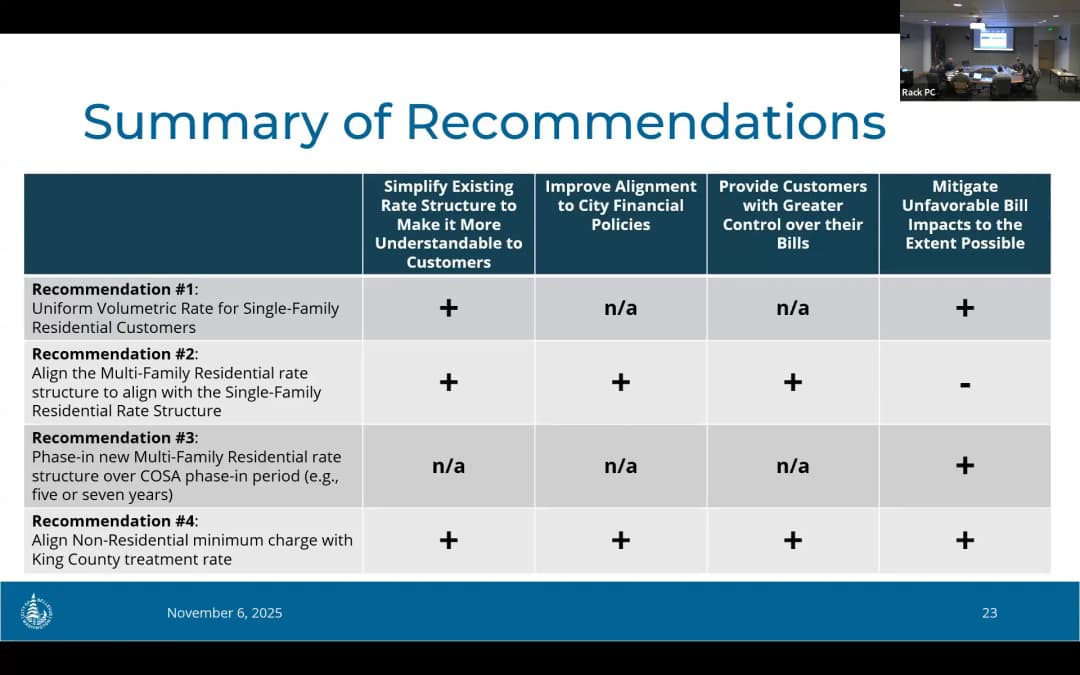
The November 6, 2025, meeting of the Bellevue Environmental Services Commission convened to address urgent updates on commission bylaws, provide deep-dive analysis on sewer utility cost of service studies and rate design, and solicit feedback on phase-in timelines for upcoming rate adjustments. The commission also reviewed solid waste performance following a summer work stoppage and received a preview of the 2027-2028 budget process. A significant portion of time was dedicated to debating whether to implement cost equity corrections over a three-year or five-year period, with the commission ultimately voting to recommend the staff's five-year proposal to City Council. Consent Calendar - The agenda was approved unanimously without modifications. - The minutes from the October 2, 2025, meeting were approved unanimously. Public Comments & Testimony - Mr. Zimmerman (Public Speaker): Spoke during the public comment period to express strong opposition to current city leadership. The speaker characterized the administration and judicial system as engaging in "fascist rule" and "Nazi pig" tactics. The speaker specifically opposed Mayor Robinson and City Attorney Tony Maccaroni, claiming to be the subject of a two-year legal campaign involving a trespass charge and a public defender dispute. The speaker stated that the City Attorney and judges are acting in collusion and demanded a revolution against the "Fascist Junta." The speaker also referenced their own prior election statements against the Mayor, claiming they were criminalized. Discussion Items - Updated Environmental Services Commission Bylaws: - Staff Proposal: Staff requested adoption of bylaws amended to conform to new City ordinances (6864 and 6865) regarding term limits (two consecutive terms), exclusion periods for disruptions (extended from 60 to 180 days), and appeal processes. Non-substantive cleanup edits included using the city seal, correct resolution references, and gender-neutral terminology. - Commission Action: The commission voted unanimously to adopt the updated bylaws. - Sewer Utility Cost of Service Analysis and Rate Design: - Cost Equity Findings: Staff presented data confirming that the multifamily residential class has been unintentionally subsidizing single-family and non-residential classes since 2019. This is largely driven by a unique multifamily rate structure that includes a fixed charge with a high volume allowance (11 CCFs) that users rarely meet, resulting in a fixed bill for 98% of these customers regardless of actual flow. - Phase-in Options: Staff presented three options to correct the cost equity: a 3-year, 5-year (staff recommendation), or 7-year phase-in period. Commissioners expressed divergent views: some argued for a 3-year phase to address inequities sooner, while others favored the 5-year plan to mitigate bill shock given King County's projected 12-13% annual rate increases. Commissioner DuPertis expressed confusion regarding the voting process but ultimately supported the staff recommendation after clarification. - Rate Design Recommendations: Staff proposed four recommendations to align rates with city policies and improve bill simplicity: 1. Single Family: Eliminate a redundant two-tier flow charge structure (for usage over 50 CCF) in favor of a uniform rate, as 99.9% of customers never exceed the tier threshold. 2. Multifamily: Restructure the rate to index the fixed charge to King County's wholesale rate, eliminate the flow allowance, and charge for flow starting at zero. This would give customers greater control over their bills (reducing fixed portion from 98% to 61%). 3. Mitigation Strategy: Recommend phasing in the multifamily restructuring over 3 to 5 years to smooth the financial impact, noting that immediate implementation would significantly increase bills for high-flow multifamily users. 4. Non-Residential: Index the fixed minimum charge to King County's rate to simplify billing. This would lower bills for small businesses using less than 15 CCFs while slightly increasing bills for high-volume users. - Commission Feedback: Commissioners discussed the nuances of the rate structures, particularly the disparity in flow charges between customer classes attributed to King County's "customer equivalent" ratio (0.63). The commission discussed the necessity of balancing cost equity with affordability and predictability. - Solid Waste Program Update: - Representatives from Republic Services and the City commended the partnership during the July work stoppage. Commissioners noted minimal service impact due to clear communication and backup drop-off plans. - Budget Planning Overview: - Staff announced the early start of the 2027-2028 utility budget process, with presentations scheduled to begin in 2026 to accommodate the city's biannual budget cycle. Key Outcomes - Bylaw Adoption: The Environmental Services Commission adopted the updated bylaws (Resolution 6864/6865 compliant) with a unanimous vote (5-0). - Phase-in Recommendation: The Commission voted to recommend a five-year phase-in period for the sewer cost of service study results to City Council. The final vote tally was 4 Ayes (Commissioners Lauterman, DuPertis, Laxson, Tyson) and 2 Nays (Commissioners Heinash and the Chair). - Rate Design Feedback: The Commission provided feedback to staff regarding the four rate design recommendations, generally supporting the approach but emphasizing the need for a phase-in to manage impacts. They instructed staff to incorporate the five-year phase decision into the final rate schedule to be presented to City Council in the spring. - Future Directives: - Staff to present a formal briefing to City Council in the spring. - Potential utility rate changes (incorporating the rate design) are targeted for adoption in January 2027. - The Commission requested a follow-up on the Utility Bill Assistance Program at the next meeting (December 8, 2025). - Commission members were notified of a regional utility rates summit on November 14, 2025, to coordinate communication regarding regional rate increases. - Adjournment: The meeting was adjourned at 8:18 p.m.
The Bellevue Planning Commission convened on November 7, 2025, for its annual retreat and study session. The meeting served as a year-end review of the commission's accomplishments, honored Commissioner Carolyn Ferris for her nearly seven years of service, and discussed strategic priorities for 2026. The session included a presentation on 2025 development trends by Development Services Director Rebecca Horner and a demographic analysis by City Demographer Bryce Shaefer, followed by a discussion on future agenda topics based on a recent member survey. Consent Calendar - The agenda for the November 7 meeting was approved unanimously. - Written public comments received prior to 11:00 AM on November 5 were noted (one comment regarding the critical areas ordinance). Public Comments & Testimony - Public Comment: No oral public comments were received. A single written comment was received regarding the critical areas ordinance; staff indicated a response had been provided to the commenter and included in the meeting materials. Discussion Items Honoring Commissioner Carolyn Ferris - Commissioner Fondu: Expressed deep gratitude and respect, citing Ferris's kindness, calm presence, and genuine care for people. He stated that Bellevue is better because of her service. Commissioner Fondu noted that Ferris embodies the ideal of an "independent team care" and is a "10 out of 10" commissioner who listens, changes her mind based on evidence, and respects the process. - Commissioner Geppo: Deserved Ferris as a "role model" for the commission, highlighting her constructive, positive, and supportive nature that helped newcomers adjust to the culture. - Commissioner Melodessa: Used an analogy of a musician playing next to a virtuoso to describe how Ferris made the team sound better while providing great expertise and purpose for the city's benefit. - Commissioner Kennedy: Noted Ferris's core values regarding equity and stable housing, praising her passion balanced with objectivity and her ability to remain non-partisan even on passionate issues. - Commissioner Ninja: Highlighted Ferris's ability to bring passion to issues while remaining mindful and objective, noting her role in helping the commission navigate the pandemic-era virtual meetings. Ninja also appreciated Ferris's use of expertise without being heavy-handed. - Commissioner Arshia Nilchian: Agreed Ferris is "incredibly sharp" and good at getting to the core of issues. Nilchian appreciated her personal time given to mentors and staff. - Commissioner Collade: Expressed personal enjoyment in working with Ferris as a wonderful person. Ferris responded to the tributes, stating she had learned much from the current commissioners and staff and expressed mixed emotions about leaving, though she intends to stay involved in the community and potentially mentor others. 2025 Year in Review & 2026 Outlook - Development Services Director Rebecca Horner: Presented on the department's five-year strategic plan, noting a strong development cycle with increased residential activity. She highlighted major projects in Downtown and Bellevue Red Hill, including Pinnacle, Park Row, and Bridle OMFE (affordable housing). - Commissioner Fondu: Asked about Wilberton allocations. Staff confirmed two projects (Frontstone East and KG) have utilized phase two provisions, totaling over 1,067 units, with six additional applications pending. Horner noted that tracking middle housing units will be improved with a new semantic type in 2026. - Planning Director Nick Whipall: Outlined 2026 priorities, including a new community engagement team, regional housing monitoring (PSI), and implementation of state legislation. Key upcoming items include the Bell Red LUCA, Downtown Zoning 2.0, and the Housing Opportunities in Mixed-Use Areas (HOMA) final decision. Demographic Trends (Bryce Shaefer) - Shaefer presented on Bellevue's diversity, noting the city is now majority-minority (nearly half foreign-born, over half speak a language other than English at home). - Data Highlights: Downtown is the most densely populated neighborhood and has the lowest home ownership rates. The I-90 corridor has seen a significant job drop due to vacancy and Boeing's exit, shifting employment focus. Median household income in Sammamish remains the highest in the nation, as does the gender pay gap within the region. Commission Functionality & Future Topics - Survey Discussion: Staff presented survey results from commissioners indicating high praise for respectful collaboration and preparation. Areas for improvement included shorter meetings, more briefings, clearer memos, and a need for a mentorship program for new commissioners. - Commissioner Fondu: Expressed concern that with five commissioners having less than a year and a half of service (and one brand new), the commission should be careful with complex topics and requested a structured onboarding review to prevent "chaos" on complex subjects. - Commissioner Kennedy: Suggested a glossary of acronyms to build over time as a handbook. - Commissioner Geppo: Proposed that a document compiling tools and tips for handling public comments and technical issues be developed for project managers. - Staff Response: Director Horner and Whipall agreed to explore structured pre-meeting briefings, better data visualization in presentations, and the development of a glossary or handbook to assist commissioners with technical terms and acronyms. Key Outcomes - Motion to Adjourn: The meeting was adjourned with a motion approved unanimously. - Strategic Directives: The commission agreed to prioritize shorter meetings, more pre-meeting briefings, and the creation of educational resources (glossary, mentorship, briefing tools) for the upcoming year to support new commissioners. - Continued Oversight: The commission will continue tracking the Wilberton vision implementation and the HOMA finalization, with specific focus on data tracking improvements for middle housing units in 2026.
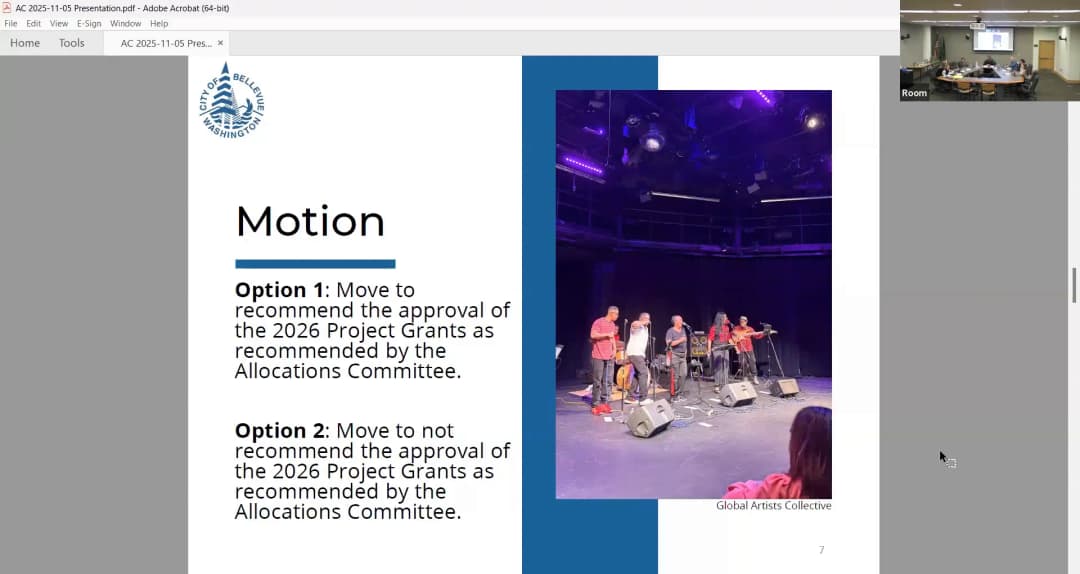
The Bellevue Arts Commission convened on November 6, 2025, to review and approve the 2026 Project Grants, discuss the status of the Art and Culture Capital Facility Grant Program, and receive public art and community updates. The meeting featured a significant increase in grant applications driven by increased funding tiers, followed by deliberations on the allocation of funds and the status of major capital projects. Consent Calendar - Agenda Approval: The commission unanimously approved the meeting agenda. - Minutes Approval: The commission unanimously approved the minutes from the previous meeting. - Committee Assignments: The commission confirmed the committee assignments for the upcoming year, noting no changes from the September sign-ups. Public Comments & Testimony - Reviewers' Perspective on Applications: The panel reviewers noted a 346% increase in applications (from 26 to 67), attributing this surge primarily to the increase in funding request tiers (from $1k-$3k to $3k-$7k) rather than a new marketing strategy, though organic social media growth contributed. They expressed appreciation for the effort of all applicants. - AI Usage Concerns: One reviewer highlighted that many applicants are using AI to draft responses, making it obvious in some cases. The reviewer stated a position that while AI is a useful tool to generate ideas, heavy reliance and copying constitutes plagiarism and may dilute the authentic voice of the applicant. - Data Categorization: A panel member suggested adding specific data buckets (e.g., performance art vs. cultural groups) to future reports to better track distribution, while another committee member cautioned against using these metrics as strict selection criteria, fearing it might limit the committee's ability to select the best projects based on innovation and feasibility. - Panel Diversity: A reviewer noted that many applicants, even those in the Bell Red Arts District, were unaware of the district's boundaries or definition, suggesting a need for better clarity in application instructions. Discussion Items 2026 Project Grants Approval - Grant Structure: Staff explained the "all or nothing" funding model where applicants request $3,000, $5,000, or $7,000. The total requested was $464,000, a 394% increase from the previous year's $71,000. - Recommendations: The Allocations Committee recommended awarding $200,000 total, covering 31 project grants ($187,000) and 13 Bell Red bonuses ($13,000). This represents 43% of total requests. - Deliberation: Commissioners questioned the marketing strategy and the spike in demand. Staff clarified that award levels had not changed in decades and the increase reflects the rising cost of producing arts events. One commissioner noted that most awards ($7,000) were chosen because they allow for substantial project implementation compared to lower tiers. - Application Guidance: Staff confirmed that office hours were held (attending 20-30 people) and that applicants receive reviewer comments upon request, though specific committee meeting discussions are not recorded. Art and Culture Capital Facility Grant Program - Program Status: The two-year program has awarded grants to four entities. Contracts for two remaining grantees were either signed or in the signing process. - Grant Highlights & Concerns: - Kids Quest: Completed their water room renovation and opened. Staff confirmed they are currently in due diligence to purchase the Bellevue Art Museum building but are not moving immediately; the renovated space will remain in use for 3-5 years. - Carlson Theater at Bellevue College: Completed lighting and seat upgrades. Staff emphasized the new community rental process is now active and affordable for nonprofits. - APAT: Received $600,000 for a new dance studio. Permitting is ongoing, with a goal to break ground early next year. - Theater Construction: A grant of $462,500 covered work for a theater space (including HVAC/AC installation) that was completed prior to the application, allowing for reimbursement of 2023-2024 expenses. - Future Funding: A follow-up application period for the Capital Facility Grant Program is expected in 2026 for awards covering 2027-2028. Public Art Updates - Installed Works: - Yonder Sky (Po Shu Wang) in the Arts District is fully operational with interactive sound components active in darker months. - Crossroads (Anamelaski) titled River is installed on light poles between Peapatch Garden and the Arts District, utilizing dichroic glass to change colors with light. - Longboat Rookery (Dan Corson) at City Hall is lit up for the darker season. - Pending Works: Rooted (Jill Anholt) is stored and waiting for foundation work associated with the East Rail Trail construction, expected to begin in spring. - Planning: Artist Matthew Mazzotta has begun the community engagement phase for the Grand Connection public art plan, focusing on the stretch from City Hall Plaza to the East Rail Trail. - Maintenance: Routine maintenance for 30 of 57 permanent outdoor artworks was completed for 2025. Rooted's maintenance costs were deemed high, requiring a strategy re-evaluation. Community & Strategic Planning - Bellevue Art Museum Sale: Staff confirmed Kids Quest Children's Museum has purchased the Bellevue Art Museum building. The deal is in due diligence with an expected closing in Q1 2026. Kids Quest will perform necessary upgrades to the Stephen Hollow building before opening new exhibits. - Economic vs. Cultural Planning: A discussion occurred regarding the city's Economic Development Plan. Staff clarified that while the plan includes a creative economy priority, a dedicated Cultural Planning process (the last being in 2004) is planned for 2027 to specifically address cultural definitions and assets separate from economic metrics. Key Outcomes - Motion Passed: The commission unanimously voted to recommend the approval of the 2026 Project Grants as recommended by the allocations committee, authorizing $200,000 in funding to 31 projects and 13 bonuses. - Next Meeting Date: Set for December 3, 2025 (first Wednesday in December). - Training Opportunity: Commissioners Charles, Sandra, Erica, Lydia, and others were invited to an in-person Parliamentary Procedures training on December 8, 2025 (5:30 PM - 8:30 PM), including dinner. - Project Closure: Staff noted that the 2025 project grant reporting and payment cycle closes on November 30, 2025.
The Human Services Commission met to address community needs updates, review a presentation from Hope Link regarding the 2025 Community Needs Assessment, and discuss funding allocations for the 2027-2028 cycle. The meeting featured public testimony concerning specific legal proceedings and city leadership, followed by a detailed review of poverty data, housing challenges, and food insecurity in North and East King County. Commissioners deliberated on funding percentages and contingency plans, approving draft recommendations pending finalization of the contingency adjustments. Consent Calendar - The October 20th minutes were approved unanimously following a motion and second. Public Comments & Testimony - Alex Zimmerman: Spoke regarding a two-year, 300-page second-degree trespass case involving a public defender. Zimmerman expressed that the legal process is excessive for a misdemeanor, stating, "You know what this means. They want to keep me under bad condition." He criticized the judicial system, calling the judge a "Nazi pig" and asserting he plans to appeal. He concluded by shouting, "viva Trump, viva new American revolution." - City Council Member (Robinson): Expressed strong support for the Commission's work and the community's needs. She stated a position of support for reallocating council contingency funds to human services, recommending that any such funds be one-time only to avoid setting unsustainable hiring or program baselines. She emphasized the need to fund existing agencies quickly rather than creating new ones, and noted the City Council would deliberate on this allocation at a meeting scheduled for the following Wednesday. - Major Inman (Police Dept): Stated that the Police Department is facing consistent challenges with recruitment, maintaining approximately 24 vacancies. He expressed a position of optimism regarding a new recruiting website refresh and filming event scheduled for November 16 to improve hiring outcomes. Discussion Items - Porch Light Facility Report: Multiple commissioners expressed appreciation for the facility's cleanliness and services. However, Commissioner Rashid expressed concern regarding safety issues, specifically noting an increase in parking challenges, 911 calls, and dangerous activity near the site due to the presence of people with disabilities. Commissioner Fan added concern regarding the loss of federal funding ($500,000, approx. 10% of the budget) and reported that the facility does not have parking control. - Hope Link Presentation: Hope Link staff presented alarming data, with Staff stating that one in five (20%) households in North and East King County lack sufficient income for basic needs. They expressed urgency regarding food costs rising 78% from 2020-2023 and the impact of SNAP disruptions. Staff expressed a position of support for increased home delivery and mobile market hours but noted severe capacity constraints. Commissioner Fan expressed concern regarding the closure of the GED and digital literacy programs due to funding wind-downs, while Commissioner Rashid expressed support for the financial assistance program but noted the high demand-to-capacity ratio (7,000 requests, one served). - Funding Percentages (2027-2028): Commissioners debated the allocation of contingency funds. Commissioner Fan expressed a position of support for an even split of extra funds among shelter, financial assistance, and food, prioritizing shelter and food. Commissioner Rashid agreed that an even split allows for household choice. Commissioner Paulman expressed support for maintaining the current targets for culturally specific (23%) and youth (26%) funding, suggesting language be added to the contingency plan to ensure these targets are considered when additional funds become available. - Data Analysis on Older Adults: Commissioner Fond expressed a request for a specific focus on older adults, noting a focus group recommendation to ensure their unique needs in transportation and case management are not overlooked in funding decisions. Staff clarified that while demographic data exists, it is difficult to break out by age within broad funding categories during the application review process. Key Outcomes - Approval: The draft recommendations for the 2027-2028 funding percentages were approved unanimously. - Contingency Plan: The commission decided to defer voting on the specific adjustments to the contingency plan (including the 2% adjustment cap and the split of additional funds) until the next meeting, where staff will bring back a revised draft with proposed language regarding the 23% (culturally specific) and 26% (youth) targets. - Next Steps: Further council action is pending regarding the reallocation of contingency funds, with a City Council meeting scheduled for the following Wednesday to determine the final amount and direction. - Scheduling: The next Human Services Commission meeting is scheduled for Monday, November 17.
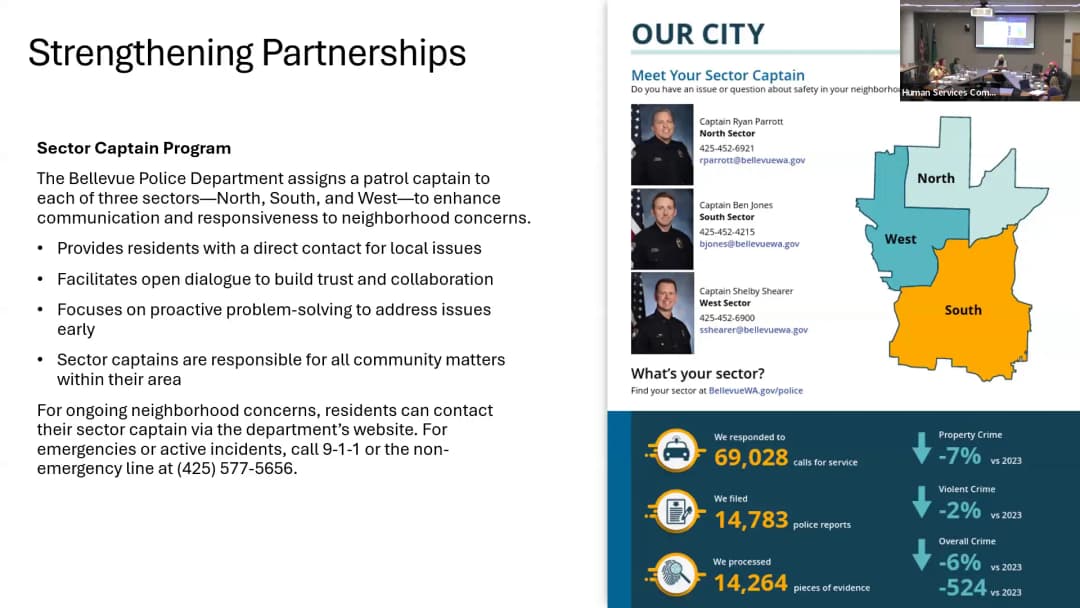
The Human Services Commission convened on October 29, 2025, to welcome new Commissioner Olga Perelman, approve June 2nd meeting minutes, and review staff reports. The meeting included public testimony regarding organizational funding and police conduct, followed by in-depth presentations on the Bellevue Community Crisis Response Program (CARES/CCAT) and the Bellevue Police Department's initiatives, recruitment, and community partnerships. Consent Calendar - The minutes from the June 2nd meeting were moved, seconded, and approved unanimously. Public Comments & Testimony - Lawrence Luo (Transcend United): Spoke on behalf of the organization seeking city support, funding, and resources for their senior community events held at Crossroads Community Center to combat post-COVID isolation for underserved seniors. - Anonymous Speaker (Self-identified as a supporter of former President Vanessa Kritzer): Expressed deep concern regarding the behavior of Alex Zimmerman, citing reports of his presence in the region. The speaker condemned the individual's rhetoric as Nazi, racist, and sexist, requested his removal from City Hall, and urged enforcement of state laws prohibiting political campaigning during meetings. - Alex Zimmerman: Accused the Commission of engaging in "pure fascism" and committing "pure crime" by allegedly cutting speeches from registered speakers (reducing allowed speakers from 25 to 10) and denying access to appeal mechanisms. The speaker stated they would report the Commission to the police if faces were not displayed during the meeting and claimed their election statement was unjustly cut. Discussion Items - Presentation: Bellevue Community Crisis Response Program (CARES, CARES 101, CCAT) - CARES Team Overview: Introduced by Dylan Gordon (Field Education Supervisor) and Jordan (Crisis Response Social Worker). The program, modeled after Spokane CARES, has evolved since 2012 from two student advocates to a team including professional social workers and up to 25 student advocates from 16 universities. - CARE 101 Unit: A co-response unit staffed by seven days a week, dispatchable by fire/police to 911 calls. They meet clients on scene or at hospitals to stabilize crises and refer them to case management. - CCAT (Community Crisis Assistance Team): Launched full-time in September 2023 following a 2021 pilot. CCAT pairs officers in unmarked cars with social workers. Pilot data showed a 45% increase in referrals to CARES advocates, an average of three referrals per client to community services, an 80% decrease in arrests, and a 24% reduction in use of force by police. CCAT hours are Tuesday-Friday (6 a.m.–midnight) and Saturday-Monday (6 a.m.–10 p.m.). - Opioid Outreach: A new social worker position funded by opioid settlement funds focuses on follow-up case management for opioid use issues and community outreach, including starting work at community court. - Resource Gaps Identified by Staff: Staff cited significant gaps in resources for women's shelters (only one in Bellevue with few beds), emergency shelters (clients often sent to Tacoma Rescue Mission), co-occurring mental health/substance use treatment, and services for individuals with multiple overlapping needs (e.g., unhoused individuals in wheelchairs with service dogs requiring ID). - Caseload & Demographics: The team currently manages approximately 250 open cases. The age demographic has shifted from predominantly elderly referrals in 2012 to primarily 30-to-50-year-olds dealing with mental health and substance use issues. 2020 data showed over 1,000 referrals annually, a number likely higher now. - Presentation: Bellevue Police Department Programs & Initiatives - Leadership Report: Major Ellen Inman provided an overview of the department's structure, mission, and accreditation status (nationally accredited by CLEAA since 2005). - Call Volume & Response: The department received over 52,000 911 calls in 2024. Priority 1 response times averaged 3 minutes and 36 seconds. - Staffing Challenges: The department is currently facing approximately 16 vacancies out of a staffed level of 206 officers. Major Inman attributed this to statewide recruiting difficulties, competition with tech companies (Amazon, Microsoft), and a national trend of retirements. - Recruitment & Diversity: The department implemented targeted digital marketing, resulting in a 300% increase in applications in the first year. Over half of recent applicants for a victim advocate position were from outside Washington. Officers receive training on cultural competence, language barriers, and de-escalation. - Community Engagement: Highlighted initiatives include the Police Advisory Councils, Sector Captains (North, West, South) for direct community liaison, Crime Prevention through Environmental Design (CPTED), the Women's Empowered Self-Defense program, Youth Camps, AirTag giveaways, and a successful gun exchange program where 87 firearms were collected in May in exchange for $13,000 in gift cards. - Threat Management: The department utilizes a joint terrorism task force for threat assessment and collaborates with the city's threat management team regarding potential school violence risks. Key Outcomes - Commission Schedule Update: The Commission will recess for August. The next meeting will be a special meeting on Monday, September 8, 2025, from 6:00 p.m. to 9:00 p.m., focusing on the upcoming funding cycle. Regular meetings will resume in September with two meetings per month. - No Formal Votes: No motions were made or votes taken on agenda items during this meeting; the session concluded with the adjournment of the meeting at 8:11 p.m. - Resource Acknowledgement: The Commission was provided with detailed data on current resource gaps (shelters, co-occurring treatment) which were highlighted as critical areas for future advocacy by staff and the public.
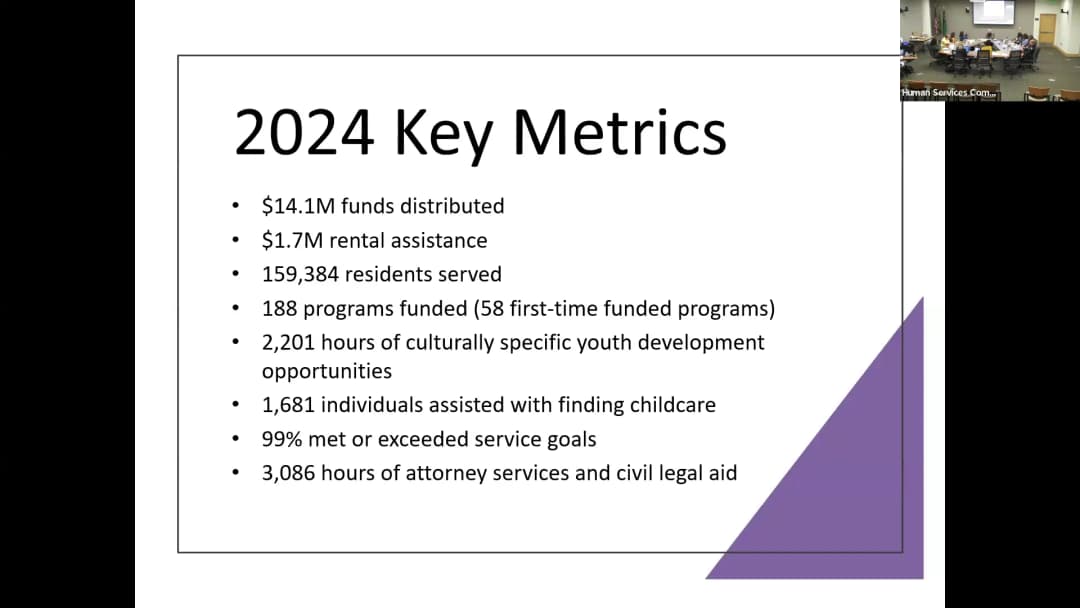
The Human Services Commission convened at 6:00 PM to gather community input for the 2027-2028 funding cycle, review the 2024 performance data, and receive updates on the city's affordable housing strategy. The meeting featured public testimony from four organizations (Sophia Way, Kindering, Evergreen Transition Program, and Boys & Girls School of Bellevue) primarily urging the prioritization of child care, early learning, and support for women experiencing homelessness, alongside a highly disruptive public comment from one individual alleging government misconduct. Staff presented performance metrics showing the city invested $14 million in 2024, with a focus on housing and food security, and discussed the strategic implementation of a 20% indirect cost rate to support organizational infrastructure. Consent Calendar - No items listed: The minutes from the previous meeting were not approved due to the absence of Vice Chair White, and no specific consent items were processed or voted on in this transcript segment. Public Comments & Testimony - Jesse Franklin (Rainier Athletes): Signed up but did not attend the meeting. - Mark Vermouth (Sophia Way): - Position: Expressed deep concern regarding the escalating impact of federal cuts on local services and urged the commission to prioritize funding for 2027 to address the increasing needs of single adult women experiencing homelessness. - Context: Highlighted that the organization serves 83% of the women they assist who have significant barriers like income gaps and disability, emphasizing the need for stability. - Christina Mendieta (Kindering): - Position: Urged the commission to prioritize child care and early learning, specifically for children with disabilities, children of color, and low-income families. - Arguments: Stated that science shows 85% of brain growth occurs in the first three years; highlighted that for every $1 spent on early learning, up to $17 is returned in savings (e.g., special education); noted disparities where Black children are three times more likely to be expelled. - Sunny Luke: - Position: Requested prioritization of early support services for families with children who have complex medical needs and disabilities, describing these services as life-saving. - Context: Shared personal testimony of a family navigating tuberous sclerosis complex and the vital role of Kindering in providing hope and support. - Alex Zimmerman: - Position: Expressed extreme opposition to the current commission and local leadership, accusing officials of being a "Nazi Gestapo" and "mafia bandita," and alleged that the city is engaging in slave labor practices involving Indian and Chinese populations to raise prices. - Position: Accused Mayor Robinson of supporting "Muslim terrorists" and claimed a "fascist government" is in power. - Christy Murphy (Boys & Girls School of Bellevue): - Position: Expressed gratitude for recent funding increases but stated there is still a "huge need" not fulfilled, specifically regarding after-school care and scholarships, citing long wait lists due to affordability. Discussion Items - Affordable Housing Strategy Update (Hannah Bern Miller, Office of Housing): - Proposal: Updated on the 2025 Affordable Housing Strategy with a goal to build or preserve 5,700 affordable units in 10 years, including sub-targets for income bands (0-30%, 30-50%, 50-80%). - Engagement: Discussed engagement goals focusing on information dissemination, public opportunity, and elevating diverse voices (organizational partners, lived experience, general public). - Strategies: Highlighted draft strategies including acquiring Naturally Occurring Affordable Housing (NOAH), funding community-based navigation services, innovation to reduce costs (e.g., design competitions with universities), and prioritizing family-sized units (2+ bedrooms). - Addressing Concerns: - Permitting: Confirmed the city is implementing state legislation to reduce permitting times and has an expedited program for affordable housing. - Infrastructure: Noted the state CHIP grant program covers utility and infrastructure costs for affordable housing projects. - Equity: Distinguished between "Housing Equity" (rectifying racial outcomes, homeownership access) and "Housing for Unique Needs" (family-sized units, aging in place, universal design). - Incentives: Discussed incentives for market-rate developers (tax exemptions, density bonuses) and the use of credit enhancement programs (like King County's) to lower financing costs for 100% affordable projects. - Human Services Funding Performance Review: - Strategic Plan Progress: Reviewed Year 1 of the 6-year strategic plan, noting accomplishments in equity-focused decision-making, expanded community engagement, and the adoption of a standardized rubric for applications. - 20% Indirect Cost Rate: Discussed the implementation of a 20% administrative overhead rate for all contracts. Staff argued this is necessary to equitably support infrastructure for small agencies who previously could not afford to pay staff salaries, despite the potential reduction in direct service units. - 2024 Performance Dashboard: Reported $14 million invested, supporting 159,000 residents across 188 programs. Breakdown: 50% housing/food, 14% mental/fiscal health, 10% education/employment. 99% of programs met or exceeded goals. - Funding Analysis (2025): - Culturally and Linguistically Specific Agencies: 28% of agencies funded were culturally specific; 23% of applicants were funded (receiving 63% of their request on average vs. 45% for all other agencies). - First-Time Funders: 5 culturally specific agencies received funding for the first time. - Community Navigation: Discussed the critical need for navigation services. Noted a disconnect in awareness where residents struggle to find resources despite availability. Commissioner suggested leveraging former system users as navigators and digitizing resources; staff noted the difficulty of maintaining real-time directory accuracy but confirmed funding for navigation is a priority for the upcoming cycle. Key Outcomes - Funding Priorities: The commission emphasized that the 20% indirect cost rate is a standard for the upcoming 2027-2028 funding cycle to ensure equitable access and organizational stability. - Strategic Direction: The commission will use the reviewed 2024 data and the strategic plan to inform funding recommendations for 2027-2028 at the next meeting on October 6, 2025. - Affordable Housing Timeline: The city will present the overarching goals and guidance of the Affordable Housing Strategy to Council in late October, with formal adoption expected in January or February 2026. - Community Outreach: A public info session is scheduled for November 6 at City Hall, followed by a public survey to gather feedback on draft strategies. - Resource Connection: Staff confirmed the existence of weekly community resource fairs at the Bellevue Downtown Library (Tuesdays) and pledged to distribute flyers and improve digital resource visibility.