Browse by city
Date range
Search help

Search titles, summaries, topics and stored transcripts together. Keywords may match separately; put the whole query in double quotes for a phrase. Matching follows word analysis, so punctuation is not exact. Both dates are included. Documents are not searched.

SHOWING 41–50 ENTRIES
41
JUN 2, 2026 · BELLEVUE, WASHINGTON · CITY COUNCIL
Bellevue City Council Meeting - June 2, 2026: Utility Bill Assistance Expansion and Safe Speeds Bellevue Program

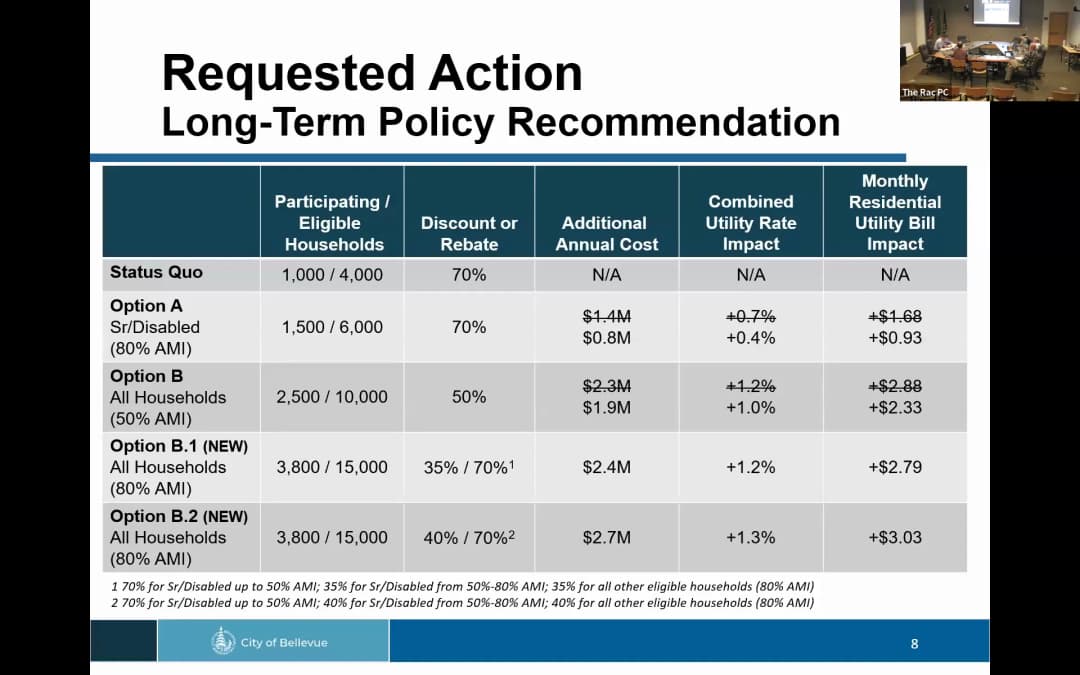
The Bellevue City Council met on June 2, 2026, to discuss and take action on two major study sessions: expanding the Utility Bill Assistance Program and advancing the Safe Speeds Bellevue initiative to reduce traffic fatalities and serious injuries. The meeting included proclamations for Pride Month and National Gun Violence Awareness Day, public comments on traffic safety, immigration enforcement, and other community concerns, and approval of the consent calendar. Deputy Mayor Hamilton presided in the absence of Mayor Malicoutian and Councilmember Breyer, whose absences were excused. Consent Calendar - The council approved the consent calendar by unanimous vote, which included three items related to the Grand Connection Crossing project (design contract and preconstruction work for general contractor/construction manager). Public Comments & Testimony - Raymond Zhao expressed support for reduced speed limits but urged investment in multimodal infrastructure and traffic calming to naturally encourage slower driving. - Ann Clark, a resident of the Vassa Park neighborhood, described dangerous speeding on Southeast 34th Street near a school bus zone, citing a lack of sidewalks and recounting her own serious pedestrian injury. She warned that a child could be killed if action isn't taken. - Steve Pantel, a Bellevue resident for 30 years, supported the Vision Zero strategy and speed limit reductions but encouraged faster implementation of low-cost safety projects, particularly for biking infrastructure in Factoria and Somerset. - Alex Zimmerman claimed he had been repeatedly trespassed and targeted by city officials due to his candidacy, alleging misuse of city funds and calling for accountability. - Guillermo Rivera, on behalf of Eastside for All and Safe Heaven, reported on immigration enforcement activity, stating that in just the last two weeks, 12 Bellevue residents had been detained (13 documented detainees) in Lake Hills, Crossroads, and Sammamish High School neighborhoods. He called for policies to protect immigrant families. - Heather Kelly, a lifelong Bellevue resident, described the fear and disruption caused by federal immigration enforcement, noting that parents are being forced to make childcare plans in case of deportation. She urged the council to recognize the human and societal consequences. - Lynn Franson requested a speed limit reduction to 25 mph on Southeast 34th Street to enable sidewalks, crosswalks, and speed cameras, noting that families and children are at risk. - Dr. Varinder Sadio, speaking on behalf of a neighborhood regarding a proposed safe parking program, expressed support for the program but opposed its location in a residential area due to traffic, safety, and animal welfare concerns. - Joe Kunzler (virtual) defended the city's actions regarding Alex Zimmerman and asked for continued exclusion of his disruptive behavior. Discussion Items Utility Bill Assistance Program Expansion - Staff from the Utilities Department and the Environmental Services Commission presented a recommendation to expand the long-term utility bill assistance program to all low-income households (up to 80% of Area Median Income, or AMI). Currently, 1,100 households receive assistance annually costing over $1 million. - The recommendation (Option B1) maintains a 70% discount for seniors and disabled residents below 50% AMI, provides a new 35% discount for seniors/disabled with incomes 50-80% AMI and for all other households up to 80% AMI. - Estimated annual assistance per household ranges from $500 to $1,600. - The expansion would be funded by a 1.2% rate increase to water, sewer, and stormwater bills, equating to $2.79 per month for a typical single-family home. - The council unanimously directed staff to incorporate the recommendation into the upcoming biennial budget and utility rates. Vision Zero and Safe Speeds Bellevue Program - Staff reported that 2025 was the worst year for traffic safety in the last decade: 3 fatalities and 38 serious injuries, 61% higher than the 10-year average. Speeding became the leading contributing factor. - The Safe Speeds Bellevue program proposes reducing speed limits on streets currently posted at 30 mph or higher. The recommendation covers 64% of these streets with a 5 mph reduction, 20% with a 10 mph reduction, and 16% unchanged. - Implementation is planned in phases starting in 2027, beginning with the urban core and high-injury network (which covers 8% of city streets but accounts for 68% of fatal and serious injury crashes). - The council approved a motion to direct staff to finalize city code amendments to adjust speed limits in accordance with the Safe Speeds Bellevue recommendations. Key Outcomes - Approved consent calendar (unanimous). - Directed staff to incorporate the Commission's utility bill assistance expansion (Option B1) into the 2027-2028 budget and utility rates (unanimous). - Directed staff to finalize and bring back an ordinance amending Bellevue City Code 11.32 to adopt the Safe Speeds Bellevue recommended speed limit changes (unanimous). - The council noted that the City Manager will provide a report on the Community Crisis Assistance Team (CCAT) program at a future meeting.
TRANSPORTATION SAFETY 42% · WATER AND WASTEWATER MANAGEMENT 18% · PROCEDURAL 10% · AFFORDABLE HOUSING 9%
42
MAY 28, 2026 · BELLEVUE, WASHINGTON · CITY COUNCIL
Bellevue Planning Commission Meeting – May 28, 2026: Downtown Livability 2.0 and Bell Red LUCA Discussions

This meeting of the Bellevue Planning Commission, held on May 28, 2026, in a hybrid format, focused on two major land use code amendments: the Downtown Livability 2.0 (information only) and the Bell Red Land Use Code Amendment (LUCA). Commissioners heard extensive public comment on Bell Red, deliberated on street grid flexibility, base FAR, affordable housing requirements, and the amenity incentive system, and directed staff to prepare for a future public hearing after an additional study session. Public Comments & Testimony - Nava Carlisle (Bellevue Chamber of Commerce) expressed strong support for the Downtown Livability 2.0 update, emphasizing that feasibility, predictability, and protection of Old Bellevue must be central. The chamber offered to partner with the city. - Diana Leo and Brady Nordstrom (Eastside Housing Roundtable) aligned with the chamber, urging removal of the rigid street grid and adoption of a block perimeter standard. They supported staff’s removal of the tiered amenity structure and called for clear compliance and deeper bonuses for affordable housing. - Paulo Sullivan (Albertsons) objected to a proposed street grid on his 18.5-acre site, presenting a master plan alternative that he argued meets all goals. He urged flexibility over the mandated grid. - Matt Rowley (architect/development planner) described the street grid as “very challenging” due to parcel fragmentation, grade changes, and existing buildings. He urged removing the grid requirement or making it a guideline. - John Morasco (Security Properties, on behalf of Albertsons) echoed concerns about the grid and urged a straightforward amenity bonus structure. He noted that mandatory affordable housing further impacts feasibility and asked for MFTE eligibility. - Nick Bratton (King County DNRP) proposed a renewed Transfer of Development Rights (TDR) partnership, potentially generating several million dollars for public improvements in Bell Red. - Jesse Clausen urged the commission not to move the proposal to public hearing yet, citing fundamental issues with the mandatory grid and incentive structure. He recommended eliminating the grid and creating a catalyst program for priority amenities. - Charlie Bowman (stream restoration advocate) argued that the LUCA undermines the Critical Areas Ordinance by not equally incentivizing stream restoration (vs. daylighting) and that costs are not offset. He requested further study before finalization. - Ben Mickel (downtown resident) asked for required or incentivized access points to the East Rail Trail, noting this was missing from the LUCA despite sub-area plan policies. - Layla Kademi (land use attorney) recommended simplifying the amenity incentive system into a single uniform menu, expanding it to include sporting facilities, child care, grocery stores, and family-sized housing, and ensuring bonus FAR offsets mandatory inclusionary costs. - Felicity Hollenbeck (Columbia Pacific Advisors) requested a 10-year vesting period for master development plans, phased amenity allowances, and appropriate economic incentives for stream daylighting. - Kevin Wallace (Wallace Properties) objected to the lower base FAR (2.0) for residential on the west side of 116th Avenue compared to 4.0 on the east side, arguing it penalizes housing and should be equalized. - Ming Zhang (architect/land owner) supported the city’s vision but renewed the call for parity in base FAR on 116th Avenue, noting that the reduced FAR on the west side undermines development feasibility. Discussion Items Downtown Livability 2.0 (Information Only) - Senior Planner Matthew Menard and Code & Policy Director Nick Whippal presented the scope of the LUCA, which aims to refine the 2017 code to address implementation gaps, enhance evening and weekend vitality, improve the ground-floor active use requirements, streamline departures, and finetune the amenity incentive program. No changes to building heights or the “wedding cake” are planned. Outreach begins in June 2026, with the first draft expected in fall 2026. Commissioners expressed support for affordable commercial space, pedestrianization of Old Main Street, and consideration of bike lane connectivity (though noted to be outside the LUCA scope). Bell Red Land Use Code Amendment - Project Manager Christina Gallett and Nick Whippal led the discussion. - Street Network: Staff presented an option to allow private access corridors to replace public local streets under certain conditions (e.g., emergency access, no adverse impacts). Commissioners debated the trade-offs between flexibility and public certainty. Several commissioners favored greater flexibility, while others worried about long-term maintenance and enforcement of private streets. Staff noted that a performance-based path with clear criteria could be developed. - Base FAR: Recommended base FARs of 2.5 for mid-rise and 4.0–6.0 for high-rise districts. The west side of 116th Avenue is proposed at base FAR 2.0 for residential (lower than the east side’s 4.0) to prioritize medical/life sciences. Many commissioners expressed support for equalizing the FAR on both sides. - Mandatory Affordable Housing: All development must provide 10% affordable housing (at 80% AMI) through on-site/off-site, fee-in-lieu, or land dedication. Affordable housing and affordable commercial floor area are exempt from FAR limits. - Amenity Incentive System: A new structure divides Bell Red into seven neighborhoods with targeted incentives. Amenities include affordable housing beyond the mandate, affordable commercial space, public art, outdoor plazas, green building certifications, and stream restoration (with clarification on daylighting vs. restoration). Staff will return with final recommendations on fee-in-lieu allocation and TDR. - Phasing & Vesting: Staff indicated that current practice allows up to 10-year vesting for master development plans but cannot vest future design reviews. Phasing of amenities is generally allowed but must be clarified. Key Outcomes - The commission agreed to schedule an additional study session before moving to a public hearing on the Bell Red LUCA, delaying the public hearing from July to later in the year (likely fall 2026). - Staff will refine criteria for the private street alternative, including performance standards and enforcement mechanisms, and will continue discussions with the transportation department on street typologies. - Staff will return with a clearer definition of “stream restoration” in the amenity system and consider adding East Rail Trail access as an express amenity. - The commission expressed a preference for directing all fee-in-lieu proceeds to affordable housing, with potential allocations for arts and parks to be resolved. - The minutes of the April 22, 2026, meeting were approved unanimously. - The meeting was adjourned after a motion and second.

ENGINEERING AND INFRASTRUCTURE 40% · AFFORDABLE HOUSING 15% · MISCELLANEOUS 13% · ACTIVE TRANSPORTATION 9%
43
MAY 22, 2026 · BELLEVUE, WASHINGTON · CITY COUNCIL
Bellevue Environmental Services Commission Special Meeting - May 22, 2026: Revised Utility Bill Assistance Program Options

On May 22, 2026, the Bellevue Environmental Services Commission (ESC) held a special meeting at 6:00 PM to consider revised policy options for expanding the utility bill assistance program. Commissioners Lutterman, Dupertis, and Laxon were present; Commissioners Hainosh, Margolis, and Tyson were excused. The commission voted 3-1 to adopt a new recommendation (Option B1) that preserves the current 70% discount for low-income seniors and disabled households while expanding eligibility to households earning up to 80% of area median income (AMI) with a 35% discount for new participants. Discussion Items - Utility Bill Assistance Program Expansion – Staff (Scott and Matt Hobson) presented revised cost estimates for expanding the long-term utility bill assistance program, originally reviewed in March 2026. The revised estimates lowered the cost of the commission’s original recommendation (Option B: expand to households up to 50% AMI, 50% discount) from $2.3 million to $1.9 million per year due to refined rebate calculations for multifamily residents. Two new options (B1 and B2) were introduced that maintain the existing 70% discount for current program participants (seniors and permanently disabled individuals with incomes up to 50% AMI) while expanding eligibility to all households up to 80% AMI (approximately $120,000 for a family of four). Option B1 offers a 35% discount to new participants at an estimated annual cost of $2.4 million (1.2% rate increase, $2.80/month for a typical single-family home). Option B2 offers a 40% discount at $2.7 million (1.3% increase, $3.00/month). The options aimed to balance expanded reach, meaningful assistance ($500–$1,600/year per household), and minimal rate impact. Commissioners debated whether to optimize for quantity of households served or depth of assistance for the most vulnerable. The chair expressed concern about cumulative rate increases from all utility projects. Staff clarified that the proposed budget already accounts for Option B’s cost; moving to Option B1 would add only about $100,000. Key Outcomes - Motion and Vote – A motion to recommend Option B1 (expand program to 80% AMI with 35% discount for new participants, preserving 70% for current eligible) was made, seconded, and passed on a roll call vote of 3-1 (Commissioners Lutterman, Laxon, and Dupertis in favor; the chair opposed). - Next Steps – The commission’s recommendation will be presented to Bellevue City Council in June 2026 as part of the 2027–2028 budget process. Changes would take effect in 2027. The revised eligibility criteria will also apply to short-term assistance programs like Neighbors Helping Neighbors. The commission also noted plans to expand solid waste bill assistance to qualifying multifamily accounts in 2027. - Confirmation of Earlier Recommendation – The original March recommendation (Option B) was superseded by the new vote.

WATER AND WASTEWATER MANAGEMENT 97% · PROCEDURAL 3%
44
MAY 19, 2026 · BELLEVUE, WASHINGTON · CITY COUNCIL
Bellevue City Council Meeting - May 19, 2026: Proclamations, Sound Transit, MFTE Catalyst, and Legacy Project

The Bellevue City Council met on May 19, 2026, to address routine approvals, public comments, and three major study sessions. The council issued three proclamations, heard from eight pre-registered speakers, and discussed the Sound Transit Enterprise Initiative, a Japanese American legacy project, and a multifamily tax exemption (MFTE) catalyst program. Consent Calendar - Approved the consent calendar, including routine items, by a unanimous voice vote. Public Comments & Testimony - Brady Nordstrom (Associate Director, Housing Development Consortium) urged adoption of a four-year MFTE catalyst with no unit cap, as agreed by the East Housing Roundtable, and asked for study of expedited permitting for the first 1,500 units in HOMA. - Diana Leo (Vice President, Bellevue Chamber) testified in support of the MFTE supercharger and opposed a 1,500-unit cap, arguing that unfunded mandates stop housing production. - Jesse Clausen (virtual) urged a usable MFTE supercharger with no unit cap, citing Oregon’s statewide requirement for tax offsets to mandatory affordability. - David Spanier (Greenwich Crest Neighborhood Working Group, representing 140 households) raised concerns about the proposed safe parking site at Newport Presbyterian Church, citing emergency access, environmental impacts, and lack of formal public review. He requested a staff briefing, joint fire safety review, and site-specific evaluations. - Grace Landau (parent of a Bellevue student) described an incident in which her 7-year-old child was not allowed to disembark from school bus 28 on November 2, 2023; she asked the council to help facilitate a Bellevue Police Department investigation. - Brian Dixon (self-represented) asked how he could receive wraparound services for housing, food, and gas, expressing frustration with government responsiveness. - Carly S. criticized the council’s handling of harassment allegations regarding public comment on Gaza and U.S. foreign policy, asserting that silencing speech contributes to erosion of democracy. Discussion Items Sound Transit Enterprise Initiative (Chair Summers’ Proposal) - Presented by Lacey Jane Wolfe (Intergovernmental Policy Advisor) and Andrew Singulakis (Transportation Director). The proposal aims to close a $35 billion revenue gap. It funds the South Kirkland-Issaquah Light Rail (Line 4) at an $8.4 billion cap (delayed from 2044 to 2050), regionalizes debt interest from 2027, and defers other projects (West Seattle Avalon station, Ballard stations, etc.). - Council discussion: Deputy Mayor Hamilton emphasized maintaining sub-area equity and requested greater clarity on the debt interest burden for East King. Councilmember Robinson proposed replacing part of Line 4 with BRT from Issaquah to South Bellevue Park and Ride and BRT along I-405. Councilmember New in House expressed concern over violation of sub-area equity and asked for analysis of the financial burden of regionalized debt interest. Councilmember Barigabo stressed that sub-area equity principles are not fully met and urged firmness in advocacy. - Outcome: Councilmember Robinson moved to direct staff to prepare a letter to the Sound Transit Board based on guiding principles, including support for Line 4 between East Main and Kirkland, BRT from Issaquah to South Bellevue Park and Ride, BRT north-south along I-405, a thorough analysis of financial impact on Eastside taxpayers, and a focus on catalyzing the project. The motion passed unanimously. The letter will also call for defined alternatives analysis and certainty on acceleration. Japanese American Legacy Project (East Main Park) - Presented by Cameron Parker, Betsy Anderson, and Susan Ulip (Parks and Community Services). The proposed installation at the park at Main St. and 112th Ave. includes a large-scale map of Bellevue, a shelter structure, and interpretive elements honoring Japanese American history. A memorandum of understanding with ESON Bellevue outlines three fundraising phases (design and two construction phases). The park naming process is ongoing; a public survey was conducted in spring 2025, and the Parks Board will recommend a name later in summer 2026. - Council feedback: Members expressed strong support. Councilmember Robinson suggested adding flowering cherry trees and inquired about a smaller adjacent lot; Councilmember Sumod Varia emphasized input from current Japanese American residents. Councilmember Barigabo encouraged collaborative design charrettes. Deputy Mayor Hamilton and Councilmember New in House praised the partnership and design. MFTE Catalyst Program for HOMA Areas - Presented by Bianca Siegel and Hannah Bon Miller (Office of Housing). Staff analyzed a limited-term “catalyst” (supercharger) to adjust the existing MFTE program in non-downtown HOMA areas. Three options were compared: staff recommendation (6-year catalyst with 1,500-unit cap), a 4-year catalyst with no cap (Option B), and a 6-year catalyst with no cap. Staff recommended the 6-year cap option to balance fiscal impact, affordability, and production. - Council discussion: Councilmember Barigabo proposed moving forward with Option B (4-year, no unit cap) plus a two-year look-back to assess housing production, affordability outcomes, and overall financial impact including sales tax revenue. Deputy Mayor Hamilton, Councilmember Sumod Varia, Councilmember New in House, Councilmember Bryant, and Councilmember Robinson supported Option B, emphasizing that a unit cap creates uncertainty and limits housing supply. Councilmember Robinson asked that after the four-year catalyst the program automatically revert to the baseline MFTE (10% at 80% AMI and 10% at 65% AMI). - Outcome: Councilmember Barigabo moved to direct staff to finalize code amendments for a four-year catalyst with no unit cap, and to establish a two-year look-back (not part of the code) covering housing production, affordability outcomes, and financial impacts including foregone taxes and sales tax revenue. The motion was seconded and passed unanimously. Council also discussed efforts to expedite permitting for affordable housing and explore deeper affordability incentives. Key Outcomes - Consent Calendar: Approved unanimously. - Appointment: Brendan Fripp appointed to the Arts Commission for a full term expiring May 31, 2028. - Surplus Easement: Resolution 10634 authorizing release and replacement of a sidewalk/utility easement at 16035 North Up Way adopted unanimously. - Sound Transit Letter: Staff directed to send a letter to the Sound Transit Board reflecting council’s guiding principles, including support for Line 4 and BRT alternatives, and demanding analysis of debt interest financial impact on East King. - Japanese American Legacy Project: Staff will proceed with the MOU with ESON Bellevue for fundraising; park naming will return to council later in summer. - MFTE Catalyst: Staff directed to bring code amendments for a four-year catalyst with no unit cap; a two-year assessment will be conducted after program launch.

AFFORDABLE HOUSING 36% · MISCELLANEOUS 19% · ENGINEERING AND INFRASTRUCTURE 18% · PARKS AND RECREATION 10%
45
MAY 14, 2026 · BELLEVUE, WASHINGTON · CITY COUNCIL
Bellevue Planning Commission Meeting on 2026 Omnibus Land Use Code Amendment – May 14, 2026

The Bellevue Planning Commission met on May 14, 2026, to hold a public hearing and consider a recommendation on the 2026 omnibus land use code amendment (LUCA). The meeting also included routine approvals, a report from the council liaison, and one public commenter. The commission ultimately voted to recommend the LUCA to city council. Consent Calendar - The agenda was approved by unanimous vote. - The minutes from the April 8, 2026 meeting were approved by unanimous vote. Public Comments & Testimony - Oral communication: One speaker, Alex Zimmerman, spoke off‐agenda for nearly three minutes, criticizing city meeting rules and freedom of speech. The Chair attempted to redirect him to agenda-related topics per Order 6752. No other speakers were registered. - Public hearing on 2026 omnibus LUCA: - Jesse Clausen McCullough Hill (online) expressed support for the omnibus, specifically thanking staff for including a fee‐in‐lieu option for residential development in the East Main area. - Phyllis (in person) spoke on behalf of her neighborhood (SR1 zoning). She opposed moving SR1 into a lower tree credit category, asking to keep SR1 protections to preserve old trees and wildlife habitat. She requested that the city analyze SR1 properties for wildlife refuge potential before making changes. Discussion Items - Presentation by Code & Policy Director Nick Whippal on the 2026 omnibus LUCA: - The package includes cleanup amendments, state law compliance changes, and minor policy adjustments. - Cleanup: scrivener’s errors, cross‑references. - State law: aligning zoning with the comprehensive plan (e.g., excluding single‐family from high‐density areas); adjusting tree code thresholds (e.g., for SR1 district, moving it to a category with similar lot sizes; raising the trigger for full tree code compliance from any reconfiguration to 20% increase in impervious surface); and streamlining permitting processes (new process chapter, consistent departure rules). - Changes since the April 8 study session: added fee‐in‐lieu for residential in East Main; restored conditional use permit criteria requiring consistency with the comprehensive plan; updated lot‐split language per Washington State Department of Commerce’s latest guidance (no two consecutive lot splits, but further subdivision via conventional short plat allowed). - Commissioner questions and comments: - Several commissioners asked about tree credit for trees on property lines. Commissioner Lou and Commissioner Gopel inquired about calculating 0.5 credit per tree on a property line (based on trunk location). Commissioner Ferris suggested using the inner root zone rather than the trunk to give credit, noting it would better protect trees whose roots extend onto a neighbor’s property. Commissioner Kennedy encouraged staff to consider further outreach to the Kelsey Creek neighborhood to address SR1 tree protections beyond this omnibus. - Commissioner Kennedy also asked about Tesla’s concerns regarding tree code triggering EV charging installations; staff confirmed the amendment raises the threshold from any parking lot reconfiguration to a 20% increase in impervious surface, which addresses the issue. - Commissioner Lou asked about cottonwoods and alders; staff noted they receive zero credits (unchanged from prior policy). - Commissioner Gopel asked about the rationale for limiting lot splits; staff explained it follows state statute to prevent piecemeal subdivision. Key Outcomes - Motion to close public hearing: Approved unanimously. - Motion to recommend the 2026 omnibus LUCA to city council: Approved by vote of 7–0 (Commissioners Ferris, Gopel, Belaveses, Kennedy, Lou, Chair Liu, and Councilmember Bargava). The motion stated the LUCA meets decision criteria (consistent with comprehensive plan, in the best interest of residents and property owners, and enhances public safety and welfare). - Amendment proposal (from Commissioner Ferris): To change the definition of a property‐line tree from trunk location to inner root system. After discussion—including concerns from staff about lack of a standard definition and from Commissioner Gopel that it could reduce tree protection—the amendment failed (2 nay, 4 nay, Chair Liu nay). - Final actions: The commission approved the April 8, 2026 meeting minutes and adjourned.

ENGINEERING AND INFRASTRUCTURE 64% · PROCEDURAL 25% · PUBLIC ENGAGEMENT 5% · ENVIRONMENTAL PROTECTION 4%
46
MAY 12, 2026 · BELLEVUE, WASHINGTON · CITY COUNCIL
Bellevue City Council Meeting – May 12, 2026: Proclamations, Public Hearings, Sewer Rates, Land Use Code, and Targeted Protest Ordinance

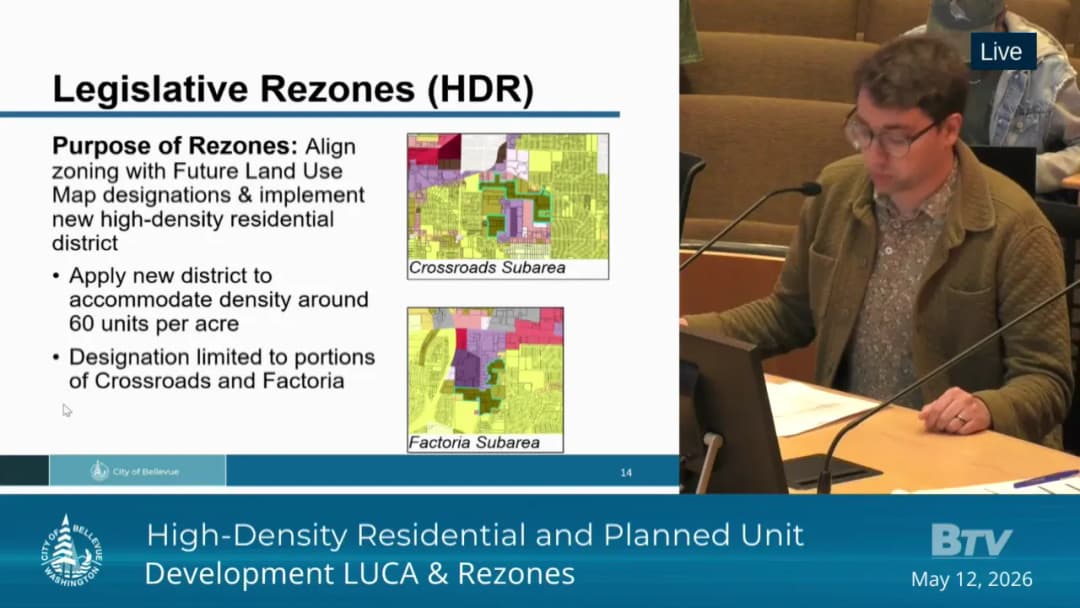
The Bellevue City Council met on May 12, 2026, starting at 2:00 PM. The meeting opened with a flag salute, roll call (Mayor Malakutin, Deputy Mayor Hamilton, Councilmembers Bargava, Newenhouse, Robinson, Sumatoria, and later Breyer), and four proclamations. Public comments were heard on a proposed targeted residential protest ordinance (Ordinance 6917) and on land‑use issues. The council then held study sessions on the 2027 sewer rate and capacity charge, and on high‑density residential and planned unit development (PUD) land‑use code amendments. The meeting concluded with adoption of Ordinance 6917. Consent Calendar - The consent calendar was approved by unanimous voice vote (moved by Deputy Mayor Hamilton, seconded by Councilmember Newenhouse). No items were pulled. Proclamations - Asian American, Native Hawaiian, and Pacific Islander Heritage Month (May 2026): Read by Councilmember Sumatoria. Accepted by a representative of CIC (Community and Immigrant Centers), who emphasized belonging and year‑round action. Former Councilmember Lee also spoke. - National Public Works Week (May 17–23, 2026): Read by Councilmember Breyer. Accepted by Lucy Liu (Utilities Director), Mark Poe (Transportation), Shelley McVane (Parks), and John Reshaw (Finance). Speakers highlighted the collaboration across departments. - National Police Week (May 10–16, 2026): Read by Councilmember Newenhouse. Accepted by Captain Benjamin Jones, who noted the department’s participation in a 250‑mile police unity tour honoring Officer Jordan Jackson. - Older Americans Month (May 2026): Read by Councilmember Bargava. Accepted by Shilpa Mehta of the Bellevue Network on Aging, emphasizing the year’s theme “Champion Your Health.” Public Comments & Testimony Oral communications (30‑minute period) included 17 pre‑registered speakers. The following positions were expressed: - Ordinance 6917 (Targeted Residential Protest): - In opposition: Nedine Hu (Seattle DSA) urged rejection, arguing the ordinance restricts political speech and has a chilling effect. Tony Andrews (Bellevue resident) stated the definition of “protest” is overly broad, and the ordinance could criminalize silent gatherings. Joseph Osteller (Seattle Against War) said the ordinance would shield Representative Adam Smith from accountability and suppress constituents’ right to protest at his home. Carla Capone criticized the ordinance for potentially equating campaign support with illegal protest. - In support: David Ellenhorn (Bellevue resident) said the ordinance is needed to prevent intimidation and harassment at homes. John Meyer (neighbor of Rep. Smith) described mob behavior, vandalism, and threats, urging passage. - Land Use / Overlake Farm & Code Amendments: - Laura Bachman (Overlake Farm owner) expressed support for the legislative rezone and for studying PUD code amendments that allow modest height increases in exchange for tree preservation. - Ian Morrison (McCullough Hill, for Overlake Farm) supported the staff recommendation and urged the council to study height incentives up to 65 feet for significant tree preservation. - Pamela Johnston (Bridal Trails) criticized the density increases, stating the city has not adequately educated residents and questioning whether the EIS studied the cumulative impacts. - Barbara Hughes (Bridal Trails resident, online) expressed concern about increased density at Overlake Farm (up to 300 units on 20‑acre site), potential height of 52–65 feet, tree loss, stormwater runoff, and traffic impacts on 140th Avenue NE. - Sewer Rates: - Al Diedeman urged the council to request more transparency from King County on the formula used to set sewer rates, and to evaluate alternatives to delay expansion projects. Discussion Items 1. 2027 Sewer Rate & Capacity Charge Proposal (Study Session) Director Lucy Liu (Bellevue Utilities) introduced the topic, noting that King County costs comprise nearly 60% of a typical residential sewer bill. King County Wastewater Treatment Division Director Cameron Grohl presented the county’s proposed 12.75% rate increase for 2027, with double‑digit increases projected for several years. The increase is driven by regulatory compliance (combined sewer overflow projects), high‑risk asset management, and system growth. Grohl described the 20‑year capital forecast and the need to balance affordability with regulatory obligations. He noted an independent third‑party review is underway and that a long‑range plan (RWSP update) will incorporate affordability. Councilmembers expressed concern about the cumulative burden on residents, especially seniors and fixed‑income households. They supported a regional letter from Sound Cities Association urging King County to address affordability, transparency, and cost containment. Councilmembers asked about internal efficiencies, the role of CSO projects, and plans for improved ratepayer assistance. Liu highlighted Bellevue’s existing utility assistance programs (70% discount for low‑income seniors/disabled, emergency assistance, and the Neighbors Helping Neighbors program), which served about 1,000 households last year. 2. High‑Density Residential & Planned Unit Development (PUD) Land‑Use Code Amendments and Legislative Rezones (Study Session) Nick Whipple (Code & Policy Director) and Sean Edgeill (Senior Planner) presented the scope of work. The package includes: - Creating a new high‑density residential (HDR) land‑use district to implement the 2024 Comprehensive Plan (up to 60 dwelling units per acre, building heights yet to be set). - Updating the PUD code (last updated in the 1990s) to make it a viable tool for large sites (10+ acres) by providing flexibility, objective standards, and incentives for affordable housing and tree preservation. - Legislative rezones: applying the new HDR district to portions of Crossroads and Factoria, and rezoning a portion of Overlake Farm to low‑density residential to support a future PUD. Councilmembers supported initiating the work. Several urged robust community engagement, especially in Crossroads and Bridal Trails. Deputy Mayor Hamilton suggested studying height incentives up to 65 feet for significant tree preservation on sites over 10 acres. Councilmember Newenhouse cautioned against “density fatigue” and emphasized maintaining what makes Bellevue liveable. Public comments earlier had raised concerns about traffic, tree loss, and infrastructure adequacy. The council voted unanimously to direct staff to initiate work and refer the matter to the Planning Commission. 3. Ordinance 6917 – Targeted Residential Protest City Manager Carlson and City Attorney Tannis presented the ordinance, which creates a gross‑misdemeanor offense for protesting in groups of four or more people in a manner that is narrowly directed at a residence in a residential land‑use district. The legal basis is the U.S. Supreme Court case Frisbee v. Schultz. The ordinance aims to balance First Amendment rights with the right to privacy and tranquility in the home. The definition of “protest” includes standing or patrolling with or without signs or noise, and “targeted” is defined by a focused posture or route directly in front of or adjacent to a residence. Council debate: Councilmember Robinson supported, citing personal experience of being targeted and the need to protect elected officials from intimidation. Councilmember Sumatoria expressed internal conflict but ultimately supported, noting that home should be a sacred place and that she had received a threatening phone call at home. Councilmember Breyer opposed, stating the ordinance is too broad and may infringe on free speech. Councilmember Newenhouse supported, highlighting the narrow tailoring and the importance of protecting families from coordinated intimidation. Deputy Mayor Hamilton argued the ordinance is content‑neutral and aligns with Supreme Court precedent. The council also discussed implementation, including police training and the burden of proof. The ordinance was adopted on a voice vote with some opposition (Councilmember Breyer voting no). Key Outcomes - Consent Calendar: Approved unanimously. - 2027 Sewer Rate Letter: Council expressed support for the Sound Cities Association’s regional letter urging King County to address affordability and transparency. No formal vote was taken, but direction was given. - Land‑Use Code Amendments & Rezones: Motion passed unanimously to direct staff to initiate work and refer to the Planning Commission. The scope includes studying height incentives of up to 65 feet for significant tree preservation on large sites. - Ordinance 6917 (Targeted Residential Protest): Adopted on a voice vote (ayes prevailed, with one nay). The ordinance amends Bellevue City Code adding new Section 10.06.130, effective upon publication.

WATER AND WASTEWATER MANAGEMENT 29% · PUBLIC SAFETY 17% · PROCEDURAL 15% · MISCELLANEOUS 15%
47
MAY 12, 2026 · BELLEVUE, WASHINGTON · CITY COUNCIL
Bellevue City Council Meeting - May 12, 2026: Sewer Rates, Land Use, and Protest Ordinance

The Bellevue City Council met on May 12, 2026, beginning at 2:00 PM. The meeting included four proclamations, a consent calendar, 17 pre-registered public comments, and three major study sessions: a proposed 2027 sewer rate increase, land use code amendments for high-density residential and planned unit developments, and an ordinance to criminalize targeted residential protests. The council also voted to adopt Ordinance 6917 and to initiate work on land use code amendments. Proclamations - Asian American, Native Hawaiian, and Pacific Islander Heritage Month: Councilmember Sumateria read the proclamation. Speakers included a representative from CIC (Center for Inclusive Communities) and former council member Lee, who emphasized the importance of recognizing diversity and history. - National Public Works Week: Councilmember Breyer read the proclamation for May 17-23, 2026. Lucy Liu (Utilities Director), Mark Poe (Transportation Deputy Director), Shelley McVane (Parks and Community Services), and John Reshaw (CFO) accepted and highlighted the work of public works professionals. - National Police Week: Councilmember Newmanhouse read the proclamation for May 10-16, 2026. Captain Benjamin Jones accepted, noting the police department's participation in a 250-mile bike ride to honor fallen Officer Jordan Jackson. - Older Americans Month: Councilmember Barkava read the proclamation for May 2026. Shilpa Mehta from the Bellevue Network on Aging accepted, emphasizing this year's theme \"Champion Your Health.\" Consent Calendar - The consent calendar was approved unanimously (moved by Deputy Mayor Hamilton, seconded by Councilmember Newmanhouse). Public Comments & Testimony Seventeen pre-registered speakers addressed the council, with a 30-minute limit. Topics included: - Opposition to Ordinance 6917 (targeted residential protest): Three speakers (Nedine Hu for Seattle DSA, Tony Andrews, Joseph Osteller for Seattle Against War) argued the ordinance is overly broad, chills free speech, and would criminalize peaceful protest at the home of Representative Adam Smith. - Support for Ordinance 6917: David Ellenhorn and John Meyer argued the ordinance is necessary to prevent intimidation and harassment, citing personal experiences and safety concerns. - Land Use/Overlake Farms: Laura Bachman and Ian Morrison (for Overlake Farms) supported the planned unit development (PUD) amendments and rezone, requesting study of height increases up to 65 feet for tree preservation. Pamela Johnston (Bridal Trails) opposed increased density, questioning environmental review. Barbara Hughes (Bridal Trails) expressed concerns about density, traffic, and wildlife impacts. - Sewer Rates: Al Diedeman urged greater transparency and affordability analysis for King County's proposed sewer rate increases. - Campaign Signs: Carla Capone began a statement about campaign sign blight but was cut off for not yielding to earlier warnings. Discussion Items Study Session 1: 2027 Sewer Rate and Capacity Charge Proposal King County Wastewater Treatment Division Director Cameron Grohl presented a proposed 12.75% rate increase for 2027, with double-digit increases forecast through the mid-2030s, driven largely by combined sewer overflow (CSO) compliance and aging infrastructure. Councilmembers expressed alarm over the cumulative 215% increase over 20 years and its impact on affordability. Deputy Mayor Hamilton, Councilmember Newmanhouse, and others supported a regional letter from Sound Cities Association (SCA) urging King County Council to consider affordability measures. Councilmember Robinson asked about state/federal funding and public education. Director Grohl outlined cost-containment efforts and a long-range planning update (RWSP). Councilmember Sumateria requested better communication and ratepayer assistance. Lucy Liu noted Bellevue’s existing utility assistance programs (70% discount for low-income seniors/disabled, emergency waivers) serving about 1,000 households annually. The council expressed unanimous support for the SCA letter. Study Session 2: High Density Residential and Planned Unit Development Land Use Code Amendments and Legislative Rezones Nick Whipple and Sean Eicholz (Development Services) presented a proposed work plan to implement the 2024 Comprehensive Plan. Three components: (1) create a new high-density residential (HDR) district (up to 60 units/acre, 40-60 ft height) for areas around Crossroads and Factoria malls; (2) update the planned unit development (PUD) code (first updated in 1990s) to provide incentives for affordable housing, tree retention, and open space, including possible height increases up to 65 feet on sites over 10 acres; (3) process legislative rezones, including Overlake Farms (to low-density residential with PUD). Councilmembers raised concerns about infrastructure capacity, engagement with neighborhood associations (especially Bridal Trails), and ensuring density aligns with community character. Deputy Mayor Hamilton urged \"bold\" implementation. The council voted unanimously to initiate the work and direct the Planning Commission to review. Ordinance 6917: Targeted Residential Protest City Attorney Trishna Khanna and Deputy City Manager Diana Carlson presented an ordinance to create a new gross misdemeanor for targeted residential protest. The ordinance prohibits protest activities (including standing, marching, with or without signs or noise) by four or more people focused on a specific residence in a residential land use district, based on the U.S. Supreme Court case Frisbee v. Schultz. Councilmembers engaged in extensive debate. Councilmembers Robinson, Newmanhouse, Deputy Mayor Hamilton, and Mayor Malikutian supported the ordinance, citing the need to protect residential privacy and safety, and noting that the ordinance is narrowly tailored and content-neutral. Councilmember Breyer opposed, arguing it is too broad and may infringe on free speech. Councilmember Sumateria expressed internal conflict but ultimately supported for the sake of family safety. Councilmember Barkava asked clarifying questions. The council discussed implementation training for police and burden of proof. The council voted 6-1 to adopt Ordinance 6917, with Councilmember Breyer dissenting. Key Outcomes - Approved consent calendar (unanimous). - Supported SCA letter regarding King County sewer rates (consensus, no formal vote but directed staff). - Initiated work on HDR and PUD land use code amendments and legislative rezones (motion by Deputy Mayor Hamilton, seconded by Councilmember Barkava, unanimous). - Adopted Ordinance 6917 defining targeted residential protest as a gross misdemeanor (vote: 6 in favor, 1 opposed). Effective date set. The meeting adjourned after a brief governmental affairs update.

WATER AND WASTEWATER MANAGEMENT 35% · PUBLIC SAFETY 17% · MISCELLANEOUS 16% · AFFORDABLE HOUSING 15%
48
MAY 8, 2026 · BELLEVUE, WASHINGTON · CITY COUNCIL
Bellevue Environmental Services Commission Meeting - May 8, 2026

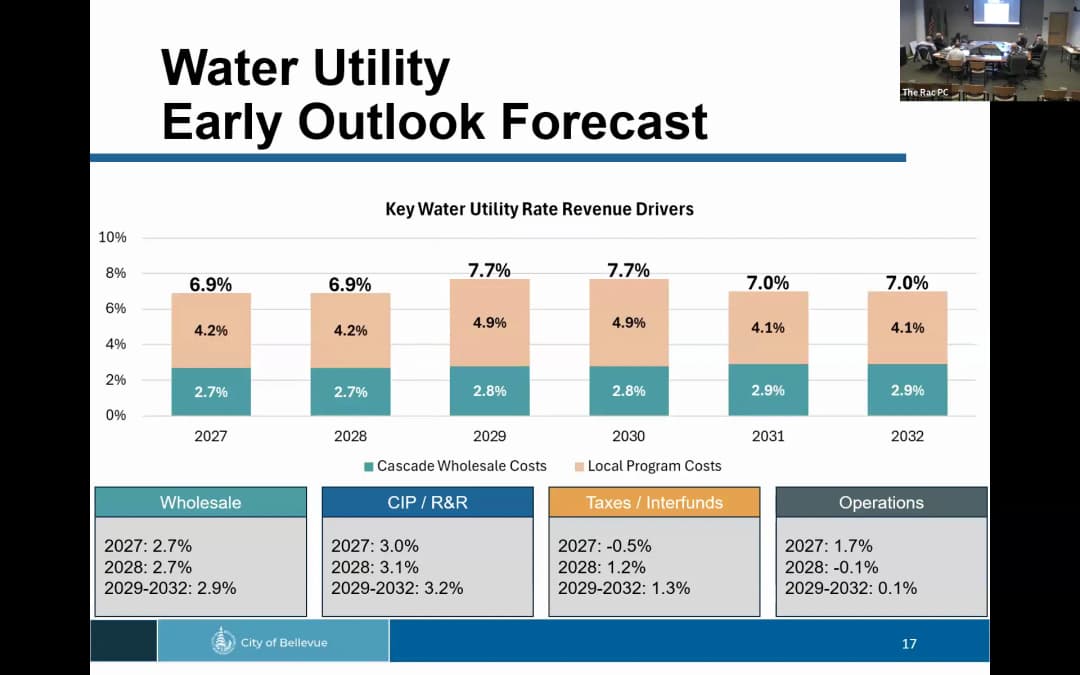
The Environmental Services Commission (ESC) met on May 8, 2026, at 6:30 p.m. to review the draft Water System Plan, receive the early outlook utility rate forecast for 2027‑2032, and discuss proposed changes to utility connection charges. The meeting also included public comments on utility assistance and veteran discounts, a staff update on sewer equity recommendations adopted by City Council, and approval of previous minutes. Consent Calendar - The meeting agenda was approved by voice vote with no objections. - The April 2, 2026, meeting minutes were approved with a correction: the CIP budget breakdown listed “$86 dollars” was changed to “$86 million.” Public Comments & Testimony - Jennifer Fisher (Executive Director, Bellevue Life Spring) — Submitted a written comment requesting expansion of the utility bill assistance program to support low‑income residents with children, not just seniors. She reported that from July 1, 2025, to March 19, 2026, Bellevue Life Spring paid 51 water bills totaling $30,002.92 for families (80 adults and 112 children under 18). Of these, 16 payments went directly to the City of Bellevue for $21,971.94 (average $1,373.25 per family) and 35 payments went to landlords for $8,051.98 (average $230 per family). - Mr. Nordhorn (public) — Stated he is a 100% disabled veteran and requested that the City of Bellevue establish a meaningful discount on utility rates for 100% disabled veterans. He noted that in Washington State there are 155,000 veterans, with 35,000 at 80% disability, 25,000 at 90%, and 7,000 at 100% disability. He suggested that after meeting with the mayor and city staff, the request should be placed on the ESC’s agenda for a recommendation to City Council. He emphasized that veterans want a discount, not a handout. - Alex Zimmerman (public) — Expressed strong opposition to city policies, the mayor, and the City of Bellevue’s public comment rules, which he claimed violate the First Amendment. He made controversial statements about the mayor and commission members. Discussion Items - Staff Report — The ESC was informed that City Council unanimously adopted all ESC recommendations from the sewer equity analysis. Staff have been directed to incorporate the commission’s sewer rate recommendations into the overall utility rates as part of the upcoming biannual budget. The commission was also reminded of the Boards and Commissions Appreciation event the following Monday. - Water System Plan Draft Review — Staff presented the first draft of the updated Water System Plan (informational only, no vote). Key points: - The plan ensures clean, safe, and reliable water service for the next 20 years, aligned with the 2044 Comprehensive Plan policies. - The system is performing well overall. Storage deficiencies in the west region (Downtown/Bell‑Red/Wilburton) will be addressed by the Maidenbauer South Reservoir project (completion by 2031). - Fire flow and minimum pressure deficiencies exist in a few areas and will be handled through the water main replacement program and future capital projects. - Emergency water supply planning (earthquake resilience) continues, focusing on developing emergency groundwater supplies and a resilient backbone pipe network. - Staff do not propose new policies; existing policies are sufficient. Community engagement will include a virtual open house and outreach this summer. - The draft plan will be shared with regulators and neighboring agencies; a final recommendation to City Council is expected later in 2026. - 2027‑2032 Utilities Early Outlook Rate Forecast — Staff presented a six‑year rate forecast based on the latest operating and capital cost projections. Key drivers: - Water: Annual rate increases of 6.9% for 2027‑2028, then 7.7% in 2029‑2030, and 7.0% in 2031‑2032. Approximately 2.8% per year is driven by Cascade Water Alliance wholesale supply cost increases; 3.0‑3.2% per year comes from the capital funding strategy. - Sewer: Annual rate increases of 9.9% for 2027‑2028, 11.0% in 2029‑2030, and 9.2% in 2031‑2032. About 6.2‑6.9% per year reflects higher King County wastewater treatment costs; 2.5% per year supports capital and asset management. - Stormwater: Lower increases than in prior forecasts; major driver is the capital improvement program and a one‑time vehicle replacement in 2027. - Combined typical single‑family monthly bill: Estimated to rise by about $18 in 2027 (to $248) and reach $371‑$391 by 2032 (including the sewer cost‑of‑service equity adjustments approved by Council). - Staff emphasized that the forecast does not include the recently approved ESC equity recommendations (would add $3 in 2027). Community meetings and online outreach will continue throughout the spring and summer. - Changes to Utility Connection Charges (Informational) — Staff proposed three amendments to Bellevue City Code: 1. Eliminate the Direct Facility Connection Charge (DFCC) and absorb its costs into the Capital Recovery Charge (CRC). The DFCC created affordability barriers for properties on septic (historically only half of costs recovered). 2. Simplify the CRC calculation by basing it on water meter size instead of fixture counts (transparent, equitable, and regionally common). 3. Change the timing of CRC collection from the utility bill (spread over 10 years) to the permitting stage (consistent with other development fees). - Staff noted that connection charges generated $5 million in 2026 versus $205 million in rate revenue; the proposed changes would have minimal impact on rates. Developer feedback was generally supportive, with some preferring the option to pay at certificate of occupancy. A formal recommendation will be brought to ESC in June. Key Outcomes - Approvals: Agenda and April 2 minutes approved. - Council Adoption of ESC Recommendations: Council adopted all ESC sewer equity recommendations; staff will incorporate them into utility rates. - Next Steps for Water System Plan: Staff will share the draft with regulators and the community; the ESC will consider a recommendation later in 2026. - Rate Forecast: The ESC will receive updated forecasts in June and July; a public hearing and formal vote on the budget and rates are scheduled for September. - Connection Charges: Staff will return in June for commission concurrence on the proposed code amendments, with a goal of implementation in 2027. - Calendar: A field trip to CIP projects is planned for the next ESC meeting (two weeks from May 8); elections will be held in June.

WATER AND WASTEWATER MANAGEMENT 79% · COMMUNITY ENGAGEMENT 5% · FISCAL SUSTAINABILITY 5% · MISCELLANEOUS 3%
49
MAY 5, 2026 · BELLEVUE, WASHINGTON · CITY COUNCIL
Bellevue City Council Meeting – May 5, 2026: Proclamations, TIF, Downtown Livability, Federal Agenda

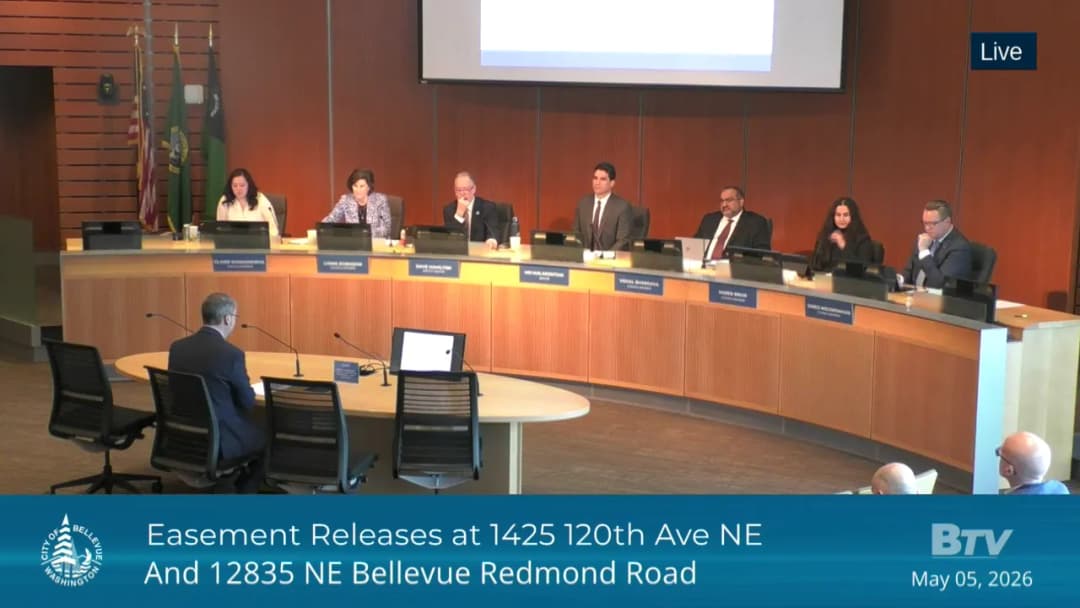
The Bellevue City Council met on May 5, 2026, to issue four proclamations, hear public comments, and conduct study sessions on the Grand Connection Tax Increment Financing (TIF), Downtown Livability 2.0 land use code update, and the 2026-2027 Federal Agenda. The council approved several items including a consent calendar, easement releases, and directed staff on key initiatives. Consent Calendar - Ordinance 6915 – Approved a funding agreement with KidsQuest Children's Museum for up to $10 million over two biennia to open a new downtown facility, and amended the 2025-2026 general fund budget to increase appropriation by $4.5 million from the long-range planning reserve. - All other routine consent items were approved unanimously. Public Comments & Testimony - Tim Carr (CEO, Bellevue Convention Center Authority) expressed strong support for the Grand Connection Crossing project and TIF as a funding tool, citing economic competitiveness and livability. - Catherine Hollis (Executive Director, Eastrail Partners) supported the crossing, emphasizing its role in connecting affordable housing, employment, and transit via a car-free pathway. - Armand Bilga (Eastside Urbanism/Complete Streets Bellevue) celebrated Bike Everywhere Month and urged continued investment in bicycle infrastructure. - Peter Burt (President/CEO, KidsQuest Children's Museum) thanked the council for supporting the museum's relocation to downtown Bellevue. - Kevin Willis (Lakemont resident) supported TIF, praising staff for the complex proposal and noting it frees up funds for other transportation projects. - Jessica Rowe (attorney, McCullough Hill, on behalf of the Plus Committee) expressed support for Downtown Livability 2.0 and urged specific code provisions for pedestrian connections, parking, and weather protection. - Matt Jack (Bellevue Downtown Association) supported the Downtown Livability 2.0 launch, promoting clarity, predictability, flexibility, and periodic code updates. - Paul Rood (resident) criticized noise regulation enforcement over 30 years, alleging regulatory capture and lack of police action on construction noise; urged council to update noise regulations. - Arlene Northhorn (resident) raised concerns about lack of progress on discount programs for 100% disabled veterans, noting no follow-up from utility staff or Environmental Services Commission. Discussion Items Grand Connection Tax Increment Financing (TIF) - Staff presented a proposal to establish a TIF area for the Grand Connection Crossing, a half-mile pedestrian/bike bridge over I-405. The TIF would capture property tax growth from 33 parcels (64.5 acres) over 25 years, using a conservative $84.4 million revenue estimate. - All six overlapping taxing districts (King County, King County EMS, King County Flood Control, King County Library System, Port of Seattle, Sound Transit) voted to participate, contributing a total of $67.7 million. - Councilmembers expressed strong support, noting the project's regional benefits, no new taxes, and the staff's successful coordination with other jurisdictions. - Outcome: Motion passed unanimously to direct staff to prepare the TIF ordinance for final action. Downtown Livability 2.0 (DTL 2.0) - Staff introduced the land use code amendment process to refine downtown regulations, focusing on evening vitality, housing production, Main Street character, streamlined code, and pedestrian environment. - Council discussed the need for measurable outcomes, incentivizing small businesses, preserving Old Bellevue's character, and proactive engagement with residents, businesses, and developers. - Outcome: Motion passed unanimously to initiate the DTL 2.0 code amendment and direct the Planning Commission to review and process it. 2026-2027 Federal Agenda - Staff presented the draft federal agenda covering key priorities (transportation, water infrastructure, housing, safety net) and policy statements. The city has one new congressional funding request: $1 million for the Safer Signals Program (real-time traffic signal safety). - Council discussed amendments: adding language on energy ratepayer impacts from data centers, water infrastructure cost increases, responsible data sharing for public safety, and strengthening municipal bond and financing tools. Several amendments were added. - Outcome: Motion passed to adopt the 2026-2027 Federal Agenda as amended, with minor adjustments. Key Outcomes - TIF Direction: Council directed staff to prepare the ordinance establishing the Grand Connection TIF area for future adoption. - DTL 2.0 Initiation: Council directed staff to begin the Downtown Livability 2.0 land use code amendment process, with Planning Commission review. - Federal Agenda Adoption: Council approved the 2026-2027 Federal Agenda with amendments, including a new funding request for the Safer Signals Program. - Appointment: Council appointed Carolyn Bassana to the Human Services Commission for a partial term. - Easement Releases: Council approved two resolutions authorizing the release of portions of easements at 1425 120th Avenue NE (sidewalk/utility) and 12835 NE Bel-Red Road (water easement).

ECONOMIC DEVELOPMENT 22% · LAND USE AND ZONING 15% · FISCAL SUSTAINABILITY 11% · PROCEDURAL 9%
50
APR 28, 2026 · BELLEVUE, WASHINGTON · CITY COUNCIL
Bellevue City Council Meeting - April 28, 2026: World Cup, Sewer Rates, and Curb Pricing

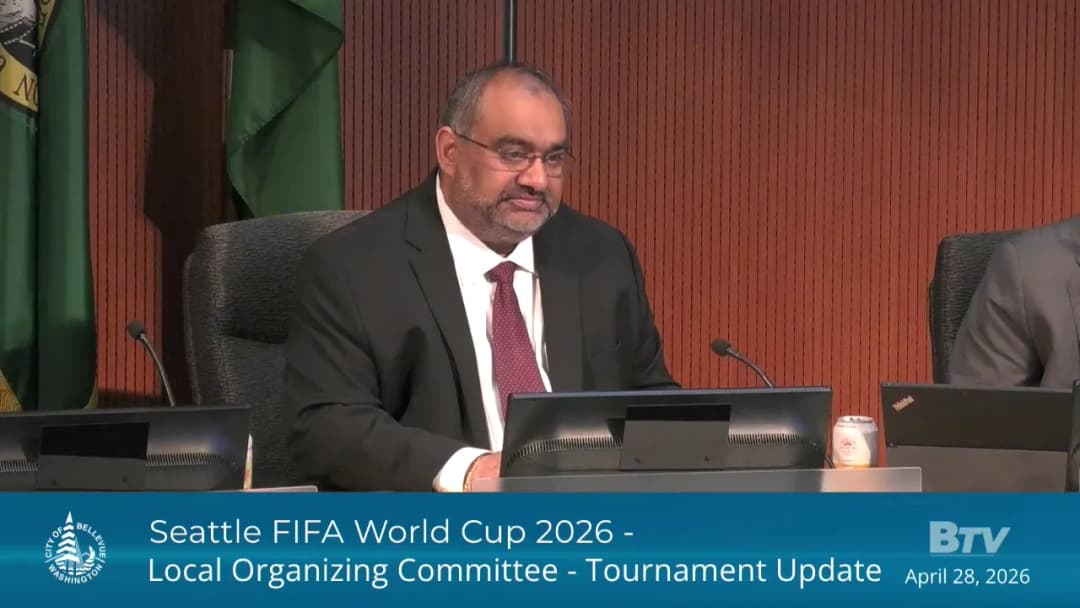
The Bellevue City Council met on April 28, 2026, at 2:00 PM (with the meeting extending into the evening, adjourning around 8:00 PM). The meeting included three proclamations, one public comment, a presentation on the 2026 FIFA World Cup, a discussion on sewer rate equity, and a presentation on a proposed paid on-street parking program. Councilmember Breyer was excused, and Councilmember Robinson joined late. Proclamations - International Firefighters' Day (May 4, 2026): Councilmember Newinhouse read the proclamation, recognizing the bravery of firefighters and the Bellevue Fire Department’s international accreditation. Fire Chief and personnel thanked the council for support, noting the new Fire Station 10 and improved response times. - Therapeutic Court Month (May 2026): Councilmember Bhargava read the proclamation, highlighting the role of therapeutic courts in public safety and recovery. Judge Lisa O'Toole and Probation Manager Craig Fritz spoke about the new Bellevue Community Court and the Community Resource Center, which has provided services including IDs and over 115 hours of community service by 15 individuals. - Public Service Recognition Week (May 3–9, 2026): Deputy Mayor Hamilton read the proclamation honoring public employees. Deputy City Manager Nathan McComan thanked the council, emphasizing the city’s core value of customer service. Consent Calendar - The council approved the consent calendar unanimously, which included routine approvals. Public Comments & Testimony - Maria Hudson spoke during oral communications, expressing strong opposition to the city’s handling of a child sex trafficking investigation. She argued that the police department’s internal investigation constitutes a conflict of interest and violates the Klu Klux Klan Act, calling for a third-party investigation. She stated that the department “buried evidence, buried witnesses” and described the situation as “eugenics-based exploitative convict leasing genocide program.” Discussion Items - 2026 FIFA World Cup Presentation: Dylan Ordonias, Senior Vice President of External Affairs for the Seattle Local Organizing Committee, provided an update on the tournament schedule (June 15–July 6, 2026, six matches in Seattle), security coordination, transit options, and fan zones. He noted that the United States men’s national team will play on Juneteenth, and that Bellevue’s hotels are tracking higher rates. Councilmembers discussed security, immigration enforcement, and community engagement. Deputy Mayor Hamilton asked about federal immigration enforcement; Ordonias stated the committee does not control federal policy but has coordinated with law enforcement. - Sewer Rate Equity Analysis: Utilities Department staff (Lucy Liu, Scott Edwards, Matt Hobson) and Environmental Services Commission Chair Ken Wan presented the results of a financial equity analysis. The analysis found that multifamily customers are paying 123% of their fair share (23% more than the cost to serve them), while single-family and non-residential customers are at 91% (low end of the reasonable range). The imbalance is due to an outdated rate structure that overcharges multifamily units. The commission recommended a 5-year phase-in to achieve equity by 2031, with annual rate adjustments of 9-11% driven largely by King County wholesale cost increases. Councilmembers expressed concern about affordability, especially for fixed-income seniors and low-income households. Staff noted that utility bill assistance programs are available (70% discount for qualifying seniors/disabled, emergency assistance, etc.) and that they will return in June with expansion options. The council directed staff to incorporate the commission’s recommendations into the upcoming budget. - Curb Pricing Program: Transportation Department staff (Andrew Singolakis, Chris Long) presented proposed code amendments to establish a paid on-street parking program. The program would use dynamic pricing (range $1–$8 per hour, adjusted by the transportation director up to twice a year based on occupancy data) to achieve 1–2 open spaces per block face. The initial zone covers downtown, Old Bellevue, and Spring District. Revenue after operating costs would be reinvested into curb management initiatives (e.g., wayfinding, bellhop late-night service, street activation, transit improvements). Councilmembers discussed the impact on businesses, employee parking, enforcement, and the proposal to offer the first 30 minutes free (rejected due to revenue loss). The council directed staff to finalize the code amendments and prepare an ordinance. Key Outcomes - Motion to excuse Councilmember Breyer passed unanimously. - Motion to approve the agenda passed unanimously. - Motion to approve the consent calendar passed unanimously. - Motion to direct staff to incorporate the Environmental Services Commission’s sewer rate recommendations into the proposed utility rates for the upcoming biennial budget passed unanimously. - Motion to direct staff to finalize Bellevue City Code amendments and prepare an ordinance for a paid on-street parking program passed unanimously.

WATER AND WASTEWATER MANAGEMENT 30% · ECONOMIC DEVELOPMENT 19% · ENGINEERING AND INFRASTRUCTURE 14% · TRANSPORTATION SAFETY 14%
OPENPUBLICA · PUBLIC MEETING INDEXUPDATED DAILY · openpublica.com