Browse by city
Date range
Search help

Search titles, summaries, topics and stored transcripts together. Keywords may match separately; put the whole query in double quotes for a phrase. Matching follows word analysis, so punctuation is not exact. Both dates are included. Documents are not searched.

SHOWING 11–20 ENTRIES
11
JUL 15, 2026 · BEND, OREGON · CITY COUNCIL
Bend City Council Business Meeting – July 15, 2026

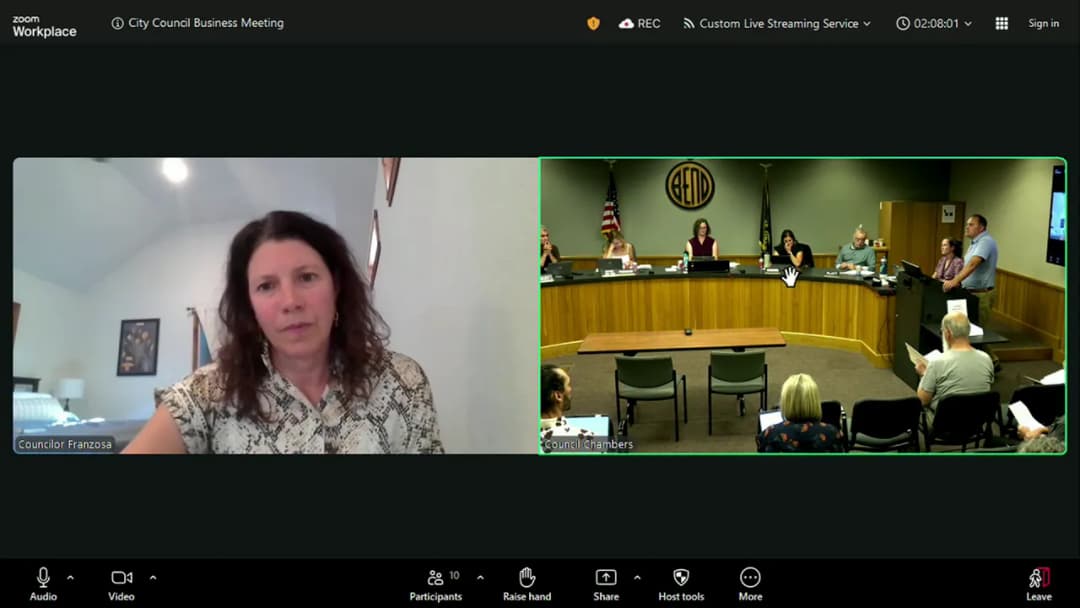
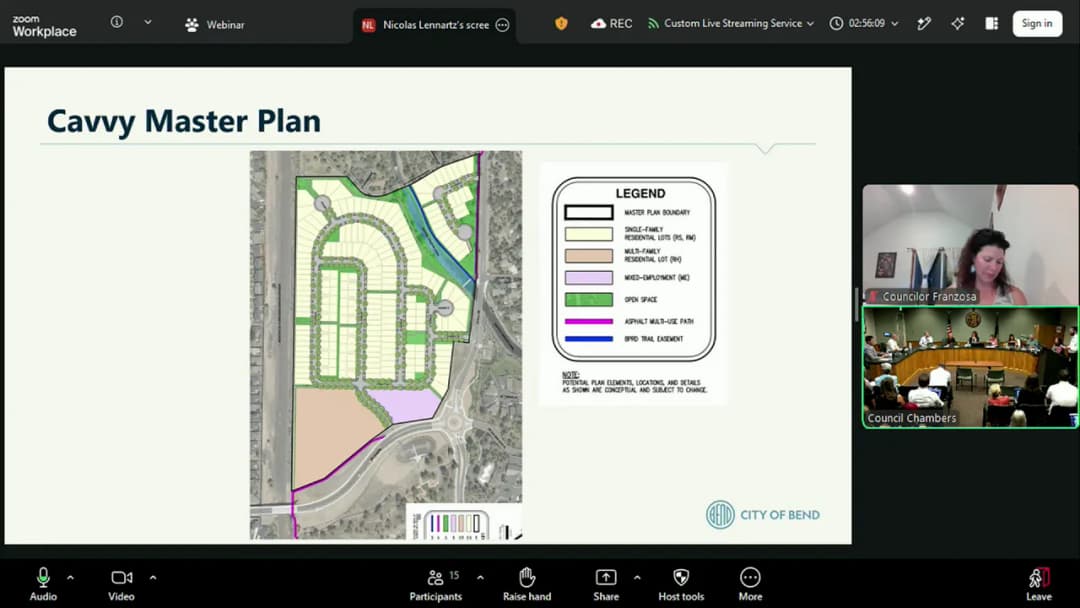
The Bend City Council held a business meeting on July 15, 2026, covering a range of topics including a shared framework with BPRD, councilor reports, public comments on privacy and youth programs, a consent agenda item on an owner's representation contract, continued deliberation on the Cavity Master Plan, a public hearing on the Bend Central District Economic Improvement District (EID) where objections exceeded the 33% threshold leading to termination, adoption of a resolution for extended enterprise zone tax abatements, approval of an intergovernmental agreement for transit bond funds, and a second reading of an annexation ordinance. The meeting also included discussion on financial tools to support the Legacy Village development. Consent Calendar - Approved consent agenda except Item D. - Item D: Professional services contract with Consor North America Inc. for owner's representation for the only and reviewer intersections project (progressive design build) in an amount not to exceed $1,155,306. Councilor Franzosa questioned the need and cost; staff explained it protects the city due to the alternative delivery method. Approved with one opposed (Councilor Franzosa). Public Comments & Testimony - Michael Baker (CEO, Boys & Girls Clubs of Central Oregon): Reported summer program capacity and gold card ceremony, noting 67 children have attended 105 days (up from 38 last year). Encouraged referrals for families in need. - Jonathan Westmoreland (Bend Privacy Alliance): Expressed concerns about privacy and cybersecurity in city systems (e.g., water meters, cloud software). Requested a standard privacy process for technology procurement, stating granular utility data can reveal household patterns. Thanked staff for engaging but emphasized the need for clear rules. Councilor Reports and Updates - Councilor Franzosa: Attended Warm Springs tribal council meeting (June 30) and Central Oregon Villages open house. Highlighted shared water resource concerns and need for community support for the Villages' move. - Councilor Riley: Attended Paiute Shah Treaty Day celebration. Expressed dismay over recent ICE activity and killings of immigrants in Maine and Texas; noted fear in the community and called for support. - Councilor Perkins: League of Oregon Cities Energy and Environment Committee voted to support a feasibility study on nuclear energy (small modular reactors). Homeless Leadership Coalition finalized a strategic framework. Bend Economic Development Advisory Board unanimously approved enterprise zone recommendation. - Councilor Norris: Echoed comments on Warm Springs trip (importance of stewardship) and immigration enforcement concerns, referencing the Latino Community Association. - Councilor Platt: Rode with police, EMS, and camping code enforcement; praised empathy of providers. Met with Bend-La Pine schools on growth planning. Highlighted Bend Climate Coalition events. - Mayor Keebler: COCO water meeting with legislators and tribal partners; supported bill to extend sunset on mitigation program. Received flag from Warm Springs tribes. Emphasized impacts of immigration enforcement and resources through Latino Community Association and Portland Immigrant Rights Coalition. Discussion Items Shared Framework with BPRD - City Manager Eric presented a draft framework document to guide city-parks cooperation on property tax exemptions and SDC exemptions. Developed over several meetings with small leadership group. Council to provide feedback; resolution planned for August agenda. Similar effort with school district underway. Cavity Master Plan (First Reading of Ordinance) - Continued deliberation on amendment to Bend Development Code for a 45-acre major community master plan. Planner Nicholas Lenar presented revised findings supporting deviations (e.g., 3,100 linear foot block perimeter) and open space composition: 4.53 acres required, 4.11 provided outside canal easement, 0.42 within. Council condition: multi-use path alignment to be lined up. Motion passed unanimously. Bend Central District Economic Improvement District (EID) – Public Hearing - Staff Sarah Smooney reported: city received written objections from owners representing 59% of commercial square footage (exceeding 33% threshold), so assessments cannot be levied and project must terminate. Public comment: - James Floyd (property owner): Opposed; praised end of process; criticized city’s sound system. - Jack Holt (property owner): Process was good; market message clear; cautioned against adding taxes. - Megan Martin (Furnish Hope): Opposed; would burden nonprofit; their own beautification plans. - Randy Woodlinks (property owner): 943,457 square feet objected; criticized city and BCDBA for not gauging opposition earlier. - Council discussion: Mayor noted value of conversation started; encouraged continued engagement. Motion to certify objections, terminate project, and direct staff to prepare ordinance rescinding EID. Unanimous. Enterprise Zone Extended Tax Abatement Resolution - Staff Katie Brooks and Cyrus Smooney presented resolution to allow up to 10-year property tax abatements (extended from 5-year max) for eligible businesses per HB 4084. Requires council approval on case-by-case basis. School support fee (15%) applies in years 4-10. Moratorium on data centers. Councilor Riley proposed amendment to recital language focusing on job/income growth and supporting local businesses. Resolution approved as amended unanimously. Intergovernmental Agreement with COIC for Transit Bond Funds - Approved IGA to allocate up to $8 million from 2020 Go Bond for transit supportive and transit enhancing capital projects, with initial $1 million transfer. Supports bus stop improvements, micro-mobility hubs, and hub-and-spoke model. Motion passed unanimously. Council thanked outgoing CET manager Bob Townsend for his service. Annexation Ordinance (Second Reading) - Councilor Norris recused due to financial impact on employer (Hayden Homes). Second reading and adoption of ordinance annexing 10 acres in Southeast Urban Growth Boundary expansion area and assigning Sign District 5. Roll call vote: all in favor (Norris recused). City Manager’s Report – Legacy Village Financial Tools - Russ Grayson (COO) presented letter from Hayden Homes requesting exploration of financial tools: local improvement district (LID), reimbursement district, supplemental SDCs, and potential city construction of a roundabout at ReMarket/27th. Staff seeking council direction. Council expressed interest in exploring options, with concerns about equity and impacts on other CIP projects. Staff will bring back options, likely with CIP update in September. Key Outcomes - Consent agenda approved with Item D passed (1 opposed). - Cavity Master Plan first reading approved with condition. - EID terminated due to sufficient objections; ordinance to rescind directed. - Enterprise Zone resolution adopted as amended. - IGA with COIC for transit funds approved. - Annexation ordinance adopted. - Staff directed to explore financial tools for Legacy Village and report back.
ECONOMIC DEVELOPMENT 40% · ENGINEERING AND INFRASTRUCTURE 24% · PROCEDURAL 8% · TRANSPORTATION SAFETY 5%
12
JUN 24, 2026 · BEND, OREGON · CITY COUNCIL
Bend City Council Work Session and Study Session on Development Infrastructure and Utility Rates – June 24, 2026

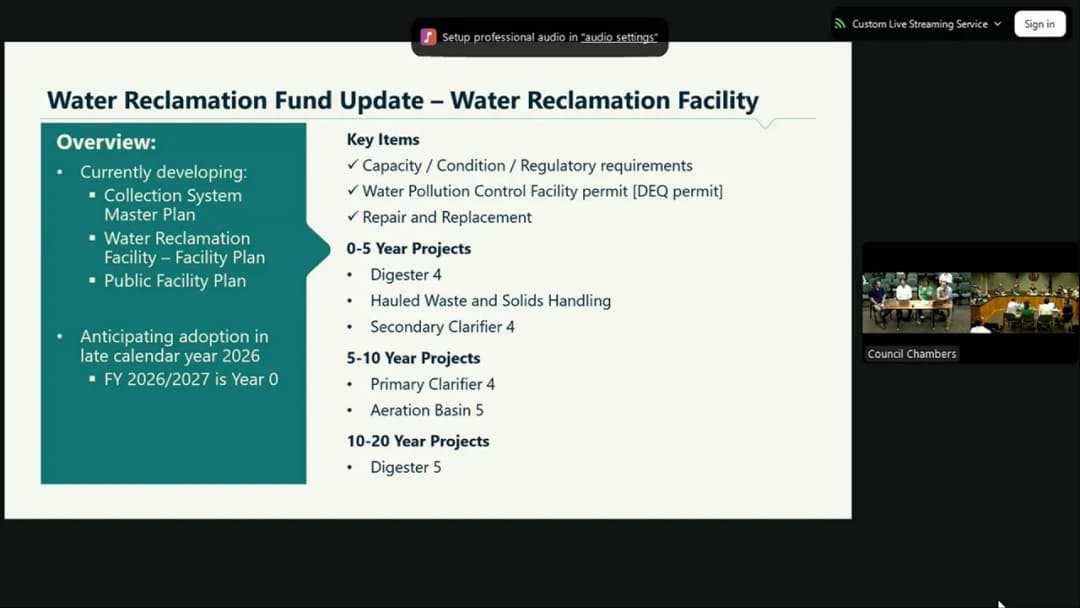
The Bend City Council convened on June 24, 2026, for a work session on development infrastructure requirements for infill housing, followed by a study session on utility capital improvement plans and rate structure. Councilor Francis was excused. Staff presented detailed analyses of how current infrastructure requirements, designed for greenfield development, create barriers for small-scale infill projects, and later briefed the council on upcoming water, stormwater, and sewer projects and the financial pressures on utility rates. Discussion Items Development Infrastructure Requirements for Infill Housing - Sarah Hudson, Senior Policy Analyst, led a presentation on how infrastructure requirements affect infill development. She noted that existing codes were written for greenfield development and that infill projects face disproportionate costs due to aging infrastructure and the need to extend utilities through the "two and through" concept. - Ben Barry, city engineer, highlighted that infrastructure costs vary dramatically by location, citing examples like rock hardness in different parts of Bend that can increase excavation costs. He presented case studies (e.g., 8th and Quimby, 5th and Franklin) where the same number of units could trigger very different requirements depending on adjacent infrastructure. - Renee Brook, planning manager, explained the current regulatory framework: middle housing (duplex, triplex, quadplex) is permitted through building permits with fewer requirements, while land divisions trigger more extensive improvements. The line between types is blurring due to state law changes. - Staff outlined five categories of infrastructure challenges: right-of-way dedication, sidewalks, frontage improvements (two and through), utility extensions, and site constraints. They proposed administrative actions (e.g., expanding the "do not widen" list), policy changes (e.g., tying requirements to intensity rather than application type), and funding approaches (e.g., fee-in-lieu programs, city funds). - Council guidance was sought on several questions: Should every new dwelling contribute to the multimodal network? Should right-of-way be dedicated now or just reserved? Should sidewalks be modernized through infill? Should two-and-through extensions be required when adjacent infill potential is limited? - Council members expressed support for creating a voluntary discretionary path for small-scale infill projects, focusing on intensity of use rather than application type, expanding fee-in-lieu programs beyond sidewalks, and expanding the do-not-widen list. They also emphasized the need to balance near-term housing with long-term system needs. Utility Capital Improvement Plans and Rate Structure - Ryan Oster, Engineering Director, introduced the utility portion as an information session. Brittany Barker presented updates on water and stormwater projects: the Outback facility improvements (NEPA completed, moving to town site act), Franklin water line improvements underway, and stormwater challenges on South Aubrey Butte where core samples showed solid rock to 100 feet, requiring alternative solutions. - Jason Sir presented on water reclamation: the collection system master plan and facility plan for the Water Reclamation Facility (WRF) are in progress, with adoption expected in fall 2026. Key projects include Digester 4 (estimated $115-120 million), secondary clarifier, and the East Interceptor in 10-20 years. - Dan (staff) explained the rate-setting process: revenue requirement, cost of service study, and rate design. He noted that current rates (adopted increases of 2-3% in recent years) are insufficient to fund the upcoming capital needs, especially for sewer. The council was asked to confirm that the values of affordability, conservation, proportionality, etc., remain appropriate for future rate discussions. - Gillian Achner, Water Policy Analyst, detailed the existing rate structure: a base charge and a volume charge, with a larger proportion now recovered through volume charges after a 2014 reform. She noted that the council's 2025-27 goals prioritize conservation-based rate structures, and staff are exploring inclining block rates. - Councilor Norris emphasized the importance of conservation in light of potential climate impacts on water supply. Councilor Riley asked about growth assumptions, noting that the city's growth plan is outdated; staff uses PSU projections and historical data. Key Outcomes - Development Infrastructure: Council directed staff to: - Explore a voluntary discretionary path for qualifying small-scale infill projects, with clear definitions to ensure pro-housing intent. - Prioritize shifting infrastructure triggers from application type (subdivision vs. middle housing) to project intensity (number of units). - Expand the do-not-widen list for streets where widening is impractical, and incorporate this into the upcoming Transportation System Plan process. - Develop fee-in-lieu programs for other infrastructure types (e.g., water mains, cycle tracks) beyond the existing Wood River Village sidewalk program. - Consider allowing exceptions to two-and-through requirements where adjacent infill potential is very limited (e.g., at dead ends). - Utility Rates: No formal decisions were made, but council: - Acknowledged the need for a more robust rate discussion in fall/winter 2026 as master plans are finalized. - Reaffirmed the values of affordability, conservation, proportionality, and stability as guiding principles for rate design. - Expressed interest in further analysis of conservation-oriented rate structures, including inclining block rates, and continuation of the low-income assistance program evaluation with the Human Rights and Equity Commission. - Next Steps: Staff will bring code amendments (e.g., middle housing land division package) in July 2026, continue internal discussions on stormwater disposal options, and prepare for the formal biennial budget process starting December 2026.

ENGINEERING AND INFRASTRUCTURE 54% · WATER AND WASTEWATER MANAGEMENT 26% · FISCAL SUSTAINABILITY 12% · AFFORDABLE HOUSING 4%
13
JUN 17, 2026 · BEND, OREGON · CITY COUNCIL
Bend City Council Meeting – June 17, 2026: Budget, Master Plan, Fees, and Climate Fee

The Bend City Council met on June 17, 2026, to address a packed agenda including budget approvals, a controversial major community master plan, fee adjustments, street safety projects, and adoption of a climate pollution fee. The meeting opened with an executive session and a statement recognizing Juneteenth, followed by council reports, public comments, consent agenda, and multiple public hearings. Consent Calendar - Unanimously approved the consent agenda. Public Comments & Testimony - Todd Torchin (Southern Crossing resident and chair) opposed the Chamberlain crossing at Reed Market Road, citing insufficient safety measures and lack of neighborhood engagement. He requested rejection or postponement. - John Halen (Bend resident) highlighted that 5,000 homes in Bend are empty and urged the city to consider a fee or property tax on empty homes. - Brian Adams (Bend resident) asked the council to postpone the climate pollution fee vote to revise ambiguous ordinance language, referencing support from Energize Bend and his daughter's graduation. - Veronica Ramos (Redemption Coffee Company owner) opposed SDC fees and the 10% business registration increase, stating these costs are pushing her business to Redmond. - Joe Bessman (Transite Consulting) requested a 50% reduction in transportation SDC for private recreational facilities based on local survey data, arguing the current method overcharges. Discussion Items - Budget Presentation & Fee Resolution: Dan (Finance) presented budget adjustments for the 25-27 biennium, including year-end loans, state shared revenues, CIP (5-year $557M), staffing schedule (+9.5 FTE plus an additional judge FTE), investment policies, solid waste rates (4.5% increase), and SDC updates. Council directed staff to exempt the mural fee ($676) for one year and pause the 10% business registration increase until January 2027, as a gesture to small businesses. - System Development Charges (SDC): After public comment, council adopted the SDC resolution as presented (vote: 4-1, with Councilor Norris recused). Additionally, council passed a motion (4-1, Councilor Franzoza opposed) to research the private recreation category using Joe Bessman's data and waive appeal fees for applicants in that category until a fall decision. - Cavi Master Plan (Item 6): This quasi-judicial hearing for a 45-acre mixed-use master plan (up to 362 homes, commercial, open space) was continued to July 15 after extensive deliberation. Key issues: whether the canal counts as open space, block perimeter deviation, and internal connectivity. Council directed staff to prepare revised findings reflecting council's consensus to approve the deviation and the open space requirement met even without counting the canal channel. - Cabin Lane Estates Annexation (Item 7): Approved on first reading (unanimous) for a 10-acre, 42-lot subdivision, assigning zoning RS and district 5. - Neighborhood Street Safety Program (Item 8): Council authorized contracts for Package A ($1,278,135) and Package B ($979,609). Package B passed with Councilor Franzoza opposed, citing the project includes paving a gravel road which is beyond the program's scope. - Affordable Housing Incentives (Item 9): Adopted a resolution rescinding prior resolutions and replacing them with an administrative policy for expedited review of deed-restricted affordable housing projects. (Unanimous) - Visit Bend Business Plan (Item 10): Approved the FY 2026-2027 business plan and budget. Visit Bend reported record visitor spending exceeding $400 million and 70% resident positivity toward tourism. - Climate Pollution Fee (Item 11): Adopted on second reading by roll call vote (4-1, Mayor Pro Tem Perkins opposed, Councilor Norris recused). Councilor Platt expressed concern about the burden on homebuilders. - Urban Renewal Agency (BURRA): Approved budget adjustments, CIP, and tax levies. The board endorsed program frameworks for commercial revitalization, tenant improvement, core area mural grants, micro/small business loans, and pre-development loans, with final proposals expected in September. Key Outcomes - Consent Agenda: Approved. - Budget Items 5A-F: Approved (unanimous). - Budget Items 5B, D, G, H: Approved (unanimous). - Fee Resolution (5E): Approved as amended (mural fee exemption, business registration pause) (unanimous). - SDC Resolution (5.4): Adopted (4-1, Councilor Norris recused). Additional motion to research and waive appeal fees passed (4-1, Franzoza opposed). - Cavi Master Plan: Deliberations continued to July 15, 2026, for revised findings. - Cabin Lane Annexation: First reading approved (unanimous). - NSSP Packages: Package A approved (unanimous); Package B approved (4-1, Franzoza opposed). - Affordable Housing Incentives: Adopted (unanimous). - Visit Bend Plan: Approved. - Climate Pollution Fee: Adopted (4-1, Perkins opposed; Norris recused). - BURRA Items: Approved (unanimous). Program frameworks endorsed.

HOUSING DEVELOPMENT 34% · ECONOMIC DEVELOPMENT 15% · ENGINEERING AND INFRASTRUCTURE 12% · PROCEDURAL 9%
14
JUN 10, 2026 · BEND, OREGON · CITY COUNCIL
Bend City Council Work Session – June 10, 2026: City Hall, SDCs, Downtown Parking

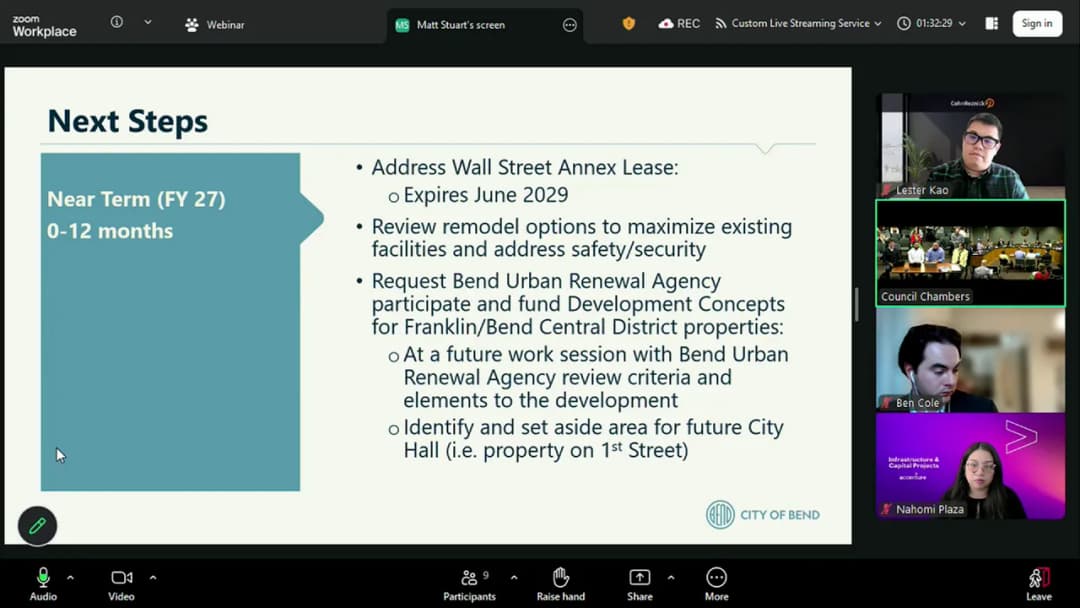
The Bend City Council held a work session on June 10, 2026, to discuss the future city hall development and the highest and best use analysis, a supplemental transportation system development charge (SDC) for the Southeast Area, and an update from the Downtown Bend Business Association regarding downtown parking management. Discussion Items City Hall Future Development and Highest and Best Use Analysis - Matt Stewart (Real Estate and Housing) presented with consultants, reviewing city hall history: current facilities (60,000 sq ft total, 50,000 usable), space needs (85,000 sq ft by 2038–2040), and prior acquisitions (≈3.2 acres at former Rainbow Motel/Franklin shelter, ≈1.2 acres at First Street/Hawthorne). The analysis evaluated four sites: downtown current footprint (1.8 acres), downtown extended (≈7 acres, including school district and library parcels), Franklin/Bend Central District (3.2 acres), and 15th Street (10 acres). - Garrett Rapsilber (HRNA) presented the highest and best use analysis: only the 15th Street site is financially feasible today; downtown and Franklin become feasible by the mid-2030s. A summary matrix scored sites on financial opportunity cost, economic development potential, and public benefit. 15th Street had the lowest opportunity cost and highest feasibility for ancillary development (townhomes and retail). - Staff recommendation: exclude downtown and downtown extended from further city hall consideration; focus on 15th Street and the First Street property in Bend Central District (the 1-acre former gas depot). Near-term steps included securing a longer term for the Wall Street Annex (lease expires June 2029), evaluating remodel options, initiating visioning for the Franklin shelter property with the Core Area Advisory Board, updating space programming, and eventually creating disposition strategies. - Council discussion: Councilors expressed mixed views. Councilors Moseley, Perkins, Norris, and Broadman supported keeping the First Street property in the BCD as a priority, while Councilor Dennison pointed to 15th Street's potential due to size and proximity to existing commercial corridors and trails. Councilor Franzosa wanted to review the full report before giving direction and raised concerns about the economic impact on downtown if city hall moves. Councilor Broadman stressed the need to add an infrastructure plan for BCD to the near-term work list. Southeast Area Transportation SDCs - Ryan Oster (Engineering) and Elizabeth O'Shea presented a proposed supplemental transportation SDC for the Southeast master plan area, applicable only to that geography. Three projects were identified: a roundabout at Diamondback Way/Caldera Drive ($3.5 million), an internal roundabout at Journey Way ($2 million), and the modernization of Knott Road and 27th Street ($5.4 million – the 36% share not already covered by existing citywide SDCs). Total cost: ≈$11 million, generating ≈4,000 trips, equating to ≈$2,800 per trip. - For example, a single-family unit currently pays a citywide transportation SDC of $10,230; the supplemental would add $2,660, bringing the total to $12,890. The methodology would match existing SDC land use assumptions, include affordable housing and child care exemptions, allow for inflation adjustments, and include a compliance fee. - Council questions: Councilor Franzosa asked about including collector roads and using Local Improvement Districts (LIDs). Staff noted LIDs require annexation or county partnership and that developers requested the SDC approach. Councilor Broadman supported exploring LIDs as a complementary tool. - Council consensus: Support proceeding with the 90-day notification process and public hearing in September. Downtown Bend Business Association Update - Rachel (DBBA) presented the organization's strategic plan based on Main Street America's Four Pillars (Promotion, Design, Organization, Economic Vitality). Highlights included a new downtown gift card program generating $60,000 in six months, beautification efforts, and a mural project that attracted 250 artist responses. - On parking, the DBBA developed a draft progressive paid parking concept as a conversation starter, not a policy recommendation. The concept aims to increase turnover in high-demand curb spaces, allow longer visits, provide affordable employee options, reduce congestion, and ensure transparent reinvestment of any revenue into downtown improvements. A survey is currently collecting stakeholder and community feedback; no results have been analyzed yet. - Council appreciation was expressed; Councilor Moseley asked about employee parking habits, and Councilor Broadman questioned garage utilization and pricing dynamics. No formal action was taken. Key Outcomes - Council supported the staff recommendation to narrow potential city hall sites to 15th Street and the First Street property in the Bend Central District, and to proceed with near-term steps including securing the Wall Street Annex, initiating visioning for the Franklin shelter property with CAB, and incorporating an infrastructure plan for BCD. - Council directed staff to proceed with the notification process for a supplemental transportation SDC in the Southeast Area, with a public hearing anticipated in September. - Council acknowledged the Downtown Bend Business Association update and the ongoing parking survey process.

ECONOMIC DEVELOPMENT 33% · ENGINEERING AND INFRASTRUCTURE 25% · HOUSING DEVELOPMENT 18% · TRANSPORTATION SAFETY 8%
15
JUN 3, 2026 · BEND, OREGON · CITY COUNCIL
Bend Budget Committee and City Council Meeting - June 3, 2026

On June 3, 2026, the Bend Urban Development Agency and Budget Committee met jointly, followed by the Bend City Council meeting. The combined session lasted approximately four hours, covering fiscal approvals, infrastructure projects, a public hearing on the climate pollution fee, and community proclamations. Key outcomes included approval of property tax levies for four tax increment finance (TIF) areas, unanimous approval of four public works contracts, and first reading of the climate pollution fee ordinance (passed 5–1). The council also denied an appeal of a noise variance permit for the upcoming Pride festival. Consent Calendar - Budget Committee: Approved property tax levies for the Britta Ridge, Emblem, Century, and Veridian TIF areas for fiscal years 2026–2027. The motion carried with one opposed. - City Council: Approved consent agenda items (not detailed in transcript) without discussion. Public Comments & Testimony - ALPR Surveillance (Visitors’ Section): Seven speakers urged the council to pause installation of fixed license plate readers, adopt a citywide surveillance ordinance, and strengthen Policy 428. Concerns included data sharing with federal agencies, vendor access to encrypted keys, and lack of public oversight. Speaker Jonathan Westmore filed a petition for policy review. - Climate Pollution Fee (Public Hearing): Over 20 speakers testified. Supporters (e.g., Sophia Borgison, Evan Ferguson, Jade O’Hara Vlachos) cited public health benefits (reduced asthma from gas stoves), climate urgency, and the need for local action. Opponents (e.g., Brad Archuletta, David Berger, Garrett Mosier) argued the fee would increase housing costs, burden the electrical grid, and lacked analysis of unintended consequences. Several business and housing organizations requested delays and exemptions for middle housing. Discussion Items - Mid-Biennium Budget Update (Budget Committee): Dan Quick reported general fund revenues on track, with property taxes 0.7% above budget (5.2% vs. 4.5% assessed value increase), room taxes 3% above budget, and development fees (building, planning) exceeding projections. Personnel savings of 5–6% ($8–9 million) offset higher-than-budgeted cost-of-living adjustments (3.3% vs. 2%). - Fee Schedule and Staffing Preview: Quick outlined proposed fee increases (building 2%, planning 5%, water 4.9%, sewer 1.8%, stormwater 8%) and 9.5 new positions (including firefighter-paramedics, wellness coordinator, urban renewal manager). Business license fee restructuring was paused; a 10% across-the-board increase was substituted. - Infrastructure Projects (Items 5–8): Four projects approved unanimously: - Digester 4 and Hauled Waste: $115 million CMGC delivery for new digester and regional waste facility (completion by 2030). - Reed Market Bridge: $46 million project ($32.3 million federal grant) for bridge over BNSF tracks and pedestrian tunnel. - Midtown Multimodal Connections: $15.8 million GMP for Franklin Avenue improvements (sidewalks, bike paths, stormwater, water line). - Olney/Revier Intersections (Four-Pack): $2.48 million PDB agreement for four intersections (roundabouts/signals) as part of GO Bond projects. Council requested further analysis of roundabout vs. signalized options, particularly regarding accessibility and safety for pedestrians and cyclists. - Climate Pollution Fee (First Reading): Cassie Lacey presented the ordinance establishing a fee on new residential gas appliances (excluding manufactured homes and commercial structures). Fee formula uses social cost of carbon, net lifetime emissions, and home-size tiers (0–1,600 sq ft: 65% factor; 1,600–3,000: 100%; 3,000: 150%). Initial fee set at 20% of calculated value (e.g., $2,000 for average home with all gas appliances). Revenue to be used for climate mitigation and electrification incentives. Fee effective April 1, 2027, with annual council review. Council deliberation split: Councilors Franzoza, Mendez, Riley, Platt, and Mayor Kebler supported; Councilor Perkins opposed, citing grid reliability concerns, housing affordability impacts, and premature implementation. Key Outcomes - Budget Committee: Completed state shared revenue hearing and approved TIF property tax levies. No further committee meetings scheduled; council will act on budget adjustments June 17. - City Council: - Approved all four infrastructure contracts (Items 5–8) unanimously. - Passed first reading of Climate Pollution Fee ordinance (5–1). Second reading and final adoption scheduled for June 17, 2026. - Approved second reading of ordinance amending advisory boards committees (unanimous). - Denied appeal of noise variance for Pride festival (unanimous), upholding city manager’s permit allowing 80 dB from 10:30 a.m. to 3 p.m. on June 6. - Directed staff to work tree code and industrial land readiness discussion into a September work session. - Agreed to include roundabout policy review within the existing standards and specifications work plan, with timeline to be provided at next meeting. - Approved advisory body appointments as recommended by the mayor.

ENVIRONMENTAL PROTECTION 37% · ENGINEERING AND INFRASTRUCTURE 11% · FISCAL SUSTAINABILITY 10% · PROCEDURAL 10%
16
MAY 20, 2026 · BEND, OREGON · CITY COUNCIL
Bend City Council Business Meeting - May 20, 2026

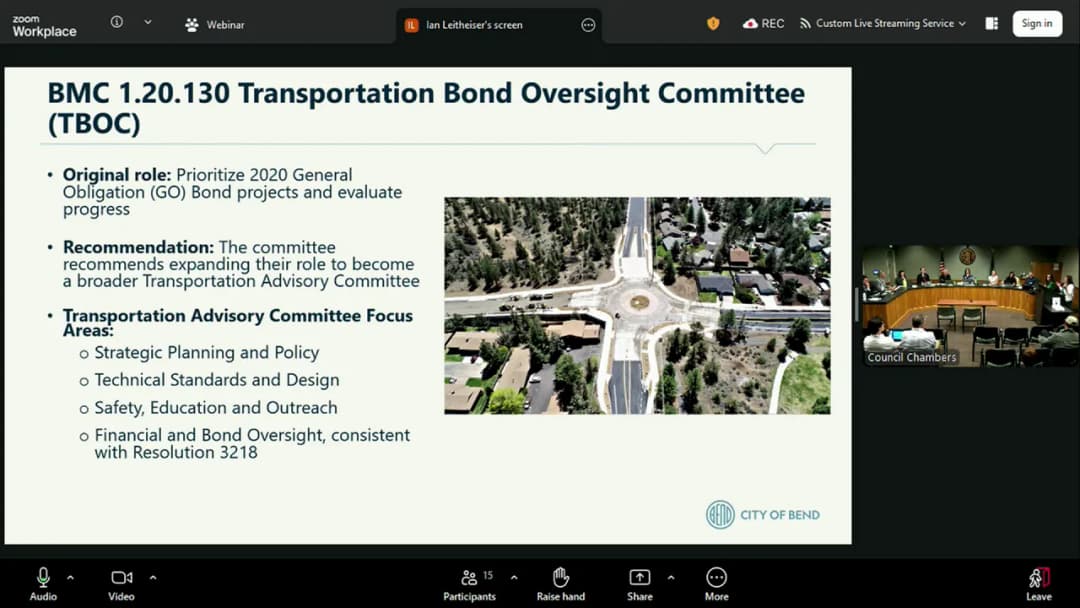
The Bend City Council met on May 20, 2026, for a regular business meeting. The session began with an executive session for real property negotiations, then proceeded to open session including proclamations, council reports, public comments, consent agenda, several ordinance readings and resolutions, and a city manager's report. Key actions included adopting the 2026 Outback Facility Plan, approving a small business assistance grant program, authorizing construction contracts for pedestrian and bicycle projects, and establishing an economic improvement district in the Bend Central District. Proclamations - 100 Years of the Bend Chamber of Commerce: The council proclaimed 2026 as the centennial year, recognizing the chamber's history since 1926 and its role in economic development. Representatives from the chamber accepted the proclamation, noting founding members still active (e.g., Bend Bulletin, QXO, Bryant Loveland and Jarvis, Umbine Communication, Bigfoot Beverages). - Wildfire Awareness Month: The council proclaimed May 2026 as Wildfire Awareness Month, urging residents to take steps to reduce wildfire risk. Melissa Steele (Deputy Fire Marshal of Wildfire Preparedness, Bend Fire and Rescue) and Lon Laneeve (co-chair, Project Wildfire Neighborhood Coalition) spoke, emphasizing proactive preparedness and community resilience. - Mental Health Awareness Month: The council proclaimed May 2026 as Mental Health Awareness Month, encouraging open conversations about mental health. Casey Monk (Regional Director, NAMI Central Oregon) and intern Stanley Duca spoke about reducing stigma and the importance of peer-led support. Mayor Keebler shared personal family experience with mental health challenges. Public Comments & Testimony - Frank Seamson (Bend resident) proposed adopting updated dark sky outdoor lighting controls for the city, referencing Deschutes County's 2025 ordinance as a model, and urged urgency given Stevens Ranch development (1,700–2,000 new homes). - Michael Baker (CEO, Boys & Girls Clubs of Bend) announced openings at the club and invited council to an award ceremony on August 27, 2026. - Jonathan Westmorland (Bend resident) raised concerns about police response to a shooting near his mother's apartment (bullet through wall, four-day delay in suspect removal) and questioned the city's plan to install stationary license plate readers (ALPR) via a $19,000 grant, potentially expanding to $250,000 without council vote. He urged bringing the contract to council for public input. The mayor clarified that any fixed ALPR contract would require council approval. - Maureen Johnson (Wood River Village neighbor) thanked the council for the wildfire proclamation, detailed her own home hardening efforts, and expressed concern about evacuation routes, questioning whether the city is prepared for worst-case wildfire scenarios. - Todd Torreson (Southwest Bend resident, chairman of Southern Crossing) asked about evacuation plans for Southwest Bend, criticized the planned two-lane roundabout at Bond and Reed Market as insufficient, and proposed three-laning Reed Market near US 97 for evacuation. He invited council to tour the area. Discussion Items - First Reading – Ordinance Amending Municipal Code Chapter 1.20 (Advisory Boards, Committees, and Commissions): City attorney presented code changes for three advisory bodies: Transportation Bond Oversight Committee (renamed to Transportation and Mobility Advisory Committee, TMAC, per council suggestion), Bend Economic Development Advisory Board (BDAB), and Affordable Housing Advisory Committee (AHAC). Changes expand scope, reduce redundancy, and align with council goals. Councilor Riley expressed concern about TMAC's broad scope; staff noted annual work plans will narrow focus. The ordinance was moved for first reading and passed unanimously. - Resolution Adopting the 2026 Outback Facility Plan: Project engineers Jeremy Tex and Brittany Barker presented the plan, which addresses water system resilience. Key risks: wildfire in watershed causing turbidity (still seeing effects from 1979 Bridge Creek fire), and limited municipal water rights (2% of Upper Deschutes Basin). Priority projects: in-conduit hydropower (could power 750 homes/year, excess sold to grid) and pretreatment system (pre-sedimentation pond and plate settler) to keep filtration operational during wildfires. Additional 48 acres adjacent to Outback site being acquired from Forest Service. Cost estimates: pretreatment and hydropower projects are within five-year CIP. Funding applications submitted for FEMA BRIC grant (up to $20M) and WIFIA loan. Council adopted the resolution unanimously. - BDAB 2026–2028 Work Plan and Small Business Assistance Grant Program: Megan Lee (Environment and Climate) presented the BDAB work plan, aligned with the economic development strategic plan. The work plan was unanimously supported by BDAB. Council approved it unanimously. Then, a joint program with Climate and Sustainability was introduced: $130,000 total for the biennium ($100K for economic development grants, $30K for climate/sustainability grants). Grants will be $5,000–$10,000 to small businesses, with scoring rubric based on project impact. Applications open in next month or two, decisions by early fall. Council adopted the resolution establishing the program, authorizing city manager to award up to $250,000 per grantee (though total is $130K). Councilor Norris noted the need for transparency; staff confirmed scoring and recommendations will be public records. - Contracts for Neff Road Bicycle/Pedestrian Project and Larkspur Path School Connection: Senior project engineer Todd Johnson presented two items. Agenda item 9: Contract with K.E. Excavating Inc. for construction of Neff Road Bicycle and Pedestrian Project (10-foot path, ADA ramps, crossing improvements) for $2,778,605, with city manager authority for up to $500,000 in amendments. Item 10: Intergovernmental agreement with ODOT for Larkspur Path School Connection Project (sidewalk along Juniper Elementary to Neff Road, 10-foot path along Pilot Butte Middle School) with city contribution not to exceed $441,444. Council discussed need for crossing at 8th Street and Norton (currently not in scope) and potential for rapid rectangular flashing beacons. Council authorized both items unanimously. - Second Reading – Ordinance to Establish Economic Improvement District (EID) in Bend Central District: Roll call vote: Councilors Franzosa (no), Mendez (yes), Riley (yes), Perkins (yes), Norris (yes), Platt (no), Mayor Keebler (yes). Passed 5-2. Key Outcomes - Proclamations: All three proclamations accepted unanimously. - Consent Agenda: Approved unanimously. - Ordinance Amending Municipal Code Chapter 1.20: First reading passed unanimously; will return for second reading. - Resolution Adopting 2026 Outback Facility Plan: Adopted unanimously. - BDAB 2026–2028 Work Plan: Approved unanimously. - Small Business Assistance Grant Program: Resolution adopted unanimously; city manager authorized to award grants. - Neff Road Bicycle/Pedestrian Project Contract: Authorized ($2,778,605 plus $500K amendment authority) unanimously. - Larkspur Path School Connection IGA: Authorized ($441,444 city contribution) unanimously. - EID Ordinance: Adopted on second reading (5-2 vote). - City Manager's Report: Noted Sparky awards for continuous improvement (water repair/rehab project), Public Works Week, upcoming planning commission roundtable on complete communities (June 22), comments on DLCD middle housing rulemaking, water bond refinancing saving $3.8 million over 10.5 years at 3.06% interest, and Fire Free Week through May 24.

PROCEDURAL 27% · WATER AND WASTEWATER MANAGEMENT 15% · ECONOMIC DEVELOPMENT 11% · PUBLIC SAFETY 11%
17
MAY 13, 2026 · BEND, OREGON · CITY COUNCIL
Bend City Council Work Session – May 13, 2026: CIP Update, Transient Lodging Tax, and Wildfire Season Preview

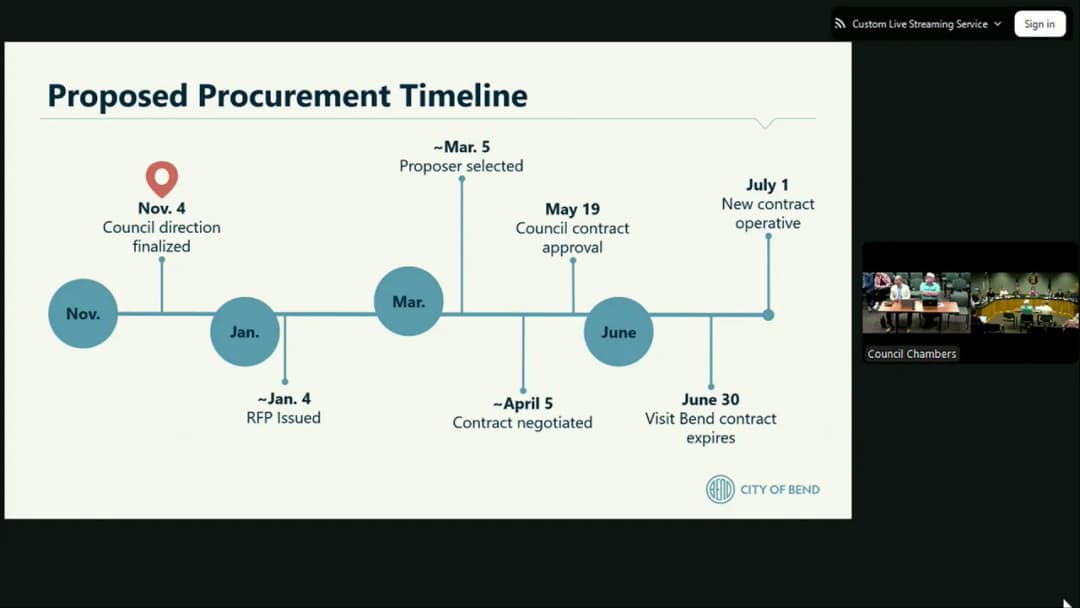
The Bend City Council held a work session on May 13, 2026, covering three major topics: a mid-biennium update on the Geobond and Transportation Capital Improvement Plan (CIP), a discussion on potential changes to the Transient Lodging Tax (TLT) allocation under House Bill 4148, and a wildfire season outlook from the fire chief. Staff presented project status, funding options, and sought council direction on several key items. Discussion Items Capital Improvement Plan (CIP) Update – Geobond and Transportation Funds - Ryan Oster, Engineering Director, presented the mid-biennium update for the Geobond ($190 million voter-approved bond) and the Transportation Fund. The presentation covered the current spend rate, a $32 million Federal Rail Administration grant for the Reed Market overcrossing (expected to be approved June 3, 2026), and the consolidation of $17 million in ODOT contribution money from several projects. Oster noted that scope creep (e.g., building shared-use paths on both sides of a road) has increased costs, requiring careful prioritization. Three options were outlined for the ODOT money: (1) partner with ODOT on Empire improvements, (2) build a southbound direct connection from US 20 to US 97, or (3) use the funds for other city priorities such as Neighborhood Safe Streets Program (NSSP) and Hawthorne connections. - Council discussed the need for contingency reserves, especially for the Reed Market and Hawthorne bridges, given potential cost escalation. Councilor Mendes expressed interest in Option 3 (safety and NSSP), while Councilor Riley emphasized congestion as a top public concern and supported options that address it. Councilor Kebler noted that a larger list of unfunded projects (e.g., Colorado/97 on-ramp, Revere/Wall intersections) should be compared side-by-side with cost and crash data before final decisions. It was agreed that the Transportation Bond Oversight Committee (recently reformed as a general transportation committee) would help evaluate options. - On the Transportation Fund side, staff proposed accelerating the Reed Market roundabout (budget increased from $4.25 million to $7 million to allow for a full double-lane option) and increasing funding for the Drake Park footbridge from $1 million to $2 million over two years, with the intent to transfer the asset to the parks district after design and construction. Council supported the $2 million increase, contingent on pursuing grants. The Galveston project will begin summer 2026 with driveway and alley work, followed by a raised crossing at 17th Street. Transient Lodging Tax (TLT) Discussion - Cyrus Mooney (Business Development Manager) and Jeff Knapp (CEO of Visit Bend) presented on House Bill 4148, which allows the city to adjust the allocation of the 1.4% TLT increment enacted post-2003. Currently, 64.6% of TLT goes to the city and 35.4% to Visit Bend. Under HB 4148, the city's share could increase to 67.3% (a 50/50 split on the 1.4% increment), generating approximately $200,000 in FY26 and $400,000 annually thereafter. The legislation also includes a business resiliency grant program, but definitions remain vague. Knapp noted that visitor spending is expected to reach $405 million this year, but cautioned against reducing tourism marketing given economic headwinds (fuel prices, potential El Niño impacts on snow and wildfire). - Councilors expressed interest in pursuing the allocation change but not before the start of FY27 (January 1, 2027), incorporating it into the upcoming request for proposals (RFP) for the destination management contract (current contract expires June 30, 2027). Councilor Kebler and others signaled that additional TLT revenue should be directed to services with a nexus to tourism, such as traffic enforcement and public safety (Councilor Mendez), shelter services (Councilor Francisca), and infrastructure maintenance. There was consensus to include the business resiliency grant concept in the RFP with clear criteria and triggers, rather than implementing it immediately. Council did not support pursuing a future room tax increase at this time, but agreed to revisit after the new contract and FY27 budget are in place. Wildfire Season Update - Fire Chief Todd (no full name given) presented an outlook for the 2026 wildfire season. Key points: a transition to ENSO-neutral conditions has led to a coin-flip season; below-normal precipitation and early snowmelt have dried fine fuels; mid-elevation snowpack is gone. Analog years (2015, 2018) suggest an early fire season onset. The fire risk is expected to be above normal by June, with peak fire potential in July. The chief emphasized that large snow years don't guarantee low fire acreage (citing 2002, 2011, and 2024). The community was encouraged to sign up for Deschutes Alerts, maintain defensible space, and participate in Firewise efforts. The fire academy graduation in late June will help relieve staffing vacancies by July 1. Key Outcomes - CIP Direction: Council directed staff to refine options for the $17 million ODOT contribution money and bring back a comparative analysis including crash data, cost estimates, and traffic modeling for unfunded projects (e.g., Colorado/97 on-ramp, Revere/Wall intersections). The transportation committee will be asked to advise on priorities. Contingency reserves will be added to high-risk projects (Reed Market, Hawthorne bridges). - Drake Park Bridge: Council approved increasing the Transportation Fund allocation to $2 million over two years (from $1 million) for design and construction, with the intent to transfer the asset to the parks district. Staff will also explore less expensive rehabilitation options. - TLT Allocation: Council directed staff to prepare code changes and incorporate a shift to a 50/50 split on the 1.4% TLT increment into the upcoming RFP for destination management services, effective FY27. Additional revenue will be allocated through the budget process, with initial signals pointing toward public safety and shelter services. - Business Resiliency Grants: Council decided not to implement a dedicated grant program immediately, but will include a framework in the RFP that defines triggers and criteria for deploying such funds in future years. - Wildfire Preparedness: No formal action was taken; council received the information and encouraged community vigilance and registration for emergency alerts. - Next Steps: Staff will return for further discussions on CIP details in June (including water/utilities), and present the TLT RFP timeline and Visit Bend's annual budget report in the coming months.

ENGINEERING AND INFRASTRUCTURE 45% · ECONOMIC DEVELOPMENT 22% · TRANSPORTATION SAFETY 12% · ENVIRONMENTAL PROTECTION 7%
18
MAY 6, 2026 · BEND, OREGON · CITY COUNCIL
Bend City Council and Urban Renewal Agency Meeting - May 6, 2026

The Bend City Council met on May 6, 2026, for a regular meeting that included proclamations, council reports, public comments, consent agenda, and public hearings on an Economic Improvement District (EID) and short-term rental code amendments. The council also approved a bikeway construction contract and a second reading of a timber yards development code amendment. The meeting was followed by the Bend Urban Renewal Agency meeting, where a loan program concept was discussed. Consent Calendar - The consent agenda was approved unanimously, except for Item B (Community Development CDBG Annual Action Plan), which was pulled for discussion. After clarification, Item B was approved separately. Public Comments & Testimony - Robert Rector and Mark Huber (residents of the Pilot View Canal Historic District) expressed concerns about the Central Oregon Irrigation District's (COID) plans to pipe the canal, which they argued would harm the historic district and property rights. They urged the council to consider the impact and invited councilors to visit the area. - Scott Dawkist (resident) requested the installation of stop signs on NW Skyline Ranch Road at NW Salilo Lane and NW Ochoa Drive to address speeding and safety concerns before a serious incident occurs. He noted that city staff and developers had indicated no action would be taken until the road is fully connected. - Michael Baker (CEO, Boys & Girls Clubs of Bend) provided updates on the club's summer programming (12 weeks this year) and facility improvements, and invited councilors to tour the club. Public Hearing: Economic Improvement District (EID) in the Bend Central District - Presentation: Cyrus Mooney and Danielle Elder (Bend Central District Business Association) presented the proposed EID boundary, assessments (starting at $0.10 per square foot in FY26, increasing $0.01 each year), and scope of services (beautification, marketing, maintenance, events). The city retains 5% for administration. The EID would require a remonstrance hearing in July; if more than 33% of commercial property square footage opposes, assessments cannot be levied. - Public Comment (opposition): - Sylvia McFarland and Lewis (owners of multi-tenant industrial buildings) opposed the EID, arguing it would burden industrial tenants with no benefit, drive businesses to Redmond/La Pine, and that the business association did not consult them. - Randy Windlitz (property owner) claimed 782,035 square feet of opposition had been submitted (exceeding the 33% threshold), making the EID a "dead issue." He also argued the ordinance was not compliant with state statute. - James Floyd (owner of Cascade Professional Center) stated the EID would add to existing tax burdens (transportation fee, property taxes) and provide no value to his tenants. - Council Deliberation: Councilor Franzosa expressed concerns about the impact on industrial tenants and the need for more vetting, suggesting a pause. Other councilors (Riley, Perkins, Norris, Keebler) supported moving forward, noting the EID and urban renewal are complementary and that the 33% threshold provides a safeguard. The motion to adopt the first reading passed 5-2. Public Hearing: Short-Term Rental Code Amendment (BDC 3.6.500) - Deliberation: The public hearing closed on April 15, 2026, with the written record held open until April 29. Councilor Franzosa moved to withdraw the application, arguing the action was too targeted (Old Bend) and not a citywide policy. She noted that the current code allowed unlimited STRs in commercial zones, but withdrawal would maintain the status quo. Councilor Mendes sought a compromise (e.g., capping STRs at 25-50% of a development), but no majority support emerged. The motion to withdraw passed (with some councilors voting against). Councilor Platt indicated a future agenda request to address STRs in commercial zones more broadly. Discussion Items - Proclamations: The council proclaimed May 2026 as Child Care Provider Appreciation Day, National Preservation Month, and Foster Care Month. Speakers from Neighbor Impact, Deschutes Historical Society, and CASA Central Oregon provided remarks. - Good of the Order: Councilor Norris read a statement recognizing Asian American Native Hawaiian and Pacific Islander Heritage Month, condemning anti-Asian violence, and emphasizing the need for specificity in honoring distinct communities. - Council Reports: Councilors reported on various events, including the youth summit, CityFest (20% reduction in unsheltered homelessness noted), transportation bond oversight, fire readiness meetings, and the Bend MPO. Councilor Riley shared data on opioid overdose deaths decreasing locally but warned of a new drug (orphine) resistant to naloxone. Councilor Perkins noted the CHRO funded the Gales property for shelter but criticized the county commission for not covering a $2,100 shortfall. Councilor Platt highlighted Zama's projected 5 GW power output. - City Manager Report: The city manager announced a June 3 meeting starting at 5:30 p.m. to handle the supplemental budget and carbon impact fee hearing. He also reported that S&P reaffirmed the city's AA+ rating on water bonds with a stable outlook. Key Outcomes - EID Ordinance: First reading passed (5-2). The ordinance will proceed to a second reading and remonstrance hearing on July 15, 2026. - Short-Term Rental Code Amendment: Application withdrawn. The current code remains in effect; future policy discussions on STRs in commercial zones may occur. - Bikeway Construction Contract: Authorized contract with Taylor Northwest LLC for $2,264,529 for three path segments on SE 9th St, NE Bear Creek Rd, and SE 15th St N. Unanimously approved. - Timber Yards Development Code Amendment: Second reading and adoption by roll call vote (unanimous). - Urban Renewal Agency: Staff directed to proceed with developing a loan program (micro, small business, pre-development loans) with additional considerations from council (e.g., gaps in tenant improvement costs, partnership with COIC). A final proposal is expected in September 2026.

PROCEDURAL 35% · ECONOMIC DEVELOPMENT 28% · COMMUNITY ENGAGEMENT 8% · HOUSING DEVELOPMENT 5%
19
APR 22, 2026 · BEND, OREGON · CITY COUNCIL
Bend City Council Work Session - April 22, 2026: Climate Fee, Water Update, Venue Study

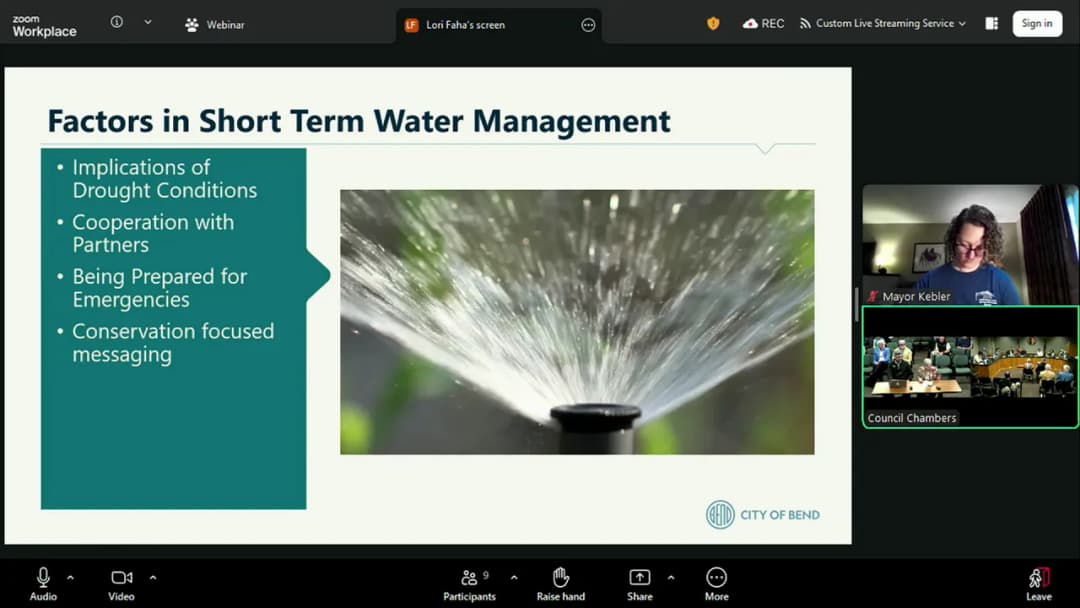
The Bend City Council held a work session on April 22, 2026, covering three major topics: final policy direction for the proposed Climate Pollution Fee, an annual water conservation and supply update, and a feasibility study for a new public assembly venue. Council provided clear direction on fee exemptions, effective date, and building applicability, received updates on water conservation progress and drought preparedness, and expressed support for further exploration of a multi-purpose event venue. Climate Pollution Fee Direction Staff Presentation (Cassie Lacey, Senior Management Analyst): - Staff requested final direction on exemptions/adjustments, effective date, building types, and fee update process to develop the code chapter and ordinance for first reading on June 3, 2026. - Two items were ready for immediate policy inclusion: (1) an exemption for deed-restricted affordable housing, and (2) treatment of dual-fuel equipment (either outright exemption or a separate fee schedule line). - For the effective date, three options were discussed: April 1, 2027; July 1, 2027; and January 1, 2028. Staff noted alignment with the state building code becoming mandatory on April 1, 2027. - Building type applicability: staff recommended applying the fee to all new residential structures built under the residential code (single-family, duplex, townhouses, ADUs), excluding triplexes/quadplexes built under commercial code due to administrative complexity and low volume (only one three-unit development in the past year). - Additional ideas (renewable natural gas, 120% AMI exemption, solar homes, pilot project) were identified as feasible but requiring more time, potentially delaying the June 3 adoption. Council Discussion and Positions: - Dual-fuel equipment: Council unanimously agreed to include dual-fuel heat pumps as a separate equipment type in the fee schedule (lower fee based on lower net carbon), rather than an outright exemption. Councilor Platt stated, “I am not in favor of any kind of exemption for a dual fuel system,” and Councilor Perkins added that the existing net-carbon formula already accounts for lower emissions. - Deed-restricted affordable housing exemption: Council unanimously voted against providing an exemption. Councilor Platt cited letters from two major affordable housing builders (Rooted and Habitat) who oppose the exemption, arguing that electric efficient homes have lower and more predictable operating costs. Councilor Franzosa read from the emails: “Exemptions that allow less efficient systems risk locking homeowners into high lifetime costs.” Mayor noted that the fee is not a major barrier and can be revisited if issues arise. - Effective date: Council reached consensus on April 1, 2027, to align with the state building code. Councilor Mendez noted the predictability for builders. Staff confirmed April 1 is the earliest feasible date. Mayor expressed some concern about staff readiness but accepted the consensus. - Building types: Council agreed to apply the fee to all residential code structures and to track triplexes/quadplexes built under commercial code via annual reporting. Councilor Franzosa emphasized infill housing support, but others preferred administrative efficiency. The issue can be revisited if market trends change. - Fee update process: Council approved the proposed annual fee resolution update (each June) and annual reporting on adoption rates, revenue, energy mix, greenhouse gas reductions, utility bill impacts, and equipment cost changes. Councilor Platt requested adding tracking of electric resistance vs. heat pump heating sources and legislative/utility changes. Staff confirmed that data can be collected. - Additional ideas: Council postponed further exploration of renewable natural gas, solar exemptions, and pilot projects, directing staff to consider them in the upcoming non-financial incentives work with the Environmental Climate Committee. Councilor Mendez suggested that some ideas could fit into the non-financial incentives discussion. - Next steps: Staff will bring the first reading of the ordinance and code chapter on June 3, 2026. Councilors Platt and Mendez volunteered to work with staff on draft language. Water Conservation and Supply Update Staff Presentation (Lori Feya, Environmental Resources Manager; Dan Denning, Water Conservation Program Manager): - Celebrated the 100-year anniversary of Bend’s water system, including banners in the Old Mill District and Earth Day activities. - Drought preparedness: Despite a severe drought year (snowpack comparable to 1977), the dual surface water/groundwater system ensures supply. Staff coordinate with Tumalo Irrigation District, Forest Service, Avion, and ROATS. Curtailment (event-based emergency) is distinct from long-term conservation. - Conservation successes in 2025: Reduced maximum day demand; a 12% voluntary reduction ask yielded aggregate savings across three largest customers; increased participation in turf replacement and device rebates; total water production decreased while population grew. Gallons per capita per day (GPCD) dropped to 161, exceeding the council goal of 165. - New tools: Consumption and rebate distribution dashboards allow targeting. Gray water feasibility study showed more potential in multifamily/commercial than single-family. - 2026 outlook: April demand is up 20% over last year. Staff are deploying a holistic approach: awareness campaigns (e.g., “B Water Smart”), technical assistance, incentives, and enforcement. Firewise messaging will be coordinated. Green meeting events scheduled. - Progress report: A five-year update to the Water Management and Conservation Plan will be submitted to the state in October 2026, including reanalysis of projections and modeling of new measures (gray water, low-income repair assistance). Council Questions: - Councilor Franzosa asked about expanding incentives; staff noted turf replacement remains popular and underperforming programs may be replaced. - Councilor Riley asked what a 17 GPCD reduction looks like for a household; staff explained that a two-minute reduction on one irrigation station saves about 20 gallons. Public Assembly Venue Study Presentation (John Katz, CSL International; Jeff Knapp, Visit Bend; Katie Brooks, Economic Development Officer): - Conducted stakeholder interviews and market analysis over several months. The study found positive conditions for a multi-purpose venue (conference, concerts, community events, amateur sports) in the 1,000–3,000 seat range with a flat floor, retractable seating, and an adjacent hotel. - Key factors: Bend is a national destination, has a vibrant downtown and arts community, and is the economic hub of Central Oregon. Challenges include winter accessibility, limited direct flights, and existing venues (Riverhouse, Hayden Homes, Tower Theater). - Economic impact in year four: 17,000+ room nights, 30,000 new non-local visitor days, $11.7 million direct spending, $19.8 million total economic output, 247 jobs (full- and part-time), and $323,000 incremental hotel tax. - The venue is not intended to replace existing facilities but to fill a gap (e.g., no mid-sized concert venue). Cannibalization is a risk, but the majority of events would be net new. A headquarter hotel is essential for attracting conventions. - Estimated cost (based on similar Tahoe Blue Center) is around $110 million, but architecture and site selection are needed. Council Input and Next Steps: - Mayor expressed support for continuing to the next phase without committing public dollars, saying “we're not putting ourselves on the hook to build anything.” - Councilor Riley raised concerns about trade-offs, job quality (mostly part-time/service), and opportunity costs given other community priorities. He requested concrete case studies illustrating economic development benefits. - Councilor Franzosa emphasized the need to sequence with other community efforts (performing arts center, expo center) and to understand financial models (public-private-philanthropic). - Council agreed to allow Visit Bend to proceed with the next phase: architectural design, site selection, detailed feasibility, and financial modeling. Staff will provide updates as the work progresses. Key Outcomes - Climate Pollution Fee: - No exemption for deed-restricted affordable housing. - Dual-fuel heat pumps will be included as a separate equipment type in the fee schedule (not exempt). - Effective date: April 1, 2027. - Fee applicable to all new residential structures under the residential code (single-family, duplex, townhouses, ADUs); triplexes/quadplexes under commercial code excluded but tracked. - Annual fee update and reporting approved; additional tracking of heating source types and legislative changes added. - First reading of ordinance and code chapter scheduled for June 3, 2026. - Water Update: Received; goal exceeded (161 GPCD vs. 165 target). Staff to continue drought outreach and prepare five-year progress report. - Venue Study: Council supportive of proceeding to next feasibility phase led by Visit Bend, with recognition of no current commitment of public funds.

ENVIRONMENTAL PROTECTION 30% · WATER AND WASTEWATER MANAGEMENT 26% · ECONOMIC DEVELOPMENT 21% · AFFORDABLE HOUSING 11%
20
APR 15, 2026 · BEND, OREGON · CITY COUNCIL
Bend City Council Business Meeting – April 15, 2026

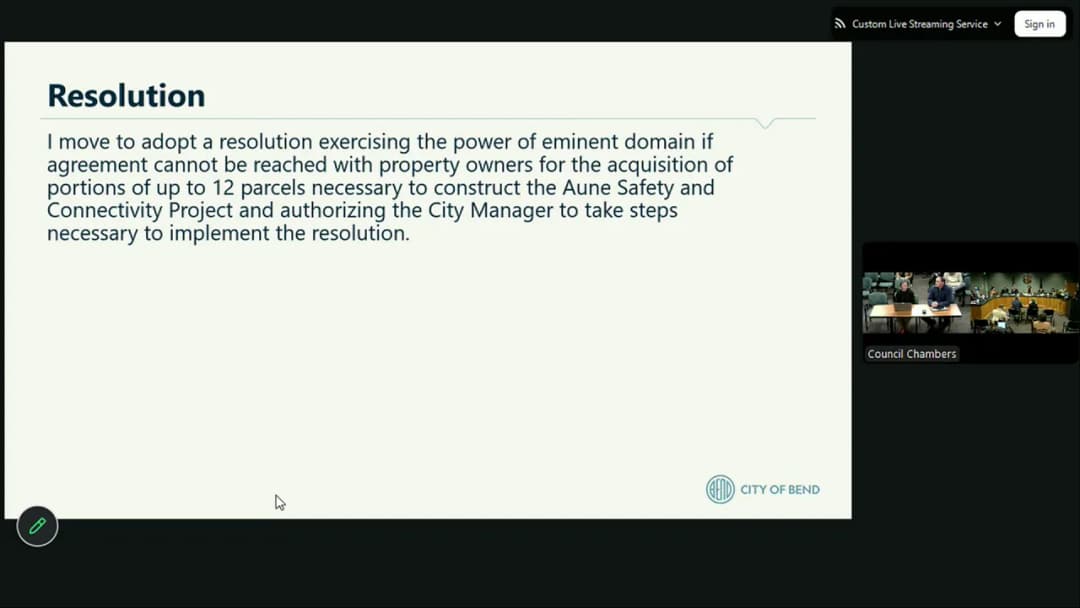
The Bend City Council convened on April 15, 2026, for a regular business meeting that included proclamations, public testimony, quasi‑judicial hearings, contract approvals, second readings of ordinances, and a quarterly goal update. Key actions included approving the consent agenda, advancing a short‑term rental code amendment with the record held open, approving the first reading of the Timber Yards master plan amendment, authorizing eminent domain for the Ani safety project, renewing a property tax exemption for affordable senior housing, awarding four street preservation contracts, and adopting several second‑reading ordinances. The council also discussed reducing the frequency of work sessions to one per month. Consent Calendar - Approved the consent agenda, which included routine approvals and unanimous consent items. Public Comments & Testimony - Climate Impact Fee: Numerous residents urged the council to pass a strong climate impact fee with implementation by April 2027 and no exemptions, citing health benefits, grid reliability, and climate justice. Several speakers from the building trades and energy industry opposed the fee, arguing it would increase housing costs, strain the electric grid, and that the grid’s carbon intensity makes electrification ineffective. Representatives from the Bend Chamber of Commerce and Central Oregon Builders Association called for a pilot program and exemptions for workforce housing. Staff noted a work session is scheduled for the following week and a final vote is targeted for June. - TDS Fiber Optics Box: Nancy Hawks testified about a noisy, visually obtrusive TDS equipment box near her home in Northwest Crossing, presenting a petition with nearly 80 signatures asking for relocation. She requested a meeting with the city and TDS. - Short‑Term Rental Code Amendment (Item 5): Residents of the Old Bend neighborhood spoke in favor of the proposed changes, arguing that CN‑zoned properties should follow the same rules as residential areas to protect neighborhood character. Property owners and investors opposed the amendments, stating they relied on existing rules, requested grandfathering of pending permits, and asked for a financial impact analysis. - Other: Several speakers commented on transportation safety (cut‑through traffic on Riverfront Street) and general support for city policies. Discussion Items - Short‑Term Rental Code Amendment (Item 5): Staff presented proposed amendments to Bend Development Code 3.6.500, which would require CN‑zoned properties (five parcels in Old Bend) to follow the same STR permitting rules as medium‑density residential zones, including a 500‑foot separation and a one‑unit limit. The council heard public testimony and, at a party’s request, voted to hold the record open until April 22 for additional written evidence, with responses due by April 29. - Timber Yards Master Plan Amendment (Item 6): Staff and the applicant (Kennedy Wilson) presented a request to update the master plan to reflect reduced development intensity (fewer commercial units, shift from west‑to‑east construction), replace a planned road with a bike‑pedestrian corridor, and adjust transportation mitigations (including a mini‑roundabout instead of a full one). The Planning Commission had recommended approval. After no public comment, the council voted unanimously for first reading. - Eminent Domain Resolution (Item 7): The council authorized the use of eminent domain if voluntary agreements cannot be reached for 12 properties needed for the Ani Safety and Connectivity Project, which includes intersection upgrades and a shared‑use path. - Property Tax Exemption Renewal (Item 8): Staff presented a resolution to reauthorize a qualified rental property tax exemption for Mountain Laurel Lodge, a 54‑unit 55+ affordable housing development. All taxing districts (including Bend‑La Pine Schools, which initially delayed) had approved the exemption. The council approved the full exemption, noting it is a renewal and savings pass directly to residents. - Street Preservation Contracts (Items 9‑12): The council approved four contracts: Granite Construction ($2.4M for paving), Doodle Construction ($949,000 for chip seal), VSS International ($589,325 for microsurfacing on Third Street), and VSS International ($395,325 for residential slurry seal). Together they treat 77 lane miles. - Second Readings (Items 13‑16): The council adopted ordinances for the Stevens Road Tract UGB expansion area, Legacy Village master plan, annexation of 265.7 acres, and wildfire hazard mitigation building codes (R327). Councilor Norris recused herself from these items due to a conflict of interest. Roll call votes were taken; results varied (one “no” on some items, one abstention). - City Manager Quarterly Update & Meeting Schedule: City Manager Eric King reported on goal progress, noting delays due to state funding inaction and staffing, and proposed reducing work sessions from two per month to one, starting August/September, to allow deeper focus. Council generally supported the concept and discussed fine‑tuning timing and content. Key Outcomes - Short‑Term Rental Code Amendment: Record held open until April 22 for additional written evidence; responses due April 29; council will deliberate at a future meeting. - Timber Yards Master Plan: Approved first reading (unanimous); second reading scheduled for May 6. - Eminent Domain Resolution: Adopted (unanimous). - Mountain Laurel Lodge Tax Exemption: Resolution adopted (unanimous), granting full property tax exemption for all taxing districts. - Street Preservation Contracts: Four contracts awarded (each approved with unanimous voice votes). - Second Readings (Items 13‑16): All ordinances adopted by roll call; Councilor Norris recused; Councilor Franzosa voted “no” on four items; Mayor Pro Tem Perkins abstained on three items. - Meeting Schedule: Council agreed to move to one work session per month; staff will bring back a detailed proposal for implementation.

HOUSING DEVELOPMENT 28% · PROCEDURAL 27% · ENVIRONMENTAL PROTECTION 16% · ENGINEERING AND INFRASTRUCTURE 7%
OPENPUBLICA · PUBLIC MEETING INDEXUPDATED DAILY · openpublica.com