Browse by city
Date range
Search help

Search titles, summaries, topics and stored transcripts together. Keywords may match separately; put the whole query in double quotes for a phrase. Matching follows word analysis, so punctuation is not exact. Both dates are included. Documents are not searched.

SHOWING 21–30 ENTRIES
21
APR 8, 2026 · BEND, OREGON · CITY COUNCIL
Roundtable on Climate Pollution Fee Exemptions and Timeline - April 8, 2026

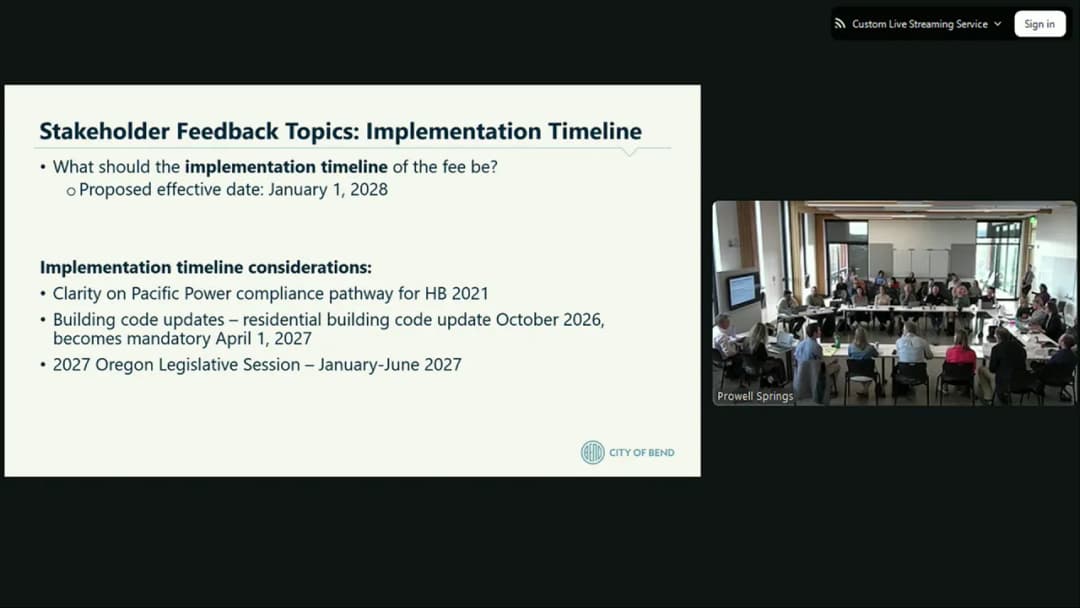
The city of Bend convened a roundtable discussion on April 8, 2026, to gather stakeholder input on potential exemptions and the implementation timeline for the proposed climate pollution fee on new residential gas appliances. Participants included city councilors, staff, utility representatives from Pacific Power, Central Electric Cooperative (CEC), and Cascade Natural Gas, as well as housing, business, labor, and environmental stakeholders. The meeting featured utility presentations on grid capacity, renewable energy compliance, and low-carbon gas investments, followed by structured discussion on exemption categories and fee start date. Discussion Items - Staff Background (Cassie): Outlined the fee structure: social cost of carbon × net lifetime carbon per gas appliance × tier factor (65% for homes ≤1,600 sq ft, 100% for 1,600–3,000 sq ft, 150% for 3,000 sq ft). Council previously set the fee at 20% of the calculated value. Example: an average-size home with all gas equipment would owe just over $2,000. - Pacific Power (Elisa Dunlap): Presented grid infrastructure challenges—Bend has 3% annual load growth (second highest in service area). Five of seven substations are planned or recently upgraded; a new substation in Southeast Bend is in permitting. HB 2021 requires 80% emissions reduction by 2030; an RFP for renewables is underway with preliminary results expected summer 2026. Power costs and transmission constraints are key concerns. - Central Electric Cooperative (Brent Tempas): CEC serves 7,500 members in Bend, with 5,300 square miles of territory. Their power from BPA is 89-94% emission-free (hydro + nuclear). Growth drives Tier 2 power purchases (more expensive and carbon-intensive). CEC is building a new substation (Stevens Ranch, $13M) and considering a second. Resource adequacy is a growing challenge. - Cascade Natural Gas (Don Moore, Cole Burgess, Alan Spector): Stressed the interdependence of gas and electric grids—in January 2024, 70% of PNW energy came from natural gas. Natural gas accounts for 15% of Oregon emissions; Cascade’s share is 3.4%. They are investing in renewable natural gas (RNG) and a dual-fuel heat pump pilot. Proposed that the fee be delayed until HB 2021 compliance is demonstrated, and recommended a multi-year pilot to study carbon and grid impacts. Key Outcomes - Exemptions: Strong consensus from multiple stakeholders (Affordable Housing Committee, Human Rights & Equity Commission, COBA, Chamber, labor) to exempt deed-restricted affordable housing, with an AMI target up to 120%. The Environment & Climate Committee (ECC) supported only this exemption and opposed others. Mixed views on dual-fuel systems: ECC supported a fee reduction (not exemption) for mixed-fuel heating; COBA and building trades supported exemption; Cascade proposed pilot data to inform policy. RNG exemption was opposed by ECC and some others, while Cascade and building trades supported it. An additional suggestion was to exempt or reduce fees for homes with solar, tied to system size. - Implementation Timeline: No decision made; input to be considered at the April 22 work session. ECC recommended a start date of July 1, 2027, aligning with the building code update (April 2027). COBA proposed a 2–3 year pilot program before citywide implementation, collecting data on energy use and grid impacts. Cascade Natural Gas asked that the fee lie dormant until Pacific Power demonstrates HB 2021 compliance (likely 2029–2030). Other stakeholders (Chamber, labor) supported aligning with building code or delaying to assess layered costs. Pacific Power and CEC did not take a specific position but committed to sharing data. - Next Steps: Staff will synthesize roundtable input for the April 22 council work session, where council will deliberate on fee design and timeline. A policy vote is anticipated in June 2026.

ENVIRONMENTAL PROTECTION 57% · WATER AND WASTEWATER MANAGEMENT 20% · ENGINEERING AND INFRASTRUCTURE 10% · AFFORDABLE HOUSING 5%
22
APR 1, 2026 · BEND, OREGON · CITY COUNCIL
Bend City Council Meeting – April 1, 2026

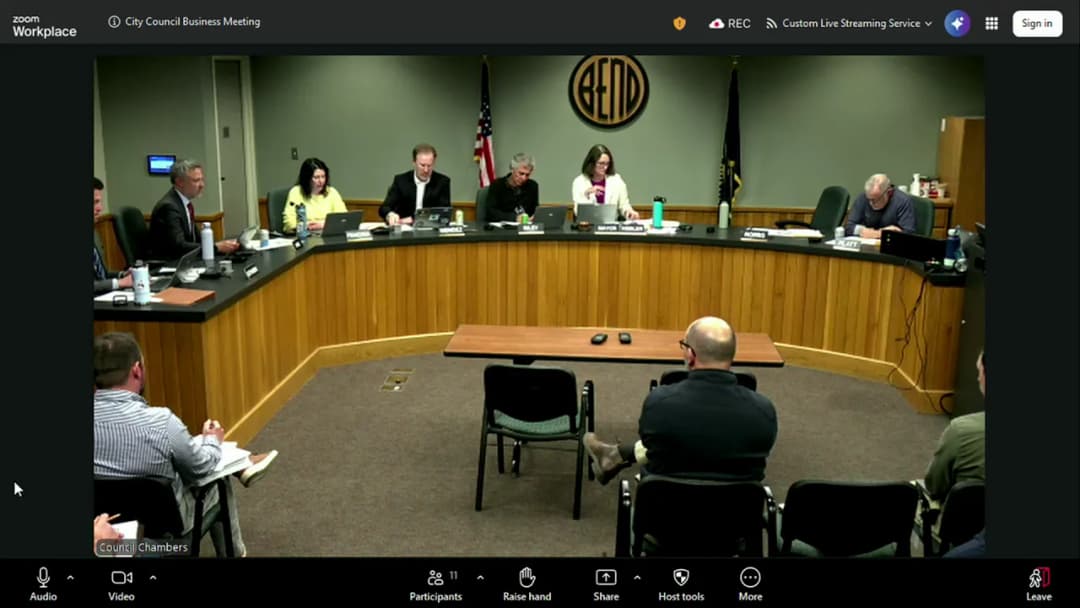
The Bend City Council met on the evening of April 1, 2026, at City Hall. The meeting included two proclamations (Arbor Day and Dark Sky Week), public comments, approval of the consent agenda, and significant actions on a major housing development (Legacy Village), a wildfire building code amendment, a growth plan contract, an eminent domain resolution for a multi-use path, and a sewer project loan and contract. Councilor Norris recused herself from items 5–8 and 10–11 due to her employment with Hayden Homes. Consent Calendar - The consent agenda was approved unanimously. Public Comments & Testimony - Jonathan Westmoreland (Bend resident): Requested council direct staff to review his submitted materials on a surveillance procurement framework and begin discussion at the April 10th Public Contract Subcommittee meeting. - Ben Leech (small business owner, Cascade Cottons): Asked council to help combine two water meters on his property to eliminate duplicate sewer fees, citing a $1,885 annual overcharge. - Brennan Breed (member of Energized Bend): Urged council not to carve out exemptions for renewable natural gas (RNG) in the proposed climate impact fee and to implement the fee starting in April 2027, aligned with the building code update. - Priscilla Calledos (Bend resident, Environmental Center): Supported a strong climate impact fee with no exemptions and implementation in April 2027. - Christy Mellum (Bend resident): Called for a strong climate impact fee to be passed expeditiously, stating that a 20% fee is insufficient. Discussion Items Proclamations - Arbor Day Proclamation: Declared April 24, 2026 as Arbor Day in Bend. Robbie Silverman (Save Bend Green Spaces), Ian Gray (City Urban Forester), and students from Pacific Crest Middle School spoke about upcoming tree planting events and the importance of protecting Bend’s tree canopy, particularly juniper trees on the east side. - Dark Sky Week Proclamation: Declared April 13–20, 2026 as International Dark Sky Week. Brandon Matthews (Dark Skies Oregon) and Taylor McEwan (Bend Elks) highlighted the benefits of responsible lighting, noting that the Bend Elks’ stadium lighting retrofit reduced light spill and energy use by 60%. Council Action & Reports - Councilors reported on recent committee meetings, including the Accessibility Advisory Committee, Bend MPO, Edco Pub Talk, City Club of Bend, and League of Cities training. Mayor and Councilor Riley expressed condolences on the passing of Warm Springs Chief Delvis Heath Sr. and recognized Transgender Day of Visibility (March 31) and Month of the Military Child (April). Items 5–7: Legacy Village (Stevens Road Tract) – Comp Plan Amendment, Master Plan, Annexation - Staff Presentation (Karen): The project is driven by House Bill 3318 (2021), which mandates minimum density (9 units/gross residential acre), a housing mix (10% townhomes, 35% plex/multifamily), and 20 acres of deed-restricted affordable housing. The concept plan (2022) and comp plan policies (2023) set baseline requirements. The applicant (Hayden Homes) proposes 2,487 homes, 11% townhomes, 58% plex/multifamily, and 23.8 acres of affordable housing (3.8 acres more than required). The master plan includes 39.5 acres of open space, a 23-acre community park, and a multi-use path network. The comp plan amendment reduces market-rate RH units from 480 to 300 to make development viable. - Planning Commission Recommendation: Unanimous for the comp plan amendment; 5-2 for the master plan and annexation (dissenters cited concerns about commercial land conversion under SB 8). - Applicant Presentation (Joey Sheer, Jen Kopitz): Emphasized alignment with the bill’s affordable housing goals, successful precedent at Parkside Place, and a phasing plan from south to north. They committed to preserving commercial and mixed-employment parcels (5 acres commercial, 7 acres mixed employment) and coordinating with Cascades East Transit for future transit stops. - Council Deliberation: Councilor Françoza expressed concern that commercial uses often go unbuilt, but other councilors noted the land-use process only designates parcels—it does not require construction. Councilor Riley supported the project due to affordability and housing diversity. The mayor highlighted the project’s benefits for educators and the Common School Fund. - Outcome: All three motions passed unanimously (Councilor Norris recused). Item 8: Wildfire Building Code (Section R327) - Presentation: The ordinance adopts discretionary section R327 of the Oregon Residential Specialty Code, requiring home-hardening standards for new residential construction citywide. Staff recommended aligning the effective date with the new building code in October 2026 but offered an emergency effective date of April 15, 2026 if unanimous. - Discussion: Councilor Françoza argued that education on defensible space should be a higher priority. Deputy Fire Marshal Melissa Steele explained that home hardening and defensible space are complementary and that education alone does not spur action. Other councilors noted the importance of future insurability and alignment with neighboring jurisdictions (Sisters, Deschutes County). - Outcome: The motion to adopt the ordinance passed (no opposition stated; Councilor Françoza did not voice a no vote). The emergency clause was not pursued. Item 9: Growth Plan Contract Amendment - Presentation (Brian Rake): The contract with Cascadia Partners LLC increases by $2,739,282 for Phase 1 services in the 2025-2027 biennium, part of a multi-phase growth plan. The work includes housing needs analysis, buildable lands inventory, transportation system plan update, community visioning, and equity analysis. Total project cost estimated at $7.2 million. Funding is within the adopted budget. - Outcome: Motion to authorize the contract amendment passed unanimously. Item 12: Eminent Domain for Neff Corridor Improvement Project - Presentation (Eric Forster): Resolution authorizes eminent domain for up to 15 parcels needed for a 10-foot multi-use path along Neff Road from Pilot Butte Middle School to Eagle Road. The tool provides schedule certainty if voluntary agreements cannot be reached. - Outcome: Motion passed unanimously. Items 10-11: Azalea and Windsor Sewer Project – Loan and Construction Contract - Presentation (Drew Wells, Kim Millett): The project installs sewer mains on Azalea and Windsor areas as part of the Septic to Sewer program. Total loan amount not to exceed $2.9 million; construction contract with C Bar L Development LLC for $1,907,607.60. The loan is eligible for 50% principal forgiveness. Construction expected mid-April to October 2026. - Discussion: Councilor Mendez asked about properties that did not sign up; staff explained that the program is resident-driven and no second outreach is made, but all properties in the project area receive laterals regardless of sign-up status. - Outcome: Both motions passed unanimously (Councilor Norris recused). Key Outcomes - Arbor Day and Dark Sky Week proclamations adopted. - Three motions for Legacy Village (comp plan amendment, master plan, annexation) all passed unanimously (Councilor Norris recused). - Wildfire building code (R327) adopted without opposition. - Growth plan contract amendment approved unanimously. - Eminent domain resolution for Neff path approved unanimously. - CWSRF loan and construction contract for Azalea/Windsor sewer project approved unanimously (Councilor Norris recused). - Next steps: Second readings on April 15 for ordinances; staff will report on climate impact fee roundtable on April 8; the public will be invited to a Hawthorne Connection open house on April 7 and the growth plan kickoff workshop in August.

HOUSING DEVELOPMENT 36% · ECONOMIC DEVELOPMENT 16% · PROCEDURAL 10% · AFFORDABLE HOUSING 7%
23
MAR 18, 2026 · BEND, OREGON · CITY COUNCIL
Bend City Council Meeting: March 18, 2026 – Legislative Update, Parking Contract, and Immigrant Community Resolution

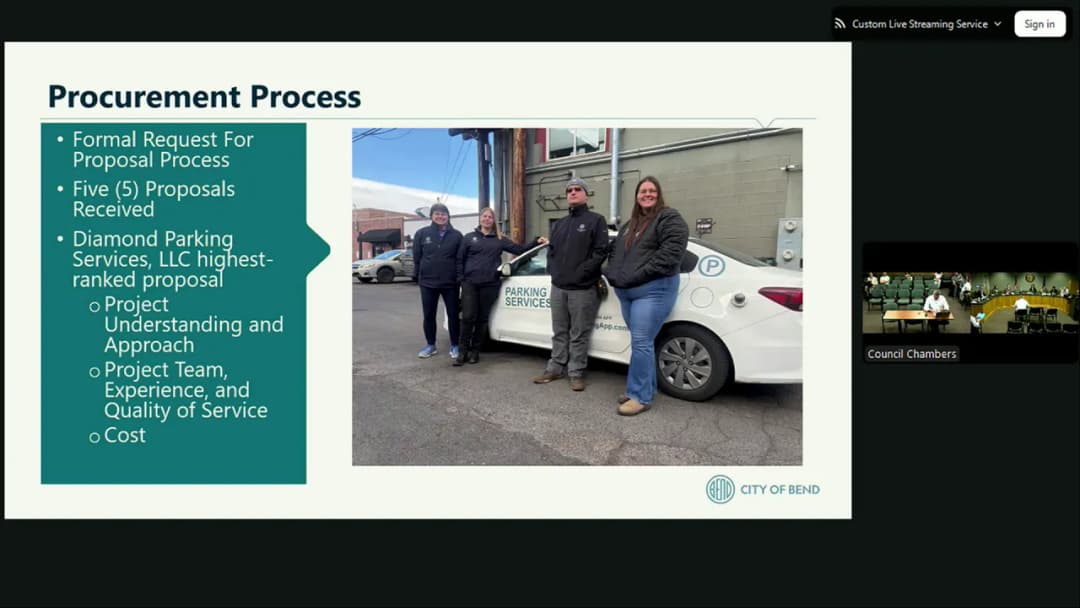
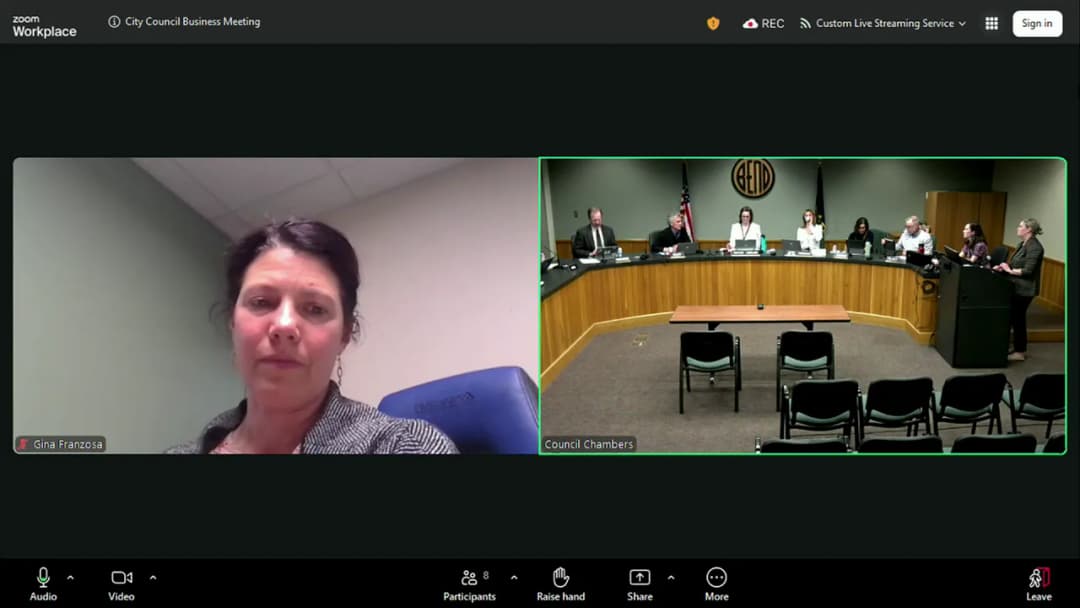
The Bend City Council met on March 18, 2026, to receive a state legislative update, discuss a Southeast Bend neighborhood roundtable, approve a parking management contract, adopt a resolution supporting immigrant communities, and authorize a sewer project loan and construction contract. The meeting also included several council member reports and public comments. Consent Calendar - The consent agenda was approved unanimously. Public Comments & Testimony - Michelle (online): Noted that the Southeast Bend roundtable recap omitted a key neighborhood position: "no gas stations" approved near elementary schools. She asked the city to confirm if conditions for approving gas stations are still in place. - Jonathan Westmoreland (in-person): Reported that 45% (28 of 62) city employee email addresses from the League of Oregon Cities directory were involved in data breaches, some including password data. Urged the city to view SB 1516 (end-to-end encryption) as a floor, not a ceiling, and to be vigilant with vendor contracts. - Todd Torzen (in-person, Southern Crossing Neighborhood Association chair): Requested a Southwest Bend roundtable similar to the Southeast event. Opposed the $NSSP project for a road crossing of Reed Market, proposing a more comprehensive solution. Noted parking loss due to Glasswater Townhomes construction and asked council to work with the old mill owners and Bend Parks and Rec to create new parking. - Jane Lisa (in-person, King's Forest neighborhood): Expressed concern about lack of evacuation routes in light of new high-density development (e.g., Wildflower Project at 15th and Wilson, adding 4,000 vehicle trips per day). Urged council to fund and assign evacuation routes. - Michael Baker (in-person, CEO Boys & Girls Clubs of Bend): Reported the club was open 222 days in 2025 and will be open 273 days in 2026, with expanded hours including Saturdays. Handed out 17,400 meals in 2025, on track for 25,000 in 2026. Rock wall recertified after seven years. Promoted the "Great Promsby" event on April 18. Praised City Manager Eric King. - Kinsey Hood Martin (in-person): Thanked council for the resolution supporting immigrant communities, calling it meaningful and significant. Hoped for continued tangible resources and commitments. Discussion Items - State Legislative Update: Eric Cancler (city lobbyist) and Kate Schneider (executive policy officer) reported on the short session. Key outcomes included: lodging tax flexibility (70/30 split shifted to 50/50 for tourism/marketing vs. other uses—pre-2003 Bend increment unaffected), protection of $207 million in shelter funding, passage of an amendment to HB 4037 improving urban reserve rules for cost-of-serving parcels, and a measure protecting neighborhood commercial areas from being entirely consumed by affordable housing developments. Council discussed SB 1551 (wildfire restrictions for HOAs) and a provision in HB 4037 that prohibits public hearings for developments meeting clear and objective standards. - Southeast Bend Neighborhood Roundtable Debrief: Council praised the new roundtable format (listening session with staff booths). Councilor Riley said it was "amazing" to have staff present to answer questions. Councilor Platt commended staff for showing transportation system evolution. Councilor Perkins noted requests for similar sessions from other neighborhoods. Staff will bring a plan for the next roundtable. - Council Member Reports: Several members reported on various meetings: Central Oregon transportation committee (Councilor Francisa), Civics Lab Human Library in Redmond and Bend MPO budget committee (Councilor Mendez), Embrace Bend civics event, a film screening at COCC, a tour of Homemade Toffee in the central district, and COIC supporting the Central Oregon Civic Action Project (Councilor Riley). Councilor Perkins gave an update from the Coordinated Housing Response Office: a point-in-time count had data issues mainly in shelters, not unsheltered; the RFP for service providers saw a record 23 applications; funded items included anti-trafficking rapid rehousing, a supply hub, emergency shelter for domestic violence survivors, home repairs for low-income homeowners, and rent/food assistance. Councilor Perkins also reported pitching a public-private partnership to support workforce experiencing homelessness (20% of emergency shelter residents work). Councilor Norris noted the Southeast Bend roundtable turnout and a joint Bend Parks and Rec meeting. Councilor Platt reported on the OSU Cascades provost reception (Big Hill facility) and the plan commission discussion on Timber Yards. Mayor Kebler noted the joint parks meeting discussed affordable housing, the riverfront project, and bridges; the rural fire district working group will have a work session in May on a fire levy renewal in 2028 and a feasibility study for long-term funding; the DBBA meeting this morning included feedback on the Franklin decision and a plan for paid parking to be brought in June; and a group of Cub Scouts visited city hall. - Resolution Supporting Bend’s Immigrant Communities: Melissa Camania (affordable housing coordinator) and Catalina Sanchez Frank presented. The resolution reaffirms Bend as a welcoming community, condemns current federal immigration enforcement approach, and allocates $100,000 to the Latino Community Association (50% for welcoming city work, 50% for direct support to families impacted by immigration). Council noted that funds are open to all immigrant groups through LCA as administrator. Councilor Mendez expressed pride in the resolution as a statement of community values. Councilor Francisa, as a daughter of an immigrant, thanked the council. The resolution passed unanimously. - King Hezekiah and Fargo Sewer Project: Jason (principal engineer) presented. These two septic-to-sewer conversion projects, part of the seventh selection through the program, are in the King's Forest area. King Hezekiah: 25 properties benefit, 13 committed, 1,900 linear feet. Fargo: 17 properties benefit, 12 committed, 1,000 linear feet. Construction contract awarded to Far 7A Companies for $1,674,186, 26% under engineer's estimate. Total budget $2.875 million. A clean water state revolving fund loan (not to exceed $2.875 million) will finance the project; eligible for $1 million in emerging contaminants forgiveness and up to $4,500 in principal forgiveness, so net repayment roughly half. Councilor Riley asked about a disconnected cul-de-sac (Cabin Lane) not included in sewer extension; staff noted the program is competitive and must balance system-wide needs. Both resolutions passed unanimously. - Parking Management and Enforcement Contract: David Avister (transportation mobility) presented. The contract with Diamond Parking Services (highest ranked of five proposals) is for citywide parking management, enforcement, and maintenance of pay stations and the parking garage. $536,000 first year, up to $2,906,000 over five years with annual renewals. Two new parking districts (Old Bend East and Miller's Run) are proposed; council will receive final recommendations in June after public comment. Council had a lengthy discussion about enforcement issues in the existing Old Bend parking benefit district (tickets for overtime street parking, wrong-direction parking, visitors unable to parallel park). Councilor Perkins argued the district was never explained to residents and enforcement goes beyond what was agreed. Councilor Norris noted that the neighborhood originally asked for enforcement to address pressures from visitors. The contract was approved unanimously. - Tree Preservation Ordinance: Second reading of an ordinance amending BDC 3.2.200. Councilor Mendez recused himself due to a conflict of interest. The ordinance passed on a roll call vote (6–0, with Mendez recused). Key Outcomes - Adopted Resolution Supporting Immigrant Communities (unanimous): Condemns federal immigration enforcement, allocates $100,000 to Latino Community Association for welcoming city work and direct family support. Council will send a letter to federal representatives. - Approved Clean Water State Revolving Fund Loan (unanimous): Not to exceed $2.875 million for King Hezekiah and Fargo Sewer Project. - Awarded Sewer Construction Contract (unanimous): Far 7A Companies, $1,674,186. - Approved Parking Management Contract (unanimous): Diamond Parking Services, $536,000 first year, up to $2,906,000 over five years. - Adopted Tree Preservation Ordinance (6–0, Mendez recused). - Directed Staff: To bring forward a schedule for additional neighborhood roundtables and to include a policy discussion on existing parking district rules when presenting the new Old Bend East district in June. - Next Steps: City Manager Eric King will send a survey to council to assess workload and prioritize work plan items; a quarterly goal update in April will include scheduling and prioritization discussions. The central library closes for renovation in April; the new central library opens May 11.

WATER AND WASTEWATER MANAGEMENT 16% · PUBLIC ENGAGEMENT 15% · TRANSPORTATION SAFETY 14% · COMMUNITY ENGAGEMENT 10%
24
MAR 11, 2026 · BEND, OREGON · CITY COUNCIL
City of Bend Work Session: Mobility, Transit, Franklin Closure, and Juniper Tree Code – March 11, 2026

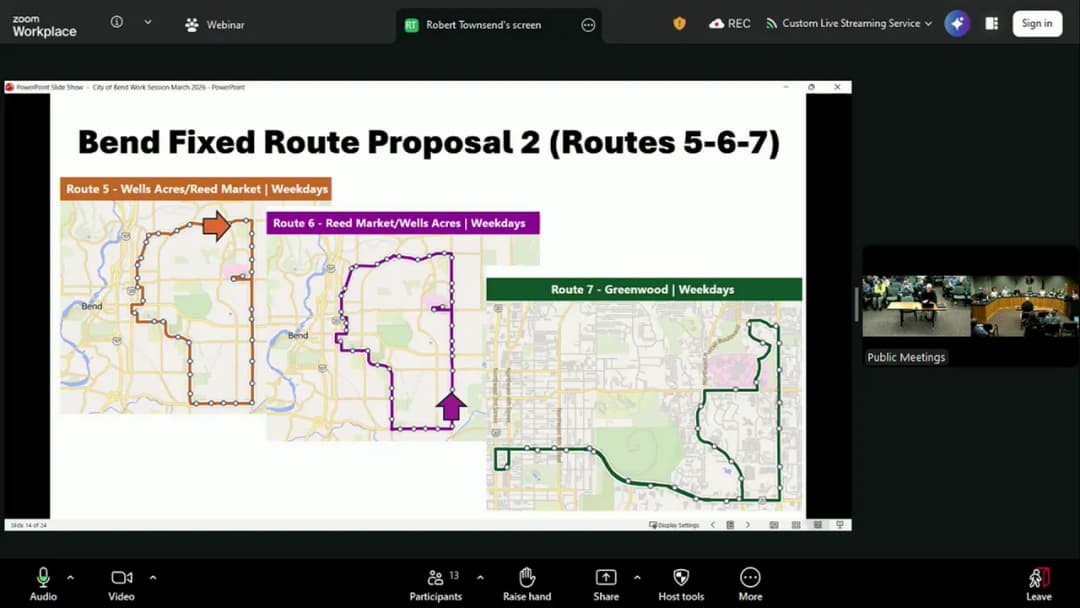
The Bend City Council held a work session covering four major topics: an overview of the city's mobility programs, an update from Cascades East Transit (CET), proposed closure options for the Franklin Avenue underpass project, and a discussion on Western juniper tree preservation in the development code. Staff presentations provided data, and council members gave direction for further analysis on several items. Mobility Program Overview - Janet Ruby, assistant city engineer, described staffing growth from two to nine positions, funded in part by the transportation utility fee, to implement the Transportation System Plan. Derek Hofbauer, mobility programs manager, detailed new programs including the bike share system (300 bikes, 45,000 trips, 75,000 miles, an estimated 13,000 car trips reduced), and planned mobility hubs at two locations: SE 3rd & Foster House and Robo Road near Cascade Village, with designs for construction in 2027-2028. Derek stated that about half of all trips in Bend are under 3 miles and a quarter under 1 mile, supporting the goal of expanding travel options. Transit Update (CET) - Bob Townsend, CET director, provided an update on core service data, noting that total ridership (including non-urban services) has surpassed pre-pandemic levels and is growing 10–20% per year. Fare reimplementation began February 9, 2026, with a soft launch on February 2. As of late February, 2,600 accounts were registered, with 30 new accounts per day. February fares collected were $98,000, exceeding projections, though only three weeks of revenue. Group pass partnership agreements numbered 30. Ridership on Bend fixed route declined by about 25% after fares, but Townsend highlighted benefits such as more efficient service and expansion of dial-a-ride to northeast Bend (April 1) and Deschutes River Woods (May 1). He discussed proposed route modifications to achieve 15-minute headways on busier corridors by reallocating resources from lower-ridership routes. Townsend also noted that Senate Bill 1544 (allowing COIC to be the qualified entity for three counties) passed and awaits the governor's signature. A working group with council members Mendez and Riley was proposed to envision future transit. Franklin Underpass Closure Options - Garrett Sabron (engineering) and representatives from KE and Del presented a revised construction schedule for the Franklin Avenue improvements (Harriman to 4th Street). The preferred plan includes two closure periods for the undercrossing: mid-September to mid-November 2026, and early January to May 2027, keeping the corridor open during the holiday season. Councilor Mendes asked about maintaining one travel lane where possible; Jay Johnson (KE) estimated an additional cost of $100,000–$125,000 for the holiday break. Detours will use Greenwood Avenue, and bike/ped access on the south side of the undercrossing will be maintained throughout. Council expressed support for the schedule. Questions were raised about coordination with other upcoming projects (e.g., the Butler roundabout) and traffic impacts on Greenwood. Staff confirmed that communications and signal timing adjustments will be proactive. Juniper Tree Preservation and Land Development - Ian, city urban forester, and Jenna Dyball, OSU extension forester, presented on Western juniper ecology, distinguishing post-settlement trees from old-growth specimens (some exceeding 1,600 years old). Jenna explained that juniper expansion over the past 150 years is due to reduced fire frequency and livestock grazing, not any inherent invasiveness. Water use studies show junipers consume about 13 gallons per day, but water yield benefits from removal are uncertain. Staff recommended maintaining the current code (juniper treated like other trees) until the annual review later in 2026, while noting discretionary pathways already exist. Council discussed several options: exempting junipers entirely (no support), creating a different standard for industrial parcels, counting street trees as mitigation, and setting density thresholds for juniper‐dominated sites. Councilor Mendez emphasized that all trees matter, not just iconic ones. Councilor Françosa raised equity concerns about differential impacts on the east side. Staff were directed to return with analysis on: (1) a distinct regulatory pathway for industrial land (all trees, not just juniper), (2) allowing street trees to count as mitigation, (3) whether density thresholds for junipers could be used, and (4) alignment with the upcoming defensible space code. No code amendments were approved; staff will present findings at a future work session. Key Outcomes - Council unanimously supported the Franklin underpass closure schedule with a holiday break and asked staff to coordinate with other upcoming projects and improve traffic communications. - For transit, council endorsed the proposed working group (Mendez and Riley) to develop a long-term vision for transit in Bend. - On junipers, council directed staff to explore: industrial land exemptions (trees generally), street tree mitigation credits, juniper density thresholds, and coordination with defensible space code. No immediate changes to the tree code were made; further analysis is expected within a few months.

TRANSPORTATION SAFETY 25% · ENVIRONMENTAL PROTECTION 24% · ENGINEERING AND INFRASTRUCTURE 15% · PUBLIC ENGAGEMENT 11%
25
MAR 4, 2026 · BEND, OREGON · CITY COUNCIL
Bend City Council Business Meeting – March 4, 2026

The Bend City Council held a business meeting on March 4, 2026, addressing proclamations, council reports, public comments, tree preservation code amendments, bond issuances, and urban renewal agency business. The meeting included a public hearing, consent calendar, and second readings of ordinances. The urban renewal agency (BURA) also met to authorize debt and discuss development assistance programs. Proclamations - MS Awareness Week – Mayor read a proclamation recognizing the week and highlighting the impact of multiple sclerosis on nearly 1 million Americans. Councilor Keebler shared a personal connection (her mother has MS). - Absolutely Incredible Kid Day – Proclaimed March 19, 2026, as Absolutely Incredible Kid Day. Keisha Kaboda, Executive Director of Campfire Central Oregon, announced a free ice skating event on March 15, 2026, from 12:30–3:30 PM at the Pavilion. Council Reports - Councilor Franzosa: Recognized community members and the legacy of Dave Marchie, who helped revitalize the Commons. - Councilor Platt: Attended the Planning Commission meeting, the Advisory Body Summit, and an event on homelessness; expressed concern about U.S. military involvement in Iran. - Councilor Norris: Attended the Advisory Body Summit; noted a neighborhood association meeting missed due to a sick child. - Councilor Perkins: Attended Black History Month events, the Spring Festival, and the Bend Economic Development Advisory Board meeting; previewed a public assembly venue feasibility study from Visit Bend. - Councilor Riley: Attended a rally in support of Ukraine, COCC’s Black History Month celebration, and a talk by Ijeoma Oluo; echoed concerns about the situation in Iran. - Councilor Mendez (serving as MPO chair): Reported that the MPO Policy Board selected chair/vice chair and that the Transportation Improvement Plan will be adopted next month. - Mayor Keebler: Reported on legislative progress (SB8 fix, TLT flexibility bill, recreational liability bill), a visit to Pacific Crest Middle School, and joint meetings with parks and county leadership. Public Comments & Testimony - Aaron Rivers and Kacia Rivers (Southwest Bend residents): Expressed support for stricter enforcement of off-leash dog laws; suggested increasing fines from $250 to $500 or more and requiring community service. - Kristen Reidelberger (Central Oregon Landwatch): Urged the council to maintain junipers in the tree code as both regulated and priority trees, citing climate resilience, wildlife habitat, and equity concerns. - Chris Madison (ISA board certified master arborist): Opposed weakening tree code protections, noting that every $1 invested in urban trees yields $2.25 in benefits; argued that junipers are iconic to Bend. - Donna Britt (small business owner): Described frustration with a city portal glitch that prevented her from renewing her business license before the deadline, resulting in a $20 late fee; the city manager promised to follow up. Consent Calendar - The council approved the short consent agenda unanimously (motion by Councilor Perkins, second by Councilor Riley). Discussion Items - Tree Preservation Code Amendments (Item 5) – Public hearing and first reading of an ordinance amending BDC 3.2.200. Staff presented narrow amendments: new exemptions for residential land divisions on parcels ≤1 acre, land divisions where resulting lots are ≥1 acre, and sites with no trees; a discretionary root protection zone path; and alignment of replacement trees with parking lot canopy requirements. Councilor Mendez declared a conflict (employed by Hayden Homes) and left the dais. The motion for first reading passed unanimously. A work session on junipers is scheduled for March 11, 2026. - Bond Authorization (Items 6 & 7) – Staff requested two resolutions: (1) issuing up to $9.5 million in full faith and credit bonds for the public works campus closeout, air traffic control tower match, streets equipment, and urban renewal projects; (2) refunding 2016 water revenue bonds to save $300,000–$400,000 per year ($3–$4 million over 10 years). Councilor Mendez clarified that general fund property taxes would not repay the bonds. Both resolutions passed unanimously. - Second Readings (Items 8, 9, 10) – Three ordinances were adopted by roll call: (8) amending the comprehensive plan map for the Southeast UGB expansion area; (9) annexing 66.46 acres in the same area; (10) creating Chapter 3.120 of the Bend Municipal Code to prohibit firearms in city buildings. All passed unanimously. - City Manager Report – Updates on equity work (job descriptions, immigrant community resolution), upcoming roundtable (March 12) and joint meeting with Bend Parks and Recreation (March 17). - Urban Renewal Agency (BURA) Meeting – The council reconvened as BURA. Approved minutes from prior meetings. Authorized $5.1 million in debt (to be loaned by the city) for core area projects, pledging tax increment revenues. Staff then presented an educational overview of development assistance tools (grants, loans, rebates, land acquisition). Council directed staff to explore policy changes to the site-specific housing program, including: lower AMI to 80%, further limit rent increases, simplify to a 20-year rebate, consider requiring first-floor commercial in mixed-use zones, and exploring homeownership models. Staff will return in May with proposals and stakeholder feedback. Key Outcomes - Proclamations for MS Awareness Week and Absolutely Incredible Kid Day adopted. - Consent agenda approved. - First reading of tree preservation code amendments approved; second reading scheduled for March 18, 2026. - Bond resolutions for $9.5 million (full faith and credit) and water revenue bond refunding approved. - Second readings of three ordinances approved by roll call. - BURA: Minutes approved; $5.1 million bond authorization approved; staff directed to research and bring back recommendations for site-specific program changes by May 2026.

AFFORDABLE HOUSING 24% · COMMUNITY ENGAGEMENT 15% · TREE PRESERVATION 12% · PUBLIC SAFETY 7%
26
FEB 25, 2026 · BEND, OREGON · CITY COUNCIL
Bend City Council Work Session on Financial Strategy and Wildfire Resilience - February 25, 2026

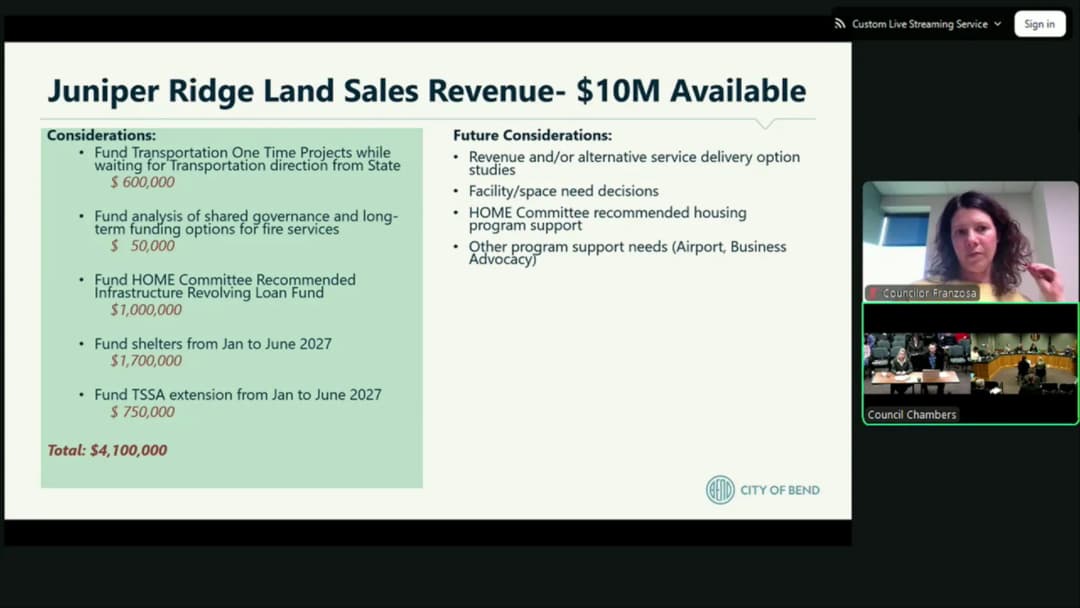
The Bend City Council held a work session on February 25, 2026, to discuss two major agenda items: the use of $10 million in one-time Juniper Ridge land sale proceeds and wildfire resilience code updates. Council reached consensus on a modified allocation of funds and directed staff to proceed with adopting home hardening standards and developing a defensible space code work plan. Discussion Items: Financial Strategy - Staff recommended $4.1 million of the $10 million available in Juniper Ridge land sale proceeds be used for council goals: $600,000 for transportation safety projects, $1.7 million for housing and homelessness (including a revolving loan fund and shelter bridge funding), $700,000 for shelter system support, and $50,000 for a public safety shared governance study. - Council discussed alternatives: Councilor Mendes proposed increasing transportation safety funding to $1.2 million; Mayor suggested $50,000 for small business grants (later increased to $100,000). Councilor Francosa advocated for considering other reserve funds and a broader discussion of city needs. - After debate, council agreed to: allocate $1.2 million to transportation safety (up from $600,000), $1.7 million to housing, $700,000 to shelter funding, and move the $50,000 fire governance study and $100,000 small business grants to contingency funds rather than Juniper Ridge proceeds. The total allocation from Juniper Ridge proceeds is approximately $3.6 million, with additional items funded from contingency. Discussion Items: Wildfire Resilience Code Options - Sarah Hudson and Melissa Steele presented options for code updates: home hardening (state code R327) and defensible space (state model code). R327 applies to new residential construction and cannot be amended; it adds 2-3% cost. Defensible space addresses vegetation management in three ignition zones. - Council debated scope: Councilor Francosa raised concerns about cost and enforcement on existing homes. Councilor Riley noted affordability and insurance benefits. Staff recommended adopting R327 citywide and exploring defensible space for the entire built environment with phased implementation and strong education. - Council consensus: adopt R327 citywide with a first reading on April 1, 2026, and an effective date after community input. For defensible space, direct staff to develop a work plan for the entire built environment, focusing on the critical five-foot zone, with phased enforcement and inclusion of resources (e.g., fire levy, state grants) for incentives and assistance. Key Outcomes - Financial Strategy: Council directed staff to bring a supplemental budget reflecting the modified allocation: $1.2 million for transportation safety, $1.7 million for housing, $700,000 for shelters, and to use contingency for the fire governance study ($50,000) and small business grants ($100,000). The total Juniper Ridge land sale proceeds used is $3.6 million, leaving approximately $5.35 million for future needs. - Home Hardening (R327): Council supported jurisdiction-wide adoption. First reading set for April 1, 2026, with a public hearing; effective date to be determined after builder and community conversations. - Defensible Space: Council directed staff to proceed with developing a work plan for a defensible space code applying to the entire built environment. The plan will include phased implementation, education-first enforcement, and identification of funding sources for homeowner incentives. Further council touch points are scheduled for later in 2026.

ENVIRONMENTAL PROTECTION 18% · WILDFIRE MITIGATION 17% · BUDGET EQUITY ANALYSIS 12% · TRANSPORTATION SAFETY 11%
27
FEB 18, 2026 · BEND, OREGON · CITY COUNCIL
Bend City Council Business Meeting – February 18, 2026

The Bend City Council held a business meeting on February 18, 2026, following an executive session. The meeting featured a proclamation for Ukraine solidarity, a push for a 20% climate impact fee on natural gas appliances, approval of a major annexation, and several policy updates. Key statistics: over 800 housing units planned in Copperwood Crossing; 1500+ emails received on the electrification fee; 20+ public comments heard. Proclamation: Day of Solidarity with Ukraine - Councilor Mike Riley read a proclamation declaring February 24, 2026, as the Day of Solidarity with Ukraine. The proclamation honored Ukrainian refugees and resilience. It passed unanimously. Community members Peter Sahidacny and Carrie Dolanuk Brown accepted the proclamation. Presentation: 100 Years of Water Service - Lori Faya, Environmental Resources Manager, presented a year-long campaign celebrating Bend's high-quality water from Bridge Creek. The campaign includes activities on history, conservation, and stewardship. Public Comments & Testimony: Electrification Climate Impact Fee - Over 20 speakers provided testimony. Supporters (e.g., Sophia, Noel Nelson, Michaela May, Brennan Bean, Sean Nolan, Ken Wilkins, Nate Springer, Derek Reimers, Josh Mooney, Mike Reed, Amelia DeBose, Debbie Pandenberg, Mary Pantenberg, Tristy Osbund, Alice Weston) urged the council to set the fee at 100% of the social cost of carbon, citing climate urgency and public health. Opponents (e.g., Brian Adams, Brad Archelletta, David Berger, Roger Gray) argued the fee would harm affordability and grid reliability, and criticized the process for not hearing from Cascade Natural Gas. Discussion and Vote: Electrification Fee - Council discussed the proposed 20% fee based on the social cost of carbon. Councilor Steve Platt moved to direct staff to pursue the fee at 20%, with a council-led roundtable in April and final vote in May/June. Councilor Megan Perkins opposed, citing unanswered questions about impacts. The motion passed with one dissenting vote. Consent Calendar - Approved the consent agenda unanimously. (Details not provided in transcript.) Public Hearing and Vote: Copperwood Crossing Annexation and Comprehensive Plan Amendment - Public hearing for two related items: amending the comprehensive plan map (less than 1% net change) and annexing 66.46 acres in the Southeast UGB expansion area. The development plans for 813 housing units, open space, and high desert trail. Councilor Megan Norris recused herself due to a conflict. After debate about state law allowing housing on commercial land, the motion passed with one dissenting vote. Ordinance First Reading: Firearms Prohibited in City Buildings - Council adopted an ordinance banning firearms in city buildings used for official meetings, per SB 243. Unanimous. Joint Resolution: Temporary Safe Stay Area (TSSA) Extension - Council approved a joint resolution with Deschutes County to extend the TSSA closure date to June 30, 2027, with phased closure and increased case management funding. Unanimous. Resolution: Eminent Domain for Franklin Avenue Project - Authorized the city manager to proceed with eminent domain for up to three parcels if necessary. Unanimous. Advisory Body Code Updates - Council discussed proposed changes to the Transportation Bond Oversight Committee (TBOC), Bend Economic Development Advisory Board (BDAB), and Affordable Housing Advisory Committee (AHAC). Direction was given to refine the TBOC proposal, align BDAB with the economic development strategy, and modernize AHAC's code to reflect current work. Key Outcomes - Electrification Fee: Staff directed to draft a fee at 20% social cost of carbon; roundtable in April; final vote planned for May/June 2026. - Copperwood Crossing: Approved comprehensive plan amendment and annexation on first reading. - Firearms Ordinance: Approved first reading; final adoption pending. - TSSA Extension: Joint resolution adopted; closure date extended to June 30, 2027. - Franklin Avenue: Eminent domain resolution adopted. - Advisory Bodies: Staff to bring consolidated code amendments incorporating council direction.

ENVIRONMENTAL PROTECTION 20% · PROCEDURAL 12% · ENGINEERING AND INFRASTRUCTURE 11% · COMMUNITY ENGAGEMENT 9%
28
FEB 11, 2026 · BEND, OREGON · CITY COUNCIL
Bend City Council Work Session on Electrification Fee and TSAP - February 11, 2026

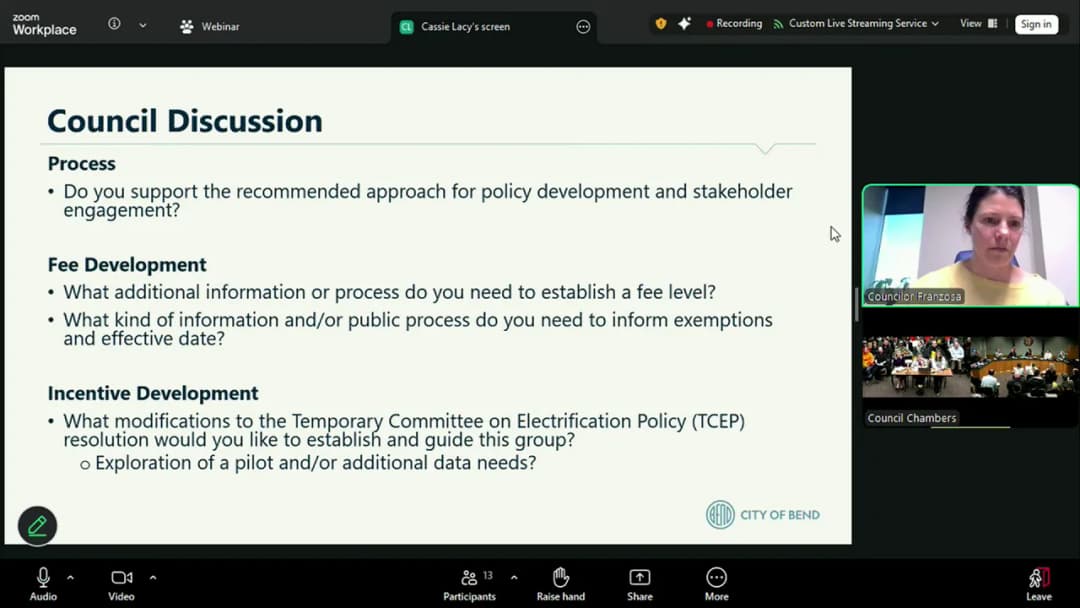
The Bend City Council held a work session on February 11, 2026, to discuss two major topics: the proposed electrification fee and incentive program, and an update on the Transportation Safety Action Plan (TSAP). The council reviewed updated fee analysis, considered grid impacts from Pacific Power, debated fee levels, and settled on a direction for stakeholder engagement. Later, the MPO presented crash data trends and the upcoming TSAP update timeline. Public Comments & Testimony - During the electrification discussion, an audience member attempted to interject but was informed by the mayor that this was not a time for public comment and directed to send emails or attend a future public meeting. Discussion Items Electrification Fee Policy (Work Session Focus) - Presentation by Cassie Lacey (Senior Management Analyst) and Danielle Walker (Consultant, Brightland Group): - Staff presented a refined fee calculation that now uses net carbon produced (gas appliance emissions minus emissions from alternative electric equipment) rather than gross emissions, accounting for Bend's current electricity mix (Pacific Power and Central Electric Cooperative). The fee is calculated as: social cost of carbon (EPA-based) × net lifetime carbon produced × tier scaling factor (based on home size). The maximum fee for a mid-tier home (average size) was shown, along with two reduced levels: 50% and 20% of that maximum. - For a home installing all gas appliances at the maximum fee, the total would be $9,714; at 50% it would be about $4,857; at 20% it would be about $1,954. The fee is per appliance, so individual appliance fees are lower (e.g., gas stove at 20% = $141). - Revenue estimates: at maximum fee $2.5M/year; at 20% $1M/year (after 35% administrative costs). These funds could incentivize heat pump installations (e.g., at 50% incentive, 59–122 heat pump retrofits per year depending on fee level). - Greenhouse gas reductions: a combination of new homes electrifying (due to fee) and existing home retrofits (funded by fee revenue) could roughly double carbon reductions compared to the fee alone. - Presentation by Elisa Dunlap (Pacific Power): - Pacific Power's Bend area growth is 7.75 MW per year (temperature-adjusted), one of the fastest-growing regions in their service territory. Current grid infrastructure includes seven substations, with five planned upgrades and one new substation (east side) in 5–10 years. - Future emissions reductions: HB 2021 requires 80% clean by 2030, 100% by 2040. Pacific Power's current compliance portfolio shows a steep drop between 2029 and 2030, but cost off-ramps exist. Their RFP for renewable generation is open all year; better cost clarity expected by end of 2026. - Grid impact: if all new homes (741/year) were all-electric, increased demand would be 6.73 MW/year. At lower adoption rates (e.g., 25% electrification), demand increase would be 1.68 MW/year. - Load in queue for Bend: 14 MW residential, significantly more non-residential. - Council Discussion and Positions: - Councilor Platt supported the 50% fee level, citing affordability and job concerns. He appreciated fee adjustability. - Councilor Mendes advocated for a lower

ENERGY POLICY 55% · PUBLIC ENGAGEMENT 16% · TRANSPORTATION SAFETY 13% · PROCEDURAL 4%
29
FEB 4, 2026 · BEND, OREGON · CITY COUNCIL
Bend City Council Business Meeting, February 4, 2026

The Bend City Council held a business meeting on February 4, 2026, starting at 2:00 PM UTC. The meeting opened with a statement recognizing Black History Month, followed by council reports, extensive public testimony on a proposed natural gas fee and other issues, and action on several agenda items including an economic development strategic plan, a collective bargaining agreement, and a notice of termination to solid waste franchise holders. Consent Calendar - Approved items A, B, and D of the consent agenda (details not specified). - Approved a contract with Neighbor Impact for utility assistance third-party services, authorizing an amount not to exceed $52,342 for the first year and up to $261,710 over five years, with annual renewals allowed. Public Comments & Testimony - Sarah Odendahl (CEO, Bend Chamber): Expressed support for the city's Economic Development Strategic Plan, emphasizing the need for a strong, well-resourced program focusing on business retention, growth, and inclusivity. Also urged consideration of a pilot program to collect data on all-electric homes before implementing a fee on natural gas appliances. - Michael Baker (CEO, Boys & Girls Clubs of Bend): Provided updates on extended teen hours and new Saturday operations; invited council to the annual meeting on February 24. - John Stark (CEO, Economic Development for Central Oregon): Supported the Economic Development Strategic Plan, noting his organization's role in business retention, expansion, and recruitment, and highlighted tools like tax increment financing and opportunity zone redesignation. - Justin Gottlieb (Independent Canners of Central Oregon): Expressed anger at local governance regarding improper disposal of containers, citing 600,000 improperly disposed containers. Criticized what he called discriminatory ideology and misunderstanding of addiction, urging better solutions. - Robin Church (Wildfire Risk Assessor, Project Wildfire): Urged adoption of R-327 wildfire building code before the spring construction season, citing Bend's high wildfire risk and potential economic benefits. - Craig Renkert (Resident, Project Wildfire): Supported R-327, noting personal experience building a home with its provisions and the need for community-wide adoption. - Lon Lenev (Project Wildfire Neighborhood Coalition): Representing the coalition, asked the city to adopt R-327, emphasizing that code adoption is necessary to accelerate regional wildfire safety. Noted that Deschutes County adopted it last week and Sisters already has. - Todd Torzin (Southern Crossing Neighborhood Association): Thanked council for advancing roundabout and bridge projects, but expressed concern that a two-lane roundabout is not proposed for Bond Reed Market despite doubling residential units; requested collaboration on transportation solutions. - William Dahlquist (Resident, Summit West neighborhood): Described unsafe traffic conditions on Skyline Ranch Road, citing construction, school, and tourism traffic, and asked for traffic calming measures. - Greg McAvoy (Resident): Requested lowering the speed limit on SE Murphy Road from 35 mph due to increased traffic and observed speeds over 45 mph. - Mark Gentle (Chair, Aubrey Butte Neighborhood District): Raised concern that neighborhood districts do not have liability insurance through the city after previously having deductions for insurance; asked council to help find a solution. - Carol Carson (Resident, West Hills neighborhood): Opposed restrictions on natural gas, arguing it is reliable, affordable, and that electrification would increase environmental impact and costs. - Alice Weston (Sierra Club Oregon, Progressive Workers Union): Supported a strong climate impact fee to facilitate electrification and a just transition fund, citing 2024 as the hottest year on record and the benefits of heat pumps. - James Kinney (Resident): Opposed regulation of natural gas, calling it affordable and efficient, and noted that replacing a gas furnace with a heat pump costs $23,000 versus $12,000 for a gas unit. - Brian Adams (Resident, President of Coenergy Propane, Energy Advisory Work Group): Urged council to pause consideration of a gas appliance fee, citing a projected 9-gigawatt electricity shortfall in the Pacific Northwest by 2030 and risks to reliability and affordability. - Ken Wilkins (Resident): Supported a climate pollution fee on new homes with gas appliances, but expressed concern that funds might be redirected to new builds instead of helping low-income residents electrify. Criticized lack of follow-through on the Petrosa master plan. - Amelia DuBose (Resident): Urged council to adopt a strong climate pollution fee, arguing that fossil fuel lock-in harms long-term affordability and health, and that the average Oregonian could lose $12,000 per year in personal income due to climate change. - Rachel Cannon (Apprentice Wireman, IBEW Local 280): Opposed forced electrification and a natural gas tax, citing grid reliability issues and arguing that local rules should wait for state energy policy outcomes. - Sean Nolan (Resident): Supported the electrification fee, arguing that renewable natural gas does not address health risks of natural gas in homes and that grid capacity concerns are managed by utilities. - Lori Bauman (Laborers Local 737): Opposed electrification, arguing it increases construction costs and that renewable natural gas can reduce emissions without sacrificing reliability or affordability. Warned of brownouts and blackouts. - Mary Pantenburg (Resident): Supported a strong climate impact fee, stating that delaying electrification increases long-term costs and that 95% of homes use natural gas, but 13% of childhood asthma cases are linked to it. - John Hanner (Laborers Local 737): Opposed quick electrification, suggesting a slow approach with a pilot project to study data before any fees. - Michaela May (Student, Caldera High School): Supported a strong climate impact fee, noting 66°F temperatures and Hoodoo Ski Area suspension of operations due to lack of snow, highlighting impacts on local livelihoods. - Chad Finnison (Union member, natural gas pipeliner): Opposed disincentives for natural gas, stating it is part of the energy matrix and that technology is improving. - Joe Craig (Resident): Supported a climate impact fee, citing Oregon's rank of 47th in renewable energy growth and his own net-zero home built in 2016. - Brad Archuletta (Business agent, UA Local 290): Opposed forced electrification, arguing Pacific Power's grid still relies on coal and natural gas, and that rates could rise up to 140% per year by 2030 if the utility meets clean energy deadlines. - Dan Cartwell (Mechanical Engineer, Electrify Oregon): Supported a strong climate impact fee, stating that natural gas is a major contributor to climate change and that electric options are available and efficient. - Dave Berger (Business agent, UA Local 290): Urged council to slow down on the gas tax, citing lack of community outreach compared to other policy areas, and noting that 67% of Bend voters oppose taxes on natural gas appliances. - Mike Reed (Resident): Supported the climate impact fee, arguing the natural gas grid is old and reliant on Canadian supply (66% from Canada), while the power grid is being upgraded with the Power Act protecting residential customers. - Jeff McGilvery (UA Local 290): Opposed the climate action fee, saying it would increase housing costs and reduce construction jobs. - Mike Aldred (Iron Workers Local 29): Opposed the gas tax, citing a DHM poll showing 52% of Oregonians think economic growth is slower than national average, and 67% of Bend voters oppose taxes on natural gas appliances. - Jeff Grant (Laborers Local 737): Opposed forced electrification, urging council to keep natural gas as an affordable choice and noting 67% of Bend voters oppose such taxes. - Clara Patt (Resident, Family Kitchen volunteer): Supported a strong climate impact fee, stating natural gas causes 13% of childhood asthma cases and that the fossil fuel industry does not have the community's best interests. Discussion Items - Black History Month Proclamation: Mayor read a statement recognizing Black History Month, highlighting Oregon's history of intolerance and recent tragedies, and committing to an inclusive community. - Council Reports: Councilors reported on various meetings and events, including: - Attendance at planning commission, Bend Fire banquet. - Meetings with Mosaic regarding community health care and the Mobile Street Medicine Program. - Testimony on recreation liability before the Oregon legislature. - BDAB meeting discussing economic development strategy; tourism down only 4% this winter. - Tour of a new co-working space at the Old Mill. - Regional housing council and coordinated homeless response office joint meeting. - Meeting with Petrosa residents about commercial amenities. - Transportation Bond Oversight Committee discussion on expanding to a citywide transportation advisory committee. - Prioritizing infrastructure projects with ODOT. - Conversations about construction impacts on neighbors. - Town hall with state representatives. - Meeting with Redmond officials on shared issues. - U.S. Conference of Mayors in DC, where frustration with federal immigration enforcement was a major theme. - Utility Assistance Program Update: Staff presented on the program's success since 2022, including a 75% increase in households served in the first year, a 9.3% increase in the second year, and a projected 10.5% increase in 2026. Water shutoffs declined by 75% in the first year due to improved processes. - 15th and Ferguson Roundabout Eminent Domain: Staff requested authorization to use eminent domain if necessary for right-of-way acquisition. The project was reprioritized due to public input. Only a few corners of five parcels are needed; staff noted they rarely actually use eminent domain. - Economic Development Strategic Plan: Staff presented the plan, developed over about a year with extensive stakeholder outreach (50+ focus group members, 80+ interviews, 170+ survey responses). The plan includes five goals: business retention and growth, targeted recruitment, building resiliency, enabling inclusive prosperity, and planning for growth. Key data: 75% of city tax revenue comes from residential property; 53% of workers commute into Bend; Bend is the fastest-growing city in Oregon at 2.5% growth. Next steps include a business retention plan, small business grant pilot, and urban renewal area investment strategies. - Solid Waste Franchise Termination: Staff recommended issuing a notice of termination to both solid waste haulers (Cascade Disposal and Republic Services), starting a six-year window period to negotiate new franchise agreements. Current franchises are evergreen with terms from 1980, and the city has been working regionally with Deschutes County and Redmond to develop modern agreements. The county and Redmond have already issued termination notices. Key Outcomes - Approved appointment of Garrett Mosher to the home committee (unanimous). - Authorized agreement with Neighbor Impact for utility assistance third-party services (motion by Councilor Perkins, second by Councilor Norris, unanimous). - Adopted resolution authorizing eminent domain for the 15th and Ferguson Roundabout Project (motion by Councilor Perkins, second by Councilor Platt, unanimous). - Approved collective bargaining agreement between city and Bend Fire Association Support Services Group (motion by Councilor, second by Councilor Franzosa, unanimous). - Approved the city of Bend's Economic Development Strategic Plan (motion by Councilor Perkins, second by Councilor Platt, unanimous). - Authorized city manager to issue notice of termination to solid waste franchise holders Cascade Disposal and Republic Services, initiating a six-year window period (motion by Councilor Perkins, second by Councilor Mendez, unanimous). - Council will hold a work session on February 11, 2026, to discuss climate policies, including a potential natural gas fee. City Manager's Report - Bend-Redmond MSA ranked 4th nationally in the Milken Institute's 2025 Best Performing Cities report, up from 6th. - State revenue forecast increased by $252 million, but job growth is not keeping pace with GDP growth, suggesting caution. - The Reed Market roundabout project will open on February 11, 2026, with remaining paving in spring.

ECONOMIC DEVELOPMENT 20% · ENERGY POLICY 20% · PROCEDURAL 9% · TRANSPORTATION SAFETY 9%
30
JAN 28, 2026 · BEND, OREGON · CITY COUNCIL
Bend City Council Meeting – January 28, 2026: Equity Program Structure and Transportation Standards

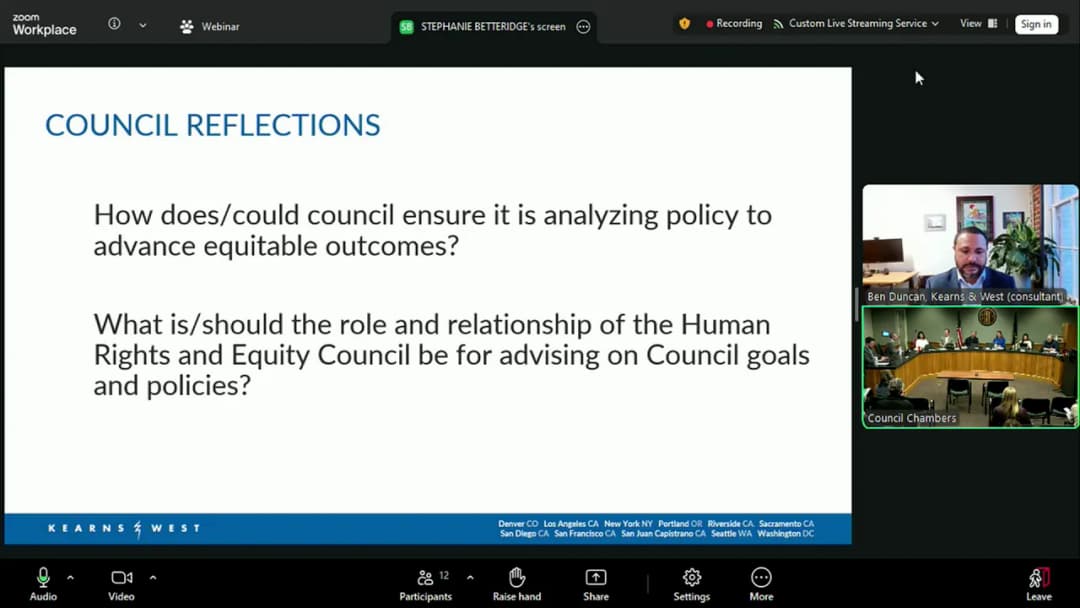
The Bend City Council met on January 28, 2026, with the mayor absent at a conference. The meeting featured a presentation by consultant Ben Duncan on the city's equity program structure, followed by a discussion on transportation standards and an update on the Hawthorne Bridge project. No consent calendar or public testimony was heard. Discussion Items Equity Program Structure - Ben Duncan, from Kearns West, presented findings and recommendations from the city-contracted review of its equity-related functions. Key findings included strong existing core functions but a need for more centralized oversight, clear decision-making authority, and consistent implementation across departments. Duncan recommended four high-level areas: embedding equity into decision-making, balancing centralized oversight with decentralized implementation (a “hub and spoke” model), building organizational capacity through tools like the AIM (Assumptions, Impacts, Measures) framework, and embedding community engagement as a core function. - City Manager Eric outlined an implementation plan: moving the equity and accessibility program into the city manager's office, formalizing equity liaison roles in departments as “spokes,” using the AIM tool across all departments (initial focus on four council-identified areas: water rates, wildfire mitigation, home committee, and growth plan), and adding a community engagement position. Eric also proposed expanding Ben Duncan’s contract to help refine the purpose of the Human Rights and Equity Commission (HREC). - Council members discussed the need for internal buy-in from departmental leadership, the importance of supporting the new equity director (the fourth person in this role), and the risk of equity work becoming performative. Councilor Francesa suggested having Ben Duncan provide periodic independent progress reports to council. Councilor Perkins proposed adding an equity impact analysis section to council issue summaries, while Councilor Norris cautioned against superficial use of checklists and suggested a phased on-ramp for mandatory equity reviews. - Councilor Mendez raised the need for a review of identity-based investigation processes within the city. Eric confirmed this would be done in the next 12 months, involving the DEIA task force and HR. - Council agreed to a joint meeting with the Human Rights and Equity Commission in March to discuss their role and relationship with council, with some members suggesting rotating council representation at HREC meetings. Transportation Standards Update - Operations Chief Russ, Assistant City Engineer Janet Ruby, and City Engineer Ryan Oester presented on the process to update transportation standards, focusing on lowering speeds, improving safety, and addressing community concerns. Three key policy areas were discussed: speed reduction, cut-through traffic, and street section design. - Council expressed strong support for lowering speed targets: 20 mph on local streets, 25 mph on collectors, and 30 mph on arterials (with design speeds set accordingly for new roads). Councilor Perkins emphasized a combination of engineering, education, and enforcement. Councilor Riley supported education over enforcement. Councilor Norris noted that simply lowering posted speed limits does not change driver behavior and that physical changes are needed. - On cut-through traffic, council supported expanding analysis and tools beyond bike/ped safety to address excessive vehicle traffic, as seen in Wood River Village. - For street sections, council directed staff to develop a 50-foot local street standard and a car-free (woonerf) standard. On arterial and collector streets, council preferred moving bike facilities off-road (behind the curb) and narrowing lane widths (from 11 feet) to improve safety and aesthetics, informed by research. Councilor Perkins stressed working within existing right-of-way when possible, and Councilor Norris emphasized flexibility in retrofit situations (e.g., Franklin Avenue). - On intersection forms, council directed staff to explore a preferred standard (e.g., protected roundabouts) with community input, but did not make a final selection due to time constraints. Councilor Mendez requested data on the performance of recently built intersections like Wilson and Third. Councilor Norris highlighted the need to consider pedestrians with visual impairments in design. - Staff will conduct workshops with engineers, emergency services, transit, school district, freight, advocacy groups, and the public, with a council work session in late summer, public comment in fall/winter, and adoption in spring 2027. Hawthorne Bridge Update - Project manager Garrett and city staff presented an update on the Hawthorne Avenue bridge project. The project is largely federally funded ($32 million) with a $1 million General Obligation Bond contribution. The preferred concept for street-level improvements on Hill to Harriman (west side) is a “promenade” (one-way westbound with on-street parking and a shared pedestrian/bicycle space), which received the most public support at a December open house (200 attendees). - The bridge alignment has been shifted to a more centered position to create a “people street” concept underneath, but this requires addressing traffic network connectivity in the superblock bounded by Franklin, Greenwood, First, and Third streets. Staff are in conversations with property owners (including the developer of the northeast corner and the bottle drop business) about temporary driveway access until redevelopment, and are exploring improvements to Irving and Greeley streets to maintain east-west connections. Council expressed support for the promenade and noted the potential for the bridge to connect Drake Park to Juniper Park. - The design schedule is tight due to federal funding deadlines: concept and cost estimates in April, Geobond budget discussion in May-June, council update in July, design completion in August, construction starting late 2027 to early 2028. Council approved the direction and requested continued engagement. Key Outcomes - Council directed the city manager to proceed with implementing the equity program structure recommendations, including hiring a new equity director in the city manager's office, formalizing departmental equity liaisons, expanding the AIM tool, and adding a community engagement position. Ben Duncan’s contract will be expanded to assist with HREC purpose and recruitment. Council will receive independent progress updates from Duncan. - Council agreed to add an equity impact analysis section to council issue summaries, with a phased approach to avoid performative use. - Council directed a review of identity-based investigation processes within the city, to be completed within 12 months. - Council scheduled a joint meeting with the Human Rights and Equity Commission for March 2026. - On transportation standards, council provided direction on speed reduction targets, cut-through traffic mitigation, and street section design (narrower lanes, off-street bike facilities, car-free standards). Staff will proceed with community engagement and return with a final proposal in spring 2027. - For the Hawthorne Bridge, council endorsed the promenade concept and centered bridge alignment, and directed staff to continue design and community engagement, with budget decisions in May-June 2026. The project remains on schedule.

RACIAL EQUITY 36% · ENGINEERING AND INFRASTRUCTURE 28% · TRANSPORTATION SAFETY 18% · PERSONNEL MATTERS 8%
OPENPUBLICA · PUBLIC MEETING INDEXUPDATED DAILY · openpublica.com