A special meeting of the Berkeley City Council was called to order at 4:03 PM on Tuesday, July 14, 2026, to receive and discuss the 2025 Police Accountability Board (PAB) and Office of the Director of Police Accountability (ODPA) Annual Report. The presentation was led by Interim Director Kathy Lee and Policy Analyst Jose Murillo, with Chair Josh Cayetano joining virtually. Councilmembers present: Taplin, Trega, O'Keefe, Blackaby, Lunapara, Humbert, and Mayor Yishi. Absent: Kessarwani and Bartlett. The meeting lasted approximately two hours and included Q&A, public comment, and council member remarks. Presentation Highlights - Interim Director Kathy Lee outlined the complaint process: intake, investigation, findings (sustained, not sustained, unfounded, exonerated), and appeals to the city manager. - In 2025, the ODPA received 43 complaints from 27 unique complainants. Of 69 allegations investigated and closed, 13 were sustained by the PAB, but the police chief agreed with none of the sustained findings. Agreement rates were higher for other categories. - 22 cases were administratively closed, many due to staffing shortages (budgeted for two investigators but lost one during a hiring freeze). - Policy Analyst Jose Murillo presented the board's policy work, including reviews of surveillance technology, vehicle pursuits, and a partnership with UC Berkeley's Criminal Law and Justice Center. - Stop data analysis: 4,540 stops in 2025. Black/African American individuals were stopped at higher rates relative to population benchmarks. Unhoused individuals were stopped 937 times compared to a point-in-time count of 880. The analysis included temporal, residency, and housing status factors. - Use of force: 276 incidents, 1,276 individual force applications. 48.3% involved Black/African American subjects. 62% of incidents led to arrest. - Training: 6,872.5 hours of training, 54.4% POST-certified. Public Comments & Testimony - Carol: Commented on encampment clearances, noting that notices given five weeks in advance (e.g., April 29 for a June 2 clearance) do not provide sufficient certainty for residents; suggested closer-to-date notice. Also questioned why unhoused individuals are stopped more often and mentioned a part-time CIT coordinator. - Andrea Pritchett: Expressed concern about CIT training frequency and the early warning system for officer misconduct. Noted that unhoused people are least likely to file complaints and stated her own complaint was not seriously handled. Encouraged council to ask probing questions for those who cannot. Discussion Items - Councilmember Humbert: Asked about staffing levels, the complaint process, and the timeline for policy reviews. Noted a 100% disagreement rate on sustained findings and asked for breakdown of allegation types. Pointed out that most sustained allegations were for lesser issues, not serious categories like use of force or false arrest. Questioned a discrepancy in city manager decision counts. - Councilmember Blackaby: Discussed operational challenges for PAB to review council items within 19-day windows. Suggested combining not sustained/unfounded/exonerated to show higher agreement. Noted stop data temporal analysis shows no clear bias and search yield rates are stable. Encouraged broader outreach (e.g., LinkedIn). - Councilmember O'Keefe: Asked about access to records from BPD; Interim Director Lee noted delays due to BPD staffing, but extensions were granted. Chair Cayetano added that the former director had to sue the city for records and some were never produced, impairing findings. Asked about a wish list for additional data to collect. - Councilmember Lunapara: Asked about POST-certified training and use-of-force incidents not leading to arrest. Wanted data separating institutionalization from non-arrest. Also asked about a sustained allegation regarding body-worn cameras where the chief agreed but no formal discipline was issued; Chief Lewis explained discipline is case-by-case and confidential. - Councilmember Trega (via comments): Expressed interest in better communication of policy complaint reports to council, balanced clearance rates, and understanding disagreements between PAB and BPD on sustained allegations. - Mayor Yishi: Thanked staff and noted the importance of celebrating successes while addressing areas for improvement. Acknowledged the heavy workload of volunteer PAB members and the need for sufficient review time. Key Outcomes - The council received the report and discussed it thoroughly. No formal votes were taken on the report itself, as it was a work session. - Council members expressed optimism about upcoming permanent regulations and a full board after recent appointments. - Several council members requested future reports include trend data, comparisons with other jurisdictions, and clearer breakdowns of sustained allegation types. - The council acknowledged the need to improve coordination between council agenda timing and PAB review capacity. - The meeting adjourned at approximately 6:15 PM after a unanimous roll-call vote to adjourn.
Public Meetings - Berkeley, California
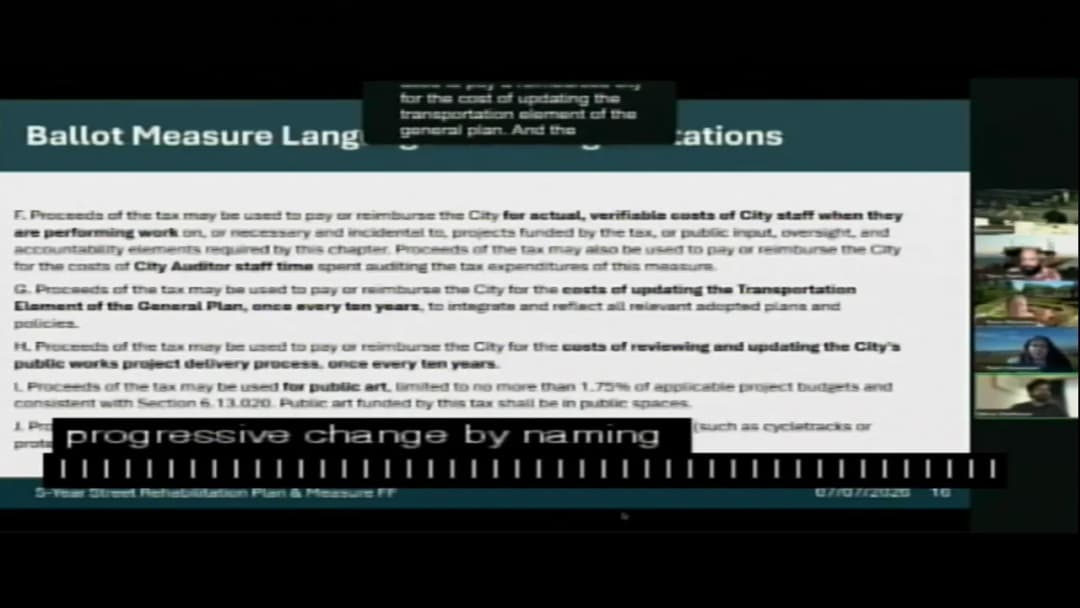
Public Meetings - Berkeley, CaliforniaCeremonial Matters and Presentations - Adjournment in Memory: Councilmember Tregub spoke in memory of Carl Anthony (1938–2026), a pioneering environmental justice architect and planner. His grandson, Makai Sloane Anthony, shared remembrances. - AC Transit Presentation: Stephen Jones (Director of Legislative Affairs) and Ryan Lau presented on the agency's fiscal challenges. AC Transit carries over 3 million riders monthly, 65% of whom are transit-dependent, and projects a $200 million deficit over four years. Without new funding, service cuts of up to 16% and potential layoffs of 300 employees may occur. They urged support for the Connect Bay Area Act (SB 63), a half-cent sales tax measure that would generate $52 million annually for AC Transit. A contingency plan would reduce service on some lines if no funding is secured by December 2026. Consent Calendar The consent calendar was approved unanimously (9-0) after moving Item 9 (Waterfront Specific Plan) to consent. Items included: - Item 3: Public art fee study (speaker urged consideration). - Item 4: Revenue agreements ($80,000 for crime suppression grants). - Item 5: Annual police equipment report (noted PAB review submitted as supplemental). - Item 6: Ambulance transport fee increase (public hearing held, approved). - Item 7: Memorandum of Understanding Compendium 2026 with law enforcement agencies (approved after public hearing, with discussion on data sharing restrictions). Public Comments & Testimony - Non‑Agenda: Speakers addressed garbage collection, Palestinian solidarity, housing data from Emeryville, a coffee shop complaint, and concerns about a planned bike lane on Hopkins Street near Martin Luther King Jr. Middle School. - On Consent/Information Items: Public comments highlighted the police equipment report (need for PAB review, concerns about weapons inventory) and the loophole in public art fees. - On Item 8 (Large Vehicle Parking): Multiple speakers opposed criminalizing RV dwellers, emphasizing the lack of housing alternatives. One speaker (Amber) described barriers to obtaining housing vouchers. The Berkeley Chamber of Commerce expressed support, citing health and safety concerns. - On Item 10 (Street Rehabilitation): Speakers advocated for a Hearst Avenue complete street study and questioned bicycle infrastructure usage. Others raised equity concerns for South Berkeley. - On Item A (Rent Ordinance): Landlords and tenant advocates debated the amendments. Nonprofit housing providers supported the fee waiver provision; some landlords argued increased regulation discourages housing supply. Discussion Items - Large Vehicle Parking Regulations (Item 8): Council debated a referral to study and potentially amend city code to address abandoned and long-term parking of large vehicles in the public right-of-way. Supporters (Councilmembers Taplin, Humbert, Blackaby, Kesarwani) called it a balanced approach to public health and safety, while critics (Mayor Ishii, Councilmember Lunapara) worried it would criminalize homelessness without providing housing. Amendments removed golden duplex provisions. The motion passed 7-2 (Lunapara and Mayor Ishii dissenting). - Five-Year Street Rehabilitation and Measure FF Plans (Item 10): Staff presented the integrated plan covering FY 2027-2031, with $88.6 million from ongoing revenues and $40 million from Measure FF. Key corridors (Claremont, Telegraph, Oxford) were deferred due to ongoing planning. Hopkins Street was included but staff noted the funds would be carried over pending multimodal design. Council discussed equity across districts, with Councilmember Blackaby noting District 6 receives 12% of treatment despite having 17% of street miles. The resolution was amended to require further review of certain safety projects by the Safe Streets Citizens Oversight Committee. The motion passed unanimously (9-0). - Rent Stabilization Ordinance Amendments (Item A): Council considered placing cleanup amendments on the November 3, 2026 ballot. Changes included: capping banked rent increases at 10%, extending tenant right-to-organize to buildings with 5+ units, preventing removal of protections for sitting tenants, authorizing fee waivers for nonprofit housing providers, and clarifying replacement unit definitions. The measure passed unanimously (9-0), with Councilmembers Lunapara, Tregub, and Mayor Ishii designated to write the ballot argument. Key Outcomes - Consent Calendar: Approved 9-0. - Ambulance Transport Fee Increase: Approved 9-0. - MOU Compendium: Approved 9-0. - Large Vehicle Parking Referral: Approved 7-2 (Lunapara and Mayor Ishii dissenting). - Street Rehabilitation and Measure FF Plans: Approved 9-0, with amendments adding a whereas clause and resolve clause on safety projects. - Rent Ordinance Ballot Measure: Approved 9-0 to place on November 3, 2026 ballot. - Council adjourned at approximately 9:05 p.m.
This evening's meeting included ceremonial recognitions, public comments, approval of the consent calendar, and substantive action items on borrowing, infrastructure bonds, rent stabilization ballot measures, and surveillance technology policies. The council heard robust public testimony both in person and online, particularly on the surveillance technology items. Consent Calendar - Approved the consent calendar unanimously (8-0, Councilmember Bartlett absent). Key items included: issuing an RFP for public safety technology tools (item 19, a follow-up from May 7 directive); replenishing the Business Damage Mitigation Fund (item 37) with contributions from multiple councilmembers; donations to the Berkeley Nikkei Senior Center (item 38), Little Free Store (item 39), Zero Empty Spaces in downtown Berkeley (item 41), and the Solano Stroll funding (item 42); a letter of support for Senate Bill 1383 (item 40) with Councilmember Kessarwani abstaining; and acknowledgment of East Bay Asian Local Development Corp. (EBALDC) taking over as lead developer for the North Berkeley BART project (item 29), with approval of pre-development funds. Councilmembers noted that item 19 is a procedural step and not a contract award; PAB members have been involved in the RFP drafting. Public Comments & Testimony - Public Comment on Non-Agenda Matters: Speakers addressed the ongoing conflict in Gaza, street paving concerns (Hopkins Street), the proposed closure of Fire Station 4, the mayor's interruption of a previous speaker (First Amendment concerns), and objections to surveillance technology. One speaker urged the council to reconsider its position on Gaza. Another criticized the city's housing policies, citing studies showing market-rate housing does not quickly become affordable. - Public Comment on Consent Calendar: Many speakers opposed item 19 (RFP for public safety tech), arguing that Flock and similar vendors have ties to ICE and violate sanctuary policies. Several requested the item be pulled from consent for fuller discussion. Supporters of item 29 praised the North Berkeley BART project and urged approval. Speakers also backed item 40 (SB 1383) and thanked the council for funding the Solano Stroll. - Public Comment on Item 45 (Rent Stabilization): Both in person and online, speakers offered views: small housing providers opposed further amendments to the golden duplex exemption, citing burdensome regulations; nonprofit housing providers supported the fee waiver amendment for affordable housing. Council continued this item to July 7 after hearing public comment. - Public Comment on Item 46 (Surveillance Technology): Over a dozen speakers opposed adoption of the surveillance use policies, expressing concerns about privacy, data security, potential for abuse, and the cost given the city's budget deficit. Speakers referenced the current political climate and urged the council to reject expanded surveillance. Some questioned the effectiveness of safeguards against facial recognition and data sharing with federal agencies. Discussion Items - Item 43 – Borrowing of Funds (Tax and Revenue Anticipation Notes): City Manager presented the annual bridge borrowing to cover cash flow gaps. Finance Director confirmed S&P rating of F1+. Approved unanimously. - Item 44 – Issuance of $20M General Obligation Bonds (Measure T1): Parks Director Scott Ferris presented a detailed history of T1 projects (100 projects, $104.5M bond plus $83M in leverage). Remaining $20M will fund five projects: MLK Yap Use Services Center, South Berkeley Senior Center (pending November bond), African American Holistic Resource Center, Tom Bates restroom, and 1947 Center window replacement. Councilmembers praised staff and the program. Approved unanimously. - Item 45 – Rent Stabilization Ordinance Ballot Measure: Proposed to place cleanup amendments on the November 2026 ballot, including a fee waiver for nonprofit affordable housing providers and modifications to the golden duplex exemption. Council voted to continue discussion to the July 7 meeting to allow further review. - Item 46 – Surveillance Technology Ordinance (Community Video Streams & Investigative Software): BPD leaders presented the use policies and acquisition reports, emphasizing that these are pre-procurement steps. Key safeguards: facial recognition banned; searches tied to specific cases; no data sharing with ICE; audit provisions; human-in-the-loop for AI. Public Safety Policy Committee had 11 recommended changes incorporated. Council debated privacy vs. public safety benefits. Vice Mayor Tregum abstained; motion passed 8-0-1. Key Outcomes - Consent Calendar: Approved unanimously (8-0). - Item 43 (Borrowing): Approved unanimously (8-0). - Item 44 (T1 Bonds): Approved unanimously (8-0). - Item 45 (Rent Stabilization Ballot): Continued to July 7, 2026 meeting for further discussion. - Item 46 (Surveillance Technology Policies): Approved 8-0-1 (Vice Mayor Tregum abstaining). Policies adopted for community video streams and investigative software; council clarified this does not authorize any contract—future vendor selection will return for approval. - Staff Direction: BPD will proceed with the RFP process for public safety technology tools, with continued involvement of the Police Accountability Board. The city auditor will conduct audits of the business license tax, rent board, public health, and Measure FF (Safe Streets).
The Berkeley City Council held a special meeting on June 23, 2026, at 6:17 PM to adopt the proposed FY2027-2028 biennial budget and FY2027 annual appropriation ordinance. The city faces a $30 million structural deficit for the next two years, with uncertain revenue prospects due to potential statewide ballot measures that could eliminate $35 million annually. The proposed FY2027 all-fund budget was $918.1 million in expenditures against $787.3 million revenue, and FY2028 was $873.1 million expenditures against $789.6 million revenue. Staff presented minor changes since the June 16 meeting, primarily capturing pass-through funds and updated arts and first source budgets. Major debate centered on funding firefighter/paramedic positions, the small sites affordable housing program, and the use of Measure U1 funds. Public Comments & Testimony - SEIU 1021 (Thomas Gregory, Nikia Harris, others): Urged funding six laid‑off positions, arguing the city should use one‑time money to avoid layoffs while other positions (fire/police) receive temporary funding. Highlighted that eliminating community health workers harms maternal and infant health equity. - Firefighters and union representatives (Stephen Gilman, John Butler, many others): Stressed that voters passed two sales tax measures (FF and GG) generating over $100 million for public safety, and cutting nine fire positions (5 firefighters, 3 paramedics, 1 inspector) breaks a promise to the public. They argued the cuts would increase overtime and reduce response capacity, particularly for Station 4 which responded to 17 cardiac arrests. - Small sites/affordable housing advocates (Leah Simon‑Weisberg, Bridget, Reverend Sophia DeWitt, many others): Stated that Measure U1 (passed 2016, 75% approval) was intended for affordable housing preservation. They argued small sites cost $459,000 per unit vs. $930,000 for new construction, and cutting the program erodes voter trust. They rejected the framing of firefighters vs. housing as a false choice. - Arts community (Claire Greensfelder, Lisa Bullwinkle): Opposed cuts to civic arts grants ($83,000) and the elimination of the cultural affairs leadership position, noting arts generate revenue and small grants provide community benefit. - Telegraph for People (Bryce Miller, Mia Garden, Grayson Savoy): Supported the mayor’s $1.3 million allocation for car‑free telegraph design, calling it a public safety and economic development victory. - Live Free California (Kelvin Ward, others): Thanked the council for $200,000 in continued funding for gun violence intervention, noting zero fatal shootings in Berkeley in 2025 after multiple shootings in 2024. - Residents and land trust members: Many opposed redirecting small sites funds, while a few supported using the money for new construction to leverage more state/federal dollars. Discussion Items - Staff Presentation: Deputy City Manager presented adjustments since June 16, including increased pass‑through business district funds and updated parks tax/Measure FF allocations. No changes to the general fund. - Councilmember Kesserwani’s Supplemental (with Blackaby and Taplin): Proposed funding nine fire department positions (5 firefighters, 3 paramedics, 1 fire inspector) from general fund sources, and reallocating $3.8 million from the housing trust fund small sites program to new affordable housing projects, citing better leverage ($4:1) and faster unit creation. Later amended: keep $2.5 million for small sites and leave $1.3 million in the trust fund for new production. - Mayor Ishi’s Proposed Budget and Amendments: Initially proposed one fire inspector position and preserving small sites funding. After public comment, she offered a friendly amendment adding all nine fire positions (using ambulance fee revenue, not U1 or city clerk funds), keeping the full $3.8 million for small sites, and moving four CIP items to unfunded pending Measure FF eligibility review. She stressed fiscal caution given November’s ballot uncertainty. - Council Debate: Vice Mayor Tregab and others argued for the “three Ps” (production, preservation, protection) and noted small sites keep communities intact. Councilmember Blackaby framed the choice as getting the most affordable housing per dollar. Councilmember Humbert praised the compromise but ultimately supported the main motion. Councilmember Kesserwani defended the substitute as fiscally prudent and noted $286,000 per unit cost for small sites vs. $209,000 for new construction. Key Outcomes - Substitute Motion (Kesserwani): Failed (2 yes, 6 no, 1 abstention). The motion would have retained $2.5 million for small sites, kept $1.3 million in the housing trust fund, and funded nine fire positions via ambulance revenue without taking from the city clerk’s office. - Main Motion (Mayor Ishi, as amended): Passed unanimously (9‑0). The adopted budget includes: - Full funding for nine firefighter/paramedic/inspector positions for FY27, with a mid‑year review in early 2027 to assess FY28 positions. - $3.8 million for the small sites program (including $2.5 million carried over and $1.3 million new from housing trust fund). - $1.3 million for car‑free Telegraph Avenue design. - $200,000 for Live Free gun violence intervention. - Four CIP items moved to unfunded pending eligibility review by the Measure FF oversight committee. - $50,000 (FY27) and $25,000 (FY28) for Euclid Street garbage corral design from District 6 office funds. - FY27 Annual Appropriation Ordinance: Approved unanimously (9‑0), with revised gross appropriation of $921,596,116 and net appropriation of $795,829,332.
The Berkeley City Council met on Tuesday, June 16, 2026, at 6:03 PM to address a full agenda including ceremonial honors, federal securities law training, approval of the consent calendar, several action items placing charter amendments and bond measures on the November 3, 2026 ballot, and a detailed presentation and discussion of the proposed fiscal year 2027–28 biannual budget and five-year Capital Improvement Program (CIP). The meeting extended past midnight with extensive public comment on the budget. Consent Calendar - Approved routine items including memoranda of understanding, tax inflators for voter-approved measures (items 3–17), the bicycle plan update (item 29), and community support items (items 31 and 33). Councilmembers made discretionary donations from their office budgets to items 31 (Resourcery Org mural reveal and food drive) and 33 (United for Health Moffat Library Clinic). The consent calendar passed unanimously. Public Comments & Testimony - Non-agenda public comment: Reverend Angela Jernigan spoke in support of the Live Free community violence intervention program; Dr. Stephen Albert alleged a First Amendment violation at a prior meeting and demanded a cease-and-desist; Martin Kirkwood expressed concerns about extended parking meter hours reducing economic activity; Makai Freeman and others commented on parking and accessibility. - Consent calendar public comment: Amori Langmo (Berkeley Firefighters Association) warned about the proposed elimination of 20 firefighter positions in the budget; Tao Passell supported the bike plan; Jeff Lomax criticized parcel tax inflators on businesses; Carol Murasovic clarified the transition from the Mental Health Services Act to the Behavioral Health Services Act and the continuation of the Options encampment wellness team; others spoke on the bike plan and small sites. - Item 38 (General Obligation Bond) public comment: A speaker noted that inflation has increased 50% (from 2.4% to 4.2%), warning that construction cost escalation could lead to budget overruns and require higher taxes. - Item 39 (Sales Tax) public comment: Several speakers opposed the sales tax measure as regressive and harmful to low-income residents and small businesses, noting it would give Berkeley one of the highest sales tax rates in the country. - Item 40 (Budget) public comment: SEIU representative Thomas Gregor urged funding filled positions over vacancies and criticized the elimination of the street mobility team; Amori Langmo highlighted that the fire department is 15% less reliant on general funds than a decade ago and urged preserving firefighter and paramedic positions; advocates for the Small Sites program (Benito Goel, Asa Ndi, Angela, Matt Gustafson, Charlie, Kelly, Avery Arbah, Sophia DeWitt) requested the city accept the Housing Advisory Commission’s recommendation to allocate $2.5 million for small sites; Kelvin Ward and Teresa Gonzalez supported Live Free funding, citing a 13:1 return on investment; others spoke on street paving (Linda Artell), cultural grants (Claire Greensfelder), and fire safety (Alan Kane for Solano Stroll). Discussion Items - Securities Law Training: Chris Lynch from Jones Hall provided training on federal securities laws for the upcoming bond issuances, emphasizing disclosure obligations, the city’s written policies, and the importance of including all material facts. - Item 34 – Residential Preferential Parking Program: Approved for the 1500 block of Delaware Street after a standard opt-in process with 82% resident support. - Item 35 – Policy for Disruption of Remote Participation: Approved to comply with SB 707, requiring a one-hour recess attempt before reconvening or adjourning. - Item 36 – All-Electric Standards for Infrastructure Bond: Approved with the city manager’s supplemental allowing rare exceptions for gas infrastructure, plus a friendly amendment stating council authority is a legislative discretionary act not subject to litigation. Councilmember Humbert offered the amendment; it passed unanimously. - Item 37 – Charter Amendment Measure: Approved to place on the November 3, 2026 ballot, covering electoral reforms and protections for elected officials. Councilmembers Mayor Ishi, Taplin, and Lunapara designated to draft ballot arguments. - Item 38 – General Obligation Bond Measure: Approved to place on the November 3, 2026 ballot for $100 million in infrastructure. Included a friendly amendment from Councilmember Humbert similar to item 36, plus a severability clause read into the record. Authors designated: Mayor Ishi, Councilmembers Blackaby, Tregob, Taplin. - Item 39 – Sales Tax Measure: Approved to place on the November 3, 2026 ballot, a 0.5% transactions and use tax to bring Berkeley to parity with neighboring cities. First reading of ordinance passed. Authors designated: Mayor Ishi, Councilmembers Kessarwani, O’Keefe. - Item 40 – Budget and CIP Presentation: The council heard a two-hour presentation on the five-year CIP ($410.6 million planned, $2.12 billion unfunded needs) and the proposed FY2027–28 biannual budget. The city manager outlined a structural deficit of approximately $30 million, requiring elimination of 183 positions (20 filled, expected to reduce to 14 through attrition and flexible placement). The mayor presented budget amendments identifying $514,000 in general fund savings to support five priority projects: a full-time Office of Economic Development position ($236,000), Solano Stroll ($40,000), Live Free ($100,000), DBA outreach worker ($38,000), and the Pitch project ($250,000 from salary savings). The mayor also added $160,000 from city attorney savings and other adjustments. Councilmembers discussed revenue options including utility users tax on streaming services and ambulance transfer fees. No vote taken on the budget; adoption scheduled for June 23, 2026. Key Outcomes - Consent calendar approved (all items). - Item 34 (Residential preferential parking) adopted. - Item 35 (Remote participation policy) adopted. - Item 36 (All-electric standards) adopted with friendly amendment. - Item 37 (Charter amendment) adopted for November ballot. - Item 38 (General obligation bond) adopted for November ballot with severability clause. - Item 39 (Sales tax) adopted for November ballot; first reading of ordinance passed. - Item 40B (Solano Stroll referral) – motion to take no action passed. - Budget discussion continued: Council will consider final adoption of the FY2027–28 budget and CIP on June 23, 2026. Mayor’s budget amendments will be incorporated into that discussion. - The meeting was extended to 12:00 AM and adjourned after non-agenda public comment.
The Berkeley City Council met on Tuesday, June 9, 2026, at 6:09 PM. The meeting included ceremonial recognitions, public comments on non-agenda items, approval of a consent calendar with councilmember donations, and action items including adoption of environmental health fee increases, a comprehensive parking management program (including extended hours, Sunday metering, and fee adjustments), zero waste compliance fees, and denial of an appeal regarding exterior elevated element inspections. The council also held a discussion on desired qualifications for the next Director of Police Accountability and moved a capital improvement program item to the June 16 meeting. Consent Calendar - Approved items 1–21 unanimously, with councilmembers contributing discretionary funds to the Poet Laureate program (item 19), César Chávez tribute site (item 20), and Holocaust Remembrance Day program (item 21). Total contributions exceeded $5,000 for the Poet Laureate program. - Item 22 (hot tub regulations) was approved separately by a 7–0 vote (Councilmember O'Keefe recused due to intent to purchase). Councilmembers Kessarwani, Bartlett, and Trager were added as co-sponsors. - Policy recommendations for event producers (items 18A and 18B) were adopted via the companion report (18B). Public Comments & Testimony - Non-agenda items: Multiple speakers urged continued funding for the Berkeley Gun Violence Intervention and Prevention Program (Live Free). Teresa Gonzalez (state director, Live Free) reported a 100% reduction in gun violence in 2025, a 13-to-1 return on investment, and $0 taxpayer cost from shootings that year. Community members, including Reverend Angela Jernigan and Andrew Fisher, emphasized the program's life-saving impact. Dr. Stephen Alpert alleged a First Amendment violation by the Mayor for interrupting his remarks at a prior meeting and demanded a cease-and-desist commitment. Other speakers addressed Gaza remembrance, a wellness fair, and business conditions. - Consent calendar: Daniel McChesney-Young (Ecology Center) supported items 18A and 18B. Lisa Bullwinkle thanked council for Poet Laureate funding. Cameron Wu praised item 19 and event producer reforms. Several speakers sought balance in Holocaust remembrance and raised concerns about Sunday parking and business impacts. - Action items: Public comments on the parking program opposed Sunday metering and credit card fees, citing affordability and business impacts. On zero waste fees, one speaker urged enforcement of SB 1383 waste laws. - Item 28 (CIP): Kathy Fogle requested that McGee Avenue remain in the paving plan, citing a pavement condition index of 11 and safety hazards. Discussion Items - Item 23 – Environmental Health Fee Schedule: Staff presented a proposal to raise fees for food facility inspections (unchanged since 2011) and create a new fee structure. The increase is projected to generate $666,000 annually, offsetting a $980,000 general fund subsidy. Councilmembers asked about small business support and regularized increases. The public hearing was closed, and the resolution was approved unanimously (8–0). - Item 24 – Parking Management Program (Go Berkeley): Staff proposed extended meter hours (6–8 PM and Sundays), new meter zones, a cashless transition, credit card convenience fee pass-through, graduated residential parking permit (RPP) fees, and updated violation fines. The package is projected to generate $5.3 million net annually. Council debate centered on Sunday metering: Councilmember Blackaby offered an amendment to remove the Sunday component, which failed 2–6–1 (Councilmembers Bartlett and Blackaby in favor; Councilmember Trager abstained). The main motion passed 7–1 (Councilmember Bartlett opposed). The approved program begins with a pilot and warning period in early FY27. - Item 25 – Zero Waste Plan Check and Compliance Fees: Staff recommended a flat $250 fee per activity to recover costs for construction/demolition reviews, special event plans, and SB 1383 compliance. The fee is projected to generate $419,000 annually and offset a $419,000 deficit in the zero waste enterprise fund. The resolution passed unanimously (8–0) with a clause ensuring compliance with state solar fee caps. - Item 26 – Appeal of HAC Decision for 1615 Fairview Street: Appellant Andrew Marowitz argued that the E3 inspection requirement violates constitutional protections against unreasonable searches and due process. Staff explained that the program stems from the 2015 balcony collapse and applies to all buildings with three or more units and exterior elevated elements six feet or more above grade. The council (with Mayor Ishi recused) voted 7–0 to deny the appeal and uphold the building official's determination. - Item 27 – Qualifications for Director of Police Accountability: Lauren Garrison-Green (WBCP Inc.) facilitated a discussion. Councilmembers emphasized the need for: independent yet collaborative leadership, impartial investigation expertise, strong public communication skills, cultural competency, experience navigating police accountability frameworks, and ability to finalize regulations. Priorities include finalizing PAB regulations, conducting community listening sessions, and rebuilding trust. The search remains open until June 24; 44 applicants have applied. Virtual interviews are scheduled for July 17, with finalist interviews before the full council in late July. Key Outcomes - Approved environmental health fee increases (item 23) effective July 1, 2026. - Adopted comprehensive parking program (item 24) including extended hours, Sunday metering, new zones, cashless transition, credit card fee pass-through, graduated RPP fees, and increased violation fines. Implementation to begin in early FY27 with a pilot and warning period. - Adopted zero waste compliance fees (item 25) effective July 1, 2026. - Denied appeal on E3 inspection requirement for 1615 Fairview Street (item 26). - Set timeline for Police Accountability Director recruitment: interviews July 17, council interviews late July. - Moved item 28 (Capital Improvement Program) to the June 16 meeting. - Councilmembers noted intent to review RPP fee levels and fine severity for double parking and red curb violations in one year.
The provided material is not a Berkeley city meeting. It is a transcript of a radio talk show featuring Congressman Mark Pocan taking calls. No agenda, minutes, or city council discussion items are present. Discussion Items - A caller from Romeoville, Illinois, expressed frustration that Democrats are not vocally protesting like Republicans did during the Biden administration. The caller urged Democrats to scream on camera and appear at the Supreme Court and Congress steps. - Congressman Pocan responded that Democrats are holding many press conferences daily, but the mainstream media does not cover them, and independent media fragments the audience. Key Outcomes - No decisions, votes, or city-related actions were taken, as this content is unrelated to a Berkeley city meeting.
The Berkeley City Council met on Tuesday, May 19, 2026, at 6:26 PM. The meeting included ceremonial recognitions, public comments, a consent calendar, renewal of the downtown property-based business improvement district (PBID), and the first public hearing on the proposed FY2027-2028 biannual budget. The budget presentation revealed a structural deficit of approximately $30 million per year, with proposed reductions including 150 full-time equivalent positions, potential closure of Fire Station 4 (deferred with one-time funds in FY27), and cuts to various city services. Council members later stated their budget priorities. Ceremonial Matters - National Public Works Week Proclamation (May 17-23, 2026): Recognized the Public Works Department for serving over 120,000 residents, maintaining 214 miles of streets, 400 miles of sewers, 78 miles of water piping, 8,000+ street lights, and implementing red curb painting at 1,700 intersections to comply with a new state law. - Willard Park Clubhouse and Restroom Replacement Project Award: The project received the California Parks and Recreation Society's Facility Design Award of Excellence, along with four other awards (APWA Northern California Project of the Year, etc.). The facility expanded child care and recreation, achieved LEED Gold net-zero status, and serves as a neighborhood resiliency hub. Consent Calendar All items were approved unanimously by the council. Key items included: - Items 6 & 7: Joint Home Key Plus applications for supportive housing: 110 units at People's Park and 85 studio/one-bedroom units at North Berkeley BART, serving low-income and previously unhoused individuals and veterans. - Item 14: Addition of three ceremonial street name signs honoring Daniel Ellsberg on Kittridge Street (between Milvia and Fulton). - Item 15: Referral to incorporate food insecurity as a funded category in future community agency grant cycles (co-sponsored by multiple councilmembers). - Items 16-19: Relinquishment of funds and donations for community events: Berkeley Humane's Pints for Paws fundraiser, 100 Black Men of the Bay Area's Tommy Smith Youth Track Meet, Berkeley Flea Market Art Walk, and Berkeley Rotary Endowment Education and Community Welfare Support. Councilmembers contributed from their discretionary accounts (totals varied; e.g., $250 to $500 per item). Public Comments & Testimony Non-Agenda Comments: - Dr. Stephen Alpert criticized the council for pro-developer bias, overturning labor standards, and pushing a false narrative that market-rate housing produces affordable units, citing a study showing it takes over 20 years (or 100 years historically) to filter down. - Rohan Prasad urged the council to pass a resolution calling on Governor Newsom to hold a citizens' assembly on AI, citing risks of mass unemployment and authoritarianism. - Abby Viera, a new Rent Board employee, shared she received a layoff impact notice weeks after starting, moving her family to Berkeley. - Della Luna praised Oakland Mayor Zoran Mamdani for closing a $12 billion deficit without cutting benefits, urging Berkeley to follow suit. - Denise Jones (Berkeley Drop-in Center) requested $500K for two years to sustain food, clothing, and services as funding ends July 1, 2026, due to Proposition 1 and BHSA changes. - Cheryl Davila (former councilmember) criticized the meeting break and reduced public comment time; called for freeing Palestine and opposing fascism. On Consent Items: - Pam Gray and Andrew Crispin (Berkeley Food Network) thanked council for item 15 on food insecurity, noting upcoming CalFresh cuts and economic pressures. - Patricia Ellsberg (Daniel Ellsberg's widow) thanked the council for the street naming. - Phyllis Olin, Jackie Cabasso, John Burroughs, and Judith Ehrlich spoke in support of the Ellsberg street signs, emphasizing his anti-war and anti-nuclear activism. - Kelly Hammergren and Carol Morasovic raised concerns about the 90-day records retention schedule for board/commission meeting recordings, arguing it is too short and risks losing historical and legal records. - Andrew Pritchard (Berkeley CropWatch) criticized the pepper spray reporting requirement on the consent calendar, stating it fails to protect marginalized people and that no non-police alternative exists after the mobile crisis team was cut. - Aidan Hill (candidate for City Council District 2) urged pulling item 6 (People's Park supportive housing) from consent, arguing the community was not consulted and that South Side lacks open space. He noted the item involves $14.36 million in public housing funding amidst a $30M deficit. - Ruben Lazardo and Kieran Slaughter supported the 100 Black Men track meet and the People's Park housing. - DeMarcus Williams (chair of Tommy Smith Youth Track Meet) noted the event provides over 4,000 free meals to young athletes. On PBID Renewal (Item 20): - Tim Southwick (property owner) objected to the 10-year term, citing failure to clean graffiti at BART station; he proposed opting out and cleaning it himself. - Tom Parrish (Berkeley Repertory Theater) supported the PBID for its cleaning, hospitality, and marketing services. - Tim Southwick Jr. also advocated for reducing the term to five years. - Cheryl Davila called the 10-year, $33.5 million contract a "no-bid contract" and excessive given the city's deficit. On FY2027-2028 Budget (Item 21): - Justin Pitcher (president of Public Employees Union Local 1) urged the council to see employees as people, not statistics. He cited the loss of 20 positions in his unit, including the street trauma prevention program (which was applying for a grant) and a Rent Board employee who just moved to Berkeley. - Leah Simon-Weisberg (Housing Advisory Commission) asked for adequate funding for the Small Sites program to preserve affordable housing. - Rebecca Webb (clerical chapter president) noted 50 positions lost in her unit, representing 10% of the workforce, and warned that remaining workers cannot do more with less. - Christina Oatfield (Planning Commission member) supported Small Sites funding as an anti-displacement strategy. - Michelle Tuedi (Firewise organizer) advocated for priority-based budgeting as recommended in a 2013 city auditor study. - Carol Morasovic (Homeless Services Panel of Experts) opposed eliminating the winter shelter and funding for DBA social workers; she noted additional revenue from Measure W expected in late 2027. - Ben Nash (Parks Recreation Waterfront Commission) urged not to cut parks department budget and recommended a parks impact fee for new development. - Andy Katz (Community Health Commission) asked to retain Heart-to-Heart health program and public health emergency preparedness positions. - John Canner (Downtown Berkeley Association) noted the homeless outreach position was co-funded by the DBA and important for downtown. - Tom Parrish (District 6 resident) advocated for maintaining civic arts grant funding, citing a $197 return on investment per dollar. Discussion Items PBID Renewal (Item 20): - Staff (Elinor Hollander) presented the proposal to reestablish the downtown property-based business improvement district for 10 years (through 2036), managed by the Downtown Berkeley Association. After a public hearing and ballot tabulation, 170 valid ballots were counted: 81.53% in favor (weighted by financial obligation), 18.47% opposed. The council voted unanimously (9-0) to approve the renewal and the 10-year contract with DBA. FY2027-2028 Biannual Budget – Public Hearing 1 (Item 21): - City Manager Paul Buddenhagen, Budget Manager Maricar Dupaya, and Deputy City Manager David White presented the proposed budget. - Deficit: $31.3 million in FY27 and $29.5 million in FY28 after adjustments. The deficit stems from structural imbalance (expenses growing 8% vs. revenues 6.5% over past decade), reliance on one-time fixes, rising pension/healthcare costs, and uncertain state/federal funding. - Balancing Plan: Includes 150 FTE reductions (45 already frozen, 85 vacant, 20 filled), use of $12.045 million in one-time resources (from AA-1 excess equity and dissolution of rural development fund) to smooth the deficit and preserve public safety positions until a November 2026 sales tax measure vote. If the measure fails, an additional $9.6 million in cuts would be needed in FY28. - Key Reductions: - Police: Reduction of 25 sworn positions (23 officers, 2 sergeants) from baseline; one-time funds retain 15 officers (net reduction of 10) and 6 of 13 dispatchers. Specialty units (traffic, community services bureau, bicycle team, parts of detectives) would be consolidated or eliminated. - Fire: 12% reduction proposed; Fire Station 4 would close (9 positions), but one-time funds keep it open in FY27. Street trauma prevention program and CERT trainings would be eliminated. - Health, Housing & Community Services (HHCS): 45 positions eliminated, including mobile crisis response team, Heart-to-Heart health program, and 32 mental health positions (right-sizing due to lost revenue). Vector control transferred to county. - Parks, Recreation & Waterfront: Reductions to after-school programs, camps, and community center/pool hours; one-time funds maintain three positions for pool hours. Marina and capital project staff also cut. - Other departments: Cuts to city clerk, city manager (including all DEI staff), communications, finance, HR, IT, planning, and charter offices. Economic development loses one filled position (community development project coordinator). - Council Questions: Members probed the rationale for targeting Fire Station 4 (Chief Sprague explained it was the second slowest station but could be covered from three sides; brownouts would not save enough). Chief Lewis described the impact on police specialty units. Councilmember Bakabi asked about revenue-generating positions lost and the effect of not including proposed fee increases in the budget. Staff confirmed fees are not yet in the budget. - Councilmember Priorities: - Councilmember Taplin: Prioritized minimizing workforce cuts, keeping Fire Station 4 open, maintaining street trauma prevention and CERT, preserving police community services bureau and special units. - Councilmember Bartlett: Focused on defending the weak (seniors, mental health, outreach, warming center, small sites) and maintaining public safety. - Councilmember Humbert: Emphasized public safety/fire, preserving jobs, especially the OED position, and cybersecurity. - Vice Mayor Tregub: Prioritized protecting jobs (especially 311/911 dispatchers), and retaining the filled OED position and street trauma prevention. - Councilmember O'Keefe: Stressed preserving fire station 4 due to wildfire risks in the hills and older population. - Councilmember Bakabi: Top priority was public safety (no closure of station 4), then infrastructure, and supporting economic development and technology to boost productivity. - Councilmember Kesarwani: Emphasized looking at vacant positions before filling filled ones, monitoring contracts, and competitive procurement; opposed cutting small sites funding further. - Councilmember Lunapara: Minimizing layoffs, maintaining non-police responses to homelessness/mental health, preserving street trauma prevention and small sites, and reducing council policy committees and non-personnel budgets. - Mayor Ishi: Stated priorities: housing/homelessness, public safety, infrastructure, accountability/transparency. Noted inclement weather shelter remains funded; winter shelter closure may be offset by a new alternative shelter. Advocated for recouping owed revenue, tourism promotion, and exploring mandatory time off if sales tax fails. Other Items (Fee Schedules): - Items 22, 23, 25, 26, and 27 (fee schedules for animal care services, neighborhood services code enforcement, HHCS facility rental, recreation facilities/programs, and planning/development) were passed unanimously with minimal discussion. An amendment to item 22 removed the senior altered animal permit fee per the municipal code. Items 24, 28, and 29 were continued to June 9, 2026, because public hearings were already opened but the meeting ran late. Key Outcomes - Consent Calendar: Approved unanimously. - PBID Renewal: Resolution reestablishing the downtown PBID for 10 years and contract with Downtown Berkeley Association approved 9-0. - Fee Schedules: Items 22, 23, 25, 26, and 27 approved as recommended (with amendment on item 22). - Budget: Public hearing remains open; next steps: Budget & Finance Committee on May 28, full council on June 9 (CIP) and June 16, with adoption target June 23. The council will consider mayor's budget recommendations and potential adjustments. - Continued Items: Public hearings for items 24 (environmental health fees), 28 (Go Berkeley parking program), and 29 (zero waste fees) were continued to the June 9, 2026 meeting.
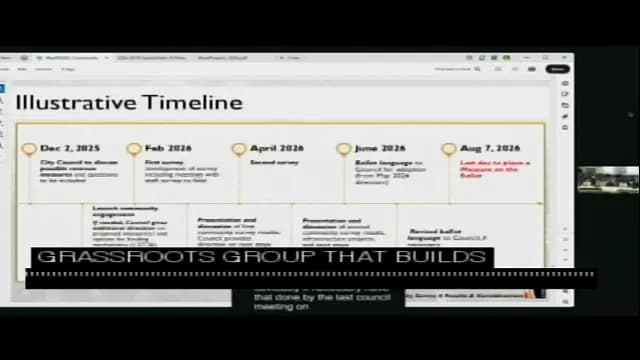
The Berkeley City Council held a special meeting on Tuesday, May 19, 2026, at 4:03 PM to discuss the results of the second community survey and provide direction on potential ballot measures for the November 3, 2026 General Municipal Election. The two proposed measures are a $300 million general obligation bond for infrastructure and a 0.5% increase in the sales and use tax (from 10.25% to 10.75%) to address the city's structural deficit. Staff from Lake Research Partners presented survey findings, and city staff presented a refined project portfolio for the bond. The council unanimously voted to affirm direction to prepare ballot language for both measures. Public Comments & Testimony - Judy Zaika (Co-president, Berkeley Historical Society and Museum) expressed concern about the perception that the Veterans Memorial Building and Old City Hall are vacant, noting they are used daily and seismically unsound. She urged adequate funding for seismic upgrades. - Alison Labonte (District 2 resident) questioned the user-friendliness of smart bathrooms requiring QR codes and noted a discrepancy in the King Pool project cost (still $5 million despite locker room removal). - John Kane (Downtown Berkeley Association) supported the FEMA grant match approach for the Civic Center but requested flexibility in how the $5 million match is deployed if the grant is not secured. - Karen Chapman (Berkeley Historical Society) asked the council to approve the bond and reconsider the allocation for Old City Hall to build a great museum. - Ann Harlow (Berkeley Historical Society) highlighted that the Dorothy Day House and Options Recovery Services also occupy the buildings and warned of earthquake risk. - Erin Dean supported projects 30 and 31 (Model Sherick and Veterans Memorial Building) and projects 22 and 23 (native plant median conversions), citing community enthusiasm for native plants. - Mary Carlton suggested adding "as needed" to soil replacement and irrigation for median conversions to reduce costs and plastic use. - Ted Steen (Eshore Alliance FC) urged inclusion of the Harrison Park turf field conversion and bathroom improvements, noting a petition with hundreds of signatures. He also raised concern about a 40-60% increase in youth sports fees. - Lisa Bullwinkle (Art Commission, speaking as resident) advocated for fixing existing facilities and increasing funding for the Veterans Building to create an art center. - Irene (Bay Area Adult Soccer League) strongly supported the Harrison Park artificial turf conversion to relieve congestion at Tom Bates fields, calling it a public health and mental health issue. - Tasha Baptist (speaking as individual) urged the council to reject the $300 million bond as insufficient, noting the city's infrastructure needs exceed $1.5 billion, and proposed a higher bond amount. - Jeannie Hammond (Sacramento Street resident) supported median conversions for biodiversity and pollinator habitat. - Amy Woodward (District 3 resident) supported median conversions and the Francis Albrier Community Center. - David Flores (District 2 resident) endorsed investment in the Civic Center for community gathering and historic preservation. - Lonnie Hancock (former mayor and state senator) urged saving historic buildings for legacy and community soul, comparing to the East Bay Regional Park District. - Harry Dowert (Bay Area Adult Soccer League commissioner) supported the Harrison Park turf conversion and thanked staff for field coordination. Discussion Items - Community Survey Results (Lake Research Partners): David Mervyn presented findings from a survey of likely Berkeley voters conducted April 21-25, 2026 (margin of error ±4.4%). Key results: - General Obligation Bond: 69% inclined to vote yes (initial ballot), 16% no, 15% undecided. After pro/con arguments, support dropped to 64% yes, 20% no, 15% undecided—still close to the two-thirds threshold needed for passage. - Sales and Use Tax: 52% yes, 32% no, 16% undecided initially. After arguments, support rose to 56% yes, 30% no—above the simple majority needed. - Both measures saw slight declines from February polling, attributed to a crowded ballot with other revenue measures (regional transit, living wage, arts tax, soda tax increase, public bank). The bond and sales tax performed slightly better when heard second in the survey order. - Undecided voters were more likely to be renters, women, independents, and voters in the Berkeley Hills (for sales tax). - Infrastructure Bond Project Portfolio (City Staff): Deputy City Manager David White, Assistant to City Manager Carrie, Parks Director Scott Ferris, Fire Chief Sprague, and Public Works Interim Director Wahida Miri presented the refined project list totaling $272.5 million, with $40.5 million for staffing and implementation. Key changes from December 2025: - Community Facilities & Quality of Life: Francis Albrier Community Center replacement, Harrison Park turf conversion, restroom upgrades (Harrison, Waterfront, Cedar Rose, Courtnesis), King Pool renovation (reduced from $25M replacement to $5M for concrete/piping/pumps), removal of dog parks, Live Oak Park improvements, and other projects. Added: Monkey Island Park, Garber Path, Adeline Corridor open space, Dwight Twelve Open Space, native plant median conversions. - Public Safety: Fire station renovations (including Station 4), 2100 MLK Public Safety Building (911 dispatch and police), fire training center. Stations are outdated (built 1950s-60s) and need to meet Essential Services Act and reduce carcinogen exposure. - Critical Infrastructure & Accessibility: $14.6M for 50/50 sidewalk program, $4.5M for ADA barrier removal, upgrades to animal services, Mental Health Annex, South Berkeley Senior Center HVAC, African American Holistic Resource Center. Civic Center buildings (Old City Hall and Veterans Memorial Building) scaled to grant match only ($5M total for both). - Evaluation Framework: Six-factor scoring (health/life safety, infrastructure condition, accessibility/resilience, community use/equity, green sustainability, deliverability, external funding potential) used to prioritize projects. - Sales Tax Use: Proposed to generate $9-10 million annually for general fund structural deficit, allocated to maintain Fire Station 4, fund 15 police officers and 6 dispatchers, and support Parks Recreation and Waterfront staffing for after-school programs, camps, pools. - Council Deliberations: Councilmembers expressed general support for both measures. Several members (Blackaby, Tregub, Bartlett) requested consideration of increased funding for Old City Hall and Veterans Memorial Building seismic upgrades. Councilmember O'Keefe noted concern about sales tax polling being close to 50% but was reassured by survey context. Councilmember Kesarwani emphasized transparency on costs and highlighted West Berkeley projects. Councilmember Humbert praised the 50/50 sidewalk program. Councilmember Blackaby stressed accountability and transparency. Mayor Easy acknowledged the challenge and supported moving forward. Key Outcomes - Motion: Councilmember Taplin moved to affirm direction to prepare ballot language for a $300 million general obligation bond and a 0.5% sales and use tax increase for the November 3, 2026 ballot. Seconded by Vice Mayor Tregub. - Vote: Unanimous (8-0, with Councilmember Casserwani absent). All present councilmembers voted yes: Kesarwani, Taplin, Bartlett, Tregub, O'Keefe, Blackaby, Humbert, and Mayor Easy. - Next Steps: Staff will return on June 16, 2026 with proposed ballot language. Final language must be submitted to the county by August 7, 2026, with a target of council approval by July 28, 2026. The project list will be finalized with flexibility for grant leverage and cost changes.
The Berkeley City Council met on Tuesday, May 12, 2026, at 6:08 p.m. The meeting included ceremonial proclamations, public comment on non-agenda items, approval of the consent calendar, and a single action item approving a lease agreement. Council members also made donations to the Juneteenth Festival. Ceremonial Matters - Jewish American Heritage Month: Proclamation read by Mayor Ishii, accepted by Robin Mencher, Director of Jewish Family and Community Services East Bay. The proclamation noted that about 25% of Bay Area Jewish households include people of color, rising to nearly 40% in younger households. - Affordable Housing Month: Proclamation accepted by Tracy Matthews, a Berkeley resident and member of East Bay Housing Organization (EBHO). The proclamation cited over 39,000 affordable homes in California ready to build but lacking financing, and a 44% potential reduction in affordable housing options if proposed federal budget cuts are enacted. - Eid al-Fatir and Eid al-Adha: Proclamation written by interns, accepted by Sophia Sheikh on behalf of Asiasidiki. Recognized the two major Muslim holidays, with Eid al-Fatir celebrated March 30–31, 2026 and Eid al-Adha beginning May 27, 2026. Noted 23 distinct Muslim student organizations at UC Berkeley. Consent Calendar - Council members made donations to the Berkeley Juneteenth Festival (Item 16): Councilmember Kesarwani ($100), Lunapara ($200), Blackaby ($500), Vice Mayor Traeger ($200), Bartlett (sponsor), Humbert ($250), Taplin ($250), O'Keefe ($250). Item was approved unanimously. - Appointments to the Police Accountability Board (Item 4) and a contractual amendment for a special event permitting software module (Item 5) were approved as part of the consent calendar. - City Manager confirmed that Item 15B (companion report) was the operative item, with 15A incorporated by reference. Public Comments & Testimony - Jess Heinzelman (Throne Labs): Thanked council for the pilot program, citing survey results that 90% felt safer and 90% reported other positive outcomes. Referenced a recent staff memo. - Richard Woods: Advocated for vegetarianism, linking animal slaughter to homelessness and citing biblical references. - Marbury Watker: Resident on Bancroft & 6th Street, reported that a traffic light installed 17 months ago removed 40–50 parking spots, affecting 30 businesses and homeowners. Requested council attention. - Dr. Stephen Alpert: Criticized Councilmember Humbert’s website for misrepresenting a London School of Economics study by Buck Holtz. Stated the study found it takes over 20 years (optimistic) or over 100 years (historical data) for market-rate housing to filter down to become affordable. Accused Humbert of deception. - Ryan Lau (AC Transit): Announced a potential service reduction due to a $200 million deficit over four years, with possible 16% service cuts and up to 300 job losses. Public hearing set for June 10, 2026 at 5 p.m. - Rosalina Gutman: Called for an official proclamation recognizing May 12 as Global Awareness Day for Multiple Chemical Sensitivity. - Caller ending in 211: Commented on Eid al-Fatir, calling for unity between Jews and Muslims, and praised former Mayor Shirley Dean. - Susan Schwartz (Friends of Five Creeks): Urged the city to fund green infrastructure at Channing Way and Aquatic Park to avoid losing a $1.5 million EPA grant. Suggested using funds from a Monsanto PCB settlement. - Rubel Wubishet (Alchemy Community Therapy Center): Representing a nonprofit with 20 therapists and 250 clients moving to Berkeley, requested reinstatement of loading zones and ADA parking removed by the traffic light at Bancroft & 6th Street. - Carol Morasovic (public comment on non-agenda): Reported that the City Auditor could not easily determine total consultant spending due to inconsistent classification. Asked council to address this after the budget process. Discussion Items - Item 17 – Lease Agreement with Patia and Associates Inc. for 125–127 University Avenue: The lease was presented as a public hearing because of a code requirement. Councilmember Blackaby questioned whether the rent of $4,265 represented an increase. Staff confirmed the rent rose to $2.50 per square foot from $2.05–$2.15. No public comment. The public hearing was closed, and the lease was approved unanimously. Key Outcomes - Consent calendar approved unanimously, including donations totaling $1,450 for the Juneteenth Festival from council members’ office accounts. - Lease agreement with Patia and Associates approved unanimously. - The meeting adjourned without further action.