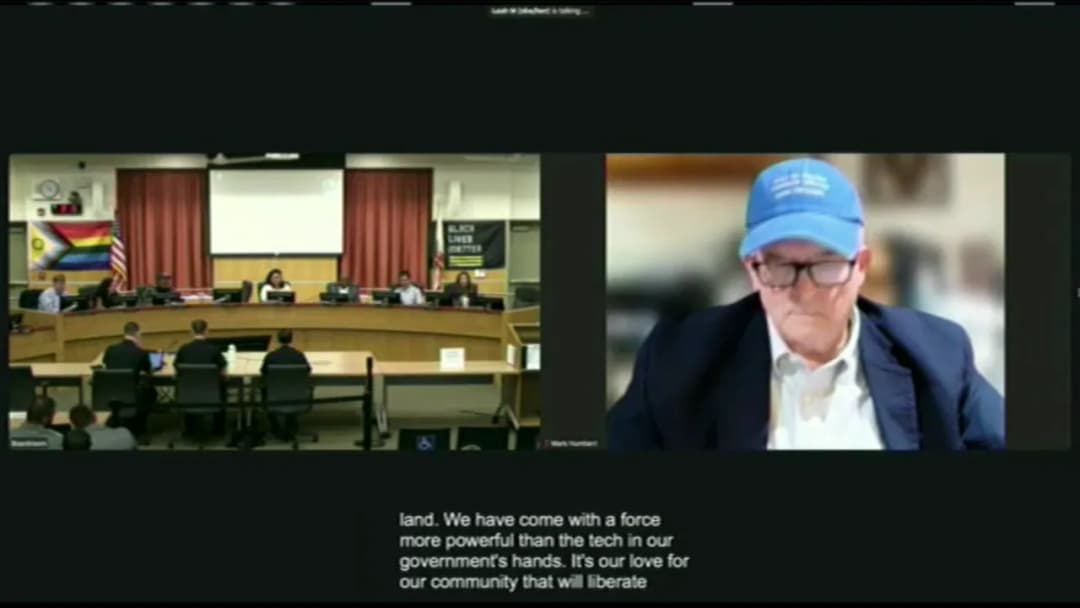
The Berkeley City Council met on Tuesday, October 13, 2026, at 6:06 PM in a hybrid format. The meeting began with roll call (7 of 9 councilmembers present; Bartlett absent initially, Taplin absent later), a land acknowledgement, and ceremonial matters including a BART update, a proclamation for United Against Hate Week, and a proclamation for Pregnancy and Infant Loss Awareness Month. The council then proceeded through a consent calendar, public hearings, and action items, concluding near 10 PM. Consent Calendar - Item 1 – Surveillance Technology Vendor Accountability – Adopted second reading of Ordinance No. 8,033-N.S., requiring enforceable provisions in contracts with surveillance tech vendors and revising the annual reporting schedule (first report due November 17, 2026; subsequent reports in March beginning March 2028). - Item 2 – San Pablo Avenue Specific Plan – Adopted second reading of Ordinance No. 8,034-N.S., creating the San Pablo Commercial District and making conforming zoning amendments. Public comment criticized last-minute amendments and the process; several speakers urged reconsideration. - Item 3 – Bid Solicitations (Measure BB Paratransit Fund $2,240,000) – Approved. - Item 4 – BOSS Contract Amendment (McKinley House) – Approved, increasing contract by $104,474 to $1,015,607 (Behavioral Health Services Act Fund). - Item 5 – BCFOA Medical Expense Reimbursement Plan Side Letter – Approved. - Item 6 – Rolling Orange Website Maintenance – Approved, $115,000 over two years, total not-to-exceed $909,300. - Item 7 – Granicus Video Streaming – Approved, $72,200 increase, total not-to-exceed $395,146. - Item 8 – Protiviti Professional Services (GSA vehicle) – Approved, up to $425,000 through June 30, 2027. - Item 9 – Paymun K-Dock Restroom Renovation – Approved, $11,000 increase to $451,000. - Item 10 – BORP Adaptive Sports 50th Anniversary – Approved, councilmembers donated from office budgets ($1,000 Taplin, $100 Ishii, $150 Tregub, plus contributions from Kesarwani, Blackaby, Bartlett, Humbert, O'Keefe, Lunaparra). - Item 11 – Creations Berkeley Dance Tour – Approved, councilmembers contributed from office budgets ($250 Bartlett, plus others). - Item 12 – Resolution Supporting Proposition 4 (California Fair Elections Act) – Approved unanimously. Public Comments & Testimony - Non-Agenda Public Comment (first period): Speakers raised concerns about hate speech in political campaigns, the Turtle Island Monument project, and pedestrian safety (citing hit-and-run on University Avenue). A resident noted Berkeley's high pedestrian injury rates. - Consent Calendar Comments: Multiple speakers criticized the San Pablo Specific Plan process, alleging last-minute amendments violated the Brown Act and suppressed public input. Others supported the surveillance tech accountability item. - Item 15 – Affordable Housing Preference Policy: Several speakers supported the policy but urged deeper affordability and better outreach. Moni Law highlighted that 9,000 applicants sought 87 units at the Modell-Miller-Sherrick building, and that many unhoused people grew up in Berkeley. A speaker asked that outreach organizations track verified applicants beyond initial lotteries. - Item 14 – Undergrounding Transformers: Developers, an architect, and a planning commissioner spoke in favor, describing how above-ground pad-mounted transformers can destroy project viability. A PG&E representative noted the company's preference for above-ground but acknowledged the city's authority. - Item 16 – 2027 Meeting Schedule: One speaker (Kelly Hammergren) suggested extending summer recess through Labor Day. - Final Non-Agenda Comment: Speakers discussed concerns about elevator breakdowns in affordable housing, rental housing safety inspections, a smoke shop opening without notice, and criticisms of the United Against Hate proclamation for not adequately addressing anti-Black racism and Islamophobia. Discussion Items - Item 13 – Environmental Health Fee Schedule: Opened and closed public hearing; adopted Resolution to approve revised fee schedule effective October 13, 2026, rescinding Resolution No. 72,308 N.S. - Item 14 – Undergrounding Electrical Transformers (BMC 23.304.100): Staff presented; council commended the work. After public comment, adopted first reading of ordinance prohibiting above-ground installation of electrical transformers on private property for new residential, commercial, and mixed-use projects, preserving city engineer's discretion over public right-of-way. - Item 15 – Affordable Housing Preference Policy Pilot Assessment and Policy Update (continued from Sept. 29, 2026): Staff presented findings from the pilot: 17 preference households placed in the Modell-Miller-Sherrick building; highest-priority applicants (4 points) were all descendants of redlined neighborhood residents. Proposed shifting from a points-based system to a tiered system (Tier 1: BART-displaced; Tier 2: descendants of redlined neighborhoods; Tier 3: current/displaced Berkeley households; families with children prioritized within tiers). Council adopted the staff recommendation unanimously. - Items 18, 19, 20 (Information Reports Pulled to Action): Council discussed Inclusionary Housing Annual Report (FY2026), Measure O Impacts, and Condominium Conversion Report. Key data: Housing Trust Fund has $4.9 million uncommitted; Measure O has $2.9 million remaining (report had error stating $17M); 34 new BMR units were made available in FY2026. Council acknowledged the cyclical nature of fee revenue and the need for future affordable housing bonds. - Item 16 – 2027 City Council Meeting Schedule: Council adopted an amended schedule removing the August 31, 2027 regular meeting, making the last meeting before summer recess July 6, 2027, and resuming September 14, 2027, after Labor Day. Key Outcomes - Consent Calendar passed unanimously (all ayes). - Item 13 (Environmental Health Fee Schedule) adopted unanimously. - Item 14 (Undergrounding Transformers) adopted first reading unanimously. - Item 15 (Affordable Housing Preference Policy) adopted staff recommendation unanimously. - Item 16 (2027 Meeting Schedule) adopted with amendment (remove Aug. 31 meeting) unanimously. - Ceremonial Matters: Recognized outgoing Interim Director Kathy Lee and new Director Mary Opler for Police Accountability; proclaimed October 18–24, 2026 as United Against Hate Week; proclaimed October 2026 as Pregnancy and Infant Loss Awareness Month.
Public Meetings - Berkeley, California
Public Meetings - Berkeley, CaliforniaThe Berkeley City Council met on Tuesday, September 29, 2026, at 6:04 PM, in the School District Board Room. The meeting included ceremonial proclamations, public comments, approval of a consent calendar with 36 items, a public hearing on bond financing for the Ashby Lofts project, and extensive discussion and adoption of the San Pablo Avenue Specific Plan. The meeting was extended to 11:30 PM to accommodate the agenda. Ceremonial Matters - Mayor Ishii presented a proclamation honoring John Caner for 17 years of service as CEO of the Downtown Berkeley Association. - An adjournment in memory of Jean Nakamura, former BUSD educator and girls' basketball coach at Berkeley High, was read. - Mayor Ishii declared September 29, 2026, as "Julie Sinai Day" in recognition of her service as Chief of Policy. Consent Calendar - The Council approved the Consent Calendar as amended, including two urgency items: a resolution supporting Prop 1 (Veterans and Affordable Housing Bond Act of 2026) and a resolution opposing Prop 43 (limits voter ability to raise revenues). - Item 21 (window replacement contract) was removed by the City Manager. - Item 13 (Surveillance Technology Vendor Accountability) was amended to change the reporting schedule: the first report under the new calendar-year reporting period will be due in March 2028. - Item 36 (Mutual Aid Air Support Surveillance Use Policy) was moved to consent with language from the Police Accountability Board regarding audit requirements. - Councilmembers relinquished discretionary funds for various community events: Cal Sailing Club Open House (Item 27), Sinbad Voyage mural restoration (Item 28), Music in the Elmwood Festival (Item 31). - Several contracts, grants, and administrative items were approved, including the appointment of Mary Opler as Director of Police Accountability (effective October 5, 2026, at $230,000 annual salary), and ratification of recess actions. Public Comments & Testimony - Non-Agenda Matters: Speakers addressed concerns about encampment clearing at Ocean View, the need for Behavioral Health Commission members, affordable housing policy, and Hopkins Street bike lanes. - Consent Calendar: Speakers commented on surveillance technology reporting, the Alcohol Policing Partnership grant (urging inclusion of Fire Department data and education components), and the Realize Vision 2050 plan (criticizing Councilmember Taplin's response to a community volunteer). - Ashby Lofts (Item 33): One speaker supported the bond financing. - San Pablo Avenue Specific Plan (Item 34): A large number of public speakers expressed divided views. Supporters emphasized the need for housing, while opponents raised concerns about gentrification, displacement of businesses, and lack of on-site affordable housing. Several speakers urged a five-story base height to maximize affordable units through state density bonus. Discussion Items - Item 33: Ashby Lofts Bond Financing – The public hearing was held and closed with no objections. The Council approved the resolution authorizing tax-exempt bond issuance by the California Municipal Finance Authority for the Ashby Lofts project. - Item 34: San Pablo Avenue Specific Plan – Staff presented the three-year planning process. Key features include a new San Pablo Commercial (CSP) zoning district with maximum heights of 7 stories (75 feet) for residential/mixed-use and 3 stories (40 feet) for non-residential, with height increases allowed via state density bonus up to about 8 stories. The plan includes design standards, incentives for public open space, and sidewalk widening. Councilmember Kesarwani offered four amendments: (1) increase non-residential height to 75 feet and 5 stories; (2) set minimum density at 100 dwelling units per acre (staff had proposed 145); (3) correct a drafting error regarding ground-floor residential restrictions; (4) adjust affordable housing requirements on MULI parcels to 35% family-sized units and income mix up to 120% AMI with at least 50% at 80% AMI. Councilmember Traegub offered an amendment to reference commercial anti-displacement provisions from the Corridor Zoning Update and Renaissance referrals. Councilmember O'Keefe added a suggestion for a business license tax waiver. Councilmember Blackaby added specific ideas for business support during construction. After extensive debate, Councilmember Blackaby made a substitute motion to set base height at 5 stories (55 feet) for both residential and non-residential, which failed 3–6. The main motion (with 7-story base and amendments) passed 8–0. - Item 35: Affordable Housing Preference Policy – Continued to the October 13, 2026, council meeting due to time constraints. Key Outcomes - Adopted Urgency Resolutions: Support for Prop 1 (Veterans and Affordable Housing Bond Act) and opposition to Prop 43 (limit on revenue-raising). - Approved Consent Calendar: 34 items (including amended items) passed unanimously. - Approved Ashby Lofts Bond Financing (Item 33): Unanimous, resolution adopted. - Adopted San Pablo Avenue Specific Plan (Item 34): The Council approved the resolution adopting the Specific Plan, Design Standards, General Plan and zoning amendments, and repealing the West Berkeley Plan and San Pablo Avenue Public Improvements Plan. The motion included Councilmember Kesarwani's four amendments, the commercial anti-displacement language, and the friendly amendments from Councilmembers O'Keefe and Blackaby. Base height: 7 stories (75 feet) for residential/mixed-use; non-residential height increased to 5 stories (75 feet). Minimum density set at 100 dwelling units per acre. First reading of ordinance to create San Pablo Commercial District (Chapter 23.202.160) approved. - Continued Item 35: Affordable Housing Preference Policy to October 13, 2026. - Extended Meeting Time: Rule suspended to 11:30 PM to complete the agenda.
A special meeting of the Berkeley City Council was called on Tuesday, September 29, 2026, at 4:08 PM to resume consideration of two items continued from the September 15, 2026 meeting. The primary agenda was Item 1a, a resolution to allow the Berkeley Police Department (BPD) to use tear gas in narrowly defined life-threatening incidents and to lift the pandemic-era moratorium on smoke and OC spray. Item 1b, from the Peace and Justice Commission, proposed retaining existing bans and commissioning health studies. Councilmembers Kesarwani, Tregub, O’Keefe, Blackaby, Lunaparra, Humbert (participating remotely due to illness), and Mayor Ishii were present; Councilmembers Taplin and Bartlett arrived during the meeting. Public comment was taken, followed by council deliberation and votes. Public Comments & Testimony - The vast majority of speakers urged the council to reject the resolution and retain the bans. They highlighted health risks (asthma, chemical sensitivity), the classification of tear gas as a weapon of war, its potential for indiscriminate harm (drifting in the air, striking unintended people), and the lack of demonstrated need—noting that BPD had used tear gas only three times in decades, all of which were resolved without it. Several speakers expressed distrust in police accountability structures and feared the tool would be used against protesters or marginalized communities, especially in the current political climate. One representative of the Berkeley Friends Meeting (Quakers) called for retaining the ban. - Sergeant Derek Rady, speaking on behalf of the Berkeley Police Association, supported restoring tear gas for the Special Response Team, calling it an industry-standard de-escalation tool that provides time and distance in high-risk incidents such as armed barricades, hostage situations, or active shooters. He emphasized that the proposed policy would strictly prohibit crowd control use and that Berkeley is currently the only department in the nation whose tactical team lacks this tool. Discussion Items - Councilmember Kesarwani, the item author, moved adoption of Councilmember Blackaby’s amended version of the resolution, adding a clause requiring BPD to notify the City Manager (and subsequently the council and Police Accountability Board) within 10 days of any use of the tools, referencing existing reporting policies. She argued the resolution is narrowly tailored for critical life-threatening incidents only, not crowd control, and that a less-lethal tool could save lives in rare but dangerous scenarios. - Councilmember Blackaby and Vice Mayor O’Keefe supported the motion. Blackaby emphasized that no other major California city maintains an outright ban and that the resolution provides reasonable safeguards; O’Keefe noted that the risks of deployment are weighed against the risks of not deploying in life-threatening situations. Councilmember Humbert also supported, stating he had been tear-gassed during a protest and firmly opposed crowd control use, but trusted BPD to follow policy. - Councilmember Taplin urged caution, suggesting the need for more community education and trust-building before such a change. Councilmembers Bartlett, Tregub, Lunaparra, and Mayor Ishii opposed. Bartlett argued that the rarity of use (once in 40 years) did not justify the community fear and erosion of goodwill; Tregub cited Berkeley’s own negative experiences with chemical agents; Lunaparra highlighted the long-term health impacts, lack of precision, and the message such a move would send in the current political climate. Mayor Ishii echoed concerns about the historical context and lack of urgency. Key Outcomes - Item 1a (Tear gas resolution): The motion failed on a vote of 4–5. Voting in favor: Councilmembers Kesarwani, O’Keefe, Blackaby, Humbert. Voting against: Councilmembers Taplin, Bartlett, Tregub, Lunaparra, Mayor Ishii. - Item 1b (Peace and Justice Commission proposal): A motion to take no action was approved unanimously (8–0), effectively leaving the existing bans in place. - The meeting adjourned at approximately 5:10 PM; the regular council meeting was scheduled to begin at 6:00 PM.
The Berkeley City Council convened on Tuesday, September 15, 2026, at 6:02 PM in a hybrid meeting. The agenda included preliminary ceremonial matters, city manager comments on the Harrison Street encampment abatement, an auditor report, an urgent item on wildfire bills, a 20-item consent calendar, and two action items (21a and 21b) concerning the reinstatement of tear gas and other chemical weapons. Following extensive public comment and council deliberation on the chemical weapons items, the council voted 5-4 against extending the meeting beyond midnight and instead scheduled a special meeting for September 29, 2026, at 4:00 PM to continue discussion. Ceremonial & Preliminary Matters - Land Acknowledgement read by Vice Mayor O’Keefe, recognizing the Ohlone people. - Pledge of Allegiance led by the Mayor. - Proclamation: America the Entrepreneurial 2026, presented by Economic Development Manager Eleanor Hollander. - Proclamation: September 2026 recognized as Hunger Action Month, accepted by Andrew Crisman, Executive Director of Berkeley Food Network. Consent Calendar - Urgent Item: Councilmember Blackaby introduced a request for the Mayor to send letters to the Governor urging signature on eight wildfire resiliency bills. The item was approved unanimously for inclusion on the Consent Calendar. - Consent Items (1–20): Approved as a group with the following amendments: - Item 15 (Gilman District Merchants Association grant): Councilmember Taplin added as co-sponsor. - Item 16 (Housing fee study): Councilmembers Humbert and Lunaparra added as co-sponsors. - Urgent wildfire item: Councilmembers Humbert and O’Keefe added as co-sponsors. - Key consent items included: 1. Grant application for Community Resilience Center Planning Grant (up to $500,000) 2. Contract with Downtown Berkeley Association for Addison Street Catenary Lighting ($150,000) 5. Amendment with Fire Aside, LLC for wildfire resilience software (additional $150,000, total $410,000) 12. Grant application for Safe Routes to Transit and Bay Trail Program (up to $25,000,000) 13. Supporting a Neighborhood Decarbonization Pilot Project 14. Whistleblower Program Special Report on Workplace Relationship Policies 15. District 1 grant to Gilman District Merchants Association ($65,000) 16. Referral for comprehensive housing fee study 18. Resolution in support of AB 1761 (electricity data disclosure) 19. Resolution opposing coal and petroleum coke in the Bay Region, supporting AB 40 20. Renaissance Part 2 – Commercial Vacancy Blight Prevention and Mitigation Public Comments & Testimony - Non-Agenda Matters: Multiple speakers addressed the morning’s Harrison Street encampment abatement, criticizing the city’s approach and alleging violations of court orders. Others raised concerns about the public safety technology RFP scoring process and tenant conditions at Evans Manor. - Employee Unions: No representatives spoke. - Consent Calendar Comments: Several community members spoke in favor of Item 19 (no coal) and expressed concerns about the Renaissance referral (Item 20) lacking accountability deadlines. A speaker questioned the Fire Aside contract’s privacy implications. Others urged support for the decarbonization pilot and the Gilman District grant. - Items 21a and 21b (Chemical Weapons): Over two dozen community members, students, and organizational representatives spoke overwhelmingly against lifting the tear gas ban. Speakers cited health risks, past misuse during the 2014 protests, the inability to contain chemical agents, and the importance of police accountability. Many supported the Peace and Justice Commission’s alternative (21b) to study health impacts. Only a few speakers acknowledged the narrow proposed use, but virtually all opposed 21a. Discussion Items - City Manager Comments (Not on Agenda): City Manager Paul Budenhagen reported on the Harrison Street encampment closure, noting that the city is complying with court orders regarding disability accommodations, storage of belongings, and relocation evaluations. He stated the city is appealing a related ruling to the Ninth Circuit. - Auditor Report (Item 14): Auditor Jenny Wong presented the whistleblower program’s evaluation of workplace relationship policies, finding gaps in addressing romantic/dating relationships and recommending nepotism/cronyism provisions. - Items 21a and 21b – Tear Gas and Chemical Weapons: - Councilmember Kesarwani presented 21a, arguing for a narrow reinstatement for BPD’s Special Response Team only for barricaded suspects, hostage rescues, and high-risk warrants, with explicit prohibitions on crowd control. - Councilmember Blackaby introduced supplemental language clarifying permissible uses and adding reporting requirements within 10 days. - George Lippman presented the Peace and Justice Commission’s position (21b) to retain the existing bans and instead commission an academic study of health impacts. - BPD Chief and Captain answered council questions, describing three incidents since 2020 where tear gas might have been considered but was not needed. They argued that the tool reduces the need for lethal force in rare, high-risk situations. - After extended public comment, the council debated adjournment deadlines. A motion to extend past midnight failed 4-5. A subsequent motion to schedule a special meeting on September 29, 2026, at 4:00 PM to continue items 21a and 21b passed 6-3. Key Outcomes - Consent Calendar Approved with amendments, including co-sponsorship changes on items 15, 16, and the urgent wildfire item. - Action Items 21a and 21b Continued: The council voted 6-3 to schedule a special meeting on Tuesday, September 29, 2026, at 4:00 PM for further discussion and potential action on the tear gas/chemical weapons items. - No other action items were decided due to the early adjournment. - Referrals Approved: The Renaissance Part 2 (Item 20) and housing fee study (Item 16) were referred to the City Manager as part of the consent calendar. - Discrepancy Note: The problem statement indicated the meeting date as 2026-09-16, but both the agenda and transcript confirm the meeting occurred on September 15, 2026. The summary uses the date from the primary source material.
The Berkeley City Council held its regular meeting on Tuesday, September 15, 2026, at the School District Board Room, 1231 Addison Street, Berkeley, CA, with in-person and remote participation. The agenda included consent calendar approvals, a whistleblower program report on workplace relationship policies, a referral analyzing housing-related fees, and a significant discussion on the potential reinstatement of tear gas use by the Berkeley Police Department. Extensive public comment reflected deep community division, particularly over the tear gas proposal. Consent Calendar - Item 4 (Formal Bid Solicitations and Request for Proposals): A resolution approving expenditures not to exceed $65,000 from the FY 2026-27 office budget of District 1 Councilmember Rashi Kesarwani to provide a one-time capacity building grant. - Item 14 (Whistleblower Program Special Report): The report found that Berkeley's current workplace relationship policies do not address romantic dating or cohabitating relationships when they intersect with hiring, supervision, and other employment decisions. The consent item recommended that the Council ask the City Manager to implement recommendations one and two, consistent with the management response, and refer recommendation three to the Agenda and Rules Committee. - Item 15 (Shelter/Housing Investment): A district investment referenced in public comment as connected to the Shelter Plus Care program; one speaker urged the Council to pass the item, describing the state of unsheltered residents as a humanitarian and environmental crisis. - Item 16 (Referral for Housing Fees Report): A referral directing staff to prepare an information report assessing all housing-related impact, development, and local parcel tax fees, including a summary of categories, amounts, and the bases for calculating fees across all cities in the matrix, to better understand the true and total costs of developing housing of all types in Berkeley. Public Comments & Testimony - Multiple speakers opposed reinstating tear gas, calling it a "chemical weapon" and urging the Council not to "green light chemical weapons, even if they're following their own rules, it's not safe." One speaker described encounters with tear gas deployed in residential neighborhoods during protests and argued the risk is higher than officials acknowledged. Another speaker criticized the Council: "Not a single one reported on all the people who were injured in the streets." - A speaker urged the Council to pull an item off the consent calendar, asking them to read the contract carefully with someone who understands Article 1, Section 1 of the California Constitution, arguing the agreement could allow the government to "stockpile information" about private individuals. - A speaker stated that the Shelter Plus Care program "didn't pay their portion of the rent" and criticized the city for managing an unsheltered crisis "without a sanctioned encampment." - A resident of Evans Manor, owned by the Berkeley Student Cooperative, reported going to the Rent Board without help and requested that the Council establish a commission addressing issues at their building. - A speaker expressed opposition to building large surface parking lots on prime waterfront land. - Several speakers raised police accountability concerns, including that lawsuit payouts come from the general fund rather than the police budget, and one speaker declared that organizers "plan to flip the Berkeley City Council" over the tear gas vote. - One speaker raised a procedural question about when public comment would be taken on the City Manager's report, noting the current comment period was limited to consent calendar and information items. Discussion Items - Tear Gas / Chemical Agent Policy (referenced as item 21A): The Council received a presentation from the Police Department describing three specific situations in which tear gas could be authorized if feasible: issuing verbal warnings, taking steps to secure suspects in a controlled area, and attempting to establish communication with a barricaded individual before deployment. The chief noted that negotiators would evaluate whether efforts were succeeding and assess other risks before deploying. Council members acknowledged the public's deep concern, with one noting, "I think this is the main concern that a lot of us have up here," and another stating that even a clear future argument to lift the ban would be difficult. Councilmembers thanked the Public Safety Policy Committee, the police chief, deputy chief, and captain for their work on the item. - The Council noted a discrepancy in a submitted memorandum from Councilmembers Kesarwani, Ishii, and Humbert: it included "version one" of a bike lane design from the April 15 committee meeting rather than the version currently under discussion. - District 1 Councilmember Rashi Kesarwani expressed pride in hosting two Home Key sites and in co-sponsoring a resolution opposing coal introduced by Councilmember Trago. Key Outcomes - The Council received extensive public testimony on the tear gas item and conducted deliberation; the transcript does not include a recorded vote or final action on this item. - Several public requests were made to pull items from the consent calendar, including the privacy/contract item and items relating to the Shelter Plus Care program; the transcript does not record the Council's final votes on those requests. - The Council heard the whistleblower report recommending implementation of two of the three workplace relationship policy recommendations, with the third referred to the Agenda and Rules Committee. A management response was noted as consistent with recommendations one and two. Note: The transcript is partial and does not contain complete vote tallies or the full record of actions for all agenda items; this summary reflects information available in the agenda, minutes, and transcript provided.
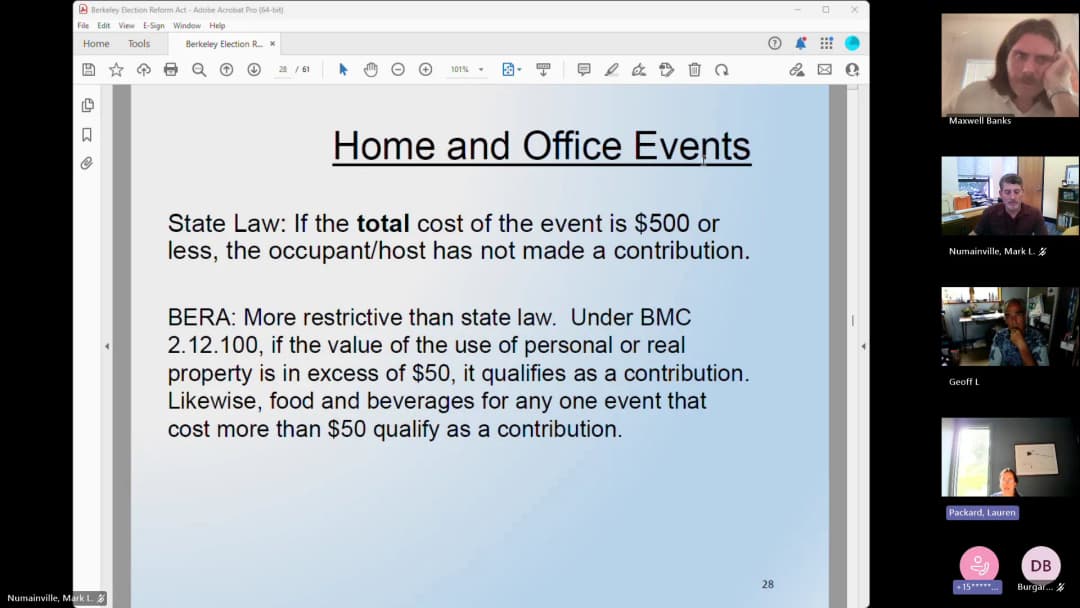
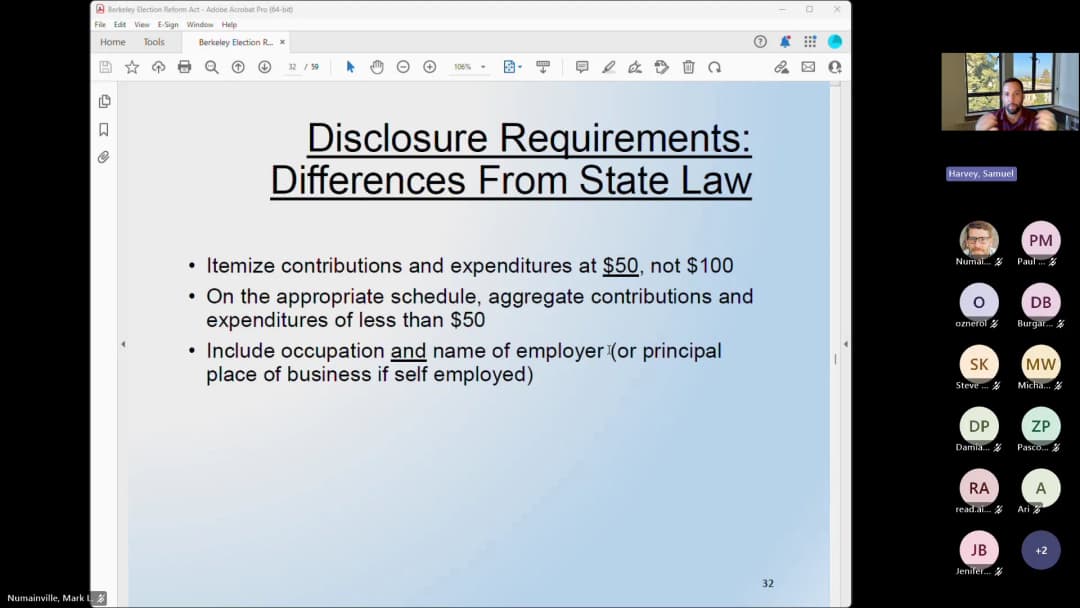
On August 28, 2026, at 8:00 PM UTC, the City of Berkeley held a virtual workshop on the Berkeley Election Reform Act (BERA) to guide candidates and ballot measure committees through local and state campaign finance rules. The session was led by City Clerk Mark Newmanville, Deputy City Attorney Lauren Packard, Assistant City Clerk Denise Burgada, and attended by participants Maxwell Banks (assistant treasurer for a committee supporting Measures U and V) and Jeff Lomax (forming a general purpose committee). The workshop covered contribution limits, reporting requirements, filing deadlines, and common pitfalls. Public Comments & Testimony - Maxwell Banks asked clarifying questions about the Form 410 committee ID number process, the timing of filing reports relative to the $1,000 threshold, and the distinction between late contribution reports and major donor notice requirements. He also sought clarification on cumulative contribution aggregation for reporting thresholds. - Jeff Lomax asked about the distinction between independent expenditures and expenditures made pursuant to a general committee’s remit, the coordination test, and the certificate of mass mailing process. - Both participants engaged in several back-and-forth exchanges with staff to understand nuances of BERA versus state law, including volunteer event exemptions, anonymous contribution limits, and the 45-day rule for paying bills. Discussion Items - Overview of BERA and State Law: Staff explained that BERA (Berkeley Election Reform Act, codified in BMC Chapter 2.12) is more restrictive than the state Political Reform Act. Key differences include contribution limits of $290 per individual for candidate committees, a prohibition on business/labor union contributions to candidates, and a lower itemization threshold ($50 for contributions vs. $100 at state level). - Getting Started: Staff detailed the required forms: Form 501 (candidate intention statement) and Form 410 (committee organization). They emphasized that committees must be formed within 10 days of reaching $1,000 in activity, and that the committee ID number is obtained from the California Secretary of State. - Campaign Bank Accounts and Record Keeping: Staff stressed no commingling of personal and campaign funds, one bank account per committee per election, and mandatory record retention for 4 years. They noted that the candidate and treasurer share legal responsibility for compliance. - Contribution Rules: Contributions include cash, in-kind goods/services, loans, and personal funds. For candidates, $290 aggregate limit applies; ballot measure committees have no limit except for recall measures. Anonymous contributions are prohibited, and cash should be avoided. - Filing Schedules and Late Reporting: Staff highlighted the current 90-day window for late contribution reports (contributions of $1,000 or more must be reported within 24 hours) and the two pre-election reports due September 24, 2026 and October 22, 2026. Late filings incur $10 per day penalties. - Form 460 and Itemization: Staff walked through Schedules A (contributions), E (expenditures), and F (accrued expenses). They warned that if unpaid bills exceed 45 days, they convert to contributions, which could violate the $290 limit for candidates. - Mass Mailings and Independent Expenditures: Local rules require filing three copies of mass mailings (200+ similar pieces) with a certificate of mass mailing. Independent expenditures over $1,000 in the last 90 days must be reported within 24 hours, and three copies of the communication must be filed with the City Clerk. - Post-Election Steps: Committees can remain open to retire debt until December 31, 2028, but must continue filing reports. Surplus assets can be used for future elections with proper redesignation by filing new Form 501 and amending Form 410. Key Outcomes - No votes or formal decisions were taken; the workshop was purely informational. - Staff provided contact information for the City Clerk Department (elections@berkeleyca.gov, 510-981-6908) for filing questions and the Fair Campaign Practices Commission (FCPC) for enforcement inquiries. - Participants were reminded to consult the local filing manual (Appendix A for distinctions between BERA and state law) and to file on time, as amendments are always allowed. - The slides and recording of the workshop were promised to be emailed to attendees upon request to the elections inbox.
On August 19, 2026, the City of Berkeley Clerk’s Office and the Fair Campaign Practices Commission (FCPC) held a training session for candidates and treasurers, focusing on the Berkeley Election Reform Act (BERA) and the public financing program. The 90-minute session covered contribution limits, reporting requirements, filing deadlines, and post-election obligations. Presenters were City Clerk Mark Newmanville, Deputy City Attorney Sam Harvey, Assistant City Clerk Denise Bodegata, and Deputy City Clerk Rose Thompson. Training Session Overview The session was primarily designed for candidates participating in Berkeley’s public financing program, which provides a 6-to-1 match on qualifying contributions (up to $60 per contribution). The program was adopted in 2016 and now applies to all city elective offices, including Mayor, City Council, Auditor, Rent Board, and School Board. Candidates must agree to stricter contribution limits and source restrictions. Key Topics Covered - Berkeley Election Reform Act (BERA): Local campaign finance law passed in 1974, creating contribution limits, source restrictions, and the FCPC. The 2016 Fair Elections Act added public financing. - Contribution Limits & Sources: For public financing candidates, the maximum contribution from any natural person is $60 (adjusted for inflation). Candidates may contribute up to $290 of their own money. Prohibited sources include businesses, labor unions, nonprofits, and other entities. Contributions must be from natural persons. - Qualified vs. Non-Qualified Contributions: Qualified contributions (from Berkeley residents, natural persons, ≤$60) are eligible for 6-to-1 matching. Non-qualified contributions (from non-residents, natural persons, ≤$60) are permitted but not matched. Non-monetary contributions (goods/services) count toward the $60 limit. - Reporting Requirements: All public financing candidates must file electronically via NetFile. Form 410 (Statement of Organization) is filed with the Secretary of State; Form 460 (Campaign Disclosure Statement) is filed with the City Clerk. Contributions ≥$50 must be itemized with occupation and employer. Contributions ≥$25 require name and address. - Initial Qualifying Request: To enter the public financing program, candidates must submit 30 unique contributions of at least $10 each (total ≥$150) via NetFile, along with a signed Qualified Contribution Receipt (QCR) for each. - Matching Funds Requests: Rolling submissions – requests received by Tuesday at 5:00 PM are paid the following Thursday via ACH. Documentation must be complete; missing information delays payment. - Prohibited Expenditures: Public financing funds cannot be used for legal defense, payments benefiting the candidate’s family or businesses (≥10% ownership), capital assets $650 with useful life beyond the campaign, contributions to other candidates or committees, independent expenditures, or payments without receiving compensating value. - Late Contributions: Only candidate self-contributions over $100 in the last 16 days trigger a late contribution report (Form 497) within 48 hours. - Mass Mailings: 200+ pieces of similar mail must be filed with the City Clerk (three copies) along with a certificate of mass mailing, delivered the same day sent or next day hand-delivered. - Post-Election Obligations: Unspent campaign funds must be returned to the Fair Elections Fund by December 31, 2026. Committees should close by year-end to avoid a $50 state fee. Debt retirement contributions are allowed only from those who have not already given $60, and only until December 31, 2028. Important Reminders & Clarifications - Candidate’s Personal Funds: Candidates cannot make out-of-pocket campaign expenditures. They must first contribute personal funds (up to $290) into the campaign account, then spend from that account. Joint accounts are presumed to be the candidate’s money. - Reimbursements: Treasurers and volunteers can use personal credit cards and be reimbursed, but the campaign must report the actual vendor (e.g., Office Depot) as the payee, not the intermediary. - Date Received: For contributions, the date of receipt (possession) determines the reporting period. For online payments, it is the date the contribution is received by the campaign, not when deposited. - Over-Limit Contributions: If a contribution exceeds $60, it must be reported as received, then immediately refunded. The refund is shown on the Form 460. - Spouses/Domestic Partners: Cannot receive compensation from the campaign for services (e.g., fundraising). - Record Keeping: Maintain all receipts, bank statements, and contribution documentation for at least four years. - Staff Limitations: The Clerk’s office can provide guidance on procedures and NetFile use but cannot offer legal advice or pre-clear hypotheticals. Candidates are directed to the Public Financing Program Guide, FCPC regulations, and state manuals. Key Outcomes - No formal votes were taken; the session was educational. Candidates were reminded of upcoming filing deadlines: first pre-election report covering July 1–September 19, 2026; second pre-election report covering September 20–October 17, 2026; final semi-annual report covering October 18–December 31, 2026. - Late filing penalties are $10 per day; additional enforcement actions may be taken by the FCPC. - The Clerk’s office will provide NetFile login credentials and training upon request. Candidates were encouraged to contact the elections inbox (elections@berkeleyca.gov) with specific questions. - Candidates were advised to zero out campaign accounts and terminate committees by December 31, 2026, to avoid further filing obligations and fees.
The Berkeley City Council met on July 29, 2026, to discuss a range of items, including an urgent resolution supporting hotel workers' unionization, consent calendar approvals, and a major action item on repaving Hopkins Street with enhanced safety features. The meeting featured extensive public comment and debate over competing proposals for bicycle infrastructure, parking, and pedestrian safety on the Hopkins corridor. Consent Calendar - Urgent Item Approved: Resolution supporting Graduate Hotel workers' union vote (Unite Here Local 2), added to consent calendar; passed unanimously. - Other Consent Items: Approved relinquishment of council office budget funds for the citywide Berkeley School Supply Distribution and Resource Fair (Item 22) and Russell Street Halloween festivities (Item 25), along with various grants and appointments. All consent items passed by roll call vote (8-0, with one absent). Public Comments & Testimony - Non-Agenda Comments: Dr. Steven Alpert criticized council's pro-developer bias, citing lack of community consultation and questioning market-rate housing affordability. Juliet Leftwich objected to new aggressive parking meter rules. Derek Abbasi and Dennis Fanton opposed the 1130 Oxford Street project, alleging abuse of state housing laws. Several speakers supported the Graduate Hotel workers. - Hopkins Street Comments (Item 27): Dozens of speakers gave passionate testimony. Supporters (including parents, cyclists, climate advocates) stressed safety for children and all users, citing high injury rates and the need for protected bike lanes to reduce fatalities. Opponents (including residents, church members, business owners, seniors, people with disabilities) raised concerns over loss of parking (estimated 145 spaces or more), impacts on small businesses (e.g., Monterey Market, flower seller Mahmoud), accessibility for disabled and elderly, cost overruns (projected $15-20 million vs. $6 million budgeted), and fire department access. Many urged consideration of alternative routes (Rose/Ada streets) and more community engagement. Some speakers disputed claims that the fire department had approved the design. Discussion Items - Item 26: Inclusionary Housing In-Lieu Fee Update: Council received staff report and public comment. Motion to approve passed unanimously (8-0). - Item 27: Hopkins Street Repaving with Safety Improvements: Councilmember Kessarwani presented the main motion to repave Hopkins from Sutter to San Pablo with one-way protected bike lanes (class IV) from Alameda to Peralta, buffered bike lanes east of Alameda, traffic calming west of Peralta, a raised intersection at Monterey, bus boarding islands, and a curb management plan. Amendments were made regarding tree assessment and placemaking. - Councilmember O'Keefe offered a substitute motion to remove protected bike lanes, use class III sharrows to preserve parking, and refer implementation of Rose Street bike boulevard. It failed 3-6. - Councilmember Blackaby offered a substitute motion to have staff develop two alternative plans (one with protected lanes, one minimizing parking loss) and return for decision before detailed design. It failed 3-6 (or 3-5, with one abstention). - Councilmember Kessarwani's main motion, with her amendments, was then voted on and passed (6-3, with O'Keefe and Blackaby opposing; Bartlett voted yes but later indicated support for study; Taplin, Traga, Lunapara, Humbert, and Mayor Ishii in favor; Kessarwani also in favor as author). Key Outcomes - Item 26 Passed: Amended inclusionary housing in-lieu fee for single-family homes over 2,500 sq ft; motion carried unanimously. - Item 27 Passed: Council adopted Kessarwani's referral directing staff to design and implement repaving of Hopkins Street with protected bike lanes, pedestrian safety features, and a curb management plan. The design will include outreach to businesses, schools, and residents. The motion also supersedes prior council actions on Hopkins design. Final vote: 6-3 (Kessarwani, Taplin, Traga, Lunapara, Humbert, Mayor Ishii in favor; O'Keefe and Blackaby opposed).
The Berkeley City Council met on Tuesday, July 28, 2026, beginning at 6:03 PM and adjourning after midnight. The meeting featured a highly contested debate over Item 27, a referral to pave Hopkins Street with protected bike lanes and safety improvements, which passed after multiple substitute motions failed. Other action included approval of a consent calendar with numerous routine items, a public hearing on inclusionary housing fees, and an urgent resolution supporting a unionization effort at the Graduate by Hilton hotel. Consent Calendar - Approved an urgent resolution (Item 0) supporting the rights of workers at the Graduate by Hilton, Berkeley, to form a union with UNITE HERE Local 2. The resolution was co-sponsored by multiple councilmembers and passed unanimously. - Approved second reading of Ordinance No. 8,031-N.S. for a five-year lease with International Child Resource Institute for office space at 125-127 University Avenue. - Approved minutes for several prior meetings. - Appointed a new member to the Police Accountability Board nominated by Councilmember Taplin. - Designated Councilmember Lunaparra as voting delegate and Councilmember Humbert as alternate for the League of California Cities Annual Conference. - Authorized amendments and contracts for veterinary medical services, grant acceptance from Friends of Berkeley Animal Care Services, bid solicitations, bill printing/mailing, wildfire coordination, emergency medical supplies, and fire/rescue boat replacement. - Approved contracts for food security services (Berkeley Food Network), recreation management software, furniture for the MLK Jr. Youth Services Center, the Santa Fe Trackbed to Park Conversion project, and an amendment for the Berkeley Marina Docks D&E Replacement project. - Authorized an additional Civic Arts Commission meeting in 2026. - Approved excused absence for Councilmember Bartlett from the June 30, 2026 meeting. - Adopted a resolution to join an amicus brief challenging the EPA's rescission of the greenhouse gas endangerment finding. - Approved relinquishment of council office budget funds for the Berkeley School Supply Distribution & Resource Fair ($200 per member, with contributions from Bartlett, Tregub, Ishii, and others), for the Downtown Berkeley Association Social Service Outreach Coordinator position, and for the Russell Street Halloween Festivities (2026-2029). - Referred to the City Manager the development of commercial vacancy blight mitigation strategies (RENAISSANCE Part 1). - Item 28 (adult-oriented businesses definition update) was moved to consent and sent back to the Land Use, Housing & Economic Development Committee. Public Comments & Testimony - Public Comment on Non-Agenda Matters (start of meeting): Several speakers addressed issues including: opposition to aggressive new parking meter rules adopted in June; concerns about a proposed 32-unit development at 1130 Oxford Street (alleging abuse of state housing laws); a call for a break from contentious debates; and a complaint about Zoom meeting capacity. - Public Comment on Consent Calendar: Speakers included: John Caner (Downtown Berkeley Association) thanking Councilmember Tregub for the RENAISSANCE item; Andrew Crispin (Berkeley Food Network) expressing gratitude for the food security contract; multiple workers from the Graduate by Hilton speaking in Spanish and English about excessive workload and the need for a union; and a speaker supporting pedestrian safety and youth services. - Public Comment on Item 26 (Inclusionary Housing In-Lieu Fee): Former Councilmember Cheryl Davila advocated for 100% affordable housing; Sarah Bell (Housing Advisory Commission chair) noted that the commission voted to advance the 2,500 sq ft exemption but some members felt it was too generous for single-family homes; other speakers argued for taxing existing housing rather than new construction. - Public Comment on Item 27 (Hopkins Street): Over 100 speakers (in-person and online) expressed deeply divided views. Supporters of protected bike lanes (including many parents, youth, and cyclists) cited safety concerns, climate goals, and the need to connect bike networks. They argued that painted bike lanes and shareows are insufficient and that Rose Street is not a viable alternative. Opponents (including residents, business owners, church members, and seniors) raised concerns about loss of parking, accessibility for disabled and elderly, impacts on small businesses (especially Monterey Market), fire department access, and the cost of the project. Several speakers noted that the fire chief had not yet signed off on the specific design. A small number of speakers also addressed racial equity and gentrification concerns. Discussion Items - Item 26: Inclusionary Housing In-Lieu Fee Update – Staff presented a referral response to amend the in-lieu fee for single-family residential units, establishing a 2,500 square foot deduction (down from 5,000 sq ft for multi-unit). The council held a public hearing, then voted unanimously to adopt the resolution closing the hearing and approving the fee update. - Item 27: Referral to Schedule Hopkins Street for Paving with Enhanced Safety Improvements – This was the main action item. Councilmember Kesarwani presented the original motion, which called for repaving Hopkins Street from Sutter Street to San Pablo Avenue with one-way Class IV separated bikeways from The Alameda to Peralta Avenue, class II buffered bike lanes from Sutter to The Alameda, traffic calming, raised intersections, bus boarding islands, a comprehensive curb management plan, and outreach to stakeholders. She offered amendments to soften tree removal language and add placemaking considerations. Councilmember O'Keefe presented a substitute maintaining paving and pedestrian improvements but removing the Class IV bike lane, instead proposing class II/III bike lanes and a referral to implement Rose Street as a bicycle boulevard. Councilmember Taplin presented a supplemental to extend the protected bike lanes from Peralta Avenue to Stanage Avenue. Councilmember Blackaby offered a substitute that would direct staff to develop two alternatives (one with current plan, another with a balanced approach minimizing parking loss) and return to council for final direction. After extensive debate and public comment, Councilmember O'Keefe's substitute motion failed (3-6), and Councilmember Blackaby's substitute motion also failed (3-6). The main motion from Councilmember Kesarwani then passed on a vote of 6-3 (with Councilmembers Tregub, O'Keefe, and Blackaby dissenting). - Item 28 (moved to consent): Referral to update the definition of adult-oriented businesses in the Berkeley Municipal Code and review restrictions in the C-DMU district. Referred back to committee. Key Outcomes - Item 26 (Inclusionary Housing Fee): Adopted unanimously (8-0, with Councilmember Kesarwani absent) – Resolution amending the inclusionary housing in-lieu fee to establish a 2,500 square foot deduction for detached single-family units and maintain the 5,000 sq ft deduction for multi-unit projects. - Item 27 (Hopkins Street): Passed 6-3 (Councilmembers Kesarwani, Taplin, Bartlett, Lunaparra, Humbert, and Mayor Ishii in favor; Councilmembers Tregub, O'Keefe, and Blackaby opposed). The motion directs the City Manager to repave Hopkins Street with Class IV protected bike lanes from The Alameda to Peralta Avenue, Class II buffered bike lanes from Sutter to The Alameda, traffic calming west of Peralta, raised intersections at Hopkins/Monterey and Hopkins/California, bus boarding islands, a comprehensive curb management plan, and outreach to stakeholders. The amendment softened tree removal language and added placemaking considerations. The referral supersedes all prior council actions on Hopkins Street design. - Consent Calendar: Approved as a block, including the urgent resolution supporting Graduate by Hilton workers, all routine contracts, and council discretionary fund allocations. - Meeting adjourned at approximately 12:30 AM.
The Berkeley City Council met on Tuesday, July 14, 2026, beginning at 6:11 PM and extending to 11:15 PM. The agenda included ceremonial recognitions, public comment, a consent calendar, and major action items. The most contentious debate centered on a resolution to rescind a 1982 policy restricting use of police air support and canine units, ultimately passing in two severed votes. A separate item on chemical weapons (tear gas) was postponed to September 15, 2026. Ceremonial Matters - Disability Pride Month & BORP 50th Anniversary: Mayor Ishi proclaimed July 2026 as Disability Pride Month and recognized the 50th anniversary of BORP Adaptive Sports and Recreation. BORP’s executive director Emily thanked the council, noting the organization serves over 1,400 individuals annually through 20 weekly programs. - Braille Competition Winner: Kai Wang, a seventh‑grader at Longfellow Middle School, received a certificate for winning first place in the charts and graphs category of the national Braille competition. He thanked his teachers, mother, the blind community, and BORP. - Adjournment in Memory: Councilmember Kesserwani adjourned the meeting in memory of Vanessa Lynn Sanchez, a 37‑year‑old Berkeley resident killed in her home. He highlighted her courage fighting stage‑four breast cancer and the need to address gender‑based violence. City Auditor Comments - Auditor stated support for the public bank ballot measure’s intent but expressed concern that requiring independent audits without providing funding would reduce the scope of other audits. She urged future measures to include resources for oversight. Public Comments & Testimony (Non‑Agenda Items) - Andrea Pritchett criticized the council for dismissing racial disparities in police use of force (50% of uses against African Americans in a city less than 8% Black) and urged examination of early warning data. - John Mario Sevilla (Luna Dance and Creativity) spoke on the arts parcel tax measure, noting it serves 731 educators and 50,000 children, including 6,000 with disabilities. - Several speakers opposed changes to the Go‑Go Grand program (replaced by a Google‑brand program), citing increased financial burden and reduced mobility for seniors and disabled residents. - Other comments touched on fire department funding, the new parking program, homelessness, and the need for police accountability. Consent Calendar - Approved supplemental agenda material for item 20. - Councilmembers contributed discretionary funds to items 18 (Bertha Brown Community Memorial Gathering) and 20 (RISE student advocacy program). - Recognized new Public Works Director Jamie Parks and thanked interim Director Wahid Ameri for exceptional service. - Welcomed appointments to the Police Accountability Board (Yasmina Kitch and Pastor Dwayne Phillips). - Item 15 (after‑hours call contract) was noted as a potential pilot for AI technology. - Three citizen‑led ballot measures (arts parcel tax, public bank, sugar‑sweetened beverage tax) were acknowledged and placed on the November ballot. - Vote: Approved unanimously (9‑0). Discussion Items - Item 21 – Lease Agreement (ICRI): Approved without question. Unanimous. - Item 22 – Street Lighting Assessments: Public comment urged dark‑sky‑compliant lighting and better‑lit crosswalks. Approved unanimously. - Item 23A – Rescission of 1982 Resolution on Air Support and Canine Units: - Proposed by Councilmember Kesserwani to modernize approval procedures, replacing city‑manager pre‑approval with watch‑commander authorization and post‑deployment reporting. - BPD Chief Lewis, Deputy Chief Tate, and Captain Oakies described current mutual‑aid use (4–5 helicopter requests/year, 8–10 canine requests/year) and argued the 20–30‑minute approval delay compromises officer and public safety during critical incidents. - Authorized canine uses include: violent felony suspects, suspects with weapons likely to cause serious bodily injury, residential burglaries in progress, and high‑risk warrants. Prohibitions include crowd control and encampment sweeps. - The Peace and Justice Commission (23B) recommended retaining the 1982 ban pending further health impact studies. The Police Accountability Board submitted a letter opposing the expansion. - Public Comment: Overwhelmingly opposed, with speakers citing racial disparities, history of police violence, animal cruelty, and lack of demonstrated need. Many expressed distrust of BPD. - Council debate split between those favoring “modernization” (supporters: Humbert, O’Keefe, Blackaby, Taplin, Kesserwani) and those wanting more evidence and oversight (Bartlett, Trego, Lunapara, Mayor Ishi). - Vote: Severed into two portions: - Helicopter support: Passed 7–2 (Trego and Lunapara opposed). - Canine deployment: Passed 5–4 (Bartlett, Trego, Lunapara, Mayor Ishi opposed). - Item 23B (Peace and Justice Commission): Motion to take no action carried 7–0–1 (Bartlett passed). - Item 24 – Chemical Weapons (Tear Gas): Moved to special meeting on September 15, 2026, after debate over timing and the need to complete use‑of‑force policy review. Motion passed 7–2 (Mayor Ishi and Trego opposed). Key Outcomes - Consent calendar approved unanimously. - Items 21 and 22 approved unanimously. - Item 23A adopted (helicopter and canine use policies updated as described). - Item 23B disposed of without action. - Item 24 postponed to regular council meeting on September 15, 2026. - Meeting extended to 11:15 PM to complete agenda. - Council recessed with public comment continuing briefly after adjournment.