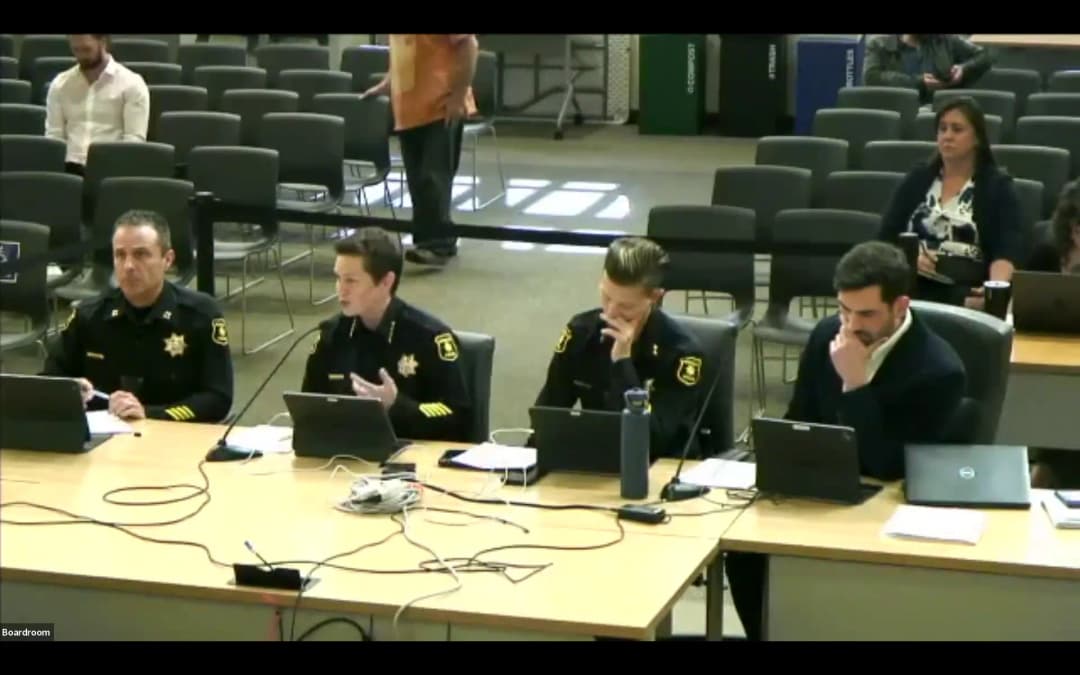
Note: The meeting transcript begins with the Mayor calling the meeting to order on Thursday, May 7, 2026, at 5:09 p.m., and it continued into the early hours of May 8. The system-provided date of May 8, 2026 is used per instruction, acknowledging this discrepancy. The Berkeley City Council held a special meeting to consider two related items: Item 1A (public safety technology, surveillance technology ordinance, police equipment ordinance approvals, policy updates, and contract authority) and Item 1B (social justice implications of contracts with immigration data broker Flock Safety, from the Peace and Justice Commission). This was a continuation from a March 24, 2026 meeting. The council heard extensive questioning from members, then three hours of public comment (two hours in person, one hour online), followed by council deliberation and a split vote on key components. Public Comments & Testimony - Support for Flock expansion: Several speakers, including Brenda Grisham (whose son's murder is unsolved), John Caner (CEO of Downtown Berkeley Association), and representatives from the Berkeley Chamber of Commerce and Bay Area Council, argued that Flock technology helps solve serious crimes, deters theft, and is essential for public safety. They cited statistics (e.g., 52 arrests in 2025 from ALPR data) and the need to support police with modern tools. - Opposition to Flock expansion: The overwhelming majority of speakers opposed the contract. Key points included: - Flock's documented data-sharing with federal agencies (ICE, CBP) and history of unauthorized access, even after purported fixes. - Risks to sanctuary city commitments, especially for immigrant, Black, and Brown communities. - Technical vulnerabilities (e.g., hacked within 30 seconds, data sent overseas for AI training). - Lack of independent evidence that surveillance reduces crime. - City attorney's leaked memo warning of $30-60 million in legal liability. - Concerns about First Amendment chilling effects and misuse by police (e.g., stalking ex-partners). - Flock's investor ties (Peter Thiel) and anti-immigrant/anti-DEI views. - Specific incidents: teacher Marimar Martinez shot five times after being tracked by Flock; activist Joseph Allman surveilled for animal cruelty investigations. - Notable speakers: Nathan Meisell (former PAB vice chair), Josh Cayetano (PAB chair), Moni Law (SEIU 1021), Sally Albright (Rent Board chair), and many community members and students. Discussion Items - Councilmember questions: Councilmembers queried BPD Chief Lewis, Deputy Chief Tate, and Flock representative Trevor Chandler on: - Differences between current camera registry and proposed Community Video Streams (CVS). - Policies on drone use (UAS), including prohibitions on First Amendment assembly surveillance. - Data-sharing protocols with other agencies (only within 9 Bay Area counties plus Sacramento, requiring signed letter agreeing to sanctuary city rules). - Liability and fine amounts (proposed $150K per violation; Richmond $290K, Oakland $200K). - Training and audit procedures for drone and ALPR systems. - Flock's past data breaches and changes since (e.g., disabling national lookup, no ICE contract). - PAB concerns: Interim Director Kathy Lee reiterated PAB's four concerns: MSA with Flock, drone policies, community video streams, and integrated single-vendor architecture. PAB's May 4 letter highlighted procurement issues and risks of single-vendor dependency. - Councilmember proposals: Councilmember O'Keefe proposed restricting drone use to imminent safety threats and banning audio microphones. Councilmember Lunapara proposed amendments to UAS policy (probable cause for felony with active threat of serious bodily injury) and an efficacy assessment for ALPR extension. Councilmember Blackaby offered the main motion. Key Outcomes - Vote on use policies and non-contract items (severed from ALPR extension): Passed 7-1-1 (Bartlett no, Trago pass). This adopted the use policies for various technologies (as amended by Mayor, Lunapara, Tregub), declined to move forward with the full Master Services Agreement (MSA) with Flock, and took no action on Item 1B. Councilmember O'Keefe's amendment to restrict drone use failed 3-5-1. - Vote on RFP process and ALPR contract extension: Passed 5-4. This directed the city manager to initiate a competitive RFP process for all surveillance technology components (in consultation with PAB and BPD), and extended the existing ALPR contract with Flock for up to 12 months (not to exceed $200,000), with amended contract terms including a $290,000 penalty per violation for data-sharing breaches. The extension is to prevent a gap during the RFP process. - Next steps: The city will issue an RFP for license plate readers, cameras, drones, and integration. The ALPR system remains active during the RFP period. Councilmembers who voted no cited distrust of Flock and the current federal administration, and concern that even an extension risks Berkeley's sanctuary commitments.
Public Meetings - Berkeley, California
Public Meetings - Berkeley, CaliforniaThe Berkeley City Council convened on Tuesday, April 28, 2026, at 6:05 PM. The meeting included ceremonial recognition of American Muslim Appreciation and Awareness Month, a presentation from the City Auditor on the city's financial condition, public comments on non-agenda matters, and several public hearings and votes on federal funding allocations, bond financing, zoning amendments, and a rezoning application. All action items were approved. Consent Calendar - Item 10: Resolution supporting Luna Dance's May Day event. Councilmembers donated from their discretionary accounts: Bartlett $200, Luna Para $200, Blackaby $250, Traggub $150, Humbert $200, Kesarwani $100, O'Keefe $250, Mayor Ishii $250. Approved unanimously. - Item 3: Appointment of Pat De Temple to the Police Accountability Board, supported by Councilmember Blackaby and O'Keefe. - Items 7 and 8: Disaster and Fire Safety Commission recommendations on wildfire and insurance bills. Item 7 was incorporated into Item 11, and no action taken on Item 7 separately. - Item 11: Resolution supporting a package of 13 state bills on wildfire prevention and insurance. Approved unanimously. - Other consent items were adopted as amended. Public Comments & Testimony - Non-Agenda Public Comments: - Dr. Stephen Alpert presented research challenging the notion that excessive regulation causes housing affordability crisis, citing studies from London School of Economics and Georgetown Law. He criticized Councilmember O'Keefe's belief in market-rate housing. - Rolf Bell, a 26-year resident and business owner, complained about a traffic signal installation at Bancroft and Sixth Street that disrupted businesses without notice, requesting a meeting with the traffic engineer. - A speaker (phone ending 211) raised a long-standing personal grievance against the city and threatened legal action. - Rob, a coworking space user, echoed concerns about parking and traffic disruptions. - Seth Shane Wynn, a homeowner and board chair of Berkeley Art Center, thanked the council for support and noted the organization's leadership transition. - Makai Freeman advocated for accessible sidewalks and bike lanes. - Della Luna complained about lack of bathrooms at the downtown Saturday farmers market. - On Item 12 (Annual Action Plan): Carol expressed concern about potential elimination of emergency shelter funding, urging prioritization of shelter. - On Item 14 (Zoning Amendments): Kelly Hammerground raised a question about the inclusion of ESR (Environmental Safety-Residential) zoning in the changes, but staff clarified no changes were made to that section. - On Item 15 (Rezoning): Matthew Wadlin, applicant, requested that the city-owned adjacent parcel (1654 Fifth Street) be included in the rezoning, but the city declined due to current use for transitional housing. Discussion Items - City Auditor's Financial Condition Audit (April 28, 2026): - City Auditor Jenny Wong and Performance Audit Manager Caitlin Palmer presented the audit covering fiscal years 2016-2025. Key findings: Berkeley faces ongoing long-term financial challenges, including a structural budget deficit. The city has used one-time balancing measures (e.g., redirecting $4.7 million from workers' compensation fund, using $3 million from Section 115 trust for pension payments). Unfunded pension liability is $695 million (high risk). Unfunded capital and deferred maintenance needs grew to $1.8 billion. Recommendations include formalizing sustainable budget strategies, regularly evaluating enterprise fees, providing investment reports with five-year return rates, replenishing the Section 115 trust, and developing a capital financing plan. - Councilmembers asked questions: Councilmember Blackaby inquired about the disconnect between actual revenues/expenses and the structural deficit; the auditor explained that actuals reflect balancing measures. He also asked about appropriate pension liability targets and the annual investment needed to curb capital backlog. Councilmember O'Keefe asked about bond rating improvement. Vice Mayor Traggub asked about the inverse revenue/expense relationship, the "other" category in personnel expenditures, and prioritization of recommendations. Councilmember Luna Para and Humbert thanked the team. - Mayor Ishii requested a report back in one year on implementation of audit recommendations. Key Outcomes - Consent Calendar: Adopted as amended (motion carried unanimously). - Item 12 (Annual Action Plan): Public hearing closed; motion to approve staff recommendation carried unanimously (9-0). The plan allocates approximately $3.4 million in CDBG, ESG, and HOME funds for affordable housing, public facilities, and homeless services. - Item 13 (Bond Financing for Ephesian Legacy Court Apartments): Public hearing closed; motion to approve bond financing carried unanimously. The project will create permanently affordable housing. - Item 14 (Zoning Amendments): Public hearing closed; motion to adopt amendments to Title 23 for state law consistency and technical edits carried unanimously. - Item 15 (Rezoning of 1646 and 1655 Fifth Street): Public hearing closed; motion to approve general plan amendment and rezoning to MUR (Mixed Use Residential) carried unanimously. The applicant's request to include city-owned parcel 1654 was not pursued due to its current use for transitional housing. - Adjournment: Motion carried.
The Berkeley City Council met on Tuesday, April 21, 2026, at 6:08 PM. The meeting included a report from closed session, adoption of the consent calendar with several legislative support positions, a public hearing on city vacancies and recruitment under AB 2561, and extensive public comment on non-agenda matters and consent items. Council members participated both in-person and remotely. Consent Calendar - Item 14: Support for SB 1301 (insurance non-renewal reform) – sponsored by Councilmember Tracub with co-sponsors Blackaby, Humbert, O'Keefe. - Item 15: Support for SB 1257 (federal immigration enforcement report) – sponsored by Councilmember Tracub with co-sponsors Mayor Ishi, Lunapara, and added Casarwani. - Item 16: Support for three environmental bills (SB 222, SB 868, AB 2389) – sponsored by Councilmember Tracub with co-sponsor Lunapara. - Item 17: Setting measurable goals and metrics for key city priorities – sponsored by Councilmember Blackaby with co-sponsor Tracub. - Item 13: Peace and Justice Commission item reaffirming commitment to international peace – Councilmember Humbert noted it was duplicative of prior council action; council agreed to take no action. - Items 11 and 12: Peace and Justice Commission recommendations on flock safety and controlled weapons were moved to future meetings (May 7 and when items return from public safety committee). - Item 2: Councilmember Bartlett's nomination to Police Accountability Board (Benjamin Nash) – acknowledged and approved as part of consent. - Item 4: $9 million in state funds secured for affordable housing at North Berkeley BART station – acknowledged. - Consent calendar adopted unanimously with amendment to take no action on item 13. Public Comments & Testimony - Non-agenda public comment: - Rachel Barry (Root and Bloom Institute): Expressed concern about loss of nearly 50 parking spaces (including ADA) after a new traffic light at 6th and Bancroft; noted 16 months of emails with no traction and requested council support. - Rolf Bell (26-year resident and business owner): Described impact on 30 small businesses and 16 residences from intersection reconfiguration; criticized lack of notice and inability to meet with Mayor Ishi or Councilmember Taplin. - Lily Howell (parent of three): Opposed proposed elimination of Parks and Recreation therapeutic recreation program for children with disabilities; called it shameful in the birthplace of the disability rights movement. - Della: Requested public reporting on causes of recent fires in Berkeley to help residents avoid hazards. - Craig Nagasowa (property owner at 1201 6th Street): Described dangerous conditions from unhoused encampment including a fire that blistered his building; criticized city for allowing the person to return. - Additional speakers supported Peace and Justice Commission's recommendations on flock safety (George Lippman, Wendy, Lisa). - Consent calendar public comment: - George Lippman (Peace and Justice Commission): Strongly opposed Flock contracts, citing data sharing with ICE, political corruption, and influence of Trump-supporting investor; urged council to be careful. - Public hearing on vacancies (Item 18): - Thomas Gregory (SEIU 1021 president): Stressed that eliminating 114 vacant positions (42 in his chapter) would permanently reduce city capacity for constituent services (planning, behavioral health, revenue collection). - Berkeley Police Association representative (Monarch): Presented current sworn vacancies (46 vacant positions, 66% of authorized staffing); noted recruitment challenges (lack of tools, competition from SFPD) and proposed budget cuts that would worsen staffing; 19 officers eligible to retire. Discussion Items - Item 18: Public Hearing on Vacancies, Recruitment, and Retention (AB 2561) - Presenter Monica Walker (HR) reported a 15% average vacancy rate citywide in 2025, with highest in small bargaining units (BFCOA, IBEW). The city received 16,000 applications (12,000 unique) and filled 248 vacancies. Retention rate was 93%. Benchmarking comparable to other municipalities (14-20% vacancy). Councilmember Blackaby asked for follow-up on benchmarking retention. - Councilmember Casarwani asked for clarification on retention calculation (retirements + voluntary separations divided by budgeted positions). - Councilmember Humbert thanked staff for the presentation. - Public hearing closed unanimously. Key Outcomes - Consent calendar adopted unanimously as amended (no action on item 13). - Items 11 and 12 deferred to future meetings (May 7 and as scheduled from public safety committee). - Public hearing on vacancies (Item 18) was held and closed unanimously; no formal vote required. - Councilmember Tracub added co-sponsors on several items (Casarwani, Lunapara). - Councilmember Humbert raised concern about duplicative item 13; council agreed to take no action. - Meeting adjourned unanimously.
The Berkeley City Council met on April 15, 2026 (the meeting was convened on April 14, 2026 at 6:05 PM and concluded after midnight) to address a full agenda. Key actions included unanimous approval of a resolution limiting city property use for immigration enforcement (ICE-free zone), adoption of significant amendments to the landmarks preservation ordinance (raising the signature threshold for public-initiated landmark designations to 200 and establishing a five-year moratorium on landmarking for properties with active SB 330 preliminary applications), and approval of the consent calendar. The meeting also featured ceremonial adjournments in memory of community activists Cynthia Brantley Pierce and Winston Burton, and public comment from the firefighters' union opposing proposed position eliminations and the closure of Fire Station 4. Consent Calendar - The consent calendar was approved as amended, including moving item 18 (Mills Act contract for 2845 Woolsey) from the action calendar to consent based on Councilmember Humbert's request. - Council members made individual donations from their office accounts to support community organizations: Kala Art Institute (item 14), Sylvia Mendez Spring Cultural Celebration (item 15), and others. Contributions ranged from $100 to $500 per council member. - Other consent items included approval of the Downtown Berkeley Association bid renewal (item 4), initiation of a process to rename Cesar Chavez Park (item 12), support for amendments to the Berkeley Green Code (item 17), and the local density bonus program referral to establish a citywide program for lower-cost ownership homes (item 13). Public Comments & Testimony - Non-agenda items: Speakers addressed historical inaccuracies in street naming (Galapagai Way), accessibility of government services at City Hall, and pedestrian safety issues at the Ashby BART crosswalk. One speaker requested construction cones be replaced at an unfinished crosswalk. - Firefighters union: Amori Langmom, president of Berkeley Firefighters Local 1227, spoke strongly against the proposed elimination of 20 firefighter positions and closure of Fire Station 4. He noted that voters passed Measures GG (2008) and FF (2020) generating $16.2 million annually for fire services, and that call volume had increased from 11,000 to 17,500 incidents per year. He warned that response delays would increase fatality rates for cardiac arrest and fires. - Item 13 (local density bonus for condos): Several speakers opposed the proposal, arguing it would allow developers to pay fees instead of building on-site affordable housing, thereby reinforcing housing segregation and reducing affordable units in wealthier neighborhoods. Others supported it as a way to create homeownership opportunities and spur stalled downtown development. - Item 20 (landmarks ordinance amendments): Speakers including Kelly Hammergren, Isaac Warshower (Berkeley Architectural Heritage Association), and LPC Chair Denise Hall Montgomery advocated for a 100-signature threshold and expressed concerns that the higher thresholds (200 or 400) would effectively end community-initiated landmarking. They also criticized the SB 330 exception as potentially enabling bad-faith applications to block landmarking. Discussion Items - Item 19 – Resolution limiting use of city property (ICE-free zone): The city attorney presented a resolution restricting exclusive use of city property without authorization, particularly for civil immigration enforcement staging. Councilmembers discussed the distinction between exclusive and non-exclusive uses and legal limitations. After brief questions and public comment, the council voted unanimously to adopt. - Item 20 – Amendments to Landmarks Preservation Ordinance: Extensive deliberation centered on two issues: - Signature threshold: The referral proposed raising the required number to initiate a landmark designation from 50 to 200 with owner consent or 400 without. The LPC recommended 100. Councilmembers debated between 100, 150, and 200. Councilmember Kessarwani advocated for a differentiated threshold (150 with owner consent, 300 without) to prevent abuse by neighbors. Ultimately, Councilmember Taplin moved a single threshold of 200 signatures regardless of owner consent, which carried 8-0-1 (Councilmember Bartlett abstained). - SB 330 exception: Two alternatives were considered: a five-year moratorium proposed by Councilmembers Kessarwani and Humbert (one-time per property, with extension through the life of any entitlement) and a 30-month (2.5-year) moratorium proposed by Vice Mayor Tregub (aligned with state law). After discussion, the council adopted the five-year option as part of the same motion, along with a requirement for staff to report back in one year on implementation. - Other technical edits: The ordinance also included fee schedule updates, typographical corrections, and procedural alignments with the zoning adjustments board and sunshine laws. Key Outcomes - Consent calendar: Approved unanimously (9-0) as amended. - Resolution on city property use (Item 19): Adopted unanimously (10-0). - Landmarks ordinance amendments (Item 20): Adopted 8-0-1 (Councilmember Bartlett abstained). Key provisions: - Signature threshold for public-initiated landmark designation set at 200 (single standard, no distinction for owner consent). - Five-year moratorium on landmarking after receipt of an SB 330 preliminary development application, limited to one time per property, with extension through the life of any resulting entitlement. - Staff directed to report back to council in one year on the administration of the new regulations. - Ceremonial adjournments: The council adjourned in memory of Cynthia Brantley Pierce and Winston Burton. - No action on firefighters' concerns: The council heard public comment but took no vote regarding the proposed position eliminations or closure of Fire Station 4. The meeting was adjourned shortly after 10 p.m.
The Berkeley City Council met on April 14, 2026, to discuss modifications to the petition signature ordinance, including the required number of signatures and the time period for gathering them. After debate, the council voted to adopt a standard of 200 signatures with a five-year validity period, including a one-time extension through the life of the entitlement and a requirement for staff to report back in one year. Public Comments & Testimony - Carol reported observing a signature gatherer for a competing proposition for the billionaires tax recruiting individuals with energy drinks, which she described as illegal. She stated she reported the incident to the city clerk and police, but police declined to act because no money was involved. - Kelly Hammergren expressed concern about comments from the fire department and unions regarding the city budget deficit. She noted that the planning department operates with 74% of its budget from permits and is not subject to the same constraints as general fund departments, and called for evaluating the planning department's budgeting. - A speaker commented on Israel and Palestine, calling for peace and criticizing leadership, and used the term "criminal" in reference to Netanyahu. Discussion Items - The council debated changes to the ordinance regarding the number of signatures required for petitions and the time period for gathering them. Councilmember Humbert raised the issue of property owner consent and suggested 100–150 signatures as a more realistic range for ordinary persons, while others coalesced around a 200-signature standard. - Councilmember Kessarwani and Humbert proposed a five-year validity period with a one-time extension through the life of the entitlement, which Councilmember Taplin's motion included. Vice Mayor Traeger stated he could not support the 200-signature number and preferred 150, but indicated he could accept the five-year period. - Councilmember Humbert requested a friendly amendment for staff to report back in one year on the administration of the new modifications, which was accepted by the motion maker. Key Outcomes - The council voted on a motion consisting of the staff recommendation with supplemental changes from Councilmembers Kessarwani and Humbert, including a single standard of 200 signatures, a five-year validity period with a one-time extension, and a request for a one-year staff report. The motion carried with all present voting yes (Councilmembers Kessarwani, Taplin, Bartlett, O'Keefe, Blackaby, Munapara, Humbert, and Mayor Ishii), though Vice Mayor Traeger indicated he could not vote for the motion. - The council adjourned after public comments on items not on the agenda.
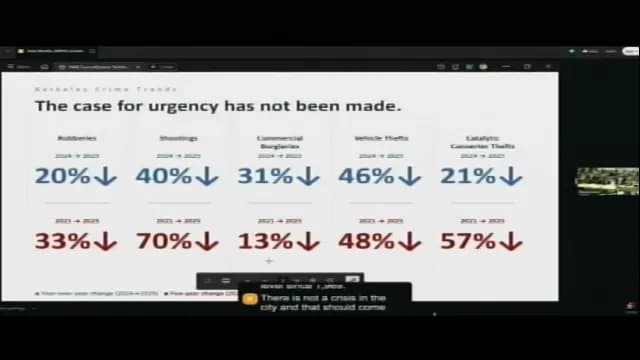
On March 25, 2026, the Berkeley City Council heard a presentation from the Berkeley Police Department (BPD) on the 2025 Annual Report. The report covered crime statistics, use of force, accountability, clearance rates, technology deployments (ALPRs, drones, RTIC), and key programs (CSOs, FLEX team, GVIPP). Council members asked questions and expressed both praise and concern, particularly around hate crimes, sexual assaults, and racial disparities in stops. Public comment highlighted concerns over ALPRs, racial profiling, hate crime data, and sanctuary city policies. No formal vote was taken; the report was received and discussed. Public Comments & Testimony - Speaker (name not given) requested more specific hate crime data by race, religion, sexual orientation, disability, and including homelessness, citing a prior council recommendation and an incident where a homeless man was stabbed. - Kit Saganor noted that unfilled officer positions do not cost the city real dollars, and questioned the future funding of the Live Free gun violence intervention program, which may be running out of funding. - Speaker (Tariq Shaw) provided statistics from the Human Rights Data Analysis Group showing racial disparities in stops: Black people were 6 times more likely than white people to be stopped while driving (per capita), 9 times more likely on foot, 11 times more for equipment violations, and 10 times more for seatbelt violations in 2025. The speaker argued these should be part of the report and criticized the notion that CSOs represent reimagining policing. - Kelly Hammergren asked about pepper spray reporting (following the March 10 meeting), whether the hate crime definition changed, and about auto theft solved cases. - Yick (student, Cal ACLU) opposed ALPRs, citing a study in Piedmont where less than 0.3% of hits led to useful investigative leads. - Alana Auerbach reiterated racial disparity statistics from the BPD open data portal, noting they were worse than 2018 findings, and that BPD was supposed to eliminate low-level stops per a 2021 Council directive but still conducted 489 equipment violations and 45 seatbelt violations in 2025. - Angeline opposed Flock cameras, arguing they create a loophole for federal immigration enforcement and compromise safety for undocumented residents and students. - Leslie opposed any Flock expansion, citing other jurisdictions canceling contracts, and argued surveillance is not in line with sanctuary city values. - Wendy Alfson referenced a July 2025 Flock access to BPD data incident not in the public report and expressed concern about immigration-related misuse. Discussion Items - Presentation by Chief Lewis, Captain Durbin, and Arla Malmberg: - Call Volume & Staffing: BPD responded to just over 60,000 calls in 2025 (down 2%), but 911 calls increased 6% to 16,255, the highest in years. Non-emergency calls dropped 5%. Calls per officer per shift declined from a peak of 6.3 in 2023 to 6.0 in 2025, attributed to the CSO program, bike unit, and FLEX team. Priority one median response time was 7 minutes. The communication center remains understaffed; 9 dispatchers hired, net gain of 3. Planning for AI-powered triage for non-emergency calls and scripted dispatch. - Crime Statistics (Group A offenses): 9,800 offenses in 2025, down 11%. Motor vehicle theft down 48% (vs. 27% nationally), commercial burglary down 31%, shootings down 40% with zero fatal/injury shootings. Aggravated assaults up 16%, sexual assaults up 20%, hate crimes reached 50 (five-year high). - Clearance Rates: Improved across categories, exceeding California state averages. Homicide clearance 100% for 5 years. Robbery clearance jumped from 34% to 49%, attributed to ALPR-supported investigations. - Use of Force: 0.46% of calls involved any force, 93% at lowest levels (1/2). Only 45 incidents (0.07%) at level 3/4. Multiple bias tests showed no systemic bias. - Technology: ALPRs resulted in 58 arrests, 387 vehicles recovered, and 121 cases supported. Fixed cameras proposed for high pedestrian intersections. Drone as first responder program outlined with 2-minute response target. - Programs: CSOs handled over 1,500 non-emergency calls, freeing sworn officers. FLEX team conducted 23 retail theft operations, 141 arrests, 72% with additional charges. Gun violence prevention (GVROs, GVIPP) partnerships with Live Free credited with reducing shootings. - Council Questions and Responses: - Hate crimes: Chief noted many offenders are in mental health crisis; composition stable; expressed openness to community ideas. - ALPR impact: Chief stated difficult to prove causation but strong evidence of tool effectiveness, e.g., clearance rate improvements without adding detectives. - DUI checkpoints: Described as educational; scooters/e-scooters emerging as DUI injury factor. - Transparency hub feedback: Users find navigation non-intuitive; improvements planned. - Drug equipment violations: Increase partly due to new NIBERS reporting and secondary charges from other enforcement; BPD will research and report back. - Recruitment: Partnership with All-Star Recruiting successful; virtual events reach 1,200 candidates. - Early Intervention System: Now being piloted with new vendor; more details in future reports. Key Outcomes - Council members unanimously commended BPD for the report and the department’s work, particularly noting high clearance rates, reduction in shootings, vehicle thefts, and burglaries, and the transparency/accountability measures. - Several council members expressed concern about rising hate crimes and sexual assaults, urging continued monitoring and partnerships. - Councilmember Bartlett highlighted the GVIPP program and indicated need to secure continued funding. - Vice Mayor Lunapara requested future reports include y-axis on workload chart, percent of arrests with use of force, and earlier complaint data (two-year lag). - Councilmember Blackaby suggested using a two-year window for complaint disposition data to capture all resolved cases. - BPD agreed to provide additional details on drug equipment violations, hate crime demographics, and early intervention system data. - No formal vote was taken; the meeting was adjourned after the presentation and discussion.
The Berkeley City Council met on Tuesday, March 24, 2026, at 6:23 PM. The meeting included ceremonial proclamations, a whistleblower report, approval of an interim police accountability director, and extensive debate on a proposed public safety technology package involving Flock Safety. The meeting adjourned at approximately 12:30 AM after continuing the Flock item to a special meeting on June 2, 2026. Ceremonial Matters & Proclamations - Council proclaimed April 12, 2026 as Holocaust Remembrance Day in Berkeley, with the proclamation received by former City Auditor Anna Rabkin. Council also allocated D13 funds for the event. - Council honored the life of Elaine Williams Bloom (passed February 24, 2026), a longtime educator and social justice advocate. Her son Russell accepted the proclamation. - Council recognized the life and advocacy of Marcia Poole, who passed away; her husband spoke. Consent Calendar - Council approved the consent calendar, which included routine approvals, grant acceptances (e.g., $465,258 for school-based health services), and several ceremonial items with discretionary fund contributions. - Item 7 (2845 Woolsey Street Mills Act contract) was pulled to the action calendar for further discussion and later continued to the next regular meeting (April 14, 2026) after the Landmark Preservation Commission did not provide a definitive recommendation. - Item 13 (pavement safety improvement project contracts) was removed by the city manager due to omitted proposals. - Item 16 (Peace and Justice Commission recommendation on Alien Enemies Act education) was referred to the budget process as it has unbudgeted costs. Public Comments & Testimony - Non-Agenda Public Comment: Speakers raised concerns about commission recommendation tracking, zoning enforcement at 2425 Durant, the naming of a street after a colonial spy's wife, the Gaza genocide, the Ashby BART crosswalk, and support for a Go Bond to improve Harrison Park fields. One speaker criticized the collapse of the police accountability board. - Consent Calendar Comments: Multiple speakers supported the glue trap ban (item 20), citing cruelty to wildlife. Others urged passage of the Peace and Justice Commission items on free speech and the Alien Enemies Act. One speaker questioned the high number of consultant contracts (item 14) given the city's deficit. Several speakers thanked council for Holocaust Remembrance Day and other community events. - Action Items: - On the Kathy Lee appointment (item 25), many speakers praised her integrity and urged council to provide strong support to the Police Accountability Board (PAB) and fill vacancies. - On the Flock Safety contract (item 26), the vast majority of speakers opposed expansion, citing Flock's history of unauthorized data sharing with ICE, risks to immigrant communities, inability to protect data from federal warrants, and the city's sanctuary commitments. A few speakers (including the Berkeley Police Association and Chamber of Commerce) supported the technology for public safety and staffing needs. Discussion Items - Whistleblower Report (Item 18): City auditor presented findings that a former employee committed the city to a $286,000 ambulance purchase without required council approval. Recommendations included clearer purchasing rules, escalation steps, training, and transparency. Council members thanked the auditor and noted that some changes have already been implemented. - Urgent Item: Cesar Chavez Park Renaming: Councilmember Kesserwani proposed amendments to refer the renaming to the Parks, Recreation, and Waterfront Commission for a community process, with Dolores Huerta as one option, and direct immediate removal of signs. Councilmember Ishii noted her separate item covering other Chavez-named sites. The amended item was approved unanimously. - Interim Director of Police Accountability (Item 25): Council unanimously approved the resolution to appoint Kathy Lee as interim director. Lee's statement was read; she expressed commitment to meaningful civilian oversight and urged council to fill PAB vacancies. - Public Safety Technology Package (Item 26): BPD and Fire Department presented a proposal for a consolidated surveillance system (ALPRs, fixed cameras, community video streams, drones as first responders, and Flock Nova software) via a single vendor (Flock Safety). The PAB presented strong opposition, citing inadequate review time (24 hours for the MSA), lack of a consolidated acquisition report, vendor selection concerns, and conflicts with sanctuary city policy. Four council supplementals were presented: - Councilmember Bartlett: Proposed amendments to the MSA including $1 million penalties, termination for convenience, strict data controls, and private right of action. - Councilmembers Humbert, O'Keefe, Taplin, and Kesserwani: Six recommendations including increased penalty to $150,000, termination for convenience, limit on anonymized data license, prior consent for changes, council approval for modifications, and anti-circumvention provisions. - Councilmember Blackaby: Similar contract amendments plus enhanced reporting (monthly for first six months, then biannual). - Mayor Ishii, Vice Mayor Lunaparra, and Councilmember Tregub: Reject Flock contract; refer community video streams and drone policies back for revision; approve fixed cameras with monthly audits; strengthen oversight, data retention, and sanctuary compliance. Council extended the meeting to 1:30 AM to allow full public comment. After extensive testimony, council voted to continue the item to a special meeting on June 2, 2026, due to unresolved issues and insufficient time for deliberation. Key Outcomes - Cesar Chavez Park: Approved referral to Parks Commission for renaming process; directed immediate removal of signs. - Kathy Lee Appointment: Approved unanimously as interim director of police accountability. - 2845 Woolsey Street Mills Act: Continued to April 14, 2026 regular meeting. - Public Safety Technology (Flock Contract): Continued to a special meeting on June 2, 2026. Council will revisit the contract, use policies, and supplementals at that time. - Consent Calendar: Approved as amended (items 13 and 7 removed; item 16 referred to budget). - Closed Session Settlements: Council approved settlements for two workers' compensation matters (claim numbers BER 2300091 and BER 240044). Council also committed to not invoking Government Code §54957.9 to relocate meetings, per the court ruling in the People's Alliance case.
At a special meeting on March 17, 2026, the Berkeley City Council received a presentation on community survey results and discussed potential ballot measures for the November 3, 2026 general municipal election. The main options were a $300 million general obligation infrastructure bond and a half-cent general fund sales tax increase. Survey results showed support above the required thresholds for both measures. The council unanimously approved directing staff to prepare draft ballot language and conduct a second community survey. Consent Calendar - No consent calendar items were listed. The meeting had only one agenda item: presentation and discussion of community survey results and direction regarding potential ballot measures. Public Comments & Testimony - Dr. Stephen Albert (District 5 resident) criticized the 500-sample survey as too small to be meaningful. - Dr. Celeste Marks stated the sample was too small and not representative of the city's demographics. - Former Mayor Gordon Wozniak thanked staff, noted that property tax increases have been driven by parcel taxes (not debt service tax, which declined 50% over 30 years), and emphasized leveraging T1 bond dollars for grants as a powerful selling point. - Linda Alberti expressed concern about slow 50/50 sidewalk program and questioned past spending on Hopkins corridor bike lanes. - A speaker from the Commission on Disability urged a separate funding set-aside within the bond for accessibility projects, warning they would otherwise compete against costly civic center seismic upgrades. - A speaker criticized the half-cent sales tax as regressive and suggested exploring less regressive funding methods. - Former councilmember L. A. Wood strongly supported civic center seismic upgrades and FEMA grant applications, and highlighted long-term savings from bringing city offices back into city-owned buildings. - Former Mayor Bates praised the process and encouraged conducting a second poll (or even two more) focused on refining messaging and arguments. - Ann Harlow (Berkeley Historical Society) supported allocating enough funds to complete the Old City Hall project, noting the building is seismically unsafe. - David Flores (Executive Director of Berkeley Community Media) supported seismic retrofits for historic buildings, noting cost escalation if delayed. - Several online commenters raised concerns about survey sample size (Chad, Carolyn, and others). - Corey requested consideration of taxing square footage rather than assessed value for equity. - Kelly Hamergren argued many projects listed are already funded by existing taxes, criticized low meeting attendance and canceled meetings of the FF oversight committee. - Multiple speakers supported restoring Old City Hall and the Veterans Memorial Building (Leila Moncharsh, Christine Uren, Isaac Worshower, Arlene). - Tony noted the city has burned through five public works directors in 15 years and called for a chief engineer and funding for a drainage plan. Presentation and Discussion - Deputy City Manager David White presented infrastructure funding challenges: a $1.87 billion unfunded need, average annual infrastructure spending of $39 million, and the sunsetting of Measure T1 (which leveraged $100 million into $183 million with grants). - White described a preliminary project list of over 30 items in three buckets: community facilities/quality of life (parks, restrooms, dog parks, cultural centers, waterfront), public safety (fire station modernization, 911 dispatch), and critical infrastructure (seismic upgrades, ADA improvements, 50/50 sidewalk program), all with a climate resilience lens. - David Merman (Lake Street Partners) presented survey results among 500 likely voters (margin of error ±4.4%): - 56% said city is going in right direction (up from 47% in 2024). - 56% rated city services good/excellent (up from 51% in 2021). - Top infrastructure priorities: safeguarding critical infrastructure from climate change (35%); increasing safety/accessibility of sidewalks (35%); reducing pollution/flood risk (28%); improving parks/playgrounds (25%); replacing public safety facilities (23%). - Combined support for a $200M or $300M GO bond: 70% yes (39% strongly yes), 13% no, 16% undecided. - Support was essentially identical for $200M (70% yes) and $300M (71% yes); the $300M version tested slightly higher. - After hearing pro/con arguments, support dipped to 67% yes (just over the two-thirds threshold). - For a half-cent sales tax: initial support 60% yes (above 50% threshold); after arguments 58% yes. - Specific high priorities: renovating 911 dispatch (29% extremely important), replacing fire stations (27%), repairing sidewalks (27%), upgrading park restrooms (25%). - Merman noted that levels of support were consistent across broad geographic areas (hills, central/south, west) and across demographics, with slightly higher support from younger voters and renters. - Councilmember O'Keefe asked how the measures could address the structural deficit; White replied that the sales tax would bring in $9M/year (partially offsetting a $27-30M deficit) and the bond would allow shifting staff off general fund. - Councilmember O'Keefe also asked about tax burden relative to neighboring cities; staff stated the $300M bond would cost about $22 per $100,000 of assessed value ($121/year for median home), and the sales tax would bring Berkeley to 10.75% (matching Oakland, Albany, etc.). - Councilmember Triebe asked about factors that could affect support between polling and election; Merman cited events (new wars), specific ballot language, and ballot crowding from other revenue measures. - Councilmember Bartlett confirmed that the survey modeled likely voters for a mid-term election, which skews older. - Councilmember Kesarwani questioned the statistical validity of the 500-sample survey; Merman explained it provides a margin of error of ±4.4% at 95% confidence. - Mayor Ishikawa noted the importance of transparency, flexibility in ballot language, and ensuring projects reflect community priorities (especially equity and accessibility). Key Outcomes - Motion (by Councilmember Kesarwani): Direct the city manager to prepare draft ballot language for a $300 million general obligation infrastructure bond and a half-cent sales tax measure, and to conduct a second community survey testing actual ballot language and interactions with other likely ballot measures. The motion carried unanimously (9-0). - Councilmember Blackaby urged inclusion of district equity and flexibility in project categories. - Councilmember Humbert expressed support for the $300M bond but urged a focus on projects polling highest. - Councilmember Triebe emphasized the importance of clearly communicating the full value of investments, including the cost of not investing, and supported the higher bond amount. - Councilmember O'Keefe strongly supported the sales tax, arguing Berkeley had been "leaving money on the table." - Vice Mayor Lunaparra supported the recommendations but noted concerns about the regressive nature of both taxes. - Councilmember Bartlett encouraged district equity and a strong downtown civic center. - The meeting was adjourned after the vote.
The Berkeley City Council met on Tuesday, March 10, 2026, at 6:04 PM. The meeting included ceremonial proclamations, a city auditor's report on non-competitive contracts, public comments, and action on several agenda items including the consent calendar, amendments to zoning and election rules, an appeal of a special assessment lien, and a resolution regarding pepper spray reporting requirements. The meeting extended to approximately 11:20 PM. Consent Calendar - The consent calendar was approved unanimously after roll call. Items included: - Urgency resolution condemning the illegal war on Iran and expressing support for impacted constituents. - Supplemental resolution opposing oil and gas leasing on California public lands. - Amendment to the 2026 state and federal legislative platform supporting a not-for-profit utility service. - Re-establishment of the Downtown Berkeley Property and Business Improvement District (PBID) for 10 years with a 20% rate increase. - Entertainment zone ordinance including North Shattuck merchant stakeholders. - AI guidelines items (two separate referrals) and a micromobility regulatory framework. - Berkeley Free Clinic critical renovations item with $250 donations from multiple council offices. - Housing zoning study on Telegraph and Claremont. - Various other items including adoption of the Ashby BART East Lot RFP framework. Public Comments & Testimony - Auditor's Report on Non-Competitive Contracts: Multiple speakers commented on the audit findings. One taxpayer expressed concern about $85 million in no-bid contracts. Martin Bork (Ecology Center) defended the transparency of their contract negotiations. Moni Vaught highlighted disparities in contracts awarded to white men versus people of color. Others called for public posting of contracts and equity priorities. - Public Comment on Non-Agenda Matters: Speakers raised issues including housing affordability, Flock camera contracts, pedestrian safety, police accountability, and honoring Country Joe McDonald. - Employee Union Comment: Jocelyn Goldsmith DeSena (SEIU 1021 CSUPTRLA) opposed items reducing police oversight, particularly the pepper spray reporting rescission. - Consent Calendar Public Comment: Support for PBID renewal and entertainment zones from Downtown Berkeley Association, North Shattuck Association, Berkeley Rep, and UC Theater. Several speakers opposed the Iran resolution, arguing it supported the regime. Others supported the Peace and Justice Commission's alternative resolution. - Item 16 (Appeal of Special Assessment Lien): The appellant, architect Michael Tollison, argued his construction was legal under CRC 105.2 and criticized city staff. Public commenters noted the complexity of code interpretation. - Item 17 (Pepper Spray Reporting): Numerous speakers opposed rescinding the 1997 reporting requirement, citing the danger of pepper spray and the need for narrative reports. Many supported the amendments by Vice Mayor Lunapara and Mayor Ishi to maintain transparency via the hub. Discussion Items - Auditor's Report on Non-Competitive Contracts: The auditor presented findings that 94 contracts worth $43 million in FY2024 were non-competitive, with two recycling contracts totaling up to $85 million lacking competition. 38% of waivers did not meet criteria. Recommendations included adding competition requirements to the municipal code and implementing a digital contract management system. Council members thanked the auditor and city manager, with several indicating interest in deeper review after budget approval. - Item 14 – Amendments to Non-Conforming Lot Coverage: Staff presented a cleanup ordinance to remove a use permit pathway for non-conforming structures in middle housing zones, ensuring only ministerial approval. Council discussion clarified that the change eliminates the option to go to ZAB for non-conforming middle housing projects. The item was approved unanimously. - Item 15 – Amendments to the Berkeley Elections Reform Act (BERA): The Fair Campaign Practices Commission (FCPC) presented four amendments: one-bank-account rule, timeline for returning unspent matching funds, reuse of campaign materials at fair market value, and cost-of-living rounding cleanup. After public comment, the council approved the amendments unanimously. - Item 16 – Appeal of Special Assessment Lien at 2750 Cedar Street: The appellant argued that construction was exempt under CRC 105.2 and that the city's demolition was illegal. Council members questioned the appellant about stop work orders and code interpretation. Staff maintained that the building official's interpretation is authoritative and that the lien was justified. The council voted to deny the appeal, upholding the staff recommendation. - Item 17 – Resolution on Pepper Spray Reporting: Councilmember Kessarwani proposed rescinding the 1997 requirement for a separate pepper spray report, citing the transparency hub. Vice Mayor Lunapara, Councilmembers Blackaby, Tregub, and O'Keefe offered a supplemental requiring specific data on the hub (date, time, location, officer role, incident type, de-escalation, first aid, etc.) and a referral to reincorporate pepper spray into the military equipment report. After extensive debate, the council adopted the mayor's amended resolution, which included: - Directing the transparency hub to include specified data within 14 days. - Referring to the city manager to explore adding pepper spray to the controlled equipment ordinance, and to work with vendors to include administration of first aid, narrative reports, and opt-in notifications on the hub where feasible. - The motion passed unanimously on roll call. Key Outcomes - Consent Calendar Approved: Unanimous roll call (all present voted yes). - Item 14 Approved: Unanimous, without opposition. - Item 15 Approved: Unanimous, with thanks to FCPC. - Item 16 (Appeal) Denied: Motion to adopt staff recommendation passed, denying the appeal and upholding the special assessment lien. - Item 17 (Pepper Spray Reporting) Adopted: The mayor's amended resolution passed unanimously. The rescission of the 1997 report is effective immediately, but the transparency hub must be updated per the resolution, and the city manager will report back on incorporating pepper spray into the controlled equipment ordinance and hub enhancements. - Meeting Extended: The council voted to extend the meeting to 11:20 PM to complete the agenda.
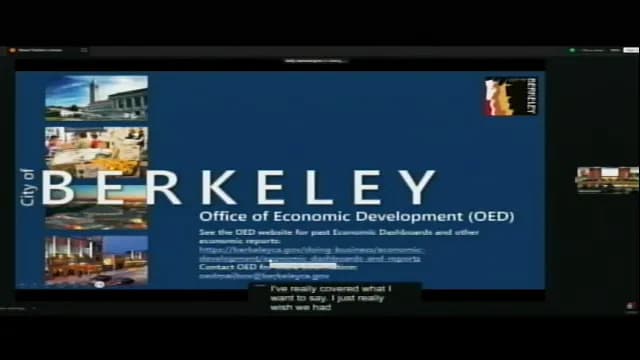
The Berkeley City Council held a special meeting on March 10, 2026, to receive the annual Berkeley Economic Dashboards update from the Office of Economic Development (OED). The presentation, led by OED Manager Eleanor Hollander and her team, provided data from calendar year 2025 on employment, industry trends, hospitality, innovation, commercial real estate, sales tax, housing, and OED programs. Council members asked questions about business retention, attraction, and barriers to economic vitality. Public commenters offered both praise and criticism. Public Comments & Testimony - John Kuhner (Downtown Berkeley Association) : Thanked OED for partnership, highlighted the activation of the Shattuck block by Flying Horse Investments and the upcoming Core Spaces project. He emphasized the need for improved public safety and a welcoming downtown, called for a discretionary budget for OED, and advocated for more class A office space and events to boost the daytime economy. - Kelly Hamergren : Expressed concern about downtown vacancies and stated that window film does not draw her to downtown. She worried about the impact of upzoning on Elmwood businesses under the quarter plan and emphasized the need to support small business owners who do not own property, noting that construction has detrimental effects on them. - Cheryl Davila (former council member) : Criticized high commercial rents as a reason for businesses leaving, argued that homelessness is exacerbated by high rents and that the city fails to provide needed services, and stated that empty buildings should be used for housing. She expressed dissatisfaction with the council overall. Discussion Items - OED Presentation (Economic Dashboards Overview) : - Unemployment: Berkeley rose to 4.7%, matching the county rate and below the state’s 5.4%. - Major employers: Top 25 include public sector, healthcare, and private corporations; new to the list were Form Energy (battery R&D) and Boichik Bagels. - Hospitality: Berkeley ranked first in hotel occupancy and second in average daily room rate, with 1.6 million overnight visitors generating $8.3 million in transient occupancy tax revenue. - Innovation ecosystem: About 370 innovation businesses; life sciences and software are the largest sectors, with 86% early-stage companies. In 2025, 88 startups raised $1.5 billion in venture capital, but over 50% was concentrated in three large deals (Rigetti, Kobold Metals, Terrabase). Additionally, $40 million in government R&D grants flowed to 16 companies. OED quantified the local impact of UC Berkeley’s innovation and entrepreneurship initiatives: 180 affiliated startups in Berkeley producing 500–600 jobs with average salaries over $200,000, contributing $200–$250 million to the economy. - Life science lab vacancy: 51.6% in Berkeley, influenced by the new Berkeley Commons property. This is higher than Emeryville and the Bay Area average, but OED noted that the market is adjusting and expects leasing activity. - Office market: Berkeley’s office availability remained stable and lower than nearby markets (30% in Oakland, 34% in Emeryville). Asking rents held steady at $3.38 per square foot. - Commercial development: New research/academic facilities under construction (Innovative Genomics Institute, Baker Labs). Private investment is reactivating spaces, such as Flying Horse Investments’ purchase of the Shattuck Plaza block, with multiple letters of interest. - Ground-floor vacancy: Dropped citywide to 6.3% from 7.5%, though some corridors saw increases. Retail occupies 31% of ground-floor space, and food & beverage occupies 13%. - Sales tax: Continued steady gains; retail accounts for 40% and food & beverage 37% of sales tax composition. A jump in personal services/taxes was attributed to fuel price fluctuations. - Housing: About 1,700 units approved in 2025, concentrated downtown and near campus. Median single-family home price in December 2025 was $1.265 million, with homes selling for 57% over list price. - OED programs: Loan programs have 25 active loans totaling $1 million. The Discovered in Berkeley campaign generated 4.6 million impressions. The Green Business Program certified 81 businesses. STEM Career X tours exposed students to careers at local startups. Civic arts grants exceeded $650,000. OED emphasized high-touch customer service and stewardship. - Councilmember Questions and OED Responses : - Councilmember Taplin : Asked about life science vacancy lessons from Emeryville. OED explained that Emeryville’s vacancy drop was due to a property sale, and Berkeley can improve perception of permit streamlining. - Councilmember Blackaby : Inquired about Berkeley Bucks (program needs more training/reminders), the innovation ecosystem bubble chart (clarified hubs), lab space for growing companies (discussed recent zoning changes and available spaces), and permitting improvements. OED noted recent zoning updates allow R&D in more districts and permit streamlining efforts. - Councilmember O'Keefe : Asked about vacancy rate calculation (OED uses street surveys and CoStar data), tracking of chain vs. local businesses (OED does not track chains but supports local businesses through campaigns and assistance), and top barriers to economic vitality. OED cited multiple factors, including unpredictable street behavior, and mentioned ongoing work on vacancy policy and creative placemaking to activate vacant spaces. They also noted plans to celebrate legacy businesses. - Councilmember Tregub : Asked about permit streamlining (OED noted award for zoning support, updated definitions), qualitative data on why companies leave (OED tracks departures; most common reasons are business failure or inability to find suitable space, but almost no companies leave due to dissatisfaction), advertising commercial opportunities (business attraction strategy in development but no current funding; OED collaborates with UC Berkeley on events but lacks a budget for national/international marketing), startup grant information (shared via newsletters and campus partners), and small business loan fund outlook (revolving funds, partnership with Working Solutions for better borrower experience). Council Comments - Councilmembers uniformly praised OED’s work and the presentation. They expressed support for business attraction efforts, permit streamlining, and increased investment in OED. Specific suggestions included personal outreach by council members to prospective companies (Councilmember Blackaby and the Mayor offered to make calls), a branded fast-track permitting program, and allocating resources to a formal business attraction strategy. Councilmembers also noted the decrease in commercial vacancy rates and the importance of supporting start-ups, local businesses, and events. Key Outcomes - The meeting was informational; no formal votes or decisions were taken. - Councilmembers directed continued focus on business attraction, retention, and permit streamlining. They expressed willingness to partner with OED on personal outreach and to explore funding for a business attraction campaign in future budgets. - The Mayor emphasized that the information should be more widely shared and announced an intention to “pack the house” for next year’s economic dashboard presentation.