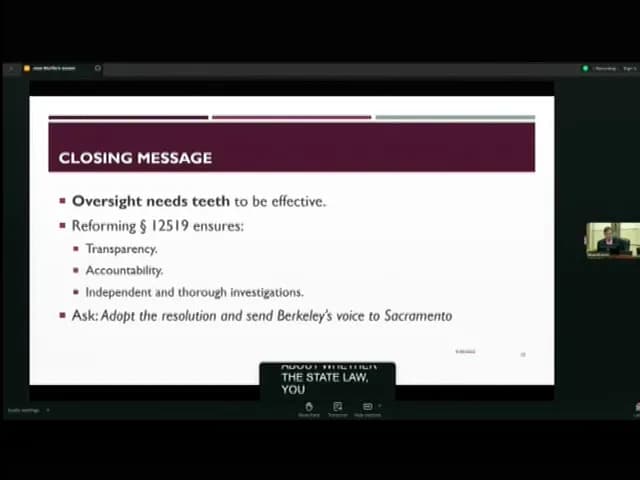
The Berkeley City Council meeting on September 30, 2025, began with ceremonial proclamations for Indigenous Peoples Day and adjournments in memory of Dan Siegel and Din Lee. The consent calendar was approved, featuring significant grants and policy measures. Public comments addressed domestic violence, humanity, and international conflicts. Discussions included planning fee changes and police accountability resolutions, with mixed outcomes. Consent Calendar - Unanimous approval of the consent calendar, including: - Item 3: Acceptance of an $8 million Proposition 47 Cohort Five grant for mental health and substance abuse treatment, aimed at diverting individuals from jail to housing and services. Councilmembers expressed full support for this initiative. - Item 7: Contract renewal for Easy Does It, providing mobility services for seniors and disabled individuals. Councilmembers commended the organization's work. - Item 11: Referral to explore funding for recreation facility improvements, with multiple councilmembers co-sponsoring and expressing support. - Item 12: Resolution supporting California Proposition 50 (Election Rigging Response Act). Councilmembers urged passage and highlighted its importance for democracy. - Item 13: Donations from council discretionary funds to the Berkeley Arts Center fall community dinner. Councilmembers praised the center's contributions. - Item 14: Donations to the Sacred Rest Drop-in Center for a landline phone to assist unhoused individuals. Councilmembers emphasized the service's value. - Item 15: Referral to amend shared micromobility fee structures to fund parking infrastructure and address improper parking. Councilmembers acknowledged the need for balance between accessibility and public safety. - Item 21: Update on police overtime audit recommendations, with the Berkeley Police Department reporting implementation of changes to improve efficiency and transparency. Public Comments & Testimony - Maria spoke about domestic violence, stating that victims require specialized shelters and that agencies are underfunded. She shared personal examples to illustrate the complexities faced by survivors. - Carol Morosevik emphasized common humanity and cooperation, urging the council to prioritize creative and humane solutions to societal issues. - Cheryl criticized the council for inaction on the Gaza conflict, calling for an arms embargo and expressing frustration over perceived lack of concern for humanitarian crises. - Ed Iskander (identified as CK) thanked the council, particularly Mayor Ishi, and requested a meeting to discuss an unspecified issue he described as egregious and contradictory to Berkeley's ethos. - An online caller discussed immigrants, COVID-19, and political concerns, urging action against former President Trump and highlighting issues of discrimination. Discussion Items - Item 16: Changes to Planning and Development Fee Schedule: Staff proposed a $2,000 flat fee for middle housing zoning certificates to streamline approvals under new regulations. After a presentation and questions from councilmembers, the council approved the recommendation. - Items 17 & 18: Police Accountability Resolutions: - Item 17: Resolution calling on the state legislature to amend government code to allow heads of civilian oversight agencies to request investigative assistance from the Attorney General. Councilmembers raised concerns about process, lack of outreach to legislators, and existing legal mechanisms. The council voted to take no action. - Item 18: Resolution directing the city manager and city attorney to develop a communications policy for investigations. Councilmembers expressed disappointment in the presentation, noted existing policies, and referred the item for a memorandum on current legal doctrines related to due process and pending investigations. Key Outcomes - Consent calendar approved unanimously. - Item 16: Changes to planning fees approved. - Item 17: No action taken. - Item 18: Referred to the city attorney for a memorandum on existing policies. - The meeting adjourned after handling all agenda items.
Public Meetings - Berkeley, California
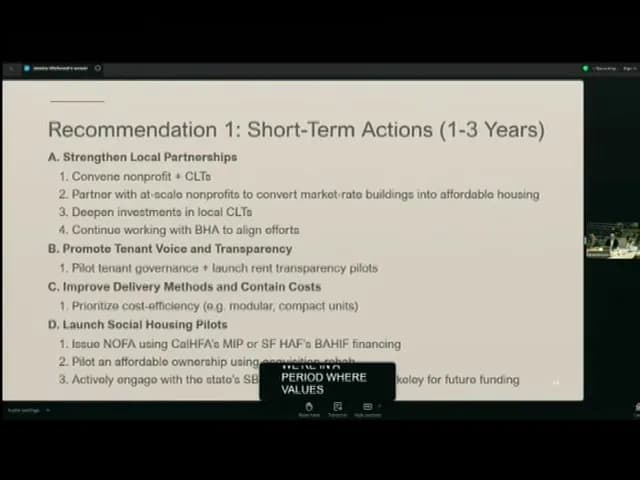
Public Meetings - Berkeley, CaliforniaThe Berkeley City Council held a special work session to receive a presentation on a study examining social housing models and feasibility in Berkeley. The session featured detailed analysis from city staff and consultants, council discussion, and public testimony, with council members expressing a range of positions on the study's recommendations and the city's fiscal capacity to pursue them. Public Comments & Testimony - Matt Gustafson (Bay Area Community Land Trust) advocated for community land trusts as a vanguard for social housing principles, emphasizing tenant governance and decommodification. - David Shear (Housing Advisory Commission) presented the commission's unanimous recommendations, urging the council to view social housing as a philosophical framework for all affordable housing work and to begin planning a 2028 funding measure to replace the expiring Measure O. - Sarah Bell (Housing Advisory Commission) echoed support for leveraging the existing Berkeley Housing Authority and pursuing future funding. - Carol supported the study but urged a realistic, scaled approach focused on self-sustaining models and oversight for tenant governance. - Maria expressed skepticism about complex financing and advocated for simpler, alternative construction methods. Discussion Items - Consultant Presentation: Jessica Hitchcock and Janet Smithheimer presented the Social Housing Study. They defined social housing by four principles: public/nonprofit ownership, permanent affordability, mixed-income tenancy, and strong tenant rights/ governance. The presentation analyzed local housing needs, reviewed international models (Vienna, Denmark), and a U.S. example (Montgomery County HOC). Financial modeling compared acquisition/rehab strategies with new construction, highlighting trade-offs between cost, scale, and depth of affordability. - Council Questions & Deliberation: - Councilmember Taplin expressed strong support for the study's principles, including income integration, tenant governance, and exploring a public agency development model. - Councilmembers Kesarwani and Humbert raised significant fiscal and philosophical concerns. Both argued the city's scarce resources should prioritize new construction for the lowest-income residents over acquiring existing rent-controlled buildings. Kesarwani stated opposition to using local subsidy for households above 120% AMI. - Councilmembers Bartlett, Drako, and Wunafara engaged with the technical aspects of the study. Discussion points included barriers to moderate-income production, opportunities for acquisition, the need for fast financing for preservation, and the potential of social housing as an overarching framework rather than a standalone program. - Councilmember Blackaby sought context on the scale of need and discussed strategies like the Bridge Housing Avalon acquisition as a potentially scalable, cost-effective model. Key Outcomes - No formal votes or decisions were taken during the work session. - Council direction emerged for staff to further analyze concrete options based on the report and council feedback. - Multiple council members and public speakers highlighted the need to begin work on a potential 2028 revenue measure (e.g., a bond) to continue affordable housing funding. - The council acknowledged the value of the study in informing a long-term vision and framing future policy discussions, even amid disagreements on immediate next steps.
This special meeting focused exclusively on the city's response to homelessness. The council received a detailed presentation from the City Manager's Office on system performance, progress, and looming fiscal challenges, followed by a presentation from the City Auditor on an audit of the Homeless Response Team (HRT). A period of public comment and extensive council discussion followed these reports. Public Comments & Testimony - Business Representatives (Downtown Berkeley Association, Berkeley Chamber of Commerce) expressed support for the city's work, especially in Civic Center Park, but advocated for more frequent homeless counts, a public dashboard for data, exploration of lower-cost shelter alternatives, and firm enforcement of sidewalk ordinances. - Unhoused Individuals and Advocates shared personal experiences, arguing that the system is resistant to letting people in due to a shortage of beds. They called for prioritizing sanctioned encampments and safe RV parking, criticized encampment sweeps as traumatic, and emphasized the need for more non-police interventions and involving unhoused people in decision-making. - Service Providers and Union Representatives raised concerns about behavioral health service reductions, coordination gaps between city outreach and mental health providers, and the destabilizing impact of encampment closures on clients. - Community Members urged the city to advocate for its fair share of Alameda County Measure W funding, asked about the cost of encampment closures, and expressed worry about potential parcel tax increases to fund services. Discussion Items - City Manager's Office Presentation (Peter Radu, Josh Jacobs, Asavri Devadiga): Staff reported a 45% reduction in unsheltered homelessness since 2019, attributing success to low-barrier, non-congregate shelter. They highlighted a severe fiscal cliff, with key programs like 24/7 shelters and motel sites at risk due to expiring state/federal funds, creating an annual deficit of over $9 million. The presentation stressed the need for sustained local funding and regional cooperation. - City Auditor's Presentation (Jenny Wong): The audit of the HRT (2022-2024) found the team conducts outreach with limited city/county resources, faced coordination gaps with service providers, and needs to strengthen its use of outcome data and public communication. Six recommendations were made to improve coordination, data tracking, and transparency. - Council Questions & Comments: Councilmembers sought details on program costs, staffing levels, coordination with Alameda County for Measure W funding, and placement policies for permanent supportive housing. Many thanked staff for their difficult work. Concerns were raised about the high cost of motel-based shelter and the need for innovative, cost-effective service models. Key Outcomes - The council accepted the City Auditor's report, with a management amendment from the City Manager to provide biannual reports (instead of quarterly) starting October 31, 2025. - No other formal votes or directives were made during this informational meeting. The City Manager's Office committed to returning in October with a list of potential alternate shelter sites and further analysis on regional partnership strategies, as requested in a prior council referral.
The Berkeley City Council meeting on September 16, 2025, primarily featured ceremonial proclamations honoring community members, extensive public comments on non-agenda issues, and council discussions on local initiatives. The consent calendar was approved, including an added urgency item, and no action calendar items were considered. Consent Calendar - The council unanimously approved the consent calendar after adding an urgency item: a letter to the California governor supporting three wildfire safety bills. Public Comments & Testimony - George advocated for updating the city's human rights treaty compliance reports, urging the council to direct the Peace and Justice Commission to review them. - Monique Hightower Gaskin expressed interest in serving on the youth commission and requested appointment consideration. - Dr. Stephen Albert opposed the middle housing ordinance for lacking design review, arguing it threatens Berkeley's architectural heritage. - Manjit Plahey criticized Sutter Health for worsening working conditions and reducing healthcare access in East Bay communities. - Jessica Prado raised concerns about public transparency, citing delays in records requests and the need for independent oversight. - Seth Chazen proposed creating an International Human Rights Day in Berkeley in honor of Anne Fagan Ginger. - Ariella Grenett expressed disappointment that green building code amendments were not on the agenda and urged action to reduce emissions from natural gas. - Maria Sowell and others commented on homelessness, advocating for porta-potties and non-congregate shelter options for vulnerable populations. - Additional comments included support for Anne Fagan Ginger's legacy, criticism of alcohol sales on Telegraph Avenue, and calls for an arms embargo related to Gaza. Discussion Items - Council members discussed and contributed discretionary funds to the Parent Writing Circles Initiative (item 11), a literacy program for parents and children. - Councilmember Lunapara introduced a referral (item 12) to align alcohol beverage retail sales regulations on Telegraph Avenue with other commercial districts, citing the need for more grocery options and addressing historic prohibitions. Key Outcomes - The consent calendar was approved unanimously. - Council members allocated funds from their discretionary accounts to the Parent Writing Circles Initiative, with multiple contributions noted. - The referral to modify alcohol sales regulations on Telegraph Avenue was advanced for future consideration.
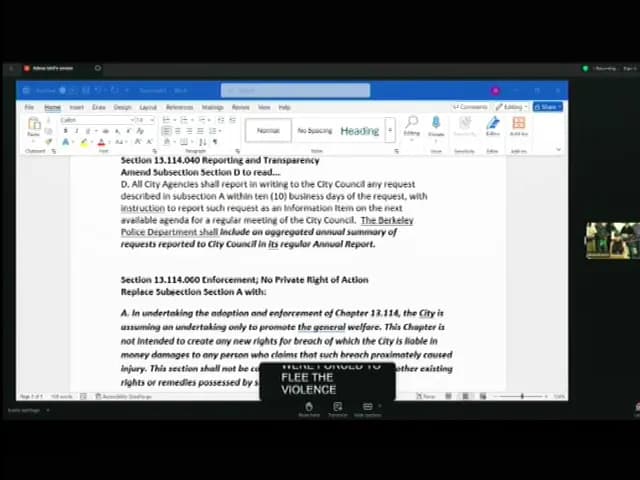
The Berkeley City Council met on Tuesday, September 9, 2025, at 6:00 PM in the School District Board Room. The meeting included ceremonial matters, approval of the consent calendar, public comment on a postponed surveillance camera contract, and the adoption of a landmark Sanctuary City Ordinance. The meeting was held in a hybrid format with in-person and virtual attendance. Consent Calendar - Ratified several recess actions, including contracts for Fire Department records management software (ImageTrend, Inc., up to $1,114,726), a portable toilet pilot program (Throne Lab, $70,000), and an AC Transit EasyPass program amendment ($125,086). - Approved resolutions for predevelopment funds ($2 million) for affordable housing at the Ashby BART West Lot, a grant amendment reallocating $1.7 million for Shorebird Park Bay Trail design and Gateway Pier improvements, and rejection of all bids for the Cesar Chavez Park Perimeter Pathway Project. - Adopted second reading of an ordinance amending ADU regulations to comply with state law and first reading of an ordinance revising the frequency of council approval for police department agreements with other agencies (item 15 was noted as voter-adopted and not subject to council change, thus removed). - Councilmembers contributed discretionary funds to Waterside Workshops (item 23) for The Land and Sea Party 2025, with a total of at least $1,750 from multiple members. - Two urgent items were added to the consent calendar: a letter supporting state wildfire risk mitigation bills (SB-326, AB-1143, AB-888) and a letter supporting transit funding for BART and other agencies. The consent calendar was approved by unanimous vote. Public Comments & Testimony - Non-Agenda Matters: Several speakers addressed concerns about ICE enforcement, the situation in Gaza, and police mutual aid agreements. One speaker urged annual review of agreements with federal agencies. - Flock Safety Cameras (Item 24, postponed): Over 30 speakers (in-person and via Zoom) opposed the proposed contract with Flock Safety for fixed surveillance cameras. Arguments included Flock’s history of sharing data with ICE, risks to immigrant communities, civil liberties concerns, and inconsistency with sanctuary city values. A few speakers supported cameras for crime investigation. The city manager had earlier pulled the item from the agenda, deferring it to October 28, 2025, to allow for a community meeting and further research. - Sanctuary City Ordinance (Item 25): Dozens of speakers, including immigrant community members, legal advocates, and residents, expressed strong support for the ordinance. Many emphasized the need for accountability and transparency, with some requesting a private right of action. The mayor introduced amendments to strengthen reporting and enforcement language. No opposition was voiced during public comment. Discussion Items - Sanctuary City Ordinance: City Attorney staff presented the draft ordinance, which codifies existing sanctuary policies into the Berkeley Municipal Code. Key features include prohibiting city resources from being used for federal immigration enforcement, requiring 10-day reporting of requests from immigration authorities, and defining protected personal information. Councilmembers shared personal stories and unanimously praised the work of the mayor’s task force and community partners. Mayor Ishi offered two amendments: (1) requiring the Berkeley Police Department to include an aggregated annual summary of immigration-related requests in its annual report, and (2) replacing the enforcement section with language from San Francisco’s ordinance clarifying that the chapter does not create a private right to money damages. Both amendments were accepted. The council voted unanimously (9-0) to adopt the first reading of the ordinance. - Flock Safety Cameras (Deferred): Although the item was postponed, the council allowed public comment. No council discussion occurred. The city manager stated the contract would return on October 28 with a revised use policy and community input. Key Outcomes - The consent calendar, including two urgent items, was approved unanimously. - The first reading of the Sanctuary City Ordinance (with amendments) was adopted by a vote of 9-0. - The Flock Safety camera contract (Item 24) was postponed to the October 28, 2025 meeting. A community information session will be held in the interim. - The meeting adjourned at approximately 9:30 PM after additional non-agenda public comment.
The Berkeley City Council met on July 30, 2025, in a hybrid format. The meeting covered consent calendar approvals, a public hearing on accessory dwelling unit (ADU) zoning amendments, and a street vacation ordinance. Key decisions included adopting revised ADU standards for the hillside overlay fire zone and approving the transfer of a portion of Carleton Street to Bayer Healthcare. Consent Calendar - Item 14 (Urban Ore contract) was pulled by the City Manager for further review of ongoing labor issues. All other consent items (Items 1–13, 15–27) were approved unanimously. Notable items include: - Amending the General Fund Reserve Policy (Item 2) - Staffing for Measure FF Safe Streets Initiative (Item 20) - Formation of a Nightlife Council sub-committee (Item 24) - Referral for a Green New Deal workforce feasibility study (Item 25) - Resolution supporting California SB 627 (No Secret Police Act) (Item 26) - Approval of Berkeley’s first Sun Day renewable energy festival on September 21, 2025, with voluntary contributions from multiple councilmembers (Item 27) Public Comments & Testimony - Non‑agenda public comment (start of meeting): Several speakers addressed the Urban Ore labor dispute, expressing solidarity with striking workers and urging the council to delay the contract. Others raised concerns about the city’s enforcement of source‑of‑income discrimination, tsunami warnings, and the humanitarian situation in Gaza. - Item 28 (ADU ordinance): Public speakers included a representative from the ADU Task Force who supported the proposed amendments but noted inconsistency with large single‑family home allowances. A millennial homeowner urged shorter tenant right‑of‑first‑refusal periods. Online commenters raised fire‑safety concerns about removing setbacks and questioned the fire chief’s focus only on the hillside overlay. - Item 29 (Carleton Street vacation): Multiple unhoused residents and advocates spoke against the street vacation, arguing that the city had not provided alternative shelter. Representatives from Bayer and partner organizations (Biotech Partners, MESA Workshops) supported the vacation, noting Bayer’s community investments and the need for secure campus access. Discussion Items - Item 28 – ADU Amendments to Title 23 (Zoning): Councilmembers debated whether to adopt stricter standards in the hillside overlay fire zone. Councilmember Blackaby presented a supplemental proposal to limit ADU height and square footage in the hillside overlay to state‑minimum levels, citing the recent evacuation study showing a potential 102% increase in evacuation time with maximum ADU development. Mayor Ishii and others argued that large single‑family homes face no similar restrictions. After discussion, a substitute motion (by Councilmember Kesarwani) was adopted, which: - Adopts staff’s recommended Title 23 changes (excluding references to Title 21) - Incorporates Blackaby’s supplemental amendments as published, except that the height standard for detached ADUs is set to 20 feet in all three categories (existing single‑family, existing multi‑family, proposed multi‑family) within the hillside overlay - Incorporates Kesarwani’s footnote clarifying that “new construction” ADUs may be attached or detached in any configuration - Retains the rooftop deck prohibition in the hillside overlay (from Blackaby’s supplemental) - Item 29 – Carleton Street Vacation (Second Reading): The council heard public testimony and then voted to adopt the ordinance vacating a 381‑foot portion of Carleton Street and authorize a quitclaim deed to Bayer Healthcare LLC. The City Manager confirmed the Homeless Response Team (HRT) has been engaging with encampment residents and will continue outreach, though shelter beds are limited. Key Outcomes - Consent Calendar approved unanimously, with Item 14 (Urban Ore) removed for further review. - Item 28 (ADU Title 23 amendments): The substitute motion passed by a vote of 6 yes, 1 no, 2 abstentions (exact tally not fully verifiable from transcript; motion carried). The ordinance updates will be brought back for second reading after incorporating the approved amendments. - Item 29 (Carleton Street vacation): Second reading adopted unanimously (8‑0‑1 absent? Roll call showed all present voting yes). The City Manager is authorized to execute the quitclaim deed. - Item 14 (Urban Ore contract): Pulled from consent; will be brought back to a future meeting after addressing labor concerns. - The council will hold a future special meeting to hear the postponed presentation from the City Auditor and Homeless Response Team.
Note: The transcript date is July 29, 2025, but the provided meeting date is July 30, 2025. This summary uses the specified date. The Berkeley City Council held a special meeting on July 30, 2025, called to order by the mayor. The meeting focused on approving the consent calendar (including a grant for a gun violence intervention program) and receiving a presentation on the city's homeless system. The meeting was attended by councilmembers Kessnerwani, Trey, Blackbee, Luna Parra, Umbert, Mary Ishi, and Corma; Councilmember Bartlett was absent. Consent Calendar - The consent calendar was approved by a motion without objection. The calendar included approval of a grant for the Live Free gun violence intervention program, which provides life coaches and outreach workers. The grant would expand the team from 2.5 staff to 4.5, supporting crisis response and trauma support for Berkeley residents affected by gun violence, including those who have lost family members in Oakland. Public Comments & Testimony - Kentrell Killens (Live Free) spoke in support of the consent calendar item, urging approval of the grant to expand the gun violence intervention program. He highlighted that the program has helped prevent gun violence homicides in Berkeley and provided support to families of Berkeley residents killed in Oakland. He emphasized the need for sustained funding and the program's role in addressing trauma. - An unidentified speaker commented on the consent calendar, contrasting the cost of the grant ($1 million) with the salary of a police analyst, questioned the value, and suggested hiring a graduate student for a lower salary. The speaker appeared skeptical of the program's cost-effectiveness. Discussion Items - Homeless System Presentation: The city manager introduced the presentation, noting that homelessness is a national failure and that Berkeley's homeless response team (HRT) works across departments to address the crisis. Peter Redu (manager of clean road services), Josh James (homeless services coordinator), and Sagari Devedea (housing specialist) presented. They outlined the scale of homelessness in Berkeley, noting that the most recent point-in-time count showed more people sheltered indoors than ever before, and fewer people on the streets. However, for every person who exits homelessness, nearly three become homeless. The presentation highlighted the Housing Retention Pilot Program, which provides up to $1,800/month for three years to high-risk elders, disabled individuals, and families with children. The program has served over 50 households and helps prevent evictions. The presenters stressed that local funding is at risk of expiring, which could reverse progress. They also noted that Berkeley's eviction filing rates are lower than the county average, with 44 evictions per 1,000 rental households in 2024. The transcript cuts off during this presentation, so additional details were not provided. Key Outcomes - The consent calendar was approved without objection, including the Live Free grant. - No further decisions or votes were recorded. The meeting was ongoing at the time the transcript ended. - The council received the homeless system presentation for discussion; no action was taken. The presentation referenced a May 20, 2025 council referral on homelessness, but no subsequent referral or directive was recorded.
The Berkeley City Council held a special meeting on July 29, 2025, at 4:00 PM in the School District Board Room. The meeting focused on approving a $1,000,000 grant for the Byrne State Crisis Intervention Program and receiving presentations on the city's homeless response system and a related audit. Councilmember Bartlett was absent. Consent Calendar - Grant Award: Byrne State Crisis Intervention Program (SCIP) Cohort 2 Funding: The Council adopted a resolution to accept a $1,000,000 grant from the Board of State and Community Corrections (BSCC) for the city's Gun Violence Intervention and Prevention Program (GVIPP). The grant funds expansion of violence intervention services via Live Free USA and establishes a temporary Crime Analyst position (not to exceed two years) at a cost of $450,000 (fully loaded). The consent calendar was approved without objection. Public Comments & Testimony - Kentrell Killens (Live Free USA) spoke in support of the SCIP grant, noting that the organization currently has 2.5 life coaches/outreach workers and the grant would add two more. He highlighted that while Berkeley has seen no gun violence homicides recently, four Berkeley residents have lost their lives in Oakland. He urged approval to maintain the program's integrity. - A second speaker (name not given) questioned the $450,000 allocation for a temporary crime analyst, suggesting a graduate student could fill the role for less. He expressed concern that nearly half the grant would go to administrative costs rather than direct services. Discussion Items - Presentation: Comprehensive Summary of Berkeley’s Homeless Response: City Manager's Office staff (Peter Radu, Josh James, Osavri — likely Osvaldo) presented an overview. Key points included: - A 45% drop in unsheltered homelessness since 2019, attributed to low-barrier, non-congregate interim housing with an 80% acceptance rate vs. 40% for traditional shelters. - 60% of Berkeley's homeless population is Black, despite Black residents making up only 8% of the city. Rising rates of acute disabilities were noted. - In the most recent point-in-time count, more people were sheltered indoors than any previous year, and the fewest were on the streets. - Regional challenge: for every person exiting homelessness, nearly three fall into it for the first time. - The city's three-pronged strategy (prevention, interim housing, permanent housing) is at risk due to expiring funding. - A pilot rental assistance program (up to $1,800/month for up to 3 years) has served over 50 households; Berkeley has the lowest eviction rate in Alameda County (4 evictions per 1,000 rental households vs. 44 county average). - Auditor's Report: Homeless Response Team Audit: City Auditor Jenny Wong presented an audit with six recommendations to improve coordination, data procedures, outcome reporting, transparency, and staffing. The City Manager's Office agreed with the findings. The Council was asked to request a follow-up report in Fall 2026 and annually thereafter. Key Outcomes - The consent calendar (SCIP grant) was approved unanimously (motion by Councilmember Bartlett? noted absent, but no objections). - No formal votes were taken on the homeless response presentations; they were informational. The Council directed the City Manager to report back on audit recommendations in Fall 2026 and annually. - The meeting adjourned without further action.
The Berkeley City Council held a special meeting on July 23, 2025, primarily to hear appeals on landmark preservation commission decisions and a zoning adjustments board approval. The council received presentations from city staff, appellants, and public testimony, with deliberations focusing on compliance with state housing laws (SB 330 and the Housing Accountability Act), historic preservation values, and community impacts such as safety and shade. Public Comments & Testimony - AC Transit Announcement: Ryan Lau, external affairs representative at AC Transit, announced the upcoming Realign service change launching August 10, 2025, highlighting updates based on post-pandemic ridership shifts and budget constraints. - Item 1 (2425 Durant Appeal): - Bonnie Zhu, a resident at 2421 Durant, expressed support for preserving the building's cultural and civic value, citing its historical significance near UC Berkeley. - A community member (name not specified) argued that the building is "irreplaceable" and criticized development driven by money over community soul. - Steve Finacome, a Landmarks Preservation Commission (LPC) member, clarified that the LPC operated under prior city attorney guidance, believing the landmark designation was symbolic and did not apply to vested projects. - Kelly Hammergren and other online commenters urged preservation, emphasizing the building's aesthetic value and cautioning against losing historic fabric for potentially stalled projects. - Isaac Warshower, on behalf of the Berkeley Architectural Heritage Association (BAHA), argued for the landmark's educational value and criticized the city's lack of comprehensive historic surveying. - Item 2 (2138 Kittridge Appeal): - Steven Schulyer, a nearby resident, emphasized the human impact of development, including traffic and disability access concerns. - Leela Moncharge questioned the efficacy of state housing promises, noting vacant developments and unaffordable rents. - Tony Mester advocated for systematic historic preservation planning to avoid "death by a thousand cuts." - Isaac Warshower (for BAHA) defended BAHA's motives, stating it seeks to preserve history collaboratively, not obstruct development. - Item 3 (2655 Shattock Appeal): - Multiple neighbors, including Betsy Dittmars and Michael Baracco, raised safety concerns about the proposed driveway on Derby Street, citing past city decisions to locate it on Shattock for pedestrian and bicycle safety. They also highlighted shade impacts on adjacent homes and requested redesigns to mitigate detriments. - Charlotte Shimora and others referenced a 1997 city council decision mandating the driveway on Shattock, arguing that state law should not override public safety. - Online commentators like Tony Mester and Cheryl Davila supported neighborhood concerns, suggesting the council has health and safety authority to modify the driveway. - Kelly Hammergren reminded the council of climate goals related to solar access. Discussion Items - Item 1: Appeal of LPC Designation for 2425 Durant: Staff, represented by Robert Rivera, recommended reversing the landmark designation because it cannot be applied to the housing project under SB 330, as vesting occurred before the designation. The appellant (represented by Isaac) argued that the designation was unnecessary and violated state law. Council members debated the merits of historic value versus housing needs, with some expressing frustration over landmark applications submitted after development proposals. The city attorney clarified that the designation was symbolic but posed policy risks. - Item 2: Appeal of LPC Designation for 2138 Kittridge: Staff similarly recommended reversal due to SB 330 vesting. The appellant, Bill Schrader, highlighted financial burdens and delays, alleging that the LPC acts as an extension of BAHA. Council discussion echoed Item 1, focusing on legal constraints and the need for proactive historic planning. - Item 3: Appeal of ZAB Decision for 2655 Shattock: Staff recommended affirming the ZAB approval, stating the project complies with parking maximums, the Adeline Corridor Specific Plan, and other codes. Appellants contested the driveway location on Derby, parking provision, shade impacts, and density bonus calculations. Council members questioned staff on discretion under state law, with some expressing sympathy for safety concerns but acknowledging limited authority to impose conditions due to vested rights. Key Outcomes - Item 1: The council voted to uphold the appeal and reverse the LPC's landmark designation for 2425 Durant Avenue. Vote tally: Councilmembers Kessarwani, Taplin, Bartlett, Trakeup, Blackaby, Luna Para, Humbert, and Mayor Ishi in favor; O'Keefe absent. Motion carried. - Item 2: The council voted to uphold the appeal and reverse the LPC's landmark designation for 2138 Kittridge Street. Vote tally: Same as Item 1. Motion passed. - Item 3: The council voted to deny the appeal and affirm the ZAB's decision to approve the use permit for 2655 Shattock Avenue. Vote tally: Councilmembers Kessarwani, Taplin, Bartlett, Trakeup, Blackaby, Luna Para, Humbert, and Mayor Ishi in favor; O'Keefe absent. Motion passed. - Additional Directives: Council members emphasized the need for a citywide historic context statement and survey to proactively identify historic resources, citing it as a pending planning department priority.
The Berkeley City Council met on Tuesday, July 22, 2025, at 6:00 PM in the School District Board Room and via teleconference. The meeting began with ceremonial matters, including a proclamation declaring July 17 as Port Chicago Remembrance Day and adjournments in memory of Marie Gunter, George Leitmann, and Rita Maran. The council addressed a lengthy agenda covering consent items, public hearings, and new business, with significant debate on surveillance technology and public safety. The meeting extended past midnight, concluding at approximately 12:30 AM. Consent Calendar - Item 1: Adopted second reading of Ordinance No. 7,979–N.S. designating Assistant City Attorney as at-will. - Item 2: Adopted second reading of Ordinance No. 7,980–N.S. amending the lease with Yoonaco, Inc. (Hana Japan) at 235 University Avenue. - Item 3: Adopted second reading of Ordinance No. 7,981–N.S. with zoning ordinance amendments for consistency with state law. - Item 4: Adopted a resolution confirming appointment of emergency standby officers. - Item 5: Approved formal bid solicitations and requests for proposals. - Item 6: Adopted a resolution reallocating FY 2025 Youth Resiliency Funding, including $20,000 to Longfellow Identity Affirming Programs. - Item 7: Adopted three resolutions accepting Alameda County grants for public health services (totaling $470,537 for FY 2026). - Item 8: Adopted three resolutions accepting State of California grants for public health services (totaling $3,534,619 over multiple years). - Item 9: Adopted a resolution amending the Supplemental Military Leave Compensation Policy retroactively to July 1, 2025. - Item 10: Adopted a resolution approving the 2024 Annual Military Equipment Report (AB 481). - Item 12: Adopted a resolution appointing Ian Hunt to the Mental Health Commission. - Item 13: Approved the Police Accountability Board's Fair and Impartial Policing Implementation recommendations, closing the FIP task force referral from February 2021. - Item 14: Adopted a resolution in support of California Senate Bill 81 (Arreguín) regarding healthcare facility information sharing and immigration enforcement protections. The consent calendar was approved unanimously by roll call vote. Public Comments & Testimony - Public Comment on Non-Agenda Matters: Several speakers addressed the council, including concerns about the city's transparency, homelessness, and the need for a ceasefire in Palestine. One speaker noted that Albany City Council grants three minutes for public comment, contrasting with Berkeley's two-minute limit. - Consent Calendar and Information Items: Public comment on item 10 (Military Equipment Report) noted that BPD had not posted the report online or held a community engagement meeting as required by AB 481. Commenters also urged continued focus on fair and impartial policing, citing persistent racial disparities in traffic stops. - Item 15 (Carleton Street Vacation): Multiple unhoused individuals and advocates spoke against the street vacation, describing it as a displacement of a community. They stressed the need for dialogue and alternative housing, noting that sweeps harm mental health. Bayer Healthcare representative Jennifer Cogley stated the company employs 850 people at the site, pays over $1 million annually in additional taxes, and needs the street vacation for safety and a stormwater treatment feature. The public hearing included emotional testimony about the lack of shelter and services. - Item 16 (MOU Compendium): Public comment raised concerns about the seven-year gap since the last compendium (2018) and the potential for cooperation with federal immigration agencies. The Police Accountability Board chair noted that MOUs with USCIS had been removed from the current compendium. Speakers urged the council to ensure BPD does not collaborate with ICE, citing recent reports of data sharing in other cities. - Item 17 (Flock Surveillance Cameras): Extensive public comment opposed the installation, citing risks of data sharing with ICE, inadequate encryption safeguards, and the potential for abuse by federal authorities. Several speakers referenced reports that Oakland and San Francisco police departments illegally shared ALPR data with federal agencies. Others argued that the only way to protect vulnerable communities is to not collect the data. A few speakers supported the technology for public safety purposes, noting its role in solving crimes. The council also heard from Flock Safety's director of public affairs, who assured end-to-end encryption and stated Flock has never experienced a data breach. - Item 11 (Jail Surveillance System): One speaker urged the council to redirect funds to domestic violence services rather than jail surveillance. Discussion Items - Item 19 (Restaurant Inspection Audit Status Report): The council discussed the status report from the City Manager's office. Director Scott Gilman reported that high- and very high-risk facilities not inspected in 2023 have been completed, and the division has filled two vacant inspector positions. He noted that the online data portal for inspections was removed due to outdated software that provided inaccurate information; a new system is expected to be operational by July 2026, with a consumer portal and geo-maps. The city auditor, Jenny Wong, expressed concern that removing the data decreased transparency, recommending a placarding or grading system used in other jurisdictions. Councilmember Kesarwani requested a comprehensive update in six months and a community outreach effort to inform residents how to request inspection reports. Councilmember O'Keefe suggested posting inspection reports as PDFs online as an interim measure. The council directed staff to explore that option. - Item 15 (Ordinance Vacating a Portion of Carleton Street): The council held a public hearing and then deliberated. City Manager Paul Buddenhagen explained that the vacation would allow Bayer Healthcare to maintain the street and install a stormwater treatment feature, and that it would improve the city's financial position by increasing property tax revenue and reducing maintenance costs. He noted that the homeless response team (HRT) would engage with people living on the street, and the city stores belongings for 30 days. Councilmember Blackaby highlighted the economic benefits. The council voted 8-0-1 (with one abstention) to adopt the first reading of the ordinance. (Note: The transcript shows one abstention; the identity is unclear from the roll call recording.) - Item 16 (MOU Compendium): The council discussed the compendium of law enforcement agreements, which had not been submitted since 2018. Chief Jennifer Lewis explained that the pandemic and policy transitions caused delays. The Police Accountability Board recommended a three-year renewal cycle instead of annual to reduce administrative burden. Councilmember Blackaby asked about the stance on ICE requests; Chief Lewis confirmed BPD would not participate in immigration enforcement. Councilmember Lunaparra questioned about a new MOU with the U.S. Marshals Service Fugitive Task Force; Chief Lewis clarified it is one-way assistance for local cases. The council approved the compendium unanimously. - Item 17 (Surveillance Technology Ordinance for Flock Cameras): This item generated the most debate. The council considered the acquisition report and use policies for Flock Safety Condor video cameras. Chief Lewis and Arlo, from BPD, presented the technology's benefits, including solar power, end-to-end encryption, and a 180-day retention period (unchanged from previous policy). They cited examples where longer retention solved crimes. The Police Accountability Board recommended a 30-day retention period, citing industry standards in San Francisco, San Jose, and Fremont. Councilmember Humbert suggested adding language to prohibit sharing data for enforcement of laws restricting reproductive rights or gender-affirming care. Councilmember Tregub proposed a suite of additional safeguards, including biannual audit reports with logs of data sharing, a 45-day retention period (amended to 90 days by Councilmember Bartlett), and a requirement that the contract cannot proceed until the sanctuary city ordinance is passed (later removed). After extensive discussion, the council voted on a motion to set retention at 90 days; that motion failed 4-5. The default 180-day retention remained. The final motion to approve the item with the additional safeguards (excluding the retention period change) passed 8-1, with Councilmember Lunaparra voting no. The safeguards include: biannual audit reports to council with specific data sharing logs, reaffirmation of use policies prohibiting sharing with immigration enforcement or for reproductive-rights-related investigations, and a requirement that the city manager ensure no contractual clauses conflict with city law before final approval. - Item 11 (Surveillance Technology Ordinance for Berkeley City Jail): The council approved the replacement of the jail's aging surveillance system, which is part of a larger control panel replacement. The total cost increase of 50% (approximately $250,000) was covered by the police department budget and capital improvement funds. The item passed unanimously. Key Outcomes - Consent Calendar: Approved unanimously. - Item 15 (Carleton Street Vacation): First reading of ordinance adopted 8-0-1 (one abstention). Second reading scheduled for July 29, 2025. - Item 16 (MOU Compendium): Resolution approving compendium adopted unanimously. Council expressed support for moving to a three-year renewal cycle. - Item 17 (Flock Cameras): Resolution adopted 8-1, with amendments including biannual audit reports, additional privacy safeguards, and direction to negotiate contract terms consistent with sanctuary city policies. The 180-day retention period was retained. The contract will return to council for final approval. - Item 11 (Jail Surveillance System): Resolution adopted unanimously. - Item 19 (Restaurant Inspections): Council directed staff to explore posting inspection reports as PDFs online and to provide a comprehensive update in six months (January 2026). Staff also committed to a community outreach effort. - Public Comment on AB 481: The council acknowledged the need to post the annual military equipment report online and hold a community meeting, as required by state law. Chief Lewis indicated compliance would be ensured. - Sanctuary City Ordinance: The council reaffirmed its commitment to a sanctuary city ordinance, scheduled for a vote in fall 2025, which will address data sharing with federal immigration authorities.