Browse by city
Date range
Search help

Search titles, summaries, topics and stored transcripts together. Keywords may match separately; put the whole query in double quotes for a phrase. Matching follows word analysis, so punctuation is not exact. Both dates are included. Documents are not searched.

SHOWING 41–50 ENTRIES
41
DEC 5, 2025 · BERKELEY, CALIFORNIA · CITY COUNCIL
Berkeley City Council Special Meeting on Infrastructure and 2026 Bond Measure - December 5, 2025

Note on date discrepancy: The meeting transcript begins with the mayor stating the date is Tuesday, December 2, 2025, but the provided meeting metadata specifies December 5, 2025. This summary uses the metadata date, but the discrepancy is noted. The Berkeley City Council held a special meeting focused on infrastructure needs and a potential general obligation bond measure for the November 2026 ballot. The meeting featured presentations from the Mayor's Vision 2050 Task Force, which presented its "Realize Vision 2050" update, and from city staff on a proposed $300 million bond to fund critical infrastructure, public safety, and community facility projects. Councilmembers discussed the scope, timing, and community engagement strategy, with consensus to move forward with a community survey and begin exploring the bond measure. Public Comments & Testimony - Ray Yep, Co-Chair of Vision 2050 Task Force: Emphasized the report is concise (eight pages), actionable, and produced in six months, urging the council to use it as the basis for funding and policy decisions. - Margot Schuler, Co-Chair: (Noted as co-chair but no separate statement given in transcript). - Speaker 1 (unspecified): Recalled a 2022 staff presentation on an asset management program and program plan that could help prioritize and sequence infrastructure work; suggested those documents are still relevant. - John (self-identified as coordinator for Community for a Cultural Civic Center): Praised recent Civic Center Park renovations, mentioned an innovative seismic study that showed potential cost savings of 51–54% for seismic renovation of the civic center buildings, and urged funding to leverage FEMA grants. - Speaker 2 (unspecified): Advocated for a bond model similar to Berkeley Unified School District’s large, periodic bonds; highlighted the city’s success in leveraging T1 funds (80% leverage) and urged inclusion of wind power at the Berkeley Marina. - Pierre (self-identified public commenter): Shared personal experiences with deferred maintenance costs and sidewalk hazards; urged proactive maintenance and safety improvements for sidewalks, streets, and fire department access. - Sophia Scoda (self-identified as Finance Director for East Bay Municipal Utility District): Suggested the council consider a parcel tax instead of a general obligation bond to spread the tax burden more evenly across the community (not just based on assessed value). - No online public comments were offered. Discussion Items - Vision 2050 Task Force Update (Realize Vision 2050): Mayor Ishii reconvened the task force to update the 2020 Vision 2050 plan, citing $1 billion in unfunded infrastructure needs and new challenges (climate change, economic shifts, Measure FF). Co-Chairs Ray Yep and Margot Schuler presented the update, highlighting five strategies with goals, action items, and performance measures. The report is titled "Realize Vision 2050" to emphasize action. Councilmembers thanked the task force and noted the alignment with staff’s proposed bond projects. - Staff Presentation on Potential 2026 Bond Measure: Deputy City Manager David White led a presentation on a potential $300 million general obligation bond for November 2026. Key elements: - Community survey: Plan to survey 500 likely November 2026 voters to gauge support for a bond measure and test project priorities. Survey expected in early 2026. - Project lists: Three categories ($100 million each): - Community Facilities & Quality of Life: Francis Albrier Community Center upgrades, King Pool, Harrison Field turf, San Pablo Sports Field, dog parks, park restrooms, Adeline Quarter open space, Aquatic Park/Dreamland, Bay Trail Marina Boulevard, University Avenue Bike Park, and sea level rise projects. - Public Safety: Fire stations 4 and 6 rebuild, emergency dispatch center renovation, new joint fire/EMS/community training center (relocation to new site). - Critical Infrastructure & Accessibility: Seismic upgrades for Madel Shiric (Old City Hall), Veterans Memorial Building, MLK Civic Center Annex; modernization of 2180 Milvia, Public Safety Center, Animal Shelter; ADA barrier removal citywide ($48 million backlog); 50-50 sidewalk repair program backlog (1,100 locations). - Tax rate analysis: The proposed bond, with $100 million issued every five years, would result in an average tax rate of $242/year for a home with the median assessed value of $550,000. The combined rate with existing bonds would be less than historical peaks in the late 1990s/early 2000s. - Timeline: Council work session tonight; community engagement in January 2026; survey results in March/April; ballot language by August 7, 2026 (final adoption by July 28, 2026). - Council Questions and Comments: - Councilmember Humbert: Supported survey but asked about testing a range of bond amounts (e.g., lower or higher). Supported including 50-50 sidewalk program; expressed reservations about seismic retrofits for Old City Hall and Veterans Building (cost disproportionate, uncertain future use). Suggested adding bus shelters and transit improvements. - Councilmember Blackaby: Supported survey, asked for benchmarking of infrastructure backlog against peer cities and for total tax burden analysis (including parcel taxes). Supported $300 million but open to adjustment based on data. Emphasized strong oversight measures in the bond. - Councilmember Linopara: Supported survey, asked about including questions on voter fatigue from other potential 2026 measures (e.g., arts parcel tax, regional transit measures). Noted interest in adding AC Transit lines improvement to survey as a separate concept (later clarified not to delay the infrastructure poll). - Councilmember Trega: Supported survey and the civic center seismic projects as foundational for democracy. Supported sealing the 50-50 sidewalk backlog. Cautioned against adding too many separate measures to the survey without similar treatment for other priorities. - Councilmember Taplin: Strongly supported survey and up to $300 million bond. Suggested polling fire projects separately to understand voter support. Listed specific projects he supports. Rejected parcel tax for capital. Emphasized need for clear nexus around safety, climate resiliency, and recreational equity, and avoiding the pitfalls of Measure L (ill-defined scope and high amount). - Councilmember Kessarwani: Supported survey but advocated for testing lower amounts due to overall tax burden. Urged careful coordination with Measure FF sidewalk funding to avoid duplication. Supported prioritizing immediate safety projects and polling them separately. Expressed caution based on Measure L experience. - Councilmember O'Keefe: Supported survey, echoed caution on cumulative tax impact, suggested adding placemaking projects (e.g., Solano Avenue plaza, Shattuck/Rose area). Requested bathrooms at Indian Rock Park. - Councilmember Bartlett: Supported survey, proposed financing the civic center projects through a special increment district rather than the bond to free up $50 million for other priorities (sidewalks, senior centers). Emphasized using supplier diversity (Bindex program) in contracting. - Mayor Ishii: Supported survey and moving forward quickly; advocated for including 50-50 sidewalk program in polling, supported a range of bond amounts, and encouraged including projects that adapt to climate change and resilience. Emphasized leveraging potential of bond funds. Advised against separating project categories in the poll, arguing a unified infrastructure package is stronger. Supported early contract for survey with retroactive approval. Key Outcomes - Council consensus to proceed with a community survey to gauge voter support for a potential November 2026 general obligation bond for infrastructure improvements. The survey will test a range of bond amounts (likely with $300 million as a reference), multiple project categories, and include questions about accountability/oversight. - Council direction to staff to seek a consultant contract for the survey as soon as possible, with the goal of launching field work in January 2026. Staff may proceed with a smaller contract and return for retroactive approval to accelerate the timeline. - Council directed staff to include the following in the survey design: - Test voter tolerance for a bond amount up to $300 million, with lower and possibly higher options. - Consider testing fire facilities separately (as suggested by Councilmember Taplin) and testing the overall package together (as preferred by Mayor Ishii). - Include contextual questions about voter sentiment on other likely 2026 ballot measures (e.g., arts parcel tax, regional transit) to assess cumulative burden. - Include questions on accountability and oversight mechanisms. - Explore potential interest in a transit-oriented component (e.g., bus shelters, small transit improvements) as part of the infrastructure package, but not a separate AC Transit parcel tax at this time (Councilmember Linopara deferred this for future discussion). - No formal vote was taken on whether to place a bond measure on the ballot; the council will return after survey results to decide on scope and timing. - Staff will provide additional analysis: - Breakdown of Measure FF sidewalk funding impact on the 50-50 program backlog. - Total property tax bill estimates (including city and school district bonds and parcel taxes) for various property values. - Further prioritization of projects based on safety, urgency, and cost deferral impacts. - Next steps: - Survey contract initiation in January 2026. - First survey results expected in March 2026. - Second survey possible in April 2026. - Council direction on ballot language in June 2026. - Final adoption by July 28, 2026, to meet August 7 county deadline.
ENGINEERING AND INFRASTRUCTURE 54% · FISCAL SUSTAINABILITY 17% · COMMUNITY ENGAGEMENT 4% · PUBLIC ENGAGEMENT 4%
42
DEC 4, 2025 · BERKELEY, CALIFORNIA · CITY COUNCIL
Berkeley Joint Powers Financing Authority Meeting – December 4, 2025

Note: The transcript indicates the meeting was held on Tuesday, December 2, 2025, but the user specifies the date as December 4, 2025. This summary uses the provided date as instructed. The Joint Powers Financing Authority (JPFA) met briefly to approve the consent calendar, hear one public comment, and adjourn. The meeting lasted only a few minutes. Consent Calendar - The consent calendar was approved by a motion and a second without opposition. No specific items were discussed. Public Comments & Testimony - Cheryl Davila, former council member, spoke during public comment on non-agenda matters. She expressed frustration that the council has not taken action regarding what she described as a genocide (referring to “day 787 of the genocide”). She also criticized the council for reducing public speaking time and taking longer breaks, stating that constituents are not given adequate opportunity to speak. Her time was cut off after 45 seconds. Discussion Items - No discussion items were presented. Key Outcomes - The consent calendar was approved unanimously (no opposition noted). - The meeting was adjourned following a motion and a second.

PROCEDURAL 100%
43
DEC 2, 2025 · BERKELEY, CALIFORNIA · CITY COUNCIL
Berkeley City Council Meeting – December 2, 2025: Fire Code, WUI Code, and Proclamations

The Berkeley City Council met on Tuesday, December 2, 2025 (with the meeting called to order in the evening) for a lengthy session covering ceremonial items, public comments, consent calendar, and action items including fire code amendments, Wildland-Urban Interface (WUI) code adoption, and a zoning change for alcohol sales on Telegraph Avenue. The meeting began with a land acknowledgement and proclamations in memory of community leader Evie Wozniak and Fire Captain Scott Hall. State Senator Jesse Arreguin provided an update on state legislative priorities. After extensive debate, the council approved the fire code with a commitment to further study specific sections, adopted the WUI code with referrals, and continued an accessory dwelling unit (ADU) item. Consent Calendar - The council approved the consent calendar, which included numerous routine items, reports, and financial contributions from council members to community organizations. Notable contributions included $250 each from multiple members to the Berkeley Holiday Fund (item 28), Urban Compassion Project (item 29), Creations Berkeley Black Joy Kwanzaa Toy Drive (item 31), and Berkeley Symphony Orchestra Winter Promenade (item 37). The calendar also included approvals of tree planting proposals, Youth Works program funding, loan modifications for Housing Trust Fund projects, renewal of the Elmwood Avenue Business Improvement District (BID) for 2026, and a referral for a proactive communication system for infrastructure projects (item 36). Council members expressed support for staff’s work on grants and the creative economy report. Public Comments & Testimony - Non-Agenda Public Comments: Multiple speakers addressed the council. Carol Morosovic urged creation of a sex trafficking task force, describing a concerning encounter. Rhonda Grushka criticized plant removal policies and served recall papers to Councilmember Blackaby. Cheryl condemned covered trash cans on Indigenous People’s Day and called for an arms embargo regarding Gaza. Online commenters raised concerns about AB 715’s impact on teaching Palestinian history (Daniel Brownson), thanked the mayor for the Telegraph Holiday Festival (Jesse Shann), and requested emergency shelter and parking for unhoused residents (Maria). Another speaker criticized the mayor and city for failing to pass a ceasefire resolution. - Public Comments on Agenda Items: During the consent calendar, speakers supported the artist affordable housing report (Debbie Potter, Kim Anno) and loan modifications for affordable housing co-ops (Jeff Melcher). On item 40 (fire code), numerous speakers expressed concerns that the 26-foot rule would threaten street fairs and festivals like Juneteenth and the Telegraph Holiday Fair, urging modifications or referral for further study. Others, including the Berkeley Fire Safe Council, urged adoption as proposed to maintain emergency response standards. On item 41 (WUI code), members of the WUI Work Group requested continued work and highlighted unresolved issues like misdemeanor penalties and appeals. Discussion Items - Presentation by State Senator Jesse Arreguin: Senator Arreguin updated the council on state work supporting Berkeley, including funding for affordable housing at BART stations ($25 million grant), sanctuary city protections, public safety legislation (SB 524 on AI, SB 627 on no secret police, SB 704 on ghost guns), health and human services investments, transportation funding ($750 million bridge loan for Bay Area transit), climate initiatives, and housing production. He emphasized continued collaboration. - Fire Code Amendments (Item 40): The council debated adoption of the 2025 fire code, including optional sections 503 and Appendix D, which require 20-foot and 26-foot clear roadway widths near hydrants and tall buildings. Fire Chief Sprague explained the code has been in place since 2008 and is compatible with multimodal street designs, citing numerous projects. Council members questioned the application, impact on events, and comparison to traffic fatalities. Councilmembers Lunapara and Humbert proposed a supplemental to adopt the code but refer sections for further review. Mayor Ishi committed to bringing a referral for transportation design standards in January 2026. After public comment, Councilmember Kessarwani offered a friendly amendment to refer specific sections (503.2.1, 503.2.2, 503.4.1, and Appendix D including D105.2) to the Facilities, Infrastructure, Transportation, Environment, and Sustainability (FITES) Policy Committee for recommendations by April 2026. The motion passed unanimously. - WUI Code Adoption (Item 41): The council held a public hearing on the second reading of amendments to the Wildland-Urban Interface (WUI) Code, including a local amendment for "Zone Zero" (no combustibles within 5 feet of structures). Fire staff noted a WUI Work Group had been meeting to refine code language, with unresolved issues pending state Board of Forestry rulemaking. Councilmember Blackaby proposed three referrals: 1) refer items from the Work Group letter (non-combustible trash bins, wood shake roof replacement, wire mesh size, metal privacy screens) to the city manager; 2) stipulate that WUI code violations are treated as civil infractions, not misdemeanors; 3) reconvene the Work Group after state regulations are finalized and report back within 90 days. The council adopted the WUI code with these referrals unanimously. - Telegraph Avenue Alcohol Sales (Item 42): The council approved amendments to Title 23 to allow retail sale of alcohol in the Telegraph Avenue Commercial Zoning District, ending a historic prohibition. Proponents highlighted the need for a full-service grocery store and alignment with other commercial districts. The item passed unanimously. - BID Renewals (Items 38 and 39): The council held public hearings and approved renewal of the Elmwood Avenue and Solano Avenue Business Improvement Districts for calendar year 2026 with no opposition. - Accessory Dwelling Unit Ordinance (Item 43): Due to time constraints after 10:00 PM, the council voted to continue this item to the January 20, 2026 meeting. Councilmember Humbert recused himself. Key Outcomes - The consent calendar was approved unanimously with council member contributions noted. - Elmwood Avenue BID renewal (2026) approved. - Solano Avenue BID renewal (2026) approved. - Telegraph Avenue alcohol sales zoning amendment (Item 42) approved unanimously. - Fire code amendments (Item 40) adopted with a friendly amendment referring sections 503.2.1, 503.2.2, 503.4.1, and Appendix D (including D105.2) to the FITES Policy Committee for review by April 2026. Mayor Ishi also committed to introducing a referral in January 2026 for transportation design standards. - WUI code (Item 41) adopted with referrals from Councilmember Blackaby: three items to city manager, civil infraction clarification, and reconvening Work Group after state rulemaking. - ADU ordinance (Item 43) continued to January 20, 2026 meeting. - The meeting was adjourned in memory of Evie Wozniak and Fire Captain Scott Hall.

PUBLIC SAFETY 27% · ECONOMIC DEVELOPMENT 15% · TRANSPORTATION SAFETY 13% · PROCEDURAL 10%
44
NOV 18, 2025 · BERKELEY, CALIFORNIA · CITY COUNCIL
Berkeley City Council Meeting – November 18, 2025: Budget, Drones, and Mills Act Pause

The Berkeley City Council met on Tuesday, November 18, 2025, at 6:43 PM. The meeting covered the city auditor’s report, consent calendar approval, adoption of building and zoning codes, a pause on Mills Act agreements, and a referral to explore drone‑as‑first‑responder technology. Council also heard public comment on housing, tenant issues, and fiscal concerns. Consent Calendar - The consent calendar was approved with Councilmember Blackaby noted as a no on item 3 (transfer tax rebate for wildfire hardening) due to a “hard cliff” provision. The calendar included items related to coordinated pricing algorithms (item 4), annual appropriations ordinance (item 8), license agreement for temporary parking at the regional sports complex (item 18), updates to sanctuary city contracting (item 27), and others. Councilmember Lunapara thanked the auditor for the payroll audit report. Councilmember Humbert was added as co‑sponsor on item 27. Public Comments & Testimony - Non‑agenda public comment: Speakers included: - A speaker representing a Rock Ridge business owner on College Avenue raised concerns that upzoning led to short leases and doubled rent, threatening small businesses. - Alex Marenkov, a disabled low‑income BMR tenant at K Street Flats, reported retaliation from management after filing health and safety complaints, including cancellation of a confirmed renovation and ignoring disability accommodation requests. He requested stronger oversight of CalCHA and FPI management. - A speaker commented on the Israel lobby, referencing a UC Berkeley event with John “Torture Memo” Yoo. - Edskander expressed frustration about lack of response from council regarding an incident at Kittridge and Shattuck (District 4). - Several online speakers supported oversight of affordable housing projects, requested education for bikers and drivers on road sharing, and criticized the middle housing ordinance and upzoning of College, Solano, and North Shattuck Avenues. One speaker noted that most new units are market‑rate, not affordable, and contrasted a five‑story building with proposed eight‑ to twelve‑story structures. - Consent calendar public comment: - Theo Gordon asked to pull item 19 (tax giveaway to a property owner) from consent, arguing the property is not uniquely special and the city should not hand out tax breaks during a budget crisis. - Several speakers supported the CareBridge program (item 7) and thanked staff for the sanctuary city contracting updates. - Item 30 (Mills Act pause) public comment: - Julie Noctway urged council to consider more data before pausing the Mills Act, noting its role in preserving architectural heritage and generating income through permits and tourism. - Jeff Baker supported the pause, suggesting the language should direct the city to affirmatively cancel contracts at the first opportunity. - John Bernstein questioned the cost estimate of $600,000/year, stating the actual cost is about $186,000/year (0.002% of the city budget), and that the city charges fees totaling $500,000 and permits for Mills Act properties exceed $5 million in work. - Mike, one of two pending applicants, noted the Mills Act helps defray maintenance costs and asked for an off‑ramp for those who self‑selected. - Kelly Hammergren said the Landmarks Preservation Commission had already proposed reforms (limit applications per year, end automatic renewal, five‑year reporting) and argued those are more reasonable than an indefinite pause. - Theo Gordon supported the pause, stating the program has been “grossly mismanaged” and that some properties receive tax breaks without any work being done. - David Scheer also supported the pause, saying the Mills Act is a “niche hobby” that should not be funded with public money. - Sarah Bell supported the pause, arguing data shows many properties are not actively preserved. - Jeremy Butler Pinkham questioned the accuracy of the cost data and said the city lacks a historic survey, putting the onus on homeowners. - Item 31 (drones as first responders) public comment: - Carol Morosevic raised concerns about depersonalization and privacy: “negotiating with a robot instead of a human being,” tracking of people not related to an incident, and who can access footage. - An online speaker supported the drone program, citing success with cameras on Telegraph and Durant. - Former Councilmember Cheryl Davila opposed, stating Flock (a potential vendor) cooperates with ICE, the city would not own the data, and the number of uses (six per year) does not justify the cost. She linked drones to surveillance and violence abroad, saying “We’re not enemy combatants.” Discussion Items - City Auditor Comments: City Auditor Jenny Wong reported on the 2025 audit recommendation follow‑up: from November 2024 to September 2025, 23 open recommendations were implemented; 48% (45 of 94) of recommendations since 2020 are now implemented, an 11 percentage point improvement. She also presented an independent third‑party audit of the payroll audit division (by GPP Analytics), which found that payroll procedures ensured accurate pay and benefits for the sample tested. She noted the city’s $28 million deficit and contributed $30,000 in savings to the general fund. - Item 28 – Adoption of Berkeley Building Codes: Director Jordan Klein presented the three‑year update to adopt California Building Standards Code with existing local amendments (no new ones). The amendments include stricter seismic standards (e.g., no drywall shear walls, plain concrete limitations) and updates to electric vehicle charging requirements for new dwellings. Councilmember Blackaby asked about impacts on housing costs and clarified the EV charging rules apply to new single‑family dwellings and ADUs with parking. No public comment. Motion passed. - Item 29 – Zoning Ordinance Amendments (SLTE 2025): Staff presented routine corrections, reference updates, and clarifications to maintain consistency with state law. Councilmember Lunapara noted these were part of the ZORP process. No public comment. Motion passed. - Item 30 – Pausing Mills Act Agreements: Councilmember Humbert introduced the item, citing the city’s structural deficit, lack of evidence that the program cost‑effectively preserves landmarks, and equity concerns (benefits mostly affluent property owners). The resolution pauses new agreements, allows two pending applications (cutoff November 19, 2025), and directs non‑renewal of all existing contracts. An amendment added language to initiate non‑renewal proceedings for all contracts at the earliest opportunity. Several council members supported the pause while expressing continued support for historic preservation. Staff explained that Mills Act contracts are 10‑year terms that renew annually unless a non‑renewal notice is sent. After non‑renewal, the tax benefit phases down over 10 years. Motion passed (9‑0). - Item 31 – Unmanned Aerial Systems (UAS) and Drones as First Responders (DFR): Councilmember Taplin introduced the referral to the city manager to begin the process under Berkeley’s surveillance technology ordinance (SCO). Chief Lewis, Captain Okeefe, and Chief May presented: DFR involves drones stationed on rooftops that autonomously respond to 9‑1‑1 calls, arriving in 2–3 minutes; UAS are operator‑flown drones used for specific incidents. Benefits include faster response, enhanced de‑escalation (e.g., identifying a cigarette lighter rather than a gun), better resource allocation (20 % of calls cleared by drone in some cities), and support for fire operations (thermal imaging, search and rescue, post‑disaster mapping). Costs: UAS $5,000–$14,000; DFR $60,000–$150,000. The department currently borrows drones 6–7 times per year. Council members raised questions on privacy (heat signatures, microphones, data retention), vendor ethics (Flock/AXON), community engagement, and use at protests. Mayor noted that the item is a referral to begin policy development, not an acquisition. Motion passed (9‑0). Key Outcomes - Consent Calendar Approved (item 3 noted as no by Blackaby; all others passed). - Item 28 – Building Codes: Motion passed (9‑0). - Item 29 – Zoning Amendments: Motion passed (9‑0). - Item 30 – Mills Act Pause: Resolution adopted (9‑0) with an amendment to initiate non‑renewal proceedings for all existing contracts at the earliest opportunity. - Item 31 – Drones as First Responders: Referral to city manager approved (9‑0) to begin SCO process, including development of use policies, acquisition reports, and community engagement; report expected in early February 2026. - Meeting Adjourned at approximately 9:30 PM (after a 10‑minute break).

PUBLIC SAFETY 28% · TECHNOLOGY AND INNOVATION 15% · HISTORIC PRESERVATION 13% · PROCEDURAL 10%
45
NOV 18, 2025 · BERKELEY, CALIFORNIA · CITY COUNCIL
Berkeley City Council Special Meeting: 2024 Police Accountability Board Annual Report – November 18, 2025

On November 18, 2025, the Berkeley City Council held a special meeting to receive and discuss the 2024 Annual Report from the Police Accountability Board (PAB) and the Office of the Director of Police Accountability (ODPA). The presentation covered complaint data, policy work, stop and use-of-force trends, and operational challenges. No formal votes were taken. Public Comments & Testimony - Carol: Expressed concerns about the proposed vexatious complainant policy, warning it could deter valid complaints from persons with mental health issues or others. She also questioned whether complaints against a particular Black resident were based on bias. - Maria: Thanked the council and oversight bodies for their work, praised an instance of de-escalation by a Berkeley police officer, and urged the city to avoid excessive surveillance and drones, advocating for community care over policing. - Leah Wilson (Vice Chair, PAB): Commented online, emphasizing that Appendix One of the Fair & Impartial Policing (FIP) report details concerns with the at-fault collision, yield rate, and veil of darkness tests. She encouraged the council to establish joint metrics for both the PAB and BPD. Discussion Items - Presentation by ODPA and PAB: Director Hansu Aguilar, Chair Joshua Caetano, and Policy Analyst Jose Murillo presented the 2024 annual report. Key points included: - 53 complaints received, leading to 459 allegations; 51 complaints were closed. Of 97 allegations reviewed by the chief, 6 were sustained (16.67% agreement with PAB findings). Seven disagreements were elevated to the city manager, who sustained 3 (42.86% agreement rate). - 4,773 stops in 2024, with racial disparities persisting. Use-of-force incidents: 294 total, with Black/African American individuals involved in 57.83% of incidents. - Policy work: the PAB used subpoena power for the first time on the texting offenses report, contributed to the FIP report (resulting in an early intervention system), engaged in prolonged regulation negotiations, and revised BPD vehicle pursuit policy (recommending a deadly-force standard for forcible intervention techniques). - Challenges: incomplete charter implementation, scope disputes, understaffing, IT delays (e.g., no shared drive access), and lack of dedicated board staff. Recommendations included finalizing regulations, addressing racial disparities, enhancing community engagement, and strengthening oversight of surveillance. - Council Questions and Discussion: - Councilmember Lunapara asked about PAB involvement in BPD policy and the distinction between internal/external complaints. Chair Caetano explained the board can initiate reviews; BPD handles internal complaints separately. - Councilmember Blackaby discussed low sustained complaint rates (6%) and suggested triage mechanisms (e.g., vexatious complainant regulation, direct body-worn camera access to speed dismissals). Director Aguilar cautioned against using sustain rates as the sole metric, noting that complaints serve as a constitutional grievance channel. - Councilmember Taplin queried about the early warning system audits; Caetano confirmed the new system will evaluate 80 factors across all sworn officers, replacing random four-officer audits. - Councilmember Trigum asked for definitions of complaint outcomes (unfounded, exonerated, sustained) and for recommendations to reduce racial disparities. Caetano cited the profiling-by-proxy policy as an unaddressed recommendation from the FIP report. - Councilmember Humbert focused on vexatious complainants and the widening gap between allegations and sustained findings, noting that a few individuals drove many complaints. He also questioned the value of analyzing discourtesy allegations (only 1 sustained out of 107). - Councilmember Bartlett raised questions about stop data (resident vs. non-resident) and reasonable suspicion. Chair Caetano noted that for Black Berkeley residents, the disparity ratio was 6.55 times that of white residents. - Mayor Arreguín asked about subcommittee priorities (Caetano said they were consolidating into a policy committee), community engagement metrics (Aguilar noted they track sign-ups and inquiries, but lack systematic data), and the IT laptop issue (still unresolved after years). Key Outcomes - No formal decisions or votes were taken; the council accepted the presentation and received the report with thanks. - Next steps identified: - The PAB aims to finalize oversight regulations and present them for council action soon. - The ODPA will continue to pursue IT infrastructure improvements and dedicated staffing for community engagement. - Several council members expressed interest in joint metrics with BPD, a follow-up on the FIP report’s profiling-by-proxy recommendation, and earlier presentation of next year’s report (aligned with BPD’s annual report). - Mayor’s closing remarks: Clarified that the charter requires the ODPA to draft the report and the PAB to approve it, and she sees no need for separate reports. She also urged the PAB to adopt more quantitative community engagement metrics.

PUBLIC SAFETY 54% · RACIAL EQUITY 12% · COMMUNITY ENGAGEMENT 10% · TECHNOLOGY AND INNOVATION 7%
46
NOV 10, 2025 · BERKELEY, CALIFORNIA · CITY COUNCIL
Berkeley City Council Meeting November 10, 2025: Fire Code, Surveillance, Landmark Reform

The Berkeley City Council met on Monday, November 10, 2025, to adopt the 2025 California Fire Code and Wildland-Urban Interface Code, accept the annual surveillance technology report, and refer landmark designation reforms to staff. Council also approved the consent calendar, including contributions to the 15th annual MLK Junior celebration and a resolution supporting Bay Area Air District zero-emission appliance rules. The meeting began with a roll call, remote participation authorization for Councilmember Bartlett due to a family medical situation, and a report from closed session (settlement of a claim for $700,000 and authorization to appeal a preliminary injunction). Consent Calendar - Approved unanimously. Councilmembers contributed a total of $2,600 from office accounts to the 15th annual MLK Junior celebration. - Adopted a resolution supporting the Bay Area Air District's Zero Emission Building Appliance Rules (Rules 9-4 and 9-6), co‑sponsored by Councilmembers Trega, Humbert, Taplin, and Luna Parra. Several public speakers expressed strong support, citing climate and health benefits; one speaker requested exemptions for low‑income households due to upfront costs. Public Comments & Testimony - Non‑Agenda Comments: Multiple speakers (in person and online) criticized the council’s scheduling of the San Pablo Avenue Specific Plan work session, which ran until 11 PM, arguing it excluded workers, parents, and the elderly. They requested a rescheduled session at an earlier hour. Other comments included a homeless resident seeking winter shelter, and climate activists from 350 Berkeley Hub urging continued climate action (noting CO₂ at 425.7 ppm vs. a safe 350 ppm). - Item 9 (Fire Code): One speaker (Theo Gordon, Disaster and Fire Safety Commission) spoke in favor. - Item 10 (WUI Code): One speaker (Theo Gordon) spoke in favor. - Item 11 (Surveillance Report): Public speakers raised concerns about data sharing with outside agencies and asked about contract remedies and subpoena risks. - Item 12 (Landmark Reform): Numerous speakers both opposed and supported changes. Opponents argued raising the signature threshold to 400 would disempower communities and called for referral to the Landmarks Preservation Commission. Supporters said the current 50‑signature threshold is too low and easily abused to block housing. Councilmember Taplin and others emphasized the need to protect property owners’ rights and avoid using landmarking to impede housing. Discussion Items 1. Item 9: Adoption of 2025 California Fire Code with Local Amendments Fire Marshal Drew White presented the update. New features include operational permits for food trucks, temporary tents, and indoor cultivation. Local amendments require visual alarm indicators in new one‑ and two‑family dwellings, eliminate the former Appendix L (firefighter air replenishment systems) in favor of fire‑access safety elevators for buildings over four stories, and adopt Appendix O (valet trash services). The first reading was approved unanimously; a public hearing and second reading are scheduled for December 2, 2025. 2. Item 10: Adoption of Amendments to the California Wild Urban Interface (WUI) Code Chief Colin Arnold explained that the new standalone code repackages existing wildland fire regulations without substantive changes. Local amendments clarify vegetation management in Zones 0–2. The council approved staff’s recommendation plus referrals: (a) thank the WUI work group and ask for a memo of any unfinished recommendations; (b) direct the fire chief to return to council and the Public Safety Committee with any additional WUI items; (c) within 60 days of the State Board of Forestry finalizing zone‑zero regulations, the chief shall report on differences between state and local rules. Vote: unanimous. 3. Item 11: Annual Surveillance Technology Report Chief Jennifer Lewis and Arlo Malberg presented audit results for body‑worn cameras, GPS, fixed cameras, ALPRs, etc. Internal usage was fully compliant. The ALPR audit revealed three outside agency searches (California Highway Patrol and two Southern California agencies) that included free‑text notes referencing ICE and CBP. BPD immediately cut off sharing with those agencies, restricted sharing to Bay Area agencies plus Sacramento, and implemented keyword filters. Since then, no further improper searches have occurred. LPRs contributed to at least 52 arrests and assisted in 29 other cases in 2025. The report was accepted unanimously, with council members commending the department’s transparency and swift action. 4. Item 12: Referral to Amend BMC 3.24.120 and 3.24.300 – Landmark Designation Procedures Councilmember Kesarwani proposed raising the signature threshold for landmark petitions from 50 to 400 (if the owner does not consent) or 200 (if the owner consents), and restricting use of SB 330 preliminary applications to prevent disruptive last‑minute landmarking. Councilmember Trega submitted a supplemental proposal for a flat 200 signatures in all cases and a five‑year freeze on landmarking after an SB 330 application. After extensive debate, the council voted unanimously to refer both proposals to the city manager and city attorney for review and return with recommendations. Key Outcomes - Closed Session: Approved settlement of a claim (Sierra Campania) for $700,000; authorized appeal of a preliminary injunction in the Berkeley Homeless Union lawsuit. - Consent Calendar: Approved unanimously. - Fire Code (Item 9): First reading approved; public hearing set for December 2, 2025. - WUI Code (Item 10): Approved with referrals to city manager and fire chief. - Surveillance Report (Item 11): Accepted unanimously. - Landmark Reform (Item 12): Referred to city manager and city attorney. - Ceremonial Items: Moved to December 2, 2025.

PUBLIC SAFETY 26% · HISTORIC PRESERVATION 26% · PROCEDURAL 11% · TECHNOLOGY AND INNOVATION 11%
47
NOV 6, 2025 · BERKELEY, CALIFORNIA · CITY COUNCIL
Berkeley City Council Special Meeting – Corridor Zoning and San Pablo Plan – November 6, 2025

The Berkeley City Council held a special meeting on Thursday, November 6, 2025, starting at 2:15 PM (Pacific) and extending into the early morning. The agenda consisted of two major presentations: the Corridor Zoning Update for Solano Avenue, North Shattuck, and College Avenue, and the San Pablo Avenue Specific Plan. Council heard staff presentations, extensive public comment (in‑person and remote), and provided feedback on draft concepts. No votes were taken; the session was a workshop to gather input for future adoption. Public Comments & Testimony - Corridor Zoning Update: Over 30 community members spoke, many representing small businesses on the three corridors. Speakers expressed strong support for protecting legacy businesses and preserving the historic, pedestrian‑scale character of the Elmwood, Solano, and North Shattuck districts. Several business owners reported they had not been adequately notified of the workshops and feared displacement from future redevelopment. Opponents argued that upzoning would destroy vibrant commercial districts without guaranteeing affordable housing. A smaller group of speakers (including young families and housing advocates) urged the council to maximize housing density, citing the need for more homes, especially in high‑resource neighborhoods, and to treat all corridors equitably. - San Pablo Avenue Specific Plan: A handful of residents and business owners stressed the importance of careful planning on San Pablo, noting the corridor’s diversity and need for truly public open space rather than privately owned plazas. Some requested a pause to allow West Berkeley stakeholders more time to engage, given the late hour. Discussion Items 1. Corridor Zoning Update (Presentation by Jordan Klein, Uttara Ramakrishnan, and Chris Sensenig) - Project Overview: The update implements Housing Element Program 27, aiming to increase housing capacity in high‑resource neighborhoods. Two alternatives were presented for each corridor: Alternative 1 (medium density, +2 stories on Solano/North Shattuck, +1 on College) and Alternative 2 (higher density, +1 additional story). With state density bonuses, buildings could reach 5–8 stories under Alt 1 and 7–11 stories under Alt 2. The presentation also covered options for upper‑floor stepbacks, ground‑floor retail requirements (corridor‑wide vs. concentrated at nodes), and objective design standards. - Community Engagement: Staff reported two rounds of workshops, a citywide virtual meeting, an online survey (1,644 responses), and multiple meetings with community organizations. Survey demographics skewed older and whiter; staff acknowledged difficulty reaching students and renters. Key feedback themes included support for housing, concerns about business displacement, parking, and height. - Council Deliberation: Council members asked about engagement with small businesses, affordable housing projections, parking impacts, state density bonus waivers, and the unrepresentative survey sample. Many council members emphasized the need to protect small businesses while adding housing; some supported Alternative 2 (higher density) for all three corridors, while Councilmember Humbert suggested a more targeted approach for College Avenue, limiting rezoning to three identified opportunity sites. There was broad agreement on flexible ground‑floor requirements (allowing residential outside retail nodes) and on exploring stronger small‑business protections. Council also discussed objective design standards (ODS): some favored detailed ODS, others worried about cost and delay. 2. San Pablo Avenue Specific Plan (Presentation by Robert Rivera) - Plan Overview: The plan covers the San Pablo corridor from the Oakland border to Gilman Street, with a focus on creating a vibrant, mixed‑use district. Proposed zoning changes include new height limits: 85 ft (8 stories) at Tier 1 nodes (University, Gilman, Ashby), 65 ft (6 stories) at Tier 2 nodes (Cedar, Dwight), and 55 ft (5 stories) outside nodes. Ground‑floor commercial would be required in nodes; an in‑lieu fee option is proposed for non‑node sites to fund small‑business support. The plan also includes a local density bonus program, object design standards, public‑realm improvements (wider sidewalks, plazas, mobility enhancements), and updates to the West Berkeley Plan. - Council Feedback: Council members questioned the local density bonus (trade‑offs with state density bonus), the commercial in‑lieu fee (feasibility and impact), and the desire for consistency in height across all corridors. Most supported 7–8 stories uniformly, favored flexible ground‑floor uses, and expressed interest in the public‑realm elements (plazas, wider sidewalks) over privately owned public spaces. There was caution about adding fees that could stall development. Councilmember Taplin proposed retiring the West Berkeley Plan only after a replacement is ready. Staff was directed to study the economic impacts of the local density bonus and the commercial in‑lieu fee further. Key Outcomes - Corridor Zoning Update: Council provided informal direction to staff: - Explore consistency in height across corridors (leaning toward Alternative 2, with up to 7–8 stories for Solano/North Shattuck and possibly lower for College due to narrow street). - No upper‑floor stepbacks on main streets, but consider stepbacks on side streets adjacent to residential areas. - Ground‑floor commercial should be concentrated at retail nodes, with flexibility elsewhere (allowing residential, live‑work). - Continue outreach to small businesses and study additional protections (e.g., relocation assistance, legacy business programs). - No vote taken; staff to incorporate feedback and return with refined zoning concepts for adoption by summer 2026. - San Pablo Avenue Specific Plan: Council directed staff to: - Aim for uniform height of 7–8 stories along the corridor, with modifications for street width and context. - Further analyze the local density bonus to ensure it does not reduce net affordable housing units. - Reconsider the commercial in‑lieu fee and avoid overly burdensome exactions. - Prioritize publicly owned plazas and wider sidewalks over privately owned public spaces. - Retain objective design standards for ground‑floor activation but keep them flexible and cost‑effective. - Amend the West Berkeley Plan only as needed for implementation, with a view to a future comprehensive update. - Staff to present a final draft plan for adoption by spring/summer 2026, with additional hearings at Planning Commission and Transportation Infrastructure Commission. - Meeting Adjourned: The meeting was extended until 12:45 AM and adjourned without any formal votes.

AFFORDABLE HOUSING 51% · ECONOMIC DEVELOPMENT 20% · COMMUNITY ENGAGEMENT 13% · PROCEDURAL 10%
48
OCT 28, 2025 · BERKELEY, CALIFORNIA · CITY COUNCIL
Berkeley City Council Meeting on October 28, 2025: Encryption, Wildfire Rebates, and Transit Design

The Berkeley City Council meeting on October 28, 2025, addressed ceremonial proclamations, audit updates, and key decisions on police radio encryption, wildfire hardening tax rebates, and the Telegraph Avenue multimodal corridor project. An urgent item limiting city property use for federal immigration operations was added, and several items were moved from consent to action for detailed discussion. Consent Calendar - Routine approvals included staff preference for the Virginia Street Bikeway, renewal of the Elmwood Business Improvement District, and funding for Russell Street Halloween festivities with council contributions. - Urgent item added: Policy to restrict use of city property for staging federal immigration operations, affirming sanctuary city status. - Items pulled to action: Authorization to encrypt Berkeley Police Department primary radio channels (Item 18) and remove pre-transfer eligibility restriction of the transfer tax rebate for wildfire hardening (Item 28). Public Comments & Testimony - Non-agenda comments: Carol Morosvik urged enforcement of the source of income discrimination ordinance, while others supported the Turtle Island Monument, with artists Lee and Marlene Watson seeking recognition. Complaints about city services and taxes were voiced, and multiple speakers opposed police radio encryption, citing transparency concerns. - Consent calendar comments: Walkbike Berkeley expressed support for bike lanes and greenway projects; residents affected by parking loss on Virginia Street opposed the bikeway plan; concerns were raised about contracts with Superior due to potential ties to ICE. - Action item comments: Strong opposition to police radio encryption from community groups like Cop Watch and individuals, who argued it undermines accountability. The Berkeley Police Association and officers supported encryption for officer safety and victim privacy. Discussion Items - Police radio encryption: Chief Jen Lewis presented state mandates, officer safety risks from suspects using scanner apps, and privacy concerns. Council debated alternatives, with a supplemental proposing a near real-time call log on the transparency hub to balance transparency and safety. - Transfer tax rebate for wildfire hardening: Councilmember Blackaby proposed removing the $3 million cap to incentivize home hardening. Discussion focused on revenue loss versus community safety, leading to a compromise with an adjusted cap and inclusion of woody vegetation removal. - Telegraph multimodal corridor project: Staff presented conceptual designs, recommending concept 3B as a compromise. It reduces lanes for slower vehicle speeds and safer pedestrian crossings, with targeted transit improvements near Ashby to mitigate bus delays. Key Outcomes - Consent calendar approved with amendments, including the urgency item on immigration enforcement. - Item 18 approved: Police radio encryption authorized with supplemental for transparency hub call logs. Vote: 8 yes (Kessarwani, Taplin, Bartlett, Trigum, Blackaby, Humbert, Ishi, O'Keefe), 1 no (Luna Para). - Item 28 approved: Modified transfer tax rebate with cap adjustments and woody vegetation definition. Vote: 6 yes (Kessarwani, Taplin, Bartlett, Trigum, Luna Para, Ishi), 2 no (Blackaby, Humbert), 1 abstain (O'Keefe). - Item 33 approved: Telegraph project conceptual design (concept 3B) with directions to prioritize transit speed and close Dwight Triangle slip lane. Vote: 8 yes (Kessarwani, Taplin, Bartlett, Trigum, Blackaby, Luna Para, Humbert, Ishi), 1 no (O'Keefe).

PUBLIC SAFETY 30% · ACTIVE TRANSPORTATION 17% · PROCEDURAL 14% · FISCAL SUSTAINABILITY 7%
49
OCT 28, 2025 · BERKELEY, CALIFORNIA · CITY COUNCIL
Berkeley City Council Special Meeting on Ashby BART East Lot RFP Framework - October 28, 2025

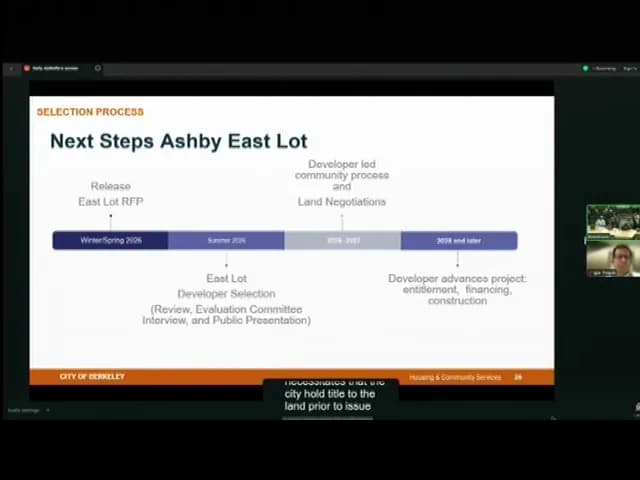
The Berkeley City Council held a special meeting to conduct a study session on the Ashby BART East Lot Transit Oriented Development Request for Proposal Framework. Staff presented the developer selection framework, public comments were heard, and council members discussed priorities before voting on a resolution related to property acquisition. Public Comments & Testimony - Representatives from the Center for Independent Living, Friends of Adeline, Healthy Black Families, and other community groups expressed positions in favor of 100% affordable housing, a right to return for displaced residents, disability-forward design, and reparations for historical harms. - Speakers advocated for increasing community representation on the evaluation committee from one to at least two or three members, emphasizing "nothing about us without us." - Specific requests included prioritizing universal design, affordable homeownership, and clarity on the South Berkeley Community Fund for reparations. Discussion Items - Staff presented the RFP framework, including threshold requirements (minimum 300 bedrooms, 35% affordability with 20% for extremely low-income households) and goals (e.g., 50% affordability, home ownership, universal design). - Councilmembers deliberated on priorities: Councilmember Bartlett stressed economic justice and wealth-building through homeownership; others supported affordability goals and community involvement. - Questions were raised about design guidelines, evaluation committee composition, financing feasibility, and alignment with reparations and disability accessibility objectives. Key Outcomes - The council unanimously adopted a resolution authorizing the city manager to expend up to $500,000 from housing trust fund dollars for property acquisition, in accordance with the exchange agreement. - Guidance was provided to staff to consider increasing community representation in the evaluation committee and strengthening universal design requirements in the RFP.

AFFORDABLE HOUSING 52% · HOUSING 19% · DISABILITY RIGHTS 8% · PROCEDURAL 6%
50
OCT 14, 2025 · BERKELEY, CALIFORNIA · CITY COUNCIL
Berkeley City Council Meeting - October 14, 2025

The Berkeley City Council convened a regular meeting focused on ceremonial recognitions, consent calendar approvals, and public comments. The council honored local sports champions and community members, received positive audit updates, and approved a consent calendar including items on noise ordinance amendments, grant applications, and police accountability. No action items were on the agenda, leading to a relatively short meeting. Consent Calendar - Item 1: Approved a budget adjustment for constructing a new restroom at Willard Park. Councilmember Humbert expressed strong support, noting the previous facility was inadequate. - Item 4: Approved a contract with Healthy Black Families, Inc. for mental health services. A public comment requested coordination with another service provider, Soul Space. - Item 5: Approved a resolution authorizing the city manager to submit a letter of commitment for matching funds for a $16.5 million FEMA grant application for seismic retrofits of Old City Hall and the Veterans Memorial Building. Councilmembers Blackaby and Tragub thanked staff for this effort. - Item 6: Approved a resolution authorizing the city manager to submit an application for a $4.1 million FEMA grant for the Berkeley Home Hardening and Defensible Space Project in the Wildland Urban Interface. Councilmember Blackaby highlighted this as part of a broader wildfire preparedness strategy. - Item 12 ("Robocop" Item): Approved a referral to the City Manager to draft an ordinance amending the municipal code to address nuisance noise from automated surveillance devices with audio capabilities. This was in response to a disruptive device at a local CVS. Councilmember O'Keefe, the sponsor, described the device as "dystopian" and a nuisance. Multiple council members co-sponsored, and public comments from affected residents expressed gratitude and support. - Item 13: Approved a resolution urging the Police Accountability Board (PAB), Berkeley Police Association, Police Department, and the City to complete negotiations on final PAB regulations as soon as possible and to schedule a closed session for updates. Councilmembers Blackaby (sponsor), Humbert, and Tragub emphasized the four-year delay under interim regulations and the need for closure. Public Comments & Testimony - Non-Agenda Matters: - A speaker expressed concern about federal efforts to weaken Fair Housing Act enforcement, particularly regarding protections for LGBTQ+ individuals and immigrant women. - A speaker advocated for ensuring downtown Berkeley has access to a mainstream movie theater, suggesting creative use of public art ordinances. - A chess club organizer expressed opposition to potentially moving the Telegraph Avenue Holiday Festival to the Ashby BART station area due to construction. - A speaker called for better education for both cyclists and drivers regarding new bicycle infrastructure and traffic interactions. - A speaker commented on national politics and public health. - A speaker opposed proposed increases to special event permitting fees, arguing it would burden community events like the Telegraph Avenue Holiday Street Fair. - The Vice President of AFSCME Local 1 commented on city auditor recommendations (Item 16), advocating for better compensation for promoted managers, increased recruitment efforts at job fairs, and expanded telework options to address budget deficits. - Consent & Information Items: - Multiple residents thanked Councilmember O'Keefe and staff for their responsive handling of the "Robocop" surveillance device issue and supported the proposed ordinance. One resident requested the legislation also address disruptive flashing lights from such devices. - An event producer and former Arts Commission chair commented on proposed special event fee increases, seeking clarity on the approval process and requesting stakeholder input. - Several speakers commented on homelessness, urging regional collaboration, expressing support for identifying alternative housing sites (Item 15), and suggesting the city directly operate shelters. - A journalist suggested the city consider creating grant programs to support local journalism organizations as a public good. - A speaker emphasized seismic risks in Berkeley and supported grant efforts for retrofits. Discussion Items - City Auditor's Report: Auditor Michelle Sage-Sloan provided positive updates on audit implementation. She reported significant progress on a 2023 audit of staff shortages, with 12 of 25 recommendations implemented, including new training programs and enhanced communication strategies. She also reported that HR had implemented 5 of 6 recommendations from a 2019 audit on the domestic violence policy response, launching an updated administrative regulation and training. - Alternative Housing Options for Homelessness (Information Item 15): Councilmembers Blackaby and O'Keefe discussed the informational report identifying potential sites for alternative housing models. Councilmember Blackaby proposed, then withdrew, a motion to bring the item back for action on November 18th, opting instead to work on a separate future item to discuss next steps and county coordination regarding Measure W funding. - Civic Arts Grants (Information Item 17): Councilmember Blackaby acknowledged the granting of 91 awards totaling over $650,000, emphasizing the city's continued commitment to supporting the arts despite budget challenges. Key Outcomes - The Consent Calendar was approved unanimously (9-0). Key approvals included: - Budget adjustment for Willard Park restroom. - Contracts for mental health services. - Authorization to apply for FEMA grants for seismic retrofit ($16.5M) and home hardening ($4.1M). - Referral to draft an ordinance regulating nuisance noise from automated surveillance devices ("Robocop" item). - A resolution urging completion of Police Accountability Board regulations. - The council received informational reports on civic arts grants and potential sites for alternative homeless housing. - A future discussion on next steps for alternative homeless housing sites is planned, to be initiated by Councilmember Humbert. - The meeting was adjourned following the consent calendar with no action items.

PROCEDURAL 32% · PUBLIC SAFETY 16% · PERSONNEL MATTERS 9% · COMMUNITY ENGAGEMENT 8%
OPENPUBLICA · PUBLIC MEETING INDEXUPDATED DAILY · openpublica.com