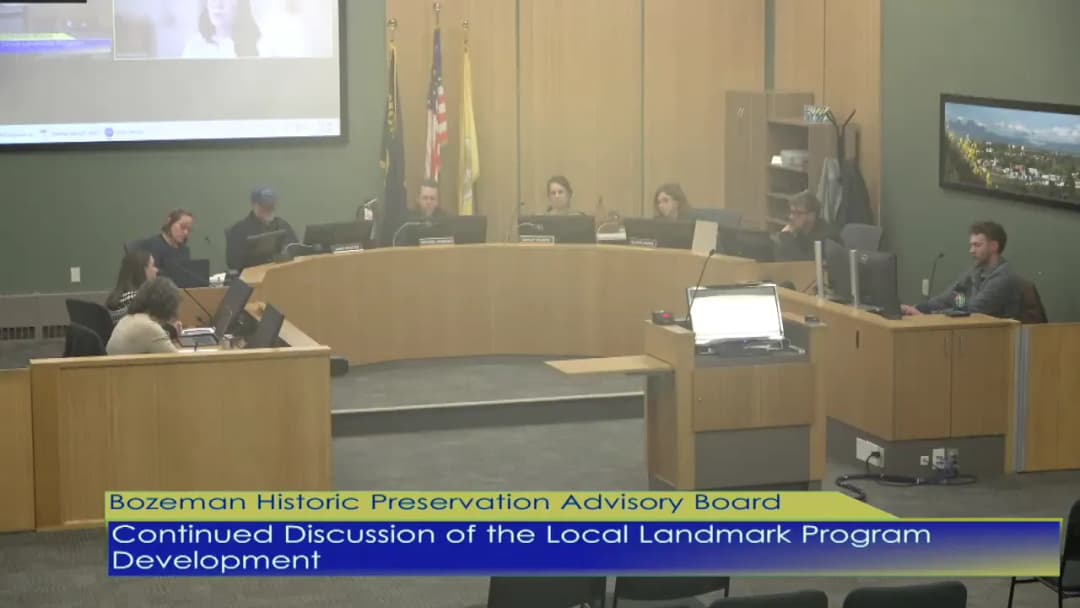
The Bozeman Historic Preservation Advisory Board (HPAB) met on March 31, 2026, at 6:00 pm to continue discussion of the Local Landmark Program Development, receive updates on the Certified Local Government (CLG) grant, and hear about the upcoming NCOD Design Guidelines engagement. The board also approved the minutes from February 18, 2026, and heard public comments. Minutes Approval - The board approved the minutes of the February 18, 2026 meeting after an amendment to include the request to discuss the interim zoning ordinance on a future agenda in the FYI section. The amendment passed 4–0 (James Webster, Mitchell Korus, Ashley Wilson, Michael Wiseman in favor; Allyson Brekke abstained). The minutes as amended were then approved 4–0, with one abstention. Public Comments & Testimony - Initial public comment (non‑agenda): Daniel Carty provided comment. - During the landmark program discussion: - Natsuki Nakamura (Bozeman resident, Economic Vitality Board member, Beta Bozeman Coalition) expressed concerns about the NCOD’s perceived regulatory sufficiency and cautioned against replacing the NCOD with the landmark program. She urged a joint HPAB–Urban Parks and Forestry Board conversation on a Heritage Tree Program. - Daniel Carty advocated for including natural elements—such as the urban forest, irrigation ditches, and unpaved trails—in the landmark program and urged the board to champion a heritage tree program. - Linda Simones stressed that historic preservation must be accessible, raising concerns about high petition signature thresholds (e.g., 75%) and costly zone map amendment fees that could discourage participation. Discussion Items: Local Landmark Program Development - Presentation: Community Development Director Erin George and consultant Adrienne Burke (Community Planning Collaborative) presented phase‑two work on the local landmark program, covering regulatory vs. non‑regulatory options, examples from other communities (Billings, Fort Collins, Aurora, etc.), and proposed criteria for significance and integrity. - Key issues debated: - How the landmark program would function inside the NCOD: because the NCOD already requires design review and certificates of appropriateness, a regulatory landmark inside the NCOD would duplicate existing processes. A non‑regulatory, honorary tier was suggested for properties within the NCOD. - The legal requirement for landmark districts to go through a zoning map amendment (ZMA), including review by the Community Development Board (planning commission). Board member Ashley Wilson voiced concerns that this process would be burdensome and costly, potentially discouraging nominations. - Alternatives discussed: starting with a single‑site landmark program (no ZMA needed), offering incentives (fee waivers, facade grants), and using design guidelines to provide different levels of protection. - Other considerations: age thresholds for landmarks, treatment of facades, and the role of Secretary of Interior standards. - Board feedback: The board agreed to revisit the city attorney to explore alternatives to the full ZMA process for landmark districts. They also emphasized the need to keep the program accessible and attractive to property owners. Key Outcomes - Staff will circle back with the city attorney to investigate alternative methods for establishing landmark districts that avoid a separate ZMA and Community Development Board review. - The board informally agreed to place a discussion on the interim zoning ordinance on a future meeting agenda. - The board acknowledged the receipt of the CLG grant approval (already acted upon by the City Commission) and the upcoming NCOD Design Guidelines engagement week. - The meeting was extended to 8:15 pm to continue the discussion. FYI Items - Certified Local Government (CLG) Grant: Rebecca (staff) reported that the City Commission approved the 2026–2027 CLG grant application at its March meeting; HPAB was informed for awareness. - NCOD Design Guidelines Update: The Lakota Group will conduct a community engagement week starting April 13, 2026, including: - Community open house on Monday, April 13, 6–8 pm. - Neighborhood focus group sessions (by invitation) on Tuesday, April 14. - Walking tours on Tuesday afternoon and Wednesday morning. - Presentation to HPAB at their regular meeting on Wednesday, April 15. - Interim Zoning Ordinance: The board expressed interest in adding this topic as a discussion item at a future meeting. Adjournment The meeting adjourned at approximately 8:14 pm.
Public Meetings - Bozeman, Montana
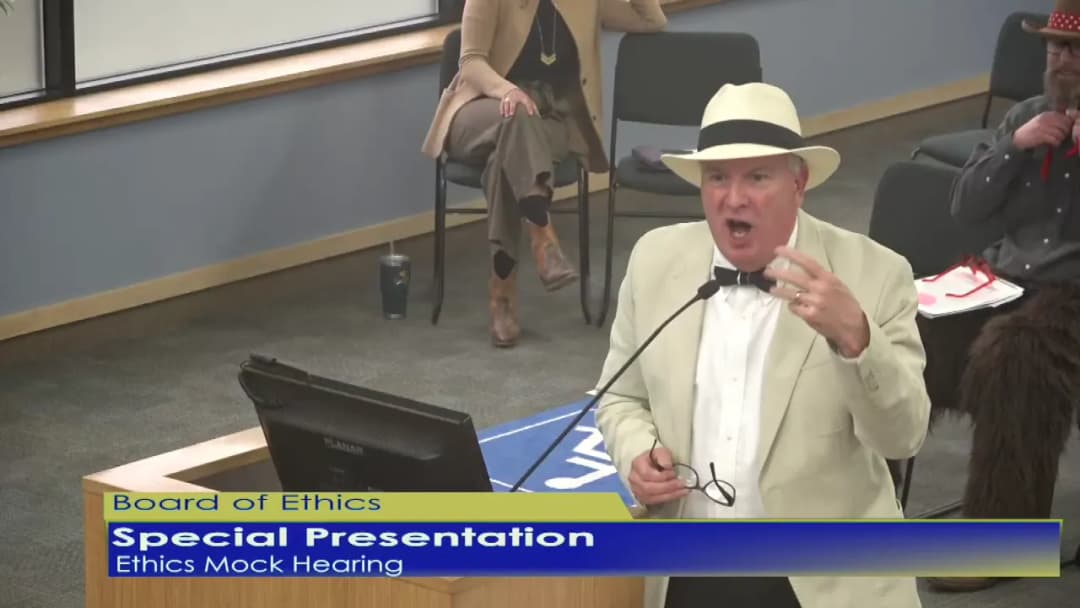
Public Meetings - Bozeman, MontanaThe Bozeman Board of Ethics held a special meeting on March 30, 2026, beginning at 9:30 AM, to conduct a mock ethics hearing as a training exercise. The simulation involved a hypothetical complaint filed by Taylor Swift against Beyoncé Knowles for alleged misuse of city resources. The board reviewed procedures for complaint handling, heard mock testimony from both parties and witnesses, and deliberated on the evidence before voting to dismiss the complaint with prejudice. Public Comments & Testimony - No public comments were received. Discussion Items - Procedural Overview: Jen Gatari and Greg presented an overview of the ethics complaint process, including filing requirements, preliminary analysis, and the board's options (dismissal, decision on merits, or formal hearing). Highlights included the burden of proof (clear and convincing evidence) and the hearing rules of procedure. - Mock Hearing: The board conducted a simulated evidentiary hearing in the case of Taylor Swift v. Beyoncé Knowles (alleged violation of Section 2.03.500 – Use of City Resources). - Complainant's Case: Taylor Swift, represented by attorney Bruce Dickinson, testified that on July 18, 2025, she observed her neighbor Beyoncé, a city employee, drive a city truck home during the workday, remove a chainsaw from the vehicle, and cut down a tree in her own yard. Swift stated she asked Beyoncé for help with her own tree and was told it would violate the rules. Swift argued this was inconsistent and an improper use of city resources. - Witness for Complainant: Mick Jagger testified he saw the city truck and heard the chainsaw, confirming the tree was completely removed. He was cross-examined about his sobriety and ability to hear. - Respondent's Case: Beyoncé Knowles, represented by Clem Clementine, testified that a storm had created a public hazard – a tree limb leaning over a power line. She stated she received permission from her supervisor, Al Green, to use the city truck to remove the limb. She claimed the city chainsaw malfunctioned (supported by a repair ticket), so she used her own personal pink-and-gold chainsaw. She argued the exception for benefit to the city applied and that she acted in a public safety crisis. - Cross-Examination and Board Questions: Attorneys questioned witnesses on the color of the chainsaw, photographic evidence, and the employee's knowledge of ethics rules. The board struggled with evidentiary objections and chain-of-custody issues regarding photos not submitted in advance. - Closing Arguments: Complainant's attorney argued the rules were violated and public trust eroded; respondent's attorney argued common sense and the benefit-to-city exception justified the actions. - Board Deliberation: Board members discussed the evidence, noting that there was supervisory approval, the limb posed a hazard, and the city chainsaw was not actually used. They concluded there was insufficient proof of a violation. Key Outcomes - Motion and Vote: Board member Jim Drummond moved to dismiss the complaint with prejudice, finding that Beyoncé Knowles did not violate Section 2.03.500. The motion was seconded by Mark Bond and passed unanimously (3-0). - Adjournment: The meeting was adjourned following the vote. The board noted the value of the training exercise for future real cases. Note: This was a training simulation. No actual ethics complaint was adjudicated.
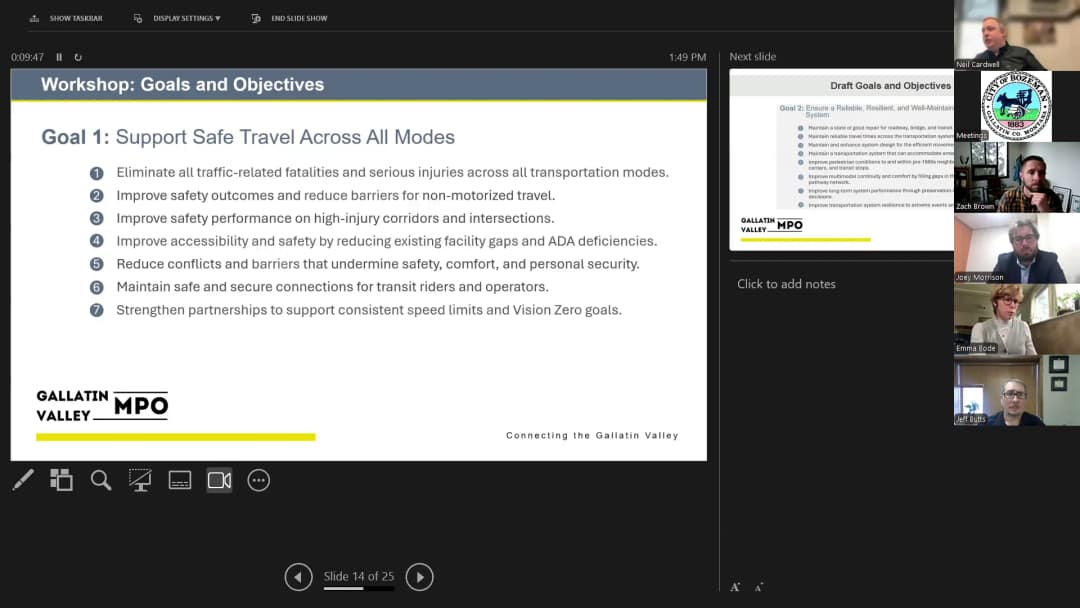
The Transportation Policy Coordinating Committee (TPCC) met on March 27, 2026, at 8:00 PM MT. The meeting included election of a new chair and vice chair, an informational overview of the Gallatin Valley MPO and regional transportation planning process, and adoption of the long-range transportation plan (LRTP) vision, goals, and objectives with amendments. All seven members were present. Public Comments & Testimony - No public comments were made on non-agenda items. No public comments were made during the action item on the LRTP vision, goals, and objectives. Discussion Items - Chair and Vice Chair Election: Mayor Morrison was nominated and elected chair (6 votes in favor, one member temporarily disconnected during the vote). City Manager Neil Cardwell was then nominated and elected vice chair (6 votes in favor, one member absent during the vote). - Informational Presentation: Jeff Butts, MPO Manager, provided an overview of the MPO, its planning factors (economic vitality, safety, etc.), boundary (Bozeman, Belgrade, Gallatin County to Fort Corns), governance structure (TAC and TPCC), required planning products (UPWP, PPP, LRTP, TIP), and the LRTP timeline. The presentation was for information only; no action taken. - Adoption of LRTP Vision, Goals, and Objectives: Jeff Butts presented the revised draft incorporating prior feedback from TPCC and TAC. Key themes from public engagement included reliability, safety, walking/bicycling, transit expansion, and state of good repair. The draft included six goals: (1) safe travel, (2) well-maintained system, (3) mobility choices, (4) quality of life, (5) transportation-land use coordination, and (6) resilience. Discussion focused on specific language in Goal 1 (speed limits), Goal 3 (bicycle facilities and consolidation of objectives), Goal 5 (transit-oriented development), and Goal 6 (resilience). Amendments were proposed and voted on sequentially. Key Outcomes - Elected Chair: Mayor Morrison (6-0-1 vote). - Elected Vice Chair: City Manager Neil Cardwell (6-0-1 vote). - Adopted LRTP Vision, Goals, and Objectives (7-0 vote) with the following amendments: - Added a new strategy under Goal 3 (Mobility Choices): "Establish a regional bicycle network connecting key destinations for all ages and abilities." - Amended Goal 1, Objective 7: Changed from "strengthen partnerships to support consistent speed limits and Vision Zero goals" to "strengthen partnerships to support Vision Zero goals" (removing reference to consistent speed limits). - Amended Goal 6 (Resilience), Strategy 1: Added the word "resilience" to read "improve the adaptability, flexibility, and resilience of the regional transportation network." - The committee discussed but did not adopt a proposal to consolidate objectives 3 and 5 and objectives 2 and 6 under Goal 3; that proposal was withdrawn. - The LRTP must be adopted by December 26, 2026, with final adoption expected in October 2026 after public review.
The Bozeman Urban Parks and Forestry Board met on March 26, 2026, to approve the community engagement plan for the Urban Forest Management Plan (UFMP), adopt the Bike Fill Community Park master plan, and discuss the board's two-year work plan. The meeting included public comments on non-agenda items and each action item. The board approved the community engagement plan with an amendment to add a fall work session, and approved the Bike Fill Park master plan as submitted. The work plan discussion was tabled to the next meeting. Consent Calendar - The agenda was amended by unanimous consent to swap action items F1 (work plan) and F3 (community engagement plan) to allow remote participation and better flow. - Minutes from the February 26, 2026, meeting were approved unanimously (5-0). Public Comments & Testimony - Non-Agenda Items: Marcia Caveney, speaking for the Bozeman Tree Coalition, expressed concern that the review of the Bike Fill master plan felt rushed and requested a work session instead of a single vote. She stated, "It feels like the train is coming through, and either get on board or get out of the way." - On the Community Engagement Plan (Item F3): Daniel Cardi (Bozeman resident, Tree Coalition member) requested that the UFMP explicitly include a Heritage Tree Program by name, not just mention heritage trees. Marcia Caveney added that the plan should address how it will guide municipal code development and noted timeline concerns about public engagement in late August overlapping with back-to-school and vacations. - On the Bike Fill Park Master Plan (Item F2): Multiple speakers addressed the board: - Doug McSpadden (Bozeman resident, GVLT supporter, Sacajawea Audubon vice president) recommended screening fences near wetlands and riparian areas to protect birds, and suggested eliminating a bridge to increase trail mileage. - Ken Sinai (recently resigned from Audubon board, personal capacity) requested a 100-foot buffer (instead of 50 feet) along Churn Creek, a longer public comment period, and a bird survey. He noted the short 10-day review window. - Marcia Caveney (Bozeman Tree Coalition) supported the buffer and screening comments and asked for a bird survey, noting state law prohibits construction in nesting habitat mid-May to mid-July. - Angie Kitchwek (Bozeman resident, Tree Coalition co-founder, online) requested more time for public feedback and emphasized the value of a bird survey. - Rick Chin, Hal Stanley, and Dan Draper (residents) expressed strong support for the project, citing its recreational benefits and collaboration between the city, GVLT, and volunteer groups. Discussion Items - Community Engagement Plan for the UFMP (Item F3): Alex Nordquest (Forestry Division Manager) and consultant team from DJ&A and PlanetGeo presented the draft plan for a 10-year update of the Urban Forest Management Plan. The plan includes four board work sessions, four public meetings, a public survey, a public comment period, and two city commission presentations. The timeline runs through November 2026 for commission adoption. Board members discussed the tight schedule, particularly the late August public meeting and comment period overlapping with school vacations. Mitch Overton (Parks and Recreation Director) confirmed flexibility in the schedule. The board voted to approve the engagement plan with an amendment to add a work session in fall 2026 to review the final draft before commission submission. The amendment passed 5-0. - Bike Fill Community Park Master Plan (Item F2): Addie Jaden (Park Planning and Development Manager) and Adam Johnson (GVLT Trails Project Manager) presented the master plan for a bike park on city land between Snowfill Dog Park and the solid waste facility. The plan was informed by over 1,000 survey responses, 800 donors, and multiple in-person and virtual open houses. The park features beginner, intermediate, and advanced trails, a rider hub, directional flow trails, and a connection to the Bridger Creek neighborhood via a multi-use path. Environmental protections include a 200-foot setback from Churn Creek, wildlife-friendly fencing, and stream crossings at existing disturbed sites. Board members shared positive feedback from a site tour, noting the appropriateness of trail placements and the reuse of fill material from road improvements. The plan was approved unanimously (5-0). - Board Work Plan (Item F1): Mitch Overton presented the proposed two-year work plan (2026–2027) organized around the board's five focus areas: Arbor Day program, UFMP updates, Cattail Creek Corridor master plan, implementation of the Parks, Recreation, Open Space and Trails (Pratt) plan (including code amendments), and biannual Sunset Hills Cemetery updates. Public comment from Daniel Cardi requested that heritage tree program development be included explicitly. Several board members expressed desire for more time to review. The discussion was tabled to the April meeting without a vote. Key Outcomes - Approved the Community Engagement Plan for the Urban Forest Management Plan with an amendment to add a fall board work session (vote: 5-0). - Approved the Bike Fill Community Park Master Plan as submitted (vote: 5-0). - Tabled adoption of the 2026–2027 Urban Parks and Forestry Board Work Plan to the next meeting (April 2026).
The Bozeman Business Improvement District (BID) Board held a regular meeting on March 25, 2026, to approve the fiscal year 2027 budget and work plan, discuss downtown public safety initiatives, and outline future planning for the district. The board also reviewed a reserve fund that has grown to nearly $300,000 and considered how to best allocate those funds as the Urban Renewal District (URD) sunsets in 2030. Consent Calendar - The board unanimously approved the minutes from the last year, with no changes to the agenda. A roll call vote was taken: Eric Nelson, Elaine Inderland, Eric Bowman, Randy Scully, Mark Kiki, and Commissioner Magic all voted "aye." Public Comments & Testimony - No public attendees were present in the room or online, so no public comments were taken. Discussion Items - FY2027 Budget and Work Plan Approval: Administrator Emily presented the proposed fiscal year 2027 budget and a draft for fiscal year 2028. Key items included a $295,000 assessment, a management fee increase to $89,000 (up from $82,500), and a $500 increase for DBA support. A $15,000 line item for the downtown safety program was retained, primarily for potential lighting and camera projects. A new $2,000 line item for hazmat cleanup (spring restoration) was added for the first time. The budget assumes scenario two (taxable value scenario) at 2.2 per $1,000 of taxable value. - Downtown Resource Officer Discussion: Emily reported that the Bozeman Police Department remains 10 officers short of its budgeted 80–82 positions. Detective Hutchins indicated a dedicated downtown resource officer may not be feasible for another three to four years, as the department must first fill vacancies. However, a change in shift scheduling will create an officer overlap from 2:00 to 5:00 p.m., potentially allowing for more patrol presence, though not funded by the BID. - Reserve Fund and Future Planning: The board discussed the BID's reserve fund, which has grown to nearly $300,000—almost a full year's operating expenses. Commissioners considered whether to earmark funds for specific projects (e.g., cameras, lighting, pedestrian safety) or to build the reserve for future maintenance needs as the URD sunsets. The idea of a broader public realm plan was introduced, which would incorporate the downtown plan and URD sunsetting, with targeted completion by fiscal year 2028 to inform the BID renewal in 2029/2030. - Federal Building Update: Commissioner Mark Kiki provided an update on the federal building property. The GSA and an appointed board are analyzing whether the building is excess to government needs. The city and downtown property owners have submitted letters of interest. A decision is expected in late spring or June. If declared excess, the city could acquire the property and potentially pursue a public-private partnership. The building is likely over 50 years old and may be considered historic. - Other Updates: Administrator Emily noted that the Montana Main Street Downtown Conference will be held in Glasgow in late April, with all four office staff attending. The Eho Peace Project construction has resumed, closing part of North Black and one lane of Mendenhall Street for four weeks. The dedication ceremony for the Eho Palmer Peace Park is scheduled for August 14, 2026, during a downtown artwalk. The downtown parking survey is open until March 30, 2026, and has nearly 1,000 responses. The Bozeman Creek Vision Plan next round of meetings will be April 6–7, 2026. Key Outcomes - Approved: The FY2027 budget and work plan passed unanimously via roll call vote (7-0). - Next Steps: Emily and Ellie will present the final work plan and budget to the City Commission on Tuesday, May 12, 2026. - Future Discussions: The board agreed to continue a monthly conversation on the downtown public realm plan and BID priorities, with a presentation from Detective Hutchins on downtown crime statistics expected in the coming months. An email survey of downtown property owners will be conducted to gather feedback on priorities.
The Transportation Advisory Board met on March 25, 2026, but lacked a quorum, so no official actions were taken. The meeting included announcements of absences and a new board member starting next month, as well as public comments from two community members. Public Comments & Testimony - Ron Adlington, a resident of Bozeman, shared personal experience and suggestions for pedestrian safety in the face of distracted driving. He proposed creating a think tank of diverse professionals (e.g., grant writers, orthopedic surgeon, insurance person, business leaders) to explore unusual funding sources for education and supplies (e.g., reflective clothing, flashers) for pedestrians and cyclists. He emphasized individual responsibility, such as wearing bright colors, obeying traffic laws, and avoiding distractions, and advocated for teaching these practices to youth. - Gracie Ann Caldwell, a student in a politics of climate change course at Montana State University, spoke about electric vehicle (EV) adoption. She noted that range anxiety is a barrier and suggested that the city create an official, up-to-date map of EV charging stations to reduce uncertainty and align with sustainability goals. She referenced the Montana Department of Transportation's 2022 prioritization study and urged collaboration between the city and state.
Bozeman City Study Commission Meeting Summary - March 25, 2026\n\nThe Bozeman City Study Commission convened on March 25, 2026, at 4:00 p.m. The meeting featured a learning session on electoral systems (wards, at-large, and hybrid), the review and approval of edits to Article 3 of the draft charter regarding the city manager, an update on the project timeline to meet ballot deadlines, and significant public comment on representation and campaign finance. The commission closed by outlining data needs and scheduling future sessions.\n\n Consent Calendar\n- The commission unanimously approved the minutes of the previous meeting (4-0). Commissioner Becky Franks participated by phone and voted yes.\n\n Public Comments & Testimony\n- Opening Comment:\n - Dan Caveney (1496 Boylan Road) thanked the commission for their work but strongly criticized the current city government for being insufficiently responsive to citizens. He argued that low public turnout does not indicate satisfaction and pushed for a structure that increases accountability. Chair Taylor acknowledged the point, stating that he did not mean to imply that lack of attendance means everything is fine.\n- Comments on Wards and Representation:\n - Mary Bateson (Bozeman resident) strongly opposed wards, calling them "a solution in search of a problem." She supported at-large elections, arguing that Bozeman lacks geographically concentrated minority or low-income populations that would benefit from wards. She stated that complicating the voting system could further lower already low voter turnout (31% in the November election) and expressed concern about the cost and complexity of maintaining ward boundaries.\n - Terry Quatrero (outside city limits but former advisory board member) favored wards. He believed they would lower campaign costs and increase neighborhood involvement. He suggested creating a candidate handbook and setting caps on campaign spending to level the playing field.\n - Natsuki Nakamura (Bozeman resident, Economic Vitality Board member speaking as an individual) opposed wards, echoing Bateson's points about demographics. She argued that Bozeman is 87% white and that minority and low-income populations are not geographically concentrated, so wards would not achieve the goal of diversifying the commission. She also noted that unopposed ward races could be less democratic.\n- Closing Comments:\n - Daniel Cardi cautioned the commission to strictly adhere to legal definitions of words like "must" and "may" in their drafting, referencing the Montana Bill Drafting Manual.\n - Mary Bateson expressed a preference for the method of mayor selection prior to the 2006 charter change, where the top vote-getting commissioner became mayor.\n - Gracie Ann Caldwell (Montana State University student) expressed interest in running for office and proposed exploring a public campaign financing voucher program, similar to models in other states.\n\n Discussion Items\n- Timeline and Ballot Education Process: Barb reviewed an updated calendar to ensure the final charter and report are ready for the August 10 deadline to submit ballot language to the county election department. Key milestones include: May 7 (draft charter to Greg for legal review), May 13 (finalize charter language), end of May (draft report released for public comment), and June 17 (public hearing on the draft tentative report). The RFP for ballot education was released and will close April 3. A brief procedural discussion occurred regarding non-voting member Mike's role in pre-selecting respondents. It was decided that Carson and Mike would review submissions and bring a recommendation to the April 15 meeting.\n- Learning Session on Wards vs. At-Large vs. Hybrid:\n - Dan Clark presented an overview of the advantages and disadvantages of various election systems, referencing academic papers and the 1976 study commission. The commission engaged in an extended Q&A.\n - Key Positions and Inquiries:\n - Deanna proposed a 7-ward system with commissioners elected per district and the mayor and deputy mayor selected internally by the seated commission.\n - Barb proposed examining a hybrid model with a majority of commissioners elected by ward plus an at-large commissioner and mayor.\n - Becky questioned whether investing in strong neighborhood councils could achieve better representation than creating wards, contrasting them with the current adversarial relationship between the city and neighborhood councils.\n - Other topics included preventing gerrymandering, accommodating renters and families who move, handling rapid growth and rebalancing wards (triggers), and how the 2023 UDC legislation might shift the purpose of neighborhood input to the front end of code creation rather than individual project review.\n - Data Requests: The commission requested Dan Clark provide further research on voter turnout in different systems, language to prevent gerrymandering, the impact of selecting a mayor from the commission versus electing one at-large, and socioeconomic representation data for comparable cities.\n- Review of Article 3 (City Manager) Edits:\n - The commission reviewed the addition of language requiring an "annual comprehensive performance review" for the city manager by the city commission. A brief discussion ensued over clarifying the supervisory role in the sentence (noting it was already stated in Section 3.04) and the use of the word "must" versus "should" in a recommendation. The edits were accepted.\n\n Key Outcomes\n- Consent Agenda: Approved (4-0).\n- Article 3 Edits: The commission approved the inclusion of language requiring an annual comprehensive performance review by the commission and a recommendation that norms of communication be discussed during the city manager hiring process.\n- Project Timeline: The calendar update was accepted, setting a course for the August 10 ballot language deadline with the public hearing scheduled for June 17.\n- Future Agenda:\n - April 2: Learning session on neighborhood councils with a proposed panel.\n - April 15: Potential learning session with Gallatin County Commissioner Zach Brown on compensation and vacancies, alongside discussion of the ballot education RFP recommendation.\n- Data Gathering: The commission tasked Dan Clark with providing further research on voter turnout in different systems, language to prevent gerrymandering, the impact of selecting a mayor from versus by the commission, and data on socioeconomic representation in comparable cities.\n\nThe meeting was adjourned at 5:56 p.m.
The Bozeman City Commission met on March 24, 2026, to deliberate and vote on the appeal of a commercial site plan for the Sundance Springs subdivision, adopt the Fiscal Years 2027–2031 Capital Improvements Plan (CIP), issue a mayoral proclamation, and hear public comments. Key outcomes included a 4-1 vote to uphold the director's conditional approval (with an added lighting condition) and unanimous adoption of the $300 million CIP. Consent Calendar - Consent Agenda One (Items G1–G21) approved unanimously (5-0). - Consent Agenda Two approved on a 3-2 vote (Commissioners Magic and Sweeney dissenting). - City Manager highlighted two items: (1) the Cattail Construction Project (North 27th from Baxter Lane to Cattail) awarded $2 million below engineer’s estimate, and (2) the Bozeman Public Library children’s room renovation ($1.2 million total, $1 million raised through philanthropy). Public Comments & Testimony - Carl Anderson (Belgrade resident, owner of Weird Productions/Director of Operations for First Contact) thanked the commission for the First Contact Day proclamation and introduced MSU students attending the meeting. - Laurie Wallace (Harvest Creek HOA, 2724 Daisy Drive) read a press release detailing the HOA’s engagement with the city regarding proposed high-density housing on 10 acres acquired for the Fowler Avenue extension. The HOA does not oppose affordable housing or the road but requests a covenant limiting development to 8 units/acre, two stories maximum, and a traffic/parking plan that does not impact the subdivision. - Daniel Cardi (Bozeman resident) reported that a contractor at Urban Farms cut down willows/cottonwoods along an irrigation ditch managed by Middle Creek Ditch Company. He asked the city to investigate and establish a process to prevent future occurrences. - Mary Francis McHugh (online) suggested adding an advisory to the consent agenda that informs the public of their right to comment and that any commissioner may remove an item for discussion. She noted the city code only allows commissioners to pull items but encouraged the presiding officer to adjust the order to accommodate public comment. Discussion Items - Appeal of Sundance Springs Commercial Lot 2 Site Plan (Continuation from Feb 24, 2026) Assistant City Attorney Severin clarified that the hearing was closed on Feb 24; the commission’s sole task was to discuss and vote on whether to uphold, amend, or overturn the director’s conditional approval. - Commissioner Magic moved to amend the approval by adding a condition requiring the lighting plan to comply with Bozeman Code §38.57.0040 G.5 (maximum 0.3 foot-candles at property boundary). She then reviewed each of the eight appeal points, arguing that: the master plan and development guidelines are non-binding; the final plat and 1996 PUD approval (with conditions) control; the 2025 code applies (not 1992 code); the site meets block frontage standards; setbacks comply; and the design guidelines have been followed. She concluded staff acted correctly and in good faith. - Commissioner Sweeney proposed an amendment to require removal of parking from the rear setback (allowing only landscaping) to comply with the Sundance Springs CC&Rs (Section 3.2) and the 2024 commission findings. She argued that design guidelines must be applied equally (e.g., not ignoring 8.3C). The amendment failed 1-4 (only Sweeney in favor). - Commissioner Bodie supported staff’s interpretation that the buildable area is defined by building/structure setbacks, and that parking is allowed in rear setbacks under the Bozeman Municipal Code. He also noted that moving parking back would not meaningfully change the development’s character and could reduce parking, potentially impacting neighbors. - Commissioner Fisher (Deputy Mayor) supported staff’s reading of the code and the 1996 PUD findings (Condition 29 allowing all B1 uses). He found the revised design more responsive to the spirit of the PUD (half-sized buildings, reduced patio, improved open space) and rejected the idea that the master plan map is an ironclad depiction. - Commissioner Madrid agreed with Deputy Mayor Fisher and Commissioner Bodie, noting that the CC&Rs’ language (buildable area determined by building/structure setbacks as allowed in the zone code) means parking is permitted in rear setbacks. - Record of the hearing and public comment from Feb 24, 2026 was incorporated; no new public comment was taken. - Fiscal Years 2027–2031 Capital Improvements Plan (CIP) Adoption - Finance Director Melissa Hodnet summarized the process: internal review started September 2025; work sessions were held in December 2025 and March 10, 2026. The CIP is a planning document; actual appropriations will be determined during the May/June budget adoption. Enterprise funds and special assessment funds (with most capital) will be discussed June 2; general fund capital on June 9. - Commissioner Bowdy moved to adopt the resolution, praising staff for prioritizing projects and noting the $300 million planned investment (with an additional $400 million in unscheduled projects). He highlighted the Fowler Avenue connector, bike/pedestrian safety, and water reclamation facility savings. - Commissioner Magic commended staff expertise and the process; Commissioner Sweeney appreciated the extended timeline compared to past years. - Deputy Mayor Fisher emphasized the $300 million figure and the importance of the unscheduled items (often called deferred maintenance). - Mayor Morrison noted the CIP helps answer constituents’ questions about how the city is investing. - The resolution was adopted unanimously (5-0). - Mayoral Proclamation: First Contact Day (April 5, 2026) - Mayor Morrison proclaimed April 5, 2026 as First Contact Day in Bozeman, referencing the Star Trek franchise’s fictional first contact between humans and extraterrestrials in Bozeman on April 5, 2063. The proclamation highlighted Bozeman’s scientific community, Montana State University’s Space Grant Consortium, and the potential for STEM tourism. - Special Presentation: Transportation & Engineering Department - Nick Ross, Transportation & Engineering Director, presented an overview of the department’s operating divisions: Vehicle Maintenance, Streets (maintenance and sign/signal), and Bozeman Solid Waste. Key stats: 695 city assets maintained; 1,694 work orders completed last year; 45,000 lane miles plowed in a good snow year; 300 miles of streets maintained; 28 traffic signals; 70% of Bozeman households served by city solid waste; 1,800 customers on the new organics collection program; 4,000 gallons of used oil and antifreeze collected from the public; $500,000 EV grant secured. - Commission FYI / Discussion - Commissioner Magic: Announced a “Walk with Me” event on Oak Street on March 26, 2026 at 3:30 p.m. at the regional park. - Commissioner Sweeney: Promoted the American Indian Council’s 50th Annual Powwow at MSU on March 27–28, 2026. - Commissioner Bodie: Reported from the Sustainability Board: update on water advisory strategies, new GHG monitoring dashboard, and board interest in affordable housing sustainability (e.g., solar orientation). - Deputy Mayor Fisher: Noted the Neighborhood Council passed a resolution requesting a moratorium on large building development/demolition in the NCOD while design guidelines are being considered. - Multiple commissioners supported adding an advisory to the consent agenda (as suggested by public commenter Mary Francis McHugh) and improving the meeting room décor (hanging past commissioner photos, city priorities, and proclamations). - City Manager stated he would: (1) investigate the tree cutting incident at the irrigation ditch, (2) work to clarify public comment opportunities in meeting materials, and (3) explore options for the wall décor. Key Outcomes - Sundance Springs Appeal: The commission upheld the director’s conditional approval of site plan 25238 with an added lighting condition, on a 4-1 vote (Commissioner Sweeney dissenting). An amendment to remove rear-setback parking failed 1-4. - CIP Adoption: Fiscal Years 2027–2031 CIP adopted unanimously (5-0). - Proclamation: April 5, 2026 declared First Contact Day. - Public Comment Procedure: City Manager to review adding a consent agenda advisory and clarifying public participation opportunities. - Tree Cutting Incident: City Manager to investigate the removal of trees along the Middle Creek Ditch at Urban Farms. - Meeting Room Décor: City Manager to bring forward options for displaying past commissioner photos, city priorities, and notable proclamations.
The transcript for the city council meeting scheduled on 2026-03-19 at 19:00:00 UTC was not included in the input. Therefore, a summary cannot be generated. Please provide the transcript text.
The City Council convened on March 18, 2026, to address routine administrative matters and deliberate on pending development proposals. The meeting proceeded with standard procedural actions followed by public testimony regarding recent zoning changes. Consent Calendar - Approval of the minutes from the previous meeting held on February 15, 2026. - Authorization of utility payment vouchers totaling $45,200 for district infrastructure maintenance. Public Comments & Testimony - Elena Rodriguez (Resident, District 4): Expressed strong opposition to the proposed rezoning of the Westside Industrial lot, stating that "the traffic impact study fails to account for peak hour congestion" and arguing that the density increases without providing adequate green space. - Marcus Chen (Local Business Owner): Voiced support for the commercial expansion proposals, noting that the "new zoning allows for mixed-use development which the business community has requested for three years." Discussion Items - Westside Industrial Zoning Amendment: Council members debated the implications of the rezoning. Councilor Vance noted that the "current traffic projections show a 15% increase in vehicle volume during rush hours," while Councilor Gupta countered that the project sponsor provided "a revised traffic mitigation plan addressing 90% of the identified concerns." - Budget Reallocation Report: The Finance Director presented a proposal to reallocate $200,000 from the Parks Reserve to the Housing Authority, citing an "urgent need to fund emergency shelter operations." Key Outcomes - Zoning Vote: The Westside Industrial rezoning amendment was passed by a vote of 5-2. The motion required a two-thirds majority. - Budget Referral: The proposal to reallocate funds was referred to the Budget Committee for further review due to concerns regarding the "sustainability of the Parks Reserve." - Public Comment Record: All public testimonies were entered into the official record and will be reviewed during the next zoning hearing.