The Bozeman Historic Preservation Advisory Board (HPAB) met on Wednesday, April 15, 2026, from 6:00 pm to 9:00 pm. The meeting featured a special presentation on the Certificate of Appropriateness (COA) review process, a work session with the Lakota Group on updating the Neighborhood Conservation Overlay District (NCOD) design guidelines, and a vote to recommend that the City Commission consider interim zoning. The board approved the previous meeting’s minutes and heard public comments on several items. Consent Calendar - Approval of Minutes (March 31, 2026): Approved unanimously (6-0). Public Comments & Testimony - Natsuki Nakamura (Bozeman resident, Economic Vitality Board member speaking personally): Expressed concerns about demolition and displacement, asked how to tip scales toward reuse and prevent “demolition by neglect,” questioned how mass/scale compatibility can be controlled when zoning allows 60–90 feet by right, and worried that neighborhoods without resources to become historic districts would receive less protection under a tiered approach. - Mark Campanelli (Bozeman resident, Bogart Park neighborhood): Recommended using ASTM definitions for mandatory (“shall”) vs. advisory (“should,” “may”) language in design guidelines; noted the high cost of redevelopment and fear of uncertain standards; urged consideration of economic realities for property owners. - Jason Delmue (via video, Community Development Board member): Argued against interim zoning, stating that survey questions were one-sided, blurred distinctions between B3 and B3C zones, and that a moratorium could harm board credibility; suggested the board show understanding of development complexity. - Mary Bateson and Daniel Carty (Bozeman residents): Expressed support for recommending interim zoning to the City Commission. Special Presentation - Overview of COA Review Criteria and Process: Community Development Review Manager Brian Krueger presented how the city applies design guidelines, including the review matrix, deviations, and examples of past projects (e.g., 16 North Wilson, Black Olive, Rialto Theater, and the Greenhouse Condominiums) to illustrate how guidelines shaped outcomes. He emphasized that guidelines are enforced daily and that concerns about enforceability are often based on misinterpretation. Discussion Items - Work Session on NCOD Design Guidelines Update: Representatives from the Lakota Group (Saraj Bahani, Matt Cole, Doug Curry) and city staff (Rebecca Harbage, Aaron George) led a discussion on key topics for updating the design guidelines, including: - A potential three‑tier approach (historic districts, character areas, general NCOD) with different regulatory intensity. - Materials: concerns about lower‑quality materials, desire for higher standards, and treatment of metal, EFIS, and wood. - Repair and rehabilitation: common issues (windows, porches, foundations, basements) and the need for cost‑sensitive guidance. - Landscape and streetscape: importance of mature trees, parking placement, driveways, and street cuts. - New construction and additions: desire for more prescriptive guidance while avoiding false historicism; examples of successful infill. - Interim Zoning Discussion: Long‑Range Planning Manager Chris Saunders explained the state law framework for interim zoning, including limited purposes (use‑based), urgency findings, 15‑day public notice, and maximum one‑year term. Board members discussed the rationale for recommending a pause while NCOD updates and the landmark program are underway. Key Outcomes - Motion to Recommend Interim Zoning: The board voted 4‑0 to send a letter to the City Commission recommending that they hold a public hearing and consider adopting an interim zoning ordinance. Voting in favor: Chelsea Holling, James Webster, Mitchell Korus, Michael Wiseman. Member Ashley Wilson recused herself and left the room; Member Danielle Nicholas left before the vote; Member Allyson Brekke was absent. The letter will be drafted by board members outside of quorum.
Public Meetings - Bozeman, Montana
Public Meetings - Bozeman, MontanaThe Bozeman Study Commission convened on April 15, 2026, to discuss the timeline for finalizing the charter, select a firm for ballot education services, and receive public comment on neighborhood associations, among other items. The meeting also included a joint discussion with Gallatin County commissioners on wards, districts, commissioner pay, and advisory boards. Consent Calendar - The consent agenda was adopted unanimously (4-0), including routine approvals and the authorization of an absence for Commissioner Barb Sistero. Public Comments & Testimony - Mark Campanelli (Booger Park neighbor, speaking as an individual) expressed that the Inter-Neighborhood Council (INC) currently serves both an advisory and advocacy role, and that better two-way communication with the city is needed. He opposed language that would restrict INC to an advisory-only role. - Daniel Cardi (Bozeman resident) requested that the commission look up definitions of advisory, advocacy, and activism, and advocated for including both advisory and advocacy roles in the charter for neighborhood associations. - Natsuki Nakamura (Bozeman resident, member of the Economic Vitality Board, speaking as an individual) noted that creating a neighborhood association is easy (11 signatures, one annual meeting) but sustaining it is difficult; she emphasized the need for a full-time city staff person to support associations and for a meaningful advocacy role so residents feel heard. - Zara Osman (West Side Bozeman resident, Vally Unit Neighborhood Association steering committee and INC alternate, speaking as an individual) shared that the INC’s survey of 428 members found over 80% in favor of submitting a formal recommendation to the City Commission, but that the Commission declined to even discuss the recommendation. She characterized this as an insult to volunteer efforts. - Jason Delmule (public commenter) argued that requiring development application notice to neighborhoods at the charter level is inappropriate, as the time for practical input is at the outset before a project is designed. He also criticized the INC survey language as one-sided and lacking context (e.g., no reference buildings; 20,000 sq ft vs. 150,000 sq ft for downtown buildings). Discussion Items - Timeline and Schedule Adjustments: The commission discussed moving the May 7 meeting to May 13 and adding a meeting on May 20 to accommodate absences. The final public hearing on the tentative report was moved from May 28 to June 17 (4:00-6:00 PM, with a possible shift to June 18 to allow a later start time). The draft charter language will be finalized by May 13, released for public comment on May 28, and the public hearing on the tentative report is June 17. The final report adoption is scheduled for August 6. - Selection of Ballot Education Firm (DaneGeld): The commission reviewed two proposals. Commissioners preferred DaneGeld (Missoula) over KW1 (Portland) due to its tiered pricing, understanding of Montana reporting requirements, and experience with Gallatin County. A motion was made and seconded to engage DaneGeld, with the level of service (lowest, active, or transformative) to be negotiated by staff. The motion carried 4-0. - Neighborhood Associations Discussion: Commissioners shared priorities for the charter article on neighborhood associations: - Carson: Urge the city to increase coverage beyond the current 28-30% of the city; simplify the process for starting an association; provide city funding for events and a dedicated staff person. - Jen: Emphasized organic growth with standards; referenced Seattle’s “Front Porch” approach; suggested that developers could be asked to contribute to neighborhood engagement costs; noted that strong, well-resourced associations might reduce the need for wards. - Deanna: Stated that the mission of neighborhood associations should be clearly defined as bottom-up communication to the city council, not just social events; opposed mandatory bylaws, preferring self-government. - Becky: Advocated for including language that affected neighborhoods must be notified upon application for development (though staff noted the trigger should be at public notice, not application); recommended at least one full-time city employee to support associations; saw associations as a pipeline for future city commissioners. - County Commissioners on Wards, Districts, Pay, and Advisory Boards: Gallatin County Commissioners Zach Brown and Jen Boyer discussed: - Wards/Districts: The county uses three districts based on population, with candidates required to live in the district for two years before filing, but elections are countywide. Advantages include geographic distribution; disadvantages include confusion over boundaries and limited candidate pools. Redistricting is done by the Clerk and Recorder every 10 years at minimal cost. - Commissioner Pay: The county uses a salary compensation committee (three commissioners, three other elected officials, up to four public appointees) that meets once a year. Pay is tied to the statutory formula for the sheriff’s salary, which limits raises because it would increase deputy pay. Commissioners noted that compensation is a barrier to attracting diverse candidates. - Advisory Boards: The county has moved away from giving advisory boards managerial authority (e.g., hiring, firing, budgets) and now restricts them to an advisory role. The county has 20-30 advisory boards; most meet monthly. Recruitment is challenging, with many boards struggling to maintain quorums. Key Outcomes - Vote on Consent Agenda: Passed 4-0. - Vote on Ballot Education Firm: Motion to engage DaneGeld with negotiated service level passed 4-0. - Timeline Change: Agreed to skip the May 7 meeting, move its agenda to May 13, add a May 20 meeting, and keep the June 17 public hearing (with a possible shift to June 18 for a later start time). - Next Steps: Staff will send out an email to finalize the agenda for the April 24 meeting. Commissioners will continue drafting charter language on neighborhood associations and advisory boards, with final votes on those topics expected at the April 30 meeting.
The Bozeman City Commission met on April 14, 2026, for a regular meeting that included updates on city projects, a special presentation on municipal court operations, and a lengthy work session on traffic safety. The meeting began with approval of the consent agenda, followed by public comments on a range of topics, and concluded with appointments and a commitment to further discuss traffic safety funding and strategies. Consent Calendar - Approved unanimously (4-0) items G1 through G4, including a water renovation project that came in significantly under engineer estimates. Public Comments & Testimony - Matt Standal (local journalist) urged the commission to increase police enforcement of traffic laws following a recent serious accident involving a teenager. - Nikki Bailey (resident) criticized street safety for cyclists, calling Bozeman the worst city she has lived in for biking, and demanded immediate action. - Patrick Moore (Valley Unit Neighborhood Association steering committee) expressed dismay that the commission declined to discuss the Inner Neighborhood Council's recommendation for an interim zoning ordinance (IZO), stating the refusal erodes public trust. - Tessa Whitmer (type 2 short-term rental owner) requested a legacy class for existing permitted short-term rentals in RA zones, noting that the city's written guidance incorrectly stated no changes would occur. The city manager acknowledged the issue and promised a text amendment to allow those operators to continue. - Mary Bateson and Daniel Cardi (residents) both urged adoption of an interim zoning ordinance within the Neighborhood Conservation Overlay District (NCOD) to pause large demolitions and new developments of 20,000+ square feet until the NCOD update is complete. - Gracie Caldwell (Campus Climate Coalition MSU president) highlighted climate week events, including a panel on women in climate action and a guided hike. - Audrey (age 7) expressed fear about crossing streets and suggested making crossing signs red. - Courtney Johnson (resident, planning professional, mother) proposed a post-approval safety review for developments near schools and parks, a better near-miss reporting system, and a formal response to a 2024 resolution of intent regarding parking and safety. - Gloria Overcash (mother and teacher) read an update from the mother of a boy critically injured on Babcock Street, urging the community to drive attentively. - Kenyon (child) said he cannot bike to his best friend because he must cross Babcock Street. - Noah Brown (resident) advocated for road diets, lower speed limits, no right on red, and a simpler process for neighborhood traffic calming. - Lynn Paul (resident, cyclist) asked for safety improvements on Valor Road during construction of the Fowler Avenue project and praised rapid flashing beacons. - Mark Eggy (resident) criticized the city for not funding safety improvements identified in the 2017 Transportation Master Plan, noting that the locations where recent crashes occurred were flagged years ago. - Gene McGinnis (87-year-old resident, cyclist) encouraged safe biking and reminded that cyclists must obey traffic laws. - Valerie Melton (school bus driver) reported seeing 4-5 vehicles running school bus red lights daily and advocated for police officers to ride buses. - Michelle Piazza (resident) asked for standardization of intersection configurations and crosswalk signals, and noted speeding on Blackwood Avenue. Discussion Items - FYIs and Updates: Commissioner Sweeney announced the Lakota group is in town for engagement on the NCOD. Commissioner Bodie reported on the sustainability board meeting, including a ranked-choice vote on a poster contest, and a walk in Cooper Park. The city manager provided an update on the Fowler Avenue Housing Project consensus process, stating that no decisions have been made, staff are not pursuing four- or five-story development, and the focus is on below-market, for-sale ownership models with a maximum of three stories. - Action Item J - Special Improvement Lighting District 796: The commission adopted a resolution creating a lighting district for West Aspen and Fifth Avenue, despite one protest that did not meet the threshold. The district funds electrical bills and maintenance for festival street string lights and park frontage lights. Commissioner Sweeney acknowledged the protester's concern about noise from street lighting. - Special Presentation - Utilities Department: Director Sean Coates presented an overview of the department's seven divisions, highlighting stormwater management, water conservation (80% of per capita water use of arid west cities), water reclamation facility innovations (AI software, wetland pilot), and proactive leak detection on 3% of the system that saved 198,000 gallons of water. - Special Presentation - State of the Courts: Chief Judge Caroline Turney reported on the municipal court's operations, including a significant increase in cases: first-quarter 2026 case numbers were 1,873, a 45% increase over the same quarter in 2025. Jury trials rose from 6 in FY24 to 17 in FY25, and interpreter minutes increased dramatically. The court requested an additional clerk position and noted that the Bridgers Treatment Court will require city funding by FY28. Judge Turney also discussed the court's role in addressing mental health and fitness-to-proceed issues. - Work Session - Traffic Safety: Transportation Director Nick Ross and Police Chief Jim Veltkamp presented the city's Safe Streets for All plan, emphasizing the Safe Systems Approach and the four Ps: physical changes, policy, policing, and promotion. Key accomplishments include lowering speed limits on 11 miles of streets, revising the UDC to lower level of service standards, securing $30 million in federal grants, and re-implementing a traffic unit. Chief Veltkamp reported that traffic stops are on track to reach 4,000 in 2026, up from 4,700 in 2025. The discussion covered challenges such as state preemption (no red light cameras), low fines set by state law, and the need for more funding. Commissioners and public commenters urged faster action on identified safety projects, doubling the STR20 multimodal fund from $150,000 to $300,000 per year, and improving public data on bike/pedestrian gaps. Key Outcomes - Consent Agenda and Lighting District: Approved unanimously. - Appointment: Simon Rusinski appointed to the Transportation Board (unanimous). - Traffic Safety Work Session: The commission expressed strong support for a second work session to further discuss traffic safety funding, strategies, and a long-term vision. Commissioners agreed to explore doubling the STR20 multimodal fund, improving public data dashboards, and considering speed limit reductions near Gallatin Regional Park. The city manager will work with staff to develop options for the next session. - Short-Term Rental Update: The city manager committed to bringing a text amendment to allow existing type 2 STRs in RA zones to continue operating. - Interim Zoning: The commission did not formally discuss the IZO request, but Commissioner Sweeney requested another commissioner to support putting it on a future agenda. - Fowler Avenue Housing: The consensus process is continuing with phase two, and no final plan has been adopted.
The Bozeman Interneighborhood Council (INC) met on April 9, 2026, to discuss proposed bylaw revisions, receive updates from the city commission liaison, and address neighborhood communications and awards. Key topics included a tabled vote on bylaw amendments, a request for a city commission discussion on interim zoning, and sharing of communication tools among neighborhood associations. Consent Calendar - The minutes from the March 12, 2026 regular meeting were approved as submitted via a motion and second, with a unanimous vote. Public Comments & Testimony - Multiple members of the public and INC representatives expressed strong disappointment that the city commission had not held a public discussion on the INC's formal request for interim zoning (moratorium) related to larger developments under the Neighborhood Conservation Overlay District (NCOD). Speakers urged Commissioner Fisher to bring the item to the commission for a public conversation, citing over 1,000 survey responses in support and a lack of transparency. They requested the city attorney provide a formal explanation of legal risks. Discussion Items - Bylaws Subcommittee Report and Proposed Amendments: The subcommittee presented an updated draft of the INC bylaws, with changes focused on clarifying voting procedures (administrative vs. representational votes). Discussion centered on lowering the quorum for meetings from two-thirds to one-third, and on representational vote thresholds. After debate, a motion to table the entire bylaw discussion until the May meeting was made and agreed to without a formal vote. The subcommittee will incorporate feedback on quorum and voting thresholds before the next meeting. - Commissioner Liaison Report: Commissioner Doug Fisher reported upcoming city commission work sessions: April 14 on pedestrian and traffic safety, and April 28 on priority work plans. He stated there was not sufficient commissioner support to schedule a discussion on interim zoning (moratorium) and that the mayor did not support it. After pushback from INC members, he agreed to relay INC's interest in a public discussion and a request for the city attorney to explain legal risks. He also noted a request for formal language to share with neighborhoods about the survey results. - Neighbor and Staff Awards: A proposal to create an annual INC award for a city staff member and a neighbor was discussed. Concerns about time commitment and potential divisiveness led to a consensus to use informal, one-time resolutions for extraordinary contributions rather than an annual process, as had been done previously for Kathy Powell. - Communication Best Practices for Neighborhoods: Representatives shared tools including Nextdoor, Facebook groups, WhatsApp, Google Groups, email lists, and phone trees. Practical challenges such as fragmentation, opt-in burdens, and differing neighborhood sizes were highlighted. The group discussed potential city support (e.g., links on Engage Bozeman) but no formal action was taken. - Integrated Water Resource Plan (IWRP) Update: INC representative Beth reported on the April 6 WAC meeting. The committee reviewed 643 self-selected survey responses; reliability of water service ranked highest in importance. 40 concept alternatives are being evaluated, including reservoir restoration and water conservation. Next steps include ranking and prioritizing, with INC encouraged to provide input. - City Liaison Update: Emily K. announced new Engage Bozeman projects: NCOD guidelines update (open house April 13, walking tours April 14-15), and Urban Forest Management Plan (online event April 28). Reminders were given about upcoming officer elections in June and the annual INC report due end of June. - Neighborhood Updates: Kath reported ongoing issues with contractor 4050 in her neighborhood, including road damage, outstanding claims, and a mailbox destroyed twice. The contractor is reportedly out of business, leaving three-week driveway blockages and unresolved claims. She urged better due diligence on city contractor selection. - Study Commission Follow-up: A previous subcommittee was asked to reconvene to provide INC input on the study commission's consultant presentation on neighborhoods; a single meeting was proposed with a vote in May. - Transportation Master Plan: An informal committee of interested neighborhoods (Bozeman Creek, tree streets, SCAN, Bogert Park) was suggested to inform the update, with City Transportation Director Nick Ross supportive. Key Outcomes - Bylaws: Discussion tabled until May meeting; subcommittee to revise quorum and representational vote provisions based on feedback. - Interim Zoning: Commissioner Fisher committed to bring INC's request for a public commission discussion and city attorney explanation to the commission; INC members will encourage neighborhood public comments. - Awards: No formal program adopted; informal resolutions may be used for exceptional contributions. - Communication: No formal decision; neighborhoods will continue using varied tools and sharing experiences. - Next Steps: Officer nominations due by June meeting; annual report due June 30; INC representatives reminded to attend April 13 NCOD open house and provide IWRP input.
No meeting agenda, minutes, or transcript were provided. Therefore, no summary can be generated.
The Sustainability Advisory Board met on the evening of April 8, 2026, in the commission room and via Zoom. Due to technical issues, the video stream was unavailable; the meeting was recorded via Zoom. The board voted unanimously to approve the March 11, 2026, meeting minutes and received an update on a new non-voting student seat for advisory boards. Consent Calendar - Minutes from the March 11, 2026, meeting were approved unanimously. - FYI: The City Commission voted to create a non-voting student seat on each major advisory board. The seat will be a one-year term starting in fall, appointed by the commission from an ASMSU Student Senate recommendation, in coordination with MSU's Boardroom Bobcats program. Public Comments & Testimony - Mark Campanelli (Bogart Park resident) expressed concern about the lack of input data for the ClearPath 2.0 model, urged proper sensitivity analysis, and noted uncertainty in climate models. He also commented on heat pump refrigerants (R-454B), the talent drain to the Yellowstone Club, and the need to start with basic building code enforcement before pursuing high-performance standards. He expressed support for affordable green building. - Mary Bateson (Bozeman resident) expressed excitement for the urban forestry presentations and requested that the board advocate for maximum funding for tree planting and care programs. - Jim Walseth (603 West Babcock) offered expertise on public fruit tree orchards, encouraged scaling up Branch Out Bozeman from a pilot program, and emphasized the importance of private trees for canopy cover. - Daniel Cardi (Bozeman resident, Bozeman Tree Coalition) submitted written comments, asked for achievable objectives in the Branch Out Bozeman program (e.g., tree survival tracking), and urged the urban forest management plan to include strong definitions and ecological vision. - Natsuki Nakamura (Economic Vitality Board member, speaking as an individual) expressed concerns about limited staff capacity (4 full-time forestry employees) and the loss of private mature trees in midtown during redevelopment, urging better integration of equity and tree preservation. - Mark Campanelli (returning) raised concerns about trees in Bozeman Creek potentially affecting flood conveyance and praised improved tree maintenance in Bogart Park. - Elizabeth Darrow (formerly Historic Preservation Advisory Board) promoted a Heritage Tree program, citizen science, and the "I See Tree" app for measuring carbon and assessing private trees. She thanked Alex Nordquist for past help. Discussion Items - Branch Out Bozeman Partnership – Lily McLean (Gallatin Watershed Council) and Alex Nordquist (City Forester) presented. Since 2021, the program has engaged 781 volunteers, logged over 2,000 hours, planted 783 trees, and staked 6,900 willows at 15 locations along 4 creeks. Goals include cleaner water, cooler summers, and equity. The program has leveraged approximately $200,000 in grants and donations. A tree voucher program distributed 79 free trees this year. Arbor Day is April 24, 2026. Board discussion covered fruit trees (caution about maintenance), repurposing wood chips (high demand, limited supply), species diversity, staffing capacity, and the need for canopy cover goals. - 2026 Urban Forest Management Plan – Alex Nordquist detailed the process to replace the 2016 plan. The city has about 28,500 trees in inventory, 4 full-time forestry staff (doubled to 8 with summer help), and a pruning rotation targeting a 7‑year cycle. The new plan, developed with consultant DGNA/Planet Geo, will include canopy cover goals, staffing assessment, community engagement, and emerald ash borer preparation. The RFP was issued in October 2025, consultant selected December 2025, and the plan will be finalized by end of 2026. Board discussion highlighted equity gaps (rental properties), the need for an outside perspective on staffing, and opportunities to incorporate private tree canopy and development review. - Gallatin Valley Beyond Plastics Poster Contest – Terry Quatrero presented. The contest, themed on remembering reusable bags, received 98 submissions from 5 schools (4th and 5th graders). The top 3 posters (A, B, C) were displayed. Board used ranked-choice voting: Poster A received 16 points, Poster C 12, Poster B 8. A motion to select Poster A as the winner passed unanimously. The winning poster was created by a 4th-grade student at Monfortan School. Prizes include a pizza party for the class and $100 for the school's food debt. - 2026-2027 Work Plan Adoption – Because of time constraints, the board agreed to defer adoption to the May 2026 meeting. No public comment was offered. Key Outcomes - Minutes Approved: Unanimous approval of March 11, 2026, meeting minutes. - Poster Contest Winner: Poster A selected as the winner (motion passed unanimously). - Work Plan Deferred: Adoption of the 2026-2027 Sustainability Advisory Board work plan postponed to the May 2026 meeting. - Next Steps: The Branch Out Bozeman partnership and Urban Forest Management Plan will continue public engagement; the board will revisit the work plan in May.
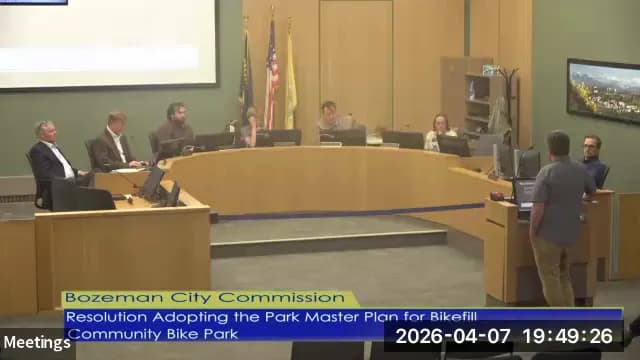
The Bozeman City Commission met on Tuesday, April 7, 2026, at 1:00 PM (MDT) in a regular meeting that included a mayoral proclamation, two special presentations, a public hearing and vote on the Bike Fill Community Bike Park master plan, and various administrative items. The meeting began with a brief technical delay to connect Commissioner Magic. Public comment was heard on several topics, including annexation zoning, women’s rights, sustainability, and the bike park. The commission approved the park master plan unanimously, along with consent agenda items and a board appointment. Consent Calendar - Minutes Approval: The commission voted 4-1 to approve the regular meeting minutes as submitted, with Commissioner Sweeney voting no. - Consent Agenda: Items G1 through G17 (fiscal year 2026, corrected from 2025 typos) were approved unanimously (5-0) after a public comment period with no speakers. Public Comments & Testimony - Heather Higgs (Harvest Creek resident): Opposed the requested R3/RB zoning for the Hanson Lane Annexation (25-775), arguing RA zoning is consistent with the growth policy and surrounding single-family density. Requested the city include the parcel in a consensus process and install traffic calming on the planned Fowler Avenue connector near Emily Dickinson Elementary. - Jan Strout (co-chair, Bozeman City for CEDAW Task Force): Celebrated the fourth anniversary of the CEDAW resolution and 11th anniversary of the Equal Pay resolution. Recommended intersectional analysis in the Equal Pay Report, use of best-practice research, and creation of a City Human Rights Commission. - Leana Bertelson (co-chair, CEDAW Task Force): Urged the city to collect intersectional data to inform training and resource allocation for women’s rights. - Gracianne Caldwell (CEDAW Task Force member): Supported a new Human Rights Commission to address safety and equity issues, citing personal experiences of harassment. - Mary Allen (Politics of Climate Change class): Recommended incentivizing green building certifications (e.g., LEED) for all new developments to reduce emissions, noting that 50% of Bozeman’s greenhouse gas emissions come from buildings. Suggested models from Boise, Rockville, and Greensburg. - Kylie (Politics of Climate Change class): Proposed a “reuse-first” policy for city-owned land, citing that adaptive reuse can reduce embodied carbon by 50-75% compared to new construction. - Public comment on Bike Fill Park (see Discussion Items): Six speakers expressed strong support, representing Bozeman Youth Cycling, Eagle Mount, Southwest Montana Mountain Bike Association, Gallatin Valley Land Trust, and individual advocates. One speaker requested annual bird surveys and respect for nesting seasons. Discussion Items - Mayoral Proclamation – Equal Pay Day: Mayor Morrison proclaimed March 26, 2026, as Equal Pay Day in Bozeman, recognizing the gender wage gap (nationwide 82 cents, Montana 84 cents per dollar) and urging continued action. - Equal Pay Progress Update: HR Director Cassandra Tozer reported that female city employees earned between 71% and 106% of male earnings in 2025 (depending on education level). Graduate-degreed women earned 106% of male counterparts. The city’s turnover rate dropped to 14% (from 35% in 2019). Paid parental leave usage was evenly distributed (35% female, 65% male). Challenges remain in lower-wage positions, where female representation increased by 17%. - Fire Department 2025 Annual Report: Chief Josh Waldo presented key stats: call volume increased in 2025 after a strategic reduction in 2022; EMS accounts for 46% of calls (below national average due to resource management). Response times: dispatch processing averaged 2 min 59 sec (above the 64-second national standard). The department added 12 firefighters via a FEMA SAFER grant, became accredited, and implemented a Quick Response Vehicle (QRV) that handled 20% of calls in Q1 2026. A new ladder truck is on order but not expected until 2028. Gaps remain in community preparedness and the need for Fire Station 4 in the southwest. - Bike Fill Community Bike Park Master Plan: Parks Planner Addie Jaden and GVLT’s Adam Johnson presented the plan. The park is located on former landfill land north of the solid waste facility, adjacent to Snowfill Dog Park. Key features: beginner zone near parking, progressive trails, one-way directional trails, a riders’ hub, boardwalk crossing over Churn Creek, and a 200+ foot riparian setback. The project has 800+ private donors, a $1.2 million city investment (including a $750,000 LWCF grant), and partnerships with GVLT, SWMTMBA, Audubon, Gallatin Watershed Council, and Eagle Mount. Public engagement included a survey with over 1,000 responses. The Urban Parks and Forestry Board unanimously recommended approval, with conditions including bird surveys and attention to native vegetation. Commissioner Sweeney disclosed her husband is a member of SWMTMBA but felt able to vote impartially. - Transportation Board Appointment: Commissioner Magic moved to appoint Grace Gilbert to the Transportation Board; no public comment was received. Key Outcomes - Votes: - Minutes approval: 4-1 (Commissioner Sweeney dissenting). - Consent agenda: 5-0. - Resolution adopting the Bike Fill Community Bike Park master plan: 5-0. - Appointment of Grace Gilbert to Transportation Board: 5-0. - Decisions: The commission adopted the park master plan, allowing staff to proceed with a site plan application, final design, and construction. The plan includes continued collaboration with environmental partners for bird surveys and riparian restoration. - Next Steps: Staff will refine the park design through a site plan application; the bike park is expected to open after construction. The city will continue monitoring equal pay metrics and fire response improvements. Commissioner Bodie requested a future work session on AI ethics in city operations. Other FYI - Commission FYI: Updates from Urban Parks and Forestry Board and Historic Preservation Advisory Board; Streamline’s 20th anniversary celebration; and the release of the third episode of the “Bozeman B” podcast on snowpack and water conservation. - Staff FYI: City Manager announced 14 transportation projects totaling $29 million for 2026, including the MSU Interceptor sewer line, safety improvements on College Street, and four new shared-use pathways. The city is on track to meet the DOJ’s April 24 deadline for ADA-compliant digital content.
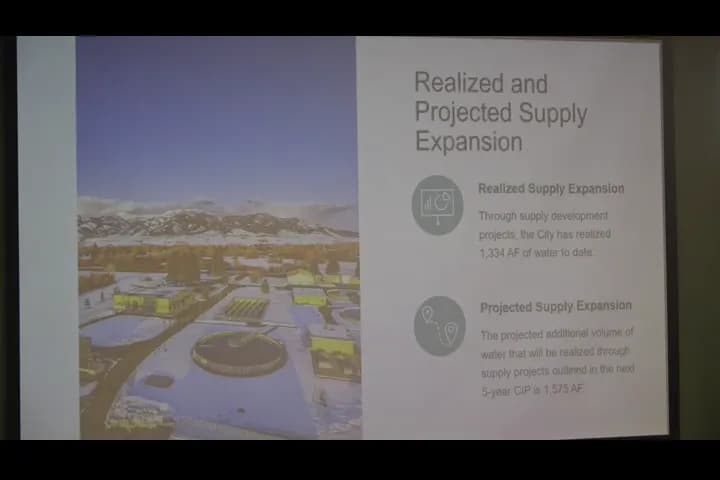
The Community Development Board (CDB) met on Monday, April 6, 2026, at 6:00 pm MDT to discuss a consent item, two special presentations, an action item to appoint a board representative, public comments on a non‑agenda item, and FYI items. All six present members voted unanimously on each agenda item. Board members were Joey Morrison (Chair), Erik Bonnett, Jason Delmue, Mark Egge, Lauren Mitro, and Chris Egnatz (arrived after roll call). Ben Lloyd was excused. Consent Calendar - Gran Cielo Phase 3 Major Subdivision (Preliminary Plat) – Application 25703: A 42‑lot subdivision (single‑family and townhouse/rowhouse) on 6.69 acres zoned R‑5, located northwest of South 27th Avenue and Bennett Boulevard. The board approved the consent item 6‑0 after a brief discussion clarifying that the project is reviewed under the old UDC, but individual lots will be subject to the new UDC at the building‑permit stage. Chair Morrison confirmed that minimum density requirements under R‑5 (old UDC) are being met. Public Comments & Testimony - Heather Higgs (city resident) – Opposed the proposed RB (high‑density) zoning for the Hanson Lane annexation parcel (Oak–Durston area), arguing that RA (medium‑density) is consistent with the growth policy and surrounding single‑family development pattern (≤ 6 units/acre). She noted that the site lacks transit and close community services and that RB would permit buildings over 40 feet. - Mike Roser (resident) – Cautioned against piecemeal zoning and development. He urged the board to consider the Fowler Road extension as part of a comprehensive plan for the area, including impacts on traffic, green space, setbacks, and storm drainage. - Laurie Wallace (Harvest Creek HOA member) – Described the proposed Fowler Avenue connector and requested that no annexation be approved without definitive traffic‑calming measures to protect student safety near Emily Dickinson Elementary School. She stated that RA zoning provides sufficient housing diversity and that RB/R3 is inappropriate. - Tom Gate (resident, since 1976) – Acknowledged the need for housing but urged balance; he supported considering the Fowler Road project in the full county context and called for traffic calming on Annie Street. - Mary Frances McHugh (Harvest Creek property owner) – Argued that RA is the most appropriate designation for the small parcel, that RB would allow 45‑foot‑tall buildings that tower over adjacent single‑family homes, and that RB is inconsistent with the urban neighborhood designation. Special Presentations - Integrated Water Resource Plan (IWRP) Update – Presented by Utilities Director Shawn Kohtz. The 50‑year water supply plan, originally adopted in 2013, is being updated to address changing needs. Highlights include: a technical and a public advisory committee both ranked environmental criteria as the top screening factor; a community survey ( 700 respondents) found 90% rated reliable water as very important, 83% stressed responsible growth management, and 70% emphasized irrigation efficiency. The city has realized 1,334 acre‑feet of water supply expansion and saved nearly 1,600 acre‑feet through conservation since 2013. Next steps: water‑advisory committee review of 40 supply alternatives, followed by a second round of community engagement. The board asked about conservation incentives (existing rebate program and developer credits) and how a low‑snowpack winter would affect work (planning began three years ago). - Landmark Program and Design Guidelines Update – Presented by Chris Saunders. Two related projects: (1) The local landmark program (phase 2) is developing a framework for voluntary/regulatory designations both inside and outside the NCOD. (2) The NCOD design guidelines (last updated 2006) are being updated for clarity and best practices. Upcoming engagement: open house April 13 (6–8 pm, Bozeman Event Space) and HPAB meeting April 15. Board members discussed the relationship between the two projects, whether NCOD boundaries might change, and how code updates can support restoration/rehabilitation (e.g., setback relief, administrative deviations). Action Items - Selection of CDB Representative to Planning Coordinating Committee (PCC) – Chris Egnatz was appointed 6‑0 to fill the board’s seat on the PCC, a tri‑jurisdictional communication and data‑sharing body (Bozeman, Belgrade, Four Corners). The PCC meets about six times per year. Board discussion clarified the PCC’s role versus the MPO (Metropolitan Planning Organization) and the opportunity for the representative to bring topics back to the CDB. Key Outcomes - Votes (all 6‑0): - Approved the February 23, 2026 meeting minutes. - Approved the Gran Cielo Phase 3 preliminary plat (consent item). - Appointed Chris Egnatz as the CDB’s representative to the PCC. - Next Meetings: The CDB will next meet April 20, 2026, with a public hearing on the Hanson Lane Annexation ZMA (zone‑map amendment) and a presentation from Economic Development Director Britt Funno. - FYI Items: The board received the City Commission’s 2026‑2027 priorities and welcomed new Associate Long‑Range Planner Collin Mieras.
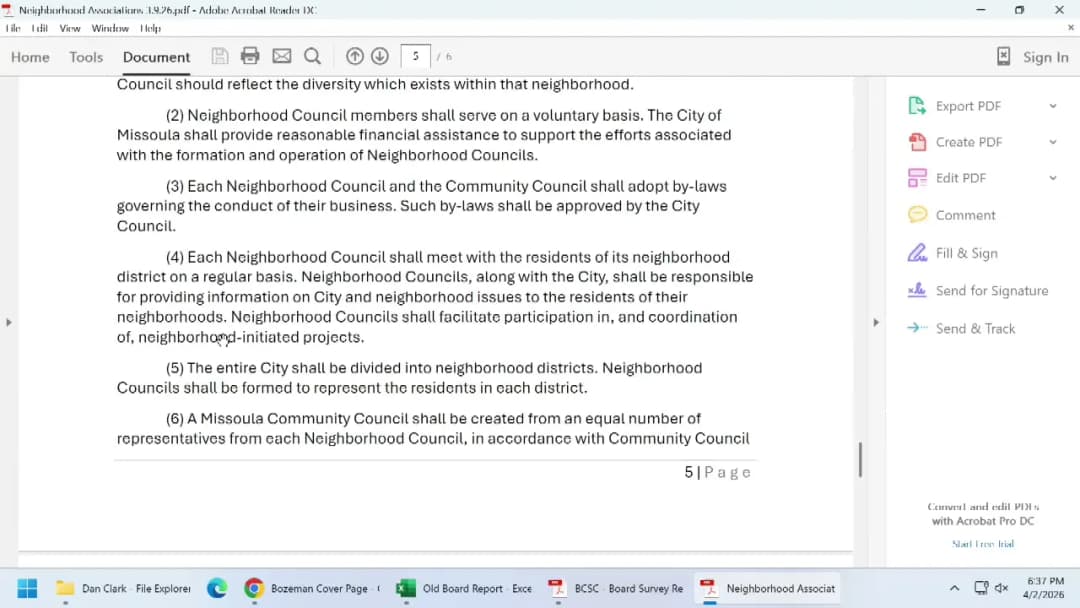
The Bozeman City Study Commission met on April 2, 2026, to receive public input, discuss city advisory boards with a panel of current and former members, and explore potential charter changes regarding wards, neighborhood associations, and board structure. The meeting spanned three rounds of public comment and included detailed analysis of board effectiveness, the "one‑body one‑voice" resolution, and civic engagement strategies. Consent Calendar - The commission approved the consent agenda (motion by Carson, seconded) with a 5–0 vote. Public Comments & Testimony - Abby Jones (Gallatin Valley Sentinel) argued that the city's representation problems are systemic, not isolated. She stated that at‑large voting creates a geographic monopoly on the commission, Resolution 5323 ("one‑body one‑voice") prevents advisory boards from offering independent advice, and the Inter‑Neighborhood Council (INC) lacks real influence. She urged ward‑based representation for both the commission and advisory boards. - Gracianne Caldwell advocated for public campaign financing via a voucher system, proposing two $5 vouchers per Bozeman resident (total cost $600,000). She pointed to Seattle's Democracy Voucher program and noted that vouchers boost voter engagement and shift candidates' focus from large donors to ordinary residents. - Dan (Bozeman resident) recommended adding a statement of intent and purpose to the charter's section on boards. - Mark Campanelli (Bogert Park Neighborhood Association) lamented the city's loss of civic soul, warned against excessive "consent," and suggested ethics training should teach how to disagree respectfully. - Pam Bodie praised the idea of legitimate advisory boards and urged the commission to consider Great Falls' model where neighborhood‑council officers are elected in general elections to increase turnout. - Mary Bateson advocated for retaining at‑large voting so citizens can vote for the most qualified candidates regardless of address, citing the risk of uncontested elections in ward systems. - Online – Amy Hoytzma (Northeast Neighborhood Association) stated that consolidating many advisory boards into fewer "big five" boards reduced participation because smaller, topic‑specific boards were more inviting. She supported restoring multiple boards. - Online – Zara Osman (West Bozeman; Valley Unit Neighborhood Association steering committee) argued that neighborhood associations are a better alternative to wards because they organically represent local interests. She called for more city investment (e.g., using utility‑bill email lists) and recommended a community‑engagement board. - Online – Amy Hoytzma (second comment) described the tension between being an arm of the city vs. a neighborhood advocate, noting that her association was formed in opposition to a city transfer‑station plan. She also recounted unsuccessful attempts to split the large Northeast boundaries due to internal disagreements. - Online – Zara Osman (second comment) elaborated that neighborhood associations should not be treated as mere advocacy groups; she explained how her association uses polls and surveys to ensure representation and urged treating them as legitimate partners. Discussion Items Panel Discussion on Advisory Boards Panelists: Jeff Krause (former mayor/commissioner), Danielle Rogers (Chair, Economic Vitality Board), Jason Delmu (Vice Chair, Community Development Board; former bike‑board chair) - Jeff Krause contrasted the historical proliferation of specialized volunteer boards (e.g., bike board, climate action board) with today's consolidated "big five" structure. He argued that the earlier informal, peer‑to‑peer atmosphere encouraged civic entry‑level engagement and provided a "watchdog" function (e.g., the now‑defunct Audit Committee). Krause criticized the barriers now faced by citizens – lengthy wait times and intimidating formal hearings – and stressed that boards should be a bridge between the public and government. He advocated for re‑creating more volunteer opportunities and for a charter that explicitly states the purpose of boards: "broaden and deepen" public participation. - Danielle Rogers described her board's substantial review work. She noted that the "one‑voice" rule (Resolution 5323) does not limit debate within boards but applies after policies are adopted. She identified participation barriers: meetings from 6–8 PM with no hybrid option, lack of child care, and inadequate onboarding regarding ethics, safety, and conflict of interest. Rogers recommended better training and more accessible meeting formats. - Jason Delmu supported board consolidation for fostering a system‑wide perspective but suggested periodic joint board work sessions on overlapping issues (e.g., land‑use and transportation). He stated that board input is generally listened to by the commission, but boards could proactively raise topics. He echoed calls for more accessible meetings and improved outreach. - Commission interaction: Commissioners queried the panel about board selection processes, term limits, and what charter provisions are needed. The discussion highlighted the need to codify the purpose and intent of boards rather than merely permitting them. Presentation on Wards, Districts, and Neighborhood Associations (Consultant Dan) - Dan presented a comparative analysis of Montana city charters (Helena, Great Falls, Billings, Butte, Missoula) and academic effectiveness criteria for neighborhood councils: (1) two‑way communication, (2) increased resident input into planning and budgeting, (3) acting as a legitimate advisory body rather than an advocacy group, and (4) building neighborhood‑level leadership capacity. He offered sample charter language incorporating these elements. - He cautioned that Helena's experience shows how unclear purpose and perceived "independence" can lead to friction between neighborhood councils and the city commission. - Commissioners debated whether to adopt wards, the relationship between ward boundaries and neighborhood association areas, and the risks of gerrymandering and frequent boundary adjustments. Some argued that a ward system could improve geographic representation; others defended at‑large voting as more open. - The group discussed whether the charter should mandate full city‑wide coverage by neighborhood associations, or retain the current organic approach. The need for mechanisms to adjust boundaries over time was also raised. Follow‑up Discussion on Next Steps - Commissioners agreed to review Resolution 5323 (the "one‑body one‑voice" resolution) at the next regular meeting and to consider including recommendations about it in their report. - An additional meeting was scheduled for April 24 to continue working on charter amendments and to respond to a survey request from the Gallatin Valley Sentinel. Key Outcomes - Consent agenda approved 5–0. - Next regular meeting: April 15, 2026, at 4–5 PM (regular business), followed by a discussion with County Commissioner Zach Brown from 5 PM on topics including commissioner compensation, vacancy filling, district representation, and redistricting. - Additional meeting set: April 24, noon–2 PM (potentially til 3 PM), to deliberate on charter language and address the sentinel's survey request. - Staff directed to distribute copies of Resolution 5323 to commissioners for review before the April 15 meeting. - No binding votes were taken on substantive charter changes; the commission will continue fact‑finding and deliberation ahead of issuing final recommendations.
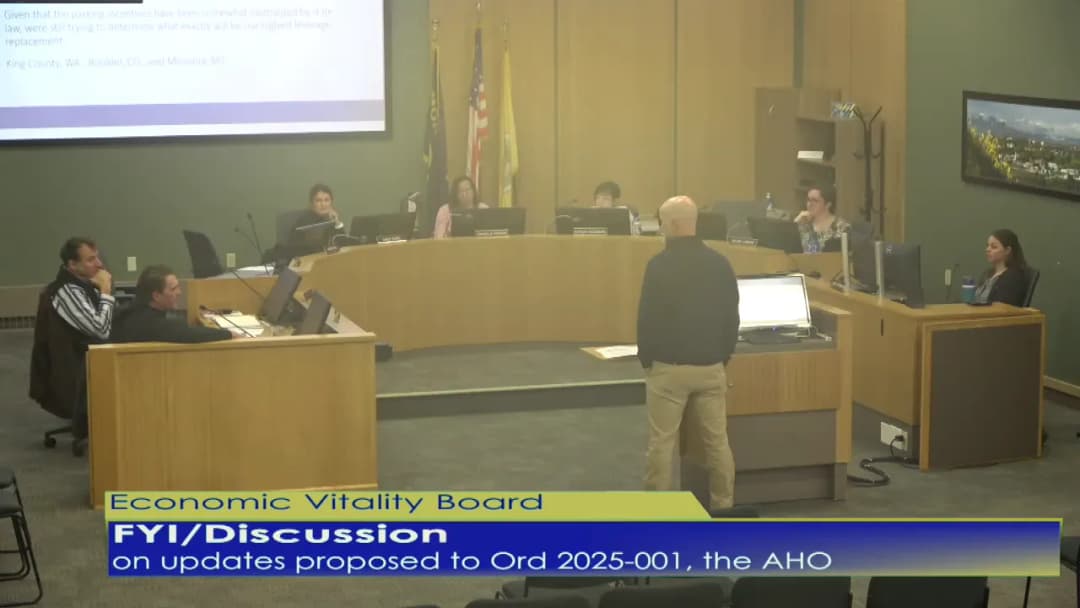
On April 1, 2026, the Economic Vitality Board (EVB) of Bozeman, Montana, convened at 6:00 PM to discuss proposed updates to Ordinance 2025-001, the Affordable Housing Ordinance (AHO). Presenters Brian Guyer (Community Housing Manager) and Brit Fontenot (staff) outlined five major updates aimed at improving clarity, flexibility, and alignment with market conditions and state legislation. The meeting included disclosures from the Chair and a brief FYI segment on upcoming city commission items. No public comments were received, and no formal votes were taken; the item was for discussion only. Disclosures - The Chair stated involvement in a petition to the City Commission requesting a reduction of the height allowance in the B3 zone from 90 feet back to 60 feet, citing concerns about leveraging additional height for affordable housing. The Chair also authored a recent guest column in the Bozeman Daily Chronicle regarding the neighborhood conservation overlay district and affordable housing. Discussion Items - Addition of For-Sale Housing Provisions: The current AHO only addresses rental units and cash-in-lieu. Staff proposed creating a separate framework for for-sale units, as stewardship of for-sale affordable units (e.g., resale formulas, buyer qualifications) is more challenging for the city. A consultant from EPS (Denver) has been engaged to develop a cash-in-lieu formula for for-sale units that may consider unit price or square footage rather than just bedroom count. - Cash-in-Lieu Amount Update: The City Commission recently approved a formula for rental cash-in-lieu based on the difference between average new construction rental rates and established affordable rates, multiplied by 20 years. For a one-bedroom unit at 60% Area Median Income (AMI), this results in approximately $200,000. The funds are flexible and can be used for gap financing on LITEC projects, down payment assistance, or other housing priorities. - Creation of a LITEC Track: Staff identified redundancies between city requirements and federal Low-Income Housing Tax Credit (LITEC) guidelines. For example, the city requires 5% of units to be affordable at 60% AMI for Type A incentives, but LITEC projects are often 100% affordable. A LITEC-specific track would allow federal compliance documents to satisfy local requirements, streamlining approvals. Approximately 1,100 LITEC units are in the pipeline, with Bozeman hosting the majority of 4% LITEC projects in Montana. - Replacement of Type B Parking Incentives: State law effective October 2026 eliminates minimum parking requirements for affordable housing projects, rendering the AHO's parking incentives ineffective. Staff is exploring replacement incentives such as expedited review, a cap-and-trade model, or other code adjustments, but noted that options like reduced landscaping requirements provided insufficient value. - Streamlined Ordinance Update Process: Staff proposed a more predictable update process, potentially triggered by annual HUD data changes or market shifts, to avoid delays. The update process will involve multiple board reviews before final adoption by the City Commission. Key Outcomes - No formal votes were taken; the board provided feedback and asked clarifying questions. Staff will incorporate input and present a more complete draft to the EVB at a future meeting (likely summer 2026). - Next steps include a work session with the Community Development Board, followed by a return to the EVB for further review, then final approval by the City Commission. - Staff will keep the EVB informed as the ordinance update progresses. FYI & Upcoming Events - Deputy Mayor noted upcoming City Commission items: April 14 work session on pedestrian and traffic safety, and April 28 discussion on commission priorities. - Brit Fontenot announced an April 21 special presentation on an economic impact analysis of the Yellowstone Fiber Network, which will be shared with the board. - Belonging in Bozeman topics are expected before the EVB in the next one to two months.