The Bozeman City Commission met in regular session on Tuesday, October 20, 2026, at 6:00 p.m. in the Commission Room at City Hall, with in-person and online participation. Mayor Morrison presided. The meeting, extended to about 10:45 p.m., included a lengthy consent agenda with heavy public testimony on an Axon contract, general public comment, a victim services presentation, approval of the BRC North Loop annexation, and adoption of two board governance resolutions. The Northwest Bozeman Area Plan work session was moved to the following Tuesday. FYI & Disclosures - Commissioner Sweeney noted that October 15 marked 60 years of the National Historic Preservation Act, cited Montana's more than 11,000 National Register listings, and urged opposition to proposed Section 106 rule changes and permitting reform. Commissioner Magic thanked city crews for post-snowstorm cleanup. Commissioner Bodie reported that the Sustainability Board supports applying lessons from the Bozeman Creek Vision Plan to the Northwest Bozeman Area Plan and noted public comment on dark-sky regulations. Staff announced that phase one of Fowler Road construction will begin soon, with an open house scheduled for November 2 at Fire Station 3. - Commissioner Sweeney disclosed that multiple family members live in the Northwest Bozeman Area Plan planning area. Consent Calendar - The Commission approved the consent agenda 5-0. The motion referred to F1–F15, while the published agenda listed F1–F13. - Routine items included accounts payable, a nuisance abatement contract, a Multihog utility vehicle purchase, an Axon equipment agreement, park design services, MSU Extension governance support, a snow removal amendment, wayfinding signage, a Parking Vision amendment, a Meadow Creek payback assignment, pedestrian crossing and lighting change orders, transfer of a City-owned Ford Taurus to Belgrade, and final adoption of a water adequacy ordinance. - Item F.4, the Axon Enterprise agreement for body-worn cameras, patrol vehicle cameras, conducted energy devices, and digital evidence management, drew extensive discussion and public comment. Commissioner Bodie stated that the body cameras do not have facial recognition, that automatic license plate reader capability will not be enabled, and that the data is confidential criminal justice information. She expressed reservations but voted for the item, and requested that the City Manager bring forward an AI and surveillance technology policy and include a surveillance/technology section in BPD's quarterly report. - After a long public comment period, the consent agenda passed 5-0. Public Comments & Testimony - On consent item F.4, more than 25 people spoke in person and online in opposition. Speakers included Daisy Berci, Nolan Verrill, Jack Hayward, Chase Creighton, John Garrett Grimm, Carl Brandenberger, Julian, Charles Miller, Homamassud, Riley Ophis, Natsuki Nakamura, Daniel Cardi, Nicholas, Alana Selinger, Skylar, Zane Haroldson, Anthony Smith, Matthew Thomas, Kiki Hulls, Izzy Burkoltz, Joan Henderson, Lita Kiefer, Harry Seaton, Taylor Pujunen, and Taylor Dean. - Recurring positions included opposition to spending approximately $2.4–$2.5 million with Axon; concerns about mass surveillance, privacy, and cloud storage; allegations of Axon's connections to ICE, DHS, and military/defense users; skepticism that facial recognition and ALPR features would remain disabled; criticism of contract terms such as auto-renewal and liability limits; and calls to table the item and investigate alternatives such as Axis Communications. Several speakers referenced Axon's recent $220 million ICE contract and said voting for Axon would contradict commissioners' previous statements about the military-industrial complex. - Charles Miller, an MSU computer science student, noted BPD reports processing approximately 200,000 pieces of electronic evidence annually and questioned whether that workload justifies the contract. Natsuki Nakamura questioned how the technology improves accountability and referenced past police shootings. Anthony Smith cited four deaths in the valley, criticized police training and de-escalation, and said lawsuits against the city will exceed the contract cost. Harry Seaton, speaking for the ACLU of Montana, cited Axon's ethics board resignations, data integration risks, and Montana's 90-day data retention period. Taylor Pujunen, recently back from the West Bank, asked the Commission to delay the vote. - During general public comment on non-agenda items, Izzy Watson, government affairs director for ASMSU, updated the Commission on appointing six ex officio MSU student members to city boards. Anthony Smith announced federal civil rights litigation against Bozeman officers and the City, named plaintiffs, and criticized the Mayor. Kyla Corota urged an urban bear management policy, noting that 14 black bears were euthanized north of Bozeman in September. Several MSU students and other speakers expressed frustration that public comment on Axon had not changed the outcome and criticized the consent process and the Commission's responsiveness. - On the board amendment item, Natsuki Nakamura, an Economic Vitality Board member, said removal of public art and beautification awards was disappointing and raised concerns about narrowing the board's mission and about body-camera community engagement. No public comments were made on the BRC North Loop annexation or the board standards resolution. Special Presentation: Victim Services - Chief Prosecutor Becky McClain introduced Victim Services Coordinator Mandy Noonan and Victim Advocate Selena Richardson, the city's first victim advocate. They described advocate duties including case notifications, witness coordination, referrals, and victim input on plea agreements. They presented caseload data showing 44% of new victim cases were assaults, 37% were partner or family member assaults/domestic violence, and 19% were other charges. They also described the victim services suite, including a children's room, secure door monitor, and duress buttons. No public comment was taken. Action Items - I.1 BRC North Loop Annexation: Staff planner Tom Rogers presented an annexation of 2.002 acres at 2777 North 7th Avenue, formerly PDI Investments. The property remains an unannexed island, and water and sewer connections are now adjacent. The Commission affirmed the prior approval, adopted the annexation resolution, and provisionally adopted the B2 zoning ordinance. Commissioner Sweeney flagged a state code citation referencing pre-MLUPA statutes that should be corrected before second reading. All three motions passed 5-0. No public comment was offered. - I.2 Board Resolutions: Assistant City Manager Cola Rowley presented amendments to the Economic Vitality, Sustainability, Urban Parks and Forestry, Transportation, and Community Development Boards. Changes included removing term limits, adding an ex officio MSU student member, and cleaning up pre-MLUPA language. The Commission discussed public art, the belonging and Bozeman work, and capital improvement plan input. It adopted the resolutions as amended 5-0 and directed the Economic Vitality Board to consider whether the belonging and Bozeman work would be best advanced by a separate board and to report back with a recommendation. - I.3 Board Standards Resolution: The Commission adopted the high performing boards resolution, establishing standards for recruitment, selection, communication, duties, and behavior for appointed boards. It approved an amendment deleting the phrase 'to the commission for the board' from the commission liaison's 'serve as a contact rather than an advocate' duty. Staff will create a presentation for commission liaisons to brief existing board members. Passed 5-0. Work Session - The Northwest Bozeman Area Plan work session was postponed to Tuesday, October 27, 2026, due to the length of the meeting. Key Outcomes - Consent agenda approved 5-0, including the Axon contract, with the motion referencing F1–F15 while the agenda listed F1–F13. - BRC North Loop annexation: prior approval affirmed, annexation resolution adopted, and provisional zoning ordinance adopted, all 5-0. - Board amendment resolutions adopted 5-0 as amended. - Board standards resolution adopted 5-0 as amended. - Economic Vitality Board asked to report on whether belonging and Bozeman work should move to a separate board. - Mayor apologized to Anthony Smith for an inappropriate reaction during public comment. - City Manager agreed to explore earlier distribution of draft agendas and to follow up on Commissioner Sweeney's concerns about consent item timing and access to staff.
Public Meetings - Bozeman, Montana
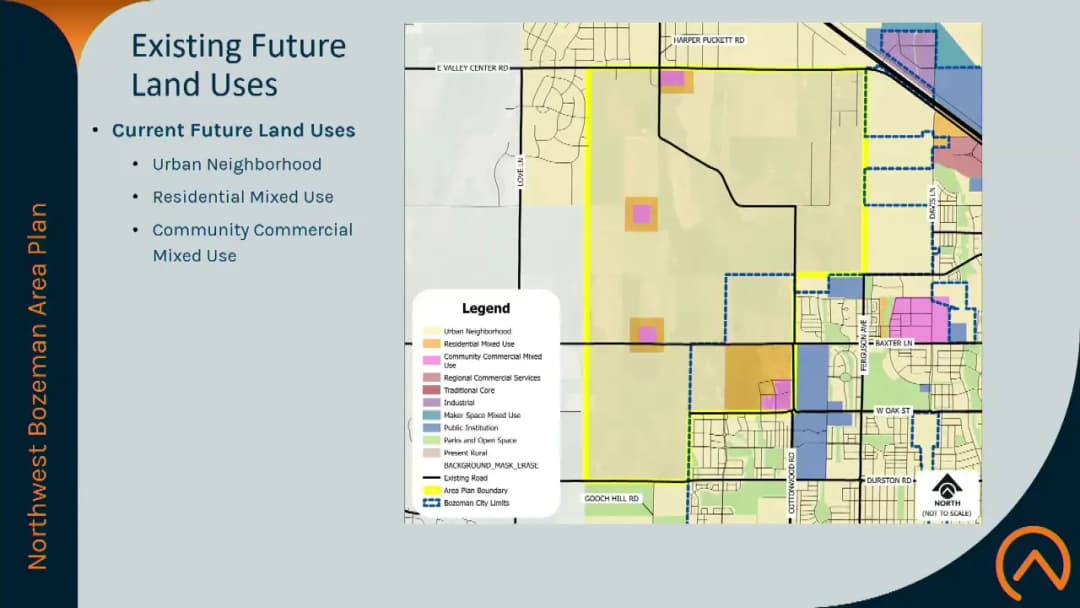
Public Meetings - Bozeman, MontanaThis meeting of the Bozeman Community Development Board featured two special presentations: the Northwest Bozeman Area Plan and an update on the Cash in Lieu of Water Rights Fee. No action items were on the agenda. Public comments were received on the area plan. Consent Calendar - Approval of Minutes (Ruffalo): The board approved the minutes from a previous meeting with a 5-0 vote (motion by Lloyd, second by Delnew; all ayes: Mitro, Delnew, Lloyd, Agben, and Iggy (via remote)). Public Comments & Testimony - Kiki Hulls (4833 Glenwood Drive, representing the Laurel Glen Association): Expressed concern that the Northwest Area Plan lacks designated parks and public facilities (schools, libraries, recreation). Criticized the proposed road alignment along Gooch Hill, arguing it encroaches on dense wetlands and creeks near Laurel Glen. Stated that the community outreach process was inadequate; HOA managers did not receive notification emails. Questioned the plan's purpose if it mostly defers to landowners. - Deb Lewis (1133 Saxon Way, Laurel Glen): Expressed opposition to development in the area, citing wildlife (hawks, eagles, coyotes, pheasants, sandhill cranes) and a sandhill crane mating area. Questioned who would pay for infrastructure (roads, sewers, schools, police, fire) — developers or taxpayers. Opposed building on wetlands. Noted that traffic on Durston Street has increased “20 or 30 fold” in ten years and is used as an escape route to Huffine, creating congestion; argued that only two east-west corridors (Durston and Baxter) feed into Love Lane, which is a two-lane road needing modifications. - Trish McAllen (4841 Glenwood Drive, 3): Opposed the proposed road alignment near her home of 22 years; stated that Durston and Gooch Hill intersection is already dangerous, with frequent wrecks in snow. Expressed concern that the road plan has not been studied adequately and would harm the wildlife corridor. Discussion Items - Northwest Bozeman Area Plan (Chris Nauman, Sandbell Planning): - Presented a high-level 3,000-acre plan as an amendment to the 2025 Bozeman Community Plan. The plan is a guiding document, not a development plan, and does not initiate annexations. Five planning objectives align with the Community Plan’s seven themes. - Framework elements include: natural resources (creeks, wetlands, riparian areas, 25%+ slopes) with regulatory setbacks; proposed collector/arterial roads (some alternate alignments to avoid wetlands compared to 2017 TMP); active transportation network (trails from 2024 Pratt Plan); and future land use nodes (commercial mixed-use at arterial/collector intersections, including a corridor concept). - GIS suitability analysis suggested relocating some commercial mixed-use nodes and extending residential mixed-use corridors. The plan does not specify densities, population projections, or park locations; parks are addressed in later subdivision/annexation processes. - Process: Public draft released Oct 8; presentations to Transportation Board, County Planning Board, Sustainability Board; work session with City Commission Oct 20; revised final draft expected early Nov; public hearing at CDB Nov 16; City Commission adoption Dec 15. - Board members asked about coordination with Belgrade, Gallatin County, MDT (future interchanges), and the need for nodes and open space. Staff noted that future land use map amendments are possible and that the plan is “at 50,000 feet.” - Cash in Lieu of Water Rights Fee Update (Todd Gaston, Westwater Research; Sean Coates, Utilities Director): - Current fee is $6,000 per acre-foot (set in 2008). The recommended updated fee ranges from $11,600 to $14,500 per acre-foot of reliable yield, with a midpoint of $13,000. For a single-family unit (0.234 acre-feet per year), this translates to about $3,000 per home (currently $1,400). The fee covers water rights acquisition only, not infrastructure. - Three valuation perspectives were used: full cost recovery (inflation/adjusted cost of city's existing pool), fair market value (current water rights prices in Gallatin Valley: $9,000–$15,000/acre-foot), and cost of developing new water rights. - The recommended fee is well below the peer average (0.4% of median home price vs. 1.6% average). Staff suggested the fee could be phased in over 3–5 years. - Board discussed water usage per household (0.234 acre-feet, based on 10-year average from 2011, noting newer homes use more due to automated irrigation; multi-family units are about half that). Questions about reliable yield and climate change adjustments were addressed — each water right must be evaluated individually; the fee assumes 49/50 year reliability. The City’s integrated water resources plan (IWERP) is looking 50 years out. Key Outcomes - The board received both presentations as informational; no action was taken. - Staff noted a correction: the next meeting (Nov 2) will feature a presentation on the Downtown Urban Renewal Plan consistency review, not the area plan public hearing (scheduled for Nov 16). - Public comments were heard and will be considered in the plan's final revision. - The board expressed general support for the fee update approach; a formal recommendation may come at a future meeting after more discussion.
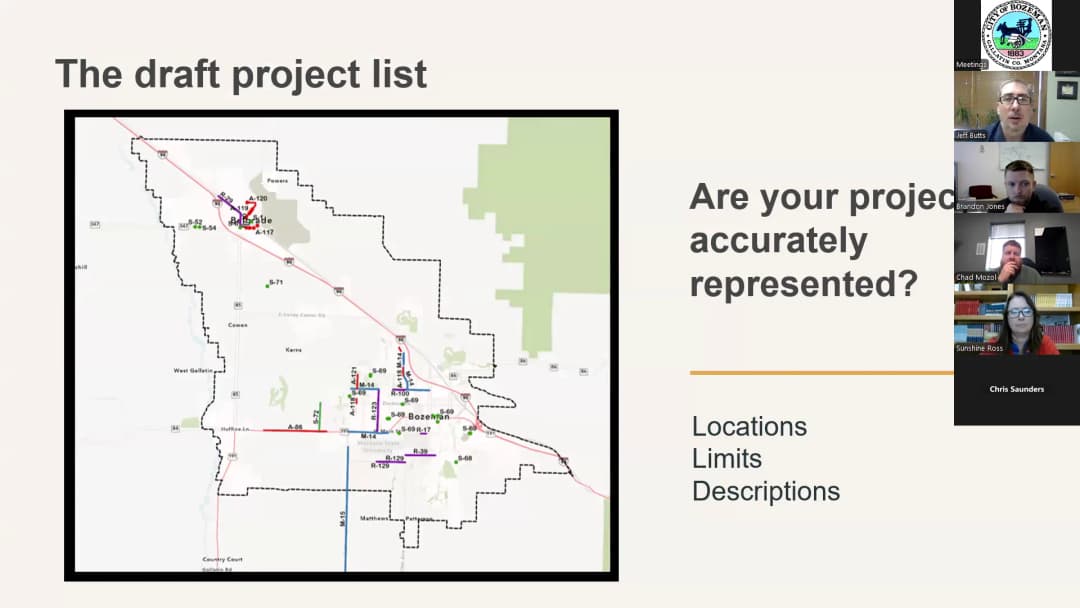
The Gallatin Valley Metropolitan Planning Organization (MPO) Transportation Technical Advisory Committee (TTAC) met by videoconference on Wednesday, October 14, 2026. According to the agenda, the meeting was scheduled to begin at 10:30 a.m. The committee took roll call, approved the August 12, 2026 meeting minutes, and received no public comments. The main business was the first review of two draft planning documents: the Federal Fiscal Years (FFY) 2027–2031 Transportation Improvement Program (TIP) and the draft Long Range Transportation Plan (LRTP). Both items were informational first reviews; no motions were made on either plan. Consent Calendar - The committee approved the August 12, 2026 TTAC meeting minutes by voice vote; Sunshine Ross seconded the motion. Public Comments & Testimony - No public comments were offered during the general public comment period or in connection with the TIP or LRTP agenda items. Discussion Items - First review – Draft FFY 2027–2031 TIP (presented by Jeff Butts): The TIP is the MPO's first locally developed TIP and carries forward existing projects from the statewide TIP. It includes 24 unique roadway and bridge projects plus programs and transit, with about $170.9 million in programmed revenue over the five-year period extending to 2031. Roadway projects total about $130.9 million, with the remainder covering transit and programmatic funding. Funding sources include STPU urban funds, federal discretionary grants, MPDG (described as a rural development grant), Transportation Alternatives, and Section 5307 transit funds. Examples cited included Belgrade Main Street reconstruction (about $1.2 million programmed total, with roughly $612,000 previously programmed and $511,000 newly programmed), Kagy Boulevard reconstruction in Bozeman (about $42.5 million total, including $14.2 million in STPU funds), three Bozeman-area Transportation Alternatives projects (about $1.6 million), and Section 5307 transit operations ($13.8 million over five years; annual federal allocations just under $1.5 million against about $2.7 million in annual operating costs). Jeff Butts said the TIP must be adopted by December 26, 2026. Written comments were requested by October 20, 2026; the item will go to TPCC on October 28, 2026 and return to TTAC on November 5, 2026 for a recommendation. A public review period of at least 14 days, with a possible 30-day window, is planned before TPCC adoption on December 16, 2026. - First review – Draft LRTP (presented by Jeff Butts): The LRTP has been under development for about two years with consultant Nelson Nygaard and with input from TTAC, TPCC, the Community Advisory Panel, and community outreach including pop-up events and surveys. The draft includes goals and objectives, scoring criteria, project lists, and policy and program chapters. Project lists were built from the Statewide TIP, the Trails Plan, Belgrade and Bozeman transportation master plans, a spring 2026 call for project concepts, and a public workshop, including a Four Corners trail request added to the illustrative project list. Draft policies discussed include Complete Streets, context-appropriate speeds on highways entering growing communities, self-enforcing design near schools, and an open-streets event concept. Remaining technical work includes alternatives analysis, environmental considerations, and existing-conditions requirements. In committee discussion, one member asked about post-adoption public outreach; staff described a planned 30-day public review period, website and event outreach, and Community Advisory Panel engagement. A member suggested contacting OLLI (Osher Lifelong Learning Institute) for a presentation, and Belgrade staff said the city's communications director could share MPO information through city social media. Sunshine Ross expressed appreciation for the strong inclusion of transit in the plan and for the collaborative process. Comments on the draft were requested by October 20, 2026, with TPCC review on October 28, 2026, a recommendation requested from TTAC on November 5, 2026, and adoption planned at TPCC on December 16, 2026. General Discussion - The chair reported on a Montana League of Cities session by MDT's John Swartz and Doug McBroom, stating that MDT this year lacked enough state match funds to use all available federal redistribution funds—about $40 million in redistribution funds were turned back, representing roughly $4.5 million in matching funds at a 13% match rate. The chair asked whether local governments could provide matching funds to capture such funds. Brandon Jones noted there is precedent for local match on projects such as Belgrade Main Street and Kagy Boulevard, though he was not sure it had been used in lieu of state match to salvage the HEZRA account. The chair said he would investigate further with MDT. - A committee member asked MDT about the newly adopted administrative rule implementing Senate Bill 533 on state-level residential system impact fees (rule 18.5.204, notice 2026-3-19.2). A staff member said they would research whether MDT would take an active or wait-for-application approach and report back. Key Outcomes - No formal action was taken on the TIP or LRTP; both remain in first-review status. - The August 12, 2026 meeting minutes were approved. - Next steps: TTAC and public comments are due by October 20, 2026; TPCC will consider both documents on October 28, 2026; TTAC must have a quorum at its November 5, 2026 special-schedule meeting to recommend adoption; the TIP must meet the December 26, 2026 federal deadline; TPCC adoption is planned for December 16, 2026.
The Bozeman Sustainability Advisory Board convened on October 14, 2026, to discuss the Northwest Bozeman Area Plan and the Bozeman Creek Vision Plan. The board received staff updates, approved the September meeting minutes, and heard public testimony on development pressures and wetland conservation. Public Comments & Testimony - Non-Agenda Items: Kiki Hulls, a Bozeman resident, asked about the city's dark sky ordinances and coordination with the county regarding light pollution from a storage facility. - Northwest Bozeman Area Plan: - Kiki Hulls, a resident on the western edge of the city, provided historical context on a 150-acre property purchase, stated that 62% of Bozeman's original wetlands have been lost, advocated for 150-foot riparian setbacks, and questioned how the city will ensure plan aspirations for parks and natural areas are enforced rather than developed. - Deb Lewis, a resident of the Laurel Glen area, raised concerns about significantly increased traffic on Durston Road and Love Lane, the lack of safe pedestrian and bicycle infrastructure for east-west travel, and suggested the city analyze existing housing vacancies before expanding into greenfield areas. Discussion Items - Northwest Bozeman Area Plan (J.1): Chris Naumann (Senior Planner, Sandbell) presented the draft plan for the approximately 3,000-acre planning area. The presentation emphasized a framework driven by natural resources, proposed adjusting future land use densities to arterial corridors, and introduced alternative street alignments to minimize wetland impacts. Sean Coates (Utilities Director) confirmed the Gooch Hill sewer lift station is in very early preliminary design stages with no site identified. Board members discussed the economics of infill versus annexation, the importance of protecting mature trees and wildlife corridors, the need for walkable neighborhood design, and the potential for new roads to significantly impact wetland complexes. - Bozeman Creek Vision Plan (J.2): John Henderson (Assistant City Manager) presented the vision plan, created in partnership with the grassroots organization C Bozeman Creek. The plan is driven by flood mitigation, proposing an engineering solution to divert up to 750 cubic feet per second (CFS) into Mill Ditch to handle a 100-year-plus flood event (1,250 CFS), while upgrading downtown structures to carry 500 CFS. Concept designs include daylighting portions of the creek through Rouse Street and in front of City Hall, and reconfiguring Bogart Park. Policy recommendations focused on flexible setback standards and city resources for proactive creek stewardship. Board members voiced strong support for the vision, raised concerns about downstream water temperature impacts on fish from the diversion, urged creative parking solutions, and requested copies of the presentation for review. Key Outcomes - Minutes Approved: The board unanimously approved the meeting minutes from September 9, 2026. - No Formal Action: Both agenda items were FYI/Discussion items. No votes were taken. Board feedback will be directed to staff for consideration in the plans' next drafts. - Next Steps: - A public open house for the Bozeman Creek Vision Plan is scheduled for November 9, 2026. City Commission consideration for plan adoption is targeted for December 15, 2026. - The next public draft of the Northwest Bozeman Area Plan is expected in early November, with a public hearing before the City Commission scheduled for December 15, 2026. - The City Commission will discuss advisory board structural changes at an October 20, 2026 work session.
The Historic Preservation Advisory Board convened on Tuesday, October 13, 2026, at 6:00 PM. The primary agenda item was a work session to review and discuss draft revisions to the Bozeman Municipal Code related to historic preservation. No minutes or transcript of the meeting were available, so details on discussion points, public testimony, and any decisions are not reported. This summary is based solely on the published agenda. Discussion Items - Work Session on Draft Revisions to Municipal Code (Burke): The board held a work session to review proposed changes to the historic preservation sections of the city code. No further information is available. Key Outcomes - No votes or formal actions are recorded due to the lack of meeting documentation.
This is a summary of the Inter-Neighborhood Council (INC) of Bozeman, Montana, held on Thursday, October 8, 2026. The meeting convened at 4:30 p.m. in the City Commission Room and via video conference, and covered routine approvals, public comment, and updates from neighborhood representatives, city staff, and the commission liaison. Consent Calendar - Minutes from the September 10, 2026 regular meeting were approved by unanimous voice vote. The motion was made, seconded, and passed with no public comment or opposition. Public Comments & Testimony - No public comments were offered during the public comment period for non-agenda items. No members of the public provided comment. Discussion Items - Neighborhood Written Updates & Follow-Up Questions: INC representatives provided updates from their neighborhood associations. Kathy Rich reported on the University Neighborhood Association; Beth Boyson reported for New Highlight View Neighborhood Association; Alexandra Lewis Lorenz reported for Valley Unit Neighborhood Association; Dan reported for the Marvin edition. A representative, Emily Mason, joined online for the Fighters Edition but did not give a report. No actions were taken on the updates. Key Outcomes - Approved the September 10, 2026 regular meeting minutes by voice vote. - Board member disclosure: Dan disclosed that he is married to a member of the legislature, Brian Colson. - The meeting was formally called to order and public comment procedures were reviewed. Next Steps - No specific future action items were identified in the portion of the meeting covered by this transcript. [Date: October 8, 2026]
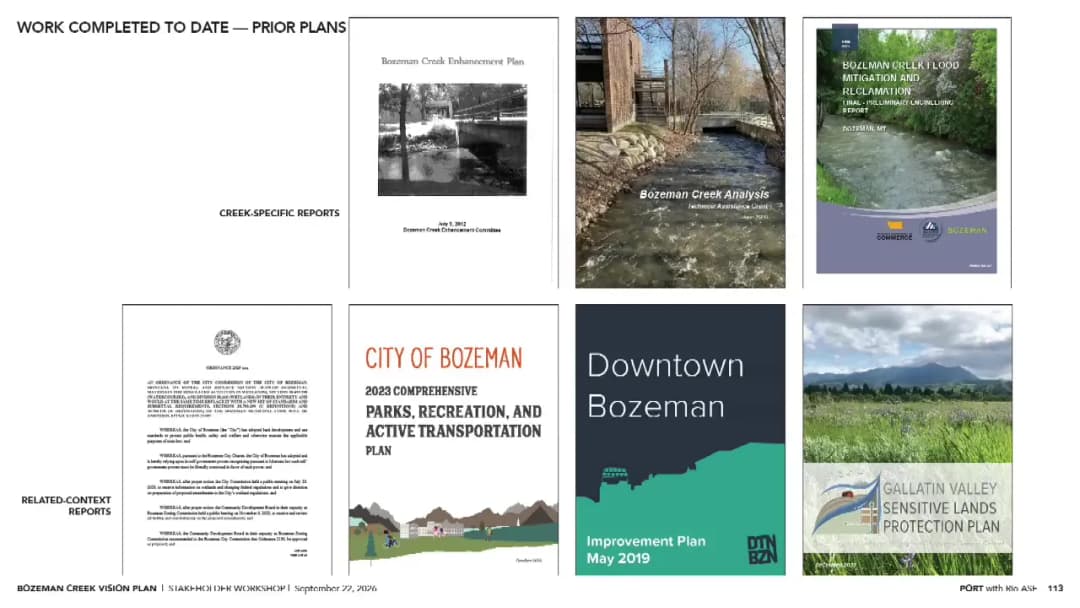
The Economic Vitality Board of Bozeman, Montana, met Wednesday, October 7, 2026, from 6:00 PM to 7:28 PM. After routine approvals, the board heard a work-session presentation from Assistant City Manager John Henderson on the Bozeman Creek Vision Plan. Board members asked detailed questions on flood modeling, costs, funding, property acquisition, water rights, and the city's partnership with C. Bozeman Creek. The board took no formal action on the plan. Consent Calendar - The board confirmed no disclosures and no changes to the agenda. - The board approved the August 5, 2026, and September 2, 2026, Economic Vitality Board meeting minutes by unanimous vote. Public Comments & Testimony - No public comments were offered during the non-agenda public comment period. - At the end of the presentation, Steve Noble, a Bozeman resident and co-leader of C. Bozeman Creek, spoke in support of the plan. He described the group as citizens advocates with no economic interest in the project and highlighted the productive collaboration with city staff, especially John Henderson. Noble said the group has been patient and persistent for about six or seven years and believes that persistence is beginning to pay off. Discussion Items - F.1 Bozeman Creek Vision Plan work session: Henderson presented the history, community engagement, and recommendations for the Bozeman Creek Vision Plan. - The plan began as a City Commission priority in 2024; it builds on the 2012 Bozeman Creek Enhancement Plan and a 2025 engineering analysis. It is being developed with C. Bozeman Creek, a local grassroots organization co-led by Steve Noble and Jim Madden. - The study area runs from roughly Ice Pond Road south to the confluence of Bozeman Creek and the East Gallatin River to the north. - Five adopted goals: manage flood risk, improve water quality and ecological health, improve public access and trail connections, support economic vitality downtown, and reconnect the community to the creek. - Community engagement included dozens of nonprofit groups, neighborhood associations, four of five citizen advisory boards, and the Downtown Urban Renewal District board. Open houses included a June event at Soroptimist Park and a 10-hour SLAM festival booth at Bogart Park on August 8 that drew about 1,000 people. - Flood findings: Henderson said FEMA's current 100-year floodplain is based on 1D modeling, while the city asked engineers to produce a 2D model for a 100-year-plus rain-on-snow event at about 1,250 cubic feet per second, roughly a 20% increase. The 2D model shows a significantly larger flood extent and up to roughly $1 billion in potential damage using available property assessment data. This is a rough order-of-magnitude estimate. - The city identified 36 under-capacity locations along Bozeman Creek and Mill Ditch, mostly culverts, bridges, and other conveyances. The most significant constrictions are old tunnels under Main Street that predate the Montana Department of Transportation and are very difficult to expand. - Proposed flood mitigation: the preferred engineering alternative is to use Mill Ditch as a flood control device. By diverting 750 CFS down Mill Ditch and improving Bozeman Creek to carry 500 CFS, the city could resolve downtown flooding up to 1250 CFS. Henderson described this as a 20-30 year, tens-of-millions-of-dollars effort, with FEMA grants likely to be the largest funding source. - Park and creekside projects: the plan includes splitting the channel into Soroptimist Park, abandoning Rouse Avenue from Main to Olive, a city-controlled right-of-way, to create public space, installing a tunnel under Babcock, daylighting a channel in front of City Hall where a parking lot now sits, fixing the problematic 90-degree bend at Creekside Park, and expanding Bogart Park by moving the Anderson Pavilion and Fred Wilson Band Shell to allow a more natural meandering channel. - Henderson emphasized that all recommended projects are on public land or public right-of-way and none require private property acquisition. The city is not in the business of identifying property acquisitions; C. Bozeman Creek could have willing-seller conversations. No eminent domain discussions have occurred. - Connectivity and policy: the plan does not propose a continuous trail along the entire creek, but would repurpose abandoned rights-of-way and dead-end streets for creek access. Policy recommendations include watershed-scale code updates, routine water-quality monitoring for Bozeman Creek, tiered or averaging setbacks instead of the current 75-foot setback, native landscaping requirements, and more proactive city maintenance of the waterway. - Funding discussion: Henderson said no total cost estimate is available yet; a feasibility study after plan adoption would prioritize sections, assign costs, and prepare for FEMA grant applications. Potential funding includes federal grants, philanthropy led by C. Bozeman Creek, Downtown Urban Renewal District funds, with a sunset around 2032, and limited stormwater utility and park maintenance district funds. He said general-purpose tax dollars are highly unlikely because of taxpayer fatigue. - Board Q&A and comments: Board members expressed strong interest and support for the plan's ambition. One commissioner supported not placing a dollar figure on the project early, saying the vision should come first. Board members also commented on accessible seating, the need to capture some of the property value gains so benefits do not all go to investors, and the value of challenging old frameworks. - Henderson noted that permitting and water rights are significant for Mill Ditch. It would be engineered as a flood control device only, with a weir limiting flow to 750 CFS; existing ditch water rights are only about 1-2 CFS, and sending water through the downstream wetland outside flood events would not be permitted without buying water rights. - Partnership structure: Henderson said the city and C. Bozeman Creek will likely need a formal memorandum of understanding modeled on the Bozeman Public Library Friends and Foundation relationship. Announcements & FYI - At the November regular meeting, the board will hear a housing tax credit project presentation from Brian, which also needs City Commission consideration. - A commissioner reported that a City Commission work session the previous evening discussed possible November 2027 ballot measures. Housing emerged as the top priority among ideas that included a pool, West Side Library, mental health/mobile crisis response, EMS, and a fourth fire station. Ballot concepts would need to be solidified by early 2027. - The City Commission will hold an October 27 work session on high-performing advisory boards. - Board members were reminded that three board positions have terms ending in December; applications are currently open. Key Outcomes - Approved the August 5, 2026, and September 2, 2026, meeting minutes unanimously. - No action was taken on the Bozeman Creek Vision Plan; it remains in development. - The next public open house is scheduled for November 9, 2026, and City Commission consideration is targeted for December 15, 2026. - Staff will continue work on feasibility, funding strategy, and formalizing the partnership with C. Bozeman Creek. - The meeting adjourned at 7:28 PM.
The Bozeman City Commission met on Tuesday, October 6, 2026, at 6:00 PM in the Commission Room at City Hall. The meeting included consent agenda approvals, public testimony on a proposed parking district, a mayoral proclamation for Fire Prevention Week, a special presentation on the 70th Montana Legislature, and a work session on potential community ballot issues. No final decisions were made on ballot measures, but commissioners narrowed focus to housing and transit funding for the near term. Consent Calendar - F.2: Ratified a Montana Department of Transportation grant to fund a full-time traffic enforcement officer in the Bozeman Police Department. - F.3 was pulled from the agenda. - All remaining consent items (F.1, F.4–F.11) were approved unanimously (5–0). Public Comments & Testimony - Gallatin High School Parking District: Multiple residents (Courtney Johnson, Richard Smith, Joshua Stack, Kim Falls, Ron Salto, Scott Johnson, Brianne Walsh, and others) expressed strong support for advancing a residential parking permit district near Gallatin High School. They cited safety hazards, obstructed sightlines, and near-miss accidents involving pedestrians and cyclists. Speakers urged the Commission to schedule a hearing—possibly by a special meeting—before further delay. Several noted the process has stretched into its third year despite unanimous Transportation Advisory Board recommendation. A second-grade child (Audrey) also testified about feeling unsafe while biking. - Non‑agenda comments: - Janae Johnson (CEO, Bozeman Public Library Friends and Foundation) announced a private‑funded West Side Library Branch (estimated $25–$30 million) to be gifted to the city, with a request for an operating levy in 2029. - Mark Campanelli (Bogert Park Neighbors Association) expressed frustration with parking enforcement and neighborhood responsiveness, cautioning against labeling residents as NIMBYs. Mayoral Proclamation - Mayor Morrison proclaimed October 4–10, 2026 as Fire Prevention Week with the theme “Charge into Safety – Safe Charging is a Superpower,” emphasizing safe use of lithium‑ion batteries. Special Presentation: 70th Session of the Montana Legislature - Staff (Jesse DiTommaso, Economic Development Coordinator) and lobbyist Danny Hess (Central House Strategies) outlined the city’s legislative preparation. Key points: - Nearly 700 bill draft requests already filed. - Priority system for city staff review: highest impact on current operations, then adopted city plans, then beneficial bills. - Proactive efforts include a municipal water bill linking land‑use planning with water planning, in partnership with other cities and the League of Cities and Towns. - Monitoring property tax reform, local government interim committee studies (special districts, voted bonds/levies), and water policy (exempt wells). - Discussion of a potential local voter‑approved tourist tax to generate revenue for city services. Work Session: Community Ballot Issues Commissioners discussed possible ballot measures for 2027–2028, guided by a rubric evaluating urgency, cost, community support, and scope. No binding decisions were made, but consensus emerged on several points: Priority Areas - Housing: Identified as the top priority. Commissioners expressed support for a dedicated funding source (e.g., a property tax levy or bond) to address gaps in deeply affordable rental and entry‑level homeownership. The city has 10 acres of land (Fowler site + five acres from Turnrow annexation) that could be used for mixed‑income development. A levy failure in 2021 was attributed to lack of specific spending plan. - Streamline Transit (GVUTD): The Urban Transportation District is considering a funding measure in fall 2027 or spring 2028. Commissioners noted strong past voter support (79% approved district creation) and the importance of transit as the second largest household expense ($13,000/year on average). Streamline provided 165,000 rides in the prior year. - Fire Station 4: Discussed as a high‑cost, city‑only need, but commissioners expressed caution after a recent ballot failure. City Manager noted a SAFER grant funds 12 firefighters for two years; ongoing operations would require voter‑approved levy or bond. - Pool, Library, Senior Center, Mental/Behavioral Health, EMS: These were considered longer‑term or regional issues. The library foundation will seek an operating levy no earlier than 2029. EMS and behavioral health may require county‑wide or special district solutions (possible 2028 ballot). The senior center has $1.4 million in CIP improvements but no ballot ask scheduled. Next Steps - Commissioners agreed to fund a statistically valid survey (budgeted) to test voter support for housing and transit levies, and potentially other items like aquatics and fire station. - City Manager directed to develop a survey scope and timeline, with results expected before December 1, 2026. - Staff will present detailed housing plans at a November 10 work session (Fowler consensus process) and December 1 work session (municipal revenue bonds). - The Gallatin High School parking district hearing remains scheduled for December 1; City Manager offered to explore moving it sooner. Key Outcomes - Consent agenda approved (items F.1, F.2, F.4–F.11) 5–0. - No formal votes on ballot issues; direction given to staff to prepare polling and refine housing proposals. - Parking district hearing currently set for December 1, 2026; City Manager will investigate accelerating the date. - Future work sessions will further define housing funding mechanisms and transit levy options.
The Bozeman Community Development Board (CDB) held its regular meeting on October 5, 2026, at 6:00 PM. The primary agenda items included a work session on the Bozeman Creek Vision Plan, the cancellation of the December 21st meeting, and a staff question-and-answer session. Consent Calendar - The board unanimously approved the minutes from the previous meeting (6-0). Public Comments & Testimony - No members of the public provided testimony on non-agenda items. Bozeman Creek Vision Plan Work Session (G.1) John Henderson, Assistant City Manager, presented an update on the Bozeman Creek Vision Plan, co-led with the community group C. Bozeman Creek (representative Jim Madden in attendance). The plan targets five goals: flood hazard mitigation, water quality and ecological health, connectivity, economic vitality, and celebrating the waterway. - Flood Mitigation Strategy: Staff presented modeling for a 100-year-plus flood event (1,250 CFS), acknowledging potential damages upwards of a billion dollars from a rain-on-snow event. The proposed solution diverts up to 750 CFS into Mill Ditch and makes structural improvements (culverts, bridges) to the Bozeman Creek channel. The plan claims that all necessary work can be completed on public property without major property acquisition. - Capital Projects: Three connected projects were highlighted: (1) Abandoning a portion of Rouse Avenue between Olive and Maine to expand Seroptimus Park and bifurcate the creek. (2) Day-lighting the diverted flow and redeveloping the City Hall parcel to fix a sharp bend and create a civic plaza. (3) Relocating the Anderson Pavilion at Bogart Park to allow the creek more room to meander. - Policy Recommendations: Staff requested feedback on a tiered setback system based on creek “reaches,” averaging setback distances across a parcel frontage, and implementing a Transfer of Development Rights (TDR) program, likely executed through a non-profit partner like C. Bozeman Creek. - Funding: The City Commission has allocated $150,000 for further study, potentially matched by C. Bozeman Creek. Staff stated the project is likely a 30-year vision, with federal funds (FEMA) as the primary source and local enterprise funds (stormwater, parks) covering a fraction. No bonds or levies are currently contemplated. - Board Feedback: - Member Mark Eggie expressed significant concern that pairing aesthetic park elements with flood mitigation could harm the project's benefit-cost ratio for FEMA grants under current federal administration rules. He advocated for prioritizing discrete, high-benefit flood control projects (like Mill Ditch) first. - Member Jason Delhew strongly argued against a rigid 75-foot setback, advocating for a performance-based, reach-specific standard. He expressed caution regarding a continuous trail along the entire creek corridor, favoring concentrated public access at defined nodes to protect ecological health and privacy. He asked for clarity on how FEMA would evaluate phased projects. - Member Eric Bonnett agreed a uniform setback is inappropriate for the urban core and supported the tiered reach approach. He emphasized the need for transparent communication with property owners if redevelopment restrictions are proposed for their land. - Mayor Joey Morrison supported broadening zoning considerations around the project but received clarification from staff that state law prohibits attaching conditions to zone map amendments. He also confirmed the city is not currently considering new tax levies for this project. - Chair Ben Lloyd provided design feedback, noting that early renderings felt too urban and the team has successfully pivoted to a more natural aesthetic. He offered specific input on the orientation of the Bogart Park pavilion to preserve sightlines from Church Street. Upcoming Items & Board Q&A (G.2 & G.3) Staff Planner Chris Saunders facilitated an open question and answer session on various planning topics. - Housing Needs: In response to a question from Member Delhew about housing supply, staff stated the current homeownership rate is 44.7% (ACS) and that townhomes present a key opportunity for attainable ownership. A new Housing Needs Assessment is scheduled for Fiscal Year 2028. - Data Centers: Member Bonnett inquired about code readiness. Staff identified gaps in regulating continuous noise (DBC), self-contained power systems, and water usage, although the standard review process is robust. - Downtown Height: Mayor Morrison asked for a recap. Staff confirmed the City Commission retained a 90-foot height limit. Outstanding issues include zoning transitions (stepbacks vs. setbacks) and transit integration. - Volume of Applications: Member Eggie noted a slowdown. Staff attributed it to market saturation, construction costs, and the effect of MLUPA routing more projects to administrative approval. - Regional Cooperation: Member Delhew asked about planning with neighboring jurisdictions. Staff cited the new Metropolitan Planning Organization (MPO) and strategic utility investments (e.g., Northwest Bozeman sewer) as primary coordination mechanisms. - Artificial Intelligence: Chair Lloyd asked about AI. Staff discussed new review software incorporating AI for flagging issues, and the challenge of distinguishing AI-generated public comments from authentic input. Key Outcomes - Decision: The board voted unanimously (7-0) to cancel the December 21, 2026 Community Development Board meeting. - Guidance Provided: The board gave clear direction to staff regarding the Bozeman Creek Vision Plan. This included a strong preference for a reach-based, performance-oriented approach to setbacks over a universal standard, a demand for rigorous financial analysis aligned with FEMA funding rules, and a desire to balance urban vitality with ecological sensitivity. - Next Steps: The final public open house for the Bozeman Creek Vision Plan is scheduled for early November, with City Commission consideration on December 15, 2026. The board’s next meeting (October 19, 2026) will feature a work session on the Northwest Bozeman Area Plan and a discussion on the cash-in-lieu water rights code update.
The Bozeman Board of Ethics met Friday, October 2, 2026, and was called to order at 9:00 a.m. The primary agenda item was the initial review of the Cynthia Smith ethics complaint filed July 5, 2026. The meeting was held in person and by video conference and was streamed on city cable channel 190. After hearing from retained counsel, the complainant, and respondents, the board voted 3-0 to dismiss the complaint with prejudice. Disclosures - Chair Sara Rushing disclosed an acquaintance with respondent Douglas Fischer but stated she did not believe recusal was required. Board member Mark Bond disclosed that his employer convenes Gallatin County's Regional Housing Coalition, which includes HRDC and the City of Bozeman. Retained Counsel Jordan Crosby reviewed both disclosures and agreed no recusal was necessary. Complaint Review Proceedings - The board reviewed the complaint, the respondents' response, Resolution 2025-64, and counsel's September 8, 2026 analysis under Bozeman Municipal Code 2.03.640(E). Chair Rushing noted this was not a formal ethics hearing; the board could dismiss the complaint, decide the merits without a hearing, or schedule a hearing. - Jordan Crosby, retained counsel, summarized the complaint as alleging improper responses to Smith's requests about HRDC, city contracts, public funding, and oversight. Crosby recommended dismissal, stating the complaint challenged conduct outside the board's jurisdiction and failed to identify specific conduct that would violate Bozeman's or Montana's ethics codes. - Complainant Cyndy Smith argued that the board should separate her HRDC employment dispute from her concerns about city officials' conduct regarding public money, oversight, equal access, possible conflicts, and retaliation. She asked the board not to dismiss the complaint but to preserve records, gather facts, and provide written findings. She said she had been unable to obtain documents through ordinary city channels. - Mayor Joey Morrison, appearing as a respondent, offered a timeline clarification: he said Smith met with him on May 11 and had escalated to an ethics complaint with the Commissioner of Political Practices by May 13. He described the records request as extremely large, involving about 150,000 emails and an estimated eight months of full-time clerk work to review and redact. He also said a meeting with the mayor is sufficient access. - Smith disputed the Mayor's timeline characterization, saying she did not file this ethics complaint two days after the May 11 meeting; she said she continued using public comment and city channels and filed only after being repeatedly denied information. - Complainant comments were limited to 10 minutes, with 50 seconds reserved for rebuttal; respondents also had up to 10 minutes for comments. Discussion Items - Board members asked Smith to connect specific facts to specific ethics-code violations. Smith said she was still gathering documentation and had not received records through ordinary city channels. - Jim Drummond said he found no concrete facts or conflict-of-interest evidence and characterized the complaint as casting a wider net after an employment dispute with HRDC. - Mark Bond said the complaint relied on subjective concerns rather than concrete allegations of ethics-code violations, and many requests for investigation fell outside the board's authority. - Chair Sara Rushing said the complaint did not identify specific conduct — who did what, when — and that the board does not conduct investigations. She also noted records-request grievances have their own procedures under the city resolution. - No board member requested additional information before the vote. Public Comments & Testimony - No public comment was accepted during the complaint review prior to the board's decision, consistent with the board's rules of procedure for contested matters. - During the non-agenda public comment period, the board called three times and checked for online comments; no public comments were offered. Key Outcomes - Mark Bond moved to dismiss the complaint with prejudice, and Jim Drummond seconded the motion, for failing to state a claim and for lack of jurisdiction under BMC 2.03.600(A)(3) and 2.03.640(G). - The motion carried 3-0. Jim Drummond, Mark Bond, and Sara Rushing voted to approve; no one disapproved. - The dismissal with prejudice means the complaint cannot be brought again. - The board did not schedule a hearing and adjourned after completing its agenda.