The Chapel Hill Town Council met on September 23, 2026, at 6:00 PM in the Council Chamber. Mayor Jessica Anderson presided, with eight members present (Council Member Louie Rivers was absent). The meeting included a proclamation, public comments, a consent agenda, and two main discussion items: an out-of-town library fee and a Land Use Management Ordinance (LUMO) update. Key decisions included approving all consent items, adopting the $65 library fee, and advancing the LUMO to a public hearing scheduled for October 21, 2026. Proclamation and Announcements - Mayor Anderson proclaimed October 2026 as Entrepreneurial and Innovation Month, highlighting the town's innovation ecosystem and partnerships. - Council Member Paris Miller-Foushee invited the community to a Good Neighbor Initiative cookout on September 24 at the Hargrave Center. - Mayor Pro Tem Camille Berry reminded residents of Hunger Action Month and encouraged donations to food support services. Public Comments & Testimony - Sharon Hartwell, a resident of Chase Park/Elliott Woods, reported that management company Remnant Management is attempting to evict her despite her lease running through November 2026. She stated that her rent would increase 61% if she signed a new lease, and that her hotel stay would end on Friday. She requested council assistance to hold the owners (VITUS and Remnant) to the terms of her lease. - During the LUMO discussion, two public speakers commented: Barbara Driscoll (New Hope Bird Alliance) urged council to slow the LUMO process, address stormwater and canopy loss, and require 100% native trees (citing Chatham County). She also recommended updating invasive species lists and creating a stop-work order for illegal tree removal. Jeanette Bench asked council to remove the quarter-mile greenway radius from LUMO until a stormwater overlay is developed, and expressed concerns about lack of community input and the sunsetting of the Community Design Commission. Consent Calendar All consent items were approved unanimously (8-0, with Council Member Rivers absent): - R-1: Construction contract with Morgan Corp. for $1,472,400 to remediate the dam at 1714 Legion Road. - O-1 & O-2: Budget ordinance amendments for stormwater and affordable housing projects. - R-2: Updated property acquisition for NS RAPID transit. - R-3: FY27 Percent for Art Plan. - R-4: Signage and naming of Community Center Building at Cedar Falls Park and greenway extensions in honor of Bill and Peggy Britt (accompanied by a $10 million gift from the Britt Foundation). - Approval of past unapproved minutes (from 2014–2024). Discussion Items Out-of-Town Library Fee - Library Director Atlas Logan recommended adopting a resolution to decline Orange County's phased-out funding and institute an annual $65 fee for Orange County residents living outside Chapel Hill corporate limits, effective July 1, 2027. The fee would align with existing fees for other out-of-county users. - Council Member Nollert moved to adopt R-5; the motion passed 8-0. The fee applies to Orange County residents outside Chapel Hill, with exceptions for current town employees and Chapel Hill-Carrboro City Schools students (per an MOU). Land Use Management Ordinance (LUMO) Update - Staff (led by Tas Lagoo, Long-Range Planning Manager) presented the 23rd informal discussion on the draft LUMO, focusing on environment and resilience, including stormwater standards, tree canopy requirements, and green infrastructure. - Key points: - RCD (Resource Conservation District) buffers remain unchanged; new lighting restrictions and green stormwater infrastructure preference added. - New tree canopy standards: 30% canopy requirement for single-family homes over 1,500 sq ft; reduced standards for missing middle housing (2-4 units) and mixed-use; mandatory tree preservation for sites 1 acre; biodiversity requirements (max 25% of any one species, 50% native/adapted species). - Expanded 100-year storm requirement to subdivisions with 4+ lots or 40,000 sq ft disturbance; new downstream impact analysis for larger projects (subdivisions with 4+ lots or 20,000 sq ft disturbance); reduced stormwater threshold for single-family homes from 20,000 to 12,000 sq ft land disturbance. - Council members asked clarifying questions about green stormwater infrastructure feasibility, native planting supply chains, enforcement of tree protection, and the role of the Community Design Commission (CDC). - Council took straw polls and made several decisions: - Adopted “Map 3” (arterial roads, collector roads with sidewalks, and school proximity) for density bonuses, with future work on criteria for greenways and transit. - Decided to keep existing by-right density thresholds for downtown (Town Center) and consider future increases after further discussion. - Supported a stepped-up native planting requirement (e.g., 50% to 100% over time) and the possibility of an environmental overlay for stormwater vulnerability and wildlife corridors for post-adoption follow-up. - Agreed to consider a requirement for at least one tree on every lot, with staff to analyze feasibility. - Council agreed to call a public hearing for October 21, 2026, with the Planning Commission hearing set for October 6, 2026. Key Outcomes - All consent items approved unanimously (8-0). - R-5 (out-of-town library fee) adopted 8-0. - LUMO draft to proceed to public hearing on October 21, 2026. - Council directed staff to return with options for a stormwater overlay and wildlife corridor protection after adoption, and to prepare a performance evaluation framework. - Council requested staff provide data on native plant supply chains and a reference list of design manual standards. - Council directed staff to develop a revised tree canopy table for the public hearing, including potential changes to mixed-use and commercial standards. Adjournment The meeting adjourned at approximately 10:00 PM.
Public Meetings - Chapel Hill, North Carolina
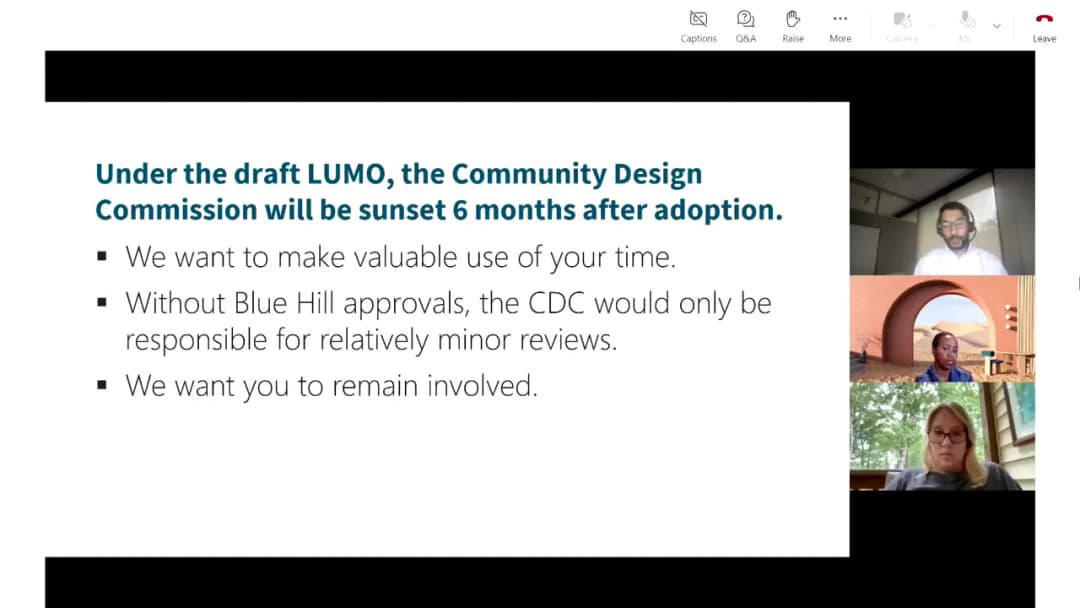
Public Meetings - Chapel Hill, North CarolinaThe Community Design Commission (CDC) met virtually on Tuesday, September 22, 2026, at 5:30 PM. The meeting began with technical difficulties and a lack of quorum, which was resolved after about 25 minutes. The commission approved the August meeting minutes and a consent agenda item for minor building elevation modifications. The main discussion centered on a staff presentation regarding the draft Land Use Management Ordinance (LUMO), including a proposal to remove the CDC's review authority over the Blue Hill form-based code district and potentially sunset the CDC as an officially recognized body. Commissioners expressed strong disappointment and concern about reduced civic engagement and concentration of decision-making authority. Consent Calendar - Minutes: Approved the August 2026 meeting minutes unanimously. (Motion by Kim Hans, second by John Biggs) - 5500 Old Chapel Hill Road: Approved building elevation modifications (adding windows to top floor, replacing dormers) as a consent agenda item. The project is a 191-unit active adult building with a four-story structure over a one-story garage. The changes were described as minor, with materials unchanged. (Motion by Kim Hans, second by John Biggs; unanimous) Discussion Items - LUMO Review (Staff Presentation): Taz (Planning Department) presented key proposals in the draft LUMO: - The CDC would no longer review projects in the Blue Hill form-based code district; authority would shift to the town manager with specific criteria. - The draft LUMO proposes sunsetting the CDC as an officially designated body within the ordinance six months after adoption, though the CDC could continue as a purely advisory board outside the LUMO framework. - Staff framed this as a way to make development review more efficient and align with the Complete Community Strategy, which targets 500 new housing units per year and expanded greenways. - Taz noted the proposal was a staff recommendation, not a direct council directive (confirmed by Councilmember Ryan, who attended and clarified council did not instruct staff to sunset the CDC). - Commissioner Reactions: - Patrick Brennan (Chair): Expressed deep disappointment, arguing the change discourages civic participation and concentrates power. He opposed the plan and urged council to encourage community involvement. - Kim Hans: Expressed shock at the presentation format (no prior documentation), questioned the town's desire for public input, and noted the CDC already functions as an advisory body with limited real authority. - John Biggs: Raised concerns about prioritizing housing unit counts over integrated land-use and transportation planning, citing negative examples from Clayton, NC. - Rachel Tushabe: Expressed disappointment and questioned whether staff live in Chapel Hill, though staff noted residency is not relevant to professionalism. - Councilmember Ryan clarified the staff proposal and encouraged further conversation. Key Outcomes - Minutes and Consent Agenda approved (see above). - No formal action taken on LUMO proposals; the presentation was informational. - Follow-up commitment: Taz agreed to send presentation slides and to raise the CDC's concerns at the September 23 council meeting. The commission requested a follow-up meeting with staff and council to discuss the CDC's future role. - Adjournment: Motion to adjourn by John Biggs, seconded by Rachel Tushabe, carried unanimously. Next regular meeting scheduled for October 27, 2026.
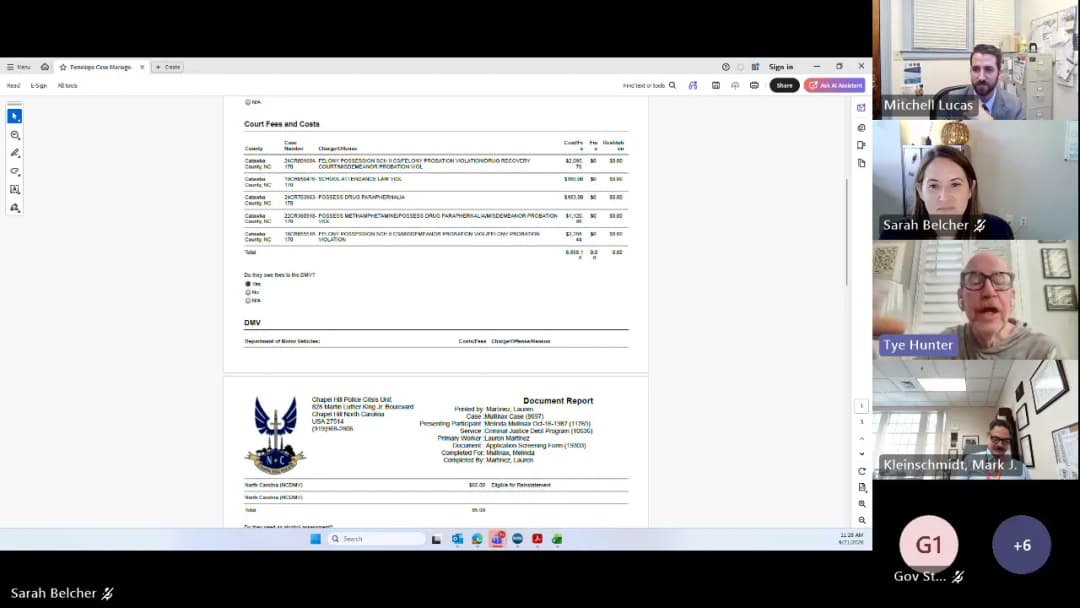
The meeting of the Chapel Hill Funding Board convened at approximately 4:14 PM EDT with six members present, constituting a quorum. Members Mark, Tiffany, Ty, Ruby, and April attended; Donna, Crystal, and Amber were absent. A vacancy exists due to Stephanie's departure. The board approved the agenda, the minutes from the August 17 meeting, and reviewed current funding balances ($22,000 for Chapel Hill, $6,933 for Carborough, $4,859 for Orange County). One applicant from Chapel Hill was considered. Consent Calendar - Agenda Approval: Motion by Mark, seconded by April, approved unanimously (5-0). - Meeting Minutes Approval: Motion by Tiffany, seconded by unnamed, approved unanimously (4-0, as Ty and Crystal were absent from the prior meeting). Discussion Items - Applicant – Melinda Mullinax: A 39‑year‑old white female residing at the We Have a Dream Recovery Home in Chapel Hill. She has been sober for over six months, is engaged in a court‑mandated drug court through Catawba County, works part‑time, and receives food stamps. She owes $6,868.16 in court fees (largest balance $2,095.78 from a probation case) and a $65 DMV restoration fee. Her only driver’s license suspension was an unpaid seatbelt ticket from 2013. The board discussed her eligibility and the nature of the fees. Member Mitch motioned to cover the top three balances (the largest $2,095.78, plus $180 and $183) and the $65 restoration fee, totaling $2,160.78 (subject to interest). The motion was seconded by Ty. Some members briefly explored negotiating with Catawba County, but it was noted that most fees have become civil judgments, making reduction unlikely. Key Outcomes - Vote on Applicant Assistance: Motion passed unanimously (Mark: yes, Tiffany: yes, Ruby: yes, April: yes). The board approved payment of $2,095.78, $180, $183, and $65 (restoration fee) to assist Melinda Mullinax in reinstating her driver’s license and removing barriers to employment and transportation. - Next Meeting: Scheduled for Monday, October 19, 2026. Members were encouraged to join 15 minutes early for technical troubleshooting. - Crystal’s Connectivity: The chair noted Crystal had login issues; she would attempt to join via the public link after the meeting.
No transcript, agenda, or minutes were provided for this meeting. Therefore, no discussion, decisions, or public comments can be summarized.
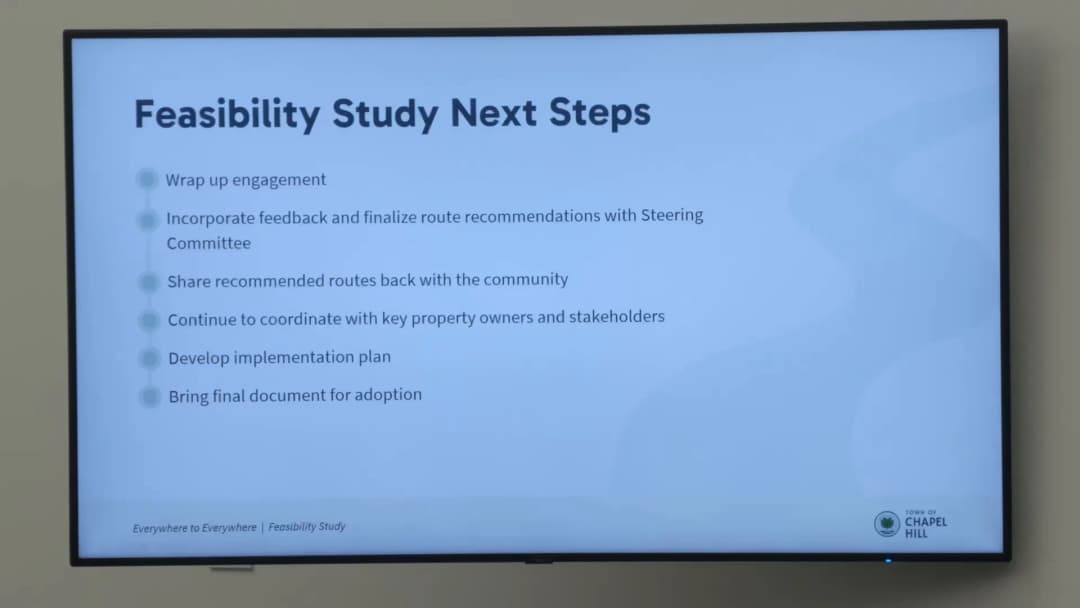
The Town Council held a work session on September 16, 2026, from 6:00 PM to approximately 9:30 PM at the Library Meeting Room B. The meeting focused on two major agenda items: the Everywhere to Everywhere Greenways Feasibility Study and the Land Use Management Ordinance (LUMO) Update. As a work session, no formal votes were taken; the purpose was discussion and feedback to guide staff recommendations. The session began with proclamations for Constitution Week and Diaper Needs Awareness Week, followed by council announcements. Proclamations and Announcements - Mayor Jessica Anderson proclaimed September 17–23 as Constitution Week, emphasizing civic participation. - Council Member Camille Berry proclaimed September 14–20 as Diaper Needs Awareness Week, highlighting the work of the Diaper Bank of North Carolina. - Council Member Louie Rivers III announced Empowerment Inc.'s 30th anniversary celebration on September 19 at the Story on Franklin Street. Discussion Items Everywhere to Everywhere Greenways Feasibility Study Staff (Bergen Watterson, Ben Berolzheimer, and consultants from McAdams) presented an update on the feasibility study, which is evaluating 25 miles of proposed greenway corridors. Key challenges included property impacts, floodplain constraints, topography, and cost. Staff explained that some potential routes face trade-offs between traditional off-road greenways (preferred by the public for safety and user experience) and less expensive on-street “neighborhood greenways” or hybrid options. Council members discussed prioritizing criteria such as user potential (ridership), connectivity to key destinations (schools, transit, community centers), cost-effectiveness, speed of implementation, and equity. There was support for quick-win projects that fill gaps and provide immediate connections, but caution about natural-surface trails due to ADA compliance and long-term maintenance. Staff sought guidance on balancing the ideal vision with practical feasibility. Council members expressed a range of views but generally favored a mix of approaches, with emphasis on routes that can move the most people and fill critical gaps. The discussion ended with staff feeling they had enough direction to refine recommendations and bring back a more detailed “story” for each corridor at a future meeting. Land Use Management Ordinance (LUMO) Update Planning Manager Tas Lagoo presented proposed changes to the LUMO, focusing on housing diversity and supply. Key topics included: - Inclusionary Zoning (IZ): Staff proposed removing mandatory IZ for multifamily development (which has rarely applied) and replacing it with voluntary incentives tied to density bonuses, while retaining mandatory IZ for subdivisions of five or more lots. The incentives aim to encourage affordable housing in projects that currently avoid conditional zoning. Some council members questioned the removal of the mandatory multifamily requirement, noting that even if rarely used, it served as a signaling tool. Staff clarified that conditional zoning has been the primary tool for securing affordable units. - Residential Occupancy Limits: Staff recommended changing the limit from four to eight unrelated individuals per single-family home in most districts, arguing the current rule is unenforceable and the limit should align with building code life-safety standards. After discussion, council members expressed lack of support for the change; a straw poll indicated a majority preferred to keep the limit at four. Several members cited concerns about developer exploitation and neighborhood character, particularly in areas like Northside. Staff acknowledged the decision but noted enforcement remains a challenge regardless of the number. - Increased Density and Location-Based Bonuses: Staff presented maps showing potential for additional density on arterial and collector streets with sidewalks (Map 2) and near schools (Map 3). Council members discussed the trade-offs, noting that some collector streets (e.g., Piney Mountain) have safety concerns despite sidewalks. There was interest in allowing fourplexes with 40% affordable units in neighborhoods like Northside, but only with community engagement. Council did not reach consensus on the specific density criteria, deciding to continue discussion at a future work session. Key Outcomes - Greenways Study: Staff will refine route recommendations using council feedback (prioritize quick wins, cost, high-usage connections, and careful consideration of environmental impacts). A more detailed presentation with corridor-specific narratives is planned for a future meeting. - LUMO – Occupancy Limit: Council indicated by straw poll a preference to keep the limit at four unrelated individuals per single-family home. Staff will retain that in the draft LUMO. - LUMO – Density and Inclusionary Zoning: No final decisions were made. Council requested a follow-up work session to further discuss density criteria, the fourplex bonus, and other affordable housing incentives. Staff will prepare additional analysis, including potential impacts on neighborhoods with Neighborhood Conservation Districts. - Next Steps: Another work session will be scheduled, likely within a few weeks, to cover remaining LUMO topics (environment and resilience) and revisit unresolved issues.
The Chapel Hill Planning Commission met on Tuesday, September 15, 2026, with five of six members present (Chair John Mitchell and commissioners Jeff Green, Chuck Mills, Libby Thomas, and Mike Zibai; Liz Lasis was absent). The commission removed a master land use plan item from the agenda and unanimously recommended that the Town Council approve the conditional rezoning at 101 Weaver Dairy Road Extension for a new fire station and affordable housing development. Agenda Item Removed: MetaMont Master Land Use Plan Modification - Chair John Mitchell proposed removing the MLUP modification because master land use plans are quasi-judicial under state law, and planning commission recommendations cannot legally be conveyed to or considered by the Town Council in such cases. - Jeff Green explained that 2019 state land-use law changes removed the planning commission from a recommendation role for quasi-judicial items, and the LUMO had not yet been updated for master land use plans. - Jeff Green moved to amend the agenda to remove the item; Chuck Mills seconded. The roll call vote was unanimous: 5–0. Public Comments & Testimony - No members of the public spoke. Discussion Items: 101 Weaver Dairy Road Extension Conditional Zoning - Planning staff and the applicant presented a proposal to rezone the 4.11-acre Fire Station 4 site at the corner of Martin Luther King Jr. Boulevard and Weaver Dairy Road Extension from Office/Institutional-2 to Residential Community Priority (RCP) with conditional zoning. - The project would replace existing fire department structures with 50–105 dwelling units, a new fire station, and up to 216,647 square feet of floor area. The proposal states that 100% of units would be affordable to households earning at or below 80% of area median income, while the RCP district requires at least 25% of units at or below 60% AMI. - Staff recommended approval, citing alignment with Complete Community goals, transit-oriented infill near planned high-frequency transit and greenways, and limited environmental impacts. - Fire Chief Jay Mib and Housing and Community Development representative Maggie Simon described the partnership, the anticipated low-income housing tax credit (LIHTC) project, and the need for flexibility in the income mix to make the project feasible. - McAdams project manager Jason Galloway presented a bubble plan with two blocks: a fire station block and a multifamily affordable housing block, with three vehicle access points plus an emergency fire apparatus exit, a future BRT stop, street trees, a community room, and a constructed stormwater wetland. - Commissioners raised concerns about placing multifamily housing close to high-volume roadways, the reduced tree canopy requirement, and ambiguity between the 25% at 60% AMI district rule and the 100% at 80% AMI condition. - Applicant and fire staff responded that site layout was driven by fire apparatus access, the need to remain in the existing station during construction, NC DOT/BRT constraints, operational sightlines, turnaround space, and stormwater needs. Fire chiefs cited apparatus length and backing safety as reasons for reduced tree canopy. - The commission discussed a requested modification to reduce the minimum tree canopy requirement from 40% to 11%; staff confirmed the figure and clarified that it includes a small triangle parcel across Weaver Dairy Road. Commissioners accepted the tradeoff given fire station operational needs and stormwater wetland benefits. - The commission agreed to recommend clarifying in Ordinance A that the 25% at 60% AMI requirement continues to apply, and to recommend that the eventual parking ratio account for the transit-oriented location, including the possibility of a LIHTC parking waiver. Key Outcomes - Unanimous 5–0 vote to remove the MetaMont master land use plan modification from the agenda. - Unanimous 5–0 vote recommending that Town Council adopt Resolution A, the resolution of reasonableness and consistency with the comprehensive plan, for the 101 Weaver Dairy Road Extension conditional zoning map amendment. - Unanimous 5–0 vote recommending that Town Council approve Ordinance A, approving the conditional zoning application, with the Complete Community Matrix and recommendations attached. - The commission previewed upcoming LUMO work: an October 6 working session to shape recommendations, an optional October 20 meeting to finalize wording and vote, and the Town Council's LUMO legislative session beginning October 21. Commissioner Mike will be absent on October 6, and the chair offered to relay his feedback.
On September 9, 2026, the Chapel Hill Town Council held its first fall session meeting at 6:00 PM in Council Chamber. The meeting included three proclamations, public comments on the People's Channel, unanimous approval of the consent agenda, and a detailed discussion on the Land Use Management Ordinance (LUMO) update. The council also voted to enter closed session. Opening and Proclamations - Hispanic Heritage Month: Proclamation celebrating Hispanic and Latino communities with the theme "Pioneers of Change, Shaping the Future Together." - Co-Responder/Crisis Week: Proclamation honoring compassionate early intervention for mental health and substance use needs. - Patriot Day: Proclamation commemorating the 25th anniversary of September 11, 2001, honoring first responders and inviting a moment of silence. Announcements by Council Members - Mayor Anderson announced Open Chapel Hill Days on September 19 and October 3, and reminded of the next council work session on September 16. - Council Member Miller-Foushee invited the community to celebrate 30 years of Empowerment Inc. on September 19. - Council Member McMahon shared his role on the Go Triangle board and interest in transit-oriented development. - Mayor Pro Tem Berry noted September is Hunger Action Month. - Council Member Nollert highlighted resources from the North Carolina Housing Coalition and Budget and Tax Center about proposed constitutional amendments affecting local government services. Public Comments & Testimony - Jesse Basker (volunteer with People's Channel): Expressed full support for the People's Channel as a community resource providing equipment, training, and youth camps. Urged continued funding. - Billy Nicholson (producer): Stated the People's Channel gives a voice to the people, helps build community, and is a valuable medium. Asked council to support funding. - Abdullah Muhammad (religious leader): Emphasized the People's Channel builds bridges, especially for sharing the message of Islam, and promotes peace and harmony. Requested continued support. Following public comments, Mayor Pro Tem Berry made a motion, seconded by Council Member Miller-Foushee, to direct staff to provide more information about funding challenges and possibilities for the People's Channel. The motion passed 8-1 (Council Member Rivers opposed). Consent Calendar The consent agenda was approved unanimously by a motion from Council Member Ryan, seconded by Mayor Pro Tem Berry. It included: - Item 4: Annual Re-Appropriate Funds for Prior Year Encumbrances Budget Ordinance Amendment (O-1). - Item 5: 2026-2027 Public Housing Capital Fund Program Plan (R-1 and O-2). - Item 6: FY27 Governor's Highway Safety Program Grant Application (R-2, $183,785). - Item 7: Town Code Chapter 2, Article IV Amendment: Campaign Contribution Limitations (O-3, maximum individual contribution $390, disclosure exemption $40). - Item 8: June 10, 17, and 22, 2026 Meeting Minutes. - Item 9: Closed Session Minutes (various dates). - Item 10: Past Unapproved Minutes (various dates). - Item 11: 2026 Council Meeting Schedule Amendment. Discussion Items: Land Use Management Ordinance (LUMO) Update Staff presented an overview of the draft LUMO, focusing on three key interests: user friendliness, economic development and land use, and built environment/public realm. The presentation covered buy-right development thresholds, incentives for community benefits, new zoning districts (e.g., RD), transition rules, and design standards. Council members asked clarifying questions about: - Buy-right thresholds (cumulative 30,000 sq ft residential + 40,000 sq ft non-residential baseline). - Impact of January 2026 density changes on development applications. - Role of the Community Design Commission (CDC) and potential sunset. - Stepbacks as massing vs. aesthetic elements. - Street tree requirements and amenity space activation. - Need for visuals to understand how rules apply on the ground. Public Comments on LUMO: - Greg Gerdeaux (homeowner): Noted the LUMO lacks references to children's play spaces; urged adding athletic instruction or youth athletic uses in residential districts. Submitted written language. - Barbara Driscoll (Conservation Chair, New Hope Bird Alliance): Concerned about impacts on stormwater, canopy loss, and biodiversity. Requested native planting requirements, bird-safe design, and a stormwater overlay. - David Shanzer (Chair, Lake Forest Association): Highlighted inadequate stormwater protection in the Booker Creek watershed; noted exemptions for many housing types from downstream analysis. Asked for developers to pay for infrastructure. - Jeanette Bench (Parks Commission member): Echoed flooding concerns and need for neighborhood parks. - Daniel Ying (resident): Criticized collector road designations as inconsistent; called for refinement. - John Sadler (resident): Warned of cumulative impacts of buy-right development on stormwater and traffic; suggested integrating street design with land use. Council Discussion and Straw Polls: Council debated process for making changes to the draft LUMO. They agreed to use straw polls to gauge interest on further information requests. Key outcomes from straw polls: - Visuals for R zones with density bonuses: Requested. - Downtown/town center design and displacement: Council asked for a work session on downtown, including LUMO-related components and potential overlay for historic areas. - Design requirements and cost/technology implications: Withdrawn after staff noted it was not a fruitful discussion. - Ban on certain uses near schools (e.g., vape shops): Requested more information. - Eliminate collector roads as density trigger: Strong consensus; staff to provide options (overlay or zoning with criteria like proximity to schools, greenways, transit). - Overlay districts for stormwater, downtown, and complete community: Council expressed interest in exploring options; staff to bring information. - Children's play spaces and active uses in zones: Requested understanding. - Native plantings and invasive species: More information requested, likely to be addressed in next session. Staff confirmed all requests were reasonable but noted timelines for detailed proposals. Key Outcomes - Motion on People's Channel: Passed 8-1 to receive more information. - Consent Agenda: Approved unanimously. - LUMO Update: Received and filed; council directed staff to provide additional information on multiple topics (visuals, collector roads, overlays, downtown design, children's play spaces, native plantings, and use restrictions near schools). - Closed Session: Motion to enter closed session under NCGS 143-318.11(a)(4) and (a)(3) to discuss 150 East Rosemary Street and attorney-client privilege passed unanimously. The meeting recessed to Room 102.
The Chapel Hill Historic District Commission met on Tuesday, September 8, 2026 at 6:30 PM in the Council Chamber to consider several Certificate of Appropriateness (COA) applications, including a fence installation at 100 S. Columbia Street, a tiny house project at 21 Cobb Terrace, an accessibility and pool addition at 204 Glenburnie Street, and fraternity house renovations at 132 S. Columbia Street. The meeting began with a recognition of Hispanic Heritage Month, approval of previous minutes, and a consent calendar. The commission approved two applications, continued one, and also approved revised Rules of Procedure. Consent Calendar - Approved as a batch: Items 3 through 6 (102 Fraternity Court, 111 Ridge Lane, 712 Gimghoul Road, 310 Pittsboro Street) – written decisions from the August meeting. - The Administrative COA Approval and Maintenance Report (Item 2) was received as information only. Public Comments & Testimony - 204 Glenburnie Street: Charles Nunn, a neighbor from 709 East Rosemary Street, expressed concerns about the proposed pool, fence, and expanded deck. He argued that the pool and fence would be visible from East Rosemary Street (a historic district street) and that the fence should be around the pool only, not the entire backyard. He also stated the deck would overpower his property and not follow HDC guidelines on topography. The applicant's team responded that the design minimizes visibility and that the fence location preserves usable yard space. The commission ultimately continued the item for more information. Discussion Items - 100 S. Columbia Street (University Baptist Church Memorial Garden Fence): Applicant Steve Harward presented revised plans for an aluminum picket fence around the memorial garden, addressing prior concerns about emergency exit access, signage visibility, and fence placement behind the stone wall. The commission discussed height relative to the stone wall at the corner (sign area). A motion passed to approve the application with a condition that the fencing at the diagonal corner (holding the church sign) be no taller than the existing stone wall. Vote: unanimous. - 21 Cobb Terrace (Tiny House and Carriage House Relocation): Applicant John Norwood proposed relocating an existing carriage house and constructing a new one-story plus daylight basement dwelling on a steep lot. Commissioner Don Tise recused himself due to a conflict of interest (his firm prepared drawings). The commission discussed the four-foot height increase, materials (cedar siding, brick foundation, glass block), and parking. A motion to approve as not incongruous passed unanimously (with Tise recused). - 204 Glenburnie Street (Accessibility Addition, Pool, Deck, Fence): Applicants Jonathan and Marica Schooler, represented by Build Sense, sought to add an ADA-accessible bathroom, lift, ramp, pool, and expanded deck for aging in place. After public testimony from neighbor Charles Nunn, the commission expressed uncertainty about visual impacts from East Rosemary Street and the massing of the deck. The commission voted to continue the item to the October 13, 2026 meeting, requesting additional renderings from the south and east elevations and encouraging further neighbor dialogue. Vote to continue: unanimous. - 132 S. Columbia Street (DKE Fraternity House Additions): Applicants Cal Fatham and Zell Hule presented plans for a covered patio, second-story deck, fire pit, additional bedrooms above a stairwell, and reconfiguration of ADA parking. The commission discussed lighting (recessed cans), dormers, and material compatibility. A motion to approve as not incongruous passed unanimously. - Legal Training: Continued to the next meeting (October) due to time constraints. - Rules of Procedure: Staff proposed a minor revision to adopt action minutes similar to the Board of Adjustment. The commission approved the revised rules unanimously. Key Outcomes - 100 S. Columbia Street: COA approved with condition that fence at the corner stone wall (sign area) not exceed the wall height. Vote: unanimous. - 21 Cobb Terrace: COA approved as not incongruous. Vote: unanimous (Don Tise recused). - 204 Glenburnie Street: Continued to October 13, 2026 meeting for additional visual information. - 132 S. Columbia Street: COA approved as not incongruous. Vote: unanimous. - Revised Rules of Procedure: Approved unanimously. - Legal Training: Continued to October 2026 meeting.
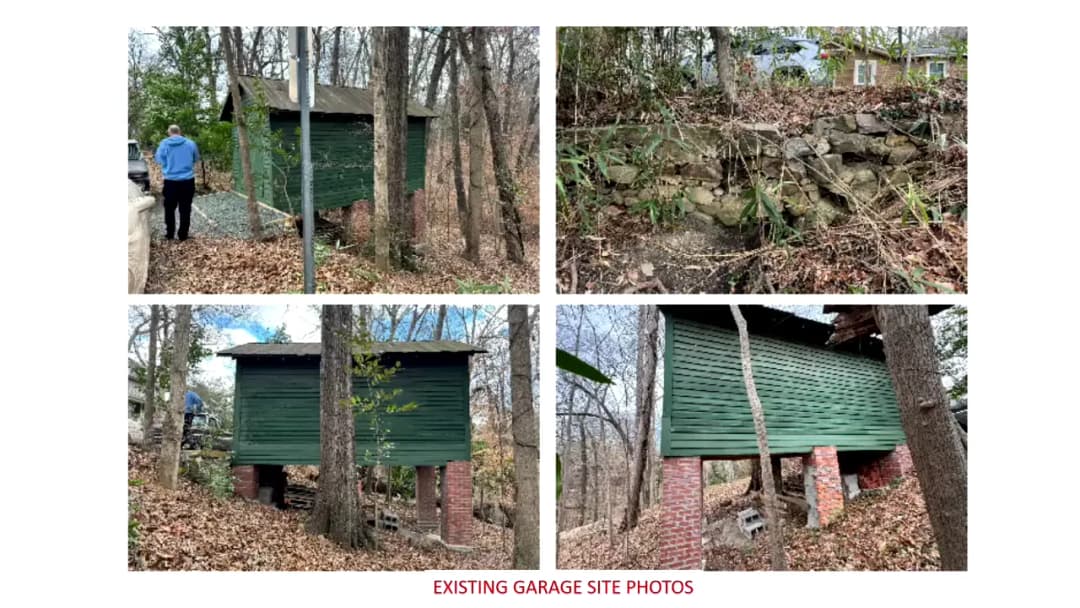
The Chapel Hill Board of Adjustment met on Thursday, September 3, 2026, at 6:30 PM in the Council Chamber. The meeting included approval of the agenda and minutes from July 2, 2026, a public hearing and deliberation on a dimensional variance for 219 Glenhill Lane, and a discussion on filling the remaining alternate seat on the board. The variance was granted unanimously (7-0), and the membership recommendation was tabled to the next meeting on October 1, 2026, pending further outreach to applicants. Approval of Agenda and Minutes - The agenda was approved unanimously. - The draft minutes from the July 2, 2026 meeting were approved unanimously. Public Comments & Testimony - No members of the public offered testimony on the variance. One attendee asked a procedural question about variance applications but did not comment on the case. Dimensional Variance: 219 Glenhill Lane - Applicant Presentation: Coulter and Kelsey Brinkley, residents of 219 Glenhill Lane, requested a variance to reduce the required 26-foot street setback to 20 feet to construct a 10-foot by 12-foot storage shed. They cited the property's steep topography and irregular corner lot as unique hardships, noting that the only flat area for the shed lies within the setback. They argued the variance would have minimal visual impact, preserve existing trees, and maintain sight lines. - Board Discussion: Board members questioned the applicants about alternative locations, the cost of grading, and the impact on driveway use. The applicants stated that other flat areas were either within other setbacks or would require significant grading and tree removal, which would be financially burdensome. The board considered the four criteria for a variance: unnecessary hardship, unique property conditions, self-created hardship, and consistency with ordinance intent. - Key Support: Board members expressed that the topography and corner lot created a unique hardship, that the applicants did not create the conditions, and that the variance would not affect neighboring properties or streetscape. The board noted the small size of the encroachment (6 feet) and the limited visibility of the shed. - Vote: The motion to grant the variance (Resolution A) passed unanimously (7 ayes, 0 nays). Membership Recommendations - The board reviewed four applications for the remaining alternate seat. Applicants included David (preferred Board of Adjustment), Peter (preferred Planning Commission), Bert Bennett (preferred Downtown Partnership), and Trevor Leatherwood (an ETJ resident). - Discussion: Several members favored David due to his enthusiasm for the BOA and a student perspective, while others noted Peter's environmental background. Concerns were raised about Trevor Leatherwood's application quality (misspellings, grammar) and Bert Bennett's focus on downtown development. The board decided to contact the top two candidates (David and Peter) to confirm their continued interest before making a recommendation. - Decision: A motion to continue the item to the next meeting on October 1, 2026, passed unanimously (7 ayes). Staff will reach out to the applicants and report back. Key Outcomes - Dimensional Variance Granted: The variance for 219 Glenhill Lane (6-foot encroachment into the street setback for a 10x12 shed) was approved unanimously. - Membership Recommendation Tabled: The board will reconsider the alternate seat at its October 1, 2026 meeting after staff contact David and Peter about their interest.
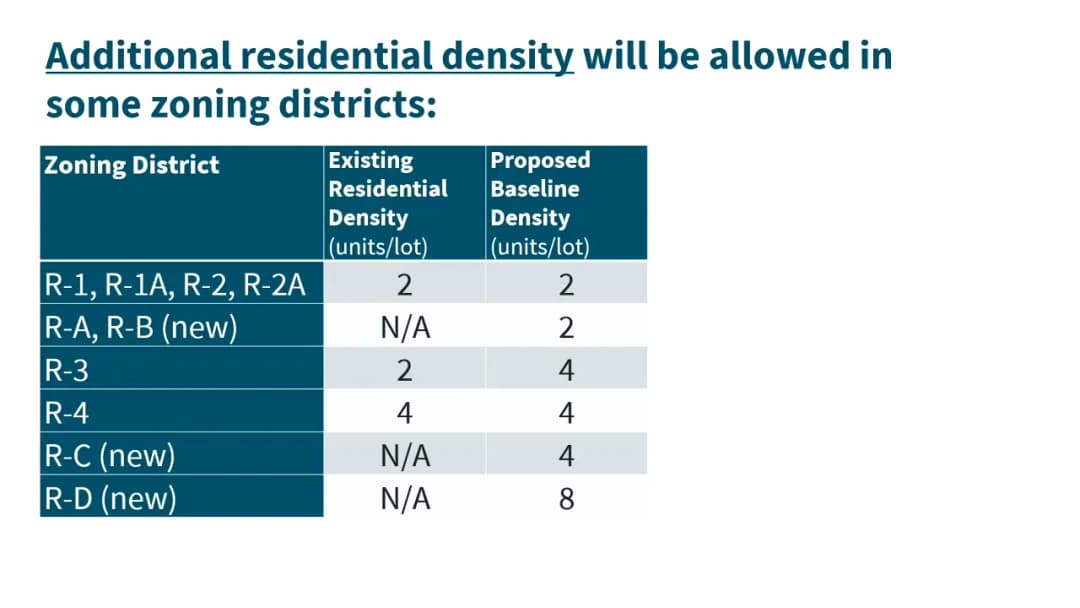
The Chapel Hill Planning Commission met virtually on September 1, 2026, to continue informal discussions on the draft Land Use Management Ordinance (LUMO). The meeting focused on two of five council-identified goal areas: housing diversity, attainability, and supply, and environment and resilience. Commissioners heard a staff presentation, public comments, and deliberated on trade-offs between densification and environmental protections. Consent Calendar - Approval of Minutes: The minutes from the August 18, 2026 meeting were approved unanimously (3-0, with members Mitchell, Mills, and Thomas voting yes; Green and Zibaie absent). Public Comments & Testimony - Kimberly Sanchez (CEO, Community Home Trust) questioned whether the proposed incentives for affordable housing would provide enough financial value to developers, noting that the current mandatory inclusionary zoning requirement has not deterred development in her experience. - Jenny expressed concern that allowing up to four units on connector roads and near greenways could increase light pollution and reduce tree canopy in critical habitat areas, undermining environmental goals. - Jake asked about a 13-acre property on Kenmore Drive (R1 district) and whether four units per lot would be exempt from stormwater and tree canopy regulations, especially given the site’s proximity to Eastwood Lake watershed. - Caroline echoed concerns about unintended consequences of reduced stormwater and canopy requirements near greenways and older neighborhoods like Coker Hills, citing increased storm intensity from recent storms. Discussion Items - Housing Diversity, Attainability, and Supply: Staff (Taz) presented proposed changes including updated inclusionary zoning (removing mandatory multifamily requirements but adding voluntary incentives with higher by-right thresholds), increasing residential occupancy limits from four to eight unrelated people (except Northside and Pine Knolls), allowing additional density (e.g., from two to four units per lot) on arterial/collector streets and near greenway entrances, and imposing size limits and design standards (e.g., front yard parking restrictions, street trees) to mitigate neighborhood impacts. - Environment and Resilience: Staff noted that stream buffer (RCD) protections are unchanged, new tree canopy standards for single-family homes (30% for homes over 1,500 sq ft) are added, while canopy requirements for missing middle and mixed-use are moderately reduced. New tree preservation mandates and incentives for native species are included. Stormwater standards are strengthened: 100-year storm requirement applies to subdivisions with 4+ lots or 40,000+ sq ft land disturbance; graduated requirements for duplexes/triplexes/fourplexes based on impervious surface (50% threshold) and land disturbance (20,000 sq ft). - Commissioner Concerns and Questions: - Commissioner Mills asked about the gap between Tier 1 (9-13% affordable) and Tier 2 (40%+ affordable) incentives; staff explained Tier 2 targets LIHTC projects and an intermediate tier could be added. - Commissioner Thomas questioned whether the arterial/collector street map appropriately identifies corridors for density, noting that streets like Caswell, Dixie Drive, and Kenmore appear as connectors despite being low-traffic, single-family loops. She suggested limiting density bonuses to arterial streets plus a short distance (e.g., 1/8 mile) from intersections to concentrate nodes. - Commissioner Losos raised concerns about stormwater modeling and the need for overlays in sensitive areas (e.g., Booker Creek watershed), and questioned the continued relevance of Neighborhood Conservation Districts (NCDs) other than Northside and Pine Knolls, given their exclusionary origins. Staff noted no imminent changes to NCDs but that new NCD creation procedures are removed in the draft. - Commissioner Mitchell inquired about the feasibility of a placeholder overlay for stormwater; staff indicated it is possible but requires time and resources to calibrate. - Economic Feasibility of Incentives: Staff confirmed that density bonuses were calibrated based on prior economic analysis recommending at least a 50% increase in developable floor area; the draft offers 60% increase at the lower tier. Key Outcomes - The minutes from August 18 were approved unanimously. - No formal motion was made on the LUMO draft; the discussion was informational. - The next Planning Commission meeting is scheduled for September 15, 2026, with development projects on the agenda (not LUMO). The next LUMO-related meeting is October 6, 2026, where the Commission will be asked to provide a formal recommendation to the Town Council (state law requires a month for the report). Council will have informal discussions on September 9 (public comment available) and September 16 (work session). - The Commission expects to compile their feedback and potentially submit a report or recommendation at the October 6 meeting. Council’s earliest possible vote on the LUMO is November 2026.