Browse by city
Date range
Search help

Search titles, summaries, topics and stored transcripts together. Keywords may match separately; put the whole query in double quotes for a phrase. Matching follows word analysis, so punctuation is not exact. Both dates are included. Documents are not searched.

SHOWING 1–10 ENTRIES
01
NEWOCT 30, 2026 · CHAPEL HILL, NORTH CAROLINA · MEETING PORTAL
Historic District Commission Meeting - October 30, 2026

The Historic District Commission met virtually on October 30, 2026, at 11:30 AM. After resolving technical difficulties with the Microsoft Teams platform, the board completed roll call (Don Tise, Brian Daniels, Josh Gurlitz, Laura Moore, Sandra Sider) and unanimously approved the agenda. The sole business was the approval of three Certificate of Appropriateness (COA) placards and written decisions from the prior meeting. Consent Calendar - [26-0384] 21 Cobb Terrace – COA placard and written decision approved unanimously. - [26-0385] 100 S. Columbia Street – COA placard and written decision approved unanimously. - [26-0386] 132 S. Columbia Street – COA placard and written decision approved unanimously. Key Outcomes - Motion to approve all three consent items passed 5–0. - Next meeting scheduled for November 10, 2026. - Chair Don Tise apologized for the previous meeting’s disarray due to a family emergency (his wife’s accident). - Election of officers was deferred to the next meeting.

PROCEDURAL 62% · TECHNOLOGY AND INNOVATION 38%
02
OCT 28, 2026 · CHAPEL HILL, NORTH CAROLINA · MEETING PORTAL
Town Council Work Session on Updated LUMO - October 28, 2026

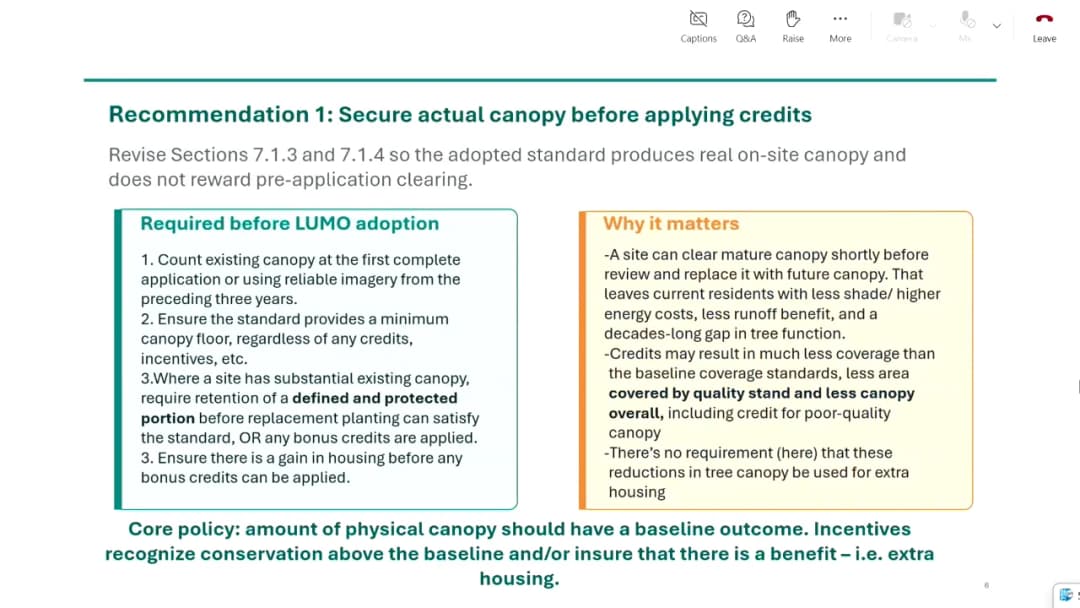
Chapel Hill Town Council Work Session on Updated Land Use Management Ordinance - October 28, 2026\n\nThe Chapel Hill Town Council held a work session on October 28, 2026, beginning at 6:00 PM, to discuss the draft Land Use Management Ordinance (LUMO) and recommendations from the Planning Commission. Mayor Jessica Anderson presided. The primary goal was to signal direction to staff on whether to adopt Planning Commission recommendations, keep the draft language as is, or seek adjustments for the upcoming November 18th business meeting. Taz Lagoo, Long-Range Planning Manager, presented staff's assessment of the Planning Commission's recommendations.\n\n Announcements\n- Mayor Anderson expressed gratitude to the Chapel Hill Police Department for their work concluding a trial related to the Hedgepeth family.\n- Mayor Anderson reminded the public that early voting was underway through October 31st, with Election Day on November 3rd.\n\n Discussion Items\n- Location-Based Density Bonuses: Staff recommended keeping all proposed bonuses, including those for proximity to schools and greenways, while the Planning Commission recommended removing the school and greenway bonuses. Council debated whether the criteria were limiting or helpful signals for housing density.\n- Hundred-Year Storm Standard: The Planning Commission recommended applying the hundred-year storm standard to most projects. Staff recommended keeping the tiered system where the standard applies to projects over 40,000 square feet of land disturbance but expressed openness to dialing thresholds.\n- Downstream Impact Analysis: The Planning Commission recommended codifying specific criteria for discretionary downstream impact analyses. Staff recommended keeping the existing flexible language. Council favored the staff recommendation, citing the need for discretion on a case-by-case basis.\n- Tree Canopy Baseline & Minimum Canopy Floor: The Planning Commission recommended a three-year lookback for measuring existing tree canopy and a minimum canopy floor that incentives could not drop below. Staff recommended against both, favoring the existing incentive system and clarifying the state forestry exemption.\n- Cluster Development: Staff presented a revision providing a one-to-one credit for land protected by regulatory requirements and a two-to-one credit for voluntarily protected land. Council supported this revised staff recommendation.\n- Native Trees: The Planning Commission recommended requiring 100% native species immediately. Staff recommended a three-year phase-in period for the 100% native requirement. Council supported the staff recommendation and expressed interest in an ecologically productive species list.\n- Stormwater Management Triggers: Council extensively discussed the Planning Commission's recommendation to use net new impervious surface as the primary trigger, removing land use and number of homes. Council did not finalize a decision, directing staff to analyze this alternative for future consideration.\n\n Key Outcomes\n- Density Bonuses: Council directed staff to retain the draft language with all proposed location-based bonuses (staff recommendation) by a vote of 5 to 4.\n- Hundred-Year Storm Standard: Council adopted a modified staff recommendation, directing staff to lower the threshold for single-family homes from 40,000 to 20,000 square feet of land disturbance to require the hundred-year storm standard.\n- Downstream Impact Analysis, Tree Canopy Issues, Cluster Development, Native Trees: On these items, Council aligned with the staff recommendations over the Planning Commission's proposals.\n- Amendments Process: Council agreed to a formal process for council members to submit amendment interests for staff to draft ahead of the November 18th public hearing.\n- Future Work: Council directed staff to return with an analysis of alternative stormwater management triggers and a broader look at stormwater and tree canopy priorities for a future LUMO work resolution.

STORMWATER MANAGEMENT 42% · LAND USE MANAGEMENT 19% · PLANNING AND ZONING 10% · TREE PROTECTION ORDINANCE 7%
03
OCT 27, 2026 · CHAPEL HILL, NORTH CAROLINA · MEETING PORTAL
Chapel Hill Community Design Commission Meeting Dismissed for Lack of Quorum - October 27, 2026

The Town of Chapel Hill Community Design Commission (CDC) met virtually at 5:30 p.m. on October 27, 2026, to consider a consent-agenda elevation update for South Creek Building 11 and a new business elevation review for the 110 Jay Street affordable housing project. Before any official action could be taken, only three commission members were present. With four members required for a quorum, Chair Patrick Brennan dismissed the meeting and directed staff to carry the items to a November meeting. Consent Calendar - South Creek-Building 11 [26-0371]: Staff requested review of revised project elevations identified during a Planning/Zoning preliminary inspection. The ordinance specifies CDC review of building elevations but does not require approval or action. No action was taken because the commission lacked a quorum. - 110 Jay Street-Affordable Housing [26-0372]: Staff asked the commission to review elevations for an affordable housing project. The agenda noted that the project only requires CDC review and that no action is required or requested. This item was not considered on its merits before adjournment. Public Comments & Testimony - Lee Bauman, applicant for the South Creek Building 11 project, briefly explained that the only change was to the color of the doors and louvers from green to black/dark bronze. He said they were trying to obtain approvals in November and needed the change to get a certificate of occupancy for the building. He also suggested that staff or the commission consider an earlier or special meeting so applicants are not held up on a simple box-checking item. Discussion Items - Staff reviewed the agenda and asked the commission to choose meeting dates for November and December. The options presented were Nov. 9, Nov. 12, Nov. 19, Dec. 7, and Dec. 10, 2026. Chair Brennan proposed finalizing dates by email because not all commissioners were present. - Councilmember Amy Ryan provided updates on the Land Use Management Ordinance (LUMO). She said a council work session was scheduled for the next night and that a final vote was hoped for Nov. 11, 2026, with the option to extend the public hearing if needed. - Councilmember Ryan discussed the council's shift away from quasi-judicial reviews, including special use permits, and described ongoing efforts to rethink boards and commissions so community input is meaningful. She also mentioned planning to prioritize stormwater ordinance changes the following spring and cited placemaking approaches used elsewhere, such as design checklists emphasizing sidewalks, shade trees, and public spaces. - Chair Brennan thanked Councilmember Ryan for her engagement and said he had drafted a resolution to preserve meaningful CDC involvement, including a possible design competition to incentivize and reward local developers and architects. Councilmember Ryan said she would share the resolution with other council members and work to put it on a council agenda. Key Outcomes - The meeting was dismissed without a formal vote because only three of the four required commission members were present. Present members were Chair Patrick Brennan and Commissioners Kelsey Brinkley and Racheal Tushabe. Commissioner Jim Faron could not join due to technology issues, and Commissioner Kim Hans was unable to attend. - The South Creek Building 11 and 110 Jay Street items were deferred to a November meeting. - Staff were directed to finalize November and December meeting dates by email within the next few days and to notify applicants of the rescheduled agenda. - In response to the applicant's request, the chair and staff indicated openness to a special earlier meeting or an earlier November date to avoid delaying the South Creek certificate of occupancy.

PROCEDURAL 62% · LAND USE MANAGEMENT 23% · COMMUNITY ENGAGEMENT 10% · STORMWATER MANAGEMENT 5%
04
OCT 21, 2026 · CHAPEL HILL, NORTH CAROLINA · MEETING PORTAL
Chapel Hill Town Council Meeting - October 21, 2026

The Town Council met on October 21, 2026, at 6:00 PM in the Council Chamber. The meeting included proclamations, a park naming resolution, public comments on affordable housing displacement, consent agenda approvals, a conditional zoning approval for a church property, and a public hearing on the updated Land Use Management Ordinance (LUMO). The council also scheduled a work session for October 28 to continue LUMO discussions. Consent Calendar - The Council adopted a resolution naming the future town park on Legion Road in honor of Howard and Lillian Lee (unanimous). - Approved miscellaneous budget ordinance amendments for various FY 2026-27 funds (O-1 through O-6). - Approved a 4% pay increase for the Town Manager, effective July 1, 2026 (R-2). - Authorized the Town Manager to execute documents for transfer of town-owned property for rights-of-way and easements for the North-South Bus Rapid Transit (NS RAPID) project (R-2.01). - Approved the September 23, 27, 28, and 29, 2026 meeting minutes. Public Comments & Testimony - Elliott Woods/Chase Park Displacement: Multiple residents and advocates (Betty Curry, Salima Smith, Beth Wilton, Randy Bradford, Shirley Williams, Chris Lunsford, Layla Adila, Glenda Brown, Tammy Coleman) delivered emotional testimony about ongoing mismanagement, broken promises, unsafe conditions, and the death of a displaced resident, Gerda Lancher, while staying in a hotel. They requested a documented review of relocation commitments, direct communication with families, and a meeting with all stakeholders. The Mayor and Council expressed support and noted staff were working on enforcement, but acknowledged limitations due to legal complexity. Councilmember Nollert voiced anger and called for consequences. - Conditional Zoning at 1651 Old Lystra Road: Two speakers (Diane Martin and Nick Robinson from Holy Trinity Anglican Church) spoke in support, emphasizing the church's decade-long search for a permanent home and their plan to include transitional housing for the homeless through the R4 rezoning. No opposition speakers. - LUMO Public Hearing: 16 speakers addressed the draft LUMO. Key themes: concerns about stormwater management and flooding (several speakers from affected neighborhoods), support for stronger native plant and tree canopy requirements, concerns about density criteria (arterial/collector roads, school proximity), and calls for adoption by year-end with annual review. The Chamber of Commerce, Home Builders Association, and Community Home Trust urged adoption, while environmental advocates pushed for stronger protections. The Planning Commission (Jeff Green, Liz Losos, Libby Thomas) presented unanimous recommendations on housing, stormwater, and trees, suggesting risk-based stormwater controls and revisions to density bonus criteria. Discussion Items - Conditional Zoning at 1651 Old Lystra Road: Staff presented the application for rezoning from R1 to R4 to allow a place of worship and up to 10 homes. The property is in the joint planning transition area, requiring dual approval from both Town Council and County Commissioners (county approved 7-0 the previous night). The church plans to include affordable housing through Pee Wee Homes. Council members praised the project for its community benefits. The public hearing was closed, and both the resolution of reasonableness (R-3) and the ordinance (O-7) were adopted unanimously. - Public Hearing on Updated Land Use Management Ordinance (LUMO): Staff (Tas Lagoo) presented the draft, highlighting improvements in user-friendliness, housing attainability, and environmental sustainability. Revisions include reductions in downtown thresholds, missing middle housing bonuses, disincentives for overparked developments, and removal of proposed occupancy limit changes. Planning Commission recommendations were presented, focusing on: (1) replacing residential unit triggers with impervious surface triggers for stormwater, (2) requiring 100-year storm design for all triggered projects, (3) developing a stormwater overlay map, and (4) revising density bonus criteria away from arterial/collector roads and school proximity. Council members debated the stringency of stormwater controls and the appropriateness of density bonus proxies. Councilmember Sharp expressed support for infill development and tree requirements. Councilmember Ryan favored starting with arterials only and later refining criteria. Councilmember McCullough requested a systematic crosswalk of planning commission recommendations. Councilmember Nollert emphasized major infrastructure investment for flood control. After procedural motions, the council voted 8-1 to schedule a work session on October 28, 2026, to continue LUMO discussion, and voted unanimously to continue the public hearing to November 18, 2026. Key Outcomes - Resolution naming Legion Road park after Howard and Lillian Lee: Adopted unanimously. - Consent Agenda: All items approved unanimously. - Conditional Zoning for 1651 Old Lystra Road: Ordinance adopted unanimously. The property will be rezoned to R4 for a church and up to 10 homes (including affordable transitional housing). - LUMO Public Hearing: Continued to November 18, 2026. Additional work session scheduled for October 28, 2026 to discuss planning commission recommendations and potential amendments. - Appointment to Planning Commission: Deferred to November 18, 2026.

05
OCT 20, 2026 · CHAPEL HILL, NORTH CAROLINA · MEETING PORTAL
Chapel Hill Planning Commission Meeting - October 20, 2026

The Planning Commission met on Tuesday, October 20, 2026, at 6:00 PM in Town Hall Room 102 to consider three conditional zoning modifications/new zonings and to provide recommendations on the Land Use Management Ordinance (LUMO) update. The meeting lasted until approximately 11:00 PM. Consent Calendar - Approved the agenda as presented. - Approved the October 6, 2026 meeting minutes with a correction noting Commissioner Mike Zibaie's presence. Public Comments & Testimony - No public comments were offered during the meeting. Discussion Items 701 Martin Luther King Jr. Boulevard – Conditional Zoning Modification - Applicant Dan Jewell (Wells Thomas & Hutton) presented a modification to a previously approved conditional zoning. The original plat erroneously placed the right-of-way along MLK Blvd. 8-9 feet closer to the site. The revised plan reduces the landscape buffer from a fixed 20 feet to a variable 10-20 feet but increases the planted area from 1,100 to nearly 1,500 square feet, maintaining the same number of plants. Additionally, the applicant committed to burying overhead power lines and extending a 10-foot multi-use path northward, subject to a UNC Board of Trustees easement. The building is shifted 2.5 feet further from the curb. - Staff recommended approval, finding the project consistent with the comprehensive plan. - The Commission voted unanimously to recommend approval to the Town Council. 742 Gimghoul Road (The Castle) – Conditional Zoning Modification - Applicant Craig Ward (Project Strategy Advisors) represented the Gimghoul Corporation, seeking to modify the 2022 conditional zoning to increase maximum impervious surface, land disturbance, and future floor area. The changes were driven by the need to widen drives, add parking, improve emergency vehicle access, and create a gravel pathway. The site is adjacent to Battle Park and currently has 52% tree canopy cover. - Staff noted the requested maximums (72,250 sq ft impervious, 80,050 sq ft land disturbance) would reach the OI-1 district limits but were well above the applicant's immediate needs (31,484 sq ft land disturbance). - Extensive discussion ensued regarding the appropriateness of granting such broad entitlements versus limiting them to known plans. Commissioner Losos moved to recommend approval with a cap on impervious surface at the “future changes” column plus 5% (approximately 35,000 sq ft) and a corresponding land disturbance limit, and to clarify that only club, accessory residential, and off-street parking uses are permitted. The motion passed 4-1-1 (Commissioner Mike Zibaie opposed, Commissioner Libby Thomas abstained). A separate consistency resolution also passed 5-0-1. 306 West Franklin Street – New Conditional Zoning - Applicant Damian Zari (Red Gate) and David Boys (Arrow Street) proposed a seven-story, mixed-use building with ground-floor retail (Franklin and Rosemary Streets), two parking levels, and five residential stories (200-250 market-rate units, excluding undergraduates). A key feature is a 40-foot-wide pedestrian laneway connecting Franklin and Rosemary Streets to improve connectivity and activate Rosemary Street retail. The applicant offered a $1 million contribution to the town’s affordable housing fund and subsidized retail space on Rosemary Street (no rent; tenant pays only operating costs) through a deed restriction. - The only requested modification is an increase in the maximum height setback from approximately 40 to 85 feet. - Staff supported approval pending consideration of the affordability proposal. - The Commission discussed the project’s alignment with complete communities goals, parking unbundling, and stormwater management. A motion to recommend approval with a condition requiring unbundled parking passed unanimously. Public Hearing: LUMO Update - The Commission resumed its ongoing review of the draft LUMO, focusing on three categories: Housing, Stormwater, and Tree Canopy. - Housing Recommendations (2 items): 1. Support location-based density increases (triplexes/fourplexes up to 8 units) on arterials and collector streets with sidewalks, but note that proximity to greenways (often in floodplains or high-value natural areas) should not be prioritized for density. 2. Recommend tying accessory dwelling unit (ADU) allowances to owner-occupancy and not relaxing size limits until single-family mansionization is addressed. - Stormwater Recommendations (4 items): 1. Replace land-use triggers with net new impervious surface area; calibrate thresholds considering impact on small developments. 2. Require 100-year storm design for flood risk control where triggered. 3. Develop a risk-based resilience overlay district (longer-term). 4. Clarify the town manager’s discretion for downstream analysis by publishing written screening criteria. - Tree Canopy Recommendations (8 items, with some dissent): 1. Establish a baseline canopy requirement that cannot be reduced by bonus credits; use three-year historical imagery to prevent pre-application clearing. 2. Adopt a minimum 20% canopy coverage in all zones (addressing the 10% allowance for community mixed-use). 3. Revise significant tree stand definitions to include rare and specimen trees. 4. Ensure every lot has at least one tree (supporting staff’s proposed “at least one tree” rule). 5. Require 100% of canopy trees and 75% of understory trees to be native species; develop a list of well-adapted non-invasive species. 6. Limit cluster development bonuses to preservation of developable land or trees exceeding minimum coverage. 7. Include tree cutting within the definition of land disturbance in RCDs. - The Commission voted 5-0-1 (Commissioner Thomas abstaining on the overall housing item) to transmit these recommendations to the Town Council for consideration. Key Outcomes - Approved Recommendations: - 701 MLK Jr. Blvd modification: Unanimous recommendation to approve. - 742 Gimghoul Road modification: Recommended approval with capped impervious/land disturbance limits (future changes +5%) and use restrictions; vote 4-1-1. - 306 W. Franklin Street: Unanimous recommendation to approve subject to unbundled parking condition. - LUMO update recommendations: Transmitted to council with a 5-0-1 vote (housing item had one abstention). - Next Steps: The Planning Commission’s recommendations will be presented to the Town Council at its meeting on October 21, 2026. The LUMO update is expected to be adopted later in the year. - Meeting Adjourned: The meeting adjourned at approximately 11:15 PM.

TREE PROTECTION ORDINANCE 18% · PLANNING AND ZONING 17% · STORMWATER MANAGEMENT 17% · MIXED USE DEVELOPMENT 8%
06
OCT 14, 2026 · CHAPEL HILL, NORTH CAROLINA · MEETING PORTAL
Chapel Hill Town Council Work Session: Parks Master Plan & Procedures Manual (October 14, 2026)

The Chapel Hill Town Council held a work session on October 14, 2026, at 6:00 PM in Library Meeting Room B. The meeting focused on receiving and providing direction on the Parks and Recreation Comprehensive Master Plan findings and fine-tuning the draft Council Procedures Manual. No formal votes were taken on these discussion items, and the council later entered a closed session. Parks and Recreation Comprehensive Master Plan Findings Atuya Cornwell (Parks and Recreation Director) and James Mickle (BerryDunn) presented key findings from the comprehensive master planning process. - Engagement: The process included 9,000 touchpoints across over 30 community events, six listening sessions in five languages, and 435 statistically valid survey responses (98% accuracy rate). - Community Desires: Top priorities included aquatic features and splash pads, reinvestment in existing parks and trails, increased facility capacity, and multicultural programming. - Awareness Gap: 43% of survey respondents indicated they were unaware of current programming and services, citing barriers such as scheduling and cost. - Financial Assessment: While cost recovery has doubled since FY2021, the current rate (21.6%) is below the national median (28.8%). Staff attributed this to the town's commitment to keeping programs affordable. - Staffing Strain: Chapel Hill operates with 8.7 FTEs per 10,000 residents (median 12.2) and manages 36.5 acres per FTE, significantly exceeding benchmarks. Staffing is stretched due to growing demand and competitive salaries. - Council Direction: Council members were clear that they want the final plan to be a realistic, prioritization-driven roadmap rather than a purely aspirational document. They specifically requested analysis of "bang for the buck," lifecycle costs, non-resident usage, and strategic partnerships (e.g., with UNC, schools, YMCA). The town manager noted the plan must integrate into the broader capital budget. Council Procedures Manual Workshop Ted Voorhees (Town Manager), James Baker (Town Attorney), and Brittney Hunt (Town Clerk) led the discussion on updating the manual, aiming to streamline it from over 60 pages to a focused rules document. - Defining Work Sessions: Council members sought stronger language to ensure work sessions have clear outcomes and expectations for guidance, moving away from being purely informational updates. The language will state a clear expectation for specific goals or input required from the council. - Agenda Placement: Council agreed to a new explicit process allowing any council member to request an item for a future agenda (7 days' notice, majority vote). After debate, the council retained the mayor's unilateral ability to add items as a mechanism for urgent situations, as the full council still controls final agenda approval. - Consent Agenda: The draft allows items to be pulled from the consent agenda with a request by noon, giving the manager discretion to defer the item to a future meeting if staff presentation is necessary. - Public Comment: Council discussed maintaining the 3-minute standard but reducing to 2 minutes during heavy attendance to hear more voices. A 60-minute total cap on general public comment was also discussed favorably. - Review Cycle: The manual will be formally reviewed every two years following the seating of a new council. Key Outcomes - Parks and Recreation Master Plan: The findings were received and filed. Staff will incorporate the extensive council feedback and return with a draft master plan for review and potential adoption at a future meeting. - Council Procedures Manual: Staff received clear direction on the highlighted sections. A final version incorporating this feedback will be drafted for formal adoption at a future regular business meeting. - Closed Session: The council voted unanimously to enter closed session (General Statute 143-318.11(a)(6)) to discuss personnel matters.

PARKS AND RECREATION 28% · GOVERNANCE AND ELECTIONS 20% · PUBLIC ENGAGEMENT 17% · ADMINISTRATIVE EFFICIENCY 15%
07
OCT 13, 2026 · CHAPEL HILL, NORTH CAROLINA · MEETING PORTAL
Historic District Commission Meeting Lacks Quorum, October 13, 2026

The Chapel Hill Historic District Commission convened on Tuesday, October 13, 2026, at 6:30 PM in Room 110 of the Council Chamber at 405 Martin Luther King Jr. Boulevard. Only three members were present, short of the four-member quorum required to conduct business. After a brief discussion and a wait of approximately 10 additional minutes, the Chair announced that the meeting could not proceed as a quasi-judicial body. Chair Don Tise was absent despite having indicated earlier that he intended to attend. The meeting was effectively adjourned without acting on any agenda items. Quorum Status - Only three commission members were present; four were required for a quorum. - The commission could not conduct a lawful meeting or vote on any agenda items. - Agenda items were to be continued to the next regular meeting unless a special meeting could be scheduled. Discussion Items - Brian Daniels noted that consent agenda items (21 Cobb Terrace, 100 S. Columbia Street, and 132 S. Columbia Street) could potentially be approved through a virtual special meeting, which is typically allowed for consent items. - Town staff indicated they would discuss with Chair Don Tise whether to pursue a virtual special meeting to expedite those approvals. - Town attorney Kevin explained that because the commission lacked a quorum, it could not schedule a special meeting on the record during this session; therefore, any special meeting would require public notice, likely 48 hours for a special meeting, though additional postcard notice might be required for new public hearings on certificates of appropriateness. - The Section 106 items and the 204 Glenburnie Street old business item would require in-person quasi-judicial hearings and would likely be scheduled for the next regular meeting. - Commissioners encouraged members of the public living in the historic district to consider serving on the commission, noting recent resignations and occasional difficulties reaching quorum. Key Outcomes - No agenda items were approved or voted upon due to lack of quorum. - Approval of consent agenda items was deferred; town staff planned to explore a virtual special meeting to accelerate those approvals, with timing subject to public notice requirements. - All other agenda items, including 204 Glenburnie Street and Section 106 updates, were continued to a future meeting. - The meeting was adjourned without formal action.

PROCEDURAL 87% · PUBLIC ENGAGEMENT 13%
08
OCT 7, 2026 · CHAPEL HILL, NORTH CAROLINA · MEETING PORTAL
Chapel Hill Town Council Meeting - October 7, 2026

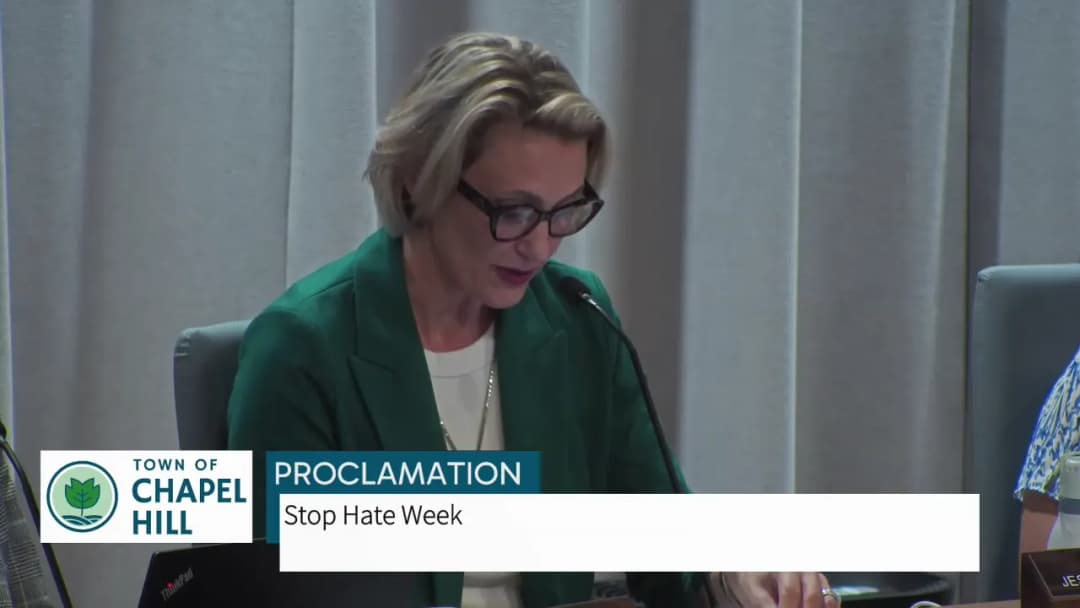
The Chapel Hill Town Council held a regular meeting on October 7, 2026, at 6:00 PM in the Council Chamber of Town Hall. The meeting included four proclamations, public comments focused on resident concerns at the Elliott Woods redevelopment, a consent agenda, an annual report from the Chapel Hill Downtown Partnership, two quasi-judicial hearings (Meadowmont Master Land Use Plan modification and The Cedars corner condo addition), a conditional zoning application for 101 Weaver Dairy Road Extension, and a closed session. All votes on agenda items were unanimous (8-0), with Council Member Sharp absent. Proclamations - Fire Prevention Week (October 4-10, 2026): Highlighted lithium-ion battery safety; proclaimed by Council Member Miller-Foushee. - Employee Appreciation Month: Celebrated the town's more than 800 employees; proclaimed by Council Member Rivers. - National Week Without Driving (October 1-8) & Walk & Roll to School Day (October 7): Encouraged active transportation; proclaimed by Council Member McCullough. - Stop Hate Week (October 18-24, 2026): A joint proclamation with Carrboro Town Council; proclaimed by Mayor Anderson. Public Comments & Testimony - Molly DeMarco (public health researcher): Spoke in support of the goals of National Week Without Driving, noting that nearly one in three people in the U.S. cannot or does not drive and that car ownership costs approximately $15,000 per year. Urged residents to try alternative modes of transportation. - Betty Carey (community advocate): Expressed concerns about the Elliott Woods redevelopment, including unsafe conditions (drilling, debris, nails), unequal treatment of residents regarding move-out dates, and lack of accountability from the property developer (Vitus). Asked for town inspections and enforcement. - Miranda Rigsby (Elliot Woods resident): Described receiving a surrender notice despite 20 years of residency and confusion about income-based eligibility. Reported safety hazards such as debris falling from roofs. - Selena Smith (Elliot Woods resident): Stated that Vitus made promises (e.g., moving before school year, no disruption) that were not kept. Reported last-minute changes to move-out dates (October 22 vs. originally November 2), lack of communication, and that pods promised for each household were not provided. - Kim Telekoff: Supported the residents and criticized the town for repeating mistakes from past displacement issues. Described a resident being told to resubmit paperwork after already filing. - Randy Bradford (Elliot Woods resident): Cited historical forced displacement of his family in Mississippi and said the current situation is wrong, asking the council to help residents. - Layla Adila (Elliot Woods resident, 30 years): Emotionally described the breakdown of a strong Black community, broken promises that no one would be displaced, families splitting up or living in cars, unsafe construction conditions, and lack of lighting. Stated that residents were offered checks to leave out of desperation. Urged the council to hold Vitus accountable. Council Responses: Council members expressed shared interest in reviewing the town's legal authority (as bond issuer) and what they could do to hold Vitus accountable. The town attorney agreed to review bond issuance documents, regulatory agreements, and deed restrictions. Manager also committed to ongoing conversations with property management. Mayor Anderson acknowledged that council members had followed the situation and apologized for not fully grasping the disruption, promising to take action. Consent Calendar Approved unanimously (8-0): - R-1: Public Housing Admissions and Continued Occupancy Policy (ACOP) Update, incorporating HOTMA 102/104 changes effective January 1, 2027. - R-2: Called a hearing for October 21, 2026 to consider an updated Land Use Management Ordinance. - September 9 and 16, 2026 regular meeting minutes approved. - Past unapproved minutes (including retreat minutes from 2017, 2022, 2024) approved. Discussion Item Annual Report: Chapel Hill Downtown Partnership MSD Services Contract - Jared Sokolsky (Board Chair) and Michael English (new Executive Director) presented the annual report for FY 2025-2026. - The partnership focuses on three core pillars: cleanliness, vibrancy, and supporting safety in downtown. - The block by block team exceeded 100% of baseline goals for eight performance metrics after starting in August 2025; in five categories they doubled the targets. - Over half of funding is allocated to clean and green services. - Council members asked about community engagement, especially with the Northside and Pine Knolls communities, unhoused residents, programming, and data presentation. - The matter was received and filed (no action needed). Special Use Permit Hearings 10. Master Land Use Plan Modification for Meadowmont (Quasi-judicial) - Applicant: Health Systems Properties (represented by Scott Murray). Sought to allow residential use (up to 12 units per acre) on a 1-acre parcel (Parcel 3) currently approved for commercial/office. - Staff (Anna Scott Myers) recommended approval, finding no contrary evidence. - Art Warner (Cedars resident & board member) testified in support, noting that residential would be less disruptive than commercial. - Council discussion: Council Member McCullough asked whether a density cap (12 units) could be removed; town attorney noted that would require a continuance and changed notice. The applicant did not seek to modify that aspect. The master plan modification was limited to up to 12 units per acre, and the separate SUP for 8 units (next item) controls actual density. - Vote: Motion to close hearing (Ryan/McMahon, unanimous 8-0); motion to approve R-3 (Ryan/Berry, unanimous 8-0). 11. Special Use Permit Modification for The Cedars of Chapel Hill – Corner Condo Addition (Quasi-judicial) - Applicant: The Cedars (represented by Perry Acock, president). Seeks approval of an 8-unit condominium building at the same parcel, with underground parking and no new curb cuts. - Staff (Alex Holloway) recommended approval. - Art Warner testified in support, noting the Cedars use few town services (own trash, roads, security, library, medical staff) and that the added units would generate an estimated $50,000-$60,000 in property taxes with no additional costs. - Council Member McCullough raised a safety concern about gas ranges in a building for seniors; applicant said they would take it under advisement. - Vote: Motion to close hearing (Ryan/McMahon, unanimous 8-0); motion to approve R-4 (Berry/Miller-Foushee, unanimous 8-0). Zoning Atlas Amendment 12. Conditional Zoning Application for 101 Weaver Dairy Road Extension (Legislative) - Applicant: Town of Chapel Hill (Fire Department and Affordable Housing Division). Seeks to rezone from OI-2 to Residential Community Priority (R-CP) to allow a new fire station (replacing Station 4, built 1982) and affordable housing. - The site is 4 acres at the corner of MLK Jr. Blvd and Weaver Dairy Rd. The plan includes a fire station, 105 affordable units (with at least 25% at or below 60% AMI), stormwater constructed wetland, and connectivity to future BRT. - Staff (Josh Mayo) recommended approval. - Dolores Bailey (Empowerment Inc.) spoke in support, announcing Empowerment is the community partner for the affordable housing developer (Laurel Street). - Council discussion: Addressed tree canopy reduction to 11% (concern from several members), crosswalk safety for pedestrians, sound/light mitigation for neighbors, fire training facility replacement, and desire for more units and better environmental performance. Council Member Rivers cautioned about careful partner selection given the Elliott Woods experience (a separate tax credit project where the town served as bond issuer). - Votes: Motion to close hearing (Berry/Miller-Foushee, unanimous 8-0); motion to adopt Resolution of Reasonableness and Consistency R-5 (Berry/Miller-Foushee, unanimous 8-0); motion to adopt Ordinance A O-1 (Miller-Foushee/Berry, unanimous 8-0). Closed Session - Moved into closed session under NCGS 143-318.11(a)(6) to discuss a personnel matter (Berry/Miller-Foushee, unanimous 8-0). The meeting then adjourned.

AFFORDABLE HOUSING 21% · LAND USE MANAGEMENT 20% · DOWNTOWN DEVELOPMENT 16% · PROCEDURAL 8%
09
OCT 6, 2026 · CHAPEL HILL, NORTH CAROLINA · MEETING PORTAL
Chapel Hill Planning Commission LUMO Discussion - October 6, 2026

The Chapel Hill Planning Commission held a meeting on October 6, 2026, to continue discussions on the Land Use Management Ordinance (LUMO) revisions. The meeting included a staff presentation, public comment, and extensive commission deliberation on key topics including housing, stormwater, trees, by-right thresholds, and enforcement. Consent Calendar - The commission unanimously approved the minutes from August 18, September 1, and September 15, 2026 meetings. Chair John Mitchell noted that the minutes were routine with no substantive votes. Public Comments & Testimony - Jacques El Chayev (320 University Drive resident, 45-year real estate professional) expressed strong opposition to policies he perceived as favoring UNC students over Chapel Hill citizens. He stated it is not the town's responsibility to house students, criticized current code enforcement, and urged the commission not to follow California's example. He submitted a letter for the record regarding unrelated students living together. Discussion Items - Staff Presentation (Taz, Planning Department): Taz provided an overview of the tentative schedule, highlighting the October 20 continued discussion and council meetings starting October 21. He summarized key changes from the July to September LUMO drafts: decreased by-right thresholds in downtown (maintaining 20,000 sq ft threshold), refined density bonus criteria for missing middle housing (replacing collector street classification with collector streets with sidewalks), added quarter-mile proximity to public schools as a criterion, restrictions on vape shops in new commercial areas, parking disincentives (85-100% of max triggers additional tree planting and pervious pavement requirements), and downstream impact analysis requirements for larger projects. - Housing Discussion: Commissioner Jeff Green raised concerns about gross floor area limits (5,000 sq ft for duplexes, 6,000 sq ft for triplexes/quadplexes) that restrict missing middle housing. He argued these limits are not evidence-based and disproportionately limit student housing options. He suggested eliminating or increasing the limits, or developing overlay districts near UNC to control student occupancy. Commissioner Libby Thomas suggested scaling floor area to lot size. The commission agreed to have Jeff write up recommendations. - Density Bonus Criteria: Commissioner John Mitchell criticized the quarter-mile from greenway entrance criterion as arbitrary and fragmented, and questioned the quarter-mile from school criterion as not effectively directing density. Commissioner Jeff Green preferred allowing quadplexes town-wide but found the collector-with-sidewalks and arterial criteria defensible, while recommending removing the greenway and school criteria. The commission generally agreed to omit greenway and school criteria for now. - Stormwater Management: Commissioner Liz Loss presented a detailed analysis of proposed stormwater regulations, including a breakdown of requirements by land use and disturbance size. She advocated for a risk-based approach rather than use- or unit-based triggers, and proposed developing a stormwater overlay district. She also recommended strengthening the downstream impact analysis requirement by adding criteria for the town manager's discretion. Commissioner Jeff Green expressed concern about costs and potential barriers to missing middle housing, but others supported stronger risk-based rules. The commission agreed that Liz would draft recommendations. - Tree Canopy Requirements: Commissioner Libby Thomas noted inconsistencies (e.g., 85% vs 75% root zone protection) and concerns about reduced canopy for dense housing. She suggested increasing the starting percentage of native species, removing the "adapted species" category, starting at 70% or higher, and restricting turf under canopy. Commissioner Green noted the auto-ratcheting timeline could be confusing. Commissioner Charles Mills had no strong objection to the current proposal. The commission agreed Libby would draft tree-related recommendations in consultation with Liz. - By-Right Thresholds: The commission reviewed tiered thresholds for residential (starting at 30 units) and commercial (starting at 40,000 sq ft) development, with affordability incentives. Commissioner Mitchell expressed skepticism about the curated downtown approach, noting past projects struggled. The commission had no further substantive changes. - Enforcement: Commissioner Thomas raised concerns about inspection and follow-up for tree protection. Staff noted limitations: fines capped at $500 per day per violation due to state law, and primary leverage is withholding permits. The commission acknowledged enforcement is resource-dependent and not easily legislated. Key Outcomes - The commission will meet again on October 20, 2026, to finalize recommendations for the Town Council on the draft LUMO. - Assignment of drafting work: Jeff Green will draft recommendations on housing (floor area limits, overlay districts); Liz Loss will draft on stormwater (risk-based approach, criteria for downstream analysis); Libby Thomas will draft on trees (canopy percentages, native species, enforcement). Drafts are to be sent to Josh (commissioner) before the October 20 meeting. - The commission will attend the October 21 council meeting to present their recommendations in person. - The next meeting is confirmed in person to facilitate discussion and public input. Note: No formal votes were taken on substantive issues; the minutes approval was the only formal action.

LAND USE MANAGEMENT 28% · STORMWATER MANAGEMENT 27% · TREE PROTECTION ORDINANCE 18% · PROCEDURAL 7%
10
OCT 1, 2026 · CHAPEL HILL, NORTH CAROLINA · MEETING PORTAL
Chapel Hill Board of Adjustment Meeting – October 1, 2026

The Town of Chapel Hill Board of Adjustment met at 6:30 PM on Thursday, October 1, 2026, in Council Chamber, Room 110 at 405 Martin Luther King Jr. Boulevard. All six voting members were present. The Board approved the prior meeting minutes, approved a draft variance decision for 219 Glenhill Lane, granted a dimensional variance for 739 Gimghoul Road, and recommended Peter Maniloff for appointment as an alternate member. Consent Calendar - Approved the meeting agenda by a 6-0 vote. - Approved the September 3, 2026 draft meeting minutes by a 6-0 vote and directed that they be entered into the official record. - Approved the draft variance decision for the dimensional variance at 219 Glenhill Lane by a 6-0 vote after members confirmed that the address and date on the decision had been corrected. Public Comments & Testimony - Applicant Vicky Parrot testified in support of the 739 Gimghoul Road variance, stating that the garage predates her ownership, was built with the house in the late 1930s/early 1940s, and that the property's steep slope and stone retaining walls make the garage's location the only practical place for an accessory dwelling unit. She said relocating the structure would cause erosion, tree loss, and additional expense. - Applicant Blue Chattergy expressed support for the project, saying accessory dwelling units are consistent with Chapel Hill's housing goals, including affordability and housing for students in historic districts. - No members of the public other than the applicants offered comment. Discussion Items - Dimensional Variance – 739 Gimghoul Road ([26-0321]): Planning staff presented the request for a property in the Gimghoul neighborhood east of UNC's main campus to reduce the required street setback from 26 feet to 9 feet and the interior setback from 10 feet to 4 feet to add an accessory dwelling unit above an existing garage. The applicant argued that the existing nonconforming garage, retaining walls, mature trees, and slope created an unnecessary hardship. Board members discussed whether the pre-existing nonconformity could be expanded, and the Board attorney explained that a variance supersedes the nonconformity rule and that the Board could impose conditions if it chose. The Board declined to add conditions, noting that any design would still need Historic District Commission approval. The Board then adopted Resolution A, directing staff to draft an order granting the variance, by a 6-0 vote. - Membership Recommendations ([26-0322]): The Board reviewed applications and resumes for the third alternate position. Candidates discussed included Mr. Bennett, Trevor Leatherwood, Peter Maniloff, and David Weiner. After discussion, the Board voted 6-0 to recommend Peter Maniloff to the Town Council for appointment as an alternate member. Key Outcomes - Approved the agenda, the September 3, 2026 minutes, and the 219 Glenhill Lane draft variance decision. - Granted the 739 Gimghoul Road dimensional variance through Resolution A, allowing the street setback to be reduced from 26 feet to 9 feet and the interior setback from 10 feet to 4 feet. - Recommended Peter Maniloff for appointment as alternate to the Board of Adjustment. - All votes taken during the meeting were unanimous, with six affirmative votes.

PLANNING AND ZONING 30% · LAND USE MANAGEMENT 30% · ZONING REGULATIONS 13% · PROCEDURAL 12%
0102
NEXT →
OPENPUBLICA · PUBLIC MEETING INDEXUPDATED DAILY · openpublica.com