Chapel Hill Community Design Commission Meeting - August 25, 2026\n\nThe Community Design Commission met virtually on August 25, 2026, at 5:30 PM. Vice Chair Kim Hans chaired the meeting due to Chair Patrick Brennan's absence. The meeting was brief, consisting of roll call, approval of previous meeting minutes, and a single new business item (Christ Community Church elevation updates), which was moved to the consent agenda and approved unanimously. New commissioner Dr. Racheal Tushabe was welcomed.\n\n Consent Calendar\n- Approval of Minutes (June Report): The commission approved the minutes from the previous meeting.\n- Christ Community Church Elevations: The commission unanimously approved the submitted elevation updates for Christ Community Church (Item 26-0260) as part of the consent agenda.\n\n Discussion Items\n- No discussion was held on the Christ Community Church item; it was moved directly to the consent agenda without questions or debate.\n\n Key Outcomes\n- The commission approved the June meeting minutes.\n- The commission approved the Christ Community Church elevation set.\n- The meeting adjourned shortly after the consent agenda vote.
Public Meetings - Chapel Hill, North Carolina
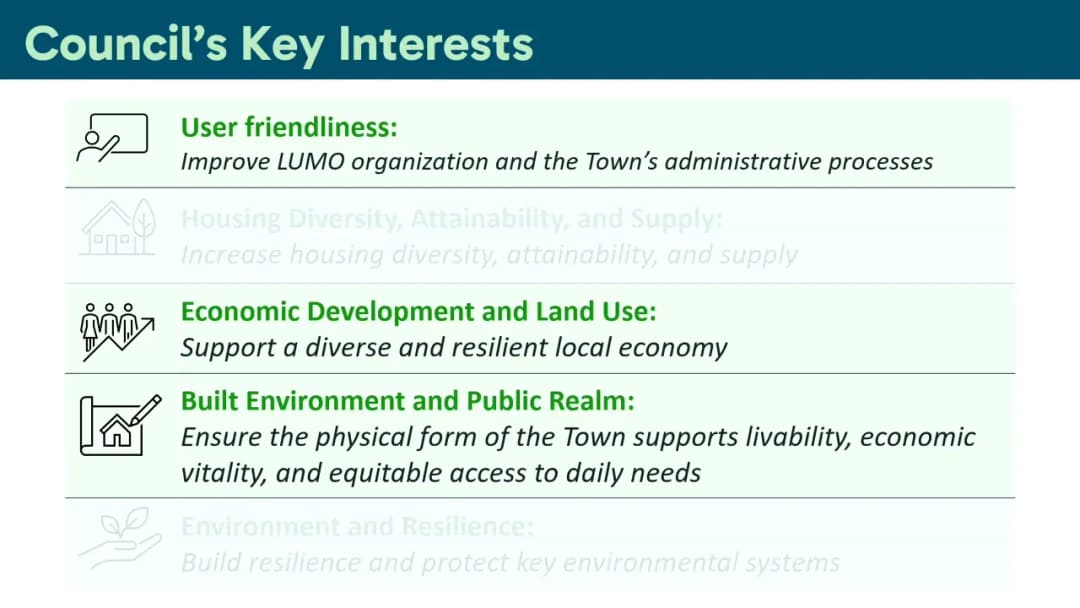
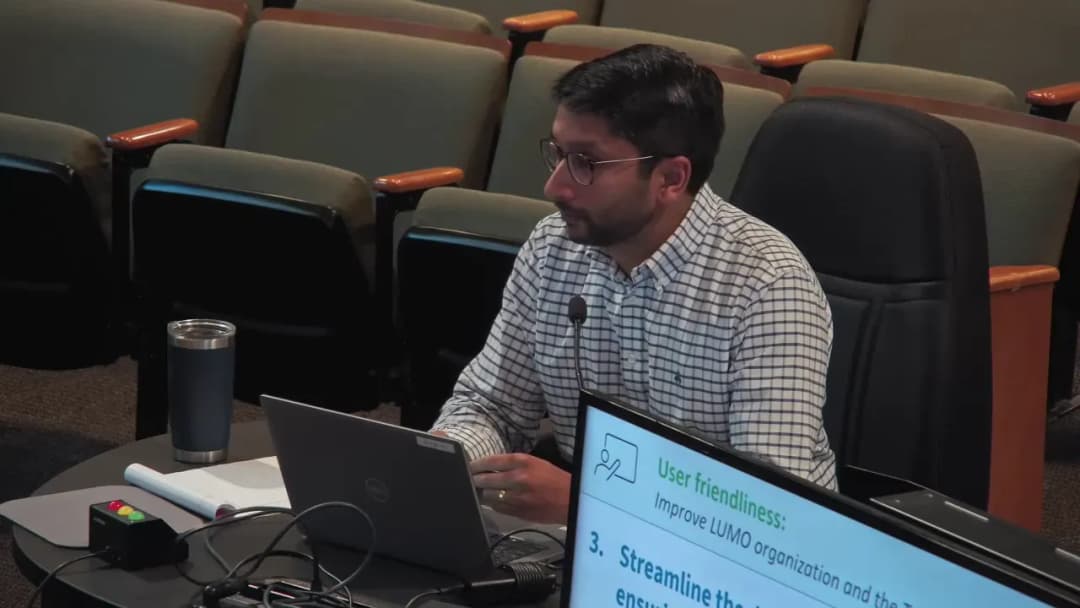
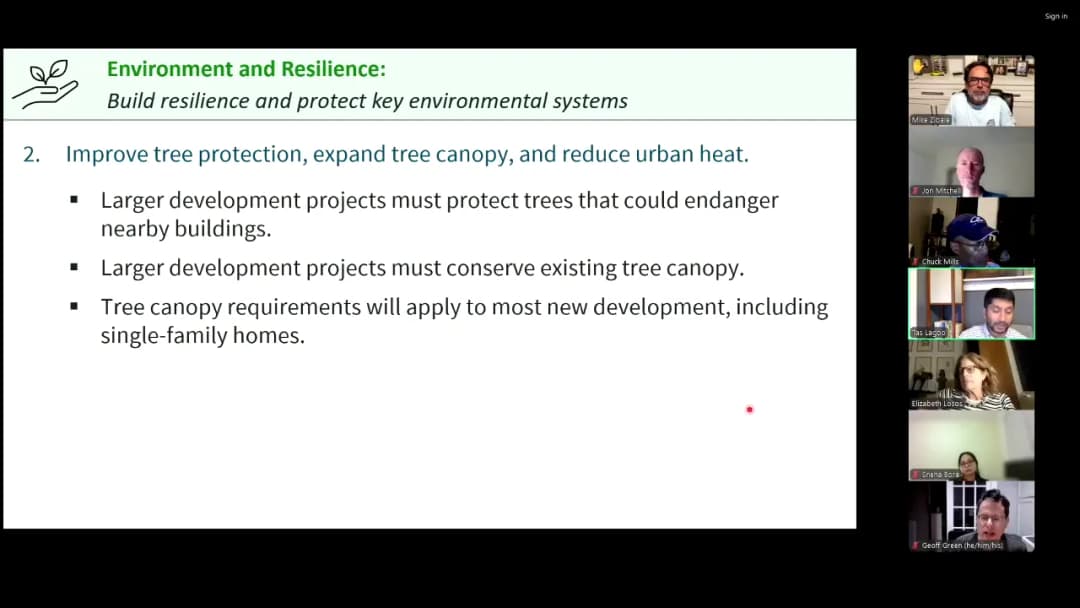
Public Meetings - Chapel Hill, North CarolinaThe Planning Commission held a meeting on August 18, 2026, from 6:00 PM to 8:05 PM, primarily to discuss the proposed Land Use Management Ordinance (LUMO) update. The commission reviewed trade-offs in user friendliness, economic development, and the built environment, and heard public comments on stormwater, affordable housing, and tree canopy. The commission also voted to make no member recommendation for a vacant council seat. Consent Calendar - Approved the June 16, 2026, meeting minutes by unanimous vote (motion by Zibaie, seconded by Losos). Public Comments & Testimony - A resident expressed appreciation for the LUMO's readability but raised concern about language exempting failing stormwater conveyances, asking that developers be required to show no increase in runoff even if existing conveyances are already failing. - Kimberly Sanchez (CEO, Community Home Trust) opposed the removal of mandatory inclusionary zoning, noting that Community Home Trust has 300 homes in inventory largely due to the current mandatory ordinance. She argued that voluntary incentives are less effective, citing Carborough's voluntary program producing only 50 units versus Chapel Hill's 250+. - A resident warned against de‑oversight of smaller developments through administrative approvals, noting cumulative impacts from many small projects. - David Shanter (homeowner near Eastwood Lake, speaking personally) supported the downstream impact analysis in LUMO Section 7.4 but criticized exemptions that treat commercial and residential development differently, arguing that the same size disturbance should trigger the same analysis regardless of use. - Barbara Driscoll stated the new LUMO is better than the old but fails to meet current stormwater and climate resilience needs due to low canopy retention percentages (10%–20%) and lack of stormwater controls on smaller lots. - A final speaker recommended adopting Raleigh's approach of a pre‑development baseline based on 100% forest cover to reduce paperwork and improve downstream flood protection. Discussion Items - LUMO Update Presentation (staff Taz Lagoo): Covered three of five council‑identified interests – user friendliness, economic development/land use, and built environment/public realm. The remaining two (housing and environment/resilience) will be discussed at the September 1st meeting. Key trade‑offs included predictability vs. community benefits, public participation vs. objective decision‑making, preserving neighborhoods vs. supporting new amenities, and private development potential vs. public benefits. - Commission Questions & Deliberation: - Commissioner Mills asked how “larger projects” are defined (e.g., tree canopy requirement applies to development of one acre or larger). - Commissioner Losos raised concerns about using collector/arterial street classifications as proxies for desired density, noting they don't always align with Complete Community goals. She questioned the 50% and 70% impervious surface standards and whether a watershed resilience overlay could be created. Staff noted legal constraints (state downzoning limits) and resource needs but said such an overlay is possible. - Regarding downstream impact analysis, staff clarified that residential development with four or fewer units is exempt; larger residential is treated the same as commercial. Commission questioned the fairness of exempting small‑scale residential even when disturbance is large. - On inclusionary zoning, staff confirmed the draft LUMO removes the mandatory requirement for multifamily developments but retains it for subdivisions. Commissioner Zibaie observed that in practice, mandatory inclusionary zoning has produced few affordable units from by‑right projects; most came from conditional rezonings. Staff noted that state law prevents applying inclusionary zoning to rental units. - Tree canopy: Commissioner Losos noted lower requirements for 2‑12 unit residential and mixed‑use, and a 25% payment‑in‑lieu option. Staff said payments must be used for canopy in the vicinity and that alternative measures (green roofs, shade structures) are not ecologically equivalent. - Missing middle housing (triplexes, quadplexes): Access is triggered by location on an arterial/collector street or within 1/4 mile of a greenway entrance. Commissioner Losos asked for a map of street classifications and noted that the percentage of R1 parcels near collectors matters for true densification vs. sprawl. Staff committed to publishing maps soon. - Commissioner Losos also noted that the greenway node definition was broader than entrance definition and should be aligned. Staff acknowledged a discrepancy and that the node language was intended to apply generally. - Commissioner Losos inquired about small area planning integration; staff said small area plans could inform future zoning map updates after the LUMO is adopted. Key Outcomes - No formal vote on the LUMO update; discussion will continue at the September 1st meeting (covering housing and environment/resilience). - Planning Commission Applications (vacant council seat): Motion by Mills, seconded by Losos, to make no member recommendation to Town Council. The motion passed 4‑0 (Chair Mitchell, Losos, Mills, Zibaie; members Green and Thomas excused). - The commission decided to postpone officer elections until December, in line with past practice, rather than September per the advisory board policy. - Next meeting: September 1, 2026, in person in the Council Chamber. Additional LUMO session possible on September 15th; formal legislative process beginning in October.
The Historic District Commission met on August 11, 2026, at 6:30 PM in the Council Chamber of Chapel Hill Town Hall. Commissioner Don Tise served as Chair; Vice-Chair Brian Daniels was absent, leaving five participating commissioners. The commission considered several certificates of appropriateness (COA) applications, approved previous meeting minutes, and received administrative updates. Announcements - Staff reminded commissioners of a free preservation workshop on September 25, 2026, for CLG training, and noted that the draft Land Use Management Ordinance (LUMO) rewrite is available for public comment through an online portal. - The commission set a meeting cutoff: no new agenda items would start after 9:00 PM, with a target adjournment by 10:00 PM. Consent Calendar - Approved the agenda as amended: agenda item order swapped for 310 Pittsboro Street and 111 Ridge Lane, and the application for 742 Gimghoul Road was withdrawn. - Approved the meeting minutes of March 10, April 30, June 9, and June 22, 2026, unanimously. Public Comments & Testimony - For 100 S. Columbia Street, Christopher Mather was sworn in and expressed support for the fence proposal, stating he stood behind the church’s efforts. - No public comments were made for other agenda items. Discussion Items - 102 Fraternity Court: Applicant Matthew Davis, president of the Sigma Kai House Corporation, presented plans to replace an existing ladder-style fire escape with a conventional stairwell to improve safety while preserving the building’s historic character. The proposal was designed to be minimally visible and match similar fire escapes in the district. The commission found the proposal not incongruous with the historic district. - 712 Gimghoul Road: Architect Colby Linton presented a proposal for a deck, pergola, and walkway attached to an existing porch at the home of Adam and Susan Jones. The design used materials and details matching the existing house and neighborhood. The commission approved the application unanimously. - 100 S. Columbia Street: Steve Harward represented University Baptist Church in requesting a 4-foot-tall aluminum picket fence around their memorial garden to deter transient activity and protect commemorative space. Discussion centered on material (aluminum vs. wrought iron), placement (on top of or behind the rock wall), gate details, and connections to adjacent buildings. Commissioner Josh Gurlitz expressed concern about insufficient specificity, and the commission voted unanimously to continue the evidentiary hearing to September 8, 2026, to allow the applicant to provide more detailed drawings, a fence sample, and installation plans. - 742 Gimghoul Road: The application was withdrawn prior to the meeting. - 111 Ridge Lane: Applicant Nancy Smith and architect Ben Johnson presented a proposal for a new single-family home designed in a traditional farmhouse vernacular with materials consistent with the district. They demonstrated that the house’s form, scale, and massing were aligned with neighboring properties. The commission unanimously approved the application, praising the design as fitting the neighborhood’s character. - 310 Pittsboro Street: Michael Celaruro presented a request for a new mechanical (DOAS) unit on the roof of the State Employees Credit Union building. The unit would be largely hidden by the parapet and set back from the street; only a sliver was visible in some views. The commission found the proposal not incongruous with the historic district and approved it unanimously. Key Outcomes - Approved (all unanimously): - Consent calendar items: agenda and four sets of minutes. - COA applications for 102 Fraternity Court, 712 Gimghoul Road, 111 Ridge Lane, and 310 Pittsboro Street. - Continued: 100 S. Columbia Street hearing continued to September 8, 2026, for additional details. - Withdrawn: 742 Gimghoul Road. Next meeting: September 8, 2026.
The Town of Chapel Hill Board of Adjustment met on July 2, 2026, at 6:30 PM in Room 110 of the Council Chamber. The meeting focused on approving the agenda, correcting and approving the June 4, 2026 draft minutes, and voting on a draft order granting a dimensional variance for 700 Bolinwood Drive. Seven members were present; one member abstained from all votes. No public comments were heard. Consent Calendar - Approval of Agenda: The agenda was approved with 6 ayes and 1 abstention (Mr. Herman). - Approval of Minutes – June 4, 2026: The draft minutes were approved with a correction to the spelling of member David Nahm’s name. The vote was 6 ayes and 1 abstention (Mr. Herman). Discussion Items - Dimensional Variance – 700 Bolinwood Drive: The Board considered a draft order prepared by staff following the evidentiary hearing and unanimous vote at the June 4, 2026 meeting. The order directed approval of the requested dimensional variance. Board members confirmed they had reviewed the draft. A motion to approve the variance order was made and seconded. Key Outcomes - Vote on the Variance Order: The Board voted to approve the dimensional variance for 700 Bolinwood Drive. The roll call resulted in 6 affirmative votes (Fishkin, Warshaw, Wortman, Bartow, Weiner, Grasty) and 1 abstention (Herman). The Chair declared the motion passed. Discussion clarified that an abstention does not count as a nay vote but also does not contribute to the required four-fifths affirmative majority; the threshold was met because six affirmative votes were cast. - Next Meeting: The Board’s next regular meeting is scheduled for September 3, 2026. The Chair noted an interest in contacting Julia Chamberlain about a potential role, with follow-up planned for the September agenda.
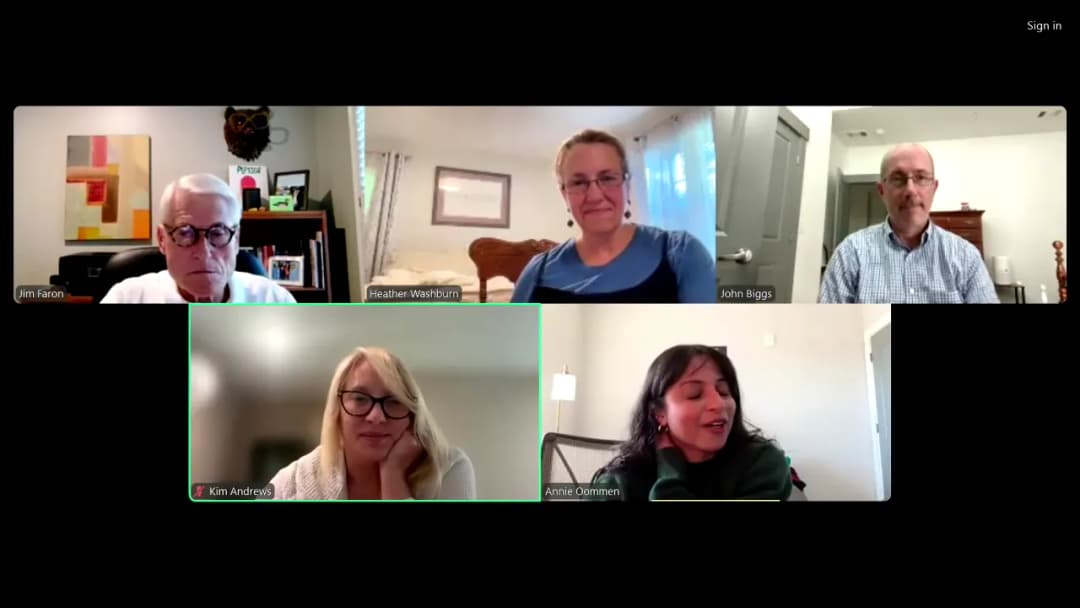
The Chapel Hill Community Design Commission met virtually on Tuesday, June 23, 2026, at 5:31 PM. The meeting focused on approving minutes from previous months and electing new leadership for a two-year term. Outgoing Chair Heather Washburn and member Annie made farewell remarks. Consent Calendar - Approval of Minutes: The Commission unanimously approved the minutes from the March, April, and May 2026 meetings. Public Comments & Testimony - No public comments were received. Discussion Items - Chair Election: Member John Biggs nominated Patrick Brennan for Chair. Brennan accepted, and the Commission voted unanimously to appoint him. - Vice-Chair Election: Patrick Brennan nominated Kim Andrews for Vice-Chair. Andrews accepted, and the Commission voted unanimously to appoint her. - Remarks: Outgoing Chair Heather Washburn emphasized evaluating projects as part of Chapel Hill's fabric, considering community context, scale, environment, and maintenance. Member Annie announced she is moving to Philadelphia after her August wedding and is rolling off the Commission. Members expressed gratitude for both outgoing members' service. Key Outcomes - Elected: Patrick Brennan as Chair and Kim Andrews as Vice-Chair for a two-year term. - Rolled Off: Heather Washburn and Annie concluded their service on the Commission. - Next Meeting: Scheduled for August 25, 2026 (no July meeting).
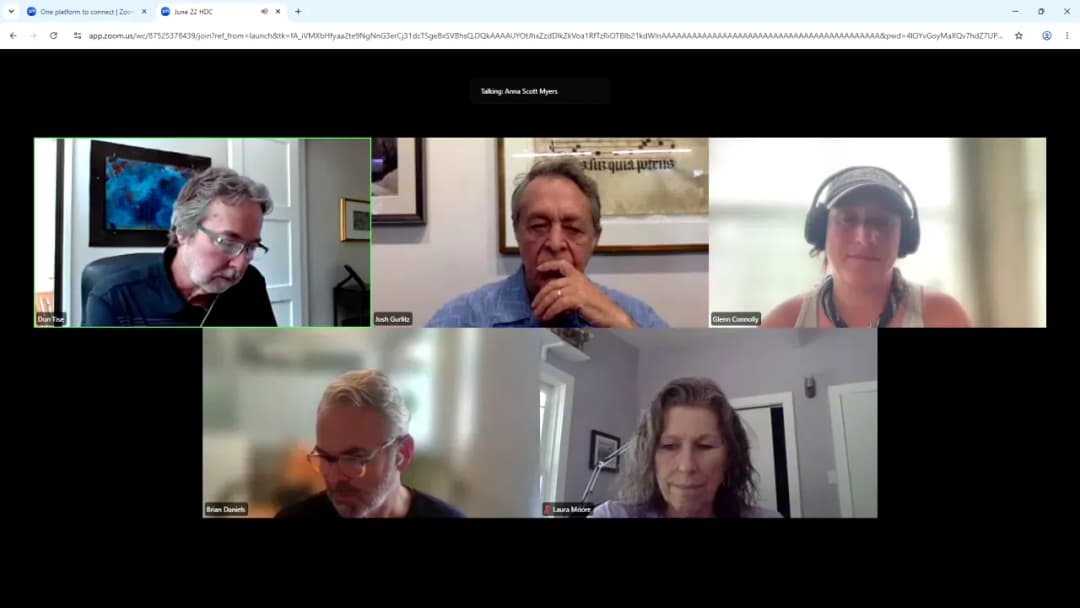
The Historic District Commission met virtually on June 22, 2026, at 3:00 PM. The meeting was brief, consisting solely of agenda approval and a consent calendar of three Certificate of Appropriateness (COA) items. No public comments or substantive discussion occurred. The commission also clarified upcoming meeting dates. Consent Calendar The consent agenda included three items: - 111 Ridge Lane (File 26-0228) – COA Placard - 118 Mallette Street (File 26-0229) – Written Decision - 214 McCauley Street (File 26-0230) – COA Placard A motion to approve the consent calendar as outlined was seconded and passed unanimously. Key Outcomes - The three consent items were approved without discussion. - The next regular meeting was confirmed for August 11, 2026, correcting a website error that had listed a July meeting instead. - Note on procedural discrepancy: The agenda and minutes indicate the chair read the public charge, but the transcript shows it was skipped. This summary follows the transcript as the primary source for what occurred.
The Town Council met on June 22, 2026, at 6:00 PM in Council Chamber to continue the June 17 meeting, focusing on the Land Use Management Ordinance (LUMO) update. The meeting opened with a Disability Pride Month proclamation honoring the late County Commissioner Jamesetta Bedford, followed by announcements and a detailed staff presentation on the draft LUMO alignment with council policy guidance. The council heard public comments and provided feedback, ultimately receiving and filing the matter. Public Comments & Testimony - Barbara Driscoll (New Hope Bird Alliance) expressed concerns that the LUMO memo focuses on density without a corresponding citywide conservation plan or zoning map. She argued that a conservation plan should come first and that the draft lacks protection for natural areas, greenways, and wildlife habitat. She also criticized the proposed single public engagement meeting as insufficient and questioned how graphics-based regulations would be enforced. - Jeanette Bench echoed concerns about environmental protections, stating that the public will not engage unless they know exactly which addresses are impacted. She noted that without a concrete map, residents will only react when buildings appear, as happened with the form-based code. She urged the council to make decisions only after identifying specific properties. Discussion Items - LUMO Update Presentation by Tas Lagoo (Planning Manager) covered: - Public participation: Summer outreach (pop-ups, user testing, office hours) and a fall schedule with work sessions and legislative process. - Council alignment: The draft LUMO aims to translate council's five policy interests (user friendliness, housing diversity, economic development, built environment, sustainability) into regulation. - User friendliness: Reorganization, plain language, graphics, improved predictability of uses, streamlined administrative processes (e.g., removing CDC review in Blue Hill, exempting small-scale commercial from zoning compliance permits, shifting special use permits to Board of Adjustment). - Housing diversity: New by-right thresholds (30+ units or 40,000+ sq ft non-residential), density tied to proximity to greenways and arterial streets, incentives for affordable housing, smaller units via floor area limits, and context-sensitive infill rules (transition requirements, street trees, front-yard parking limits for triplexes/quadplexes). - Economic development: Neighborhood-scale commercial (e.g., 3,000 sq ft retail), daycare allowances, and home-based business easing. - Built environment: Amenity space requirements, mobility infrastructure incentives (greenways), parking maximums maintained but with potential innovative approaches, and building form standards (maximum width, parking restrictions, stepbacks, blank wall limits). - Environmental sustainability: RCD buffer widths not reduced, but enhanced lighting and stormwater controls; new tree canopy conservation (10% for large sites, overall 20-40% requirement), protection of trees near property lines, lower stormwater thresholds (12,000 sq ft for single-family), and sustainability incentives for commercial development. Key Outcomes - The matter was received and filed by the council (no vote taken). - Council directed staff to identify specific policy trade-offs and conflict points (e.g., between affordable housing and tree canopy goals) for fall discussions. - Staff will share the draft LUMO within a few weeks and hold office hours for council members over the summer. - Fall schedule includes at least two work sessions for both planning commission and council, followed by legislative process, aiming for adoption by end of 2026. - Councilmember Ryan emphasized the need to focus on high-level policy debates where council must balance competing interests; Councilmember Berry urged patience and listening. - The council also recognized Disability Pride Month (July 2026) and announced a community poem workshop on June 25, 2026.
The Chapel Hill Town Council met on June 17, 2026, at 6:00 PM in Council Chamber, with 8 members present (Councilmember Miller-Foushee absent). The meeting began with a proclamation declaring July as Parks and Recreation Month, followed by public comments, unanimous approval of a 13-item consent agenda, discussions on campaign contribution limits and Complete Community implementation, a closed session, continuation of the LUMO update to a later date, and appointments to several boards. Public Comments & Testimony - Joe Patterson, speaking on behalf of Cobb Terrace and North Street residents, addressed the item restricting left turns from North Street into the Rosemary Parking Deck (consent item 11). He stated that the town had made an agreement four and a half years ago to design the exit to prevent traffic through their neighborhood, but the design and construction never occurred. He requested that Council direct staff to honor the agreement. Council acknowledged the comments but noted that no immediate action would be taken on items not on the printed agenda. Consent Calendar - All items on the consent agenda (items 2–13) were approved unanimously via a motion by Council Member Ryan, seconded by Council Member McCullough. These included: - Miscellaneous Budget Ordinance Amendment for FY 2025-26 (O-1 through O-4) - Authorization to execute development contracts and ground leases with Community Home Trust and Habitat for Humanity for the Homestead Gardens Affordable Housing Development (R-1 through R-4) - Approval of the Human Services Funding Program funding plan ($602,516) (R-5) - Sole source purchase of land surveying equipment from CW Lawley, Inc. ($62,614.28) (R-6) - Town Attorney employment contract for James Baker (R-7) - Bid award and construction contract for Fordham Boulevard Sidepath to Lanier Construction Company ($2,363,978.32) (R-8) - Ordinance restricting left turns from westbound North Street into the Rosemary Parking Deck (O-5) - Ordinance amending Chapter 10 to prohibit discrimination in public accommodations and employment (O-6) - Approval of past work session and retreat minutes from 2009–2016 Discussion Items - Campaign Contribution Limitations (Item 14): Town Clerk Brittany Hunt presented options for calculating contribution limits in future even-numbered years: keep the current two-factor formula (CPI + registered voters), use CPI only, or explore a new formula. Council discussion showed strong support for the CPI-only approach. Council Member Nollart raised concerns about allowing self-funding of campaigns, but most members preferred simplifying to CPI. No vote was taken; staff will prepare an ordinance amendment for a consent agenda in September 2026. - Update on Complete Community Implementation (Item 15): Town Manager Ted Voorhees presented an update on how the Complete Community framework is being integrated into planning and operations, including metrics, business plans, and future reporting. Council members discussed the role of the natural areas map, the need for clear definitions and visualization, and the desire for a public-facing dashboard. The item was received and filed without formal action. - Closed Session (Item 20): Council entered closed session under NC General Statutes §143-318.11(a)(5) and (a)(6) to discuss a property matter. Upon returning, they authorized the Town Manager to execute an option extension agreement for the Wallace Deck. The motion passed unanimously (8-0). - Land Use Management Ordinance (LUMO) Update (Item 16): Due to the late hour (9:04 PM) and the complexity of the presentation, Council voted to continue the item to Monday, June 22, 2026, at 6:00 PM in Council Chamber. The motion by Council Member Sharp, seconded by Mayor pro tem Berry, passed unanimously (8-0). Council Member McMahon indicated he could not attend on Monday due to a prior commitment. Key Outcomes - All 12 consent items were enacted unanimously. - Council directed staff to prepare an ordinance amendment using a CPI-only formula for campaign contribution limits, to be brought back in September 2026. - Town Manager authorized to execute an option extension agreement for the Wallace Deck. - LUMO update discussion was continued to June 22, 2026, at 6:00 PM. - Appointments made to boards: David Nahm, Thomas Wortman, and Randy Herman to the Board of Adjustment; Sandra Sider to the Historic District Commission; and Geoffrey Green to the Planning Commission.
The Chapel Hill Planning Commission met virtually on June 16, 2026, from 6:15 PM to 10:15 PM via Zoom. Chair Jonathan Mitchell led the meeting, with Vice-Chair Geoffrey Green, Elizabeth Losos, Chuck Mills, and Mike Zibaie present; Libby Thomas was absent. The primary agenda item was a detailed presentation from Planning staff on the draft Land Use Management Ordinance (LUMO) alignment memo, covering five key policy areas. The commission also heard updates on the Carolina North Stakeholder Advisory Committee and term extensions for two members. Consent Calendar - Approval of Agenda: The agenda was approved by unanimous thumbs-up. - Approval of Minutes (May 19, 2026): A motion by Losos, seconded by Vice-Chair Green, carried unanimously to approve the minutes. Announcements - Carolina North Stakeholder Advisory Committee: Vice-Chair Green reported on the initial meeting of the 36-member committee, which will advise the chancellor on development of the Carolina North campus. Consultants (Ayers Saint Gross) are conducting a place study, with horizontal construction anticipated in 2027. A link to the website (CarolinaNorth.unc.edu) and meeting video was provided. Questions raised included the status of a basketball arena (undecided) and ensuring trail system maintenance. - Term Extensions: Chair Mitchell and Elizabeth Losos had their planning commission terms extended through June 30, 2027, approved by the Town Council on June 10, 2026. Discussion Items - LUMO Update Presentation: Tas Lagoo ("Taz") presented on the draft LUMO, building on council's five key interests: user friendliness, housing diversity/attainability/supply, economic development/land use, built environment/public realm, and environment/resilience. Key points included: - User Friendliness: Proposed streamlining Blue Hill district approvals (consolidating CDC certificate of appropriateness and form district permit into staff approval), exempting small commercial projects (under 500 sq ft impervious surface/1,500 sq ft land disturbance) from zoning permits, and shifting special use permits entirely to the Board of Adjustment. The new LUMO will have fewer zoning districts overall but a transitional spike in available districts until a new zoning map is adopted. - Housing Diversity/Supply: By-right residential thresholds would increase significantly (e.g., from current 10 units in R-6 to a new baseline of 30 units in most districts, with higher limits in town centers). An alternative threshold expressed in floor area (e.g., 30,000 sq ft residential) was introduced to incentivize smaller units. A new RD zoning district (allowing 8–12 units, no minimum lot size) was proposed for missing middle housing. Density bonuses were linked to proximity to greenway entrances (1/4 mile) and higher-capacity streets (arterials/collectors), though commissioners expressed concerns about using street designations as a proxy and about potentially generating opposition to new greenways. - Affordable Housing Incentives: Robust incentives for by-right affordable housing included 60% increases in floor area ratio and height, 50% reductions in setbacks/buffers, and higher by-right unit thresholds for projects providing affordable units (e.g., up to 48 units without conditional zoning at a target level, and over 75 units at a higher target). Subdivision incentives (50% lot size reduction) were also noted. - Built Environment/Public Realm: Proposed maximum building width of 250 feet with articulation allowances, limitations on parking between building and street (to improve pedestrian experience), blank wall restrictions, and active depth requirements for ground-floor uses. Mandatory street trees adjacent to pedestrian infrastructure (with shading preference) were included. Transition zone standards will be standardized to reduce case-by-case negotiation. - Environment/Resilience: No reduction in Resource Conservation District (RCD) buffer widths. Stormwater control measures in the RCD must be green infrastructure (constructed wetlands, bioswales) unless infeasible. Minor exemptions for small residential projects (up to 30 sq ft impervious/60 sq ft land disturbance) from RCD permitting. Life safety buffers for trees endangering neighboring buildings (either protect or proactively remove). Mandatory tree canopy conservation for sites over 1 acre: at least 10% of existing canopy must be preserved. For single-family homes: 30% canopy requirement for new construction (20% for duplexes/triplexes), with exemptions for smaller units (under 2,000 sq ft SF, under 4,000 sq ft missing middle). Street tree requirements will be broadly applied. Stormwater thresholds lowered: single-family homes subject to stormwater rules at 12,000 sq ft land disturbance (down from 20,000); 100-year storm standard expanded to apply to subdivisions with 4+ lots and developments over 40,000 sq ft land disturbance (previously only conditional zonings). - Economic Development: Provisions to allow micro retail/restaurant uses (under 3,000 sq ft) in residential districts along appropriate street types, and to make mixed-use the default in multifamily districts. Daycares would be allowed in R-1/R-2 without street-type restrictions, capped at 4,000 sq ft on local streets. Home occupation regulations would be liberalized with three tiers (incidental, standard, major). - Commissioner Comments and Concerns: - John Mitchell expressed concern that linking upzoning to greenway planning could spur opposition to greenways; suggested limiting density bonuses to existing greenways only. He also worried that higher by-right thresholds might discourage large, cohesive projects (e.g., Aura, South Creek) that bring major community benefits, though staff noted that 30-45 unit thresholds still leave room for 200+ unit projects. John also supported standardized transition zones and applauded the effort to formalize them. - Geoffrey Green questioned using street classifications (arterial/collector) for density bonuses, noting that many such streets (e.g., Estes Drive between Library and Caswell, Dixie Drive) lack safe pedestrian infrastructure and are inappropriate for higher density. He advocated for applying missing middle housing townwide or through map-based rezoning. He also noted the potential to incentivize lower parking ratios through affordable housing incentives. - Elizabeth Losos stressed that regulatory changes alone are insufficient; robust small-area planning, conservation overlays (using better data), and public investment are needed to achieve complete community goals. She also suggested disincentives for using stormwater ponds in the RCD (e.g., requiring biodiversity-positive compensation) and questioned whether stormwater thresholds should be based on flood risk rather than lot size. She supported the streamlined Blue Hill approach but noted the loss of CDC's design review expertise. - Mike Zibaie inquired about enforcement of tree protection (e.g., how to determine which trees endanger neighbors), and suggested disincentives for removing rare/specimen trees beyond the proposed double-counting mechanism. He also asked about cloud-based comment platforms for the draft LUMO (staff confirmed intent to use such a platform). - Chuck Mills (spoke briefly) supported the presentation and thanked staff. Key Outcomes - No formal votes were taken on the LUMO provisions; the presentation was for discussion and feedback to guide the draft. - Next Steps: The draft LUMO will be published within the next two weeks. The commission will hold work sessions in August and September (August 18 and September 1 proposed, though some members may be out of town; hybrid format may be needed). Formal public hearings are scheduled for October (Planning Commission) and November/December (Town Council), with adoption targeted by end of 2026. Staff offered office hours for commissioners over the summer. - Information to Council: Commissioners agreed to compile individual notes from the meeting (via a Google Doc) to share informally with Town Council for its June 17 meeting. No action was taken to adopt a formal position. - The next regular Planning Commission meeting is August 18, 2026.
The Chapel Hill Town Council met on June 10, 2026, at 6:00 PM in the Council Chamber. The meeting opened with proclamations for Pride Month and National Immigrant Heritage Month. Council members made announcements regarding upcoming stormwater open houses, a Juneteenth celebration, and the next council meeting. The council adopted the FY 2026-27 budget with no property tax increase and held a public hearing on the Downtown Municipal Services District (MSD) contracted services contract. All votes were unanimous (8-0), with Council Member Sharp absent. Consent Calendar - Authorization to Execute Development Contracts with CASA for the Horizons Building and Supportive Housing Building in the Homestead Gardens Affordable Housing Development (R-1). - Authorization to Execute a 99-year Ground Lease with CASA for the Horizons Building (R-2). - Authorization to Execute a 99-year Ground Lease with CASA for the Supportive Housing Building (R-3). - Extension of Historic District Commission Member Term for Josh Gurlitz by one year to support quorum (R-4). - Extension of Planning Commission Member Terms for Jonathan Mitchell and Elizabeth Losos by one year to support completion of the LUMO rewrite (R-5). - Approval of Past Work Session Minutes from 2014-2016. - Approval of May 13 and 20, 2026 Meeting Minutes. All consent items were approved by a unanimous 8-0 vote. Public Comments & Testimony - Jasmine Catherine (Ms. Chapel Hill's Teen) spoke about her community service initiative "Film Mentality," which uses film to discuss mental health. She expressed gratitude for the proclamations and support for her upcoming competition for Miss North Carolina's Teen. - Tisha Abdul (Miss Chapel Hill 2026) , an immigrant and recent UNC graduate, thanked the council for the Immigrant Heritage Month proclamation. She expressed pride in representing Chapel Hill. - Alexandra Sheeves spoke on behalf of a group of neighbors from Kingsmill, Morgan Creek, and Highland Woods neighborhoods. She presented a petition with approximately 175 signatures requesting safe multimodal access at Odi's Road at Fordham. She asked the council to have staff work with regional planners and NCDOT to identify solutions and to learn how the town prioritizes improvements. She noted the crossing aligns with the Everywhere-to-Everywhere plan and Vision Zero goals. Discussion Items 10. Consideration of the Final Budget and Related Items for FY 2026-27 Town Manager Ted Voorhees and staff presented the final budget totaling $170,013,308, a 3.6% increase over the prior year. Key features included no property tax increase (rate remains $0.50 per $100 assessed valuation), a 4% market pay increase for employees, $2.4 million in council focus areas, and three new positions. The budget reduced reliance on fund balance to $500,000. Two additional grants were incorporated: $20,000 from AARP for a Vision Zero crosswalk project and $274,500 from the 5303 grant for the MPO. - Council Member Miller-Foushee asked about using fund balance for greenway projects. The manager responded that approximately $3 million in unassigned fund balance could be allocated to "quick win" greenway connections and potential park/trail lands south of town, to be proposed after the summer hiatus. - Mayor Pro Tem Berry asked about the town's response to potential Orange County funding cuts for the library and parks. The manager stated the budget was sufficient for now but contingency plans include fees for non-town residents, service hour reductions, and deferring the new library historian position. The town would wait for the county's final budget before acting. - Council Member Ryan expressed support for the budget but noted she did not personally support the library historian FTE, citing mission creep and inadequate acquisition funding. She voted in favor nonetheless. - The budget ordinance (O-1) was adopted unanimously (8-0). 11. Public Hearing: Downtown Municipal Services District (MSD) Contracted Services Economic Development Director David Putnam presented the proposed contract for enhanced cleaning services in the MSD. The district covers Franklin and Rosemary Streets between Henderson and Merritt Mill, generating $427,000 annually from a special tax rate of $0.00055 per $100 valuation. Stakeholder engagement identified priorities: safety, cleanliness, activation, landscaping, and town coordination. The proposed contract awards $220,000 to the Downtown Chapel Hill Partnership (with subcontractor Block by Block) for cleaning, sanitation, and reporting. The remaining funds support downtown police patrol ($127,000), landscape maintenance ($65,000 via Parks & Rec), and operations. The contract is for one year with four renewal options. - Council Member Nollert asked why contracting is cheaper than in-house. Staff cited full-time presence, equipment, and flexibility. - Council Member Ryan expressed desire for a broader downtown vision and noted the contract only covers cleaning, not other stakeholder priorities like activation. She suggested a larger policy discussion in the fall. - The public hearing was opened and closed with no public comment. - The council unanimously approved opening and closing the hearing (8-0), allowing the town manager to execute the contract. Key Outcomes - FY 2026-27 Budget adopted (O-1) by 8-0 vote. Total budget $170,013,308; no property tax increase. - Consent agenda approved unanimously, including contracts with CASA for affordable housing, ground leases, and board term extensions. - Public hearing on MSD contracted services opened and closed unanimously; manager authorized to execute the cleaning contract. - Council expressed interest in a future strategic discussion on downtown vision and funding, potentially using fund balance.