Colorado Springs, Colorado — Public Meeting Index
Search help
Summaries & topics includes titles; words may match separately. Transcripts match a literal word or phrase, with case and whitespace normalized. Punctuation and contractions must match. Documents are not searched. Results have separate pages by source; a meeting may appear in both. Both dates are included.
Summaries & topics
On July 23, 2026, the Colorado Springs Planning Commission held a hearing on five appeals challenging the city planning department's administrative approval of a major modification to a development plan for a data center at Corporate Ridge Filing No. 1 Lot 4 (proposed by Raiden Data Centers). After nearly 14 hours of public testimony, expert presentations, and commissioner deliberations, the commission voted 6-2 to deny all appeals and affirm the approval with four conditions. Commissioner comments emphasized that current Unified Development Code (UDC) definitions may not adequately address modern data center impacts, and a future work session was requested. Discussion Items - Zoning and Code Interpretation: City Attorney Trevor Gloss clarified that the current UDC (2023) classifies data centers as a light industrial use; the 2022 council amendment added data centers to this category without planning commission review. Commissioners noted that the term "data center" may be too vague in the code and does not differentiate scale or intensity (e.g., 30 generators, 36 chillers, 50 MW capacity). - Noise and Sound Impacts: Extensive testimony from applicant’s acoustical consultant, Scott Petrovitz (L. Adams Associates, 26 years experience). The noise study used software (NoiseTools) that models from 63 Hz upward per DBA standards. Low-frequency (DBC, infrasound) analysis was not required but the applicant agreed to monitor DBC if approved. Predicted operational DBA levels at property line: 34 dB at night idle, 41 dB at normal operation, max 46 dB at full load. Ambient baseline was measured at 42 dB. Wall attenuation estimated 15-20 dB difference between DBA and DBC. Sound monitoring equipment captures full spectrum (DBZ) and can be weighted later. - Environmental and Infrastructure Concerns: Applicant described a closed-loop glycol cooling system with no blowdown or water consumption; heat rejection may be 60% less than previous generation due to new NVIDIA chips allowing 113°F supply temperature. Generators are Tier 4 diesel, tested once a month for 15-30 minutes during weekdays only. Estimated 60-100 jobs on-site (security, engineers, operations, plus vendor and customer staff). The applicant committed to transparent reporting of utility usage and noise data. - Commissioner Comments: Commissioners Willoughby, Cecil, Engel, Case, Slattery, and Chair Hensler expressed that while the application met existing code criteria, the code itself may need revision to address data center intensity and cumulative impacts. Commissioner Engel favored reporting full spectrum sound. Commissioner Gigiano remained unconvinced about low-frequency noise health effects. Key Outcomes - Motion and Vote: Commissioner Slattery moved to deny all appeals and affirm the planning department’s decision with the following conditions (seconded by Commissioner Case): 1. Report utility usage (electricity, water) publicly for the first 10 years of operation. 2. Limit utility usage to 50 megawatts; any proposed increase must come back to the Planning Commission for approval. 3. Replace the M201 sheet with the corrected version submitted by the applicant. 4. Modify the sound monitoring plan to include DBC monitoring and reporting in the same manner as DBA. - The motion passed 6-2, with Commissioners Gigiano and Willoughby voting against. - Appeal Instructions: Any affected party may appeal this decision to City Council within 10 days (by August 3, 2026) by filing a notice with the City Clerk and paying a $176 fee, specifying code criteria not adequately addressed. - Future Work Session: Several commissioners requested a future planning commission work session to examine data center definitions, land use categories, noise standards, and cumulative impact regulations.
The Colorado Springs Planning Commission held a special hearing on July 23, 2026, to consider five appeals of the administrative approval of a major development plan modification for Project Taurus, a proposed data center at 1565 High Tech Way. The hearing lasted over 14 hours, with presentations from city staff, appellants, the applicant, and extensive public comment. The Commission ultimately voted to deny the appeals but modified the approval with conditions. Call to Order and Procedural Matters - The hearing was called to order at 9:15 a.m. with 8 of 9 commissioners present (Commissioner Clements absent due to family emergency). - A request for postponement to August 12, 2026, was denied by a vote of 8-0-1, with Vice Chair Slattery citing the magnitude of the hearing and public investment. Public Comments & Testimony In Support of the Appeal (Opposing the Project): Over 100 speakers addressed the Commission, expressing strong opposition to the data center. Key concerns included: - Noise pollution from chillers and generators, particularly low-frequency infrasound, and the inadequacy of A-weighted decibel measurements. - Environmental impacts: water use during drought, heat island effects, contamination risks from glycol and diesel, and harm to wildlife including bighorn sheep in nearby Garden of the Gods. - Health effects: respiratory issues from diesel particulate matter, stress from constant noise, and potential impacts on vulnerable populations. - Procedural flaws: incomplete application, errors in plan sheets (M201 showing 72 chillers vs. 36), lack of independent studies, and conflict of interest with shared legal counsel. - Economic concerns: minimal job creation (estimates ranging from 5 to 100), potential rate increases for residents, and alignment with speculative AI bubble. - Calls for a moratorium until regulations catch up, citing examples from Monument, Woodland Park, and Jefferson County. In Opposition to the Appeal (Supporting the Project): Approximately 15 speakers spoke in favor of the project, including representatives from the Chamber & EDC, IBEW, and local businesses. Arguments included: - The project meets all zoning and code requirements as a use-by-right in the Business Park zone. - Economic benefits: $785 million investment, construction jobs, $2.5 million annual utility revenue, and adaptive reuse of a vacant building. - The applicant’s responsiveness to community concerns, including relocating generators and adding a 30-foot sound wall. - The need for predictable zoning to maintain Colorado Springs’ competitive edge for future investment. - Existing data centers in the region operate quietly and without issue. Discussion Items Staff Presentation: Planning Manager Daniel Sexton reviewed the administrative process, noting the site’s history as a former Intel facility and existing industrial use. He explained that the data center is a permitted light industrial use under the Unified Development Code (UDC) adopted in 2023. Staff conducted four review cycles, engaged multiple agencies, and requested an independent noise study from Hankard Environmental, which validated the applicant’s analysis. The administrative decision found all four criteria for a major modification met: compliance with UDC, no adverse impacts, consistency with comprehensive plan, and compatibility with conditions. Appellants’ Presentations: Representing 34 affected residents, appellants including Katie Kloth, Nick Fallentine, and Integrity Matters (Katherine Kent, Katherine Gayle, Jon Forshee, John O’Brien, Deirdre Aden-Smith) argued: - The administrative approval was procedurally invalid because the original development plan was not properly identified; the baseline document was an amendment, not the original. - The noise study used wrong limits (light industrial vs. residential), omitted low-frequency and infrasound analysis, and modeled only 36 chillers while the approved plan showed 72. - The project would create greater adverse impacts than prior uses (semiconductor fab, bitcoin mining) due to outdoor generator and chiller yards without proper comparative analysis. - City staff failed to evaluate public health, safety, and welfare criteria under UDC Section 7.5.409, including hazardous materials, fire life safety, and water supply. - The applicant’s claims of a “closed-loop” water system were unsubstantiated; no maintenance or disposal plans were provided. - Seven independent grounds for reversal were identified, later supplemented to 115 reasons. Applicant’s Presentation: Caitlin Quander (land use counsel) and Jason Green (Raeden president) responded: - The project is a use-by-right in BP zoning, which has included data centers since 2023. The property has been designated as a data center in city documents since 2010. - The development plan shows 30 generators and 36 chillers, consistent across seven sheets. The disputed M201 sheet was an error from an earlier due diligence phase, submitted only for parking calculations; a corrected version has been provided. - Sound mitigation includes fully attenuated equipment, enclosures, and a 30-foot wall engineered to reduce noise to 41 dB(A) daytime and 34 dB(A) night, verified by third-party modeling. - The closed-loop cooling system requires only a one-time fill of 200,000 gallons and no blowdown; leak detection and safety protocols are standard. - Community engagement resulted in generator relocation, wall color customization, and a development agreement with a $1 million bond and continuous sound monitoring. - Power capacity is limited to 50 MW by CSU infrastructure; any expansion would require a new application. Commissioners’ Questions: Commissioners questioned staff and CSU representatives on: - The basis for determining the original development plan’s approving body (staff confirmed the original was administratively approved in 2000, file AR DP 00-00177). - CSU’s large load tariff protections: rates are structured to pass costs to the customer, with a 10-year contract and 36-month collateral to avoid burdening residential ratepayers. The utility confirmed no new transmission infrastructure is needed, and water capacity is sufficient. - The 30-foot wall’s compliance: staff confirmed it meets setback requirements and is outside easements. - Low-frequency noise: staff acknowledged state and city codes do not address dB(C), but the development agreement can require monitoring. - The discrepancy in M201: staff stated the corrected sheet could be substituted via condition. Commissioners’ Comments: - Commissioner Willoughby noted the UDC needs updating to distinguish between small enterprise data centers and utility-scale operations. - Commissioner Cecil expressed concern about dB(C) impacts but believed the project is the “least-worst” option for the site. - Commissioner Engel commended staff’s work and suggested conditions for full-spectrum sound reporting. - Commissioner Gigiano felt noise impacts were inadequately addressed. - Commissioner Robbins praised the applicant’s diligence and community collaboration. - Commissioner Case trusted staff assessments and highlighted the development agreement as a tool for ongoing oversight. - Vice Chair Slattery emphasized that CSU rate structures protect ratepayers and that the review process was thorough. - Chair Hensler acknowledged public concerns but stressed the commission must apply existing code. Key Outcomes - Motion to conduct the hearing de novo (by Commissioner Cecil, seconded by Commissioner Gigiano) failed 2-6. - Motion to deny all Appeals but modify the approval (by Commissioner Slattery, seconded by Commissioner Cecil) passed 6-2-1 (Chair Hensler, Robbins, Case, Engel, Cecil, Slattery in favor; Gigiano and Willoughby opposed; Clements absent). The conditions of modification are: 1. Reporting utility usage data (electric, water) for the first 10 years of operation. 2. Limiting utility usage to 50 MW; any proposed increase beyond that requires a hearing before the Planning Commission to act on the request. 3. Replacing the M201 sheet with the corrected version provided by the applicant at the hearing. 4. Modifying the Sound Monitoring Plan to include dB(C) monitoring and reporting in the same fashion as dB(A) monitoring. The decision may be appealed to the City Council.
The Colorado Springs City Council held a regular meeting on Tuesday, July 14, 2026, at 9:00 AM in Council Chambers. The meeting covered a broad agenda including consent calendar approvals, recognitions, a contentious ethics ordinance revision, urban forest code updates, the dissolution of the Old Colorado City Downtown Development Authority, and several annexation and rezoning public hearings. Notable outcomes include passage of an amended ethics code (7-1), approval of urban forest recodifications (8-0 each), postponement of the OCC DDA dissolution to August 25, 2026 (5-4), and unanimous approval of the PTAA and Kettle Creek annexations. The Briargate/Voyager multifamily rezoning public hearing was ongoing at the conclusion of the provided transcript. Consent Calendar - Item 4A (Second Presentation): Ordinances 26-24 and 26-25 amending stormwater quality management and discharge control code and stormwater permanent control measures. Passed unanimously. - Item 4B (First Presentation): Approval of June 9, 2026 City Council meeting minutes; Resolution 26-182 establishing 2027 cemetery fees; and referral of annexation petitions for 7770 Black Forest Road Addition No. 2 and Broadmoor Glen Additions 1-3, and resolutions setting a public hearing date for Colorado Springs Utilities' net metering rate case (August 25, 2026) and authorizing acquisition of real property for the Rio Grande Pump Station Relocation Project. All passed as part of the consent calendar. Recognitions & Appointments - Community Recognition Program (5A): Honored District 6 resident Phillip Cisneros for volunteer leadership at Freedom Elementary PTA and Cub Scout Pack 84. Passed unanimously. - Jack Slocum Day (5B): Recognized July 19, 2026 as Jack Slocum Day for the 99-year-old veteran who served in three wars and received a battlefield commission. Passed 9-0. - National Park and Recreation Month (5C): Designated July as Park and Recreation Month, citing that 92% of adults report positive mental health from time in parks and that residents living near green spaces save an average of $374 annually in healthcare costs (Kaiser Permanente study). Passed 9-0. - Board Appointments (5D): Appointed/reappointed members to Planning Commission (Nadine Hensler, Jennifer Cecil), Civil Service Commission (Jenna Blanter, Julian McPadden), Independent Ethics Commission (Timothy Simmons), Parks Board (Stephanie Prochesca, Stephen Lenzo, Vanessa Zink), and LART Advisory Committee (PK McPherson). Passed 9-0. Mayor's Business - Reported that the purchase of a replacement fire engine will be ordered without requiring an agenda item because the payment can be deferred. Sales tax revenue increased 4.1% month-over-month and year-to-date. The city will defend a lawsuit against its charter provision for April elections. Economic development director position closes July 16, 2026. Discussion Items 10A: Ethics Ordinance (Amending Code of Ethics) - Sponsor Councilmember Risley introduced revisions after an auditor's report on misuse of city resources by an elected official. Proposed changes prohibited personal use of city resources, including vehicle and staff use for babysitting. Debate focused on adding a de minimis exception for trivial use (e.g., $50 items) and clarifying that family members may accompany elected officials to official events in city vehicles. - The item was postponed to later in the agenda after a 7-2 vote. After lunch, an amended version was presented adding language allowing elected officials to transport others attending the same city business or event, and allowing city employees and valets to drive city-owned vehicles for maintenance or valet purposes. - Councilmember Henjum opposed because the amendment did not include a de minimis exception and remained concerned about personal errands during official travel. The ordinance passed 7-1 on first reading (second reading scheduled July 28, 2026). 10B & 10C: Urban Forest Code Recodification - City Forester Matthew Puckett presented the first major update since 1968, moving forestry regulations from Parks (Chapter 4) to Public Works (Chapter 3) and adding definitions, property owner responsibilities, and enforcement tools. The code maintains the existing approach where the city manages approved street trees. Letters of support from five organizations were noted. Both ordinances passed unanimously (10B: 8-0, 10C: 8-0). 10D & 10E: Old Colorado City Downtown Development Authority (DDA) Dissolution - Councilmember Williams (District 3 liaison) argued that a DDA is the wrong tool for historic Old Colorado City, noting that no other Colorado city has two DDAs and only three U.S. cities do. The DDA board and legal counsel requested more time to prepare a response. After public comment and debate, a motion to postpone item 10D (dissolution) to August 25, 2026 passed 5-4. Item 10E (correcting district boundaries by removing erroneously included properties) passed 8-1. 11A-C: PTAA Annexation Addition No. 1 (Charter School) - A redo of previously approved annexation (14.12 acres) because the city had to be included as a petitioner due to a property exchange for right-of-way. Items included a resolution of findings, annexation ordinance, and ratification of previously approved zoning (MX-M/AP-O). Staff reported unanimous support at Planning Commission and previous council votes. The applicant noted that a separate plat for Huber Road is in review. All three items passed 8-0 (Councilmember Risley recused). 11D-G: Kettle Creek Annexation (19.88 acres, Residential) - Proposed annexation of an enclave northeast of Kettle Creek Road and Old Ranch Road, with zoning to R-Flex Medium/SS-O/AF-O for single-family attached and detached homes (5-16 units/acre). Traffic concerns were raised about a narrow bridge on Old Ranch Road. Staff noted that a PPRTA project will widen the road (three lanes with center turn lane) and a left-turn lane into the site is required. Colorado Springs Utilities confirmed adequate capacity and a positive fiscal impact within 10 years. Public comments included traffic and pedestrian safety concerns. All four items passed 9-0. 11H-I: Briargate/Voyager Multifamily Rezoning (7.93 acres) - Proposed rezoning from Business Park (with high-rise overlay, 68 ft max) to MX-M (50 ft max) for up to 236 apartment units. The site is adjacent to The Classical Academy (TCA) and near residential enclaves. Opponents cited traffic congestion on Springcrest Road (the only access to the school and neighborhoods), compatibility concerns, and safety. Proponents highlighted housing need (27,000 unit shortage, 12,000 rental deficit) and that the site generates 1,224 fewer daily trips than the existing zoning for office use. The transcript ends during public comment; no vote was recorded in the provided material. The hearing remained ongoing at the conclusion of the transcript. Key Outcomes - Ethics Ordinance: Passed 7-1 on first reading (amended to allow family transport to official events and clarify vehicle operation by employees/valets). - Urban Forest Recodification: Approved 8-0 for both ordinances. - OCC DDA Dissolution: Postponed to August 25, 2026 (5-4). - OCC DDA Boundary Correction: Passed 8-1. - PTAA Annexation: All three items passed 8-0. - Kettle Creek Annexation: All four items passed 9-0. - Briargate/Voyager Rezoning: Hearing in progress; no vote recorded in transcript.
The Colorado Springs City Council held a work session on July 13, 2026, from 9:00 AM to 1:08 PM. The meeting covered presentations on the U.S. Olympic and Paralympic Museum, the 2027 Audit Plan, an agenda planner review, and several legislative items including a metropolitan district service plan, security funding for the South Nevada corridor, the Southeast Strong Neighborhood Plan, and two ordinances regarding the Old Colorado City Downtown Development Authority. The session also included a presentation of a city audit reviewing concerns involving an elected official (the Mayor). No formal votes were taken; items were discussed for future action. Consent Calendar - The minutes of the June 8, 2026 work session were approved by consensus. Discussion Items 1. United States Olympic and Paralympic Museum Presentation Marisa Wigglesworth, CEO of USOPM, presented highlights including a 22% attendance increase through May 2026 compared to 2025, though attendance (72,000-85,000 annually) is well below original projections of 350,000. The museum has $6 million in expenses and $4.2 million in revenue, with a $1.8 million gap covered by donors. City funding is $500,000 every other year for the Hall of Fame Festival. Councilmembers asked about attendance, donor amounts, employee count, and admission pricing (adult $29.95, youth $16.95). The museum serves 5,000-7,000 school group visitors annually. 2. 2027 Audit Plan Review City Auditor Natalie Lovell presented the 2027 Audit Plan, including a proposed increase from 15.5 to 17 FTE and a 2.4% ($2.4 million) budget. The plan allocates 43% of audit hours to the city, 42% to Colorado Springs Utilities, 11% to the Airport, and 4% to other enterprises. The Airport audit increase (7% to 11%) is driven by a change in risk profile. The office tracks 300 hours for the Fraud, Waste and Abuse Hotline and maintains 1,500 unassigned hours for emerging work. Councilmembers discussed the hourly billing rate ($130-$140), independence of the auditor's office, and cost-benefit of investigations. 3. Agenda Planner Review Councilmember Donelson noted that the City Branding item on July 27 is a proposal, not an update, and that the Chapter 7 UDC recodification likely will not be ready by July 27. He also requested that the Police and Fire withdrawal from the 911 Authority presentation follow the 911 Authority presentation at the August 10 work session. Chief of Staff Wayne Williams confirmed they are comfortable with that order. 4. Terra Mesa Metropolitan District Service Plan (Item 8.A) Drew Foxx presented a resolution approving a service plan for a 42-acre metro district east of Powers and Research Parkway, with $15 million maximum debt authorization for public improvements. The district will maintain detention ponds, stormwater, and sidewalks within its boundaries, while roads and traffic signals will be city-maintained. Councilmember Henjum questioned the lack of IGAs; Planning Director Kevin Walker explained that services are owned by the district. Councilmember Donelson asked about financial implications; Walker stated the district is designed to be additive without burdening general taxpayers. 5. Supplemental Appropriation for South Nevada Security (Item 8.B) Jariah Walker of the Urban Renewal Authority proposed a $458,000 supplemental appropriation from the Retail Marijuana Tax Fund to contract with Fidelis Security Solutions for security in the South Nevada corridor. The program aims to reduce calls for service and attract development. Councilmembers discussed metrics for success, cancellation clauses, and integration with CSPD. Chief Vasquez noted that building police capacity takes time and this is a good interim solution. Councilmember Leinweber emphasized this is a nationwide issue requiring incremental steps. 6. Southeast Strong Neighborhood Plan (Item 8.C) Kevin Walker and Page Saulsbury presented the Southeast Strong Neighborhood Plan, a result of five years of community engagement. The plan includes city investment of $350 million over eight years, with priority goals in economic revitalization, housing, mobility, and public safety. Councilmember Rainey requested a breakdown of investment by sector. Councilmember Williams and President Pro Tem Risley thanked stakeholders. The plan is scheduled for a city council hearing on July 28. 7. Old Colorado City Downtown Development Authority Ordinances (Items 8.D & 8.E) Emily Evans introduced two ordinances: one to dissolve the OCC DDA and one to remove 17 properties incorrectly included in its boundaries (since they were outside city limits). Councilmember Donelson expressed reluctance to dissolve a voter-created board and requested postponing action until the DDA president (who was absent) could attend. The DDA vice chair, Allison Daniel, stated the board has no plans to incur debt. Planning staff noted the plan of development is a 60+ day process. No consensus was reached; the items will be heard at the July 14 regular session. 8. City Audit: Review of Concerns Involving an Elected Official (Item 9.A) City Auditor Natalie Lovell presented an investigation report regarding the Mayor, based on two Fraud, Waste and Abuse Hotline reports. The allegations included: (1) use of city staff to supervise the Mayor's children during work hours and at city events, with an estimated $380 in staff time from one event; (2) personal use of a city-owned vehicle, including trips to Denver, Monument, and Crested Butte/Uray/Almont, resulting in underreported imputed income of approximately $298 for the long trip and an overall $425 in imputed income not reported; and (3) a new administrative regulation that was not fully followed, as additional personal mileage (60 miles) was not reported after its effective date. Lovell recommended strengthening controls around telematics data and establishing clearer policies for staff interaction with elected officials' families. Councilmembers expressed disappointment and concerns about abuse of authority. Chief of Staff Wayne Williams said the administration will review the report and respond within a month. Key Outcomes - No formal votes were taken at the work session. - The 2027 Audit Plan received discussion but endorsement will be requested at a later meeting. - The OCC DDA dissolution and boundary correction ordinances are scheduled for a regular session vote on July 14, with potential deferral. - The Terra Mesa metro district, South Nevada security funding, and Southeast Strong Neighborhood Plan are set for formal consideration at the July 28 regular meeting. - The Mayor's audit report was presented; the administration will provide a response within a month.
This broadcast, aired on Springs TV, did not constitute a regular city council or board meeting. It featured a public service announcement on emergency preparedness (Ready, Set, Go program) and promotional segments highlighting city departments and services. No formal discussions, public comments, or votes occurred. Public Service Announcements - The Ready, Set, Go program outlines three phases: Ready (prepare early, pack a go kit, sign up for alerts), Set (extreme threat, monitor fire conditions, load essentials), Go (evacuate now, listen to first responders, do not return until officials say safe). - Residents were urged to include multiple addresses (home, work, school) when signing up for emergency alerts and to download the Reachwell app for alerts in over 130 languages. More information at PeakAlerts.org. City Department Highlights - The Innovation and Technology (IT) department handles more than 28,000 requests each year, enabling the city's 3,000 employees to work smoothly and efficiently. - The Planning Department employs Johnny, who helps maintain the city's comprehensive plan and updates the unified development code and zoning map, serving as a roadmap for developers, businesses, and residents as the city grows. Key Outcomes - No decisions, votes, directives, or referrals were made. Viewers were encouraged to visit Colorado Springs.gov for more information and to listen to the "Behind the Springs" podcast.
The City Planning Commission met on Wednesday, July 8, 2026, at 9:00 AM in the Regional Development Center. The nine-member commission considered a postponed item, approved consent calendar items, and conducted hearings on the Buckingham Industrial Zone Map Amendment, the Banning Lewis Ranch Village B2 and Village C master plan updates, and the 2026 Annexation Plan (AnnexCOS). All nine commissioners were present. Postponement & Communications - Postponement (Item 5.B): The La Kitchen Parking Variance was postponed to August 12, 2026 due to the applicant's medical issues. Motion passed 9-0. - Communications: Chair Hensler recognized Vice Chair Slattery for six years of service. Planning Director Kevin Walker acknowledged staff efforts and noted preparations for the July 23 special meeting. Approval of Minutes - June 4, 2026 Work Session: Approved 8-0-1 (Vice Chair Slattery abstained, not present). - June 10, 2026 Meeting: Approved 6-0-3 (Slattery, Willoughby, and Case abstained). Consent Calendar - The commission approved the consent calendar except items 5.B (postponed) and 5.F (called off). The following items were approved unanimously without discussion: - 5.A: Liberty Logistics – Conditional Use for Warehousing/Wholesaling on 54 acres at 5930-6180 Airport Road. - 5.C: 752 Clark Place LLC – Conditional Use for Heavy Vehicle Storage on 2.29 acres at 752 Clark Place. - 5.D: Karl Malone Polaris – Conditional Use for Automobile Sales/Rental/Repair on 34,019 sq ft at 1883 S. Chelton Road. - 5.E: 5325 Mark Dabling Boulevard – Zone Map Amendment from MX-N/SS-O to MX-M/SS-O (1st reading, public hearing set for August 25, 2026). - 5.G: Galley Road – Conditional Use for Light Industry/Warehousing on 2.63 acres at 4725 Galley Road. Discussion Items Buckingham Industrial Zone Map Amendment (Item 5.F) - Proposal: Rezone 7.79 acres at 4290-4340 Buckingham Drive from BP/CR (Business Park with Conditions of Record) to LI/CR (Light Industrial with Conditions of Record). Staff found the application met rezone criteria and complied with PlanCOS; prohibited uses (household living, group living, industrial hemp, marijuana-related, natural medicines, indoor/outdoor kennels) were proposed. - Applicant: Ben Swanson (Buckingham Land Holdings) described long-term site challenges (gravel mining, fill, homeless encampments) and stated intent to buffer residential neighbors with a road, parking, and building placement. - Public Comment: - Barry Wick: Expressed uncertainty about plans, cited past neglect and drainage issues affecting Holland Park. - Marcia Wick: Voiced concerns about drainage, litter from shopping center, headlights, and inadequate buffering. - Commission Discussion: - Commissioner Willoughby confirmed future development plan review would address stormwater, landscaping, and buffering. - Commissioner Cecil asked about access roads and buffer depth; Mr. Swanson supported a 25-foot buffer but noted geotechnical constraints. - Vice Chair Slattery recommended prohibiting animal shelters, bars, and junkyards, and reducing height from 60 ft to 45 ft. Staff noted junkyards are conditional uses in LI, and new citywide kennel standards apply. - Commissioner Case asked about feasibility of 100-ft building setback; Mr. Swanson said conceptual plan already exceeded 45-50 ft of separation from residential. - Chair Hensler observed existing separation distance and parking layout functionally achieves intent. - Commissioner Engel, Robbins, and Case expressed support; Cecil and Slattery opposed due to compatibility and height concerns. - Motion: Commissioner Willoughby moved to recommend approval with conditions (prohibited uses as listed; no height reduction). Seconded by Commissioner Clements. - Vote: 7-2 (Ayes: Hensler, Robbins, Clements, Gigiano, Willoughby, Case, Engel; Nays: Cecil, Slattery). Banning Lewis Ranch Village B2 (Items 8.A-8.F) - Proposal: Major master plan amendment for 511.9 acres north of Tamlin Road and northeast of Dublin Boulevard/Banning Lewis Parkway. Includes residential (3.5-7.99 du/ac), commercial (9.3 acres at Dublin and Banning Lewis Parkway), parks (15 acres), a 25-acre school site, and a 36-acre right-of-way vacation. Rezoning to PDZ and MX-M; concept plans for commercial and residential; right-of-way vacation. - Applicant: Don Ryan (LAI Design Group) and Tyler Jones (Oakwood Homes) explained the plan updates the 1988 master plan, consolidates scattered commercial to a major intersection, reduces total homes (from 4,574 to 2,547), and preserves drainage corridors. Buildout expected 15 years. - Public Comment: None in person or online. - Traffic Engineering: Todd Frisbie confirmed the arterial network (Dublin Boulevard, Stetson Hills Boulevard) is designed for lower densities than originally planned and will accommodate traffic. Future connections (e.g., Stetson Hills to Highway 24) may use PPRTA funding but timing is uncertain. - Commission Discussion: - Commissioner Engel asked about densities in surrounding villages; applicant showed mix of 3-5 du/ac for single-family and 8-12 du/ac for cluster housing. - Vice Chair Slattery noted the application meets criteria and offers lower-density housing options while supporting growth. - Commissioner Cecil asked about pedestrian/cyclist connectivity to commercial; staff said details would come at development plan stage. - Commissioner Gigiano inquired about school funding; applicant stated they coordinate with the school district but do not control construction timing. - Votes: All six sub-items (8.A through 8.F) approved unanimously (9-0) with motions read individually. Banning Lewis Ranch Village C (Items 8.G-8.P) - Proposal: Land Use Plan for 658.34 acres south of Dublin Boulevard, north of Stetson Hills Boulevard, west of Highway 24. Includes residential (R-Flex Medium, density 3-16 du/ac), MX-M (111 acres), four neighborhood parks (16 acres), a 35-acre community park (shared with B2), two school sites (48-acre high school, 25-acre PK-8), a fire station parcel, a Rock Island Trail corridor, and a 26-acre right-of-way vacation. Six Development Standard Adjustments (DSAs) to align with product types in earlier villages. - Applicant: Don Ryan described removal of Highway 24 access (CDOT only allows emergency access) and relocation of commercial to MX-M area. Estimated units: 2,426 with average density 9.94 du/ac. - Public Comment: - David Osborne (Falcon Meadow Campground owner): Requested road access for trailers and an open-space buffer between his property and Village C. - Jay Larson (Banning Lewis Ranch resident): Raised concerns about community compatibility, lack of a southern evacuation route, and recommended surveying current residents. - Applicant Rebuttal: Tyler Jones addressed CDOT coordination, noted drainage corridors and Rock Island Trail will provide buffers, and stated the DSAs enable housing formats with shared open spaces and community facilities (pools, clubhouses). - Commission Discussion: - Commissioner Engel questioned the need for 16 du/ac density; applicant explained flexibility for cluster housing, townhomes, and multiplexes. - Commissioner Willoughby asked about DSAs in prior villages; staff clarified PDZ (Chapter 7) did not require DSAs, but UDC's R-Flex Medium does. - Vice Chair Slattery asked why no unit counts for MX-M area; applicant stated it is maximum-flexibility for future development. - Commissioner Clements asked about 1,000 sq ft lot usability; applicant confirmed small lots are for duplexes/townhomes, already built in Banning Lewis. - Commissioner Cecil noted DSAs require compensating benefits; applicant argued that shared open spaces, porch-forward designs, and Metro District-funded community facilities constitute benefits. - Traffic engineer confirmed corner-side setback reduction (10 ft vs 15 ft) would be evaluated at development plan review for sight lines. - Support: Commissioners Willoughby, Robbins, Engel, and Cecil expressed support after discussion of benefits and traffic. - Votes: All ten sub-items (8.G through 8.P) approved unanimously (9-0) with motions read individually. AnnexCOS – 2026 Annexation Plan (Item 8.Q) - Proposal: Adoption of AnnexCOS, an update to the 2006 Annexation Plan and 2019 Comprehensive Plan. Establishes a policy framework for evaluating annexations, emphasizing fiscal sustainability, infrastructure capacity, and intergovernmental cooperation. Not a land use map; annexations remain property-owner driven. - Presenter: Kevin Walker, Planning Director, described state statutory requirements, the three-mile plan, and the Area of Planning Interest (AOPI) IGA with El Paso County. Key changes: structured fiscal impact analysis, standardized submission requirements, and emphasis on enclaves. - Commission Discussion: - Commissioner Cecil clarified that annexation does not mean urban development (built environment) and appreciated the distinction. - Commissioner Willoughby asked about timelines in annexation agreements; Walker noted the city is protected from financial obligations if development does not occur, but de-annexation is rare. - Commissioner Case inquired about enclave prioritization; Walker said the plan supports a proactive stance but each case requires evaluation. - Vice Chair Slattery commended staff for incorporating public feedback following recent high-profile annexation debates. - Commissioner Engel found the plan clear and comprehensive. - Chair Hensler echoed support, stating AnnexCOS provides needed clarity and consistency. - Motion: Vice Chair Slattery moved to recommend approval; seconded by Commissioner Clements. - Vote: Unanimous (9-0). Key Outcomes - Postponement: La Kitchen Parking Variance postponed to August 12, 2026 (9-0). - Approvals (all unanimous except where noted): - Buckingham Industrial Zone Map Amendment recommended to City Council 7-2. - Banning Lewis Ranch Village B2 and Village C items (16 total) all recommended to City Council 9-0. - AnnexCOS (2026 Annexation Plan) recommended to City Council 9-0. - Next Steps: The above recommendations will be forwarded to City Council for final action (public hearings set for various dates in August and September 2026). Staff will develop implementation tools (model annexation report, fiscal impact framework) following AnnexCOS adoption.
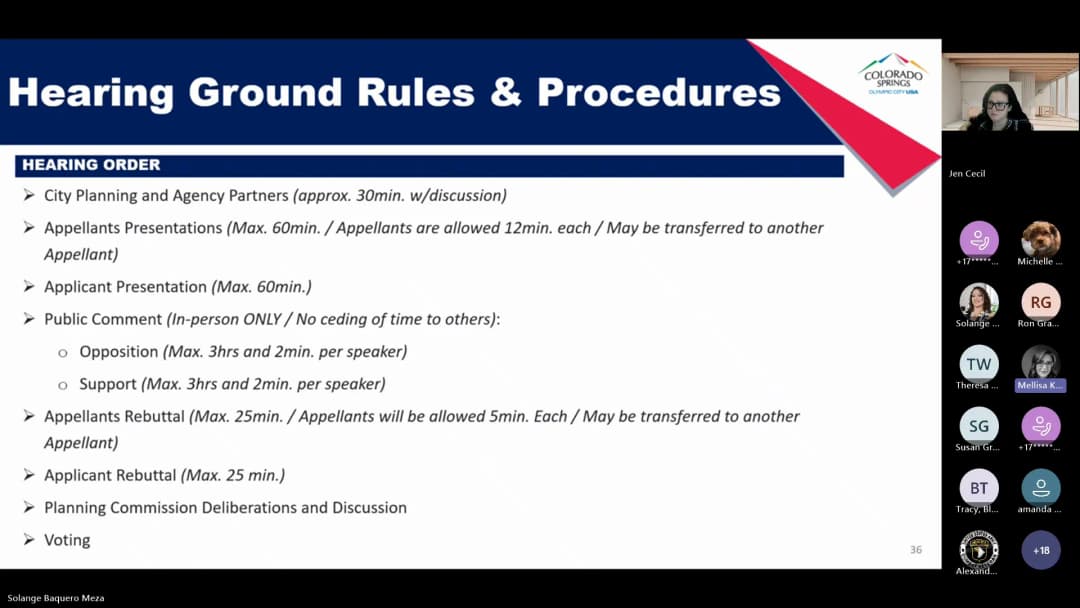
The Colorado Springs City Planning Commission held a work session on July 2, 2026, at 4:00 PM. Nine commissioners were present. No official actions were taken; items were discussed for future hearing. The session included a consent calendar, updates on Banning Lewis Village B2 and C, an overview of an upcoming appeal hearing for a data center at 1565 High Tech Way, and a presentation on the Annex COS policy update. Consent Calendar - Conditional Use (Airport Road): Staff recommended approval for warehousing and light industry uses within the streamside overlay. No public comments; placed on consent. - Parking Variance (2001 W. Colorado Ave.): Applicant seeks to convert a home to a restaurant; variance for one off-street parking space (seven required). One public comment in opposition. Staff recommended consent. - Conditional Use for Heavy Vehicle Storage (752 Clark Place): For waste/recycling trucks; staff added a condition to prevent leaks. No public comments; on consent. - Conditional Use for Light Vehicle Sales/Repair (1883 Sheldon Road): To allow sales and repair of OHVs/ATVs. No public comments; on consent. - Rezone (5325 Mark Dabbling Blvd.): From MXN to MXN SSO to allow multifamily and recreational camping. No public comments; on consent. - Rezone (Buckingham Industrial Area): From BP/COR to LI with conditions to restrict certain uses. Pulled from consent for a hearing due to residential adjacency and concerns from nearby businesses. - Conditional Use (4725 Galley Road): For office, light industry, warehouse, and outdoor storage in BP with streamside overlay. No public comments; on consent. Public Comments & Testimony - Banning Lewis Village B2: Six written comments during initial review; 12 additional after neighborhood meeting. A neighborhood meeting in December 2023 had 100 attendees; residents expressed concerns about traffic and future development. - Banning Lewis Village C: Six written comments; a neighborhood meeting in September 2025 had 60 attendees, with concerns about traffic on Woodman Road and density. - Appeal Hearing (1565 High Tech Way): Over 1,000 public comments received since the administrative approval. Two neighborhood meetings drew 400 and 600 attendees. Comments ranged from support to opposition, with concerns about noise, water use, and wildlife attractants. - Annex COS Survey: Over 250 responses collected; survey remains open. Discussion Items - Banning Lewis Village B2 & C: Staff presented details on two large annexation areas. B2 (511 acres) proposes PDZ and MXM zoning for residential and commercial, with a master plan amendment and road vacation. C (658 acres) proposes R-Flex Medium and MXM zoning, with four neighborhood parks, one community park, school sites, a fire station, and a 50-foot corridor for the Rock Island Trail. Density ranges: 3.55–7.99 du/ac in B2, and up to 16 du/ac in C (with a development standards adjustment). Parks and traffic will be discussed at the next hearing. - Special Appeal Hearing (July 23, 2026): Staff proposed procedural rules for the appeal of an administrative approval for a data center. Proposed time limits: 60 minutes for appellants (five separate appeals) to present jointly or transfer time; 60 minutes for applicant; 3 hours public comment (in-person only, 2 minutes per speaker); total expected 8–10 hours. Venue moved to the UCCS Ent Center for the Arts to accommodate up to 800 people. Commissioners agreed on 60 minutes for appellants/applicant, with flexibility up to 75 if needed. Public comment will be first-come, first-served with sign-in sheets. Security measures will be in place. The decision will be based on appeal criteria, not the original modification criteria. - Annex COS Update: A comprehensive update to the 2006 annexation plan, required every three years. Key policy areas include contiguity, enclaves, fiscal sustainability, infrastructure efficiency, housing diversity, and cooperation with other jurisdictions (county, Fountain, Manitou Springs). The city will not pursue aggressive annexation; property owners remain the trigger. Next steps include developing a model fiscal impact analysis template, updating the intergovernmental agreement with the county, and annual monitoring. The policy will be presented for a vote at a future meeting. Key Outcomes - All consent calendar items were placed on consent except the Buckingham Industrial rezone, which was pulled for a future hearing. - The appeal hearing rules were provisionally established; staff will finalize and communicate to appellants and applicant. - The Annex COS policy update will be presented to the commission for a recommendation at the next meeting. - No formal votes were taken; the work session was informational and preparatory.
The Colorado Springs City Planning Commission convened on June 10, 2026, at approximately 10:15 AM to consider a development standards adjustment and a development plan for the Cottage Court on Costilla project, a 14-lot single-family attached housing development at 745 East Costilla Street. Six commissioners were present. After presentations, public comment, and deliberation, the commission unanimously approved both the parking reduction and the development plan with conditions. Public Comments & Testimony - Support: - Sam Friesma (adjacent neighbor, 10-year resident) expressed strong support, noting ample on-street parking and alignment with city goals for walkability and density. - Amanda DeMarco (Apartment Association of Southern Colorado) supported the project as a needed addition to the housing continuum, emphasizing that smaller ownership options complement rental housing and serve workforce needs. - Jill Gabler (Pikes Peak Housing Network) praised the cottage court design for creating affordable for-sale homes, shared outdoor spaces, and community connections, and noted the parking plan is reasonable given proximity to transit and bike routes. - Opposition: - Ray Golden (Hillside resident since 1982) opposed due to historical concerns, arguing the project could set a precedent harming the neighborhood's historic character, and requested limits on future developments. - Ron Wilkinson (neighbor, 40+ years) opposed citing narrow Prospect Street, parking congestion, and safety concerns for pedestrians in winter, stating that on-street parking would exacerbate existing traffic issues. - Stephen Swift (attorney, adjacent property owner) cited notice defects (sign torn down), insufficient parking capacity, and incompatibility with the single-family character, and disputed the housing need given existing downtown vacancies. Discussion Items - Development Standards Adjustment (DVSA-26-0001): The applicant sought to apply multifamily parking standards to the 14 single-family attached homes, reducing the required off-street parking from 18 spaces to 11 (with on-street credit). Commissioners debated whether the reduction met the “equal or better” criterion, with Commissioner Engel expressing skepticism about the benefit of reducing from 28 (original code) to 18 to 11. Commissioner Cecil clarified that the adjustment effectively replaces single-family attached parking requirements with multifamily ones due to the project’s small unit sizes and shared parking characteristics. Staff Bill Gray confirmed the code allows such adjustments, and the applicant argued the smaller homes (510–960 sq. ft.) are comparable to multifamily units, justifying the lower ratio. Compensating benefits cited include infill development, affordable homeownership, and proximity to transit/bike lanes. - Development Plan Approval: The plan includes 14 units on 22,230 sq. ft. (approx. half-acre), with 11 off-street spaces in a rear alley, plus on-street parking on Costilla and Prospect Streets. The site is vacant, previously occupied by a convenience store and two homes. The applicant noted that existing curb cuts will be removed, opening up about five new on-street spaces. Fire access requires widening a portion of the alley. Drainage issues were addressed with a final letter pending from Stormwater Engineering. The plan includes a mail kiosk, shared trash enclosure, and bike racks. Commissioners asked about HOA governance, trash collection, and potential for permit parking; the applicant stated the HOA will manage common areas and that no assigned parking is planned. Commissioner Robbins suggested restricting investor purchases, but no formal condition was added. Key Outcomes - Motion to approve Development Standards Adjustment (11 off-street spaces instead of 18): Passed unanimously on a motion by Commissioner Robbins, seconded by Commissioner Clemens, based on compliance with UDC Section 7.5.601.2 criteria. - Motion to approve the Cottage Court on Costilla Development Plan: Passed unanimously on a motion by Commissioner Robbins, seconded by Commissioner Clemens, with the condition that a final approved drainage letter be submitted. The commission noted the project aligns with PlanCOS goals for infill housing and provides attainable homeownership opportunities. - Appeal information: Affected parties may appeal to City Council within 10 days (by June 22, 2026) by filing a notice of appeal and paying a $176 fee with the city clerk.
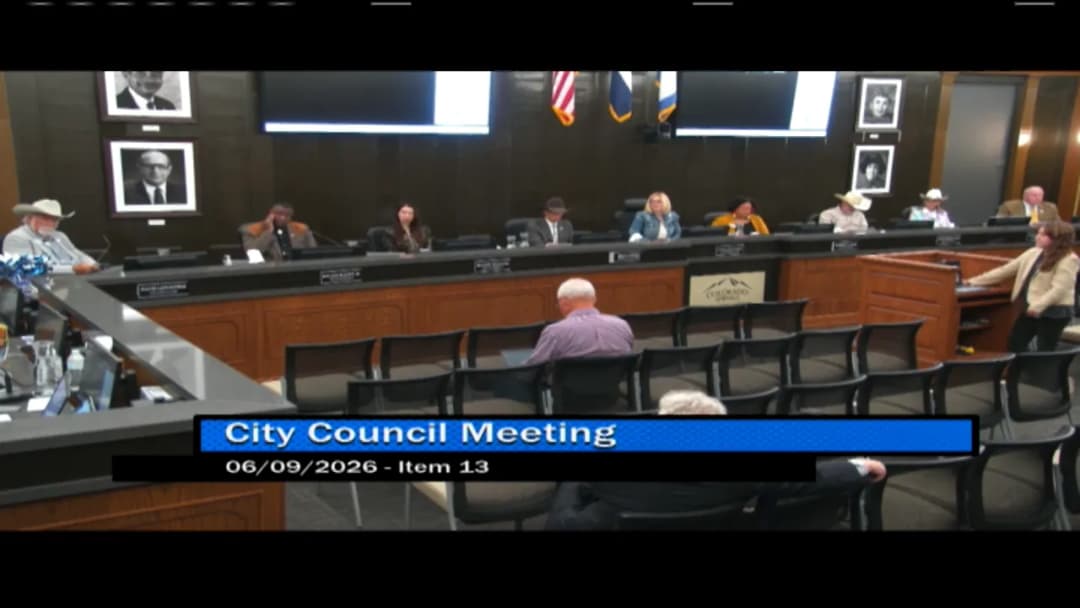
The Colorado Springs City Council held its regular meeting on June 9, 2026, at 9:00 AM in Council Chambers. All nine council members were present. The meeting covered consent calendar items, recognitions, mayoral business, a rezoning item pulled from consent, and a second reading of an ordinance on daycare centers. Public comments addressed data centers, homelessness, and council pay. Consent Calendar - Second Presentation (Final Passage): Ordinance No. 26-21 and 26-22 each requested a supplemental appropriation of up to $162,000 to the Trails, Open Space and Parks (TOPS) Fund to acquire two parcels (each approximately 40 acres) as part of the West CMSP Extension for public open space and trails. Both ordinances were finally passed. - First Presentation (Approved on Consent): - City Council meeting minutes of May 26, 2026, were approved. - Resolution 55-26 authorized acquisition of real property from the heirs of Teresa Pallas, Eugene D. Oddone, and Josephine Ida Brenner for the Kelker to South Plant Transmission Project (Colorado Springs Utilities). - Ordinance 26-24 (first reading) amended stormwater quality management and discharge control code pertaining to illicit discharges. - Ordinance 26-25 (first reading) amended the Unified Development Code (UDC) regarding stormwater permanent control measures. - Ordinance 26-27 (first reading) rezoned approximately 5.24 acres at 4535 Marconi Heights from R-E/PF/HS-O and PDZ/PF/HS-O to PF/HS-O (Public Facilities with Hillside Overlay) for the Austin Bluffs Pump Station (District 1), setting a public hearing for July 14, 2026. - The consent calendar was approved unanimously (9-0). Recognitions 5A. Elder Abuse Awareness Day (June 15, 2026) – Councilmember Leinweber presented the resolution. Jason DeBueno (Silver Key President/CEO) spoke about elder abuse risks. Councilmember Henjum shared a personal story of her mother’s financial exploitation. Statistics from the resolution: 1 in 10 older adults at home experience abuse; only 1 in 24 cases reported; in 2025, over 21,000 victims (60+) lost $7.2 billion (36% increase); average loss $38,000; Colorado elder protective services caseload rose 32% over the decade with over 8,000 cases statewide last year. Resolution adopted unanimously (9-0). 5B. Bike to Work Day (June 24, 2026) – Councilmember Leinweber presented. Carol Campbell (coordinator, Mad Woman Marketing) noted 37 breakfast stations. Elaine (Mountain Metro Transit) described bike-bus integration. Councilmember Henjum highlighted protected bike lanes and new signalized crossings in her district. Resolution adopted unanimously (9-0). 5C. Western Wear Days (June 17, July 11, July 14–18) – Councilmember Risley presented. Greg Budwine (Pikes Peak Range Riders) noted the 78th ride and 146 riders planned for the June 17 street breakfast. Laurie Carroll (Pikes Peak or Bust Rodeo Board President) emphasized that all proceeds since 1946 go to local military families. Kaylee Gripentrog (2026 Girl of the West) detailed rodeo events. Councilmember Williams shared her ranching background; Councilmember Henjum mentioned the Rocky Mountain Regional Gay Rodeo. Resolution adopted unanimously (9-0). 5D. Juneteenth Freedom Day (June 19, 2026) – Councilmember Rainey presented. Speakers included Minister Earl Shaffer Jr. (Pikes Peak Diversity Council), Angela Stevens (NAACP President), Dr. Regina Lewis, and Shirley Martinez (Pikes Peak Diversity Council). They emphasized education, voting rights, and community events (e.g., NAACP breakfast June 19, Southern Colorado Juneteenth at Norris Penrose). Councilmembers noted the work of Opal Lee, the “Godmother of Juneteenth.” Resolution adopted unanimously (9-0). 5E. Appointments to Boards, Commissions, and Committees – Council President Crow-Iverson presented appointments: Downtown Development Authority (B.J. Hibble, Tim Seiber, Patrick Stevens, Troy Coates); Downtown Business Improvement District (Beacra Solo, Jimmy Pesvan Pesmetobe, Michael Brantner, Vlad Benedetti); Fire Board of Appeals (thanked Mr. Sharkey); PPACG Community Advisory Committee (Amanda DeMarco); Planning Commission (Aaron Egbert as voting member; Henry Wright Wisner and Daniel Way as alternatives). Approved unanimously (9-0). Mayor's Business Chief of Staff Wayne Williams reported on supervisor training at El Pomar, a May 29 roundtable with landowners near military bases, and partnerships with Pikes Peak Library District. Items Called Off Consent Calendar 4B.E – Rezoning at 1625 Springcrest Road (Briargate/Voyager) – Councilmember Williams pulled this item, expressing discomfort with moving it to hearing. Councilmember Donelson questioned the process; City Attorney Stefanie Boster and Planning Director Kevin Walker explained the UDC change (adopted 2023) that moved presentation and public hearing to second reading. A motion to approve first reading (setting hearing for July 14) passed 8-1, with Williams dissenting. Unfinished Business 9A. Day Care Centers Ordinance (Second Reading) – Senior Planner Allison Stocker presented Ordinance 26-23 amending the UDC for adult/child day care centers. No changes since first reading. Councilmember Donelson opposed, fearing large daycares (over 100 children) could alter residential neighborhood character; he offered amendments that failed. The ordinance passed 8-1, with Donelson voting no. Public Comments & Testimony (One Hour – Items Not on Agenda) - Ali Lange opposed Project Taurus (large data center), citing noise, heat, water use, and health impacts; requested a moratorium or ban. - Raul Acosta (small tree service/fire mitigation business owner) inquired about the $20 million Great Opportunity Fund and requested bidding opportunities for small businesses. - LeRad Niles reported ongoing issues with homeless individuals entering yards and homes in his neighborhood; urged establishment of a homeless camp and curfew. - Steven Lightfoot claimed Stephen King murdered John Lennon and urged community organizing to break the story. - Nick Raven advocated for a professional, paid city council; suggested putting a pay measure on the ballot for voters to decide. - Caleb Miller opposed the data center and the CSU CEO raise; criticized council pay being zero and urged raising it to median wage; also opposed criminalizing sleeping in cars. - Taylor Gray opposed data centers and the CEO salary; expressed concern over data privacy and urged council to protect citizens' data; noted he drafted an ordinance for council. Key Outcomes - Consent calendar approved unanimously (9-0). - Four recognitions adopted unanimously (9-0). - Board and commission appointments approved unanimously (9-0). - Rezoning for Briargate/Voyager (4B.E) approved on first reading 8-1, setting public hearing for July 14, 2026. - Daycare ordinance (9A) finally passed 8-1. - No executive session; meeting adjourned at 11:09 AM.
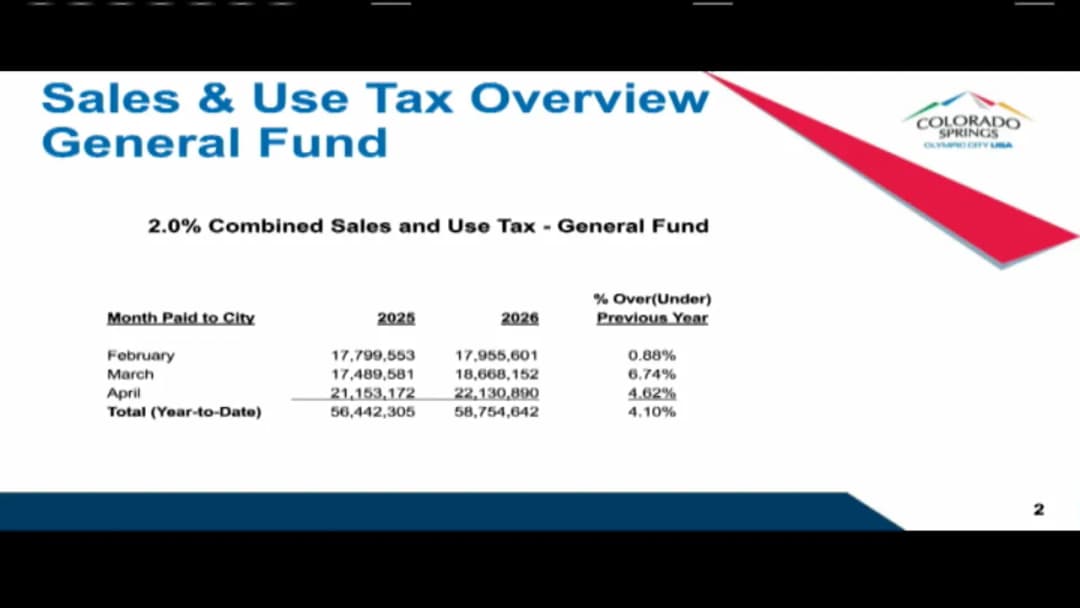
The Colorado Springs City Council held a work session on June 8, 2026, from 9:00 AM to 12:19 PM. The meeting covered the Office of the City Auditor's 2026-2030 strategic plan, the quarterly financial report, a resolution to increase cemetery fees for 2027, an ordinance amending stormwater permanent control measures, and councilmember reports. The council also unanimously approved a closed executive session to discuss legal advice regarding the Old Colorado City Downtown Development Authority. Consent Calendar - Councilmember Williams requested the removal of item 4B.E from the June 9, 2026 regular meeting consent calendar; the council agreed by consensus. - The cemetery fee resolution (Item 7A) and the stormwater ordinance (Item 7B) were both requested to be placed on the consent calendar for the June 9, 2026 regular meeting. No objections were raised. Discussion Items - Review of Previous Meeting Minutes: The May 26, 2026 work session minutes were approved by consensus. - 2026-2030 Office of the City Auditor Strategic Plan: City Auditor Natalie Lovell presented the office's first strategic plan, outlining four focus areas: talent, processes, technology, and strategic advisory. The plan aims to align with 2024 global internal audit standards and includes initiatives such as data analytics, standardized onboarding, and quarterly "Audit Insight" micro-videos. Councilmember Henjum asked about the sessions, which will be electronic and two to three minutes long. The plan was previously reviewed by the audit committee, which recommended it. - Quarterly Financial Report: CFO Charae McDaniel reported on general fund revenue and expenditures. Key statistics: combined sales and use tax revenue for February collections was flat, March collections up 6.7%, April up 4.6%, and preliminary May collections up 4% year-over-year. The 2026 budget assumes 1.4% sales tax growth. Non-sales and use tax revenue through period four is at 28.9% of budget. Single-family building permits year-to-date are down 4% compared to 2025. The unemployment rate in El Paso County is 3.6%. McDaniel expressed confidence that no mid-year cuts would be needed if current trends continue. Councilmember Risley voiced concerns about mixed economic signals and the potential for ongoing budget pressures. Councilmember Donelson noted that revenue is tracking about 2.6% above budgeted growth, but McDaniel cautioned against projecting. - Cemetery Fee Resolution: Kim King, Assistant Director of Parks, Recreation and Cultural Services, and Cheryl Godbout, Cemetery Operations Manager, presented the 2027 fee increase. The cemetery enterprise operates without taxpayer support, generating revenue from fees and a $12 million endowment. The proposed fees aim to cover costs while remaining competitive; the average in-ground burial space is below the regional average of $3,800. New fees include concrete vaults, monument disposal, and paranormal investigation fees. Councilmember Henjum raised long-term sustainability concerns, noting the need to balance affordability with future capital needs. Godbout stated that current inventory of multiple-space plots is dwindling, and new section development at Evergreen and Fairview cemeteries is critical. She estimated 10 to 20 years before the city may need to acquire additional land. The resolution will be placed on the consent calendar for June 9. - Stormwater Ordinance: Erin Powers, Stormwater Enterprise Manager, presented an ordinance amending Chapter 7 of the City Code to strengthen enforcement of privately maintained stormwater permanent control measures (e.g., detention basins, bioretention). First reading is scheduled for June 9, 2026, and second reading for July 14, 2026. The ordinance was requested to be placed on the consent calendar. Councilmember Reports - Councilmember Henjum reported on the Public Safety Committee meeting, a Civility Retreat, and Fourth of July fireworks coordination. She noted that due to reduced lodging tax revenue, only one city-funded fireworks display will occur (at Ford Amphitheater). - Councilmember Leinweber reported on the 10th Annual Get Outdoors Day at Prospect Lake (over 3,000–4,000 attendees), a Braver Angels town hall, and a Grandparenting 101 class. - Councilmember Gold highlighted Caribbean-American Heritage Month, Men’s Mental Health Month, National PTSD Awareness Month, Bike Month, Father’s Day, and Pride Month (June 13–14). She encouraged voting in the June primary election. - Councilmember Rainey thanked Colorado Springs Utilities for a tour of the Jackson Fuller substation, recognized the Leadership Pikes Peak Local Government Day, and announced plans for a Small Business Economic Forum. - Councilmember Donelson recognized Commander Mike Velasquez’s retirement after 29 years, attended the fire department open house, a sheriff's graduation, and a town hall at Fire Station 14. He also welcomed his first grandchild. - Councilmember Casey announced a District 2 town hall on June 30, 2026, at Fire Station 19. Key Outcomes - The May 26, 2026 work session minutes were approved. - The cemetery fee resolution (Item 7A) and the stormwater ordinance (Item 7B) were both placed on the consent calendar for the June 9, 2026 regular meeting; no formal vote was taken at the work session. - Council unanimously voted (9-0) to enter a closed executive session for legal advice regarding the Old Colorado City Downtown Development Authority. - No formal votes were taken on the auditor strategic plan or the quarterly financial report; they were presented for informational purposes.
Transcripts
No published pilot transcripts are available for this city. The current pilot covers Sacramento City Council only.
Transcript coverage details
The pilot includes June 9 and two June 23, 2026 sessions. Recording completeness is unknown. Missing, cancelled, incomplete, or changed transcripts can leave gaps. No match does not establish that something was never discussed.