This was a working group meeting of the Cook County Domestic Violence Task Force, convened to discuss the differences between Domestic Relations (DR) and Domestic Violence (DV) divisions, service of orders of protection, coordination between courts, and available resources for survivors. Presentations were given by staff from the Office of the Chief Judge (OCJ). The meeting was chaired by Commissioner Donna Miller. Consent Calendar - No consent calendar items were listed. Public Comments & Testimony - No public comments were made. Discussion Items - Presentation on Domestic Relations vs. Domestic Violence Divisions: Kate Nolan (Director of Legal Research, OCJ) and Hannah Fearley (Chief of Staff to Commissioner Gator) provided an overview of the key differences between the two divisions. They explained that DR is a civil division handling divorce, custody, and parenting time, while DV handles criminal cases. DR hears civil orders of protection only when they are connected to a pending DR case. Since 2024, DR judges have received domestic violence training. Service of DR EOPs can occur in open court or by the sheriff's office if the respondent is not present. Judges are strictly prohibited from investigating cases on their own due to ethical canons; they must only consider information presented in court. - Coordination Between DV and DR: A so-called exchange program exists since 2022 to coordinate emergency OPs (EOPs) when a DR case is pending, ensuring the judge familiar with the case hears the EOP. Violations of orders of protection (VOOPs) are criminal matters handled by the state's attorney at the DV courthouse. - Karina's Law and Search Warrants: Commissioner Miller's Director of Policy, Brian CC, asked a question about search warrants under Karina's Law. Hannah Fearley explained that Karina's Law has both a civil and criminal section for search warrants, with the civil version requiring a different (civil) probable cause standard. The search warrant and EOP are intended to be served concurrently to maintain the element of surprise and officer safety. The delay in serving the EOP is typically no more than about 120 hours, during which the EOP remains in effect. - Service of Orders of Protection: Fearley stated that service records show approximately 95% of civil OPs in DR are served, with the remaining 5% typically involving out-of-state respondents. This clarification was given in response to concerns about service data. - Resources for Survivors: Discussion centered on what resources can be provided in DR court. Hannah Fearley and Kate Nolan emphasized that judges cannot give legal advice or referrals to specific providers due to ethical rules. They provide a handout listing general legal aid resources such as CARPLS, Illinois Court Help, and Illinois Legal Aid Online. Commissioner Miller noted that the Board of Commissioners has funded court advocates and navigators through the state's attorney's office and via grants through the Cook County Justice Advisory Council (JAC). Madeline Baer (Network Advocating Against Domestic Violence) explained that legal aid attorneys are preferred in DR due to the complexity of the Illinois Marriage and Dissolution of Marriage Act, and that funding remains a challenge. Katie Dunn (Chicago 77) raised concerns about the drop-off of services when cases move from DV to DR. - Court Reporting in DR: Hannah Fearley outlined that only two types of hearings require a court reporter in DR: in-camera interviews of children and default proof hearings. They attempt to have a court reporter for EOPs, but the court reporter's office is understaffed due to retirements and a lack of new recruits. All EOPs are recorded via Zoom, and transcripts can be provided for a fee, though fee waivers are available. Key Outcomes - The presenters (Fearley and Nolan) agreed to send the slide deck and the DR court handout to Amy Malinaski (Director of Outreach, Commissioner Miller's office) for distribution to the working group. - Fearley will also send the specific statutes or Illinois Supreme Court rules regarding court reporting requirements to Commissioner Miller and Brian CC, which Amy will forward to the group. - The next executive meeting of the task force is scheduled for Wednesday, April 8, 2026 (note: the date appears to be before the meeting's date of April 22, 2026; this may be a typo in the transcript) at 10:00 AM in the Cook County Boardroom (in person). Details for other working group meetings will be emailed. - The meeting was adjourned.
Public Meetings - Cook County, Illinois
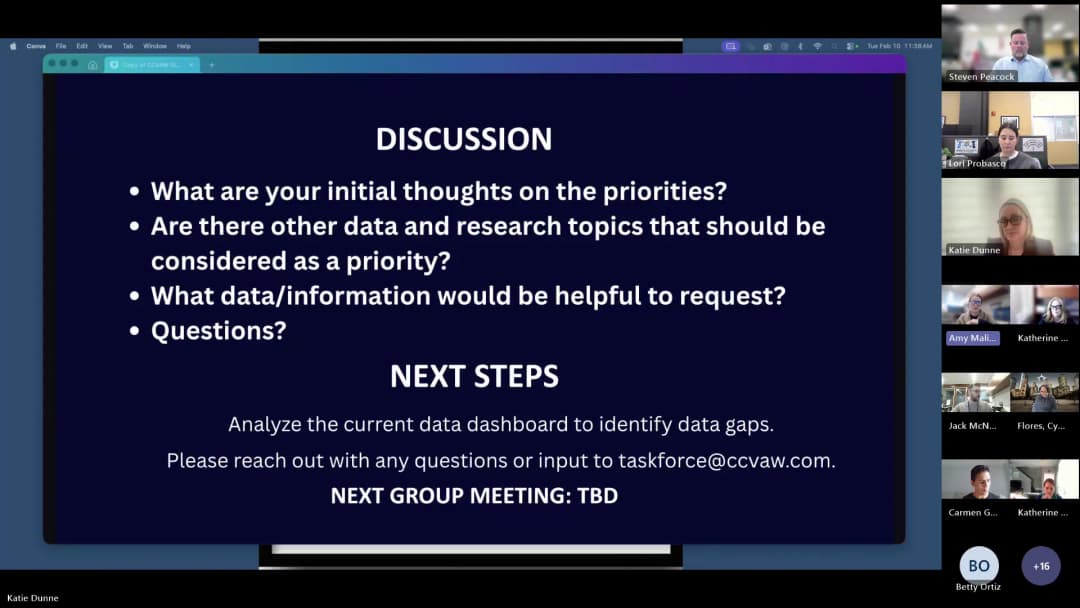
Public Meetings - Cook County, IllinoisOn April 22, 2026, the Data and Research Working Group of the Cook County Domestic Violence/Gender-Based Violence Task Force held its inaugural meeting. The meeting brought together representatives from city, county, and state agencies to initiate a coordinated, government-wide approach to address domestic violence as a public safety crisis. The group heard a presentation on the scope of the problem, discussed existing data dashboards, identified critical data gaps, and outlined deliverables leading to a final report due in July 2026. Introductions - The meeting began with introductions led by Commissioner Bridget Degnan (co-chair, representing Chicago's north and northwest side) and Amy (likely a task force coordinator). Attendees included representatives from: Cook County Department of Public Health, Justice Advisory Council, Office of the Chief Judge, City Clerk's Office, Chicago Police Department, Chicago Fire Department, Office of Emergency Management and Communications, Cook County Sheriff's Office, Office of the First Deputy, Secretary of State's Office, Chicago Department of Public Health, and several aldermanic and commissioner staff. - The working group is co-chaired by Commissioner Degnan and supported by Dr. Joshi (COO, Cook County Department of Public Health) and Christina Kalba (Justice Advisory Council). Presentation & Discussion - Katie (likely from the Justice Advisory Council) presented the group's background and goals. The effort originated two years ago after Alderman Tabaras and Commissioner Miller raised concerns about rising domestic violence homicides. A preliminary plan is in draft form. - Key statistics highlighted: - Illinois has a higher per capita death rate from intimate partner homicide than New York and California combined. - Chicago's murder rate from intimate partners is higher than New York City and Los Angeles County combined (per capita). - In 2025, domestic-related fatalities in Chicago increased by 50% (later corrected to 55%) even as fatal shootings overall decreased by 33%. - 88% of domestic homicide victims in 2025 were minorities (71% African American, 17% Hispanic/Latino, 10% white). - The Office of the Inspector General reports 336 domestic-related calls per day to the Chicago Police Department, equating to one in four priority level one calls. - The task force aims to create a new model for a coordinated system across all levels of government, improve data sharing, and produce a public dashboard for transparency and accountability. - The group will meet approximately eight times before June 2026. A final report with recommendations and findings will be presented to the Cook County Board and Chicago City Council in July 2026. Discussion on Data Gaps - Sarah Smith (Cook County Sheriff's Office) noted that while the sheriff shares data, it is incomplete due to issues like missed service notifications and short-form filings. The task force can help identify ways to fill those gaps. - AJ (Secretary of State's Office) asked what data points are currently recorded by law enforcement when domestic incidents are reported. Katie replied that the Inspector General's dashboard provides some clarity for Chicago, but similar work is needed countywide. - Latrice Moore (Chicago Fire Department) confirmed that CFD does not currently document domestic violence as a separate category in patient records. - Sergeant Cynthia Flores (CPD) explained that 911 calls are categorized by dispatchers, and officers provide a final disposition; some incidents are flagged as domestic later (e.g., after a homicide investigation). - Kate Nolan (Office of the Chief Judge) raised the need to include the Clerk of the Circuit Court of Cook County in this working group, as they maintain court data. It was noted that the clerk's office is part of the task force but was not present at this meeting. Katie agreed to follow up. Existing Data Dashboards Reviewed - Violence Reduction Dashboard (Chicago): The only dashboard currently containing domestic-related data; crucial for tracking city data. - Office of the Inspector General Dashboard: Extensive data on first responder and public safety calls, but limited to Chicago agencies. - Civic Committee Dashboard: New, focuses on violence reduction funding; no domestic data yet. - Cook County Justice Dashboard (Loyola University): Provides criminal justice system data but not cross-sectoral domestic violence data. - Participants were asked to review these dashboards and identify missing data elements, such as Chicago fire department data and suburban fire department data. Key Outcomes & Next Steps - The working group will meet regularly (approximately eight times) before June 2026. - Immediate tasks include: - Reviewing existing dashboards and identifying data gaps. - Building a comprehensive list of data sources needed from all agencies. - Investigating the creation of a public dashboard with daily cross-sectoral data from city, county, and state sources. - Supporting other working groups (High Priority Orders, Court Systems, First Responder Health) with data and research. - Amy will circulate meeting materials and compile a binder with recordings, transcripts, and shared files. - The final report will be presented in July 2026 to the Cook County Board and Chicago City Council. - No public comments were received. The meeting was adjourned by Commissioner Degnan.
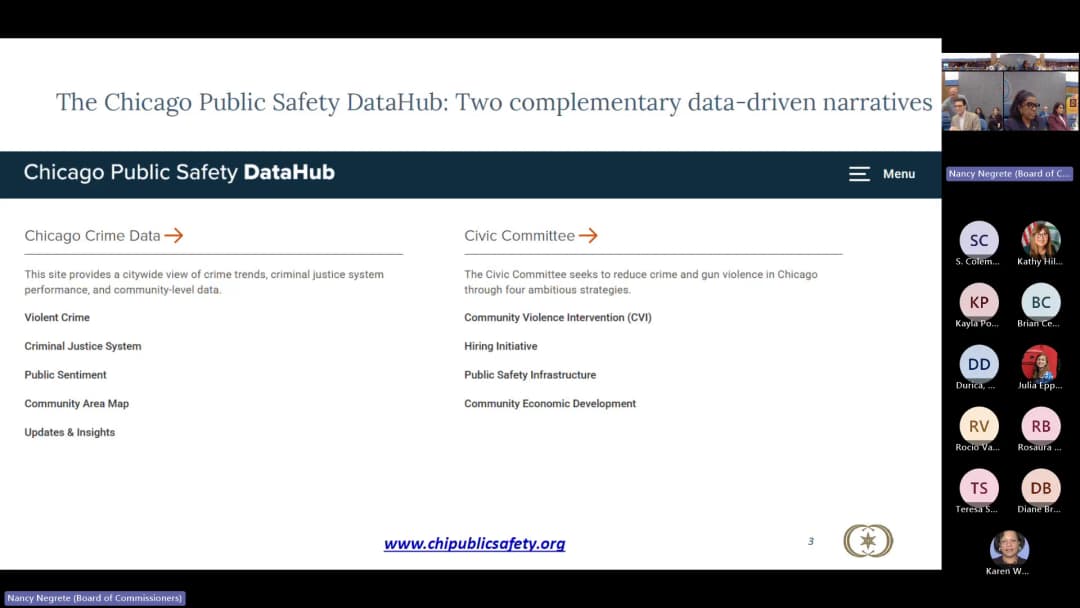
The Chicago Cook County Violence Against Women Task Force convened on April 21, 2026, at 5:15 PM, chaired by Commissioner Miller. The meeting focused on data transparency, domestic violence advocacy, and survivor needs. Two public speakers testified, and presentations were given by the City of Chicago Office of Inspector General, the University of Chicago Crime Lab, the Civic Committee of the Commercial Club of Chicago, and LifeSpan. Public Comments & Testimony - Lena Care Curry spoke about institutional violence against women in the court system, specifically the domestic relations division. She highlighted issues such as orders of protection being vacated, lack of court reporters, judicial misconduct, and lack of accountability. She urged the task force to work with survivor-provided data and explain what the public can do to address these systemic problems. - Patricia Punta Clappus shared personal experiences of harassment and alleged police misconduct, including being handcuffed without reason and taken to a hospital against her will. She also alleged that judges are being paid under the table to favor certain groups and that a local official said they only help Hispanics. She called for better law enforcement and judicial accountability. Discussion Items - City of Chicago Office of Inspector General (OIG) Presentation: The Inspector General introduced the OIG information portal, highlighting two public safety dashboards: one on 911 calls for police service (3.7 million calls from 2023 through early 2026) and one on reported crimes (236,000 reported crimes in the last 12 months). She demonstrated how to filter for domestic battery, domestic disturbance, and violations of orders of protection, showing 373,000 such calls in the period. The crime dashboard includes clearance rates, with a 70.1% clearance rate for offenses against family. The dashboards provide continuous, publicly accessible data with geographic and demographic filters. - University of Chicago Crime Lab Presentation: Javier Lopez and Martin Barron presented the Violence Reduction Dashboard, inspired by a 44% increase in non-fatal shootings and 61% increase in fatal shootings from 2015 to 2016. The dashboard, launched in 2021, provides victimization data by demographics, geography, and time. They demonstrated that domestic violence-related homicides and fatal shootings increased 56% from 2024 to 2025. The tool can identify community areas with rising domestic violence victimization despite citywide declines. - Civic Committee of the Commercial Club of Chicago Presentation: Robert Owens presented the Chicago Public Safety Data Hub (shypublicsafety.org), a collaborative project with NORC. The hub combines public and proprietary data, including a survey on public trust in police and courts. It also tracks the Civic Committee's own programs, such as a hiring initiative for South and West Side residents. Future plans include block-level crime data, expanding to Cook County, and integrating data across criminal justice agencies. - LifeSpan Presentation: Amy Clax, Executive Director of LifeSpan, discussed the complexity of domestic violence advocacy. She explained the Illinois Domestic Violence Act, the role of confidential advocates, and the differences between criminal and civil court systems. She noted that LifeSpan turns away 60% of those seeking help due to lack of resources. She emphasized the need for sustained funding, affordable housing, survivor input, and systems accountability. She called for collaboration with other domestic violence organizations and mapping of services across Cook County. Key Outcomes - The task force acknowledged the need for greater data transparency on domestic violence, especially for Cook County beyond Chicago. The OIG and Crime Lab dashboards were praised as models for a potential county-wide dashboard. - Barriers to data integration include the need for MOUs with individual law enforcement agencies in the county and the challenge of accurately coding domestic violence incidents in crime data. - The task force will work on synthesizing data from multiple sources, prioritizing survivor input, and addressing the need for affordable housing and emergency shelter as critical to survivor safety. - Next steps include forming working groups to develop recommendations, coordinating with other domestic violence organizations, and exploring ways to streamline court services across courthouses. - The meeting adjourned with a call for continued collaboration and action outside of formal meetings.
The Chicago Cook County Violence Against Women Task Force met on April 21, 2026, to receive presentations on domestic violence services, data, funding, and policy recommendations. The meeting included public testimony from two survivors, presentations from three organizations, and robust discussion among commissioners regarding gaps in services, particularly in the South Suburban area, and the need for sustainable funding and better data. Public Comments & Testimony - First Speaker (unidentified): Expressed concern about a detective teaching a concealed carry class who allegedly told students it was okay to abuse women. The speaker reported the incident to the sheriff's office but noted the detective is still teaching, raising questions about accountability. - Sarah Brown (survivor): Testified about the challenges of raising a child with an abuser and the lack of resources in the Southland region. She criticized the county's $4.2 million allocation for domestic violence services (citing $1.92 per woman) and called for more equitable funding and data collection for the South Suburbs. Discussion Items - Presentation by Madeline Fairer (The Network Advocating Against Domestic Violence): Presented 2024 hotline data: nearly 60,000 contacts (26% increase from 2023, 140% from 2019), with half from Cook County. Top request was emergency shelter (one-third of contacts). There are only 700 shelter beds statewide; Cook County suburbs had 188 days with zero beds available. Recommended better data, a dedicated county funding stream, a point person/office for gender-based violence, and focusing on community-based services beyond the criminal legal system. - Presentation by Christina Kappa (Justice Advisory Council - JAC): Described JAC's domestic violence funding portfolio under ARPA, which totaled $7.7 million from 2023 through September 2026, supporting legal aid, housing, and advocacy. A pilot in court-based services served 930 individuals in one year. Acknowledged gaps in the South Suburbs and noted that most court-based service recipients came from north and northwest suburbs, not the Southland. Committed to better coordinating with city and state post-ARPA. - Presentation by Jennifer Wells (Illinois Coalition Against Domestic Violence): Highlighted a statewide increase in domestic violence homicides and a 7-day increase in average shelter stays. Noted that most survivors file orders of protection without legal representation and face judicial bias. Discussed pending state legislation (HB) to expand remote hearings, clarify extension of orders of protection, and address technology-facilitated harassment. The bill has passed committee in both chambers. - Commissioner Questions and Discussion: Commissioner Stamps raised concerns about lack of diversity among presenters, urging inclusion of Black and brown women as subject matter experts. Commissioner McCaskill repeatedly emphasized the persistent service gap in the South Suburbs and demanded data on program effectiveness and grantee performance. Commissioner Anaya asked about dedicated funding streams post-ARPA and academic evaluation partnerships. Commissioner Degnan inquired about sustainability of funding and the feasibility of regular data requests from courts. Key Outcomes - The task force will aim to produce a report with recommendations by July 2026. - Commissioners will explore a formal data request to the Office of the Chief Judge for aggregate order of protection data, as recommended by presenters. - The task force will compile a comprehensive list of geographically-specific donation resources for domestic violence shelters. - Support for the pending state bill (HB) on remote hearings, tech harassment, and OP extensions will be formalized through witness slips and advocacy. - JAC will work to provide detailed grantee performance data to commissioners, including metrics on clients served and outcomes. - The task force will consider recommending a dedicated county funding stream for gender-based violence services and a central point person/office to coordinate countywide efforts.
This was the third executive meeting of the Cook County Violence Against Women Task Force, held on April 21, 2026, starting at 10 a.m. The meeting featured presentations from the Office of the Chief Judge, a national expert on firearm restraining orders, the Chicago Police Department, and an economist from Northwestern University. Discussions centered on protective orders, firearm removal under Karina's Law, victim services, and the economic impact of domestic violence. Public Comments & Testimony - Patricia, a 67-year-old survivor, testified that two Hispanic men physically pushed her, and she faced difficulties in court requiring their names and addresses for summons. She expressed frustration that law enforcement seemed to protect the abusers, who provided false information and claimed connections to politicians and law enforcement. She asked the task force to address this systemic barrier. Discussion Items - Protective Orders in Cook County (Carmen Navarra Jacone, Chicago Sammy Saving; Renata Steele, Office of the Chief Judge): Carmen explained that a police report is not required to file a protective order. Renata detailed the after-hours pilot program for emergency orders of protection, operational Monday–Friday 9 p.m. to 3 a.m. and Saturday–Sunday 1 p.m. to 6 p.m. (excluding court holidays). Since September 2022, 4,345 petitions were filed; 3,357 emergency orders were granted; approximately 2,800 benefited from advocacy services; 1,588 had an associated police report; and 627 were filed under domestic relations cases. Renata noted that remote hearings have reduced drop-off rates, but survivors face multiple barriers (e.g., transportation, financial dependence). Commissioner Sams asked about the drop-off; Renata highlighted education and counseling as key to retention. Commissioner Sams also inquired about reasons for limited weekend hours; Renata said it is due to staffing and judicial capacity, but a working group is proposing adjustments to the new chief judge. - Firearm Restraining Orders and Karina's Law (Dr. April Zioli, National Expert): Dr. Zioli compared evidentiary standards: preponderance for orders of protection, probable cause for ex parte firearm restraining orders (FRO), and clear and convincing for plenary FRO. Her six-state study found 21% of FRO petitions involve intimate partner violence (IPV), with 61% involving firearm threats and 36% with respondent arrest at the scene. She emphasized that FROs are useful for harm reduction but require careful consideration of survivor agency and potential retaliation. Renata Steele cautioned that FROs only remove weapons and do not prohibit contact, and that notification of the abuser may increase danger. Dr. Zioli agreed and noted that Karina's Law provides a warrant process for firearm removal under orders of protection. - Chicago Police Department Response to Gender-Based Violence (Deputy Director Mike Milstein, Lieutenant Jason Clark, Assistant Director Mariana Martinez): CPD has a standalone gender-based violence policy and provides training every three years. The victim services program has 26 staff (budgeted for 55) and is expanding citywide across 22 districts. The Domestic Violence Multi-Disciplinary Team pilot in four districts (3rd, 4th, 5th, 14th) uses a victim assessment form to connect survivors to community agencies. Regarding Karina's Law warrants: since May 2025, CPD received 60 warrants, requested extensions on 41, executed 2, returned 1 (due to expiration with holiday confusion), and recovered 30 firearms (mostly through voluntary turn-in). Deputy Director Milstein explained that the consent decree requires independent investigation before warrant execution, causing delays. Commissioner Dungan raised concerns that double-validating victim testimony undermines the expedited intent of the law and may re-traumatize survivors. The panel acknowledged the challenge and expressed need for better upfront support (advocates) to help petitioners provide complete information. Commissioner Garner asked about housing: CPD connects victims to shelters and limited Airbnb stays, but housing remains a major gap. Commissioner Garner suggested a joint city-county housing fund and noted that budgets can be amended; this aligns with discussion of housing as a priority. - Economic Impact of Domestic Violence (Dr. Adams, Northwestern University): Dr. Adams presented data from Finland showing that survivors' employment and earnings decline from the start of an abusive relationship, not just when a police report is filed. She argued this financial suppression makes leaving harder. Evidence indicates that shelter access and financial support enable women to leave faster. She highlighted that programs like the Target Abuser Call program in Chicago reduce homicides when victims stay engaged. Dr. Adams is conducting evaluations of local programs (e.g., Lifespan, Survivor Fund). She urged sustained funding for housing and victim services. Key Outcomes - Slides from all presentations will be distributed to task force members. - Three working groups have already held initial meetings; further updates will be communicated in the coming weeks. - The task force will follow up with CPD on hiring progress (budgeted 55 victim specialists; offers made for remaining vacancies) and housing coordination. - The motion to adjourn was passed unanimously.
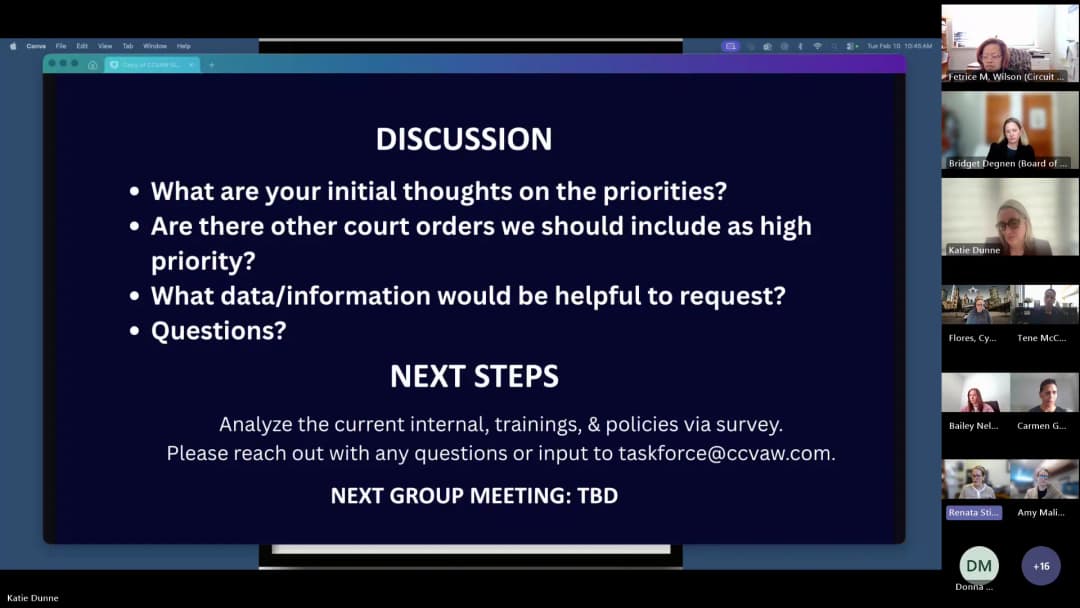
This was the first working group meeting of the High Priority Court Order task force, a new collaboration among city, county, and state partners focused on improving the response to gender-based violence in Cook County. The meeting convened representatives from the Cook County Board of Commissioners, Chicago City Council, Chicago Police Department, Chicago Fire Department, Cook County Sheriff's Office, Cook County State's Attorney's Office, Circuit Court of Cook County, Public Defender's Office, Illinois Attorney General's Office, and other agencies. The group discussed protective orders, data sharing, service of process, risk assessment, and legislative priorities. Discussion Items - Meeting Purpose and Overview (Katie Dunn, Chicago 77): Katie Dunn explained that the task force was created after conversations with approximately 100 survivors and 200 government officials at city, county, and state levels. The goal is to create a unified, victim-centered system, improve first responder safety, and reduce violent crime victimizations. She noted that while overall violent crime in Cook County has decreased, gender-based violence and victimization of women continue to increase. She cited that the Chicago Tribune reported Illinois’s per capita rate of deaths caused by spouse or intimate partner exceeded the combined rates of New York and California. - Data on Domestic Violence in 2025: Dunn presented that in 2025, fatal shootings decreased 33% but domestic-related fatal shootings increased 50%. Homicide victims in domestic cases were 71% African American, 17% Hispanic/Latino, and 10% white (minority victims comprising 88%). The Office of the Inspector General reports an average of 336 calls per day for domestic-related incidents to Chicago Police (excluding Chicago Fire), representing one in four priority level one calls. - Protective Orders Overview: Dunn outlined the current process: petitions are filed with the Clerk of the Circuit Court, a judge determines if an order is granted or a future hearing is scheduled, the Cook County Sheriff serves the order on the respondent, and a future hearing determines the duration of protection (up to two years). There are five types of orders with different legislative frameworks; some orders cannot be entered into the Law Enforcement Agencies Data System (LEADS), which limits enforceability. A key data issue is that LEADS requires a date of birth, and missing birth dates preclude about one in four orders from entering the system. - Renata Steele (Senior Division Attorney, Cook County Domestic Violence Division): Steele emphasized the need to build on past and current efforts. She described a multi-disciplinary team (MDT) between the State’s Attorney’s Office, CPD, and advocacy agencies (Lifespan and Family Rescue) that developed a Chicago-based risk assessment for lethality factors (e.g., firearms, strangulation, threats to kill). This assessment is currently used in four to five CPD districts where advocates are co-located. She noted that the best time to conduct the assessment is at the scene of an incident, with victim consent. She also reported that the Sheriff’s Office has increased resources for domestic violence, using sheriff’s police to serve orders via short form notification, which has improved service rates. She cautioned that survivors speaking publicly should be informed of potential risks (e.g., retaliation, use of their statements in court) and that their stories should be verified against case records to identify additional barriers. - Tanae McCoy Cummings (Deputy Chief, Special Victims Bureau, Cook County State’s Attorney’s Office): Cummings agreed with Steele’s assessment. She noted that from a prosecution standpoint, short form notification satisfies service requirements, but issues arise when the notification is not entered into LEADS or the paperwork does not reach the clerk’s office, making it difficult to prove service. She also acknowledged that suburban Cook County agencies use various risk assessments, and her office uses that information to inform judges at first appearance court regarding detention and conditions. - Sergeant Cynthia Flores (Chicago Police Department, Victim Services): Flores raised issues with the short form notification document—it was previously a two-sided form, and sometimes both sides were not transmitted to LEADS. Deputy Director Milstein is reformatting it to a one-page document to resolve this. She also noted a state initiative by Illinois State Police to create a statewide risk assessment bill, mirroring efforts in Cook County. - Patrice (Chief Deputy Clerk of Domestic Violence): Patrice noted that the clerk’s office receives short form notifications by mail days after service, often after a court hearing has already occurred. She asked whether sheriff’s police could transmit service information directly to the Illinois State Police for automated entry into the clerk’s system, similar to how civil process servers upload data. - Timeline and Next Steps (Amy Melanowski): The group will meet approximately eight times before July, when public hearings will be held at both the City Council and the Cook County Board of Commissioners. An executive committee meeting is scheduled for the following day (Wednesday, April 22, 2026) at 10 a.m. in the Cook County Board of Commissioners boardroom. Additional working group meetings will be scheduled, and a summary email with next steps will be sent. Key Outcomes - The working group will focus on three high-priority orders: orders of protection, warrants (both criminal and civil, particularly violation of orders of protection), and firearm enforcement (including Karina’s Law). - Initial recommendations include improving service rates (using short form notification and assessing data entry barriers), developing a pilot high-risk team using evidence-based lethality assessments, and creating an interagency data center to break down data silos (modeled after the HIDTA program). - Participants agreed to explore the date of birth issue for LEADS entry, with potential help from the Secretary of State and Cook County Clerk. - A future meeting will dive deeper into Karina’s Law warrants, weapons recovery, and challenges with extensions. - The task force will produce a public report by June 2026, followed by public hearings in July. - The group will continue to gather input from survivors and subject matter experts as the process moves forward.
The Cook County Board of Commissioners convened on April 16, 2026, at 5:15 PM (timeline noted as morning in transcript, but official start time given). The meeting included a land acknowledgement, public testimony, approval of a consent calendar, and a series of ceremonial resolutions honoring individuals and organizations. The board recognized various community contributions, including workforce development, public health, arts, and environmental justice. Public Comments & Testimony - Christina Burlis McIntyre, a plumber with Local 130 for 26 years, spoke in support of a resolution declaring April 30 as Women in Apprenticeship Day. She noted that women make up 4% of the construction workforce and about 5% of apprentices, emphasizing the need to retain women in the industry. - Sam Mulro, Executive Vice President at ASAFE Haven, expressed gratitude for the county's commitment to re-entry programs, specifically the No Place To Stay program, during Second Chance Month. He highlighted personal stories of transformation and the importance of funding re-entry services. - Jessica Jackson delivered critical comments, accusing President Preckwinkle of dodging public comments and alleging that the Public Administrator, judges, and Sheriff Dart are involved in fraudulent property seizures and evictions. She urged the President to use her authority to address these issues. - George Blake Moore criticized the state of Black communities in Chicago, citing gentrification, lack of Black-owned businesses, and incompetent leadership. He called for Black unity and self-reliance. - Rola Sweiss, President and CEO of La Rabita Children's Hospital, spoke in support of Resolution 26-1123, celebrating the hospital's 130th anniversary and 40th anniversary of its Children's Advocacy Center. She reported serving over 10,000 children in 40 years, with over 500 children served last year. - Taiwan Sims shared a personal story of being separated from his children for two years due to alleged fraudulent orders of protection. He asked the board for help, claiming abuse by the judicial system. Discussion Items & Resolutions - Consent Calendar: Commissioner Kevin Morrison moved approval of the consent calendar as amended (items 26-1027, 26-1074, 26-1071). The motion was seconded and adopted. - Retirement of Adam Clement: The board honored Adam Clement, who served nearly 15 years in the Bureau of Technology. Commissioners praised his integrity, skill in making complex issues simple, and contributions to modernization. - Honoring Firefighter Michael Altman: A resolution honoring the life of fourth-generation firefighter Michael Altman, who died in the line of duty on March 17. A moment of silence was observed. - Lane Tech Swim Coach Matt O'Hagan: Recognized for leading the boys swim team to a city championship (first in 16 years), first sectional championship, and fourth place at state (first Chicago public school in top 10 since 1955-56). The team broke 12 of 13 school records and earned seven All-American honors. - Herbie Hancock: Recognized for his global influence in music and peace, including leadership of International Jazz Day (celebrated in 190+ countries). - Sherman Dilla Thomas: Honored for his storytelling that highlights Chicago history and challenges perceptions. - National Law Day 2026: Commissioner Britton proposed a resolution praising the rule of law and defending constitutional rights amid current federal challenges. - Phil Karale: Recognized as a national champion for local government excellence. - Dr. Bina S. Peters: Recognized upon retirement as Chief Nursing Executive at Cook County Health. She was praised for starting the Daisy Award, the first nursing triennial report, and workforce development initiatives. - Chicago Women in Trades: Resolution declared April 30 as Women in Apprenticeship Day, highlighting the need for more women in construction trades. - Fraud Prevention Month: Resolution declaring April as Fraud Prevention Month, with emphasis on protecting seniors and communities of color from scams (FTC estimates $196 billion lost annually nationwide). - National Poetry Month & Gregorio Gomez Aguayo: Recognized a poet from the 16th district for his contributions to the Chicano movement. - Sikh Awareness Month: Commissioner Kevin Morrison recognized the Sikh community and their contributions. - Maritza Carvajal: Honored for her work supporting survivors of domestic violence and sexual assault. - Tracy Alston: Honored posthumously for her marketing firm and public relations work, including the Walgreens HIV Task Force and First Ladies Initiative. - La Rabita Children's Advocacy Center: Resolution celebrated 40 years of serving children and families involved in abuse investigations. - Arlington Heights Memorial Library: Recognized for its 100th anniversary, tracing back to a women's reading circle in 1887. - Ernie Bauman: Honored posthumously for founding Maywood Fine Arts and teaching tumbling for over 50 years, rebuilding after a fire in 2010. - Dr. Joanne Roberts: Honored for her advocacy leading to the Jesse L. Jackson Youth Voter Registration Bill (House Bill 4339), which passed the Illinois House. She registered over 310 students in Proviso District 209 and called for expanded voter registration in schools. - Crystal Gardner & Ouija (Westside Environmental Justice Alliance): Recognized for addressing environmental hazards on the West Side, including deferring a voucher program to protect public schools. - Autism Awareness Month: Commissioner Scott highlighted the need for equitable access to diagnosis and services. - Second Chance Month: Commissioner Scott emphasized re-entry barriers and Cook County's programs, including new funding for transitional housing. - Pastor & Movement Church Chicago: Recognized for faith-based community engagement. - Black Maternal Health Week & Minority Health Month: Commemorated to raise awareness of health disparities. - Financial Literacy Month: Commissioner McCaskill called for expanded financial education in underserved communities, municipalities, and schools. Key Outcomes - The consent calendar was approved as amended. - All ceremonial resolutions were adopted or acknowledged, with many commissioners adding themselves as co-sponsors. - The meeting adjourned after a motion was made and seconded, with all in favor. - No substantive policy votes or debates occurred beyond the consent calendar.
The Cook County Board of Commissioners held its regular meeting on April 16, 2026, at 9:00 AM. The meeting began with a moment of silence for former Commissioner Dennis Deere and his wife Barbara, who died tragically. The board heard public testimony, approved a large consent agenda, and debated a reallocation of ARPA funds for down payment assistance. Several resolutions on environmental, domestic violence, and gun safety issues were advanced. Public Comments & Testimony - Mayor Frank Padonia (Village of Posen) requested county financial assistance to cover transition costs for moving police and fire dispatch from Calcom to the Cook County Sheriff’s Dispatch Center, citing faster response times and the burden on Posen as a regional emergency services hub. He also requested expedited safety improvements on Kedzie Avenue near 145th–146th Street, noting fatalities. - Reverend Allison Farnham (Unitarian Universalist Prison Ministry of Illinois) urged the board to shift funding from the State’s Attorney’s Office and Sheriff’s Department to community violence prevention programs, noting that crime reductions and the end of money bond have reduced the need for punitive approaches. She called for bold leadership in the budget. - Micah Clark Moody read testimony from an incarcerated person detailing difficulties accessing jail policies and the law library, saying the Sheriff’s Office makes the process intentionally burdensome. - Charles Pomper read testimony from a person incarcerated for over 13 years describing harsh conditions in special management units, including denial of water and the use of “neutral loaf” as punishment. - Tanya Lee (Bridging the Gap Communal Living) expressed support for financial literacy initiatives and urged approval of resolution 26‑1190, highlighting the importance of teaching budgeting and household management. - Joseph McArthur complained about Cook County encroachments onto his private property in Rolling Meadows, alleging a bike path built without due process and police refusal to accept trespass reports. He sought leadership on flood resilience and public safety. - Mark Armstrong offered condolences for Dennis Deere’s family, then criticized U.S. Representative Janelle Bynum for using the term “illegal aliens” and argued that focusing on language policing distracts from citizen priorities. - Jessica Jackson accused Cook County of “economic violence,” alleging rigged elections, real estate theft in probate, and misuse of tax dollars for undocumented immigrants. - Bola Delano (Illinois Office of the Controller) supported financial literacy awareness month and highlighted the Bank On Illinois program, which has opened over 475,000 accounts in Cook County. - George Blakemore criticized the county for corruption, lack of black business support, and alleged mistreatment of Black residents. - Taiwan Sims complained about a false arrest and called on the board to investigate the case, claiming warrants were issued for a dissolved case. Discussion Items - ARPA Reallocation for Down Payment Assistance (Item 26‑1149): Commissioner Scott moved a $2 million transfer from other ARPA pillars to the down payment assistance program. Budget Director Kanako assured that no material impacts would occur on other services. Fred Wetherspool (Press’s Blood Administrative Reconciliation) spoke in favor, noting that 2025 funds ($8.6 million) were exhausted within 24 hours. The item was approved. - Typo Correction (Item 26‑1141): Commissioner Naya noted a report date error (December 1, 2026 to February 28, 2026) and moved to amend it to December 1, 2025 to February 28, 2026. The board approved the correction. - Domestic Violence Resolution (Item 26‑1191): Commissioner Miller explained that the resolution urges passage of House Bill 4112 and Senate Bill 3020 to update definitions of harassment to include electronic tracking, doxing, and non‑consensual digital content. She noted that electronic abuse occurs in over 90% of gender‑based violence cases. The item was approved. - Gun Safety Resolution (Item 26‑1199): Commissioner Lowry urged passage of state bills on responsible manufacturing gun legislation, stating that every delay risks public safety. The item was referred to the Criminal Justice Committee. - Environmental Resolutions: Commissioner Marita thanked the board for approving resolutions urging the Climate Change Superfund Act, rejecting legal immunity for fossil fuel companies, and supporting the disposable food service container act. A press conference was announced. - Property Tax Disbursement Hearing (Item 26‑1230): Commissioner Britton noted the resolution asks the Cook County Clerk to appear before the Legislation and Intergovernmental Relations Committee to update on the March 17 election and new initiatives. He anticipated a robust discussion in May. Consent Calendar - The board approved numerous consent items en bloc, including contracts, grant awards, intergovernmental agreements, reappointments, and routine reports across all bureaus. Key items included: - Reappointments to the Mission Brooks Sanitary District Board and Cook County Land Bank Authority. - Reallocations under the Safe and Thriving Communities Gun Violence Prevention initiative to ensure ARPA funds are spent by year-end. - Approval of dispatch agreements with the Village of Posen and Village of Stone Park. - Numerous transportation improvement projects (e.g., Lake Cook Road patching, 119th Street, 171st Street, Burnham Avenue, etc.). - Transfer of $435,000 for the Cook County Health Substance Use and Recovery Support Program. - Receipt and filing of various quarterly reports. Key Outcomes - ARPA Fund Transfer (26‑1149): Approved with no opposition, enabling immediate rollout of down payment assistance. - Report Date Amendment (26‑1141): Approved as corrected. - Domestic Violence Resolution (26‑1191): Approved. - Environmental Resolutions (26‑0977, 26‑0978, 26‑0979): Approved. - Gun Safety Resolution (26‑1199): Referred to Criminal Justice Committee. - Property Tax Resolution (26‑1230): Referred to Legislation and Intergovernmental Relations Committee. - Retention Bonuses (26‑1251): Referred to Finance Committee. - Labor Workforce Hearing (26‑1249): Referred to Labor Committee. - Waterway Health Resolution (26‑1239): Referred to Environment and Sustainability Committee. - All other consent items were approved. Commissioner Moore requested to be recorded as present on several items. - The board also deferred items 23‑3815 and 23‑0202 regarding COVID‑19 updates, and item 23‑0202. - The meeting adjourned at approximately 11:00 AM.
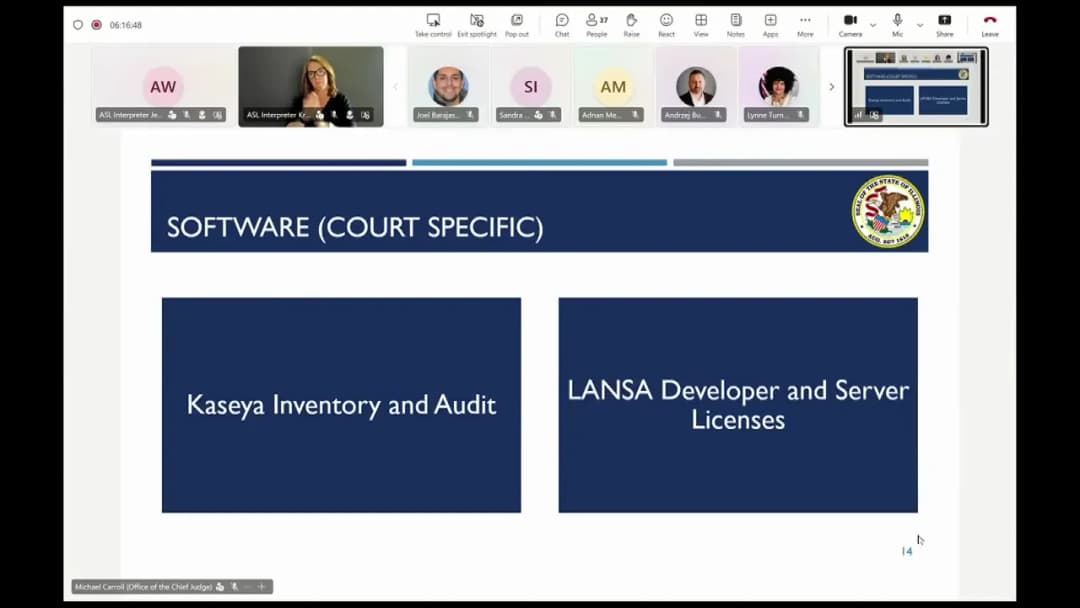
The Cook County Technology and Innovation Committee met on April 15, 2026, to discuss and act on several agenda items, including approval of minutes, a contract deferral, and receipt of reports from the Bureau of Technology and elected offices. The meeting featured extensive presentations from multiple county agencies on their technology strategies, major projects, and ongoing challenges with the Tyler Technologies integrated property tax system. Consent Calendar - Meeting minutes from March 11, 2026 (Item 26-11-46) were approved by voice vote with all ayes. - Item 26-08-16, a proposed contract with Safeware Inc. for the Sheriff's Office, was deferred to the May Technology and Innovation Committee meeting by a voice vote. - The FY2025 Chief Information Security Officer report (Item 26-06-44) was received and filed after a roll call vote: 8 ayes (Commissioners Aguilar, Degnan, McCaskill, Sean Morrison, Scott, Trevor, Vasquez, and Chairman) and 1 absent (Commissioner Miller). - A bundle of three reports—the 2026 Technology Strategic Report (Item 26-06-45), the Information Technology Projects Report (Item 26-08-37), and the Software, Asset, and Technology Hardware Asset Inventory Report (Item 26-08-38)—was received and filed after a roll call vote: 8 ayes, 1 absent (Commissioner Miller). Public Comments & Testimony - George Blake Moore, a resident, criticized the absence of a Tyler Technologies representative, stating it was unacceptable and made the county look non-functional. He urged the committee to better serve the public and noted frustration with the property tax system delays. Discussion Items - Bureau of Technology (BOT) Presentation: Chief Information Officer Tom Lynch presented the 2026 strategic plan, highlighting priorities including standardization, AI policy adoption, wide area network expansion, enterprise hybrid cloud strategy, and disaster recovery. Deputy CIO Derek Thomas reported on the Integrated Property Tax System (Tyler Technologies) status, noting significant production defects affecting refunds and distributions to taxing bodies. He stated that the clerk's redemption module is targeted for mid-to-late May but faces risk. Chief Technology Officer Hema Sunderum discussed the identity and access management and generative AI projects. - Treasurer's Office Presentation: Chief of Staff David Burns reported that the office's focus remains on Tyler system defects, which are preventing bulk refunds to approximately 87,000 Cook County residents and impeding detailed distribution data to taxing districts. He noted 61 open defects in the Tyler system. Commissioners expressed concern about the pace of defect resolution and the absence of Tyler Technologies representatives. Commissioner Degnan requested a workflow analysis and that Tyler be present at future meetings. Commissioner Morrison pressed about refunds owed for months and the risk of second-installment billing delays. - Assessor's Office Presentation: Chief Information Officer Nathan Bernacki outlined strategic pillars of distinguished service, teamwork culture, and data integrity. The office is fully live on IS World and is working on website enhancements, ADA compliance, and AI governance. - Board of Review Presentation: Director of IT Adnan Meman described six strategic IT priorities including property tax system integration, PTAP automation, workflow automation, and public transparency initiatives. - County Clerk's Office Presentation: Director of IT Andrew Bukowski reported on a new in-house unified cashiering platform and other projects. - Office of the Chief Judge Presentation: Director of Information Services Mike Carroll reported on mainframe migration completion, ADA compliance, eWarrant pilot with the State's Attorney's Office, and a major courtroom AV modernization project expected to be procured soon. - Sheriff's Office Presentation: Mar Patel, IT representative, highlighted body camera deployment, jail management system enhancements, records management system migration completed that morning, and new contraband detection technology. - State's Attorney's Office Presentation: Chief Information Officer Darren Ganier presented four priorities: a new juvenile case management system, a laptop refresh (55% complete), an Axon evidence management system go-live June 1, 2026, and collaboration on the eWarrant solution pilot. Key Outcomes - Routine approvals and reports received and filed as noted in Consent Calendar. - The Safeware contract was deferred without discussion. - No formal decisions were made on the Tyler system issues, but commissioners directed that Tyler Technologies provide a representative at future meetings and that a workflow analysis be documented. - The committee received all presentations and reports as filed. - The meeting adjourned at approximately 20:30 following a motion by Commissioner Vasquez.
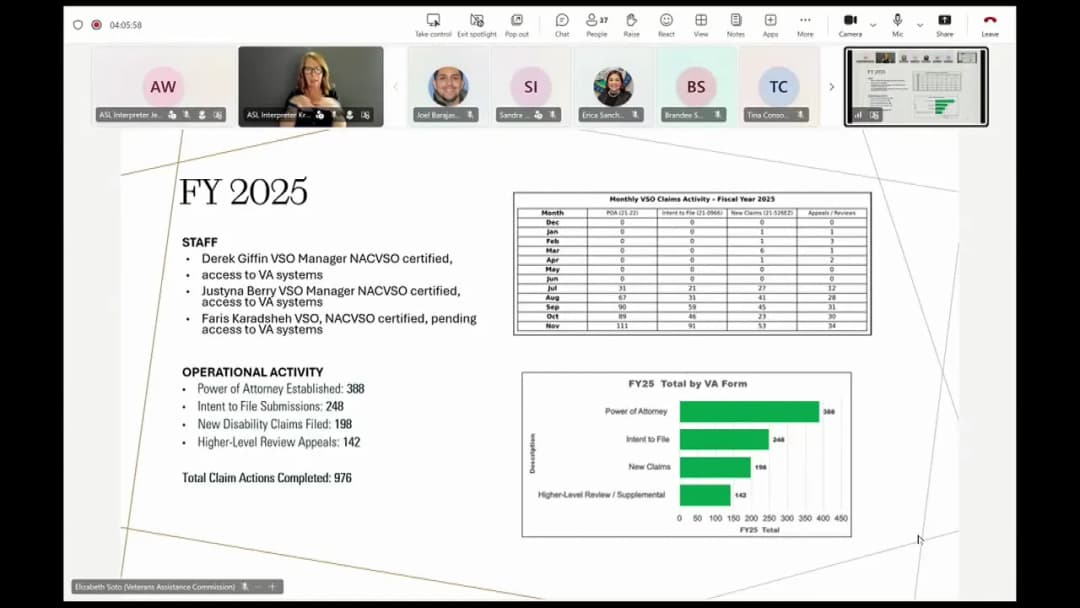
The Veterans Committee of Cook County convened on April 15, 2026, with a quorum present. The meeting included public testimony, approval of previous meeting minutes, and a detailed quarterly report from the Veterans Assistance Commission (VAC) on services, financials, and outreach efforts. Consent Calendar - Item 26-1055: Motion to approve the minutes from the May 2 meeting. Passed unanimously. - Item 26-1013: Motion to receive and file the VAC FY26 first quarter report. Passed unanimously. Public Comments & Testimony - Eva Marie Duff (VFW Illinois District Four Commander, VAC Board Member): Expressed full support for the VAC’s outreach efforts, noting they are reaching more veterans, especially women veterans facing housing instability and homelessness. Stressed that funding must keep pace with growing demand to avoid identifying crises without the capacity to solve them. - George Blakemore: Expressed strong opposition to perceived disparities in services, arguing that black veterans are neglected while immigrants receive benefits. Called for a focus on the needs of black veterans and described systemic inequities. - Speaker identified as "Dutch de Grouth" (veterans advocate): Expressed opposition to a bill that would dismantle veterans commissions across Illinois, stating it was introduced without consultation and would reduce federal dollars. Advocated for funding based on justified budgets rather than arbitrary caps. Commended Cook County leadership for recent improvements but noted ongoing challenges, including a 25% budget shortfall, staffing gaps, and procurement delays (e.g., six to eight months for basic software). Stressed that VACs generate economic return, bringing nearly $180 million in federal benefits to Illinois outside Cook County. Discussion Items - VAC FY26 First Quarter Report: Presented by Superintendent Elizabeth Soto, VSO managers Derek Giffin and Justina Barry, and Outreach Coordinator Connor Interest. - Emergency Services: $273,892.43 distributed in Q1 (Dec–Feb), an average of $90,000 per month. Projected to exceed $1 million for FY26, a 28% increase over FY25. Top categories: rental assistance ($56,835.81), food assistance ($50,800), burial/funeral assistance ($57,330.17). Services supported 907 veterans, 150 new to the VAC. Over 1,853 phone calls handled. - VSO Operations: In FY25, two accredited VSOs completed 976 claim actions. In Q1 alone, they initiated 900+ actions (319 powers of attorney, 294 intents to file, 203 new disability claims, 147 appeals). These two VSOs generated over $311,000 in direct benefits in Q1 and are responsible for over $13 million in annual benefits paid to Cook County veterans. A conservative projection with five VSOs estimates 9,000+ claim actions annually and over $23 million in compensation. Currently operating at constrained capacity. - Military Sexual Trauma (MST) Claims Clinics: Launched December 2025, led by Justina Barry (women’s MST coordinator) and Derek Giffin (male MST coordinator). Provides trauma-informed, confidential claims assistance in-person at 69 West Washington, Suite 1420, and virtually. - Outreach: Conducted 85 events in Q1 (42 VETConnect, 32 resource fairs, 1 VetTalk, 10 ceremonial events), directly assisting 282 veterans with 695 total interactions. Outreach is expanding to underserved areas on the South Side. An intake form has processed 641 veterans with over 2,600 unique requests. Plans for Q2 include website reorganization and a new Power App system for better tracking. - Commissioner Lowry and Commissioner Aguilar thanked VAC staff for their comprehensive work. Key Outcomes - Approved: Item 26-1055 (minutes from May meeting) by voice vote, all in favor. - Received and Filed: Item 26-1013 (VAC FY26 Q1 report) by voice vote, all in favor. - Adjourned: Motion by Commissioner Lowry, seconded by Commissioner Aguilar, passed unanimously.