Browse by city
Date range
Search help

Search titles, summaries, topics and stored transcripts together. Keywords may match separately; put the whole query in double quotes for a phrase. Matching follows word analysis, so punctuation is not exact. Both dates are included. Documents are not searched.

SHOWING 61–70 ENTRIES
61
JUL 22, 2026 · COOK COUNTY, ILLINOIS · BOARD OF COMMISSIONERS
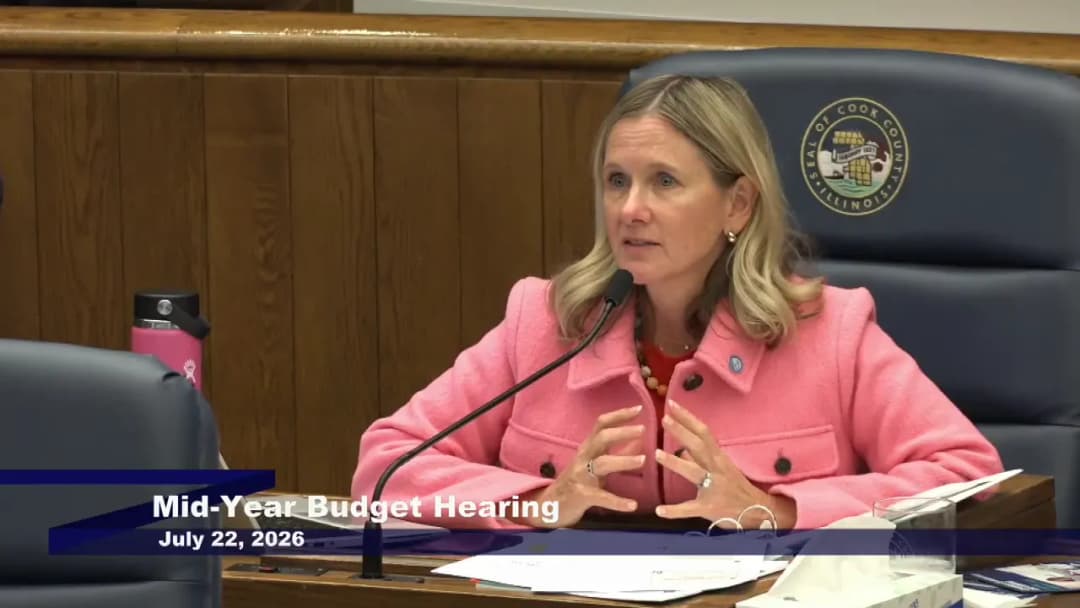
Cook County Circuit Court Clerk Mid-Year Update and Budget Review - July 22, 2026

Clerk of the Circuit Court of Cook County Marianna Spiropoulos presented a mid-year update to the board committee, highlighting progress in transparency, modernization, and fiscal responsibility. She discussed budget variances, staffing challenges, and key initiatives, followed by questions from commissioners on data, hiring, domestic violence, and jail release times. Discussion Items - Clerk's Presentation: Clerk Spiropoulos reported on the launch of an orders of protection dashboard, a NACO 2026 Achievement Award for the e-citation initiative, expansion of online services, and community outreach efforts. She emphasized that the office is on track to finish fiscal year 2026 within its approved budget. - Budget Variance Details: She explained variances across accounts: professional services positive variance of $182,000 (9.8%) due to timing of invoices; office supplies positive variance of $98,000 (43.9%) due to sufficient inventory; maintenance and operations positive variance of $119,000 (12.0%) from offsetting overspending/underspending; rental and leasing positive variance of $36,000 (13.2%) from contract renewal timing; and contingency and special purpose negative variance of $301,000 (-40.2%) due to a replacement payment from the state for child support services. - Clean Slate Automation: Clerk noted that the state's Clean Slate task force will automate record sealing for eligible nonviolent offenses, affecting over 1.7 million residents. Since Cook County represents about 40% of state cases, the office expects a significant workload increase and will seek additional staffing to comply with the mandate. - Violence Against Women Task Force: Clerk acknowledged data challenges in fulfilling the task force's requests. She noted that the office does not always capture requested data points in a clear manner, and that had to parse through 12,000 event codes manually. She requested 3–5 dedicated staff for data requests to improve response times. - Employment Plan and Hiring: Chief Human Resources Officer Chad Garrick explained that the Tileo system used for entry-level positions requires a multi-step process, including reviewing applications and resumes for 1,000+ applicants per posting. A memorandum of understanding allows skipping interviews for entry-level office clerk and financial clerk positions to accelerate hiring. As of the report, there were 24 vacancies, with 7 union positions open (6 court clerks, 1 trainer). Large hiring classes in June (40 and 35 hires) reduced the count from 127. - Will Depository System: Clerk announced legislation creating a will depository system has passed and is awaiting the governor's signature. It will allow individuals to deposit wills with the office free of charge. The Illinois State Bar Association and AARP supported the measure; the Chicago Bar Association expressed opposition, citing concerns about attorney roles. Clerk clarified the initial focus is on individuals who cannot afford attorneys. - Expungement Summit: The first expungement summit was held October 11, 2025. The next is scheduled for October 10, 2026, at Kennedy King College in Commissioner Lowry's district. The event provides free legal advice and court dates. - Jail Release Delays: Clerk and staff discussed the process of transmitting mittimus orders to the sheriff. Executive Clerk David Moses noted that clerks must verify orders with judges to avoid errors, which can slow transmission. CIO Vivek Ananda said the office is working with the sheriff to provide digital documents in near real-time, building on a successful juvenile process that already uses electronic data flow. Commissioner Vasquez requested a report from the clerk, sheriff, and chief judge on progress. - Data Requests and System Limitations: Clerk reported receiving about 700 data requests annually, all requiring approval from the chief judge's office. The system often requires manual parsing to answer specific queries. CIO Ananda said the system can be enhanced to capture more attributes, as done for Karina's law and orders of protection. Commissioner Degnan asked about the new Illinois Supreme Court transparency policy; General Counsel James Chandler confirmed that the AOIC already creates the event codes, so compliance is straightforward. - E-Citation Expansion: E-citation now includes 91 law enforcement agencies. The next major step is bringing Chicago Police Department (CPD) on board; a pilot is planned at airports and other locations. The office collects $3 per citation for Cook County and $2 for municipalities. - Technology Salaries: CIO Ananda noted a salary gap of about 40% between the clerk's office pay scale and the Bureau of Technology pay scale, making it difficult to hire and retain tech staff. The office is exploring consortium approaches rather than a single chief innovation officer. - Public Access Portals: The office is working on a new portal solution to provide self-represented litigants and attorneys with access to their own cases, a feature currently unavailable. No deadline has been set. - Karina's Law Training: Clerk reported that 100% of courtroom staff have been trained on Karina's law and orders of protection through a six-week training program (classes of 15 or fewer). Key Outcomes - Clerk Spiropoulos assured the committee that the office is on track to end fiscal year 2026 within its approved budget, with revenues and expenditures trending as expected. - Commissioners expressed support for the clerk's initiatives, including the expungement summit, orders of protection dashboard, and will depository. - The clerk committed to working with the violence against women task force and to exploring additional data dashboard enhancements. - Commissioner Vasquez indicated she would offer a resolution requiring the clerk, sheriff, and chief judge to report back on progress to reduce jail release delays. - No formal votes were taken; the meeting was informational and advisory.
DATA SHARING 32% · TECHNOLOGY AND INNOVATION 16% · COURT REPORTING 13% · PUBLIC ADMINISTRATION 12%
62
JUL 22, 2026 · COOK COUNTY, ILLINOIS · BOARD OF COMMISSIONERS
Finance Committee Hearing on FY26 Budget and Operations with Sheriff Dart – July 22, 2026

The Finance Committee of the Cook County Board held a hearing on July 22, 2026, to review the FY26 budget and operations of the Cook County Sheriff's Office. Sheriff Dart and his team provided an update on the budget, staffing, overtime, electronic monitoring, immigration enforcement, jail safety, and various programs. Commissioners questioned the Sheriff on a wide range of topics, including courthouse security, ICE interactions, jail deaths, food quality, and technology proposals. Discussion Items - Budget Overview: Sheriff Dart reported that the FY26 operating budget is $774 million, a $64 million increase from FY25, mostly due to salaries. Current spend is $362 million. Overtime budget was set at $72 million, but $60 million has already been spent, driven by an average of 467 correctional officers calling in sick or using FMLA each day. The Sheriff expressed confidence in meeting the budget due to slowed hiring. The proposed FY27 budget is $861 million, largely for pay and benefits. - Electronic Monitoring (EM) Program: The Sheriff's office is winding down its EM program, still 168 people remain. Transfer to the Chief Judge's office is slow. The Sheriff noted that legislative changes made his program unworkable; his program was more restrictive and transparent than the Chief Judge's. Commissioner Stamps questioned whether transferring EM to the Chief Judge would be safer, given recent incidents. The Sheriff reiterated that the legislature changed the rules, and he could no longer run the program safely. - Individualized Assessments and Discharge Planning: The Sheriff described a goal of providing individualized assessments and strategic evaluations to 98% of the jail population. The program includes deep intake assessments, personalized plans, and discharge planning that continues after release. Sharing of data with external entities is limited by privacy concerns. - Immigration Enforcement and Courthouse Safety: Sheriff Dart stated that his office does not honor ICE detainers, but responds to criminal warrants. The House Judiciary Committee has subpoenaed data. Since January 2025, there has been an increase in ICE agents at courthouses. The Sheriff's office provides training on distinguishing warrants, First Amendment rights, and interactions with federal agents. The Bridgeview incident on June 17, 2026, was discussed: a person ran through a courthouse exit, pursued by ICE agents. Sheriff's deputies responded, and two officers are under investigation for possible policy violations. The Sheriff emphasized that the office had no prior knowledge of the ICE operation. Commissioner Naya expressed concern about the perception of collaboration and asked for stronger protocols. Commissioner Breeda requested a private briefing after the OPR investigation concludes. Commissioner Scott suggested de-escalation by approaching ICE agents, but the Sheriff noted the chaotic and rapid nature of the incident. - Jail Safety and Deaths in Custody: Sheriff Dart reported 233 vacancies, mostly correctional officers. Deaths in custody are mostly natural causes; drug-soaked paper has been a major issue. The Sheriff stated that Narcan is available on every tier and every officer carries it. Overdose deaths dropped from 8 in 2023 to 0 in 2024, with 2 suspected in 2025. The Sheriff defended the use of Narcan by officers rather than inmates, citing concerns about detecting drug use and the ineffectiveness of Narcan on synthetic cannabinoids. Commissioner Vasquez urged making Narcan available to inmates themselves, citing national recommendations. Sheriff Dart expressed openness to exploring options. - Food Quality and Commissary: Commissioner Stamps raised concerns about the nutritional value of meals, noting that detainees often rely on commissary. The Sheriff stated that the office has been working with the food provider to ensure menus meet contract requirements. He agreed to provide data on commissary revenue and pricing. Commissioner Stamps emphasized that for an additional $17 million, meals should be more nutritious. - Technology Proposals: BriefCam AI video surveillance software was discussed for jail use, primarily to detect movements and save lives. Sheriff Dart stated that facial recognition would be used only in limited circumstances and would be reported to the board. Commissioner Vasquez expressed concerns about the technology's track record and requested the contract before the item comes to committee. The Sheriff agreed to provide the contract and a presentation. - Release Times: Sheriff's Chief of Staff Brad Curry outlined improvements to reduce delays in releasing detainees, including scanning documents sooner and starting discharge paperwork immediately after a court hearing. The goal is to have the process ironed out in three to four weeks. - Vocational Programs and Pay: Several vocational programs exist, some paid and some not. The dog training program and art/music programs are not paid; the building deconstruction program is paid. The Sheriff agreed to provide a breakdown of paid programs and amounts. - Lowering Hiring Age: Sheriff Dart championed legislation allowing correctional officers to be hired at age 18, effective January 1, 2027. He outlined a plan with mentoring, additional training, and mental health supports. Commissioner Marita asked for the full plan, especially mental health screenings. The Sheriff committed to sharing it. - CTA Deployment and Helicopter: The Sheriff's office has spent $7.5 million on CTA operations, fully reimbursed by NETA. The helicopter has logged 724 hours, with 16% for traffic enforcement, and has generated significant revenue. Data on citations and revenue will be provided. Key Outcomes - Investigations: The OPR investigation into the Bridgeview incident is expected to conclude in two to three weeks. Commissioner Breeda requested a private meeting after the investigation. - Data and Reports: The Sheriff agreed to provide the following: breakdown of paid vocational programs and amounts, data on commissary revenue and pricing, full plan for hiring 18-year-olds, contract for BriefCam AI software, metrics on the impact of the lower hiring age, and citations/revenue from the helicopter. - Collaboration: Sheriff Dart expressed willingness to work with commissioners on improving protocols for courthouse safety, virtual court appearances, and Narcan access for inmates. Commissioner Vasquez will provide research on alternative technologies. - Budget: The FY27 budget request of $861 million will be discussed further with the President's office and budget office.

PUBLIC SAFETY 50% · CRIMINAL JUSTICE 15% · BUDGET EQUITY ANALYSIS 6% · IMMIGRATION AND NATURALIZATION 5%
63
JUL 22, 2026 · COOK COUNTY, ILLINOIS · BOARD OF COMMISSIONERS
Cook County Board OIG Update and Budget Presentation - July 22, 2026

The Cook County Board of Commissioners received a quarterly update from Inspector General Twell Paxton on the Office of the Independent Inspector General (OIG). The presentation covered budget status, staffing, rising complaint volumes, key investigations, and a new public report on Cook County Health's revenue cycle. Commissioners discussed contractor oversight, the need for improved coordination, and the challenges of managing large projects across multiple elected offices. Consent Calendar - No consent calendar items were discussed. Public Comments & Testimony - No public comments were provided. Discussion Items - OIG Staffing & Budget: Inspector General Paxton reported that the OIG is budgeted for 25 full-time employees, with 20 positions currently filled (up from 14 last year). The office is under budget by $468,350 (27.3%) for the six-month period and fiscal year 2026, primarily due to open positions and unspent costs related to an upcoming office relocation. The OIG seeks five additional staff for fiscal year 2027 to address personnel shortages in areas such as unlawful political discrimination, sexual harassment, contract compliance, property tax fraud, and waste. - Complaint & Investigation Volume: Complaints increased by 25% in the first two quarters; 60 investigations were completed, exceeding the total for all of 2025. The OIG noted a troubling spike in property tax issues and an increase in sexual harassment and workplace misconduct complaints, though most are non-sustained. - Case Management System Update: Jennifer Fother, OIG Office Manager, reported that after delays, the office decided to stay on-premise for its case management system (hosted on county servers). The system is on track to be fully updated by September, with no additional cost. - Contractor A Report & Procurement Communication: Commissioner Laura discussed the findings of the recent contractor report (released July 21, 2026), highlighting failures in oversight, planning, and vendor efficiency. Inspector General Paxton emphasized the need for a single primary authority for large projects, stronger support from the Bureau of Technology (BOT), and early involvement of the OIG to prevent issues. Commissioner Trevor Burrus Jr. noted that managing without authority is a recognized challenge in large organizations and urged the board to address this systemic problem. - Law Enforcement Referrals: Inspector General Paxton stated that all completed investigation reports are referred to law enforcement; 136 reports have been issued, totaling over $3 million in federal fraud identified. No action has been taken on these referrals to date. Key Outcomes - The OIG released a public report on Cook County Health's revenue cycle, showing that claim denials have dropped significantly since 2020, with projected cost savings exceeding $500 million. Inspector General Paxton commended CCH staff for the turnaround. - The committee recessed to 9:00 AM the following day for separate presentations by the Treasurer and Assessor's offices. - No formal votes were taken during this presentation.

PUBLIC ADMINISTRATION 59% · PROCUREMENT 27% · PUBLIC SAFETY 8% · PENDING LITIGATION 6%
64
JUL 22, 2026 · COOK COUNTY, ILLINOIS · BOARD OF COMMISSIONERS
Cook County Board of Review FY2027 Budget Presentation - July 22, 2026

The Cook County Board of Review presented its proposed FY2027 budget of $27 million to the County Board on July 22, 2026. The budget reflects a $3 million increase over the prior year, driven primarily by mandatory contractual obligations following the unionization of its staff. The agency, which is 94% personnel (177 FTEs), emphasized its critical role in processing a record volume of property tax appeals and defending assessments. The presentation included discussion of workload statistics, restructuring under a new collective bargaining agreement, changes in valuation methodology, and efforts to improve equitable access for taxpayers. Budget and Staffing - The budget request of $27 million is largely driven by the first annualized impact of the collective bargaining agreement with AFSCME, covering 103 employees now on the AFSCME pay scale. Anticipated costs also include potential expansion of the bargaining unit and compression adjustments for supervisors and managers. - The agency is currently 6.3% under budget for the fiscal year, with positive variance primarily due to operating expenditures expected later in the year. - Commissioner Larry Rogers explained that the $3 million increase is budget‑neutral in essence, as it mainly funds contractually obligated salary increases. Workload and Performance - In the 2025 tax session, the Board processed over 290,000 appeals (a record), covering over 530,000 parcels. Staff conducted over 11,000 hearings and held over 200 community outreach events. - The Board also processed nearly 1,600 exempt parcels and defended nearly 80,000 parcels before the Illinois Property Tax Appeal Board (PTAB) in 2025, preserving an estimated $825 million in property tax revenue from 2020‑2024. - Historically, 60–70% of appellants receive some relief. For residential properties in tax year 2025, approximately 52.7% received a reduction. Unionization and Restructuring - The agency recently unionized its workforce, leading to new processes for overtime, scheduling, and grievance handling. Secretary Liliana Escarpita noted that the agency is undertaking a comprehensive restructuring to codify new departments, managerial structures, and fair compensation. - Chairman George Cardenas estimated the restructuring could be completed within 6–12 months. Commissioner Danner expressed concern about the practical impact on timely tax bill issuance, acknowledging potential growing pains but also long‑term efficiency gains. Valuation Methodology and Commercial vs. Residential Appeals - The Board uses a loaded cap rate method for commercial properties, which includes tax expenses. After a 2024 county‑commissioned study, the Assessor's Office agreed to adopt the same methodology, aiming for greater consistency. - Commissioner Trevor questioned whether this would narrow the gap in average percentage reductions between commercial and residential appeals. Commissioner Rogers clarified that percentage reduction is not a fair measure because it depends on the initial assessment increase, not just the methodology. - Approximately 32,000 of the 290,000+ appeals in 2025 were commercial. The Board noted that commercial property owners appeal more frequently, often with detailed appraisals, while residential owners face barriers such as time, technology, and complexity. Outreach and Equity - The Board has doubled its outreach efforts, targeting areas with steep assessment increases (e.g., West Garfield Park, South Suburbs). It partners with elected officials and community organizations to help residents navigate the appeal process. - Commissioner Stamps raised concerns about gentrification and the need to protect long‑term residents, particularly seniors and working families in historically over‑assessed neighborhoods. Commissioner Rogers acknowledged the challenges and noted that the Board has identified unjustified assessment spikes and pursued certificates of error. - Commissioner Anaya requested better tracking of appeals submitted through elected officials' offices to measure success rates by neighborhood. Chairman Cardenas expressed interest in using barcodes or QR codes to tag appeals and provide feedback. Tyler System Challenges - The Board is not on the Tyler system, but delays and bugs in the county’s property tax software have indirectly affected operations, requiring more overtime and man hours to process appeals and meet deadlines. The Board hopes greater collaboration with the new Assessor’s administration will improve predictability and timeliness. Key Outcomes - The Board of Review formally requested $27 million for FY2027, emphasizing that the increase is necessary to fulfill contractual obligations and maintain staffing levels amid rising appeal volumes. - Commissioners indicated support for the budget, with Chairman Cardenas urging the County Board to fund the agency properly to ensure efficient, independent review of property tax appeals. - The Board committed to exploring technological improvements for tracking appeals and enhancing outreach, including possible mailings to reassessed areas. - No formal vote was taken at this presentation; the budget will be considered in subsequent County Board proceedings.

PROPERTY MANAGEMENT 47% · PUBLIC ADMINISTRATION 15% · BUDGET EQUITY ANALYSIS 11% · TECHNOLOGY AND INNOVATION 10%
65
JUL 21, 2026 · COOK COUNTY, ILLINOIS · BOARD OF COMMISSIONERS
Cook County Finance Committee Hears Cook County Health Mid-Year Budget Update – July 21, 2026

On July 21, 2026, the Cook County Finance Committee received a mid-year budget update from Cook County Health (CCH). CCH Board Chair Raul Garza, CEO Dr. Eric McKaitis, and interim CFO Scott Spencer presented the health system's financial outlook, highlighting $315 million in cost reductions over two years, a $42 million budget gap in FY2026, and projected charity care rising to $500 million in FY2027 due to federal policy changes (HR1, Medicaid work requirements, ACA tax credit expiration). Commissioners expressed strong support for CCH's mission, asked detailed questions about workforce, agency staffing, revenue cycle, and the impact of federal cuts, and received commitments on specific initiatives. Presentation & Discussion - Raul Garza (CCH Board Chair) praised CCH leadership for fiscal discipline and proactive preparation for federal cuts, noting improved financial outlook but significant challenges ahead from Medicaid changes and rising costs. - Dr. Eric McKaitis (CCH CEO) reported $315 million in expense reductions (belt-tightening, operational improvements, agency reduction) that prevented service cuts or layoffs so far. He noted FY2027 will be the most financially challenging in recent memory, with charity care projected to reach $500 million (up from $156 million in 2023). CCH has launched a Medicaid education campaign (Get Medicaid Facts) and partnered with City Colleges via a $5 million Pritzker Traubert Foundation grant for workforce pipelines. - Scott Spencer (Interim CFO) showed payer mix shifts: Medicaid fell from 61.4% (2023) to 49% (2026), while uncompensated care rose from 13.1% to 24.8%. Federal policy changes (ACA tax credits, HBIA discontinuation, work requirements) are expected to reduce CCH revenue by $138 million and add $100 million in charity care in FY2027. CCH is targeting a $42 million gap in FY2026 with additional savings, but FY2028-29 projections show even greater strain. Commissioner Questions & Comments - Commissioner Bill Lowry (Vice Chair, CCH Board) thanked CCH leadership, noted the uninsured rate rose from 14% to 24% due to federal actions, and praised CCH's commitment to charity care and self-sustainability. He asked about potential service cuts or layoffs; Dr. McKaitis confirmed none to date but acknowledged future need may require such steps. - Commissioner Ny asked about specific savings initiatives (Earn project, agency reduction), behavioral health positions at JTDC, reproductive health equity grant, revenue cycle improvements, and ARPA fund spending. CCH committed to unfreeze two psychiatric social worker positions and include the $2 million reproductive health equity grant in the FY2027 budget. New revenue cycle system expected to yield about $100 million in additional revenue. ARPA funds: $36 million remaining, on pace to spend by end of September. - Commissioner Steams focused on workforce strategy, praising the shift from agency to permanent staff. CCH reported agency usage dropped from above 15% to under 9%, with 250+ conversions and 262 deactivations. Time-to-hire improved from 120 to 60 days for accelerated positions. Pipeline programs include CPS internships, City Colleges partnership, and plans for LPN/RN expansion. - Commissioner Given raised concerns about safety net hospital closures (e.g., West Suburban, Mount Sinai) and urged a proactive strategy to preserve access. CCH noted state leadership is primary, but they support safety nets through prospective payments and quality advancements. CCH also discussed efforts to hire displaced workers from closed hospitals, but outreach has been limited; Commissioner Given requested better coordination via job fairs. - Commissioner Sky asked about the impact of HR1 on Cook County, noting 400,000 Illinois Medicaid recipients could lose coverage (45% in Cook County). CCH estimates FY2027 charity care at $500 million, but Commissioner Sky warned this may be an underestimate. CCH acknowledged uncertainties but said they are preparing for a potential 30% self-pay rate. Commissioner Sky also referenced a New York Times article about federal Medicaid funding cutoffs for California and Minnesota; CCH said such a move would be "ruinous." - Commissioner Trevor pressed for a specific dollar figure of HR1’s total financial impact on CCH; Scott Spencer noted charity care is the primary driver but declined to provide a precise estimate due to unknowns. Commissioner Trevor asked about the accuracy of projections and the economic ripple effects. - Commissioner [name not provided] (seniority, last to ask) thanked CCH for partnership with CPS and inquired about Haitian/Cuban categories in the eligibility slide. CCH will confirm whether those groups include TPS holders, noting possible additional losses if TPS is revoked. Key Outcomes - No formal votes were taken; the meeting was informational. - Commitments made by CCH leadership: Unfreeze two psychiatric social worker positions for JTDC; include the $2 million reproductive health equity grant in FY2027 budget; continue and expand workforce pipeline programs (CPS internships, City Colleges, and grade school outreach). - Next steps: CCH will finalize its FY2027 budget internally within a month, then present to its board before submission to the Cook County Board in October. Commissioners requested continued collaboration on job fairs and safety net preservation planning. - Data points highlighted: $315 million in cost savings (FY2025-26); $42 million FY2026 gap; charity care from $156M (2023) to $400M (FY2026) to $500M (FY2027 projected); agency staffing reduced from 15% to <9%; 250+ agency-to-permanent conversions; 780 net hires in FY2026; revenue cycle improvements expected to yield $100 million.

PUBLIC HEALTH 40% · FISCAL SUSTAINABILITY 23% · WORKFORCE DEVELOPMENT 13% · EDUCATION 6%
66
JUL 21, 2026 · COOK COUNTY, ILLINOIS · BOARD OF COMMISSIONERS
Cook County Finance Committee Hearing on Mid-Year Budget Update - July 21, 2026

The Finance Committee of the Cook County Board met on July 21, 2026, to receive a mid-year budget update from the Office of the President (OUP). Chief of Staff Linetta Haynes Turner presented a report highlighting the county's strong financial position, recent credit rating upgrades, and a range of ongoing initiatives. Commissioners posed questions on hiring, procurement, technology, property tax system implementation, and other operational matters. No votes were taken; the meeting served as a briefing and discussion. Presentation by Linetta Haynes Turner - Turner reported that Cook County received two ratings upgrades from Fitch Ratings, bringing the total to six upgrades in five years, reflecting judicious debt management, growing reserves, and addressing long-term liabilities. - The OUP represents 10% of the county's budget ($285 million) with approximately 2,000 employees. - Key accomplishments included: - Medical debt relief: Using $7 million in ARPA funds to eliminate over $820 million in medical debt, and through a statewide program, total medical debt forgiven for Cook County residents exceeds $1.5 billion. - Digital equity: Continued implementation of the Cook County Digital Equity Action Plan. - Environmental sustainability: Collected material from 4,000+ homes, diverted 875,000+ pounds of material; recycling services for 2,778 homes in Dixmoor, Posen, and Phoenix diverted 423+ tons in 12 months. - New medical examiner's building: Land acquired, architect approved, design process starting. - Community violence intervention: $20 million invested; 50% reduction in violent crimes countywide over five years (30% in Cook County). - Technology modernization: Retiring 100+ legacy applications, achieving $6.5 million in annual savings. - Employee engagement survey: 77% participation, mean score 3.86/5. - Small business support: $7 million leveraged, 230+ businesses assisted in first six months. - Affordable housing: Modular homes pilot in Humble Park, Chicago Heights, and Proviso Township; $2 million in down payment assistance. - Turner noted external pressures: federal funding reductions to the hospital system by the Trump administration, geopolitical instability, pending litigation, and inflation. - She concluded that OUP remains within budget targets and anticipates meeting FY2027 targets. Commissioner Questions and Discussion Human Resources (Bureau of HR) - Commissioner Moore asked about delays in providing applicant lists to the county auditor's office (up to 100+ days). Chief Velisha Haddocks said she was unfamiliar with the data and agreed to review it; she noted the county is using the Taledo system and has completed enhancements. - Commissioner Moore also asked about an increase in federal candidates after federal layoffs; Haddocks confirmed a slight increase. Bureau of Administration - Commissioner Moore asked about a warehouse assessment and records retention study; Chief Administrative Officer Zara Lee said it will be finalized within 60-90 days. - Commissioner Moore asked about merging the Department of Veterans Affairs and the Veterans Assistance Commission; Lee said their missions are different and they should remain separate. Bureau of Asset Management - Interim Chief Jamie Myers reported on the boardroom renovation: AV system to be turned over next week, then training. Commissioner Moore expressed concerns about security and ADA compliance; Myers said security discussions have occurred with the secretary of the board, and ADA assessments are being procured. - Commissioner Moore asked about the CMAR contract for the hospital system ($372 million); Myers committed to providing quarterly project reports by mid-August. Chief Procurement Officer (Rafi Serafian) - Commissioner Moore asked about contract monitoring and bottlenecks. Serafian said contract management is the responsibility of using departments, and OCPO works with them when issues arise. He noted 70% of procurements are processed within 12 months (measuring from request to execution). Commissioner Moore suggested establishing a timeline for departments to report issues; Serafian agreed to explore best practices. Bureau of Economic Development - Commissioner Degnan questioned the impact of the Tyler property tax system implementation delay on land transfers and economic development. Chief Sochi Flores acknowledged challenges and said coordination with the land bank and other offices is ongoing. Commissioner Degnan urged consideration of workarounds if Tyler cannot deliver soon. - Commissioner Degnan also asked about a 22.3% variance in building and zoning permit revenue; Director Tim Bluer attributed it to an increase in permits, not just township shifts. Commissioner Degnan requested data on permit types and locations. - Commissioner Degnan asked about a 99.2% negative variance in planning and development revenue; Director Susan Campbell explained it was due to slower-than-expected revenue from the modular homes pilot program (actual revenue $2.3 million vs. budgeted $7 million). Emergency Management and Regional Security (EMRS) - Commissioner Aguilar asked about denied federal disaster relief funding; Turner said no explanation was given, and the county is working with the state's attorney's office on possible legal avenues. EMRS Executive Director Alex Joves reported a 44% cut in homeland security grants last fiscal year and an additional 7% cut this year. - Commissioner Scott asked about the impact of federal enforcement at polling places; Joves said EMRS supports election authorities but deferred to the County Clerk's office. Department of Revenue - Commissioner McCain asked about debt collection challenges; CFO Angela Manning Hardeman said the state's attorney's office has been slow on large-dollar cases. Director Tina Consola will provide a list of top debtors to commissioners. Justice Advisory Council - Commissioner McCain praised the juvenile detention alternative program and thanked Felicia for developing an internship program after years of effort. Department of Environment and Sustainability - Commissioner Dunn asked about data centers; Director Suzanne Malik McKenna said the county is working with a coalition on energy and water usage, and noted that of 54 permits sought, most will not move forward. She also reported progress on updating the environmental control ordinance, with a draft expected by Q1 2027. Bureau of Technology (Tyler System) - Commissioner Degnan asked about the Tyler system implementation; Chief Investment Officer Tom Lynch confirmed daily meetings with the Treasurer's office, and that the contract has options for two and a half more years. Commissioner Degnan stressed the urgency of getting disbursements to Special Service Areas (SSAs). - Commissioner Degnan also asked about AI policies; Lynch said policies are countywide and developed collaboratively. He noted that defining AI is tricky, and the policy covers both generative and non-generative AI. Commissioner Degnan requested upfront risk assessments for AI-related contracts. Key Outcomes - No votes were taken; the meeting was a discussion and update. - Commissioners requested specific follow-up information: HR applicant data, quarterly CMAR reports, permit data, top debtors list, and updates on Tyler implementation and AI assessments. - The OUP team committed to providing requested information and continuing coordination with separately elected offices. - The next budget hearing or update was not specified, but the committee will continue its work.

TECHNOLOGY AND INNOVATION 14% · PROCUREMENT 11% · ECONOMIC DEVELOPMENT 11% · PERSONNEL MATTERS 10%
67
JUL 21, 2026 · COOK COUNTY, ILLINOIS · BOARD OF COMMISSIONERS
Cook County FY26 & FY27 Preliminary Budget Forecast, July 21, 2026

At a meeting on July 21, 2026, Cook County CFO Angela Manning and the Bureau of Finance presented a preliminary mid-year budget forecast. They projected a $211.4 million shortfall for FY26 (less than 3% of the annual appropriation) and a much larger gap of over $550 million for FY27, driven primarily by federal legislation (HR1), inflation due to the war in Iran, rising payroll and pension costs, and the ongoing impact of the Road Builders’ litigation. The presentation emphasized fiscal discipline but warned that without structural solutions, reserves would fall below the floor by the end of FY27 and turn negative by FY29. Public Comments & Testimony - No public comments were recorded. Discussion Items - FY26 and FY27 Budget Gaps: CFO Manning and Deputy CFO Dean Constantina explained that the FY26 gap of $211.4 million (under 3% of appropriations) is manageable, but FY27 shows a combined gap of more than $550 million across the General Fund and Health Enterprise Fund. The primary drivers are the loss of allowable expenses under the transportation fund (due to Road Builders litigation), a projected $108.9 million increase in payroll without new positions, and fringe benefit growth of $35.4 million. - Revenue and Expense Variances (FY26): The county expects a favorable year-end variance of $266.3 million in General Fund revenue, largely due to a one-time $150 million cigarette tax settlement and $122.7 million above-appropriated sales tax. Expenses are projected $16.8 million below budget. The Health Enterprise Fund expects total revenues to exceed budget by $315.9 million due to a one-time $330 million appropriation adjustment, but base revenue (excluding that adjustment) shows mixed performance: County Care capitation is $103.9 million above budget, while patient fee revenues are $92.9 million short. - Health Enterprise Fund Pressures: The Fund projects a $214.7 million gap in FY27 due to HR1’s impact on Medicaid eligibility. County Care membership is expected to drop from 379,000 to 334,000, lowering capitation revenue by about $250 million. Net patient service revenue is forecast to drop by $164.8 million, while the uninsured population grows by approximately $100 million. Payroll, pharmaceuticals, and uncompensated care costs continue to rise. - Fiscal Strategies: The county plans to address the FY27 gap through both expense-side actions (targeted belt-tightening, vacancy assessment, multi-year planning) and revenue-side exploration (leveraging existing assets, new revenue opportunities). CFO Manning emphasized that restructuring will be a multi-year effort, with some revenue ideas targeted for FY28. A more robust long-range budget process will be implemented. - ARPA Sustainability Reserve: The county will allocate $52.6 million from the ARPA sustainability reserve in FY27 to sustain 12 key programs. A projected gap of $42.3 million remains for FY28-30, which the county plans to address through external funds, program-generated revenues, or scaling down initiatives. - Pension Fund: The county remains committed to making actuarially determined contributions to the pension fund, which currently has a 68.9% funded ratio. The state’s Public Act 103-0529 ensures contributions are made, with a projected drop in annual contributions after 2047 when legacy liabilities are paid down. - Impact of HR1 (One Big Beautiful Bill): HR1 is expected to reduce County Care membership by 16.2% and reduce patient service revenues by $45.4 million for CCH. It also affects directed payments. Commissioner Trevor requested a total estimate of HR1’s cumulative impact; the budget director noted an approximate $138 million impact on FY27 alone, with a total of $405 million since FY25 base, pending CCH confirmation. - Digital Ad Tax Preemption: General Counsel Laura Lechowicz-Felicione explained that the state’s digital ad tax preempts county home rule authority to implement a similar tax, though the county could advocate for a share of the revenue if litigation is resolved favorably. - TIF Surplus: Information on the FY27 TIF surplus will not be available until October, when the City of Chicago declares its surplus. - Cannabis and Vape Taxation: The county projects $12 million in cannabis tax revenue. Commissioner Gainer requested an analysis comparing that revenue to costs of law enforcement, public health, and hospital systems related to cannabis use. Vape taxes are projected at $6 million in FY26 and $6.5 million in FY27, with proceeds going to the General Fund. - Vacancies and ARPA Spending: The county has approximately 2,900 vacancies as of May 31. The budget director will include vacancy analysis in the FY27 executive recommendation. ARPA has about $80 million outstanding (allocated but unspent or pending reimbursement); the county is working to ensure all funds are spent by year-end, with potential transfers to high-utilization programs like the homeowner down payment assistance program. - Economic Indicators: Deputy CFO Constantina described using Moody’s Analytics scenario analyses to incorporate the impact of the war in Iran and other geopolitical events into revenue forecasts. Inflation and energy prices are expected to slow GDP growth in 2027, affecting sales tax revenues. Key Outcomes - The Board will receive ongoing updates through monthly revenue/expense reports, the IRFC report in October, and the executive budget recommendation. - The county will continue aggressive advocacy at the federal and state levels, including a planned trip to Washington, D.C., in mid-September to address HR1 and other federal issues. - The Bureau of Finance will explore and present new revenue options (horizon one short-term, horizon two long-term) to the Board. - CFO Manning committed to providing a deeper analysis of HR1’s cumulative financial impact on the county. - Commissioner Scott requested and will receive (via the chair) a detailed breakdown of all FTEs and vacancies to inform belt-tightening discussions. - The Board acknowledged the risk of potential pension fund consolidation with the City of Chicago and will continue to monitor pension legislation in Springfield, opposing any such moves.

FISCAL SUSTAINABILITY 57% · PUBLIC ENGAGEMENT 14% · PUBLIC HEALTH 10% · HEALTH EQUITY 6%
68
JUL 21, 2026 · COOK COUNTY, ILLINOIS · BOARD OF COMMISSIONERS
Cook County Board of Commissioners Office of Secretary Budget Summary and Archives Update - July 21, 2026

The Office of the Secretary to the Board presented its 2027 budget summary and updates on the Cook County Archives and Records (CARA) program. The discussion covered budget challenges, technology investments, and significant space constraints for the archives. Discussion Items - Budget Summary (Brandy Smith, Deputy Secretary to the Board): Smith highlighted the team's focus on operational efficiencies and transparency in 2026. The proposed 2027 budget faces a shortfall of approximately $250,000, driven by increased costs for the Granicus legislative management platform and technology enhancements for the new boardroom, including video indexing/timestamping, multilingual closed captioning, searchable meeting videos, and electronic voting. The vacant Legislative Services Director position will be reclassified to align with technological needs, with completion expected in six to nine months. A Commissioner asked about a line item showing 14% less than budgeted; Smith clarified it is a quarterly payment for Granicus and will align by year-end. Language interpretation services are not under this department but under the President's Office. - Archives Update (Victoria Sockwell, Manager of Archives): Sockwell reported accomplishments including a comprehensive inventory with Iron Mountain, exhibitions (e.g., on county and U.S. history), and educational outreach with University of Chicago students. She highlighted space challenges: the archives are in three locations (118 and two warehouses), with the 10th floor space outgrowing capacity and a warehouse area exposed to mold. She noted receiving a notice from facilities about space utilization and expressed the need for at least 10,000 square feet of permanent housing. Sockwell is the only professional archivist; all moving and preservation work falls to her. She discussed partnerships with the Chicago History Museum (interested in hosting an exhibition) and interest in a historic bank building on the South Side for permanent space. Commissioners expressed strong support for preserving history and protecting archives, with one offering to help with facilities. Key Outcomes - Commissioners unanimously praised the department's work, professionalism, and service. - A commissioner committed to drafting a resolution to acknowledge the county's next anniversary in conjunction with showcasing archives. - The board directed follow-up on finding permanent archive space, with one commissioner suggesting exploring land bank properties or historic buildings. - No formal votes were taken; the committee recessed until 9 a.m. the next day for the Cook County Sheriff's presentation.

HISTORIC PRESERVATION 57% · PROCEDURAL 24% · TECHNOLOGY AND INNOVATION 11% · ENGINEERING AND INFRASTRUCTURE 6%
69
JUL 21, 2026 · COOK COUNTY, ILLINOIS · BOARD OF COMMISSIONERS
Cook County Finance Committee Mid-Year Budget Review by Clerk Monica Gordon - July 21, 2026

Clerk Monica Gordon presented a mid-year budget review before the Finance Committee on July 21, 2026, highlighting election innovations, revenue growth, technology modernization, and community outreach. Commissioners asked about tax certificate transfers, vital records accessibility, voter protection, and digitization efforts. Discussion Items - Election Innovations: Clerk Gordon reported deployment of smart ballot drop boxes at all 55 early voting locations for the March Gubernatorial Primary, featuring built-in surveillance cameras and ballot tracking. She also launched Election Lens, a real-time analytics platform monitoring all 1,430 precincts. The high school early voting program with the Chicago Bears trained 125 students as election judges, with over 1,100 students casting ballots in a single day. The program will continue for the November election. - Revenue and Vital Records: Revenue exceeded budget projections by 4%, driven by demand for Real ID documents and vital records for school enrollment. Clerk Gordon announced development of AI-assisted tools to automate document intake, targeting Q1 FY2027 implementation. The Clerk Cashiering System (Clerk Recording System) is now used in Vital Records, allowing online mail request tracking. This system was developed in-house and earned a NACO Achievement Award. - Tyler Technologies Implementation: Responsibility for the Clerk's Office portion of Tyler Technologies is transitioning from the Bureau of Technology to internal staff. A dedicated project manager is being hired. Clerk Gordon emphasized meeting the July 31st deadline. Deputy Clerk Carolyn Ella B reported an in-house forfeiture calculator is in user acceptance testing to address the Cook County Land Bank's need for tax certificates. They are working on 3,000 parcels, expecting completion by end of August. - Property Tax Services: A secure online portal for tax buyers to electronically file take notices was launched, providing end-to-end solutions including data upload, mail merge, and digitally stamped documents. - Community Outreach: The office has served over 6,000 residents this year through 8 outreach events per month, including the Property After Death program. The Veterans Services Division partnered with the Chicago White Sox and Chicago Wolves for discounted tickets. The office is on track to reach 14,000 residents next year. - Satellite Services and Digitization: Commissioner Lowry requested expanded suburban services. Deputy Clerk Sharice Williams outlined a "One County Plan" involving kiosks to print vital records on security paper, though a capital improvement request was not funded. The office plans to continue digitizing vital records and board proceedings, with an AI-based search tool for historical records under development. - Out-of-State Vital Records: Commissioner Moore asked about helping Cook County residents obtain birth/death certificates from other jurisdictions. Clerk Williams explained legal limitations but said the office is exploring broader partnerships, possibly through NACO, to improve access. - Voter Protection and Emergency Planning: Commissioner Stamps inquired about protections in the current political climate. Clerk Gordon stated the office works with the Sheriff's Office and has comprehensive continuity of operations plans addressing various scenarios, including weather and security threats, to ensure every voter can cast a ballot. Key Outcomes - Clerk Gordon committed to keeping the board informed on Tyler Technologies implementation progress. - The Land Bank tax certificates for 3,000 parcels are expected to be completed by end of August 2026, using the in-house forfeiture calculator. - The office will seek board approval for future kiosk deployment to expand accessibility without requiring downtown visits. - Commission Chairman Daly acknowledged ongoing collaboration on the Jackson Voter Protection Ordinance. - The office will continue the high school early voting program in November, inviting commissioners to visit participating schools in their districts.

PUBLIC ENGAGEMENT 31% · TECHNOLOGY AND INNOVATION 26% · ELECTION INTEGRITY 21% · PROCUREMENT 7%
70
JUL 21, 2026 · COOK COUNTY, ILLINOIS · BOARD OF COMMISSIONERS
Cook County Land Bank FY2026 Mid-Year Budget Presentation - July 21, 2026

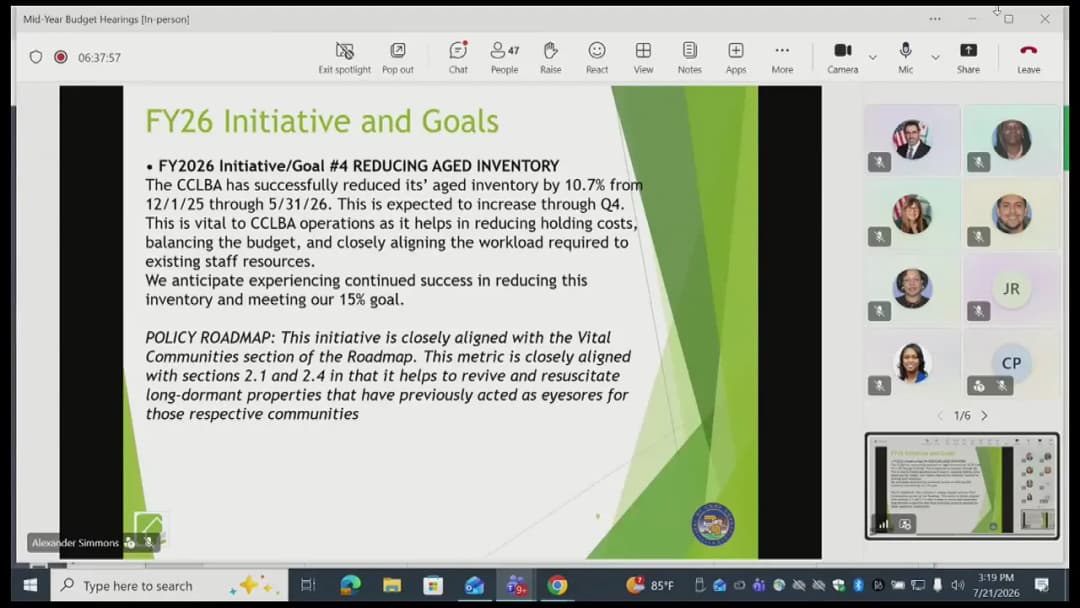
Jessica, Executive Director of the Cook County Land Bank Authority (CCLBA), presented the fiscal year 2026 mid-year budget to the Cook County Board Commissioners, joined by Daniel Taylor (Manager of Finance and Business Operations) and Alex Simmons (Senior Planning Analyst). The presentation covered revenues, expenditures, initiatives, and challenges, followed by questions and comments from commissioners. Discussion Items - Revenue Overview: As of May 31, 2026, CCLBA generated $4 million against a $7 million annual target (57% of goal), with a positive variance of $887,000. Revenue is ahead of projection due to increased sales and reduced departmental expenditures. Revenue sources include property sales (primary driver), land banking agreements, and municipal transactions with Calumet City, Chicago, Dalton, and Madison, plus a land banking agreement with the CTA Red Line. - Expenditures: Overall on pace in all categories. Personnel had a 20% variance due to four unfilled positions (currently being posted). Operations and maintenance showed lower spending due to seasonal billing cycles (invoices one month behind), but expected to meet projections by November 30, 2026. The contingencies and special purpose line included a $650,000 department spend and a $3.5 million credit appropriation transfer from Budget and Finance, resulting in a net credit of $2.8 million. No ARPA funds were used. - Homeownership and Community Wealth: 89% of properties sold this fiscal year went to homeownership, the core mission. Since inception, CCLBA has generated $309 million in community wealth (difference between acquisition cost and post-rehab market value). This aligns with the county's policy roadmap for vital communities. - Acquisitions and Inventory: 256 parcels acquired this fiscal year (51% of original 500 goal), but acquisitions are expected to slow due to higher redemptions; full-year projection is 400 parcels. The aging inventory was reduced by 10.7% from December 2025 to May 2026. CCLBA typically requests 3,000 certificates annually to achieve a net inventory of 600. - Staffing: 21 active employees with four vacancies; three additional asset managers are sought. The county allocated six new positions last year to support scaling. - Challenges: Tyler Technologies system issues are causing delays in processing refunds and exemptions, with $1 million owed to CCLBA from the treasurer and assessor. Commissioner Gaynor highlighted the need to process 3,000 properties per year to sustain operations. - Grants: CCLBA applied for $750,000 from IHDA's Strong Communities Program (Round 3) for demolition of properties beyond repair. They were previously awarded $562,000. Only technical assistance grants for brownfield remediation have been identified so far. - Enforcement and Sales Process: CCLBA uses a $20,000 mortgage clause to ensure buyers complete rehabilitation within 12-18 months. Asset managers inspect for permits before release. Time to market is approximately 60 days after acquisition, with an additional three months to contract and three months to close. The process includes monthly application reviews and title/water certificate checks. - Partnerships: CCLBA works with municipalities (e.g., Dalton with 400 delinquent properties, Calumet City on an industrial property, Madison on mall parcels) and transfers properties to the South Suburban Land Bank for profit sharing. Nonprofits are prioritized via land banking agreements. - Budget and Funding: The total operating budget is approximately $14 million. CCLBA receives $3.5 million annually from the county, with the remainder from revenue (highest was $9.6 million in FY2025). Commissioner Gaynor noted that most land banks nationally receive a portion of tax increment, which CCLBA does not, and that the $3.5 million is a fraction of the taxes generated by CCLBA (approximately $720,000 in current budget). Key Outcomes - No formal votes were taken; the presentation was informational and advisory. - Commissioners expressed strong support and gratitude for CCLBA's work, particularly in homeownership, community wealth, and partnerships. Commissioner Lower thanked Jessica for assisting the Black Fire Brigade in housing for youth. Commissioner Moore requested data on total properties returned to productive use (2,505 to date) and tax value increases ($38 million in taxes generated, plus $37.5 million from redemptions due to take notices). - Commissioner Basquez highlighted successful enforcement against a non-compliant buyer and thanked Kevin Garvey for assistance. Commissioner Chavez asked about partnerships for maintenance and inventory returns to municipalities. - Concerns were raised about Tyler Technologies delays and the need for a solution to keep land bank operations moving. Chairman Daly noted the county is working with all agencies to resolve the issue. - Jessica indicated that CCLBA is scaling developers from small rehabs to new construction, with 65% of inventory now vacant land. Additional resources, especially for preservation services ($6 million annually to maintain 2,000 properties), would allow further impact. - The meeting concluded with no further questions.
AFFORDABLE HOUSING 29% · COMMUNITY ENGAGEMENT 25% · BUDGET EQUITY ANALYSIS 24% · PROPERTY MANAGEMENT 22%
OPENPUBLICA · PUBLIC MEETING INDEXUPDATED DAILY · openpublica.com