Browse by city
Date range
Search help

Search titles, summaries, topics and stored transcripts together. Keywords may match separately; put the whole query in double quotes for a phrase. Matching follows word analysis, so punctuation is not exact. Both dates are included. Documents are not searched.

SHOWING 11–20 ENTRIES
11
AUG 18, 2026 · DAVIS, CALIFORNIA · CITY COUNCIL & PLANNING COMMISSION
Davis City Council Meeting – August 18, 2026: Outdoor Dining, ADUs, Public Comments

The Davis City Council met on August 18, 2026, at 6:30 PM in Community Chambers. The meeting included a consent calendar with routine approvals, two public hearings on the Downtown Outdoor Dining Program and Accessory Dwelling Unit (ADU) ordinance amendments, and a long-range calendar discussion. Councilmembers attending in person and one remotely. Several public comments addressed license plate readers, a removed memorial, the respite center, batting cage fees, and homelessness policies. Consent Calendar - Approved the consent calendar unanimously (5-0) after City Manager Dunstan corrected the local match amount for Item 4D (SS4A Grant) from $160,000 to $130,000, with a city portion not to exceed $25,000. - Councilmember Chapman commended the Civic Gym Facility License Agreement (Item 4C) with Five Starz Volleyball Club, noting the gym has been closed since 2019. - Vice Mayor Partida questioned whether Police Accountability Commission workplan additions (Item 4J) requiring staff time should come to council; Assistant City Manager Gryczko explained it was for cross-commission coordination. Council supported bringing such items to consent for awareness. Public Comments & Testimony - Zachariah Oquenda (PAC member) announced a September 10 event on immigration enforcement and law enforcement relationships. - Respite Center neighbor requested updates on the respite center’s future, stating it was promised closure but remains open without clear communication. - William Copper, Evelyn, Alan Miller, Arden Ambrose Winters, Bob Reese, Johan The Under Norda, and others opposed the Motorola license plate reader (ALPR) system, citing privacy, Fourth Amendment concerns, risk of ICE access, and the Supreme Court’s SHAT Tree decision. Several urged reconsideration of the council’s prior approval. - Holly Nolan, Dylan (Social Services Commissioner), Nico, Kathy Forkas, and others criticized the city’s removal of a memorial for two ICE victims (Lorenzo and Johan) from the Solidarity Wall within 24 hours, calling it inconsistent with past tolerance for other memorials and a free speech issue. - John Merritt and Arden Ambrose Winters objected to the price increase at Playfields Park batting cages from $1 to $15 per token (a 1400% increase), calling it unaffordable and a potential pretext to shut down the facility. - Nathan Hamill (speaking as a traveler) described multiple arrests for illegal camping, argued the camping ordinance violates his rights, and shared an experience of being tased by police. - Brandon Fleming (Dunloe Brewing) thanked staff for help with outdoor dining conversion but questioned the 25-foot height requirement for string lights across sidewalks. - Michael Harrington and others provided general comments; Harrington announced he is considering ballot initiatives for citywide elections and term limits. - Several speakers supported item 4J, including Sahara Taisio and Michael Cadrick Odyssey, who encouraged the PAC’s examination of homelessness and law enforcement. Discussion Items Item 5 – Downtown Outdoor Dining Program Ordinance Amendment - Assistant Planner Samantha Bailey presented amendments to extend the conversion deadline from July 1 to December 15, 2026, and clarify building permit, sidewalk clearance, and design standards. - Councilmembers discussed distinguishing state/federal requirements from discretionary local rules. Councilmember Chapman requested a chart for the next meeting. Councilmember Partida raised bike rack requirements. Mayor Neville suggested adding rationale for local rules. - Action: Council voted unanimously (5-0) to continue the item to September 1, 2026, with direction to provide a breakdown of mandatory vs. discretionary provisions and explore cost relief for businesses needing building permits. Item 6 – 2026 Accessory Dwelling Unit Ordinance Amendment - Community Development Director Sherri Metzger explained the annual update aligns with state law, which preempts most local standards. Key changes include prohibition on short-term rentals (discretionary) and clarification that no local standard may preclude an 800-square-foot ADU. - Councilmember Vaitla opposed short-term rentals for ADUs, favoring long-term housing. Councilmember Deos asked about enforcement and existing restrictions. Councilmember Partida supported retaining the 30-day minimum rental prohibition. - Councilmember Deos noted confusing language in the 5-foot setback exception for 800-square-foot ADUs; staff agreed to clarify the wording. - Action: Council voted unanimously (5-0) to introduce and conduct the first reading of the ordinance, including the short-term rental prohibition. Item 7 – Long Range Calendar - City Manager Dunstan announced: outdoor dining item moved to September 1; animal services JPA update possibly moved to September 15; his annual evaluation scheduled for September 15 or later; and an economic development update moved to October 6 due to Councilmember Deos’ absence on October 20. - Mayor Neville noted upcoming SB 580 requirements on immigration enforcement policies need to be calendared. - Public comment: Alan Miller requested an item to scrub MAPP report servers; Michael Harrington stated he is drafting initiatives for citywide elections and term limits. Key Outcomes - Consent Calendar: Approved 5-0 with corrections to Item 4D. - Downtown Outdoor Dining Program: Continued to September 1, 2026, for further clarification and cost relief options. - ADU Ordinance Amendment: Introduced and approved on first reading 5-0, including prohibition on short-term rentals. - City Manager Evaluation: Scheduled for September 15 closed session or later. - Animal Services JPA: Update expected at September 15 meeting if needed. - Economic Development Update: Moved to October 6. - SB 580 Compliance: Will be placed on a future agenda. - The meeting adjourned in memory of Steve Streeter, former planning commissioner and community volunteer.

PROCEDURAL 19% · AFFORDABLE HOUSING 16% · PUBLIC ENGAGEMENT 14% · ENGINEERING AND INFRASTRUCTURE 9%
12
AUG 12, 2026 · DAVIS, CALIFORNIA · CITY COUNCIL & PLANNING COMMISSION
General Plan Committee Meeting on 2050 General Plan Update - August 12, 2026

The General Plan Committee (GPC) met on August 12, 2026, at 6:00 PM in Community Chambers to continue discussions from July 22, 2026, on the 2050 General Plan Update and Draft Preferred Land Use Alternative/Map. The meeting included a presentation on new materials—housing trends in Davis and at UC Davis, target population projections, and utility capacity—followed by public comments limited to those topics and committee deliberation on key questions. The committee voted to form a subcommittee to revise the vision statement and project outcomes, and agreed to agendize a presentation on open space and habitat element assessment for the next meeting. Consent Calendar - Item 3A – Meeting Administration and Procedures: Approved unanimously by motion. Public Comments & Testimony - Susan Rainier (licensed architect, 1999 resident): Expressed concern that the process is too developer-friendly; urged net-zero energy targets, protection of Measure J, no building on floodplains, preservation of conservation easements, planning transportation before major growth, and stronger requirement for UC Davis to house students. Called for removing Village Farms from the map and respecting voters’ two rejections. - Beth Fouracre (program director, Redwood Seed Scholars Program): Emphasized the need for protected bike lanes to serve people with disabilities, especially with e-bikes. - Alan Miller (Old East Davis resident): Opposed expansion of downtown east of the railroad tracks; expressed distrust of the planning process, stating that public input is often ignored. - Marjorie Longo (30-year resident, acting chair of North Central Wild Horse Neighborhood Association): Stated that the revised draft land use map erroneously shows low-density residential on a 13-acre conservation easement along Road 113; requested correction and reaffirmation that all conservation easements are permanent. Also concerned about the “Death Star” expansion north of 113 lacking green space and blocking wildlife corridor. - Ziv Lang (25-year resident): Opposed high density in existing neighborhoods; called for fixing transit first, stronger language to pressure UC Davis to build 50% on-campus housing, and preservation of Measure J/RD. - Ningwan (long-term resident, former HRMC liaison): Noted that downtown is a designated historic district requiring state approval for changes; questioned the need for expansion due to population stagnation; expressed concern about AI and women’s rights; opposed taking farmland; asked to keep Rancho Yolo area unchanged. - Elizabeth Fosanski (Rancho Yolo resident): Requested a commitment to 100% renewable energy in the plan. - Mary Ann Hernandez (resident off Pole Line): Urged removal of Village Farms from the map, keeping Measure J/RD intact, and requiring UC Davis to house more students. - Rena Nyer (resident): Asked for clearer advance focus; stated Village Farms should be removed after two voter rejections; requested that conservation easements be shown on map and clearly off-limits; expressed concern about an urban limit line implying growth priority; opposed a fixed growth target; supported on-campus housing but not annexation with UCD. - Elizabeth Ray (since 1976): Opposed development near old dump, above Channel A, and near vernal pools; called for traditional apartments for workers, free electric bus service every 15 minutes to campus; warned against building on floodplains; urged keeping Measure J/RD to counter outside money influence. - Dr. Glenn Holstein (environmental scientist, director of Tuliomi conservation group): Spoke for democracy; appalled that Village Farms remains on the map after two voter rejections; urged removal. - Brad Sutton (City of Davis resident): Stated conservation easements are in perpetuity (Civil Code 815.2) and needed for flood control; requested general plan explicitly preserve all easements and reject any exchange or extinguishment; asked to remove Village Farms. - Eileen Samets (former planning commissioner, coordinator of Citizens for Responsible Planning): Opposed major overhaul of current general plan; urged no amendment to Measure J/RD; requested urban limit line drop to Channel A; no building on large FEMA floodplains or conservation easements; stronger language for UC Davis to build 50% on-campus housing. - Jeffrey Stalnick (vice chair of Davis Senior Citizens Commission): Noted Measure V lost by 276 votes; claimed the “no” campaign was funded by a group of mostly white male homeowners over 60 with average home price over $1 million; supported infill development. Discussion Items - Presentation by Eric Yurkovich (Alta/Raimi + Associates): Presented housing trends: population and housing growth leveled off after 2000; from 2013-2020, 1,400 units permitted; UC Davis has built 6,200 beds since 2016 LRDP baseline, with remaining capacity of 2,800 beds; on-campus student housing increased from 29% to 42% (target 47-48%). Discussed three data sources for future housing projections: CA Dept of Finance (higher), SACOG (lower due to limited land), and RHNA trend (7,300 units beyond current 28,000). Staff recommends planning for 6,200 additional units beyond the 6th cycle RHNA of 2,075 units to meet future need. Wastewater treatment plant has capacity for about 8,000 additional units beyond already approved pipeline projects (including Village Farms and Willow Grove). Draft land use map unchanged from July 22; includes increased density downtown, along transit corridors, in neighborhood centers, and on faith-based/institutional lands; also includes areas outside city limits (Village Farms, Willow Grove, Disk project, northeast and north areas). Public comments and Planning Commission feedback summarized: remove Village Farms, protect ag easements, need transportation plan, focus density on transit corridors, require UC Davis housing. - Committee Discussion: Commissioners posed clarifying questions on timeline for mobility element, flexibility of commercial space requirements, housing unit projections, wastewater capacity specifics, flood control planning, and the need for integrated transportation and land use. Commissioner Husing emphasized planning for active mobility (protected bike lanes) to meet climate goals and improve affordability; linked transportation to social equity. Commissioner Greco advocated for comprehensive flood control planning, realigning Channel A away from Covell Boulevard, and considering west side development. Commissioner Brinkley (Open Space) recommended focusing on southward expansion (south of Willowbank) to avoid sensitive habitats in the north and to connect to Poodah Creek and Grasslands Park via bike/ped infrastructure. Commissioner Ringer (Social Services) stressed housing affordability, noting UC Davis employees commuting from outside (62% of 11,000 employees live outside Davis) and median home prices significantly higher than neighbors. Commissioner Ennis supported upzoning single-family areas (SB9 allows four units without rezoning) and mixed-use neighborhood centers with higher densities. Commissioner Moore (Climate & Environmental Justice) suggested a minimum percent commercial space aggregated over an area rather than per parcel; also noted unhoused populations congregate in floodplains and should be considered in flood control planning. Chair Brinkley proposed that the urban limit line be adjusted to include conserved lands in the sphere of influence, and recommended setting a formal housing unit target rather than a range. Key Outcomes - Subcommittee on Vision Statement: Motion by Commissioner Ennis, seconded, to create a subcommittee to revise the current vision statement and project outcomes into overarching design principles for the city. Vote: 5 in favor, 1 opposed (motion carried). - Agenda for Next Meeting: Commissioners agreed to agendize a formal presentation of the Open Space and Habitat Element Assessment (pending approval by the Open Space and Habitat Commission). - Staff Request: Staff (Dara Dungworth) asked each commissioner to report back to their respective home commissions to ensure the input given tonight reflects the full commission’s direction, with any additional feedback to be brought to the third GPC meeting in winter. - No Formal Resolutions: Staff deemed their notes and recording sufficient; no resolution or summary from this body was required at this stage.

AFFORDABLE HOUSING 28% · ENGINEERING AND INFRASTRUCTURE 13% · PUBLIC ENGAGEMENT 11% · PROCEDURAL 10%
13
JUL 22, 2026 · DAVIS, CALIFORNIA · CITY COUNCIL & PLANNING COMMISSION
Davis Planning Commission Meeting Summary – July 22, 2026

The City of Davis Planning Commission met on Wednesday, July 22, 2026, at 7:00 p.m. in Community Chambers, 23 Russell Boulevard. Four of seven commission members were present, and staff confirmed a quorum. The commission approved an amended agenda, deferred the consent item, received an informational General Plan Update, held a public hearing on an Accessory Dwelling Unit (ADU) ordinance amendment, and conducted a public workshop on a draft mobile vending ordinance. The meeting continued past 9:30 p.m. Consent Calendar - Item 5A, Commission Schedule Standardization, was removed from the consent calendar during agenda approval and moved to the next regular meeting. Staff noted that the next regular meeting would be September 9, 2026, and that no August Planning Commission meeting was currently scheduled, effectively creating an August recess. Public Comments & Testimony - Spear, a Davis resident, expressed support for street vendors and urged adoption of a positive, inclusive mobile vending ordinance, citing street vendors' community value, economic opportunities for seasonal workers and immigrants, and public safety benefits. - Matt Williams praised the first General Plan Committee session and urged that Fiscal Commission representatives participate in the General Plan Update process, citing $264.77 million in unfunded street-related liabilities and nearly $200 million in unfunded pension and retiree health care benefits. - Dave McLaughlin urged preserving the current General Plan, making no changes to Measure J or Measure D, restricting housing development to south of Channel A, prohibiting development in FEMA floodplains and conservation easements, and pressing UC Davis to provide student housing. - Ziv Lang, a 25-year Davis resident, opposed gutting the citizen-based General Plan, asked that the Village Farms site be removed from the preferred land use map, objected to development north of Channel A due to floodplain and toxics concerns, and urged UC Davis to commit to at least 50% on-campus housing. - Scott Davis opposed nullifying conservation easements and open-space commitments, saying the city's character and voter-approved protections were at risk. - John Cooper, speaking for the second time that day, urged preserving Measure J/R, removing Village Farms from the map, and encouraging UC Davis to provide more faculty and student housing. - Rena Nyer asked that the vision statement remain unchanged, that no growth targets be added to the General Plan, and that Measure J/R, historic neighborhoods, habitat restoration, and conservation easements be protected. She also noted that approved Nishi should be on the map while Village Farms should not. - Arch Island raised concerns about renewed efforts involving the Wild Horse Golf Course conservation easement and submitted an email thread on the matter. - Marjorie Longo, acting chair of the North Central Wild Horse Neighborhood Association, urged the commission to reject any swapping, consolidation, relocation, or extinguishment of conservation easements and asked when staff would respond to the July 1 land use subcommittee letter. - Karen Shaw, a Davis resident since 1986, cited the 1995 Wild Horse Neighborhood Development Agreement's requirement that the conservation easement preclude development of the golf course property and said the land use subcommittee's July 1 letter broke public trust. - Brad Sutton requested that the General Plan expressly preserve all conservation easements in perpetuity, citing flood-control, groundwater recharge, and greenway benefits along Channel A. - After the General Plan presentation, Matt Williams asked that the vision statement include an accountability element and suggested cross-laminated timber as a lower-carbon, lower-cost option for taller buildings. - Susan Rainier said showing Village Farms in its full footprint was disingenuous after voters rejected it, cited concerns about approximately 1,600 cars, gridlock, and the need for a transportation master plan, and said development should not guide the General Plan. - Jeff Merritt, an 11-year resident, asked the commission to respect voters, remove Village Farms, protect Measure J/R, preserve the citizen-based nature of the General Plan, push UC Davis to house its students, build already-approved projects first, and protect conservation easements. - Sam Lonese, a UC Davis student and Davis resident, supported citywide intensification, increased density in single-family zones, mixed-use expansion, southern annexation with transit planning, and policies that streamline housing production. - John Johnston called for measurable population, housing, and school-enrollment goals before finalizing the land use map, and said the plan should more clearly demonstrate how it would meet Davis's 2040 carbon-neutral goal, noting that about 74% of the city's CO2 emissions come from cars. - Eileen Samets, a former planning commissioner and coordinator of Citizens for Responsible Planning, said the current General Plan was an excellent citizen-based model that needed updating rather than a major overhaul, opposed amending Measure J/R, urged moving the urban limit line south of Channel A, and called for stronger UC Davis housing language. Discussion Items General Plan Update (Informational Item 6A) - The GPU consultant from Raimi + Associates/ALTA presented an abbreviated version of the presentation given earlier that day to the General Plan Committee. The presentation covered the vision statement, project outcomes, community outreach, spring land use concepts, feedback received, and a revised preferred land use map. - The revised map proposes downtown height and density increases and a modest expansion of the downtown boundary, housing opportunities on school, institutional, and faith-based sites, modest density increases in single-family neighborhoods, intensification along commercial centers and transit corridors, an adjusted urban limit line, and retention of existing open space and conservation easements. The map also kept previously proposed sites such as Village Farms on the map. - The consultant noted that upzoning alone does not guarantee construction because private developers must balance construction costs and feasibility. He also noted that ADU production and SB9 use in Davis and Yolo County have been limited. Future work will examine utility capacity, transportation, feasibility, and economic impacts. - Commissioner discussion included concern that revisiting the downtown form-based code could delay development; support for southern expansion with new road and infrastructure planning; requests for agricultural buffers; a suggestion to add the golf course and El Masero within the urban limit line; concern about the jobs/housing balance in the northwest area; and a statement that the draft land use map does not yet achieve a jobs/housing balance. - Commissioner McLaughlin responded to public criticism of the July 1 land use subcommittee letter, saying it was not intended as a threat to conservation easements and did not mention Wild Horse. He explained the subcommittee's planned analytical process and cited housing shortfalls, possible state enforcement, and the city's chronic budget shortfall. A motion asking staff to respond to the letter by August 31 was withdrawn after staff and the Community Development Director said a written response was already planned for the next regular meeting. - The commission did not take a formal action on the General Plan Update; it was informational. Commission consensus was that the map needs changes, with individual commissioners offering different specific recommendations. Public Hearing: Zoning Ordinance Amendment - 2026 ADU Ordinance (6B) - Staff proposed amendments to Chapter 40 to align the city's ADU and junior ADU regulations with current state law. The update covers definitions, permit processes, height and setback standards, design requirements, and sales/conveyance provisions. Staff noted that the non-ministerial ADU section would be considered later alongside future SB9 work. Staff stated the ordinance is exempt from CEQA. - No public comments were made on this item. - Commissioner discussion included support for the update, questions about SB9 lot splits, and a question about interaction with the downtown form-based code. One commissioner questioned a proposed requirement for privacy film on second-story ADU windows, and another commissioner urged exploring incentives for property owners who deed-restrict ADUs for low-income renters. - The commission passed a motion approving the resolution recommending City Council adoption of the ordinance amendment. After the vote, the commission made a separate recommendation that staff bring forward an ADU incentive program for deed-restricted low-income units. Public Workshop: Draft Proposed Mobile Vending Ordinance (6C) - Staff presented a preliminary draft ordinance to add mobile vending on private property to Chapter 40. The workshop was for feedback only; no action was requested. Staff said the mobile vending ordinance would later be combined with a separate sidewalk vending ordinance for public property and business-license updates. - Staff posed questions about location restrictions, co-location restrictions, permit caps, approved commissary location, and whether mobile vending should be allowed in mixed-use zones. - Public comment on this item included: Gustavo Landeros, a street vendor, urged that the ordinance be drafted with vendors, warned that some provisions he disagreed with may be illegal, recommended consulting a street-vending lawyer, and called for a welcoming, inclusive program such as a taco plaza modeled on Sacramento. Sam Lonese and Mariana opposed permit caps and gas-station restrictions, questioned the 500-foot school buffer, and supported allowing mobile vending in mixed-use zones. Another commenter said SB 946 prevents cities from banning sidewalk vendors to protect restaurants from competition, urged space for both vendors and brick-and-mortar businesses, and asked for Spanish-language outreach. - Commission discussion by question: - Location restrictions: one commissioner supported the 500-foot school buffer; another felt 500 feet may be too restrictive; another said restrictions need a health, safety, or welfare justification. Several commissioners opposed the farmers-market proximity restriction as protectionist and favored allowing vendors on vacant or underused private lots. - Co-location restrictions: commissioners generally supported no specific co-location bans beyond health and life-safety review, leaving the decision to private property owners. - Permit caps: commissioners generally opposed arbitrary caps. Some noted caps may be legally difficult to justify, while one commissioner expressed concern about unlimited pop-ups but had no proposed methodology. - Commissary location: commissioners generally opposed requiring the approved commissary to be located within Davis city limits. One commissioner called it an undue burden and suggested exploring inter-county inspection reciprocity. - Mixed-use zones: commissioners agreed mobile vending should be allowed in mixed-use zones. - Commissioners also raised prohibiting alcohol, tobacco, and cannabis sales. Staff noted the intent to keep mobile vending and sidewalk vending rules parallel. Long Range Calendar - The next regular Planning Commission meeting is anticipated for September 9, 2026. The deferred Commission Schedule Standardization item will be considered then, and staff will provide a written response to the July 1 land use subcommittee letter. - The next General Plan Committee meeting is scheduled for August 12, 2026, at 6:00 p.m. - Staff indicated a goal of bringing a more developed mobile vending ordinance back for commission consideration on September 9, 2026. - Potential future items include SB9 and SB6 ordinances, a historic resource management ordinance, and December historic resources training. Key Outcomes - Agenda approved as amended, with Item 5A moved to the September 9, 2026 meeting. - General Plan Update received as informational; no formal vote. Commissioner feedback will be reported back to the General Plan Committee. - ADU ordinance resolution approved by voice vote, recommending City Council adoption. - Commission recommended that staff bring back an ADU incentive program for deed-restricted low-income units. - Mobile vending workshop held with no formal action; commission feedback will inform a future ordinance draft. - Staff committed to publishing a written response to the July 1 land use subcommittee letter at the September 9, 2026 meeting.

AFFORDABLE HOUSING 21% · PROCEDURAL 13% · CANNABIS REGULATION 11% · MOBILE FOOD VENDING 11%
14
JUL 22, 2026 · DAVIS, CALIFORNIA · CITY COUNCIL & PLANNING COMMISSION
Davis General Plan Committee Special Meeting on 2050 General Plan Land Use Map, July 22, 2026

The General Plan Committee (GPC) held its first special meeting on July 22, 2026, at 3:00 p.m. in Community Chambers, 23 Russell Boulevard, Davis. Agenda items included election of a chair, approval of the consent calendar, and the first presentation of the draft preferred land use alternative/map for the 2050 General Plan update. The committee heard extensive public comment, but did not complete the planned commissioner round-robin discussion; several data requests and a proposal for a vision-statement subcommittee were carried forward to a follow-up meeting. Consent Calendar - Approved Meeting Administration and Procedures by one unanimous motion; no commissioner requested removal of the item. Public Comments & Testimony - Chair Catherine Brinkley noted roughly 50 people in the audience, and public speakers were limited to three minutes. - Ningwan, a former Historical Resources Management Commission member, asked the committee to weigh major changes to downtown Davis carefully because downtown is a historic resource and is close to her family's history. - Susan Rainier said Village Farms should be fundamentally redesigned or removed rather than embedded in the general plan, urged a transportation master plan covering roads, transit, bicycle and pedestrian circulation, emergency access and future mobility, and said projects should conform to the general plan rather than the general plan conforming to projects. - Jim Flanagan said any future development and the urban limit line should stay below Channel A to avoid flood hazards, defended Measure J/RD, called on UC Davis to build far more on-campus housing, and criticized the survey as voluntary, non-representative, and open to non-residents. - Nikki Bameron, a Nextdoor moderator, expressed concern about the community's division after the Measure V debate, worried that the same proposal appeared on the draft map after a narrow defeat, and asked how the process would heal divisions; she said she had not seen community meeting outreach on Nextdoor. - Tim Keller of the Davis Citizens Planning Group urged the committee to be bold, argued the draft lacked a transit-first plan and a compelling vision, and said transit and density are mutually reinforcing. - Richard McCann of the Davis Citizens Planning Group endorsed transit-first comments, said transit corridors were not actually shown on the map, and said the prospect of separate Measure J/RD votes along East Covell would require a comprehensive approach. - Matt Williams said the presentation jumped to solutions before defining the problem, cited $264 million in unfunded capital infrastructure repair and replacement liability and 10 studies showing housing costs the city more than it generates in revenue, and said the vision statement lacked a measurable vision. - John Cooper objected to Village Farms remaining on the map after voters rejected it and asked the city to encourage UC Davis to build more student and staff housing. - Marjorie Longo, acting chair of the North Central Wild Horse Neighborhood Association, said conservation easements are not fungible and raised alarm about a planning commission land use subcommittee letter discussing consolidating or swapping open space and agricultural easements; she opposed weakening the Wild Horse Golf Course or North Davis Farms conservation easements. - Jeff Merritt asked to remove Village Farms from the map, said any future version would need to be smaller, below Channel A, outside flood zones, protective of vernal pools, and reasonable in scale; he also called for UC Davis to house substantially more students on campus, warned against converting family neighborhoods into informal dormitories, and supported density in downtown and walkable commercial areas while noting the approved Nishi project should be built. - Victoria Link supported preserving existing open space and adding new open space, said Wild Horse residents feel surrounded by development pressure on all sides, and urged traffic mitigation and grade-separated crossings for schoolchildren before conditions worsen. - Julie Silva, a senior center volunteer, opposed large borrow pits next to homes, citing drowning, mosquito, and public health risks, and said such pits should be kept far from residential areas and water channels. - Sam Onise, a UC Davis student and Davis resident, said the proposed single-family density increase from 5.99 to 7.5 dwelling units per acre should go significantly further, called for broader upzoning, and supported southeast annexation because much of the land north of the city is in a floodplain. - Rena Neyer said the general plan process should be citizen-driven and accessible, cited a consultant report in which 62% of respondents questioned the urban limit line as drawn, defended Measure J/RD, urged UC Davis to build more on-campus housing, said Village Farms should be removed after Measure V and Measure X defeats, and said any urban limit line should be below Channel A. - Eileen Sammits, former planning commissioner and coordinator of Citizens for Responsible Planning, said the existing general plan is an exemplary citizen-based document created by more than 100 volunteers on 15 committees at a cost of about $1 million and needs updating rather than overhaul; opposed weakening Measure J/RD; urged moving the urban limit line south of Channel A to avoid landfill toxins and FEMA flood hazards; opposed building on large floodplains and conservation easements; and called for much stronger UC Davis on-campus housing requirements, noting UCD is among the few UC campuses not committed to 50% on-campus housing. - Fred Bouderi said existing neighborhood shopping centers should not be allowed to drop required commercial space to make housing easier to build, because removing neighborhood-serving commercial space would increase car trips and work against sustainability. - Zachariah Okenda supported upzoning lower-density residential areas, said SB9 provisions could become useful over time, supported considering expansion below Montgomery in South Davis, and urged the plan to explicitly address where shelters and services for unhoused residents can be located. - Russ Allen Slee said Measure J/RD should be left alone, the general plan should respect voters, UC Davis should build housing on its own land, and conservation commitments should be lasting promises. - Steve Chapman said the supporting materials appeared to treat conservation easements as fungible and asked that the committee remove that idea from the process. Presentation: 2050 General Plan Update and Draft Preferred Land Use Alternative/Map - Eric Yurkovich of Raimi + Associates presented with Community Development Director Sherri Metzger and Principal Planner Dara Dungworth. He explained that the General Plan Committee is an ad hoc body that will meet at key milestones, about eight times across the process, and that commissioners are asked to report back to their respective commissions. - The draft vision statement is: Davis advances safe, fair, affordable, healthy, and sustainable neighborhoods where everyone has what they need to thrive and succeed. Project outcomes include a broad range of housing types, active mobility and social gathering spaces, parks and biodiversity, places for businesses, multimodal connectivity, fiscal sustainability, and climate readiness. - Earlier engagement included Commission Palooza 2 on April 13, a community workshop on April 30, an online survey, and piggyback meetings in May and June. Three land use concepts were tested: a concentrated high-intensity option, a dispersed lower-intensity option, and an employment-focused option, plus options for growth outside city limits including an urban limit line, open space preservation, and possible annexation of El Macero and Old Willowbank. - Feedback showed strong support for a vibrant, walkable, mixed-use downtown; support for more housing in more places; support for neighborhood centers and transit corridors with varying density; strong support for neighborhood-serving retail, small offices, and health care; less support for hotels, industrial, and large offices; and mixed views on the urban limit line. - The draft preferred map recommends incremental downtown changes and expansion to West Olive Drive and several parcels east of downtown; identifies faith-based and institutional sites for streamlined higher-density housing; modestly increases density in lower-density single-family neighborhoods; designates medium-density mixed-use centers at locations such as Davis Manor, Westlake Plaza, and The Courtyard; increases employment densities along the I-80 frontage and in South Davis; adjusts the urban limit line in the northeast; removes El Macero and Old Willowbank from the southern alignment; maintains open-space easements; and keeps existing projects such as Village Farms, Willow Grove, and DISC in the mix while considering land use changes along the 113 corridor and Covell Boulevard. The consultant stressed the map is not final. - The consultant noted the city has received no SB9 applications since the law took effect, and Yolo County also has none per HCD databases. Rough-cut projections in the staff report estimated 8,000 to 9,000 housing units within the city through the revised map and other pipeline sources, with a caveat that HCD may not accept all of those as housing sites in the near term. - Remaining technical work includes flood zone impacts, utility capacity, traffic analysis, economic benefits, housing feasibility, and additional community and commission engagement in the fall. The same presentation was scheduled for the Planning Commission later that evening. Commission Discussion & Clarifying Questions - Staff confirmed that California law requires cities to maintain and periodically update general plans, and that HCD is scrutinizing local ballot measures that may limit housing production. - Commissioner Chris Ringer cited data from a recent town-gown discussion showing UC Davis on-campus housing rose from 29% of students in 2016 to 42% now, and requested comparable city housing production data to ground future discussion. - Several commissioners emphasized that land use and mobility planning must be developed together. The consultant said mobility networks are being worked on in tandem but were intentionally not released with this land use draft; a broader land use and transportation discussion is planned for the fall. - Commissioner Steve Greco asked why expansion west of Stonegate and south of Willowbank were not included. Staff and consultants explained that areas west of 113 have severe floodplain constraints, and the South Davis area is small, constrained by the county line, difficult to access without adding traffic to Mace Boulevard, and would require boundary adjustments and a resident vote. - Commissioners raised concerns about utility and wastewater capacity as a potential urban service area issue. Staff said wastewater treatment capacity is limited and expansion could cost $60 million to $80 million, so capacity must be understood before further land use planning. - The Open Space and Habitat Commission is completing an open space and habitat priorities assessment and map that will be brought into the committee process. - Commissioners requested the exact SACOG/state target population number the plan is planning for, more time with the community engagement feedback, and integrated mobility information. - A commissioner proposed forming a subcommittee to turn the draft vision statement into a more ambitious statement beginning with By 2050, Davis will...; staff responded affirmatively, with details to be determined. Key Outcomes - Catherine Brinkley was elected chair at the start of the meeting. - The consent calendar was approved unanimously. - No formal commission recommendation on the draft preferred land use map was adopted; the four consultant questions remain open for a future meeting. - City staff said they will ask the City Council whether Village Farms should remain under study after voters rejected the project at the ballot. - Commissioners requested, and staff and consultants agreed to compile: UC Davis on-campus housing data and city housing production figures; the SACOG/state target population number; utility and wastewater capacity information related to urban service areas; integrated land use and mobility materials; and further clarification of urban limit line choices in West Davis and South Davis. - Staff responded affirmatively to a proposal to workshop a stronger vision statement in a subcommittee. - The next meeting was scheduled for August 12, 2026, at 6:00 p.m. Staff said future GPC meetings will be evening meetings on Wednesdays when the Planning Commission is not meeting, and the procedures will be amended to adjust the prior time limit. The committee used the option to continue past the scheduled 5:00 p.m. hard stop and adjourned about 10 minutes over.

AFFORDABLE HOUSING 27% · COMMUNITY ENGAGEMENT 18% · PROCEDURAL 17% · TRANSPORTATION SAFETY 9%
15
JUL 8, 2026 · DAVIS, CALIFORNIA · CITY COUNCIL & PLANNING COMMISSION
Davis Planning Commission Meeting - July 8, 2026: Outdoor Dining Ordinance Amendments and General Plan Update

The Davis Planning Commission met on Wednesday, July 8, 2026, at 7:00 p.m. in Community Chambers. The meeting included a public hearing on proposed updates to the Downtown Outdoor Dining Program ordinance, an informational update on the General Plan Update, and announcements regarding staff transitions and upcoming meeting schedules. Public Comments & Testimony - Non-Agenda Public Comment: A speaker identifying as Nun made several statements regarding a Chinese empire fund, allegations against a council member, and concerns about construction on Russell Street and G Street. The remarks were not directly related to agenda items. - Comment on Item 5A: A speaker named Cement, who identified as an assistant planner, expressed concerns that outdoor dining parklets remove parking spaces, potentially harming downtown business. They urged the commission to consider parking impacts. Discussion Items - Item 5A: Public Hearing – Downtown Outdoor Dining Program Amendments Assistant Planner Samantha Bailey presented proposed amendments to Chapter 40 of the Davis Municipal Code. The amendments aim to clarify definitions, design standards, application and conversion processes, and extend the conversion deadline for existing outdoor dining areas to December 15, 2026. Staff noted that approximately 15 downtown restaurants need conversion, with three on G Street already operating under the program. Commissioners asked about building permit requirements, processing timelines, design guidelines, and license fees. Vice Chair Brinkley requested a clarification on "exclusive private use" language. The commission unanimously voted to recommend approval of the ordinance amendments as written. - Item 5B: General Plan Update Informational Update Principal Planner Dara Dungworth provided an update on outreach efforts, including the launch of the "Hello Davis" e-newsletter and the formation of the General Plan Committee (first meeting July 22, 2026). Commissioner Vince McLaughlin presented a letter from the Land Use Subcommittee (McLaughlin and Rowe) requesting five maps for the General Plan: open space designations, income-generating properties, annexation opportunities, and others. Discussion focused on the subcommittee's scope, the need for broader public outreach, and the use of GIS tools. No formal action was taken on the informational item. Key Outcomes - Motion on Item 5A: Commissioner McLaughlin moved to recommend approval of the Downtown Outdoor Dining Program ordinance amendments as presented. Commissioner Valencia seconded. The motion passed unanimously. - Staff Direction: Staff will prepare a response to Commissioner McLaughlin’s map requests for the September meeting. The commission discussed improving public awareness of the General Plan Update through targeted email launches and social media. - Schedule Changes: The commission will consider a permanent start time change to 6:00 p.m. and a formal recess aligning with City Council beginning in 2027, with details to be presented at the July 22 meeting.

GENERAL PLAN UPDATE 19% · MOBILE FOOD VENDING 17% · PROCEDURAL 16% · PUBLIC ENGAGEMENT 12%
16
JUL 7, 2026 · DAVIS, CALIFORNIA · CITY COUNCIL & PLANNING COMMISSION
Davis City Council Meeting July 7, 2026: Transit Proclamation, General Plan, Downtown Financing

The Davis City Council held a regular meeting on Tuesday, July 7, 2026, starting at 6:30 p.m. in Community Chambers. The meeting featured a ceremonial proclamation for the 55th anniversary of Davis Community Transit, a lengthy consent calendar, and three major discussion items: the General Plan Update, the Downtown Public Realm Financing Plan, and a 90-day check-in on the Economic Development Strategic Plan. Council also streamlined its long-range calendar and adopted the 2026-2027 meeting schedule. Council Member Chapman was absent. Consent Calendar - Community Park Restroom Site Improvements (Item 4A): Awarded contract to F. Loduca Co. Councilmember Bapu Vaitla disclosed his home is within 500–1,000 feet of the project but stated no disqualifying conflict of interest. - Lumberyard Project Improvement Agreement (Item 4C): Approved resolution for improvements at 500–512 G Street. Councilmember Vaitla noted the item was not project approval but an improvement agreement, and that state law prohibits the city from mandating on-site parking. - Palomino Place Final Map (Item 4D): Approved final map for subdivision improvement agreement. - Davis Community Meals and Housing Fee Payment Agreement (Item 4F): Approved loan agreement for Paul’s Place (1111 H Street). - Measure V Election Results (Item 4M): Approved resolution declaring results of the June 2, 2026 Special Municipal Election—Measure V (Village Farms Davis) was defeated. - Wages for Unrepresented Executive Management (Item 4L): Approved resolution for wages/benefits. City Manager Dunston read salary details: 2.5% COLA for most executives; Police Chief received 2.2% increase; new Assistant Public Works Director salary range $164,560–$200,002; Public Works Director salary range reset to $189,245–$230,028. - All other consent items (Items 4B, 4E, 4G–4K, 4N–4R, 4S): Approved en bloc. Public Comments & Testimony - General Public Comment (Item 3): Multiple speakers addressed non-agenda topics. A resident expressed frustration over delays in addressing the L Street “drug haven” and the respite center. A speaker criticized Vice Mayor Partida over Pride displays and alleged transgender medical harm to minors. Another speaker complained the city did not recognize the 250th anniversary of U.S. independence. One speaker urged the city to designate construction job sites as points of sale for use tax collection. A speaker supported infill over sprawl after Measure V’s defeat. A remote speaker reported stolen cargo bikes found near the respite center, alleging felony theft there. - Consent Calendar Public Comment: Commenters spoke on items 4A (restroom—urged sex-segregated signs), 4K/L (wages—questioned taxpayer value), 4M (Measure V—criticized rushed ballot), and 4O/P/Q (paid parking—opposed, saying they would shop elsewhere). A speaker from the forming Community Navigators Labor Union criticized the city for reducing respite center staff from eight case managers to two, claiming it would increase homelessness and enforcement costs. - General Plan Update (Item 5): Speakers asked about staff reports, flooding, and offered alternative growth scenarios. The Davis Citizens Planning Group requested to present its scenario at upcoming meetings. - Downtown Public Realm Financing Plan (Item 6): A speaker from Davis Downtown Business Association expressed appreciation for the process and optimism. - Economic Development Strategic Plan (Item 7): A speaker thanked staff for efforts. - Long Range Calendar (Item 8): A speaker urged better downtown lighting and personal safety assessments after dark. Discussion Items - General Plan Update (Item 5): Community Development Director Sherri Metzker presented the status. The city has completed community visioning, is developing draft land use concepts, and has held workshops with 200 attendees. Key challenges include VMT reduction, floodplain mapping (currently modeled, not engineered, especially north of Covell and east of I-113), and utility capacity. Council members expressed a desire for more frequent check-ins, discussion of population targets, and a clearer visioning process. Council agreed to reconstitute a two-member subcommittee for more touchpoints. No vote was taken. - Downtown Public Realm Financing Plan (Item 6): Economic Development Director Katie Yancey and consultant Rachel Brown presented. The Downtown Specific Plan identified 28 infrastructure projects totaling $52 million (2022), with a 40%/60% cost split between existing and new development. A preliminary gap analysis shows a potential $8–$12 million shortfall. Rachel Brown recommended exploring an Enhanced Infrastructure Financing District (EIFD) as a tool to capture tax increment from new development, but emphasized it would be the last funding layer after impact fees, grants, and other sources. Council members were divided—some saw potential, others doubted sufficient growth to justify the tool. No action was taken; staff will continue analysis. - Economic Development Strategic Plan Update (Item 7): Director Yancey reported 90-day progress: retained one business looking to relocate, attracted two qualified locates representing 75 jobs, attended two regional events, and noted one metric modification (outdoor dining program conversion deadline). Councilmember Deos requested specific metrics and stories. Councilmember Vaitla urged faster development of an economic branding/vision. Council passed a motion (4-0) to prioritize branding/vision work to 2026 instead of 2027. - Check-in on Long Range Calendar & Meeting Schedule (Item 8): City Manager presented a streamlined long-range calendar with six items to remain, many to be removed (with staff memos), and three needing direction: vacancy tax analysis (moved to economic development updates, including fee vs. tax options), lighting assessment (staff will create inventory and consult police chief on crime correlation), and greenfields electrification ordinance (kept in queue). Council approved the 2026-2027 meeting schedule resolution, maintaining summer recess (one July meeting, off until third Tuesday in August) and adjusting November/January meetings due to holidays. Key Outcomes - Consent Calendar approved (motion by Deos, second by Vaitla, 4-0). - General Plan Update: No action, but council will reconstitute a two-member subcommittee for more frequent input. - Downtown Public Realm Financing Plan: No action; staff will continue analysis. - Economic Development Strategic Plan: Council directed staff to prioritize economic branding/vision development for 2026 (motion by Vaitla, second by Deos, passed 4-0). - Long Range Calendar and Meeting Schedule: Resolution adopting the 2026-2027 meeting schedule approved (motion by Deos, second by Partida, 4-0). Staff will provide memos on lighting inventory and vacancy analysis. Greenfields electrification ordinance remains on calendar.

ECONOMIC DEVELOPMENT 25% · PUBLIC ENGAGEMENT 14% · ZONING REGULATION 13% · COMMUNITY ENGAGEMENT 12%
17
JUN 24, 2026 · DAVIS, CALIFORNIA · CITY COUNCIL & PLANNING COMMISSION
Davis Planning Commission Meeting - June 24, 2026: GPU Scenarios, CUP Approval, and Meeting Frequency Debate

The Davis Planning Commission met on Wednesday, June 24, 2026, at 7:00 PM in Community Chambers. The agenda included a public hearing for a conditional use permit, a student presentation on General Plan Update scenarios, an informational update on the GPU process, and a proposal to hold monthly GPU update meetings. The commission voted 4-3 against advancing the monthly meeting proposal to the City Council. Consent Calendar - Approved the minutes from the April 8 and April 22, 2026 Planning Commission meetings. Public Comments & Testimony - Chad Paglisi (UC Davis student) raised a concern about transit access: improving the right‑of‑way at 8th and 3rd Streets to allow shuttle or bus turnarounds downtown. - Matt Williams (public comment on GPU) emphasized that the community needs a clear vision statement and flagged a jobs‑housing imbalance (two housing units per job in the SACOG blueprint) and a $500 million unfunded liability. - Mary Jo Bryan urged the commission to incorporate outreach reports from the League of Women Voters and Davis Community Action Network into the GPU process. - Connor Gorman supported a vacancy tax for commercial properties, noting the Whole Foods building as a prime example. - Sadaf Sinambari (CRD graduate) called for greater collaboration between the city, local organizations, and student classes to produce a comprehensive general plan. - Chris Granger (Cool Davis executive director) praised the student presentation and recommended including measurable metrics in the GPU. - Sam O'Neese (UC Davis student) supported more public engagement opportunities, especially for students during summer. - Multiple speakers (including John Johnson, Gonzales Etoff) provided comments on the student presentation, addressing annexation, paid parking, and the need for coordination between city goals and the Climate Action Plan. Discussion Items A. Public Hearing: Mancini’s Sleepworld Conditional Use Permit (CUP 03-26) - Staff recommended approving the CUP for a mattress store at 4525 Fermi Place, in a PD 4-88 Light Industrial/Business Park zone where retail commercial is a conditional use. No exterior alterations planned; interior demolition only. - The commission affirmed the zoning interpretation and unanimously approved the resolution. Motion passed without opposition. B. UC Davis Class Presentation on GPU Scenarios - Students from CRD 152 (taught by Commissioner Brinkley) presented their final project for Davis 2050. Key proposals included: annexing campus to give students voting rights, building 8,500 housing units by 2050 (16% above RHNA baseline), 20% reduction in car trips, form‑based codes, a parking benefit district, a regenerative economic zone, paid internships ($500,000/year), and a student liaison commission with voting seats. The class did not conduct formal community outreach but surveyed class members. - Commissioners and public engaged in a lengthy Q&A. Topics included annexation mechanics (campus spans Yolo and Solano counties), the impact of floodplains on development, balancing regulatory burdens for businesses, and the feasibility of paid internships given the city’s $2.5 million deficit. C. General Plan Update (GPU) Informational Item - Principal Planner Dara Dungworth reported on engagement activities (Palooza 2, workshop 2, surveys, stakeholder meetings). She committed to providing monthly written updates and passing student feedback to the consultant team. - Commissioners and public offered criticism: the second workshop jumped to solutions without defining problems; the land‑use alternatives did not meet the RHNA baseline of 7,300 units; iterative feedback was missing; and meeting dates were not announced at least one month in advance. Staff promised to coordinate with the communications team and improve outreach. D. Commission‑Initiated Task Proposal – Monthly GPU Meeting Meetings - Commissioner Brinkley proposed that the Planning Commission meet at least once a month to hold a standing GPU agenda item, to enhance transparency and public input. The proposal was debated. - Supporters (Weiss, McLaughlin, Valencia/Fulp‑Cooke, Brinkley) argued that more meetings would increase community engagement, allow iterative feedback, and fulfill the commission’s role in a major update. - Opponents (Rowe, Troost, Bennett) cited staff time, the City Council’s desire to expedite the process, and the existing public outreach program as sufficient. They noted the upcoming General Plan Committee (with three commissioners) would handle GPU oversight. - The vote was 4‑3 against sending the proposal to the City Council. Key Outcomes - Approved the Mancini’s Sleepworld Conditional Use Permit (unanimous). - Not approved the proposal to hold monthly GPU update meetings (4‑3 vote). - Staff committed to periodic written GPU updates and to sharing student feedback with the consultant team. - Land‑Use Concepts Committee (Commissioners Rowe and McLaughlin) will begin reporting regularly to the full commission about their work. - July 8 and July 22 meetings will feature: a downtown outdoor dining ordinance (July 8), ADU and mobile vending ordinance amendments (July 22). The July 8 meeting may lack quorum; an email poll will be sent to schedule summer meetings.

GENERAL PLAN UPDATE 31% · COMMUNITY ENGAGEMENT 20% · PROCEDURAL 11% · ZONING REGULATION 7%
18
JUN 16, 2026 · DAVIS, CALIFORNIA · CITY COUNCIL & PLANNING COMMISSION
Davis City Council Meeting - June 16, 2026: Parking Ordinance, Budget Forecast, and Youth Summit

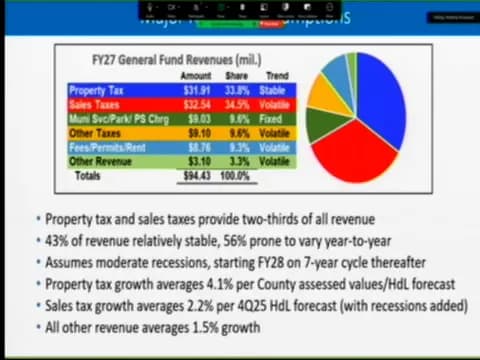
The Davis City Council met on June 16, 2026, at 6:30 PM in Community Chambers. The meeting included public comments, a presentation on the Youth Empowerment Summit, a public hearing on metered parking changes for downtown lots, and a long-range budget forecast update. The council approved the consent calendar, introduced a modified parking ordinance, and discussed options to address projected budget gaps. Consent Calendar - The council unanimously approved the consent calendar, which included 20 items (A through T). Key items included: - A resolution authorizing an agreement with Tyler Technologies for an ERP system upgrade (not to exceed $3,250,000 over five years). - Approval of a loan amendment with Inventopia and re-establishment of a council subcommittee for negotiations. - Various resolutions for animal services, sidewalk accessibility, stormwater rates, Unitrans service changes, micromobility MOU, janitorial services, investment services, chemical purchases, drainage pump station repairs, traffic safety grants, environmental permitting services, and other routine matters. - Councilmember Chapman and Vice Mayor Partida commented on the ERP system and the Inventopia loan, expressing excitement and urging careful negotiation. Public Comments & Testimony - General Public Comments (on items not on the agenda): Several speakers addressed the council: - David Phoe and Craig Domini expressed concerns about inadequate services for the unhoused community, urging increased funding for the respite center. - Alan Miller criticized the Human Relations Commission (HRC) for failing to address antisemitic incidents and for perceived bias, referencing a banner at a park and calls for commissioner accountability. - Niangwan warned about alleged Chinese communist infiltration using robots and fake women, a statement not fact-checked. - A speaker (name not given) criticized the HRC and Councilmember Vaitla for the Mopper report and lack of Jewish safety concerns. - Another speaker thanked Mayor Neville and Vice Mayor Partida for condemning a banner at Central Park celebrating the October 7th attacks. - A previous teacher recounted a commissioner laughing during public comment and called for HRC training on religious tolerance. - Henry Gang, a poet from Glendale, encouraged council members to be more approachable and honorable. - Public Hearing on Metered Parking (Item 5): Eleven speakers commented: - Kevin Wan (DDBA President) supported paid parking as a management tool but urged a lower starting rate ($1/hour) and phased implementation. - Chelsea (downtown business owner) opposed the expansion, warning it would drive customers to nearby cities with free parking. - Trish Price (Bike Davis) supported the proposal, noting that parking is subsidized and that walkable spaces benefit businesses. - Alan Miller recalled past issues with the Amtrak lot and questioned Caltrans restrictions. - Patrick (Social Services Commissioner) advocated starting at a low rate and improving the free garages. - Brett Lee (former councilmember) urged caution and a slow start at $1/hour. - Michael Scheer warned that paid parking would hurt downtown businesses, citing Berkeley as a cautionary example. - Multiple other speakers expressed concerns about rate increases and the impact on small businesses. - Long Range Budget Forecast (Item 6): Two public comments: - Dan Carson noted that COLA assumptions may be too low and that infrastructure needs are growing (backlog from $100M to $180M in four years). - Alan Miller criticized the state of roads and bike paths, urging prioritization of infrastructure over other projects. Presentation: 2026 Youth Empowerment Summit Update - Jesse Salinas, Yolo County Assessor/Clerk-Recorder/Registrar of Voters, presented on the Youth Empowerment Summit (YES), a national award-winning program. Key points: - Ninth annual summit held; next one on September 24, 2026, at UC Davis. - Over 700 high school students have participated since 2018; last year had 141 students (goal of 150). - Pre- and post-survey results showed large increases in understanding of voting (+284%), local government function (+557%), roles of elected officials (+160%), and comfort contacting them (+229%). - Among YES participants, voter turnout was 67% in the November 2024 election (ages 18-25), compared to 67% statewide in Yolo County (statewide 30% for that age group). - Councilmembers expressed support and asked about expanding to middle schools and improving down-ballot voting education. Discussion Items - Item 5: Public Hearing – Ordinance Amending Metered Parking for Downtown Lots - Staff (Ryan Chapman, Public Works Director) proposed converting three lots (North F, South G, Amtrak) to paid parking, expanding hours (10 AM–7 PM Monday–Saturday, except Amtrak Monday–Friday), and increasing the rate from $1 to $3/hour. This would affect about 16% of downtown parking. - Estimated revenue at $2.7M/year at 70% occupancy; current enforcement costs $1M/year; one-time costs of $50,000 for kiosks/signs. - Council debate focused on starting rate, ease of payment technology, and flexibility. Councilmember Dios suggested a resolution rather than ordinance for rate setting. Councilmember Chapman proposed starting at $1/hour for all four lots (including existing E Street lot) and returning in nine months to review data. Council also directed staff to explore app-based payment options (e.g., ParkMobile) and report back. - The council approved the motion (vote: unanimous) to introduce the ordinance with amendments for resolution-based fees and to bring back a resolution with $1/hour rates. - Item 6: Long Range Budget Forecast Update - Consultant Bob Leland (Baker Tilly) presented a 20-year forecast. Key findings: - Davis sales tax per capita is very low ($128), ranking 368th out of 483 cities. If at median, city would receive an additional $26.1M annually. - General fund reserves are projected to decline, averaging a gap of about $2.7M per year in the near term, but improving in the 2030s as pension costs drop. - Three options were presented: (1) wait and see, (2) implement gradual reductions (e.g., $1.5M/year), or (3) draw down $9M over three years from the OPEB trust (currently $70M) to cover the gap. - Council expressed interest in a combination of modest cuts and OPEB trust drawdown, with year-by-year flexibility. Further discussion will continue with the Fiscal Subcommittee. Key Outcomes - Consent Calendar: Approved unanimously (motion by Councilmember Dios, second by Partida). - Metered Parking Ordinance: Introduced with amendments to set rates by resolution; final adoption scheduled for July 7, 2026. Initial rate set at $1/hour for all four lots (E Street, North F, South G, Amtrak). Staff directed to explore app-based payment options and return in approximately nine months with utilization data. - Youth Empowerment Summit: Presentation received as informational; council encouraged continued engagement. - Budget Forecast: No formal action taken; council directed staff to bring back further details on OPEB trust drawdown and potential cuts for future meetings. - Future Agenda: Councilmember Vaitla requested a future discussion on the Human Relations Commission.

FISCAL SUSTAINABILITY 20% · PARKING MANAGEMENT 14% · PROCEDURAL 12% · YOUTH PROGRAMS 10%
19
JUN 2, 2026 · DAVIS, CALIFORNIA · CITY COUNCIL & PLANNING COMMISSION
Davis City Council Meeting – June 2, 2026: Budget Adoption, Surveillance Renewal, and Hybrid Meeting Policy

On Tuesday, June 2, 2026, at 6:30 p.m., the Davis City Council met in the Community Chambers. The meeting included ceremonial proclamations, a consent calendar, a public hearing on vacant positions, adoption of the FY 2026/27 mid-cycle budget, renewal of surveillance technology and military equipment policies, and adoption of a hybrid meeting disruption policy. The meeting lasted until approximately 10:30 p.m. Consent Calendar - H Street Temporary Re-Paving Project, CIP No. ET8250: Approved Resolution awarding contract to McGuire & Hester, finding the project exempt from CEQA. - First Amendment to Use and License Agreement – Davis Farmers’ Market: Approved Resolution authorizing a five-year extension and fee increase for the Davis Farmers’ Market Alliance to operate in Central Park. - Grant Applications for Agricultural Conservation Easements (Bensen Farm and Gill Orchard 3): Approved Resolutions authorizing grant applications to the California Department of Conservation’s Sustainable Agricultural Lands Conservation Program, with $120,000 in matching/monitoring funds each. Councilmember Partida highlighted these as positive uses of Measure O open space funds. The consent calendar was approved unanimously. Public Comments & Testimony - General Public Comment (before agenda items): - Zachariah Okenda announced a Housing for All Davis forum on June 11, 2026, at the Veterans Memorial Theater (6–9 p.m.) addressing unhoused issues. - Dorothy Jensen questioned why the city had not yet proclaimed July 4th for the nation’s 250th birthday and why patriotic crosswalk painting was not authorized while LGBTQ+ crosswalks were allowed. - Several speakers opposed the renewal of surveillance technology and military equipment, citing privacy, ICE data sharing, and lack of effectiveness. One speaker noted that police militarization does not reduce violent crime, referencing a study of 9,000 agencies. Another speaker provided detailed concerns about ALPRs, Cellebrite, and drones, arguing they harm marginalized communities. A speaker representing Students Demand Action thanked the council for the gun violence awareness proclamation. - Beth Bourne made lengthy, controversial comments opposing LGBTQ+ pride recognition, claiming that the city promotes harmful procedures for minors. The mayor reminded the audience to refrain from applause or disapproval. - A speaker from the Davis Phoenix Coalition highlighted the YOLO Rainbow Families support group for parents of LGBTQ+ children, emphasizing the importance of community support. - Nung Wan commented on robots not having legal personhood and alleged misuse of CCP law codes in mock trials. Discussion Items Item 5: Public Hearing on Local Public Employees Vacant Positions (AB 2561) - HR Director Christopher Bensch presented the second annual report. Citywide vacancy rates averaged 8.4% in 2025 (high 10.3%, low 7%) and 8.2% through April 2026. No positions were vacant over a year without active recruitment. Turnover dropped from 8.2% in 2024 to 6.6% in 2025, largely due to improved retention in the Davis Police Officer Association. No bargaining unit representatives presented. Councilmember Vaitla praised the 20% drop in turnover, attributing it to recent compensation increases. The staff recommendation to receive the report was approved unanimously. Item 6: Fiscal Year 2026/27 Mid-Cycle Budget Adoption and Appropriations Limit - Finance Director Alberto Preciado presented the all-fund summary (revised budget $258.6 million) and general fund summary (ending fund balance $13.4 million, 13.7% reserve). The long-term forecast showed improvement but still below the 15% reserve policy. Sales tax per capita ranks in the 23rd percentile among similarly sized California cities; reaching the median would add $6.7 million annually. Councilmember Chapman requested analysis of potential revenue from approved housing developments. Public comment: Zachariah Okenda suggested developing a revenue-to-expenditure index; Dan Carson urged delaying final action until the Fiscal Commission could review the forecast and assumptions. The council approved Resolution adopting the City Operating and Capital Budget, the Redevelopment Successor Agency Budget, and Resolution establishing the FY 2026/27 Appropriations Limit ($143.8 million, with subject appropriations at $83.5 million or 58.1% of the limit). Additionally, the council dissolved the short-term budget ad hoc subcommittee and formed a new ad hoc subcommittee on long-range revenue generation, consisting of Councilmembers Vaitla and Neville. Item 7: Surveillance Technology Annual Renewals and Military Equipment Reauthorization - Police Chief Todd Henry presented 20 surveillance technologies (including Accurint, body cameras, Cellebrite, ALPRs, drones) and a list of military equipment (armored rescue vehicle, chemical agents, kinetic munitions, etc.). For 2025, Cellebrite was used on 44 devices with warrants and 11 with consent; ALPRs were searched 458 times; drones used 28 times. Two policy violations for late activation of body cameras were reported and remedied. Military equipment items were not used in 2025. The department requested addition of a DJI Neo drone and replacement of aging rifles. Public comment overwhelmingly opposed renewal, citing risks of data sharing with ICE, lack of transparency, and studies showing no crime reduction. Councilmembers expressed trust in Chief Henry and the police department but acknowledged concerns about third-party data handling. Chief Henry stated the city does not use Flock cameras and that ALPR data is held by Motorola with a one-year retention (considering reduction to 90 days). The council approved the continued use of all surveillance technologies and re-adopted the military equipment use policy unanimously. Item 8: Implementation of SB 707 – Hybrid City Council Meetings and Technology Disruption Policy - City Clerk Zoe Mirabile explained that SB 707 requires hybrid meetings with real-time remote public participation starting July 1, 2026. A trial run will occur at the next meeting (June 16). She presented a technology disruption policy: if the two-way platform fails, the council must pause for up to one hour for good-faith efforts to restore service; if unsuccessful, the council may continue with time-sensitive items or adjourn. The policy was adopted unanimously. Item 9: AB 1234 Reporting and Long Range Calendar - No meetings attended at city expense were reported. City Manager Daryel Dunston proposed additions for June 16: respite center MOU (as regular item), ERP contract (consent), public hearing on downtown paid parking lots, and long-range fiscal forecast presentation. For July 7: general plan update. Council also discussed scheduling a closed session on June 15 to review the city attorney’s performance. The long-range calendar updates were noted. Key Outcomes - Consent Calendar: Approved unanimously. - Item 5 (Vacant Positions): Approved staff recommendation to receive the report. - Item 6 (Budget): Approved resolutions for FY 2026/27 Operating and Capital Budget, Redevelopment Successor Agency Budget, and Appropriations Limit. Dissolved short-term ad hoc budget subcommittee; formed long-range revenue subcommittee (Councilmembers Vaitla and Neville). - Item 7 (Surveillance & Military Equipment): Approved continued use of all 20 surveillance technologies and re-adopted the military equipment use policy via ordinance, with findings per Government Code Section 7070 et seq. - Item 8 (Hybrid Meetings): Adopted the Technology Disruption Policy for hybrid meetings. - Next Meeting: Tuesday, June 16, 2026, at 6:30 p.m., with a trial run of hybrid participation.

PUBLIC SAFETY 28% · TECHNOLOGY AND INNOVATION 19% · PROCEDURAL 15% · FISCAL SUSTAINABILITY 10%
20
MAY 19, 2026 · DAVIS, CALIFORNIA · CITY COUNCIL & PLANNING COMMISSION
Davis City Council Special and Regular Meeting - May 19, 2026

The meeting consisted of a special ceremonial session recognizing youth and community service award recipients, followed by a regular meeting covering consent calendar, public comments, water management plans, fee studies, and mid-cycle budget updates. Ceremonial Presentations - The council presented six Golden Heart Awards (three in community service, three in personal challenge) to Davis-area high school students, honoring their volunteer work and resilience. Recipients included Kyle, Vera Lu, Liliana Teague (community service) and Carson Schiller, Saren Tadeos, Vivian Uyama (personal challenge). - The council also presented two Tong Hai Win Awards: Sharon Schumacher (individual, over 30 years of volunteer leadership) and Un Cafecito (community organization, supporting Latino families through education and mentorship). Each recipient or representative spoke. Consent Calendar - The council approved the consent calendar with the exception of item G (Treasurer's Report) by voice vote (all ayes). - Item G was subsequently taken up separately: after brief discussion and public comment, it was approved by voice vote (all ayes). Public Comments & Testimony - A resident reported black mold in her apartment complex and said she would bring water test results to the council, expressing concern for other tenants. - Nimwan, a self-described granddaughter of the lost Chinese Empire, provided documents criticizing the Confucius Institute and CCP propaganda, and performed a song, expressing opposition to the Chinese Communist Party. - Alan Miller criticized the council's earlier resolution against anti-Muslim bigotry and anti-semitism, stating it did not help and that a sign celebrating Hamas was displayed in Central Park. He announced a campaign to publicize Davis as "the biggest little Jew hating city in the world." - Beth Bourne accused Councilmember Glare Pertita (likely Gloria Partida) and her NGO Davis Phoenix Coalition of fraud, including unauthorized use of city resources for events and political signs in public rights-of-way, arguing the council member is allowed to break rules others cannot. - Dorda Jensen supported Beth Bourne's comments, citing a U.S. Transportation Secretary letter against political messaging in crosswalks, and questioned why the council would allow rainbow crosswalks for Pride but potentially deny patriotic crosswalks for July 4th. - During the water plan hearing, a speaker suggested incorporating price elasticity analysis into the water shortage contingency plan to understand how rate changes affect consumption. - Another speaker discussed the imbalance between surface water and well water usage during summer months (up to 40% from wells) and proposed using Willow Slough water to dilute wastewater for treatment plant efficiency. - During the fee study hearing, a speaker asked about transient occupancy tax exemption for stays over 30 days and claimed hotels force guests to move out to avoid exemption. (Mayor noted this was not on the agenda.) - Another speaker urged the council to bring development impact fees into compliance with new state law requiring calculation by square footage rather than per unit, to avoid increasing costs for smaller, more affordable housing. Discussion Items Water Shortage Contingency Plan and Urban Water Management Plan - Staff presented the 2025 Urban Water Management Plan and Water Shortage Contingency Plan, required every five years. Key points included: historical water production and projected demand, a 21% decrease in water use from 2013 baseline by 2024, water loss meeting 2028 standard (21.9 gallons per connection per day vs. 31.1 standard), and the city's water use objective. The Climate and Environmental Justice Commission recommended approval. - Council members asked about tiered pricing (constrained by Prop 218), water loss comparisons with other jurisdictions, and the effectiveness of the Aquahawk program (over 9,500 subscribers, sending 200-500 courtesy notices every two weeks, leading to leak repairs). - The council held a public hearing and adopted both resolutions. Parks and Community Services Fee Study and Proposed Fee Changes (Parts A & B) - Part A: Matrix Consulting presented the fee study, showing overall cost recovery at 50% ($745,000 revenue vs. $1.5 million cost). Specific categories: aquatics 40% recovery, senior center rentals 102%, facilities/parks 60%, and special events very low (large event permit fee $138 vs. cost $7,000). The study recommended using a benefit pyramid to set fees. - Part B: Finance Director presented proposed citywide fee changes exceeding CPI, including increases for fire hydrant use/loss fees (e.g., from $520 to up to $6,000 for inspection), new backflow test fees, road closure inspection fees, stormwater quality inspection fees, and police extra duty costs. Parks fees included adjustments for facility rentals and permits. - Council members discussed the impact of fee increases on utilization, the differentiation between for-profit and nonprofit events, and the need for marketing to increase facility use. - The council approved both parts together. Mid-Cycle Budget Update - City Manager Dunstan outlined a framework for refining the adopted two-year budget (FY26-27) based on new data. He announced upcoming organizational restructuring due to retirements, including consolidating public works departments and reimagining community services. Other actions: clearing civic gym for RFQ to generate revenue, restructuring underperforming leases, and overhauling outdated fee schedules. - Finance Director Preciado presented general fund summary: revised ending fund balance reserve at 13.7% ($13.3M), improved from originally adopted 11.1% ($10.9M). Revenues projected at $95.08M (slightly down from $95.16M) due to lower cannabis tax ($500,000 reduction). Expenditures reduced by $600,000 to $97.8M, with $1.4M in proposed reductions (e.g., eliminating positions, reducing professional services) and $500,000 one-time savings from unutilized purchase orders. Proposed amendments include $450,000 for police MOU costs, $150,000 for LED streetlight replacements, and other items. - Council members expressed appreciation and discussed long-term fiscal challenges, including pavement deferred maintenance ($25M over 10 years, needing $5-6M additional annually), parks subsidy (parcel tax covers only 15-16% of costs), and the need for future revenue measures. A subcommittee will continue work. No action taken; item will return on June 2 for possible adoption. Key Outcomes - Approved consent calendar (unanimous). - Approved Item G (Treasurer's Report) (unanimous). - Adopted Water Shortage Contingency Plan and 2025 Urban Water Management Plan (unanimous). - Approved Parks and Community Services Fee Study and Proposed Fee Changes (unanimous). - Received mid-cycle budget update; no vote taken; discussion to continue on June 2.

PROCEDURAL 22% · BUDGET EQUITY ANALYSIS 14% · PARKS AND RECREATION 10% · YOUTH PROGRAMS 9%
OPENPUBLICA · PUBLIC MEETING INDEXUPDATED DAILY · openpublica.com