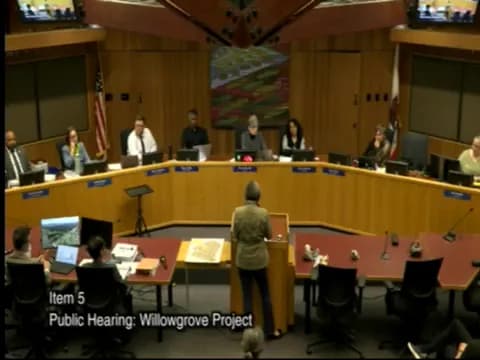
The Davis City Council met on Tuesday, May 5, 2026, at 6:30 PM in Community Chambers. The meeting began with ceremonial proclamations, followed by public comments, approval of the consent calendar, and a public hearing on the Willowgrove Project. The council unanimously certified the project's Environmental Impact Report (EIR), approved all related entitlements, and voted to place the project on the November 3, 2026 general municipal ballot. Ceremonial Proclamations - National Public Works Week (May 17–23, 2026): Councilmember Chapman recognized the contributions of Public Works personnel. Deputy Director Adrian Henning and Senior Civil Engineer Melody Eldridge accepted on behalf of staff. - Asian American, Native Hawaiian, and Pacific Islander Heritage Month: Councilmember Partida proclaimed May 2026 as AANHPI Heritage Month. The proclamation was accepted by Ellen Wade of APAPA, who thanked the council and highlighted the 2026 theme "Power and Unity." - Jewish American Heritage Month: Councilmember Deos proclaimed May 2026 as Jewish American Heritage Month. Ted Lasher of Congregation Bet Haverim accepted, noting the city's past support against antisemitism. - May is Bike Month: Councilmember Vaitla proclaimed May 2026 as Bike Month. Active Transportation Coordinator Corey Frost presented a sign marking Eighth Street as the first bike lane in the U.S. (1967) and reported over 500 participants at the Lupaloza event. - National Mental Health Awareness Month: Mayor Neville proclaimed May 2026 as Mental Health Awareness Month. Sarah Gavin (Communicare Ole), Martha Gilmore (Davis Center for Psychotherapy), and David Pinto (NAMI Yolo) spoke about reducing stigma and the importance of community support. Gavin noted that Communicare Ole provided over 60,000 behavioral health visits in Yolo County in the past year. - 50th Anniversary of Village Homes: Councilmember Vaitla recognized the 50th anniversary of Village Homes, a pioneering sustainable neighborhood. Founder Judy Corbett and UC Davis Design Museum Director Tim McNeil accepted the proclamation. Public Comments - On Proclamations: Several residents spoke in support of Jewish American Heritage Month, with one resident (Alan Hirsch) praising Davis as a pluralistic community that addresses antisemitism effectively. Other comments addressed water quality concerns (black mold at an apartment complex), housing needs, and skepticism about the Willowgrove project. - On Antisemitism and Extremism: Dan Ovadia and Alan Miller criticized the council for what they perceived as insufficient action against antisemitic rhetoric and protests. They referenced a May 1 rally by Yolo Democratic Socialists of America that included groups they labeled as extremist. Speaker Alan Miller verbally confronted the council, crumpling proclamation flyers. Another resident expressed fear for personal safety. - On Willowgrove Project (majority of public comment): The council heard from approximately 30 speakers, nearly all in strong support of the project. Supporters included residents, students (fifth graders advocating for softball fields), parents of children with developmental disabilities, representatives from Habitat for Humanity, the Davis Storm Girls Basketball program, school board member Hiram Jackson, and business owners. Key supporting themes: need for housing, affordable units, supportive housing for individuals with intellectual/developmental disabilities (IDD), athletic facilities (lighted softball fields, gym), and the project's readiness (tentative map already filed). One speaker (Marjorie Longo, Wild Horse Neighborhood Association) asked the council to accept donated land for an agricultural buffer, require 40% single-story homes along the western edge, and not further densify the project. A farmer (Amher Gill) raised concerns about maintenance of Channel A. No speakers opposed the project outright. Discussion Item: Willowgrove Project Public Hearing - Staff Presentation: Senior Planner Eric Lee presented the project overview, detailing the 232‑acre site north of East Covell Boulevard and Alhambra Drive, with 1,250 residential units (250 affordable apartments, 288 townhomes/condos, 215 medium‑density lots, about 200 low‑density lots). The project includes 73 acres of open space, 20.8 miles of bike/pedestrian trails, a community park with lighted softball fields and a gymnasium, and a 20‑unit commitment for individuals with intellectual/developmental disabilities (up from 10). A grade‑separated crossing at Harper Junior High was not recommended by staff due to design, cost, and operational challenges—a signalized at‑grade crossing is proposed instead. City Manager Daryel Dunston clarified that the $3.5 million developer contribution is for public safety needs (e.g., Station 31 upgrades), not a new fire station. - EIR Consultant (Nick Papani): Presented the CEQA process: a Notice of Preparation (July 12–August 12, 2024), scoping meeting, draft EIR (54‑day review, ended December 10, 2025), and final EIR (released March 16, 2026). The EIR identified significant unavoidable impacts in aesthetics, agriculture, air quality (criteria pollutants), construction noise, population/housing, VMT, transit, and wastewater treatment. Alternatives were analyzed, including lower density and reduced footprint options. Staff recommended adoption of a Statement of Overriding Considerations and certification of the EIR. - Applicant Presentation: James Coppert and Bree Mobius (lead land use counsel) presented the project pillars: designed for Davis, infrastructure for inclusion, and ready now. Key commitments: 250 affordable units (built in one phase without city loans), $3.5 million for public safety, $1.8 million for affordable homeownership (down payment assistance), $1.5 million for Channel A Basin, 374 acres of off‑site agricultural preservation, and a Community Facilities District (CFD) providing an additional $5.2 million in revenue to the city. The project has a filed tentative map (unprecedented for a pre‑ballot project) and anticipates delivering homes by 2028. - Council Deliberation: All council members expressed strong support. Vice Mayor Partida and Councilmember Chapman, who served on the subcommittee that negotiated the development agreement, praised the project's responsiveness to community input. Councilmembers highlighted the affordable housing commitment, IDD units, athletic equity (lighted softball fields), the gym as a resilience hub, and the binding language in the development agreement. Councilmember Deos noted the project's accountability measures. Mayor Neville praised the tentative map and IDD housing as showing extraordinary commitment. Key Outcomes 1. Certification of the Final EIR – Unanimously approved (5‑0), including adoption of CEQA Findings of Fact, Statement of Overriding Considerations, and Mitigation Monitoring and Reporting Program. 2. General Plan Amendment and Baseline Project Features – Unanimously approved (5‑0), setting land use designations for the 232 acres and establishing baseline features (e.g., 250 affordable units, 20 IDD units, no development north of Channel A, 374 acres off‑site ag preservation). 3. Pre‑zoning and Preliminary Planned Development – Ordinance introduced (5‑0) to pre‑zone the site as Preliminary Planned Development 02‑23 upon annexation. 4. Development Agreement Ordinance – Ordinance introduced (5‑0) approving the development agreement with all commitments (parks, fees, affordable housing schedule, CFD, etc.). 5. Vesting Tentative Subdivision Maps, Affordable Housing Plan, and Final Planned Development – Resolutions approved (5‑0), including approval of the affordable housing plan (250 deed‑restricted units) and final design guidelines. 6. Ballot Measure Resolution – Unanimously approved (5‑0) ordering the submission of a measure to voters at the November 3, 2026 general municipal election to approve the land use designation change and baseline project features. Additional Action: The council scheduled a closed session for June 2, 2026, starting at 5:00 PM, to conduct the city manager’s annual performance evaluation and a mid‑year review (coming up on eight months). The meeting adjourned in honor of Robin Tuta.
Public Meetings - Davis, California
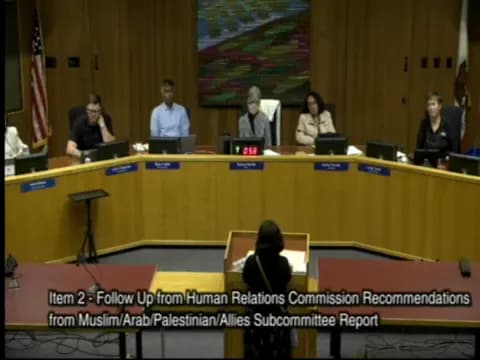
Public Meetings - Davis, CaliforniaThe Davis City Council held a special meeting on April 28, 2026, beginning at 5:30 PM, to consider recommendations from the Human Relations Commission (HRC) regarding discrimination against Muslim, Arab, Palestinian, and allied (MAPA) communities. The meeting included extensive public testimony from both supporters and opponents of the recommendations, followed by council deliberation and unanimous votes on several actions. Public Comments & Testimony - Dozens of community members spoke, with positions divided. Many MAPA community members and allies shared personal experiences of harassment, fear, and erasure in Davis, urging adoption of all six HRC recommendations. They argued that the recommendations were modest and necessary to address specific harms, and criticized staff proposals as a watered-down "all lives matter" approach. - Numerous Jewish community members and representatives of groups such as Hillel, Aggies for Israel, and the Jewish Community Relations Council opposed the MAPA report, calling it flawed, anti-Semitic, and divisive. They highlighted the lack of rigorous methodology, the conflation of Zionism with racism, and the report's failure to address anti-Semitism. Some speakers called for rejection of the report and recommendations entirely. - Several Jewish anti-Zionist speakers expressed support for the MAPA recommendations, asserting that supporting Palestinian rights is consistent with Jewish values and that Zionism should not be equated with Judaism. Discussion Items - Mayor Donna Neville opened by emphasizing that the council was considering the HRC recommendations themselves, not the underlying MAPA report. She clarified legal misunderstandings about free speech, equal protection, and the role of elected officials versus city staff. She expressed a desire to acknowledge the experiences of all marginalized groups without diminishing others. - Councilmember Bapu Vaitla moved to adopt HRC recommendations 1, 2, and 4 (acknowledgment of anti-MAPA discrimination, commitment to free speech including advocacy for Palestinian justice, and training on anti-Palestinian racism and anti-Muslim bias for staff and council). He argued that these actions were basic steps that did not harm any community and reflected real pain. - Councilmember Linda Deos proposed an additional motion to acknowledge concerns about anti-Semitism and reaffirm that both anti-Semitism and anti-MAPA harassment are unacceptable. She also supported the staff recommendation for broad-based training. - Councilmember Gloria Partida reflected on the difficulty of balancing concerns and noted the value of hearing all voices. She expressed interest in a broader climate survey. - Councilmember Josh Chapman supported recommendations 1 and 2 but concurred with staff on recommendations 3, 5, and 6 (relating to other jurisdictions), citing practical considerations. Key Outcomes - Vote 1: Motion to adopt HRC recommendations 1, 2, and 4 as originally written passed unanimously (5-0). - Recommendation 1: Acknowledgment of anti-MAPA discrimination in Davis. - Recommendation 2: Commitment to free speech, including speech advocating for justice for Palestine and Palestinian people. - Recommendation 4: Commitment to anti-Palestinian racism and anti-Muslim bias training for staff and council. - Vote 2: Motion to acknowledge concerns about anti-Semitism and reaffirm that both anti-Semitism and anti-MAPA harassment are unacceptable, and that discrimination of all forms exists, passed unanimously (5-0). - Vote 3: Motion to adopt staff recommendation for hate-free together to partner with the city to develop broad-based cross-cultural anti-bias resources for the community passed unanimously (5-0). The council did not adopt HRC recommendations 3, 5, and 6 (which involved requests to DJUSD and UCD) due to practical overlap with existing communications.
The Planning Commission of Davis, California met on Wednesday, April 22, 2026, at 7:00 PM. The commission unanimously approved a conditional use permit for Inspire Martial Arts at 4614 2nd Street and a final planned development and design review for a new manufacturing building at 4630 Fermi Place. The agenda was amended to defer a proposed monthly General Plan Update meeting discussion to a future date. Staff provided updates on several projects, including the upcoming G Street developments and the Willow Grove workshop before the City Council. The meeting adjourned at 8:05 PM. Consent Calendar - Minutes from December 10, 2025: Approved unanimously. - 2024-2025 Certified Local Government (CLG) Annual Report: Received and accepted unanimously. - Upcoming Subdivision Committee Public Hearing on 724 and 730 G Street Tentative Map and Parcel Map: Informational item noted. Public Comments & Testimony - Inspire Martial Arts (Item 6A): Multiple members of the public spoke in support of the conditional use permit. - Jim Gray (real estate broker, representing the landlords) noted the area’s history of flexible uses and encouraged approval. - Chris Smithers (instructor and former student) described the school’s positive community impact and parking advantages. - Barry Rice (long-term resident and college professor) praised the inclusive environment and mental health benefits; urged support. - Chad DeMacy (local real estate agent and parent) highlighted the ample parking compared to the current downtown location. - Mikel Wilson (instructor and former student) emphasized the school’s role in personal growth and parking relief. - Patty Young (former parent of students) described safety concerns at the current site and requested approval for the move. - No speakers opposed the project. - Palisades LLC Manufacturing Building (Item 6B): No public comments were made. Discussion Items - Inspire Martial Arts (CUP 01-26, PA 26-04): Senior Planner Eric Lee presented the staff recommendation to affirm the zoning interpretation allowing commercial recreation as a conditional use in the PD 4-88 Light Industrial/Business Park Subarea and to approve the conditional use permit. The proposed use would occupy approximately 5,554 square feet within an existing 10,000-square-foot building with no exterior modifications. The applicant, Richard Baccherini (owner), noted the parking availability and the benefit of co-location near the Target shopping center. The commission praised the business's reputation and the lack of opposition. The item passed unanimously. - Palisades LLC Manufacturing Building (FPD 01-26, DR 03-26, PA 26-05): Staff presented a proposal for a 12,000-square-foot manufacturing and office building with a 2,400-square-foot storage building on a 1.26-acre parcel at 4630 Fermi Place. The use (design and manufacture of laser systems for medical devices) is permitted in the light industrial business park subarea. The project complies with all zoning standards, includes landscaping and bioswales, and is CEQA-exempt. The applicant, Steve Greenfield (Cunningham Engineering), and Andy Quang (CHD Architects) answered commissioner questions about building flexibility and parking lot shading. The commission approved the resolution unanimously. - Announcements and Staff Updates: Principal Planner Dara Dungworth reported that two major G Street projects (240 G and 500 G) and the Sweet Briar Townhomes are moving toward construction this summer. Senior Planner Eric Lee provided a recap of the Willow Grove City Council workshop (April 21), which was well-received, with a public hearing set for May 5. He also noted that a minor Certificate of Appropriateness for the historic Amtrak station had been processed administratively. Commissioner Vince McLaughlin commented on the project’s alignment with economic development goals. - Long Range Calendar: Staff outlined upcoming work: General Plan Update (GPU) workshop on April 30 and continuing outreach, a planned development audit, a mobile vending ordinance update, and a housing progress package (ADU, SB6, SB9 updates) tentatively scheduled for June 10. Quarterly historical resources training sessions were noted as placeholders pending adoption of the Historic Resource Management Ordinance, targeted for September 9. Key Outcomes - Inspire Martial Arts CUP: Motion to affirm the zoning interpretation and approve Resolution approving CUP 01-26, with a CEQA exemption finding under Section 15301(a), passed unanimously (4-0). - Palisades LLC Manufacturing Building FPD and DR: Motion to approve Resolution approving Final Planned Development 01-26 and Design Review 03-26, with CEQA exemption findings under Sections 15303 and 15332, passed unanimously (4-0). - Agenda Amendment: Item 6C (Commission Initiated Task Proposal for Monthly GPU Update Meetings) was removed from the agenda due to the absence of Commissioner Brinkley, who sponsored the proposal; no vote on the item. - Consent Calendar: Approved unanimously with no items removed for separate discussion. - Next Steps: City Council will hold a public hearing on Willow Grove on May 5, 2026. The next GPU public workshop is April 30, 2026. Staff will continue work on various ordinance updates and planned development cleanup.
The Davis City Council held a regular meeting on Tuesday, April 21, 2026. Key topics included a workshop on the Willowgrove development project, a presentation on the Yolo County Animal Services Joint Powers Authority (JPA) governance model, a public hearing on weed abatement, and extensive public comments focused on bicycle safety following the recent death of UC Davis student Lincoln Sabini. The consent calendar was approved unanimously, and the council provided directional feedback on Willowgrove without taking final action. Consent Calendar - Approved unanimously, including grant applications (ATP Cycle 8 for Richards I-80 bicycle/pedestrian improvements; SACOG 2026 Federal Funding for Anderson Road rehabilitation), the AB 1600 Development Impact Fee Report, the 2026 Thong Hy Huynh Award recipient recommendations (Sharon Shoemaker in 18+ category; ¿Un Cafecito? in Community Organization category), and commission minutes. Public Comments & Testimony - Bicycle Safety (Lincoln Sabini) : Over a dozen speakers, including friends, family, and community members, urged the council to prioritize physically protected bike infrastructure. Many described Sianni as a “strong” and “sturdy” person; speakers noted he was killed on a straight section of Hutchinson Drive while in a painted bike lane. Speakers advocated for “Lincoln’s Loop” — a protected bike/pedestrian corridor in West Davis/West Campus area — and for safer crossings at Covell Boulevard near Harper Junior High. A petition with nearly 3,000 signatures was referenced. The council acknowledged the loss and adjourned in Sabini’s honor. - 8th Street Bike Lane Commemoration: Catherine Brinkley presented a petition with 135 signatures urging the city to recognize 8th Street as America’s first bike lane during Bike Month (May). Several speakers supported this. - Willowgrove Project: Multiple residents expressed strong support for the 1,250-unit development, emphasizing the need for family-friendly housing to sustain school enrollment and provide affordable options. Speakers highlighted the 250 affordable units (20% of total), inclusive playground, and commitment to intellectual/developmental disability housing. A few Wildhorse residents requested buffer enhancements (wider buffer, meandering fence, single-story homes along the edge). One speaker opposed the ultra-dense alternative. - Animal Services JPA: One speaker opposed forming an operational JPA. - Other: One speaker discussed Israeli independence and anti-Zionist Jews; another responded with a plea for inclusive dialogue. Discussion Items - Item 4 – Weed Abatement Public Hearing (Fire Marshal Sandholdt): No property owners protested. The council unanimously approved the staff recommendation. - Item 5 – Yolo County Animal Services JPA Governance Model (Alex Tengolics, Yolo County): Tengolics presented four JPA models (contract, JPA-contract, self-sufficient JPA, nonprofit partnership). Current cost per capita in Yolo County is about $22, in line with statewide averages. A request-for-information from nonprofits found no immediate capacity to provide services at scale. The county’s planning JPA could transition to an operational JPA that contracts with the county. Council members sought more information on cost allocation methodology, potential savings, and transition costs. The council did not take a formal position but expressed interest in further analysis; a JPA meeting is set for May 20. - Item 6 – Willowgrove Project Workshop (Community Development staff, applicant team): The project proposes 1,250 residential units (mix of low, medium, high density), 250 affordable rental units (20% of total, with units for IDD individuals), 288 condos (targeted at $484,000–$649,000), a 20.8-acre regional park ($20.8M investment, including inclusive playground, lighted softball fields, gym), 3 miles of bike/ped trails, and a small retail area. The Development Agreement includes $1.8M for affordable homeownership assistance, $3.5M for public safety, and $1.5M for Channel A improvements. The Pacific Companies CEO explained financing through vertical integration and private gap funds, avoiding city subsidies. Council members praised the subcommittee’s negotiations and expressed broad support; no final action was taken. Follow-up hearing set for May 5. Key Outcomes - Consent Calendar approved unanimously. - Weed Abatement approved unanimously with no protests. - Animal Services JPA: No formal decision; council requested more financial detail and directed staff to coordinate with Yolo County and the JPA planning body. - Willowgrove Project: Council provided feedback supporting the project. The development team committed to refine the bike crossing at Harper Junior High (crosswalk at signalized intersection was presented as an alternative to a grade-separated tunnel). Council asked for additional details on traffic volumes and crossing design. The project is scheduled for a public hearing on May 5, 2026, with potential Measure J/RD ballot placement in November 2026. - Long Range Calendar: A special meeting was announced for April 28, 2026 at 5:30 p.m. to discuss Human Relations Commission recommendations regarding Muslim, Arab, Palestinian, and ally communities.
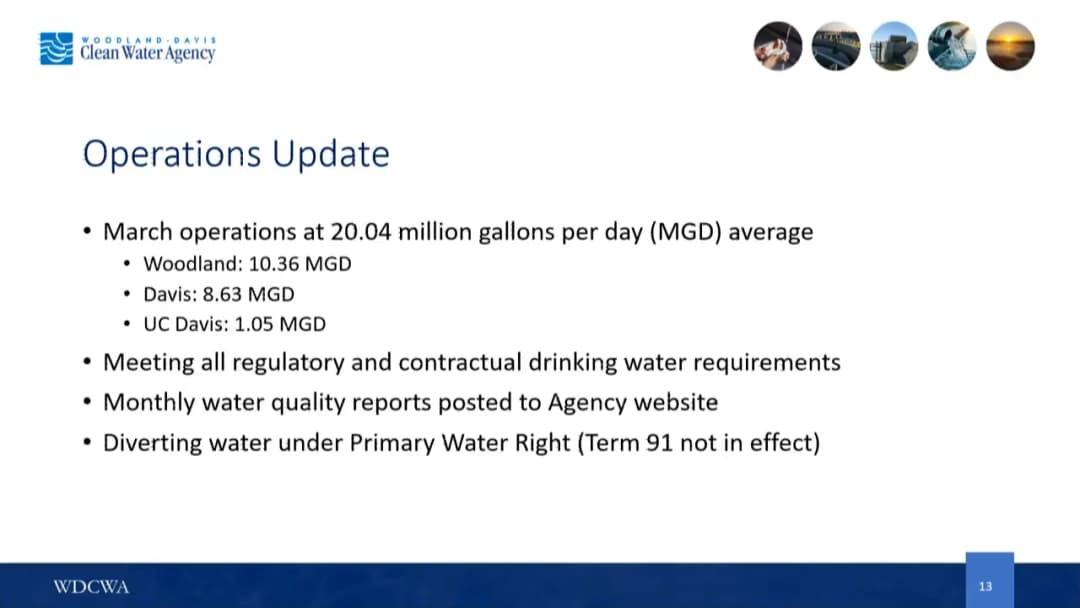
The Woodland-Davis Clean Water Agency Board of Directors met in regular session on April 20, 2026. The transcript text identifies the meeting as April 16, 2026, but this summary follows the provided meeting date of April 20, 2026. According to the transcript, the meeting began at 3:00 p.m. and lasted about one hour. The board approved the consent calendar, heard staff reports on source water assessment, water supply, long-term water supply, capital improvements, electrical reliability, operations, the draft FY 2026-27 budget, and 10th anniversary celebration planning. Board member Angel Brahas was absent as a non-voting member; the university was represented. The next regular board meeting is scheduled for June 18, 2026. Consent Calendar - The board adopted the agenda and approved the two consent items: the January 15 minutes and the quarterly treasurer's report for the second quarter of fiscal year 2025-26. - During discussion, one board member estimated the agency's total fund balance at roughly $16 million, while noting that not all of it is allocated to reserves, and estimated reserves in the $8-10 million range. Public Comments & Testimony - No public comment was offered; the chair noted that no members of the public were present. Source Water Assessment (SRSSU 2025) and Partnerships - Staff reported completion of the five-year Sacramento River source water assessment, prepared with the City of Sacramento, West Sacramento, Placer County Water Agency, Sacramento County Water Agency, and East Bay MUD. - The report was submitted in December 2025 and approved without comments; it will remain posted on the agency website. - The agency participates in the voluntary spill notification network and this year joined the rice pesticide program, which provides access to more testing and data on rice pesticides, including thiobencarb. Water Supply and Snowpack Update - Staff reported gross water supply at 102% of average as of the day before the meeting, with more rain expected the following week. - Lake Oroville was about 90% full and roughly 115% of average; Lake Shasta was also well above average, with some flood-control and salmon pulse-flow releases. - Snowpack was described as poor: the second worst year on record behind 2015, with the Northern Sierra at 11% of average, Central California at 25%, and Southern California at 28%. - The agency has its full 10,000 acre-feet of CVP water available and is not in a Shasta critical year. Staff predicted the Term 91 curtailment of the primary Sacramento River water right would begin between May 1 and May 15, later than earlier forecasts because of April rain. - A small summer water transfer is being considered for the City of Davis and potentially UC Davis, but not the City of Woodland. Long-Term Water Supply and Water Rights - Staff reported work on a supplemental EIR, with an administrative draft expected around mid-May and completion targeted for September 2026. The goal is to bring a long-term water agreement to the board for approval at the September 2026 meeting. - The supplemental EIR would allow summer-only water transfers with any Sacramento River settlement contractor as opportunities arise; South Sutter Water District would be the long-term partner for both summer and winter supply as needed. - Board members asked detailed questions about the agency's primary water right. Staff explained the primary right is an appropriative right, allows up to 52 million gallons per day, and is based on historical applications; the agency uses about 19,000 acre-feet per year out of a 45,000 acre-foot annual entitlement. The 1994 priority date makes the agency one of the most junior rights on the Sacramento River, but staff said the right should be defensible for future growth. Capital Improvements, Permitting, and Electrical Reliability - Staff described a minor erosion project at the joint intake parking lot, replacement of an intake flow meter, and efforts to obtain a permanent permit for alum use at the water treatment plant. The Division of Drinking Water has asked for a two-week full-capacity run, a condition the agency says it cannot meet; the agency is seeking an alternative approach and can remain on the temporary permit. - A filter re-rating study is expected to take about a year. The filters are currently permitted at 6 gallons per minute per square foot; the goal is to increase plant capacity by 4 million gallons per day to 34 MGD in a two-step process. The current permitted plant capacity is 30 MGD, with the primary water right supporting up to 52 MGD. Staff noted City of Davis interest in higher near-term capacity, and the overall effort could take 1.5 to 2 years. - The agency had 16 power outage events between 2017 and 2025. Staff met with PG&E to improve electrical reliability. The August 2024 outage required 14 days of generator operation and cost $279,000 in diesel, backup generator, and maintenance; a July 2025 outage resulted in a net payment to Jacobs of $34,000 after reassessing liquidated damages. The agency paid 100% of the July costs and most costs for August, excluding contractor electrical repairs. A board member described the costs as straight hits with no reimbursement. - Staff are also installing power-quality equipment and considering relocating surge arresters that have failed during voltage events. Operations Update - Average treated water was about 20.04 million gallons per day, with roughly half to Woodland and half to Davis/UC Davis combined. - Staff stated water quality continues to meet and exceed drinking water requirements; Woodland is injecting into ASR wells, while Davis has finished its ASR testing. - Staff presented preliminary delivery planning if the Term 91 curtailment begins in early May: about 10 million gallons per day to Woodland and 10 MGD to Davis/UC Davis from June through September, then about 4 to 4.5 MGD in October. These numbers would increase if the curtailment start is later. FY 2026-27 Budget - Staff presented a year-end projection for the current fiscal year: total operations and maintenance is projected to come in about $1.62 million below the authorized budget, including about $700,000 below budget on electricity, $400,000 below on chemicals, and $400,000 below on the distributed energy resources (DER) design project because a federal Bureau of Reclamation grant application received no decision and the project was paused. The grant request was for $3 million toward construction. - The draft FY 2026-27 budget is roughly $2 million higher than the current year, driven by about $765,000 in repair and replacement work, $600,000 for supplemental water purchase, and $740,000 as a placeholder to begin procuring long-lead DER equipment. - The DER project as a whole is estimated at about $8 million. One board member called that a lot of bread and expressed concern about the agency paying for it without grant funding. Staff said the amount in the budget is not an approval to proceed; they may recommend completing design to 90 percent, estimated at $150,000-$200,000, to be shovel-ready for future grants. Further board and city discussion is expected before construction. - SRF debt service remains $9.99 million per year, unchanged. Woodland made its final reserve payment last fiscal year; Woodland has about 10.5 years of debt payments remaining and Davis about 20.5 years. - The final budget will be presented for adoption at the June 18, 2026 board meeting. 10th Anniversary Celebration - Staff announced a 10th anniversary celebration at the joint intake facility on the river on June 2 at 10:00 a.m., with a tent, chairs, and refreshments. - A plaque will be installed at the water treatment plant dedicated to Dr. Marble and Angela Sacopoulos for their work on water rights and project development; both are expected to attend. - Board members praised the project as a major success story, noting it came in five months ahead of schedule and $8 million under budget, and consolidated four river intakes into one shared facility. Future Board Calendar and Board Comments - The next board meeting is scheduled for June 18, 2026 at Woodland City Hall, with final budget adoption, a public hearing on the Urban Water Management Plan, and selection of chair and vice chair. - A short-term summer water transfer agreement may also be brought to the June meeting. - Board members offered no formal comments beyond the earlier discussions. Key Outcomes - Consent calendar approved: agenda, January 15 minutes, and Q2 FY 2025-26 treasurer's report. - No formal vote was taken on the budget; it will return for final adoption on June 18, 2026. - The DER project is not approved for construction; the board expects further discussion, and staff are considering a study session or June discussion before any commitment. - The 10th anniversary event is set for June 2 at 10:00 a.m.; board members encouraged broad community promotion. - The next regular board meeting is June 18, 2026.
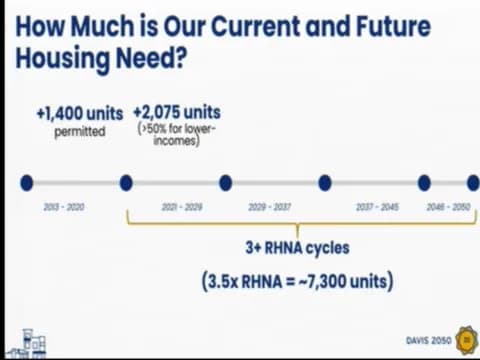
The joint meeting of the Climate and Environmental Justice, Open Space and Habitat, Planning, Recreation and Park, Social Services, and Transportation Commissions convened at 5:30 PM in Community Chambers, 23 Russell Boulevard, Davis, CA. The sole agenda item was a presentation and discussion on draft land use concepts for the 2025 General Plan Update, led by consultants Raimi + Associates. Commissioners provided feedback within their respective scopes, and public testimony was heard at the end of the meeting. The meeting adjourned around 8:00 PM. Consent Calendar - Unanimous approval of the agenda and designation of Jordan Blough (Climate and Environmental Justice Commission) as Lead Chair for the meeting. Public Comments & Testimony - Richard McCann (former Natural Resources and Utilities Commissioner): Noted that about 56% of residents commute out of Davis for work, creating emissions. Urged more in-town jobs and housing to reduce car dependency, criticized the concepts as too car-centric, and called for stronger accountability measures in the General Plan. - Trish Price (Bike Davis): Expressed general support for the process and encouraged improved bicycle infrastructure. Discussion Items - Presentation by Raimi + Associates: - Overview of the General Plan process and community engagement results: A vision statement was finalized — "Davis advances safe, fair, healthy, and sustainable neighborhoods where everyone has what they need to thrive and succeed." - Land use background: Existing land use distribution — 15% commercial/mixed-use, 10% public, 13% open space, and about two-thirds housing (half low-density single-family). The city added 3,500 jobs since 2010; 44% of residents both live and work in Davis. The city faces a fiscal deficit in FY 24-25. - Three land use concepts for areas inside city limits: 1. Concept 1 (Concentrated): Intensifies downtown, select commercial and faith-based sites, employment areas, and some single-family neighborhoods. 2. Concept 2 (Dispersed): Expands downtown south, adds more mixed-use along transit, intensifies all employment areas, and allows more housing types in all single-family neighborhoods. 3. Concept 3 (Employment-focused): Expands/intensifies downtown and all employment areas, with additional density on select school sites. - One concept for areas outside city limits: Establishes an urban limit line, designates open space, creates design guidelines, and considers annexation of existing neighborhoods (e.g., El Macero, Willowbank). The concept includes areas for mixed-use north of the city and recognition of pending projects (Village Farms, Willow Grove, DISK). - None of the inside-city concepts alone meet the projected need of 7,300 housing units by 2050; outside-city expansion would be required. - Commission Discussions: - Climate and Environmental Justice Commission (Chair Jordan Blough): Supported mixed-use, higher density, walkability to daily needs, and alignment with the Climate Action Plan. Advocated expanding the urban limit line to capture the full sphere of influence and prioritizing multifamily housing with open space access. - Open Space and Habitat Commission (Chair Patrick Huber): Emphasized tree canopy enhancement, ecological diversity in stormwater channels, and opposed leapfrog development northeast of the city. Supported downtown intensification (citing Bend, Oregon) and suggested small-scale agriculture, climate tech jobs, and co-op/intergenerational housing outside city limits. - Planning Commission (Chair Michelle Weiss): Advocated for an innovation district linked to UC Davis, extensive upzoning to meet housing needs, annexation of UC Davis and El Macero, a comprehensive flood control master plan, and public-private partnerships using surplus city land. - Recreation and Park Commission (Chair Tony Marigo): Stressed that new housing should be within a 5-minute walk of parks (currently 35–55% depending on concept), connectivity between neighborhoods, and adequate funding for park maintenance and recreation programming. Raised concern about voter rejection of past Measure J/R/D expansions. - Social Services Commission (Co-Chair Patrick Curzon/others): Called for bold ambition to meet housing affordability goals (citing the 7,300-unit need), equity metrics, minimum density requirements on redevelopment sites, preservation of naturally occurring affordable housing, and exploring a transportation hub to Woodland. - Transportation Commission (Vice Chair Mark Huising): Proposed transportation benchmarks (e.g., car ownership per household, distance to trip generators) to reduce the $15,500/year average household car ownership cost. Supported infill over expansion due to existing infrastructure costs, and identified the intersection of Russell/113 as a logical high-density location. Key Outcomes - No formal votes were taken; commission feedback will inform continued refinement of land use concepts. - Next steps include a community workshop on April 30, 2026, an online survey, pop-up events, and additional focus groups. Refined concepts will be presented back to the commissions in late summer/early fall 2026. - The consultant team encouraged additional written feedback from commissioners via liaisons.
The Planning Commission held its first meeting of 2026 on Wednesday, April 8, 2026, at 7:00 PM. The primary agenda item was a public hearing on the Willowgrove Project, a proposed 1,250-unit residential community on approximately 232 acres northeast of Davis. Prior to the hearing, the commission elected a Chair and Vice Chair for 2026 and approved the consent calendar. After extensive public comment and deliberation, the commission voted to recommend City Council approval of the project’s environmental review, general plan amendment, pre-zoning, development agreement, tentative map, affordable housing plan, and final planned development, subject to several amendments. Consent Calendar - Minutes from October 22, 2025 and December 2, 2025 – Approved unanimously by voice vote. Public Comments & Testimony - Support for the project (spoken and voicemail): Dozens of community members urged approval, citing the need for housing to retain families, support schools, and provide affordable and inclusive options. Teachers, parents, and UC Davis staff noted that many workers commute from outside Davis due to lack of attainable housing. Supporters highlighted the project’s diverse housing mix, 250 deed‑restricted affordable units (including 10 reserved for individuals with intellectual/developmental disabilities in partnership with Alta Regional Center), the large community park with amenities (indoor gym, lighted softball fields, pickleball courts, inclusive playground), and the commitment to deliver homes by spring 2028 if approved by voters in November. - Wild Horse Neighborhood representatives (Marjorie Longo, Kelly Safford, others): Asked the commission to preserve the meandering fence line, add the proposed 1.1‑acre western buffer (about one‑third of the 300‑foot buffer originally requested), and retain the 40% single‑story requirement along the buffer to protect the existing wildlife habitat. They urged rejection of staff’s preference for a straight fence line and opposed any further densification of the project. - Concerns raised (Victoria Link, David Sandino, Dave Hart): Called for an over‑/under‑crossing on the east side for student safety, a comprehensive traffic analysis integrating nearby projects (Village Farms, Palomino Place), affordable for‑sale ownership units instead of only rentals, and questions about the financial viability of the private equity‑backed lender. One speaker noted that the LAFCO sphere of influence does not include this land, raising governance concerns. Discussion Items - Chair and Vice Chair Elections (Item 4): Michelle Weiss was re‑elected Chair by unanimous consent. A vote was held for Vice Chair between Alan Bennett (incumbent) and Catherine Brinkley. Brinkley won with a majority (4‑2 or similar, chair did not vote). - Willowgrove Project (Item 7): Staff (Eric Lee, Nick Papani) and the applicant (Bree Mobius and team) presented the project details, including the General Plan Amendment, Pre‑Zoning, Development Agreement, Vesting Tentative Subdivision Map, Affordable Housing Plan, Final Planned Development, and the Final Environmental Impact Report (EIR). The EIR identified significant unavoidable impacts in aesthetics, agriculture, air quality, greenhouse gases, noise, population/housing, transportation (VMT), and cumulative traffic/capacity. Mitigation measures were included. The applicant emphasized the “shovel‑ready” status, the unprecedented affordable housing commitment (250 units built in one phase without city funds, exceeding the 141‑unit requirement by 177%), and community benefits such as a $20.8 million park, 2,500 new trees, all‑electric design, and solar purchase options. - Commission Deliberation: Commissioners commended the thoroughness and community engagement. Key points of discussion: - Affordable Housing (for‑sale vs. rental): Commissioner Valencia and others expressed a desire for deed‑restricted for‑sale units to address the “missing middle.” Commissioner Fulp‑Cooke echoed this. After debate, Commissioner Valencia made a motion to add 10 deed‑restricted affordable for‑sale units in the MDR1 area (80‑120% AMI) with $20,000 per unit down payment assistance. The motion passed unanimously. - Sustainability: Commissioner Brinkley proposed adding two items to the baseline features: (1) optimizing rooftop solar capacity and offering an expanded solar purchase option for homeowners; (2) including edible landscaping on private and HOA‑managed areas where feasible. The first was approved (7‑0). The second was moved as an amendment to the Development Agreement (community benefits) and passed 4‑3. - Grade‑Separated Crossing: Several speakers and commissioners supported a potential over‑/under‑crossing at the southeastern corner near Harper Junior High. The commission voted to recommend City Council consider a developer contribution to such a crossing if the upcoming Active Transportation Plan update deems it feasible and desirable. - Traffic and Phasing: Commissioners noted the project’s fair‑share contributions to 24 cumulative improvements, with the applicant advancing frontage widening. The city attorney advised against attempting to phase or condition the project relative to Village Farms, given the different stages of entitlement and the need to deliver housing quickly. Key Outcomes - Resolution 1 (CEQA): Approved unanimously – recommends City Council certify the Final EIR, adopt findings of fact, a Statement of Overriding Considerations, and a Mitigation Monitoring and Reporting Program. - Resolution 2 (General Plan Amendment, Pre‑Zoning, Development Agreement): Approved as amended with: - Addition of solar capacity optimization and expanded solar purchase option to baseline project features (7‑0). - Addition of “edible landscaping on private and HOA‑managed areas where feasible” to the Development Agreement under community benefits (passed 4‑3). - Resolution 3 (Vesting Tentative Map, Affordable Housing Plan, Final Planned Development): Approved as amended – 10 deed‑restricted affordable for‑sale units in MDR1 (80‑120% AMI) with $20,000 per unit down payment assistance, held in the Housing Trust Fund for these units (unanimous). - Additional Motion: The commission voted to recommend that City Council, contingent on the Active Transportation Plan study, consider a developer contribution to a future grade‑separated bike/ped crossing at the southeastern edge of Covell Boulevard (approved, voice vote). - Other: The commission agreed to agendize a discussion on monthly meeting frequency for the April 22, 2026 meeting (approved by voice vote). The meeting adjourned at approximately 10:30 PM.
The Davis City Council met on April 7, 2026, at 2:30 PM. The meeting included seven ceremonial proclamations recognizing National Public Safety Telecommunications Week (April 12–18), Earth Day (April 22), American Muslim Appreciation and Awareness Month, Arab American Heritage Month, Child Abuse Prevention Month, Donate Life Month, and Parkinson's Awareness Month. City Manager Mike Webb announced a $1 million congressional appropriation for bicycle and pedestrian improvements at the Amtrak station, the Andrew Marcus Golden Hearts Awards deadline of April 17, and picnic day safety reminders. The consent calendar was approved unanimously. General public comments addressed the proposed sanctuary city ordinance, the MAPA report, international issues, and community arts funding. Regular agenda items included a public hearing on FY 2026-27 CDBG and HOME allocations, a mid-year budget update, and the first reading of a sidewalk maintenance and inspection ordinance. Consent Calendar - Approved unanimously, including the Social Services Commission work plan, the sanctuary city ordinance (item G), and other routine items. Public Comments & Testimony - Robert Holland urged the council to reread the MAPA report with an open mind and avoid unfair blaming between groups. - Alan Miller criticized the council for bringing national/international conflicts into chambers and offered a book on Israeli history. - Jordan Elson (Third Space Art Collective) proposed the organization take over the Bicycle Hall of Fame building to create a community arts and mutual aid hub. - Margaret Graham (Patty on the Bench) thanked the council for Arts and Cultural Affairs grants that funded a free St. Pat's in the Park concert with over 400 attendees. - Recorded comments: Several speakers supported the sanctuary city ordinance, with one urging removal of a clause allowing cooperation to protect life or property, and another requesting additional provisions for legal defense and ICE preparedness. A speaker on CDBG funds suggested reimagining public safety to include accessibility, tree pruning, and ventilation upgrades. Discussion Items - CDBG and HOME Partnership Program Public Hearing: Staff presented the FY 2026-27 allocation recommendations, maintaining existing award levels. The city received $1,053,776 for 2025-26 ($730,000 CDBG, $323,000 HOME), with a $72,000 reduction from the prior year. Staff noted uncertainty due to HUD delays. Council approved the recommendation. - Mid-Year Budget Update (FY 2025-26): Director Presciato reported general fund revenues are projected at $500,534 above budget, but expenditures increased by over $1 million, dropping the reserve from 11.5% to 8.9%. Key adjustments: Cannabis tax revenue decreased by $500,000 (from $1.7M to $1.2M) due to a dispensary closure and regional competition. Sales tax is projected $100,000 below budget. Property tax remains steady with 4.4% assessed value growth. The city faces a structural deficit; staff will bring a long-range forecast and options in May/June. Council formed a budget subcommittee (Councilmembers Neville and Partida) to work with staff. - Sidewalk Inspection and Maintenance Ordinance (First Reading): The city established a five-year rotating sidewalk inspection program (SAFE). An ordinance placing responsibility for sidewalk repair on adjacent property owners (consistent with state law) was introduced. Key points: City-owned trees are not exempted; utility-caused damage is exempt. Enforcement will not begin until council adopts policies on implementation, including potential baseline repairs, relief for low-income and senior homeowners, payment plans, and community outreach. The ordinance was approved 5-0 on first reading, with a second reading scheduled for the next meeting. Staff will return with a timeline and policy options before July 1, 2026. Key Outcomes - Consent calendar approved unanimously. - CDBG/HOME funding recommendations approved; staff authorized to submit the annual action plan upon HUD confirmation. - Mid-year budget resolution approved, including reallocation of vacancy savings and funding for Russell Boulevard corridor improvements ($265,000) and maintenance projects ($275,000). - First reading of sidewalk maintenance ordinance passed 5-0; second reading and potential policy discussions to follow. - Budget subcommittee formed (Neville and Partida) to assist with the May/June budget cycle. - Long-range calendar noted heavy upcoming agendas; council requested review of scheduling conflicts.
The Davis City Council met on March 17, 2026, at 6:30 p.m. in the Community Chambers. The meeting included a ceremonial proclamation for American Red Cross Month, approval of the consent calendar with one councilmember requesting to be recorded as a no vote on a fireworks item, public comments on e-bike safety and sanctuary city support, and a lengthy deliberation on a Sanctuary City Ordinance and Human Relations Commission (HRC) recommendations. The council unanimously adopted the Sanctuary City Ordinance and gave direction on several related initiatives. Ceremonial Presentation - Proclamation Recognizing March as American Red Cross Month – Councilmember Deos read the proclamation, and a representative from the Red Cross spoke about its history. Consent Calendar - The consent calendar was approved unanimously by roll call (Chapman, Neville, Partida, Deos, Vaitla all aye). However, Councilmember Vaitla earlier indicated he wished to be recorded as a no vote on Item P (Authorizing 2026 Pyrotechnic Displays for the Fourth of July celebration). The final roll call did not reflect this request, creating a discrepancy between the stated intent and the recorded vote. (The agenda notes that a 4/5 vote is required for late items; no discussion was held on this discrepancy.) - Councilmember Deos additionally expressed appreciation for staff’s work on the Lake Boulevard Bike Lanes project (Item E), which was included in the consent calendar. Public Comments & Testimony - E-bike and e-scooter safety (under Item 3, general comments) – Several residents urged the council to ban motorized e-bikes/e-scooters for children under 16 on greenbelts. Dr. Ulfat Cheikh cited injury statistics and American Academy of Pediatrics recommendations. Nikki Martin and Tova Stiles (via voicemail) shared the story of Julie Veress, a nurse killed by a teenage e-bike rider on a multi-use path, and called for a 10 mph speed limit on paths and restricting high-speed e-bikes to streets. - Sanctuary City support (Item 5) – Multiple community members spoke in favor of adopting a strong sanctuary city ordinance and implementing the HRC’s recommendations. Speakers included Venus Manishel, Spear (using they/them pronouns), Frank Pinto, Layla Cervantes, Silas (survivor of human trafficking), Ann Block, Dima Tamimi, Alan Hirsch, Sam Monise, Tommy Noyes, Kevin Baker (HRC commissioner), Reem Alders Maui, and Ellen Kalaric (via voicemail). Key themes: need for community notification of ICE activity, funding for immigration legal defense, a rapid response plan, and visible city support. One speaker opposed moving the MAPA item to April 28 (Israel Independence Day). - Fireworks opposition (Item 3 and Item P) – Todd Adelman and Connor Government (via voicemail) urged pulling Item P from the consent calendar for discussion, citing the 2025 pyrotechnic explosion that killed seven people in another city and calling for a shift to drone shows. - Arts MOU gratitude – Kyle Monhollen (Davis Live Music Collective) thanked the city for its partnership (Item N on consent calendar). Discussion Items - Item 5A: Sanctuary City Ordinance – City Attorney Inder Khalsa and Deputy Police Chief Matt Petersen presented the ordinance, which largely mirrors state law (SB 54) and prohibits city resources from assisting federal immigration enforcement. They explained that certain HRC-requested provisions (non-discrimination clause, procurement restrictions, employee outside-work limits, community notification, mask prohibition) were not included due to legal or practical concerns. The council discussed each element extensively. Councilmember Vaitla raised concerns about city employees working with immigration enforcement; staff agreed to research limitations. - Item 5B: Human Relations Commission Recommendations – Assistant City Manager Kelly Stachowicz presented six high-priority recommendations from the HRC to support immigrant safety and solidarity. These included: (1) adopting a binding sanctuary city ordinance, (2) establishing immigration legal defense capacity, (3) implementing an ICE preparedness and rapid response plan, (4) supporting know-your-rights trainings, (5) strengthening language access, and (6) demonstrating visible city support. Key Outcomes 1. Sanctuary City Ordinance – The council voted unanimously to adopt the ordinance (motion by Mayor Neville, seconded by Councilmember Chapman; all ayes). Staff will incorporate minor amendments suggested by HRC co-chair Kevin Baker (text simplifications and adding “equipment, tools, and funds” to the reporting requirement). 2. Community Notification – Instead of putting a notification requirement in the ordinance, the council directed staff to add information to the city website directing residents to NORCAL Resist for verifying and reporting ICE sightings. The city manager will also notify councilmembers of known ICE activity. 3. Immigration Legal Defense – The council declined to create a city-funded legal defense program at this time but agreed to form an ad hoc subcommittee (Mayor Neville and Vice Mayor Partida) to research potential funding sources (e.g., state grants) and report back. 4. ICE Preparedness / Rapid Response Plan – The council decided not to form a multi-jurisdictional Brown Act task force, but instead will have the Police Department lead development of a plan with input from the HRC. The ad hoc subcommittee will also review model plans from other cities. 5. Know-Your-Rights Trainings – The council encouraged the HRC and Police Accountability Commission to continue sponsoring immigrant-focused forums; existing resources are sufficient. 6. Language Access – The council prioritized strengthening Spanish-language translation on the city website and in materials. Staff will assess current translation capabilities and consider using interns and AI tools for PDFs. 7. Visible Support – The council affirmed ongoing visible support for immigrants, and Mayor Neville will send a letter opposing the proposed HUD rule that would eliminate funding for mixed-status households. 8. Long Range Calendar – A special meeting on the MAPA report was scheduled for April 28, 2026, with related proclamations moved to that date. The leaf blower electrification item was placed on the pending list, and e-bike safety was added as an upcoming topic. 9. Consent Calendar Discrepancy – The transcript shows a unanimous vote on the consent calendar, but Councilmember Vaitla had requested to be recorded as a no on Item P (pyrotechnic displays). No resolution of this discrepancy was recorded. Adjournment The meeting adjourned at approximately 11:10 p.m.
On Tuesday, March 3, 2026, the Davis City Council met at 6:30 p.m. in the Community Chambers, 23 Russell Boulevard, Davis, CA. The meeting opened with a moment of remembrance, ceremonial proclamations, and a Sister City presentation from Sangju, South Korea, followed by approval of the consent calendar, a presentation and approvals related to the Economic Development Strategic Plan, introduction of amendments to the Affordable Housing Code, and planning for future agenda items. Ceremonial Presentations & Sister City Update - Mayor Donna Neville opened the meeting by expressing condolences for Julie Varess, a 60-year-old Davis resident and Davis Aquatic Masters member who died in a bicycle accident in Davis on March 2, 2026. The Mayor said the incident remains under investigation. - The Council approved the meeting agenda unanimously at the start of the meeting. - Proclamations recognized March 7–14 as Arbor Week, March as Developmental Disabilities Awareness Month, March as National Nutrition Month, Cathie Bullis as the Brinley Community Volunteer Award winner, Brodie Hamilton and Sharon Schauer as Citizens of the Year, and the late Dr. John Lofland with a Special Recognition Award. - Arbor Week: The City of Davis was recognized as a Tree City USA for 45 years. Tree Davis Executive Director Yael Franco invited the community to a tree planting event on March 7, 2026, at 9 a.m. in the Cannery neighborhood. - Developmental Disabilities Awareness Month: Team Davis and Community and Employment Services accepted the proclamation. A Team Davis member, AJ Van Der Vanderpan, shared how moving to Davis helped him feel welcomed and included. - National Nutrition Month: Demcina Babazade and Dr. Francine M. Steinberg accepted on behalf of Davis registered dietitians and highlighted the 2026 theme, “Discover the Power of Nutrition.” - Cathie Bullis was honored for founding Davis Picks It Up. The proclamation cited 734 community volunteer members as of September 2025 and 58,400 pounds (29+ tons) of litter collected; Bullis later said the effort has grown to more than 850 members and over 32 tons removed. - Dr. John Lofland was honored for chronicling Davis history; his partner, Barbara Summer, accepted the award. - Leo Bach, a dispatched civil servant from Sangju, South Korea, presented on the Sister City relationship. He highlighted annual youth exchanges, 10 students from each city, 20 Sangju students attending UC Davis summer programs, and bike club exchanges. Ruth Asmundson, Davis Sister Cities ambassador, praised Sangju as one of the most successful sister city relationships. Consent Calendar - The Council unanimously approved the consent calendar with no items pulled. The Mayor thanked staff for their work on Picnic Day 2026 safety measures included in Item 4B. - Consent items included a geotechnical services task order for Chiles Ranch Subdivision, Picnic Day 2026 safety enhancement zones and temporary park alcohol exception suspension, a second reading of municipal code clarifications, approval to continue emergency well cleaning and rehabilitation with Eaton Drilling, and commission minutes. Public Comments & Testimony - Councilmember Bapu Vaitla gave a personal statement during Council announcements, saying he had been called the N-word by occupants of an SUV near UC Davis the previous Wednesday. He said he was infuriated but not surprised, and described Davis as both a caring community and a community with racism reflected in housing policy and public discussions that avoid race, class, and equity. Several Councilmembers responded with support and apologies. - Matt Williams thanked Councilmember Vaitla for sharing his experience and also raised concerns about the timing and completeness of the city’s annual financial statement being presented to the Fiscal Commission. - A representative of Aggie Skate Club thanked the Council for revising municipal code related to skating in public parks. - A speaker who identified as a mobile home park resident said she had been evicted and locked out, and expressed concerns about police involvement and broader fears about AI and discrimination. - Dima Tamimi, speaking as a Davis community member and Human Relations Commissioner, provided an update on the sanctuary city ordinance process, noting the city attorney and police chief had agreed to incorporate community-developed principles. - Multiple public commenters discussed e-bike safety after the fatal March 2 bicycle crash. Some urged stricter e-bike regulation, including banning Class 3 e-bikes and prohibiting e-bikes on greenbelts; another cautioned against overreacting before the investigation is complete. - A recorded public comment on Picnic Day urged non-police code enforcement, income-based fines, water stations, and Narcan availability. - A recorded public comment urged the city to consider a bus line to help unhoused residents reach appointments and services. - During discussion later in the meeting, Councilmember Chapman criticized a public commenter’s earlier description of the Council as “monkeys” and Councilmember Partida thanked Councilmember Vaitla for his courage. Discussion Items - Economic Development Strategic Plan: Economic Development Director Katie Yancey presented a five-year plan with six economic development objectives: improving the business climate, attracting investment and growing key industries, supporting small businesses, advancing strategic partner and capital development projects, building a skilled workforce, and fostering collaborative partnerships. She described the plan as addressing the city’s fiscal crisis through revenue generation, business-friendly policy modernization, asset repositioning, and partnership building. Public commenters included the Davis Chamber of Commerce, Davis Downtown Business Association, a Mace Ranch Business Park developer, and community members. Councilmembers discussed prioritized implementation, performance metrics, reducing planned development (PD) overlay barriers, leveraging UC Davis, and branding. Director Yancey said staff can return with a more detailed work plan in about 60 days. - Affordable Housing Code Amendments – Land Dedication: City Manager Daryel Dunston and City Attorney Inder Khalsa presented proposed amendments to Section 18.05.050 of the Affordable Housing Code. The amendment would require ownership projects choosing land dedication to provide “adequate resources to realistically allow for the total number of units required” to be constructed, with an exploratory review of supporting financial information. The City Attorney clarified that the land dedication option was already discretionary and subjective, and that the proposed language would not change the city’s legal position under the Housing Accountability Act. Public comment was divided: some opposed the amendment as a new subjective barrier, while others supported it as closing a loophole. Councilmember Vaitla said the amendment closes a loophole that allowed developers to dedicate land without providing enough resources to build units. Councilmember Deos expressed concern about creating barriers, but ultimately supported the motion after discussion. Key Outcomes - Approved the agenda and consent calendar unanimously. - Approved the Economic Development Strategic Plan unanimously. - Approved staff’s request to prepare an analysis of the property tax and sales tax base and make recommendations on fiscal improvements, unanimously. - Directed Economic Development Director Yancey to return in approximately 60 days with an implementation work plan and decision points for Council prioritization, unanimously. - Introduced amendments to Affordable Housing Code Section 18.05.050 as presented and directed the inclusionary housing subcommittee to work with staff to bring back options for a broader overhaul of the ownership affordable housing ordinance. The motion passed with no announced no votes. - Under AB 1234 reporting, Councilmembers reported no meetings attended at city expense. - Long Range Calendar: The Council agreed to fold sidewalk maintenance policy into budget discussions and defer street tree maintenance to a later date. Staff was directed to pursue a presentation from the county on animal services before the contract ends in June. Staff will bring the MAPA item back on April 21, 2026.