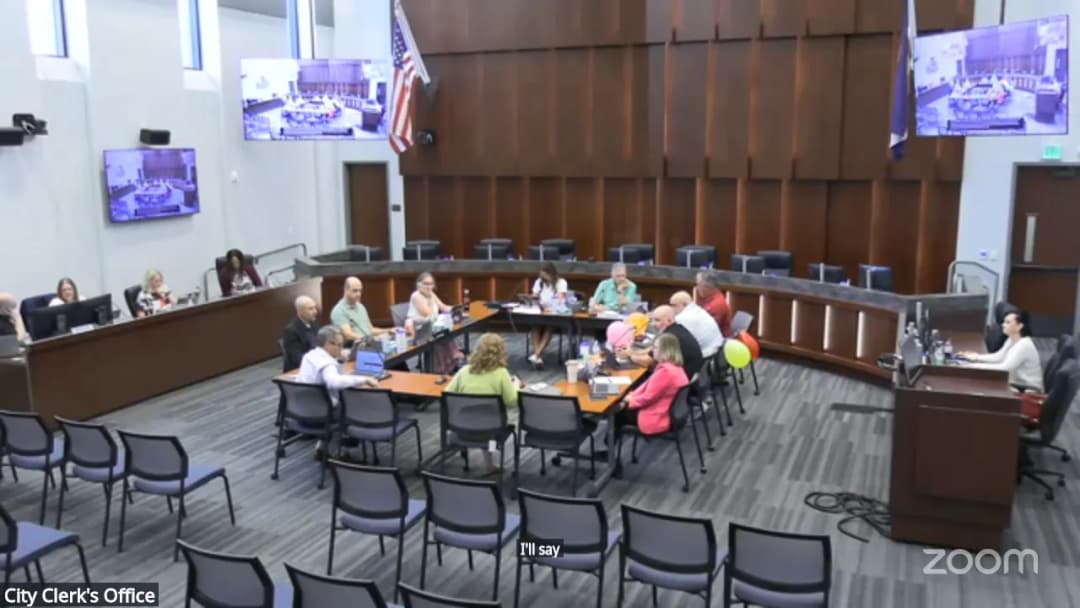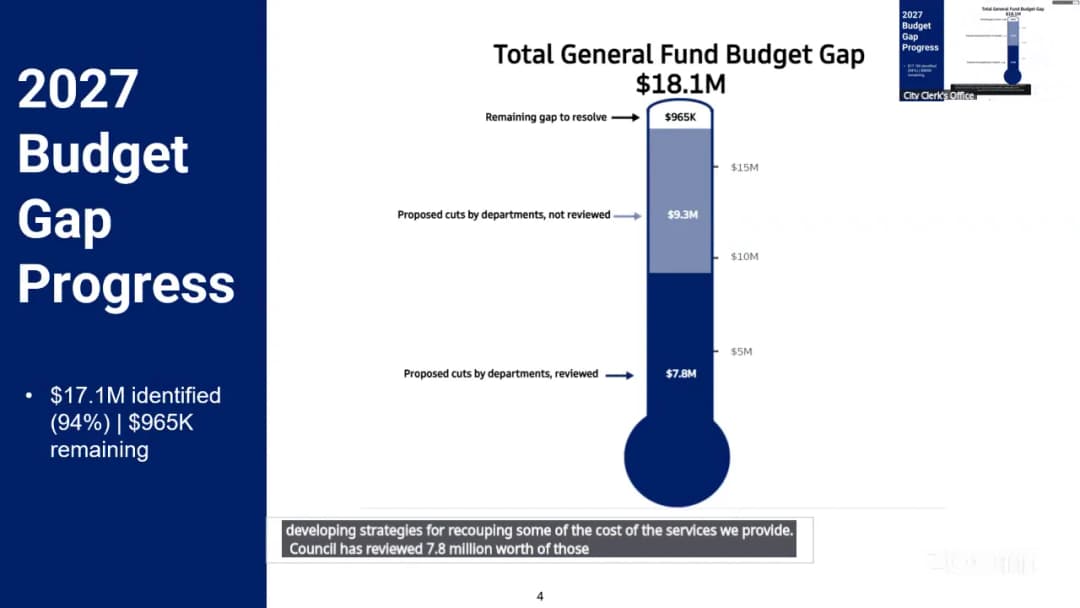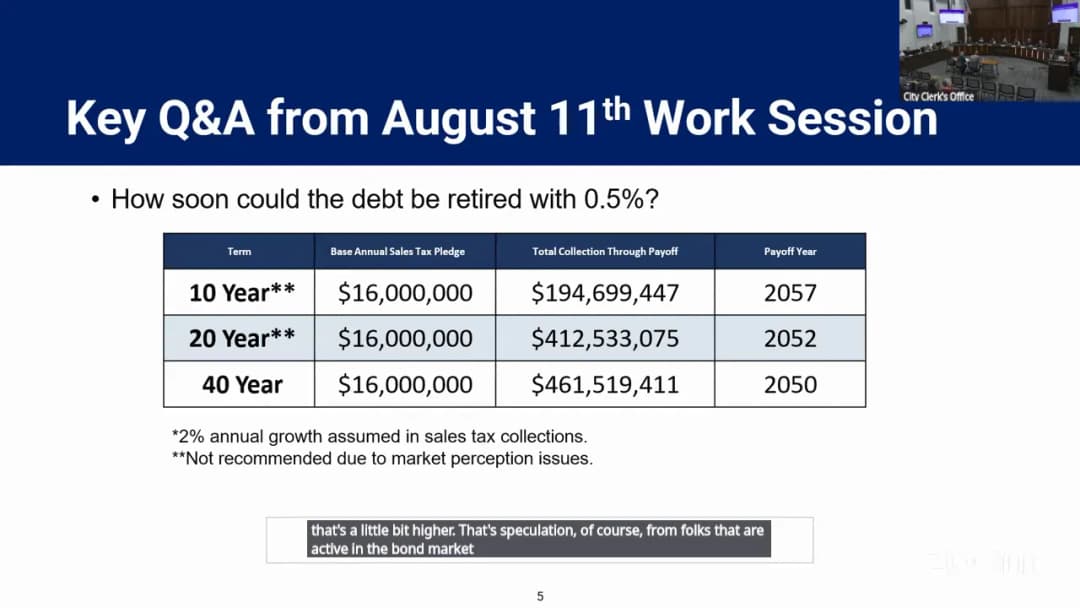
The Greeley City Council held a work session on August 25, 2026, beginning at 5:00 PM and adjourning at 8:12 PM. All seven council members were present. The session covered the annual audit presentation, proposed comprehensive financial policies, the second‑quarter financial update, long‑range financial projections, and a follow‑up discussion on a potential ballot measure for a tax increase. No formal votes were taken; the session was informational and deliberative. Executive Session - Council approved a motion to enter executive session to receive legal advice regarding a proposed ballot measure concerning a tax increase. The transcript does not include the executive session discussion. Audit Presentation (Plante Moran) - Tim St. Andrew, partner at Plante Moran, presented the results of the financial statement and single audit for the year ending December 31, 2025. The city received an unmodified opinion—the highest level of assurance. Key highlights: - General fund balance decreased $16 million from 2024 to $52.1 million; $38.9 million of that is unrestricted. - Combined utility operations (water, sewer, stormwater) had a $109 million unrestricted net position at year end. - The city invested $203 million in infrastructure in 2025, including the issuance of $115 million in certificates of participation (COPs) for the West Greeley development project. - Councilmember DeBoutez expressed appreciation for the audit team’s work, noting that past audits had been a “source of stress and anxiety.” Comprehensive Financial Policies - Finance Director Kirk Jones presented a proposed framework consolidating the city’s existing financial policies into a single document. The framework organizes 11 policy areas (e.g., reserves, debt, grants, capital assets) and introduces new policies on real property acquisitions and donation governance. - Key provisions discussed: - Reserves: General fund contingency reserve equal to two months of expenditures (consistent with GFOA best practices). - Debt: Bond maturities capped at 30 years; refunding requires net present value savings exceeding 3% of refunded maturities; interfund loans beyond one year require council approval. - Grants: Grants exceeding $500,000 or requiring unbudgeted match come to council; the city may recover indirect costs up to 15%. - Donations: Donations over $10,000 or involving real property require council approval. - Councilmember Olson asked about enforcement and the need for a process to evaluate new programs funded by grants that lead to ongoing personnel costs. Councilmember Olson and others emphasized that the framework consolidates existing practices and does not change current operations. 2026 Second Quarter Financial Update - Robert Miller, budget office, presented economic conditions and revenue trends through June 30, 2026: - Sales tax: Grew 4.3% through five months, below the budgeted 5.6%. - Construction revenues: $8.2 million above budget, driven by multifamily development (primarily Union Colony). - Oil and gas: Expected to exceed budget. - Interest earnings: Projected $7 million above budget through June. - Overall general fund impact: Expected positive $1.8 million (including $1.2 million from prior‑year reconciliations). - Councilmember Olson noted that while residents complain about high utility and food costs, the city’s tax revenue from utilities and food is below budget, likely due to “trading down” behaviors. Long‑Range Financial Update - Nathan Mosley, budget director, presented the city’s five‑year general fund projection. The city has faced a structural deficit since 2023, with expenses exceeding revenues. To address this, the 2027 budget process used target‑based budgeting with reduction targets of 4%, 17%, and 25% for departments based on council priorities. - Key assumptions and outcomes: - The 2027 recommended budget closes the structural gap in the out‑years (2028–2031), but 2027 expenditures will still exceed projected revenues; one‑time carryover funds ($1.1 million from 2025 and an estimated $1.8 million from 2026) are used to balance. - No annual salary increases are programmed for 2027; instead, a 2% bonus for staff and 1% for executives is included. - Remaining gap of about $1.3 million (from departments like CPRD, OEM, municipal court, and the police precision contract) is covered by carryover funds. - Council discussion focused on the need for guardrails on grant‑funded positions, the impact of the compensation plan adopted in 2022, and the desire for a structurally balanced budget (Councilmember Rudy). Councilmember Olson asked for a list of programs added since 2022 that contributed to the deficit. Councilmember DeBoutez requested a service‑level impact analysis if CPRD were cut 17% across the board. Ballot Measure Follow‑Up - Brian McBroom and Stacey Arzeda provided information for a potential November 2026 ballot question to fund the West Greeley Catalyst project and the Civic Campus. Staff recommended a 0.6% sales tax increase (0.5% for Catalyst, 0.1% for Civic Campus) for 40 years to achieve credit enhancement for revenue bonds. - Key details: - A 40‑year tax would allow the Catalyst project to be paid off by 2050 (29 years early), saving approximately $200 million in debt service. - The city’s credit rating could improve from BBB to at least A, reducing future borrowing costs. - Staff now recommends funding Civic Campus COPs entirely from food tax, rather than general fund and quality‑of‑life funds. - Councilmembers expressed diverse views: - Councilmember Olson advocated for solving the $377 million combined debt burden (Catalyst, Civic Campus, and Merger) and wanted a clear list of deferred CIP projects if the tax fails. He noted that the 40‑year term was a “hard pill to swallow” but saw it as necessary for credit enhancement. - Councilmember Huddleston favored a 20‑year term but would support putting a question to voters; he was concerned about uncertainty in construction costs and the bond market. - Councilmember Roth opposed the 40‑year length and said he could not support a combined “both pass or both fail” question; he was open to a ballot question only for West Greeley. - Mayor Pro Tem McDonald stated she was “completely out” if the measure did not address both projects, but warned that adding Civic Campus without solving West Greeley’s debt was irresponsible. - Councilmember DeBoutez said the 42‑day timeline before ballots mail was too short, and she would not support a tax increase this year. - Councilmember Rudy wanted a flat, structurally balanced budget and did not want to use one‑time money for ongoing expenses, implying opposition to a new tax. - The Mayor asked for consensus to place a question on the November ballot. No consensus was reached; the council effectively decided not to proceed with a ballot measure resolution for the upcoming election. Scheduling and Adjournment - City Manager Brian McBroom reminded council of employee pictures at Island Grove Park the next day. - The work session was adjourned at 8:12 PM. Key Outcomes - No consensus to place a ballot question on the November 2026 election; the council will not advance a tax increase measure at this time. - The comprehensive financial policies will be further refined and brought back for formal adoption after additional council feedback. - The 2027 budget process will continue, with a budget retreat scheduled for September 11, 2026, and adoption anticipated in October–November. - Council directed staff to provide analysis of uniform 17% cuts by department and their service impacts. - Council expressed desire for guardrails to prevent future structural deficits, particularly around grant‑funded positions.
Public Meetings - Greeley, Colorado
Public Meetings - Greeley, ColoradoThe Greeley City Council held its regular meeting on Tuesday, August 18, 2026, from 6:00 PM to 9:09 PM. The meeting featured extensive public testimony on automatic license plate readers (ALPRs), the Catalyst/Cascadia project debt, and proposed budget cuts to museums and natural areas. The Council voted unanimously on several major actions, including the annexation of the Great Western Industrial Park (GWIP) and the Arroyos del Sol natural area, and approved a resolution preserving the option for a November 2026 ballot measure. Consent Calendar - Approved the City Council Meeting Proceedings of July 21, 2026, and the Work Session Proceedings of July 28, 2026. - Authorized a consulting contract with Stanton Constructability Services LLC for cost estimating. - Authorized a contract with Otak, Inc. for Trail Design Services. - Item 12 (MCI Grant) was pulled for separate discussion. Public Comments & Testimony Automatic License Plate Readers (Flock Safety): Multiple speakers, including Spencer Milne, Kevin Freestone, Chris Johnson, Catching Valentinis, Alyssa Milne, Andy, and Jesse Mongan, opposed the ALPR contract. They cited the lack of a public vote, the $166,000 cost for 17 cameras and 2 audio detectors, Fourth Amendment concerns, potential for misuse by law enforcement, and called for the immediate termination of the contract and removal of all cameras. Catalyst/Cascadia Project & Proposed Sales Tax: A significant number of speakers opposed the project and the proposed 0.5% sales tax increase to cover the debt. Jim Riesberg and Mary Monohan criticized the council for ignoring prior public votes. Tiffany Simmons presented a timeline of spending, suggesting earlier pauses could have saved millions (estimating $68.6 million spent by February). Jeff Kennedy, while against the project, supported a dedicated sales tax to avoid cutting other city services from the $90 million debt. Tom Pfankuch supported a sales tax increase, noting Greeley has the lowest combined rate among the ten largest Colorado cities. Brandon Wark and Evan Peterson spoke in opposition to the tax, stating it unfairly burdens lower-income residents. Natural Areas, Trails & Museums: Speakers urged the council to maintain funding for natural areas and museums. Saria Mowrer and CJ Mowrer spoke about the mental health benefits of the natural areas. Ulli Limpitlaw noted that 17 of the 20 largest Colorado cities have a dedicated sales tax for natural areas, while Greeley does not. Dr. Chris Bowles, former museum manager, stated the proposed budget cuts violated the city's ordinance obligations and went against staff recommendations. David Simmons spoke about the educational value of the museums. Great Western Industrial Park (GWIP) Annexation: Mayor of Windsor Julie Cline and Town Board member Ron Steinbach requested a pause for intergovernmental collaboration. Greg Flebbe, former Greeley planner, opposed the annexation, citing alleged outstanding violations and zoning incompatibilities. Bill Gillard and Jeff Kennedy supported the annexation for bringing industrial and blue-collar jobs. Arroyos del Sol Annexation: Mayor Julie Cline spoke in support of the annexation if it preserved the shared community separator vision between Greeley and Windsor, noting Windsor contributed $250,000 towards the original purchase. Other Issues: Ripley Casdorph requested addressing late start times for senior hockey leagues. Kenneth Howell requested safety improvements at bus stops on West 11th Street. Pam Bricker thanked Councilmember DeBoutez for her service. Discussion Items - Pulled Consent Item 12 – MCI Grant Program Authorization: Mayor Pro Tem McDonald expressed concern about the lack of a sustainability plan for hiring positions funded by the grant. Chief of Police Adam Turk acknowledged that no ongoing local funding source had been identified, stating the grant application is for up to $50 million. He noted that a potential public safety tax had not been ruled out. The resolution passed 7-0. - Items 14 & 15 – Great Western Industrial Park (GWIP) Annexation and Zoning: Don Threewitt presented the staff report for the 325.63-acre property. The Planning Commission recommended approval 4-1. The applicant, Mark Savala of BRO Real Estate Group, stated the primary driver for annexing into Greeley was access to water services. During council deliberation, Savala clarified that the property is not 99% surrounded by Windsor (closer to 50%) and that his firm is not associated with Global AI or open violations. Councilmember Huddleston expressed excitement for the job potential. Mayor Pro Tem McDonald noted that intergovernmental talks with Windsor had been unproductive. All 15 serial annexations and the I-H / C-D zoning ordinance passed unanimously (7-0). - Items 16 & 17 – Arroyos del Sol Annexation and Zoning: The Council approved the annexation and C-D (Conservation District) zoning for the 999.72-acre city-owned natural area. A clerical error in the zoning ordinance (which referenced "Kennison Annexation") was corrected. The motion to amend and approve the ordinances passed 7-0. - Item 18 – Resolution for 2026 Coordinated Election IGA: City Clerk Heidi Leatherwood presented the resolution. She clarified that approving the IGA preserves the option for a November ballot measure without a financial commitment, which is triggered only upon submitting ballot content by September 4th. The estimated cost is approx. $180,260 ($2.50/voter x 72,104 voters). Councilmember Huddleston conditioned his support on ensuring the Civic Campus COPs are not put at risk or delayed. Councilmember DeBoutez stated she would not support a ballot question that included the civic campus component. The resolution passed 7-0. - Initiatives from Councilmembers: Councilmember Rudy requested staff explore bus or shuttle coordination with UC Health at Highway 34 and 59th Avenue. Council reached consensus to direct staff on this matter. Key Outcomes - Votes: - Approved consent items 9, 10, 11 (7-0). - Approved Item 12 (MCI Grant Application) (7-0). - Approved all 15 GWIP Serial Annexations and the associated I-H / C-D Zoning (7-0). - Approved the Arroyos del Sol Annexation and Zoning, including a clerical correction (7-0). - Approved the Resolution for the 2026 Coordinated Election Intergovernmental Agreement (7-0). - Appointed Justin Yeater to the Planning Commission for a three-year term. - Directives & Next Steps: - Staff to explore public transit access to the UC Health hospital. - Council to discuss ballot language and potential November 2026 ballot measures at the August 25th Work Session and the September 1st Meeting.
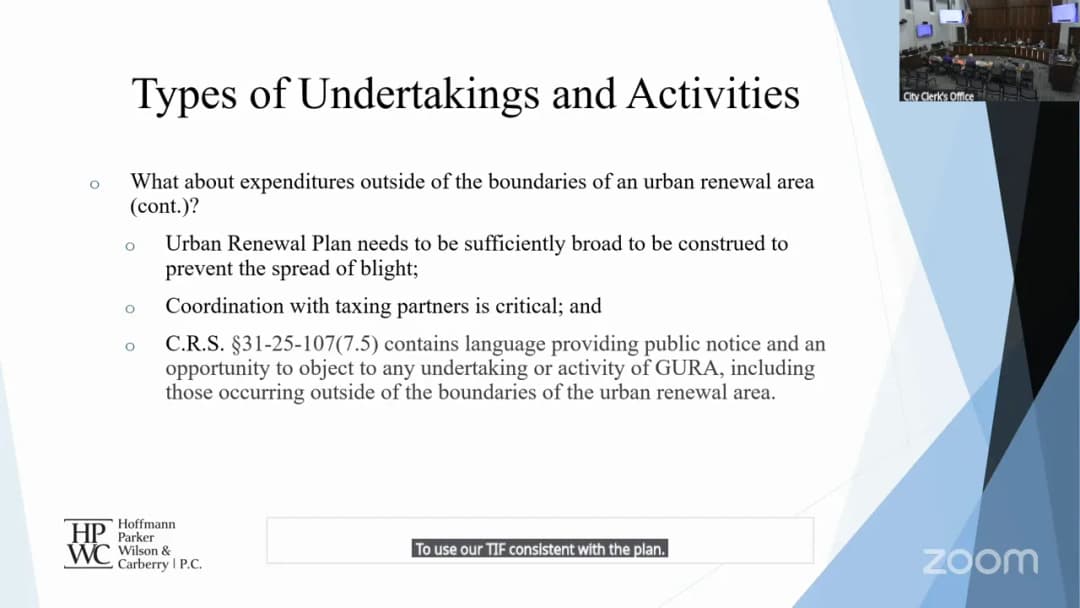
The Greeley City Council held a work session on Tuesday, August 11, 2026, at 6:00 PM in the City Council Chambers. The session included a presentation from the Greeley Urban Renewal Authority (GURA) on urban renewal law and Tax Increment Financing (TIF), a progress update on the MERGE (US Highway 34) project, and extensive deliberation on a potential November 2026 ballot question asking voters for a 0.5% sales tax increase to fund the Catalyst (West Greeley) and Civic Campus projects. No formal votes were taken, and several items were tabled for further discussion at the August 25 work session. Reports from Mayor and Councilmembers - Councilmember Johnny Olson raised concerns about the closure of a bus route serving Northridge and Toiton, leaving students with a one-mile walk to school. He asked Council to reach a consensus to pause the cancellation pending further evaluation. He also alerted staff to recurring issues with streetlights on 20th Avenue west of the AIMS campus entrance, a heavily used pedestrian corridor in the evenings. - Councilmember Ryan Roth acknowledged the tragic loss of life resulting from a weather incident (microburst) on Highway 34/85 in East Greeley, thanking the Fire and Police Departments for their swift response. He also issued a lighthearted challenge to country music artist Ashley McBride, inviting her back to Greeley to experience its music and entertainment scene firsthand. Greeley Urban Renewal Authority (GURA) Presentation and Discussion - Presenters: Don Threewitt (Interim Community Development Director), Corey Hoffman (GURA Counsel), Kelli Johnson (Deputy City Manager), and members of the GURA Board. - Purpose: To build a shared foundation of understanding between Council and the GURA Board to inform future visioning work. - Urban Renewal Framework: Mr. Hoffman explained that urban renewal is a legislative tool to address blight. A property must meet four of several statutory blight criteria. The City Council is the policymaker that identifies blight and approves plans, while GURA implements those policies as a separate body corporate and politic. - Tax Increment Financing (TIF): The primary tool for urban renewal. A base property value is set. Revenue from the base continues to go to taxing entities. Revenue from increased property value (the increment) is captured by GURA for blight remediation over a maximum of 25 years. City Council can also choose to apply a sales tax increment. - Expenditure Outside Plan Area: Councilmember DeBoutez asked if TIF from one area could be transferred to another. Mr. Hoffman explained it can only be done with a demonstrable nexus connecting the expenditure to preventing the spread of blight within the originating area. Councilmember Olson suggested that a proposed pedestrian underpass on 17th Street could serve as such a nexus for the Greeley Mall TIF area. - House Bill 1348 (2015): Compliance is triggered by new plans or substantial modifications. Requirements include expanding the GURA Board to 13 members (with appointees from Weld County, a special district, and the school board) and mandatory negotiations and potential binding mediation with taxing entities. Councilmember DeBoutez sought clarification on what constitutes a "substantial modification"; Mr. Hoffman stated the determination is largely subjective and suggested working with taxing entities to confirm the characterization. Routine undertakings within an existing plan area do not trigger compliance. - TIF Bonding Authority and Fund Sunset: Bonding capacity is determined by projected TIF generation over the bond term. Unpledged funds in the special fund at the end of the 25-year TIF collection period must be returned to taxing entities on a pro-rata basis, except for sales tax increment and grant-derived funds. MERGE Council Update - Presenters: Seth Sorensen (Public Works Director), Matt Bournonville and Scott Richrath (Infrastructure Strategies). - Status: This was the first of a regular update cycle, with subsequent updates planned for October and December 2026. - Progress Milestones: The RAISE grant has been finalized. RSNH was awarded the Master Services Agreement and has initiated work towards the 30% design milestone. All sub-teams (interchanges, environmental, utilities, right-of-way) are fully mobilized. A CMGC RFQ has been issued, with interviews for shortlisted firms scheduled for August 25 and 26, and an award expected by early October. - Schedule and Delivery: Milestones have been met. Initial construction is targeted for late 2027 or early 2028, with the project concluding in 18 to 24 months. Federal grant funds must be utilized by September 30, 2030. Councilmember Olson commended the team for its progress since the March 2026 rebaseline, highlighting that the CMGC method aims to maximize savings. - Budget and Cost Range: The initial 2025 estimate of $134 million was developed prior to engaging a design engineer and cost estimator. The revised cost range is now $160 million to $190 million, reflecting a clearer understanding of the project's complexity (two interchanges and a mobility hub on US Highway 34). A specific cost figure cannot be provided until the CMGC contractor is onboard. - Financing and TIFIA: Councilmember DeBoutez asked if the TIFIA loan application could be rejected. Mr. Richrath said a compliant application is expected, but the timing of the rural discount interest rate is critical and requires congressional engagement. Councilmember Olson confirmed the rural designation is a limited resource and the city must actively engage its congressional delegation for support. Mayor Pro Tem McDonald asked directly if the project would be completed; Mr. Richrath and Mr. Bournonville stated a clear path forward exists, with more certainty once the CMGC contractor is onboard. - Funding Commitments: Councilmember Olson noted that $30 million in voter-approved funds from the 2016 ballot measure (KGM funds) remain part of the project's funding structure, emphasizing the importance of honoring that commitment. Mr. Sorensen noted that state involvement is a hope but the city's strategy is based on funding sources within its control. 2026 Ballot Question Discussion - Presenter: City Manager Brian McBroom. - Background: Council directed staff to explore a ballot question following a recent executive session. - Projects Under Consideration: - Civic Campus: $85 million in new debt, with estimated maximum debt payments of $8 million annually, funded through existing revenues. A first COP issuance is tentatively scheduled for September 1, 2026. - Catalyst (West Greeley): Existing debt of approximately $115 million ($92-93 million spent). Estimated debt payments would be $7 million annually if converted to long-term debt. An economic development payment beginning at $12 million annually (escalating at 2% per year) is required over the 40-year bond term. Mr. McBroom noted that no viable financial model currently exists without a financial partner or a dedicated revenue source. - Proposed Tax: A 0.5% increase to the city sales tax rate (from 4.11% to 4.61%) for economic development purposes. A resolution placing the question on the November ballot must be adopted by September 1, 2026. - Council Positions: - Councilmember DeBoutez advocated for separating the two projects into distinct ballot questions. She argued that the Civic Campus funding is already secured and that combining the projects risks voter confusion. She favored a simple question dedicated solely to funding the Catalyst project. - Councilmember Rudy expressed philosophical opposition to a tax increase and a preference for finding a private partner. However, he acknowledged that a combined ballot question for both projects would free up general fund monies for deferred capital improvement projects (CIP). He opposed broad ballot language that would allow the council to spend excess revenues on other projects. - Councilmember Olson supported a combined ballot question for both projects. He argued that a 40-year tax term (matching the revenue bond term) would enhance the city's bond rating, potentially saving over $100 million in interest. He emphasized the need for very specific ballot language focused on paying down the debt for these two projects, after which the tax would sunset. - Mayor Pro Tem McDonald strongly advocated for combining both projects into a single question to unite the community and end the perceived divide between "downtown versus West Greeley." She supported dedicating all excess revenues to deferred CIP projects rather than broad economic development. - Councilmember Roth expressed hesitation about the tax increase, citing low public trust, but leaned towards a combined effort to ensure the whole community is invested. He wanted information on the ramifications of not putting a measure on the ballot. - Mayor Hall stated he was not in favor of a tax increase, but acknowledged the difficult position created by the Supreme Court ruling (February 24th). He felt private partnership opportunities should still be explored. - Key Clarifications: CFO Allena Portis explained that the $12 million economic development payment for the Catalyst project is deposited into a supplemental debt service reserve fund to provide a 1.5x debt service coverage ratio. If not drawn upon, the funds return to the city. Mr. McBroom stated that the structural deficit is expected to be resolved in the 2027 budget, and that absent a ballot measure, the three major projects (Civic Campus, Catalyst, MERGE) are covered, but the deferred CIP list would continue to be negatively impacted. Key Outcomes - No formal votes or decisions were made on the ballot question. - Council agreed to place further discussion on the August 25, 2026, work session agenda to allow time for new information to be circulated and reviewed. - Staff directives for the August 25 meeting: - Provide detailed information on how tax term lengths (10, 20, and 40 years) would impact the city's bond rating. - Draft separate ballot question language: one combining Catalyst and Civic Campus, and one for a narrower scope. - Provide a complete list of deferred Capital Improvement Projects (CIP) that would be impacted. - Report on the specific ramifications of not issuing the Certificates of Participation (COPs) for the Civic Campus project by the September 1 or December 31 deadline. - The meeting adjourned at 8:23 PM.
The Greeley City Council convened for a regular meeting on Tuesday, August 4, 2026, at 6:00 PM. Mayor Pro Tem Melissa McDonald chaired the meeting in the absence of Mayor Dale Hall. The meeting featured several proclamations, a major downtown development agreement, annexation discussions, and the approval of federal HUD funds. The council also authorized an executive session to discuss legal strategy regarding the West Greeley Catalyst Project. Note on meeting timing: There is a discrepancy between the official meeting minutes, which record the executive session beginning at 8:29 PM, and the meeting transcript, which states it began at 8:17 PM. Note on HUD funding amounts: There is a discrepancy in the stated funding figures. The meeting minutes record Housing Director Deb Callies stating the allocation was $2.4 million against $4.4 million in requests. The meeting transcript records her making the same statement, followed by Housing Investment Manager Cece Cervantes stating the allocation was $2.48 million against $4 million in requests. Proclamations, Recognitions, and Presentations - Mayor Pro Tem McDonald presented the Certificate of Achievement for Excellence in Financial Reporting from the GFOA to Finance Director Kirk Jones and the finance team for the city's 2024 Annual Comprehensive Financial Report. - A proclamation was read declaring August 2026 as National Emergency Management Awareness Month, accepted by Emergency Management Director Peter Perez and partners from School District 6, Aims Community College, UNC, and area hospitals. - A proclamation was read for the 10th Anniversary of Greeley Monster Day, accepted by co-creators Ed and Marsha Edmonds. Daniela Hernandez announced the event for August 21-22. - Councilmember Roth presented the "What's Great About Greeley" report, highlighting the restoration of the "Prize Catch" statue, the opening of UNC's new College of Osteopathic Medicine, and the 50th anniversary of Centennial Village Museum. - Dr. Michael Welsh presented the second edition of Confluence, The Story of Greeley Water in collaboration with the City of Greeley Water and Sewer Department. Consent Calendar The following items were approved unanimously (6-0) as part of the consent agenda (Items 9-13, 15-17, 19-21): - Approval of proceedings from the July 7 and July 14, 2026 meetings. - A work order with Na Ali'i Companies for Cameron Peak Fire Mitigation design services. - A settlement agreement resolving claims against the city. - An Intergovernmental Agreement with the Greeley Urban Renewal Authority. - Authorization for the City Attorney to take legal action on property at 2495 28th Street. - Authorizations to provide fire protection services and commence court action to exclude properties from the Windsor-Severance and Eaton Fire Protection Districts for the Cache, Seeley Lake, Willow Vista, Schmerge, and Kinnison Annexations. - First reading of an ordinance changing the official zoning map for the Great Western Industrial Park (GWIP) property to I-H and C-D (Item 19). - First reading of an ordinance annexing the Arroyos del Sol property (Item 20) and its associated zoning map change to C-D (Item 21). Note: Items 14 and 18 were pulled from the consent agenda for separate discussion. Public Comments & Testimony - Kathy Hasch criticized the city's risk-taking on the Catalyst project, supporting Weld County's decision to decline participation in financing. - Bill Gillard spoke against potential regulations on artificial turf and expressed privacy concerns regarding the Flock Safety camera system. - Ashley White (Butterfly Pavilion) advocated against budget cuts to the Natural Areas and Trails department, emphasizing its ecological and community benefits. - Kevin Pierce (Wildlands Restoration Volunteers) urged the council to avoid additional cuts to Natural Areas and Trails, citing over 1,700 hours of volunteer service and strong community partnerships. - Scott Royer requested the painting of an unpainted speed bump on 16th Street and spoke about his plans for the 100th anniversary of Charles Lindbergh's flight. - Kenneth Howell criticized city staff for failing to answer council questions during budget presentations, urging accountability at the September 11th budget retreat. He later commended Housing Solutions staff during the HUD hearing. - Tiffany Simmons questioned the timing and motivations of the GWIP annexation, raising concerns about enclave creation, service capacity, and links to the Catalyst project and Global AI. - Peggy Sue Squires called for a public vote on the Cascadia project. - Louise Wilson reported increased accidents on 23rd Avenue and opposed a potential data center over water contamination fears. - Mary Metzger urged humility and stewardship over ambition regarding the GWIP annexation and data center. - Kris Simmons (spoke during council initiatives after being missed in regular citizen input) urged termination of the Flock Safety contract, citing a recent Supreme Court ruling. Discussion Items Item 14 – Civic Campus Development Services Agreement Deputy City Manager Kelli Johnson and Senior Strategic Advisor John Hall presented the agreement for the downtown project involving the City, Weld County, and School District 6. - Richmark Vertical would serve as development manager (5% fee on hard costs) and Thrash Development as general contractor (4% fee). - Incentives for a minimum 80-room hotel include $4.7 million in gap funding, a 10-year lodging tax rebate capped at $1.5 million, and a $200,000 land sale. - Incentives for 160 market-rate apartments include $4 million in gap funding and fee rebates. - Councilmember Huddleston confirmed $8.7 million of the incentives were already designated in the city's redevelopment fund since 2023. Adam Frazier of Richmark Vertical confirmed the project was not bankable without incentives, citing a 20% increase in steel costs since year-end. - Councilmember Olson noted the total incentives amounted to approximately $24 million (28% of the overall budget) and voted no, arguing the city should resolve the West Greeley Catalyst budget issue first. - Outcome: The motion passed 5-1. Item 18 – GWIP Serial Annexations (First Reading) Interim Community Development Director Don Threewitt answered questions. - Councilmember DeBoutez confirmed the city can provide adequate services and that no enclave is created. - Councilmember Olson confirmed the annexation was petitioned by the property owner (Bro). - Mr. Threewitt was asked to research whether a gas turbine or energy facility is a permitted use under the proposed I-H zoning for the second reading. - Outcome: The motion to introduce the 15 ordinances and schedule the second reading for August 18, 2026 passed 6-0. Item 23 – 2026 HUD Annual Action Plan Housing Director Deb Callies and Housing Investment Manager Cece Cervantes presented the plan. - A proposal to change the HUD program year from a calendar year to a fiscal year (ending June 30) was included to better align with HUD regulations. - The public hearing featured support from Kenneth Howell (Housing for All Advisory Board) and Melanie Faure (Upwards), as well as criticism from Ashley Fusco regarding the disparity in scrutiny between this item and the Civic Campus incentives. - Outcome: The resolution was approved 6-0. Item 24 – Third Supplemental Appropriation Ordinance (2026) Budget Director Nathan Mosley presented an $84.815 million appropriation. - $84.65 million for the Civic Campus project and COP issuance costs. - $41,250 local match for a DOLA housing needs grant. - Councilmember Olson asked to separate the items but was told only an ordinance amendment could do so. - Outcome: The ordinance was adopted 5-1. Key Outcomes - Civic Campus Dev Agreement (Item 14): Approved (5-1). - GWIP Serial Annexations (Item 18): First reading approved (6-0). Second reading scheduled for August 18, 2026. - 2026 HUD Annual Action Plan (Item 23): Approved (6-0). - 2026 Supplemental Budget Appropriation (Item 24): Approved (5-1). - Executive Session (Item 25): Authorized (6-0) to discuss legal strategy for the West Greeley Catalyst Project.
The Greeley City Council held a work session on July 28, 2026, beginning at 6:00 PM and adjourning at 7:24 PM. The session included reports from councilmembers, a discussion on the Landscape Code Update, and a review of the proposed 2027 Capital Improvement Plan (CIP). No formal votes were taken, as this was a work session intended to gather council feedback. Reports from Mayor and Councilmembers - Mayor Hall reported that CDOT completed a traffic study on 10th Street (43rd to 71st Avenue) and reduced speed limits: the previous 55 mph zone is now 50 mph, and the 45 mph zone is now 40 mph. - Councilmember Roth recognized outgoing UNC President Andy Feinstein for eight years of service, noted the ribbon cutting for the new Osteopathic Medicine School, thanked Parks and Recreation for the Arts Picnic, and the Water Department for a prompt response to water system issues. - Councilmember Rudy attended a ride-along with the Greeley Police Department, thanking Chief Turk and Officer Julian Vasquez for their professionalism. - Councilmember Huddleston attended the Weld County Fair, highlighting youth participation and the community's agricultural heritage. Landscape Code Update - Interim Planning Manager Caleb Jackson and Senior Manager of Code Compliance Buxton Demers presented a draft landscape code update and compliance strategy. The draft clarifies that the required 50% live planting in front yards must be perennial plants (annuals allowed but not counted), and recodifies tree mitigation provisions inadvertently omitted from prior updates. - Artificial Turf: Council had diverging views. Councilmember DeBoutez opposed artificial turf citing impervious surfaces, urban heat, microplastics, and harm to trees. Councilmembers Olson, Rudy, Roth, and Huddleston supported allowing turf with strict standards (permit, licensed installer, permeable base, drainage, and continued tree/live planting requirements). Mayor Hall wished to review specific code language before committing. Staff will refine the draft and return for Planning Commission review and formal adoption. - Compliance Strategy: Staff recommended a priority-based approach focusing on nuisances (bare dirt, erosion, tall weeds, dead landscaping, abandoned yards) over maintained but technically non-compliant yards. Council generally supported this. Councilmember Olson raised concern that city-owned properties often fail to meet the same standards, undermining enforcement credibility, and suggested escalating fines for non-cooperative owners. Staff will explore alternative compliance or minor variance pathways for properties seeking to go below the 50% live planting threshold. - Statistics: In 2025, 200 landscape cases were opened, 99 scheduled for hearing; through June 2026, 66 cases had already been opened. 2027 Capital Improvement Plan Budget Review - Deputy Director of Budget and Policy Kalen Myers presented the proposed 2027 CIP, noting it is more constrained due to three simultaneous large capital commitments: the West Greeley project (20-year debt), downtown revitalization (new city hall via COP and utility work), and the MERGE project (Highway 34 interchange improvements). These consume substantial flexible funding (food tax, quality of life), leaving limited capacity for other priorities. - The proposed 2027 CIP includes approximately 150 projects across 24 funds, with over 80% allocated to water/sewer/stormwater and transportation categories (largely restricted funding). Annual maintenance and replacement funding was reduced by 25% (from $5.6 million to $4.2 million per year for three years) to maintain cash flow for strategic projects. - Deferred projects include HVAC replacements, facility upgrades, irrigation systems, playground replacements, and a water/sewer facility campus. Staff emphasized these are deferred, not removed, and will be monitored. - Councilmember Olson urged prioritizing deferred maintenance (e.g., moving it up before major debt payments in 2028/2029) and questioned large cash balances in food tax ($2.9 million) and quality of life ($4.4 million) funds, suggesting those funds should be programmed for projects. Myers explained that balances are being conserved for future debt obligations and that as costs firm up, additional appropriations may be possible. - Councilmember Huddleston asked about lead times for critical equipment (transformers 52 weeks, ice rink refrigeration 48 weeks) and suggested phasing large projects like the Highland Hills Golf Course irrigation replacement ($6.5 million). Staff confirmed proactive procurement and phasing discussions are underway, and an asset management framework will be presented to council soon. - Councilmember DeBoutez noted that some smaller dedicated funds carry significant balances and could be redirected. She also expressed concern about the September 11th retreat being late for major budget changes; Mayor Hall clarified that statutory deadlines allow for later adoption this year. - Mayor Hall acknowledged the structural deficit discussions and that departments have worked to address it. Staff will incorporate council feedback and bring an updated CIP to the September 11th work session retreat. Key Outcomes - Landscape Code: Council supported: (1) clarifications to front yard standards requiring 50% perennial live planting and recodifying tree mitigation; (2) allowing artificial turf in front yards via permit with strict installation and design standards, contingent on reviewing final code language; (3) adopting a priority-based compliance strategy focusing on nuisance conditions, and exploring variance pathways for properties below 50% live planting. Staff will present a refined ordinance to Planning Commission and then to Council for formal adoption. - 2027 CIP: Council provided initial feedback, including emphasis on deferred maintenance, phasing large projects, and evaluating fund balances. Staff will refine the proposal and present a detailed review at the September 11th retreat, with formal budget adoption expected later in the fall.
The Greeley City Council held its regular meeting on Tuesday, July 21, 2026, at 6:00 PM in the City Council Chambers and via Zoom. The meeting included recognitions and proclamations, citizen input on budget cuts and transparency, public hearings on municipal code amendments, and a resolution for legal services related to the West Greeley project. The council approved the consent agenda, adopted two ordinances, approved the legal services work order, and made multiple appointments to boards and commissions. An executive session was held to discuss litigation and negotiations with the Town of Windsor. All votes were unanimous (7-0) where recorded. Recognitions and Proclamations - Mayor Hall read a proclamation declaring July 21, 2026, as "America 250 Colorado 150 Day" in Greeley. Representatives from the Greeley Exchange Club and Union Colony Exchange Club accepted. Karen Zach announced the Field of Flags event at Bittersweet Park from July 31 to August 2, with a formal program on August 1 at 10:00 AM. - Councilmember Olson presented the "What's Great About Greeley" report, highlighting Aims Community College's designation for supporting student basic needs, the city's Excellence in Community Engagement award from the American Water Works Association for lead service line outreach (one of only three communities nationwide recognized), and employee Chris Regal's GIS professional certification (fewer than 5,500 holders worldwide). Public Comments & Testimony - Kathy Hasch expressed concern over increased utility costs and city spending, urging a conservative approach to avoid bankruptcy. - Bill Gillard praised the Link Library and opposed Item22 (legal services contract), citing a conflict of interest. - Marshall Clough opposed proposed budget cuts to museums, emphasizing their role in preserving Greeley's unique historical heritage. - Paula Ikenoriye spoke against cuts to natural areas staff and proposed a cannabis tax for revenue. - Marcus Embry (Chair of the Museum Advisory Board) stated that the Culture, Parks, and Recreation Department (CPRD) excluded the board from budget deliberations and requested documents by July31; noted a proposal to cut museum staff from 16 to five. - Geoffrey Havens supported the board's request for information and asked council to direct staff to provide the requested documents and involve museum professionals. - Steve Teets requested updated contracts for transit programs and regulations for e-bikes and e-scooters, citing safety concerns. - Gabrial Llanas criticized CPRD leadership for not considering alternatives to museum cuts and asked council to review a museum-prepared budget. - Scott Royer commented on declining water levels at Lake Loveland. - Eli Wilcox criticized budget cuts while the city continues spending on the Cascadia project and a $200,000 consultant, calling for fiscal responsibility. - Peggy Sue Squires urged council to pause the Cascadia project until basic needs are met. - Tiffany Simmons highlighted loss of trust in council, cited lack of transparency, and the conflict-of-interest perception around the legal contract with a former council member. - Mary Monohan spoke about proposed budget cuts and trail maintenance concerns. - Kris Simmons urged council to reject Item22 outright and establish a cooling-off period for former elected officials receiving city contracts. Discussion Items - Appointment of Carmody Lee as Region4 Trustee to the High Plains Library District Board was ratified (part of consent agenda). - Public hearing and second reading of an ordinance amending city code references to City Hall (procedural update for temporary location) was adopted 7-0 after no public comment. - Public hearing and second reading of an ordinance amending contractor licensing requirements extended licensing to general contractors and roofing contractors, with three-year licenses, ICC certification for most classes, and a three-stage enforcement process (withhold permits, stop-work orders, referral to advisory board). Councilmember DeBoutez asked about homeowner notification; Councilmember Huddleston asked about certification costs and license revocation. Members of the public spoke in support, with suggestions to require liability insurance. The ordinance was adopted 7-0. - Resolution authorizing a work order with Coan, Payton & Payne, LLC for legal services on the West Greeley project (maximum $125,000 through end of October 2026). City Attorney Stacey Aurzada explained the need for specialized local real estate and land use expertise after the PUD was repealed in February 2026. She addressed conflict-of-interest concerns, stating no legal prohibition and that the firm conducted an ethics review. Councilmember DeBoutez said she was now comfortable given leadership changes and the reduced scope. Councilmember McDonald expressed confidence in Brett Payton's expertise and advocacy for Greeley. The resolution passed 7-0. - Appointments to boards and commissions: Sonya Oster (Citizen Budget Advisory Committee,3-year), Ib Meyer (Human Relations Commission,3-year), Dr. Carmody Lee and Nancy Masimer (Museum Board,3-year), Gil Astorga, Daniela Hernandez, Marielle Waller (Union Colony Civic Center Advisory Board,3-year), and Maria Duran (Youth Commission,2-year). Recruiting continues for the Judicial Review Board. - Initiatives from council: Councilmember Roth requested an update on the abandoned hotel at Highway34 and 23rd Avenue; Councilmember Olson requested briefings on the O Street/59th Avenue roundabout and83rd Avenue intersection design; Councilmember DeBoutez requested an update on Merge project financing. Council agreed to address these in an August work session. Consent Calendar - Appoved (7-0) items9-14 and18: Council meeting minutes of June16,2026; ratification of Carmody Lee to the Library Board; contract with ICON Engineering for stormwater master plan; contract with Martin and Wood for water resources engineering; contract with Mark Thomas & Company for downtown infrastructure design; grant agreement for housing planning funds; and first reading of an ordinance appropriating additional FY2026 funds (public hearing scheduled for August4,2026). Items15,16,17 were removed from the agenda due to minor corrections. Key Outcomes - Consent agenda (9-14,18) passed 7-0. - Ordinance updating city hall references adopted 7-0. - Ordinance extending contractor licensing adopted 7-0, with a30-day public notice and60-day grace period for ICC certifications. - Resolution approving legal services work order for West Greeley project adopted 7-0 (maximum $125,000 through October2026). - Appointments to boards/commissions approved as listed. - Executive session authorized (7-0) to discuss litigation and negotiations with the Town of Windsor (wastewater lawsuit Case No.25CV30355 and annexation objections). The session was held from7:38 to8:31 p.m.n- Motion to authorize city attorney to prepare documents reflecting actions taken passed 7-0 by voice vote. - Scheduling and other events: none noted; meeting adjourned at7:28 p.m. (regular portion).
The Greeley City Council held a special meeting on Tuesday, July 14, 2026, at 6:00 p.m. in City Council Chambers at City Center South, 1001 11th Avenue, Greeley, Colorado, with hybrid participation available via Zoom. Mayor Dale Hall presided; all seven council members were present. The council considered a resolution reaffirming the city’s commitment to constructing a new City Hall as part of the Civic Campus Project and affirming the city’s intent to issue Certificates of Participation (COPs) to fund the project. The resolution passed 6–1, and a related authorizing motion passed 7–0. The meeting adjourned at 7:39 p.m. Discussion Items - Staff presentation and timeline: Deputy City Manager Kelli Johnson and Senior Strategic Advisor John Hall reviewed the project’s origins in the 2032 Downtown Master Plan and coordinated talks with Weld County and Greeley School District 6. The city hall portion is budgeted at approximately $83.6 million and would be funded through COPs. Staff said the earliest they could return for COP authorization was September, with COP ratings and posting in October and receipt of funds in November. Delaying to December would push receipt of COP funds roughly three additional months and require an interim bridge funding structure. - Debt and financing context: Chief Financial Officer Allena Portis said West Greeley debt payments are modeled at approximately $1.2 million in 2027, about $5 million in years two through five, and $7.3–7.8 million in years six through eight. Civic Campus COP payments are modeled at approximately $4.1 million beginning in 2029, increasing to approximately $7.9 million annually through 2031. Repayment sources include food tax, quality of life tax, and the general fund beginning around year ten; food tax and quality of life tax are the primary sources through approximately 2046 for West Greeley. - Partner costs and testimony: Richmark developer Adam Fraser estimated that making School District 6 and Weld County whole if the city did not build its city hall or parking garage would be approximately $8 million, including roughly $4 million for horizontal work needed for District 6’s certificate of occupancy. Hotel developer Walker Thrash said he had invested slightly over $500,000 in the project, with total hotel development costs of about $28 million; he had briefly withdrawn after investors lost patience, restructured with a joint venture partner, and would recommit if the resolution provided a definitive COP issuance date. School District 6 Superintendent Deirdre Pilch said the district had spent about $4 million on encumbered costs, its first COP payment was due the following month, and it was fully committed to downtown; she would bring the full school board together to reassess if the city did not move forward. District 6’s Jeff Kirtley said design development documents were complete, a construction estimate was expected within days, construction documents were expected by September, and the district’s COPs had already been issued. Downtown Development Authority representative Bianca Fisher praised the collaboration, including over 140 internal coordination meetings; Superintendent Pilch cited more than 150 meetings as evidence of the partners’ effort. John Hall said the combined project would bring over 1,000 employees downtown, generate about $2 million annually in sales tax, and produce roughly $12 million in construction-period economic impacts over four to five years. - Council deliberation: Mayor Pro Tem Melissa McDonald said she was concerned about holding West Greeley and Civic Campus debt at the same time, but if the council was ready to give its word to proceed, it should proceed now. Councilmember Johnny Olson opposed adding roughly $80 million in new debt while the city faced about $90 million in West Greeley COP debt; he said the West Greeley debt resulted from a February referendum that halted zoning after the COPs were issued, and he would have no hesitation supporting downtown if not for that debt. He also said the city should make District 6 and Weld County whole. Councilmember Ryan Roth said he was not fully persuaded by downtown economic projections and had significant hesitations, including unresolved assumptions about affordable housing and diversity goals, though he agreed sooner was better than later. Councilmember Brian Rudy said he had never seen a four-way public-private partnership of this scale and viewed the project as a major economic driver. Councilmember Craig Huddleston noted construction costs were escalating about five percent annually, so a six-month delay could add roughly $2 million; hotel developer Thrash said a half-point interest-rate increase would not break the deal, but additional delay without a hard commitment date would unravel the capital structure. Councilmember Deb DeBoutez moved to adopt the resolution as presented, and Mayor Pro Tem McDonald seconded. Key Outcomes - Resolution reaffirming the city’s commitment to the new City Hall as part of the Civic Campus Project and affirming the intent to issue COPs passed 6–1 on a roll call vote at 7:38 p.m.; Councilmember Olson voted nay. - Motion authorizing the City Attorney to prepare required resolutions, agreements, and ordinances and authorizing the Mayor and City Clerk to sign them passed 7–0 by voice vote at 7:38 p.m. - Next steps: staff will finalize predevelopment work, complete the land exchange agreement with School District 6, execute land trades, schedule a development agreement for council adoption, and return in September with COP authorization documents. COP ratings and posting are targeted for October, with receipt of funds in November. - The special meeting adjourned at 7:39 p.m.; the council then convened for its regularly scheduled work session.
The Greeley City Council held a work session on July 14, 2026, beginning at 7:48 p.m. following a special meeting. The session focused on Phase 2 of the Development Code Update, covering eight regulatory topics, and a progress update on the 2027 budget development. Councilmembers discussed options and provided directional consensus on code changes and heard presentations on budget reductions across city departments. The meeting concluded with a unanimous vote to enter executive session regarding the Civic Campus Project. Development Code Updates Interim Director of Community Development Don Threewitt and Jen Gardner of Logan Simpson presented Phase 2 of the Development Code Update, with the goal of a "90 by 90" standard (90% of administrative decisions within 90 days). Council provided consensus on five key topic areas: - Urban Agriculture / Animal Keeping: Council selected a permit-based option allowing up to six chickens by right, with standards to vary by lot size and zoning district. Staff will incorporate health, sanitation, and housekeeping standards. (Consensus: Permit option) - Cottage Commercial: Council selected a location-specific approach with a no-employee limitation and a requirement for adjacent property owner notification. Staff will address parking (including on-street), building code, and health department compliance. (Consensus: Location-specific option with amendments) - Build to Rent Housing: Council agreed to establish base code performance standards rather than case-by-case PUD negotiations. Staff will include open space, amenity, and maintenance requirements, and will address potential conversion to condominiums. (Consensus: Base code standards) - Oil and Gas / Mining: Council approved an engineering-based flexibility option for setbacks from plugged and abandoned wells, requiring field verification, replug certification, and a professional engineer's assessment. Additional scrutiny will be required near sensitive uses (schools, daycares). A public disclosure mechanism may be incorporated. (Consensus: Engineering flexibility with sensitive use provisions) - Gravel Extraction: Council endorsed a combined approach that adds modern operating standards (noise, lighting, hours, reclamation) and separately regulates accessory uses like batch plants and crushing. Staff will evaluate whether to require Council review and environmental reports for large-scale operations. (Consensus: Combined approach) - Solar Energy: Council indicated no objections to modernizing solar standards, including different scales and emerging practices. - Data Centers: Council supported a proactive regulatory approach, allowing data centers in industrial districts with standards for noise, setbacks, water supply, and an electric will-serve letter to demonstrate no impact on residents' supply. 2027 Budget Development Update City Manager Brian McBroom emphasized the need to structurally correct the ongoing deficit and noted that spending reductions have begun in 2026. Director of Budget and Policy Nathan Mosley reported that $16.8 million in reductions have been identified, with $11.8 million covered in prior sessions and $5.1 million presented tonight, leaving a $1.3 million gap to be addressed at the September 11th budget retreat. - Internal Services (presented by Assistant City Manager Kimberly Southern): A total of $3.35 million in savings were identified, exceeding the $3.15 million target. Reductions included eliminating positions (City Clerk's office: one vacant position; Innovation and High Performance: three roles; HR: three employees and four leadership roles; IT: three positions including the CIO), reducing boards and commissions reception to every three years, transitioning Spanish agenda translation to an existing platform, and increasing liquor license fees. Service impacts include longer customer wait times and deferred CRM implementation. Election costs have risen to $175,000 due to Weld County fee increases; Council input on budgeting approach is requested. - Water and Sewer (presented by Deputy City Manager Bret Naber and Director Sean Chambers): The water fund targets a 4.5% rate increase and the sewer fund a 3% increase, driven by reduced per capita usage, conservation, and inflation. Staff is recalibrating usage projections and delaying some CIP projects. The Water and Sewer Board will make its recommendation on July 15. - Stormwater: The stormwater program is heavily capital-project focused, with downtown infrastructure revitalization addressing flooding. Staff targets the minimum rate increase needed to fund priority projects. Greeley's rates are below several peer cities. - Public Works (presented by Bret Naber and Director Seth Sorensen): A reduction target of $2.1 million was set, with $1.9 million identified to date. Cuts include two engineering positions, three Clean Safe Beautiful positions, two mobility positions, and reductions in spring cleanup ($100,000), software, travel, and snow removal chemicals. Staff will begin charging time to capital projects and improve cost recovery. A gap remains. Key Outcomes - Council reached consensus on five Development Code Update topics, directing staff to draft standards incorporating specific parameters (permit-based chicken keeping, location-specific cottage commercial with no employees and neighbor notification, base code standards for build-to-rent, engineering-based oil/gas setbacks with sensitive use scrutiny, and combined gravel extraction standards). - Council signaled support for solar energy modernization and a proactive data center regulatory approach. - Budget presentations concluded with a remaining $1.3 million gap; Council will discuss final adjustments at the September 11th budget retreat. - Council unanimously (7-0) voted to enter executive session at 9:44 p.m. to receive legal advice and instruct negotiators regarding the Civic Campus Project. The executive session began at 9:54 p.m. and ended at 10:40 p.m.
The Greeley City Council held a regular meeting on July 7, 2026, at 6:00 p.m. in City Council Chambers and via Zoom. Both Mayor Dale Hall and Mayor Pro Tem Melissa McDonald were absent due to illness, leading to the election of Councilmember Johnny Olson as temporary presiding officer. The meeting featured extensive public comment on proposed budget cuts to museums and cultural programs, discussion of a 2027 budget development update, and a decision not to pursue a November ballot measure for tax increases. Consent Calendar - Approved the City Council Meeting Proceedings of May 19 and June 2, 2026, and the City Council Work Session Proceedings of June 9, 2026. - Confirmed the appointment of Robert Hepperle to the Human Relations Commission for a term through May 31, 2028. - Authorized grant agreements for peace officer behavioral health support, the Olmstead Advancement Program, and the RAISE Grant Program. - Authorized Airport Improvement Program Grant Agreements in amounts of $285,000 and $150,000. - Found substantial compliance with annexation laws for the Arroyos del Sol Annexation (approximately 999.72 acres). - Introduced the first readings of ordinances amending contractor license requirements and references to City Hall. - Item 13 (Resolution authorizing a legal services work order with Coan, Payton & Payne, LLC) was pulled from the Consent Agenda by Councilmember Huddleston and later died due to lack of a motion. Public Comments & Testimony - 42 members of the public spoke during Citizen Input, the majority opposing proposed budget cuts to the Greeley Museums, Centennial Village, and community events (e.g., Arts Picnic, Friday Fest, Farmers Market). Speakers argued that the cuts disproportionately affect museums, violate the city charter, and risk losing institutional knowledge and community heritage. Several also raised concerns about traffic safety on 23rd Avenue, e-bike and scooter dangers, conditions at mobile home parks, and the need for new revenue sources such as recreational marijuana taxes. - Two speakers spoke during the public hearing on the Fire Fighters Union collective bargaining agreement: one expressed general support for police and fire, and another asked whether the agreement included funding for additional firefighters (staff confirmed it did not). Discussion Items - Election of Temporary Chair: Due to the absence of the Mayor and Mayor Pro Tem, Councilmember Roth nominated Councilmember Olson, who was elected 5-0. Olson presided for the remainder of the meeting. - Agenda Adjustment: Two items related to the Civic Campus Project (Item 23 and Item 26) were removed and will be considered at a special meeting on July 14, 2026, as approved 5-0. - Recognitions and Proclamations: Proclamations were read for Parks and Recreation Month and the Centennial Village 50th Anniversary. Chief Rudy presented the "What's Great About Greeley" report highlighting the Poudre River Trail completion, airport funding, and the Starrise Apartments award. - Councilmember Initiatives: Councilmember DeBoutez proposed a budget retreat on Friday, September 11, 2026, for an in-depth discussion of all budget reduction proposals; council reached consensus. - Item 22 – Collective Bargaining Agreement with Fire Fighters Union Local 888: Assistant City Manager Kimberly Southern presented the tentative agreement reached May 18, 2026, and ratified June 13, 2026. The two-year contract (2027-2028) includes a 4% wage increase each year, a 22.5% raise for battalion chiefs in year one, and cost-neutral items such as wellness screenings. The public hearing was opened and closed with no further testimony. The ordinance was adopted 5-0. - Item 24 – Ballot Measure Planning: June 2026 Polling Results: Consultant Alex Dunn of Aspect Strategic presented results from a random survey of 600 residents. Three proposed sales tax measures for public safety (0.5%), homeless solutions (0.15%), and combined public health and safety (0.5%) each received support in the 45-47% range, with a slight majority opposed. Support declined from 2025, and the share of residents reporting financial distress nearly doubled. Council consensus was not to proceed with a ballot measure at this time. - Item 25 – 2027 Budget Development Update: Budget Director Nathan Mosley recapped the process, noting $17.1 million in proposals identified so far toward the structural deficit, of which $2.8 million are revenue proposals. Deputy City Manager Kelli Johnson and CPRD Director Diana Frick presented the Culture, Parks, and Recreation (CPRD) reduction proposal. CPRD's gross budget is $32 million, offset by $14 million in revenue; the department was assigned a 17% reduction ($3.7 million). Staff identified $2.9 million through 10 full-time position eliminations (4 VSA, 3 involuntary, 1 retirement, 1 unfilled), operational changes, and $608,000 in new revenue. A remaining gap of $800,000 requires policy direction. Four options were presented: (1) accelerate cost recovery via user fees, (2) transition museums and city-produced events to external operators, (3) reduce natural area investment, (4) eliminate the horticulture program. Councilmember Huddleston questioned the equity of cuts, noting museums have seen only inflation-level increases while parks and recreation budgets grew at double that rate. Councilmember DeBoutez asked about the methodology for service tier classifications. Councilmember Olson noted the department cannot sustain further service reductions. The Communications and Engagement (C&E) department was assigned a 25% reduction ($756,000), achieved primarily through personnel reductions (6 fewer FTEs), resulting in longer response times and reduced multilingual outreach. No questions were raised on C&E. - Executive Session: Council entered executive session at 9:55 p.m. under C.R.S. §§ 24-6-402(4)(b) and 24-6-402(4)(e)(I) to receive legal advice regarding potential settlement of litigation (the Estate of Sebastian Osborn). The session ended at 11:23 p.m. Key Outcomes - Council adopted the collective bargaining agreement with the Fire Fighters Union Local 888 by a 5-0 vote. - Council determined not to proceed with a November 2026 ballot measure for tax increases. - Council approved a budget retreat on September 11, 2026, to finalize 2027 budget decisions. - Item 13 (legal services work order) died for lack of a motion after being pulled from the Consent Agenda. - All other Consent Agenda items (9-12, 14-20) were approved 5-0. - The motion to go into executive session regarding litigation settlement passed 5-0. - The motion authorizing the City Attorney to prepare necessary documents passed 5-0.
The Greeley City Council held its regular meeting on Tuesday, June 16, 2026, at 6:00 PM in the City Council Chambers at 1001 11th Avenue, with hybrid participation via Zoom. Mayor Dale Hall presided, with six council members present (Johnny Olson excused). The meeting included citizen input on multiple contentious topics, approval of a consent agenda, a preliminary budget reduction proposal from the City Attorney's Office, and appointments to boards and commissions. Consent Calendar - Item 9: Motion to approve the City Council Work Session Proceedings of May 26, 2026; the May 19, 2026 meeting proceedings were deferred for staff revision following public comments about incomplete recordings. - Items 10–18: Routine resolutions and ordinances, including consulting contracts for Martin and Wood Water Consultants, design services for the MERGE project, cost-sharing IGA for US 34 & WCR 17 interchange improvements, airport improvement cost-sharing amendment, intent to issue tax-exempt multifamily housing revenue bonds for the Prairie Rose Rehab, Hope Springs, and Island Grove Village Apartments projects, intent to issue revenue bonds for low-/middle-income housing, and introduction of an ordinance ratifying the collective bargaining agreement with the Greeley Fire Fighters Union Local 888 (2027–2028). - Vote: Councilmember Rudy moved to approve the consent agenda as amended (deferring May 19 minutes), seconded by Mayor Pro Tem McDonald. Passed 6–0 with Olson absent. Public Comments & Testimony Eleven residents spoke during citizen input, each allotted up to three minutes: - Edwin Grant expressed frustration over downtown Greeley development costs, high project expenditures, and a personal billing error from Medicare/Medicaid. - Johann Lindberg criticized the Cascadia project for lacking transparency, stating that the council has broken the public's trust and hidden information from residents. - Andrew Brown and Chris Lambeth (Greeley Police Officers Association and IAFF Local 888) announced the Fire vs. Police Demolition Derby on July 5th at the Greeley Stampede, with proceeds split between union benevolence funds. - Tiffany Simmons requested that the May 19, 2026 meeting minutes be revised to accurately summarize her public hearing comments and those of a subsequent speaker, claiming staff editorialized the record as not relevant. - Steve Teets discussed a recent U.S. Supreme Court ruling (which he said the city lost), criticized the Greeley-Evans Transit rebranding, and raised safety concerns about e-bikes and e-scooters on sidewalks. - Chris Morowski (trustee, Greeley Firefighters Local 888) supported the ratified collective bargaining agreement, praising the collaborative interest-based process, and highlighted a market adjustment that restored battalion chiefs to the 50th percentile, correcting what he called an improper directive from former City Manager Raymond Lee. - Bill Gillard questioned city budget priorities and high executive salaries (citing the combined salaries of five employees at $1.4 million), arguing that compensation should reflect the community's median income of $69,000 rather than competing with wealthier cities like Fort Collins. - Rachel Burdan opposed the Cascadia project, claiming the council has already made up its mind, questioned the feasibility study, and warned of financial risks up to $900 million. - Rhonda Solis clarified her opposition to the Cascadia project, referenced expert studies by Newmark and Professor J.C. Bradbury, and urged the council to partner with local institutions like UNC and Aims instead of building an arena/water park/hotel. - Peggy Sue Squires requested that the Cascadia project be placed on a ballot for a public vote. - Scott Royer recommended restricting irrigation to 6 PM–6 AM to conserve water given historically low moisture levels. Reports from Mayor and Councilmembers - Councilmember Huddleston highlighted the 8th anniversary celebration of 477 Distillery as a downtown small business success. - Mayor Pro Tem McDonald announced the Fire vs. Police Demolition Derby and read a formal statement on behalf of the council expressing full confidence in the newly led Communications and Engagement Department, focusing on transparent, innovative communications; she also offered condolences to the University of Northern Colorado community. - Councilmember Rudy recognized UNC alumnus Justin Gaethje for winning the UFC lightweight championship. - Councilmember Roth recognized Police Chief Adam Turk for being sworn in as president of the Colorado Association of Chiefs of Police. - Mayor Hall announced the appointment of Councilmember Huddleston as an alternate to the Downtown Development Authority (with Roth remaining voting member), appointment of Councilmember DeBoutez as co-chair of the Mayor's Task Force on the Homeless, completion of the 45-mile Poudre River Trail from Bellevue to Island Grove Park, and an invitation for council to tour the Regional Real Time Information Center (RTIC). Discussion Items City Attorney's Office 2027 Budget Reduction Proposal (Item 20) City Attorney Stacey Aurzada presented a proposal meeting a 17% reduction target through two personnel eliminations (an administrative assistant and an attorney via voluntary separation) and across-the-board operating cuts, including elimination of an AI-assisted legal research platform. She noted the departing attorney handled high-volume contract work, and workload will be redistributed, slowing turnaround. The office has no revenue generation capacity, employs four enterprise-fund attorneys for environmental/water work, and handles in-house tort litigation (making the city self-insured). Councilmember Huddleston asked about the AI platform, and Aurzada explained it operated as a closed system reducing legal research risks. Councilmember DeBoutez asked about historical staffing; Aurzada said the office was recently nearly fully staffed for the first time in years, and an assessment found that level appropriate for the growing city, but the reduction will drop below that level. Mayor Hall thanked Aurzada and noted this is a preliminary discussion; the city manager's recommended budget will be presented in July/August. Initiative from Mayor and Councilmembers (Item 8) Mayor Hall requested council consensus to direct staff to prepare a resolution for the July 7 meeting articulating the city's intent to continue the Civic Campus project and issue Certificates of Participation (COPs) for financing. He also directed staff to deliver a draft development agreement to Richmark Vertical by the end of June for council review starting July 7. Council reached consensus to proceed. Key Outcomes - Consent agenda approved 6–0 as amended (May 19 minutes deferred for revision). - Mayor's Civic Campus initiative received council consensus to bring a resolution to the July 7 meeting. - City Attorney's Office budget reduction was presented as preliminary information; no vote taken. - Appointments to boards and commissions were approved as recommended: Commission on Disabilities (Martha Kyler, Todd Page, 3-year terms); Construction Trades Advisory and Appeals Board (David Powell, 3-year); Downtown Development Authority (Matthew Estrin, Matthew Hortt, Brian Seifried, 4-year); Human Relations Commission (Lisa Bernal, 3-year); Museum Board (Shan Craven, 3-year); Water and Sewer Board (Cheri Witt-Brown, 5-year); Youth Commission (Levi Aldridge, Phynix Stull, 2-year). - Motion authorizing the City Attorney to prepare resolutions, agreements, and ordinances reflecting council actions passed 6–0 by voice vote. - Meeting schedule: The June 23 work session is cancelled due to the Colorado Municipal League Conference; no meeting on June 30 (fifth Tuesday); next regular meeting is July 7, 2026.