Browse by city
Date range
Search help

Search titles, summaries, topics and stored transcripts together. Keywords may match separately; put the whole query in double quotes for a phrase. Matching follows word analysis, so punctuation is not exact. Both dates are included. Documents are not searched.

SHOWING 1–10 ENTRIES
01
SEP 16, 2026 · HAWAII COUNTY, HAWAII · COUNTY COUNCIL & COMMITTEES
Hawai‘i County Council 49th Session – September 16, 2026

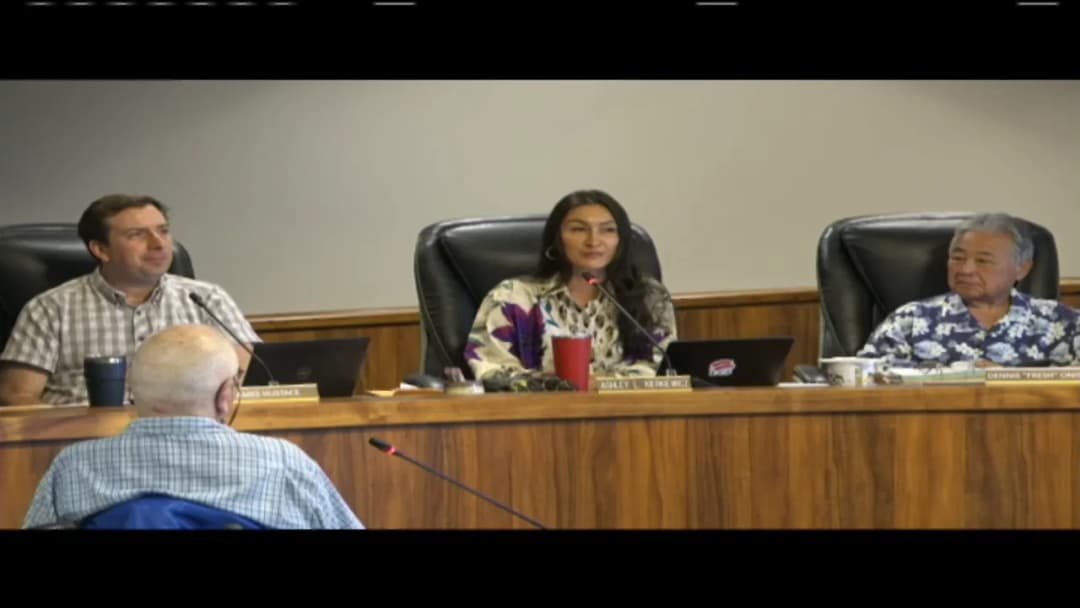
Presentations - The Council recognized the September 2026 Jove Award recipient. Speaker remarks centered on peer support, trauma, and mentoring youth. - The Council recognized Peace Week and the International Day of Peace, including a peace message displayed at the County Building. Public Testimony - One speaker, Gigi, testified from Hilo; no remote testifiers were signed up. The Chair noted the three-minute-per-item public comment rule. Actions and Discussion - The Council approved the minutes of the June 4, 2026 meeting with no amendments. - The Council discussed Bill 176 Draft 2, a General Plan amendment-related bill. Staff addressed the lack of an existing interim amendment process and noted that the 45-day comment period for the council and public will close October 24, 2026. - The Council heard Bill 181, a City of Hilo District zone map change affecting 283 West Puainako Street. The bill was introduced by Councilmember Kimball by request. A planning commission field recommendation would allow a two-lot subdivision of about one acre each. - The Council considered Resolution 664-26, Draft 2, which approves the Council’s legislative proposals and priorities for inclusion in the 2027 Hawai‘i State Association of Counties legislative package. The Council acted after voting to suspend Rule 23. - The Council referred a matter to executive session for confidential attorney-client discussion, including potential settlement issues. Announcements - A Kona council public hearing was scheduled for Friday, September 18, 2026, at 5:00 p.m. at the West Hawai‘i Civic Center, Building G. - The 2026 Breadfruit Celebration in Kona was announced for September 19–24.

PROCEDURAL 25% · PUBLIC ENGAGEMENT 10% · COMMUNITY ENGAGEMENT 9% · PUBLIC ACCESS OPEN SPACE 9%
02
SEP 15, 2026 · HAWAII COUNTY, HAWAII · COUNTY COUNCIL & COMMITTEES
Hawai‘i County Council Policy Committee on Planning, Land Use, and Economic Development - September 15, 2026

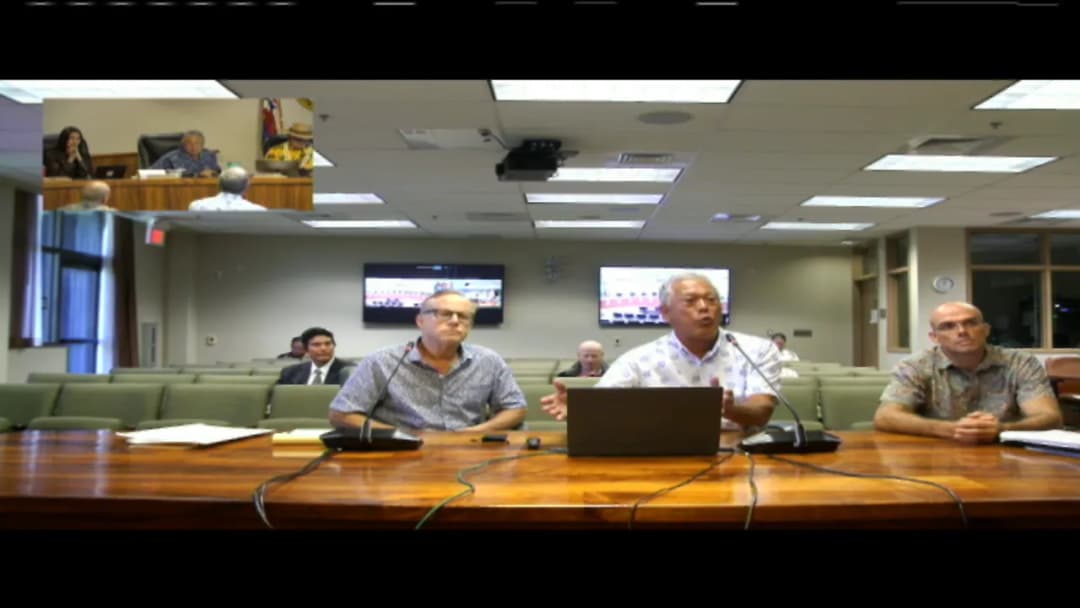
The Policy Committee on Planning, Land Use, and Economic Development met on September 15, 2026, in Hilo, Hawai‘i, via interactive conference technology. The primary agenda item was Bill 147, relating to transient vacation rentals (TVRs) and short-term vacation rentals (STVRs), introduced by Council Member Kimball. No minutes were available for this meeting. Public Comments & Testimony - Sarah Lean Pedro, President of the West Hawaii Association of Realtors, provided oral and written testimony on Bill 147, including three exhibits of mortgage records. She noted that some industry leaders could not testify publicly due to their positions and encouraged Council members to reach out to industry leaders independently. - One testifier stated, "We're fighting to stay alive here in a place that we love," and pleaded that the community is "just all asking for help," reflecting strong resident concern. - John Pelletier, Chair of the Kona Community Development Plan Action Committee, testified that allowing unhosted STVRs in RM and CN districts conflicts with the Kona CDP's housing and transportation goals. He cited UHERO’s 2025 Housing Fact Book finding that 67.8% of condominium purchases on Hawai‘i Island were by out-of-state buyers and stressed the importance of affordable housing in the urban core. - A testifier from the agricultural community said farmers should not face major additional requirements and costs, sharing that one change with no physical modifications cost more than $45,000 and a full project would likely cost under $200,000. - Del Otsuka and Martino Wing also testified on Bill 147. Discussion Items - Jeff Darrell of the Planning Department explained that Bill 147 would remove use permit requirements for hosted rentals in state urban/rural districts and for hosted rentals on pre-1976 lots in agricultural districts. It would also allow some existing condominium developments to continue operating if they received plan approval before the effective date. - Council Member Kimball discussed the proposed definition changes, including clarifying that a bed-and-breakfast is a subordinate use of the principal home, and noted the amendment aligned with planning commission recommendations. - Kimball noted the county had identified approximately 30 new STRs since September 1, and explained that the building code treats rentals over five bedrooms differently. - The committee discussed the Rose Hill case, in which the Hawai‘i Supreme Court ruled against Rose Hill and upheld the county's prior short-term vacation rental ordinance. - Members considered whether to consider amendments separately or as a package. Kimball stated that some amendments "would represent a shift in policy" and suggested it might be cleaner to "preserve what that is and redefine or return the rest." - The Chair stated that if the committee could not complete the amendments, the item would be postponed to the next meeting. The Chair also noted potential conflicts with other Council members' communications. Key Outcomes - The committee did not complete action on Bill 147 or its amendments and postponed further consideration to the next policy committee meeting. - Council Member Kimball indicated she would treat the lack of response as support and include the topic in a comprehensive amendment to be taken up at the next meeting.

ZONING AND LAND USE 57% · AFFORDABLE HOUSING 11% · AGRICULTURE AND LAND USE 11% · PROCEDURAL 5%
03
SEP 15, 2026 · HAWAII COUNTY, HAWAII · COUNTY COUNCIL & COMMITTEES
Communications, Reports, and Oversight Committee Meeting – September 15, 2026

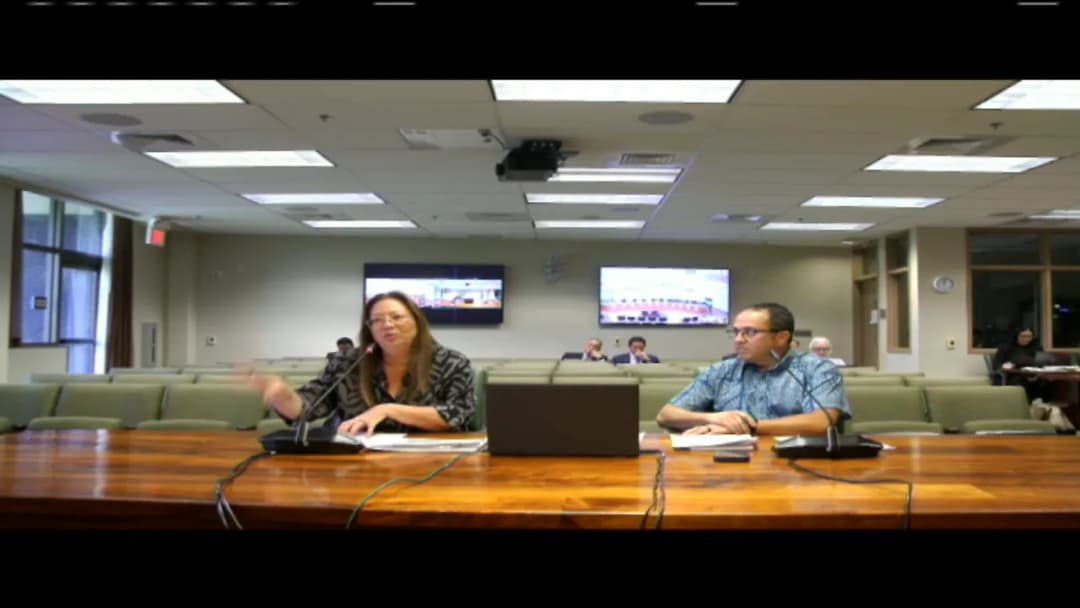
The 26th session of the Hawai‘i County Council’s Communications, Reports, and Council Oversight Committee convened at 4:00 p.m. (actual start 5:15 p.m.) on September 15, 2026, with Chair Michelle Galimba presiding. All nine council members were present at some point. The committee considered four communications: the quarterly affordable housing report, a presentation on Project WAO (traditional watershed stewardship), a follow-up audit of the abandoned vehicle program, and a presentation on the wastewater facility plan and cesspool conversion evaluation. No public testimony was offered. All communications were closed with unanimous votes. Consent Calendar - Comm. 35.9 – Quarterly Affordable Housing Report (Apr–Jun 2026): Housing Administrator Kehaulani Costa confirmed no changes since the last report. The committee closed the file with 9 ayes. Discussion Items Comm. 999 – Project WAO Presentation - Kamuela Plunkett (Pacific Islands Climate Adaptation Science Center) presented Project WAO, a pilot project in West Hawai‘i that maps traditional ahupua‘a boundaries, vegetation zones, and aquifer recharge areas to inform modern land-use planning. He highlighted that ancestral watershed districting capped ahupua‘a at the forest line (Wao) and that fog interception can increase water budgets by up to 30%. Future rainfall projections show 30–50% decreases by end of century, with some aquifers already impaired. - Council members expressed strong support: Councilmember Kimball called it “profound” and noted the opportunity to synthesize traditional practices with Western governance. Councilmember Villegas praised the “synchronicity” with earlier discussions and the return to host-culture wisdom. Councilmember Kleinfelder appreciated the layered approach and questioned aquifer claims made in other land-use decisions. The committee closed the file with 9 ayes. Comm. 1061 – Follow-Up Audit of DEM’s Abandoned Vehicle Program - Maxine Peshecko (Office of the County Auditor) presented the follow-up review (Report 2026‑02). Of five original recommendations: three completed (PPE use, increased reporting options with QR code flyer, cross-training), two in progress (formalizing policies/SOPs – target end of 2026; vehicle auctions – last auction Dec 2024, need 55–60 vehicles to proceed). - Councilmember Hustace asked about backlog; Tiffany Wallace (DAV specialist) stated inventory not yet sufficient. Councilmember Kagiwada requested the flyer for inclusion in her newsletter. Chair Galimba asked when policies/SOPs would be finalized; Wallace said by year’s end. The committee closed the file with 6 ayes (members Kierkiewicz, Kleinfelder, and Inaba excused). Comm. 1062 – Wastewater Facility Plan and Cesspool Conversion Evaluation - Gary Deese and Jason Nikaido (Corolla Engineers) presented a summary of the two reports. Key findings: - Wastewater Facility Plan: Condition assessment of 6 treatment plants and 17 pump stations: 20% good/minor defects, 50% fair/significant defects, 25% poor, 5% failed. 70 capital projects identified. Total 20‑year program cost: $1.1 billion (near‑term legally mandated) + $0.5 billion (20‑year horizon) = $2.3 billion total wastewater needs. Most spending required in first 10 years due to AOC and Kīlauea settlement mandates. - Cesspool Conversion Evaluation: 48,600 cesspools in county. Three conversion methods: county sewer extensions ($784 million, $93,000 per cesspool), new decentralized systems ($3 billion, $300,000 per cesspool), individual wastewater systems (IWS, $1.2 billion, $40,000 per cesspool). Full technical conversion would cost $5 billion. Proposed plan reduces county role to 10 priority sewer extension projects (3,100 cesspools, $266 million), with most conversions (80–90%) via IWS by property owners. Total proposed plan cost: $2 billion. - Councilmember Kleinfelder questioned cost per mile for sewer lines; asked about cost comparison with IWS. Noted that $40,000 per IWS is far cheaper than $93,000+ per sewer connection. Called for taking findings to EPA. Councilmember Kimball noted that IWS may not improve water quality in some locations, and workforce shortages may hinder mass conversions. She also asked whether the most recent UH prioritization tool (with 14 criteria) was used; presenters confirmed they used the initial 3‑level tool. Kimball also questioned whether Phase 2 of the Hilo WWTP (activated sludge upgrade, required by 2035) is cost‑effective; Kelly Hartman (DEM) confirmed it is regulatorily required under the AOC. - Councilmember Villegas expressed hope for future technology to manage waste without water. Kelly Hartman clarified the AOC mandates. Chris Laude (DEM temporary wastewater chief) emphasized that DOH requires cesspool closure but does not mandate the county to do it; he cautioned that IWS may not prevent near‑shore water impairment, and that the Hilo NPDES permit may soon include nutrient limits. The committee closed the file with 6 ayes (Inaba and Kierkiewicz excused). Key Outcomes - All four communications were closed with unanimous votes (Comm. 35.9 and 999: 9‑0; Comm. 1061 and 1062: 6‑0, with three members excused). - The abandoned vehicle program audit follow-up will be finalized when SOPs are completed by end of 2026. - The wastewater facility plan and cesspool conversion report will be finalized by January 31, 2027 to meet AOC deadline. - Council expressed interest in further discussion with DOH on IWS feasibility, water quality impacts, and workforce capacity for mass conversions.

WASTEWATER MANAGEMENT 40% · CLIMATE CHANGE ADAPTATION 17% · AUDITING PROCEDURES 11% · CAPITAL IMPROVEMENT PROJECTS 9%
04
SEP 15, 2026 · HAWAII COUNTY, HAWAII · COUNTY COUNCIL & COMMITTEES
Hawai‘i County Finance Committee Meeting: Bill 192 Extension and Vehicle Leases (September 15, 2026)

Date: September 15, 2026 | Time: 2:45 p.m. (called to order) – 5:09 p.m. adjourned The Committee on Finance convened to consider Bill 192 (extending the homelessness and housing fund), seven resolutions authorizing multi-year leases and subscriptions, and a bill on fiscal impact statements. After extensive public testimony and debate, Bill 192 was amended and forwarded to the full council on a 7–2 vote. All lease resolutions passed unanimously. Bill 171 was postponed. Public Comments & Testimony - Bill 192 (Homelessness and Housing Fund Extension): 17 testifiers spoke, all but one in strong support. Supporters included representatives from Going Home Hawaii, Big Island Substance Abuse Council (BISAC), Lokahi Treatment Centers, Hope Services Hawaii, Project Vision Hawaii, Kumukai Health and Wellness, and individuals with lived experience. They highlighted program outcomes: 4,166 unduplicated residents served in year three, 1,218 prevented from homelessness, 448 placed in permanent housing, 84% employment rate at Going Home Hawaii, 93.3% success rate, and 8.7% recidivism. Personal stories described medical respite, recovery, and family reunification. The sole opponent (Kapono Kekella) urged pausing the extension to allow a third-party audit and greater state/federal buy-in, while acknowledging program benefits. Discussion Items - Bill 192 (Amends Chapter 19, Article 11, Section 19-90): Introduced by Councilmember Inaba, the bill would extend the requirement to appropriate at least $9 million annually from residential tier‑2 and tier‑3 property tax revenue to homeless and housing programs through June 30, 2029, and specify seven allowable uses (prevention, outreach, shelter, behavioral health, housing development, etc.). - Amendment (Comm. 1059.2): Councilmember Inaba moved to clarify that the $9 million shall be appropriated to programs, not a special fund, to avoid confusion with charter-defined special funds. The amendment passed unanimously (9‑0). - Debate: Councilmembers expressed mixed views. Supporters (Inaba, Kagiwada, Kierkiewicz, Galimba) noted the fund’s successes, the need to give providers stability for the next grant cycle (starting November 2026), and the importance of awaiting the ongoing audit (expected by end of 2026) while not sunsetting programs prematurely. Opponents (Onishi, Chair Kānealiʻi-Kleinfelder) cited lack of a third‑party audit, concerns about self‑reported data, the minimum $9 million floor locking funds, and persistent visible homelessness. Director Nakagawa and Administrator Costa described the evolving grant process and the quarterly community of practice meetings. The County Auditor’s representative, Maxine Pasheko, confirmed the audit is underway but declined to advise on the bill. - Resolutions 670-26 through 675-26 (Multi‑Year Leases): - Res. 670-26: $110,000/year for two dump trucks (hauling, paving, debris removal). - Res. 671-26: $225,000/year for three grapple trucks (emergency response, tree removal, drain clearing). - Res. 672-26: $80,000/year for an excavator with mulching unit (roadside repair, flood channel clearing). - Res. 673-26: $19,000/year for a crew cab pickup (Highway Maintenance Division). - Res. 674-26: $697/month for CLEAR investigative software (Prosecuting Attorney). - Res. 675-26: $4,835/month for Westlaw legal research (Prosecuting Attorney). All were introduced by Chair Kānealiʻi-Kleinfelder (by request). Public Works representative Kelsey Kaluis confirmed the vehicles will replace aging fleet via lease‑to‑own. No public testimony. Each passed with unanimous votes (some members excused). - Bill 171 (Fiscal Impact Statements): Would require the Finance Director to prepare fiscal impact statements for council bills with fiscal implications. Councilmember Onishi successfully moved to postpone the bill to the November 5, 2026 committee meeting (seconded by Kimball; 7‑0). Key Outcomes - Bill 192: Amended (Comm. 1059.2) and forwarded to the full council with a favorable recommendation (7‑2). Voting against: Chair Kānealiʻi-Kleinfelder and Councilmember Onishi. The extension would run through June 30, 2029, with a minimum $9 million annual appropriation. - Resolutions 670-26 through 675-26: All forwarded to the full council with favorable recommendations (unanimous). - Bill 171: Postponed to November 5, 2026. - Communications 23.42 and 1056: Closed without action.

HOMELESSNESS 46% · PROCEDURAL 21% · PUBLIC WORKS 8% · BUDGET EQUITY ANALYSIS 7%
05
SEP 15, 2026 · HAWAII COUNTY, HAWAII · COUNTY COUNCIL & COMMITTEES
Policy Committee on Environmental and Natural Resource Management – September 15, 2026

The Policy Committee on Environmental and Natural Resource Management met on September 15, 2026, to consider two bills: Bill 191, which amends erosion and sedimentation control enforcement, and Bill 183, which proposes increases to wastewater service rates and creates a new hotel rate class. Bill 191 was passed with an amendment and recommended to the full council. Bill 183 was postponed to the October 6, 2026 hearing following extensive public testimony and council discussion. Public Comments & Testimony - Del Otsuka opposed Bill 183, calling it an "archaic flat rate tax" that reverses the polluter-pays principle, penalizes businesses that invest in green infrastructure, and squeezes local families by tripling utility rates while choking short-term rental income. - K. Cole McClellan (Outrigger Hospitality Group) opposed the creation of a separate hotel rate class, arguing it violates state law (HRS 237D-1 and Act 17) which defines all transient accommodations uniformly. He urged the committee to remove the isolated hotel classification and place hotels within the uniform non-residential schedule. - Jerry Gibson (Hawaii Hotel Alliance) stated support for necessary rate increases but requested hotels be treated under the non-residential class. He argued the proposed separate hotel rate, with increases approaching 300%, is infeasible and threatens local jobs, workforce benefits, and small properties. Discussion Items - Bill 191 (Erosion and Sedimentation Control): Councilmember Inaba introduced the bill to establish administrative enforcement for Chapter 10 violations, including fines up to $1,000 per day without requiring a criminal conviction. The amendment (Comm. 1058.1) removed the option of service by newspaper publication, relying on hand delivery or certified mail to satisfy due process. Councilmember Galimba raised concerns about Good Samaritan grading after natural disasters; Deputy Corporation Counsel and DPW staff noted that property owners can call the Engineering Division (808-961-8327) for guidance. The definition of grading (over 100 cubic yards, cut/fill over 5 feet, or altered drainage) and grubbing (over 1 acre) was clarified. The bill aims to provide realistic enforcement tools where previous criminal referrals were never pursued. - Bill 183 (Sewer Service Charges): Director Dan Gervin (DEM) and Regulatory Administrator Kelly Hartman presented the rate increase as a legal mandate under the Administrative Order on Consent (AOC) to become self-sustaining by 2031. Supplemental materials included a rate study, rate model, and legal framework. Key discussion points: - Rate increase magnitude: Director Gervin disputed the 300% figure, stating that fixed monthly charges for hotels rise from $96 to $1899 (approx. 100%) and per-thousand gallon rates from $10.85 to $21.40 (also approx. 100%), similar to residential and non-residential increases. - Legality of hotel class: Corporation Counsel and consultant Art Griffith (FG) confirmed that Maui and Kauai have similar hotel classes; Oahu does not but the practice is legally defensible under cost-of-service principles. - Small hotel impacts: Councilmember Kagiwada requested analysis of impacts on small hotels like SCP Hilo and possible relief mechanisms for low-income households and nonprofits. Director Gervin noted that smaller hotels would have lower discharge and thus lower usage charges. - Budget projections: Councilmember Caneali-Kleinfelder questioned inflated projections (e.g., OCE repairs from $18,900 in FY2425 to $92,000 in FY2627) and the absence of debt service in the rate study. Consultant Art Griffith attributed the jump to catch-up spending after years of underfunding; debt service was excluded because it relates to capital investment, not operations. - Connection compliance: Hartman announced a connection compliance plan due in December 2026 to enforce sewer connections and broaden the rate base, potentially moving short-term vacation rentals into non-residential rates. - Infiltration and energy savings: Director Gervin described ongoing efforts to identify and repair leaks in the collection system, which can reduce energy costs (electricity approaching $3.5M/year). Two crews are scoping lines and using GIS for scheduling. - Calculator request: Councilmember Inaba requested a simple rate calculator to allow council members to model changes; a meeting with DEM was scheduled within the week. Key Outcomes - Bill 191: Amended by Communication 1058.1 (approved unanimously, 9 ayes). The committee voted unanimously (9 ayes) to recommend passage to the full council. - Bill 183: Motion to postpone to the October 6, 2026 committee hearing passed unanimously (9 ayes). Councilmember Inaba requested a meeting with DEM by Thursday or Friday to develop a rate calculator and review materials, noting that the 200+ pages of supplemental reports were provided only the day before the meeting. - Council also noted that DEM will present a connection compliance plan in December 2026 to enforce sewer connections and potentially reclassify short-term vacation rentals to commercial rates.

WASTEWATER MANAGEMENT 54% · PUBLIC WORKS 11% · BUDGET EQUITY ANALYSIS 7% · TAXATION POLICY 6%
06
SEP 15, 2026 · HAWAII COUNTY, HAWAII · COUNTY COUNCIL & COMMITTEES
Hawaii County LAAC Meeting on Waikoloa Green Rezone – September 15, 2026

The Committee on Legislative Approvals and Acquisitions (LAAC) met on September 15, 2026, at 11:08 a.m. to consider Bill 186 (state land use reclassification from Agricultural to Urban) and Bill 187 (zoning map amendment for the Waikoloa Green LLC project, a proposed 400-unit multifamily housing complex on 14.868 acres in South Kohala). Following extensive public testimony, discussion of water availability, wildfire evacuation risks, and other infrastructure concerns, the committee amended the bills and postponed both to the next meeting on October 6, 2026. Public Comments & Testimony - Don Thomas (University of Hawaii groundwater researcher): Testified on Bill 186, stating that the conventional groundwater model is incomplete and that sustainable yields and aquifer boundaries need re-evaluation. He cited evidence of multiple deep aquifer layers and urged caution before approving new withdrawals. - Alex Lancaster (founder, Hawaii Livestock Management): Expressed strong support for Waikoloa Green, describing it as a project that combines housing, agriculture, and local employment. He stated that the 400 multifamily homes are intended for local families and that water use for housing is a legitimate priority. - Michelle Stefanik (Waikoloa Village resident): Opposed both bills, citing inadequate evacuation capacity and wildfire risk. She referenced the county’s 2008 South Kohala Community Development Plan calling for a second access road, the 2021 Mono Road fire evacuation delays, and the state housing agency’s recent withdrawal of an environmental exemption for a separate affordable housing project due to evacuation safety concerns. She requested a permanent second road be built before additional homes are occupied. - Matt Chocker (Executive Director, Wildfire Safety Advocates): Opposed the bills, presenting new information that the Hawaii Housing Finance and Development Corporation (HHFDC) withdrew its environmental exemption for a nearby 329-unit affordable housing project after wildfire safety concerns were raised. He argued that the same concerns apply to the larger Waikoloa Green project. He also raised personal concerns about school capacity and the lack of a student evacuation plan, noting that the current plan relies on staff vehicles for about 175 students. - David Foster (Waikoloa resident, Wildfire Safety Advocates): Opposed approval, highlighting a map showing four major developments (including Waikoloa Green) that would double the village’s population. He argued that cumulative impacts on roads, schools, water, and emergency services are being treated as afterthoughts and that no cohesive community plan exists. - Kalani Flores (Florist case ‘Ohana): Opposed the bills, citing insufficient community engagement and lack of updated data on water sustainability. He argued that an environmental assessment is required under HRS §343 due to a historic trail and a proposed solar energy facility on the property. He also noted that the county’s water use and development plan is outdated (last updated 2010) and that the sustainable yield for the Waimea aquifer has not been reassessed. Discussion Items - Applicant presentation (John Yoshimura and Danny Popkin, Waikoloa Green LLC): The applicant apologized for their abrupt departure at the previous meeting and reported a significant reduction in projected water demand—from 1.29 million gallons per day to 362,000 gallons per day—after re-evaluating their water use. They committed to EPA WaterSense standards and a water conservation plan. They also highlighted community benefits: approximately $10 million in fair share contributions, five acres donated for public facilities, a 111-acre conservation easement with the Waikoloa Dry Forest Initiative, and over 200 acres for solar energy. They acknowledged that the project remains subject to condition B, which requires available water before certificates of occupancy are issued. - Planning consultant John Pippen addressed public testimony, stating that no HRS §343 environmental assessment triggers apply to the project: the historic trail is not on the state or national register, the proposed solar facility is not fossil-fuel-based, and no state or county lands or funds are involved. He noted that the Department of Education had indicated no concerns about school capacity (letter expected). - Dr. Jonathan Lee K. Shoyer (water expert, no affiliation with applicant) gave a presentation at the request of Councilmember Inaba. He covered water law history, the designation process under the state water code, sustainable yield calculations, and current pumping levels. He noted that existing pumping in the Waimea aquifer is at 89.68% of the 16 million gallons per day sustainable yield, and that authorized planned uses (including pending projects and DHHL needs) could push the system toward the 90% trigger for designation. He emphasized that climate change projections show a 33–55% reduction in recharge by 2100. He also explained the “Kauai Springs” case and the duties of county agencies to analyze public trust impacts when approving developments that affect water resources. - Councilmember Hustace proposed an amendment (Communication 1025.11) requiring the applicant to prepare and implement a water conservation plan with a goal of at least 30% reduction in projected water use for residential portions, using EPA WaterSense as a benchmark. The amendment passed 8-1, with Councilmember Kānealiʻi-Kleinfelder opposed. - Councilmember Inaba offered a housekeeping amendment (Communication 1025.10) to correct an error from a previous meeting. It passed unanimously. - Councilmember Kagiwada raised concerns about public trust duties and asked about alternative water sources. The applicant confirmed that brackish and recycled water from the adjacent Anaehoʻomalu aquifer could further reduce potable water demand. - Councilmember Kierkiewicz suggested requesting a letter from the Commission on Water Resource Management (CWRM) to clarify total water commitments in the Waimea aquifer. - Councilmember Kānealiʻi-Kleinfelder expressed skepticism about the viability of planned agricultural uses and food hubs without adequate water, and noted the broader infrastructure deficits in Waikoloa (single road, fire risk, schools). He supported the postponement to gather more data. Key Outcomes - Amendment adopted (8-1): Bill 187 was amended to include a water conservation plan requirement (Communication 1025.11). - Housekeeping amendment adopted (9-0): Bill 187 was amended to correct an error in a previous amendment (Communication 1025.10). - Postponement (unanimous): Both Bill 186 and Bill 187 were postponed to the committee’s next meeting on October 6, 2026, to allow further research, including a request to CWRM for a water commitment status and additional information from the applicant. - Next steps: The applicant agreed to provide more details on agricultural water use and alternative sources. Councilmembers requested a list of all pending developments in the area (as previously required by Councilmember Inaba) and a response from CWRM regarding the Waimea aquifer’s authorized planned use.

WATER AND WASTEWATER MANAGEMENT 47% · PROCEDURAL 10% · COMMUNITY ENGAGEMENT 8% · PUBLIC SAFETY 7%
07
SEP 2, 2026 · HAWAII COUNTY, HAWAII · COUNTY COUNCIL & COMMITTEES
Hawai'i County Council 48th Session: Budget Items, Legislation, and Community Grants Approved on September 2, 2026

The Hawaii County Council held its 48th session on September 2, 2026, at the Hawaii County Building in Hilo. The meeting began with presentations recognizing two youth representatives to a national AI symposium, Officer Blake Bragos as the August 2026 HVEO Award recipient, and lifeguards in appreciation of Lifeguard Appreciation Week (August 17-23, 2026). The Council then proceeded through a lengthy agenda including over 30 resolutions, multiple bills for first and second readings, and two executive session items. The meeting lasted from 9:03 a.m. to 1:04 p.m., with a brief recess. Public Comments & Testimony - Josephine Kili Pio opposed Resolution 633-26 (Kona Cat Commons Sanctuary Project), noting the D-FIN Foundation has been registered less than two years and lacks a known track record. - Nicole Sasaki Simmons from the County of Hawaii Parks and Recreation supported Resolution 650-26 for the 40th annual Kupuna Hula Festival, highlighting its role in honoring kupuna and perpetuating Hawaiian culture. - Julie Eliason testified in support of Bills 173 and 175, describing the property tax burden on her hosted transient vacation rental and urging passage of a bed-and-breakfast tax class and amnesty. - Stephanie Bath supported the nominations of Jaylyn Brendlen and Gary Rosenberg to the Puna Community Development Plan Action Committee, citing their community involvement and expertise. - Tom Wazinski, president of the West Hawaii Veterans Cemetery Development and Expansion Association, strongly supported Resolution 657-26 for a Medal of Honor Memorial, noting Sgt. 1st Class Rodney J. Yano's connection to the island. - Lilinoi Kili Pio Young supported Resolution 641-26 for a ceremony honoring Honolulu Landing, expressing gratitude for the county's acquisition and preservation efforts. - Celia Bardwell Jones supported Resolution 661-26 for the Barrio Fiesta, emphasizing its educational value for Filipino diaspora and UH Hilo students. - Renee Godoy, founder of Friends of First Responders, supported Resolutions 636, 655, and 656 for the Robust Conference and officer wellness resources, sharing a story of a couple whose marriage was saved by the conference. - Del Otsuka supported Resolution 609-26 (HGEA contract) but urged the council to prioritize filling vacancies over spending on consultants. - Mitchell Marks, executive director of the D-FIN Foundation, testified on Resolutions 633 and 649, explaining the Kona Cat Commons will serve as a pilot project with a template for other cat sanctuaries island-wide. Discussion Items - Communications (Nominations): The Council confirmed Jaylyn Brendlen (Puna CDP Action Committee), Gary Rosenberg (Puna CDP Action Committee), and Grace Reinhard (Tax Board of Review) unanimously (9-0 each). Brendlen and Rosenberg received detailed introductions from Mayor's representative Mike Alameda and supportive comments from council members. - Resolutions: Most resolutions were approved without debate, including: - Res. 609-26 (HGEA Unit 15 contract, estimated cost $1,819,315 over four years) – approved 9-0. - Res. 610-26 (MRI Software licensing agreement, approx. $55,593/yr) – approved 7-0 (two excused). - Res. 611-26 (Police de-escalation training grant, $129,033) – approved 9-0. - Res. 612-26 (Legal research services, approx. $13,522/month increasing 7% yearly) – approved 9-0. - Res. 614-26 (Handheld mass spectrometers for HPD fentanyl detection) – approved 9-0. - Res. 615-26 (Domestic violence prosecution grant, one deputy prosecutor) – approved 9-0. - Res. 616-26 (Naloxone nasal spray distribution boxes) – approved 9-0. - Res. 617-26 (NACo and WIR board nominations) – approved 9-0. - Res. 627-26 (Preservation forum travel stipends, $20,192) – approved 9-0. - Numerous community grant resolutions (Res. 633-26 through Res. 663-26, and Res. 647-26, 648-26, 649-26, 650-26, 652-26, 653-26, 654-26, 655-26, 656-26, 657-26, 659-26, 660-26, 661-26, 662-26, 663-26, 667-26) were approved, mostly 9-0. Some had brief sponsor remarks highlighting the funded programs. - Res. 634-26 (Ocean View Skatepark Association grant) was amended via Comm. 1008.1 to extend the project completion deadline to May 31, 2027. The amendment and suspension of Rule 23 passed on a 7-2 roll call (Councilmembers Houstis and Kimball opposed). The resolution as amended passed 9-0. - Bills for First Reading: - Bill 169 (Draft 2) – PONC program amendments: Approved with an amendment (Comm. 939.6) to align language, then passed first reading 8-0 (one excused). - Bill 173 (Draft 2) – Bed and breakfast home tax class and amnesty: Extensive discussion occurred. Councilmember Kimball introduced an amendment (Comm. 960.6) to remove the waiver of rollback taxes, which failed 2-7. The main motion failed on a roll call vote of 3-6 (Ayes: Galimba, Kagiwada, Campbell; Noes: Houstis, Kānealiʻi-Kleinfelder, Kierkiewicz, Onishi, Villegas, Inaba). - Bill 176 (Draft 2) – General Plan amendment procedures: Passed first reading 9-0. - Bill 177 – Budget amendment for de-escalation training: Passed first reading 9-0 (companion to Res. 611-26). - Bill 178 – Budget amendment for special response team grant: Passed first reading 9-0. - Bill 179 – Research and Development Department responsibilities and grant program: Passed first reading 9-0. - Bill 180 – Budget amendment for preservation forum travel: Passed first reading 9-0 (companion to Res. 627-26). - Bills for Second Reading: - Bill 172 – Motor vehicle weight tax budget: Passed final reading 9-0. - Bill 174 – Kona Low Small Business Recovery Grant ($500,000): Passed final reading 9-0. - Bill 175 (Draft 2) – Transient accommodations law amendments: Passed final reading 9-0. - Executive Session: The Council entered executive session on Communication 1034 (enumeration & settlement of property acquisition and inverse condemnation claim) and accepted the Office of Corporation Counsel's recommendation. The file was closed (9-0). Communication 1006 (litigation against the county) was also closed after accepting counsel's recommendation (9-0). Key Outcomes - Nominations Confirmed: Jaylyn Brendlen (Puna CDP Action Committee), Gary Rosenberg (Puna CDP Action Committee), and Grace Reinhard (Tax Board of Review) all confirmed unanimously. - Resolutions Approved: All 30+ resolutions passed, most unanimously. Res. 634-26 was amended and passed 7-2 on the suspension vote but 9-0 on final. - Bill 173 Failed: The bed-and-breakfast tax class bill did not pass first reading (3-6). - Other Bills Advanced: Bills 169, 176, 177, 178, 179, 180 passed first reading; Bills 172, 174, 175 passed second/final reading. - Executive Session Actions: The Council approved legal recommendations for two matters (litigation and property settlement), closing the files. - Presentation Recognition: The Council honored student AI symposium delegates, Officer Blake Bragos (HVEO Award), and lifeguards for Lifeguard Appreciation Week.

TAXATION POLICY 19% · PROCEDURAL 15% · PUBLIC SAFETY 12% · COMMUNITY ENGAGEMENT 7%
08
SEP 1, 2026 · HAWAII COUNTY, HAWAII · COUNTY COUNCIL & COMMITTEES
Hawaii County Council Committee on Governmental Operations: September 1, 2026 Nominations and HSAC Legislative Package

The committee met on September 1, 2026, at 9:02 a.m. in Hilo to consider six mayoral nominations to various boards and commissions and to approve the county's legislative package for the Hawai‘i State Association of Counties (HSAC). Chair Jen Kagiwada presided until passing the gavel to Vice Chair Holeka Goro Inaba for the final item. All nominations were approved by majority vote, with one nomination advancing despite two dissenting votes. The meeting was briefly interrupted by a public outburst. Consent Calendar - No items were designated as a consent calendar; each nomination was considered individually. Public Comments & Testimony - No registered oral testimony was offered at the start of the meeting. However, during the discussion of Communication 1003 (nomination of Zahava Zaidoff), an unidentified member of the public interrupted the proceedings, shouting about caffeine deprivation, unsafe sidewalks, and referencing labels such as "retarded." Chair Kagiwada called a brief recess before continuing. Discussion Items - Communication 1003 – Nomination of Zahava Zaidoff to the Transportation Commission: Mayor’s Executive Assistant Micah Alameda introduced Zaidoff, a resident of Ocean View, as an advocate for people with disabilities and rural transportation. Zaidoff expressed support for creative solutions like expanding taxi-cab programs to connect residents to mass transit. Councilmember Dennis “Fresh” Onishi asked about revenue generation (e.g., bus advertising) and light rail; Zaidoff was open to discussion but deferred on specifics. Councilmember Matt Kaneali‘i-Kleinfelder questioned Zaidoff’s familiarity with the Mass Transit Master Plan and the Multimodal Transportation Plan and funding sources, expressing concern about her lack of detailed knowledge. Councilmember Ashley Kierkiewicz defended Zaidoff, noting that nominees are not expected to have read all plans before confirmation. The nomination passed 8–1, with Kaneali‘i-Kleinfelder opposed. - Communication 1051 – Nomination of Kiliheaaahiahi Dorian Inaba to the Public Access, Open Space, and Natural Resources Preservation (PONK) Commission: Councilmember Holeka Goro Inaba recused himself as the nominee is a family member. Alameda introduced Inaba, a former firefighter and paramedic now an RN, as a dedicated advocate for preserving culturally significant lands. Several council members praised her background. Councilmember Heather Kimball voted no, citing a personal ethical position against appointing family members of council members. The vote was 6–2 in favor (Galimba and Kimball opposed). - Communication 1047 – Nomination of Sunita Przewlocki to the PONK Commission: Alameda introduced Przewlocki, a real estate agent and mother of three, who spoke about the importance of preserving open spaces and ocean access. Councilmember Onishi noted that her partner is State Representative Matthias Kusch, and encouraged appreciation for volunteers. Kaneali‘i-Kleinfelder voted no, stressing the need for transparency regarding family connections. The nomination passed 8–1. - Communication 1049 – Nomination of Jayssa Asuncion-Grace to the Game Management Advisory Commission (GMAC): Alameda introduced Asuncion-Grace, a hunter from Ka‘ū, who spoke about overhunting and the need to let the land rest. Councilmembers expressed strong support, noting she would be the only female GMAC commissioner. Onishi suggested she use council members for legislative support. The nomination passed unanimously (9–0). - Communication 1050 – Nomination of Robert A. Camara to the Hawai‘i County Cultural Resources Commission: Alameda described Camara as a government watchdog. Camara, a Hilo native, connected historic preservation to disaster preparedness, referencing the 1868 Ka‘ū earthquake. Councilmembers praised his depth of knowledge. The nomination passed unanimously (9–0). - Communication 1052 – Nomination of Porsche Ha‘o to the Board of Appeals: Alameda introduced Ha‘o, a co-owner of One Ton Chips, who expressed a desire to serve and ensure due process in property disputes. Councilmembers commended her business experience and community involvement. The nomination passed unanimously (9–0). - Resolution 664-26 – HSAC Legislative Package: Councilmember Kimball presented the package, which includes draft bills on prohibiting commercial aquarium collection, allowing counties to request state land use boundary amendments, requiring denitrification in wastewater systems, extending the GET surcharge to 2045, and updating housing assistance criteria; plus seven policy priorities. Chair Kagiwada offered an amendment (Comm. 1048.1) to add a draft bill on county regulation of tobacco sales (preemption) and three new priorities: emergency preparedness, responsible game management of wild ungulates, and legislation increasing wages. The amendment passed 8–1 (Onishi opposed). Onishi questioned the wage priority, suggesting cost-of-living reduction instead, but did not offer an amendment. The amended resolution passed 8–1 (Onishi opposed). Key Outcomes - Zahava Zaidoff confirmed to Transportation Commission (8–1). - Kiliheaaahiahi Dorian Inaba confirmed to PONK Commission (6–2). - Sunita Przewlocki confirmed to PONK Commission (8–1). - Jayssa Asuncion-Grace confirmed to Game Management Advisory Commission (9–0). - Robert Camara confirmed to Cultural Resources Commission (9–0). - Porsche Ha‘o confirmed to Board of Appeals (9–0). - Resolution 664-26 amended and approved (8–1) to forward to the full Council with a favorable recommendation. The committee will submit the legislative package to HSAC for consideration. - The meeting adjourned at 10:28 a.m.

PROCEDURAL 29% · TRANSPORTATION SAFETY 15% · PUBLIC ACCESS OPEN SPACE 14% · GAME MANAGEMENT 11%
09
SEP 1, 2026 · HAWAII COUNTY, HAWAII · COUNTY COUNCIL & COMMITTEES
Hawaii County Council CRCOC Meeting – September 1, 2026: Kailua Village BID Annual Report

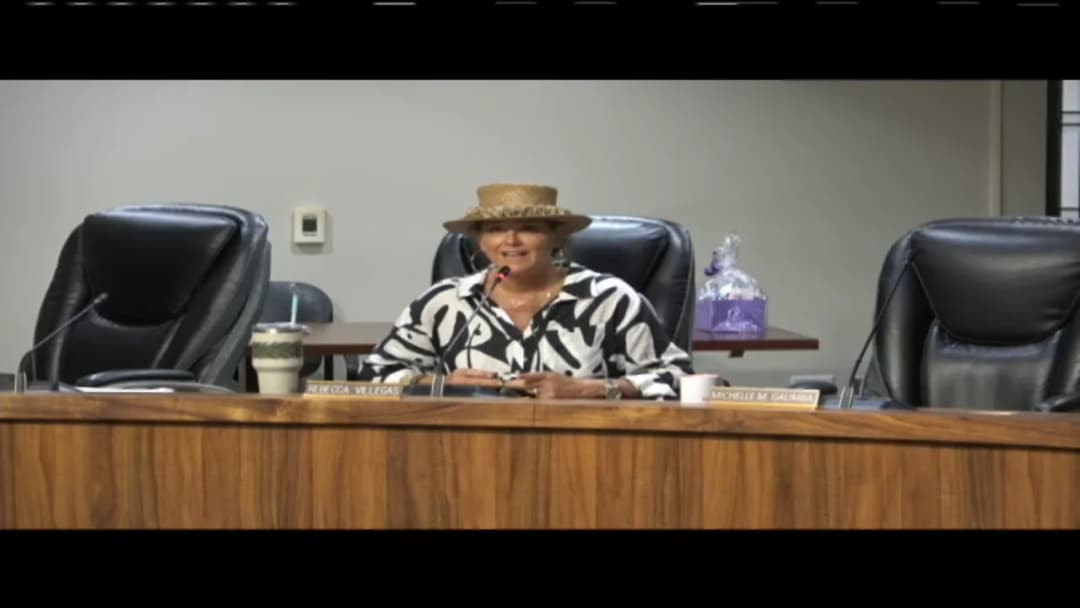
The committee met on September 1, 2026, at 7:10 p.m. (the meeting was originally scheduled for 4:30 p.m.) via interactive conference technology from the Hilo County Building and the Kona Council Chambers, with courtesy sites in Ocean View, Pāhoa, and Waimea. Council Chair Rebecca Villegas presided. Quorum was present: Councilmembers Kimball, Inaba, Kierkiewicz, Hustace, and Kagiwada joined the chair. Councilmembers Galimba, Kānealiʻi-Kleinfelder, and Onishi were excused. No public testimony was offered. The sole agenda item was the 2025–2026 annual report of the Kailua Village Business Improvement District (KVBID), presented by Executive Director Ross Wilson. Discussion Items - KVBID Annual Report (Comm. 1000): Ross Wilson summarized the report, noting that the district was established nearly 20 years ago to address challenges in historic Kailua Village. He emphasized that KVBID’s role is to collaborate with and complement county services, not replace them. He reported that the village is “clean and safe” and outlined two initiatives: cleanliness and safety. Wilson also mentioned plans to work with the county on new ordinances addressing panhandling, loitering, and public intoxication, and requested that police budgets be increased if possible. He highlighted the district’s branding efforts, including the installation of historic and cultural signs. - Councilmember Comments: Councilmember Inaba expressed appreciation for the work done in Kailua Village, particularly along the gateway for cruise ships. He suggested that the county explore supporting the creation of new business improvement districts by allowing taxes already paid to be committed for use by the districts, rather than requiring additional fees. Councilmember Kierkiewicz praised the KVBID model as a “boots on the ground” public-private partnership and echoed Inaba’s suggestion about tax diversion. Chair Villegas, whose District 7 includes the KVBID, thanked Wilson for his leadership and noted the healthy collaborative relationship between the council and KVBID with community policing. She expressed hope that the resistance to a Hilo Business Improvement District might fade in light of Kona’s success. Key Outcomes - Motion to Close File: Councilmember Inaba moved, seconded by Councilmember Kimball, to close the file on Communication 1000. The motion carried unanimously by voice vote (6 ayes, 3 excused). The committee then adjourned.

COMMUNITY ENGAGEMENT 45% · PROCEDURAL 33% · PUBLIC PRIVATE PARTNERSHIPS 22%
10
SEP 1, 2026 · HAWAII COUNTY, HAWAII · COUNTY COUNCIL & COMMITTEES
Hawai‘i County Council Committee on Legislative Approvals and Acquisitions Meeting - September 1, 2026

The Committee on Legislative Approvals and Acquisitions (the committee) convened on September 1, 2026, at 4:25 p.m. (originally scheduled for 2:30 p.m.) in Hilo, with members participating via interactive conference technology from Kona and remote sites in Ocean View, Pāhoa, and Waimea. The meeting addressed five agenda items: one resolution authorizing land acquisition negotiations, two zone change bills for small residential subdivisions, and two linked bills for a large multifamily and agricultural development in Waikōloa. Public testimony focused on the Waikōloa Green project (Bills 186 and 187), raising concerns about wildfire evacuation, water availability, and community impacts. Consent Calendar - No consent calendar was used; each item was discussed individually. Public Comments & Testimony - Matt Chalker (Executive Director, Wildfire Safety Advocates): Testified on Bills 186 and 187. Expressed respect for the developers but opposed the project due to lack of firm commitments on wildfire safety infrastructure. Noted that an evacuation study shows only about one-third of residents could escape within the time a fire could spread across Waikōloa Village (referencing the Lahaina fire). Stated that the development would add 1900 residents to a community already lacking evacuation capacity. Urged deferral until second road and fire safety measures are in place. - E. Kalani Flores (self and representing Flores’ ‘Ohana): Testified on Bills 186 and 187. Requested deferral until an inventory of groundwater pumping from the Waimea Aquifer, a report from Hawaii Water Service on daily pumpage, and an analysis of whether proposed development would exceed the aquifer’s sustainable yield (stated as 16 million gallons per day). Also argued that an environmental assessment is required under HRS Chapter 343 due to triggers such as state land use amendment, historic trail, and proposed solar facility. Called for a community meeting in Waikōloa. - Bob Yankee (Waimea resident): Testified on Bills 186 and 187. Detailed evacuation difficulties, referencing the 2021 Māhukona fire evacuation where travel from school to Waikōloa Road took one hour (normally four minutes). Cited the recent evacuation study showing only 2,000 residents could evacuate in the first hour, while the village population is projected to grow from 7,000 to 13,000 with four projects. Stated that adding population without road capacity is irresponsible. Quoted the late Fire Chief Todd: “the fire department cannot stop a fire under red flag conditions; the only thing is to evacuate.” Discussion Items - Resolution 632-26 – Land Acquisition for Waiakahiʻula: Introduced by Councilmember Kierkiewicz. Authorizes the Finance Director to negotiate acquisition of parcels for ocean access and a burial/agricultural complex site, listed as 5th and 6th priorities in the 2025 PONC report. Councilmember Kierkiewicz noted urgency due to a property owner threatening development that could damage a burial site. Motion to forward with favorable recommendation passed unanimously (9 ayes). - Bill 181 – Zone Change at Waiākea, South Hilo: Changes RS-15 to RS-10 for a 21,792 sq ft parcel at 283 West Puainako Street, to allow subdivision into two lots. Planning Director Jeff Darrow presented. Applicant’s representative stated the lots are for long-term rental and estate planning. Councilmember Kānealiʻi-Kleinfelder questioned the fair share contribution difference between this and later bills; Director Darrow noted it was due to timing of annual updates. Councilmember Kagiwada supported as infill. Motion to forward with favorable recommendation passed unanimously (9 ayes). - Bill 185 – Zone Change at Puʻukapu, Waimea: Changes A-40a to FA-1a for 2.397 acres at 64-5091 White Road, to create two one-acre lots for family members. Director Darrow presented. Conditions include water system improvements (fire hydrant) and 10-foot road widening setback. Councilmember Hustis asked about the closest fire hydrant and road widening. Councilmember Kānealiʻi-Kleinfelder raised fair share contribution discrepancy (this application had older, lower figures). Director Darrow agreed to review. Motion to forward with favorable recommendation passed 7-0 (Councilmembers Onishi and Galimba absent). - Bills 186 & 187 – Waikōloa Green Development: - Bill 186: State land use boundary amendment from Agricultural to Urban for 14.868 acres to allow multifamily residential. - Bill 187: Zone change from RA-1a and Open to RM-1.5, FA-1a, A-10a, and Open for 79.145 acres (with 14.868 acres for 400 multifamily units, plus 275 family agricultural lots and open space). - Applicant presentation: John Yoshimura (partner) and Danny Popkin described the project’s four pillars: housing (workforce/affordable), renewable energy (solar lease on 200 acres), food sustainability, and Hawaiian sense of place. Addressed fire safety: met with Wildfire Safety Advocates, hardened utility assets, expanded firebreaks, and noted a breakthrough on the second egress road. On water: cited will-serve letter from Hawaii Water Service (installed capacity 11.4 MGD, firm capacity 8.3 MGD, current demand 5-6 MGD). Team member Kanani Atan (former DWS) argued that the Waimea Aquifer sustainable yield (16 MGD) is preliminary and that the property straddles the larger Anaehoʻomalu Aquifer. Discussed using separate ag wells for irrigation. - Councilmember Hustis questioned water supply and community engagement; applicant noted plans for a community center and a 5-acre parcel for emergency shelter. - Councilmember Kagiwada pressed on water concerns, noting Environment Hawaii article. Applicant acknowledged uncertainty but said they followed process. - Councilmember Villegas expressed serious concerns about water (citing cultural and ecological impacts) and affordable housing credits, noting the county’s history of unfulfilled promises. Applicant stated intention to build affordable units within the 400 multifamily units (20% = 135 credits), but could also use credits. Councilmember Villegas also questioned long-term affordability. - Councilmember Kānealiʻi-Kleinfelder questioned the shift from Open to developable, renewable energy specifics, and fair share contributions. Applicant said they are negotiating a 30 MW solar lease. On water, she noted complexity of sustainable yield calculations. - Councilmember Kierkiewicz supported the project’s integrated design but requested a third-party water expert (CWRM) appear at the next meeting. - Councilmember Hustis moved to amend Bill 187 with Communication 1025.2 (Firewise USA requirement). The amendment requires the development to achieve and maintain Firewise USA certification or an equivalent county-approved wildfire resilience plan, binding on successors. Corporation Counsel confirmed legality. Adopted 7-0. - Councilmember Hustis moved to amend Bill 187 with Communication 1025.3 (drainage/flood mitigation). Requires applicant to address findings of the South Kohala Flood Study, upstream/off-site runoff, and downstream impacts in drainage studies. Adopted 7-0. - Councilmember Inaba moved to amend Bill 187 with Communication 1025.5 (affordable housing phasing). Requires that for each 20% of market-rate units built, 20% of affordable housing credits must be earned; the last 20% of market-rate cannot proceed until all affordable credits are completed. Adopted 7-0. - Councilmember Inaba then requested postponement to allow discussion with Department of Education on school capacity and to bring in water expert Jonathan Scheuer (as suggested by Councilmember Kānealiʻi-Kleinfelder). Motion to postpone both Bills 186 and 187 to September 15, 2026, passed 7-0. Key Outcomes - Resolution 632-26: Forwarded to full Council with favorable recommendation (9-0). - Bill 181: Forwarded to full Council with favorable recommendation (9-0). - Bill 185: Forwarded to full Council with favorable recommendation (7-0, two absent). - Bill 186: Initially tabled (6-1, two absent), then postponed to September 15, 2026, committee meeting (7-0). - Bill 187: Amended with Firewise, drainage, and affordable housing phasing conditions; then postponed to September 15, 2026 (7-0). The committee will continue discussion on that date.

ZONING AND LAND USE 28% · WATER AND WASTEWATER MANAGEMENT 20% · PUBLIC ENGAGEMENT 8% · AFFORDABLE HOUSING 7%
0102
NEXT →
OPENPUBLICA · PUBLIC MEETING INDEXUPDATED DAILY · openpublica.com