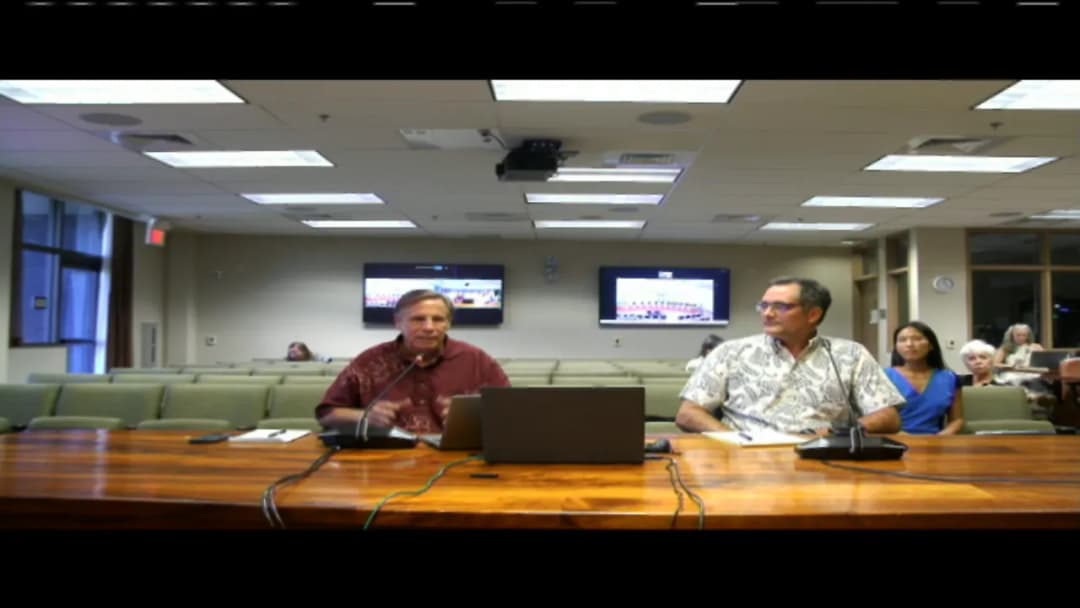
The Policy Committee on Planning, Land Use, and Economic Development of the Hawai‘i County Council met on September 1, 2026, starting at 2:51 PM and adjourning at 4:19 PM. The primary agenda item was Bill 147, which proposes amendments to Chapters 2 and 25 of the Hawai‘i County Code to establish operational standards and use regulations for transient vacation rentals, including hosted bed and breakfasts (B&Bs) and unhosted short-term vacation rentals (STVRs). The committee heard public testimony, deliberated, and voted to postpone the bill to the September 15, 2026, committee meeting. Public Comments & Testimony - John Pellateer (Kona CDP Action Committee) supported removing STVRs from RM (multifamily residential) and CN (neighborhood commercial) zoning, citing the need to preserve housing for residents and align with recommendations from the Windward and Leeward Planning Commissions and the Office of Hawaiian Affairs. - Joy Dillon (Hilo resident) opposed Bill 147, arguing that the term “bed and breakfast” creates confusion for mortgages, insurance, and HOA regulations, and that proposed penalties are punitive. - Richard Henderson (individual resident) expressed concerns about the bill’s impact on legally established RM visitor use projects, reliance on General Plan resort nodes, CN zoning eligibility, and the definition of hosted rentals, recommending amendments to preserve existing uses. - Mary Begier (individual citizen) urged the committee to leave the existing bed and breakfast rules unchanged. - Caitlin Miller (Executive Director, Hawaii Mid and Short-Term Rental Alliance) thanked the committee for amendments but requested further refinement of definitions (e.g., B&B, host, hosted TVR) and urged careful review of practical impacts before moving forward. - Sherry Rockwood (Wycloa Village resident) asked the committee to distinguish between owner-occupied hosted rentals and investor-owned vacation rentals, noting that her property taxes increased from $1,900 to $9,000 after renting part of her home, and urged protection for resident hosts. - Madeline Ross (North Kohala farmer and Airbnb co-host) opposed the bill, stating that it would prohibit existing hosted rentals with more than five bedrooms without a grandfather clause, and that the council’s own economic impact study found only 4% of owners would convert to long-term housing. She requested a grandfather clause and definition of “hosted” as living on the same TMK. - Jesse Rubendahl (North Kohala property manager and farmer) opposed the bill, emphasizing that the five-bedroom cap would eliminate his family’s affordable housing provided by the rental, and requested a grandfather clause for existing operators. - Martina Wing (Big Island resident, 25+ years) opposed Bill 147, calling the permitting process “cumbersome and confusing,” and argued that the bill adds bureaucratic burdens on small operators, especially after Hurricane Lala. - Anna Ruth Piffer (North Kohala hosted rental owner) opposed the five-bedroom rule, stating that her seven-bedroom property supports numerous local jobs and that a reduction to five bedrooms would cut revenue by 40%, harming the local economy and tax revenue. She recommended increasing the cap to 10 for existing compliant properties. - John Moss (Waikaloa vacation rental operator, 16 years) opposed the bill, citing cumulative tax increases that have made Hawaii too expensive for visitors, leading to a decline in bookings. - Julie Eliason (Kohala Ranch resident) opposed the bill, expressing concerns about the cost and complexity of obtaining a special use permit, excessive fines, and lack of clarity on midterm rentals (31-179 days). She requested lower fines and clear guidance. - Linda Halbriter (North Kohala resident, 79 years old) opposed the bill, stating that the new rules would be a “huge burden” on her as a kapuna, and that the permit process is overwhelming. She asked that existing legal operators be guaranteed permits. - Jamie Humphrey (North Kohala single mom and cleaner) opposed the bill, stating that her cleaning jobs for five Airbnb owners with more than five bedrooms provide flexible work and that shutting down these rentals would harm local families. She noted that the homes would not become affordable long-term housing. - Gina Gugliamelli was called but did not testify. Discussion Items - Councilmember Heather Kimball, the bill’s sponsor, introduced a motion to approve Bill 147 and forward it to the full council with a favorable recommendation. She described the bill as a “housekeeping” measure that clarifies existing policies, aligns with state law, and removes administrative burdens for hosted rentals by eliminating the need for use permits in state land use urban and rural areas. She noted that the five-bedroom cap aligns with existing zoning and building code requirements for lodges or hotels. - Councilmember James Hustace raised questions about terminology (TVR vs. hosted/unhosted vs. B&B), the definition of midterm rentals (31-179 days), and the burden of proof in enforcement, suggesting that the fine schedule may lack a clear rebuttal process. - Planning Director Jeffrey Darrow explained that the bill is the result of eight years of work and aims to bring existing hosted rentals into compliance without requiring land use permits, in coordination with the new registration system (Chapter 6) that launched on September 1, 2026. He noted that the fines were based on other counties’ rates. - Councilmember Jenn Kagiwada asked about outreach to the public and the impact on property loans. Councilmember Kimball noted a webinar and website (HawaiiCountyTVR.com) with FAQs, and Darrow stated that the administration has been asked to do a public media announcement. - Councilmember Matt Kāneali‘i-Kleinfelder expressed concerns about the density implications of allowing multiple units on pre-1976 lots, including impacts on infrastructure (roads, water, sewer). He noted that while the bill is about housekeeping, it could lead to significant density increases. Councilmember Kimball responded that the bill does not increase density and that Bill 123 already limits STVRs to one per building site when an ADU is present. - Councilmember Ashley Kierkiewicz (Chair) proposed postponing the bill to allow fresh minds and further public input, noting the complexity and the late hour. Councilmember Kimball made a motion to postpone to September 15, 2026, which was seconded by Councilmember Inaba. Key Outcomes - Motion to postpone Bill 147 to the September 15, 2026, committee meeting was passed unanimously (9-0). The bill was not approved or forwarded to the full council. The committee will consider the bill and four proposed amendments (clerical, midterm rentals, CN zoning, RM zoning) at the next meeting.
Public Meetings - Hawaii County, Hawaii
Public Meetings - Hawaii County, HawaiiThe Policy Committee on Environmental and Natural Resource Management (PCENRM) of the Hawaiʻi County Council met on September 1, 2026, at 1:18 p.m. (delayed from the scheduled 12:30 p.m. start) to consider Bill 183, which would increase wastewater service rates and establish a new hotel service class. After public testimony and departmental presentations, the committee voted to postpone the bill to its September 15, 2026 meeting. Public Comments & Testimony - Brianni Kobayashi Kualii (General Manager, SCP Hilo Hotel) opposed the bill, stating that the hotel uses 32% less water than the national hotel median, removes 2.2 pounds of trash per guest stay (over 200,000 pounds total), and has achieved EarthCheck silver certification. She argued that a flat hotel class rate penalizes conservation and urged a performance-based rate structure. - Matthew Pickett (Hilo Hawaiian Hotel) opposed the bill, noting a 78% increase in year one and a 189% increase by year five (from roughly $145,000 to $500,000 annually). He argued the hotel class lacks a published cost-of-service basis and requested the effective date be moved to July 1, 2027, to allow time to pass costs to customers. - Barbara Bell (resident of Puako, South Kohala) supported the bill, emphasizing the need for the wastewater division to become self-supporting and stop relying on the general fund. She suggested future amendments for short-term vacation rental rates and recycled water rates. - Georgine Adams (resident of Mauna Lani Resort, Puako) supported the bill as a first step toward sustainable funding, noting the importance of continuous and reliable funding for wastewater infrastructure. - Kaikola McClellan (on behalf of Outrigger Hospitality Group and Hawaii Hotel Alliance) opposed the bill, calling the hotel class a “super tax” with rate increases over 300%. He noted that short-term rentals (more numerous than hotel units) are not included, and argued the bill threatens local jobs and mid-market hotels. - Cyrus Johnson (private citizen) opposed the hotel class, stating it unfairly targets Hilo hotels that serve local families and visitors, and suggested deferring the bill. Discussion Items - Department Presentation: Director Dan Gervin and consultant Art Griffith (FG Solutions) presented the wastewater rate study. They explained that the hotel class rate is based on higher biological oxygen demand (BOD) and total suspended solids (TSS) in hotel wastewater due to restaurants, laundries, and high occupancy. The study projects that without rate increases, the general fund would need to contribute $65 million over five years; with the proposed rates, the general fund contribution would drop to zero by 2031. Current revenues cover only 52% of operating costs. The proposed residential rate increases from $52 to $63 in January 2027, reaching $125 by 2031. - Council Questions: Councilmember Houstis noted that the rate study did not include data from Hawaii American Water, the other private wastewater utility on the west side, and questioned the completeness of the comparison. Councilmember Inaba opposed moving the bill forward without the study being provided to the council beforehand, and noted that the projected Honolulu rates (used in the presentation) did not match his knowledge of actual Honolulu bills. Councilmember Kimball requested the integrated wastewater management plan be presented before further action. Councilmember Onishi questioned efforts to expand the sewer system to bring in more users, noting the Hilo plant has capacity for 5 million gallons per day but currently treats only 3 million. He also suggested reaching out to state legislators for funding. - Motion to Postpone: Councilmember Houstis moved to postpone Bill 183 to the September 15, 2026 committee meeting. The department agreed to provide the rate study and requested information ahead of the next meeting. Key Outcomes - Motion to postpone Bill 183 to September 15, 2026, was approved by a vote of 7 ayes (Councilmembers Houstis, Kagiwada, Kimball, Kānealiʻi-Kleinfelder, Inaba, Onishi, Kierkiewicz). Councilmembers Villegas and Galimba were excused. The bill will be reconsidered at the next PCENRM meeting.
The Policy Committee on Health, Safety, and Well-Being of the Hawaii County Council held its 11th session on September 1, 2026, beginning at 12:21 p.m. (agenda noted 11:30 a.m.) at the Hawaii County Building in Hilo. The meeting addressed two bills: Bill 184, requiring native plants in county landscaping, and Bill 189, clarifying the process for clearing unsafe flora. No public testimony was received. Both bills were forwarded to the full Council with recommendations, though Bill 189 passed with a divided vote of 6-3. Bills for Ordinances Bill 184: Relating to the Use of Native Plants in County Landscaping - Sponsor: Council Member Kierkiewicz - Description: This bill amends Chapter 14 of the Hawaii County Code to require the use of native plants in county landscaping on county properties, including parks, public facilities, streetscapes, and rights-of-way, where practical and appropriate. It also encourages interpretive signage and annual departmental reporting on progress. - Discussion: Council Member Kierkiewicz explained the bill as a simple policy to prioritize native plants, lead by example, and educate the community. Council Member Inaba suggested including non-invasive lei-making plants that may not be native, and Kierkiewicz committed to a friendly amendment at Council. Council Member Onishi noted the importance of avoiding sidewalk damage from large tree roots. No opposition was voiced. - Vote: Motion to forward to Council with a positive recommendation passed unanimously (9 ayes, 0 noes). Bill 189: Relating to Clearing Unsafe Flora - Sponsor: Council Member Onishi - Description: The bill amends Chapter 14, Article 25, Section 14-151 of the Hawaii County Code to specify that a department designated by the mayor may investigate and certify complaints of unsafe flora, and that an appropriate expert may be consulted in such cases. - Discussion: Council Member Onishi stated the bill aims to clarify the process for addressing dangerous trees on private or vacant properties, especially after experiences with storms like Lala and Iselle. He noted that currently, complaints go to the mayor’s office then to Public Works, but the department lacks arborist expertise. The bill allows the designated department to consult an expert when making determinations. - The discussion revealed significant concerns. Council Member Kierkiewicz questioned what the bill actually adds, noting the code already allows the mayor to delegate and that the real issue is resourcing and lack of enforcement. Council Member Kagiwada highlighted that existing code Section 14-152 allows the county to recoup costs from property owners but has never been used, and she expressed frustration that the bill does not address implementation failures. Council Member Kimball worried about an unintended consequence: the mandatory consultation with an expert for all complaints (including non-tree hazards like dry grass) could create unnecessary requirements. Council Member Onishi acknowledged the bill is just a start and that further amendments are needed. - Supporters (including Council Members Onishi and Kleinfelder) argued the bill gives departments clear authority to hire experts and is a first step toward better vegetation management. - Vote: Motion to forward to Council with a favorable recommendation passed 6-3. Voting aye: Galimba, Hustace?, Inaba, Kleinfelder, Villegas, Onishi. Voting no: Kagiwada, Kierkiewicz, Kimball (Vice Chair). Key Outcomes - Bill 184 was forwarded to the full Council with a unanimous positive recommendation (9-0). A friendly amendment regarding non-invasive lei plants was promised. - Bill 189 was forwarded to the full Council with a favorable recommendation (6-3). No amendments were adopted at committee, but the discussion highlighted the need for broader policy changes and resource allocation. - No other business was discussed. The meeting adjourned at approximately 12:11 p.m. (timing unclear from transcript).
The Committee on Finance of the Hawaiʻi County Council met on September 1, 2026, from 10:36 a.m. to 12:15 p.m. to consider several communications, resolutions, and bills. All nine council members were present. The meeting included public testimony, discussion of a transformative community paramedicine grant, and unanimous approval of all agenda items. Consent Calendar - Communication 23.41 (Report of fund transfers, June 16–July 15, 2026): Closed file after discussion about a $90,000 increase for Wilder Transitional Housing renovation and Parks salary transfers. - Communication 24.39 (Report of change orders, May 1–15, 2026): Closed file after questions about the Civic Auditorium design and a $90,000 change order for affordable housing work. - Communication 24.40 (Report of change orders, June 1–15, 2026): Closed file after discussion about a $2 million increase for the Public Safety Building consulting contract. - Communication 27.7 (Donations from Daniel R. Sayre Memorial Foundation): Closed file after Fire Chief Volpe and Ocean Safety Chief Young described funding for rescue watercraft operator certification. - Resolution 645-26 (Software license renewal for Real Property Tax Division, $61,110/year for three years): Forwarded to council with favorable recommendation. Assistant Administrator Keda Joe explained the AI-driven software reduces processing time from five months to four weeks. - Resolution 646-26 (Grant for trial advocacy training, $86,932): Forwarded to council with favorable recommendation. - Resolution 651-26 (Community Paramedicine Program grant, $2,355,000): Forwarded to council with favorable recommendation after extensive discussion (see below). - Resolution 658-26 (Transfer $113,000 for Pāhoa Aquatic Center upgrades): Forwarded to council with favorable recommendation after public testimony. - Resolution 665-26 (Grant for HIBIKE bike share program, $240,000): Forwarded to council with favorable recommendation. - Resolution 666-26 (Workforce Innovation and Opportunity Act grant, $1,300,000): Forwarded to council with favorable recommendation. - Bill 182 (Budget amendment for trial advocacy training, $86,932): Forwarded to council with favorable recommendation. - Bill 188 (Budget amendment for community paramedicine, $2,355,000): Forwarded to council with favorable recommendation. - Bill 190 (Budget amendment for workforce programs, $1,300,000): Forwarded to council with favorable recommendation. Public Comments & Testimony - Kelly Hudik (public) testified in support of Resolution 665-26, stating that the HIBIKE bike share program promotes transportation options, reduces traffic congestion, integrates with the Hele-On bus system, and supports bicycle safety and infrastructure. She noted that Hawaiʻi Island is the only island with a bike share system integrated into mass transit. - Dorothy Staskowitz (Pāhoa High School swim coach) testified in support of Resolution 658-26, explaining that the pool has had no equipment upgrades in 30 years, diving boards are non-operational, and the funding would allow the Pāhoa pool to host complete high school swimming and diving meets. She emphasized the importance of outdoor activities for youth. - Tegan Staskowitz (PhD candidate and lifelong swimmer) testified in support of Resolution 658-26, sharing personal experiences of the pool's impact on the Puna community and the need for safe, modern diving boards and blocks. Discussion Items - Resolution 651-26 (Community Paramedicine Program): Chief Volpe and EMS Chief Kanai presented the $2.355 million grant from the Rural Health Transformation Program. The program will fund mobile integrated health care, telehealth equipment, two type-2 ambulances, and partnerships with healthcare providers to reduce 911 calls and emergency room visits. Councilmembers Kirkiewicz, Onishi, and Kierkiewicz asked about staffing (15% vacancy rate for paramedics), telehealth kits (Lenovo tablet, hotspot), integration with Starlink for rural connectivity, and sustainability after the five-year grant. Chief Kanai noted that the first year includes equipment costs; future years will have lower funding. The program aims to divert non-emergency calls and address social determinants of health. Councilmember Kirkiewicz urged planning for long-term funding by pursuing the homeless and housing fund. - Resolution 658-26 (Pāhoa Aquatic Center): Councilmember Kierkiewicz highlighted community advocacy and the need for the pool to host state and national meets. The $113,000 transfer from the Geothermal Community Benefits Fund will replace diving boards, starting blocks, and related equipment. - Resolution 666-26 (Workforce Development): Deputy Director Dennis Lynn and Clinton Mercado (Workforce Development RD) described the $1.3 million grant for adult, dislocated worker, and youth programs, including internships and apprenticeships. They noted a $260,000 federal cut this year. Councilmember Onishi discussed partnerships with Hawaiʻi Community College for wastewater training and youth internships. Councilmember Kierkiewicz asked about workforce board membership and data transparency; the department is working on ADA-compliant website updates. - Communication 23.41 (Fund transfers): Councilmember Hustis questioned the $90,000 increase for Wilder Transitional Housing (sewer-to-septic conversion, ADA bathrooms). Royce Shiro (Office of Housing) explained that the sub-recipient agreement with Hope Services needed additional funds to award the construction contract. Councilmember Kagiwada asked about Parks maintenance salary transfers; Sharmae Felipe (Parks business manager) said vacancies were used to cover year-end expenses. - Communication 24.39 (Change orders): Councilmember Hustis asked about the Civic Auditorium renovation; Ms. Felipe explained that flooring and bleacher replacements were separated into a new design scope due to a change in flooring material. Councilmember Onishi noted that previous administration had already paid for design, and the department is now redesigning. Councilmember Hustis also asked about an affordable housing subdivision public meeting cost of $26,000. Key Outcomes - All resolutions and bills were forwarded to the full County Council with unanimous favorable recommendations (9-0 votes, with occasional abstentions/excused noted). - Communications 23.41, 24.39, 24.40, and 27.7 were closed files. - The committee received extensive updates on the community paramedicine program, workforce development, and Pāhoa pool upgrades. - The meeting included a brief interruption for a test of the county's emergency broadcast system.
The Hawaiʻi County Council convened on August 5, 2026, at the West Hawaiʻi Civic Center in Kailua-Kona, with Chair Holeka Goro Inaba presiding. The meeting began at 9:04 a.m. and adjourned at 10:15 a.m. All nine council members were present (Councilmember Kierkiewicz joined later). The agenda included approval of minutes, several resolutions, first-reading bills, and second-reading items. Key topics included interagency safety coordination, coconut rhinoceros beetle quarantine enforcement, Safe Routes to School funding, emergency small business grants, and an eminent domain action for road improvement. Consent Calendar - Minutes of May 20, 2026, were approved without amendment. - Resolutions 602‑26 (Interagency Public Safety Coordination with National Park Service), 603‑26 (Urging DOA/Biosecurity to enforce CRB interim rule), 605‑26 (Charter amendment for County Auditor), 618‑26 (Grant for First Responders’ Robust Conference), 619‑26 (Grant for Ku‘ikahi Mediation Center training), 620‑26 (Grant for Palace Theater community program), 621‑26 (Grant for First Responder wellness books), 622‑26 (Grant for First Responders’ Kids’ Camp), 623‑26 (Grant for AED upgrade for ‘Ōʻōkala Mauka Community Association), 624‑26 (Grant for Laupāhoehoe Train Museum honeybee education), 625‑26 (Grant for Celebrate ‘Ohana Festival – District 8), 626‑26 (Grant for Ku‘ikahi Mediation Center training – District 1), 628‑26 (Grant for SHAC Foundation ‘Ulu Ho‘olaule‘a), 629‑26 (Grant for SHAC Foundation ‘Aha ‘Ulu Cultural Gathering), 630‑26 (Grant for Celebrate ‘Ohana Festival – District 9), and 631‑26 (Grant for Global Breadfruit Summit) were all adopted unanimously (8, 9, or 8 ayes as noted; Councilmember Viegas was excused for a few votes). Public Comments & Testimony - Laila Kealoha (Pohaku Pāleʻa Maka) testified in support of Resolution 603‑26, urging the state Department of Agriculture and Biosecurity to fully implement the coconut rhinoceros beetle interim rule. She noted that nearly five months have passed since the rule passed and implementation has been slow, and asked the council to also speak to the mayor about promoting the rule in his weekly updates. - Megan Lamson Leatherman (Hawaiʻi Wildlife Fund) supported the resolution, emphasizing that 30 agricultural and culturally important species (e.g., ʻulu, kalo) are at risk. She described a friend’s experience in Tahiti where the entire plane was fumigated to prevent pests, contrasting that with Hawaiʻi’s slower response. - Stephanie Easley (Coordinating Group on Alien Pest Species, UH) noted that only the Department of Agriculture and Biosecurity has enforcement authority under the interim rule, and that community groups like the Big Island Invasive Species Committee are doing outreach with limited resources. She urged the council to help move CRB enforcement up the department’s priority list. - Kavehi Young (Big Island Invasive Species Committee) reported that over 600 beetles have been found on island (mostly in Kona), and that BISC is providing compliance trainings. She reiterated the need for the rule to have “teeth” and requested the council’s support. Discussion Items - Resolution 604‑26 and Bill 172 (Safe Routes to School Funding): These authorize an intergovernmental agreement with the state to receive $6,282.72 to update the county’s motor vehicle registration system and implement a $5 per vehicle surcharge for the Safe Routes to School program. Councilmember Kānealiʻi-Kleinfelder expressed concerns about equity, noting that only two projects (Pāhoa and Hilo) have been funded historically. Public Works staff explained that state and federal criteria (e.g., economically disadvantaged areas, project readiness) drive site selection, and that the state will determine how surcharge funds are distributed. Councilmember Kānealiʻi-Kleinfelder voted no on the resolution, stating he wanted to send a message to the state about better accountability. The resolution passed 7‑1‑1 (Kierkiewicz absent). Bill 172 passed first reading unanimously (9‑0). - Bill 174 (Kona Low Small Business Recovery Grant): Appropriates $500,000 in state grants to support one-time relief for small businesses damaged by the Kona Low storm. Passed first reading unanimously (8 ayes, 1 excused). - Bill 175 (Transient Vacation Rental Amendments): Changes certain responsibilities from the finance director to the planning director, creates a four‑month registration grace period, and exempts prospective vacation rentals that have submitted a valid use/special permit application from Ordinance 25‑50. Councilmember Kimball introduced an amendment (Communication 964.1) to clarify that bed‑and‑breakfasts already holding a permit are deemed registered and do not need annual renewal. The amendment passed unanimously, and Bill 175 as amended passed first reading (9‑0). - Resolution 567‑26 (Eminent Domain for Government Beach Road): This second‑reading item would authorize condemnation of private property for road widening in Keonepoko Iki, Puna. Councilmember Kierkiewicz reported that negotiations with the landowner (ʻOhana) have reached an agreement in principle, and Corporation Counsel is finalizing documents to be presented in executive session. The council voted unanimously (9‑0) to postpone the resolution to the call of the chair. - Bill 168 (Zoning Change – Hienaloli, North Kona): Repeals several older ordinances and rezones 6.467 acres from Village Commercial (CV‑7.5) and Multiple‑Family Residential (RM‑2.5) to Double‑Family Residential (RD‑3.75) and Agricultural (A‑5A) based on the Leeward Planning Commission’s favorable recommendation. Passed second reading unanimously (9‑0). Key Outcomes - Resolution 603‑26 approved unanimously (9‑0): Council urges the Department of Agriculture and Biosecurity to fully implement and enforce interim rule 26‑1 to prevent the spread of coconut rhinoceros beetle. - Resolution 604‑26 adopted (7‑1‑1, with Councilmember Kānealiʻi-Kleinfelder opposed and Kierkiewicz absent): Authorizes the intergovernmental agreement and system upgrade for the Safe Routes to School surcharge. - Bill 172 passed first reading (9‑0) to appropriate the $6,282.72 in state funds for the registration system update. - Bill 174 passed first reading (8‑0‑1) to appropriate $500,000 for the Kona Low Small Business Recovery Grant Program. - Bill 175 passed first reading as amended (9‑0), clarifying registration exemptions for existing permitted bed‑and‑breakfasts. - Resolution 567‑26 postponed (9‑0) to the call of the chair pending finalization of a negotiated settlement with the property owner. - Bill 168 approved on second reading (9‑0), rezoning property at Hienaloli. - All consent resolutions (618‑631) were approved with near-unanimous support. (Vote counts: 9 or 8 ayes as recorded.) - Councilmember Kānealiʻi-Kleinfelder expressed strong reservations about the Safe Routes to School surcharge’s equity and lack of state criteria, but the measure passed. - Announcements included: Agri‑Food Summit (Aug. 7‑8), Waikōloa evacuation drill (Aug. 15), webinar on TVR registration portal (Aug. 7), and reminders for the August 8 primary election (mail ballots due by 7 p.m. on election day; drop boxes available countywide).
The Hawaiʻi County Council's Committee on Finance held its 41st session on August 4, 2026, at 9:30 a.m. in the West Hawaiʻi Civic Center (Kona Council Chambers), with public courtesy sites in Ocean View, Pāhoa, and Waimea. The committee reviewed routine finance reports, resolutions for grants and multi-year agreements, and four budget bills. A single public testifier spoke in opposition to Bill 173, a proposed new "bed and breakfast home" property tax class. After substantial debate and an amendment to remove a 3% assessment cap, the committee voted 4–4 on Bill 173, forwarding it to the full Council with an unfavorable recommendation. The meeting adjourned at 11:48 a.m. Public Comments & Testimony - Terry Hawkins, a 73-year-old senior and 22-year small business owner of a hosted short-term vacation rental, testified in opposition to Bill 173. She stated that she works two jobs to pay her mortgage, that she recently received a 400% property tax increase, and that the proposal would put her out of business. She argued the bill fails to address unhosted rentals and proposed taxing only the commercial portion of her property, similar to agricultural mixed-use properties. Consent Calendar - Communications (files closed unanimously, 8–0, Council Member Inaba excused): - Comm. 23.39 and 23.40: Fund transfers for June 1–15 and June 16–30, 2026. - Comm. 24.37 and 24.38: Change orders authorized May 1–15 and May 16–31, 2026. - Comm. 27.6: Donations received from the Daniel R. Sayre Memorial Foundation. - Comm. 118.6: Fourth quarter reallocation report, April 1–June 30, 2026. - Comm. 574.3: Noncapitalized donations for April 1–June 30, 2026. - Comm. 970: Tabular summary of net funded debt as of June 30, 2026. - Resolutions (forwarded to Council with favorable recommendation, unanimously 8–0, Inaba excused): - Res. 609-26: HGEA Bargaining Unit 15 contract costs, estimated at $1,819,315 over four fiscal years. - Res. 610-26: Five-year MRI Software LLC licensing agreement for PHA Pro software; approximate first-year cost $55,593. - Res. 611-26: Intergovernmental agreement for $129,033 in federal funds for police de-escalation (Verbal Judo) training. - Res. 612-26: Five-year online legal research services agreement; monthly costs starting at $13,522.08, then $14,245, with 7% annual increases. - Res. 627-26: Grant of $20,192 for four attendees to the National Alliance of Preservation Commissions Forum 2026. - Budget bills (forwarded to Council with favorable recommendation, unanimously 8–0, Inaba excused): - Bill 177: Appropriates $129,033 for the Byrne State Crisis Intervention De-escalation Training Program. - Bill 178: Appropriates $20,797 for the Justice Assistance Grant Special Response Team Capability Enhancement account. - Bill 180: Appropriates $20,192 for the Certified Local Government Program travel stipends. Discussion Items - Communications: - On Comm. 23.40 (fund transfers), Council Members questioned Public Works about security services costs exceeding budget and about transfers for traffic signal materials; Parks and Recreation's Charmaine Felipe explained a transfer for higher electricity costs. Finance Director Diane Nakagawa agreed to compile a multi-year summary of security services costs across departments and to review whether homeless/housing funds could be used for security contracts. - On Comm. 24.37 (change orders), Council Member Hustace noted that the cumulative change order total for the Wilder Transitional House renovation is inaccurate and will be corrected. OHCD's Royce Shiro explained the project includes 88 bathroom renovations and a septic conversion, and that re-bidding caused a shortfall. - On Comm. 24.38 (change orders), Planning's Bethany Morrison described Hackbed's facilitation of general plan implementation focus groups, including community development plan framework discussions. Research & Development staff explained a reduced contract with the University of Hawaiʻi for a livestock agent and plans to use savings for food security. OHCD's Kiko Mercado detailed the Vibrant Hawaii community-based social navigators pilot program (funded by ARPA SLURF), noting it will end in August 2026; she shared its role in emergencies and expressed disappointment at the lack of continuation funding. - On Comm. 970 (net funded debt), Director Nakagawa stated the report reflects only payments made since the previous report. Council Member Onishi requested details on a $3.925 million water supply bond issued June 23, 2022. - Resolutions: - On Res. 609-26, Council Member Kagiwada asked whether health insurance costs are included in the HGEA contract cost estimate. Director Nakagawa said she would confirm where those costs are reflected. - Bill 173 (Bed and Breakfast Home Property Tax Class): - Real Property Tax Administrator Lisa Mira outlined the department's neutral but cautionary view: the proposed new class would be the 11th tax class (or 13th with tiers), and the 3% assessment cap would require additional software programming. She noted there are over 2,000 known properties that could qualify, that compliance staffing is difficult, and that public notification for a December 31 amnesty deadline would be challenging within the timeframe. She also noted that Maui and Kauaʻi have owner-occupied commercial/short-term rental classes without caps. - Council Member Kimball, the introducer, stated the bill originated from complaints to the Mayor about tax increases on hosted rentals and is intended to incentivize registration and differentiate hosted from unhosted rentals. She offered an amendment (Comm. 960.2) to remove the 3% cap, which was adopted unanimously (8–0). - Debate revealed mixed positions: Council Member Hustace opposed waiving rollback taxes as unfair to owners who complied; Council Member Villegas expressed internal conflict over balancing affordability and fairness; Council Member Kierkiewicz asked about community outreach and the distinction from long-term rentals; Council Member Onishi questioned the motivation and funding connections to the planning department's STVR program. - After the amendment, the motion to forward Bill 173 as amended with a favorable recommendation failed 4–4 (Ayes: Galimba, Kagiwada, Kimball, Kānealiʻi-Kleinfelder; Noes: Hustace, Kierkiewicz, Onishi, Villegas; Inaba excused). Consequently, Bill 173 will be forwarded to the full Council with an unfavorable recommendation. Key Outcomes - All routine communications, resolutions, and budget bills (except Bill 173) received unanimous favorable action (8–0, Inaba excused). - Bill 173 was amended to remove the 3% assessment cap but failed to advance with a favorable recommendation; it will be reported to the full Council as unfavorable (4–4 vote). - Finance Director Nakagawa committed to provide: (1) a multi-year summary of county security services costs, and (2) a review of allowable uses of homeless/housing funds for security-related contractual services, with results shared with Council. - The Finance Department will provide details on the June 23, 2022 $3.925 million water supply bond. - A correction to the Wilder Transitional House cumulative change order total will be made. - The Planning Department will share Hackbed's work products and final report on general plan outreach focus groups.
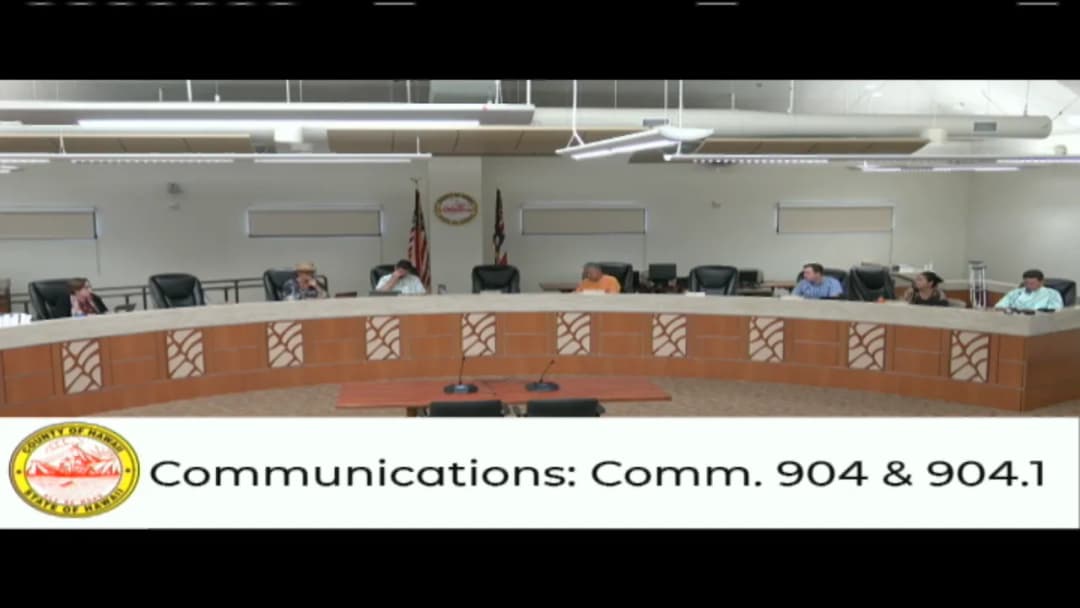
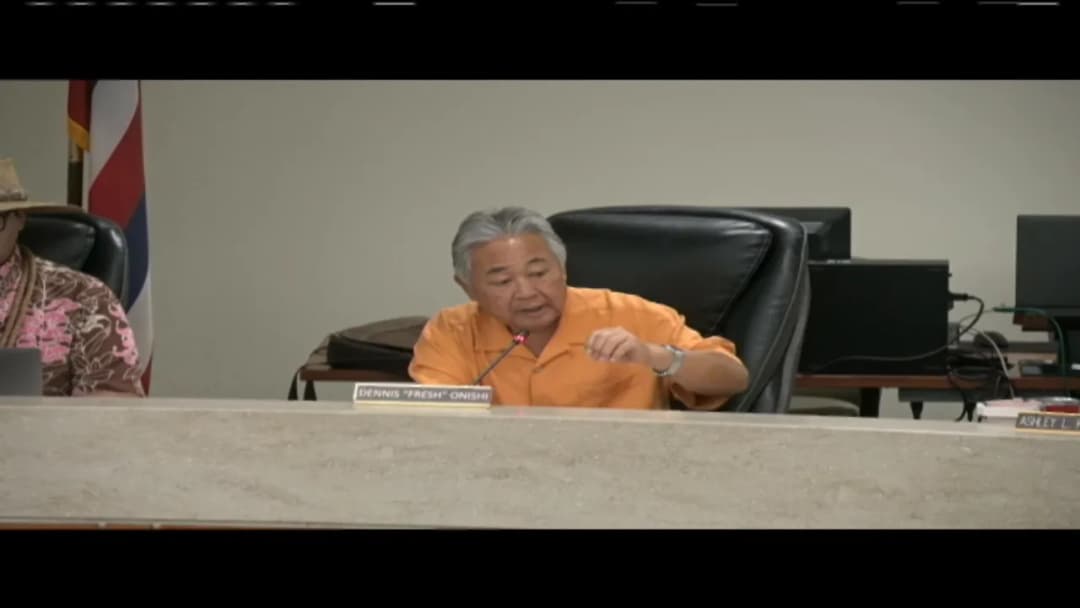
The Committee on Legislative Approvals and Acquisitions (LAAC) met on August 4, 2026, from 9:00 a.m. to 9:03 a.m. in the Kona Chambers. Chair Heather L. Kimball presided. Present were Councilmembers Kagiwada, Hustace, Kānealiʻi-Kleinfelder, and Villegas. Councilmembers Inaba, Kierkiewicz, and Galimba were absent. The sole agenda items were Communications 904 and 904.1, concerning a Permitted Interaction Group (PIG) for the Waiwai Grants. No public testimony was offered. Discussion Items - Comm. 904: Requested formation of a Permitted Interaction Group to evaluate and review the 2026-2027 Waiwai Grants application process, discuss code amendments, and develop recommendations for the 2027-2028 process and scoring rubric. A motion to close the file on Comm. 904 had been previously made. - Comm. 904.1: Transmitted a report from the ad hoc committee’s findings and recommendations. No separate action was taken on this communication. Key Outcomes - The committee voted to close file on Comm. 904. The vote was 6 ayes (Kimball, Kagiwada, Hustace, Kānealiʻi-Kleinfelder, and Villegas) and 0 nays, with three members absent (Inaba, Kierkiewicz, Galimba). - Chair Kimball thanked Councilmembers Kagiwada, Inaba, and Galimba for their support of the ad hoc program, and Jessica Valdez in Chair Inaba’s office for her work on improving the process. - The meeting adjourned at 9:03 a.m.
The Communications, Reports, and Council Oversight Committee (CRCOC) of the Hawaiʻi County Council met on August 4, 2026, at 2:31 p.m. at the West Hawaiʻi Civic Center in Kailua-Kona. The committee addressed three communications: an affordable housing agreement for a subdivision in Puna, a status update on virtual access for county boards and commissions, and a presentation on early childhood systems funded by the American Rescue Plan Act (ARPA). No public testimony was offered. Communications - Comm. 977 – Affordable Housing Agreement for Wung Subdivision (TMK: 2-4-003:035): The committee discussed a housing agreement that allows the developer to satisfy affordable housing requirements either by purchasing an excess credit or building a rental unit. Councilmembers raised concerns about the lack of public reporting when requirements are actually fulfilled. Corporation counsel agreed to explore a system for tracking and reporting satisfaction. Motion to close file passed unanimously (9 ayes, 0 noes). - Comm. 978 – Status of Virtual Access for County Boards and Commissions: Mike Alameda, Executive Assistant in the Mayor’s Office, presented an update. Out of 30 active boards/commissions, 26 currently offer remote public participation. Four boards remain without remote access: the Liquor Commission, Liquor Adjudication Board, Public Access Open Space and Natural Resources Preservation Commission (PAOSNRPC), and Tax Board of Review. Plans are in place to bring Liquor Commission online by September 2026, PAOSNRPC by January 2027, and the Tax Board under discussion. Alameda also reported efforts to create a central YouTube repository for archived meeting recordings. Councilmembers emphasized the importance of equitable access, especially for mobility-limited community members. Motion to close file passed unanimously (9 ayes, 0 noes). - Comm. 979 – Presentation on ARPA Funding for Early Childhood Systems: Marlene Zeug of the PEWA Project, along with Angela Thomas (Hawaiʻi County Early Childhood Coordinator), Doug Imig (Friends of the Future), and others, presented results of the county’s early childhood investment, including the Pāhoa Promise place-based initiative. Key outcomes included reducing overdue well-child visits from 36% to 3.4% in one year, distributing 23,000 books island-wide, supporting five family child care startups (three licensed), and training early childhood educators. Future funding relies on federal disaster relief ($8.9 million for Hawaiʻi County over four years, starting 2027) and a congressionally directed earmark ($300,000). A significant funding gap exists between the end of ARPA funds (December 31, 2026) and the start of new funds. Councilmembers expressed strong support for sustaining the early childhood coordinator position and the programs. Councilmember Kimball indicated she would work on a budget amendment to continue the position. Councilmember Inaba requested a detailed report on deliverables and expenditures from the ARPA-funded contracts. Motion to close file passed with 6 ayes, 0 noes, and 3 excused (Councilmembers Hustace, Kierkiewicz, and Onishi). Key Outcomes - Comm. 977 closed with a directive for corporation counsel to improve tracking of affordable housing requirement satisfaction. - Comm. 978 closed with acknowledgment of progress and a request for an updated column on meeting recordings. - Comm. 979 closed with councilmembers pledging to explore budget options to sustain the early childhood coordinator position and requesting a final accountability report on ARPA expenditures.
The Policy Committee on Planning, Land Use, and Economic Development of the Hawai‘i County Council met on Tuesday, August 4, 2026, at 1:33 p.m. at the West Hawai‘i Civic Center in Kailua-Kona. Chair Ashley Kierkiewicz presided. The sole agenda item was Bill 176, which amends the General Plan amendment procedures. The meeting adjourned at 1:53 p.m. Public Comments & Testimony - No oral testimony was offered for any agenda item. Discussion Items - Bill 176 – General Plan Amendment Procedures: Councilmember Inaba introduced an amendment (Communication 968.5) to the bill. The amendment clarified that the council may adopt the planning director's recommendations as-is, with amendments, or reject them; extended the planning director's review period from 30 to 60 days; and required the planning department to submit a complete legislative history report including summaries of public workshops, comments, and relevant records. The amendment did not include a requirement for the planning department to provide recommendations or a draft plan before initiating the comprehensive review—a policy kept per discussion between Chair Kierkiewicz and Councilmember Inaba. - Planning Director Jeff Darrow expressed concern about Section 16A, subsections 1 and 2, arguing it would be difficult for the department to produce a draft plan or amendment recommendations at the start of the process without first receiving input from other agencies and the public. He requested a change to that section. - Councilmembers debated the timing and clarity of the requirement. Councilmember Kimball noted the need for a clear direction before public outreach. Councilmember Hustace questioned the interpretation of the section. Councilmember Inaba argued that prior consultation could occur and that providing a draft or recommended amendments at initiation gives the public and council a solid starting point. - Chair Kierkiewicz stated for the record that the intention of Section 16A is to produce either recommended amendments to the current plan (subsection A1A) or a draft new plan (subsection A1B), not mere recommendations. She emphasized this interpretation for future reference. - Councilmember Kimball suggested wordsmithing the section for clarity. Key Outcomes - Amendment to Bill 176: Councilmember Inaba’s motion to amend the bill with Communication 968.5 passed unanimously (8 ayes, 0 nays, 1 excused – Councilmember Onishi). - Final Vote on Bill 176: The bill as amended was forwarded to the full county council with a favorable recommendation. The roll call vote was 6 in favor (Councilmembers Kimball, Villegas, Inaba, Hustace, Kagiwada, and Kierkiewicz), 1 opposed (Councilmember Galimba), and 2 absent (Councilmembers Kaneali‘i-Kleinfelder and Onishi). - Next Step: Bill 176 proceeds to the full council for first reading.
The Committee on Governmental Operations and External Affairs (GOEAC) met on August 4, 2026, at 12:00 p.m. in Kailua-Kona, with Chair Jen Kagiwada presiding. The committee reviewed four resolutions and two bills, all of which were recommended for passage to the full County Council. No public testimony was offered. Resolution 614-26: Handheld Mass Spectrometers for Hawaiʻi Police Department - The resolution authorizes the Mayor to accept a U.S. Department of Justice grant to purchase two handheld mass spectrometers to detect fentanyl. Lieutenant Kelly Moniz of HPD testified that the devices will reduce officer exposure to fentanyl and improve charging capabilities, especially in West Hawaiʻi where samples are currently driven to Hilo. The committee voted 9-0 to forward the resolution with a favorable recommendation. Resolution 615-26: Domestic Violence Prosecution Project Grant - This resolution authorizes the Mayor to accept a state grant to partially fund a deputy prosecuting attorney for misdemeanor domestic violence and protective order cases. Grant Nagata and Shannon Kagawa from the Prosecuting Attorney's Office testified that the grant funds a dedicated family court prosecutor for East Hawaiʻi. Councilmember Onishi questioned why the position is not permanently funded and noted the high incidence of domestic violence on the island. The committee voted 9-0 to forward the resolution favorably. Resolution 616-26: Naloxone Nasal Spray Distribution Boxes - The resolution authorizes the Mayor to accept a state Department of Health grant for installation and maintenance of two naloxone boxes at the Hilo County Building and West Hawaiʻi Civic Center. Ms. Samura and Deputy Director Lin of the Mayor's Office testified that the boxes are free to the community and supplied by the state. The committee voted 8-0 (Councilmember Kānealiʻi-Kleinfelder absent) to forward the resolution favorably. Resolution 617-26: NACo and WIR Board Nominations - The resolution approves the slate of officers for the National Association of Counties (NACo) and Western Interstate Region (WIR) boards. Councilmember Kimball noted that Hawaiʻi County typically receives a presidential appointment to NACo. Councilmember Onishi provided historical context on allocation of seats among counties. The committee voted 8-0 (Councilmember Kānealiʻi-Kleinfelder absent) to forward the resolution favorably. Bill 169: Public Access, Open Space, and Natural Resources Preservation - Code Amendments - The bill amends Chapter 2, Article 42 of the Hawaiʻi County Code to require that all qualifying lands with a score of 70% or higher be included on the Public Access, Open Space, and Natural Resources Preservation Commission’s recommendation list. It also establishes timelines for acquisition and reassessment. Councilmember Hustace introduced two amendments (Communications 939.2 and 939.3) that were adopted unanimously. The first amendment simplified the acquisition timeline to five years after an adopted resolution. The second amendment added duties for the commission to review and reassess properties. Councilmember Kierkiewicz questioned the impact on the commission and the reassessment process. Deputy Finance Director Malia Kai supported the amendments, stating they provide clarity. The committee voted 9-0 to recommend passage on first reading. Bill 179: Department of Research and Development - Code Amendments - The bill amends Chapter 2 of the Hawaiʻi County Code to describe the responsibilities of the Department of Research and Development (RD) and establish a grant program of at least $1 million annually for community-based economic development. Co-makers Councilmember Kierkiewicz and Council Chair Inaba explained that the bill clarifies RD's duties, including data collection, technical assistance, and grant-making. Director Benson Medina and Deputy Director Lin testified that the bill aligns with current operations and provides clearer guidance. Councilmember Kānealiʻi-Kleinfelder raised concerns about the distinction between RD and the Office of Sustainability, Climate Equity and Resilience (OSCAR), and emphasized that grants should directly benefit Hawaiʻi County residents. Councilmember Onishi requested a regular reporting requirement to the council, which the director agreed to. The committee voted 8-0 (Councilmember Onishi absent) to recommend passage on first reading. Key Outcomes - All six agenda items were forwarded to the full County Council with favorable recommendations. - Vote tallies: Res. 614-26 (9-0), Res. 615-26 (9-0), Res. 616-26 (8-0), Res. 617-26 (8-0), Bill 169 (9-0), Bill 179 (8-0). - Bill 169 and Bill 179 were both amended before the final vote. - Councilmember Onishi expressed intent to discuss permanent funding for the domestic violence prosecutor position in the next budget cycle.