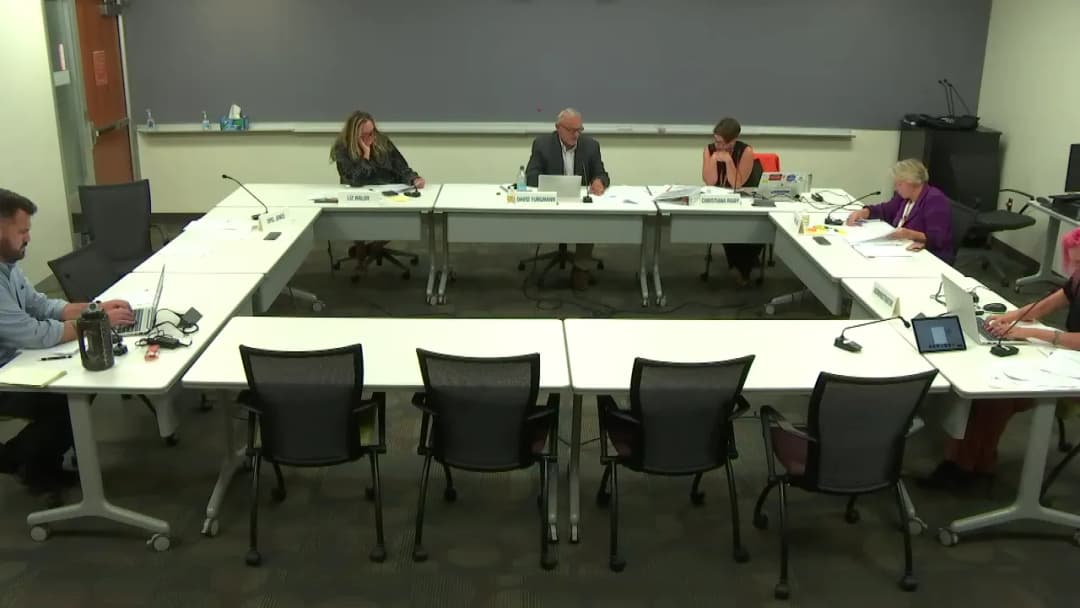
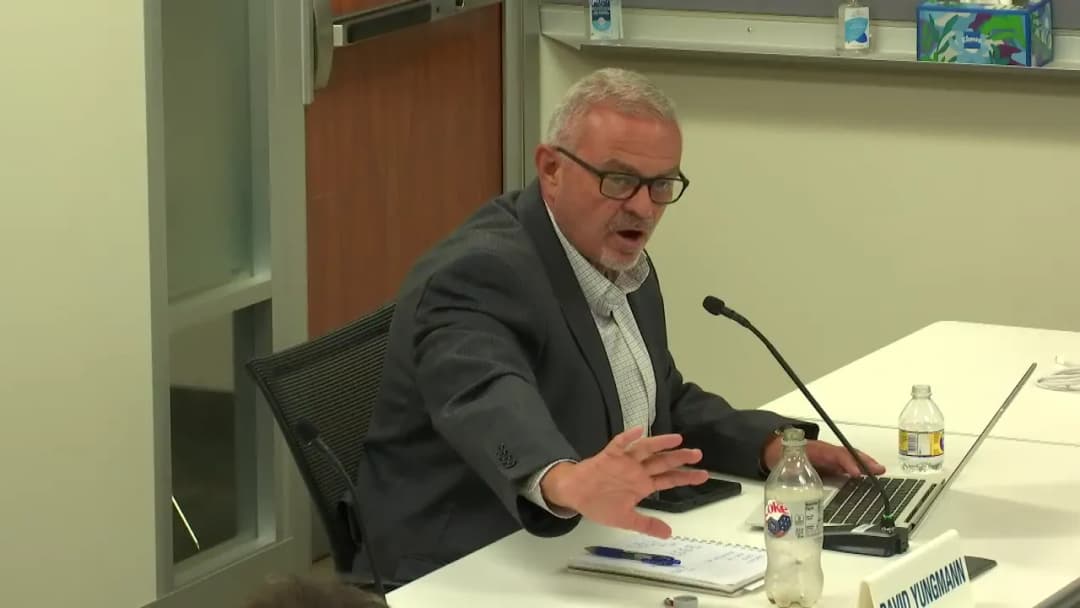
The Howard County Planning Board met on September 17, 2026, to consider two agenda items: a concept site plan for a deck setback encroachment and a major subdivision request. The board approved both items unanimously after staff presentations and discussion. The board also set a virtual work session for October 1, 2026, to review rules and procedures. Call to Order and Administrative Items - The board established a quorum with members Cethel, Moser, and Gadzi present. The agenda was approved. Minutes from previous meetings were deferred. - Executive Secretary announced that the October 1, 2026, meeting will be a virtual work session to review the board’s rules and procedures. CSDP-26-002 – Jason Clapp (Deck Setback Encroachment) - Staff from the Department of Planning and Zoning presented a request to reduce the required side yard setback from 7.5 feet to 3 feet 9.75 inches for a replacement deck at 99 E. Gold Amber Garth in the Village of Long Reach. - The existing deck was non-compliant; the new deck extends the length but not the width. The lot coverage would increase slightly to 30.4%, requiring a finding that the deck is a similar minor structure. - The petitioner, Jason Clapp, presented photos and framing plans, noting the angled property line. - The board discussed the process and appreciated the applicant’s compliance. No public comments were received. - Motion to approve CSDP-26-002 was made, seconded, and passed unanimously. PB 463 – Tom and Jill Henderson (Resubdivision) - Staff presented a request to resubdivide an existing 7.22-acre lot (Lot 3 of Rutherford Subdivision) into two buildable lots, zoned RR-DEO in Tier III Growth Area. - The property is served by private septic. Environmental features (wetlands, streams, steep slopes, forest) are mostly in rear and will be protected by conservation easements. Forest conservation is met on-site. - The petitioner’s engineer, Paul Sill, explained the lot shapes were irregular due to limited perk test areas. One lot contains the existing house. - Board asked clarifying questions about locations of streams and steep slopes. No public comments. - Motion to approve PB-463 was made, seconded, and passed unanimously. Key Outcomes - CSDP-26-002 approved unanimously to allow the deck setback encroachment. - PB-463 approved unanimously to allow the resubdivision. - The October 1, 2026, meeting will be a virtual work session (no in-person attendance). Note: The board also discussed a planned presentation on quasi-judicial procedures, which was postponed due to lack of public attendees.
Public Meetings - Howard County, Maryland
Public Meetings - Howard County, MarylandThe Inspector General Advisory Board (IGAB) held a hybrid meeting on Thursday, September 17, 2026, at 6:30 PM in the C. Vernon Gray Room and via WebEx. The board welcomed new members, received an update from Inspector General Kelly Madigan, discussed access to county systems, reviewed the IG performance evaluation criteria, and planned the annual report and required joint meeting with the County Executive and County Council. Consent Calendar - No consent calendar items were presented. Public Comments & Testimony - No public comments were made. Discussion Items - Introduction of Deputy Inspector General Frank Lopez: Mr. Lopez, a 29.5-year veteran of the Maryland State Police (retired December 2025), introduced himself. He has four sons raised in Howard County and coached youth soccer. The board welcomed him. - Introduction of New IGAB Member Michael Cummins: Mr. Cummins is a retired federal law enforcement agent (FDA Office of Criminal Investigations, retired 2020) and former auditor for military and federal IG offices. He currently leads a global security team for a pharmaceutical distributor. - Inspector General Update (Kelly Madigan): - As of the meeting date, the OIG had received 101 complaints and had 18 open and active cases. - Two new investigators will be onboarded: one on September 21, 2026, and one on November 2, 2026. - An intern from the University of Maryland (rising junior) has joined two days per week for academic credit. - The OIG training course is nearing rollout to the Office of Law and Office of Human Resources; the goal is 95% completion by all Howard County employees (approximately 5,000–6,000). - Permanent office space was secured at 9755 Patuxent Woods in mid-August, occupying a shared suite with five offices, three cubicles, and a conference room. A county vehicle (Honda CRV) was obtained in late May/early June using prior year salary savings. - Systems Access: The county has identified over 300 systems; access to date includes email and basic time/attendance systems (4–5 systems). Ms. Madigan expects to have core systems identified by end of calendar year. Lack of access (e.g., personnel records) has impeded some investigations—some cases cannot be fully pursued because required records are denied under the current interpretation of the Maryland Public Information Act (MPIA). - Case Management System: A SharePoint-based system has been operational since mid-April, enabling tracking of investigative tasks and metrics. - Update on MPIA Litigation in Baltimore City: - Chair Salem reported on a hearing held September 16, 2026, before Judge Pamela White regarding Baltimore City IG access. The judge ordered the city to respond to subpoenas and reinstate direct server access for the IG, ruling that the IG’s confidentiality obligation negates MPIA redaction concerns. The ruling is persuasive but not controlling in Howard County. The board discussed whether state legislation is the best long-term solution. Ms. Madigan and attorney Amanda noted the need to review the written order before determining impact. - Inspector General Performance Evaluation Criteria: - The board agreed to reduce the performance evaluation metrics from eight (as in the county’s standard form) to three narrative metrics: 1. Outreach – communications, training, public relations. 2. Professionalism – incorporating judgment, problem solving, teamwork, adaptability, attendance, etc. 3. Performance – meeting responsibilities (e.g., casework, administrative duties). - The board will draft narrative language for each metric, share with Kelly Madigan for input, and finalize a rating after approval by HR. An interim meeting before December 3, 2026, may be needed. - IGAB Annual Report Discussion: - The board is required to issue an annual report by the end of each calendar year, submitted simultaneously with the IG’s annual report. A joint meeting with the County Council and County Executive is also required. - The board set a deadline of December 14, 2026, for a near-final draft. Statistics will run through the end of November. The joint meeting should be scheduled within the next month, likely before the new council takes office in December. - IGAB Vacancy Update: - Julia Zhu has been nominated to fill the D1 seat (replacing Steve Grisenberry). A public hearing is scheduled for September 22, 2026, with a county council vote on October 5, 2026. She is expected to join by the December 3 meeting. - Other Business: - Chair Salem suggested amending the board’s rules and procedures to explicitly define performance evaluation oversight as a ministerial function, to ensure clear authority. This would be considered next year. Key Outcomes - Welcome: Frank Lopez as Deputy IG and Michael Cummins as new board member. - Performance Evaluation: Consensus to proceed with three narrative metrics (outreach, professionalism, performance) subject to HR approval; Chair Salem will draft language. - Annual Report: Draft due December 14, 2026; IG statistics through November 30, 2026. Staff (Isaiah and Nick) will schedule the joint meeting with the County Executive and County Council within the next month. - Systems Access: Ms. Madigan will provide a further update at the December 3 meeting on progress toward accessing core county systems. - Next Meeting: Thursday, December 3, 2026, at 6:30 PM. Additional interim meetings may be called to finalize the performance evaluation narrative and annual report.
The Maryland Department of Transportation (MDOT) held its Consolidated Transportation Program (CTP) tour stop in Howard County to present the draft six-year transportation program and hear from state and local elected officials. County Executive Calvin Ball and MDOT Secretary Katie Thomson (the transcript also spells the name as Thompson) opened the meeting; modal agency leaders then presented, followed by questions from Howard County officials. No minutes were available, so this summary is drawn entirely from the raw transcript. Note: the agenda lists the meeting date as September 16, 2026 at 6:00 PM, while the provided timestamp indicates September 17, 2026 11:00 AM UTC; this summary uses the timestamp date. No consent calendar, votes, or formal public testimony occurred. Welcoming Remarks - County Executive Calvin Ball, speaking at his final CTP meeting as Howard County executive, welcomed MDOT and thanked Secretary Thomson and MDOT staff for an eight-year partnership that supported transit, roads, bridges, pedestrian and bicycle improvements, safety programs, and transportation demand management. - Ball said the Route 1 Pedestrian Safety Action Plan (PSAP) will deliver more than two miles of contiguous multimodal facilities along the southern Route 1 corridor when fully constructed, and he thanked MDOT for including more than $4 million in the draft CTP for PSAP construction and implementation. - Ball listed Howard County transportation priorities including future access to Maryland 175, improved connections to Maryland 108, shared-use connections at Snowden River Parkway and Maryland 175, and a long-term multimodal connection using the former CSX corridor. He recalled that over the past eight years, state support included more than $30 million in operating assistance for local transit, $2.8 million in capital support, and nearly $1 million in transit innovation grants. - Secretary Thomson said Howard County was the fifth stop on the second day of the CTP tour. She explained that fiscal constraints required difficult choices to prioritize must-fund needs and limited MDOT's ability to bring in new programs; MDOT is modernizing how it prioritizes asset management and new capacity and intends to offer greater clarity on trade-off decisions. MDOT Modal Presentations - State Highway Administrator Will Pines said SHA is advancing safety, state of good repair, and economic development despite fiscal constraints. He noted that this month (September 2026) SHA is starting a project to resurface Maryland 100 between Snowden River Parkway and Maryland 108, and is advancing operational and safety upgrades on I-70 between Maryland 32 and the Beltway, with data collection under way and a public workshop expected in 2027. On Maryland 32 from North Linden Church Road to I-70, Pines said that if funding is not authorized, no additional SHA capital program funding is available to support noise mitigation at this time. - District Engineer Andrew described the county-state relationship as collaborative and said SHA looks forward to continuing the Maryland 175 Columbia Gateway Project collaboration. - Maryland Transportation Authority (MDTA) representative Melissa Williams said the Key Bridge Rebuild continues in full force as MDTA's top priority. In fiscal year 2026, MDTA's vehicle recovery unit provided roadside assistance to more than 7,700 motorists at both Baltimore tunnels, and proposed toll changes will follow the statutory public toll-setting process and require MDTA board approval in fiscal year 2028. - A Maryland Transit Administration (MTA) representative said CTP funding will advance a project through 30% design, and that MTA supports Howard County with nearly $6 million in grants toward the purchase of one heavy-duty bus, two small buses, and the rideshare program. - A Maryland Aviation Administration (MAA) representative said BWI Thurgood Marshall Airport produces an economic impact of $11.5 billion annually and supports over 117,000 jobs. MAA supports more than 30 public-use airports, and the draft CTP focuses on critical state of good repair for airfields and airport terminals. Questions & Discussion - A Howard County council member, who noted they were closing out their tenure, described BWI noise problems created by NextGen, calling it a highway in the sky, and pressed for continued partnership among MDOT, MAA, the county roundtable, and the FAA on noise. Aircraft flyovers caused several pauses during the meeting. - The same council member recalled that when they last met with a neighborhood group, about 300 residents in a church said don't take away our ability to turn left or north on Route 29; the member asked MDOT to work with the community instead of simply building another right lane out of River's Edge. - The council member asked how Howard County can access MDOT's bus rapid transit (BRT) grant funding set aside for counties other than Montgomery County, and who administers it; MDOT offered to brief them offline. - The council member asked about the high percentage of wheelchair-accessible taxis and Ubers in the city and whether the state is examining that, citing Howard County's aging population. MTA said it is exploring the issue, including its taxi access program, noted that vendors are changing their business models, and committed to follow up. - Another elected official requested an update and the date of a public open house for an unspecified priority project; MDOT said it would follow up with details. - One official noted that potential alternatives considered for a corridor access project included a right-in/right-out design that would require drivers to make U-turns near Johns Hopkins or MD 32 to head in the desired direction. Key Outcomes - No votes were taken; the meeting was an information-sharing and listening session on Maryland's draft CTP. - Howard County officials expressed support for the draft CTP and urged continued investment in the Route 1 pedestrian safety projects, Maryland 175 Columbia Gateway access, I-70 and Maryland 32 improvements, and BWI noise mitigation. - Speakers requested MDOT follow-ups on BWI/FAA noise coordination, BRT grant set-aside access, wheelchair-accessible for-hire vehicle policy, and project briefings or open-house timing. - MDOT, SHA, and MTA committed to continuing the county partnership and providing offline follow-up on the questions raised.
On September 16, 2026, the Howard County Council convened a special meeting in open session immediately following the Zoning Board meeting (scheduled to begin at 10:00 a.m.) to determine whether to close the meeting for a closed session. The sole agenda item was a motion to close under Maryland Code General Provisions §3-305(b)(1) and (7) to discuss the performance, discipline, and removal of one or more Board of Appeals members and to obtain legal advice from counsel. Discussion Items - The council heard the legal basis for the closed session, initially referencing June 30 but correcting the date to September 16, 2026. - Councilmember Walsh made a motion to close the meeting, citing the specific statutory authority and topics (performance, discipline, removal of board members and related legal advice). The motion was seconded by Vice Chair Rigby. Key Outcomes - The council voted to close the meeting in accordance with §3-305(b)(1) and (7). By roll call: Vice Chair Rigby voted yes, Councilmember Walsh voted yes. Chair Jones and Councilmember Yungmann were noted as not present for the vote. The motion passed, and the council adjourned the open session to proceed into closed session in the Large Conference Room. The live stream ended at that point.
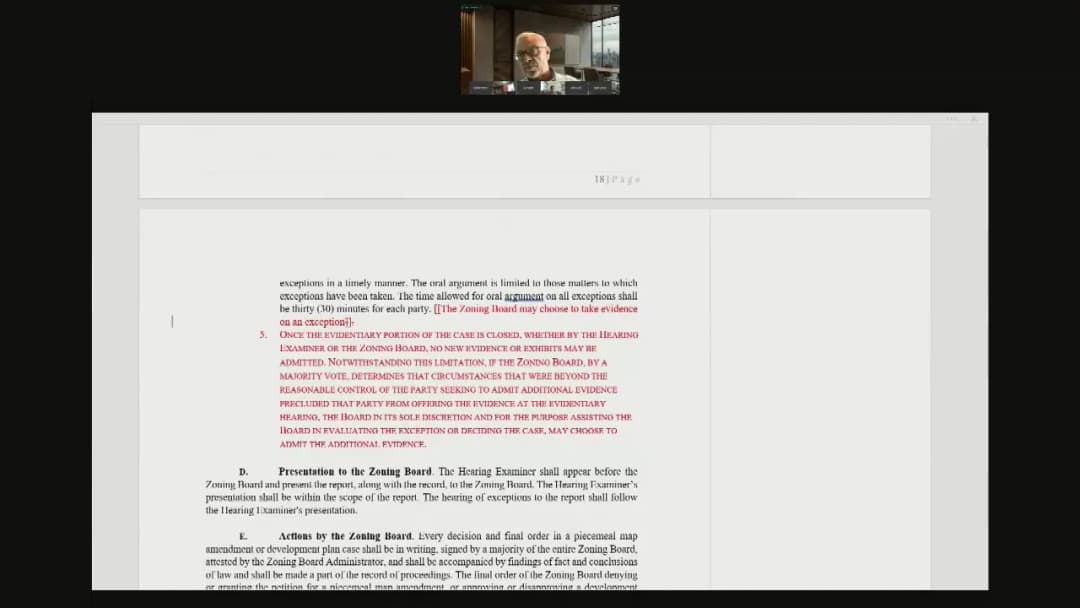
The Howard County Zoning Board held a hybrid administrative meeting on September 16, 2026, at 9:00 a.m. to review and vote on proposed draft changes to the Rules of Procedure for the Zoning Board and the Zoning Board Hearing Examiner. The board had discussed the revisions at an administrative meeting on September 14, and a revised draft was sent to board members on September 15. A quorum was present, and the meeting was livestreamed for the public. Discussion Items - Zoning Board Rules of Procedure: Staff reviewed the proposed changes, including: - A requested reference to prior comprehensive rezoning related to the zoning counsel role; the board agreed this would be incorporated into accompanying code changes rather than the rules themselves. - A new state code reference for political contribution disclosure affidavits, which would also require conforming code amendments. - A typographical cleanup noted by one board member. - Clarified language for the administrative meeting scheduling process: if at least three board members request an administrative meeting within five days, the chair shall call it; otherwise the petition automatically defaults to referral to the hearing examiner. Legal advisor Mr. Moore noted one phrase implied a board decision where the process is actually a default, but the board agreed the draft language was sufficient. - The most substantive debate concerned paragraph 5 on the zoning board receiving new evidence during exceptions. Chairperson Youngman and Ms. Walsh opposed the stricter proposed language, saying the existing code is less prescriptive and has been working. Ms. Rigby expressed concern that some parties could use exceptions to game the process and get a last word, but she ultimately agreed to strike the provision because the problem had occurred only once and the next board could revisit it if necessary. Dr. Jones also supported letting the next zoning board decide. - Hearing Examiner Rules of Procedure: After approving the Zoning Board rules, Chairperson Youngman moved to approve the corresponding proposed draft of the Zoning Board Hearing Examiner Rules of Procedure with the same paragraph 5 removed. The motion was seconded. - Zoning Counsel Contract: At the end of the meeting, the board noted that the zoning counsel contract renewal is not a Zoning Board action but a County Council action. The board planned to discuss it before the next legislative public session on Tuesday, September 22, 2026. Key Outcomes - The board voted unanimously (5-0) to approve the proposed Zoning Board Rules of Procedure draft with paragraph 5 stricken. - The board voted unanimously (5-0) to approve the proposed Zoning Board Hearing Examiner Rules of Procedure draft with the same paragraph removed. - Staff will finalize the documents, make them available on the Zoning Board website, and advertise the proposals. - A public hearing on the proposed rules will be held Monday, October 19, 2026, at 6:00 p.m. in the Banneker Room and virtually. Registration to testify is required by 6:00 p.m. that day. - Written testimony may be submitted by email to councilboard@howardcountymd.gov until 5:00 p.m. on Monday, November 2, 2026, per Section 2.407 of the Howard County Zoning Board Rules of Procedure. - A final adoption meeting is planned for the week of November 2, 2026. - The Zoning Counsel contract renewal was referred to the County Council for handling the following week.
The Howard County Alcoholic Beverage Hearing Board met on September 16, 2026, to consider two petitions for suspension or revocation of liquor licenses. The first petition was postponed, and the second involved an underage sale at 103 Wine and Spirits in Elkridge. The board heard testimony from the liquor inspector, the licensee's representative, and the licensee, then moved into closed session to deliberate on potential sanctions. Consent Calendar - Approval of Minutes: The board unanimously approved the minutes of the August 25, 2026 hearing. - Postponement of First Petition: A petition to find, suspend, or revoke the license of Omnicap Spirits LLC (trading as Metal Rich Wine and Spirits) was postponed on request. The board unanimously approved the postponement. Discussion Items - Petition Against Ayushi LLC (trading as 103 Wine and Spirits): The board considered a petition alleging an underage alcohol sale on February 15, 2026, at 610 Meadow Ridge Center Drive, Elkridge. The liquor inspector, Sega Gurma, presented stipulated facts: On February 15, 2026, two 17-year-old males purchased Smirnoff vodka, seltzers, and Busch beer from cashier Yashil Patel without identification being checked. Video footage showed the sale, and licensee Amit Kumar Patel told Corporal Baxter the minors were "regulars." A customer (later identified as a possible teacher) reported the sale to police. The liquor inspector noted concern that the owner admitted the minors were regulars but acknowledged the owner's cooperation. - Licensee's Defense: Martin Johnson, a former Howard County liquor inspector representing the licensee, testified that the minors had been carded 48 hours earlier on Friday, February 13, 2026, and presented a fake ID showing age 22. The lottery scanner used at the time only translates barcodes and does not detect fake IDs. After receiving the petition in late July 2026, the store purchased an Intellicheck Age ID system (99.97% accurate) and caught seven fake IDs in the first two weeks. The store implemented a policy to card anyone appearing under 40. The owner, Amit Kumar Patel, testified that the minors had been coming in for two weeks and were carded each time; on Friday he also asked additional questions. He did not card them on Sunday because he recognized them. He voluntarily provided video to Corporal Baxter on February 19, 2026. The video from Friday had overwritten by the time the petition was filed. The owner has 22 years in business with no prior violations. - Board Questions: Board members questioned why the Friday video was not preserved (overwritten within days) and noted that Mr. Johnson's observation of an "adult-oriented" ID in the wallet was speculative given the grainy video. The liquor inspector deferred to the board on disposition, finding the owner's admission of regulars concerning but noting his cooperation. Key Outcomes - Closed Session: The board voted unanimously to enter a closed session under Section 3-305(B)(7) of the Howard County Liquor Board rules to consult with counsel on legal advice regarding potential sanctions (revocation, suspension, or fines). The open session was adjourned, and no decision was announced publicly. - Next Steps: The board will deliberate in closed session and issue a decision at a later date.
On September 15, 2026, at approximately 10:00 AM, Hearing Examiner Joyce Nichols presided over a hybrid hearing for Case BA26-014V, a residential district variance petition filed by Charles Watkins. The petition requested a 3.5-foot variance from the required 7.5-foot side yard setback to construct a sunroom at 6243 Woodcrest Drive, Ellicott City, MD 21043. The hearing was streamed via WebEx and the Banneker Room. Discussion Items - Variance Request: Applicants Charles E. Watkins and Patricia Rainey Watkins sought approval for a 3.5-foot variance to reduce the side yard setback from 7.5 feet to 4 feet to accommodate a sunroom addition. The Watkins purchased the property in 1996 as the second owners. - Examiner's Findings Review: Examiner Nichols walked through the five required criteria for granting a variance: 1. Unique Physical Conditions: The lot is rectangular with a slight upward slope of 2–3 feet from the street to the rear. The house orientation causes the intended rear yard to be legally classified as a side yard, leading to the setback difficulty. However, the examiner noted the lot shape is similar to neighbors and struggled to identify a unique physical condition beyond the house orientation. 2. Neighborhood Character: The sunroom would not alter the neighborhood character, as neighboring properties have similar sunrooms. It would not impair adjacent property or public welfare. 3. Self-Created Hardship: The hardship was not created by the owners; they purchased the property as built in 1996 and were unaware of the side-yard setback issue due to the house orientation. No construction had begun. 4. Minimum Variance: The requested 3.5-foot reduction is the minimum necessary to allow the family sunroom, which is modestly sized. 5. Historic District: The property is not in a historic district. - Neighbor Input: One neighbor, Mr. Holland, was present but did not offer testimony. The applicants reported speaking with neighbors who voiced no concerns, and no opposition was expressed. Key Outcomes - The hearing was concluded and the record closed. Hearing Examiner Nichols indicated that a decision and order would be forthcoming. No immediate vote was taken; the examiner will issue a written decision.
On September 14, 2026, the Howard County Hearing Examiner, Joyce Nichols, convened a hybrid hearing at the George Howard Building (Banneker Room and WebEx) to consider Case BA26-016V – a variance petition from Chris Maclay (5655 Railroad Avenue, Elkridge) to exceed the maximum 800 sq ft lot coverage for an existing accessory dwelling unit (ADU) by 200 sq ft (a 20% increase). The hearing streamed live via the county website. Discussion Items - Applicant Testimony: Chris Maclay, a 74-year-old carpenter, testified that the ADU—originally built as a workshop and later converted—now measures 1,000 sq ft. He stated he did not obtain permits for the construction or conversion. The variance is needed to legalize the existing structure. Maclay explained that after losing his museum job in 2018, he rents out the front of the house to nurses and lives in the ADU himself, relying on rental income and Social Security. He expressed a desire to remain in Elkridge and avoid selling the property. - Hearing Examiner Findings: Examiner Nichols reviewed the five required findings for a variance: 1. Unique physical conditions: The lot is extremely narrow, long, and slopes approximately 2–3 feet from the main house toward the rear. The topography and storm drainage patterns were noted. 2. No harm to neighborhood: The area is zoned R-12 and already developed residentially; the ADU is visually similar to the main house (an A-frame with metal roof and gray siding). The variance will not alter the neighborhood character, impair adjacent property use, or be detrimental to public welfare. 3. Hardship not self-created: Maclay acknowledged he built without permits but argued the hardship arises from the lot's physical constraints and his financial need. The examiner expressed difficulty with this finding but continued the analysis. 4. Minimum necessary relief: The applicant seeks only to legalize the existing 1,000 sq ft structure, not to add any new square footage. 5. Not within a historic district: Maclay confirmed the property is not in a historic district. - Neighborhood Context: Maclay stated that all neighboring properties have long, narrow lots with sheds or structures, and he has helped many neighbors with their projects. No neighbors appeared in opposition. Key Outcomes - The hearing examiner concluded the evidentiary hearing and stated that a decision and order would be forthcoming. No immediate ruling was issued from the bench. - The applicant must next obtain necessary building permits and inspections to legalize the structure after the zoning variance is resolved (if granted).
The Zoning Board of Howard County met on September 14, 2026, to review and discuss proposed changes to the Rules of Procedure for the Zoning Board and the Zoning Board Hearing Examiner. The meeting was held in a hybrid format, immediately following the 10 AM Council Monthly Meeting. Discussion Items - Role of Zoning Counsel: The Board clarified that the Zoning Counsel's role is not to advise the Board during hearings but to produce evidence and testimony supporting the existing comprehensive zoning, as per County Code Title 16, Subtitle 1000, Section B. This clarification arose from previous cases where confusion occurred about the Zoning Counsel's advisory role. - Scheduling and Administrative Meetings: The Board discussed changing the default process: instead of requiring an administrative meeting to send cases to the Hearing Examiner, cases would automatically go to the Hearing Examiner unless a specific number of Board members request an administrative meeting to keep the case. This would eliminate unnecessary five-minute administrative meetings. - Filing Deadlines and Exception Period: The Board considered shortening the time to file exceptions from 20 to 10 business days to streamline the process. - New Evidence During Exceptions: A key discussion focused on proposed rule section 2.405 C5, which would restrict introducing new evidence during exceptions. The Board debated whether to adopt a strict rule (no new evidence unless a party had no prior opportunity) or maintain the current permissive standard. Key Outcomes - No final votes were taken on the proposed rule changes during this meeting. - The Board scheduled a virtual meeting for Wednesday, September 16, 2026, at 9:00 AM to finalize and vote on the proposed rule language. - The public hearing on the proposed rules is set for October 19, 2026. - The Board directed staff to clean up the language regarding administrative meetings and conforming legislation to be ready by Thursday, September 17, 2026, for legislative submission. - The Board did not reach consensus on Section 2.405 C5 (new evidence during exceptions) and agreed to continue discussion at the Wednesday meeting. Note: These discussions are part of ongoing efforts to refine procedures following the first year of the new zoning process, with several changes requiring both rule amendments and legislative action.
The Howard County Council held its monthly meeting on September 14, 2026, with a hybrid format. The primary agenda item was the annual meeting with the Inspector General, followed by reports. Key discussions centered on the Inspector General's progress, access to records, and challenges with obtaining information from county systems. A notable procedural dispute arose over adding an item regarding Columbia Community Concepts to the agenda. Annual Meeting with Inspector General - Inspector General (IG) Kelly Madigan provided an update on the office's status, including securing permanent space at 9755 Patuxent Woods Woods, hiring Deputy Inspector General Frank Lopez, and onboarding two additional investigators. The office has implemented a case management system and created an ethics training course for county employees. - The IG reported that as of September 11, 2026, the office had received 97 complaints, converted 19 into active cases, and had 13 active cases and 15 open complaints. She explained that complaints must involve Howard County government, employees, or funds and touch on fraud, waste, abuse, efficiency, accountability, or integrity to become cases. - Councilmember Young questioned the impact of an upcoming court decision in Baltimore City (Judge Pamela White) on IG access to documents. The IG outlined three potential remedies: judicial, legislative (drafted with County Solicitor Gary Cook and sponsored by Delegate Chao Wu for local and statewide bills), and a third option making the IG a co-custodian of records (disagreed upon by Mr. Cook). - Councilmember Rigby asked about staffing, noting the IG's current team (herself, deputy, two incoming investigators). The IG plans to request an administrative assistant in the next budget cycle. - Councilmember Yungmann expressed concern that legislation to improve access might not pass the General Assembly. The IG confirmed she will contact former council members when hearings are scheduled. - Councilmember Walsh emphasized the need for the IG to set a marker of 30 priority systems for access and urged the IG Advisory Board to advocate for the office's needs proactively. - The IG Advisory Board member expressed frustration over the slow pace of granting direct records access, noting it has hindered investigations and impeded the board's oversight. - Councilmember Young asked whether the IG has been denied information outright under the Maryland Public Information Act (MPIA). The IG clarified that all denials are based on mandatory denials under MPIA, not bad faith, but confirmed these denials have prevented pursuit of some cases, e.g., personnel records to verify employee qualifications. Reports - Council Administrator reported technology upgrades for meetings and a new database for council appointments to boards and commissions. - County Auditor reported two audit reports issued (GASB 75 and Office of Transportation) and noted the audit of Columbia Community Concepts (CCC) is stalled because CCC's legal counsel is challenging the county's authority to conduct the audit. Procedural Dispute - Councilmember Young requested to add an item about Columbia Community Concepts to the agenda under Rule 5 (each council member can add one item per year). Chair Jones initially denied the request, stating that as no representative would appear (due to the pending audit), it would be a waste of time. After the County Auditor clarified that the audit has not commenced, Chair Jones agreed to place the item on the October meeting agenda. Councilmember Yungmann noted significant time has passed since the audit was first proposed (May 2026) without cooperation from CCC. Key Outcomes - The Council will place Columbia Community Concepts on the October monthly meeting agenda. - The IG will continue pursuing legislative remedies in Annapolis with support from the Council. - The IG Advisory Board is expected to advocate more strongly for the office's access needs. - The County Auditor will provide an update on the Columbia Community Concepts audit status at the next monthly meeting.