Browse by city
Date range
Search help

Search titles, summaries, topics and stored transcripts together. Keywords may match separately; put the whole query in double quotes for a phrase. Matching follows word analysis, so punctuation is not exact. Both dates are included. Documents are not searched.

SHOWING 91–100 ENTRIES
91
SEP 2, 2026 · INDIANAPOLIS, INDIANA · CITY-COUNTY COUNCIL
Public Safety Committee Meeting – September 2, 2026: Budget Hearings & Sheriff's Quarterly Report

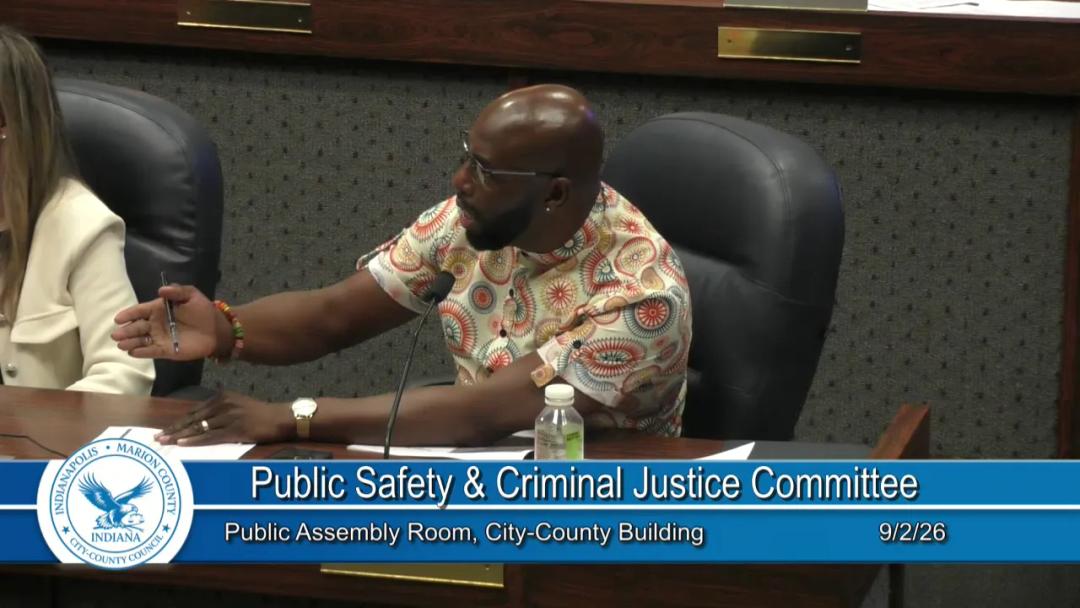
The Public Safety and Criminal Justice Committee of the Indianapolis-Marion County City-County Council met on Wednesday, September 2, 2026, at 5:30 p.m. in the Public Assembly Room. The committee considered Proposal No. 248 (accepting the Sheriff's 2026 Second Quarter Report) and held budget hearings for the Marion County Clerk’s Office, the Metropolitan Emergency Services Agency (MESA), and the Marion County Sheriff’s Office (MCSO) for the 2027 fiscal year. Public testimony focused on inmate phone and video call access. Consent Calendar - Proposal No. 248, 2026 – Directed the Council to accept the 2026 Second Quarter Report from the Marion County Sheriff, as required by HEA 1208 (2025) and related statutes. After a brief question about a printing glitch (resolved by checking the digital copy), the report was accepted without objection. No formal vote was recorded, but the item passed as part of the consent agenda. Public Comments & Testimony - Anna Thomas (Validist Movement) expressed disappointment that the sheriff’s budget did not expand the pilot program from one free phone call per week to three, stating that phone calls are a lifeline for families and support systems. She shared her brother’s experience with addiction and incarceration, and urged continued conversation on including more free calls. - Ladessa Sparks (justice-impacted advocate) emphasized that family connection is a public safety investment. She described the burden of costly calls and video visits, and argued that free communication helps maintain relationships that support successful re-entry. - Jessica Inholt (Validist Movement) spoke from personal experience of incarceration and having a child while inside. She noted that free calls would relieve family financial burden and help individuals set up their own re-entry support. - Sheikh Devante Gilbert Bay (Validist Movement) criticized Sheriff Forrestal for not following through on earlier commitments to expand free phone calls. He also raised concerns about the lack of transparency and oversight of the commissary fund, stating that the sheriff could not say how much revenue it generates or how funds are specifically allocated. He called for an oversight board. - James Wright (local entrepreneur) suggested that instead of increasing overtime for jail staff, the department should increase PTO and mental health resources for both staff and inmates. He noted that some jail areas lack functional tablets and that vendors may not deliver promised services (e.g., access to books). He advocated for more library books to support mental health. Discussion Items - Proposal 248 – Sheriff’s Quarterly Report: Councilor Wells noted a printing issue with the hard copy (last pages distorted), but after confirming the digital version was correct, no further comments were made. The report was accepted. - Marion County Clerk’s Office Budget (2027): - Clerk Kate Sweeney-Bell presented a budget increase of $765,000 (from $5.5M to $6.3M) driven by adding 10 FTEs (from 84 to 94 of a possible 115), 1% COLA, insurance increases, and recreation of positions. The office has collected $39M in fees/fines this year and had over 270,000 interactions. - Councilor Delaney asked about the fluctuation in staffing (from 115 down to 84). The clerk attributed it to unfilled positions being defunded by the controller, attrition in lower levels, and the need to rebuild to functional levels. - Councilor Graves asked if the office’s revenue collection (court costs, bonds, child support, etc.) is comparable to similar cities. The clerk stated Marion County is the best in the state due to its size and efficient collection. - Councilor Boots sought clarification on full capacity (115 FTEs) and whether 94 is efficient. The clerk confirmed that with process improvements, 94 is sufficient to deliver services. - Councilor Cormay requested historical data on services (e.g., marriage licenses) over the last 4-5 years to analyze trends. The clerk agreed to provide it. - Leader Mowrey praised the presentation as a “gold standard” for budget hearings. - Metropolitan Emergency Services Agency (MESA) Budget (2027): - Chief Brown and CFO presented a proposed budget of $32M (12.5% increase over 2026). Key points: - Staffing: Authorized 226 positions, but currently 159 filled (30% vacancy). The 2027 budget funds 175 positions (15 additional telecommunicators) to meet national call-answering standards (90% in 15 seconds). - Tornado siren replacement: Contracts finalized; installation of first 6 sirens to begin in October, 6 more in November, goal to replace 32 by 2027. Delays attributed to parts procurement and coordination with electrical contractors. - Technology: Upgraded public safety network with redundancies; WebEOC crisis tracking tool used during recent flood – enabled 4,000 structure assessments in 3.5 days. AI is being explored for non-emergency calls. - CJIS compliance: 50% complete, expected ahead of schedule in 2027. - Councilor Perkins questioned the request for $3.3M increase in personnel when the current vacancy rate is 30%. The CFO clarified that the 2026 budget funds only 160 positions (not 226), and the increase covers COLA, union contracts, and 15 new hires to address staffing needs. - Councilor Perkins also made a public request for a separate committee debriefing on MESA’s flood response, citing communication gaps and lack of public awareness. He criticized the mayor for lack of leadership during the disaster. - Councilor Delaney thanked MESA for 24/7 flood response work and asked about the mass notification system (RAVE). Chief Brown explained it is opt-in and used for alerts; the system was activated during the flood. - Councilor Boots noted that inaccurate federal flood predictions (Friday morning revision) contributed to poor communication and more damage. He and others stressed the need for a thorough after-action review. - Councilor Graves asked about methods for informing the public. Chief Brown described coordination with PIOs, media, and the RAVE opt-in system. Sirens are only for tornado warnings, not flood alerts. - Councilor Boots also asked about AI implementation. Chief Brown said they are being cautious, examining companies and comparable PSAPs, and would start with low-risk non-emergency calls. - Councilor Mallory questioned the slow pace of siren installation (6 per month) and urged expediting. - Marion County Sheriff’s Office (MCSO) Budget (2027): - Sheriff Kerry Forrestal and CFO Kaelin Carr presented a flat budget ($4.15M increase for contractual obligations only: 3% COLA, food services escalation, medical RFP). - Staffing: Funded for 882 FTEs (same as 2026), currently at 792.5 (down from 797.96 in May). The adult detention center (ADC) has 456 staff, including 258 detention deputies (KPMG recommends 397). Courtline has 44 deputies (recommended 91). High turnover attributed to compensation and demanding work environment. - The sheriff filed a lawsuit against the Indiana Department of Correction (DOC) that afternoon, seeking an order to take custody of 257 inmates (sentenced to DOC but not transferred) and to recover costs ($85/day cost vs. $42/day reimbursement, costing the county $4M/year). - Programs: MAT program expanded (injectable buprenorphine), 5 suicide prevention advocates, tablets with free content, 487,000 free phone calls and 57,000 free video visits year-to-date. - Medical contract: Eskenazi Health declined to take over; RFP for new medical vendor will likely exceed $20M and require a future appropriation. - Commissary fund: Funds many programs and legal counsel (not tax money). The sheriff stated three deputy chiefs sign off on expenditures. Councilor Perkins noted the council receives quarterly reports but does not approve specific programs. He invited the public to review those reports. - Councilor Mowrey asked about tablet costs and damage policy (one tablet per inmate; if damaged, no replacement). - Councilor Mascari asked about the ongoing issue with Eskenazi and the DOC’s failure to take prisoners. The sheriff confirmed that DOC only pays $42/day and has not taken inmates, leading to overcrowding (2,657 inmates in facility designed for 2,400, at 89% capacity). - Councilor Boots questioned the legal basis for DOC reimbursement and whether the lawsuit seeks timely payments. The sheriff said the goal is to force DOC to take prisoners within 5 days per statute. - Councilor Perkins noted the low number of ICE detainees (1-2) and contrasted it with earlier concerns. He also asked about the role of internal vs. Corporation Counsel legal advice. Corporation Counsel had deferred to the sheriff’s internal attorney (Kevin Murray), who explained that his funding comes from the commissary fund, not county general. - Councilor McCormick asked if free calls apply to receiving families (yes) and whether all inmates have tablets (most do, some areas have wall-mounted “pay phones”). - Councilor Wells raised concerns about the re-entry lobby and re-entry court sunset, noting a “gut” of current programs and lack of substantial replacement. She called for an audit of programmatic impacts, not just commissary spending, to improve re-entry outcomes. Key Outcomes - Proposal No. 248 was accepted without a recorded vote. - The committee approved the Marion County Clerk’s Office 2027 budget as presented. - The committee approved the MESA 2027 budget as presented, with an understanding that a separate debriefing on flood response will be scheduled. - The committee approved the Sheriff’s Office 2027 budget as presented (no additional funding beyond contractual increases). - A lawsuit against the Indiana DOC was filed by the sheriff on the day of the meeting. - Councilor Perkins requested, and the committee agreed to schedule, a future session for MESA to debrief on flood disaster response, with emphasis on communication and leadership. - Councilor Wells indicated an intention to review commissary-funded programs and evaluate their effectiveness in reducing recidivism. - Public comments on expanding free phone calls were noted; no immediate action was taken.
PUBLIC SAFETY 27% · BUDGET 25% · CORRECTIONAL FACILITIES 25% · PUBLIC ENGAGEMENT 8%
92
SEP 2, 2026 · INDIANAPOLIS, INDIANA · OTHER MEETINGS (I)
Indianapolis Historic Preservation Commission Hearing – September 2, 2026

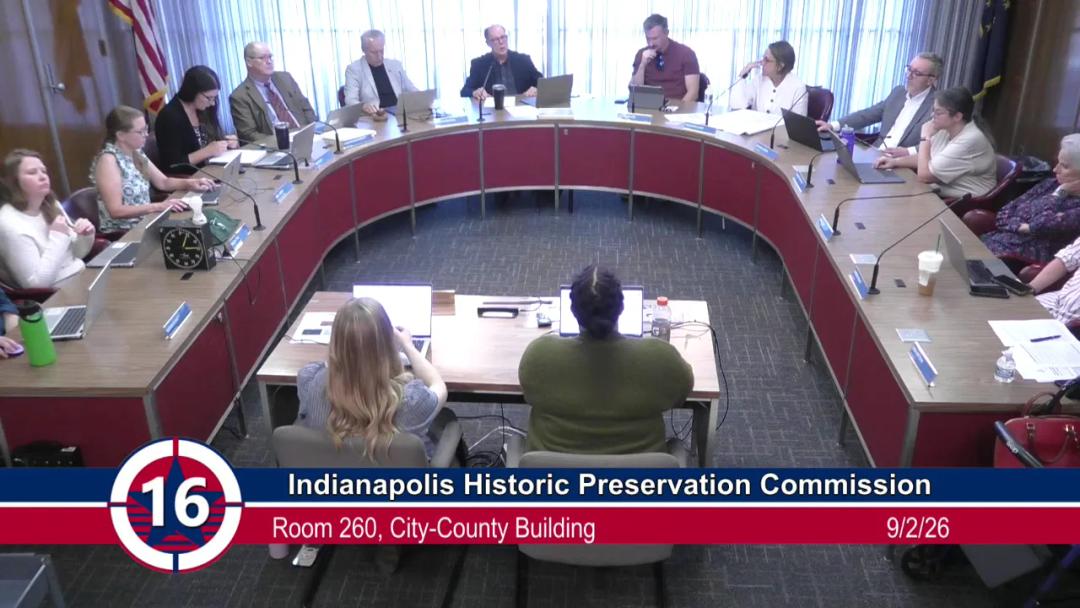
The Indianapolis Historic Preservation Commission (IHPC) held its regular monthly hearing on Wednesday, September 2, 2026, at 5:30 PM in the Public Assembly Room of the City-County Building. The meeting covered approval of August minutes, policy updates, a brick change for a hotel project, an enforcement action on a property in disrepair, and a public hearing on a proposed new single-family house in the Cottage Home Conservation District. The commission voted to approve the policy updates, the brick substitution, and the new house with stipulations, while directing staff to pursue enforcement and a progress report for the Burgess Avenue property. Consent Calendar - Approval of August 2026 Minutes: Approved unanimously without correction. - 2026 IHPC Policy Updates: The commission approved annual updates to the IHPC policies, with a note from Commissioner David Baker that the section on exempt signs appears twice and should be consolidated in the future. Administrator Meg Bush noted that further changes for special event signs are under development. Motion carried unanimously. - 2024-COA-226 (Wholesale District) – 230 South Pennsylvania Street: The applicant, represented by Tim Oaks (Ice Miller) for Boxcar Development LLC, requested approval to substitute brick originally specified from a Nebraska plant (Yankee Hill dark iron spot) with a custom-matched brick from the same manufacturer’s California plant. The change was necessary because the Nebraska plant could not produce the required shapes. Commissioner Susan Williams reported viewing the mock-up on site and found the difference minimal. The commission approved the substitution unanimously. Old Business – Enforcement Action - 324 Burgess Avenue – Enforcement for Code Violations: The property owner, Mr. Madeiros (address: 2255 North 400 West, Greenfield, IN), appeared before the commission. Staff summarized extensive repair orders dating back to 2009, including foundation, roof, siding, and porch issues. The property had been placed on a demolition order but was removed after minor foundation repairs. Staff recommended a 90-day compliance period (by December 1, 2026) for the most urgent repairs, with a progress report due at the December hearing. Mr. Madeiros cited health issues (autoimmune pancreatitis) that delayed work, but stated he is now in remission and has materials ready. He plans to do most work himself with one helper. The commission did not take a vote but directed staff to file a complaint with the prosecutor’s office and continue conversations with Indiana Landmarks about a possible receivership if compliance is not achieved. The owner was encouraged to work with staff on active certificates. Public Hearing – 929 Stillwell Street - 2026-COA-206 (Cottage Home) – 929 Stillwell Street – Matthew Peyton, applicant: The applicant, Matthew Peyton (Pat Architecture, 6219 Guilford Avenue, Indianapolis), presented revised plans for a two-story single-family residence with a detached three-car garage connected by a breezeway. Changes from the previous hearing included: greater separation of the two front gables, recessing the chimney from the front facade, reducing the size of the south gable, adding windows to the garage to make it more cottage-like, and modifying the fence to have a lower 42-inch section in the middle with a taller privacy section near the patio. The property owner, Jason Owens (929 Norman Street, Indianapolis), spoke briefly, expressing willingness to adjust the fence further. Staff Position: Morgan (staff) recommended denial, stating the proposal remains non-compliant with the Cottage Home Conservation Area Plan due to excessive height, massing, scale, and complexity. Staff acknowledged the garage windows were an improvement but believed the design still needed reworking. Commission Discussion: - Commissioner David Baker visited the site twice and found the house appropriate given the unique context of the block, which has lost most original cottages and now contains larger homes. He noted a similar large house across the street with an 8-foot fence. He supported approval with continued tweaks. - Commissioner Susan Williams expressed concern about the fence, calling it a “barricade,” and questioned whether an 8-foot fence across the street was properly approved. She supported the house design but wanted a more appropriate fence. - Commissioner Michael Bivens questioned the complex roof lines, noting that a roof plan would help clarify. He was concerned that insulation design drove the roof shape rather than aesthetics. He suggested simplifying the roof. - Commissioner Anson Keller noted that the lot historically had a building nearly as wide as the proposed house, and the lack of public remonstrance spoke to the neighborhood’s acceptance. He supported approval. - Commissioner William Browne (President) noted the chimney change significantly improved the front facade and was comfortable with the design. He and others wanted the fence’s low section made wider. The applicant agreed to work with staff on the fence and provide a roof plan. Key Outcomes - Vote on 929 Stillwell Street: Motion to approve with staff’s nine stipulations (including submission of a roof plan, pre-construction meeting, and field staking). The motion passed 7–2. (Two ayes against, seven for; the two opposed were not specified but likely the two commissioners who expressed concerns.) - Policy Updates: Approved unanimously. - Brick Substitution: Approved unanimously. - 324 Burgess Avenue: No formal vote; the commission directed staff to pursue enforcement and requested a progress report at the December 2, 2026 hearing. The owner was given 90 days to complete priority repairs (foundation, roof, siding, porch). - Next Steps: Staff will continue to work with the applicant on 929 Stillwell Street to finalize drawings and fence details. For Burgess Avenue, staff will file a complaint with the prosecutor and explore receivership options with Indiana Landmarks.

HISTORIC PRESERVATION 66% · PROCEDURAL 17% · FENCE REGULATION 6% · BUILDING CODE ENFORCEMENT 5%
93
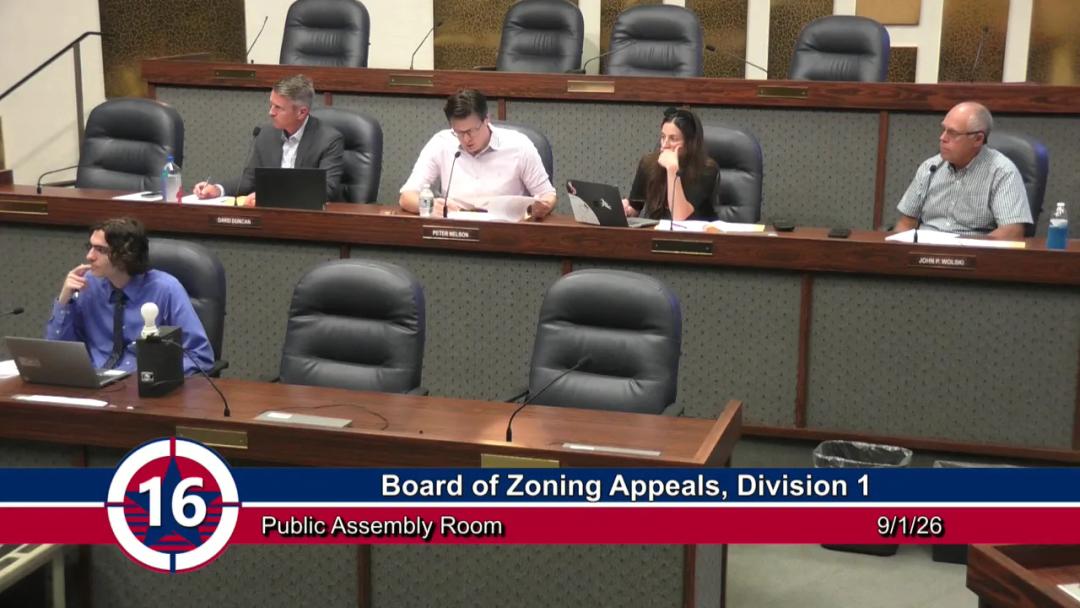
SEP 1, 2026 · INDIANAPOLIS, INDIANA · BOARD OF ZONING APPEALS I
Board of Zoning Appeals Division I Meeting – September 1, 2026

The Metropolitan Board of Zoning Appeals Division I met publicly on Tuesday, September 1, 2026, at 1:00 PM in the Public Assembly Room, City-County Building, Indianapolis. Chair Peter Nelson presided with board members David Duncan, Jennifer Witt, and John Wolski; three votes were required for action. The agenda listed Andrew Katona as a member, but the transcript identifies John Wolski as the fourth member present. The board handled continuances, an expedited docket, and three public hearings, granting several variances and denying two fence-related petitions. Next scheduled hearing date: October 6, 2026. Procedural Actions and Special Requests - The board unanimously approved a waiver of its rules to vote on the expedited docket without additional testimony from individual petitioners. - The board granted a one-day waiver of mailing and sign-posting notice for petition 2026-DV1-041 (9202 Hemingway Drive). - 2026-DV1-039 (2734 North Sherman Drive): withdrawal acknowledged because staff determined the proposed multi-unit house already met applicable standards and no variance was needed. - 2026-DV1-031 (4850 West 78th Street): continued to October 6, 2026, at staff's request so the petitioner could evaluate options and continue discussions with staff and nearby easement holders. - 2026-DV1-036 (6317 Askin Drive): continued to October 6, 2026, at staff's request to allow additional research on stormwater infrastructure utilities near the proposed pool. - 2026-DV3-011 (3603 South Meridian Street): continued to October 6, 2026, for further work on fence and wall clear-sight-triangle plans. - 2026-UV1-020 (3503 North College Avenue): board acknowledged an automatic continuance to October 6, 2026, filed by a registered neighborhood organization. - 2026-DV1-042 (1039 Kessler Boulevard East Drive): continued to October 6, 2026, without additional notice. The board requested a formal motion and vote after staff initially described it as an automatic continuance. - 2026-UV1-022 (3441 West Washington Street): continued to October 6, 2026, with notice. Staff reported that proper notice had not been provided, no sign was posted, and the notice was mailed late. Edgar Gonzalez appeared for the address and requested a 13-day notice waiver, but no motion for waiver was made. The board directed the applicant to work with staff to re-notice and post the sign. - 2026-UV1-019 (8185 Sycamore Road): moved from the public hearing docket to the expedited docket after no opposition appeared; it was later granted. Expedited Docket - 2026-DV1-033 (8006 Meridian Hills Lane): variance to allow a building addition resulting in 80 percent open space where 85 percent is required. Granted 4-0. - 2026-DV1-041 (9202 Hemingway Drive): variance for a subdivision entrance sign in a boulevard island with a 4.4-foot front setback where 10 feet is required. Granted 3-1, with David Duncan voting no. - 2026-UV1-019 (8185 Sycamore Road): variance to permit a 24-foot by 36-foot, 864-square-foot playhouse in the established front yard where minor residential structures are not permitted. Granted 4-0. - 2026-UV1-021 (6448 West Ohio Street): variance of use to permit a medical clinic in a government-owned building. Granted 4-0. Public Hearing: 2026-DV1-013 (Amended) – 2440 Lafayette Road The petitioner sought variances to keep a six-foot-tall chain-link perimeter fence in the front yard, where the maximum permitted height is 3.5 feet and chain link is not permitted in commercial front yards. Staff recommended denial: approximately 1,225 linear feet of chain-link fence with barbed wire had been installed in mid-2025 without approval, triggering three complaints to the Mayor's Action Center and a violation opened in October 2025. The original requests to keep barbed wire and encroach into an AES easement had been withdrawn at the July hearing, and the petition had previously received a 1-2 indecisive vote. The petitioner's representative cited security, noted other six-foot fences in the area, and offered to remove the barbed wire and make length adjustments. Board member Jennifer Witt spoke in opposition, calling the fence inappropriate for the commercial corridor and saying it further industrialized the area. The variance was not granted; all four members voted no. Public Hearing: 2026-DV1-028 – 1019 North Beville Avenue The petitioner, Nicholas Gonzalez, requested a variance for a 7.5-foot-tall privacy fence in the side and rear yards, where six feet is the maximum. He said the height was needed to protect privacy around an above-ground pool and deck, to account for grade changes, and to provide pool safety. He offered conditions to maintain the fence and comply with short-term rental regulations, and he later agreed to a remonstrator request that the variance only last for the life of the fence and not survive a sale. Jacob Phillips, an adjacent neighbor to the north, spoke in support, saying the fence improved privacy and screened the short-term rental property. Jeff Grossman of the Springdale Neighborhood Association spoke in opposition, citing a unanimous neighborhood association vote against the petition, concerns about precedent, and the out-of-state investor context. City-County Councillor Jesse Brown, District 13, urged denial, saying the city should not bend zoning rules for out-of-town investors. Staff recommended denial, finding no practical difficulty that was not self-imposed; staff said a compliant six-foot fence or a 36-inch railing atop the deck could secure the pool area, and the aerial view suggested a hot tub rather than a pool. The variance was not granted; John Wolski voted yes, and Jennifer Witt, Peter Nelson, and David Duncan voted no. Public Hearing: 2026-UV1-023 – 1002 East 25th Street Global Preparatory Academy Monon LLC requested four variances for a new monument sign with an internally illuminated digital display: a 2-foot front setback where 5 feet is required, internal illumination not permitted in the I-2 district, a digital/EVMS display not permitted in the I-2 district, and location within 25 feet of a protected residential district where 600 feet of separation is required. The petitioner argued the school needed a visible entrance sign and the digital display would help communicate school events to the neighborhood. The petitioner accepted nine commitments, including no scrolling or flashing, messages remaining static for at least 15 seconds, messages limited to school activities, the sign being turned off from 9 p.m. to 6 a.m., automatic dimming, a photometric plan, and automatic termination if educational use ceases. A support letter from Councilman Gibson was submitted. Staff made a split recommendation: approval of the setback and internal-illumination variances, but denial of the digital display and 600-foot separation variances, citing the sign's visibility from residentially zoned parcels and the Monon Trail, potential driver distraction, and enforcement challenges. No remonstrators appeared. The board voted on the petition as a single item, subject to the nine commitments; Peter Nelson, Jennifer Witt, and John Wolski voted yes, granting the variance. David Duncan's vote was not read in the transcript. Key Outcomes - Granted: 2026-DV1-033, 2026-DV1-041, 2026-UV1-019, 2026-UV1-021, and 2026-UV1-023. - Denied: 2026-DV1-013 (Amended) and 2026-DV1-028. - Continued to October 6, 2026: 2026-DV1-031, 2026-DV1-036, 2026-DV3-011, 2026-UV1-020, 2026-DV1-042, and 2026-UV1-022. - Withdrawal acknowledged: 2026-DV1-039.

FENCE REGULATION 28% · PROCEDURAL 23% · SIGN REGULATION 17% · ZONING AND LAND USE 16%
94
SEP 1, 2026 · INDIANAPOLIS, INDIANA · CITY-COUNTY COUNCIL
Administration and Finance Committee Budget Hearings - September 1, 2026

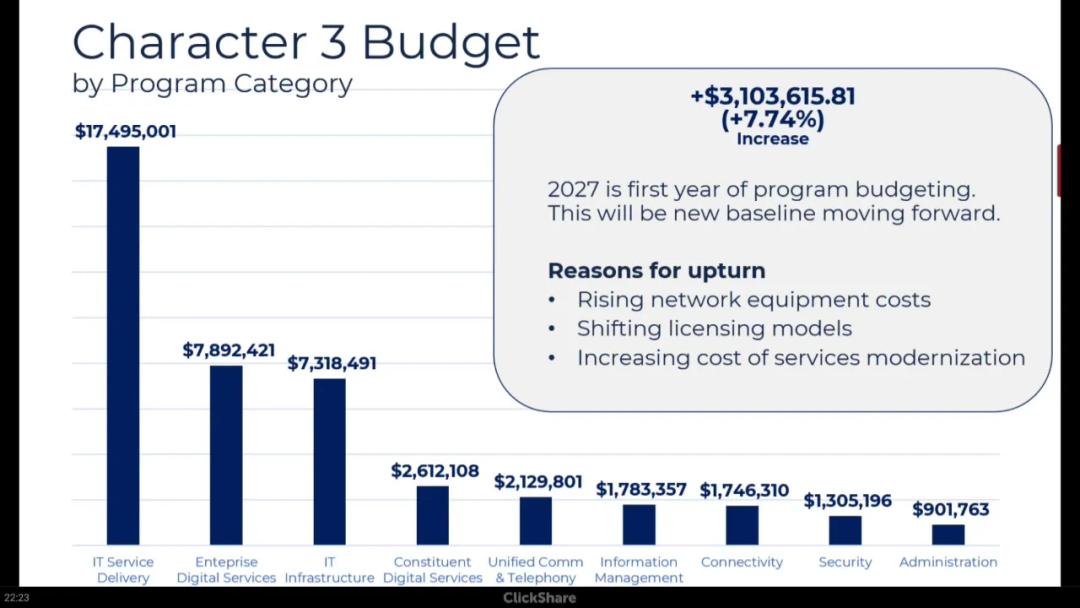
The Administration and Finance Committee of the Indianapolis-Marion County City-County Council held a meeting on September 1, 2026, at 5:30 p.m. in Room 221 of the City-County Building. The committee reviewed proposed 2027 budgets for three agencies: the Office of Minority and Women Business Development (OMWBD), the Office of Audit and Performance (OAP), and the Information Services Agency (ISA). No formal votes were taken; the presentations and related discussion were informational. Office of Minority and Women Business Development (OMWBD) - Director Fredericks presented the agency's 2027 budget request. He stated that the city's program continues to operate normally despite state-level changes (AG opinion letter and Governor's Executive Order 2617), and that the city program is based on the U.S. Supreme Court case J.A. Croson vs. City of Richmond. - Key statistics: From 2020 to 2024, competitive city-county spend of $3.8 billion resulted in an XBE economic impact of $800 million (21% ROI). Combined with incentive projects, total spend was $8.8 billion with $2 billion in direct XBE spend (24% ROI). The office provided over 2,000 business consultations from 2020 to 2025. - Proposed a new Small Business Enterprise (SBE) program with a 20% participation goal, applying to firms at or below half of SBA size standards, with a maximum annual revenue of $1.32 million per owner/member, and requiring the business to be headquartered and domiciled in Marion County. This would require a new ordinance and mayoral approval. - In Q&A: Counselor Nielsen asked about the need for a new ordinance and partnerships with SBA. Director Fredericks confirmed a new ordinance would be needed and that the office collaborates with local SBA partners. President Lewis asked about potential conflict with the state program; Director Fredericks did not foresee conflict, noting the city's focus on Marion County. Counselor Boots noted a drop in consultations since 2023; Director Fredericks attributed it to businesses becoming busy after certification. Office of Audit and Performance (OAP) - Director Wesley Jones presented the 2027 budget request of $2.0 million, a $92,004 increase, largely driven by personnel costs. The office has 9 FTEs with zero vacancies. The audit team focuses on performance audits, risk management, and financial controls; the performance and innovation team provides data literacy training and consulting. - Notable: The office's whistleblower hotline received 44 submissions in 2026, with 13 deemed credible. The OAP audit of the Office of Public Health and Safety (OPHS) was released in April 2026, and follow-up work is ongoing. - In Q&A: Counselor Mowery asked about the audit schedule and follow-up on OPHS. Director Jones explained the risk-based approach and that a six-month follow-up is typical, with the earliest opportunity for OPHS being late 2026. President Lewis asked about staff certifications; Director Jones noted two staff have advanced professional certifications, and the budget supports training for certifications like Certified Internal Auditor and Certified Fraud Examiner. Councillor Allen asked about the timeline for follow-up audits; Director Jones reiterated the six-month window and the need for auditees to implement changes. Information Services Agency (ISA) - New Chief Information Officer Kate Coton presented the 2027 budget. ISA has 52 budgeted positions with a 75% fill rate (13 vacancies). The agency relies on managed service providers (MSPs) for 76 additional positions. The budget is $88.6% in character three (contractual services), with a $3.1 million increase due to new building technology, ARPA initiative rollovers, and rising technology costs. - Key initiatives: Migration of PeopleSoft to cloud, new property tax and camera system (deployment in 2027), GIS upgrades, AI-powered dashboards for courts (reclaiming 100 hours/week), cybersecurity SOC deployment, and device lifecycle management (Windows 10 devices reduced to a dozen). - In Q&A: Counselor Barth asked about the ratio of city staff to contractors and cybersecurity risks. CIO Coton acknowledged pay disparities make city hiring challenging but noted the value of public service and benefits. She described multi-pronged cybersecurity approach including federal/state partnerships, tooling, and training. Councillor Wells asked about device management, cost savings, and recycling. CIO Coton explained that PCs are leased with a $1 buyout option, and the city partners with an e-recycler. She noted that device refresh is critical for security and compliance. Key Outcomes - No formal votes or decisions were taken. The committee heard presentations from OMWBD, OAP, and ISA. The presentations provided the committee with information on each agency's proposed 2027 budget, operations, and priorities. No further action was scheduled at the meeting.

MINORITY AND WOMEN BUSINESS DEVELOPMENT 18% · TECHNOLOGY AND INNOVATION 18% · BUDGET 15% · AUDIT 14%
95
AUG 28, 2026 · INDIANAPOLIS, INDIANA · OTHER MEETINGS (J-Z)
Marion County Election Board Meeting: August 28, 2026

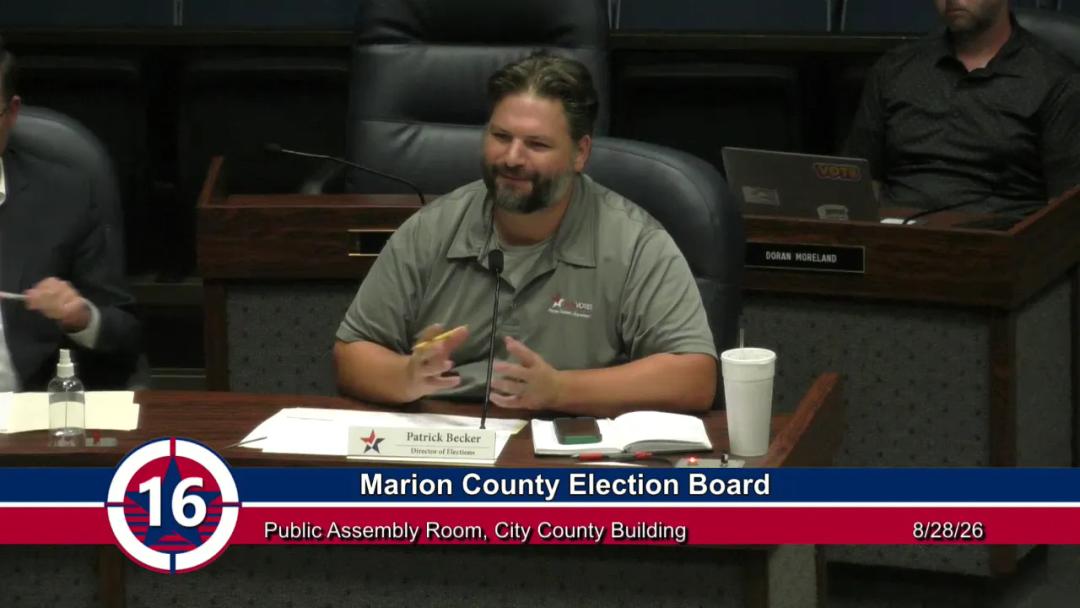
The Marion County Election Board met on August 28, 2026, in the Public Assembly Room at the City-County Building, 200 E. Washington Street, Indianapolis. The agenda called for a 2:00 PM start; the board was called to order at approximately 2:06 PM. Chair Nolita Stewart presided, with Vice Chair Jennifer Ping and Secretary Kate Sweeney Bell present, joined by election staff and counsel. The board approved prior minutes, acted on primary election complaints, authorized an ES&S voting-system contract negotiation, tabled a new e-poll book vendor decision, and approved a Town of Clermont ballot resolution. Note: The raw transcript audio refers to August 26, but the agenda and the supplied meeting date are August 28, 2026; this summary uses August 28, 2026. Approval of Minutes - The board unanimously approved the minutes of the August 10, 2026 meeting (3-0). 2026 Primary Election Complaints - Director Becker presented a spreadsheet of 15 complaints (2026-1 through 2026-15) received from the 2026 primary election season. - Staff and legal counsel reviewed all complaints; staff notes recommended dismissal, with some complaints already addressed in real time (e.g., electioneering at early-voting sites). - Secretary Bell and the election attorney were sent to one early-voting site during the primary to address electioneering issues. - Board dismissed complaints 2026-1 through 2026-14 by unanimous vote (3-0). - Board dismissed complaint 2026-15 by a 2-0 vote, with Secretary Bell abstaining. - Director Becker noted complaint filers have been notified; the board action starts a 30-day judicial-review/appeal clock. ES&S Contract Approval - Under Memorandum No. 18, the board authorized the director to continue to negotiate and enter into a new agreement with ES&S (Election Systems & Software) for voting-system procurement, software licensing, maintenance, and election support. - ES&S has been under contract with Marion County since 2016. - The upgraded voting system is expected to cost approximately $14.5 million. The Admin & Finance Committee approved an initial $4 million down payment on August 18, 2026; that amount still needs full City-County Council approval. Funding for the remainder is being developed with the Office of Finance and Management and City-County Council leadership. - The proposed contract is for a five-year term, January 1, 2027 through December 31, 2031, with a not-to-exceed amount of $17 million, including the $14.5 million initial procurement and ongoing licensing, maintenance, and support. - The City of Indianapolis Information Technology Board approved a resolution for the same term and amount on August 25, 2026. - The current ES&S contract runs through the end of 2026 and covers the county's existing ExpressVote 2.0 devices, DS200s, and DS-850 high-speed tabulators. - The board approved the memorandum unanimously (3-0). 10x Software Solutions (Tabled) - Memorandum No. 19 requested approval to execute an agreement with 10x Software Solutions Inc. for electronic poll book support under RFP-45ELC-37. - The RFP was published in August 2025 with the Office of Finance and Management purchasing division. Delays included a scoring committee member's personal issue; the member was ultimately removed. - The scoring committee included election board management, an ISA security team member, and an active poll worker; more than 20 staff and poll workers participated in demonstrations and provided feedback. - The two vendors within budget were 10x Software Solutions and KnowInk LLC. The scoring committee selected 10x. - The proposed agreement is for five years with a not-to-exceed amount of $1.625 million; some proposed optional costs may not be used. - 10x is new to Indiana but operates in 25 states and has done e-poll books in Ohio since 2015. It has committed to a dedicated Indiana support team and quoted optional election-day support for up to three people for up to three days. - Director Becker stated that 10x and KnowInk both confirmed they could fully deploy by September 21, 2026 if a decision was made by the end of August; 10x has assured the county it can ship, install, and deploy before that date. - Board members asked about training and support; the Director described plans for poll-worker office hours, one-on-one training, updated Channel 16 training videos, and vendor-provided materials. - Secretary Bell expressed concern about being the first Indiana county with 10x, the tight timeline, the new election operations center, unanticipated staffing changes, and the upcoming general election. She moved to table the approval until a future meeting. - The motion to table carried unanimously (3-0). Director Becker was asked to check whether KnowInk, whose contract has expired but which helped the county through the primary, could extend its current arrangement through the general election if needed. Town of Clermont Resolution - Under Resolution 5-26, the board used authority in Indiana Code 3-10-6-7.5 to place only contested municipal general elections on the ballot. - The Town of Clermont (also rendered Claremont in the transcript) has a vote-for-three office/race with only one candidate filed for the fall 2026 election. - Removing that office from the ballot eliminates three ballot styles. - The resolution expires by law on January 1, 2027. - The board approved the resolution unanimously (3-0) and congratulated the sole candidate. Other Business and Election Updates - Ballot proofing is underway: the third ballot proof was sent out before noon on August 28 to political parties and school corporations. Edits are due September 3, 2026; ballot ratification is scheduled for September 4, 2026. An outstanding judicial review question may affect ballot content. - The new Election Operations Center move was completed in late June. Network installation was expected to be completed August 28, security cameras are being updated, and 24-hour security began August 24 and runs through the end of November. - Preventive maintenance is underway on more than 2,400 pieces of equipment, with a target completion date of September 4, 2026. - On September 7, 2026, the county will begin testing the vote-by-mail system and creating memory sticks for voting machines. - On September 14, 2026, logic and accuracy testing begins at the new operations center, and seasonal election workers start. - The vote center plan is being reviewed: more than 150 sites have responded about flood damage or other availability issues; Rocky Ripple Town Hall is the only questionable location. Staff expects to present the vote center plan for board approval on September 11, 2026. - The Clerk reminded voters that absentee ballots must be returned by 6:00 PM on Election Day; late ballots cannot be counted. The county is considering extended in-person hours at the City-County Building to accept hand-delivered absentee ballots. - Early voting will open at the City-County Building on October 6, 2026; additional locations will open after the vote center plan is approved. - The Clerk also reported a Perry Township request to move its early vote center because of limited space. - Poll workers and seasonal workers are still needed; applications are available through MCEB.gov and political parties. Key Outcomes - Approved August 10, 2026 meeting minutes (3-0). - Dismissed 2026 primary election complaints 2026-1 through 2026-14 (3-0) and 2026-15 (2-0-1, Secretary Bell abstaining). - Approved ES&S contract authorization for up to $17 million over five years, subject to remaining City-County Council funding approvals (3-0). - Tabled 10x Software Solutions e-poll book approval until a future meeting (3-0); staff to follow up with KnowInk on an extension through the general election if needed. - Approved Town of Clermont Resolution 5-26 (3-0). - Next scheduled meeting: Friday, September 4, 2026, at 10:00 AM in the T-260 Conference Room at the City-County Building, for ballot ratification.

ELECTION PROCEDURES 39% · ELECTIONS 37% · TECHNOLOGY AND INNOVATION 14% · PROCUREMENT 6%
96
AUG 28, 2026 · INDIANAPOLIS, INDIANA · OTHER MEETINGS (J-Z)
Marion County PTABOA Meeting Summary - August 28, 2026

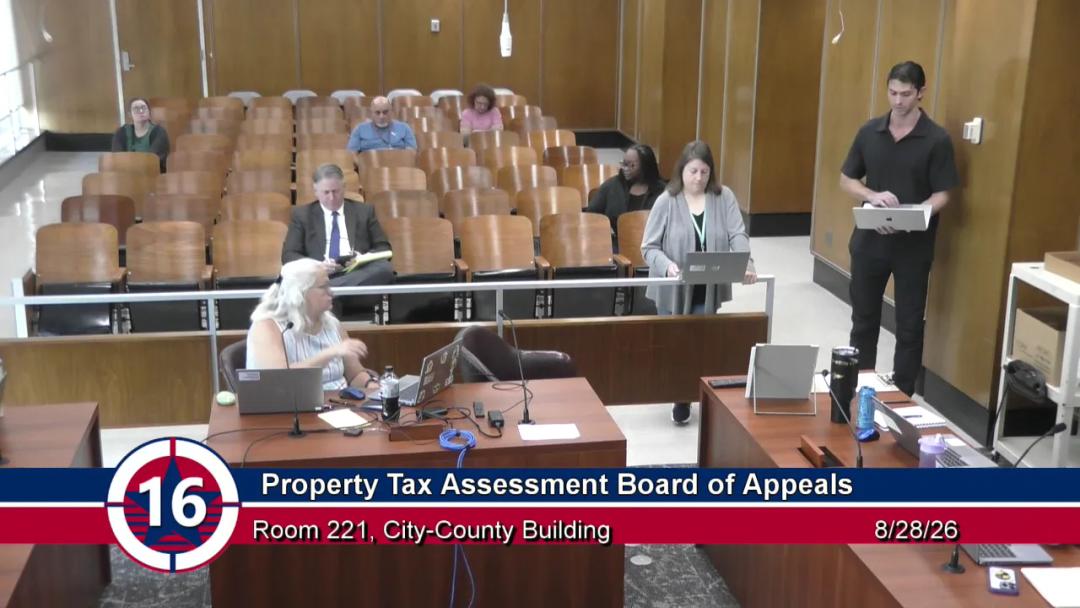
The Marion County Property Tax Assessment Board of Appeals (PTABOA) met on August 28, 2026, at 2:15 PM in the City-County Building, Room 221, Indianapolis. The board, with members Steve Ajamie, Kevin Robinson, Greg Rathnow, Cathi Gould, and Brian Barton, heard and acted on numerous property tax appeals, including residential and commercial properties, and addressed one public hearing on a homestead exemption. Consent Calendar - Approved minutes from the previous meeting. - Approved pages 1-27 of the appeals (various parcels) with no discussion. - Approved pages 28-162, with exceptions for parcel 1049173 (tabled for further review), parcel 1011647 (tabled), and others noted. - Approved pages 164-201 (hearing officer appeals, mostly sustained due to taxpayer non-appearance). - Approved pages 202-243 (withdrawals). - Approved pages 244-279 (exemptions), with exceptions for parcels 7043927, 1100879, and others tabled. Public Comments & Testimony - Julian Zunarelli (parcel 1048792) appealed the removal of his homestead exemption after transferring title from an LLC to his individual name. He argued it was an administrative change and he remained the resident. The auditor's office stated that Indiana Code requires reapplication for homestead on a change in legal entity. The board voted 2-2 (Ajamie and Barton for, Rathnow and Gould against), resulting in a tie. The matter was tabled to the next meeting (September 25, 2026). Zunarelli requested documentation of the relevant code. - Anonymous taxpayer (Burmese language) sought to reopen a closed appeal (parcel 5021290) due to a language barrier. The board noted the matter was not on the agenda and tabled it to the next meeting, pending a translator. Discussion Items - Board tabled several parcels for further review: parcel 1049173 (PK1 zoning with zero assessment), parcel 1011647 (apparent vacancy issue), parcel 1038992 (dated building design adjustment), and exemption parcels 7043927 (Goodwill Legacy Group deed transfer date) and 1100879 (Capital Improvement Board ownership). - Board discussed and accepted recommended adjustments for multiple appeals, including corrections to square footage, market adjustments, and reclassifications. Key Outcomes - Approved consent calendar items as noted. - Tabled the Zunarelli homestead appeal and the Burmese language reopening request to the next meeting. - Tabled several parcels for additional information: 1049173, 1011647, 1038992, 7043927, and 1100879. - The board did not act on Mr. Johnson's request to reopen appeals (parcels 7016209, 7002482) as he was not present. - Meeting adjourned.

PROPERTY TAX ASSESSMENT 65% · PUBLIC RECORDS MANAGEMENT 13% · LEGAL AND LIABILITY 10% · PROCEDURAL 9%
97
AUG 27, 2026 · INDIANAPOLIS, INDIANA · OTHER MEETINGS (A-H)
Indianapolis Board of Business and Neighborhood Services Meeting - August 27, 2026

The Board of Business and Neighborhood Services (BNS) met on August 27, 2026, to approve lien resolutions and receive the department's 2027 budget presentation. Director Abby Brands presided, and board members Courtney Yarbrough, Camille Blunt, and Kate Warpool introduced themselves. The board consented to moving the budget presentation after the action items. The July 23rd meeting minutes were approved unanimously. Action Items - Minutes: The board approved the July 23rd meeting minutes by unanimous voice vote. - Resolution 2026 C-10030 (also referenced as 'C 1003' in the transcript): The board authorized the director to place liens on properties listed in Exhibit A for unpaid high weeds and grass mowing and abatement costs under Chapter 575. Staff reported 307 mowing cases totaling $136,873. The motion passed unanimously. - Resolution 2026 C-10031: The board authorized the director to place liens on properties listed in Exhibit A for unpaid trash, junk, and debris cleanup and abatement costs under Chapter 361. Staff reported 34 trash violation cases totaling $16,487.10, with cases reflecting amounts 30 days past due as of August 27, 2026. The motion passed unanimously. 2027 Budget Presentation - BNS presented its 2027 budget for information; it is not a voting matter. The budget is increasing by nearly $1.4 million, with $1.3 million of that increase dedicated to personnel. Personnel increases include 3% cost-of-living adjustments for non-union staff and 3% increases for union staff per the collective bargaining agreement. The department's attrition rate assumption drops from 17.79% to 5.9%, and a new enterprise-wide step-and-grade policy for non-union staff was noted. - The department projects $25.5 million in 2027 revenue across licenses and permits, charges for services, fines and forfeitures, and other receipts. - BNS reported on flood response: over 4,000 rapid damage assessments completed in less than a week by about 30 inspectors to support FEMA disaster relief. - Staffing: BNS currently has 10 vacancies, roughly half in each division; an enterprise culture survey scored BNS at or above the city average. - Construction and business services: 460 booking appointments have been scheduled; state legislation changes and new workflows were implemented; a special events ordinance overhaul is underway. - Streamline Indy: drainage permit data showed 104 permits in progress, with 95 waiting on the applicant; average turnaround improved from 113 working days in the prior year to 62 in 2025, with a 2026 year-to-date average of 47 working days against a target of 45. Structural permits issued averaged 15 working days; 25% of applications remained in progress, and applicant response times averaged 15 working days, with one case waiting 106 days. - Neighborhood and property enforcement: 13 tons collected in the first neighborhood cleanup; 31 tons collected in 2025; over 400 tons abated in 2025 through trash cases. The high weeds and grass assistance program provided one free mow year-to-date at a city cost of $95. - Repair, vacancy, and demolition: over 1,100 repair orders opened last year; 500 opened year-to-date at the beginning of August; 667 vacancy cases opened against a target of about 100 in 2026. In 2025, 107 structures were bid for demolition; 49 structures are under contract, 36 are in the bid process, and 50 remain in the backlog. - Technology: new right-of-way inspection requests, a road closures map, a case-search tool, an Open Counter permit wizard, and expanded interpreter services in the six most-spoken languages were highlighted. BNS is moving from an OpenGov discovery contract to a request for qualifications for a new permitting and code enforcement system. - Alley program: $5 million committed over three years; 32 alley segments completed, representing over 27,000 feet of right-of-way; more than 44 tons of illegal dumping cleaned up. - XBE spending: city goals are 15% for MBE, 8% for WBE, and 3% for VBE. BNS exceeded goals by about 2 percentage points in two categories over a nine-year average and was about a quarter point short in the MBE category. This year, roughly $250,000, or 11.5% of eligible spend, has gone to MBE firms so far. Key Outcomes - The board unanimously approved the July 23rd minutes, Resolution C-10030, and Resolution C-10031. - The 2027 budget presentation was received by the board for information and discussion; no vote was taken. - The next regular meeting is scheduled for September 24, 2026, at 3:00 PM in Room T260.

BUDGET 39% · CODE ENFORCEMENT 20% · TECHNOLOGY AND INNOVATION 9% · PROCEDURAL 8%
98
AUG 27, 2026 · INDIANAPOLIS, INDIANA · OTHER MEETINGS (A-H)
Joint Board Meeting of Citizens Energy Group and CWA Authority – August 27, 2026

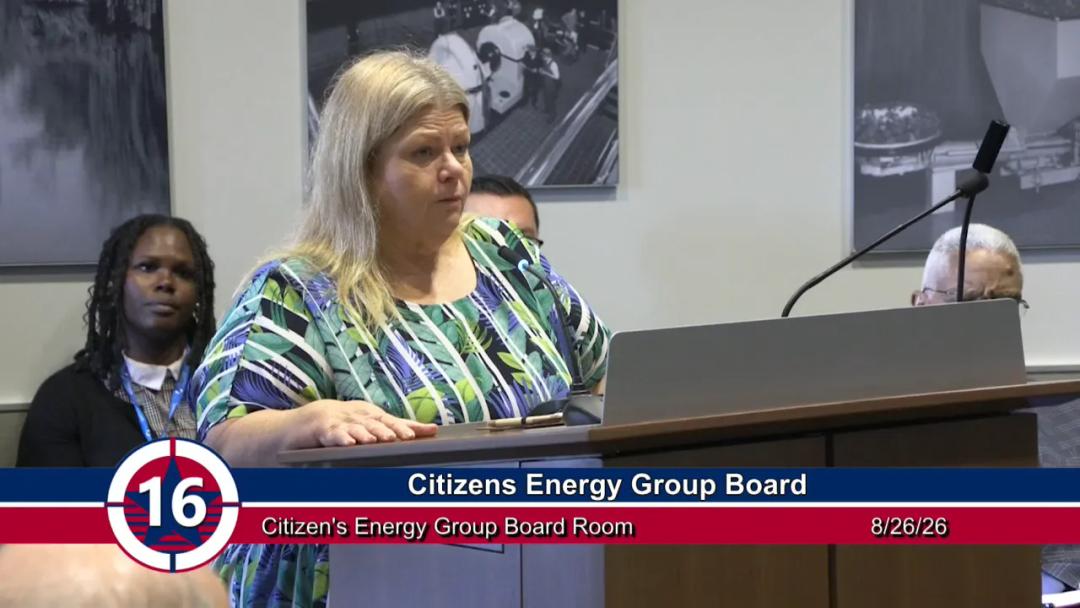
The joint board of directors of Citizens Energy Group and CWA Authority met on August 27, 2026, to approve routine items, receive reports from committees and officers, and hear from a community stakeholder. All actions were approved unanimously. Consent Calendar - Minutes Approval: Approved minutes of the joint meeting held May 27, 2026. - Fuel Cost Adjustment (FAC 82): Approved as presented. - Gas Cost Adjustment (GCA 171): Approved as presented. Public Comments & Testimony - No members of the public offered comments. Discussion Items - Audit and Risk Committee Report (Director Jeffrey Good): The committee met on August 26, 2026. Key points included: - Third quarter FY2026 financial statements: combined net income of $54 million, down $3 million year-over-year due to increased interest and depreciation from the Deep Rock Tunnel project. - Long-term debt issuances totaling $212 million during the quarter and $173 million post-balance sheet. - Insurance program update: overall premium increase of 4.8%, with softening rates; cyber premiums flat. - Internal audit: FY2027 audit plan approved; one completed review on meter read accuracy. - Advisory Tax Committee Report (Chair not specified): The committee met on August 19, 2026. Highlights: - FY2027 budget and FY2026–2031 forecast: operating costs expected to increase 3.5% in 2027; total debt remains at $2.9 billion. - Executive compensation benchmarking (Willis Towers Watson presentation): the 12 executive positions are 6% below market median in base salary, 8% below in total cash, 47% below in total direct compensation (due to no long-term incentives), and 39% below in total rewards. Proposed adjustments were approved. - Short-term incentive plan for 2027: unchanged framework with four pillars; customer satisfaction metrics recalibrated based on historical performance. - CFO Report (Craig Jackson): - Financial outlook: $15 million favorable to budget, increasing to $18 million after including July actuals. Drivers: better gas margins and $9 million in PFAS-related settlement payments. - Rate Stabilization Fund: approved release of $6.9 million from Citizens Water rate stabilization fund to operating cash, as the original debt has been refunded. - Disposition of Funds Report for FY2027: approved for filing with the City of Indianapolis. - CEO Report (Jeffrey Harrison): - Savings for customers: $17 million prepay savings for natural gas customers; $10 million annual savings from renegotiated steam contract. - Flood response update (Ed Bukavec, VP Water Operations, and J.P. Gio): - Wastewater: Deep Rock Tunnel captured 400 million gallons of combined sewer overflow; plants treated 1.1 billion gallons over the flood weekend. - Water: White River North plant temporarily offline but restored; Westfield utility lost three wells (3 million gallons/day supply) but interconnections maintained service. - Gas: Approximately 50 customers affected; 400 feet of pipe exposed; restoration ongoing. - Cross-functional team formed to assess damage and seek disaster relief or insurance. - Strategic Planning Update (Sabina Carner, VP/Controller): One new initiative per strategic pillar: - Customer Satisfaction: Expand youth-focused outreach on water cycle, conservation, and career paths. - Employee Engagement: Implement a career learning pathway program. - Financial Integrity: Create an economic impact statement quantifying Citizens’ total local/regional impact. - Performance Excellence: Define an AI toolkit and complete a pilot project documenting 60 standard operating procedures. - Community Stakeholder Comments (Lisa Lafflin, Executive Director, West Indianapolis Development Corporation): - Represented the Indy Alliance of Community Development Corporations. - Described housing development efforts (300+ homes assisted, 11 built recently, 35 rental units, 40-unit multifamily breaking ground). - Highlighted challenges: rising costs, utility connection fees, and need for fee waivers or reductions. - Requested consideration for fee assistance and shorter planning timelines. - Thanked Citizens for flood response and community partnership. Key Outcomes - Approvals (all carried unanimously): - Minutes, FAC 82, GCA 171. - Citizens Energy Group and CWA Authority FY2026 third quarter financial statements. - Executive compensation adjustments for FY2027. - FY2027 budget and FY2026–2031 forecast. - Customer benefit distribution of $45,000 for 2027. - Capital contribution of up to $8 million from Citizens Gas to Citizens Resource. - Transfer of $6.9 million from Citizens Water rate stabilization fund to operating account. - Disposition of funds report for FY2027. - Next Steps: - Staff to file disposition of funds report with City of Indianapolis. - Continue flood damage assessment and potential insurance claims. - Implement strategic initiatives in FY2027. - No public comments or further business.

AFFORDABLE HOUSING 19% · BUDGET 15% · EXECUTIVE COMPENSATION 12% · COMMUNITY ENGAGEMENT 10%
99
AUG 27, 2026 · INDIANAPOLIS, INDIANA · CITY-COUNTY COUNCIL
Parks and Recreation Committee 2027 Budget Hearing - August 27, 2026

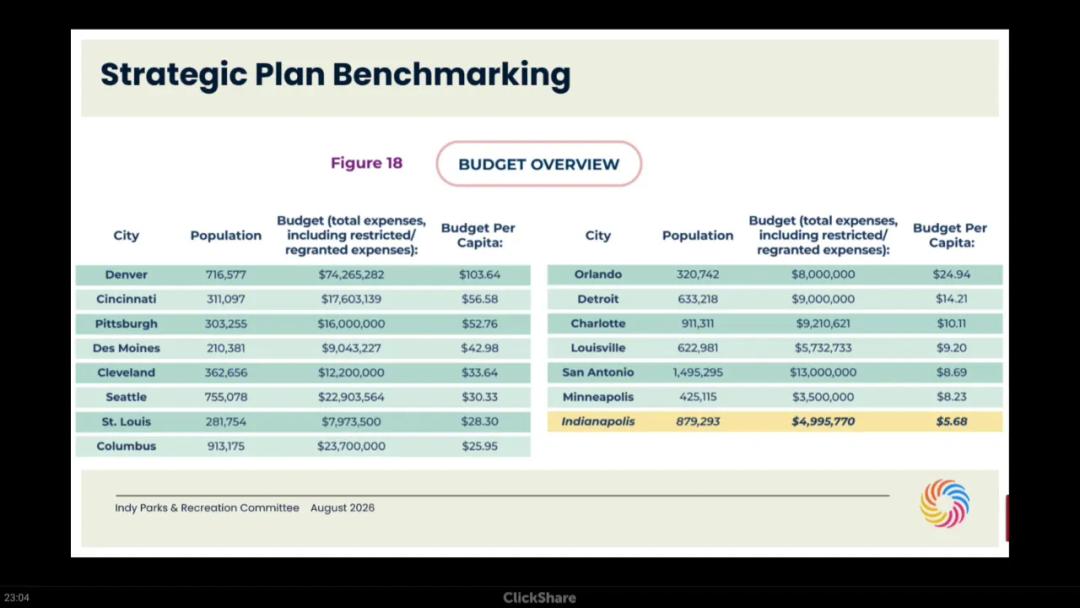
On Thursday, August 27, 2026, the Parks and Recreation Committee of the Indianapolis-Marion County City-County Council held a budget hearing in the Public Assembly Room of the City-County Building. Chair Dan Boots (District 3) presided, joined by Councilors Krista Lee Wells (District 11), Jesse Brown (District 13), Brian Delaney (District 2), and Jessica McCormick (District 16). The committee heard 2027 budget presentations from the Department of Parks and Recreation (Director Brittany Crone) and the Arts Council of Indianapolis (Judith Thomas). Members opened with acknowledgments of recent regional flooding and the role of city parks in emergency response. No votes were taken. Flood Response and Park Operations Context - Director Crone announced that Broad Ripple Park Family Center will host FEMA on Friday and Saturday, August 28-29, 2026, from 9 a.m. to 6 p.m. for residents to register for individual assistance; no advance registration or forms are needed. - Riverwood Park continues to serve as a community hub for the flood-impacted Ravenswood neighborhood, and Broad Ripple Park connected 15 households with pet-friendly accommodations on the first day and night after the flooding. - Flooding at Riverside Park damaged on-site food storage; the department is working to restock as soon as possible. Budget Hearing: Department of Parks and Recreation - Indy Parks presented its first program/outcome-based budget, organized into 15 program nodes instead of the traditional character-based format. The parks general fund request for 2027 is 7% above 2026; the overall budget rose 0.7% because federal grants are being spent down. - System scale: 218 parks covering nearly 12,000 acres serve more than 10 million visitors annually; Eagle Creek Park alone sees about 1.5 million visits a year; the trail network is over half the length of the Grand Canyon; total park acreage is nearly the size of the city of Lawrence; more than $150 million in capital improvements are largely wrapping up this year; the annual budget is more than three times its 2015 level of $17 million. - Lilly Endowment Grant: 40 projects, roughly half already open and nearly all complete by year-end, delivered across all nine townships, including 30 new playgrounds, three new splash pads, pickleball courts at six parks, sports fields at three parks, and new trails at three parks. Over 40% of the city's 136 playgrounds are being upgraded; new splash pads opened at Chapel Hill and Dewberry Parks, with Graham Edward Martin Park next. - Other capital highlights: the renovated and expanded MLK Park and Landmark for Peace Memorial opened this spring; Lilly, with the Caitlin Clark Foundation, donated downtown land for a new park with a multi-use basketball/soccer court; and Parks Alliance partnerships include a new playground at Tarkington Park and relocation of the historic Traders Point covered bridge to Lily Lake at Eagle Creek. - Newly secured: a $10 million Bezos Earth Fund grant for the first phase of the Hallville Riverfront Vision Plan at Reverend Moselle Sanders Park, one of eight cities selected nationally. The project will plant more than 400 trees, restore native wetlands, build two miles of trails, and add a community farm and orchard, with Belmont Beach plans made shovel-ready. Groundbreaking is targeted for 2027 with substantial completion in 2029. - Councilor-selected projects from the 2025 cycle: Wish Park (Pike Township) broke ground in spring; Thompson Park was completed in May; Canterbury Park is under construction; Roby Park improvements were awarded this week; and Haverstick Woods preservation is being coordinated with Councilor Delaney and the Indiana Wildlife Federation. - Aquatic strategy: the department is evaluating a move toward more indoor pools, more splash pads, and a reduced outdoor pool footprint; pool attendance exceeded 106,000 this summer despite a $1 increase in admission prices driven by chemical and maintenance costs. A system-wide pool assessment will guide $1.1 million in JOC line-item allocations; roughly $1 million is anticipated for aging aquatics infrastructure in 2027. - Capital and maintenance: the annual capital budget is $5.8 million; facility maintenance funding increased by $300,000 to $1.86 million; a new capital asset lifecycle development fund was created; the capital budget is now a non-reverting fund. Introduced 2027 fiscal appropriations include $2.1 million for a new playground at Rhodius Park (home of the only adaptive/inclusive camp for children with disabilities), $700,000 for court improvements at 18 parks, and cameras at 23 additional locations (explicitly not Flock cameras). - Selected 2027 budget nodes: food programs at just under $2 million; cultural arts with a $1.3 million pass-through to the Indy Arts Council plus $2.1 million for arts programming and concerts; environmental education at over $1.1 million; special events at $231,000; summer camps at $568,000; community engagement at $213,000; training at $48,000; athletics and sports at $27,000. - Programs: summer camps served 10% more youth, over 4,700 campers; 159+ special events and 100+ performances hosted; 56,000+ meals served; Drive & Dish distributed nearly 10,000 grocery orders totaling 312,000 pounds, with a new Christian Park location planned; volunteer partnerships removed 1,000+ bags of litter and weeds and improved 340+ landscape areas. The department also celebrated the 100th anniversary of the Frederick Douglass golf course, the first course in the country named after a Black man. - Staffing: active FTE is 299, down from 307, reflecting positions defunded in prior-year budget cuts rather than new cuts; no budgeted positions were eliminated for 2027; about half of FTEs are seasonal. A staffing assessment is ongoing; COLA, step and grade pay, and continued lifeguard sign-on bonuses are expected to support retention. Park rangers are funded under IMPD's budget; the parks safety ambassador program is under development, potentially with police powers. Parks Discussion and Councilor Questions - Councilor Wells questioned the 2027 allocation of only $192,550 for parking lots, drives, and pedestrian bridges (rising to $400,000 in 2028-29 and over $1 million in 2030) and advocated directing wheel-tax dollars from the veto-override road fund to safe access to parks. Staff responded that road and bridge improvements require coordination with DPW because many park roads continue into neighborhoods. - Councilor Brown sought reassurances on staffing and attrition; CFO John George stated all budgeted positions were retained. Brown expressed concern about fewer staff in parks and the shift toward cameras and splash pads, asked what data justify camera purchases (staff cited incident reports, facility gaps, and visit/event levels), suggested QR-code donation prompts at free programs, and urged acquisition of wetlands and mature forests for stormwater resilience. - Councilor McCormick asked about FTE and vacancy figures; about 150 full-time staff listed on a slide may be a typo, and roughly half of the 299 FTEs are seasonal. She asked how camera priority sites were selected and praised Chapel Hill Park's Lilly-funded amenities. - Councilor Wells registered disappointment that 2027 goals for arts and nature programs for minority and low-income residents are below levels of two years ago, with arts program participation at about 60% of prior levels, and that Indy Arts Council funding is flat. Staff noted prior-year figures were inflated by ARPA dollars and that new metrics are being phased in. Wells strongly supported expanded evening hours and staffing, endorsed security cameras, and said she would not support increased funding for more police officers in parks. She added, "You can't say you're frankly pissed off about gun violence and then support a budget where we close our parks at 7 p.m." - Chairman Boots asked about trail maintenance (a DPW-led combination), the safety ambassador program, and staff incentives; encouraged expanding friends-of-parks groups; and said his push to override the mayor's veto of tax proposal 192 was intended to protect parks and quality of life, not only roads. Budget Hearing: Arts Council of Indianapolis (Note: the agenda identifies the presenter as the Arts Council of Indianapolis; the transcript's opening refers to the "Arts Council of Minneapolis" in an apparent transcription error.) - Judith Thomas presented the Indy Arts Council's 2027 request: $1.3 million from the city for the annual grants program, plus continued Capital Improvement Board and Bond Bank funding at the same level as last year. The council approaches its 40th anniversary and has administered the city's annual arts grants for 39 years. - In 2025, the annual grants program supported a record 103 organizations reaching at least 8 million residents and visitors each year, more than double the 49 organizations funded in 2016, and a record 20 BIPOC-led organizations, up from 4 in 2019. Applications for the next multi-year cycle open in January 2027. - State arts funding in Indiana declined 33%, increasing pressure on local support. - Project grants for free arts programming in parks, libraries, and community centers drew 144 proposals; 22 were approved, with $1.5 million requested and $200,000 awarded. Nearly 80% of peer local arts councils nationally offer similar programs. Examples included an immigrant-family workshop at the Eagle Branch library (16 families, 51 participants) and Creative Roots youth programming at Cranert Park. - Marketing and awareness reached 9.3 million in earned media, over 5 million combined video/social media views, and 1.1 million website visits. - Funding context: the Arts Council budget is about $5 million, or $5.68 per capita, well below peer cities such as Columbus (about $25 per capita) and Cincinnati (about $56 per capita); other cities use bed taxes, food-and-beverage taxes, county sales taxes, and ticket fees. In 2025, the council invested $2.2 million across about 135 nonprofits and paid $441,000 to 665 professional artists. - Thomas asked the city to develop a sustainable long-term funding model for arts and culture over the next four to five years and thanked the council for its public art ordinance work. Arts Council Discussion and Councilor Questions - Chairman Boots noted arts funding has not returned to 2005 levels and pledged to pursue a sustainable economic model for arts funding. - Councilor Brown said flat funding feels like a decrease given cost-of-living pressures, and argued that public art and Indy Arts Council funding should not be competitors, preferring money that flows through artists. - Councilor McCormick said there is "not enough funding" the city could give the arts, cited Denver at over $100 per person, and argued arts investment benefits quality of life, education, and business recruitment. Key Outcomes - No votes or formal recommendations were taken; the hearing was informational for the committee's 2027 budget deliberations. - Indy Parks will complete its pool condition assessment in the coming weeks to guide $1.1 million in JOC allocations and will continue its internal staffing assessment. - Indy Parks will begin work on the 2028 comprehensive plan, including public input and council conversations on the future of aquatics. - The Arts Council of Indianapolis's $1.3 million 2027 request, along with its call for a sustainable long-term funding model, was placed on the record. - Next steps: FEMA registration at Broad Ripple Park on August 28-29, 2026; continued committee review of the 2027 city budget.

PARKS AND RECREATION 47% · BUDGET 19% · ARTS AND CULTURE 18% · PUBLIC SAFETY 4%
100
AUG 26, 2026 · INDIANAPOLIS, INDIANA · OTHER MEETINGS (I)
Indianapolis Public Library Board of Trustees Meeting - August 26, 2026

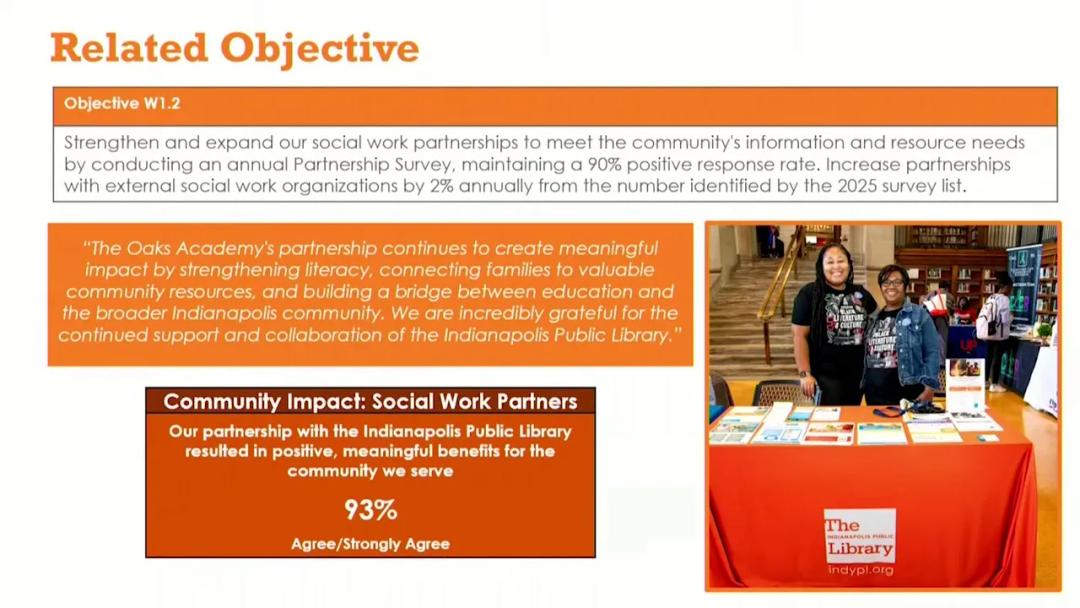
The regular monthly meeting of the Indianapolis Public Library Board of Trustees was called to order at 19:00 on August 26, 2026, at the Lawrence Branch. President Ray Bieterman presided, with all board members present. The meeting featured reports on branch operations, the 2026 Summer Reading Program, financial updates, and a mid-point review of the library's strategic plan. Several resolutions were approved, and discussions highlighted teen programming and community engagement. Consent Calendar - Approved the minutes of the regular meeting held July 27, 2026, and the special meeting held August 11, 2026 (voice votes with no opposition). - Approved Resolution 31-2026 authorizing the 2027 budget and tax levies, including a 4% growth rate in the tax levy as set by the state and an overall 7.2% increase in the general fund. - Approved Resolution 32-2026 regarding financial, travel, and personnel matters for the period between board meetings. Lawrence Branch Report Lawrence Branch Manager Monica Tabuta presented an overview of the branch. The branch first opened in 1967, moved to its current location in 1983, and underwent renovations in 2020. It serves over 44,000 people in its base population, with 8 elementary schools, 3 high schools, and 7 private schools in the service area. The branch has 5 full-time staff, 11 part-time staff, and 7 pages. In 2025, the branch served 96,862 visitors and helped over 12,000 patrons. Programs include story times twice a week, teen zone twice a week, Dungeons & Dragons, painting classes, and the summer Heart of the Neighborhood event on June 17, 2026. Board members praised the teen programming and suggested collaboration with local art organizations. 2026 Summer Reading Program Report Deborah North (School Age and Family Program Specialist) and Alex Hamton (Adult Program Specialist) reported on the 2026 Summer Reading Program. Key outcomes: - Over 20 million minutes read, a 2.5% increase over 2025 (which had 26 million minutes). - Nearly 29,000 total participants (down from over 30,000 in 2025, attributed to a decline in group program participation due to reduced daycare vouchers). - 6% increase in branch participation, with adult program participation growing six percent. - Success in targeted low-participation zip codes: 14% increase in teen participation, 20% increase in adult male participation, 27% increase in senior participation. - Over 7,700 in-branch activations (pilot tracked throughout summer). - 94% of caregivers agreed the program encouraged their child to read; 78% said it improved reading confidence; overwhelming majority of adults said the program met expectations and encouraged them to read. - 1,900+ books donated to Listen to Our Future. - Partnerships included CanCan Cinema (film series), Indianapolis Zoo (preschool program), and others. - Patron feedback highlighted the program's role in learning (Haitian Creole resources), belonging (community hub), and well-being (reducing screen time). Finance Committee Report Mary presented the July 2026 financials: revenue from property taxes at 54% of expected; e-rate receipts of nearly $32,000; total interest revenue of $14,116. Year-to-date expenditures at 48% of budget, with personal services and benefits at 67% of total expenditures. The committee recommended approval of Resolution 31-2026 for the 2027 budget and tax rates, which includes a four percent increase in the tax levy and an estimated debt payment for the 2026 bonds. The City-County Council budget presentation scheduled for September 23, 2026 at 5:30 PM. Other Committee Reports - Diversity Policy and Human Resources Committee (Dr. Palacio): No resolutions; continuing discussions on policies and professional development. - Facilities Committee (Dr. Riolo): Noted that the meeting venue was changed from Fort Ben Branch because it closed for two weeks starting today to install acoustic panels. - Library Foundation Update (Dr. Riolo): The fifth annual Circulate fundraiser on August 15, 2026 raised more than $130,000 with 220 guests. The foundation received more than $130,000 in donations this month for initiatives including bilingual storytime, conversation circles, and fall festival. CEO Report and Strategic Plan Update CEO Ryan reported: - Impact story: long-haul truck driver discovered audiobooks and completed online courses; submitted by Lawrence Branch. - Star Awards for July: 7 employees recognized for patron services, peer support, community involvement, etc. - Engagement data: Youth programs (481 programs, 12,499 attendees), adult programs (265, 3,678); all-ages programs (63, 4,372). Total program attendance up 16% versus July 2025 (20,549 vs. 17,632). - Circulation and visitors down about 1.5-2.8% from July 2025, with top branches Glendale, Fort Ben, College Avenue. - Upcoming events: Chair aerobics, business series, Heart of Every Neighborhood, Library Card Days September 26-28. Mary Ann McKenzie presented the mid-point strategic plan update: - Belonging KPIs: Visitors and web traffic showing positive long-term growth; active cardholders up 6.5% from end of 2024. - Learning KPIs: Circulation per active cardholder showed a slight decline (orange arrow); e-resource use steady. - Well-being KPIs: Social work team interactions soared; mental and physical well-being programs up; financial literacy programs had fewer offerings but steady attendance. - Partnership survey: 21% response rate from 285 organizations; 98% agreed partnership provided positive community benefit; 91% said mutually beneficial. - Obective B 5.4 (Innovator in Residence) was discontinued in favor of the successful Better Together civics engagement event and selection for Urban Library Council's Civics Maker Lab for adults (ages 18-24). Key Outcomes - Approved minutes for July 27 and August 11, 2026 meetings. - Approved Resolution 31-2026 (2027 budget and tax rates) and Resolution 32-2026 (financial/travel/personnel matters). - A board member requested disaggregated data on teen programming across branches, including demographic and outcome metrics, to be presented at a future meeting. - The next regular meeting is scheduled for September 28, 2026, at 6:30 PM at the Glendale Branch Library.

PUBLIC LIBRARY SERVICES 60% · BUDGET 11% · YOUTH PROGRAMS 9% · PROCEDURAL 9%
OPENPUBLICA · PUBLIC MEETING INDEXUPDATED DAILY · openpublica.com