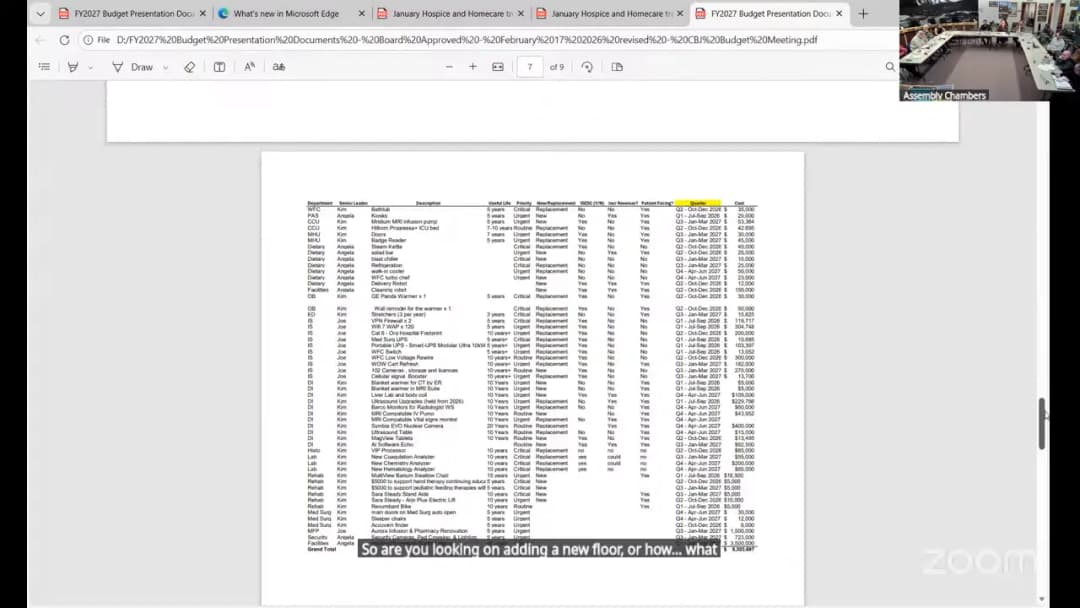
The meeting began with a special assembly session to ratify a labor agreement, followed by a finance committee meeting, and then joint sessions with the Airport Board and Bartlett Regional Hospital Board. Discussions focused on budget projections, capital needs, and operational risks for both the airport and hospital. Consent Calendar - Resolution 4039: Unanimously approved, ratifying the collective bargaining agreement with the Public Safety Employees Association for fiscal years 2026-2028. The economic modifications include annual wage increases of 3%, 3%, and 5% for sworn officers and 3%, 3%, and 5% for all other bargaining units (after a typo correction noted by the mayor). Public Comments & Testimony - No members of the public signed up to testify during either the assembly or joint meetings. Discussion Items Airport Board Joint Meeting - Budget Overview (FY26-27): Airport Manager Andres Delgado presented a projected under-spend of approximately $110,000 in FY26 due to a mild winter reducing de-icer use (savings of $300,000) and reclassification of runway/taxiway painting as federally eligible (historically $225,000 annual operating cost). FY27 budget assumes full encumbrance of de-icer (inventory $800,000) and creation of a Deputy Airport Manager position for continuity and operational backup. Personnel costs are driven by CCFR contract increases; travel/training jumps $100,000 for required certifications. - Revenue Adjustments: The airport financial model was updated to correctly allocate benefits to airfield leases and commercial parking, shifting costs from Part 135 operators (e.g., Alaska Seaplanes) to Part 121 carriers (e.g., Alaska Airlines). This resulted in lower fuel flowage fees and higher landing fees. Passenger enplanement growth of 2.8% annually is projected through 2030 (from 460,000 to over 600,000 by 2043). - Passenger Facility Charges (PFC) Swap: $1 million from airport fund balance was used to purchase an ARF truck after an FAA grant was rescinded due to procurement method. PFC revenue will replenish the fund balance. - Capital Improvement Projects (CIP): Major projects include a $25 million reconstruction of Runway 26/25 approach lighting (full 2,400 feet) — awaiting FAA environmental review — and three grant applications totaling $5 million for control tower electrical/mechanical work. The airport expects $300,000 reimbursement from the state for Mendenhall River bank stabilization. - ARF Truck Crisis: The airport currently has three ARF trucks: a 2016 model, a 2003 model (out of service), and a 1992 model (surplused). Two loaner trucks — from Palmer (leased) and Gustavus — are in use. The Gustavus truck must return by May 1, while the new truck arrives in April (in service June/July). In late February, the 2016 and Palmer trucks both failed (turret and pump seal issues), leaving only the Gustavus truck operational. A second flat tire would have caused an ARF Zero status, halting all air carrier service. The airport seeks to acquire a second new or used truck quickly, with possible funding from the city’s fleet reserve and PFC reimbursements. The FAA will not support a new truck until 2031. A 10-year replacement policy is being developed. - Fund Balance: Airport policy requires a three-month operating reserve ($3 million). The proposed FY27 budget maintains just above this target. A potential $900,000 to $1 million in unrestricted funds from terminal project closeout could boost the cushion. Bartlett Regional Hospital Board Joint Meeting - FY26 Financial Performance: CEO Joe Warner reported that expenditures are exceeding budget due to expansion of primary care clinics (Family Practice and Glacier Pediatrics), new specialty providers (GU, ophthalmology, orthopedics), and one-time costs. A $1.2 million impact from delayed Wildflower Court rate setting and $3.2 million in unrecovered pharmaceutical revenue (to be captured in second half) affect the bottom line. The hospital projects a net income of $5 million for FY27, excluding the lost Rural Demonstration Program ($4.2 million annually, not extended). - Reimbursement Challenges: The hospital is exploring alternative Medicare/Medicaid payment models (e.g., critical access, rural health clinics) to offset the loss of the demonstration program and mitigate impacts from rural health transformation (Medicaid reduction expected 35% in expansion population). - Facility Master Plan: An aging facility (average age 18–19 years) requires significant upgrades. A master plan is being finalized to address services for an aging population, with a 5–10 year capital roadmap. Emergency department renovation design is nearly complete; construction starts April 2026 (18 months). - Housing: $3.5 million is budgeted for potential expansion of Bartlett House (doubling size) to provide patient and employee housing. Currently, 15 new employees rescinded offers in 2025 due to housing issues. - Hospice and Home Care: Hospice loses $30,000/month and home care $50,000/month due to Medicare reimbursement changes. The board committed to continuing these services for five years, focusing on increasing average hospice length of service. - Wildflower Court: As of December, census averaged 55 patients; a pipe burst in January closed 8 beds (expected to reopen mid-March). Current census is 47 of 51 beds. New rates bring the facility to break-even. - Strategic Relationship with CBJ: Board member Max Mertz called for an intentional review of the charter relationship (last updated 1974) to improve efficiency in procurement, CIP, interfund cash management, and shared services. The hospital completed its first separate audit, which identified a significant deficiency in timely interfund reconciliation — a plan is in place to resolve it. - Employee Engagement: Annual survey shows improvement to the 39th percentile (up from teens two years ago), with a goal of reaching the 75th. Focus is on preventing burnout from rapid change. - Community Engagement: The board is developing a plan for broader community dialogue on the value of the community hospital and encouraging local use of services. Key Outcomes - Resolution 4039 passed unanimously. - Airport ARF Truck: The assembly and airport board agreed to pursue rapid acquisition of a second used ARF truck, leveraging the city’s fleet reserve for quick purchase, with subsequent reimbursement through PFC collections or an assembly ordinance. A policy for 10-year replacement cycles will be established. - Joint Meeting Schedule: Next AFC meeting set for March 4, 2026 at 5:30 PM. Assembly members reminded of March 15 deadline for community grant requests and April 16 deadline for budget reduction proposals.
Public Meetings - Juneau, Alaska
Public Meetings - Juneau, AlaskaThe meeting was called to order at 5:45 PM with a land acknowledgement and roll call. Members present: Mr. Kelly, Ms. Hall, Lisa Hughes Gandis, Chair Steininger. Liaisons present: Mr. Becker (Docks & Harbors), Ms. Schreimer (Parks & Rec), and a Planning Commission representative. Agenda and minutes from January 26, 2026 were approved. Consent Calendar - Agenda approved. - Minutes from January 26, 2026 approved. Discussion Items 1. Vertical Bridges Lease Amendment (3000 Fish Creek Road) – Staff requested support to amend an existing 402 sq ft communications tower lease at Eagle Crest, expanding the footprint and extending the lease to the maximum 35 years allowed by code. The former Eagle Crest General Manager and board were in favor. Committee voted unanimously to support the amendment. 2. Proposed Land Trade with State of Alaska – Staff presented a proposal to trade a vacant city-owned parcel (approx. 0.96 acres) near the Juneau-Douglas Bridge to the Alaska Department of Transportation (DOT) in exchange for state land needed to improve the North Douglas boat launch ramp. DOT would grant the city an easement for non-permanent uses. The trade is expected to be value-positive for the city. Committee voted unanimously to direct staff to begin negotiations. 3. Disposal of 155 Heritage Way (City Hall) – Staff recommended a sealed competitive bid sale with a minimum bid of $2.5 million, citing the building (22,000 sq ft on a quarter-acre lot) will be vacated by December 2026 after the move to the Burns Building. An assessor’s analysis valued the property between $900,000 and $3.5 million; an appraisal would cost $15,000 and take several months. Discussion included alternative disposal methods, potential use restrictions, and tax incentives. Assemblymember Hughes Gandis moved to obtain an appraisal; that motion failed 3-1. A subsequent motion by Mr. Kelly to proceed with sealed bid and direct the city attorney to draft an ordinance passed 3-1 (Hughes Gandis opposed). 4. Peer-to-Peer Vehicle Sharing Excise Tax (Title 69) – Deputy City Manager Barr introduced draft legislation to impose an excise tax on peer-to-peer car rentals originating or ending within a half-mile radius of downtown cruise ship areas. The tax aims to discourage congestion and raise revenue for parking management. Discussion addressed zoning, enforcement, and impacts on traditional rental car companies. The Marine Parking Garage has a waiting list of 200 and the Downtown Transportation Center 87, with both garages oversold by over 45%. Motion to refer the ordinance to the next regular Assembly meeting, Committee of the Whole, and Visitor Industry Task Force passed unanimously. 5. Short-Term Rental Update – Assemblymember Hughes Gandis provided an informational overview, noting materials from prior task force work were distributed for review. The topic will be taken up at the next regularly scheduled Lands meeting. 6. Affordable Housing Fund Update – Scott Chamber gave a verbal report as a precursor to the June annual report, noting the fund’s five-year history and upcoming decisions on budget and per-unit caps. Assemblymember Kelly raised the idea of incentivizing units for licensed professions (e.g., teachers, medical professionals). Ms. Hall expressed concern about targeting specific professions given broader housing needs. The Mayor questioned enforceability. No motion was taken; further discussion will occur at the next meeting. Key Outcomes - Approved Vertical Bridges lease amendment support (unanimous). - Directed staff to negotiate land trade with DOT (unanimous). - Approved sealed bid sale of 155 Heritage Way with $2.5 million minimum bid, directing city attorney to draft ordinance (3-1). - Referred peer-to-peer vehicle sharing ordinance to Assembly, Committee of the Whole, and Visitor Industry Task Force (unanimous). - Short-term rental and affordable housing fund topics continued to next meeting.
The Assembly Committee of the Whole met on February 24, 2026 (the meeting began on February 23 and continued past midnight) to discuss several critical community issues. Topics included an update on the GLOF (glacial lake outburst flood) enduring solution and phase two flood fighting, the NRCS buyout program for View Drive, input on the Telephone Hill request for qualifications, a financing update for the Seawalk project, budget reduction strategies, and the results of the Community Compass survey. The assembly took several votes and provided direction to staff. Consent Calendar - The agenda was approved without changes. - The January 26, 2026 Committee of the Whole minutes were approved by unanimous consent. Discussion Items GLOF Enduring Solution & Phase 2 Flood Fighting - Director Koch presented an update on the Army Corps of Engineers’ Charrette, which identified a lake tap as the preferred long-term solution to mitigate GLOF risks. The lake tap would be a gravity-fed tunnel to drain Suicide Basin, with an estimated cost of approximately $118 million (including 50% contingency) and a timeline of 5–6 years from design to completion. By contrast, a dam or levee could cost $200–$300 million and require relocation of up to 2,855 properties. - Deputy Director Rumsey reported on Phase 1 and Phase 2 HESCO barrier installations. Phase 2 is expected to be twice the size of Phase 1, with construction beginning mid-March 2026. The Army Corps of Engineers has awarded a contract to Sea Alaska Construction Solutions. - City Manager Kester announced that the Army Corps had unexpectedly rescinded direction to pursue the lake tap as a selected alternative, stating they would instead support continued flood fighting for an undetermined period. The Corps indicated that an enduring solution might be “decades, not years” away. Manager Kester expressed deep frustration and said the city would aggressively advocate for the lake tap through its congressional delegation. A meeting with the Assistant Secretary of the Army is scheduled for February 26, 2026. - Assembly members expressed shock and concern over the Corps’ pivot. Some noted that community unity on the lake tap alternative would strengthen advocacy efforts. Staff confirmed that the Corps will still fully fund Phase 2 HESCO barriers, but repairs and reinforcements to Phase 1 may cost three to four times more than anticipated. NRCS Emergency Watershed Program & View Drive Buyout - Director Koch presented the results of an informal poll of 18 View Drive property owners regarding participation in the NRCS buyout program. Of 14 respondents, only two expressed interest, and one was unclear. Most cited inability or unwillingness to pay the required 25% non-federal cost share. - The program would purchase and demolish repetitively flooded homes, restoring the land to natural state. Total project cost is estimated at $25 million. The city would also incur non-reimbursable costs of $50,000–$100,000 per property beyond the 25% share. - Assembly members discussed the viability of a single-property buyout, potential in-kind contributions (e.g., land swaps), and alternative mechanisms such as city loans or grants. Many expressed sympathy for residents facing difficult decisions. - Staff was directed to host a neighborhood meeting (with no more than three assembly members) to further explain the program and gather feedback. Telephone Hill RFQ Input - City Manager Kester summarized the progress on Telephone Hill redevelopment. One occupied property remains until February 28, after which demolition design can be finalized. A preliminary developer outreach report identified key themes: flexible RFQ process, clear incentives (land at nominal cost, tax abatement, affordable housing funds), and mixed-use potential. - Assembly members discussed priorities: housing density (100–150 units), 20% affordability, mixed-use allowed, and incentives such as nominal land sale or deferred payment, affordable housing loans, and tax abatement. Some debated whether to proceed with demolition before issuing an RFQ. - A motion to halt demolition and redirect staff to investigate incremental infill development failed 2-5. An amendment to delay demolition until after the RFQ is issued also failed 2-5. The assembly reaffirmed the current direction: proceed with demolition and RFQ development, with flexibility for mixed-use and a range of incentives. Seawalk Procurement & Financing Update - Manager Kester reported that the Seawalk project (estimated $28 million) must be accelerated due to Petromarine’s construction schedule. The city will issue a revenue bond backed by marine passenger fees to finance the project. A best-interest finding is planned to work directly with contractor Western Marine for the portion concurrent with Petromarine’s work. - Assembly members expressed support. Some requested details on bond terms and debt service. The assembly directed staff to draft an ordinance for $28 million in revenue bonds, funded by passenger fees. Motion passed without objection. Budget Process: How Members Propose Reductions - Finance Chair Walls presented a framework for proposing budget reductions, emphasizing that members should consider operational impacts and coordinate with the city manager before bringing reductions to the finance committee. No formal vote was taken. Community Compass Survey Results - Communications Director Heimbigner and survey consultant Maylani Shivens presented findings from the Community Compass survey, which received 4,400 responses (99% confidence level). Key priorities for protection: streets/roads/bridges, schools, public safety, water/wastewater. Top areas considered for cuts: tourism management, climate change/energy efficiency, economic development. Revenue generation options: property tax reform (51% support) and underperforming property fees (48%). Community value statements: making Juneau a place for working-age residents and young families was the top priority. - Assembly members noted the survey’s design and representation challenges, including underrepresentation of lower-income residents. The survey will inform upcoming budget decisions. Key Outcomes - Approved the January 26, 2026 minutes. - Directed staff to host a neighborhood meeting for View Drive residents regarding the NRCS buyout program. - Reaffirmed direction to proceed with Telephone Hill demolition and RFQ development, with flexible incentives. - Directed staff to draft an ordinance for $28 million in revenue bonds for the Seawalk project. - Received the Community Compass survey report for use in budget deliberations. - The meeting extended approximately 10 minutes beyond the scheduled time, adjourning around 12:13 AM on February 24, 2026.
The Public Works and Facilities Committee of the City and Borough of Juneau met on February 24, 2026, to discuss and vote on several infrastructure and solid waste management items. Key actions included fund transfers for water main and culvert repairs, a directive to fund waterfront restrooms, and a detailed presentation on the future of solid waste disposal. The meeting began with a land acknowledgement of the Clinkett (Tlingit) people. Consent Calendar - Approved the January 16, 2026 meeting minutes as presented. - Approved the agenda as amended, swapping the order of the first two items. Discussion Items - Blackerby Subdivision Reconstruction Fund Transfer: Director Koch requested a transfer of $370,000 from the Dudley Street CIP to the Blackerby Subdivision Reconstruction project. The Blackerby project addresses water main breaks and requires additional funds per engineering estimates. The Dudley Street project was identified as having surplus funding. The motion passed by unanimous consent. - Bear Creek Culvert Fund Transfer: Director Koch requested a transfer of $180,000 from the Dudley Street CIP to the Bear Creek culvert project. The project addresses sinkholes on First Street in Douglas caused by a failing culvert, complicated by utility lines. Mr. Bohan (chief engineer) noted that such failures are emergent problems across the city. The motion passed by unanimous consent. - Waterfront Restrooms and Museum Options: Port Director Carl Uchytil presented a memo on restarting a project for public restrooms and a waiting area along the seawalk, originally conceived as phase two of the Downtown Waterfront Improvement Plan. City Manager Rorie Watt explained that a previous vision to place the city museum at that location, supported by $500,000 in marine passenger fees, has not advanced. The assembly discussed the need for public restrooms downtown. Assemblymember Hughes Gandis supported moving forward with restrooms, citing a major need. Assemblymember Hall objected for fiscal reasons. The motion to direct staff to include funding for a waterfront covered shelter with restrooms in the FY27 passenger fee request passed 3-1 (Steininger yes, Brooks no, Hughes Gandis yes, Atkinson yes). - Recycling Center Verbal Update: Director Koch reported that the recycling center reopened on Saturday, February 22, 2026, with reduced hours initially accepting mixed paper, cardboard, and glass. Weather depressed turnout, but operations were manageable. The city is seeking liquidated damages from the contracted provider for the 27-day closure. Staff acknowledged the work of contract manager Stuart Ashton and thanked representatives from Clinkett and Haida tribal government for their partnership. - Solid Waste Disposal Study Presentation: Jacobs consultant Tara presented the Phase Two solid waste study evaluation. Key findings: the Capital Disposal landfill is expected to close in 10–20 years; a transfer station is necessary for all disposal scenarios; and waste-to-energy is not cost-effective for Juneau due to insufficient waste volume. Scenario B (off-site shipping by barge) was ranked first for near-term cost, but both Scenario A (new local landfill) and Scenario B remain viable. The estimated operating cost for a transfer station is $79/ton, for a new landfill $155–$270/ton, and for export $210–$283/ton. The CBJ currently has no direct ownership of disposal facilities. Recommendations include reaffirming assembly direction to gain control, funding transfer station design, and devoting resources for implementation. Key Outcomes - Approved transfer of $370,000 from Dudley Street CIP to Blackerby Subdivision Reconstruction (unanimous). - Approved transfer of $180,000 from Dudley Street CIP to Bear Creek Culvert project (unanimous). - Directed staff to include funding for a waterfront covered shelter with restrooms in the FY27 passenger fee request (passed 3-1). - Agenda item on microtransit was deferred to the next meeting. - Next meeting scheduled for March 16, 2026, at noon.
The regular Juneau City and Borough Assembly meeting was held on February 9, 2026, beginning at 6:00 PM. The meeting included a proclamation for National Engineers Week, approval of minutes, a correction of an agenda item title, public testimony on non-agenda items, multiple rezoning decisions, adoption of assembly goals, and approval of funding for affordable housing projects. The meeting was extended until approximately 10:12 PM for executive session. Consent Calendar - Unanimously approved as amended. The amendment corrected the title of an ordinance appropriating funds to St. Vincent's through the Affordable Housing Fund from "Hill Street facility improvements" to the correct title reflecting facility improvements. The item was pulled from public hearing and placed on consent. Public Comments & Testimony - Joshua Adams (downtown incremental developer): Urged the assembly to meaningfully engage with the Historic Resources Advisory Committee (HRAC) recommendations rather than ignoring them. He described HRAC as a technical advisory body, not an obstacle to development, and requested a formal feedback loop. - Max Rosen (Baron's neighborhood, board member of Friends of the Juneau Public Libraries): Expressed strong community support for neighborhood libraries as accessible spaces that foster connection across generations. Urged continued library funding despite challenging budget decisions. - Bruce Weyrock (President, Foundation for End of Life Care): Thanked the assembly for past and ongoing support of Bartlett Regional Hospital's hospice services, which serve a vast Southeast Alaska region with a growing elderly population. Noted that Bartlett is the only accredited hospice provider in an area larger than several New England states combined, with only one provider for 71,000 people. - Tony Tangs (downtown resident, Telephone Hill): Raised parking concerns for proposed high-end housing on Telephone Hill, estimating three parking spaces per unit would be needed. Pointed to $20 million in CIP funding (FY28 and later) for parking, suggesting a subsidy of $300,000 per unit. - Larry Talley (the flats): Proposed using the $9 million allocated for demolishing Telephone Hill housing to instead build housing on existing vacant lots (25,000 sq ft) on Third Street and Dixon. Estimated $9 million could yield 43 one-bedroom units at $325/sq ft, preserving 13 existing houses. - Mary Alice McKean (downtown resident): Argued that Telephone Hill houses are assets, not worthless wrecks. Suggested the city should sell or transfer houses to people willing to adhere to development conditions, maintaining 13 units of housing and saving $5.5 million in demolition costs. - Paige Bridges (Carroll Way, downtown): Displayed photos of the Tanaka house she is restoring to argue that the hill's houses are structurally sound (full-dimension timber, old growth) and not rotting. Urged the city to allow residents to buy back houses or rent-to-own. - Susan Clark (federal building area): Criticized the Telephone Hill process, citing over $500,000 in consultant fees to First 40 Feet (since July 2023) and an additional $884,000 for a six-month extension through June 2026. Noted that a 2022 sales tax proposition bundled the project with 18 other items, and claimed the option to leave the hill as-is was never offered. - Shannon Green (Valley resident): Challenged the city's FAQs on Telephone Hill, arguing the 2022 sales tax vote was not a blank check for tens of millions in development. She claimed her informal poll showed 99% of people asked were unaware of the Telephone Hill project. - Eunice James (valley): Stressed the dire need for affordable, long-term rental housing, particularly for young people returning from education, medical professionals, and tribal citizens. Highlighted unsafe living conditions due to lack of heat and water. - Carol Bookless (Douglas): Criticized the Telephone Hill plan as inconsistent with the Community Development Department's mission to respect history and culture. Proposed building a high-rise at the high end of the site to achieve 155 units while preserving heritage. Suggested the city create an inventory of all CBJ-owned properties for development. - Bruce Simonson (downtown resident): Thanked the assembly for the budget survey but requested that a PDF of questions be posted on CBJ's website and that the deadline be extended until at least March 3rd to allow more public input. - Steve Benke (Thane, representing Renewable Juneau): Notified the assembly of a Southeast EV shipping solutions panel on Wednesday, 6-8 PM at K2 Studios. Described the growing difficulty of getting EVs into/out of Juneau (barge lines stopped hauling, ferry limits of two per sailing with months-long wait lists). Over 100 Juneau households now own EVs, and he urged CBJ to advocate for solutions. Discussion Items - National Engineers Week Proclamation: Mayor Weldon read a proclamation declaring February 22–28, 2026 as National Engineers Week in Juneau. A representative from the Juneau branch of ASCE accepted and highlighted the role of engineers in addressing GLOF issues and other community challenges. - Approval of Minutes Correction: Mr. Kelly moved to approve the January 12, 2025 minutes, but the date was corrected to 2026. Approved unanimously. - Agenda Change: The manager requested pulling ordinance 2025-01 (St. Vincent's grant) from public hearing and placing it on the consent agenda due to a title error. Approved. - Downtown Douglas/West Juneau Area Plan (Ordinance 2025-42): The assembly adopted the plan (7-2) over objections from Mr. Kelly and Mayor Weldon. Supporters (Ms. Wall, Ms. Hughes Candies) noted the plan's aspirational value and the work of both the steering committee and planning commission. Opponents argued that most of the plan is unfunded and therefore not appropriate for adoption as ordinance. - Senior Citizen Rebate Code (Ordinance 2026-04): Housekeeping measure passed unanimously after a food/utility exemption. - Rezone 5200/5220 Commercial Boulevard – Industrial to Light Commercial (Ordinance 2026-05): Approved 7-2. The applicant (Charles Donart, Jeff Larson, Marcy Larson) argued the parcels have been for sale for 10 years with no industrial interest, and that housing (114-120 units) addresses acute needs. CDD Director Lawhorn cited concerns about precedent setting, lack of design standards, pedestrian safety, and enforcement challenges. Two amendments (pedestrian safety, notification of nearby transfer station) failed. The planning commission had denied the rezone. - Rezone 7170 Glacier Highway – D18 to Light Commercial (Ordinance 2026-06): Approved 6-3. Applicant Marciano Duran argued that D18 only allows 91 units via alternative subdivision while light commercial allows 120 units, in a location ideal for workforce housing (bus line, commercial access). Opponents (Mr. Smith, Ms. Hall) noted that light commercial would not guarantee housing and removes a high-density residential zone. - Port Lease (Ordinance 2026-09): Authorized the port director to negotiate and execute a lease for waterfront commercial activity. Approved unanimously. - Peterson Hill Housing Grant (Ordinance 2025-01bS): Appropriated $800,000 to Klinket Hyder Regional Housing Authority for Peterson Hill Phase 1B (16 single-family homes at ≤80% AMI). Approved unanimously. - North Douglas Housing Grant (Ordinance 2025-01bT): Appropriated $250,000 for five new units in North Douglas. Approved unanimously. - Brave Enterprises LLC Loan (Ordinance 2025-01bV): Appropriated up to $900,000 for 18 units at ≤80% AMI in downtown Juneau. Developer stated a two-year timeline. Approved unanimously. - Southeast Endeavors LLC Loan (Ordinance 2025-01bW): Appropriated up to $200,000 for a fourplex (two units at ≤80% AMI). Construction nearly complete. Approved unanimously. - Assembly Goals for 2026: Adopted with two amendments: 1. Housing goal amended to add "and implement" and "property ownership" (pursue and implement zoning amendments that support an increase in property ownership and incremental infill development). 2. Community wellness goal amended to read "Juneau is safe, affordable, and welcoming for all citizens." - Communication Tower Lease (Diamond Park): Motion of support approved to negotiate directly with the original proposer for a 110-foot replacement light pole/tower. Key Outcomes - Rezones: Two rezones approved (Commercial Boulevard to light commercial 7-2; Glacier Highway to light commercial 6-3), overriding planning commission denials. - Assembly Goals: Adopted with amendments adding "property ownership" to housing goals and "affordable" to community wellness. - Funding Approved: $3.15 million total appropriated for affordable housing (Peterson Hill, North Douglas, Brave Enterprises, Southeast Endeavors). - Human Rights Committee Event: Approved $750 funding request for a May event. - Appointments: Ephraim Frailick (reappointment through 6/30/2028) and Melody Music (appointment through 6/30/2027) to the Systemic Racism Review Committee. - Executive Session: The assembly entered executive session at 10:12 PM to discuss collective bargaining negotiations; no return to regular session.
The Assembly Finance Committee met on February 4, 2026, to hear presentations from key partner organizations, discuss the return of a $2 million grant from Gastineau Human Services, review the FY27 assembly grant process, and consider placing the 3% temporary sales tax and bond propositions on the October 2026 ballot. The meeting was called to order by Chair Wall, with all members present except Steininger and Hall; Atkinson attended via Zoom. Consent Calendar - Approval of Minutes: The January 7, 2026, Assembly Finance Committee meeting minutes were approved without changes. Travel Juneau Presentation - Executive Director Liz Perry and Board Co-Chair Serene Hutchinson presented Travel Juneau's performance and budget. Key statistics included: 19 meetings secured for fiscal 2026 with an estimated economic impact of over $3.5 million; a pipeline of $8.3 million in business over the next three years; media audience reach of over 10 million people; and $126,000 in media publicity value. Travel Juneau has seven employees. - Perry noted the organization has operated on a flat budget for three years (same hotel bed tax grant of $1.267 million) and has made cuts to contracts and initiatives. She warned that significant cuts (e.g., 30%) could lead to loss of market share, citing case studies from Colorado and Sonoma. - Assembly members asked about metrics (e.g., geofencing, hotel occupancy data, conversion rates). Perry cited a drop in hotel occupancy but stable average daily rates. Hutchinson emphasized that negative national news about Juneau requires proactive marketing. - When asked about a 30% cut, Perry said it would likely eliminate a department. The board's priority is preserving staff. Juneau Community Foundation Presentation - Executive Director Amy Skilbred reported that the combined Juneau Hope Endowment Fund and CBJ Social Service Grant program has distributed $22.6 million over ten years ($11.8 million from CBJ, $10.7 million from the foundation) to 46 organizations. For FY26, grants were given out in September/October 2025. - She outlined the grant process: letters of interest, professional advisory committee review, listen and learns (six scheduled for later in February 2026), applications due in March, and grants awarded by end of July/early August. - Skilbred noted there is about $400,000 more in requests than available funding. CBJ provides $50,000 annually to support program administration. - In response to potential cuts, she stated a 30% reduction ($500,000-$600,000) would lead to hard conversations and likely loss of some organizations, especially given uncertainties in Medicaid and other federal funding. - Assembly members asked about savings and interest income; Skilbred explained reserves are set aside for market downturns and are not accessible for operations. Small Business Development Center (SBDC) Presentation - Business Advisor Hussein presented the Juneau SBDC's impact. In 2025, the center served 114 small businesses (70 new), logged 891 advising hours, and helped clients raise $2.6 million in funding, supporting 142 jobs. In 2026, as of February 24, they had already logged 137 advising hours and helped raise $1.5 million. - The budget is $158,500 total, with CBJ contributing $28,500 (18% of total). This local funding leverages $4 for every $1, attracting $130,000 in federal and state funds. Without CBJ's investment, the Juneau center would not exist. - Advising is free and confidential. Common topics include capital/finance, business planning, and growth management. Hussein noted confusion among local businesses regarding CBJ sales tax. - The center is part of a federally accredited network, and its funding is competitive. Hussein emphasized that CBJ's contribution is catalytic, not duplicative. Gastineau Human Services Grant Update - Manager Kester reported that Gastineau Human Services received a $2 million CBJ grant in 2024 to build 51 permanent supportive housing units, leveraging federal dollars. Due to changes in federal funding, those grants are no longer available, extending the project timeline to 5–10 years. - Motion: Assemblymember Weldon moved to direct staff to work with Gastineau Human Services to return the $2 million to CBJ, with the understanding that they can request funding again when closer to development. The motion passed by unanimous consent after an initial objection by Assemblymember Brooks (who withdrew after clarification). FY27 Assembly Grant Process and Deadlines - Finance Director Flick announced that the community grants process will continue, with a deadline of March 15, 2026, for organizations to find an assembly sponsor. Applications will be presented at the April 1, 2026, AFC meeting. The website (juneau.org/grants) provides history and details. - Chair Wall reminded members that one-time grants require a sponsor each year, while ongoing operational grants appear in the city manager's budget. 2026 Ballot: 3% Temporary Sales Tax and Bond Propositions - Flick outlined the need to place the temporary 3% sales tax extension on the October 2026 ballot (expires June 2027). The current allocation is 1% operations, 1% projects/grants/other services (mostly operational), and 1% infrastructure. The last date to introduce an ordinance is June 8, 2026; public hearing and action by July 27, 2026. - Assemblymember Kelly asked about adjusting allocations if exemptions on food/utilities remain. Flick estimated that to hold the operations and infrastructure portions at $14 million each, the middle share would drop to about 0.6% (roughly $7 million). - Manager Kester noted the current allocation provides flexibility, but the real issue is reduced revenue. - Motion: Assemblymember Weldon moved to direct staff to draft an ordinance for the 3% sales tax using the current allocation, to be brought back to the finance committee for discussion. The motion passed by unanimous consent after Assemblymember Brooks (concerned about grants) withdrew his objection. - Regarding bonds, Flick presented two options from last year: $8 million for water/wastewater utilities (postponed) and $10 million for school capital improvements (failed). Assemblymembers expressed varying levels of support, with many undecided. Chair Wall noted the need to prioritize and that the joint facilities committee (with school district) should meet to discuss school bonds. - No formal action was taken on bonds; the matter will be revisited. Key Outcomes - Gastineau Human Services Grant: Motion passed unanimously to direct staff to work with GHS to return the $2 million grant, with the option for future funding when the project advances. - Temporary Sales Tax: Motion passed unanimously to draft an ordinance for the 3% sales tax (current allocation) for the October 2026 ballot, to be discussed further in finance committee. - Next Meeting: The next AFC meeting is a joint meeting with the airport and Bartlett Regional Hospital on February 25, 2026. Other joint meetings are scheduled for March 4 (Eagle Crest), March 18 (Docks and Harbors, Board of Education), and a gondola discussion on April 1.
The Juneau Assembly met with federal and state representatives to discuss the city's top priorities, including glacial lake outburst flooding (GLOF) mitigation, federal funding, and the state's fiscal challenges. The meeting included updates from the city's federal lobbyist, the offices of Senators Sullivan and Murkowski, and state legislators, followed by Q&A. Federal Lobbyist Update (Katie Catchell) - GLOF Mitigation: The Army Corps of Engineers is proceeding with Phase II HESCO barriers to extend protection. The city is working on legislative language for the Water Resources Development Act (WRDA) to expedite a lake tap solution, with a target of May 2026 for documentation. The city is also seeking congressionally directed spending for geotechnical work and design. - FEMA: After a meeting in DC, FEMA committed to helping Juneau seek relief from NFIP standards regarding bank armoring for HESCO barriers. The city is submitting a justification. - HUD: HUD agreed that CDBG-DR funds allocated to the state could be used for HESCO barriers and pumps. The city will make this case in the state action plan. - Forest Service: The Forest Service will not impede NEPA for the lake tap; the Army Corps and Forest Service will coordinate on a streamlined NEPA strategy. - Coast Guard: The Coast Guard is moving forward with a request for information on housing for the home porting of the Storis icebreaker. The city is urging expedited action. Federal Delegation Priorities - Senator Sullivan's Office (Maria Yucatel): The GLOF solution is a top priority. Other priorities include Coast Guard home porting, reopening of the Adak Naval Base, Port of Nome cost-share (90/10), ANWR/Inlet development, rural health transformation fund ($1.4 billion for Alaska), and tourism via the Visit America Act. - Senator Murkowski's Office (Kara Hollett): Priorities include avoiding a government shutdown (funded through Jan 30), passing appropriations bills (including $1.5 million for USGS GLOF monitoring and $200,000 for Ok Bay navigation), health care premium tax credits, and permitting reform. Senator Murkowski will not give her annual address to the legislature in February. State Delegation Update - Senator Jesse Keel: The state is in a dire fiscal situation, with a $1.5–1.9 billion draw from savings projected. The governor's budget includes no new capital projects and no community assistance funding. He supports an income tax, not a sales tax, and is working on a bill (HB 242) to modernize consent statutes for sexual assault by medical providers. - Representative Sara Hannon: Priorities include restoring vetoed state construction projects (70/10 match), the Alaska Performance Scholarship, and a permanent BSA increase (last year's $700 million increase was actually $680 million per student, permanent). She introduced HB 261 on school funding averaging to smooth budgeting. Housing: a bill to allow ADA to loan developers for workforce housing. - Representative Andy Story: The legislature is functional but faces a difficult governor. The capital budget is minimal; a general obligation bond for infrastructure is a possibility. He supports pension reform and notes the state's high error rates in assistance programs. Lobbyist Kevin Jardell Remarks - The state budget is very tight, but a defined benefit pension plan may pass the legislature. The rural health transformation fund ($270 million over 5 years) is a bright spot, but rules are unclear. The fund cannot be used for operations; it must be transformative. The state is looking for proposals. A sales tax from the governor is unlikely to pass, but the discussion is needed. Oil tax adjustments and smaller taxes (e.g., on vaped nicotine) are also being considered. Key Outcomes - No formal votes were taken. The meeting was informational. - Next steps for GLOF: Submit WRDA language, continue federal agency follow-up, and prepare for a disaster supplemental appropriations bill. - The city will continue to coordinate with the congressional delegation on GLOF, housing, and other priorities. - The state delegation will work on education funding, housing, and revenue solutions, with a focus on the fiscal cliff.
The City and Borough of Juneau Assembly convened on January 12, 2026, for a regular meeting that began with a tribute to the late long-time city resident Jurdis Baxter and a proclamation honoring Fire Chief Richard Etheridge on his retirement. A significant portion of the meeting was dedicated to a staff report on the ongoing response to the December 2025–January 2026 winter storm, including avalanche mitigation efforts in the Baron's subdivision and flood mitigation advocacy in Washington, D.C. Public testimony heavily focused on opposition to the Telephone Hill redevelopment plan, with residents and developers arguing against demolishing existing housing and proposing alternative strategies. The Assembly approved a capital improvement budget transfer for the new Municipal Building (Burns Building) after failing to pass amendments that would have reduced the scope or allocated funds to the Lemon Creek Multimodal Path. Consent Calendar - Approved the minutes from the December 17, 2025 special assembly meeting. - Approved the minutes from the December 15, 2025 regular assembly meeting. - Approved the consent agenda as amended by the removal of Transfer Request T2606 for separate discussion. Public Comments & Testimony - Max Rosen (Baron's neighborhood, speaking for the Friends of the Juneau Public Libraries): Expressed full support for public libraries as essential civic spaces and urged the Assembly to maintain the library budget as a core community service despite fiscal challenges. - Heather Marlowe (Oak Bay/Satellite Harbor): Suggested the Assembly initiate outreach to private property owners downtown (including the Bill Ray Center) to identify barriers to development, proposing a target of 250+ new units and offering to provide a detailed grid of property profiles. - Larry Tally (Flats): Expressed strong opposition to the Telephone Hill demolition project, arguing it is financially infeasible and calls for the $9 million budget to be used to build approximately 43-180 new housing units instead of demolishing existing ones; supported a seminar on infill and incremental development. - Tony Tangs (Downtown): Expressed opposition to the process used to initiate the Telephone Hill project, criticizing former City Manager Rory Watt for bypassing public input and for proceeding with infrastructure upgrades before Assembly approval, describing the action as improper. - Joshua Adams (Downtown, incremental developer and resident of the Bosch Kerrigan House): Expressed strong opposition to the planned demolition of the historic Bosch Kerrigan House on Telephone Hill, emphasizing its unique architectural value and warning against the destruction of the neighborhood's history. - Catherine Fritz (Highlands): Expressed strong opposition to the Telephone Hill project, characterizing the demolition without a viable development plan as reckless and irresponsible, and advocated for "Concept D" (selling existing homes for infill) as a superior, cost-effective alternative. - Susan Clark (Flats): Expressed concern that Third Street serves as a significant safety and access bottleneck for the proposed Telephone Hill development, noting the city has no plan to widen the street despite recent infrastructure spending. - Paige Bridges (Carroll Way/Downtown): Expressed opposition to the Telephone Hill plan, arguing that the community needs green space and a park in the downtown area rather than housing, and voiced frustration that the current plan risks failing to produce the promised housing outcomes. - Bruce Simonson (Downtown): Submitted five specific questions demanding clarity on the number of affordable units, the identity of developers who lobbied for demolition, the total taxpayer cost, the costs/benefits of keeping current homes, and the tools available to ensure community vision is met after the property is transferred to private sector control. - Mary Alice McKean (Downtown): Expressed concern that the project as described will not meet public targets due to a proposed design yielding only 87 units (a 44% reduction from the 155-unit goal) and advocated for a comparison of demolition versus "Concept D" (incremental infill). - Angie Menbyer/McBride (Downtown): Expressed opposition to the Telephone Hill demolition, stating it would not result in affordable housing due to high construction costs on the hill and urging the city to sell existing parcels and reinvest those funds into infill or other redevelopment strategies. Discussion Items - Proclamation for Chief Richard Etheridge: The Assembly unanimously approved a proclamation recognizing Chief Etheridge for his 27-year career with the City and 33 years in public safety, highlighting his retirement after leading the CARES program and his role during the pandemic. - Winter Storm and Avalanche Response: City Manager provided a detailed update on the December 2025–January 2026 winter storm, noting the state disaster declaration, the evacuation of the Baron's subdivision (approximately 50 peak shelter residents), and the relocation of cold weather shelter residents from Marie Drake to Glacier Valley due to structural snow load concerns. Staff confirmed the suspension of Capital Transit service on the Glacier Avenue section of the Baron's path and the use of an "Avalanche Monster" and helicopter monitoring for the upcoming weather event. - Advocacy for GLOF Mitigation: City Manager reported on a week-long trip to Washington, D.C., meeting with federal officials to discuss long-term flood mitigation. Updates included meetings with the Army Corps of Engineers, HUD, FEMA, and the Forest Service, with a focus on advancing the Water Resources Development Act (WRA) and securing funding for Phase Two. - Transfer Request T2606 (Municipal Building): The Assembly debated a transfer of $20,586,040 from various Capital Improvement Projects (CIPs) to fund the purchase and renovation of the Burns Building for the new Municipal Building. - Ms. Hughes Scandis introduced an amendment to delete funding for the Lemon Creek Multimodal Path (CIP D12-100) to be backfilled by general funds; this amendment failed 4-4. - Mr. Brooks introduced an amendment to reduce the transfer amount to $14,586,040 from specific CIP accounts; this amendment failed 1-7. - The original motion for the full transfer amount carried 7-1. Key Outcomes - Approval of Capital Transfer: Transfer Request T2606 was approved, authorizing a transfer of $20,586,040 from various CIP accounts to CIP D12-112 (Municipal Building) for the purchase and renovation of the Burns Building. - Ordinance Adoption: - Ordinance 2025-01BX adopted to transfer $200,000 from the General Fund back to the Marine Passenger Fee Fund. - Ordinance 2025-44 adopted to amend the Commercial Passenger Vehicle Fine Schedule to include fines related to vehicle standards. - Capital Priorities: The FY 2027 CBJ Legislative Capital Priorities List was formally adopted via resolution. - Appointments: - Reappointed Douglas Saylett to the Board of Equalization. - Appointed Laurel Shoop and Michael Beasley to the Douglas Advisory Board. - Appointed Teresa Ross, Travis Wolf, and Britta Tonenson to the Local Emergency Planning Committee. - Mayor's Report: Announced the drafting of legislation to convert the Eagle Crest advisory board from an empowered board to an advisory board due to recent executive director and chair resignations and financial issues. - Committee Reports: Scheduled next Committee of the Whole for January 26 (focusing on Douglas West Area Plan and Assembly Goals), with specific liaison reports provided on planning, housing, and Eagle Crest status.
The Assembly Finance Committee convened to address the FY2027 draft budget calendar, receive updates from partner agencies (Alaska Committee and Southeast Childhood Collective), and deliberate on three major capital projects: the View Drive flood buyout program, the Municipal Building renovation funding, and a sales tax exemption for composting. Committee members engaged in detailed discussions regarding scheduling conflicts, funding mechanisms for non-federal cost shares, and the prioritization of capital projects amidst revenue uncertainties. Consent Calendar - Approved the minutes from the December 1, 2025 meeting without changes. Public Comments & Testimony - Alaska Committee (Wayne Jensen): Stated that the organization is deeply grateful for the City and Borough of Juneau (CBJ) partnership. While acknowledging that they have reserves and would attempt to reduce reserves if funding were cut, they emphasized that the grant is vital for their operations, particularly regarding the Gab Alaska program and legislative reception. They expressed a position of seeking continuity of the grant. - Southeast Childhood Collective (Blue Scheibler & Nikki Love): Expressed strong appreciation for the City's historical support in stabilizing the child care sector. They advocated for the continuation of funding, noting that without such support, child care programs statewide are closing. They highlighted the necessity of their proposed $16 million family and child care center to address workforce shortages, specifically for children aged 0-18 months. - Municipal Building Project (Manager Kester): Argued that providing decent, safe office space for employees is a moral obligation. He expressed that the proposed partial remodel of the Burns Building is significantly more cost-effective ($8.5 million) than a full renovation of the current City Hall ($40 million) or a purpose-built facility, while also reducing operating costs by 50%. - Flood Buyout (Manager Kester & NRCS): Presented the View Drive buyout as a necessary emergency measure. The position was that while the
The Juneau City and Borough Assembly convened to address the severe winter storm from December 2025 to January 2026. The primary focus was the adoption of Resolution 4038, declaring a local emergency to unlock state and federal resources for critical infrastructure. During the meeting, the Deputy Manager clarified the scope of assistance available, confirming that disaster declarations do not cover private property snow removal or individual homeowner assistance, though a state disaster declaration was verbally received from the Governor. Consent Calendar - Resolution 4038 was adopted by unanimous consent on motion of Assembly Member Euskandis. Public Comments & Testimony - Assembly Members Inquired About Public Assistance: - Assemblymember Steininger raised concerns regarding the lack of direct assistance for homeowners, specifically inquiring if the disaster declaration would enable the state to clear snow from private residences or commercial properties. The Deputy Manager expressed that they "empathize and understand the challenge" but confirmed that state assistance is "unfortunately not available" for clearing snow from private properties. The Manager noted that the state's disaster relief fund is "nearly or potentially completely" exhausted due to recent statewide emergencies, and while an "individual assistance program" is requestable, it requires "significant" damage to be approved. - Madam Mayor inquired if the permission granted to the city to dump snow in the channel is also allowed for individuals; the Deputy Manager stated, "I believe the answer to that question is no," though they committed to verifying this. - Assemblymember Wall asked if formal volunteer groups were organizing to help homeowners who are struggling, noting that neighbors have already been assisting. The Deputy Manager noted that "neighbors helping neighbors" activities are occurring, but no "formal" organization currently exists beyond this, though conversations with the United Way are underway to see if efforts can be "formalized." - Assemblymember Hall asked if agencies like the United Way or Red Cross could establish a formal system (e.g., a forum) for residents to request help. The Deputy Manager responded that they would "certainly ask that question" but noted the challenge of "staff capacity" required to manage such efforts. - Assemblymember Brooks asked if the National Guard could assist elderly or disabled individuals who are "physically like buried on their properties" or help with property access. The Deputy Manager stated their understanding is that the National Guard "cannot be requested to assist on private or commercial properties," including for access purposes other than clearing roofs. - No Members of the Public: There were no members of the public signed up for testimony online or present in the room to speak on non-agenda items. Discussion Items - Scope of Disaster Declaration: The Deputy Manager explained that the declaration is focused on "critical public infrastructure," specifically "snow load clearing," "drainage assistance," "opening up access to fire hydrants," "stormwater infrastructure," and "avalanche monitoring forecasting and mitigation." It was clarified that the declaration does not extend to private residential snow removal. - State Resources and Funding: The Deputy Manager highlighted that the state has faced "many" disaster declarations this year, straining resources. They also indicated that an "appropriation ordinance" will likely be needed in the future to address the storm, though the specifics are not yet determined. - Governor's Response: It was confirmed that the Governor verbally declared a state disaster "last night" in response to the local and tribal declaration, noting that the "verbal declaration carries the force of law" until written follow-up is received. - Potential for Formalized Aid: The discussion explored the feasibility of formalizing the informal "neighbor to neighbor" support. The Deputy Manager suggested that a "return on investment" assessment would be necessary to determine if investing resources in a formal system would be "substantially greater" than the organic community response. Key Outcomes - Resolution 4038 Adopted: The Assembly unanimously adopted Resolution 4038, declaring a local emergency for the winter storm. - State Disaster Declaration Received: A verbal state disaster declaration was confirmed by the Governor. - Clarification on Aid Limitations: Staff confirmed that neither the state disaster fund nor the National Guard can be deployed to clear snow or provide direct assistance on private or commercial properties. - Next Steps: No further action was taken regarding specific funding appropriations at this meeting, but the Deputy Manager flagged the anticipation of an "appropriation ordinance" for future council consideration. - Meeting Adjourned: The meeting concluded at 5:30 PM with no further public comments.