Note: The meeting transcript indicates a date of September 21, 2026, but the official record lists the date as September 23, 2026. This summary uses the official date. The committee convened at 5:03 PM with all four members present and the PRAC liaison online. They approved the agenda and minutes, acknowledged that a previously kept item (Second and Franklin land purchase) could not be heard due to lack of proper public noticing, and postponed it to the next meeting. The main topics were regulation of e-bikes and e-motos, and a utility easement request. Consent Calendar - Approval of the agenda and minutes were adopted without objection. Discussion Items E-bike and e-moto regulation: Mr. Barr presented a memo with recommendations to distinguish e-motos from e-bikes using three criteria: functional pedals from the original manufacturer, a maximum speed of 20 mph on level ground using motor power alone, and a motor rated at 750 watts or less. Vehicles not meeting these criteria would be treated similarly to gas-powered dirt bikes—prohibited on public property and only allowed on private property or designated areas. He recommended not pursuing regulation of e-scooters or e-skateboards at this time to focus on the immediate e-moto issue. The committee discussed enforcement, age limits, helmet laws, and whether to adopt a single borough-wide rule or different rules for park spaces. Members largely agreed with the staff recommendations but differed on whether to handle the parks-specific ordinance (Ordinance 2026-41) separately. After deliberation, the committee indicated they would like to consider both the parks ordinance and a borough-wide ordinance together to ensure consistency. Utility easement: Staff requested that the committee forward a request from AELMP for a utility easement in perpetuity (originally granted in 1988) to the full assembly. The easement is for a main transmission line through downtown. The committee unanimously voted to forward the request with support. Staff report and recognition: Mr. Blydoorn presented a 10-year recap of the 2016 Land Management Plan accomplishments, highlighting the work of outgoing Chair Hughes Gandhi. He presented her with a terrarium and treats. Chair Hughes Gandhi expressed gratitude. PRAC liaison report: Paulette Trimer reported online that the Parks and Recreation Advisory Committee named the 35-mile off-road vehicle park "Area 35," provided an update on the Treadwell Disc Golf course, and discussed foreclosed properties. Key Outcomes - The committee gave direction to staff to draft an ordinance regulating e-motos as described, with a focus on the three distinguishing criteria. They directed staff to prepare ordinance language and to postpone Ordinance 2026-41 so that it can be considered alongside the borough-wide ordinance at a future assembly meeting. - The committee forwarded the AELMP utility easement request to the full assembly with a unanimous motion of support. - The meeting adjourned at 5:59 PM.
Public Meetings - Juneau, Alaska
Public Meetings - Juneau, AlaskaThe City and Borough of Juneau Assembly Finance Committee met on 2026-09-03. Mayor Weldon presided; Assemblymembers Wall and Atkinson participated by Zoom, and all other members were in Chambers. Assemblymember Hughes-Scandies left later in the meeting due to illness, leaving eight members for the remaining votes. The committee approved prior minutes, extensively amended and advanced the nonprofit sales tax ordinance, approved a one-year change to the Juneau Arts and Humanities Council grant MOA, advanced two HESCO barrier fund ordinances, received an FY26 sales tax update, and directed staff to prepare debt policies. Consent Calendar - The committee approved by unanimous consent the minutes of the May 6, May 13, May 20, June 3, and July 8, 2026 meetings. Ordinance 2026-32 – Nonprofit Sales Tax - Finance Director reviewed Ordinance 2026-32, which had been referred back from the full assembly. The ordinance would change sales tax treatment of nonprofit sales, services, and rentals, with exemptions such as social services. - An amendment added a definition of social services provided as direct services to vulnerable, disadvantaged, or distressed individuals to meet basic life needs, including food assistance, housing assistance, disability support, day services, and senior or assisted-living support. Staff said the exemption would apply only to those direct services; other sales, such as janitorial or shredding services, would remain taxable. The definition was adopted without objection. - Assemblymember Steininger proposed an exemption for nonprofits with less than $300,000 in annual sales, services, and rentals, renewable every two years with a CPI adjustment. Opponents, including Assemblymembers Wall and Hughes-Scandies, said the threshold was arbitrary and created uneven policy; supporters, including Assemblymembers Smith, Kelly, and Mayor Weldon, said it provided needed relief for small volunteer-run nonprofits. The amendment failed on a 4-5 vote. - Assemblymember Hall proposed an exemption for intermittent fundraising events, defining them as discrete campaigns, galas, auctions, bake sales, or temporary market drives with selling windows of no more than 14 consecutive days and no more than four times per calendar year. A Steininger amendment to strike the language excluding events in a permanent retail establishment and to strike the permanent retail establishment definition passed 8-1. The Hall amendment as amended then passed 6-3. - The committee adopted a City Attorney drafting amendment clarifying that the social services exemption applies to organizations with current IRS 501(c)(3), 501(c)(4), or 501(c)(19) exemption rulings and a manager-issued exemption certificate, and only if income from the sale is exempt from federal income tax. - The committee adopted an amendment changing the ordinance effective date to January 1, 2027. - Assemblymembers Wall and Hughes-Scandies objected to final referral, saying the process felt rushed and the carve-outs created inconsistent policy. Assemblymember Steininger said the work had been underway for about a year. The committee voted 7-2 to move Ordinance 2026-32 as amended to the full assembly. JAC Grant MOA - Finance Director explained that the Juneau Arts and Humanities Council MOA normally uses a 30% administrative overhead and 70% direct grant split. JAC requested more operational flexibility and overhead for FY27 as a one-time stabilization request. JAC Executive Director Maggie McMillan, with board president James Bibb present, said the organization had already made deep cuts and that without the change it would likely lose its education department, including placing about 13 artists in schools and busing about 1,500 students to arts field trips each year. - Assemblymember Smith moved to direct staff to amend the FY27 JAC MOA as requested for one year only. Assemblymember Wall objected, saying the grant was intended to support the broader arts community, not just JAC. - Assemblymember Steininger amended the motion to also direct staff to draft an appropriating ordinance adding $80,000 for major, individual artist, and catalyst grants so other nonprofit grantees could be backfilled while the JAC request moved forward. The amended motion passed 7-1. HESCO Barrier Fund Ordinances - Ordinance 2026-01B(D) would move $500,000 from the original HESCO capital project into a restricted lands fund for a future homeowner grant program when HESCO barriers are removed. The committee moved it to the full assembly without objection. - Ordinance 2026-01B(E) would set aside funds in the debt service fund for repayment of the DEC State Revolving Loan Fund loan. The committee moved it to the full assembly without objection. Sales Tax Update - Finance Director reported FY26 sales tax came in near $67 million, compared to a $70 million budget and a revised forecast of about $61 million after the October exemptions. The city was about $3.2 million below budget but about $6 million higher than expected after accounting for exemptions. - Six months of exemption data showed about $3.6 million in food-exemption revenue loss and just under $1 million in utility-exemption loss. Annualized estimates were about $7.3 million for food and $1.9 million for utilities, totaling about $9.2 million, about $1.8 million below the predicted $11 million. - The Finance Director attributed the stronger sales primarily to inflation, including higher fuel prices after the conflict with Iran, plus stronger visitor spending. She also warned that inflation will push up city costs in FY28. Debt Policies - Finance Director presented two draft policies: a debt policy for governmental debt and a tax and security law compliance policy. She said they were designed to guide future debt decisions, meet rating-agency expectations, and address federal tax-law compliance. - She noted one issue requiring further review: IRS rules limiting use of tax-exempt bond proceeds for private trade or business to 10%, which could implicate facilities such as Centennial Hall. - The committee directed staff to prepare a resolution to formally adopt the two policies. Key Outcomes - Minutes approved by unanimous consent. - Ordinance 2026-32 moved to the full assembly as amended, 7-2, with an effective date of January 1, 2027. - JAC FY27 MOA direction approved as amended, 7-1, including a direction to draft an $80,000 backfill ordinance for major, individual artist, and catalyst grants. - HESCO ordinances 2026-01B(D) and 2026-01B(E) moved to the full assembly without objection. - Staff directed to prepare a resolution adopting the two debt policies. - Staff agreed to conduct targeted outreach to nonprofits about Ordinance 2026-32 and the upcoming public hearing. - The next Assembly Finance Committee meeting was scheduled for November 4, 2026, at 5:30 p.m.
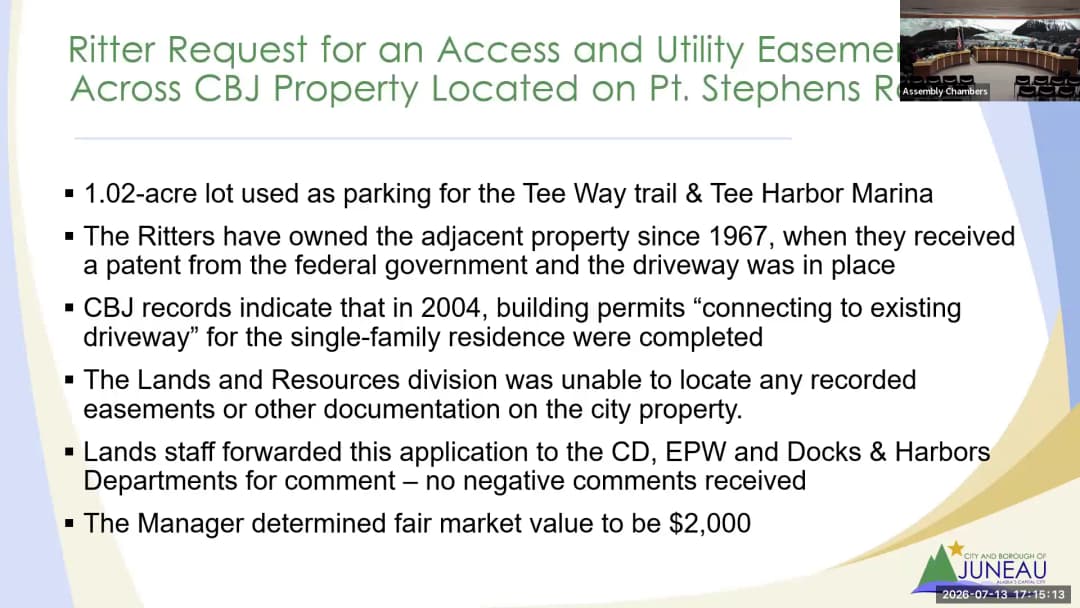
The Land Housing and Economic Development Committee met on August 26, 2026, to consider a lease request for affordable housing, an easement request, and receive updates on Coast Guard infrastructure and a quarry permit. The meeting was called to order, the agenda approved without objection, and minutes from the previous meeting were held for later approval. Discussion Items - Juneau Housing First Collaborative Lease Request: Staff presented a request to lease a 7.5-acre city property off Sean Drive for less than fair market value to develop one-bedroom apartments for individuals below 80% area median income. The property is zoned rural reserve and requires a zone change to light commercial, which the applicant is pursuing. The northern portion will be retained for trail access and future city use. Staff recommended working with the original proposer. Committee member Steininger asked about splitting the property, but staff noted a lease is more efficient initially. The committee voted unanimously to support a lease by direct negotiation and forward to the full assembly. - Rider Request for Easement on Point Stevens Road: Staff explained a request to formalize an existing driveway easement across a city-owned parking lot parcel. The applicants have owned adjacent property since 1967 and the driveway predates city incorporation. The easement is valued at $2,000 and received no objections from city departments. A motion to forward the request with support to the full assembly was initially questioned but then approved unanimously. - U.S. Coast Guard Cutter Home Porting Infrastructure Environmental Assessment: Staff provided a written report on the Coast Guard's environmental assessment process. An open house was held on June 30, and a public comment period ends July 24. Staff have expressed city interest in partnership. No action taken. - Stabler Point Rock Quarry Conditional Use Permit: Staff reported that the city has applied to renew a 10-year conditional use permit for the quarry. The permit does not expand the footprint and will go to the Planning Commission in July. No action taken. Committee Member Comments Ms. Paulett Schreimer provided an update from the Parks and Recreation Advisory Committee (PRAC) meeting, including discussions on indoor pickleball courts, the mountain bike trail near Glacier Elementary, e-bike classifications, a land swap MOU with the state, scheduling policy for Treadwell Arena, and annual report finalization. Key Outcomes - Motion 1: To support a lease of a portion of parcel LND 0834 by direct negotiation for the Housing First Collaborative, forwarding to the assembly. Passed unanimously. - Motion 2: To forward the easement request to the full assembly with a motion of support. Passed unanimously after initial objection removed. - No other votes were taken. The next meeting is scheduled for August 3.
The Juneau Assembly Finance Committee held two joint meetings on March 19, 2026: first with the Docks and Harbors Board to review the FY27 enterprise budget, and then with the Juneau School District Board of Education to review the FY27 school district budget. Both presentations highlighted strong financial management, upcoming capital needs, and ongoing revenue challenges. Docks and Harbors Budget Presentation - Matt Creswell, Harbormaster, presented the FY27 budget for Docks and Harbors, an enterprise department comprising the docks (cruise ship operations) and harbors (small boat harbors, launches). - Docks Enterprise: Revenues exceed expenditures; FY27 contribution to fund balance is approximately $692,000, bringing the end-of-year fund balance to $4.65 million. A new cruise ship dockage fee structure nearly doubled revenue; $2.464 million will transfer to CBJ general fund. FTEs increased by 0.01 to 19.74 through reprogramming. The cruise ship electrification project is estimated at $60+ million (35% design expected by fall). - Harbors Enterprise: Revenues continue to outpace expenditures; FY27 revenues $7.15 million, expenditures include $880,000 draw on fund balance for capital projects. Fund balance projected at $1.204 million at end of FY27. Major capital projects: Aurora Harbor Phase 4 (final phase, occupancy by May 1, 2026), new drive-down float (grant-funded), new Aurora Harbor office ($5 million), Statter Harbor breakwater study (estimated $100 million project, 80/20 split), North Douglas launch ramp ($30 million), Fishermen's Terminal property ($10 million placeholder). Insurance costs tripled from $258,000 to $757,000 since FY22. - Discussion topics: - Revenue diversions: The docks enterprise loses $717,000 in marine passenger fees and the harbors enterprise loses approximately $450,000 in raw fish tax (state shared revenue). Total diversion to CBJ general fund is $3.67 million. - Board members expressed concerns about the raw fish tax diversion, with Matt Later stating it feels like being penalized for fiscal responsibility. Clayton Hamilton (fisherman) noted harbors are doing fine but acknowledged the need for future investments. Tyler Emerson encouraged looking elsewhere for revenue. - Uninsured vessel surcharge (new fee) expected to collect over $100,000 to help cover costs of sunken vessels. School District Budget Presentation - Superintendent Frank Houser and CFO Nicole Herbert presented the FY27 adopted budget. - Enrollment continues to decline by 1.5-2%; projected ADM of 3,767 for FY27. - The budget assumes a Base Student Allocation (BSA) of $6,660 (flat from FY26). No state increase anticipated. - Revenue: CBJ appropriation provides 47% ($35,801,900 for general operations plus $2,109,000 for non-instructional shared services); state foundation funding provides 52%; other local sources 0.96%. Hold harmless funding (final year) accounts for nearly 2% of budget. - Expenditures: Total $81 million, with 75.28% going directly to instruction, 86% to salaries and benefits. The budget balances by using $5.7 million from fund balance, leaving approximately $1.7 million reserve (above the 1.5% policy minimum). - Non-instructional shared services request of $2,109,000 (slightly less than FY26) covers high school activities, student transportation, food services, community schools, and learn to swim. - Discussion topics: - Fund balance usage and future sustainability: CFO Herbert explained that anticipated vacancies and health insurance waivers typically replenish fund balance during the year, creating a cyclical pattern. - Energy efficiency: District is using a Renew America's Schools grant for HVAC upgrades; operations manager can switch between heating oil and electricity to optimize costs. - After-school childcare: A proposal from the Chamber of Commerce for expanded summer childcare did not find an assembly sponsor for grant funding; some assembly members are considering an ordinance. - Communication and coordination: Extensive discussion about the failed Dzántik'i Héeni (Zontachini) playground project, which suffered from unclear roles and lack of transparency between the city and school district. Multiple members called for a better process for joint facility projects. Key Outcomes - Assembly Motion: Passed (7-0-2?) to direct CBJ staff to work with JSD staff to propose a process for better communication and decision-making on joint facility projects. - School Board Motion: Passed (unanimously) mirroring the assembly motion, directing their staff to participate in developing the process. - Next joint committee meeting scheduled for March 31, 2026, to discuss potential school bond debt and CIP priorities.
The Assembly Public Works and Facilities Committee met on March 17, 2026, at noon to discuss several key items. The meeting included an update on Recycle Works, a transfer of funds for the Crow Hill project, a request to apply for a $17 million loan for HESCO barriers related to glacial lake outburst flooding, the draft FY 2027-2032 six-year capital improvement program (CIP), and informational updates on the drinking water utility and microtransit. Votes included unanimous consent on several items, and committee members expressed ongoing interest in exploring microtransit options. Consent Calendar - The agenda was approved as amended, with an added update on Recycle Works. - The minutes of the February 23, 2026 meeting were approved as written. - Item 1 (CIP fund transfer for Crow Hill): Unanimously forwarded to the full assembly. - Item 2 (HESCO loan application): Unanimously forwarded a resolution to the full assembly authorizing the manager to apply for an ADEC loan not to exceed $17,015,000 and execute the loan agreement. - Item 3 (FY 2027-2032 CIP): Unanimously forwarded the draft CIP to the full assembly for introduction and inclusion in the FY27 budget review process. Public Comments & Testimony - No public comments or testimony were recorded during this meeting. Discussion Items - Recycle Works Update: Director Koch announced that as of this week (mid-March 2026), Recycle Works is back to full recycling operations, including full hours and acceptance of all materials, including aluminum and plastic. She credited Stuart Ashton for his role in getting the bailer working and finding efficiencies. - Item 1: CIP Fund Transfer for Crow Hill: Director Koch presented a request to transfer funds from the Crow Hill Reservoir Inspection and Rehabilitation Project to address a separate electrical issue in the Crow Hill drinking water system. The electrical infrastructure, installed in the early 1990s, has faults that are difficult to locate. The project aims to conduct a more comprehensive fix starting in FY 2027. The committee forwarded the request to the full assembly without objection. - Item 2: HESCO Barriers and DEC SRF Loan: Director Koch discussed a request to apply for an approximately $17 million ADEC State Revolving Fund loan for HESCO barrier reconstruction after expected GLOF damage in August 2026. She emphasized that this action is non-binding and preserves options. She noted that CBJ already has an $8.8 million SRF loan for phase one, and that the U.S. Army Corps of Engineers committed in October 2025 to installing phase two at federal expense, valued at nearly $30 million. The loan would cover reconstruction of both phase one and phase two after the 2026 flood. Director Koch and Deputy Director Rumsey clarified that damage estimates for phase one have increased from an initial $1 million to significantly more, as the work is now seen as reconstruction, not just repair. Mr. Brooks asked about the ability to request a larger loan amount, and staff responded that $17 million is the maximum for 50% forgiveness. The committee forwarded the resolution to the full assembly. - Item 3: Draft FY 2027-2032 Six-Year Capital Improvement Program: Deputy Director Rumsey presented an overview of the draft CIP. Key points: The CIP is funded from four primary sources (3% sales tax, 1% special sales tax, passenger fees, and departmental enterprise funds). For FY27, $9.6 million is allocated to street projects from the 3% sales tax, plus $2.4 million for other CIP priorities. The 1% sales tax initiative list has been updated. Of the $23.2 million in tax-funded CIP projects, 76% are for maintenance and repair (87% excluding the restricted budget reserve). The CIP book includes a new column identifying which departmental priorities are recommended for FY27 funding. The committee forwarded the draft to the full assembly. - Informational Item: Drinking Water Utility Update: Director Koch informed the committee that AELNP is conducting a major construction project (April 1 to June 30 annually for four years) that will impact the Salmon Creek secondary water supply, which provides about one-third of the community's drinking water. Contingency planning includes: cruise ships have been informed they are interruptible customers; streets and DOT crews have been asked to fill water trucks downtown to conserve valley supplies; and if needed, CBJ will issue a press release asking for voluntary water conservation. The public has been responsive in past similar situations. - Informational Item: Microtransit: Director Koch provided an overview of microtransit as a potential third element (beyond fixed route and paratransit). She described various models (first mile/last mile, connection to transit centers, door-to-door). She noted that adding this service would be an expansion and that additional federal funding through the state is unlikely. Existing system costs are about $9.77 per ride (average 17 riders per hour), but low-ridership routes (e.g., former North Douglas route) cost closer to $80 per ride. Mr. Brooks expressed continued dissatisfaction with the lack of transit options for areas like North Douglas and the airport, and requested a pilot cost analysis, acknowledging the need for creative approaches. Key Outcomes - Recycle Works returned to full operations as of mid-March 2026. - Crow Hill CIP fund transfer forwarded to full assembly (unanimous consent). - ADEC loan application for up to $17,015,000 for HESCO barriers forwarded to full assembly (unanimous consent). - FY 2027-2032 draft CIP forwarded to full assembly for introduction and inclusion in budget review (unanimous consent). - No action taken on the drinking water utility or microtransit informational items. - Next meeting scheduled for April 13, 2026 at noon. - Continued exploration of microtransit options, with a potential pilot cost analysis requested.
The Lands Housing and Economic Development Committee met on March 17, 2026, to discuss the annual report of the Affordable Housing Fund and consider potential limits on short-term rental units per person. The committee received updates on program performance, discussed modifications, and advanced two motions related to short-term rental regulation. Consent Calendar - Approval of the agenda with no changes. - Approval of the February 23rd minutes as presented. Discussion Items Affordable Housing Fund Annual Report Acting Community Development Director Shambourgh presented the fifth annual report on the Affordable Housing Fund, which includes three programs: the Competitive Affordable Housing Fund (grants and loans), the Accessory Dwelling Unit (ADU) Grant Program, and the Manufactured Home Down Payment Assistance Program. Key highlights: - Over five rounds, 29 total applications were received: 15 workforce housing loans and 14 grants. - The ADU grant program has seen 35 grants and 28 denials, primarily due to failure to obtain a certificate of occupancy within 18 months. Grant amount is currently $13,500; staff noted some applicants feel this is insufficient, with a past proposal to increase to $50,000. - The manufactured home down payment assistance program was updated in 2024 to $20,000 or 50% of required down payment, leading to increased interest. - The program requires at least 20% of units at 80% Area Median Income (AMI) for workforce housing loans, but rising AMI has made this threshold easier to meet; staff cautioned against frequent changes to maintain developer confidence. - Assemblymember Kelly proposed adding preference points for teachers, healthcare professionals, or similar personnel, or offering incentives for developers to set aside additional units for these groups. Staff will refine the concept. - Assemblymember Steiniger inquired about ADU denial reasons and why more homeowners do not apply; staff cited lack of awareness, insufficient grant amounts, and reluctance to engage with government programs. - Assemblymember Kelly asked about budget projections for sales tax revenue and general fund contributions; Manager Custer responded that the FY27 CIP includes scheduled funding, but future years may be affected by revenue reductions. Short-Term Rentals – One per Person Limit The committee discussed potential limits on short-term rental units following a memo from the municipal attorney. Key points: - The attorney confirmed the city has legal authority to impose limits, such as one per person or owner-occupancy requirements. - Assemblymember Steiniger suggested defining the policy goal (e.g., returning housing to long-term market vs. revenue generation) before deciding on specific limits. - Assemblymember Hall expressed interest in an upper limit on units per entity to bring housing stock back into long-term use, noting that most operators own few units but some own many. - Assemblymember Kelly supported exploring limits and using permit fees to fund the affordable housing fund. - The committee also discussed data availability on current operators with multiple units; staff can provide aggregated data. Key Outcomes - Motion 1 (Kelly): Direct staff to bring back an ordinance establishing an upper limit on the number of short-term rental units per applicant. Approved without objection. - Motion 2 (Kelly): Direct staff to bring back an ordinance charging a fee for short-term rental applications and dedicating those fees to the affordable housing fund. Approved without objection after brief discussion on administrative costs. - Staff will prepare ordinances for the committee's next meeting on April 13, 2026. - Regarding the Affordable Housing Fund, staff will consider Assemblymember Kelly's incentive idea for units targeting licensed professionals.
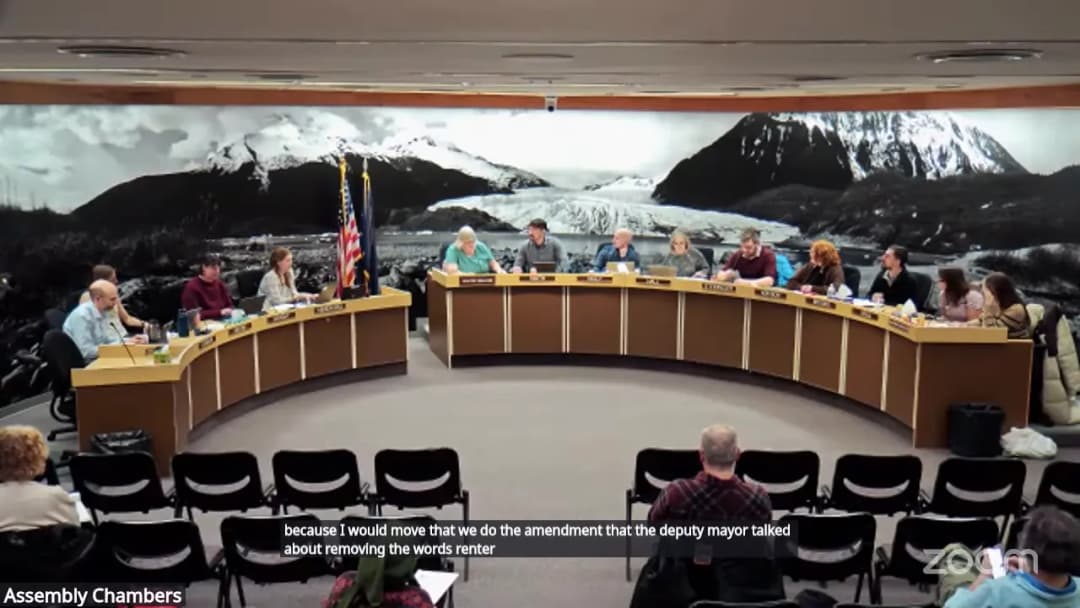
The Committee of the Whole met on March 16, 2026 at 6:07 PM to discuss three ordinances: extending the Thane emergency shelter to year-round operations, disposing of the current city hall at 155 Heritage Way, and implementing a tax on peer-to-peer vehicle rentals. The meeting included a land acknowledgement and a staff report. No public comments were taken. Discussion Items - Year-Round Emergency Shelter Operations: Manager Barr presented a proposal to fund year-round operations of the Thane emergency shelter at an estimated $1.1 million annually. He noted that the current partner, St. Vincent de Paul, is able to manage year-round operations this year, but emphasized that successful summer operations would require stricter enforcement of the 48-hour dispersed camping code. Assembly members raised questions about enforcement capacity, transportation, capacity, and neighborhood concerns. The committee voted to forward the ordinance (Ordinance 2025-01b-AF) to the full assembly for public hearing without objection. - Disposal of 155 Heritage Way (City Hall): The manager outlined options for selling the building, including competitive sealed bid with a $2.5 million minimum, request for proposals, or negotiated sale to a nonprofit. Assembly members debated whether to obtain an appraisal (estimated cost $15,000–$20,000), with most opposing it. Conditions for sale were discussed, such as requiring year-round occupancy and preference for local buyers. A motion to forward the ordinance (Ordinance 2026-15) to the full assembly for public hearing and return it to the Committee of the Whole passed 7-2, with members Wall and Hughes Scandies voting no. - Tax on Peer-to-Peer Vehicle Sharing (Ordinance 2026-12): Manager Barr introduced a proposed 10% excise tax on peer-to-peer rentals (e.g., Turo) within a downtown cruise dock zone, to offset parking management costs. The Lands, Housing and Economic Development Committee recommended a map adjustment and a private property exemption. Assembly members discussed the complexity of the exemption, applicability to traditional rental companies, and map boundaries. Several amendments were proposed for the next meeting: removing the word "renter" from the ordinance, extending the tax to traditional rental car companies, extending the map to include the remainder of the rock dump and the IGA parking lot, and reconsidering the private property exemption. The committee directed staff to bring back amendments for the next meeting. No vote was taken on the ordinance itself. Key Outcomes - Ordinance 2025-01b-AF (year-round shelter) was moved to the full assembly for public hearing without objection. - Ordinance 2026-15 (city hall disposal) was moved to the full assembly for public hearing and referred back to the Committee of the Whole. The vote was 7-2 in favor. - Ordinance 2026-12 (peer-to-peer vehicle tax) will be brought back to a future Committee of the Whole meeting with staff-prepared amendments addressing the renter language, inclusion of traditional rental companies, map extension (rock dump and IGA parking lot), and the private property exemption. - The next meeting is scheduled for April 13, 2026 at 6:00 PM.
The meeting was called to order on March 9, 2026, but metadata indicates March 10, 2026. This summary uses the provided date. The Assembly addressed a lengthy public comment period, several ordinance readings, and key decisions on View Drive flood buyout, Eagle Crest board status, and social service funding concerns. The meeting concluded with an executive session on collective bargaining. Consent Calendar - Approved minutes for February 9 regular and February 25 special assembly meetings. - Passed consent agenda items (routine ordinances for introduction). Special Order of Business - Proclamation for Sienna: Recognized youth leader Sienna for civic engagement and environmental advocacy. Sienna expressed gratitude and encouraged youth to believe in themselves. Agenda Changes - Manager's requests: Moved new business before public hearing to allow early testimony on View Drive; added item to postpone consideration of Eagle Crest Board advisory ordinance (originally scheduled for March 16 Committee of the Whole); pulled Resolution 4042 (supporting lake tap mitigation system) pending new information from Secretary Adam Tell's visit later in March. Public Comments & Testimony (41 speakers; rules suspended to allow 2 minutes each) - Amy Miller (Valley) : Expressed frustration with CBJ’s handling of Mendenhall Valley flooding, high taxes, and lack of long-term solutions. Criticized Telephone Hill demolition and Eagle Crest gondola costs. Stated she and friends are planning to leave Juneau due to feeling unheard. - Kirsha Hughes Candies (North Douglas) : Thanked the Assembly for their service; urged the public to channel anxiety constructively rather than displace anger onto local officials. - Max Rosen (Downtown) : Supported libraries as essential community infrastructure; encouraged continued funding. - Maureen Conerton (Auke Bay) : Opposed $5.5 million demolition of Telephone Hill, citing budget shortfall and lack of developer commitment. Suggested redirecting funds to relieve budget cuts. - Robin Chartrand (North Douglas) : Criticized Telephone Hill project as wasteful and premature, noting pending lawsuits and risk of losing federal funding. Called for listening to constituents and following legal processes. - Sean Strauss (Valley) : Supported housing expansion but opposed current Telephone Hill plan, citing no developer commitment, high costs, and risk of no housing outcomes. - Robert Reich (Auke Bay) : Represented Echo Ranch Bible Camp; requested assistance to expedite rebuilding of collapsed field house after January snowstorms, currently before Planning Commission in April. - Dr. Will Jemison (Valley) : CEO of JAMHI Health & Wellness; highlighted positive outcomes from past city investments (new providers, 76% increase in primary care) and urged continued partnership despite city budget constraints. - Catherine Fritz (Highlands) : Questioned data behind 100-unit target for Telephone Hill; estimated $45 million subsidy needed; urged pausing demolition and considering alternative options. - Tony Tangs : Opposed subsidizing “unaffordable housing” on Telephone Hill; stated average subsidy of $300,000 per unit with 20-year tax recovery timeline. - Rebecca Belmore (Valley) : Science director at Southeast Alaska Watershed Coalition; described ongoing fish habitat restoration and bank stabilization projects in Mendenhall watershed; invited public to meeting on March 19. - Bruce Batello (Douglas) : Argued that petition signatures must meet 25% threshold within 30 days; urged clarifying charter interpretation to prevent granting additional 10 days when initial count is insufficient. - Melani Shavins (Downtown) : Supported Batello’s proposal on petition rules; stated that unclear thresholds lead to divisive ballot measures and undermine initiative process. - Josh Anderson (North Douglas) : Local contractor; noted confusion and lack of confidence in city government; called for simplification and cost-effective projects. - Dan Parks (Lena Point) : Executive Director of Southeast Alaska Food Bank; opposed proposed 30% reduction in social service block grant; noted demand increase from 300 to 500 clients per week; urged maintaining funding. - Mariah Thibodeau Offer (Downtown) : Opposed Telephone Hill demolition; emphasized historic and cultural value; referenced past destruction of Indigenous neighborhoods. - Sean Cantola (Valley) : Real estate developer; supported Affordable Housing Fund but recommended sliding-scale loan amounts based on bedroom count to encourage family-sized units. - Skip Gray (Twin Lakes) : Opposed destroying Telephone Hill homes; compared proposed 100-155 units to larger apartment complex; suggested selling houses with historic preservation stipulations. - Kim Metcalf (Downtown) : Opposed Telephone Hill demolition; cited 1,052-signature petition; urged prioritizing other needs over $9+ million project. - Tina Rice (Valley) : School counselor; stressed importance of Hope/CBJ social service grants for weekend food bags for over 100 students weekly; warned 30% cut would harm children. - Shannon Green (Valley) : Referenced social media comments criticizing gondola cost overruns; expressed loss of confidence in CBJ leadership; urged aligning spending with budget survey priorities. - Erin Walker Tollis : Executive Director of Catholic Community Service; requested maintaining social service block grant funding; noted 30% decrease in social service workforce and increased senior food needs (meals served only 4 days/week). - Angie Amend-Bayer (Downtown) : Referenced Innovation Summit and budget survey; opposed Telephone Hill demolition; urged reserving $5 million for urgent fiscal needs. - Jacqueline Peta (Valley) : President/CEO of Klinket Haida Regional Housing Authority; described Shaay Khaat Hit youth shelter serving 3,000 bed nights; warned cuts would impact runaway and homeless youth. - Kaya Quinto (Valley) : Executive Director of Glory Hall; stated 99 units of housing, 15,000 emergency beds, 60,000 meals annually; stressed crucial role of SSAB funds. - Morgan Cruz Airsman (Valley) : Glory Hall board member; warned loss of funding would eliminate meal program and jobs; said need does not disappear. - Aaron Surma (North Douglas) : NAMI Juneau; described time spent fundraising to replace state cuts; said advocacy and crisis stabilization work would be at risk if CBJ hope funds reduced. - Casey Krieger (South Douglas) : Thanked city for dropping trespassing charges; criticized Eagle Crest gondola cost increases from $10M to $40M; questioned transparency and deferred maintenance decisions. - Heather Parker (Downtown) : Supervising attorney at Alaska Legal Services; highlighted $6,000 in SNAP benefits secured for one family; urged continued Hope funding for civil legal aid. - Paige Bridges (Downtown) : Emphasized beauty and arts value of Telephone Hill; urged sparing the neighborhood. - Debbie Fisher (Valley) : Thanked Assembly; urged broadening resolution language to include midterm flood solutions (not just long-term lake tap) and better communication with flood-affected residents. - Dave Ringle (Airport neighborhood) : Reported first decrease in warming shelter attendance in four years; credited affordable housing and social services; urged continued investment. - John Ingalls (former Telephone Hill resident) : Opposed demolition; cited doubled construction costs and successful historic restoration elsewhere. - Susan Clark (Flats) : Highlighted $1.4 million already spent on Oregon consultant for Telephone Hill; questioned need to contract out bidding and geotech work. - Bruce Simonson : Opposed demolition until RFQ responses are reviewed by Assembly. Discussion Items - View Drive NRCS Buyout: The manager recommended entering into a formal agreement with NRCS for a buyout program, with up to $558,000 for appraisals and cost estimating. Discussion included cost-sharing (25% local), off-ramps, and need to inform homeowners early about expected costs. Motion passed as amended (7-2) to enter agreement and draft appropriation ordinance with flexible funding source (general fund or emergency reserve). - Eagle Crest Board Advisory Ordinance: The Mayor proposed postponing discussion on converting the Eagle Crest board from empowered to advisory for six months (to September 28, 2026) to allow ongoing work with Goldbelt and others. Some Assembly members objected, preferring to decide sooner. Motion to postpone passed 7-2. - Hardship Tax Exemptions: Approved late-filed senior/disabled veteran exemptions for Paula Sumdum and Daniel Roundow (unanimous). Public Hearing Ordinances - Ordinance 2025-01BAB: Appropriated $493,000 from school district funds for Dzantik’i Heeni playground improvements. Passed. - Ordinance 2026-10: Amended title definitions to include online newspaper of general circulation. Passed. - Ordinance 2026-08: Exempted residential composting from sales tax. Passed 7-2 (Mayor and Deputy Mayor Smith opposed). - Ordinance 2025-01BU: Appropriated $150,000 grant to St. Vincent de Paul for long-term maintenance. Amended to remove reference to Teal Street. Passed. - Ordinance 2025-01BZ: Appropriated $2 million from general fund to replenish deferred building maintenance CIP. Passed. - Ordinance 2026-07: Exempted 2026 fireworks display purchase from procurement code. Passed. Key Outcomes - View Drive Buyout: Assembly directed staff to enter into formal NRCS agreement and draft appropriation ordinance for up to $558,000 (funding source to be determined). Multiple off-ramps available before final commitment. - Eagle Crest Ordinance: Postponed to September 28, 2026 Committee of the Whole. - Election Overview: Clerk presented 2026 municipal election timeline; no action needed. Discussion on petition signature deadlines – Attorney clarified history of interpretation; Assembly may consider legislation but advised caution near petition season. - Committee Reports: Various updates on Lands (vertical bridge, land swap, short-term rentals), Public Works (water mains, museum, recycling), Finance (special meeting March 18 with docks/harbors and school board), Human Resources (forwarded resolution on committee engagement, discussed board term limits), etc. - Executive Session: Assembly entered executive session to discuss collective bargaining negotiations; no return to regular session.
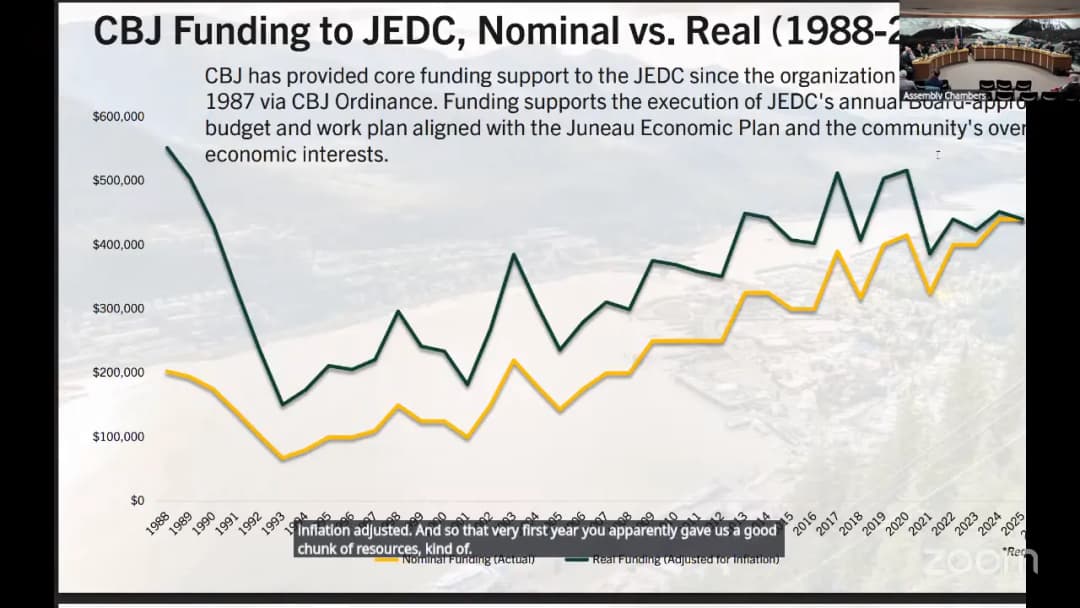
The special Assembly Finance Committee met jointly with the Eagle Crest Board of Directors on March 4, 2026, to review the Eagle Crest FY27 budget, discuss revenue and expense trends, and receive an update on the gondola project. Following the joint session, the Finance Committee heard presentations from KTOO Public Media, Juneau Arts and Humanities Council, and Juneau Economic Development Council regarding their FY27 funding requests. The committee also received an update on foregone revenue analysis and logistical details for upcoming budget meetings. Eagle Crest Budget Presentation - Eagle Crest Acting General Manager Aaron Lupro reported a current season snowfall of 305 inches, 61 days open (budgeted 86), and 19 snowmaking days. Community engagement included summer camps (50 kids over 4 weeks), Haunted House fundraiser, Christmas Eve event (60 kids), and Discover Eagle Crest Day. The school group scholarship program reached 19 classes of 30+ students each. - Major maintenance completed in FY26: new bull wheel bearing on Tarmigan, fleet maintenance, Fish Creek Lodge water project, blasting for road hardening, snow gun refurbishment, patrol hut relocation, and lift component rebuilds. - Brandon Cullum, Board Chair, presented budget trends: general fund support peaked in FY25 at $1.4M+ due to catch-up maintenance, then returns to historical $930,000 in FY27. Personal services increased due to integration into CBJ pay plan, but actual spending is lower due to a 15% vacancy rate (budgeted 4.1%). - Revenue trends: operating revenues correlate with snowfall. Poor snow years in 2025 and early 2026 reduced pass sales. Jim Calvin showed that adult pass sales declined 15% from 2022 to 2025 as prices increased, with teen and youth passes down 25%. The board emphasized restoring confidence rather than raising prices to increase revenue. - Expenses: aging infrastructure (lifts from 1969-1977, Riblett parts no longer available), building assessment, aging fleet, and staff retention challenges. CIP request for FY27 is $167,000, down from $576,000 in FY26, which the board acknowledged as insufficient but accepted. - Fund balance: negative fund balance allowed in FY25 to support sustainability path. Full cost allocation rising, reducing the net benefit of general fund support to Eagle Crest. Gondola Project Update - Jim Calvin presented the gondola update: a $27 million cost estimate from Cornerstone General Contractors (first estimate, with a $3M contingency). This far exceeds the available $3.5M unspent funds and earlier expectations of $10-15M. - Options discussed: Goldbelt (partner) additional investment, CBJ borrowing, third-party investors, or terminating the project. Terminating would cost $11M in sunk costs (including $2.5M for gondola purchase and shipping) and leave Eagle Crest with little chance of self-sufficiency. - If Goldbelt invests, conditions may include year-round operations. The assembly and board agreed to prioritize discussions with Goldbelt, then explore ADA lending, then national investors. The guaranteed maximum price is expected April 1, 2026. - Assembly members expressed shock and trepidation. The board noted the need to consider alternatives if the gondola is not viable. KTOO Public Media Presentation - President Justin Schumann reported that KTOO lost $1.2M (34% of its budget) due to federal rescission of Corporation for Public Broadcasting funds in July 2025. The revised FY26 budget is $2.9M, with CBJ's partnership grant growing from 13% to 15% of revenue. - Community giving and bridge grants (Public Media Bridge Fund $500K, Voices Across Alaska $340K) have provided temporary stability, but the loss is permanent. KTOO projects a deficit for FY27 and is investing in fundraising. - KTOO provides Gavel Alaska coverage (legislative, judiciary, executive) statewide, reaching 62,282 on-demand sessions in 2025. Also supports public safety communications (e.g., glacial lake outburst flood coverage). - Requested CBJ maintain current funding level for FY27. Juneau Arts and Humanities Council Presentation - Executive Director Maggie McMillan outlined JAHC's use of CBJ funding: $12,000 for individual grants (14 artists received $1,000 each), $12,000 for affordable facility use, and major grants ($118,650 distributed to 15 organizations). The major grant requests totaled $349,000, far exceeding available funds. - JAHC faces financial challenges: reduced staff, closed one gallery, and is developing a new strategic plan. Fundraising revenue projections are conservative. If CBJ funding is reduced, grant programs would likely be eliminated. - JAHC also runs arts education programs (Artists in Schools, Poetry Out Loud state competition) and manages Centennial Hall rentals. Juneau Economic Development Council (JEDC) Presentation - Board Chair Aaron Morrison and Executive Director Brian Holst presented JEDC's work: focused on demographic retention, housing, key regional industries (tourism, mining), entrepreneurship, talent development, and economic services. JEDC manages numerous programs including summer camps (300+ youth), robotics (statewide), Maritime Festival, Innovation Summit, and revolving loan funds. - CBJ provides $1.9M over five years, which JEDC leverages to bring in $11.7M in additional resources (6:1 leverage). For every $1 of CBJ funding, $4-5 is delivered in economic programming. - Vulnerable programs if funding is reduced: summer camps, robotics, Maritime Festival, Innovation Summit, research, and Local Frequency program. JEDC has drawn down reserves from 10% to 8% and targets 6-12 months of reserves. - JEDC also manages loan portfolios for CBJ and the City of Haines, and provides administrative support to other nonprofits. Foregone Revenue Update - Assemblymember Steininger reported that the foregone revenue working group (with Mayor Weldon and Assemblymember Hughes-Candies) is analyzing various revenue opportunities. They aim to bring a prioritized list of items to the committee, focusing on those that could generate significant revenue toward the $2 million goal. The group expects to present soon. Key Outcomes - No formal votes were taken on any agenda items. - The assembly will hear a detailed gondola presentation from Craig Dahl on April 1, 2026. - The Eagle Crest Board will continue discussions with Goldbelt and explore other options; the board has a regular meeting on March 5, 2026. - The foregone revenue group will continue its analysis and report back. - The next finance committee meeting is scheduled for March 18, 2026, with a joint meeting with Docks and Harbors and the Juneau Board of Education.
The meeting began as a special Assembly Finance Committee (AFC) meeting, approved minutes, then convened joint meetings with the Juneau Airport Board and the Bartlett Regional Hospital Board. The airport board presented its FY27 budget, highlighted a critical shortage of ARF firefighting trucks, and discussed funding options. The hospital board presented its financial outlook, addressed facility and workforce challenges, and emphasized the importance of maintaining a strong community hospital. Consent Calendar - The AFC unanimously approved the minutes of the February 4, 2026 meeting. Airport Board Discussion Items - Airport Manager Andres Delgado presented the FY26 projected under-spending of $110,000 due to a mild winter and reduced de-icer use, and outlined FY27 expense assumptions including a new deputy airport manager position and union rate increases. - The airport financial model was updated to correct an allocation mismatch between Part 121 (air carriers) and Part 135 (commercial operators), resulting in lower fuel flowage fees and higher landing fees. - Revenue projections assume 2.8% annual passenger growth through 2030, reaching over 600,000 enplanements. - CIP projects include the Runway 26 MALSR reconstruction ($25M, 93.75% FAA funded), a new control tower grant applications, and various completed projects. - Fund balance target is three months of operating expenses ($3M); future refinements may add $900k–$1M. ARF Truck Crisis (Airport Rescue Firefighting) - The airport currently has only one reliable ARF truck; a second is on lease from Palmer and a loaner from Gustavus must return by May 1. - A temporary failure of two trucks in February reduced the airport to Index B, limiting aircraft size, and risked ARF Zero status (no air carrier service). - A new truck is expected in late April 2026 but won't be in service until June/July. - The FAA will not approve a new AIP-funded truck until 2031, so the airport board and city staff discussed using the city fleet reserve or airport fund balance with PFC reimbursement to purchase a second truck quickly. - Board members (Soutier, Epstein, Williams) stressed the urgent need and supported flexible funding mechanisms to avoid a single point of failure. Hospital Board Discussion Items - CEO Joe Warner reported that FY26 expenditures will exceed budget due to new clinics and provider hires; FY27 net income of $5M is projected (excluding the lapsed rural demonstration program worth $4.2M). - The hospital is pursuing Rural Health Transformation grants to improve technology and care coordination, particularly to offset anticipated Medicaid reductions. - Facility master planning is underway; a housing expansion for employees and patient lodging is budgeted at $3.5M as a placeholder for rural health transformation funds. - Hospice and home care services are losing $30k/month and $50k/month respectively; the board committed to continue these services for at least five more years. - Employee engagement improved to the 39th percentile; the goal is 75th percentile. - Wildflower Court now has 47 of 51 beds occupied after a pipe burst temporarily closed eight beds. - Board member Max Mertz proposed a review of the 1970 charter relationship between CBJ and the hospital to improve efficiency in procurement, CIP, cash management, and shared services. - The hospital's separate audit (first year) is nearly complete; significant prior period adjustments were identified and booked. - New board member Jeannie Monk emphasized the need for community engagement to highlight the value of a community hospital. Key Outcomes - The AFC acknowledged the airport board's request for a second ARF truck and noted the city fleet reserve as a potential quick-funding source. - The hospital board and assembly discussed the need for a formal review of the CBJ-hospital charter relationship; no formal motion was made. - The AFC updated the budget calendar, with assembly grant requests due March 15, 2026, and assembly member budget reduction proposals due April 16, 2026. - The next AFC meeting is scheduled for March 4, 2026.