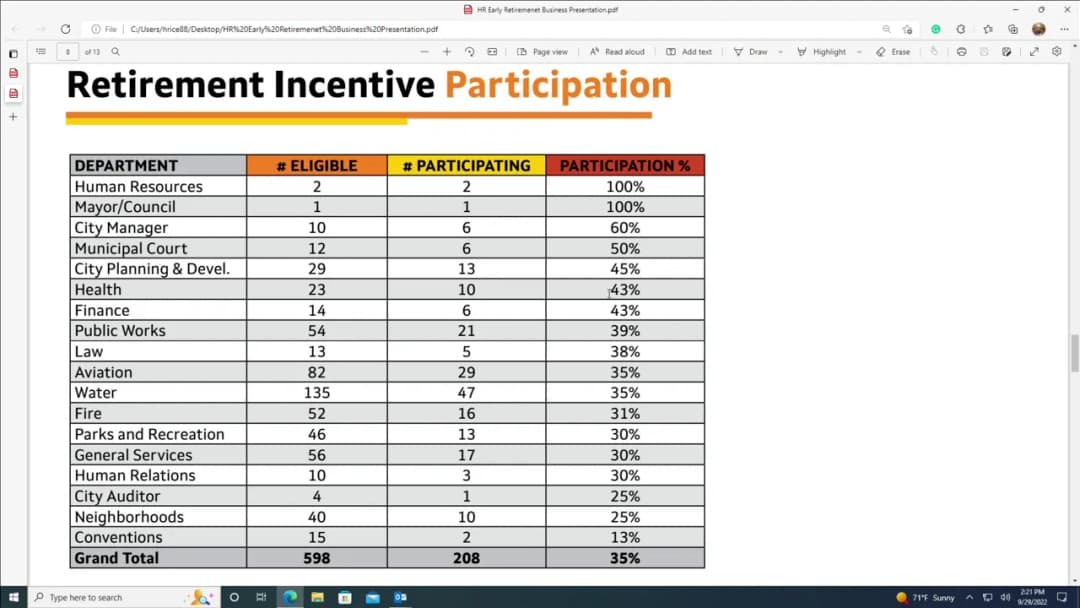
The Kansas City Council met on September 29, 2022, to receive presentations on the KC Streetcar Public Transportation Agency Safety Plan (PTASP) annual update and a retirement incentive analysis. Following the presentations, council members engaged in an extensive discussion on city hiring processes, vacancy rates, and recruitment strategies. KC Streetcar Public Transportation Agency Safety Plan (PTASP) Update - Jason Waldron (Transportation Director) and Angie Lori (Associate Director of Transportation) presented the annual safety plan required by the Federal Transit Administration (FTA) for receiving federal funding. - The existing system covers 2.2 track miles (4.4 total miles), with extensions planned south (3.5 miles) and north (0.75 miles to Berkeley Riverfront). - The plan includes four safety management components: policy, risk management, promotion, and assurance, and designates a chief safety officer (Jason Waldron serves in that role). - MoDOT (Missouri Department of Transportation) commended the city's safety record. No votes were taken; the presentation was for information. Retirement Incentive Analysis - Terry Casey (HR Director) and Tanner Owens (City Manager’s Office) presented an analysis of the retirement incentive program implemented in 2021. - Out of 598 eligible employees, 208 retired: 124 chose a lump‑sum payment, 84 chose accrued sick leave payout at 100%. - Net salary and benefit savings from FY2022 through FY2027 are projected at $44 million; subtracting $11.6 million in one‑time incentive costs yields net savings of $32.7 million. - As of the meeting, 117 of the 208 positions remain vacant. A general assumption of 3.5% annual salary/benefit growth was used for FY2024‑2027 projections. - Council members questioned the saving’s impact on the city’s structural imbalance (estimated at $26 million in the five‑year plan). The budget officer noted the savings would reduce but not eliminate the imbalance. Discussion on Hiring Practices and Vacancy Rates - Council members expressed concerns about slow hiring timelines, with applicants reporting waits of seven weeks or longer to be contacted. - Director Casey acknowledged the 26% citywide vacancy rate and outlined efforts to modernize recruitment, including centralized hiring, automation of application screening (via a PeopleSoft consultant), and training for hiring managers. - Councilwoman Robinson and others urged standardized hiring benchmarks and professional HR practices rather than leaving timelines to department discretion. - The finance director confirmed a “right‑sizing” review of all vacancies is underway as part of the FY2024 budget process, but no hiring freeze is in place. - Councilwoman Hall requested a follow‑up presentation at a full business session within the next two weeks to provide unified data on vacancies by department, positions to be eliminated, and overall savings. Key Outcomes - The council will receive a more detailed report on vacancy rates and the right‑sizing effort at a future budget committee meeting. - The HR director committed to providing specific turnaround time data for the hiring process. - No ordinances or resolutions were introduced; the meeting was primarily a work session for information and discussion.
Public Meetings - Kansas City, Missouri
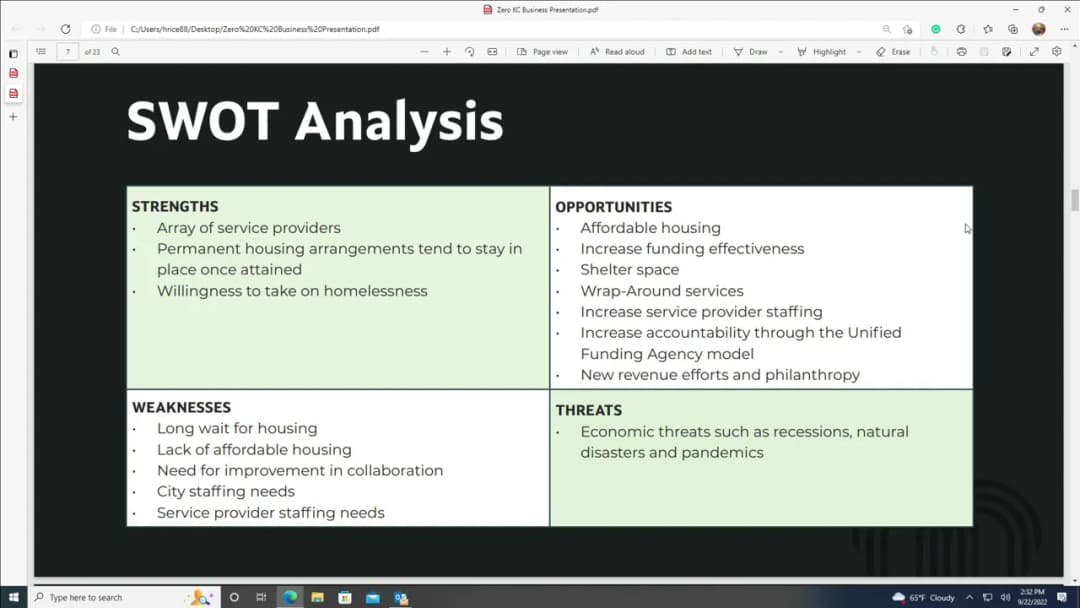
Public Meetings - Kansas City, MissouriThe Kansas City Council met in Business Session on September 22, 2022, to approve prior meeting minutes, review the audit scope statement for the Central City Economic Development (CCED) Sales Tax program, and receive the Houseless Task Force's "Zero KC" strategic plan. A floor introduction for a citywide community land trust model was also announced. Consent Calendar - Approved the minutes of the September 15, 2022 Business Session by unanimous voice vote. CCED Sales Tax Audit Scope Statement City Auditor Doug Jones presented the scope statement for an audit of the Central City Economic Development Sales Tax Program. He reported that the sales tax is expected to generate about $10 million annually, with total revenue between fiscal years 2018 and 2022 of about $46 million and fiscal year 2023 revenue expected to exceed $11 million. The City Council has approved $40 million for 28 projects, the program has distributed over $20 million, and four projects have been completed. The program is nearing the midpoint of its 10-year lifespan. The audit objectives are to evaluate whether CCED projects are making progress toward completion and whether funds were spent according to funding agreements. The work will include reviewing statutes and city code, interviewing staff, board members, and developers, and reviewing a sample of projects. The report is planned for January 2023. - Councilmember Robinson asked how the audit was selected, how progress toward completion would be determined, and whether the CCED board's strategic plan would be audited. Auditor Jones said the audit would focus on processes, procedures, and funding agreements, not the strategic plan. - Mayor Lucas noted there are currently two vacancies among the three city positions on the CCED board, following D.J. Pierre's departure from the country and Mia Richardson's resignation. He said he had not yet filled the positions but intended to do so as soon as possible, and that a quorum still exists. - Councilmember Ellington asked that the audit also examine the $2,500 application fees paid by denied applicants, including whether denial letters were issued and where the fees go. Auditor Jones responded that this was not currently included in the audit scope, but he would consult staff about it. Houseless Task Force Strategic Plan ("Zero KC") Councilwoman Parkshaw introduced the presentation on behalf of the Houseless Task Force, joined by Dr. Ann Williamson, Markea Watson, Executive Director of the Greater Kansas City Coalition to End Homelessness, and Josh Hinge, Houseless Prevention Coordinator. Dr. Williamson presented findings from the community needs assessment: - The January 2022 point-in-time count found 711 unsheltered persons, a dramatic increase from about 450 the previous year. - Nearly 63% of extremely low-income renters experience a severe housing cost burden, defined as paying 50% or more of gross monthly income for rent and utilities. Extremely low income is 30% of the HUD-adjusted area median income. For a family of four in 2022, the transcript gives the income figure as "just over $9,000" and later references "just over $29,000" in the same calculation (discrepancy noted). - There is a gap of nearly 28,000 affordable and available rental units for extremely low-income renters. - Only 3% of people housed through the CoC's coordinated entry system return to homelessness. The assessment identified needs for greater collaboration, hygiene facilities, additional shelter space, wraparound services, nonprofit staffing, more affordable rental units, prevention services, and more flexible funding sources to leverage federal dollars. Markea Watson and Josh Hinge presented housing inventory data showing a projected need for more housing, including a zero gap identified for transitional housing and shared housing. They noted that unsheltered homelessness is rising while emergency shelter homelessness is declining. Emergency Rental Assistance Program (ERAP) data showed that 72% of assistance went to Black or African American applicants, who represent about 28% of the population, and that assistance averaged almost nine months. Focus group results emphasized the need for wraparound services, shelter and housing options that do not require sobriety, more housing units, increased inclusivity for LGBTQIA community members, and person-centered approaches. The strategic plan is built on five agreed principles: living outside is dangerous; more housing is needed; wraparound services are essential; one size does not fit all; and solving homelessness requires ongoing investment. Priority projects include a low-barrier emergency shelter, humane encampment response, more street outreach, aligning CoC and ESG programs, and engaging neighborhoods and the business community. Councilmember Robinson asked where the detailed needs assessment and strategic plan could be found; Parkshaw stated they are online at kcmo.gov/housing and will be emailed and provided in hard copy. Robinson also asked about costs and the plan for the approaching winter. Parkshaw said cost estimates are not yet determined, and that an extreme weather ordinance would be introduced in about two to three weeks, developed with a regional approach and partners across the state line. Robinson raised concerns about the absence of visible Latino representation in ERAP data and about language barriers; Watson explained that federal race/ethnicity categories may create a paradox where Hispanic individuals identify as white or Black racially, and said the housing department could provide more detail. Robinson also asked whether the five-year housing plan informed the strategic plan; Watson confirmed it did. Key Outcomes - Unanimously approved the minutes of the September 15, 2022 Business Session. - Received the CCED sales tax audit scope statement; the audit report is expected in January 2023. - Received and discussed the Zero KC strategic plan. Two pieces of legislation were introduced: a council resolution to adopt the plan and a measure to establish a houseless commission and disband the task force. An extreme weather ordinance is expected within two to three weeks. - Councilwoman Parkshaw announced a floor introduction for a citywide community land trust model, referred to committee. - Meeting adjourned.
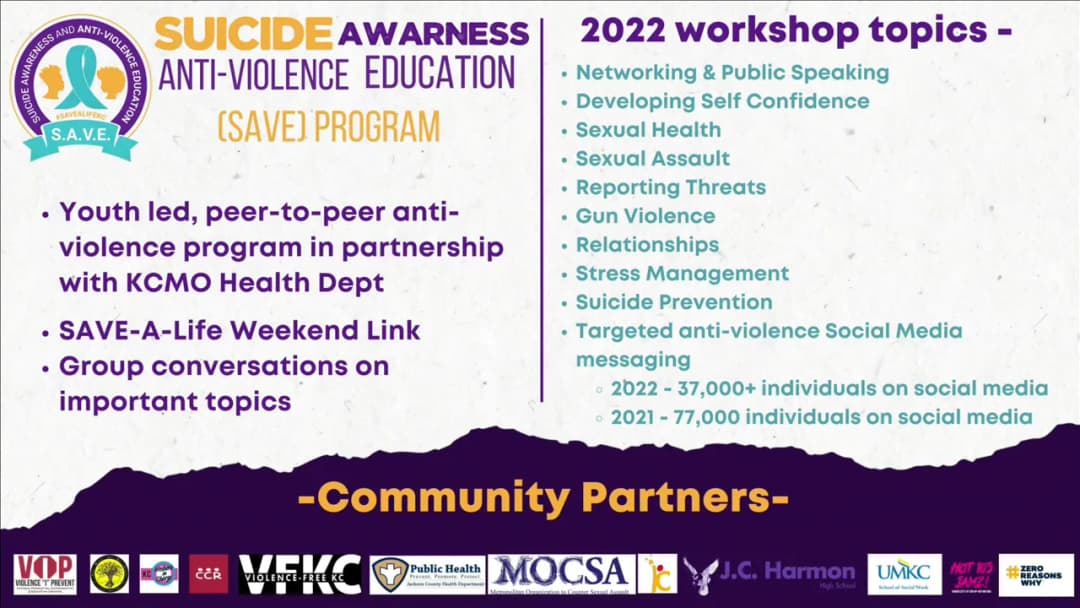
The Kansas City, Missouri City Council held a business session on September 15, 2022, presided over by Mayor Pro Tem Kevin McMahon. The meeting included approval of previous minutes, a presentation on recruiting a diverse police force, and a comprehensive update on youth suicide prevention efforts by the Health Department in partnership with Youth Ambassadors. No public comments were heard. Consent Calendar - Approval of Minutes (August 25, 2022): The council unanimously approved the minutes from the business session of August 25, 2022. Discussion Items Audit Scope: Recruiting and Hiring a Diverse Police Force - Presenter: Doug Jones, City Auditor, presented the scope statement for an audit on recruiting and hiring a diverse police force. The audit aims to help the police force represent community diversity, build trust, and is expected to be released after completion. Jones noted the scope would also be presented to the police board on September 27, 2022. - Council members had no questions; the presentation was received. Youth Suicide Prevention Presentation - Presenters: Dr. Marbia Jones (Health Department Director), Dr. Alex Francisco (Senior Population Health Scientist), and Dr. Monique Johnston (Executive Director, Youth Ambassadors). - Data from 2022 Missouri Student Survey (grades 6-12, three counties): - Approximately 8% of students had planned suicide in the past 12 months; about 5% had attempted. - Nearly 45% of students in Jackson County had made fun of another person. - Emergency room presentations for youth mental health have increased overall from 2019-2022, with a notable doubling between August and September. - 26% of youth in the region have been diagnosed with an anxiety-related disorder (Children's Mercy data). - Prevention Strategy: Dr. Marbia outlined a public health pyramid approach emphasizing prevention (trauma-informed care, mental health first aid, strengthening families curriculum, community wellness ambassadors) over costly late interventions. - Youth Ambassadors' SAVE Program (Suicide Awareness Anti-Violence Education): Dr. Johnston reported serving nearly 38,000 individuals through social media messaging in August 2022, with 87% of surveyed teens showing increased resilience after six weeks, 93% feeling better equipped to handle conflict non-violently, and 94% feeling better prepared for future opportunities. - Council Questions/Comments: Council members expressed strong support and appreciation; Councilwoman Bunch asked for more granular data by school district (noted limitation); Councilman Fowler highlighted suicide as the second leading cause of death for ages 10-35 and praised the focus on prevention; Councilwoman Robinson and others acknowledged the stigma of mental health and the need for better data on methods (guns noted as primary for completed suicides). Discussion also covered the new 988 hotline rollout and resource challenges. Key Outcomes - Approved: Minutes of August 25, 2022 business session (unanimous). - Received: Audit scope statement for diverse police force recruiting; will be presented to police board on September 27, 2022. - Received: Youth suicide prevention presentation with commitment to continue partnerships and potentially expand programs like Handle with Care (launched August 22, 2022) and public mental health tools. - Floor Introduction: Mayor Quinton Lucas had a same-day resolution to appoint a member to the Board of Zoning Adjustment, but was not present; item noted for future action.
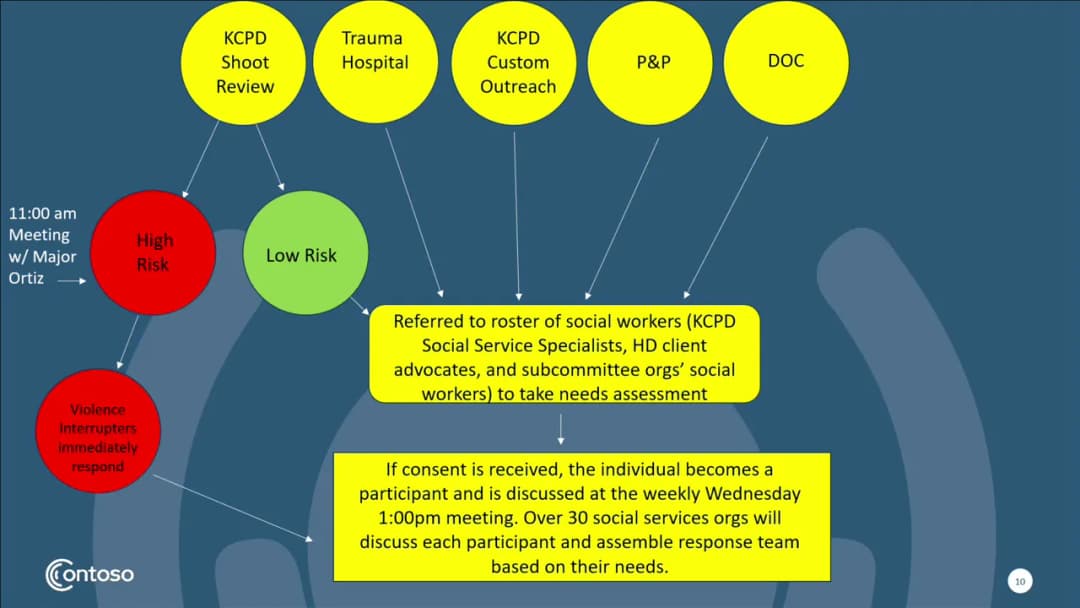
The City Council met for a Business Session on Thursday, August 25, 2022, at 2:00 PM in the Council Chamber. The agenda included approval of prior minutes, a presentation on the tree canopy audit scope statement, a presentation on the Partners for Peace initiative, discussion of ordinances, and a closed session. Consent Calendar - Approval of Minutes (August 18, 2022 Business Session): Moved and seconded; all members voted aye. Motion passed. Discussion Items - Tree Canopy Audit Scope Statement: City Auditor Doug Jones presented the audit objective to determine whether city departments remove and replace city trees in a way that supports the goal of increasing tree canopy to 35%. The audit will review tree-related ordinances, regulations, practices, and inventory data. Council members asked about maintenance (Councilwoman Boo) and tree species diversity in light of the emerald ash borer (Councilwoman Parkshaw). The audit is anticipated to be completed by December 2022. - Partners for Peace Initiative: Melissa Johnson (Mayor's Office) and Major Ortiz (KCPD) presented the initiative, developed through the Harvard Bloomberg Collaboration Track. The public value proposition aims for a 15% annual reduction in shootings, with a 50% reduction by 2028, an increased solved rate, and measurable community trust. Key components include a social services provider inventory, weekly shoot review meetings, referral systems from five sources (KCPD shoot review, trauma hospitals, custom outreach, probation/parole, and Department of Corrections), and deployment of violence interrupters. In the first two weeks, 20 at-risk individuals were contacted and de-escalated; one family of 18 was relocated with job training and therapy. Councilwoman Shields expressed gratitude and support for the collaborative effort. - Discussion of Ordinances, Resolutions, and Communications: No discussion occurred; the council proceeded to a closed session. Key Outcomes - Minutes Approved: Unanimous approval of the August 18, 2022 Business Session minutes. - Closed Session: A motion to enter closed session pursuant to §610.021(3) and (13) RSMo (personnel matters) was moved, seconded, and approved by voice vote (all ayes). The meeting then adjourned to closed session.
The Kansas City, Missouri City Council met in a business session on August 18, 2022, to receive presentations on the Climate Protection and Resilience Plan and the proposed Kansas City Detention and Rehabilitation Center. No formal votes were taken; both items were discussion-only, with follow-up actions and committee referrals announced. Climate Protection Plan Presentation - Andy Sevistino, Chief Environmental Officer, presented the Climate Protection and Resilience Plan, developed with the Climate Protection Steering Committee and consultant Brendell Group. He emphasized that 'the time for climate action is now.' - The plan updates the city's prior climate action plan and is guided by Resolution 2005, setting goals of climate neutrality by 2040 for the community and 2030 for city operations. - Sevistino reported a 24% reduction in community greenhouse gas emissions and a 26% reduction in municipal operations from the 2005 baseline. He noted IPCC warnings and that Kansas City has been placed in a hazardous heat zone with projected heat indices over 125°F. - The plan identifies 22 strategies and 98 short-term actions; it projects 8.7 million metric tons of emission reductions by 2040, still about 1 million metric tons short of carbon neutrality, requiring carbon sequestration and emerging technologies. - Equity was a central focus: climate justice workers conducted community outreach, and the plan received 728 public comments during the review period. A 600-page equity-centered engagement summary was included. - Robin Gunall, Fourth District resident and steering committee chair, spoke as a 'concerned mom' in support of the plan, citing benefits like home energy upgrades, heat pump rebates, and reducing pollution in vulnerable communities. Council Questions and Positions: - Councilwoman Hall raised concerns about the exclusion of natural gas/renewable natural gas from clean energy definitions, questioned the inclusion of natural gas cooking emissions, asked for a coal-versus-natural-gas climate impact analysis, and sought details on Northland outreach, restaurant reliance on natural gas, costs to homeowners, and Evergy participation. - Councilman Fowler asked how the plan would affect utility costs for individual ratepayers, particularly low-income residents, and requested analysis on housing affordability impacts. - Councilwoman Robinson asked to clarify the distinction between the plan and future policies, noting Missouri's natural gas preemption law, and requested where pollution disparities are addressed in the plan. - Councilwoman Shields expressed support, calling the plan 'a roadmap, not a cudgel,' and thanked the committee for its work. Next Step: The plan will be considered by the Transportation, Infrastructure, and Operations Committee on Wednesday, August 24, 2022, at 9:00 a.m. Council members requested written answers to their questions. Kansas City Detention and Rehabilitation Center - Marsha Hoffman (SFS Architecture), Bruce Umt (Dewberry), and Kwame Smith (SFS Architecture) presented the preliminary program and budget for a new detention center. They were joined by Captain Graves of the Kansas City Police Department. - The project team outlined five key goals: providing essential detention services, immediate medical/mental health triage, acute stabilization and step-down for inmates with mental health needs, accountable engagement and treatment, and co-location with a community resources center to support re-entry. - The steering committee's consensus calls for a 310-bed rated capacity facility, which translates to 375 actual beds due to support spaces, intakes, and daily court traffic. The recommended program is approximately 180,000 square feet. - Two reduced alternatives were presented: a 122,000-square-foot version that minimizes rehabilitation and stabilization spaces, and a 58,000-square-foot minimum that removes long-term medical/mental health beds and most programs. - Preliminary costs (in today's dollars) were presented as: - Option 1 (122,000 sq ft): construction $93M-$103M; total project $93M-$102.7M. - Option 2 (180,000 sq ft): construction $137M-$151.5M; total project $137M-$151.5M. - Escalation costs were estimated at 10-12% for the next year, 6-8% the following year, and 3-4% thereafter. - The proposed site is the former Heart of America Airport, about 49 acres of city-owned property east of the city, south of U.S. Highway 40, adjacent to Jackson County's future detention facility. Floodplain constraints limit developable area. Council Questions and Positions: - Councilman Fowler asked about specific rehabilitation services, certifications, job training, and programming for long-term inmates. City staff (municipal court representative) responded that the facility would offer specialty court programming (drug court, veterans treatment court, mental health court), re-entry services, GED programs, and connections to the Full Employment Council and mental health providers. - Councilman Fowler also questioned the handling of individuals held longer than 365 days and whether programming would reduce recidivism. - Councilwoman Hall praised the focus on mental health and rehabilitation, and noted the current shortage of beds for women (105 beds total) and the need for more capacity. - Councilwoman Robinson emphasized collaboration with the county and suggested the city focus its $100 million on a state-of-the-art rehabilitation and workforce development center, while the county handles accountability. - Captain Graves invited council members to the Board of Police Commissioners meeting on Tuesday, August 23, 2022, at 9:30 a.m. for a presentation on the current jail's status. Key Outcomes - No formal resolutions, ordinances, or votes occurred on either presentation. - The Climate Protection and Resilience Plan will be heard by the Transportation, Infrastructure, and Operations Committee on August 24, 2022, at 9:00 a.m. - Council members requested that staff provide written answers to their questions, including concerns about natural gas, utility costs, outreach, and equity. - The detention center team will continue refining concepts; next steps include council approval of the scope of work, implementing a communication plan, public engagement, and selecting a delivery method. No decision was made on the facility's size or budget. - A follow-up on the current detention center's status is scheduled for the Board of Police Commissioners meeting on August 23, 2022, at 9:30 a.m.
The Kansas City City Council held a business session on August 11, 2022. The meeting began with the approval of previous minutes, followed by a presentation from the Mayor on four new housing-related ordinances and an update on detention center issues. The Council also introduced an ordinance on city hall security and later voted to enter a closed session to discuss legal, personnel, and sealed bid matters. Consent Calendar - Approval of minutes from the business session of August 4, 2022: Moved and seconded, passed unanimously by voice vote. Discussion Items - Housing Kansas City and Incentive Discussion: Mayor introduced four pieces of legislation: - A $50 million bond expenditure to supplement the Affordable Housing Trust Fund. He noted that the previous allocation of $7.3 million produced about 500 units of affordable housing, averaging $23,000 per unit in government investment. - An updated affordable housing set-aside ordinance, replacing a previous 2019 ordinance that required a 10% set-aside at 80% AMI with a new 10% set-aside at 60% AMI. The Mayor stated that no new housing units have been produced under the prior set-aside ordinance. - An ordinance to allow accessory dwelling units (ADUs), such as "grandma's quarters," which are currently grandfathered in only in certain districts. - A targeted incentives policy to establish a framework for accelerating development review for projects that meet city priorities (e.g., industrial, data centers, housing). These ordinances were assigned to committees for further discussion. - City Hall Security Ordinance: The Mayor introduced an ordinance to clarify screening requirements at City Hall. Councilman Allen expressed concerns about the legal framework, noting potential conflicts between governance and regulatory models and lack of access to the agenda. The Mayor stated the ordinance was on the docket and would be discussed at full council. - Kansas City Detention Issues: The meeting discussed ongoing challenges with detention facilities. Commissioner Don Kramer and Bishop Mark Tolbert (President of Board of Police Commissioners) were present. A motion was made to enter closed session to discuss legal matters, personnel, and sealed bids. Key Outcomes - Approval of minutes from August 4, 2022 business session (unanimous). - Introduction of four housing ordinances: $50 million bond, affordable housing set-aside update, ADU allowance, and targeted incentives policy. All assigned to committees. - Introduction of city hall security ordinance, assigned to finance committee with accelerated review requested. - Motion to enter closed session (pursuant to RSMo 610.021) passed on roll call vote: 13 ayes, 1 present (Councilmember Lucas). The closed session included discussion of legal matters, personnel (city auditor and city clerk), and sealed bids. Media and non-essential staff were excused. Note: There was a discrepancy between the transcript's stated date (August 4, 2022) and the instruction to use August 11, 2022. The summary reflects the date as directed.
The Kansas City City Council held a Business Session on August 4, 2022, at 8:15 PM. The meeting included approval of minutes, a presentation from City Auditor Doug Jones on the annual update and two audit scope statements (community policing fund and short-term rental program), and a presentation from KCPS Interim Superintendent Dr. Jennifer Collier on the district's strategic plan (Blueprint 2030) and priorities. Council members discussed the audits and the school district's challenges. Consent Calendar - Approval of minutes of the Business Session of June 14, 2022: Approved by voice vote (all in favor, no opposition). Discussion Items - City Auditor's Annual Update and Audit Scope Statements - City Auditor Doug Jones presented the FY2022 annual report, noting six performance audits issued, with potential direct financial impacts of $822,000 and indirect impacts on $45.4 million in public monies. For every $1 spent, the office identified about $40 in potential impacts. The office met its goal of issuing six audits and achieved 89% management agreement on recommendations. - Scope statement for Community Policing and Prevention Fund audit: Quarterly audits to verify expenditures align with council expectations. First quarter audit anticipated September 2022. - Scope statement for Short-Term Rental Program audit: Objectives to assess compliance with registration regulations and impact on city taxes. Audit planned for November 2022. - Council members raised questions and concerns: Councilwoman Parkshaw asked about evaluating complaints; Mayor Pro Tem inquired about tax revenue collection and registration gaps; Councilman Bunch highlighted enforcement challenges and density issues. The auditor clarified that the audit will classify complaints and assess registration processes. - KCPS Interim Superintendent Presentation (Dr. Jennifer Collier) - Dr. Collier introduced herself and the district's mission: upholding equitable educational experiences. She presented student demographics (90% students of color, 24% English language learners, high special education population). - Outlined Blueprint 2030 strategic plan: focus on literacy, math, culturally responsive teaching, social-emotional wellness, and parent engagement. Addressed deferred maintenance ($300M) and desire for new buildings. - Council members asked about abandoned buildings and blight (Councilwoman Robinson), bond issue history (Mayor Lucas), and support for culturally responsive teaching (Mayor Lucas). Dr. Collier affirmed commitment to community engagement and addressing building conditions. Key Outcomes - Approved minutes of the Business Session of June 14, 2022. - City Auditor's annual report and audit scope statements received and discussed; no formal vote taken. - KCPS presentation received; no formal action taken. - Meeting adjourned without further business.
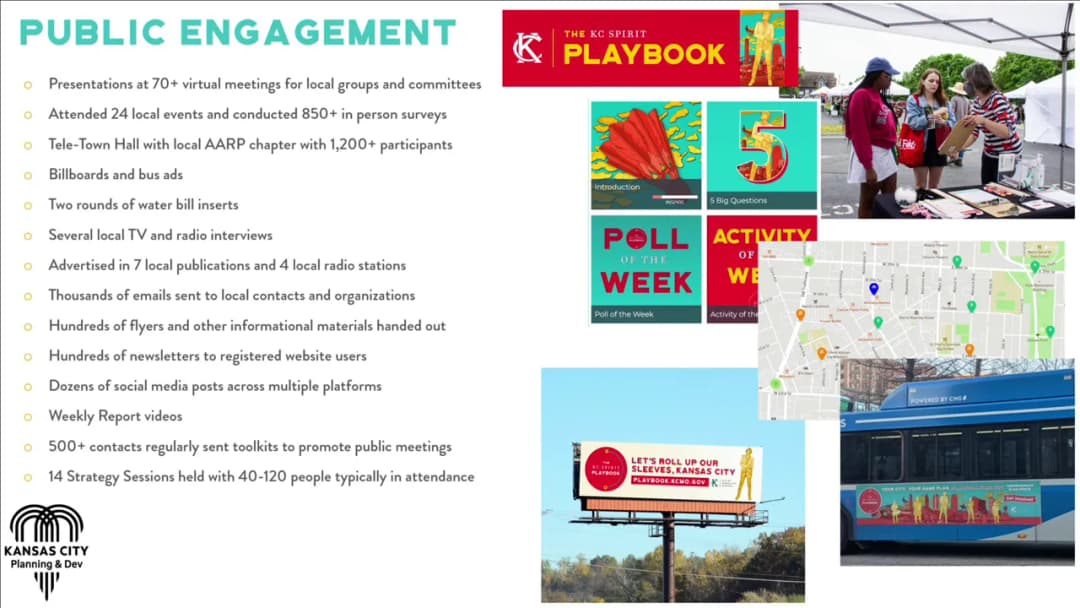
The Kansas City, Missouri City Council held a business session on July 21, 2022, where it approved prior meeting minutes, received an in-depth update on the city's comprehensive plan process, and heard a same-day resolution to fund the Negro Leagues Hot Dog Festival. No public comments were received. Consent Calendar - Approval of Minutes (July 14, 2022): Moved, seconded, and approved unanimously by all council members present. Discussion Items - Comprehensive Plan Update: Kyle Elliott (Division Manager, Long-Range Planning and Preservation), Morgan Pemberton (6th District Planner), and Gerald Williams (4th District Planner) presented an update on the comprehensive plan, a roughly three-year process started in 2019 that will guide the city over a 20-year timeframe. The plan is structured around a vision statement, 10 citywide goals, 25 objectives with specific recommendations, and an implementation strategy with metrics/KPIs. - Public engagement included 70+ virtual presentations, a teletown hall with AARP (1,200 participants), and strategy sessions on four topic areas (livability, visibility, serviceability, and another) with 40–120 attendees each. Online engagement drew about 47,000 website visits, over 1,700 registered users, and nearly 10,000 people who actively engaged with surveys/activities. - Councilman Fowler expressed concern that economic growth was not prominently featured and stated that unused land could fuel the city's goals. Staff responded that business attraction/retention, access to jobs, and development patterns are included in the objectives. - Mayor and Councilman Bunch praised the planning team for completing extensive work despite pandemic challenges and limited budget. Councilman Bunch highlighted the long-term impact of past plans (e.g., the 1970s Westport area plan) as evidence of why the comprehensive plan matters. - Deputy Director of City Planning Diane Binkley acknowledged staffing challenges but noted recent hiring and ongoing improvements. - Same-Day Resolution – Hot Dog Festival Funding: Councilman Barnes presented a same-day resolution to amend an existing ordinance (a $36,000 contract with the Negro Leagues) to add $50,000 for the annual Hot Dog Festival, which will take place the following weekend. The event has been funded for at least seven years but was missed in budgeting because it was canceled the prior two years due to COVID-19. No vote was taken in this segment. Key Outcomes - Minutes from the July 14, 2022 business session were approved unanimously. - The comprehensive plan update was informational; no formal action was taken. Staff noted the draft plan is expected to be released for public review in September–October 2022, with adoption targeted by the end of the year (December–January). - Two new long-range planners were introduced: Noah Chapin (District 2) and Marlene Torres Pardo (District 5). - The Hot Dog Festival funding resolution was introduced but not voted on during this session.
The Kansas City City Council held a business session on July 14, 2022, to discuss public safety in entertainment districts, the Rebuild KC grant program, and a resolution to correct a pay oversight for city employees. The meeting included presentations from the Kansas City Police Department and the Neighborhood Services Department, followed by council questions and debate. Consent Calendar - Approval of Minutes: The council approved the minutes from the June 9, 2022, business session by a voice vote; no opposition was expressed. Presentation & Discussion: KCPD Violence Prevention and Entertainment Districts - Major Simons and Captain Graves of the Kansas City Police Department presented the department’s entertainment district plan, which operates 24–26 weekends per year (April through October) on Fridays and Saturdays. The plan assigns three squads (traffic, tax, and impact) totaling up to 18 officers and three sergeants, plus a commander, to monitor four main areas: Power & Light, 18th & Vine Jazz District, Westport, and the Plaza. The primary goal is presence and deterrence, not enforcement. - Staffing challenges were highlighted: off-duty officer positions are increasingly hard to fill due to higher-paying, lower-risk private security jobs (e.g., $75/hour for retail). Westport has struggled to recruit off-duty Jackson County deputies. - Permitting of special events remains an issue: last‑minute, poorly vetted events strain resources. The council was reminded of a 2020 ordinance that increased lead time and costs for permits; an update may be needed. - Scooter safety was discussed: geofencing has helped in Power & Light, but juvenile use and late‑night hazards persist. Councilwoman Hall suggested a curfew for scooter rentals, a practice used in college towns. - Council members offered comments: - Councilwoman Robinson thanked the department for improvements at 18th & Vine and stressed the need for city investment in security, possibly using CID sales tax revenue. - Councilman Bond raised concerns about the proliferation of entertainment districts as a workaround for outdated alcohol laws, which may strain police resources and concentrate violence in unplanned areas. - Councilwoman Hall emphasized the need for better recruiting and asked for an update on the jail/rehabilitation center committee. - The mayor noted that 2020–2021 saw many unpermitted events but permits are now more routine; he encouraged revisiting the permitting ordinance. Presentation & Discussion: Rebuild KC Grants - Forrest Decker, Director of Neighborhood Services, reported on the Rebuild KC grant program funded with $15 million from the American Rescue Plan. The call for applications yielded 1,215 requests totaling $264 million—about 5–6% of the dollar amount can be funded. - Applications came from nonprofits (most), individuals, for‑profit businesses, neighborhood associations, and government agencies. 145 requests were for $1 million or more. - A staff team of 26 people spent 4,000 hours reviewing applications. Phase 1 reduced the pool to 600 applications ($145 million) by eliminating duplicates, already‑funded projects, infeasible requests, and those violating city standards. - Phase 2 categorized remaining applications into six buckets: community programs, infrastructure, sustainability, housing, home repair, and other. The proposed plan is to present recommendations in four tranches over four council meetings, starting with home repair and infrastructure. - For home repair, staff will refer all 141 applicants to the city’s minor home repair program and recommend 17 projects totaling an estimated $5.1 million (subject to field verification). - Infrastructure projects, such as sidewalk and pedestrian improvements, were included despite possible alternative federal funding. Councilman Bunch argued that federal transportation dollars are cumbersome and ill‑suited for small projects; PIAC funds are oversubscribed. - Council members raised concerns: - Councilman O’Neill questioned why infrastructure was paired with home repair when other funding sources exist; he asked for justification of each project. - Councilwoman Bough requested a complete list of all recommended projects across all categories to allow holistic decision‑making, not piecemeal approvals. - Councilman O’Neill also asked why the new Office of Citizen Engagement was not involved in coordinating the grant process; Decker replied that the hire occurred after the process started. - Councilwoman Robinson supported seeing all 600 semifinalist applications to ensure transparency and informed council decisions. - Staff will provide a full spreadsheet of all applications and proposed recommendations prior to the next meeting. Discussion Item: Resolution on Local 500 Employee Pay Oversight - Councilman Parkshaw introduced a resolution addressing a payroll oversight that will cause approximately 70 Local 500 employees who received promotions in the last 18–24 months to miss the 4% pay increase scheduled for August 1, 2022. The resolution directs the city manager to identify the affected employees, calculate the lost amount, and return with an appropriation ordinance within 30 days. - Parkshaw requested same‑day adoption to expedite correction. Councilwoman Shields noted that any pay adjustment can be made retroactive, so there is no immediate loss if decision delays. - The resolution was introduced on the floor; no vote was recorded in the transcript before adjournment. The meeting ended without further action on this item. Key Outcomes - Minutes approved (voice vote, unanimous). - KCPD will continue the entertainment district plan and explore expanding camera signage to all entertainment districts (84 additional signs ordered). - The Rebuild KC grant recommendations will proceed in four tranches; a full list of all semifinalists will be shared with council prior to votes. - The resolution regarding the 70 affected employees was introduced but not voted on; it remains pending for a future meeting. - No other formal votes were taken.
The Kansas City, Missouri City Council met in business session and then as a committee of the whole on Friday, June 10, 2022, beginning at 9:45 a.m., to consider Ordinance 220383, which would provide lidded trash and recycling carts to residents. After extensive deliberation over three committee substitutes and a proposed phased approach, the council agreed by voice vote to advance a floor amendment that funds recycling carts for all households, expands dumpster days, and directs staff to develop a trash cart program for future consideration. No agenda or minutes were provided; this summary is derived solely from the transcript. Consent Calendar - Approved the minutes of the business session of May 26, 2022, by unanimous voice vote. Public Comments & Testimony - Aidan Montheiser, owner of a waste transfer station in the Third District, expressed interest in sponsoring trash carts and offered to work with city staff on financing options. - Beth Borger of the South Kansas City Alliance raised concerns about communication for extra dumpster days, noting contracted dumpster days and the need to reach rental-heavy neighborhoods. She also questioned elimination of trash amnesty around holidays. Discussion Items - Opening Remarks: Councilman Hall described the history of trash service problems, citing 32,045 missed trash calls and 18,882 missed recycling calls (50,927 total) from 2015–2019. He emphasized residents' frustration and the need for a compromise. - Councilwoman Robinson posed three questions about service equity, access, and whether residents should expect adequate trash collection from existing taxes. She referenced a $17.1 million budget surplus and stated her support for universal carts without additional fees. She also said the city needs 167,000 trash carts for 167,000 households. - Staff Presentation: Public Works Director Michael Shaw explained automated and semi-automated collection, the current 12,000 carts in 12 neighborhoods, and details of the proposed 65-gallon carts, RFID tracking, education components, expanded dumpster program (from 400 to 800 dumpsters), and financing options including a $1.5 million grant, a $950,000 resin donation from Dow Chemical, and zero-interest financing. - Committee Substitute 1 (Hall/Robinson): Buy all recycling and trash carts for 162,000 homes using $6.1 million in ARP funds and financing the balance; 10-year cost estimated at $64.1 million. - Committee Substitute 2 (Mayor Lucas/O'Neill): Buy all recycling carts, but only 40,000 trash carts—20,000 for rental and 20,000 subsidized—with $50 acquisition and $25 annual rental fees; no general fund money required in early years. - Committee Substitute 3 (Park/Shaw): Provide carts to all homes unless residents opt out; $25 annual service fee; general fund contribution of $1.1 million in FY23 and $31–32 million over 10 years. - Councilwoman Hall's Phased Proposal: Start with recycling carts in year one (opt-in $50 purchase), add trash carts in year two, while implementing education, dumpster, bulky, and amnesty programs. - Debate Highlights: - Councilman Lucas (Mayor) favored opt-in/rental to limit general fund impact and avoid encouraging more waste. - Councilman Fowler warned that a $64 million general fund commitment would reduce funding for streets and other needs. - Councilman Bunch questioned whether illegal dumping sources would be addressed by carts. - Councilwoman Park Shaw supported universal carts with opt-out and subsidy, cautioning against fees for cost-burdened residents. - Councilwoman Boo asked about expansion capacity and whether 40,000 carts would be sufficient. - Councilwoman Shields advocated including a composting program to reduce food waste and animal attraction. - Councilman O'Neill supported the lower-cost opt-in plan. - Councilman Barnes challenged the assumption that carts would increase trash volume. - Councilwoman Robinson insisted on universal carts, saying "trash service is not something that we should be requiring people to fill out a form to say that I'm indigent." - Consensus Path: The council agreed to remove trash carts and the rental program from the current ordinance, keep recycling carts for all households, and direct staff to craft a trash cart solution for a future budget. Key Outcomes - By voice vote, the council directed that a floor amendment to Ordinance 220383 be prepared reflecting the consensus: universal recycling carts for all 162,000 households, education, increased dumpster days, bulky item pickup, trash amnesty, and a composting program. - The rental program and trash cart purchase were intentionally excluded from the amendment; staff were directed to research and propose a trash cart program providing the greatest number of carts at the best value, including comparison with peer cities. - The council then voted to rise and report, ending the committee of the whole.