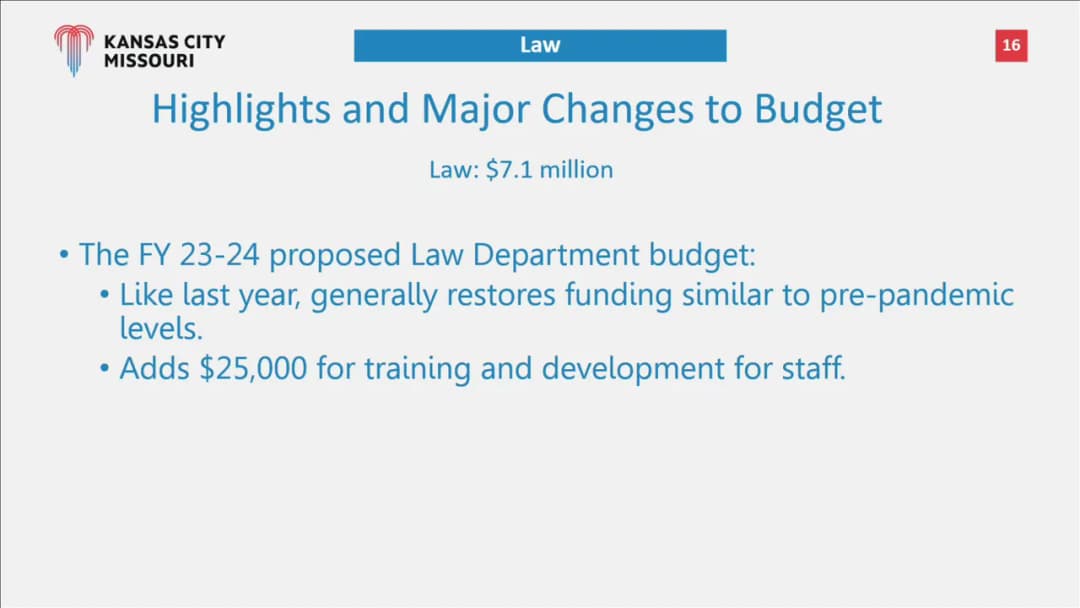
The Kansas City Council held a business session on March 9, 2023, beginning at 8:15 PM UTC. The meeting included approval of previous minutes, budget presentations from the General Services, Law, and Finance departments, an update on the UNESCO Creative Cities of Music designation, and a motion to enter closed session. Consent Calendar - Approval of Minutes (March 2, 2023): A motion was moved, seconded, and passed unanimously by voice vote. Discussion Items - General Services Department Budget (FY2024): Director Jolanda McKenzie presented a $40.7 million budget, a $5 million decrease from FY2023 due to the expiration of one-time ARPA-funded decision packages. Key metrics included 94% cybersecurity training completion (goal 99%), 94% fleet availability (goal 95%), and a 26.27% vacancy rate across 218 positions. Workforce challenges included high turnover (28% due to retirement) and a 10-day window to hire top candidates. Councilwoman Robinson questioned about real estate surplus staffing ($70,000 increase), a $1 million HVAC investment at 18th & Vine, and the need for approximately $3 million in additional capital improvements. She also asked about the compressed natural gas station and department safety officers—both unfunded in the current budget. McKenzie noted no safety officers in every department and will provide cost estimates. - Law Department Budget (FY2024): City Attorney (unnamed) and Fiscal Officer Stacy Perry (41-year veteran) presented a $7.1 million budget, primarily personnel-driven. The department has a 27% vacancy rate. Key performance indicators included claims resolution (fell short at 83% through Q3) and tax collection litigation ($6.2 million revenue). A $25,000 training decision package was funded. Councilman Allen questioned the scope of municipal prosecutions (assault cases, not robbery or rape) and requested data on special prosecutor costs over five years. Councilman Fowler praised a trial attorney’s performance. - Finance Department Budget (FY2024): Director Tammy Queen presented a $21.3 million budget, a 15% ($2.8 million) increase. Vacancy rate was 18% (102 positions). Key metrics included $9 million collected in FY2022 via tax gap data mining (goal $6.5 million for FY2024), 91% budget transfers processed within two days, and quarterly expenditure forecasts within 3%. A $1 million decision package for payroll system improvements was approved. Councilwoman Robinson asked about priority-based budgeting resources; Queen confirmed existing FY2023 funds will cover it (ETA FY2026-27). Councilman Bunch commended the low vacancy rate compared to other departments. - UNESCO Creative Cities of Music Update: Dr. Jake Wagner presented on Kansas City’s designation as the only U.S. UNESCO City of Music (since 2017). He highlighted international collaborations: a 2018 trip to Poland, a 2019 presentation in Italy, virtual Voyage of the Drum project during COVID, a 2022 conference in Brazil (Santos), and recent visits to Chile (Frutillar) and Sweden (Norrköping). Upcoming local events include the Jazz Draft (April 27, 2023) at the Blue Room and an International Jazz Day relay (April 30). Councilman Barnes noted a resolution to increase funding for the program and mentioned potential to host the UNESCO music cities conference in 2027. Key Outcomes - Closed Session: Councilwoman Parkshaw moved to enter closed session under RSMo 610.021(1) and (9). The motion was seconded and approved unanimously by roll call vote (all ayes). - No other binding votes were taken; budget presentations were informational. Follow-up items include: cost estimates for safety officers and CNG station (General Services), five-year special prosecutor spending data (Law), and continued support for UNESCO programming.
Public Meetings - Kansas City, Missouri
Public Meetings - Kansas City, MissouriThe Kansas City City Council held a Business Session on March 2, 2023, in the 26th Floor Council Chamber. The meeting included approval of previous minutes, presentations from the City Auditor's Office on the annual audit plan and a governance risk assessment of boards and commissions, a detailed audit of the Community Policing and Prevention Fund (CPP) for the second quarter of fiscal year 2023, and a presentation on the new IRIS on-demand transit service partnership with KCATA. A motion for a closed session to discuss legal matters and employee labor negotiations was approved. Consent Calendar - Approval of Minutes: The minutes from the Business Session of February 23, 2023, were approved by a voice vote with all in favor (no opposition noted). Discussion Items - City Auditor's Office – Governance Risk Assessment Scope Statement: The City Auditor presented a scope statement for an audit of selected boards and commissions. The audit aims to assess governance practices of boards that expend significant public resources (nearly $400 million in fiscal year 2022). A governance risk assessment checklist will be distributed to component units and 27 additional boards required to file conflict-of-interest disclosures. The audit is expected to be released in August 2023. - City Auditor's Office – Annual Audit Plan for Fiscal Year 2024: The Auditor presented the annual audit plan, noting a goal of issuing nine audits in fiscal year 2024 (a 50% increase over the current year's goal of six). Planned audits include assessments of hiring practices, cybersecurity incident response, TIF reimbursements, recycling, and utility street cut repairs. The plan was described as flexible and subject to revision based on council directives or emerging issues. Councilmember Bough asked specifically about the TIF reimbursement audit, and the Auditor clarified it would evaluate whether city departments are requesting reimbursements from TIF projects in a timely manner. - Audit of Community Policing and Prevention Fund – Second Quarter Fiscal Year 2023: The City Auditor's team presented findings on the police department's spending from the CPP fund (established by Ordinance 220216 in March 2022). Key findings include: - The police department reported allocating approximately 21% of the $33.36 million CPP fund in the second quarter, totaling about half of the fund spent through the first two quarters. - Hiring of new officers: The department allocated $733,246 for 36 new officers (from Academy Class 174, which began prior to the fund's creation). The city council had expected classes to begin on or after May 1, 2022. Projected total spending for new officer hiring is no more than $2.5 million of the $4 million allocated. - Crime lab expenses: All $2 million allocated for the crime lab (including DNA detection software) was spent on personnel by the second quarter; no DNA software was purchased. Police financial services stated the crime lab's budget is $5.5 million and the CPP allocation was insufficient for salaries, let alone equipment. The department did receive software through the police foundation. - CAN centers: $400,000 was allocated for CAN centers in East and Metro Patrol. Through the second quarter, about $113,000 was spent, primarily on salaries for four officers assigned to community outreach, not on physical centers. Councilmember Parks-Shaw expressed concern that the plan for community-based centers may not be moving forward, but police staff indicated they are still exploring office spaces in neighborhoods. - Councilmember Bough asked about the hiring projection, and police staff noted they are on track to potentially reach 88 new officers by year-end, with 74 so far including laterals and current academy classes. - KCATA IRIS On-Demand Transit Service Presentation: KCATA staff (Director Shaw and CEO Bill George of WHC) presented the IRIS partnership, a new on-demand microtransit service funded by the city (included in the existing KCATA service agreement). Key details: - Service will launch in the Northland (Phase 1) on March 15, 2023, with expansion south of the river later (Phase 2). It is app-based (available on Apple and Google Play) and also accessible by phone for those without smartphones. - Fleet includes 20 new Chevrolet Bolt EVs (fully electric) plus sedans and minivans from the Z trip fleet. Vehicles are ADA accessible with lift ramps and bike storage. - Service area is divided into zones; trips within a zone cost $3, between zones $4, point-to-point to entertainment zones (Zona Rosa, Plaza, 18th & Vine, etc.) $10, and to the airport $15 (or $10 from Northland). Trips to or from transit hubs are free. - Revenue model: 80/20 split (city 80%, KCATA 20%), with first-year gross revenue projected at $1.2 million. The city's annual cost is $8 million (included in existing payment to KCATA, not new funding). The service is operated by WHC under a competitive bid contract; KCATA manages the service. Councilmember O'Neill expressed desire for a path to bring the service in-house within 2–3 years; staff confirmed ongoing discussions with the union (ATU Local 1287) about that possibility. Councilmember Bunch raised concerns about KCATA's financial situation and ability to maintain existing fixed-route service levels given driver shortages; KCATA staff stated they are confident and that IRIS will complement rather than reduce service. - Law Department Budget Presentation: Councilmember Parks-Shaw requested that the Law Department (and possibly Finance) be given an opportunity to present to the Council before the budget vote, noting they had not been heard during previous budget presentations. The Mayor indicated this could be scheduled for the next Business Session. Key Outcomes - Closed Session Motion: Councilmember O'Neill moved, seconded by Councilmember Fowler, to hold a closed session pursuant to Missouri Revised Statutes Section 610.021 (subsections 1 and 9) to discuss legal matters, privileged communications with attorneys, and employee labor negotiations. The motion passed by roll call vote (all present members voted aye; Mayor Lucas also voted to participate in closed session). The Council then adjourned to closed session. - No formal votes were taken on the auditor's presentations or the KCATA program; presentations were for information and discussion only.
The Kansas City Council held a business session on February 23, 2023, at 8:15 PM, primarily to receive and discuss the Kansas City Fire Department Cultural Assessment Report. The report, commissioned after a 2020 Kansas City Star investigation, was presented by consultants Deborah Jarvis, Dr. Nozella Brown, and Dan Bay, along with Interim Fire Chief Ross and Chief Equity Officer Ladonna McCullough. Council members raised concerns about the lack of concrete action steps, barriers in the collective bargaining agreement (CBA), the effectiveness of zero-tolerance policies, and the need for measurable progress in diversity and accountability. The session concluded with a motion to go into closed session for personnel matters. Consent Calendar - Approval of the minutes from the business session of February 9, 2023. Motion passed by voice vote. Public Comments & Testimony - No public comments were formally recorded, but audience members were present. Discussion Items - Presentation of KCFD Cultural Assessment Report – Consultants summarized findings from 231 employee interviews (18.6% sample), noting a lack of shared mission, vision, and values; deep cultural issues; and systemic patterns of negative behavior. The report validated the 2020 Star investigation and emphasized the need for truth-telling, admitting mistakes, and listening respectfully. - Intercultural Development Inventory (IDI) Results – Dr. Brown presented IDI results for fire management, union leadership, and DEI work groups, showing a wide range of intercultural orientations. Many members lacked the capacity to adapt to diverse perspectives, and targeted development was recommended. - Recommendations Overview – Dan Bay outlined six pages of recommendations, stressing collaboration, employee engagement as architects of change, and sustained oversight. He cautioned that culture change is a marathon, not a sprint. - Council Questions on Action Steps – Councilman Ellington criticized the report for containing only strategies, not specific, actionable steps (e.g., “develop a code of ethics” without prescribing content). Consultants acknowledged that detailed action plans must be created collaboratively by department members, with strong oversight. - CBA Impediments – Councilwoman Robinson and others questioned how collective bargaining agreement provisions (e.g., seniority-based promotions, labor-management committees, investigation processes) hindered change. Chief Equity Officer McCullough noted that the CBA’s investigation rules are projected onto city EEO processes, limiting their effectiveness. Councilman Ellington pressed for action steps and questioned why the city had not already implemented recommendations from earlier stakeholder sessions. - Zero Tolerance Policy – Councilwoman Barnes asked about enforcement. City Manager Platt stated that all reported incidents are acted upon, but victims and witnesses often do not report, a cultural issue requiring further work. - Diversity and Hiring Data – Deputy Chief Gist reported that of 74 recent academy graduates (2021–2022), two-thirds were white in 2021 and 86% white in 2022. A new hiring vendor (NTN) produced an eligibility list with 57% white, 43% minority, and 10% female. Councilwoman Barnes requested detailed breakdowns by rank and leadership promotions (108 promotions from 2021–2023: 75% white, 19% black, 5% Hispanic; 81% male, 19% female). - Gender‑Neutral Stations – City Manager Platt confirmed that stations 7 and 24 have been remodeled; stations 30 and 47 are next, with stations 34 and 44 to follow, all funded by capital improvement sales tax. - Labor Relations and Next Steps – Councilwoman Robinson asked the city manager to report back within 30 days after discussions with unions on the five recommendations (A–G) regarding the labor management agreement. The manager agreed. Key Outcomes - The council received the KCFD Cultural Assessment Report and heard presentations from consultants and city staff. - Council members directed the city manager to engage with unions on the report’s recommendations related to the CBA and to report back within 30 days. - A motion to go into closed session under RSMo § 610.021(3) and (13) for personnel matters was approved by roll call vote (11–0). The council then adjourned to closed session.
The Kansas City Council met on January 13, 2023, at 6:00 PM to fill a vacancy on the municipal court bench (Division 205). The meeting included presentations from three candidates and a public vote. After deliberations, the council selected Shayla Marshall. Consent Calendar - The council unanimously approved the minutes of the December 8, 2022 business session. Discussion Items - Candidate Presentations: Each of the three finalists—Sarah Christensen, Shayla Marshall, and Beth Morano—was given up to 15 minutes for a presentation followed by 15 minutes of questions from council members. - Sarah Christensen (Pro Bono Attorney, Lathrop GPM): Emphasized her background as a public defender and in private practice. She advocated for expanding specialty courts (veterans, drug, mental health) to address root causes of municipal offenses and reduce warrants. She stressed the importance of honesty, kindness, and curiosity as judicial qualities. - Shayla Marshall (Director of Diversity, Equity, Inclusion, Missouri State Public Defender): Highlighted her experience as a public defender and social worker. She proposed creating a women's treatment court and emphasized understanding the humanity of defendants. She discussed the need to address racial and gender disparities and to connect defendants with community resources. - Beth Morano (Former City Prosecutor and Police Legal Advisor): Focused on procedural fairness, evaluating court programs, and using data to improve outcomes. She emphasized the role of the judge in ensuring equitable treatment and reducing recidivism through alternative sentencing and collaboration. - Key Questions: Council members asked about the biggest challenges facing municipal court (warrants, volume, lack of jail), the candidates' philosophy on debtor's prison and American exceptionalism, plans for community education, and how they would interact with the council. Key Outcomes - Vote: The council voted 11-1 to select Shayla Marshall as the new municipal court judge for Division 205. Council member Shields cast the single vote for Beth Morano. - Next Steps: The city attorney will prepare a floor resolution for immediate adoption, with all council members listed as sponsors unless they opt out. - The mayor and council members thanked all candidates for their participation and public service.
The City Council held a business session on December 8, 2022, at 8:15 PM. Key items included an audit of short-term rental permit compliance, proposed service improvements from the Kansas City Area Transportation Authority (KCATA), and introduction of two ordinances for possible same-day adoption. Consent Calendar - Approval of minutes for the business session of December 1, 2022, was moved and seconded, and passed unanimously. Discussion Items: Short-Term Rental Permit Compliance Audit City Auditor Doug Jones presented the audit of short-term rental permit compliance. Key findings: Since 2018, only about 7% of hosts have obtained permits, and as of August 2022, an estimated 11% of current hosts had a permit. The city lost approximately $2.6 million in convention and tourism taxes and fees between July 2021 and August 2022 due to inability to assess and collect from short-term rentals. The city collected only $17,500 in renewal fees, whereas if all 1,800 listing units were registered, the city could have expected over $100,000. The audit recommended ordinance changes to prohibit listing without a permit and to require intermediaries (e.g., Airbnb, VRBO) to verify permits. City Planning Director Jeffrey Williams agreed with four of five recommendations, disagreeing with requiring intermediaries to provide records. Discussion ensued about enforcement difficulties, low fines ($150), and need for ordinance changes. Council members expressed frustration over lack of enforcement and revenue loss. The mayor noted that without permit requirements, the city cannot identify operators or work with intermediaries. Councilwoman Shields raised state law constraints on requiring data from platforms. Councilman Bunch mentioned ongoing work to move the program to a better-equipped department. Discussion Items: KCATA Proposed Service Improvements KCATA CEO Todd and staff presented proposed service improvements effective January 2023. Key changes: Main Street Max and Troost Max routes to improve from 30-minute to 20-minute headways. Several routes will move layover locations from Barney Allis Plaza to 11th Street near YMCA and East Village Transit Center. This does not reduce service but adds stops. Ridership trends: 13% above previous year in last three months, at 90-99% of pre-COVID levels. KCATA hired 71 new operators since August 1, with 59 still active; a new class of 30 starts in January. Minimum operator requirement is 208, with a target of 400. On-demand flexible service to launch in Q1 2023 in Northland, projected 250-350 rides per month. Council members questioned service levels, especially for Northland and KCI corridor, and urged faster restoration of pre-COVID service. Councilman Bunch noted that zero fare is meaningless without good service. KCATA acknowledged funding constraints and operator shortages. Key Outcomes - The short-term rental audit report was received; further ordinance work is expected, with a resolution to move the program to a different department. - KCATA's January 2023 service changes were presented; no formal vote was taken, but the council discussed the need for continued improvement and funding. - Two ordinances were introduced for possible same-day adoption: 221063 (police radios, approximately $19 million funded by Board of Police Commissioners) and 221061 (settlement of lawsuit by Gwendolyn Grant against the city and police board). These were discussed but not voted on in the session.
The Kansas City Council held a business session on December 1, 2022, at 8:15 PM. The agenda included approval of prior minutes, a presentation on short‑term rental taxation and fees by the City Auditor, and a presentation from the Ivanhoe Neighborhood Association regarding operational funding and governance issues. No formal votes were taken beyond the consent calendar. Consent Calendar - Approval of Minutes (November 3, 2022): A motion was made and seconded; all members voted aye. The motion passed unanimously. Short‑Term Rental Presentation - City Auditor Doug Jones presented findings from an audit of short‑term rental (STR) impacts on taxes and fees. He noted that Kansas City cannot collect its 7.5% convention and tourism (C&T) tax or the $1.50 per night hotel/motel occupancy fee from STRs because the city code defines a hotel as a building with more than eight rooms, mirroring state law. Other Missouri cities (St. Louis, St. Charles, Independence) do not have this restriction. The audit estimated that the city lost over $2.28 million in C&T taxes and nearly $354,000 in occupancy fees between July 2021 and August 2022. Recommendations included making changes to the C&T tax a state legislative priority and pursuing a separate occupancy fee for STRs (which would likely require a public vote due to Hancock Amendment restrictions). A companion audit on STR permit compliance is expected within two weeks. - Councilmember Tim noted that the city’s legislative priorities already include the C&T tax recommendation. - Councilmember Bunch questioned whether a public vote is needed for an occupancy fee, given it is a fee rather than a tax. The city attorney explained that the existing occupancy fee under Chapter 40‑11 was voter‑approved and is considered a tax‑like charge; a new fee for STRs could be created but may require a vote. - Councilwoman Robinson asked about neighborhood disruption from STRs and a survey being conducted by the city manager’s office. The manager’s office stated the survey is collecting feedback until December 15 and can be accessed at kcmo.gov. - Councilwoman Hall asked whether the legislative priority should wait until survey data is available. The auditor confirmed that the state law change would only grant enabling authority; local action would still be needed. Hall also noted that hotels must report occupancy; STRs should do the same. - Councilmember Bunch asked for data on the number and location of STRs. The auditor stated that estimates were developed using the city’s vendor (Host Compliance) and aggregate data from platforms; detailed permit information will be in the companion audit. Ivanhoe Neighborhood Association Presentation - Mr. Fields and Mr. Young (Ivanhoe residents) and Councilman Ellington presented a request for $175,000 in city funds to provide one year of operational support for the Ivanhoe Neighborhood Council (the neighborhood association). They described the association’s history of community work—closing 700 drug houses, running minor home repair programs (bringing $23 million in improvements), after‑school programs, and achieving high Eagle Scout rates. The building is currently closed and locked; the association cannot conduct programming. Concerns were raised about the current board, which has not held elections since before COVID, allegedly mismanaged funds, and attempted a merger with Community Builders without member input. An election is scheduled for the coming Saturday to replace board members. - Councilwoman Robinson emphasized the need to protect two existing city contracts: a CDBG minor home repair contract and a CCED housing development grant. She supported the one‑year funding to keep the building open and allow the Office of Citizen Engagement to operate from there. - Councilmember Barnes asked whether the Ivanhoe Neighborhood Council is the same entity as the organization that does programming (e.g., minor home repair). Mr. Young confirmed they are one board and one organization. - Councilmember Bunch asked about board composition and elections. Mr. Young explained that the membership votes for the board at annual meetings; no election has been held in years. The upcoming Saturday election is intended to replace the current board. - The council expressed condolences to Mr. Young for the recent loss of his son to homicide. Key Outcomes - The minutes of November 3, 2022, were approved unanimously. - No other votes were taken. The short‑term rental audit was presented for discussion; the council will consider legislative priorities at an upcoming legislative session. The Ivanhoe funding ordinance (providing $175,000) is scheduled for discussion in the Finance Committee, contingent on the outcome of the association’s board election.
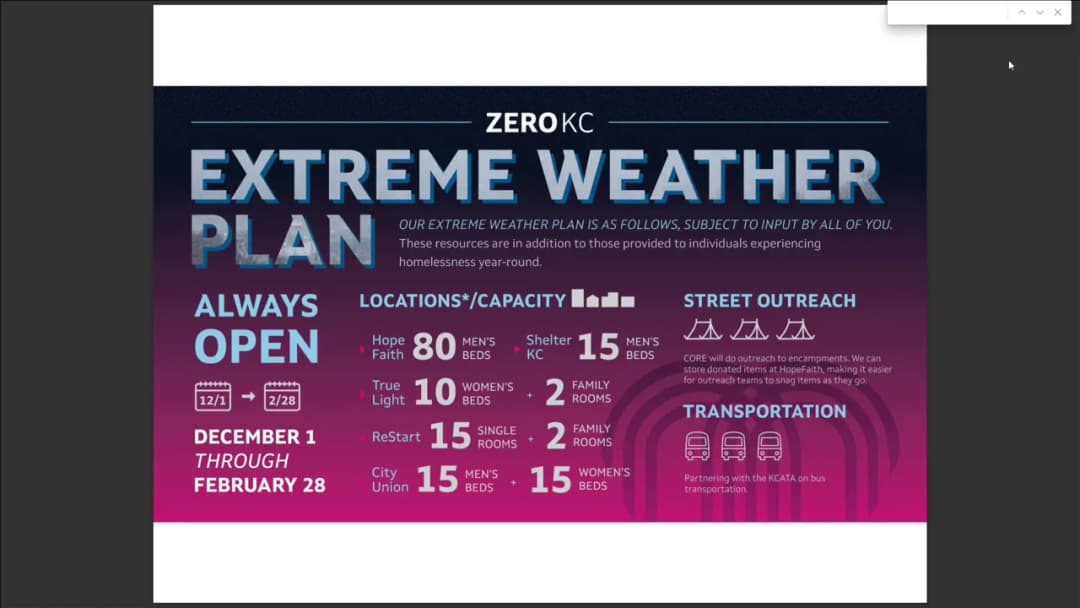
Note: The transcript of this meeting is dated October 27, 2022, but the meeting is specified to have occurred on November 3, 2022. The meeting opened with a motion and second, which passed unanimously. The primary agenda items included an audit report on first‑quarter spending from the Community Policing and Prevention Fund (CPPF) and a presentation on the extreme weather plan for people experiencing homelessness. Audit Report: Community Policing and Prevention Fund (CPPF) – Fiscal Year 2023 First Quarter City Auditor Doug Jones presented the audit, which examined whether the Kansas City Police Department (KCPD) spent the CPPF as intended by the City Council during the first quarter of FY2023 (May–July 2022). Key findings: - Spending Rate: KCPD reported spending approximately one‑third of the funds appropriated to the CPPF in the first quarter. - Special Operations & Traffic Division: The full $2.6 million appropriated to this category was expended. KCPD used its general fund to cover remaining operations in this area. - School Resource Officers (SROs): The department allocated expenses for five SROs for six of seven pay periods and four SROs for the last pay period. - Community Action Network (CAN) Centers: Two officers were allocated to the Metro Patrol CAN Center for all seven pay periods, and two officers to the East Patrol CAN Center for the last two pay periods. - Process: KCPD’s fiscal division developed a manual process to report spending; while accurate if operated as intended, it is labor‑intensive and carries risk. - No recommendations were made in the audit; no management response was requested. Discussion and Questions - Councilwoman Parkshow asked about trends for future quarters. Deputy Chief Neil Mayer and Captain Josh Hynan responded that hiring of 88 new officers is the goal, with four academy classes planned for the year. Spending on officer salaries and other categories will increase as officers progress through the academy and receive step increases. - Councilman Barnes questioned whether underspending in some categories (e.g., hiring fewer than 88 officers) would allow KCPD to reallocate funds within the CPPF. The police representatives indicated they would use excess funds to cover underfunded categories, but Councilman Barnes expressed concern that the council’s intent was to hire 88 officers. - Councilman Allington asked about the $300,000 spent on enhanced cell phone analytical software (used for GPS tracking in investigations) and questioned why that amount was not part of the IT/forensic category. He also raised concerns about the allocation of funds to technology versus community officers. He requested a business session to discuss IT consolidation. - Councilwoman Robinson asked about the disposition of unspent funds. City Manager (or legal counsel) explained that funds could either return to the city or be transferred within the police budget by the Board of Police Commissioners. She also noted that the special operations division had fully expended its CPPF allocation and would rely on general fund transfers. - Councilman Hellington (likely Councilman Ellington) asked about the impact of short staffing on overtime costs. Deputy Chief Neyer stated that overtime is significantly over budget due to the need to fill vacant positions, and that salary savings from unfilled positions are often consumed by overtime. - Radios: Councilwoman Robinson asked about the status of police radios nearing end of life. Deputy Chief Neyer confirmed that radios are at end of life, with no support from the manufacturer, and that a lease‑to‑purchase arrangement is preferred but requires city contract authority. The vendor has a deadline for pricing. Extreme Weather Plan for Unsheltered Residents Josh Hinges, Homeless Prevention Coordinator, presented the 2022–2023 extreme weather plan. - New Capacity: Approximately 154 new beds are available this winter, compared to last year. The main hub for men is Hope Faith (80 beds, with ability to increase capacity). Restart provides 15 single rooms and 2 family rooms for women and children; True Light provides 10 single rooms and 2 family rooms. Shelter KC and City Union Mission each expanded by 15 beds in both men’s and women’s shelters. - Change from Last Year: The city moved away from using the Garrison Community Center due to neighborhood disruption (after‑school programs were affected) and transportation issues. Hope Faith is a known location on a main transit route. - Operations: Shelters will remain open regardless of temperature thresholds, allowing up to three times more days of operation compared to last year. Street outreach will continue through the Core Group, a coalition of trained professionals who can respond citywide. - Donations: Cold‑weather gear can be dropped at Hope Faith for distribution. - Resources: A “street sheet” (resource guide) is available quarterly from the Kansas City Public Library, and a document “10 Things to Consider” was created for faith communities wanting to open warming centers. Discussion - Councilwoman Robinson noted the gap between the point‑in‑time count (711 unsheltered) and the 154 new beds. Hinges explained that not all unsheltered individuals will use warming centers (due to domestic violence, LGBTQ+ concerns, mental illness) and that a low‑barrier emergency shelter is needed. He also mentioned a forthcoming camp decommission strategy. - Councilwoman Robinson encouraged reaching out to churches and organizing training. She also asked about providing resources to tent encampments. Hinges confirmed that outreach teams distribute donations and maintain relationships. - Councilwoman Parkshow highlighted an ordinance being introduced (co‑sponsored with the Mayor) to authorize use of leftover funds from the previous year’s extreme weather plan to implement this year’s plan, without new appropriations. Key Outcomes - Approved motion: The meeting’s opening motion passed unanimously (presumably adopting the agenda or minutes). - Next audit: The auditor expects to release the second‑quarter audit report by December 2022, with a faster turnaround. - Ordinances Introduced: 1. Ordinance co‑sponsored by Mayor Lucas and Councilwoman Parkshow to reallocate existing funds for the extreme weather plan. 2. Ordinance introduced by Councilwoman Robinson and Councilman Ellington to provide $175,000 in emergency one‑time funding to reopen the Ivanhoe Neighborhood Council center; referred to committee. No formal votes on the audit or plan were taken; they were presented for discussion.
On October 27, 2022, the Kansas City City Council received presentations on two major initiatives: the 2023 NFL Draft and the Green Line trail project. The meeting began with unanimous approval of the previous meeting's minutes. No public comments were heard. The council then heard updates from NFL officials and local stakeholders on the draft's planning, followed by a presentation on the Green Line, an eight-mile pedestrian and bicycle loop connecting downtown areas. Council members expressed support while raising questions about funding, equity, connectivity, and prioritization among competing downtown projects. Consent Calendar - The council approved the minutes of the previous meeting by a unanimous voice vote (all in favor, none opposed). Discussion Items NFL Draft Update (April 27–29, 2023) John Barker, Senior Vice President for Global Event Operations and Production for the NFL, along with Kathy Nelson, President and CEO of the Kansas City Sports Commission, provided an update on the 2023 NFL Draft. The event will be held at Union Station and the National World War I Memorial, with a secure perimeter, free admission, and an estimated $102.1 million in direct local spending. The draft will include a main stage, fan experiences (e.g., a 40-yard dash, football-themed activities), and a business connect program that has vetted 289 local suppliers (90 recommended by community partners and 197 through online applications). The NFL will use about 800 paid “teammates” (volunteers) per day. The draft will be broadcast wall-to-wall on ABC, ESPN, and NFL Network. Construction will take about four weeks, with a one-week teardown. Council members expressed enthusiasm and asked about inclusion of minority-owned businesses, youth exposure, and the role of the Professional Football Players Mothers Association. Councilman Robinson noted the importance of involving young children of color in event planning. The NFL team committed to working with local organizations. Green Line Initiative Steve McDowell (BNIM Architects), James Baker (consultant), and Jared Campbell (Downtown Council) presented the Green Line, a proposed eight-mile loop trail connecting downtown neighborhoods, parks, and the riverfront via the Terminal Railway right-of-way, Paseo, and existing trails. The first phase (southern leg) is the most challenging due to railroad ownership, but the Kansas City Terminal Railroad has become a partner. A feasibility study, funded by Fourth District PIAC, estimated costs at about $7 million per mile. Community engagement included an open house (100+ attendees) and a survey (400+ responses). The project could generate an estimated $250 million in economic activity. Council members raised concerns about prioritization among downtown projects (e.g., South Loop Link, Barney Allis Plaza, downtown baseball) and connectivity to underserved areas, especially the east side and northland. Councilwoman Robinson urged the team to focus on green space in the third district, which has the least. Councilman Ellington questioned east-side connections. Councilman Fowler requested links to the northland trail system. The presenters acknowledged the need for diverse funding (grants, private, philanthropic) and committed to further community engagement. Key Outcomes - The council approved the minutes of the previous meeting unanimously. - No votes were taken on the NFL Draft or Green Line presentations; they were informational updates. The council directed staff and stakeholders to continue refining plans, explore funding, and address equity and connectivity concerns.
The City Council held a business session on October 13, 2022, primarily focused on a detailed presentation from the Human Resources Director and Finance Director regarding the city's hiring process, vacancy rates, and a right-sizing initiative. The meeting also included the approval of minutes from the previous session and an announcement of a forthcoming ordinance related to a ballot question. Consent Calendar - Approval of minutes for the business session of October 6, 2022. Motion passed by voice vote. Public Comments & Testimony - No public comments were recorded. Discussion Items - HR Presentation on Hiring Process and Vacancy Data: Terry Casey, Human Resources Director, presented an overview of the hiring process, including steps from PRC (Personnel Review Committee) approval to onboarding. Key statistics included: 5,428 total positions, 4,012 filled, 1,416 vacancies (26% vacancy rate). Since February 2022, the city received 7,403 applications, made 360 hires, added 129 positions, and lost 332 employees. The 10-year average employee count was 4,266. The presentation highlighted improvements such as centralized HR functions, electronic forms, QR codes on job postings, and a forthcoming automated talent acquisition system. - Right Sizing Initiative: Tammy Queen, Finance Director, described the right-sizing process, which involves departments reviewing org charts to determine if all vacancies are needed. The next step is priority-based budgeting. For FY24, a 10% vacancy factor (based on normal attrition) will be applied to department budgets, with the goal of eventually reducing this factor as the organization is right-sized. - Council Questions and Comments: - Councilwoman Parkshaw asked about posting processes, background check timelines, and expressed concern about high vacancy rates in essential service departments (aviation, public works, solid waste, parks). She emphasized the need for recruitment strategies and cautioned against a blanket 10% vacancy factor. - Councilwoman Robinson noted the overall 26% vacancy rate and questioned the lack of a specific target for reduction. She requested a report on how vacancies make the city vulnerable and called for clearer communication with residents about service impacts. - Councilman Allington (Ellington) asked about the relationship between vacant positions and contracted services, referencing a prior resolution (22002) directing evaluation of contracts for potential insourcing. He noted that the required report had not been provided and requested data on contract costs versus hiring. - Councilwoman Shields clarified drug testing policies (only for safety-sensitive positions) and raised a concern about delays in processing her new aide. - Councilman O'Neill highlighted the use of temporary labor (e.g., Labor Ready) and the wage disparity between temporary workers and city employees, urging faster hiring to bring them onto the city payroll. - Councilman Barnes asked about which positions require PRC approval; he was told that general fund positions and reclassifications go through PRC, but many field positions are exempt. - Ordinance Announcement: Councilman Fowler stated he would introduce an ordinance regarding a ballot question (likely Question 1, the 175/125 sales tax extension). The ordinance would allocate 64% of the proceeds ($80 million) equally among council districts, to be distributed via the existing PIAC process, and would be adopted on the same day to allow campaigning with the message of equal distribution. Key Outcomes - Minutes from October 6, 2022, were approved. - The HR presentation was received; council members raised concerns and requested additional data, including: - A report on city vulnerabilities due to high vacancy rates. - Information on contracted services versus vacant FTEs. - A list of positions exempt from PRC. - Clarification on hiring timelines and temporary worker conversion. - The Finance Director will continue developing the FY24 budget with a 10% vacancy factor, and right-sizing plans will proceed with departmental input. - Councilman Fowler will introduce an ordinance (same-day adoption) to allocate $80 million from a proposed sales tax equally across districts via PIAC.
The Kansas City Council held a business session on October 6, 2022, at 8:15 PM. The meeting began with the approval of minutes from the previous session on September 29, 2022, followed by a presentation from the City Auditor on the scope of an audit of water services customer service. The council then moved into closed session to discuss legal matters. Consent Calendar - Approval of Minutes: The council unanimously approved the minutes from the business session of September 29, 2022. A motion was made and seconded, and all members present voted aye. Discussion Items - High Water Usage Scope Statement (City Auditor): City Auditor Doug Jones presented the scope statement for an audit of water services customer service. He explained that unexpected large increases in water consumption may indicate changes in customer behavior, meter failures, or problems with fixtures. The audit objective is to determine whether the Water Services Department provides adequate resources to customers to address unexpected high water use. The audit will involve interviews, review of policies and training materials, and analysis of customer service calls. The anticipated release date is February 2023. Councilmember McMahon asked whether water services now uses the city's centralized HR hiring process, but the auditor noted that the audit does not cover hiring practices. No other questions were raised. Key Outcomes - Closed Session Motion: The council voted to go into closed session under Missouri Revised Statute Section 610.021(1) for discussion of legal matters, litigation, and privileged communications with attorneys. The motion was made, seconded, and passed unanimously on a roll call vote (all present members voted aye). The session was to be held on the tenth floor.