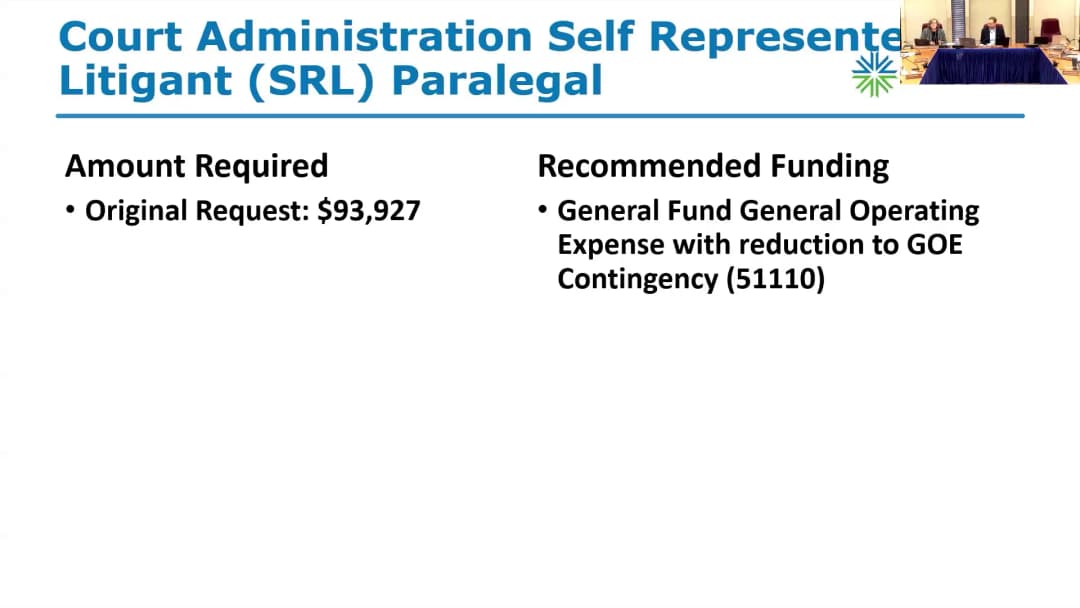
The Lake County Board's Financial and Administrative Committee convened on October 30, 2025, to review a consent agenda, receive updates on economic development initiatives, approve several resolutions regarding holidays, roofs, and demolition contracts, and deliberate on fiscal year 2026 budget amendments. The committee addressed ambiguities regarding funding sources for the Circuit Clerk and State's Attorney's office, ensuring alignment with statutes and fund balances while maintaining a net zero impact on operating taxes. Consent Calendar - Minutes Approval (Item 8.1): The committee unanimously approved the minutes from the September 4th meeting following a motion by Member Hewitt and a second by Member Clark. - Holiday Schedule Resolution (Item 8.3): Approved a resolution establishing the 2026 holiday schedule. This includes adding President's Day (Monday, February 16, 2026) as a court closure day per Administrative Order 25-06 and approving the Treasurer's Office closure on Friday, February 12, 2026, for training purposes. Member Maine expressed concern regarding public access if no skeleton crew is present, but the administration noted low foot traffic expected for floating holidays. - Roof Replacement Contract (Item 8.4): Approved a resolution authorizing a contract with Knickerbacker Roofing and Paving for $1,390,900 to replace roofs at the Washington Street pedestrian bridge and Babcock courtroom. This project addresses excessive wear missed during the criminal court tower construction. Only one compliant bid was received, with two other interested parties declining due to winter weather conditions and warranty limitations. The scope is designated for immediate action to complete before April 2026. - Demolition Contract Modification (Item 8.5): Approved a contract modification increasing the value by $4 million per renewal year for each of three contractors (McDonough, AGAE, Leonardo) under the Job Order Contracting (JOCK) agreement. This modification supports the Inter-governmental Support Agreement (IGSA) for the demolition of the Hall-Halsey Village housing structures in North Chicago. It was clarified that this work is fully funded by the Navy via federal grant pass-throughs, with Lake County serving only in an administrative routing capacity. Public Comments & Testimony - No public comments or testimony were received during the meeting. Discussion Items - Lake County Partners (LCP) Update (Item 8.2): Kevin Consendine presented a year-end economic development update. - Project Descriptions: Highlighted expansions by Bel Air Creations (scent company) in Round Lake Park and MSI Express (food company) moving into the former Jelly Belly space in North Chicago. The committee noted a potential to exceed $1 billion in direct capital investment for the year. Additional initiatives included the launch of SEDS (Strategic Economic Development Strategy) under new director Steve Dobretto, the Navigate Lake Youth Career Fair with over 6,000 attendees, and the GSEP partnership reaching 228 pro-Chicago land decisions. - Speaker Positions: Member Clark expressed concern regarding national narratives about Chicago safety potentially affecting business attraction, specifically asking if ice raids or political rhetoric were causing companies to rethink locations. Consendine stated that while these are obstacles being actively managed in messaging strategies, no data currently shows a negative impact on visitor numbers or investment decisions. Member Clark and Member Bolitzek expressed full support for the team's efforts to counter these misperceptions and promote the region's success. - Fiscal Year 2026 Budget Amendments: Administrator Patrice Sutton presented amendments approved during prior budget meetings, with several items requiring further committee direction. - U of I Extension Funding: Increased contribution by $10,000 to the University of Illinois Extension. Member Maine, Member Hewitt, and Member Volitic expressed skepticism about funding without specific program metrics or a clear link to urgent needs like SNAP, with Member Hewitt citing a 20-year history of the request. Vice Chair Cunningham, Member Clark, and Member Volitic advocated for the funding, citing the organization's community impact and the need for a universal support approach. Chair Hart directed staff to provide specific program impact details before final action next week. - Circuit Clerk Operations Fund: Discussion centered on funding the Circuit Clerk's office operations. The committee agreed in consensus that the county should not double-fund the office if revenue sources exist to cover expenses, directing staff to transfer funds only to the extent necessary based on the clerk's specific operational needs, pending further clarification on planned expenditures. - State's Attorney Gun Violence Prevention Initiative: Approved a $642,077 one-time transfer to cover a grant gap from July to November 2026. The State's Attorney agreed to remove one new FTE position and maintain a contract worker rather than converting them to full-time to manage uncertainty. Member Maine requested a broader committee discussion on handling grant gaps across multiple departments (e.g., Health Department) rather than addressing only this single program. The committee noted the funding is an interim solution pending state/federal release. - Circuit Clerk Access Eye and Self-Represented Litigants: Approved funding ($50,000) for the "Eye" calendaring system and a new Self-Represented Litigant (SRL) paralegal position ($93,927) to assist individuals navigating court procedures. Member Clark expressed strong support for the SRL initiative, noting its life-changing impact on 25,000+ annual litigants. The committee agreed these should be funded via the Court Automation Fund (requiring Clerk/Judge approval) and General Fund respectively. - Voting Tabulation System: Agreed to proactively budget for a future upgrade of the voting tabulation system in the Capital Improvement Fund, with a provision to adjust if state certification does not occur. - Contingency & Tax Levy: The committee reviewed the final budget structure, which maintains the property tax levy at half of the allowable CPI and keeps contingency reserves within policy limits to handle potential reductions in federal/state grants. Member Clark expressed concern over the lack of increased contingency, but the committee agreed the current reserve policy provides sufficient safety. Key Outcomes - Approved Staff Direction: Authorized up to 10 hours of staff time for members to research and report on how Lake County government can internally commemorate the 250th anniversary of the Declaration of Independence in July 2026. - Budget Amendments: Directed staff to finalize FY2026 amendments including the U of I Extension funding (pending data), Circuit Clerk operational transfers (based on actual needs), State's Attorney grant gap funding, and voting system capital budgeting. - Contract Approvals: Finalized approval for the Knickerbacker roofing contract and the Jock modification for Navy demolition projects. - Holiday Calendar: Officially added President's Day to court closures and the Treasurer's office closure for February 2026.
Public Meetings - Lake County, Illinois
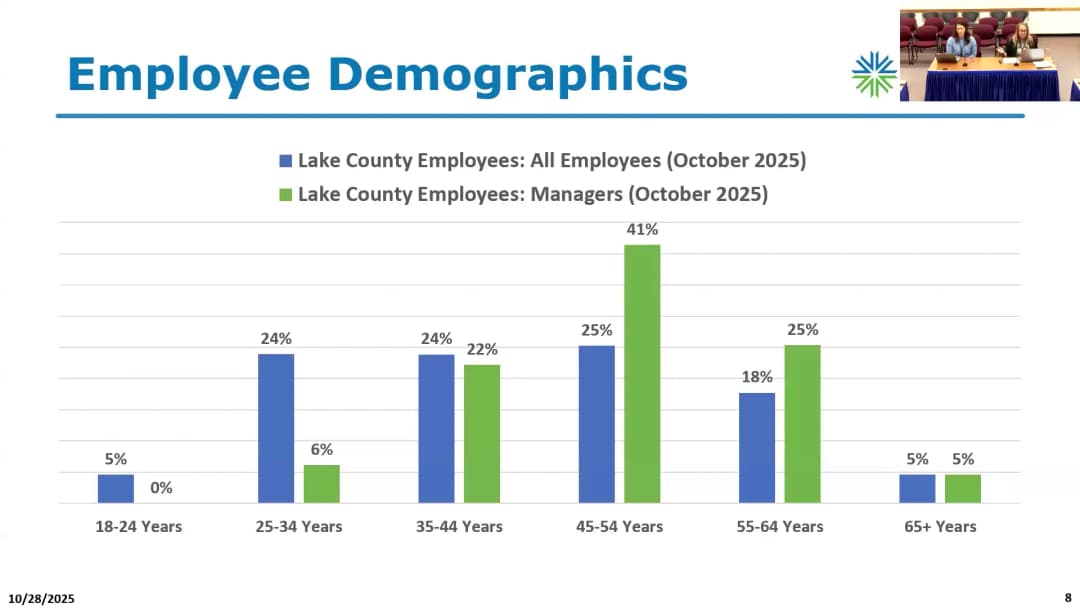
Public Meetings - Lake County, IllinoisThe Diversity, Inclusion, and Equity (DEI) Committee convened on October 20, 2025, to review ongoing accessibility and organizational initiatives, examine current workforce demographics against census data, and approve meeting minutes. The meeting featured presentations from County Administration and HR leadership regarding compliance deadlines and future data collection via the Workday system. Consent Calendar - Minutes Approval: The Committee approved the May 2025 minutes (Action 8.1) via a motion and second, resulting in a unanimous vote with no oppositions noted. Public Comments & Testimony - The Chair explicitly called for public comments and stated, "No public comments" were received. Discussion Items - ADA Transition Plan Update (Presented by Ruth Ian): - Project Scope: The project, contracted to Kimley Horn in October 2024, expands on previous 2016/2018 work to include a countywide master plan. It involves reviewing over 1,000 pedestrian crossings, 95 miles of sidewalks, and 89 signalized intersections, plus a new component reviewing public service areas across all departments. - Compliance Deadline: A state ruling requires all web content and communications created or primarily accessed after April 24, 2026, to meet ADA standards. Content created prior to this date is exempt unless it is a "primary and active document" (e.g., the current budget). - Current Status: The ADA coordinator has been identified, grievance procedures established, and an online scanning tool by vendor Civic Plus is in place to identify non-compliant pages. The consultant is currently reviewing public service areas via surveys and staff interviews. - Timeline: The final transition plan, including cost estimates and implementation schedules, is scheduled for presentation to the committee in February 2026. - Operational Assessment Update (Presented by Ruth Ian): - Project Scope: Contracted to Carter Development Group in June 2025, this initiative aims to analyze employee demographics, perspectives, and organizational culture. - Current Status: The consultant has reviewed employee policies, procedures, and communications strategies. An anonymous employee survey is scheduled to begin in November 2025. - Timeline: The final comprehensive report and implementation roadmap are due to county administration in July 2026. - Workforce Demographics Report (Presented by Darcy and Crystal Adams, HR): - Overview: HR staff compared current Lake County employee data against 2020 Census data. The workforce generally mirrors county demographics. - Specific Findings: - Management Demographics: The percentage of white managers decreased by 5% (from 72% to 67%). - Unknown Demographics: The category of "unknown" demographics increased by 7% (from 12% to 19%), attributed to self-identification choices. - Job Categories: The top three EEO categories are professionals, administrative support, and protective service workers. Females predominantly hold administrative roles, while males hold protective service and skilled maintenance roles. - Age & Tenure: The majority of managers are ages 45–54, with over 60% of managers having more than 10 years of service with the county. - Future Data Collection: HR expressed optimism that the upcoming 2026 implementation of the Workday system will allow for more accurate, voluntary collection of education, certification, and diverse demographic data to track unconscious bias and inform equitable professional development. Key Outcomes - Minutes Approved: The May 2025 minutes were unanimously approved. - Next Meeting Scheduled: The next meeting is set for February 24, 2026. - No further action items or votes were recorded for the ADA or Operational Assessment updates, as they remain in the data collection and consulting phases. - No executive session was held, and no additional reports were delivered due to scheduling constraints regarding training updates.
This meeting of the Public Works and Transportation Committee, the Planning, Building, Zoning, and Environment Committee, and the Finance Committee continued the fiscal year 2026 joint budget hearings for Lake County. The proceedings covered presentations from multiple departments, including Public Works, Transportation, Facilities, Planning, Stormwater, Technology, Clerk, Treasurer, Assessors, and Finance. Key proceedings included the approval of several operating budgets, a detailed review of the Capital Improvement Plan (CIP), and an extensive discussion regarding New Program Requests (NPRs), specifically focusing on the State's Attorney's Office violence intervention program and the Circuit Court Clerk's voting system upgrade. The committee finalized the approval of most departmental budgets but tabled the final approval of the alternative budget scenario and specific unfunded NPRs for further scenario analysis. Consent Calendar - Routine administrative matters, including the Pledge of Allegiance, roll calls, and confirmations of no addenda or public comments on non-agenda items where not applicable. - Approval of the recommended fiscal year 2026 budgets for Enterprise Information Technology (8-T1), FICA (8-F10), IMRF (8-F11), and various debt service funds (8-F12 through 8-F15). - Approval of Special Service Area budgets for Woods of Ivanhoe (8-F16) and Ivanhoe Estates (8-F17). - Approval of the Finance department budget (8-F19). Public Comments & Testimony - General Public: No public comments were recorded for items not on the agenda during the opening segments. No specific public testimony was captured regarding the budget items in this transcript. Discussion Items - Facilities and Construction (8-F18): Discussion centered on a $320,000 request to modernize the jail and jury parking garages (pay stations and control arms). Members expressed concern regarding the return on investment ($30,000 annual revenue vs. $320,000 cost) and the potential unintended consequences of the current parking model. The County Administrator noted the request was an adjustment from an initial $75,000 quote to a full system modernization. The committee voted to remove the $75,000 portion from the CIP for future discussion. - Planning, Building, Zoning, and Development (8-P1): Director Wagner and Operations Manager Eric Stefan presented the budget and a request for one additional field inspector to address increased code enforcement workload and backlogs. The committee supported the position, citing the critical need to maintain service levels in unincorporated areas. - Stormwater Management (8-P2, 8-P3): Director Kurt Wolford presented the budget, noting a 63% decrease in revenue due to property tax allocation changes despite increased permit fees and project expense matches. The committee approved the budget but requested clarification and further review of proposed staffing reorganization (reducing two Capital Improvement Program Manager positions to fund a new Director role) before finalizing the head count structure. - State's Attorney Office (NPRs): The State's Attorney presented a request for $1.877 million to fund four positions for the Gun Violence Prevention Initiative (GVPI) due to the expiration of state legislative funding which only covers through June 30, 2026. Members debated the necessity of county funding for grant-supported programs. While no consensus was reached for full funding, the committee expressed strong interest in funding six months of the program and requested scenarios be developed to fund this gap while potentially cutting other recommended programs or utilizing contingency. - Circuit Court Clerk (NPRs): Clerk Vega discussed a $2.4 million request for a 2.0 certified voting tabulation system, which was not recommended due to lack of state certification. The committee noted this would require future capital funding. There was also discussion regarding a request for an "Access to the Portal" for the Circuit Court Clerk (reduced from $150,000 to $50,000), with members exploring potential funding through special revenue funds rather than the general fund. - Administrative Assistant Position: The committee discussed an administrative assistant position in Facilities (combining two part-time roles into one full-time) to improve retention and continuity. Several members expressed support for this efficiency measure. Key Outcomes - Approvals: The following budgets were approved: Public Works (8-1, 8-2, 8-3, 8-4), Division of Transportation (8-5 through 8-10), Facilities and Construction operations (8-F18 - amended), Facilities and Construction CIP (8-F31 - amended to remove $75,000 for parking), State's Attorney Office (non-recommended NPRs noted), Circuit Court Clerk (8-F24), Treasurer (8-F28, 8-F29), Chief County Assessor (8-F30), and the consolidated debt service funds (8-F12-15). - Deferrals and Future Actions: - GVPI Funding: The committee directed administration to prepare scenarios to fund six months of the State's Attorney Gun Violence Prevention Initiative, pending analysis on offsetting costs or utilizing alternative revenue sources. - Clerk Portal: The committee directed administration to explore funding the Circuit Court Clerk's "Access to the Portal" ($50,000) through special revenue funds rather than general property tax funds. - Stormwater Reorganization: The committee agreed to review the proposed staffing reorganization (converting vacant CIP manager positions to a Director role) and funding transfers with the Finance and County Administrator's office before final approval. - Alternative Budget Scenarios: Action on the alternative budget scenario (Scenario Two) and specific unfunded NPRs (including the self-represented litigant, landscape master plan, and others) was postponed to the next meeting on October 30, 2025, to allow for further scenario analysis. - Directives: - Remove the $75,000 item for parking garage controls from the Capital Improvement Program (CIP) budget. - Prepare amendments for the next meeting (October 30) specifically addressing the GVPI six-month funding gap and exploring funding sources for the Clerk's portal and administrative assistant positions."
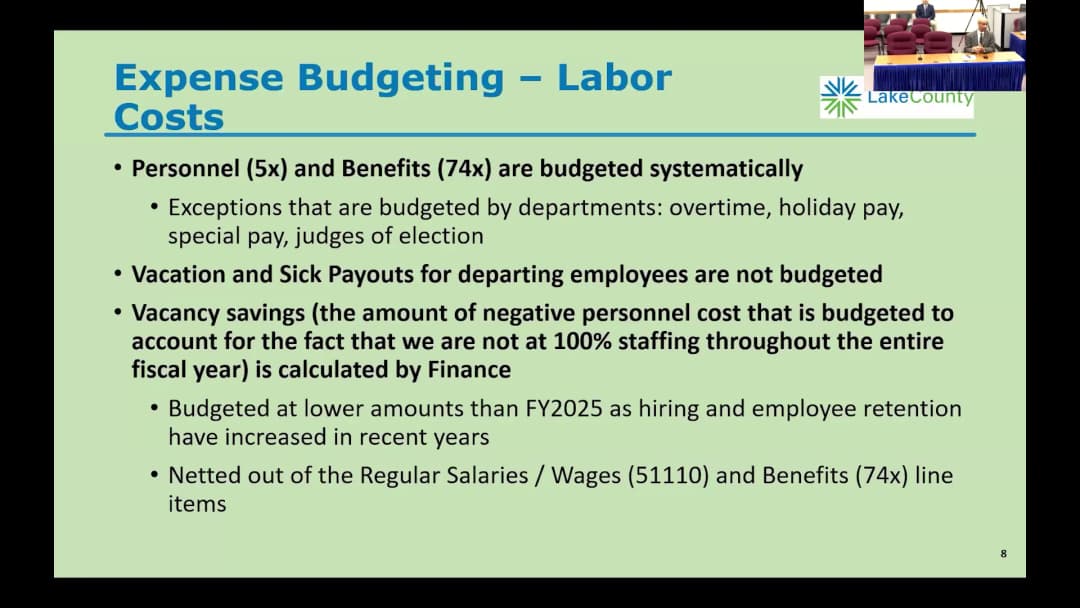
The Public Works and Transportation Committee convened at 8:30 a.m. to review the Fiscal Year 2026 budget recommendations for Public Works, the Division of Transportation, and Special Service Areas. The meeting featured presentations from the Budget Manager and department directors, along with deliberations on specific line items, funding sources, and operational strategies. While the Finance Committee had previously approved the consolidated county budget framework, this session focused on the specific allocations and approvals for the Public Works and Transportation sectors. Consent Calendar - A collective motion was approved to recommend the Fiscal Year 2026 budget for the Public Works department (Item 8.1), including the operational fund and a new transfer to the capital fund (Item 8.26). - A collective motion was approved to recommend the Fiscal Year 2026 budget for the Division of Transportation (Item 8.5) and its associated special revenue funds: County Bridge Tax (8.6), Matching Tax (8.7), County Motor Fuel Tax (8.8), County Option Motor Fuel Tax (8.9), and RTA Quarter Percent Sales Tax (8.10). Public Comments & Testimony - [None recorded; no public comments were solicited or made during the meeting.] Discussion Items FY26 Budget Overview and Process Reform - Michael Wheeler (Budget Manager) presented the overall budget highlights, noting that the 2026 budget is the first to fully incorporate compensation study increases directly into department budgets rather than holding them in contingency. - Member Maine and Chair Clark discussed the previous day's cut-off of discussions regarding unbudgeted funds in the Clerk of the Court's office; Chair Clark expressed that the cut-off was a procedural necessity to move on items with solid answers, affirming that the questions regarding revenue unbudgeting were valid and important. - Wheeler detailed the "new program request" process for FY26, highlighting the introduction of a collaborative peer review where department heads present requests to one another. He noted that requests are categorized by funding status: included in the primary property tax increase, included in Scenario 2, queued for Q2 FY26, or not recommended. - Wheeler clarified that budget approvals occur at the "category level" (e.g., total Personnel, total Commodities) rather than item-by-item, and explained that the "A" prefix in account numbers simply denotes "Account." - Wage Increases: Wheeler specified a 3% lump-sum increase for non-union employees and a 1.75% increase to the wage table, resulting in individual raises ranging from 1.75% to 4% within a fixed departmental budget cap. Conversely, IMRF and Sheriff Law Enforcement Pension contributions decreased slightly, offsetting a 7.4% increase in health insurance premiums. Public Works Department Budget - Nick Principali (Budget Analyst) noted a 4% revenue increase for Public Works driven by user charges and interest, and highlighted the first-time budgeted transfer of $9.29 million from the operational fund to the capital fund. - Austin McFarland (Public Works Director) stated that the department has maintained regulatory compliance for drinking water and wastewater and is tracking to complete ARPA projects by mid-2026. - Member Wasick asked about specific erosion issues at the East Main plant; McFarland confirmed they are consulting on remediation for property line erosion and damaged fencing. McFarland expressed strong support for the resilience investments being funded. - Member Hewitt questioned the Smart Meter program regarding headcount savings. McFarland explained that while the meters department was eliminated 10 years ago, the new smart meters aim to improve leak detection and automation. He confirmed a pilot test is planned before broad rollout to ensure functionality. Division of Transportation (DOT) Budget - Shane Schneider (DOT Director) presented a status quo budget for 2026, maintaining 71 million in federal funding for the transportation improvement plan. He noted no headcount changes and no new program requests. - Member Main expressed full support for the non-motorized improvements, specifically citing the 75-mile increase in bike paths since 2022. He urged residents to participate in the "Envision 2050" long-range plan survey. - Vice Chair Maine raised a position of concern regarding the phrase "transportation use over the short term" in the RTA Quarter Percent Sales Tax documentation (Page 260-269), questioning if it implied a binding time limit inconsistent with their five-year plans. - Schneider and the Budget Team agreed the language was informational and carried over from past years; they committed to updating the text to accurately reflect the board's long-term commitment to the fund's purpose (transportation, paratransit, public safety). - Member Main clarified his concern regarding the binding nature of such language, distinguishing between board policy guidance and the specific ordinance passed at the time of the tax's creation. Member Hewitt expressed support for clarifying the language to remove ambiguity, stating that the current phrasing is "our bad for not working with the department." - Member Belitzik and Member Main inquired about recycled materials in pavement (approx. 30%). Schneider explained that this percentage is near the technical maximum to maintain pavement integrity and is also market-driven regarding available materials; he expressed no position on increasing the policy mandate beyond technical limits. - Member Main questioned the terminology "bike friendly shoulder." Schneider stated there is no funding requirement for this term and that they are increasingly referring to it as a "wide paved shoulder," though the term is used to indicate a safer space for cyclists. Key Outcomes - Approval of Public Works Budget: Motion carried to approve the FY26 budget for Public Works, including the $9.29 million operational-to-capital transfer. - Approval of Transportation Budgets: Motion carried to approve the FY26 budgets for the Division of Transportation and all associated special revenue funds (Bridge, Matching, Fuel, Option Fuel, and RTA Sales Tax). - Agreement on Language Revision: The committee directed the Budget Team to update the RTA Sales Tax fund description to remove the phrase "use over the short term" to better align with the "Envision 2050" long-range planning horizon. - Next Meeting: Scheduled for October 29, 2025. - Adjournment: Committee declared adjourned at the conclusion of the meeting.
The Planning, Building, Zoning, and Environment Committee convened to approve the recommended Fiscal Year 2026 budgets for the Planning, Building, Zoning, and Development (PBZD) Department and the Stormwater Management Commission (SMC). The committee reviewed detailed presentations on funding requests, staffing changes, revenue projections, and strategic initiatives. While the PBZD budget was approved unanimously, the SMC budget approval came with significant discussions regarding a proposed staffing reorganization and the classification of capital funds, resulting in a decision to vote on the current budget while deferring the reorganization approval to a later date pending further administrative review. Consent Calendar - No additions or amendments were made to the agenda. - No public comments were received prior to the regular agenda. Public Comments & Testimony - No members of the public offered testimony during the meeting. Discussion Items - PBZD FY26 Budget Review: - Director Wagner and Deputy Director Eric Stefan presented the budget, noting a projected increase in building permit revenue to $1.8 million due to commercial solar projects and a slight increase in personnel from 33 to 34 Full-Time Equivalents (FTEs) with the addition of one Field Inspector. - Speaker Position (Member Schlick): Expressed support for the additional inspector, citing regular contact regarding property maintenance issues in the unincorporated areas. Requested a future analysis correlating the cost of the position with increased revenue from fines and fees. - Speaker Position (Member Peterson): Stated that District 1 is significantly busier than other districts and expressed full support for the additional staff, describing the request as "sorely needed." - Speaker Position (Member Frank): Agreed the position was a "no-brainer" but inquired about an unfunded workspace improvement project, noting that the department had previously identified space utilization issues. - Director Response: Explained that the workspace improvements aimed to upgrade underutilized areas and reconfigure desks to reduce distractions (ambient noise) and improve focus, which was not included in the capital funding list. - Discussion on Municipal Agreement (IGA): Member Frank raised concerns regarding the financial sustainability of IGAs, specifically the lack of escalator clauses in multi-year contracts and the need to ensure costs are fully covered. Director Wagner confirmed that annual rate analyses are performed and that new renewals will include updated hourly rates that cover direct costs, administrative costs, and indirect costs. - Solar Permitting Trends: Member Frank questioned the metric for residential solar reviews. The department clarified that while the current metric tracks turnaround times (1-2 days) to maintain "Solar Smart Gold" status, the volume of reviews is averaging slightly less than previous years (approx. 10 vs 13 per month) and may soften in FY26 as federal tax credits begin to phase off. - SMC FY26 Budget & Reorganization Proposal: - Director Kurt Wolford presented the budget, which reflected a 63% decrease in total revenue due to lower property tax allocation but included significant non-property tax revenues from stormwater permits, grants (FEMA, DCO), and project expense matches ($2.2M received to date). - Staffing Reduction Proposal: Director Wolford proposed removing two Full-Time Capital Improvement Program (CIP) Manager positions and one Part-Time Accounting Specialist from the FY26 headcount (reducing FTE from 22 to 20). He requested to reallocate the salary funds of the two removed positions to create a new "Director of Capital Improvement and Maintenance" role, promoting an existing employee as part of a staffing reorganization to accommodate increased duties from dissolved drainage districts. - Fund Segregation: The Director proposed a new fund account (743) to segregate non-operational, pass-through funds (state/FEMA grants) from the operational budget to ensure proper usage and compliance with budget policies regarding levies. - Speaker Position (Member Schlick): Expressed sympathy for the need to pay staff more for increased workloads but stated he could not vote on the fund reallocation without seeing a formal, vetted reorganization plan, including classification changes and compensation details. - Speaker Position (Member Compost): Expressed reluctance to approve the reorganization "outside of the box" without a formal plan submitted through the proper channels. While commending the initiative, urged the committee to vote on the budget as currently presented (which includes the headcount reduction but not the new position funding) and return to address the reorganization later via the FNA committee. - Speaker Position (Member Frank): Noted the valid need to retain professional engineers for complex capital projects and supported the staffing goals, though noted that the budget submission lacked clear alignment with HR and finance teams regarding the reorganization details. - County Administrator Comments: Administrator Sutton clarified that while the operating budget was consistent, the engineering services line item ($2.6M) requested by the department should be treated as an emergency appropriation in FY25 rather than FY26, as the revenue was already received. She indicated that the reorganization details were not final and required further vetting by HR and Finance before a final amendment could be presented. - Speaker Position (Member Main): Stated that staff should not be removed simply to fund a new position without a formal plan, but acknowledged the need to ensure capital funds are used appropriately. Expressed comfort in voting on the budget as is, with the understanding that the reorganization would be revisited at the FNA committee. Key Outcomes - Item 8.1 (PBZD Budget): Approved unanimously (8-0). The committee authorized the recommended FY26 budget for the Planning, Building, Zoning, and Development department, including the funding for the new Field Inspector position and workspace improvements. - Items 8.B.2 & 8.B.3 (SMC Budget): Approved unanimously (8-0). The committee authorized the recommended FY26 budgets for Stormwater Management and the Regional Stormwater Management Projects Funds. The vote was conducted with the understanding that the proposed staffing reorganization (consolidating CIP managers into a new Director role) is not fully finalized and will be reviewed at the Finance, Budget, and Taxation (FNA) committee meeting prior to final implementation of any personnel changes or fund reallocations. - Process Directives: - Staff will work with the Finance Department to treat the $2.6M engineering services request as an FY25 emergency appropriation. - HR and Finance will complete the vetting of the proposed staffing reorganization for the SMC and present final recommendations to the committee at the next meeting. - Next Meeting: Scheduled for October 29, 2025. - Adjournment: The meeting was adjourned at the conclusion of the votes."}
The Technology Committee convened on October 21, 2025, to review and approve the Recommended Fiscal Year 2026 Budget for Enterprise Information Technology. The meeting featured presentations by CIO Chris Blanding and IT staff, followed by a Q&A session regarding budget composition, server infrastructure, sustainability goals, and device recycling. The committee unanimously approved the requested budget motion. Consent Calendar - Budget Approval: The Committee moved to approve the Recommended Fiscal Year 2026 Budget for Enterprise Information Technology. The motion was made by Member Dan Ford and seconded by Member Peterson. The budget was adopted unanimously. Public Comments & Testimony - No public comments were presented during this session. Discussion Items - FY 2026 Budget Overview: Assistant CIO Nick presented the budget totaling $17,996,08 (interpreted as $17,996,080 based on context), representing a decrease of $540,167 (approximately 3%) from FY 2025. This reduction is attributed to the conclusion of temporary staff augmentation contracts tied to major technology implementations. - Software and Online Services Increases: Member Dan Ford questioned the significant increase in the "software and online services" line item. CIO Blanding clarified that this was not related to the ERP system (Workday), which is prefunded by the County Administrator's office through 2026 and is not currently included in the EIT budget. The increase reflects ongoing operational support for existing software. - Server Infrastructure and Cloud Migration: Member Frank asked about the increase in server counts from 352 to 491. CIO Blanding explained this is a combination of virtualized environments and cloud servers rather than physical hardware additions. The increase is largely due to the consolidation of Health and Courts systems into the unified virtual server environment. CIO Blanding confirmed the department is actively moving away from on-prem physical servers. - Sustainability Metrics for Cloud Migration: Member Frank raised concerns about the sustainability impact of moving data to the cloud, specifically regarding carbon footprint and water usage metrics. While acknowledging that cloud providers operate at scale with efficiency, Blanding admitted specific data metrics for this transition were not immediately available but promised to follow up with the committee on research regarding sustainability measurements. - Device Refurbishment and Recycling: Member Frank inquired about the department's sustainability practices regarding end-of-life devices and potential donations to "PCs for People" under the Digital Growth Initiative. Blanding confirmed that devices are currently recycled but noted a policy challenge prevented donations to "PCs for People" at that time. Member Dan Ford and Member Frank agreed this was a topic requiring further conversation to explore alternatives to simple recycling for reuse. Key Outcomes - Vote: The Recommended FY 2026 Budget for Enterprise IT ($17,996,080) was approved unanimously. - Directives: - The Technology Committee requested further research and reporting on sustainability metrics (carbon footprint, water usage) related to cloud migration. - The committee directed IT staff to undertake a further conversation regarding policies to facilitate device refurbishment and donation programs rather than solely recycling end-of-life hardware. - Next Steps: CIO Blanding will provide the requested sustainability data to the committee in the future.
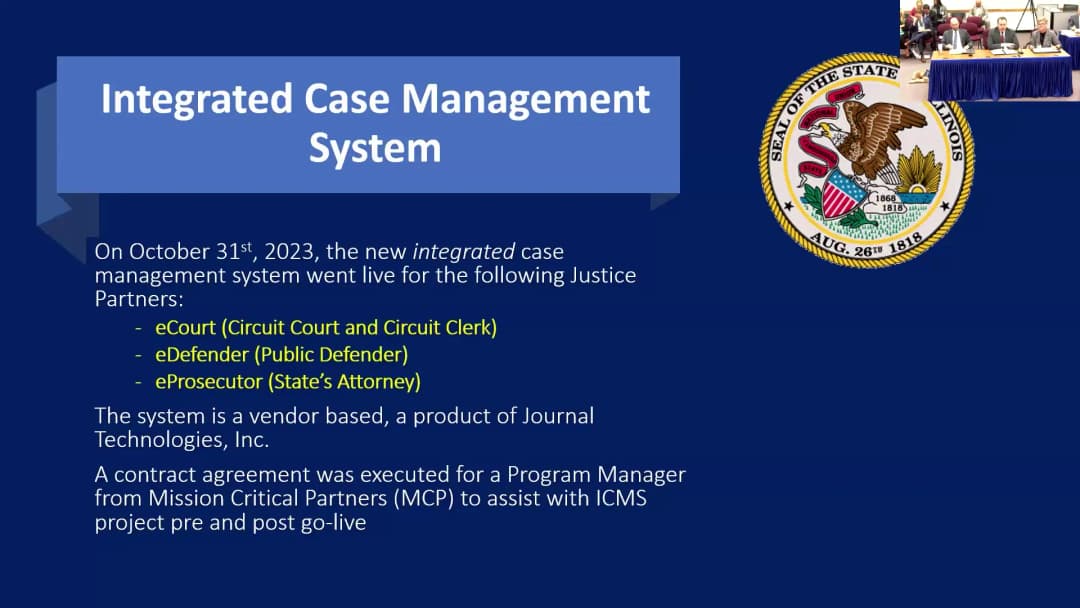
This joint meeting of the Finance and Administrative (F&A) Committee and the Health and Community Services (HCS) Committee, followed by the Law and Judicial (L&J) Committee, convened to review and approve the proposed Fiscal Year 2026 budgets for Lake County departments. The session covered public comments regarding lake cleanliness and wastewater infrastructure, followed by detailed presentations on departmental budgets for workforce development, community development, video gaming, opioid settlements, the regional office of education, the health department, court administration, the state's attorney's office, sheriff's office, public defender, and circuit court clerk. Key discussions centered on the impact of the "Safety Act" on warrant processing, the uncertainty surrounding state and federal funding for gun violence prevention initiatives, and the re-evaluation of health insurance drug coverage. Consent Calendar - No items were listed under the Consent Calendar; all budget items were treated as discussion items requiring specific motion and vote. Public Comments & Testimony - Carl Zeigahn: Expressed full support for the county board to consider allocating funds for non-toxic lake cleanup methods. He highlighted the existence of the non-profit Global Waterworks in Libertyville and noted that some lakes are currently unsafe for swimming, urging the board to prioritize this to attract future visitors. - Rob Breyson: Expressed full support for the expansion of sewer systems to address water quality issues. He cited the "Chain of Lakes" watershed plan, which identifies 8,000 septic systems (80% within 1,000 feet of the lake) as a primary negative impact on the lakes, and asked the board to consider funding for sewer expansion in the budget. Discussion Items - General Process & Compensation: Chair Frank suggested the Finance Committee hold off on final action regarding amendments to the budget until the conclusion of the HCS and other committee meetings to assess the aggregate fiscal impact. The County Administrator's Office noted the inclusion of 3% lump sum wage increases for non-union employees and the transition to a 1.75% salary table increase. - Health Department (Chris Hoff): The Health Department expressed concern regarding potential federal grant terminations and the "Inflation Reduction Act" (referred to as the "big beautiful bill") which may restrict Medicaid access. They noted a 7.4% increase in blended health insurance premiums but emphasized that 5% of their budget goes directly to participants for wages, tuition, and assistance. The department expressed a position of needing to prepare for a potential influx of uninsured residents due to federal policy changes. - Courts (Chief Judge Shanes): The 19th Judicial Circuit discussed the transition of the Integrated Case Management System (ICMS) from a consultant model to in-house support, requesting funding for a Program Manager and an Analyst. The Department of Illinois Courts provided an unexpected $440,000 in FY25 funding, creating a need for future budget amendments to utilize these funds for the second position. The Committee expressed concern regarding the long-term sustainability of the Court Automation Fund due to its role in funding technical needs. - State's Attorney (Eric Reinhardt): The State's Attorney strongly advocated for the permanent funding of the Gun Violence Prevention Initiative (GVPI) and Cyber Forensic Analyst positions. They expressed deep concern that state legislative funds have not distributed since the July 1, 2025, budget passage and that federal DOJ grants have been eliminated. They noted a 61% decrease in firearm homicides in target areas between 2022 and 2024, urging the board to view the $1.8 million request as a critical safety priority rather than deferring until Q2. The Committee expressed a position of needing to wait for more clarity on state funding before committing to permanent county funding for this program. - Sheriff's Office (Sheriff Jim Clow): The Sheriff's Office detailed a 105% increase in active warrants due to the "Safety Act" elimination of cash bonds, leading to a request for three new warrant clerks. The Sheriff expressed a position of frustration regarding long case durations, stating that the jail population is largely held over due to delays in the court system (judges and attorneys) rather than his office's operations. He noted the continued use of McHenry County for inmate housing to prevent staffing crises and highlighted a 6% overall budget increase. - Public Defender (Gregory Tixai): The Public Defender's Office requested one additional social worker to meet the ratio of one per three to four attorneys, noting current staff are managing over 150 cases each. They expressed concern that without this resource, they will be unable to properly assess root causes (mental health, trauma) and reduce recidivism. They also confirmed they rely entirely on County Enterprise IT for their case management system, which they cannot support internally. - Circuit Clerk (Aaron Cartwright): The Clerk proposed funding the "Attorney Enhancement Portal" to allow online court date scheduling, aiming to reduce public reliance on phone calls. A significant discussion occurred regarding the Circuit Clerk Operations and Administrative Fund. The Clerk confirmed a new bank account was opened in March 2024, but County Administrator Patrice Sutton noted that the fund had previously been deposited into the General Fund without specific budgeting for its statutory purpose of offsetting collection and disbursement costs. The Clerk expressed a position of needing an Attorney General opinion before utilizing the $518,000 balance for personnel, whereas the Finance Committee expressed strong concern that these funds should be used to offset costs immediately rather than sitting idle. - Human Resources (Darcy Craig Sun): The HR Director explained that health insurance premium increases were driven by national prescription drug costs, specifically GLP-1 (weight loss) drugs. After considering feedback, the department expressed a position of maintaining the status quo in 2026 regarding drug coverage criteria rather than implementing new restrictions, choosing to re-evaluate in 2027. They noted the Workday ERP project consumes nearly all current staffing resources. Key Outcomes - Workforce Development: Motion passed by HCS and Finance to approve the FY2026 budget of $8,985,501. - Community Development: Motion passed by HCS and Finance to approve the FY2026 budget of $1,161,405. - Video Gaming: Motion passed by HCS to approve the budget of $1.2 million and amend the policy to retain $825,000 (up from $800,000) in the fund, with Finance approving the amendment. - Opioid Settlement: Motion passed by HCS and Finance to approve the FY2026 budget of $700,000 for the grant program. - Regional Office of Education (ROE): Motion passed by HCS and Finance to approve the FY2026 budget, which includes increased rent for a new facility in Vernon Hills, funded by the ROE's own resources rather than increasing county expenditure. - Health Department & Special Services: Motion passed by HCS and Finance to approve the FY2026 budget for the Health Department and the Tuberculosis (TB) and Solid Waste Management special service areas. - Courts (L&J): Motion passed by L&J and Finance to approve items 8.L18 through 8.L26, including an amendment to 8.L19 (Detention Center) and a decision to defer the funding of the ICMS analyst position (NPR) to November for the emergency appropriation of the $440,000 state windfall. - State's Attorney (L&J): Motion passed by L&J and Finance to approve items 8.L1 through 8.L6 as recommended. The Committee expressed consensus to consider funding the Gun Violence Prevention Initiative and Cyber Forensic Analyst in the future but did not vote to amend the budget this session, deferring the discussion to tomorrow's session pending state funding clarity. - Coroner & Sheriff: Motion passed by L&J and Finance to approve the budgets for the Coroner's Office and Sheriff's Office (items 8.L7-8.L13), including the warrant clerk positions and radio equipment NPR. - Sheriff Merit Commission: Motion passed by L&J and Finance to approve the FY2026 budget of $118,649. - Public Defender: Motion passed by L&J and Finance to approve items 8.L15 through 8.L17. - Circuit Clerk: Motion passed by L&J and Finance to approve items 8.L27 through 8.L30 as amended, budgeting for the new Fund and allocating $7,500 for expenses. - Veterans Assistance Commission: HCS approved the VAC budget for adoption. - F&A Committee: HCS/F&A/County Board budgets approved. The LCTA membership fee of $10,000 was removed via amendment. An amendment was passed to shift the $10,000 LCTA allocation to the U of I Extension. The County Administrator's Office budget was approved with radio lease NPRs. Internal Audit and Human Resources budgets were approved. - Adjournment: The committees adjourned and voted to reconvene tomorrow at 10:40 AM to vote on remaining Technology, GOE, and County Board items (F10-F19).
The Joint Budget Hearing for the Health and Community Services (HCS) departments and the Finance Administrative (FA) Committee convened on October 21, 2025, to review and approve the proposed Fiscal Year 2026 budget. The meeting featured presentations on the overall budget preparation process, including new collaborative review methods and labor cost adjustments, followed by specific departmental presentations and deliberations on the Workforce Development, Community Development, Video Gaming, Opioid Settlement, Regional Office of Education, and Health Department budgets. Consent Calendar - No items were added to the consent calendar; the Finance Committee Chair suggested deferring final action on amendments until the end of the following day to allow for an aggregate perspective on budgetary impacts. Public Comments & Testimony - Carl Zegan: Expressed full support for the board to invest in efforts to clean up local lakes using less toxic methods to improve water quality for visitors and residents. - Robert Bryson: Expressed support for expanding sewer systems in the chain of lakes area, citing that 80% of the 8,000 septic systems are within 1,000 feet of the lakes and negatively impacting water usability. Discussion Items Overall Budget Process & Labor Costs - Michael Wheeler (Budget Manager): Presented the FY2026 budget preparation, highlighting the introduction of a "collaborative peer review" where department heads presented new program requests to one another. He confirmed that compensation study increases are now fully loaded into department budgets for FY2026. He noted a 3% lump-sum increase for non-union employees and a 1.75% increase to salary tables, with a blended health insurance rate increase of 7.4% offset slightly by reductions in IMRF and SLEP pension rates. Workforce Development Department (Item 8.H1) - Jennifer Sereno (Director): Presented a budget of $8,985,501, a 24% increase in base funding due to formula grants linked to higher unemployment rates. She detailed that $5 million (56% of the budget) directly supports participants through wages, tuition, and assistance. - Member Cunningham: Expressed strong support for the program, noting its effectiveness with youth and the community. - Member Clark: Inquired about reporting and performance metrics for the Skillbridge program; the director confirmed internal tracking of metrics and external reporting to the Department of Defense. - Member Cunningham: Expressed concern regarding the 82% federal reliance but was reassured by the stability of current grants through 2027. Community Development (Item 8.H2) - Dominic Strezzo (Administrator): Presented a $5,161,405 budget (an 8% increase), noting that funds are primarily federal HUD grants (entitlement programs) used for affordable housing and homeless services. - Member Cunningham: Expressed full support, praising the department for fair funding allocation and strict eligibility requirements rather than handouts. - Member Altonberg: Expressed pride in the housing programs and asked about federal funding risks; the director clarified that while policy implementation is a concern, the funding itself remains stable but delayed. Video Gaming (Item 8.H3) - Nicole Sutton (Administrator): Addressed a policy amendment increasing the retained gaming revenue cap from $800,000 to $825,000 to cover rising costs for the 211 information and referral system via United Way. - Member Cunningham: Expressed confusion regarding the role of the state versus the county in funding 211 services. - Administrator Sutton: Clarified that Lake County initiated the program and it remains a partnership, with the increase specifically allocated to software costs. - Member Maine: Inquired about the policy cap; Sutton confirmed it is a fixed dollar amount subject to future policy changes. Opioid Settlement Fund (Item 8.H4) - Ashley Watson (Opioid Coordinator): Presented a budget including $700,000 for grants, part of a larger pool expected to reach $9.2 million by 2030. She emphasized a strategic, evidence-based spending plan. - Member Cunningham: Encouraged faster expenditure of funds given the urgency of the opioid epidemic. - Watson: Stated an intent to spend approximately $700,000 annually to extend the funds through 2030. Regional Office of Education (Item 8.H5) - Dr. Karen Kerner (Director): Presented a budget increase driven by moving to a new 42,000 sq. ft. facility in Vernon Hills (a lease, not a county purchase) which will house county-mandated positions. - Member Altonberg: Inquired about the square footage mandates; Dr. Kerner explained the county portion of the rent increased due to the larger mandated space for county-funded staff, though the county's net financial exposure remains unchanged as Dr. Kerner covers the excess from other funds. - Member Cunningham: Expressed strong support for the office's work with schools and students. Health Department (Item 8.H6, 8.H7, 8.H8, 8.H9) - Chris Hoff (Executive Director): Presented a nearly $100 million budget facing uncertainty due to potential federal grant terminations (an $11 billion cut nationwide) and Medicaid restrictions. Key initiatives include reopening the substance use withdrawal management unit and value-based care contracts. - Member Cunningham: Expressed concern about staffing shortages but noted the department's efforts. - Member Clark: Inquired about the decrease in benefits (attributed to young employees opting out of premium plans) and confirmed vacancy savings were retained in contingency accounts. - Member Main: Inquired about the Tuberculosis clinic budget increase ($347k to $1M), clarified by staff as the result of fully staffing positions and a fund balance analysis requiring higher property tax contributions. - Member Cunningham: Inquired about landfill fees and the solid waste management tax, which is projected to decline as landfills approach capacity; staff confirmed a fund balance of over $2M is reserved for future inspections post-closure. Key Outcomes - Item 8.H1 (Workforce Development): Approved by HCS and FA Committee (Motion by Vice Chair Altenberg, Second by Vice Chair Cunningham; Finance motion by Member Clark, Second by Member Hewitt). - Item 8.H2 (Community Development): Approved by HCS and FA Committee (Motion by Vice Chair Altenberg, Second by Member Casmin; Finance motion by Member Clark, Second by Member Falitzik). - Item 8.H3 (Video Gaming): Approved by HCS and FA Committee, amended to reflect the $25,000 increase for 211 services (Motion by Vice Chair Cunningham, Second by Member Casmin; Amendment motion by Chair Cunningham, Second by Member Casbin. - Item 8.H4 (Opioid Settlement): Approved by HCS and FA Committee (Motion by Member Cunningham, Second by Member Kenisnik; Finance motion by Member Hewitt, Second by Member Peterson). - Item 8.H5 (Regional Office of Education): Approved by HCS and FA Committee (Motion by Vice Chair Cunningham, Second by Member Kenisnik; Finance motion by Vice Chair Park, Second by Member Falitzik). - Items 8.H6 through 8.H9 (Health Dept, TB, Solid Waste, Special Services): Approved by HCS and FA Committee in a joint vote. - Next Steps: The Finance Committee will adjourn until October 28, 2025, to finalize all budget amendments and prepare for the full County Board approval meeting scheduled for November 18, 2025.
The Joint Finance and Law & Judicial Committees convened on October 21, 2025, to review and approve the Fiscal Year 2026 budget for the Lake County judiciary, law enforcement, and public safety agencies. The meeting addressed routine budget items, new program requests (NPRs) for staffing and technology, and debates regarding funding sources for existing programs, particularly the Gun Violence Prevention Initiative (GVPI). Committees approved recommended budgets for the Courts, Child Advocacy Center, Coroner, Sheriff, Public Defender, and Circuit Clerk, while deferring final decisions on two unsolicited NPRs pending further financial analysis. Consent Calendar - Routine approvals and unanimous actions were dispensed with for the Pledge of Allegiance, as it had already been recited during the morning session. Public Comments & Testimony - Bernisha Lawrence (19th Judicial Circuit Court): Expressed that the Court facility dog is a vital stress-reduction tool for domestic violence petitioners and veterans' clients. Stated full confidence that the e-suite system is mature enough to transition from external consultants to in-house personnel. - Carl Waldorf & Lisa Wolf (Court Administration): Presented the ICMS (Integrated Case Management System) budget. Stated that the consultant costs significantly exceeded the cost of the proposed in-house positions. Clarified that the request for two positions (Program Manager and Analyst) is split: one to be funded immediately in FY26 and the second potentially funded via a separate FY25 appropriation of unanticipated state funds ($440,000). - Member Frank: Expressed deep concern regarding the perpetual increase in county personnel headcount (currently 5% growth) relative to minimal population growth, noting that 42% of the budget is personnel costs. Demanded data on case completion times, stating that current "clearance rates" do not explain public frustration with case delays. - Member Kenish: Offered strong support for the Child Advocacy Center's (CAC) expansion of services, including the physical abuse component and on-call pay, calling the work "life-saving." - State's Attorney Eric Reinhardt: Urged the Board to permanently fund the Gun Violence Prevention Initiative (GVPI) and Cyber Forensic Division, stating that the loss of state and federal grants creates an imminent risk of layoffs. Expressed that the 1.7 million dollar request is critical to maintaining safety programs that have already reduced gun violence by 61% in specific target areas. Stated a firm position that waiting until Q2 funding decisions are made is too late due to the expiration of current grants. - Sheriff Jim Klaus: Emphasized that the increase in warrant volume (up 105%) is a direct consequence of the Safety Act, as defendants with no cash bond fail to appear for court more frequently. Expressed that the jail overcrowding is caused by case processing delays, not Sheriff's decisions. - Public Defender Gregory Tixai: Stressed that the Public Defender's office is still understaffed despite recent hiring. Argued that the additional social worker position is essential to address root causes of criminal behavior (mental health, substance abuse) and that the office lacks internal IT capacity, relying entirely on the County and Courts for IT support. - Circuit Clerk Aaron Cartwright: Defended the creation of a separate bank account for the Circuit Clerk Operations and Administrative Fund, stating it was necessary to ensure funds collected were properly used to defray collection costs as required by statute, rather than being absorbed into the general fund. Opposed the implication that previous administrators mismanaged these funds, stating they were used correctly under prior interpretations. - Member Altenberg: Corrected the record regarding the history of the "CS5" program, stating that previous state funding was misused by the recipients, leading to the loss of that specific program, and clarified that current "Peacemakers" have different insurance coverage through Waukegan Township. Discussion Items - ICMS New Program Request (Judge Shane/Carl Waldorf): Discussed the request for a Program Manager and an Analyst to support the e-suite system in-house. The County Administrator noted that the unanticipated $440,000 state funding received in FY25 must be appropriated in a separate action by the next board meeting, as it is not available in the current FY26 budget cycle. The Committee agreed to approve the FY26 budget with the single requested position and revisit the second position via amendment if the state funds are appropriated. - Gun Violence Prevention Initiative (GVPI) Funding (Eric Reinhardt): The State's Attorney requested permanent county funding ($1.7 million range) for the GVPI due to the shutdown of federal grants and the delay of state appropriations from Springfield. The County Administrator stated that while the program is effective, the Board could not fund the full permanent cost currently and suggested waiting for the Q2 budget review to see if state funds arrive. A consensus emerged to allow the State's Attorney to pursue this as an amendment or consideration for future funding rather than immediate approval in the current budget. - Sheriff's Warrant Staffing (Sgt. Morrison): Presented data showing a 99-105% increase in warrant-related work following the implementation of the Safety Act (which eliminated cash bonds). Requested funding for three to six additional warrant clerks to manage the backlog. The Committee approved the recommended staffing increase for three clerks as a partial measure. - Sheriff's Body Scanners (Chief Klaus): Approved the request for new body scanners to detect contraband (guns, drugs) entering the jail, citing 45 recent incidents where items were recovered after entry. The Sheriff noted a 90-day procurement timeline and a five-year warranty. - Sheriff's Merit Commission (Alex): Approved the budget increase to support continuous hiring processes and updated testing procedures for deputy recruitment. - Circuit Clerk Operations Fund (Aaron Cartwright): Addressed the accumulation of $518,000 in the Clerk's Operations and Administrative Fund. The Clerk confirmed the fund would be budgeted for future expenses (approximately $750,000 total projected balance) to defray collection and disbursement costs, pending Attorney General interpretation on whether salaries can be covered. The County Administrator's amendment was adopted to formalize the budget for these funds. - Child Advocacy Center (Carrie Flanagan): Received support for the on-call special pay ($32,000) and the physical abuse component. The Director noted the center is one of the few in Illinois to handle physical abuse cases and is seeking accreditation for this expansion. Key Outcomes - Approved: FY26 budgets for the 19th Judicial Circuit Court (Items 8.L18-8.L26, including the amended 8.L19 for Holse detention correction), Child Advocacy Center (8.L1-8.L6), Coroner's Office (8.L7-8.L8), Sheriff's Office (8.L9-8.L13), Sheriff's Merit Commission (8.L14), Public Defender (8.L15-8.L17), and Circuit Clerk (8.L27-8.L30 as amended). - Approved with Deferral: The request for the second ICMS analyst position and the full funding for the Gun Violence Prevention Initiative and Cyber Forensics Division were not approved in the current vote; these items remain for discussion and potential amendment in the coming days or future board sessions. - Consensus Reached: The Law & Judicial Committee indicated a consensus to look favorably upon the State's Attorney's requests for the Cyber Forensic analyst and GVPI program for future funding consideration, acknowledging the data provided on cost savings and public safety benefits. - Financial Actions: The amendment to the Circuit Clerk fund was adopted, authorizing the budgeting of up to $750,000 in expenditures (contractual services and commodities) from the fund balance and revenue projections to satisfy statutory requirements for defraying costs.
The Lake County Board convened on Tuesday, October 14, 2025, at 9:00 a.m. The meeting included special recognitions, public comments, and consideration of several major items, including a resolution prohibiting county property for civil immigration enforcement staging, an amendment to board rules, and multiple funding and appointment approvals. The meeting adjourned around 12:30 p.m. Special Recognitions - Gail Graves was recognized for her contributions to literacy, public health, and community outreach, including co-founding the African American Community Partnership Group and leading United Way's Community Impact Division. - Digital Inclusion Week (October 6–10, 2025) was proclaimed, highlighting that over 3,870 residences lack broadband and over 35,000 residents lack a computer. Lake County’s Digital Growth Initiative has trained over 3,000 residents and distributed 600 laptops. - Veterans Day and Operation Green Light for Veterans (November 4–11, 2025) were recognized. The Veterans Assistance Commission serves approximately 200,000 transitioning service members annually. Lake County is home to Naval Station Great Lakes and other military facilities. - National First Responders Day (October 28) was recognized, honoring an estimated 4.6 million first responders nationwide. - October 2025 as Domestic Violence Awareness Month was proclaimed, noting the National Domestic Violence Hotline reports 24 victims per minute in the U.S. (over 12 million annually). A Safe Place and the State’s Attorney’s Office collaborate on prosecution and victim support. - Rhonda Heller was celebrated for 35 years of service at the Lake County Health Department, where she progressed from associate sanitarian to senior environmental health practitioner. Consent Calendar - Items 6 through 37 on the consent agenda were approved unanimously (19-0) after removing items 12, 13, and 15 for separate consideration. Public Comments & Testimony - Sean Kalakie (Fremont School District 79 board secretary) introduced two board members as liaisons to the County Board to improve communication, especially regarding the Ivanhoe Village development. - Rayne Edwards thanked board members for mentioning the return of hostages from Hamas and for showing up on immigration issues, but expressed concern about unprofessional behavior by elected officials. - Andrea Moore requested the County consider adopting an agreement with the Illinois Commerce Commission to enforce towing regulations, citing a personal experience of being charged $280 and denied credit card payment. - Rosemary Heileman (League of Women Voters of Lake County) introduced a new board observer, David Young. - Margaret Carrasco criticized ICE operations in Waukegan, describing them as “Nazi soldier tactics,” and called for an emergency meeting on October 16, 2025, to address the impact on residents and the local economy. Discussion Items - Resolution 38 – Prohibiting County Property for Civil Immigration Enforcement Staging: The resolution bans use of county parking lots, vacant lots, and garages as staging areas, processing locations, or operation bases for ICE. An amendment by Member Main to change the language to “county property for county purposes only” failed (6 in favor, 13 opposed). A motion to refer the item back to the Finance and Administrative Committee also failed (4-15). The original resolution passed 14-5. - Item 50 – Circuit Court Clerk Operation and Administration Fund: The resolution creates a new fund for the circuit court clerk. An amendment to require remittance of funds to the county treasurer per state statute (705 ILCS 135/15) passed (15 aye, 0 no, 3 abstain). A motion to refer back to committee failed (4-12). The amended resolution passed (15 aye, 3 abstain). - Item 51 – County Board Rules of Order and Operational Procedures: The board considered amendments to the rules adopted December 10, 2024. An amendment by Member Peterson to change travel training approval from the county administrator to the county board chair passed (15-1). An amendment by Member Altenberg to restore language on appointed official selection (Section 7 of Supplement A) passed by voice vote. The final rules as amended passed (12 aye, 1 abstain). Key Outcomes - Resolution 38 adopted (14-5): County property cannot be used for ICE civil immigration enforcement staging, processing, or operations. - Board rules updated (12–0–1): Travel approval returned to board chair; appointed official selection section restored. - Circuit Court Clerk Fund created (15–0–3): New fund established with requirement that certain fees be remitted to county treasurer first. - Multiple funding and contract approvals: - Workforce development sub-award with College of Lake County ($697,862, 3 new FTEs) – approved unanimously. - Inmate medical care contract with WellPath LLC ($4,657,248 for one year) – approved. - Engineering services for Gauges Lake Road improvements ($3,237,837, funded by motor fuel tax) – approved. - Roundabout construction on Russell Road at Kenosha Road and Lewis Avenue ($7,219,693.30, funded by county option motor fuel tax) – approved. - Demolition of dangerous building at 9865 West Logan Court, Zion – approved. - Polling place accessibility grant ($250,000) – approved. - Design services for multi-agency facility in Libertyville ($1,184,559) – approved. - Appointments approved: Letitia Holbert, Amy Van Streen, James Snodgrass to Workforce Development Board; Keith Hansen and Allison Murray to Barrington Countryside Fire Protection District; Linda Peterson to Housing and Community Development Commission.