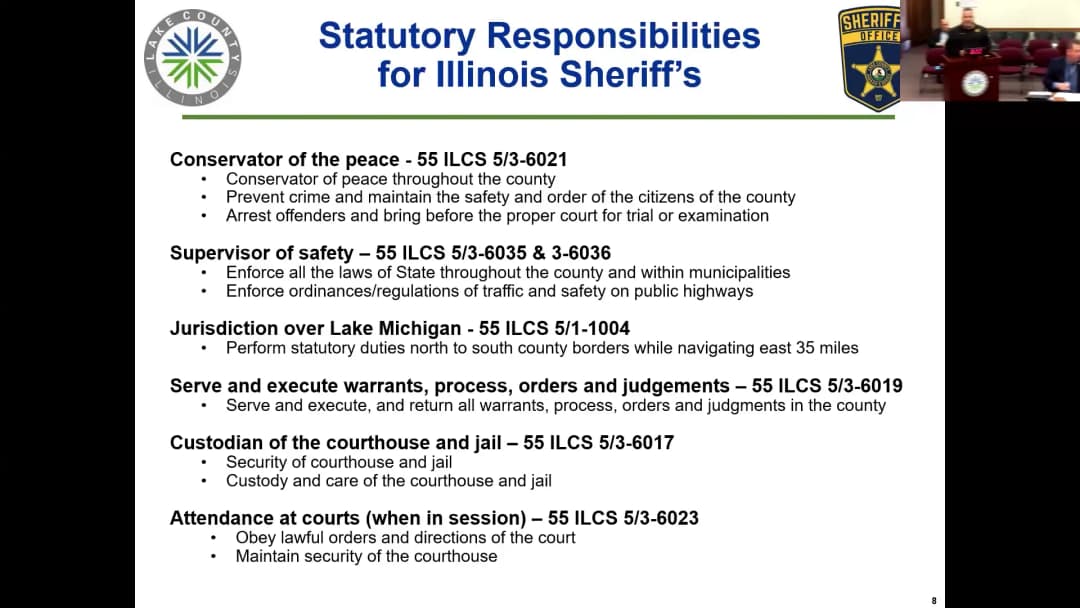
Date: August 5, 2025 The Law and Judicial Committee met on August 5, 2025, to consider a consent agenda, three regular agenda items, and a detailed update from the Sheriff’s Office. Key topics included grant funding for the Children’s Advocacy Center, a revised fee schedule for the Sheriff’s Office, a HIDTA grant award, and an extensive discussion on jail operations, staffing, overtime, and the McHenry County inmate contract. The meeting concluded with a vote to keep executive session minutes sealed. Consent Calendar - The committee approved the consent agenda (item 8.18.4) which included minutes from June 24–25, 2025, and reports from the Aaron Weinstein office, Jennifer Bannock, and Chief John Allenberg. The motion was made by Vice Chair Roberts, seconded by Member Altenberg, and passed unanimously. Discussion Items - Children's Advocacy Center Grant (8.5): Sarah Hammock, program director, presented a resolution authorizing acceptance and renewal of $219,591 in Victims of Crime Act (VOCA) funding from the Children's Advocacy Centers of Illinois. The grant period runs July 1, 2025, to June 30, 2026, and fully funds mental health programming (two contract therapists) and on-call special pay for forensic interviews. The medical clinic had a soft launch in June 2025, expecting increased cases. Member Altenberg recused herself. The motion passed unanimously. - Sheriff’s Office Fee Schedule (8.6): Sheriff’s representatives (Deputy Chief and Sergeant Scott Morrison) presented a revised fee schedule, the first update since 2017. Key changes: service of summons fees decreased 27% due to route efficiencies; replevin fees increased substantially (from $170–$206 to up to $445) because service now requires three deputies instead of one. The fees represent about 5% of Sheriff’s revenues. Revenue forecasting accuracy was noted: 99.71% in FY24, 98.57% in FY23, 107% in FY22. The motion passed unanimously. - HIDTA Grant (8.7): Lieutenant Novak presented the fifth year of the High Intensity Drug Trafficking Area (HIDTA) grant from the Office of National Drug Control Policy, totaling $254,700. Statistics for 2024: 156 criminal investigations, 80 arrests of drug/gun/human traffickers, seizure of approximately $24 million in narcotics street value, 130 illegal firearms, and 58 machine gun conversion devices. The motion passed unanimously. - Sheriff’s Office Update (8.8): Sheriff presented an extensive update covering: - Successes: Suicide intervention, marine rescue of two teenagers, discovery of a loaded automatic weapon on an inmate, interception of fentanyl-laced mail, consolidation of 911 systems, and partnerships for mental health crisis response (COAST program, over 1,000 people contacted). - Staffing: Since 2018, 167 hires but 217 departures (net -50). Hiring challenges due to direct supervision model, tier two pension, and national law enforcement recruitment difficulties. Raises of 23% helped but still not highest paid in state. Average daily jail population rose from 521 (2024) to 583 (2025), with total population at 621 (morning of meeting). - McHenry County Contract: To address safety concerns from overcrowding and understaffing, the Sheriff exercised statutory authority to transfer up to 150 inmates to McHenry County at $100/day (vs. local cost of $168.23/day). 147 inmates were housed there. The contract reduced lockdowns and overtime (overtime hours decreased 52% with Tyler training factored). The Sheriff emphasized the decision was for safety, not savings, though net savings may exist. Travel costs and in-person court requirements limit expansion. - Overtime Costs: High overtime driven by hospital guards (e.g., one inmate at Condell required 40,000 hours of overtime) and other necessities. - Funding: The Sheriff requested consideration of using RTA quarter-percent sales tax funds (over $100 million available) for a new public safety building and jail medical unit expansion. Discussion noted Lake County is the only collar county not using these funds for public safety, historically because it lacked a gas tax (now a 4-cent gas tax recently passed). - Board Comments: Members expressed support, asked about long-term planning, and recognized the national scope of staffing issues. Chair Cunningham noted the need for a strategic conversation about jail model and facility. Sheriff reiterated commitment to safety and transparency. Key Outcomes - Approval of Consent Agenda (minutes and reports) – unanimous. - Approval of Children’s Advocacy Center Grant Resolution – unanimous (Member Altenberg recused). - Approval of Sheriff’s Fee Schedule Ordinance – unanimous. - Approval of HIDTA Grant Resolution – unanimous. - No formal action on Sheriff’s Update – discussion only. - Executive Session Minutes: The committee voted to keep all executive session minutes closed, following the State’s Attorney’s recommendation. Motion by Member Cittas (?) passed unanimously. - Next Meeting: August 26, 2025.
Public Meetings - Lake County, Illinois
Public Meetings - Lake County, IllinoisThe Health and Community Service Committee met on August 5, 2025, at 8:31 AM. Chair Parak participated electronically due to a qualifying reason. All members except Member Casson were present. The committee approved several resolutions and an ordinance, and conducted an executive session for periodic review of closed session minutes. Discussion Items - Workforce Development (8.1): Director Jennifer Sereno presented a joint resolution accepting the Illinois Department of Commerce and Economic Opportunity Workforce Innovation and Opportunity Act (WIOA) Apprenticeship Expansion Grant 2025 in the amount of $275,000 for the Lake County Workforce Development Department, authorizing an emergency appropriation and increasing headcount by one full-time employee. The grant funds a second apprenticeship navigator focused on the care economy (healthcare, education, social services). Over the past two years, the program has onboarded 19 apprenticeships through social service agencies and worked with Joquegan High School on a paraprofessional apprenticeship program leading to a teaching certificate. The resolution passed unanimously. - Citizen Participation Plan Revisions (8.2): Community Development Administrator Dominic Strezo presented a resolution approving revisions to the Housing and Community Development Commission citizen participation plan. The revision clarifies the appeals and grievance procedure for non-funding decisions, as recommended by the State's Attorney's Office. The resolution passed unanimously. - HOME American Rescue Plan Program Allocation Plan Amendment (8.3): Dominic Strezo presented a joint resolution approving the first amendment to the HOME ARP Program Allocation Plan. Due to a HUD miscalculation, an additional $9,044 was awarded. The total HOME ARP funds are approximately $6 million, with none spent yet. The amendment incorporates the additional funding. The resolution passed unanimously. - Rental Assistance for Asylum Seeker Services (8.4): Dominic Strezo presented a joint resolution accepting an additional $30,000 from the Metropolitan Mayors Caucus for rental assistance for asylum seeker services. The funds will be passed through to partner Mano Amano. The resolution passed unanimously. - Nuisance Ordinance Amendment (8.5): Director of Environmental Health Larry Mackey presented an ordinance amending Chapter 94 of the Lake County Code of Ordinances (Nuisances and Environment Sanitation, Administrative Adjudication). Changes include: striking minor well and septic violation provisions from the nuisance ordinance (to be enforced under their own ordinances), and adding that allowing animal feces or urine to deposit on another person's property to the extent it causes property damage or loss constitutes a public nuisance. This also covers harboring animals (e.g., feeding wildlife) that cause such nuisance. The provision requires evidence and is intended for extreme cases. The ordinance passed unanimously. - Medicaid Match Dollars for Health Department Capital Projects (8.6): Director of Finance and Administrative Services Angela Cooper presented a joint resolution authorizing an emergency appropriation of $2,040,635.74 in Medicaid match dollars for fiscal year 2025 for the Lake County Health Department and Community Health Center. The funds are designated for capital and facility improvement projects and are placed in a dedicated fund. The resolution passed unanimously. - Member Comment – Nursing Inspire Program: Member Cunningham reported attending the graduation ceremony for the Rosalind Franklin University Nursing Inspire program, which has 17 students from under-resourced high schools. The program provides CNA training at CLC and aims to develop the healthcare workforce. Lake County workforce development was recognized for its support over the past three years. Key Outcomes - All six resolutions (8.1–8.6) and the ordinance (8.5) were approved unanimously by voice vote. - The committee entered executive session via roll call vote (motion by Vice Chair Cunningham, second by Member Keneshnick) for the purpose of periodic review of closed session minutes (5 ILCS 120/2). - After executive session, the committee accepted the State's Attorney's Office recommendations: release 4 of 12 executive session minutes items and keep 8 items confidential. The motion passed unanimously. - The next regular meeting is scheduled for August 26, 2025.
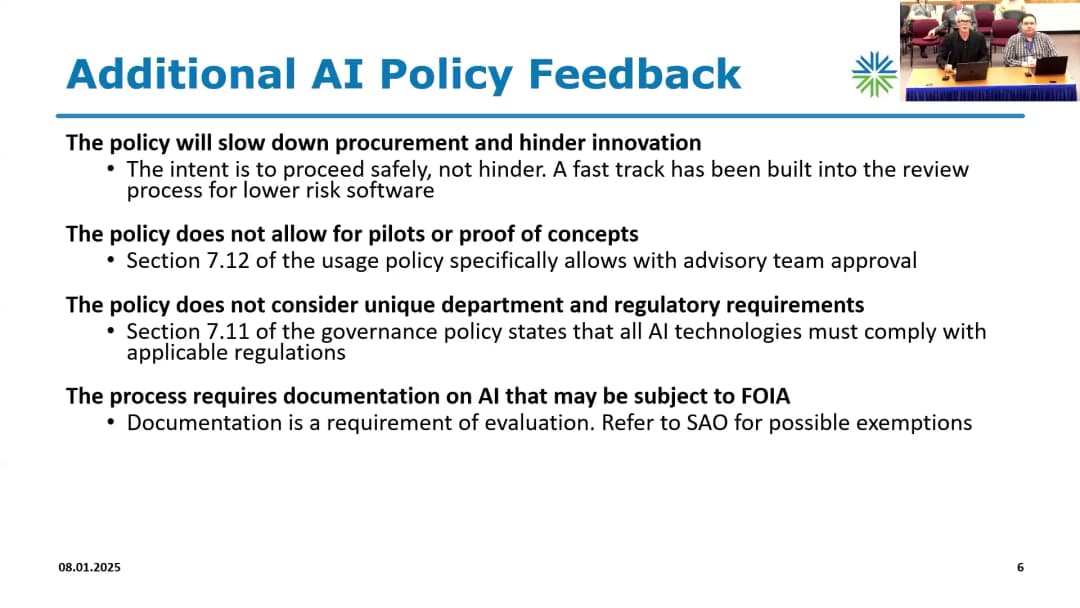
The Lake County Technology Committee met on August 1, 2025, at 8:30 AM via hybrid format. Chair Clark presided. The committee approved a consent agenda, a contract for security system installation, and three new or revised IT policies (cybersecurity awareness training, AI governance, AI usage). Updates were provided on broadband initiatives, the digital navigator program, and the enterprise resource planning (Workday) implementation. All votes were unanimous. Consent Calendar - Item 8.1 (Consent Agenda): Approved unanimously without discussion. Discussion Items - Item 8.2 – Contract with Pace Systems Inc.: Joint resolution authorizing a $52,457.85 contract to install access control, security cameras, and intrusion alarm systems at a leased warehouse (33740-3742 Hotheron Court, Waukegan) in support of the county clerk’s move. Funded by the county clerk. Director of Facilities Carl Carrar explained the system ties into the county IT network and will use the same provider as at 415 Washington. Committee members asked about video access, cybersecurity, and integration with county IT. Clerk’s office staff clarified that access is tied to two-factor authentication and that the warehouse security will follow similar protocols. Approved unanimously. - Items 8.3, 8.4, 8.5 – IT Policies: Three joint resolutions were considered together: - 8.3 Cybersecurity Awareness Training Policy (revised): Requires annual training per state statute, continues monthly Ninja videos (participation 90%), and focuses phishing test failures on additional training. - 8.4 Artificial Intelligence Governance Policy (new): Establishes oversight for AI software procurement, risk evaluation, and an advisory team. Allows fast-track approval for low-risk tools. Excludes pilots/proofs of concept unless reviewed. - 8.5 Artificial Intelligence Usage Policy (new): Provides guidelines for ethical, responsible use of AI, including human-in-the-loop, prohibitions on entering PII, and reporting requirements. - CIO Chris Blanding and Applications Manager Mike Buslana presented. The policies underwent a collaborative countywide review; all department feedback was integrated where possible. The Sheriff's Office opted out temporarily due to contract matters but will continue to participate. The Health Department opted of regulatory requirements (HIPAA, Board of Health approval) but will develop its own aligned policies. Both departments expressed intent to adopt future versions. Committee members praised the collaborative process and emphasized the need for government-specific training scenarios and pre-approved AI tool lists. Approved unanimously. - Item 9.1 – Broadband Update: Kay Crandall (Digital Equity Manager) and Kim Lunt (Digital Equity Coordinator) reported on federal BEAD program changes (technology-neutral, removal of fiber-first preference, low-cost plan requirements, workforce/digital equity funding cuts). Illinois is in wave two. The county is monitoring, engaging ISPs, and lobbying for restored metrics. Public Wi-Fi projects in Waukegan and North Chicago are progressing with intergovernmental agreements. Digital Navigator program metrics: served 1,913 unique residents, 1,355 engagement hours, 1,561 sessions, 426 devices distributed. Learn to Earn classes use North Star assessments (293 users, 508 passes out of 1,035 assessments, 451 certificates). Digital Equity Coalition meetings held. Committee members thanked staff and noted the life-changing impact. - Item 9.2 – Enterprise Resource Planning (ERP) Implementation Update: Patrice (project manager) reported that the Workday system has completed configuration and unit testing (2,700+ scenarios by 60 team members). End-to-end testing launched this week (1,000+ scenarios, touching dozens of hands). Over 900,000 rows of Lake County data loaded. Change management outreach underway. Project remains on schedule and within budget. Committee members expressed excitement about efficiency gains (e.g., automated invoice processing). - Directors Report: None. - County Administrator's Report: Introduced new CFO Regina Tuchuk. Key Outcomes - Approved Consent Agenda (Item 8.1) unanimously. - Approved contract with Pace Systems Inc. (Item 8.2) unanimously. - Approved Cybersecurity Awareness Training Policy, AI Governance Policy, and AI Usage Policy (Items 8.3, 8.4, 8.5) unanimously, with noted opt-outs by Sheriff's Office and Health Department. - Received broadband and digital equity updates; noted ongoing federal policy changes. - Received ERP implementation update; project on time for go-live. - Postponed Item 13.1 (closed session minutes review) to the next meeting (August 29, 2025) on a motion by Member Campos, second by Roberts, approved unanimously. - Meeting adjourned at approximately 9:45 AM.
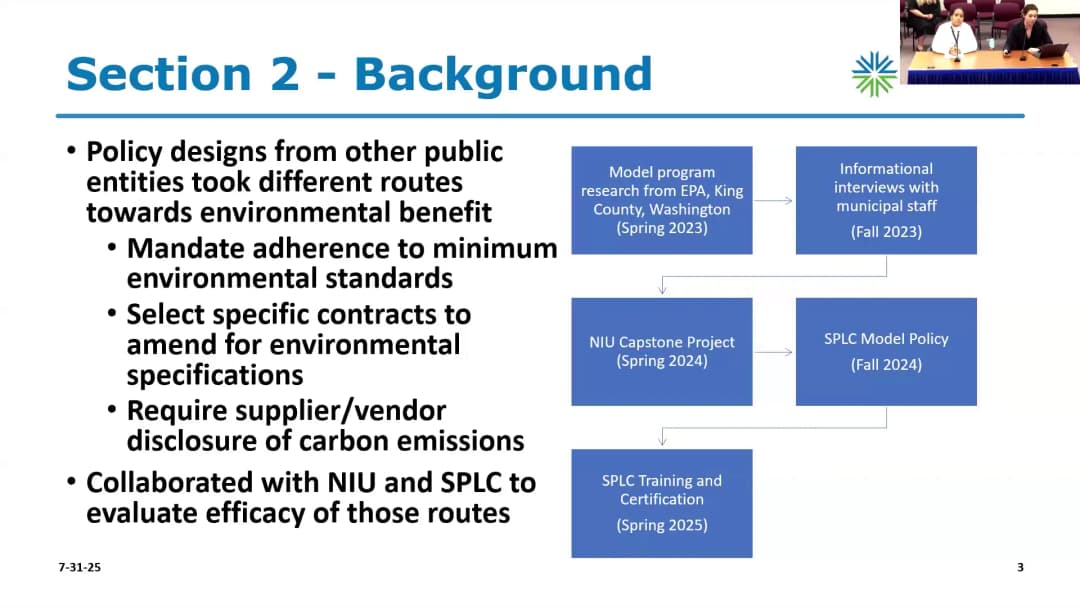
The Lake County Financial and Administrative Committee met on Thursday, July 31, 2025, at 8:30 AM. The meeting included discussions on the dissolution of two special districts (South Lake Mosquito Abatement District and Avon Fremont Drainage District), a new environmentally preferred purchasing policy, and an informational review of the county's economic incentive policy. Several routine consent items were approved, and key decisions included directing staff to initiate the dissolution process for the mosquito abatement district and postponing the purchasing policy for further refinement. Consent Calendar - Items 8.1 through 8.14: Approved unanimously. No items were pulled or discussed. Public Comments & Testimony - Stephanie Hannon (Village Manager of Bannockburn): Opposed dissolution of the South Lake Mosquito Abatement District, citing its critical public health role (West Nile virus, vector-borne diseases), cost-effectiveness (2024 levy $481,000), and legal requirement for a voter petition/referendum. Urged the committee to not advance dissolution without proper public input. - Andrew Eastman (Trustee, Village of Riverwoods): Expressed strong concern about disbanding the district, referencing a Chicago Tribune op-ed by Martin Clifton on the efficiency of such bodies. Urged committee to understand the district's value. - Chris Ford (Mayor of Riverwoods): Requested the committee consider the district's stable financial condition and health benefits. Noted low tax rates, reserves for unusual mosquito populations, and that dissolution would cost municipalities more and increase health risks. Cited the district's high rating by the National Association of County and City Health Officials. Urged expansion rather than dissolution. Discussion Items - Dissolution of South Lake Mosquito Abatement District (Item 8.20): Assistant County Administrator Ruth Ann Hall outlined the dissolution process: a proposing ordinance triggers a financial audit, then a backdoor referendum if 200 signatures or 7.5% of registered voters oppose. The district has a fund balance of just under $1 million. Chair Hart supported moving forward with analysis, noting that the Lake Bluff district was dissolved in 2021 with no complaints and that 47 municipalities in the county lack such districts. Member Maine raised concerns about shifting costs to municipalities and loss of economies of scale, and noted that unincorporated areas would lose service. Vice Chair Park favored municipal control. Member Clark argued villages are best placed for accountability. Member Hewitt cited experience in unincorporated areas where services were not picked up. The committee agreed to direct staff to prepare a proposing ordinance and initiate an audit. - Lease for Election Equipment (Item 8.15): Clerk Anthony Vega presented a lease for new warehouse space at 3740-3742 Hawthorne Court, Waukegan, for $168,132.51 annually (20,000 sq. ft., two indoor loading docks) — a significant cost reduction from the current space. Approved unanimously. - Board of Review Emergency Declaration (Item 8.16) and Appointment of Alternate Members (Item 8.17): Approved unanimously. - Procurement Card Program (Item 8.18): Agreement with JP Morgan Chase for a two-year term with three one-year renewals. Approved unanimously. - Environmentally Preferred Purchasing Policy (Item 8.19): Sustainability Programs Manager Robin Groom presented a policy to incorporate environmental criteria into purchasing (e.g., third-party eco-labels, 5% price preference for green options). Discussion focused on the 80% of purchases under $30,000 that would not be covered by the policy's mandatory provisions, cost implications (a worst-case analysis showed up to $3 million on 2024 construction contracts), and concerns about certifications burdening small vendors. Member Clark emphasized creating market demand; Member Peterson questioned cost impacts. The committee voted to postpone the item to the September cycle to allow staff to address competition, eco-label definitions, and fiscal guardrails. - Dissolution of Avon Fremont Drainage District (Item 8.21): Ruth Ann Hall explained that under the Illinois Drainage Code, dissolution can proceed if 75% of the district lies within municipalities (Grays Lake 74.67%, others small shares). The process requires resolutions from each municipality and court approval. Chair Hart noted the district's funds would be distributed to municipalities. Member Maine requested a conversation with the Stormwater Management Commission (SMC) to understand impacts. The committee agreed to proceed with outreach to municipalities and SMC. - Economic Incentive Policy (Item 8.22): Administrator Sutton provided an informational review of the policy, used rarely (one executed sales tax sharing agreement since 2010, two others approved but unused). The policy allows case-by-case incentives (property tax sharing up to 50%, sales tax sharing) for new investments or expansions that demonstrate a return to the county. Members discussed concerns about transparency, fairness, and
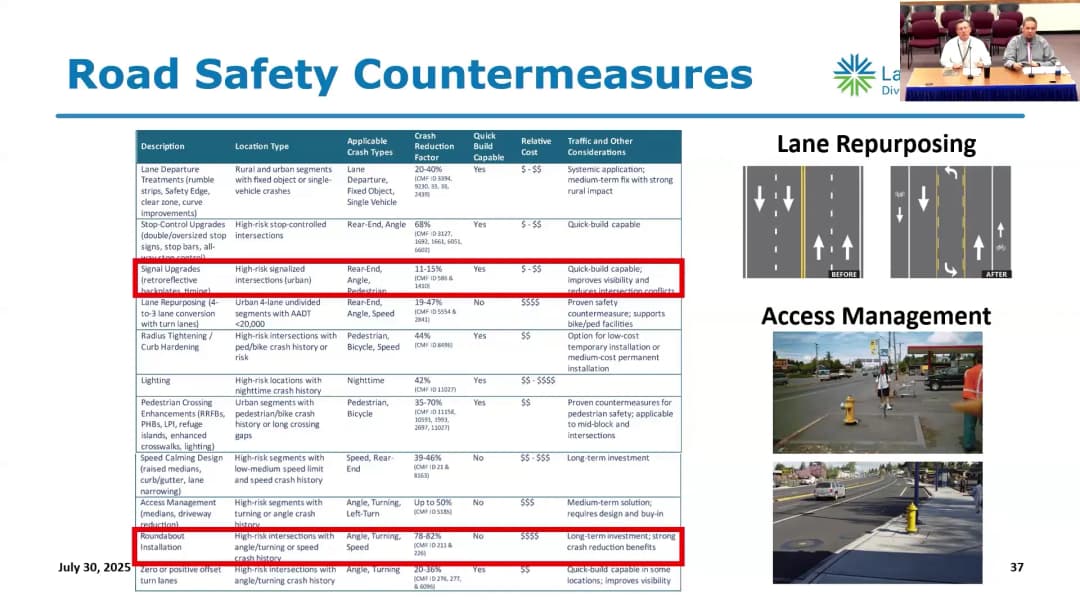
The Lake County Public Works and Transportation Committee met on July 30, 2025, at 8:30 AM. The meeting was chaired by Chair Clark and included roll call with members Kasman, Hewitt, Hunter, Vice Chair Maine, Roberts, and Wasick present. The committee addressed several resolutions, received presentations on water system resiliency and the Safety Action Plan, and discussed a bridge load posting. Consent Calendar - Item 8.1: Consent agenda was approved unanimously by motion (Kasman, second Hunter) without discussion. Discussion Items - Item 8.2: Joint Resolution for Belt Filter Press Maintenance – Authorized an agreement with Alpha Laval Inc. (Houston, TX) for $203,475 to perform critical maintenance, repair, and reconditioning of the belt filter press at the Mill Creek Water Reclamation Facility. Director Austin McFarland explained the equipment is over 20 years old and the department plans to replace it with a centrifuge in approximately two years. Member Roberts inquired about warranties and the lifespan of repairs. Motion carried unanimously. - Item 8.3: Engineering Services for Corrosion Control Evaluation – Authorized an agreement with CDM Smith Inc. (Chicago, IL) for $73,640 to conduct a desktop study for the Picar Water System corrosion control evaluation. The study is required by the EPA due to a planned water source change from well water to Lake Michigan water, to assess potential lead leaching from pre-1978 homes. The evaluation is expected to take about two months. Motion carried unanimously. - Item 8.4: Emergency Contract for Vernon Hills West Pump Station Force Main Replacement – Authorized a contract with Boulder Contractors Inc. (Carrie, IL) for $7,020,250, including an emergency appropriation from public works reserve funds, to replace two 16-inch force mains. The project was originally planned for FY26 but moved up due to partner agreements. Member Hunter noted the bid tab showed a base bid and an alternate; Director McFarland agreed to provide clarification on the difference before the finance committee. Motion carried unanimously. - Item 8.5: Director’s Report – Water System Resiliency Evaluation – Luke Manson (from consultant CDM Smith) presented a resiliency study for the Vernon Hills water system, which is served by CLC Java. The study assessed alternatives for a long-term interruption of CLC Java supply. The recommended short-term improvement (approximately $5 million) is a new interconnection with Buffalo Grove, including 3,700 feet of 14-inch water main and upgrades to the Corporate Woods reservoir pump station. Long-term (approximately $10 million) would add five groundwater wells, pending treatment for contaminants. Total estimated cost is $15 million in 2025 dollars. The presentation noted that Vernon Hills is the only CLC Java member without adequate backup water supply. Committee members expressed support and discussed implementation timelines (3–5 years). No action was taken; the study will inform future capital planning. - Item 8.6: Right-of-Way Acquisition for Wadsworth Road Improvements – Authorized $1,600,000 from the quarter-percent sales tax for transportation funds for right-of-way acquisition (by agreement or condemnation) for the Wadsworth Road project from Illinois Route 131 to Sheridan Road. Director Shane Schneider detailed the project scope: widening from two to three lanes, a new bike path on the south side, drainage replacement, and culvert/retaining wall work. Approximately 50 parcels require partial takings or temporary easements (average 10 feet per parcel). Construction is targeted for 2028. Motion carried unanimously. - Item 8.7: Safety Action Plan Presentation and Long-Range Plan Update – Mike Clemens, Manager of Transportation Planning, presented the final Safety Action Plan, funded by a federal Safe Streets and Roads for All grant. Key statistics: 65,504 total crashes (2018–2022), 225 fatal crashes, 248 fatalities, and 22,805 total injuries or fatalities. Fatal and serious injury crashes are concentrated on 7.5% of the roadway network (High Injury Network). Emphasis areas include speeding, impaired driving, roadway departures, and intersections. A goal of zero traffic fatalities and serious injuries by 2050 was set. Committee members discussed the methodology, including risk factor scoring and equity considerations. Chair Clark noted the plan will be incorporated into the county's long-range transportation plan (Envision 2050) and expressed interest in a Vision Zero resolution. The committee directed staff to bring back a resolution for consideration. - Bridge Load Posting Update – Director Schneider reported that IDOT posted weight restrictions on the Deerfield Road bridge over the North Branch of the Chicago River (20 tons for combination vehicles, 15 tons for single vehicles) due to beam deterioration. The bridge, constructed in 1962, was transferred to county jurisdiction in 2018. An engineering analysis for rehabilitation or replacement will be brought forward soon. School buses and emergency vehicles are affected based on individual vehicle weight. No formal action was taken. - County Administrator’s Report – Patrice Sutton welcomed new Chief Financial Officer Ritina Tuchek and provided an update on the ERP project, noting end-to-end testing has begun and is on track. Key Outcomes - Items 8.2, 8.3, 8.4, and 8.6 were approved unanimously. - The water system resiliency study (Item 8.5) was presented for information; staff will consider it in future capital planning. - The Safety Action Plan (Item 8.7) will be used to guide project selection; staff will prepare a Vision Zero resolution for committee consideration. - The bridge load posting will be monitored, and an engineering contract will be brought forward. - The next committee meeting is scheduled for August 6, 2026.
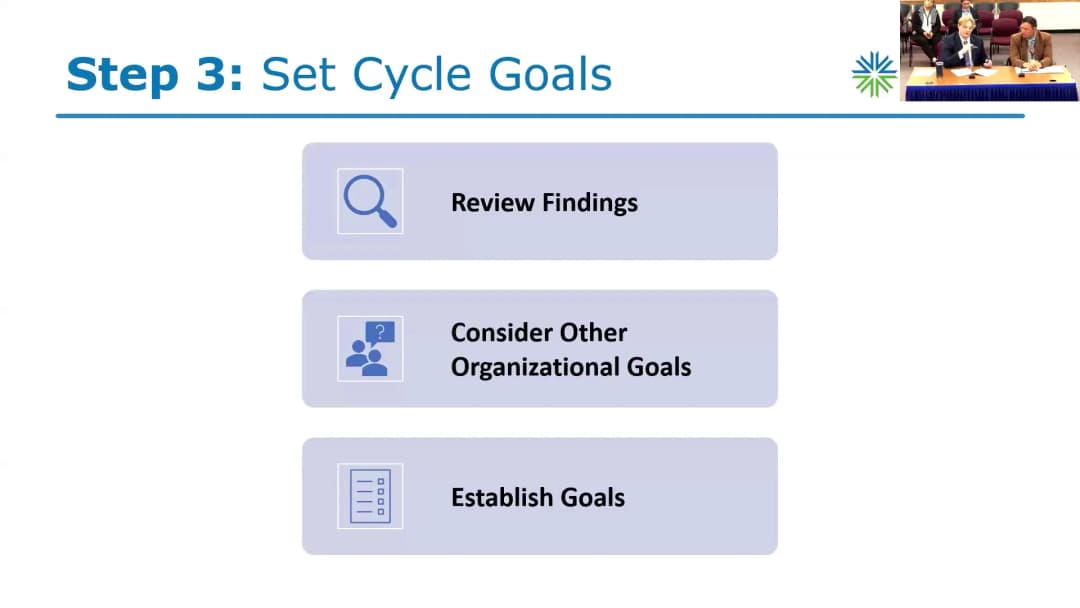
The Lake County Planning, Building, Zoning, and Environment Committee met on July 29, 2025, at 10:32 AM. Chair Aldenberg called the meeting to order with a quorum present, including member Schlick participating electronically. The meeting included a public comment, a consent agenda, and two major discussion items: an environmentally preferred purchasing policy and an energy program update. Consent Calendar - A motion to approve the consent agenda was made by member Compost, seconded by member Frank, and passed unanimously. Public Comments & Testimony - Andrea Gualdron, a student from Stevenson High School, expressed interest in becoming involved with the county board. She noted her experience with GIS data, zoning laws, and actuarial programs (e.g., Modeling the Future Challenge) and her collaboration skills through Science Olympiad. No specific agenda item was addressed. Discussion Items Environmentally Preferred Purchasing Policy - Robin Grooms, Sustainability Programs Manager, and Yvette Alberin, Purchasing Manager, presented the initial draft of an environmentally preferred purchasing policy, which would take effect in 2026. The policy aims to incorporate sustainability into county procurement through employee training, purchasing guides, eco-label certification forms, and a 5% price preference for green vendors in competitive bids. The 5% threshold was chosen based on national models and applies only when the green option meets specifications, is within budget, and is available with reasonable competition. - Key statistics: The policy could add up to $3.535 million in additional costs if all 33 construction bids in 2024 had a green option, but the presenters emphasized that the policy is not intended to inflate budgets. Eco-labels would be third-party verified to avoid greenwashing. - Member Frank questioned interaction with state/federal transportation funds and IT energy consumption. Staff clarified that the policy would not conflict with grants or statutes and that IT procurements can include sustainability specifications in RFPs. - Member Knijznek sought clarity on how the 5% preference interacts with the Responsible Bidder Ordinance. Staff confirmed that compliance with the ordinance is a prerequisite before applying the green preference. - Member Wasley raised circular economy concerns, including electronics recycling. Staff noted that existing surplus and recycling policies, as well as bid specifications, already address this. - Member Maine expressed caution about competing eco-labels and suggested focusing on a few measurable metrics (e.g., carbon or water usage) rather than relying on labels alone. He also asked about labor practices, but staff stated the policy currently covers only environmental factors. - Member Schlick (remote) advocated for guardrails beyond 5% (e.g., a dollar cap) and expressed concern that a single green bidder could exploit the preference. He argued for requiring more than one green bidder to trigger the preference. - Chair Aldenberg and member Compost emphasized the importance of local businesses and the need for purchasing staff to have flexibility in decision-making. - Member Peterson raised budget concerns, noting that cost increases could reduce the number of projects completed. - Member Velitzik (remote) supported the policy, arguing that government purchasing power can drive market change and that climate adaptation costs may justify such investments. - Member Frank clarified that the policy does not preclude staff from rejecting a green bidder if they are not responsive or responsible. - Staff response: Yvette Alberin noted that the committee's feedback would inform revisions, and the policy may appear on the next day's Financial & Administrative Committee agenda for further discussion, not final action. Energy Program Update - Carl Fuchs, the new Energy Program Manager, presented an overarching framework for decarbonizing county operations, aligned with the 2020 board resolution to reduce emissions 50% by 2030 and 90% by 2040, and procure 100% renewable energy by 2040. He noted that buildings account for 65% of Lake County's emissions. - Program goals include reducing total energy usage by 30% by 2040, reducing energy use intensity (EUI) by 20% by 2040, evaluating energy efficiency in all building upgrades, completing a facility-level decarbonization plan for major buildings by 2027, and creating a countywide investment plan by 2027. - Strategic pillars emphasize energy efficiency, electrification and renewables, energy data management, resilience, strategic funding, and leadership. A seven-step program cycle (data foundation, performance review, goal setting, strategic planning, execution, evaluation, and recognition) will guide repeatable, data-driven progress. - Member Wasek asked about partnerships, such as with ComEd. Staff confirmed ongoing data partnerships and plans to seek grants and funding opportunities. - Member Frank commended the framework's comprehensive approach. - Staff response: Carl Fuchs and Director Carl Carrar noted that the next steps include completing data collection and benchmarking, and they will return with progress updates in a few months. Key Outcomes - The consent agenda was approved unanimously. - No votes were taken on the environmentally preferred purchasing policy or the energy program; both were presented for discussion and feedback. - Staff will incorporate committee input into the purchasing policy and will present it again for potential action at a future meeting. - The energy program will continue with data collection and benchmarking, with a progress report expected in early fall. - The meeting adjourned without executive session; the next meeting will include a review of executive session minutes.
The Health and Community Service Committee convened on Tuesday, July 29, 2025, at 8:32 AM. Chair Park presided with Vice Chair Altenburg and members Castle, Conning, Dan Force, Kinesek, and Casman present. Member Maine was absent with notice. The meeting was conducted in person with remote access available. The committee approved a consent agenda and discussed multiple workforce development grants, a supplemental grant, a memorandum of understanding, and received reports from the Workforce Development Director and County Administrator. Consent Calendar - Item 8.8 (Consent Agenda): Motion by Vice Chair Altenburg, second by Member Kinesek, passed unanimously. Public Comments & Testimony - No public comments were made. Discussion Items - Items 8.2–8.4 (DCEO Workforce Grants – Taken Together): Director Jennifer Sereno presented three joint resolutions: - 8.2: Accepting the Illinois Department of Commerce and Economic Opportunity (DCEO) Workforce Innovation and Opportunity Act (WIOA) Program Year 2025 formula grant of $8,516,791 – a 24% increase over the prior year due to higher unemployment rates in Lake County. Funds support 30 staff positions, operations, and participant services (60% direct to participants, including over $1M in tuition, $1M in training wages, $500K in employee training, and over $600K in youth contracts). Pilot projects in manufacturing, AI, and apprenticeships were noted. - 8.3: Accepting a DCEO Quest grant modification of $135,000 to serve an additional 13 individuals in training and six with employer training wages. - 8.4: Accepting a DCEO Rapid Response grant of $350,000 to respond to layoff events. Since May 2024, 12 WARN events impacted over 1,000 workers; the grant will assist 28 impacted workers, 75 businesses, and support tuition and training wages. - Item 8.5 (Supplemental Grant – $232,774): Director Sereno explained this state-funded grant allows pilot programs without federal restrictions. The focus is on a program for young adults (high school graduates) not in employment or education, providing job readiness, life skills, digital literacy, and connections to apprenticeships or work-and-learn programs in professional services (customer service, accounting, marketing, graphic design). - Item 8.6 (MOU and Cost-Sharing Agreement): A joint resolution approving the Workforce Development Board MOU and cost-sharing agreement with the Job Center of Lake County. The job center has 14 partners; the facility cost is $228,000 (covered largely by College of Lake County). Workforce Development occupies the most space and will receive $51,000 back from partners. - Item 8.7 (Director’s Report): Director Sereno presented the Job Center annual report: - 21,000 individuals served in the past year (phone calls, visitors, outreach events, kiosks). - 8 kiosks placed at various locations (e.g., libraries, townships) for self-service access to job postings and partner links. - 10 Job Center on the Move locations in townships and libraries. - 125 U.S. Navy recruits assisted in transitioning to civilian workforce. - Summer Youth Program: 172 students placed at 30 worksites (including county departments), earning $15/hour for 20 hours/week over 6–7 weeks. Over 1,000 applications received; 150 students participated in a digital literacy program through the Lake County Digital Growth Initiative, earning a laptop. - Upcoming events: job fair on August 12, “Getting Hired After 50” Zoom event on August 7, and employer compliance training on August 20/22. - Members expressed strong support: Member Casman thanked Director Sereno for “inspiring work” and praised dynamic outreach. Member Cunningham requested that workforce development events be shared via board newsletters to reach residents. Another member (serving on Workforce Board) commended staff and noted that the WIOA funds increase aligns with national advocacy. - Item 9 (County Administrator Report): County Administrator Patrice Sutton updated the committee on the Enterprise Resource Planning (ERP) system implementation. Key points: - The project is in the “messy middle” with end-to-end testing beginning. Grant management, payroll, and compliance reporting are being integrated. - Staff augmentation in HR and finance is in place; departments are working extra hours. - Introduction of Regina Tuchek, new Chief Financial Officer and Director of Finance. - Member Cunningham praised the ERP system and highlighted that Lake County’s technology committee passed four resolutions at NACo. - Member Remarks: A member noted a new COVID-19 strain circulating and advised testing if symptomatic. Key Outcomes - All motions (Items 8.2–8.4, 8.5, 8.6, and 8.8) passed unanimously. No opposed votes were recorded. - No executive session was held. - The next committee meeting is scheduled for August 5, 2025, where open and closed meeting minute recommendations will be reviewed.