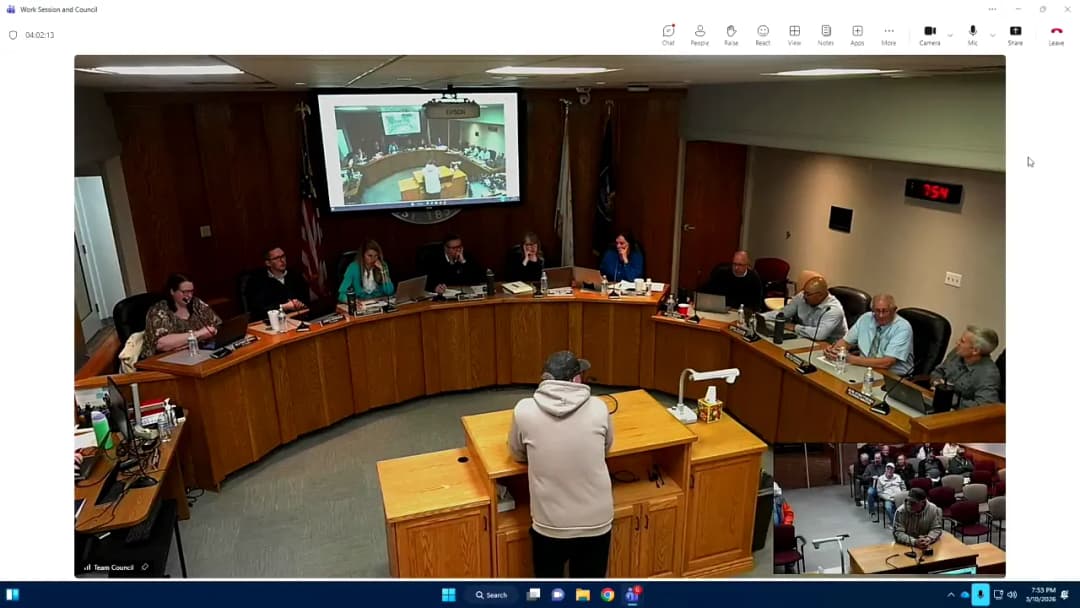
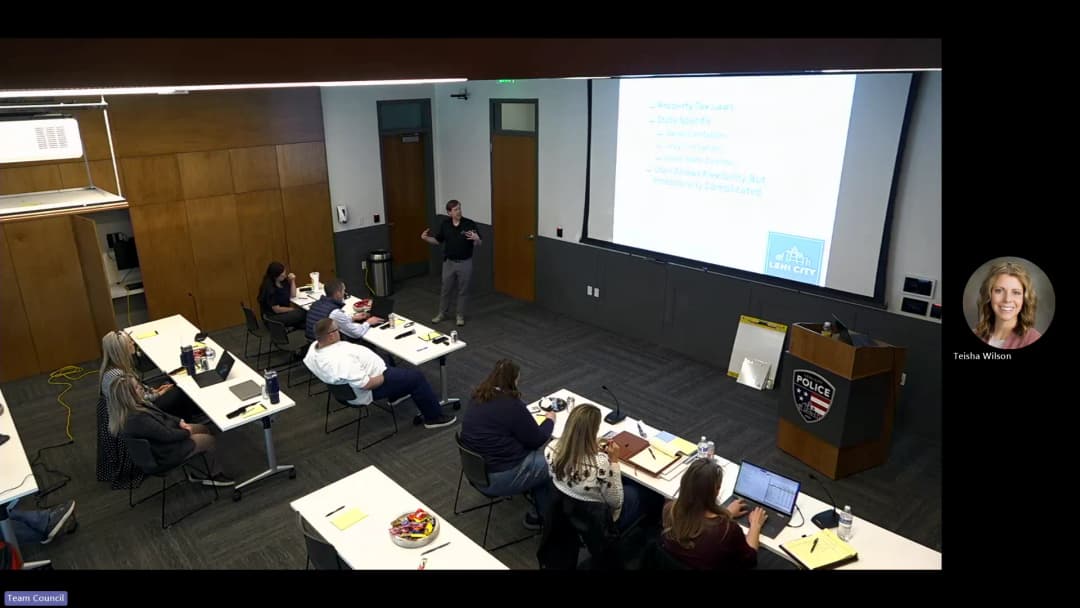
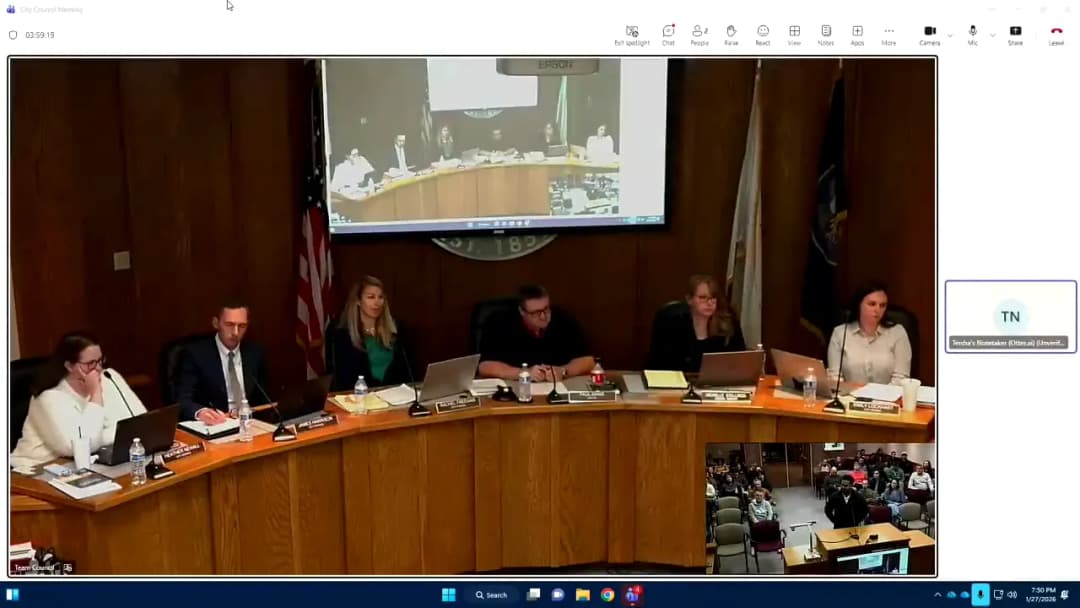
The Lehi City Council met on March 10, 2026, for a pre-council work session and regular meeting. During the work session, the council received updates from UDOT on the 2100 North Freeway and Pioneer Crossing Flex Lanes projects, discussed a proposed art installation for the new civic center, reviewed city goals and staff objectives, debated term limits for elected officials, considered a lease agreement with Ivory Innovations for a satellite literacy center, and deliberated a feasibility study for an ice center. The regular session included approval of consent agenda items, several resolutions for interlocal agreements, annexations, zone changes, and a development code amendment. Consent Calendar - Approved the consent agenda with an amendment to strike line 363 from the city council meeting minutes and adjust the text accordingly. Public Comments & Testimony - Mr. Palmer (pre-council citizen input) expressed concerns about safety on 200 South, citing excessive speeds and lack of sidewalks and bike lanes, and urged the council to prioritize traffic calming measures. - Andrew Ward (during regular session) opposed the Clark Meadows subdivision concept plan, arguing that reduced lot sizes erode semi-rural character and animal rights, and noted potential flooding and fire risks from nearby irrigation ditches. - Bart Peacock (during regular session) raised concerns about the 1400 East / 1220 North zone change, stating that a pre-cast fence is not fireproof and that he needs to maintain his irrigation ditch by burning, which could damage nearby structures. Discussion Items - UDOT 2100 North Freeway & Pioneer Crossing Flex Lanes Update: Andrew Jordan and Jeremy Baume presented. Construction on Pioneer Crossing flex lanes is underway, with three lanes in each direction expected by May and completion by fall 2026. The 2100 North Freeway project started March 10, 2026, with completion targeted for end of 2028. Council questions covered lane widths, speed limit (40 mph on Pioneer), lighting, and a pending noise study redesign for the I-15 interchange. - Civic Center Art Installation: Steve presented three concepts for a large bronze tree sculpture ($220,000). Council generally supported the concept but emphasized pursuing private donations; some members preferred a simpler flag or no art initially. No formal vote; staff directed to continue fundraising. - City Goal & Staff Goal Presentation: Bo and Bill led discussion on the council’s one-thing goal language. Council suggested changing “supports” to “values” and adding “for our residents.” Final wording to be circulated via email. - Mayor/Council Term Limits: Councilmember Harrison proposed term limits. Council debated pros and cons; some members favored two consecutive terms per position, others opposed any limits, citing trust in voters. Consensus to have staff research options and bring back a potential ballot measure for 2027 municipal elections. - Ivory Innovations Lease Agreement: Discussion on a 20-year, $1/year lease for a satellite literacy center. Councilmember Stallings raised concerns about shared insurance costs. Staff instructed to review insurance liability and negotiate terms. - Ice Center Feasibility Study: Marlon presented a $33,725 study from Babcock Design for a three-sheet ice rink with multi-sport courts, to be funded by RDA administrative fees. Council divided; some members questioned profitability and preferred county involvement. Decided to table for two weeks to allow Marlon to gather data on similar facilities’ profitability and ask Utah County to contribute. Key Outcomes - Resolutions Approved: - Resolution 2026-13 (Jordan River Pedestrian Bridge with UDOT): Approved unanimously. - Resolution 2026-14 (Shared Use Path Bridge with UDOT): Approved unanimously. - Resolution 2026-15 (Interlocal Agreement with Utah County for Utah Lake Trail): Approved unanimously. - Annexations Approved: - Sleigh Holdings (4 acres at 2300 W / 300 S): Approved unanimously. - Cedar Hollow Holdings (15.31 acres at 400 S / Center St): Approved unanimously. - Zone Changes Approved: - Parker Zone Change (2.4 acres, A1 to R1-22): Approved unanimously. - 1400 E / 1220 N Zone Change (5.25 acres, A1 to R1-22): Approved with additional condition that the preliminary subdivision and right-to-farm analysis return to council for review. - Snow Zone Change (0.66 acres, TH5 to R1 Flex): Approved unanimously. - 498 N / 900 E Zone Change (0.91 acres, R1 Flex to R18): Approved unanimously. - Development Code Amendment: Ordinance 09-2026 adding automobile accessories and installation to permitted uses: Approved unanimously. - Clark Meadows Subdivision Concept Plan: Approved 11 lots with density-in-lieu exception for setbacks, saving the city an estimated $300,000 in land and trail costs; DRC and planning commission comments included. - Term Limits & Ice Center Study: Tabled for further research and discussion at future meetings.
Public Meetings - Lehi, Utah
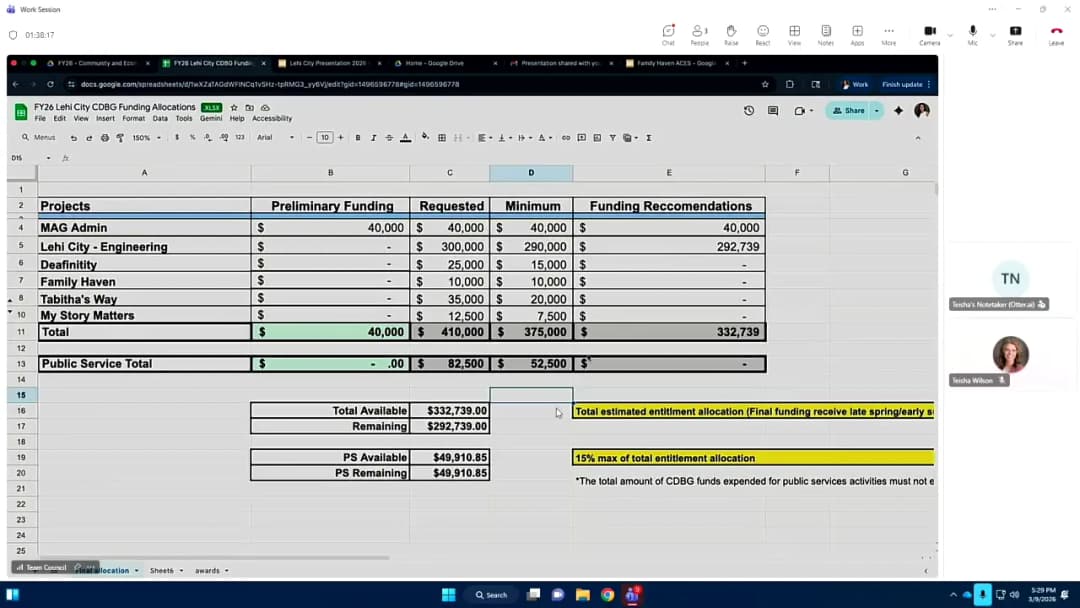
Public Meetings - Lehi, UtahThe Lehi City Council met on March 9, 2026, at 4:00 p.m. in the City Council Chambers. The meeting included presentations and discussions on several key topics: a community development block grant (CDBG) program overview and funding recommendations for multiple applicants, options to improve access and parking at Ozier Park, a safer systems approach and the 700 South cycle track, and an update on the UAMPS extended day-ahead market and pooling appendix. The council also received an update on the pedestrian bridge funding. No public comments were heard. Invocation Councilmember Stallings offered an invocation, asking for guidance and blessing on the city's residents and first responders. Discussion Items Ozier Park Access and Parking Options Steve from the parks department presented three options to increase access to the pond at the north end of Ozier Park for fishing and to improve mobility for all users. The options were: (1) a full paved road and 65 parking stalls (cost $285,000–$300,000), (2) a 10-foot paved trail around the pond with 8–10 parking stalls ($186,000), (3) a paved trail only ($40,000), and (4) a small road with trail and parking ($200,000). Council members expressed support for the trail-only option as a first step, citing cost, safety concerns about mixing vehicles and pedestrians, and the availability of existing parking (128 stalls). Council directed staff to include the paved trail in the budget request. A potential dock from Tibble Fork was also discussed as a low-cost addition to improve fishing access. Community Development Block Grant (CDBG) Program and Funding Decisions Claudia Saldana from the Mountainland Association of Governments (MAG) presented the CDBG program overview. The city receives approximately $300,000 annually, with a 15% cap on public services. Five applicants presented: - Tabitha's Way Local Food Pantry: requested $20,000–$35,000 to support food assistance, serving 17,000 Lehi individuals in 2025. - Lehi City Engineering (sidewalk project): requested $292,000 to add curb, gutter, and sidewalk on 600 North between 100 East and 400 East, addressing safety near schools and high pedestrian traffic. - Family Haven: requested funds for therapy and child care services for families in crisis. - My Story Matters: requested $12,500 for re-entry stabilization case management for formerly incarcerated individuals. - Definity Media: requested $25,000 for workshops and one-on-one support for deaf residents. Council discussed the difficulty of funding multiple applicants given the 15% cap on public services. Staff recommended funding the sidewalk project in full. Council voted to approve the staff recommendation, directing that the preliminary funding decision allocate the full $292,000 to the sidewalk project. The council noted that other applicants could seek funding from regional CDBG sources or city budget. Safer Systems Approach and 700 South Cycle Track Mike West presented a detailed overview of the Safe System approach, emphasizing the need to reduce traffic fatalities and serious injuries. He then discussed the existing two-way cycle track on 700 South, noting its design trade-offs and costs. Options for improvement included leaving it as-is, adding concrete protection ($740,000), converting to one-way protected bike lanes on each side ($750,000), or a buffered bike lane. Council members expressed mixed views, with some favoring one-way protected lanes for intuitive use and others noting the high cost and the fact that the track was recently completed with MAG funding. No decision was made, but the council agreed to revisit the issue when restriping is needed in about five years. An update on phase two of the cycle track (westward from 2300 West) was provided: funding is from MAG, likely available in 2028, and the design will be a two-way trail behind the curb. UAMPS Extended Day-Ahead Market and Pooling Appendix Joel from Lehi Power explained the upcoming changes due to the California Independent System Operator (CAISO) extended day-ahead market. The new market rules will require earlier scheduling and tighter resource adequacy requirements. The pooling appendix, governing UAMPS energy purchases, is being updated after 45 years. The council was skeptical about potential cost increases but acknowledged the need to participate. The matter will be brought back for approval on March 24, 2026. Pedestrian Bridge Update Brad reported that the MAG funding for the pedestrian bridge over SR-92 ranked highly and is expected to be funded. The city is also pursuing federal funding through Representative Mike Kennedy’s office with a $1.5 million request. Key Outcomes - The council directed staff to include a paved trail around the Ozier Park pond ($40,000) in the budget request. - The council made a preliminary CDBG funding decision to allocate $292,000 to Lehi City Engineering for the sidewalk project on 600 North. - No action was taken on the 700 South cycle track; future redesign will be considered when road restriping is needed. - The UAMPS pooling appendix will be considered for approval at the March 24, 2026 council meeting. - The pedestrian bridge funding is on track for MAG support, with additional federal funding pursued.
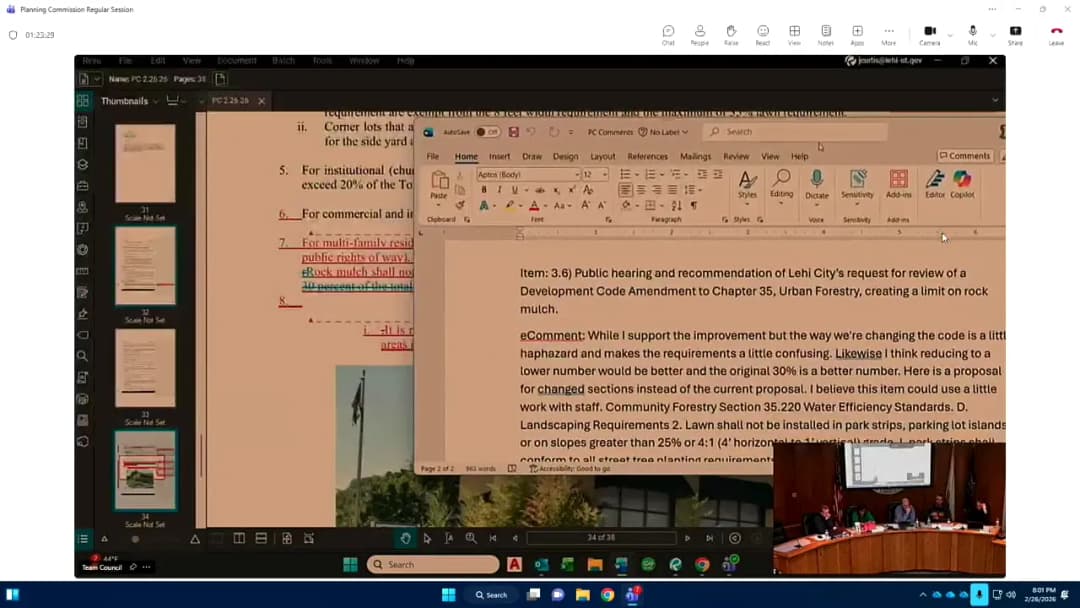
The Lehigh City Planning Commission met on February 26, 2026, at 1:45 PM to consider several land use and code amendment items. All items received recommendations for approval, with one item advancing to the City Council. Consent Calendar - Motion to approve the consent agenda, including approval of previous meeting minutes, passed unanimously. Public Comments & Testimony - Paul Jones (adjacent neighbor to Fox Trail): Expressed concerns about lot sizes being smaller than the R1-22 zone requires (under half-acre) and requested revisiting the road connectivity requirement, which he believes forces smaller lots. He appreciated prior collaboration. - Stephen Hansen (online comment): Supported the eight-lot plan over previous plans, but suggested hardscaping instead of park strips (due to tree mortality) and asked for standard residential fencing. - Montane Hamilton (online comment on rock mulch amendment): Proposed an alternative code amendment with a 30% rock mulch limit instead of 60%, along with other landscape requirements, and suggested further staff review. Discussion Items - 3.1 Cascade Collisions – Plat Amendment (1115 E Main St): Request to add one commercial lot to Lehigh Plaza Plat B. No improvements. Staff clarified the lot ownership. Public hearing held with no comments. Motion to approve with findings of compliance. Passed unanimously. - 3.2 JDH Developments – Zone Change (Vivian Estates Phase 5): Proposed change from TH5 (Transitional Holding) to RA1 on 11.58 acres at 2125 N 600 E, consistent with General Plan. Applicant NC Cooper confirmed. Public hearing, no comments. Motion to recommend approval, citing conformance with General Plan. Passed unanimously. Referred to City Council (target date: March 24, 2026). - 3.3 Symphony Homes – Preliminary Subdivision (Fox Trail): Eight-lot single-family subdivision at 1500 N 2850 W, with lots ranging from 16,000 to 33,000 sq ft. Density bonus granted by City Council in lieu of road widening. Public comments heard (Paul Jones and online). Staff explained connectivity standards (emergency access, pedestrian connectivity). Commissioners discussed lot sizes and the inability to waive connectivity. Motion to approve the subdivision as meeting code requirements. Passed unanimously. - 3.4 Development Code Amendment – Chapter 12D (Flood Damage Prevention): New chapter to comply with FEMA remapping. Staff absent due to illness. Commissioner expressed desire for author input but noted City Council would also review. Motion to recommend approval with findings; added DRC comment on paragraph spacing. Passed unanimously. - 3.5 Development Code Amendment – Chapter 37 (Maximum Setback Exception): Removes exception allowing parking module to exceed 50-foot maximum setback. Commissioners discussed need for an explicit maximum setback limit (e.g., 85 feet). Motion to recommend approval with a staff-recommended maximum setback (to be researched), finding the amendment conforms to code. Passed unanimously. - 3.6 Development Code Amendment – Chapter 35 (Urban Forestry – Rock Mulch Limit): Proposes limiting rock mulch to 60% of landscaped area in commercial and multifamily developments (originally 30%). Staff explained DRC compromise. Public comment (Montane Hamilton) favored 30%. One commissioner opposed 60%; others supported after staff rationale. Motion to recommend approval of the 60% limit with DRC comments. Passed (1 nay). Key Outcomes - Consent agenda approved. - Plat amendment (3.1) approved. - Zone change (3.2) recommended for approval to City Council. - Preliminary subdivision (3.3) approved. - Flood damage prevention chapter (3.4) recommended for approval. - Maximum setback exception removal (3.5) recommended for approval with added maximum setback of 85 feet (staff to refine). - Rock mulch limit (3.6) recommended for approval at 60%, with DRC comments. - Meeting adjourned at approximately 7:00 PM.
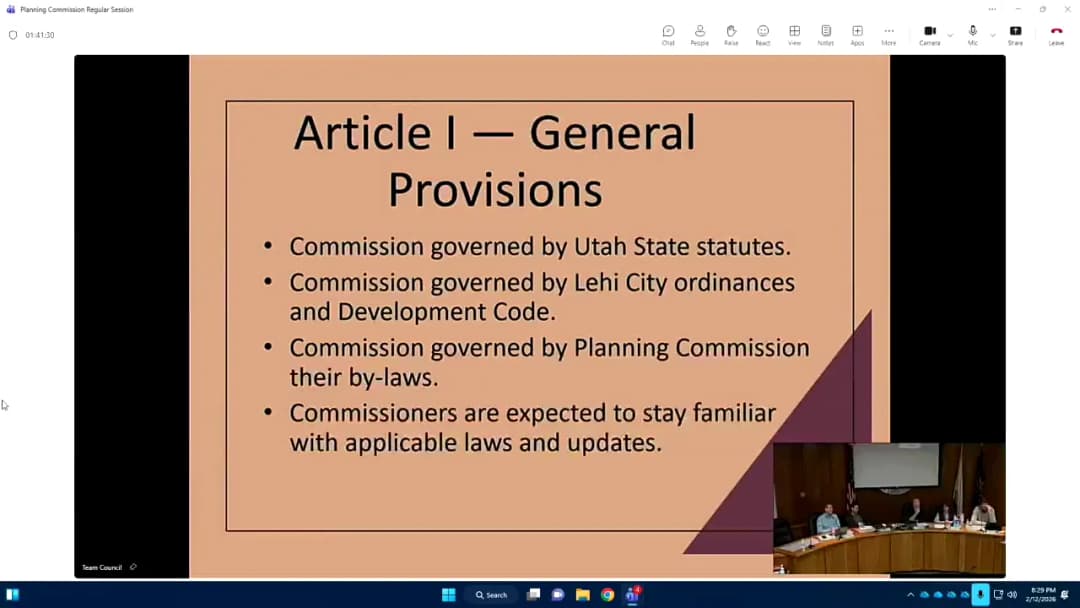
The Lehi City Planning Commission met on February 12, 2026, to consider several land-use applications and a code amendment. Public hearings were held for most items, and the commission voted to approve or recommend approval of all proposals. The meeting also included a training on the commission's bylaws. Consent Calendar - Approval of Minutes: The commission unanimously approved the minutes from the January 22, 2026 meeting. Public Comments & Testimony - Item 3.2 – Parker Zone Change: CLG Properties (Sean and Jennifer Lewis) submitted a written comment: no objections to the zone change, but raised concerns about sewer infrastructure on 300 North, noting that five of the six homes in the area are on septic and wells, and asking that sewer stubs be considered when future developments arise. - Items 3.3/3.4 – Grow Developments Zone Change and Concept Plan: - Danny Gutierrez (neighbor and developer of adjacent subdivision): Not opposed to the zone change, but concerned about road connectivity; noted that Titan Drive was built with the expectation it would connect through to the north, and the proposed layout could create three closely spaced access points. - Bart Peacock (neighbor at 1533 W 1220 N): Concerned about an irrigation ditch along the north property line; maintenance (burning) would be impeded if structures are built close to the property line; also raised safety concerns about narrow 1220 North and requested that construction traffic use wider subdivision roads. - James Cortesy (owner of property being sold): Stated that irrigation water from the ditch floods his property and will need to be addressed. - Item 3.8 – Heritage Meadows Preliminary Subdivision: - Joshua Lutz (neighbor): Expressed support for the development but requested a bridge/trail connection to the existing trail south of the site. He gathered 16 responses from neighbors: 14 favored the bridge even if it meant fewer lots, and the two opposed still wanted the bridge. He suggested the developer could increase density as an incentive. - Kara Traveler (online comment): Supported the development on condition that a bridge be provided. Discussion Items Item 3.1 – Flagship Home Transitional Holding Zone: Withdrawn by the applicant; may not be resubmitted. Item 3.2 – Parker Zone Change (2.4 acres, 300 N Palomino Way): Staff presentation noted the zone change from A1 to R122 matches the general plan’s VLDRA designation. The applicant was absent. The public heard the written comment. Commissioner discussion focused on sewer capacity; staff confirmed the existing infrastructure is adequate and developers will extend service as needed. The commission voted unanimously to recommend approval to the city council, finding consistency with the general plan and that development concerns will be met by the developer per standard city regulations. Items 3.3/3.4 – Grow Developments Zone Change and Concept Plan (5.25 acres, 1450 W 1220 N): These items were considered jointly. The zone change from A1 to R122 is consistent with the general plan. The concept plan shows eight lots each exceeding the 22,000 sq ft minimum. Public testimony raised concerns about road alignment (Titan Drive connection), irrigation ditch maintenance, and road width on 1220 North. Staff and the applicant discussed options: 1220 North will be widened to city standards, the developer may pipe the ditch if required, and access to headgates will be preserved. The concept plan requires further study at preliminary plat stage. The commission unanimously recommended approval of the zone change and approved the concept plan (as final authority) with a non-binding recommendation that the developer continue to engage with neighbors. Item 3.5 – Lawrence Snow Zone Change (0.66 acres, 151 E 1450 N): The zone change from TH5 to R1 Flex is permitted by the general plan’s LDR designation. The applicant intends to demolish the existing home and build a new one. No public comments. The commission unanimously recommended approval to city council. Item 3.6 – Belmont Flex Suites Concept Plan (1552 N Boston St): Kairos Land Development presented a non-residential flex office/warehouse development. An exception was requested from the 50-foot max setback due to a 10-foot utility easement (proposed setback is 59 feet). The applicant updated the site plan to include 34 parking stalls and requested that parking calculations be based on net (leaseable) square footage rather than gross, and that mezzanines not count toward parking. Staff supported the exception and parking approach. No public comments. The commission approved the concept plan with the setback exception and directed that parking be calculated using net square footage. Item 3.7 – Daryl Hodgson Flag Lot (645 W 2100 N): A flag lot previously approved in 2019 has expired; the same plan was resubmitted. Both lots meet the RA1 requirements. No public comments. The commission unanimously approved. Item 3.8 – Heritage Meadows Preliminary Subdivision (13 lots, 1250 W 800 N): The property was recently rezoned to R122. The applicant, Symphony Homes, seeks approval of a 13-lot subdivision. Public comments requested a bridge/trail connection to the south. The applicant stated they are studying the feasibility. The commission approved the preliminary subdivision, finding it complies with code, and included a recommendation that the developer strongly consider providing the bridge connection. Item 3.9 – Lehi City Zone Change (0.91 acres, 498 N 900 E): The city applied to rezone from R1 Flex to R18 to correct a density non-compliance. The three lots in the approved subdivision exceed the R1 Flex density cap (3.3 vs. 3.25 units/acre) but meet lot size requirements. R18 removes the density cap and is consistent with adjacent zoning. No public comments. The commission unanimously recommended approval to city council. Item 3.10 – Development Code Amendment (Automobile Accessories and Installation): The amendment adds a separate use category for less intensive auto businesses (e.g., tinting, decals, wraps) in non-residential zones, allowing them without the more restrictive regulations for auto repair. No public comments. The commission unanimously recommended approval to city council. Bylaws Review and Adoption Commission staff presented a training on the Planning Commission’s bylaws, covering membership, officers, meeting procedures, quorum (3 members), voting, recusals, and Robert’s Rules. Discussion included how to handle public comments and tie votes. After the training, the commission voted unanimously to accept the bylaws. Key Outcomes - Minutes of January 22, 2026 approved. - Item 3.1 withdrawn. - Item 3.2: Recommended to city council (unanimous). - Items 3.3 & 3.4: Zone change recommended; concept plan approved (unanimous). - Item 3.5: Recommended to city council (unanimous). - Item 3.6: Approved with exception and parking method (unanimous). - Item 3.7: Approved flag lot (unanimous). - Item 3.8: Preliminary subdivision approved with recommendation on bridge (unanimous). - Item 3.9: Recommended to city council (unanimous). - Item 3.10: Recommended to city council (unanimous). - Bylaws accepted (unanimous). Note: The transcript consistently refers to the city as “Lehigh City,” but the correct municipal name is Lehi City. This summary uses the official name.
This summary covers the Lehi City Council pre-council work session and regular council meeting held on February 10, 2026. The work session included discussions on telecommunications agreements, ordinance amendments for council and mayor compensation, and a noise control ordinance. The regular meeting featured public comments on the noise ordinance and a presentation from a county commissioner candidate, followed by council deliberation and a vote on the noise control ordinance. Consent Calendar - The consent agenda for purchase orders and city council minutes was approved unanimously (5-0). Public Comments & Testimony - Former Mayor Johnson introduced Isaac Paxman, who is running for county commissioner. Paxman spoke about his experience in local government and his readiness to serve. - Teresa Gonzalez requested the city consider increasing fencing requirements between residential and commercial properties to eight feet and adding noise buffers, noting she had raised the issue multiple times over six years. - Ross Carter expressed support for the noise ordinance changes but raised concerns about enforcement, particularly regarding nighttime disturbances. - John Hatfield, owner of HADCO Construction, opposed the noise ordinance as drafted, stating it lacked exceptions for historic businesses. He noted HADCO has operated in Lehi since the 1980s, employs over 750 people, and that a buffer was created when the facility was built. He requested the ordinance not be applied unconditionally to businesses like his. - Mike Bentley, a resident living near HADCO, described being woken up 4-5 nights per week by loud truck noise and said his family’s use of their backyard is impacted. He acknowledged some efforts by HADCO but stated coexistence has become difficult. Discussion Items - 4.1 – Option and Lease Agreement with New Singular Wireless (ATT): Staff explained that ATT will place equipment on an existing pole, requiring a small property lease. The agreement is one of only five or six such arrangements in the city. - 4.2 – Telecommunications Franchise Agreements: Two franchise agreements were discussed: a renewal for CenturyLink (now Lumen) and a new franchise for Emery Telecom. These agreements grant right-of-way access for internet service and include a 2.5% municipal telecommunications tax, considered reasonable compensation under federal law. - 4.3 – Ordinance Amendment for Mayor and Council Compensation: Staff proposed clarifying the compensation process by adopting salaries annually via a public hearing and ordinance, aiming for transparency and compliance with state code. Council members debated whether salary increases for elected officials should be automatic (as “shall” for city employees) or discretionary (as “may”). Councilmembers Emily, James, and others favored “may” to allow flexibility and avoid locking future councils into automatic increases. Councilmember Stallings raised concerns about the “shall” language potentially forcing council salaries to rise whenever employee salaries increase. The council also discussed distinguishing cost-of-living increases from merit increases for elected officials, with consensus that merit increases are not appropriate for council members. - 5. – Noise Control Ordinance (2026-04): The council discussed enforcement practicality. City Attorney Ryan noted that enforcing a specific decibel level requires a calibrated device and trained personnel (code enforcement or police officers). Police Chief confirmed that officers would have access to a calibrated device and training. Councilmember Freeman raised concerns about regulatory takings for historical businesses; Ryan responded that the ordinance is not a land-use ordinance, and the decibel levels have not changed, so vested rights arguments likely do not apply. Councilmember Harrison argued the ordinance ensures fair and equal application across the city. Councilmember Lockhart noted that the decibel levels are mild compared to other cities. Councilmember Lockhart also objected to a proposed exemption for sounds from city municipal buildings or property, except for essential government functions, arguing the city should be held to the same standard as others. The council supported amending the exemption by adding the word “essential” to specify essential government functions. Key Outcomes - Consent Agenda: Approved unanimously (5-0). - Noise Control Ordinance (2026-04): Approved unanimously (5-0), with an amendment to Section 5-3-7-6 to include the word “essential” before “government services.” Councilmember Lockhart voted yes but expressed concerns about enforcement and asked staff to report issues so the council can pivot if needed. - Councilmember James noted that Councilmember Freeman announced she is exploring term limit options for the council, and that staff time has been approved to research this; a future proposal is expected. - Next Steps: The compensation ordinance amendment will be brought back to a future meeting with proposed changes to make council salary increases discretionary (“may” rather than “shall”). The noise ordinance as amended will be adopted.
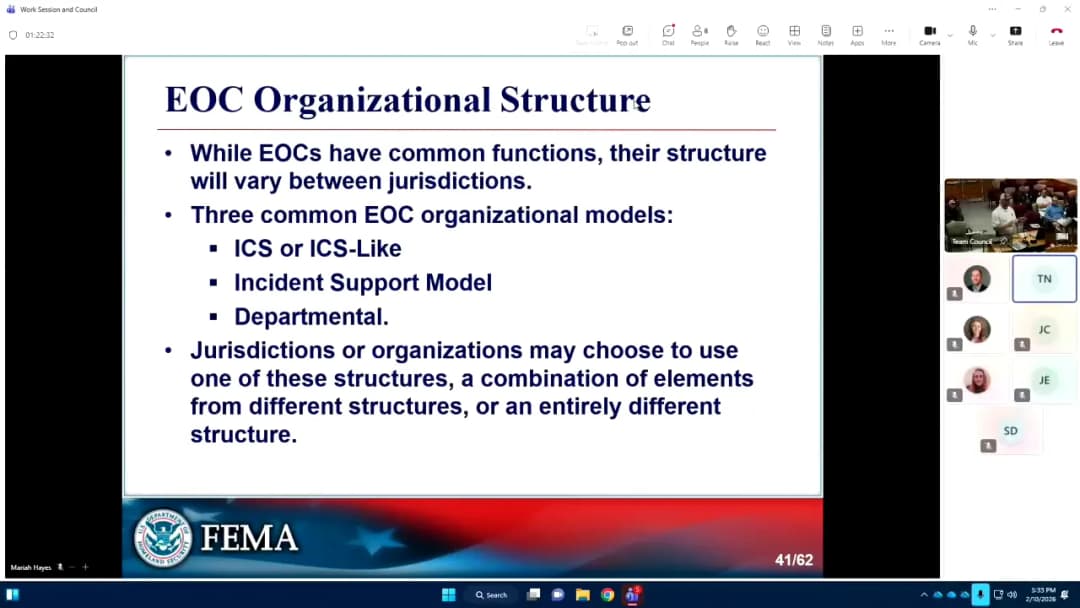
On February 10, 2026, the Lehi City Council convened for a regular meeting that included a comprehensive FEMA emergency management training session led by Utah County Emergency Manager Peter Quittner, followed by a unanimous vote to hold a closed meeting. The training covered the National Incident Management System (NIMS), incident command structure, roles of senior officials, and coordination between local, county, state, and federal entities. No agenda or minutes were available for this meeting. Discussion Items - FEMA Emergency Management Training for Senior Officials: Peter Quittner, Utah County Emergency Manager (15 years of experience), presented a FEMA course designed for elected and appointed officials. The training emphasized: - The National Incident Management System (NIMS) as a consistent template for managing incidents of any size, ensuring all responders are trained uniformly. - The legal basis for NIMS (Homeland Security Presidential Directive 5 and 8). - Local control: The city retains authority over its incident even when outside assistance is requested; the mayor has ultimate responsibility, but can delegate authority to an incident commander. - The roles of multi-agency coordination groups, emergency operations centers (EOCs), and joint information systems (JIS) for coordinating messaging and resources. - The distinction between a “declaration of emergency” (preparation) and a “disaster declaration” (response), which can suspend normal procurement rules. - Recent changes to federal disaster thresholds: Utah County’s threshold increased from approximately $3 million to $15–20 million, and the state threshold also rose significantly. - The importance of documenting all costs and volunteer contributions to qualify for FEMA reimbursement (75% federal, 25% local match). - Council and Staff Discussion: Councilmembers and city staff engaged in a Q&A session, including: - Councilmember Newell asked about confusion over command during the UVU incident; Quittner explained that while incidents may appear chaotic, internal organization is often structured, and communication is key. - Councilmember Lockhart asked when a delegation of authority is needed; Fire Chief (name not provided) explained that authority is already delegated to department heads, and further delegation to outside entities (e.g., for the Dry Creek fire) occurs when city resources are overrun. - Mayor (name not provided) noted that the council’s role during emergencies is to stay at the EOC or broadband room to approve funding, not to be on scene. - Emergency Manager Scott and Cameron (liaison) emphasized they would be the point of contact for the council during incidents. - Quittner recommended tabletop exercises to help officials understand their roles and to draft delegation of authority documents in advance. Key Outcomes - Unanimous Vote to Hold a Closed Meeting: The council voted unanimously (5–0) to hold a closed meeting in the council conference room to discuss “character, professional competence, or physical or mental health of an individual” (motion by Councilmember Stallings, seconded by Councilmember Lockhart). No further details were provided in the open session. - Training Takeaways: The council gained awareness of NIMS, incident command structure, and the importance of exercising emergency plans. No formal action was taken on the training itself. Note: The meeting began with a prayer and a brief technical difficulty with the presentation equipment. No consent calendar or public comments were included in the transcript.
The Lehi City Council held a work session on February 9, 2026, to discuss several key items, including the Thanksgiving Point Development Agreement, sidewalk funding, code amendments for screening and parking requirements, and auto sales in commercial zones. The meeting began with a prayer and the introduction of new code enforcement officer Travis Sharman. Introduction of Staff - Council welcomed Travis Sharman, the newly hired code enforcement officer. Discussion Items - Thanksgiving Point Development Agreement & Participation Agreement: Ryan Thomas of Stack Real Estate presented the history of the Thanksgiving Station project, including concept plan approval (March 22, 2022), area plan approval (August 8, 2023), and HTRZ approval (November 13, 2023). Over 20 drafts of the development agreement were discussed over nearly two years. Councilmembers expressed concerns about the agreement's obligations on the city, including the creation of a Public Infrastructure District (PID) allowing up to 15 mills of taxing authority, city sales tax backing of bonds (which was removed after public pushback), and the city's commitment to advocate for roads like Clubhouse Drive and a northern east-west connector. The developer offered to return with a simplified participation agreement aligning with the HTRZ code. Council agreed to review a revised version at a future meeting. - Sidewalk Funding Discussion: Councilmember Freeman initiated a discussion on prioritizing sidewalk projects and costs. City staff presented a priority system (near schools, parks, collectors, etc.), with an average cost of $350 per linear foot. A citywide map showed about 6.5 miles of missing sidewalks downtown (estimated cost $2.5 million for high priority areas, $9.9 million for lower priority) and 14.5 miles outside downtown. Council discussed using CDBG funds, grants, and potential cost-sharing programs used by other cities. Council requested a citywide priority list and further analysis on specific corridors like 2300 West, 5th West, and routes to public venues. - Code Amendments: Screening for Non-Residential Uses: Councilmember Stallings proposed amending code to require screening/buffering when any non-residential use borders a residential use, regardless of zoning district. Council supported the change and staff will draft an amendment. - Off-Street Parking Reductions: Council expressed concern over parking waivers for new developments downtown, citing a recent concept plan with zero parking that would rely on legacy center lot. Discussion included requiring parking studies, minimum parking percentages, and revisiting allowed uses. Council directed staff to explore amendments for parking requirements in mixed-use and historic commerce districts. - Auto Sales in Commercial Zones: Council debated removing minimum lot size requirements and instead basing inventory limits on available parking while maintaining public safety standards. Ideas included creating separate categories for small auto dealerships vs. class A sales, as in Farmington. Staff will research and bring draft code amendments. - Transient Room Tax for Short-Term Rentals: Council discussed requiring short-term rental hosts to obtain business licenses and sales tax ID numbers to ensure compliance with state lodging taxes. Staff will review with business licensing before proceeding. - Upcoming Agendas: Mayor asked council to send agenda items directly to him with a two-week lead time to allow staff adequate preparation. Key Outcomes - The Thanksgiving Point developer will return with a simplified participation agreement; no vote taken. - Council directed staff to amend code to require screening for non-residential uses near any residential use. - Council directed staff to develop a citywide sidewalk priority list and explore alternative funding mechanisms. - Staff will draft code amendments on parking requirements for mixed-use and historic commerce districts. - Staff will research and propose amendments to auto sales regulations in commercial zones. - Action on the safe systems/bike lane presentation and transportation plan item (2C) was postponed to the next work session due to staff illness. - The meeting adjourned with plans to continue discussions at the following regular session.
The Lehi City Council held a work session on February 5, 2026, to review financial policies, including budgeting, debt, reserves, impact fees, and property taxation. The discussion centered on balancing growth-related costs, maintaining fiscal discipline, and considering the long-term impacts of tax and fee decisions on residents and businesses. Council members and staff provided various perspectives on how to approach these issues without formal votes being taken. Discussion Items - Budgeting Policies: The finance director outlined seven financial policy categories, emphasizing the need for balanced budgets, conservative revenue estimates, and careful use of one-time funds. He noted that using reserves for capital projects is acceptable but warned against using one-time revenues for ongoing expenses. - Debt and Intergenerational Equity: Discussion covered the trade-offs between issuing debt for capital projects versus pay-as-you-go financing. The finance director explained that debt can promote intergenerational fairness, as those who use the infrastructure help pay for it. Council members debated the cost of debt interest versus construction inflation (7-10% per year) compared to borrowing rates under 3%, making debt attractive. One council member raised concerns about paying interest over long periods. - Impact Fees: The finance director reported that single-family homes in Lehi pay approximately $25,000 in impact fees. A council member noted that lowering impact fees to address housing affordability would shift the burden to existing residents through higher taxes or rates. A recent workshop with a major homebuilder revealed that reducing impact fees by 10% would not necessarily lower home prices, as builders sell at market rate. The discussion also highlighted the importance of regularly updating impact fee studies to stay compliant with state auditor requirements and to account for inflation. - Property Tax and Truth in Taxation: The council reviewed the truth-in-taxation process, including the certified tax rate and the two-year cycle for considering property tax increases. Staff explained that property tax growth from new development (new homes) does not require a tax increase hearing, but increases due to inflation do. Council members with prior experience noted that public turnout for small increases was minimal, while school district increases drew more attention. There was discussion about the timing of tax notices versus budget adoption, and a potential legislative bill to adjust the timeline. - Commercial vs. Residential Tax Base: Several council members emphasized the importance of growing the commercial tax base to reduce reliance on residential property taxes as the city nears build-out. They noted that Lehi struggles to attract commercial development due to competition from neighboring cities like Saratoga Springs and Eagle Mountain, which have lower property tax rates and faster growth. One council member suggested that increasing the residential exemption or lowering impact fees could discourage commercial investment. Another pointed out that shifting the tax burden to commercial would make it harder to attract businesses and jobs. - Reserves and Utility Rates: The finance director reviewed reserve policies, including a goal of 35% of general fund expenditures to weather a three-year recession. Utility rates should cover full costs including asset replacement, as reflected in impact fee facilities plans. A council member asked about the new power generation plants and whether their cost is allocated to growth or existing users; the finance director confirmed that a recent impact fee study allocated costs appropriately. - Quarterly Financial Reports: The finance director shared that quarterly reports are prepared but that the first quarter report is often less useful due to timing of revenue collections (e.g., property tax comes in December, sales tax lags two months). A council member suggested adding year-over-year comparisons for at least two years to improve the report's usefulness. Key Outcomes - No formal votes or motions were made during this work session. - The council expressed interest in continuing discussions on financial policies, impact fee updates, and strategies to increase commercial tax revenue. - The meeting was adjourned with the understanding that further discussions would continue, including potentially addressing the city's contribution to the county warming center at a future meeting. - Council members agreed to review the financial policies and property tax approach in more depth, with some indicating they would use calculators to analyze the numbers before the next session.
This budget retreat, held on February 3, 2026, from approximately 12:30 PM to 3:30 PM, provided city council members with an in-depth review of government fund accounting, utility fund health, and revenue sources. Finance Director Dean (along with staff members Allison and Carmen) led presentations on fund structures, sewer/water/power/garbage fund performance, sales and property tax trends, and franchise taxes. No formal votes were taken; the session was primarily educational and preparatory for upcoming rate decisions and budget discussions. Discussion Items - Government Fund Accounting: Dean explained fund accounting principles, distinguishing governmental activities (general fund, special revenue, capital projects, debt service) from business-type activities (enterprise funds: sewer, culinary water, pressurized irrigation, power, garbage; and internal service funds: fleet, IT, risk management, buildings). He noted that the general fund can have up to 35% of annual revenue in unassigned fund balance (state law), and that the city currently has about 30%. - Sewer Fund: Operating revenue of approximately $15 million vs. operating expenses of $19.6 million (including depreciation). Removing depreciation yields a $1.7 million cash loss. The fund pays about 75% of its costs to Timpanogos Special Service District (TSSD). TSSD increased rates 50% in January 2024 and announced additional 15% increases in 2025 and 2026. The city raised sewer rates 25% two years ago and 15% last year, and is now considering another 15% increase. Cash reserves are $5.6 million (123 days of operating expenses). Councilmember Rachel questioned why TSSD rates vary across cities and why Alpine appears to pay less; Dean noted rates are based on metered flows and capital project needs. - Culinary Water Fund: Healthy with large cash reserves and debt service coverage ratio of 5.5 (very strong). No rate increase planned. Pressurized irrigation (PI) fund has negative cash but is paying itself back for past capital projects; all new meters will be installed by 2030. A rate study consultant will use metered data to design a new rate structure with base and usage components. - Garbage Fund: Operates essentially as a pass-through with Waste Management. Contract includes CPI escalation and rising landfill fees. Current rate $16.94/month; proposed increase of $1.50 in July to keep pace. Recycling contamination rate affects costs; cameras on trucks may be used for education (contentious issue previously). - Power Fund: Unrestricted cash of $27 million (188 days). Debt service coverage is good. A rate study is underway; a gradual base charge ramp-up (up to $10/month) was implemented two years ago. Power costs spiked during the Texas winter freeze event, causing a $7 million monthly bill for two months. The fund has since recovered. - Revenue Sources: Sales tax at 1% city portion – half is point-of-sale, half distributed by population. Property tax: Truth in Taxation laws require council approval to exceed certified tax rate. Sales tax growth: 9.15% year-over-year through November 2025, but state forecasts 3.5% growth for 2026. Property tax revenue stable with modest growth from new development. Franchise taxes: 6% on electric/gas, 5% on cable TV, 3% on telecom; cannot tax internet service. - Comparisons with Other Cities: Lehi has the highest taxable property valuation in Utah County. Sales tax per capita is roughly average. Property tax rate is lower than many Salt Lake County cities, but those cities often have separate police/fire districts with higher fees. Council discussed pros and cons of creating dedicated public safety districts (transferring oversight, losing federal funding flexibility). - Legacy Center & Recreation: General fund transfers $2 million annually to cover recreation programs (facility, youth sports, pools). The largest cost driver is the indoor pool. Key Outcomes - Preliminary Utility Rate Increases Proposed (to be finalized later): - Sewer: 15% increase (to take effect July 1, 2026) - Garbage: $1.50/month increase - Power: New rate structure from ongoing study, to be presented at a future council meeting - Pressurized irrigation: New metered rate structure to be developed after consultant receives sufficient data - No votes taken on rate increases; these will be brought to council for formal adoption. - Staff to provide separate reports on culinary and pressurized irrigation fund balances for council review (currently combined in financial statements). - Council to receive a follow-up presentation on power rate study results in the coming weeks. - Continued monitoring of sales tax trends and state legislative proposals on property tax caps (discussed as a concern for bedroom communities).
The Lehi City Council convened on January 27, 2026, at approximately 7:00 PM in the Lehi City Hall council chambers. All five council members were present: Councilmembers Newell, Harrison, Freeman, Stallings, and Lockhart, along with Mayor Benz. The meeting addressed a range of items including public comments on bike lane infrastructure, a public hearing on transportation impact fees, approvals for a substation construction and a development agreement amendment, a zoning change to allow short-term rentals in Cold Springs Ranch, a controversial concept plan for a 219-unit development that was denied, a code amendment adding adult daycare as a home occupation, and two resolutions on local land use authority and transportation funding—one approved and two tabled. Consent Calendar - The consent agenda was approved unanimously (5-0) without discussion. Public Comments & Testimony - Chris Rollins (Lehi homeowner, 11+ years) expressed strong support for the protected bike lanes (cycle track) on 700 South, citing safety benefits for families and children. He requested that the council keep the cycle track design with a physical barrier, while being open to adjustments like curbing or signage. - Lynette McKenna (representative of Ruth and Nathan Hale Theater) invited the community to a week of discounted shows (Feb 2-7) for Lehi residents, using code LEHI5. - Hunter Page (Lehi resident, 4 years) spoke in favor of expanding bike infrastructure, noting that safer cycling options reduce traffic congestion and improve quality of life. He uses the bike lanes with his family and described the experience as "magical." - Crystal Harmon (homeowner near 1900 N) expressed concern about the proposed five-lane expansion on 1900 N, citing a speed study showing 80% of cars going 42+ mph in a 25 mph zone. She requested better pedestrian safety measures like crosswalks and barriers, noting a recent car crash that damaged her neighbor's fence near her children's playground. - Matt Redford (founder of Blaze 360) proposed a digital building documentation solution for the fire department to improve pre-planning and emergency response. He asked the council to direct staff to evaluate his company's platform. - Jose Zuniga (member of Western State Union Carpenters) requested fair opportunities for union labor in city projects, emphasizing apprenticeships for local youth and concerns about under-the-table payments. Public Hearing on Transportation Impact Fees - Rachel Volick (Bowen Collins Associates) presented the proposed update to the transportation impact fee. The last full analysis was in 2015; the new fee is based on the 2025 Transportation Master Plan. The existing fee is $121.79 per trip; the proposed fee is $146.87 per trip (a 20% increase), but with a credit schedule for existing users, the effective increase is 10% in 2026, rising to 20% by 2035. The fee goes into effect 90 days after adoption. - Council discussion: No questions; councilmember Freeman moved to adopt Ordinance 03-2026 with a commitment to revisit the fee every two years to account for inflation. The motion passed unanimously (5-0). Discussion Items Sky Substation Construction – Resolution 2026-04 - Brent Thomas (assistant director, Power Department) presented the agreement with RME for construction of the Sky substation. RME was the successful bidder; construction is slated to start mid-February. - Council vote: Motion to approve Resolution 2026-04 passed unanimously (5-0). Pro Steel Customs Development Agreement Amendment – Resolution 2026-03 - Dusty Yates (project petitioner) requested an amendment to add his company name (Malakus) and remove U-Haul/rental use from the agreement, as well as improve a 180-foot park strip. The original development agreement was approved in May 2025. - Discussion: Councilmember Freeman asked about a right-turn lane on southbound 2300 West onto Main Street; the applicant confirmed a turn lane is planned. Councilmember Lockhart noted that the change opens the property to auto sales (previously included U-Haul), but clarified the definition still allows general auto sales. The council discussed allowing car sales in commercial zones citywide; Councilmember Newell and Freeman are working on a draft for a work session. - Council vote: Motion to approve Resolution 2026-03 including all DRC comments passed 5-0, with Councilmember Lockhart voting yes to honor the prior council's decision despite personal reservations about development agreements. Cold Springs Ranch Area Plan Amendment – Ordinance 01-2026 - Kenneth Glaude (homeowner in Cold Springs Ranch) spoke in favor of allowing owner-occupied short-term rentals (STRs). He argued they support financial stability, are well-managed through platforms like Airbnb, and do not cause more parking or noise issues than long-term rentals. - Staff comment (Kim, city staff): STRs are allowed elsewhere in the city under regulations (owner occupancy, parking per bedroom, max 10 guests). The Cold Springs area plan currently excludes them; if changed, the HOA could still restrict them via private covenants. - Public comment: Brianna Hickon (homeowner in Cold Springs Ranch) stated she bought her home intending to use an STR to offset her mortgage but discovered the prohibition. She argued that the amendment would not strip HOA authority but allow future boards flexibility. - Council discussion: Councilmember Lockhart moved to approve, citing affordability benefits and consistency with city code. Councilmember Freeman seconded. Findings were added: the change promotes affordability and makes code consistent with the rest of the city. Motion passed unanimously (5-0). Concept Plan for Cho Property – 219 Units at 600 S & 2900 W - Tom Romney (Focus Consulting) presented a redevelopment concept for the 56.5-acre Chew property, currently zoned as environmentally sensitive area (ESA, 1 unit per 5 acres, yielding 25 units). The proposal included 219 units (53 single-family, 166 townhomes) with 48% open space, trail connections to the Jordan River, and a future lighted intersection on Pioneer Crossing. The petitioner acknowledged the need for a general plan amendment and rezoning. - Council discussion: Several council members expressed strong opposition to the density (going from 25 to 219 units). Councilmember Harrison noted infrastructure constraints (narrow 600 S road) and dependency on Saratoga Springs. Councilmember Freeman objected to Lehigh building density for Saratoga’s commercial. Councilmember Lockhart cited floodplain and wetland concerns, and the burden of maintaining the proposed open space. Councilmember Newell supported matching the character of the neighborhood (single-family, quarter-acre lots). Councilmembers also emphasized that property rights are limited by zoning and the city's obligation to protect existing residents. - Applicant feedback: The applicant (Braden Cooper, Century Communities) asked for direction on whether density or product type was the issue. The council indicated that a modest increase from 25 units (e.g., clustering on the east side) might be considered, but 219 was too high. - Council vote: Motion to deny the concept plan with findings including inadequate infrastructure, lack of a plan for the Saratoga border, and inconsistency with the general plan. The motion passed unanimously (5-0). Development Code Amendment – Adult Daycare as Home Occupation – Ordinance 02-2026 - Kim (staff) explained the amendment to allow adult daycare under home occupations, similar to existing child daycare rules. This would serve elderly or disabled individuals needing daytime care. - Discussion: Councilmember Stallings expressed support but requested that adult daycare providers obtain a Utah Department of Health Adult Daycare license and comply with Utah Admin Code R 501-1, plus an annual fire life safety inspection. This was incorporated into the motion. - Council vote: Motion to approve Ordinance 02-2026 with the added licensing requirements and DRC comments passed unanimously (5-0). Resolution 2026-05 & 2026-06 – Urging Preservation of Local Land Use Authority - Councilmember Harrison presented the resolution opposing statewide high-density or "by-right" housing mandates, emphasizing local control. The resolution was amended to remove a reference to Davis and Weber counties to avoid unintended offense. - Council discussion: All members voiced support, noting that land use decisions are best made locally and that state mandates shift infrastructure costs to cities. Councilmember Newell appreciated the acknowledgment of the need for a diverse housing supply. - Vote on Resolution 2026-05: Motion passed unanimously (5-0). - Vote on Resolution 2026-06 (for participating municipalities): Motion passed unanimously (5-0) with the same amendment. Resolution 2026-07 & 2026-08 – Urging Equitable Transportation Funding for Utah County - Councilmember Harrison introduced the resolution, which originally included comparisons to Davis and Weber counties. After discussion, council members expressed concerns about the timing and need for more collaborative data. Stakeholders suggested waiting for the Pell study and aligning with other cities via MAG. - Decision: Motion to table both resolutions until August 1, 2026, with direction to staff to gather data and bring back revised language for council consideration. The motion passed unanimously (5-0). Key Outcomes - Consent Calendar: Approved 5-0. - Transportation Impact Fee: Ordinance 03-2026 adopted 5-0, with biennial review requirement. - Sky Substation: Resolution 2026-04 approved 5-0. - Pro Steel Customs Development Agreement: Resolution 2026-03 approved 5-0 with DRC comments. - Cold Springs Ranch Short-Term Rentals: Ordinance 01-2026 approved 5-0, allowing owner-occupied STRs; HOA retains civil enforcement ability. - Cho Property Concept Plan: Denied 5-0 with findings including insufficient infrastructure and inconsistency with general plan. - Adult Daycare Code Amendment: Ordinance 02-2026 approved 5-0, requiring state licensing and fire inspection. - Local Land Use Authority Resolutions: Both Resolution 2026-05 and 2026-06 approved 5-0, urging preservation of local control. - Transportation Funding Resolutions: Resolutions 2026-07 and 2026-08 tabled until August 1, 2026, with staff directed to collaborate with MAG and other cities. - Administrative: The February 24, 2026 city council meeting was cancelled; budget retreat scheduled for January 29 and February 5, with budget presentations March 9-10.