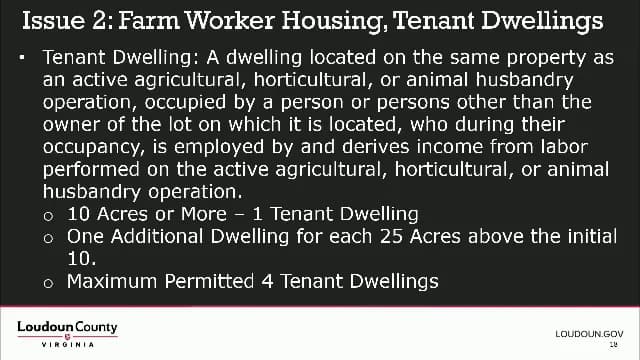
The Transportation and Land Use Committee (TLUC) held a special meeting on February 19, 2026, to continue discussions on the Comprehensive Plan Amendment (CPAM-2024-0002) and Zoning Ordinance Amendment (ZOAM-2024-0002) concerning rural uses and standards in Western Loudoun. The meeting focused on four outstanding issues: agricultural processing, farm worker housing, slaughterhouses, and agricultural education or research. Staff presented proposals and stakeholder input was gathered. No formal votes were taken; staff will prepare motions for the next TLUC meeting. Public Comments & Testimony - Kate Zerschmeid (Great Country Farms): Expressed support for flexible farm worker housing and local slaughterhouses. Opposed the 51% sourcing requirement for agricultural processing, calling it burdensome and unnecessary, and argued it would limit farmers' creativity. Emphasized that vehicle counts are a solid metric for ag education/research but urged simple, appropriate metrics to avoid driving farms to extinction. - Harriet Wagmire (Wegmire Farms): Questioned the distinction between principal and accessory processing, noting that her farm grows crops on multiple non-contiguous parcels. Requested flexibility in vehicle limits during harvest seasons, stating that 200+ vehicles can arrive for field trips but upper limits are too small. - Stephen Bradford (Potomac Vegetable Farms, Farm Bureau, Ag District Advisory Committee): Expressed gratitude for the participatory process and emphasized the need for diverse, low-impact, and flexible worker housing solutions. Highlighted the importance of inter-reliance among farms and supported collaborative approaches like migrant worker campgrounds. - Stacy Karlberg (Fireside Farm): Encouraged simple and not overly burdensome regulations for farm worker housing and ag processing. Supported flexible structures (e.g., tiny houses) and collaborative farm worker housing solutions. Asked not to hold farms to higher standards than breweries/vineyards. - Chris Van Black (Farm Bureau): Supported the 51% sourcing requirement expanded to a 50-mile radius for ag processing, but argued that farms should not face stricter rules than breweries or other non-farming rural uses. Stated that farms are being team players but other industries are not reciprocating. Warned of "all show and no grow." - Avis Renshaw (Lost Corner Farm): Supported meaningful local sourcing percentages and creation of an agricultural campground zoning category. Urged the board to value farm retention and local food availability. - Donnie Walker (Residential Sector): Expressed strong support for expanding ag education to fill gaps in vocational education, simplifying permits (e.g., removing grading plans). Favored bringing back slaughterhouses as by-right uses with permanent structures and employee-only processing. Urged simplified processes for farm worker housing, including addressing and safety incentives. - Linda Stunts (Residential Sector): Stressed that water supply issues in Western Loudoun are critical (cited a study showing well water levels declining 10–40 feet over 30 years). Supported seasonal worker housing and USDA-certified slaughterhouses but opposed more breweries/wineries. Questioned enforceability of 51% sourcing and suggested using land-use program monitoring approaches. - Robin Eve Jasper (Planning Commission): Aligned with Chris Van Black's "all show and no grow" concern, warning that permissive entertainment uses could escalate land values and squeeze out farming, similar to the data center effect in Eastern Loudoun. Supported the ag processing sourcing compromise and noted that health and safety codes already govern unconventional structures. Discussion Items - Agricultural Processing: Staff proposed relaxing the current 51% on-site sourcing requirement to 51% derived from agricultural operations within Loudoun County or from properties within 50 miles of Loudoun County. Discussion focused on enforceability, economic impact, and whether a percentage threshold is necessary. Vice Chair Turner questioned how the 51% would be measured or enforced. Chair Randall asked whether processing outside-sourced product still benefits Loudoun's economy; Chris Van Black affirmed it helps the region but not necessarily Loudoun farmers. Some speakers (e.g., Donnie Walker, Kate Zerschmeid) expressed concern about the burden during droughts or crop failures and suggested safety valves. The consensus leaned toward keeping the 51% from 50 miles but further refining details. - Slaughterhouses: Staff proposed allowing smaller-scale standalone slaughterhouses as a minor special exception (or potentially by-right) to address the current unmet need (e.g., year-long waits for processing). Vice Chair Turner and Supervisor Kerschner favored by-right with strong performance standards, arguing that the market would naturally limit size. Chair Randall asked for a definition of "smaller scale"; staff suggested square footage limits (e.g., under 10,000 sq ft). Donnie Walker proposed requiring 100% of animals from Loudoun County and restricting operations to permanent structures. The committee generally supported by-right approval with health/safety standards and renaming the use to "animal processing" to avoid negative connotations. - Farm Worker Housing: Staff presented a two-pronged approach: (1) creating a new "seasonal agricultural worker camp" use (mirroring state-defined migrant labor camps, permitted annually by the Health Department) and (2) modifying tenant dwelling regulations to allow more units, allow income from any Loudoun County farm, and permit unconventional structures (yurts, RVs, tiny houses). Fire Marshal Mike emphasized the need for addressing and access for emergency responders. Stacy Karlberg supported the flexible structures for affordability. Donnie Walker advocated for simplifying permits (no grading/site plans) and incentivizing permanent tenant dwellings. Chair Randall expressed concern about the term "migrant labor camp" and safety of workers. Vice Chair Turner suggested seasonal agricultural worker camp as a preferable name. The committee was open to exploring these options but noted complexity; staff will prepare motions for next TLUC meeting. - Agricultural Education or Research: Staff noted that the current definition is duplicated in both public/civic/institutional and agricultural support uses with different vehicle limits. The question was whether to clarify the definition and differentiate between minor farm-based education (agritourism) and large institutional facilities (e.g., Virginia Tech research stations). Vice Chair Turner asked if it could be folded into agritourism. Chris Van Black and several stakeholder speakers felt existing agritourism zoning is adequate for current farm education activities. Stacy Karlberg cautioned against creating a use that could be abused as an event center and suggested requiring identifiable research partners. The committee generally agreed that the definition needs cleaning up but that a new separate use is not necessary; the institutional-type uses can remain under special exception. Key Outcomes - No formal votes were taken. The committee reached directional consensus on several issues; staff will prepare motions for the next TLUC meeting (tentatively March or as scheduled). - Agricultural Processing: Support for the 51% sourcing requirement expanded to a 50-mile radius, but further refinement is needed regarding enforceability, drought/crop failure exceptions, and possible incentives (e.g., Loudoun Grown program). Staff will bring back draft language. - Slaughterhouses: Strong support for allowing smaller-scale animal processing as a by-right use (not minor special exception) with defined scale limits (square footage), health/safety standards, and possibly a local sourcing requirement. The use should be renamed to "Animal Processing." Staff will develop performance standards. - Farm Worker Housing: Staff will explore two tracks: (1) a seasonal agricultural worker camp use aligned with state migrant labor camp regulations (permitted annually by Health Department) and (2) revised tenant dwelling rules allowing unconventional structures, more units, and off-site income. Addressing, safety, and sanitation (e.g., vaulted privies) need to be addressed. Staff will bring forward proposals for committee consideration. - Agricultural Education or Research: The current duplicative definitions will be cleaned up. Minor farm-based education will remain under agritourism accessory uses; large institutional facilities will continue to require special exception. No new standalone use is recommended at this time. - Next Steps: Staff to draft motions and proposed ordinance language based on this meeting's guidance for the TLUC's next meeting (likely in March). The Zoning Ordinance Committee will begin review in June, with Planning Commission public hearings anticipated at year-end or early 2027.
Public Meetings - Loudoun County, Virginia
Public Meetings - Loudoun County, VirginiaThe Loudoun County Board of Supervisors held its regular business meeting on February 18, 2026, at 5:00 p.m. (with public input starting as early as 6:00 p.m.). Chair Randall called the meeting to order, followed by the pledge of allegiance and an invocation by Supervisor Kershner. The board deferred two items: Item 8 (Cochran Tech) was deferred to April 21, 2026, and Item 9 (Sterling Boulevard Service Road Improvement) was deferred to a future meeting. The board then adopted the consent agenda and considered several standing committee reports, legislative updates, and public input. Consent Calendar - The consent agenda was approved unanimously. It included: - R‑1: Resolution to Recognize Asbury Lloyd, Jr. (approval and presentation) - R‑2: Resolution to Recognize Recipients of the 2026 Award for Best Workplace for Commuters (approval only) - 1a: Award Authority Increase for traffic calming and safety improvements - 1b: Contract Award for IT hardware, software, and maintenance support - 1c: Contract Award and CIP Amendment for Route 7/Route 690 (Hillsboro Road) Interchange - 1d: Human Resources Policy Handbook revisions (Chapters 1 and 9) - 1e: Family Services Advisory Board 2025 Annual Report and Bylaws Revision - 1f: Revised Community Criminal Justice Board Bylaws - 1g: Loudoun County Community Services Board Bylaws Revision - 1i: Attainable Housing Loan Program – Clear Springs Apartments (Phase 1 and 2) - 1j: Attainable Housing Loan Program – Dogwood Farm Station Apartments - 1k: Attainable Housing Loan Program – Dulles Plaza Apartments - 2a: Heritage Commission 2025 Annual Report - 2b: Heritage Commission Bylaws Amendment 2025 - 2c: Historic District Review Committee 2025 Annual Report - 2d: Historic District Review Committee Bylaws Amendment 2025 - 2e: Project Plan for CPAM‑2025‑0002 (2026 Review of the Countywide Transportation Plan) - 3a: Appointments and Confirmations - 4: Administrative Items Report of February 18, 2026 - 5: Ratification of Tentative Agreement with IAFF Local 3756 for voluntary early detection cancer screenings Supervisor Briskman highlighted the attainable housing loan programs, noting that the three items (Clear Springs, Dogwood Farm Station, Dulles Plaza) would provide a total of 378 attainable units with affordability restrictions ranging from 40 to 75 years. Chair Randall and Supervisor Turner praised the county’s housing efforts. Item 7 (Auto World Substation) was pulled from the consent agenda for a separate vote. Public Comments - Shane Crow (Algonkian district, speaking for Upvote Virginia) reported that two ranked‑choice voting bills (HB 630 and SB 176) had passed their respective chambers and would expand local options for using ranked‑choice voting to all local governing bodies, including school boards and town councils. He expressed support for the legislation. - Mr. Griffin was called out of order by the chair for addressing the audience instead of the board. After a warning, he was ruled out of order and did not complete his remarks. - Mr. Heidi (Sterling) raised concerns about the school budget, noting that per‑student spending was projected to reach $25,000 with a declining enrollment, and that the budget was increasing more than 6 % per year. He questioned the addition of 14 elementary school principals and the discrepancy between teacher contract raises (6.5 % over three years) and the proposed 2.5 % step increase. He urged the board to scrutinize the budget. Discussion Items - Legislative Update (Item I‑1): Jonathan Freeman reported on the status of bills after crossover. Key points: - Housing grants bills passed both chambers and are expected to move quickly. - Oak Hill acquisition bills: HB 500 passed the House unanimously, but Senator Perry’s bill was left in Senate Finance; the matter is now a budget conversation. - Local anti‑rent‑gouging authority bills were defeated (House bill continued to 2027, Senate bill defeated). - Data center bills: Undergrounding transmission line bills (carried by Perry and Srinivasan) passed the Senate; they allow localities to assess costs to the GS5 rate class (high‑energy users ≥25 MW). The SCC clarified that the locality’s share could be 0–100 %. - A bill allowing a 15.8 % tax by Dominion on GS5 rate class to aid low‑income elderly/disabled electric costs passed the Senate. - A bill to take 30 % of new data center revenue was defeated. - All transit funding bills were defeated; now a budget discussion. - Chair Randall noted that the Faith in Housing Act (HB 630/SB 176) is still active and likely to go to conference. - Board members discussed the implications of the undergrounding bills. Supervisor Briskman expressed concern that the bills place the burden on localities to fund undergrounding, even if Dominion or the SCC do not agree. Supervisor Umstattd worried that the costs would fall on residents and businesses rather than solely on data centers. Supervisor Turner noted that the GS5 rate class could be charged, and that the bills provide a local option. Supervisor Crony asked about the authority to consider grid impacts; the county attorney clarified that the board does not currently have that authority. Supervisor Turner also highlighted SB 253, which would assign costs of new capacity and distribution infrastructure to the high‑usage customer class; he argued it directly addresses the issue. - Auto World Substation (Item 7): Chair Randall made a motion to approve the substation (ZMAP‑2024‑0010, SPEX‑2024‑0047, SPEX‑2025‑0112). Supervisor Crony noted the substation would be approximately 30 feet from the W&OD trail and expressed concern about the trail becoming a utility corridor. Supervisor Briskman added that the area already has data centers and that a 12‑foot screen would not mitigate noise and visual impacts. Staff confirmed the 12‑foot wall and that the buffer would be 15 feet wide. The motion passed 5‑3‑1 (Chair Randall, Supervisors Crony and Briskman voted no; Supervisor Sainz absent). - Ashburn Village Boulevard Pedestrian Safety (Item 10): Supervisor Glass moved to endorse the relocation of the crosswalk, installation of rectangular rapid‑flashing beacons, construction of a raised median refuge island, installation of ADA‑compliant curb ramps, and a budget adjustment of $532,000 from the CIP contingency. Chair Randall split the motion. The first part (endorsing the crosswalk relocation, flashing beacons, and perpetual maintenance) passed 8‑1 (Chair Randall opposed). The second part (raised median, ADA ramps, and funding) passed 8‑1 (Chair Randall opposed). Chair Randall argued that the location had no pedestrian crashes in five years, that an underground tunnel and a nearby traffic signal exist, and that the $532,000 could be better spent elsewhere. - CPAM‑2024‑0005, Electrical Infrastructure (Item 6): Staff presented proposed map and policy amendments to the 2019 General Plan regarding siting, design, and aesthetics of high‑voltage transmission lines. Supervisor Turner offered an amendment to Strategy 6.1E to add reference to “appropriate locations identified in the fiscal management and public infrastructure policies in Chapter 6,” which staff supported. The amendment passed 9‑0. The main motion (approving the CPAM with the amendment and other proposed edits) also passed 9‑0. - Appointments (Item 3b): Supervisor Glass nominated Jessica Lewis to the Library Board of Trustees for the Little River election district. The nomination was accepted. Key Outcomes - Consent Agenda: Approved unanimously. - Auto World Substation: Approved (5‑3‑1). - Ashburn Village Boulevard Pedestrian Safety: First part (flashing beacons and maintenance) approved (8‑1); second part (raised median, ADA ramps, funding) approved (8‑1). - CPAM Electrical Infrastructure: Approved with amendment (9‑0). - Cochran Tech (Item 8): Deferred to April 21, 2026. - Sterling Boulevard Service Road Improvement (Item 9): Deferred to a future meeting. - Legislative Motions: The board passed three motions supporting specific bills: - Spark Program (House Budget Amendment 307H and Senate Budget Amendment 308): Unanimous (9‑0). - SB 339 (State Corporation Commission cost allocation proceedings): Unanimous (9‑0). - SB 253 (assigning costs of new capacity and distribution infrastructure to high‑usage customers): Unanimous (9‑0). - Closed Session: The board voted 9‑0 to enter closed session under Va. Code § 2.2‑3711(A)(7) to consult with legal counsel on actual or probable litigation. Upon returning, the board certified that no formal action was taken in closed session. Voice for a Cause: The chair recognized Station Stitchers, a nonprofit that has handcrafted and donated over 5,000 quilts to local organizations serving people in need. President Henrich noted that the group is entirely volunteer‑run and relies on donations and grants.
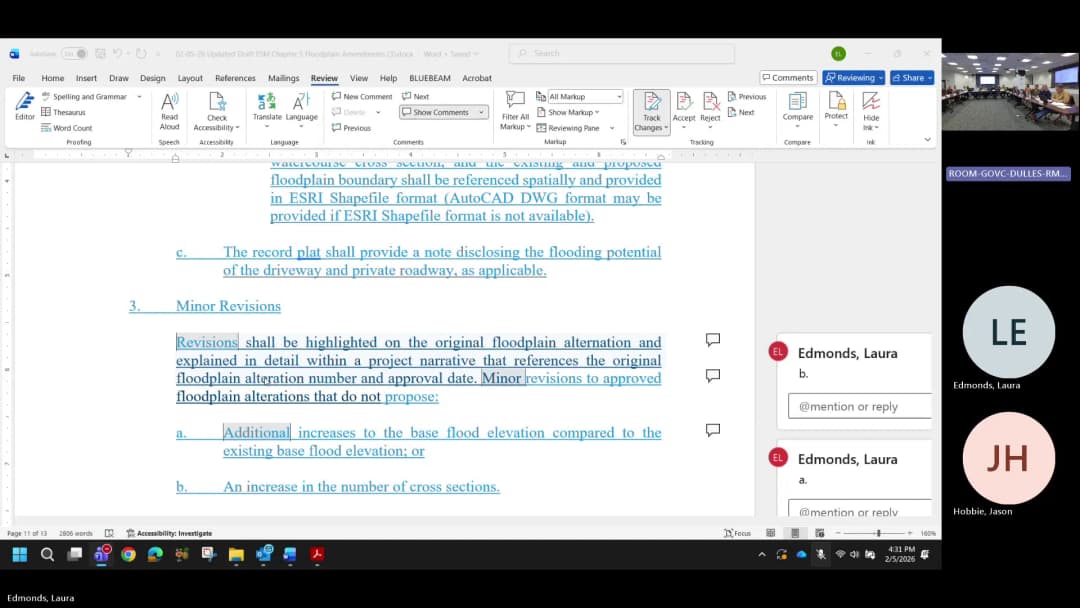
The committee met to approve minutes and conduct a detailed review of revised draft floodplain amendments to Chapters 5 and 8 of the Facility Standards Manual. Consent Calendar - Approved the minutes from the January 15, 2026 meeting with amendments. Motion carried unanimously. Discussion Items - Floodplain Amendments Overview: Staff and work group members presented revised text for Section 5.44 (Floodplain Alterations) and related sections. Key changes include a new independent no-rise certification replacing the previous declaration of no impact, revised categories for floodplain alteration types, and updated topography requirements. - Independent No-Rise Certification: Defined as requiring no increase in base flood elevation and no discernible change to the floodplain boundary. Examples include storm drain outfalls and clearing without grade changes. A new FEMA-based form will be developed. - Topography Standard: After debate, the committee agreed to use "best available topography" rather than strict two-foot contours, particularly for exhibits where no grading is proposed. Staff will adjust the requirement accordingly. - Grading Permit Inclusion: Added grading permit to the list of applications for which floodplain alteration approval must be obtained prior to approval. Language was refined to avoid duplication, using "if not previously provided" to allow single submission. - Driveway and Private Road Standards (Type One): Revised to allow C2 private roads (up to 7 lots) and agricultural accesses. Fire apparatus access roads may use culverts or arch pipes but not bridges. Added note requirement on record plats warning of potential flooding. - Type Two Floodplain Alteration: Confirmed that supporting data includes compensatory storage analysis. Duplicate LOMAR timing language in Chapter 5 was removed and retained in Chapter 8. - Chapter 8 Cleanup: Vicinity map section (8101 A7) updated to include AIOD on vicinity maps for site plans. Wetland permit note for grading permits corrected to reflect that permits must already be in hand. Key Outcomes - Approved the January 15 minutes with edits. - Directed staff to implement the discussed changes: use "best available topography", add grading permit, remove duplicate LOMAR language, move no-rise form to items-to-accompany, and other technical corrections. - The revised draft will proceed to county referral and then return to the committee for final recommendation before formal public process.
An ad hoc work session of the Zoning Ordinance Committee (ZOC) brought together county staff and agricultural stakeholders to discuss proposed floodplain ordinance changes affecting agricultural fencing. No formal agenda or minutes were available for this session. The discussion centered on lowering the floodplain accessory-structure threshold for agricultural fencing from 840 to 600 square feet, the definition of exclusion fencing, and FEMA no-rise certification requirements. No votes were taken. Discussion Items - Proposed threshold change: Staff explained that both major and minor floodplains currently allow agricultural fencing up to a limit, beyond which a special exception is required. The proposed zoning ordinance would lower that limit from 840 to 600 square feet, matching a FEMA accessory-structure recommendation. Staff described 600 square feet as about the size of a residential garage or shed. Because FEMA treats a fence as a structure, Loudoun County must regulate it as one. - Exclusion fencing in the proposed rewrite: Maggie noted that exclusion fencing would be added as its own permitted use, so it would not be limited by the square-footage threshold; however, it would still require a zoning permit and a FEMA no-rise certification. - Post-footprint calculation: The 600-square-foot limit is based on the footprint of the fence posts, calculated using the pi-r-squared formula, not on linear fence length. Bill Hatchet, a Western Loudoun cattle farmer, said a fencing project that used roughly 6,000 nine-inch round posts would exceed the threshold, and ordinary pasture and cross fencing can easily run long distances across a floodplain. - Hatchet position: Bill Hatchet said farms need agricultural fences in floodplains for cattle control, and exclusion fencing is an environmental benefit because it keeps livestock out of streams. He asked the committee to broaden the exception beyond the draft exclusion fencing definition so farmers are not caught in a costly special-exception process for ordinary agricultural wire fencing. - Exclusionary versus agricultural fencing: Staff read the draft exclusion fencing definition as a system of fencing, such as barbed, high-tensile, or electric wire, installed to exclude livestock from water courses for water quality improvement. Chris, from the soil and water conservation district, said the difference between exclusion fencing and general pasture fencing is often a distinction without a difference, because the same wire fence can serve both purposes; he supported considering a broader agricultural fencing definition. - FEMA and no-rise requirements: Staff and Chris clarified that exclusion fencing is an allowed use and does not need a special exception, but it is not exempt from zoning permitting or from the FEMA no-rise requirement. Any fence in a floodway requires a no-rise certification and a zoning permit. Chris estimated no-rise studies for fencing in the 1,500 to 3,000 dollar range, and riparian buffer tree-planting studies around 8,500 dollars. For soil and water conservation projects, grant funding can cover these costs. - Federal advocacy: Dale suggested asking the Board of Supervisors or the Virginia congressional/senate delegation to seek changes to FEMA rules. Staff and Chris noted that county staff and multiple previous members of Congress, including Congresswoman Wexton and Senator Kaine, had already tried multiple times without success. Gwen added that the no-rise interpretation is a FEMA-wide national policy, not a local or regional one. - Proactive zoning enforcement: Dale expressed concern that proactive zoning enforcement could suddenly target long-existing farm fencing. He described a 177-acre Trap Road operation that had operated for about 20 years and was recently told it needed a special exception. Staff responded that agricultural fencing would be an allowed use, so it would be unlikely to trigger enforcement, and a fence installed without a permit could be remedied by obtaining a no-rise certification. - Simpler fencing definition: Dale suggested defining agricultural fencing by construction type, such as wire fencing that lets water flow through, rather than by whether it is exclusionary, so farmers do not have to determine which regulatory box applies. He also questioned whether fencing on lands enrolled in open-space or conservation programs should be included. - Environmental distinction: Tia agreed with exploring a broader agricultural fencing definition but stressed that fencing that blocks or moves water must continue to be treated separately. The committee chair said ZOC would treat agricultural/exclusionary fencing as one category and all other fencing as a separate issue. Key Outcomes - No formal vote or decision was made; the session was an information-gathering discussion. - The committee directed staff to explore whether the exclusion fencing definition could be expanded to cover broader agricultural wire fencing and to bring draft options back to ZOC. - Staff reiterated that the county cannot waive the FEMA no-rise certification requirement for floodplain fencing; any permitted fencing still requires certification. - The item will be placed on the next ZOC meeting agenda for March 4, 2026. Staff may provide draft language by March 3 if ready; otherwise, the discussion will continue at a later meeting.
The Loudoun County Planning Commission held a work session on February 12, 2026, in Leesburg, Virginia. The Commission approved the previous work session minutes, received disclosures of applicant meetings, and considered three land-development work items: Quantum Park, Valley Commerce Center, and the NOVEC-Deimos Substation. The Commission voted to forward the first two applications to the Board of Supervisors with recommendations of approval and deferred action on the substation to a future work session. Consent Calendar - Minutes of the January 8, 2026, Planning Commission Work Session were approved 8-0-1, with Commissioner Jasper absent. Disclosures - Commissioners disclosed pre-meeting contacts with applicants. Commissioner Combs reported a February 9 meeting regarding Valley Commerce Center; Commissioner Miller reported meetings regarding both Quantum Park and Valley Commerce Center; Commissioner Frank reported meetings with Quantum Park and Valley Commerce Center representatives; Commissioner Banks reported text contact with a Valley Commerce Center representative; and Chair Kears reported meetings with both Quantum Park and Valley Commerce Center representatives. No conflicts were declared. Quantum Park (LEGI-2023-0097 / ZCPA-2023-0008) - Staff described a zoning concept plan amendment for the Quantum office campus north of Loudoun County Parkway, south of Waxpool Road in the Broad Run election district. The proposal would allow a data center, substation, and office use, and is grandfathered under the revised 1993 zoning ordinance that permits data centers and transmission substations without a special exception. - Since the November 2025 work session, the applicant had dedicated right-of-way for future Lockridge Road, reduced the proposed data center height from 100 feet to 75 feet, committed to a GIS substation, and improved screening and architectural elevations. During the meeting, Commissioner Frank requested and the applicant agreed to reduce the overall building height to 65 feet. - Staff discussed a prior proffer requiring three traffic signals along Loudoun County Parkway. Signal 3 is installed, signal 1 is in design, and a bond exists for signal 2, though staff did not anticipate that this application would trigger signal 2. Staff recommended a fair-share contribution toward the future Lockridge Road/Loudoun County Parkway signal; the applicant submitted a written commitment of up to $20,000, with the final amount to be determined with DTCI. - The applicant explained that the substation could not be moved to a rear parking area because Verizon holds exclusive lease rights to that secure parking area. The applicant said the substation was pushed back as far as possible and would be fully screened. - Commissioner Myers expressed disappointment that a substation would be placed at the front of a signature corporate campus, but the motion to forward the application to the Board of Supervisors with a recommendation of approval passed 7-1-1, with Commissioner Myers opposed and Commissioner Jasper absent. Valley Commerce Center (LEGI-2023-0080 / ZMAP-2023-0008 / ZMOD-2023-0041) - Staff presented a 117-acre application located in the northeast quadrant of Percival Road and Leesburg Pike, adjoining the town of Purcellville in the Purcellville Joint Land Management Area. The application includes a zoning map amendment and a zoning modification to eliminate certain road, water, and wastewater standards. - Staff continued to recommend denial, citing inconsistency with the Purcellville JLMA place type, land use and development pattern guidance, potential impacts to adjacent residential neighborhoods, and a reasonable potential to affect off-site residential water availability. Staff also noted outstanding issues involving the Purcellville North Collector Road connection, traffic, the loggerhead shrike habitat, heritage resources, and proffer administration. - The applicant said it had reduced density to 986,000 square feet, reduced building heights to 32 feet along the western side and 40 feet along the eastern side, added a $500,000 traffic signal contribution, a Mayfair left-turn lane, a right-in/right-out entrance, construction traffic management, and a 300,000-square-foot warehousing/storage restriction to limit water demand. - The applicant’s hydrogeologist testified that off-site well impacts are not expected, based on pumping tests and a county-reviewed hydrogeologic study. He said the state would cap the proposed well’s permitted production below the tested rate, making the use more regulated than 39 by-right residential wells and septic systems. - Commissioner Combs asked for comparable water-use metrics; the applicant cited approximately 0.002 gallons per square foot per day for long-term storage, 0.12 for light manufacturing, and 0.235 for flex uses. - Commissioner Miller asked about protecting the wooded area shown in staff figure 7. The applicant agreed to remove building envelopes from that area and treat it as a tree save/no-build area rather than a formal tree conservation area, with staff to review the language. - Motion by Commissioner Miller, seconded by Commissioner Banks, to forward the application to the Board of Supervisors with a recommendation of approval passed 6-2-1, with Commissioners Barnes and Frank opposed and Commissioner Jasper absent. NOVEC-Deimos Substation (LEGI-2024-0059 / CMPT-2024-0010) - Staff presented a commission permit for a 26-acre property at the northwest corner of Belmont Ridge Road and Arcola Mills Drive in the Little River election district. The property is zoned industrial park and is currently used as a construction staging area. - Staff said the applicant increased the proposed screen wall from 12 feet to 16 feet and placed it on a six-foot berm, achieving an effective screening height of about 20 feet. The applicant offered three facade design options: earth-tone masonry, a design matching the adjacent data center, and a residential/Brambleton-style design. - Staff recommended approval pending commission guidance on the screen wall design. One public comment raised concerns about visual impact and perceived health and safety effects due to the substation’s proximity to a daycare south of the site. - The applicant said it had responded to December 18, 2025, concerns by raising the wall, adding landscaping, and preserving existing trees. The applicant stated that a GIS substation is not feasible for NOVEC at this time. - Several commissioners noted that the 16-foot masonry wall was proposed only along the two road frontages, with a six-foot board-on-board fence elsewhere. Commissioner Myers moved to defer the application to a future work session to review the option-three facade and possible 12-foot or 16-foot wall treatments around the remaining sides; the motion was seconded by Commissioner Motoretti and passed 8-0-1, with Commissioner Jasper absent. Briefing of February 24, 2026, Public Hearing Items - Staff previewed three future public hearing items. The first was a Duval special exception request for a private driveway crossing steep slopes and sensitive soils on Tree Crops Lane; staff has no outstanding issues. Commissioner Myers noted the property is in a conservation easement and that no alternative driveway placement is feasible. - The second item was a Dominion Energy substation extension near Cross Trail Boulevard and the W&OD Trail, requiring special exceptions to establish the substation use in a JLMA district, reduce the parking ratio, and eliminate buffers between substations. Commissioners asked about reforesting areas where mature trees would be removed. - The third item was a Fleetwood Road Child Care Center special exception request north of Route 50 and east of Route 15. The proposal includes a 3.97-acre parcel, a 10,000-square-foot facility, a 727-square-foot outdoor play area, a sign development plan, and up to 167 children. Staff raised concerns about size and scale, compatibility with the transition large-lot neighborhood place type, screening, and the need for a left-turn lane on Fleetwood Road. Staff recommended limiting the center to 100 children and addressing site access. Administrative Items - Chair Kears notified the Commission that he had emailed Planning Commission leadership requesting the annual strategic planning meeting. Key Outcomes - Minutes approved 8-0-1. - Quantum Park forwarded to the Board of Supervisors with a recommendation of approval, a 65-foot height cap, traffic signal fair-share commitment, and off-site trail/reforestation commitments; vote 7-1-1. - Valley Commerce Center forwarded to the Board of Supervisors with a recommendation of approval, including the tree save/no-build area condition; vote 6-2-1. - NOVEC-Deimos Substation deferred to a future work session to review revised wall treatment options; vote 8-0-1.
The Loudoun County Board of Supervisors held a public hearing on February 11, 2026, addressing eight items including consent calendar approvals, a contentious resolution regarding open-space easements for a transmission line, and zoning applications for a private school, a data center, and an office building. The meeting featured public testimony from residents, business owners, and advocacy groups, and the board voted on several items after suspending the rules. Consent Calendar - Item 1: Proposed Amendment to Chapter 860.02 (Penalty for Delinquency) – Approved 9-0. - Item 2: Conveyance of easements within PINs 040-26-1254-000 and 040-35-3126-000 to Loudoun Water for a water main serving attainable housing – Approved 9-0. - Item 3: Conveyance of easement within PIN 040-26-1254-000 for a trail and crosswalk on Loudoun County Parkway – Approved 9-0. - Item 5: Withdrawal of land (Rockland Farm, LLC) from the New Rockland Agricultural and Forestal District – Approved 9-0. Supervisor Glass noted the landowner plans to place the property into a conservation easement. Public Comments & Testimony - On Item 4 (Open-Space Easements for Golden-Mars Transmission Line): - Victor Block (Loudoun Valley Estates HOA President) urged approval of all eight easements, arguing Dominion Energy manufactured the timeline and that Route 1F is a pressure tactic. He referenced Chino Hills, California, where towers were later torn down for undergrounding. - Vicky Hugh (Loudoun Valley Estates resident) opposed overhead lines near her home, stating the power is intended for data centers, not reliability. She asked the board to accept the easements to protect the community. - Maritess Pack (Loudoun Valley Estates homeowner) expressed health concerns for her children due to magnetic field exposure from high-voltage lines and supported underground alternatives. - Jeff Walsh (resident) argued Dominion’s 15-month delay in filing for state approval created artificial urgency and urged approval of the original eight easements. - Philip Emanuel (resident) stated that Routes 3A and 3B were not before the board when it acted in January 2025, and that undergrounding is technically feasible. He asked the board to align its position with the full record. - Brian Turner (via phone, representing Lansdowne Conservancy and HOA Roundtable) supported the original easements, stating Route 1F is not currently before the SCC and that the easements provide leverage for undergrounding. - On Item 6 (Arc of Loudoun at National Conference Center): - Penny Satches Brough (resident) raised concerns about the school using a private playground in Lansdowne without liability coverage, urging clarity that the playground is not authorized. - On Item 7 (Concorde Industrial Park): - Theo Stomatis (Loudoun County Chamber of Commerce) supported the application, noting Prologis’s investments and community involvement. - Alan Safarian (owner of AAI Heating and Air Conditioning) spoke in favor, describing his positive experience as a tenant in a Prologis building. - Emily Johnson (Piedmont Environmental Council) opposed the rezoning, arguing it would displace flex industrial tenants and harm economic diversity. She cited businesses struggling to find space in Loudoun. - Victor Block (Loudoun Valley Estates HOA) again spoke, noting that the data center would likely be fed by the Golden-Mars line and urged the board to consider transmission impacts. Discussion Items - Item 4: Resolution for Acceptance of New Open-Space Easements and Diversion of Open-Space Easements (Sterling): - Staff presented an alternative resolution accepting seven of eight easements, excluding PIN 122-49-7166-000 (which would block Routes 3, 3A, and 3B). The alternative keeps Route 1F (median of Loudoun County Parkway) viable, though staff and board members expressed strong opposition to that route. - Supervisor Sainz (district representative) supported the alternative, noting it allows continued advocacy for undergrounding and maintains leverage with the State Corporation Commission (SCC). He thanked residents for their advocacy. - Supervisor Glass asked to delay the vote until after a scheduled meeting with staff on Friday, February 13, but Supervisor Sainz argued the community’s letter requesting immediate action and the SCC timeline warranted a vote that night. The board suspended the rules (9-0) and then adopted the alternative resolution (9-0). - The motion excluded the easement that would block Routes 3, 3A, and 3B, keeping them viable for overhead construction. Route 1F remains viable but unblockable by the county. - Item 6: The Arc of Loudoun at the National Conference Center (Ashburn): - Staff recommended approval of two special exceptions to allow a private school for up to 50 students and to eliminate the outdoor play area requirement. The school is temporary within the existing conference center, pending redevelopment of the campus. - The applicant highlighted the reuse of underutilized space with no new construction or parking needed. The traffic analysis estimated 124 additional weekday trips. - The board suspended the rules and approved the application 9-0. Supervisor Randall praised the Arc’s commitment to serving individuals with disabilities. - Item 7: Concorde Industrial Park (Sterling): - Staff presented a rezoning from PDGI to Industrial Park, with special exceptions to increase FAR to 0.8 for data center use, allow a utility substation, and modify buffering. The site currently has four flex-warehouse buildings (269,000 sq ft). The application includes multiple development options (data center, warehouse, flex). - The applicant (Prologis) argued the existing buildings are inefficient and non-conforming, and that redevelopment for data center is the most viable economic use. They noted heavy investment in new flex industrial elsewhere in the county. - Supervisor Sainz questioned the displacement of existing tenants (including a food bank and small businesses). Supervisor Laterno asked about the economics of alternative uses. Supervisor Crony noted the county already secured right-of-way for Sterling Boulevard and questioned the lack of proffers. - The board forwarded the application to the March 17, 2026 business meeting for final action (9-0). - Item 8: Dulles North 3 (Sterling): - Staff presented a special exception for a one-story commercial office building on property zoned PDIP. The proposal is straightforward and consistent with the Route 28 Tax District. - The board suspended the rules and approved the application 9-0. Key Outcomes - Item 4: Adopted alternative resolution accepting 7 of 8 open-space easements (excluding PIN 122-49-7166-000) – Vote 9-0. The county attorney will notify the SCC and Dominion of the decision. - Item 6: Approved LEGI-2025-0061, SPEX-2025-0146, and SPEX-2025-0162 for The Arc of Loudoun at the National Conference Center – Vote 9-0. - Item 7: Forwarded LEGI-2024-0002, ZMAP-2024-0001, SPEX-2024-0009, SPEX-2024-0040, SPEX-2025-0153, and SPEX-2025-0161 (Concorde Industrial Park) to the March 17, 2026 business meeting for final action – Vote 9-0. - Item 8: Approved LEGI-2025-0021 and SPEX-2025-0045 (Dulles North 3 office building) – Vote 9-0 (Supervisor Laterno absent). - Consent items (1, 2, 3, 5) approved 9-0 each. - The board will conduct a straw poll via email to support a state budget amendment funding Spark operations.
On February 11, 2026, the Loudoun County Board of Supervisors held a Business Meeting primarily to receive the FY 2027 Proposed Budget Presentation from County Administrator Tim Hemstreet. The presentation outlined the proposed budget, including tax rates, revenue projections, spending priorities, and a capital improvement program. Supervisors asked clarifying questions and expressed appreciation for the work of county staff. The meeting adjourned after a brief question-and-answer session, with a public hearing scheduled to follow. Discussion Items - County Administrator Tim Hemstreet presented the FY 2027 Proposed Budget, highlighting a balanced budget with a real property tax rate of 80.5 cents, a general personal property tax rate of $4.15, and a vehicle tax rate of $3.09 in tax year 26 and $3.00 in tax year 27. The operating budget growth is 9% for the county and 8% for schools. The proposed budget includes 187 new positions across 18 departments, with a focus on public safety and infrastructure of care. Data centers now comprise 45% of local tax funding, up from 38% last year, and are the primary driver of revenue growth. The six-year Capital Improvement Program totals $4.3 billion, including county projects, transportation projects, and school projects. - Staff discussed the importance of long-term forecasting and preparing for a slowdown in data center revenue growth expected in the early 2030s. Strategies include the pathway to stabilization and allocating additional pay-go funding to the capital budget. - Supervisors asked questions about the local composite index, the value of a penny in the property tax, and the specifics of the CIP. Supervisor Bricksman clarified that the increased school transfer (8%) is partly due to a higher local composite index. Supervisor Turner asked about the sheriff's deputy pay increase (8.75% average) and the use of opioid abatement funds. Chair Randall noted the ALICE numbers (one in five households) and expressed openness to further housing fund discussions. - The budget presentation also highlighted accomplishments, including a triple-A bond rating, economic development results (178 business accomplishments, $8.4 billion investment, 4,500 jobs), and various county programs. Key Outcomes - The proposed budget document will be posted online, and additional copies will be available for supervisors and the public. - Supervisors were asked to submit budget questions in writing to Megan Burke by February 20, 2026, for both county and school sides. CIP-related questions were requested by February 17, 2026. - The Finance Committee scheduled CIP work sessions on February 24, 2026 at 6 p.m. Board members considering new funding scenarios were asked to meet with the Office of Management and Budget between February 11 and 13. - Public hearings on the budget were announced for February 26 and February 28, 2026. - Chair Randall acknowledged the staff's work and thanked them, noting that the business meeting was adjourned to allow for a break before the subsequent public hearing.
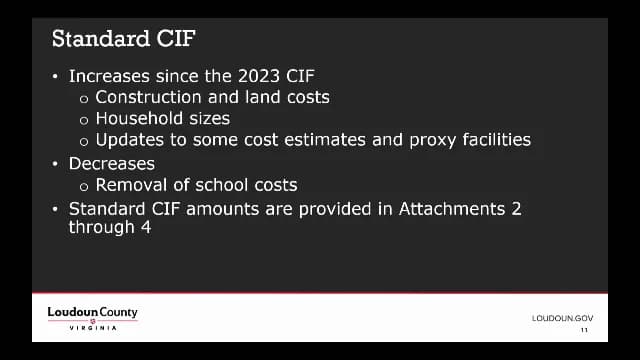
The Loudoun County Board of Supervisors Finance/Government Operations and Economic Development Committee met on February 10, 2026, to discuss the FY 2027-2032 Capital Improvement Program, economic development updates, federal impacts, and several action items, including the 2025 Capital Intensity Factors. The committee approved a consent agenda, an EDAC ad hoc committee, and recommended the Capital Intensity Factors for a public hearing. Consent Calendar - Approved items on consent included: Item 4 (Shenandoah Building Renovation), Item 5 (General Government Office Building Solar Analysis), Item 6 (Award Authority Increase for IT Products & Software Services), Item 7 (Award Authority Increase for Traffic Calming Contracts), Item 8 (Contract Award for IT Hardware/Software and Maintenance Support), Item 9 (Contract Award and FY 2026 CIP Amendment for Route 7/Route 690 Interchange), Item 11 (Proposed Changes to HR Policy Handbook Chapters 1 and 9), Item 13 (2025 Family Services Advisory Board Annual Report and Bylaws Revision), Item 14 (Revised Community Criminal Justice Board Bylaws), Item 15 (Loudoun County Community Services Board Bylaws Revision), Item 16 (Community Development Block Grant Funding Recommendations), Item 17 (Attainable Housing Loan Program for Clear Springs Apartments Phase 1 and 2), Item 18 (Attainable Housing Loan Program for Dogwood Farm Station Apartments), and Item 19 (Attainable Housing Loan Program for Dulles Plaza). Chair Briskman noted the Dogwood Farm Station loan of $7 million for 72 affordable units (8 at 30% AMI, 28 at 50% AMI, 36 at 60% AMI) affordable for at least 75 years. Chair Randall encouraged members to review committee reports on consent. Chair Briskman clarified that the solar analysis in Item 5 is specific to the new general government office building, separate from an ongoing analysis by the Department of General Services for other county properties. Discussion Items - FY 2027-2032 Proposed Capital Improvement Program (CIP) Presentation (Item 1): Staff presented the $4.3 billion proposed CIP, with 31% for county projects, 41% for transportation, and 28% for schools. County projects total $1.3 billion, transportation $1.8 billion, and schools $1.2 billion. New school facilities are deferred due to declining enrollment projections. Funding for sidewalk and trail programs was adjusted for bundling; bus shelter production accelerated to 40 per year. Debt issuance capacity is maintained each year, with increased use of local tax funding reducing debt reliance. Staff outlined next steps: board members can sign up for meetings February 11-13; written questions due February 17; work sessions on February 24 and March 4. Discussion included library space strategy—Ashburn Library is undersized and planning dollars are allocated to explore expansion or relocation—and clarification that the Western Loudoun Recreation Complex (96,000 sq ft) is separate from a future library. Chair Briskman noted the CIP will be posted online after the presentation. - Monthly Department of Economic Development Report (Item 2): Director Buddy Rizer reported 80 wins, 5,444 jobs, and $158 million in commercial investment through January 2026. The November unemployment rate was 3.6% for Loudoun vs. 4.6% nationally. Job creation in Loudoun outpaces the national average by 8.2%. The business retention and expansion program (BRE) has conducted 3,373 activities since 2020, resulting in 259 wins, $223 million in capital investment, 11,017 jobs created/retained, and 3.36 million square feet of commercial space filled or retained. Discussion covered commercial vacancy rates (flex industrial ticking up due to older obsolescent product), Dulles airport passenger numbers (slight dip, potentially due to hesitancy in international travel), and challenges for small businesses displaced by redevelopment. Business Retention Manager Chris Hunter highlighted the program's proactive relocation assistance and the importance of transit-oriented development for future office demand. - Impact of Ongoing Federal Actions on Loudoun County Update (Item 3): County staff and lobbyists from Becker provided an update. The FY 2026 appropriations bills reversed many cuts from HR 1, restoring and even increasing funding for programs at HHS, Education, and others. Bipartisan progress was noted, though DHS remains in a continuing resolution. The Road to Housing Act and Housing for the 21st Century Act, passed with strong bipartisan support, aim to increase housing supply. Discussion included potential impacts on Loudoun: four federal grants were identified as high risk (none rescinded yet); the Urban Area Security Initiative (UASI) grant ($3.05 million) is being redirected by the federal granting agency, but the board had already planned for conversion to local tax funding. Supervisor Umstead raised questions about federal appetite for additional Metro funding and the per diem reimbursement for federal property. Chair Briskman expressed concern about layoffs of federal employees affecting program restoration and highlighted the loss of the UASI grant. - Economic Development Advisory Commission (EDAC) Ad Hoc Committee Request (Item 12): EDAC Chair Tim Shimbara requested creation of an ad hoc committee to examine the future economic outlook of Loudoun County, focusing on identifying opportunities, barriers, and considerations for a resilient commercial tax base. The deliverable is research-focused, not policy recommendations. Supervisor Leturner requested specific analysis on flex space types and market demand. Chair Briskman noted the need to be respectful of staff time. The committee approved the ad hoc committee 5-0. - 2025 Capital Intensity Factors (CIF) (Item 10): Staff presented the proposed 2025 CIF, recommending removal of school costs from the standard and urban multifamily CIF due to declining enrollment projections from LCPS (no new schools needed for at least 10 years). The fiscal impact committee (FIC) had previously reduced school costs by 10%, but staff recommended full removal based on updated data. The resulting CIF decreases significantly for most unit types (e.g., standard single-family detached in Eastern region drops from $86,691 in 2023 to $41,530 in 2025). County costs increased due to rising construction costs and household sizes. The age-restricted CIF (no school costs) increased slightly. The road CIF increased modestly. Staff recommended the CIF take effect upon board approval and apply only to applications accepted after that date. The committee discussed implications: Supervisor Umstead questioned whether the county collects proffers for growth in towns (staff indicated no agreement exists). Supervisor Leturner raised legal concerns about collecting proffers for renovations rather than new schools. Chair Briskman noted pending state legislation (SB 717) that would mandate transit-oriented development without local proffer authority, potentially increasing need for schools. She requested delaying the public hearing until state legislation is settled. The committee voted 5-0 to recommend the Board of Supervisors advertise the CIF for a public hearing, with no date set, pending further developments. Key Outcomes - Consent Agenda Approved unanimously (5-0). - EDAC Ad Hoc Committee Approved unanimously (5-0) to examine future economic outlook, including specific analysis on flex space types. - 2025 Capital Intensity Factors recommended for public hearing (5-0), with staff recommendation to remove school costs. Public hearing date to be determined, pending outcome of state legislation. - FY 2027-2032 CIP Presentation received; next steps include February 11-13 sign-up for staff meetings, written questions due February 17, and work sessions on February 24 and March 4. - Federal Actions Update noted ongoing impacts: four high-risk grants under review, UASI grant redirected, and appropriations bills restoring many cuts. Staff and lobbyists will continue monitoring.
The Loudoun County Board of Supervisors met jointly with the Loudoun County Public Schools (LCPS) Board on February 9, 2026, to receive the FY 2027 budget presentation and to begin a discussion on a proposal to expand School Resource Officers (SROs) into elementary schools. Both bodies also recognized new school board members and supervisors at the start. Discussion Items LCPS FY 2027 Budget Presentation Superintendent Dr. Aaron Spence presented the adopted LCPS operating budget for FY 2027, which totals approximately $2.07 billion, a $105 million (5.3%) increase over the FY 2026 budget. Key points included: - Enrollment: Projected to decline by 316 students, yet the number of English learner (EL) students is expected to increase by 1% and special education population by 3.4%. The budget adds 51.6 positions for specialized supports and 120 total new FTEs, with 94.2% of positions school-based or school-facing. - Compensation: The collective bargaining agreement provides a 2.5% step increase plus a 4% COLA for certified staff and 5% COLA for non-certified staff, averaging 6.5–7.5% increases. Health insurance premiums will increase by 20%. - State Funding: Projected to decrease by $3.3 million due to lower enrollment, a shift in the local composite index, and a reduction in state-funded teacher raise percentage. - County Transfer: The budget aligns with the county's guidance of $105 million in new local revenue, which would support a 7.6% increase in county funding from FY 2026. - Cost per Pupil: $25,490, a 6.9% increase. - Unmet Needs: Initiatives such as slower program expansion, employee tuition assistance, and phased remodeling stipends were noted as delayed investments. - Several supervisors praised the budget for staying within county parameters. Questions covered enrollment trends, the removal of 72 classroom teachers (addressed as attrition-based), the status of the eastern Loudoun welcome center, and meal debt policies (no child is denied a meal, and debt is written off annually). Discussion on School Resource Officers (SROs) in Elementary Schools Sheriff Chapman and Lieutenant Colonel Sawyer presented a proposal to place SROs in all elementary schools over a four-year period, at an estimated cost of $7 million per year (about $20 million total once fully phased). The proposal cited: - Over 4,000 annual calls for service across all LCPS schools, with about one-third (1,500) occurring at elementary schools. - National trends: a 1,000% increase in attacks on elementary schools over the past decade, and over 25% of school shootings now occur at elementary levels. - The SRO role follows a triad model: enforcement, education, and engagement. - Currently, unarmed security personnel are used in elementary schools; the sheriff’s office argued SROs provide better training, immediate response, and investigative capabilities. - The proposal would begin with the most remote schools and be phased countywide. School board members asked about community engagement, the existing MOU process (which currently covers middle and high schools only and was not expanded because funding was uncertain), and how this compares to practices in neighboring jurisdictions (most do not have SROs in elementary schools). Chair Chandler noted that the school board had not seen the proposal before the meeting and emphasized that the conversation should continue with town halls. No decisions were made. Key Outcomes - The FY 2027 LCPS budget presentation was formally received by the Board of Supervisors; no vote was taken. The board will continue to review the request and the county’s budget before appropriation. - Discussion on expanding SROs to elementary schools is ongoing. The sheriff’s office agreed to hold a town hall to gather community input. The school board indicated it would need time to consider the proposal. No formal action was taken at this meeting. - Questions about budget details (e.g., school lunch debt, Perkins grant funding, and student post-graduation data) were noted for follow-up responses.
During the February 3, 2026 Business Meeting, the Board of Supervisors adopted the consent agenda, received updates on legislation, public safety, and property assessments, approved two legislative resolutions, recognized Black History Month, and conducted nominations and a closed session for property acquisition. The meeting lasted from approximately 9:00 a.m. to after 6:00 p.m., with a break for ceremonial resolutions and public input. Consent Calendar - Approved unanimously (6-0-3, with three supervisors absent) the consent agenda including: - R1: Proclamation to recognize Black History Month in Loudoun County. - 1A: Invasive Plant Species Management Program Guidelines for County-Managed Lands. - 2A: Appointments and confirmations. - 3: Administrative Items Report of February 3, 2026. Discussion Items - Legislative Update (Jonathan Freeman): Freeman reported on the 2026 General Assembly session, including progress on the home ownership grant program (passed committee 10-4, already passed the House), the Oak Hill acquisition bill (re-referred to appropriations), and local anti-rent gouging bills (sent to housing commission for study). He noted that several data center bills (noise, water, air pollution, energy) were defeated, and the Faith in Housing Act (HB 1279 and SB 388) is moving, with concerns that it strips local land use control for religious organizations. - Motions on Legislation: - HB 395 (Small Portable Solar Devices): Supervisor Brixman moved to support the bill, which would allow balcony solar (up to 1200 watts) without utility interconnection. After discussion about safety and weight concerns, the motion passed 6-1-1, with Supervisor Umstad opposing and Chair Randall abstaining. - HB 1021 (Affordable Rental Units in Assisted Living Facilities): Chair Randall moved to support the bill, which gives localities the option to require affordable rental units in assisted living facilities via special use permits. Debate centered on whether it creates a requirement or option. The motion passed 6-1-1, with Supervisor Laterno opposing and Supervisor Kirchner abstaining. - Significant Incident Report (Chief Travis Pro): The Combined Fire and Rescue System responded to 10,358 incidents in Q2 FY2026, including 7,500 EMS calls and 2,800 fire-related calls. Notable incidents include a $1.25 million lithium-ion battery fire, a $2.7 million electrical panel failure, and a fatal arson in Sterling. Community initiatives included a toy drive (4,000 toys) and coat drive (1,361 coats). The Emergency Communications Center earned triple ACE accreditation. - Real Property Assessment Update (Commissioner Wertz): Total real property value reached $185.7 billion, up 12.4% year-over-year. Residential appreciation averaged 1.2% across districts, while data centers now represent 26% of total assessed value (up 3%). Commercial new construction totaled $2.2 billion, with data center land averaging $3.76 million per acre. The average single-family home assessed value increased 1.9% to approximately $1.27 million. Inventory remains low at 1.9 months supply. Ceremonial Resolutions - Black History Month Proclamation: Chair Randall read the proclamation recognizing February 2026 as Black History Month. Speakers included Donna Bohannon (Black History Committee), Dr. Wendy Manuel Scott and students Annabelle Spencer and Shamika Kirby (George Mason University) discussing the "Spatializing Black Stories" digital archive of the Willard community, Dr. Dietrich Wallace (Sigma Gamma Rho), Charles Avery (Loudoun Douglas Alumni Association), and Michelle Thomas (NAACP). Supervisor Sainz emphasized the fight to preserve African American history. The proclamation was unanimous. Public Comments & Testimony - A brief remark from Supervisor Griffin, who spoke to the audience about prior restraint and constitutional issues, was ruled out of order by the Chair for violating board rules of order that require comments be directed to the board and not to the audience. Key Outcomes - Consent Agenda adopted unanimously. - HB 395 supported by vote of 6-1-1 (Supervisor Umstad opposed, Chair Randall abstained). - HB 1021 supported by vote of 6-1-1 (Supervisor Laterno opposed, Supervisor Kirchner abstained). - Nominations confirmed: Several board and commission appointments, including Emily Johnson (Heritage Commission), Susan Betts (Parks, Recreation, Open Space), Eric Woodall (NOVA Parks), Steve Schulte (ADU Board), Charles Clear (ADU Board), and Reed Clark (Heritage Commission). - Closed session held to discuss acquisition of a parcel in the Dulles Election District; no formal action taken.