Browse by city
Date range
Search help

Search titles, summaries, topics and stored transcripts together. Keywords may match separately; put the whole query in double quotes for a phrase. Matching follows word analysis, so punctuation is not exact. Both dates are included. Documents are not searched.

SHOWING 91–100 ENTRIES
91
MAR 4, 2026 · LOUDOUN COUNTY, VIRGINIA · COMMISSIONS & ADVISORY BOARDS
Zoning Ordinance Committee Meeting Summary – March 4, 2026

The Zoning Ordinance Committee (ZOC) met virtually on March 4, 2026, from 9:00-11:00 AM in the Dulles Room. The meeting covered status updates on several zoning and comprehensive plan amendments, with a focused discussion on the Floodplain Ordinance update, particularly regarding agricultural fencing in floodplains. Consent Calendar - The Action Report from January 7, 2025, was approved unanimously (with one abstention from Jim). Discussion Items - Floodplain Ordinance Update – Staff (Maggie) presented revised language for agricultural fencing in the floodplain. The original language allowed only exclusion fencing; after an ad hoc meeting, the language was expanded to include all agricultural fencing (high tensile electric and barbed wire). Committee member Joe questioned whether a no-rise analysis could be waived for minimal-impact projects; staff clarified they are bound by FEMA requirements. Rich raised concerns about the fencing types, noting that high tensile and barbed wire are unsuitable for sheep, goats, and horses, and requested adding board fencing (three- or four-board). Staff had no objection. The committee held a straw vote and agreed to add board fencing to the permitted fencing types; the vote was near unanimous (Jim abstained). - Data Center Standards & Locations Phase 2 (ZOAM-2024-0001) – Ryan provided an update: staff is compiling research on microgrids, energy storage, and utility substations, and is drafting use-specific standards. The project remains on schedule for a board check-in in September 2026 and adoption target of spring 2027. A member asked about the relevance of Amazon’s purchase of the GW campus for data center; Ryan confirmed the new standards would apply to all future data center projects. - Zoning Ordinance Rewrite Adjustments 1 (ZOAM-2025-0001) – The project is on track for a June 2026 board presentation. The committee discussed including cleanup items (e.g., duplications of uses) in this first adjustment; non-controversial items will be included, while controversial ones will be deferred to a future amendment. The final draft will be presented to ZOC before the board. - Western Loudoun/Rural Uses and Standards (WLRUS) – The project is advancing: a Transportation and Land Use Committee (TLUC) meeting on March 18, 2026 will seek direction from stakeholder meetings. The Board of Supervisors will hold a direction meeting on May 5, 2026. The text amendments are expected to come before ZOC possibly between June and December 2026. Committee members confirmed that ZOC’s role is to provide feedback on the draft text, though the board sets policy direction. - DPZ Work Plan – Dan presented the DPZ work plan in January; a new version will be presented at the next ZOC meeting. Key Outcomes - Straw Vote: The committee endorsed adding board fencing (three- or four-board) to the list of permitted agricultural fencing types in the floodplain ordinance. Staff will incorporate this language before the final package returns for a formal vote. - Schedule Confirmations: Data Center Standards remain on track for spring 2027 adoption; ZOAM Rewrite 1 is set for June 2026 board presentation; WLRUS text will be refined over the summer, with ZOC review anticipated in the latter half of 2026. - Next Meeting: The next ZOC meeting is scheduled for April 8, 2026, at 9:00-11:00 AM in the Dulles Conference Room (in-person).
PROCEDURAL 33% · FLOODPLAIN MANAGEMENT 26% · ZONING ORDINANCE 12% · DATA CENTER DEVELOPMENT 10%
92
MAR 4, 2026 · LOUDOUN COUNTY, VIRGINIA · BOARD OF SUPERVISORS & PLANNING COMMISSION
Finance/Government Operations and Economic Development Committee CIP Work Session - March 4, 2026

The Loudoun County Board of Supervisors Finance/Government Operations and Economic Development Committee (FGOEDC) held a Capital Improvement Program (CIP) work session on March 4, 2026, at 11:00 AM. The committee reviewed proposed amendments to the FY 2027–FY 2032 CIP, discussed several funding scenarios, and forwarded the amended CIP to the full Board of Supervisors for its March 9, 2026 budget work session. Chair Briskman presided; Supervisor Laterno participated remotely from Washington, DC. Chair Randall was absent. Consent Calendar No items were placed on the consent agenda for adoption. Public Comments & Testimony No public comments were made. Discussion Items - FY 2027–FY 2032 Proposed CIP: Staff presented the results of scenarios previously requested by the committee. The main scenario discussed (from Supervisor Turner) involved moving $6.8 million from the Belmont Ridge Road bicycle/pedestrian crossing of the Dulles Greenway to create a new Partlow Road Improvements project, with an updated cost estimate of $9.4 million. The Belmont Ridge Road crossing would be delayed, with remaining funds held for future years. The committee concurred by consensus. - Destiny Drive Scenario: Supervisor Laterno had requested a scenario to shift funding from the Stone Springs Shared Use Path and Millstream Drive sidewalk to Destiny Drive long‑term improvements. However, he withdrew this request, stating that a better offset had been identified and that pushing the sidewalks to the end of the prioritization list would likely prevent them from being built. - Town Projects: Supervisor Kirshner requested funding for two town projects: $120,000 for the Town of Hillsborough’s Old Stone School renovation and $308,000 for a local match for the Town of Lovettsville’s second water tower. No offsets were identified, so the committee discussed sending these to the FY 2026 year‑end fund balance discussion. - Southern Service Center Planning: Supervisor Laterno requested that $500,000 in planning funds for the Southern Service Center be sent to the FY 2026 fund balance discussion. He argued the facility is countywide and should not require a district offset. Staff clarified that the motion merely adds the amount to the fund balance list, not an acceleration of the project. - Offset Policy Discussion: Supervisor Umstead asked for a clearer policy on when projects require a district offset versus being treated as countywide. She noted inconsistencies with past projects (e.g., a Leesburg bus shelter). The committee agreed to discuss this offline later. Key Outcomes 1. Committee directed staff to incorporate the Partlow Road scenario (moving $6.8 million from Belmont Ridge Road crossing) into the proposed CIP. 2. Motion to forward the amended CIP to the March 9, 2026 Board of Supervisors budget work session passed 4‑0‑1 (with Chair Randall absent). The motion also included sending $500,000 for the Southern Service Center planning to the FY 2026 fund balance discussion. 3. Separate motion to send $120,000 for Hillsborough Old Stone School and $308,000 for Lovettsville water tower to the FY 2026 fund balance discussion passed 4‑0‑1. These funds will be considered by the finance committee and full board during the year‑end fund balance process.

BUDGET EQUITY ANALYSIS 56% · TRANSPORTATION SAFETY 30% · PROCEDURAL 11% · TRAIL DEVELOPMENT 3%
93
MAR 3, 2026 · LOUDOUN COUNTY, VIRGINIA · BOARD OF SUPERVISORS & PLANNING COMMISSION
Loudoun County Board of Supervisors Business Meeting - March 3, 2026

Date: March 3, 2026 Time: Meeting called to order at approximately 9:00 a.m. (with delays due to missing quorum); ceremonial resolutions and public input starting as early as 5:30 p.m. Location: Loudoun County Government Center, Leesburg, VA Presiding: Chair Randall Members present: Supervisors Randall, Brixman (remote), Sainz (remote), Umstead, Glass, Letourneau, Turner, Kirshner, Croney The meeting opened with a delayed start until a quorum was achieved. The agenda included consent items, a legislative report, ceremonial resolutions, board committee reports, board comments, public input, and a closed session. Key actions included adoption of the consent agenda, a 6‑3 vote to add an immigration enforcement policy statement to the legislative program, and approval of two proclamations (Red Cross Month and Groundwater Awareness Week). Consent Calendar - Approved unanimously. Items included the Agricultural and Forestal District 2025 Annual Report, Agricultural District Advisory Committee Bylaws Amendment, Affordable Dwelling Unit Advisory Board Bylaws Amendments, Housing Advisory Board Bylaws Amendment, Housing Choice Voucher Resident Advisory Board Bylaws Amendments, confirmations and nominations, Administrative Items Report, Gated Community Design and Construction Standards, and a proffer amendment public hearing waiver for The Villas at Cascades (PCOR‑2026‑0008). Public Comments & Testimony Speakers focused overwhelmingly on groundwater concerns, with many thanking the board for the Groundwater Awareness Week proclamation but urging more aggressive action: - Avis Renshaw (President, Loudoun County Farm Bureau) – requested the board act on a 76‑page groundwater study available on the LCPCC website; noted her well went dry for the first time in 2025 and that nearby subdivisions are drawing down the aquifer. - Madeline Skinner (resident of Philemont) – opposed a planned development on historic horse show grounds that will add over 4 acres of asphalt; raised concerns about blasting, lack of well‑dry‑down testing, and potential harm to neighboring wells. - Andrew Stoddard (resident of Hamilton, water resources engineer with 50‑year experience) – stated that the number of wells has increased from 6,000 in 1980 to 19,000 in 2025; asked the board to determine the finite limit for combined groundwater and surface water withdrawals to ensure sustainability. - David Ward (retired county water resources specialist, 42‑year resident of Catoctin District) – thanked the board and urged the county to move beyond crisis‑driven awareness; noted the “dark ages of groundwater awareness” after 2008. - Roger Smith (resident near Waterford) – criticized a November 2024 project that extracts water from the Peonian Springs aquifer and sends it to the Potomac rather than recharging the aquifer; urged future projects to align with the groundwater proclamation. - Kyle Hartman (remote, lifelong Sterling resident) – recommended focusing on increasing recharge rates and reducing hardscape; noted that less snowfall and more torrential rain are reducing groundwater recharge. - Mara Walsh Copeland – criticized the Walrus process for unbalanced public input (54% industry, 32% ag/conservation, 14% citizens) and urged the board to review the TLUC staff packet and Kimley Horn summary before May. - Nicholas Ratcliffe (Waterford resident, research geologist retired from USGS) – expressed dismay that the county appears to lack adequate staff to evaluate water‑contractor recommendations; suggested the board engage USGS‑type expertise. - Trinity Mills (Loudoun Wildlife Conservancy) – called for a robust, transparent, and rigorously reviewed groundwater study with oversight from USGS and DEQ. - Dick and Diana Virgo (property owners in Clark’s Gap corridor) – opposed the proposed interconnection project for Peionian Springs and Waterford that would drill four commercial wells extracting 414 gallons per minute (54 million gallons/year); feared drying up neighboring wells and urged termination of the project. - Robert Cohen (hydrogeologist) – stated that the “red blob” groundwater decline map produced by the Ag Work Group and published by the Conservation Coalition is “fallacious, unscientific, and misleading”; provided a memo detailing errors. - Nan McCary (Lucketts resident) – thanked the board for the proclamation and urged more public education on water sustainability. - Phil Daly (Lincoln resident) – noted that the spring and creek on his property have been drying up in recent years; expressed concern that past studies have been ignored. Discussion Items Legislative Report (Item I‑1) Jonathan Freeman (County Administration) updated the board on the 2026 General Assembly session (final weeks). Key items: - Homeownership grants program: Both bills on third reading, no issues expected. - Data center bills: Undergrounding/transmission line bills and Senator Lucas’s weatherization bill still pending in House Labor and Commerce. - Housing bills: Two concerning bills active: - SB 454 / HB 816 (by‑right multifamily in business districts) – narrowly passed (11‑10) Senate; on House floor. No affordable housing requirement. - HB 1279 / SB 388 (“faith in housing”) – on Senate floor; expected to go to conference. No requirement for affordability or water availability. - Budget: House and Senate budgets differ on data center sales‑and‑use‑tax exemption (House keeps expiration 2035 with energy efficiency standards; Senate eliminates exemption by Jan 1, 2027). Senate’s LCI formula change would reduce Loudoun’s K‑12 funding by $31.5 million annually starting 2028. Senate proposal to divert 0.7% data center tax from NVTA to WMATA capital fund opposed. House budget includes $76.5 million/year for WMATA operating funds. - Oak Hill state park: Delegate McCullough’s HB 500 continued (soft defeat). House budget proposes $5 million state funding (instead of $10 million) and requires Loudoun to contribute an additional $5 million (raising county total to $27 million). Senate budget does not include acquisition. Chair Randall noted the board may need to reconsider before governor’s action. Discussion included questions about water availability concerns expressed by the board (Chair Randall noted that none of the housing bills address water adequacy). Immigration Enforcement Policy Statement (Motion by Supervisor Brixman) Supervisor Brixman moved to add to the 2026 legislative program a policy statement: “The Board of Supervisors supports legislation that encourages transparency in civil immigration enforcement activities, limits state and local law enforcement cooperation in immigration matters, and limits their ability to enter into immigration enforcement agreements.” - Supporters (6): Chair Randall, Vice Chair Turner, Supervisors Brixman, Glass, Saints, and Croney. They argued the statement sends a message to residents – many of whom are scared to leave their homes – that the board sees them; noted fewer than 1 in 7 ICE arrests involve violent criminal charges; cited local ICE operations that lack judicial warrants. - Opponents (3): Supervisors Umstead, Kirshner, and Letourneau. They expressed concerns that the statement would tie law enforcement’s hands in cooperating with ICE regarding violent offenders; called it overly broad, a “dangerous precedent,” and poorly timed (near end of session). - Outcome: Motion passed 6‑3. Ceremonial Resolutions - Proclamation Recognizing March 2026 as American Red Cross Month in Loudoun County (R‑1) – Approved. Supervisor Glass presented and noted the Red Cross provides 40% of the nation’s blood supply and that winter storms have impacted blood drives. - Proclamation Recognizing National Groundwater Awareness Week, March 8–14, 2026 (R‑2) – Approved. Supervisor TeKrony (via staff) highlighted that 75,000 residents in western Loudoun rely on groundwater; noted drought concerns and a state bill to study groundwater. Board Comments & Regional Updates - Supervisor Croney expressed disappointment about Amazon’s purchase of GWU’s 120‑acre Loudoun campus (potential data center use): “The continued concentration of this single industry does not serve the long‑term interests of our community.” - Supervisor Umstead reported that elementary schools had 1,649 calls for service to the sheriff’s office in the last school year (over 181 days), supporting the need for SROs in elementary schools. - Supervisor Brixman also criticized the GWU land sale: “I have no interest in data centers being developed on this property… trusted community partners don’t make these sorts of decisions without involving the community.” - Supervisor Kirshner expressed gratitude for the groundwater proclamation and noted county staff are working on a detailed study of western Loudoun’s groundwater. - Vice Chair Turner announced he will join the effort to place a Desert Shield/Desert Storm memorial on the National Mall. - Chair Randall stressed the need to treat substance dependence as a disease, not focus on individual substances. Key Outcomes - Consent agenda adopted unanimously. - Motion to add immigration policy statement passed 6‑3 (supervisors in favor: Chair Randall, Vice Chair Turner, Brixman, Glass, Croney, Saints; opposed: Umstead, Kirshner, Letourneau). - Proclamation for Red Cross Month approved. - Proclamation for Groundwater Awareness Week approved. - Board comments set a direction for staff to continue monitoring Oak Hill, groundwater study, and data center policy. - Closed session on annual performance reviews of the County Administrator and County Attorney (no formal action taken). - Next steps: Staff will continue legislative advocacy on housing, budget, and Oak Hill; public input on water issues will inform future policy.

PROCEDURAL 19% · WATER AND WASTEWATER MANAGEMENT 17% · PUBLIC HEALTH 10% · IMMIGRATION POLICY 10%
94
MAR 2, 2026 · LOUDOUN COUNTY, VIRGINIA · BOARD OF SUPERVISORS & PLANNING COMMISSION
FY 2027 Budget Work Session – Loudoun County Board of Supervisors – March 2, 2026

The Loudoun County Board of Supervisors convened a budget work session on March 2, 2026, at 10:30 AM to begin deliberations on the FY 2027 proposed budget. Chair Randall opened the meeting, stressing the importance of work sessions for offering amendments and asking questions. Staff provided an overview of the budget packet, tax rate proposals, and the toteboard process. An opening motion to place the proposed budget on the table at a real property tax rate of 80.5 cents (tax year 2026) and personal property tax rates of $4.15 (general) and $3.09 (vehicles, tax year 2026) / $3.00 (tax year 2027) passed 9‑0. The remainder of the session focused on departmental resource requests, with no final votes on individual items. Discussion Items Emergency Management, Safety, and Security (David Short) - Funded request: one security analyst to monitor open‑source and social media for threats to county officials, employees, and facilities. This position would transition threat monitoring from a collateral duty to a continuous function. - Unfunded alternate: one senior emergency management specialist to manage the Tier II hazardous chemical reporting program, the local emergency planning committee (LEPC), facility plan reviews, and dam/impoundment compliance. This would free up a supervisor to focus on special events coordination. - Supervisor Crowley noted the board had approved six safety/security specialists in FY 26; Short confirmed they have been hired and are focused on physical security, not the cyber/social media role. - Vice Chair Turner clarified that alternate requests are additional unfunded items, not alternatives to funded items, and can only be added by reducing other expenses or raising the tax rate. Equity and Inclusion (Carl Rush) - Unfunded alternate: one learning development supervisor to enhance OEI’s capacity for professional learning, curriculum oversight, and data tracking. Current lack of middle management limits scaling; OEI has received over 160 requests and provided 600+ hours of leap implementation support. - Supervisor Bricksman expressed hope that a large resource request elsewhere would not be approved, freeing funds for all alternate requests. - Chair Randall acknowledged the team’s work amid challenging conditions. Finance and Procurement (Eileen Crawford) - Funded request: two grant analysts to support prospecting, compliance, and data management for federal, state, and county grants. The county missed a multimillion‑dollar grant due to insufficient writing capacity. - Funded request: $500,000 to continue the child care fee reduction program from January 1 to June 30, 2027, after ARPA funds expire. The program currently serves 121 children with a waitlist of 51; families must be at or below 80% AMI and use a Loudoun provider. Full‑year funding would be approximately $1 million annually. - Supervisor Laterno questioned whether two analysts were needed given potential reductions in federal grants; Crawford emphasized increased compliance requirements from executive orders and site visits. - Chair Randall noted the board had previously prioritized transitioning the child care program to local funding. General Services (Mr. Brown) - Funded requests: facilities maintenance staffing for new stations (Fire Station 28, Purceville expansion), glass recycling expansion (funded by plastic bag tax), a program administrator, and a local tax‑neutral waste management position. These maintain current service levels. - Unfunded alternate: one public works crew chief and two technicians to address a growing backlog; without them, work orders per staff would rise from 300 to 342, risking deferred inspections and noncompliance. - Brown noted the county maintains stormwater infrastructure as the “maintainer of last resort,” with only two crews for the entire county. Supervisor Kirshner questioned whether the county should continue accepting that liability. - Supervisor Bricksman expressed concern about the sustainability of the plastic bag tax revenue; a pending state bill could reduce the county’s share. Human Resources (Aaron Moore) - Funded request: a reasonable accommodation coordinator (due to ADA caseload doubling post‑COVID), two staffing/compensation positions (application volume rose from 30,000 to 60,000 per year since FY 23), and a benefit specialist for workers’ comp/FMLA (claims up 19%–76% while workforce grew 48%). The benefit specialist is listed as priority 3. - Supervisor Crowley asked if the benefit specialist was truly the lowest priority; Moore acknowledged operational risks if unfunded. - Supervisor Bricksman asked about accommodations for addiction; Moore confirmed that substance abuse treatment falls under disability accommodations. Information Technology (Nate Wentland) - Funded request: a security operations manager to oversee cybersecurity tools and response to increasing ransomware and nation‑state threats. The position is critical for maintaining the county’s cyber insurance rating and protecting sensitive data. - Chair Randall praised the team’s proactive approach. Public Affairs and Communications (Glenn Barber) - Funded request: a communications manager dedicated to supporting the Department of General Services (DGS), whose communications needs have grown significantly. This would free up other PAC staff and improve service delivery—currently 15–20% of services miss requested timeframes. - Chair Randall commended the county’s social media updates. Real Property Asset Management and Planning (Jackie Marsh) - Funded request: a planning program manager and a senior master planner to handle increased space planning workload; the team currently completes about 70% of projects annually, and these positions would raise that to 90%. - Unfunded alternate: a real estate specialist to manage lease negotiations; the county oversees 75 leases plus 16 new ones. - Supervisor Turner asked whether a new county government building would reduce the need for lease space; Marsh noted that new buildings are designed for 2050 growth, and leased space will still be needed for employees who don’t fit in the central building. Key Outcomes - Opening motion passed 9‑0 to set tax rates and appropriations as proposed, allowing budget deliberations to proceed. - No final decisions on individual resource requests were made during this work session; board members indicated they would consider motions at the conclusion of work sessions based on overall budget capacity. - Staff will respond to remaining budget questions at the next work session on March 5, 2026. - The CIP work session is scheduled for March 4, 2026 (Finance Committee). - Chair Randall will be absent for the March 4 public hearing; Vice Chair Turner will preside.

BUDGET EQUITY ANALYSIS 25% · PERSONNEL MATTERS 18% · ENVIRONMENTAL PROTECTION 15% · PUBLIC SAFETY 12%
95
FEB 28, 2026 · LOUDOUN COUNTY, VIRGINIA · BOARD OF SUPERVISORS & PLANNING COMMISSION
Loudoun County Budget Public Hearing (Session III) – February 28, 2026

This public hearing, held on February 28, 2026, was the final session for community input on the proposed FY2027 budget and tax rates. The Board of Supervisors heard from over 25 speakers on a range of topics, including traffic safety on Evergreen Mills Road, the expansion of School Resource Officers (SROs) into elementary schools, homelessness services, mental health investments, arts funding, and immigration enforcement cooperation. Public Comments & Testimony - Evergreen Mills Road Safety Improvements – Multiple speakers (Michael Conarritis, Michelle O'Dell, Jeremy Del Piaz, Mark Witt, Chad Thompson) requested that the county address a five‑mile bottleneck on Evergreen Mills Road from Hoagland Road to Ryan Road. They highlighted the dangerous 55 mph speed limit, lack of a center turn lane, and the safety burden on Loudoun Country Day School (LCDS), which budgets $105,000–$115,000 annually for an off‑duty sheriff’s deputy at the Red Cedar intersection. Speakers urged a roundabout or traffic signal, and noted that planned developments will add 1,500–2,000 housing units along the corridor. - School Resource Officers (SROs) in Elementary Schools – This was the dominant topic, with roughly equal numbers of speakers for and against the Sheriff’s proposal to fund SROs in all elementary schools at an estimated cost of $18 million over four years. - Supporters (including Alicia Brand, Mike Clancy, Mark Witt? actually Witt spoke on road safety, but others: Jason Harding, Susan Cox, Gary Higgins, Richard Ryan) argued that SROs provide immediate protection, that response times from outside officers are too long, and that Virginia already has SROs in 29% of elementary schools. They cited 1,649 calls for SRO support from elementary schools in the prior school year (nine per day). Several speakers dismissed concerns about racial bias or ICE ties as irrelevant. - Opponents (including Jasmine Tyler, Erica Daly, Corey Brunette, Meredith Way, Gail Pien, Melissa McAllister, Carla Miller, Heather Gottlieb, Lisa Potter, Max Matlin, Julia Casdorf, and an unnamed elementary school parent) argued that data shows SROs do not prevent school shootings, disproportionately discipline Black, Latino, disabled, and low‑income students, and that the $18 million would be better spent on counselors, housing vouchers, after‑school programs, or social workers. Several speakers also opposed the Sheriff’s 287(g) agreement with ICE, fearing that SROs could be used for immigration enforcement. One speaker called the proposal a coercion tactic to bypass the School Board. - Homelessness Services – Nicole Acosta (Community Foundation for Loudoun and Northern Fauquier Counties) and Valerie Pisierra (Loudoun Human Services Network) urged expanded capacity. Acosta noted that the point‑in‑time homeless count grew from 93 (2005) to 303 (2024), while bed counts have not kept pace. Pisierra reported Loudoun has only 0.32 permanent supportive housing beds per 10,000 residents, well below neighboring jurisdictions. - Mental Health & School Funding – Lynn Davis (Algonkian district) criticized the county for failing to fund mental health services, arguing that 18 million could fund 100 counselors plus 82 social workers rather than SROs. A speaker from the Loudoun Arts Council, Betsy Lavino, urged the board to view the arts as infrastructure, citing pandemic‑era benefits. - ICE Cooperation – Max Matlin and others called for transparency on names and charges of individuals transferred to ICE, and urged the board to cut funding to the adult detention center to force termination of the 287(g) agreement. - Other – Several speakers supported the Sheriff’s SRO proposal but also raised concerns about response times and the need for a comprehensive approach. Key Outcomes - No formal votes were taken. The meeting was strictly for public input. - Chair Randall acknowledged that the board will review all comments and include them in the Wednesday budget package. - Chair Randall committed to visiting Loudoun Country Day School and the Evergreen Mills Road corridor to assess the traffic safety issues. - The hearing adjourned with no further business. A quorum was present; Supervisor Caleb Kirsner was absent due to a family emergency.

PUBLIC SAFETY 42% · TRANSPORTATION SAFETY 12% · MENTAL HEALTH AWARENESS 9% · IMMIGRATION POLICY 9%
96
FEB 26, 2026 · LOUDOUN COUNTY, VIRGINIA · BOARD OF SUPERVISORS & PLANNING COMMISSION
Loudoun County Board of Supervisors Budget Public Hearing – February 26, 2026

This public hearing was the first of two sessions held by the Loudoun County Board of Supervisors to receive community input on the proposed FY2027 budget and tax rates for the fiscal year beginning July 1, 2026. Over a dozen speakers addressed the board, focusing primarily on the need for increased funding for affordable housing, permanent supportive housing (PSH), human services nonprofits, and youth mental health programs. No votes or formal decisions were taken. Public Comments & Testimony - Kristen Langhorn (Asburn District resident) advocated for critical support services for vulnerable neighbors, specifically permanent supportive housing (PSH). She expressed concern that the county has repeatedly rejected state-funded PSH units and that Department of Family Services (DFS) staff cited staffing limitations as a reason for considering program closure. She requested that the board learn about plans to invest in staff and collaboration to prevent vulnerable residents from becoming unsheltered. - Lisa Max (CEO, Ark of Loudoun; Chair, Loudoun Human Services Network (LHSN)) expressed gratitude for the proposed 3% increase to the Human Services Nonprofit Program (HSNP) but raised concerns that increasing the maximum grant request from $113,000 to $135,000 could cause vital organizations to lose funding. She requested an analysis of how the increased maximum might affect total grantees and, if necessary, an increase to the overall funding pool. She also urged additional funding for housing-related services, including more PSH. - Joe Meyer (CEO, Shelter House) presented data showing that homelessness in Loudoun has increased dramatically since 2021: family homelessness up 143%, households without children up 258%, hypothermia shelter usage up 83%, and drop-in service usage up 112%. He noted that Loudoun has the highest rate of unsheltered chronically homeless single adults in the metropolitan region, yet only 14 PSH beds exist (10 for singles). He requested a 5% increase to existing service contracts and additional funding for PSH. - Amanda Carwin (Loudoun Director, Northern Virginia Affordable Housing Alliance) thanked the board for committing $86 million to attainable housing since FY2023 and dedicating a full penny of the real property tax to the housing fund, but stated the county is not on track to meet its housing goals. She highlighted that homelessness is increasing and that Loudoun lags behind other jurisdictions in PSH investment. She cited the recent displacement of 86 families in Leesburg as an example of the crisis. She urged investment in programs, services, and support to bridge the gap to home ownership. - Kim Tapper (Executive Director, A Place to Be; LHSN Executive Committee) echoed concerns about the HSNP grant maximum increase and requested an analysis of its impact. She suggested either increasing the total funding pool or reconsidering the new maximum to avoid unintentionally decreasing services. She expressed gratitude for a $5 million investment through the Community Foundation but emphasized the need for a human services strategic plan involving nonprofits, the county, and LCPS. - Kim Hart (Managing Director, Good Housing) acknowledged the county’s progress in funding attainable housing (from $0 in 2016 to $29 million), but warned that at the current pace, the county will miss its 2040 goal by more than 4,000 units. He requested that the board fund a refresh of the United Housing Needs Strategic Plan to reassess goals and ensure sufficient land, zoning, and funding. - Lakeisha Gore McDerfee (Chair, Loudoun County Commission on Aging) spoke on behalf of older adults, the county’s fastest-growing population (44,000 residents aged 65+). She recommended five areas of focus: annual review of the strategic plan through an aging lens, dedicated funding for aging initiatives, housing set-asides, continued tax relief and transportation support, and sustained funding for PRCS area agency on aging programs (adult day centers, senior trips, community programming). She noted that senior centers are full, adult day centers have wait lists, and demand for home-delivered meals is increasing. - Theos Tomalis (Loudoun County Chamber of Commerce) expressed appreciation for the board’s investment in the Loudoun Housing Trust Fund, calling housing stability an economic imperative. He raised concerns about Loudoun’s lack of PSH beds compared to other Northern Virginia jurisdictions and urged the board to support expanding PSH to mitigate downstream costs in emergency services and shelter placements. - Kumkum Kunaparedi (Secretary, Shelter House Board of Directors) emphasized that a flat budget is effectively a cut given rising need due to economic anxiety and federal layoffs. She requested a 5% increase to keep programs working and urged expansion of PSH. She warned that without a place to land, people cycle through crisis indefinitely. - Dr. James Smith (Resident, Sterling; Board member, Shelter House, Health Services Agency of Northern Virginia) supported increased funding for PSH, noting Loudoun is the healthiest county in Virginia and can do more to address homelessness. - Thomas Price (Resident, 20+ years) opposed a proposal to put School Resource Officers (SROs) in every elementary school, calling it costly and unnecessary. He urged redirecting those funds to youth mental health programs and counseling services, citing isolation and vulnerability among youth. - Mitch Chris Bell (Director of Real Estate Development, True Ground Housing Partners) thanked the county for its investments in affordable housing loans and encouraged additional funding for affordable housing programs, PSH, and the use of publicly owned land for housing development. He cited COG data identifying a need for tens of thousands of additional homes in Loudoun. Key Outcomes - No votes or decisions were taken during this session; the hearing was solely for public input. - Madam Chair (the presiding supervisor) noted that board members not present would watch video recordings before budget deliberations, and she committed to scheduling a meeting with Shelter House and other interested supervisors to clarify the 5% funding request and discuss next steps.

AFFORDABLE HOUSING 36% · HOMELESSNESS 23% · PROCEDURAL 12% · AGING SERVICES 9%
97
FEB 26, 2026 · LOUDOUN COUNTY, VIRGINIA · BOARD OF SUPERVISORS & PLANNING COMMISSION
Loudoun County Board of Supervisors Budget Public Hearing - February 26, 2026

This was the second session of the budget public hearing for the fiscal year 2027 proposed budget and 2026 tax rates. The board heard from community members on a range of topics, including healthcare access, school resource officers, housing voucher programs, and nonprofit funding. Public Comments & Testimony - Dr. Tanya Atkins, CEO of HealthWorks for Northern Virginia, thanked the board for supporting Federally Qualified Health Centers serving over 9,000 Loudoun residents, and highlighted that homelessness or near-homelessness is a major barrier to medical compliance. She applauded affordable housing efforts but urged closing gaps for those who are unhoused or nearly unhoused. - Guy Tessier argued against expanding SROs into elementary schools, citing data from the US GAO showing school shootings are concentrated in urban, higher-poverty, diverse schools, and from a University of Arizona study that stressed secure firearm storage education. He noted the LCSO's funding request for SROs did not address safe storage and urged the board to consider low-cost alternatives. - Isaac Pacheco, Vice Mayor of Round Hill, thanked the board for prior support and emphasized that county investments in western Loudoun benefit the entire county. He requested continued financial support for Round Hill's utility system to serve residents both inside and outside the town limits. - Samantha Clark, Secretary of the Loudoun Human Services Network and CEO of LAWS, thanked the board for a proposed 3% increase to the nonprofit grant program but flagged that raising the maximum grant request from $113,000 to $135,000 without proportionally increasing the total pool could unintentionally reduce the number of funded organizations. She urged analysis and potential adjustment. She also expressed gratitude for a one-time $5 million community investment but stressed the need for ongoing operational support and additional funding for permanent supportive housing. - Julia Jarvis opposed SRO expansion, citing the Virginia School Safety Survey, which listed mental health resources, counselors, cameras, building upgrades, and community partnerships as higher priorities than additional law enforcement. - Eydix Alamen (with interpreter), a mother and leader of La Nueva Mayoria de Virginia, opposed SROs in elementary schools, stating that many families live in fear due to 287(g) agreements where local law enforcement collaborates with ICE. She advocated for investing in after-school programs, housing support such as rental vouchers, and education instead of more police. - Bessie Andino and Carmen Maria Andino (through interpreters) advocated for a $17 million local housing voucher program. Carmen Maria Andino reported paying over 70% of income on rent and described families trapped between incomes too low for one program and too high for another. - Jefferson Rivas, a student from Sterling, opposed SROs due to fear from ICE collaboration and asked for mental health resources, psychologists in schools, free after-school programs, and bullying and drug prevention programs. - Jose Tercios (represented by his daughter) spoke as one of 80 displaced families from the Leesburg Mobile Home Park, now paying five times more for housing, and asked for local housing vouchers to prevent displacement. - Alejandra Hernandez reported that 12,000 to 16,000 households in Loudoun earn less than $50,000 a year, that 42% of renters spend over 30% of income on rent, and 21% spend over half. She urged a $17 million local housing voucher program, noting that displaced families saw a nearly 340% rent increase and 95% could not access existing programs. - Olivia Moreno, a retiree with 22 years of service in Loudoun, said she cannot afford her home on a fixed pension and does not qualify for existing assistance. She supported housing vouchers for older adults to age with dignity. - Tomasa Valencia, a restaurant worker of 14 years, pays $2,000 in rent (over 40% of income) and said temporary rental assistance ended, so she needs permanent local housing vouchers. - Andrea Alvarez described her husband working six days a week in construction, yet they struggle with a $2,000 rent for a two-bedroom apartment, and requested housing vouchers. - Veronica Gonzalez, displaced from the Leesburg Trail Park, now pays triple the rent and was forced to move to Winchester, losing childcare support and causing school disruption for her children. She asked for local housing vouchers to prevent future displacement. - Evelia Chavez, a mother of three, opposed SROs due to fear from immigration policies and asked for mental health support, psychologists in schools, long-term funding for after-school programs, and housing vouchers. - Reina Amador, a community leader, opposed SROs, citing distrust from ICE collaboration, and advocated for housing support, mental health services, drug prevention, and expansion of after-school programs. - Carrie Kidwell, a volunteer with Moms Demand Action, stated that decades of research show SROs do not prevent school shootings and can disproportionately affect marginalized students. She urged investing $18 million annually in prevention and community care rather than expanded policing. Key Outcomes - No formal votes were taken at this hearing. Board members not in attendance will review video recordings of the budget hearings. - Supervisor Brisbane clarified that the competitive nonprofit grant program has been increased by $1 million in the proposed budget (including last year's $800,000 gap closure for organizations scoring 75% or higher), and core nonprofit grants have increased by $650,000 — well above the 3% figure mentioned by some speakers. - The board heard numerous requests for a $17 million local housing voucher program and strong opposition to the $6.5 million annual proposal for SROs in elementary schools, with speakers urging investment in mental health, after-school programs, and other non-policing safety measures.

AFFORDABLE HOUSING 56% · PUBLIC SAFETY 25% · BUDGET 5% · IMMIGRATION POLICY 4%
98
FEB 24, 2026 · LOUDOUN COUNTY, VIRGINIA · BOARD OF SUPERVISORS & PLANNING COMMISSION
Loudoun County Planning Commission Public Hearing - February 24, 2026

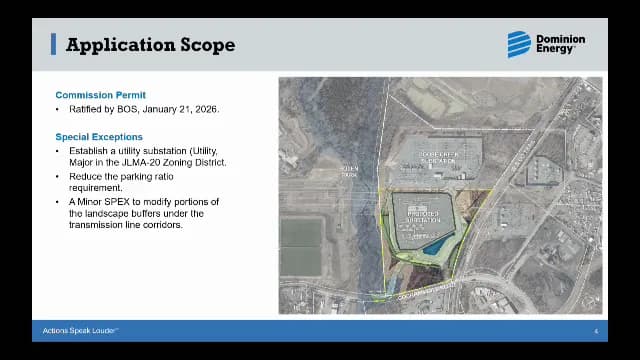
The Loudoun County Planning Commission held a public hearing on February 24, 2026, to consider three legislative applications: a residential driveway within the Mountainside Overlay District (MOD), a utility substation, and a child care center. The Commission voted to approve the first two items and denied the third after extensive discussion on traffic and safety concerns. Public Comments & Testimony - Duvall Property: One speaker (Tom Moeller) expressed support, noting the applicant's conscientious stewardship. One speaker (JT Hornyak) opposed the project, citing concerns about natural springs, erosion, and setting a precedent for development on conservation easements. - Aspen Substation: One public comment was received (not read aloud) expressing concern about encroachment on the Washington & Old Dominion Trail; staff clarified that no encroachment would occur. - Fleetwood Road Child Care Center: Multiple residents from the adjacent Meadows community spoke in opposition, citing severe existing traffic congestion, safety risks for children, inadequate road infrastructure, and outdated traffic studies. One speaker (Ben Keathill, HOA president) noted that the community had engaged with the applicant but remained concerned about traffic. Discussion Items - Duvall Property (LEGI-2025-0041): Staff presented three special exception requests to allow a private driveway within the MOD, citing steep slopes and sensitive soils. The driveway would provide access to a future home on a 44.6-acre parcel with a conservation easement. Staff recommended approval with conditions, including relocation of an existing structure and revegetation. The applicant (James Kirk) explained that the driveway alignment was necessary to meet grade requirements and that the building envelope was fixed. Commissioners discussed the existing logging road, the feasibility of moving the structure, and the driveway surface (permeable gravel). - Aspen Substation (LEGI-2024-0038): Staff presented three special exception requests for a utility substation on a 34.32-acre site near Bolin Park and the W&OD Trail. The substation is part of Dominion Energy's Northern Virginia reliability plan. Staff recommended approval with conditions including a 20-foot solid screen wall, tree conservation, and pollinator habitat. The applicant (Jack Story) noted the substation would be gas-insulated and sited under existing transmission lines. Commissioners asked about visibility from the trail and park, and confirmed the existing pond would be reconstructed for stormwater. - Fleetwood Road Child Care Center (LEGI-2023-0104): Staff recommended denial, citing incompatibility with the transition large lot neighborhood place type, inadequate road infrastructure, traffic safety concerns, and excessive signage. The applicant (Michael Romeo) argued that the use is appropriate given residential growth in the area, that the zoning ordinance permits child care centers in TR districts, and that VDOT did not warrant a turn lane. He offered to accept most conditions but opposed limiting enrollment to 100 children, installing a turn lane (not feasible without road upgrades), and a noise attenuation wall. Commissioners questioned the traffic study methodology, noted the intersection of Route 50 and Fleetwood Road already operates at failing level of service (LOS E/F), and expressed concerns about the lack of funding for road improvements. Key Outcomes - Duvall Property: Motion to forward to the Board of Supervisors with a recommendation of approval, subject to conditions dated February 17, 2026, and amended to allow relocation of the existing structure prior to occupancy permit rather than grading permit. Passed 8-0-1 (Commissioner Banks absent). - Aspen Substation: Motion to forward to the Board of Supervisors with a recommendation of approval, subject to conditions dated February 11, 2026. Passed 6-0-3 (Commissioners Banks, Miller, Myers absent). - Fleetwood Road Child Care Center: Motion to forward to the Board of Supervisors with a recommendation of denial based on findings in the staff report. Passed 6-0-3 (same absentees).

ZONING REGULATIONS 23% · TRAFFIC STUDIES 22% · TRANSPORTATION SAFETY 10% · ENGINEERING AND INFRASTRUCTURE 9%
99
FEB 24, 2026 · LOUDOUN COUNTY, VIRGINIA · BOARD OF SUPERVISORS & PLANNING COMMISSION
Finance/Government Operations and Economic Development Committee CIP Work Session – February 24, 2026

The Finance/Government Operations and Economic Development Committee (FGOEDC) held a work session on the proposed FY 2027–FY 2032 Capital Improvement Program (CIP) on February 24, 2026. The committee reviewed the $4.3 billion six-year CIP, discussed cost increases for the Western Loudoun Recreation Center Complex, and considered several funding scenarios including reallocations for transportation and community projects. No public comments were received. The committee voted on multiple motions, forwarding one item to the full Board of Supervisors for further analysis. Discussion Items - FY 2027–FY 2032 Capital Improvement Program Overview - Staff presented a high-level summary of the proposed CIP totaling $4.3 billion: $1.3 billion (31%) for county projects, $1.8 billion (41%) for transportation, and $1.2 billion (28%) for school projects, aligning with the board’s guidance of 30/40/30 funding ratios. - Debt capacity remains in each year of the six-year period, but is tighter in the first three years due to the addition of the new Department of General Services headquarters and other projects. - The percentage of local tax funding in the proposed CIP increased from 24% in FY26 adopted to 29% in the proposed CIP. - No new road projects were added; priority went to cost increases, schedule adjustments, sidewalk/trail bundling ($35–$40 million per year), and intersection improvements (all round three projects incorporated). - A new 40,000 square foot library facility in the Ashburn planning sub-area was discussed, with recommendations to expand the Sterling Library via lease, incorporate a larger footprint in the Cascades Library project, and evaluate options for the existing Ashburn Library. - Western Loudoun Recreation Center Complex - Staff provided a detailed update, noting that the project cost estimate has increased from $152 million (FY26 adopted CIP) to $261 million, an increase of $108 million. - Reasons for the increase include: square footage expansion from 83,000 to 96,000 sq ft (to include a teen center approved in April 2025), site constraints (topography, wetlands, vegetation preservation), underestimated earthwork and site utility costs, and low original cost assumptions per square foot. - The complex includes a recreation center (gym, fitness, aquatic center with competition and leisure pools, running track), outdoor park amenities (four diamond fields, four multi-use fields, pickleball, tennis, basketball, playground, off-leash area, trails), and a future library site. - Supervisor Leterno questioned whether changing sites could reduce costs; staff responded that on a per-square-foot and per-acre basis, the project is comparable to Ashburn Rec Center and Hansen Park when escalated for inflation, but site-specific challenges remain. - Supervisor Kershner expressed concern about the cost increase but acknowledged inflation and initial mispricing were factors. - The revised budget is already included in the proposed CIP; additional funding will be needed in FY27 for construction contract award. - Funding Scenarios and Motions - Route 15 / Hogback Mountain Road Roundabout and Fleetwood Road - Supervisor Tacroni submitted a scenario to remove the Route 15 Hogback Mountain Road Roundabout project ($14.3 million) and reallocate funds to Fleetwood Road improvements, plus move $3.15 million from the Route 15 Braddock Road Roundabout project (due to expected federal earmark). Staff did not recommend this because the Fleetwood Road study is not yet complete. - An alternative motion was offered: rename the project to "Route 15 Hogback Mountain Road Intersection Improvements" and evaluate alternatives to the roundabout (e.g., turn lanes). Supervisor Laterno suggested referring the matter to the full Board of Supervisors work session on March 9, 2026, to allow district supervisors a vote and to gather additional traffic data. That motion passed 4-0-1 (Chair Randall absent). - Supervisor Kershner opposed removing the roundabout, noting that the project had undergone a public process and that fatalities have occurred at the intersection. Supervisor Tacroni argued that the intersection is a low-volume, low-priority (level 3 in IIP) and that Fleetwood Road has greater safety concerns. - Belmont Ridge Road Bicycle/Pedestrian Crossing to Partlow Road Improvements - Supervisor Turner moved to remove $6.804 million from the Belmont Ridge Road bicycle/pedestrian crossing of Dulles Greenway (funds in FY30-32) and create the Partlow Road Improvements Project. This was seconded by Supervisor Saines and passed 4-0-1. - Other Scenarios Discussed - Supervisor Laterno requested staff to prepare a scenario moving funding from Stone Spring shared use path to Destiny Drive long-term improvements, and moving the $500,000 Southern Services Center planning money from FY30 to the FY26 fund balance discussion. - Supervisor Kershner raised several town projects: Lovettsville water tower (remaining $308,000 after EPA grant), Lovettsville wastewater treatment, Hamilton sewer lining, and Hillsborough Old Stone School ($120,000 value engineering). Staff recommended a comprehensive water/wastewater study be completed before funding town utility projects, but agreed to look into a scenario for the Hillsborough Old Stone School. Key Outcomes - Motion to refer Route 15 Hogback Mountain Road intersection discussion to the full Board of Supervisors work session on March 9, 2026 (directing staff to provide traffic analysis, updates to the corridor study, and cost estimates for turn-lane alternatives). Passed 4-0-1. - Motion to create the Partlow Road Improvements Project by removing $6.804 million from the Belmont Ridge Road bicycle/pedestrian crossing of Dulles Greenway. Passed 4-0-1. - Motion directing staff to develop CIP scenarios including those listed by staff and return to the committee on March 4, 2026. Passed 4-0-1. - A motion by Supervisor Tacroni to reappropriate Route 15 roundabout funds to Fleetwood Road failed 1-3-1 (only Supervisor Tacroni voted in favor). - The committee did not vote on Supervisor Laterno’s requested scenarios (Stone Spring/Destiny Drive, Southern Services Center) but directed staff to include them in the packet motion. - Staff was asked to evaluate the Hillsborough Old Stone School scenario ($120,000) separately.

TRANSPORTATION SAFETY 30% · BUDGET 22% · PROCEDURAL 17% · PARKS AND RECREATION 15%
100
FEB 19, 2026 · LOUDOUN COUNTY, VIRGINIA · BOARD OF SUPERVISORS & PLANNING COMMISSION
Loudoun County TLUC Meeting: Housing Update and Lodging Deferral – Feb 19, 2026

The Loudoun County Board of Supervisors Transportation and Land Use Committee (TLUC) met on February 19, 2026, to discuss the Unmet Housing Needs Strategic Plan (UHNSP) update, approve consent agenda items (bylaws amendments for several boards), and reconsider a lodging use proposal. The committee also debated reporting frequency and directed staff to prepare a white paper on unit size and naturally occurring attainable housing. Consent Calendar - Approved unanimously (4-0-1): Item 2 (Board of Building Code Appeals Bylaws Amendments), Item 3 (Affordable Dwelling Unit Advisory Board Bylaws Amendments), Item 4 (Housing Advisory Board Bylaws Amendments), Item 5 (Housing Choice Voucher Resident Advisory Board Bylaws Amendments). Public Comments & Testimony - No members of the public signed up to speak. Discussion Items - Reconsideration of Lodging Use Limits: Supervisor TeKrony moved to reconsider a prior vote (5-0) on permitting lodging uses to host up to 25 annual parties that exceed maximum daily guest limits. She proposed tiering the number of allowed parties by use type (e.g., bed and breakfast homestay vs. country inn) because current flat 25-party allowance disregards facility size. The motion to defer discussion to the March 18, 2026 TLUC meeting passed 4-0-1. - UHNSP 1st & 2nd Quarter FY26 Update: Staff (Christine Hillock and Eric Keeler) presented progress on the strategic plan. Key facts: 100% AMI for a family of four in the DC metro area is $163,900; the plan targets 20% of new homes (≈8,200 units) be attainable by 2040, plus access/preservation of 7,800 units. In FY26 Q1-Q2, 32 new attainable units were occupied and 106 units accessed/preserved. The annual goal for new units increased to 500 (from 350), and for preservation/access to 250 (from 150). Only 6.4% of the FY26 new unit goal was achieved so far, but 1,279 units are in the pipeline. Staff proposed changing reporting from quarterly to semi-annually, citing the multi-year development timeline and a planned public dashboard. Board members Chair Randall and Vice Chair Turner preferred quarterly or enhancing metrics and dashboards rather than reducing frequency. Supervisor Glass supported semi-annual if a dashboard is created. - White Paper on Unit Size and Affordability: Supervisor TeKrony moved to direct staff (in conjunction with the Affordable Dwelling Unit Advisory Board) to prepare a white paper exploring how smaller unit sizes affect market value and whether they could create naturally occurring attainable starter homes, retiree homes, and missing middle housing. Discussion noted that smaller units do not automatically become affordable given high land and construction costs, and the paper should examine the correlation between size reduction and price reduction, as well as alternative financial tools (e.g., equity-sharing grants). Motion passed 4-0-1. Key Outcomes - Lodging use deferral to March 18, 2026 TLUC meeting for further tiering discussion. - Consent agenda approved without comment. - Information item acknowledged; staff will continue quarterly reporting for now with a push toward better metrics and a public dashboard. - White paper motion approved directing staff to report back on unit size and affordability strategies. - Meeting adjourned at approximately 5:30 PM, followed by a special TLUC meeting.

AFFORDABLE HOUSING 62% · ZONING REGULATIONS 16% · COMMUNITY ENGAGEMENT 8% · PROCEDURAL 7%
OPENPUBLICA · PUBLIC MEETING INDEXUPDATED DAILY · openpublica.com