Note: The transcript references July 28, 2025, but the provided metadata indicates the meeting occurred on August 28, 2025. This summary uses the given date. The meeting continued the commission's discussion on its purpose and intent, following up on a June discussion. Members reported on individual meetings with their respective Board of Supervisors members to gather feedback on the commission's future role. The central debate was whether to develop a comprehensive bylaw rewrite proposal before engaging with the Board of Supervisors or to first conduct a gap analysis and stakeholder interviews. Public Comments & Testimony - No members of the public signed up to speak. Discussion Items - Commissioner Littleton reported meeting with Vice Chair Brisbane, who was receptive but suggested the commission look at successful models like the Heritage Commission. She encouraged the commission to proactively provide input rather than waiting for formal referrals. - Commissioner [Name] reported meeting with Supervisor Sains, who supported updating bylaws but did not want the commission inserted into additional workflows. He preferred the commission to proactively advise on matters it finds important. - Commissioner Littleton (continued) reported meeting with Supervisor Tacroni, who stated that the commission currently provides no value add to her day-to-day work. She suggested a gap analysis of the county's communications infrastructure to identify where the commission could fill unmet needs. - Commissioner Ivy reported that he had not yet been able to schedule a meeting with the Chairwoman, but resonated with the gap analysis approach. - Commissioner [Name] reported meeting with Supervisor Glass, who supported expanding the commission's scope to wireless communications, but also noted that if no expansion is possible, she would support winding down the commission. - Commissioner [Name] reported meeting with Supervisor Kirshner, who argued that continuing broadband projects and the county's reliance on communications infrastructure make dissolution premature. He supported updating bylaws to include fiber, wireless, mobile, satellite, and copper. - Commissioner [Name] reported meeting with Vice Chair Turner, who was supportive of rewriting bylaws from a clean slate and mentioned the mobility gap initiative. He also highlighted a specific knowledge gap around monopoles and recommended Commissioner Dale Coleman as an expert. - Commissioner [Name] reported meeting with Supervisor Laterno, who suggested drafting a letter to the Finance Committee to request a discussion about the commission's future, rather than immediately presenting a bylaw rewrite. - A debate ensued between Commissioner Littleton (favoring a gap analysis and voice-of-customer approach) and other commissioners (favoring developing a bylaw rewrite proposal based on the commission's own expertise). Commissioner Littleton argued that the commission should not presume to know what the Board needs without systematic engagement. Others countered that the commission has already received feedback and should present a concrete proposal for the Board to react to. Key Outcomes - A motion was made by Commissioner Tom to develop a comprehensive bylaw rewrite proposal and present it to the Board of Supervisors. The motion was seconded by Jason. A friendly amendment to first conduct a gap analysis was declined. The motion passed with a majority, though Commissioner Tom voted against it. - Commissioner Tom will draft a new bylaw proposal and circulate it to the commission for feedback before the next meeting. - The next meeting is scheduled for September 22, 2025. No meeting in August. - Staff will provide an update on the broadband value dashboard and fiber installation progress at the next meeting, as concerns were raised about potential delays and misleading reports from the provider.
Public Meetings - Loudoun County, Virginia
Public Meetings - Loudoun County, VirginiaThe Loudoun County Planning Commission held a public hearing on July 29, 2025, to consider multiple land use applications including agricultural and forestal district (AFD) renewals, an early withdrawal request, rezoning proposals, and special exceptions. The meeting lasted well past midnight due to the volume of items. Consent Calendar - The minutes from the June 24, 2025 public hearing were approved unanimously (9-0). Public Comments & Testimony - Valley Commerce Center: Mayor Christopher Bertot, several Purcellville Town Council members (Susan Khalil, Ben Nett, Carol Luke, Caleb Stout), and residents from Mayfair and Wright Farm opposed the rezoning, citing incompatibility with the 2019 general plan, traffic, water concerns, and community opposition. Business owners and representatives from JK Moving Services and local contractors spoke in support, citing a need for flex industrial space. - West Belmont: Residents of Belmont Green, represented by attorney Michael Overson, raised concerns about density, the LITEC building height, traffic, and loss of open space. Speaker Graham Letterer noted the proposed density is eight times that of the adjacent PDH3 neighborhood. Applicant Colleen Gillis responded that the project is consistent with the suburban compact neighborhood place type. - Dog Home Away from Home Kennel: Neighbors Nancy Meisner, Eileen Vroom, and Catherine Edwards opposed, citing noise, property devaluation, and a 2020 escape incident. Customers Michael McBroom and Jay Dreyer praised the owners' care and the need for affordable pet care. - Pantovic Property Rezoning: Emily Johnson of the Piedmont Environmental Council opposed, noting incompatibility with the suburban neighborhood place type and proximity to homes and a daycare. - Cochran Tech: Neighbor Benjamin Wynne requested protections regarding blasting impacts and driveway access. Emily Johnson again opposed, citing data center impacts on Goose Creek and steep slopes. Discussion Items 1. Agricultural and Forestal District Renewals: Six AFDs (Chrysalis Vineyards, New Hughesville, New Mount Gilead, New Rockland, New Upperville, New Aldie) were presented. Staff recommended renewal for four years with minimum lot size conditions. All were recommended to the Board of Supervisors unanimously (9-0 each). 2. Oak Hill Farm AFD Early Withdrawal: Staff supported early withdrawal to facilitate conservation sale for a potential state park. Commissioners debated risks of early withdrawal versus waiting for natural expiration in April 2026. A motion to recommend approval failed (5-4). An amended motion to send to a future work session passed (8-1). 3. Valley Commerce Center: The applicant sought rezoning of 117 acres from JLMA3 to PDIP for up to 1.3 million square feet of industrial uses. Staff cited inconsistency with the rural neighborhood place type, traffic impacts, and concerns about on-site well water reliability. After 23 speakers (10 for, 13 against), the commission voted to forward the item to a work session (8-1). 4. West Belmont: The applicant proposed rezoning 27 acres to allow up to 361 residential units and 11,000 square feet of commercial uses. Staff noted the density is consistent with the suburban compact neighborhood but requested more detail on open space and unit types. The commission voted unanimously to send the item to a work session (9-0). 5. Dog Home Away from Home Kennel: The applicant requested a special exception for a 15-dog kennel on a 4.85-acre lot. Staff supported approval with conditions. After public comment, a motion to recommend approval with added conditions (6-foot privacy fence, limit of 4 dogs outside during daytime, zero dogs outside between 9 p.m. and 7 a.m.) passed (5-4). 6. Pantovic Property Rezoning: The applicant sought rezoning from CR1 to IP for industrial uses. Staff cited compatibility issues with the suburban neighborhood place type and requested more detail on building height, buffers, and traffic analysis. The commission voted to send the item to a work session (9-0). 7. Cochran Tech: The applicant requested a rezoning to IP and special exceptions for a data center and utility-scale battery storage. Staff and the fire marshal’s office noted unresolved standards for battery storage. The applicant offered to remove battery storage if it would expedite approval. The commission voted to send the entire application to a work session (7-2), with the option to remove battery storage later. Key Outcomes - All six AFD renewals recommended to the Board of Supervisors (unanimous). - Oak Hill Farm early withdrawal sent to a future work session (8-1). - Valley Commerce Center forwarded to a work session (8-1). - West Belmont forwarded to a work session (9-0). - Dog Home Away from Home Kennel recommended for approval with conditions (5-4). - Pantovic rezoning forwarded to a work session (9-0). - Cochran Tech forwarded to a work session (7-2).
The Loudoun County Board of Supervisors Transportation and Land Use Committee (TLUC) met on July 28, 2025. Supervisor TeKrony chaired, Supervisor Glass participated remotely, and Chair Randall was absent. The committee adopted the consent calendar, heard public comment, received the six-month land-use review implementation update, recommended approval of the Belmont Cove rezoning, and acted on the Phase 2 data center standards and locations scope. Consent Calendar - Motion by Supervisor TeKrony, seconded by Supervisor Kirschner, passed 4-0-1 (Chair Randall absent). - Approved items: Environment and Energy Work Plan quarterly update; Advisory Plans Examiner Board FY2025 annual report; Facilities Standards Manual Public Review Committee FY2025 annual report; Environmental Commission FY2025 annual report and bylaws amendment; Housing Advisory Board FY2025 annual report and Advocacy Committee report; Affordable Dwelling Unit Advisory Board FY2025 annual report; Planning Commission CY2024 annual report and bylaws update; and Housing Choice Voucher Resident Advisory Board FY2025 annual report. - Chair TeKrony encouraged the Housing Advisory Board to explore affordable housing by design (smaller units and lot sizes) in its tiny homes work and thanked the Environmental Commission. Public Comments & Testimony - A development-industry speaker (Mr. Capretti) said the project steering committee includes three representatives from the building industry association, three from NAOP, and one from the Chamber of Commerce, with about 36 industry participants across 11 committees; he expressed support for the collaborative land-use review process and for staff giving the industry direct feedback. - Ted Lewis, a Little River District resident, described noise from the True North Data Center that began in late June 2025 and continued for six days and nights while emergency generators ran as an energy supplement. He argued the generators were intended for emergencies, not routine power supplementation, and urged stricter regulation of emergency generators and air-quality requirements. - Jim Bingle, speaking for the Piedmont Environmental Council, urged the board to consider data-center external costs such as greenhouse gas emissions and higher electricity bills. He highlighted distributed energy alternatives, and noted that sulfur hexafluoride (SF6) used in gas-insulated substations is estimated to be 24,300 times more climate-hostile than CO2, persists more than 1,000 years, and amounts to the equivalent of about 50 typical coal power plants. Information Item: Administrative and Legislative Land Use Review Assessment - Staff and the Alvarez & Marsal consultant reported on the first six months of implementing 69 recommendations from the land-use review. The project is expected to take 18-24 months, with reports to TLUC every six months and completion targeted in roughly four six-month stages. - A governance structure has been created, including an executive leadership committee, a project steering committee with industry representatives, and 11 task force groups covering topics such as legislative processes, permitting, proffers and bonds, development review, training, technology, and a scorecard. Staff said all 69 recommendations are moving forward. - Early accomplishments include consolidating bond templates from more than a dozen to three, adding Landmark workflow improvements, updating checklists, creating a customer-service team in permitting, hiring an assistant county attorney, a planner III, a senior planner, four permit technicians, and recruiting a training manager. Future work includes a scorecard, traffic-study process improvements, reducing referrals, and dashboards. - No formal action was taken on this information item. Action Item: Belmont Cove Rezoning and Appendage (LEGI-2023-0074) - Staff presented the 14.6-acre site west of Russell Branch Parkway, east of Belmont Manor Lane, and south of Route 7 in Ashburn. The applicant sought to rezone about 8.1919 acres to R-16 ADU for 78 single-family attached units, together with zoning concept plan amendments and modifications. - Staff said the applicant increased the share of units with no more than 2,600 square feet of livable space to 60 percent, added sidewalks, and amended landscape buffers, but staff could not support approval. Outstanding issues included unit sizes larger than envisioned for the suburban mixed-use place type, missing sidewalks on all street sides, public/civic space location and amount, and a Russell Branch Parkway buffer reduction that staff viewed as maximizing development rather than meeting modification criteria. - Applicant representatives said density is about nine units per acre, they added plantings in the Russell Branch Parkway buffer, proposed about 12 affordable for-sale units, discussed possible first-time homebuyer contributions, a 10-by-20-foot pavilion, universal-design outreach, and reduced unit depth to add sidewalks. - During discussion, Vice Chair Turner asked the applicant to explore some units around 2,300 square feet and a possible reduction of 42-foot units to 40 feet. Supervisor Glass asked about extending a trail and supported unit-size and first-time-buyer considerations. - Vice Chair Turner moved, and Supervisor Glass seconded, a motion to recommend approval with findings that the residential mix would better balance the suburban mixed-use place type, transportation impacts are mitigated through road and transit contributions, and environmental impacts are addressed through tree conservation, pollinator gardens, native plantings, reforestation, and low-impact development practices. The motion passed 4-0-1. Action Item: Data Center Standards and Locations, Phase 2 (CPAM-2025-0001 & ZOAM-2025-0001) - Staff presented the proposed Phase 2 scope, which combines a Comprehensive Plan amendment and zoning ordinance amendment. It would update data center and utility substation use standards, examine noise, on-site power generation, energy storage, and parking, relocate footnotes from Table 3.025-1, and delete urban employment zoning districts. No mapping component is included. - Staff noted a correction to the staff report: the grandfathering resolution vote was 5-4, with Supervisors Burksman, Glass, TeKrony, and Turner opposed, not the name listed in the report. - The board member initiative from March 18, 2025, directing research on on-site energy generation was folded into Phase 2. Staff met with board members, and the Planning Commission expressed support on June 12, 2025. The draft schedule anticipates a September 2025 board item and final board action in the fourth quarter of 2026, with a possible extension into 2027. - In committee-of-the-whole discussion, Vice Chair Turner raised how to tighten standards for new data centers without making existing ones nonconforming, including possible Tier 4-equivalent generator emissions and noise standards, 500-foot setbacks, building-mounted equipment height, and substation issues. Supervisor Kirschner cautioned against overregulation that would discourage retrofits and stressed flexibility and incentives for the roughly 200 existing data centers. Deputy Director Burkett noted the possibility of separate standards for new versus redeveloping/expanding data centers. - Supervisor Glass asked staff to research the condominium-creation process for data center parcels and its interaction with grandfathered site plans and permits. Chair TeKrony raised substation screening, security lighting near homes, footnotes, periodic consultation with the Environmental Commission, and possible public innovation-forum engagement. Staff confirmed those topics can be included. - The committee first passed a motion directing staff to research, summarize, and present the condominium process and how condominium ownership affects county ordinances and the land development process as part of Phase 2. The vote was 4-0-1. - The committee then passed the main motion recommending that the Board of Supervisors approve the draft Phase 2 project plan in Attachment 1. The vote was 4-0-1. - Chair TeKrony moved a separate policy recommendation that Chapter 2 of the 2019 General Plan state that the Transition Policy Area is focused on open space, environmental protection, and housing, and that data centers should not encroach into the TPA outside the designated transition light industrial, industrial, and transition industrial/mineral extraction place types where they are conditional uses. The motion was seconded by Vice Chair Turner and passed 3 yes, 1 abstention, 1 absent. - Chair TeKrony then moved to direct staff to develop policy language precluding data centers in the Dulles Cloud South area identified in the Department of Economic Development's 2022 Loudoun Data Center Land Study. That motion failed on a 2-2 tie, with Chair Randall absent. Key Outcomes - Consent calendar adopted: 4-0-1. - Belmont Cove rezoning recommended for approval: 4-0-1. - Phase 2 data center project plan recommended for approval: 4-0-1. - Condominium research directive added to Phase 2 and passed: 4-0-1. - TPA data-center encroachment policy recommended: 3-1-1 (one abstention, one absent). - Dulles Cloud South preclusion motion failed: 2-2, one absent. - Next steps: staff to return in about six months; Phase 2 ROIA expected in September 2025; final Phase 2 board action targeted for Q4 2026.
The Board of Zoning Appeals (BZA) held a public hearing on July 24, 2025, at 6:00 PM in the Board Room of the Government Center, Leesburg, VA. The primary agenda item was the Cascades Marketplace Sign Development Plan (LEGI-2024-0009 / ZMOD-2024-0005), a request for numerous deviations from the county’s sign ordinance to accommodate a mixed-use redevelopment of the 30-acre site. One item (BOZA-2025-0003, Johnson – Variance) was withdrawn by the applicant prior to the hearing. Consent Calendar - No consent calendar items were considered. Public Comments & Testimony - No members of the public spoke in favor or opposition to the sign plan. Discussion Items - Staff Presentation: Jacob Hambrick, Principal Planner, presented the staff report. He detailed the requested deviations: increasing ground signs from 2 to 10, cumulative area from 120 sq. ft. to 1,867 sq. ft., individual sign area up to 700 sq. ft., and height up to 14 ft.; entry signs from 60 sq. ft. to 700 sq. ft.; wall signs allowing up to 10 tenant signs per building; window signs up to 25% of each window; temporary construction fence signs at 100% coverage for up to 24 months; and miscellaneous signs (e.g., EV charging stations) from 1 to 30. Staff supported approval subject to conditions, finding the request consistent with the 2019 General Plan and meeting the seven criteria in Section 1011.03.D of the zoning ordinance. - Applicant Presentation: Morgan Hadlock (Curata Partners) represented the applicant, accompanied by Brian Sismanski (MVNA Architects) and Michael Majestic (Willard Retail). They argued that the existing sign ordinance is ill-suited for a large mixed-use development, that many increases are due to a change in how sign area is measured (now including structure), and that the plan supports wayfinding, pedestrian orientation, and vibrancy. They emphasized that the project is part of a broader redevelopment approved in 2023 and that the signage is necessary for visibility and tenant identification. - Board Member Questions and Concerns: - Mr. Gray expressed concern that the request seemed to supplant the Board of Supervisors’ sign ordinance and could set a precedent. He worried about the lack of specificity for many signs, particularly temporary construction fence signs, which he feared could become billboards. - Mr. Clark argued that the BZA’s role is legislative, not quasi-judicial, and that the seven criteria allow for flexible evaluation. He found the plan reasonable given the economic realities of retail and the need to avoid blight. - Mr. Kramer questioned the density of drive-through signs, the scale of window signs, and the temporary signage duration. He sought more clarity on the visual impact. - Mr. Canonica, familiar with the area, noted that most signage is internal to the site and supports pedestrian-oriented goals. He requested real-world examples of comparable approvals. - Chair Forbes (also referred to as Madam Chair) led a detailed line-by-line review of sign types, focusing on ground signs, wall signs, window signs, and temporary signage. She expressed concerns about volume, scale, and the potential for abuse with temporary signs, especially the 100% coverage of construction fencing and indefinite vacancy signs. - Legal Discussion: The county attorney, Hugh Green, noted that the BZA cannot impose content-based conditions because the ordinance is content-neutral. However, conditions on size, number, duration, and location are permissible. The board explored the possibility of limiting temporary signage to project-related content but was advised that would be content regulation. Key Outcomes - Decision to Continue: The board voted unanimously to continue the public hearing to Thursday, September 25, 2025, at 6:00 PM (same location) to allow the applicant to refine the sign plan based on the board’s concerns. The continuance avoids a one-year bar on reapplication if the plan were denied. - Next Steps: The applicant and staff will work together to address specific concerns, particularly regarding temporary signage, construction fence coverage, duration of vacancy signs, and overall visual clutter. The board expects a revised plan with more specific examples and possibly reduced requests in certain areas. - No Final Vote: No motion to approve or deny was made. The hearing will be reopened in September with the same panel (if possible). - Zoning Administrator Report: The August 2025 meeting is canceled; training will be rescheduled. One variance application is expected for September.
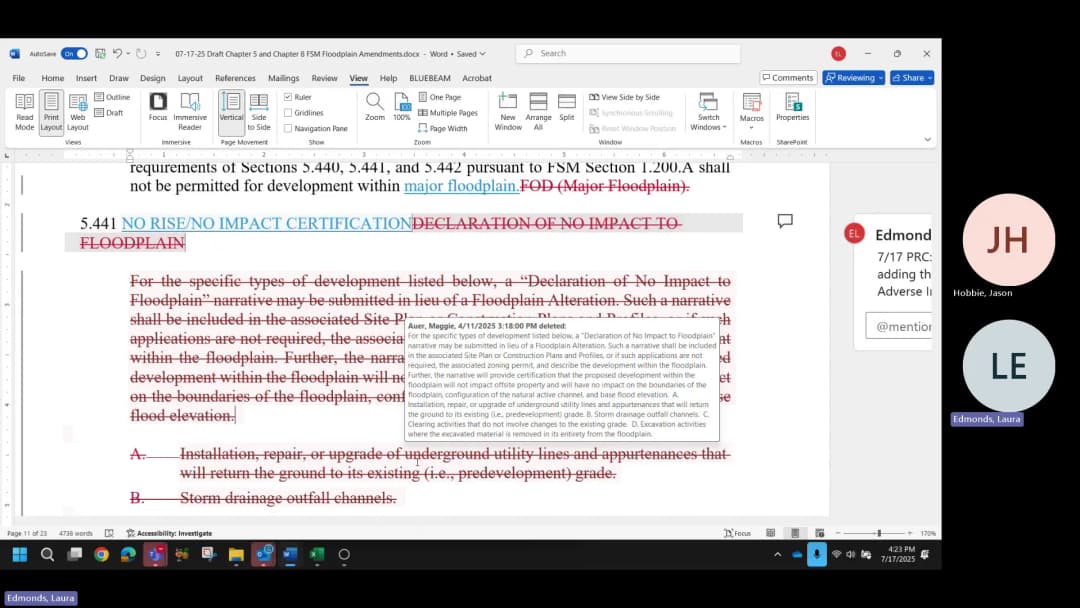
The Facility Standards Manual (FSM) Public Review Committee met on July 18, 2025, to approve minutes and the annual report, discuss the 10-year private reserve fund, and review proposed floodplain section updates. The committee also adjusted its meeting schedule. Consent Calendar - Minutes from June 12, 2025 – Approved unanimously (voice vote, all in favor). - 2025 Annual Report – Approved with amendments (motion made, seconded, voice vote all in favor). Amendments included adding a tech memo on stormwater, rewording a section to "establish land engineering and other division standards," and separating DOM topics as suggested by Betsy. Scheduling Changes - August 2025 meetings – Cancelled. - September 18 meeting – Rescheduled to September 11, 2025 (back-to-back with September 4). Committee members Kevin and Pete confirmed availability; additional confirmation from Laura needed. - Remaining 2025 meetings – Scheduled through December, with intent to possibly reduce to one meeting per month in November/December depending on progress. - October meeting room – Expected return to the Dulles room by the second October meeting (tentative, pending completion of renovations). Discussion Items 10-Year Private Reserve Fund - Staff Update (Seb) – Originally proposed moving the trigger for the 10‑year reserve fund to bond release and using developer reserve studies, but after review, staff determined that interpretation stretched the ordinance too far. The approach has pivoted to a "seed money" model where a calculation based on the construction bond estimate (e.g., a percentage of bond items) would be used to establish a fund at the time of recordation. Staff acknowledged urgency to avoid zoning violations. - Committee Discussion – Several members expressed concerns: - Angela – Provided example: a 105‑lot subdivision has $220,000 in maintenance costs over 10 years. She questioned asking developers to fund that amount up front when HOA dues and capital contributions typically cover reserves. She offered to share reserve study data. - Kevin – Suggested a simpler approach: for projects in an existing HOA, show that the HOA’s reserve fund is sufficient; for new HOAs, an escrow could be released once the HOA is funded. He also asked if staff would accept input from industry experts on appropriate percentages. - Derek – Recommended sending a formal letter to the Zoning Administrator stating that the current ordinance language is unworkable and requesting a fix through the Zoning Ordinance Quick Fix process. He noted the issue is a zoning ordinance problem, not solely an FSM problem. - Multiple committee members – Agreed that the original intent was to ensure long‑term road maintenance, not to require a large cash deposit at recordation. The committee consensus was to pursue two tracks: (1) draft a letter to the zoning administrator from the PRC asking for a revision, and (2) develop an interim calculation method for the seed money. - Follow‑up – A small group (Derek, Angela, Kevin, and staff) will draft the letter and a proposed calculation method, aiming to circulate before the next meeting. Floodplain Section Updates (5.400 series) - Minor edits – Streamlined language in Section 5.400 (floodplain studies) and removed duplicate wording. - No Rise / No Impact Certification – The committee debated the removal of items B, C, and D (storm drain outfalls, excavation activities, clearing) from the declaration of no impact. Staff (new floodplain administrator) interpreted "no impact" strictly, meaning no change to the floodplain boundary or BFE. Committee members argued that these activities historically were allowed under a narrative statement and had only nominal, non‑adverse effects. The committee requested that the language be revised to "no adverse impact" and that the list of permissible activities be reinstated. Staff agreed to take this back for review and return with revised language at the next meeting. - Type One Floodplain Alteration Criteria – Discussion focused on what qualifies as a type one alteration (lower fee, reduced review). Examples included minor grading for trails, ineffective flow area fills, and minor revisions to previously approved alterations. Staff clarified that the intent is to allow projects that do not require hydraulic model updates. The committee agreed to add clarifying examples (e.g., "minor grading in ineffective flow areas") but noted that site‑specific judgment will still apply. A new subsection was added for minor revisions to approved alterations, subject to floodplain administrator approval. - Type Two concerns – Some members raised that the new type one criteria could inadvertently allow complex projects (e.g., a bridge spanning the floodplain) to be treated as type one. Staff clarified that type one is for projects with no hydraulic model changes; complex structures would still require type two. Key Outcomes - Minutes and Annual Report – Approved unanimously. - 10‑Year Reserve Fund – Committee will draft a letter to the Zoning Administrator requesting a revision to the ordinance and will develop an interim calculation method. The letter will be circulated before the next meeting. - Floodplain Language – Staff will revise the “no rise/no impact” section to use “no adverse impact” and re‑include the list of permissible activities. Clarifying examples for type one alterations will be added. Additional discussion on storm drain outfalls and excavation will be addressed in the next round. - Next Meeting – Scheduled for September 11, 2025 (rescheduled from September 18).
The Loudoun County Board of Supervisors Transportation and Land Use Committee (TLUC) held a special meeting on July 16, 2025, as the fourth stakeholder meeting in the CPAM-2024-0002 and ZOAM-2024-0002 process reviewing Western Loudoun rural uses and standards. The meeting focused on farm wineries, limited breweries, and limited distilleries. Committee Chair Supervisor TeKrony presided and set a hard stop of 10:30 p.m. No minutes were provided in the source material, so this summary is based on the agenda and raw transcript. Staff Presentations - Planning and Zoning staff introduced the item, noting future stakeholder meetings: September 30, 2025 (mountainside overlay and signage), October 22, 2025 (bed and breakfast), November 5, 2025 (food trucks, food service, and rural restaurants), and an early 2026 catch-all meeting. Staff noted ABC was invited but unavailable; a supplemental memo contained ABC's written responses, many of which were unanswered because ABC's legal counsel said answers would depend on specific facts. - Karen Bergen of the Virginia Department of Agriculture and Consumer Services (VDACS) presented on food safety jurisdiction. She explained that VDACS regulates retail food establishments and manufactured food products; wineries, breweries, and distilleries can be VDACS-inspected if food preparation is limited and does not involve raw animal protein, while complex food preparation and raw protein handling fall under the Virginia Department of Health. Inspections are risk-based, occurring roughly every 12 months, 18 months, or 3 years, and VDACS investigates 100% of complaints. - County Attorney Jason Hobby summarized Virginia Code provisions for farm wineries, limited breweries, and limited distilleries. He said farm wineries have the most protection from local regulation, limited breweries somewhat less, and limited distilleries the least. He noted the Code uses terms such as "substantial impact" and "reasonable" without precise definitions, leaving localities discretion in drafting regulations. Invited Stakeholder Input - Richard Rasmus, a Hamilton resident, described a proposed brewery on 17 acres near his farm with plans for 265 parking spaces and eight buses. He said the property could not credibly be considered a farm operation and urged uniform standards, including review of counties such as Fauquier. - A representative later referred to as "Mr. Fabbioli" said the craft beverage industry had helped build the rural economy, businesses need room to evolve, and he was concerned about overregulation. - Scott Seiburger, a Blue Ridge Mountain Road resident, said a limited brewery near his home operated as a commercial entertainment venue under a zoning loophole, and he urged strict on-site agricultural requirements, noise caps, event limits, inspections, and stronger protections for the mountainside overlay district. - Tol Gabaki of Hillsborough Winery and Brewery, vice chair of the Loudoun County Brewers Association, said limited breweries and farm wineries collectively preserve over 3,000 acres, host nearly one million visitors annually, generate nearly $50 million in economic impact, and are regulated by 27 federal, state, local, and private agencies. He urged a light-handed approach and said the limited brewery law intentionally omitted growing requirements because processing facilities were not yet available in Virginia. - Lacey Huber of Stone Tower Winery, secretary of the Virginia Wineries Association, said events are integral to selling farm product and economically sustaining farmland. She said additional local regulation could stop investment and lead to more housing in Western Loudoun. - Kate Zerschmid of Great Country Farms, Bluemont Vineyard, and Dirt Farm Brewing cited a May 8 poll in which over 82% of respondents wanted to promote farming and preserve open space while discouraging subdivisions, and only 3.8% wanted to limit business uses. She urged solutions that help rural businesses thrive while addressing noise, lighting, and traffic concerns. - Scott Hamburger of Blue Valley Farm, a former founder and CEO of Fortessa, said he operates a 100-acre working farm near at least seven wineries and breweries that collectively preserve thousands of acres. He argued that zero adverse impact is impossible and called for the lightest possible regulatory touch, while still expecting businesses to be good neighbors. - Chris Suarez, a Loudoun resident and brewing industry professional, quoted a congressional record statement supporting agritourism and said agritourism is an economic imperative that helps farmers pay taxes and maintain land. - Doug Smith, speaking as a residential representative, said residents near ABC uses experience noise, headlights, trespassing, road congestion, accidents, and potential septic strain from large crowds. He called for uniform regulations consistent with Comprehensive Plan policies 3.1 and 3.2. - A later unlabeled stakeholder warned that unrestricted "booze tourism" could inflate land values and undermine genuine agricultural activity. - Dale Poland Myers, a fifth-generation farmer and planning commissioner, recalled the 1988–1990s farm crisis and the "200-acre/1,000-acre solution" preservation plan. She said many current concerns sound like enforcement issues, not a need for heavy new regulation, and warned against taking a "sledgehammer" to the industry. Committee of the Whole Discussion Topic 1: On-Site Agricultural Operation and Production - Staff asked whether farm wineries, limited breweries, and limited distilleries should have to meet the county's agricultural operation definition to qualify for building and fire code exemptions. Building official Raymond Rinaldi explained the Code of Virginia definition of farm structure and said occasional wedding use may be permitted by an Attorney General opinion only if it does not supersede the primary agricultural use. - Fire Marshal Micah Kiger said his office has limited ability to inspect agricultural-exempt structures, and he asked participants to consider safety because he does not want to "be the reason there are statistics." - Supervisor Kirchner cited zoning noise complaint data from the Catoctin District: 62% of noise-related complaints were determined unfounded, 36 complaints were resolved through warnings or minor infractions, and only 2% resulted in formal citation. - Supervisor Kirchner suggested using the Commissioner of Revenue's existing land-use assessment process, which requires applicants to document acreage, crops, and livestock every five years under penalty of law, as one way to verify bona fide agricultural operations. Staff and the County Attorney agreed this could be one criterion but not necessarily the only one. - Some industry representatives warned that the state has not defined specific on-site growing amounts for breweries and distilleries and said imposing local thresholds could conflict with state law and create lawsuits. No formal consensus was reached on the agricultural operation definition. Topic 2: Separate Limited Distillery Use - Staff noted limited distilleries are not currently identified as a separate use in the zoning ordinance and are treated like limited breweries. The County Attorney said the Virginia Code gives localities broader authority over limited distilleries, including noise regulation, than over limited breweries. - The committee generally appeared to support creating a separate limited distillery use with its own use-specific standards rather than folding it into the limited brewery definition. Topic 3: Use-Specific Standards for Commercial Wineries, Limited Breweries, Limited Distilleries, and Farm Wineries - Hours of operation: Discussion centered on whether hours should be consistent across the uses. Some supervisors preferred earlier weekday hours and slightly later weekend hours; Vice Chair Turner said midnight was too late for rural Loudoun; several winery representatives said the current 11 p.m. noise ordinance effectively serves as their event cutoff. Fauquier County was cited as having 9 p.m. Monday–Thursday, 11 p.m. Friday–Saturday, and 10 p.m. Sunday. No consensus was reached. - Noise: The committee generally agreed that the existing 55-decibel property-line standard should be retained and applied consistently to indoor and outdoor areas. Enforcement, especially after hours and on weekends, was highlighted as a key issue. - Road access: Current standards apply only to commercial wineries; farm wineries, limited breweries, and limited distilleries have no road access standards. DTCI staff noted that road adequacy depends on width, geometry, sight distance, and other factors, not just pavement. Supervisors discussed whether to apply traffic thresholds or performance standards and whether new regulations could discourage rural businesses. No consensus was reached. - Parking: The current standard is eight spaces per 1,000 square feet of gross floor area, which does not count outdoor licensed areas. Stakeholders said field or pervious parking should be allowed and that overflow parking designation and zoning permit exhibits should be strengthened. No final decision was made. - Buffering and screening: Limited breweries and farm wineries currently have no buffer requirements; commercial wineries are subject to Chapter 7 buffer standards under certain conditions. Some supervisors supported requiring buffers based on proximity to existing dwellings, while others warned against penalizing businesses when new neighbors move in. No consensus was reached. - Setbacks: Current setbacks vary by use, including 25 feet for farm wineries and 50 feet for limited breweries/distilleries. Board Chair Randall said setback issues were not among the complaints she receives, and several participants warned that changing setbacks could create many nonconforming structures. The committee did not agree to increase setback requirements. Topic 4: Accessory Events - Staff explained that the county's zoning administrator has consistently interpreted weddings and other events not directly related to winery or brewery operations as requiring temporary special event permits or a separate banquet/event facility use, although the Code of Virginia provides for "usual and customary" activities and events. - Several industry representatives argued that events are simply another way to sell their wine and beer and should be treated as part of normal business operations. Supervisors and staff noted that if a use qualifies as a bona fide agricultural operation, agritourism events could be permitted by right up to certain limits, while non-agricultural commercial operations would still need special event permits or banquet facility approval. The issue was not resolved. Key Outcomes - No formal votes or binding consensus were recorded; the meeting functioned as a stakeholder and committee work session for staff to refine draft language. - Staff were directed to explore using the county's existing land-use assessment process as a possible basis for verifying agricultural operations, while considering additional criteria. - There was general support for creating a separate limited distillery use rather than continuing to treat it as a limited brewery. - The remaining accessory events discussion was deferred to the November 5, 2025 meeting, which will also cover food trucks, food service, and rural restaurants, to avoid overlap and accommodate industry schedules. - Staff were asked to consider enforcement capacity, including potentially assigning new zoning enforcement positions to after-hours and weekend work in Western Loudoun. - The next scheduled meetings in the series are September 30, 2025; October 22, 2025; November 5, 2025; and an additional early 2026 catch-all meeting.
The Loudoun County Board of Supervisors held a business meeting on July 15, 2025, beginning at 4:00 PM. The meeting included a consent agenda, committee reports, public input, and votes on several significant land use and policy items. Key actions included approval of the Cross Mill Center data center (5-4), denial of the Hiddenwood Assemblage industrial rezoning (5-4), and approval of the Arcola Grove rezoning with a GIS substation (5-4). The Board also adopted the 2026 health plan with GLP-1 coverage, endorsed a BMI for transmission line transparency in staff reports, and deferred a vote on proactive zoning enforcement in Algonkian District to September. Consent Calendar - Approved consent agenda items en bloc, including: - Contract renewals for fuel services, architectural services, and construction support. - Contract award for next-generation bus farebox system. - Award authority increase for fire apparatus. - Award authority during August Board recess. - Contract award for construction management at risk for Western Loudoun Recreation Complex. - FY 2025 Section 8 Management Assessment Program certification and submission. - Scope modification for MHSADS group home replacements. - Route 50 and Northstar Boulevard crosswalks. - Safe Passage to Schools pilot location recommendations. - FY 2027 budget development preliminary CIP guidance and fiscal policy updates. - Appointments confirmations and nominations. - Administrative items report. - Incentive package for ORBCOMM retention and expansion. - Contract award for labor relations administration services. - Policies and procedures on advisory boards and bylaws template amendments. - Timeline extension for Dulles Technology Park (LEGI-2025-0056). Public Comments & Testimony - Data Centers and Cross Mill Center: Multiple speakers opposed the Cross Mill data center, citing environmental impacts, noise, energy grid strain, and complicity in human rights abuses. Some speakers supported the project, emphasizing economic benefits and appropriate location near existing infrastructure. - Hiddenwood Assemblage: Residents from Hiddenwood Lane and Briarfield Estates spoke. Hiddenwood residents argued their application reduced data center use and mitigated impacts; supporters urged approval for industrial space shortage. Opponents cited conflicts with comprehensive plan and precedent. - Arcola Grove: Public comment included opposition due to proximity to residential areas, concerns about substation emissions (SF6), and compatibility with planned mixed-use community. - Transmission Lines (Dominion Route 3/3A): Several speakers opposed proposed routes through Broad Run watershed, near schools, and over conservation easements, urging use of existing rights-of-way. - River Creek Parkway: A senior resident requested a traffic light at Olympic Boulevard for safer left turns. - Leesburg Mobile Home Park: Residents described imminent mass eviction and requested Board assistance with relocation. - Zoning Enforcement: A Broad Run Farms resident opposed proactive enforcement, arguing the current complaint system was sufficient. - Procedural Issues: Chair Randall enforced rules against off-topic remarks; one speaker was directed to sit down for veering from the agenda item. Discussion Items - Health Plan Update (Item 1i): Staff presented 2026 health plan renewal with 12.2% premium increase for active employees and pre-65 retirees (including GLP-1 coverage for weight loss at 1.8% of plan costs). GLP-1 coverage would require a weight management program with weekly weigh-ins. Post-65 retirees would see 4.5% increase. The Board approved the plan design change, premiums, and renewal of vendor contracts. - Street Name Selection (Item 7): Supervisor Kershner moved to direct staff to generate historic street names for a private right-of-way off Loyalty Road. Approved 9-0. - BMI on Transmission Line Information (Item 14): Supervisor TeKrony and Chair Randall co-sponsored a motion to require narrative and mapping of high-voltage electrical infrastructure in staff reports for industrial/data center land use applications. Approved 9-0. - DPZ Work Plan (Item 11): Staff presented quarterly update with 10 new or ongoing projects. Approved 9-0; an additional motion to add National Register nominations for Howardsville and First Baptist Church of Watson passed 9-0. - Arcola Grove Rezoning (Item 13): Supervisor Letourneau moved approval for a GIS substation and additional 200,000 sq ft of data center (applicant had removed natural gas turbines and added tier-four generators). Staff cited concerns over building height, buffer, and setback non-conformance. Approved 5-4 (Turner, Letourneau, Kershner, Umstattd, Saines in favor; Glass, Brixman, Cronin, Chair Randall opposed). - River Creek Parkway Study (Item 8): Supervisor Turner moved to conduct a multimodal and operational safety study without requiring a road diet as a specific task. Approved 9-0. - Virginia Property Maintenance Code (Item 10): Supervisor Glass moved to direct staff to pursue adoption of remaining code chapters with effective date July 1, 2026, and implementation January 1, 2027. Approved 9-0. A second motion to prepare a resource request for additional zoning enforcement staff during FY27 budget passed 9-0. A third motion by Supervisor Brixman to defer discussion of proactive enforcement in Algonkian District to September 16, 2025, passed 9-0. Key Outcomes - Approvals: - Health plan design change for 2026 including GLP-1 coverage and premiums (approved). - Street name generation for Loyalty Road private right-of-way (9-0). - BMI requiring transmission line and substation info in land use staff reports (9-0). - DPZ work plan with projects and addition of Howardsville and Watson historic nominations (9-0). - Arcola Grove rezoning with GIS substation and proffers (5-4). - Cross Mill Center data center (ZMAP-2023-0002 & SPEX-2023-0007) (5-4). - River Creek Parkway safety study without road diet requirement (9-0). - Virginia Property Maintenance Code adoption direction and budget resource request (both 9-0). - Denials: Hiddenwood Assemblage rezoning (ZMAP-2023-0004) denied (5-4). - Deferred: Proactive zoning enforcement area discussion in Algonkian District to September 16, 2025. - Other Actions: Approved incentive package for ORBCOMM, contract awards, and administrative items. Entered closed session for property acquisition (Ashburn/Little River), litigation (Catoctin code enforcement), and business expansion (Dulles/Sterling).
Note: The agenda listed this meeting for Wednesday, July 9, 2025, but the user-provided date is July 10, 2025. This summary uses the provided date. Introductory paragraph: The Transit Advisory Board (TAB) held its regular business meeting on July 10, 2025, at the Transit & Commuter Services Office in Leesburg, Virginia. The board approved the minutes from the May 14 meeting, discussed the annual report planning, and received extensive staff updates on ridership trends and the launch of the microtransit pilot in Leesburg. Consent Calendar - Approval of May 14, 2025, Business Meeting Minutes: After a brief discussion and a proposed amendment to clarify that Kevin Potter (NOVA-TRAC) presented their concept, the board voted to approve the minutes as amended. The motion passed unanimously. Public Comments & Testimony - No members of the public were present to comment. Discussion Items - Annual Report Planning: The board reviewed the 2024 Annual Report (Attachment 2) as a template. Vice-Chair Vlad Ovchynnikov volunteered to take the lead on drafting the 2025 report, with input from members to be collected offline. The report is scheduled for discussion at the September meeting and a vote in November. - Staff Updates – Transit Service and Ridership (Scott Gross and Steven Pairo): - Commuter Bus: Ridership dipped in May and June, but when adjusted for abnormal days (holidays, protests), daily ridership remains near the March peak of 1,440 riders per day (about 1,400 in June). Two additional morning and afternoon trips were added in May, and all commuter routes were re-timed on June 30 to account for increased traffic due to return-to-office mandates. - Local Bus: Ridership is stable and healthy, though not at pre-COVID levels. Weekend service was expanded in April. - Paratransit: Ridership spiked significantly last fall and remains well above planned levels, creating budget pressures. - Microtransit Pilot (Leesburg): Launched on July 7, 2025, as a soft launch. Service operates three vehicles (two minivans, one electric wheelchair-accessible “Game Changer”) from 7 a.m. to 7 p.m. weekdays, free of charge. Ridership: 12 on Monday, 21 on Tuesday, and about 24 on Wednesday. Average trip times are 7–18 minutes, compared to 45–60 minutes on fixed routes. The app provider is Rideco. Staff are actively collecting data, identifying gaps (e.g., areas just outside the zone), and adjusting stops. The pilot is intended to inform potential replacement of fixed routes 55 and 56. - New Commuter Routes: Timetable testing is underway for new routes to Dale City, VA, and Frederick, MD, with buses running the proposed routes daily for five weeks to validate schedules. - Transit Center Discussion: Staff noted that a hub-and-spoke transit center is not currently efficient, but microtransit may reveal demand patterns that support such a system in the future. - Member Comments: Members discussed the potential for microtransit to serve students after school, the need to track no-shows and cancellations, and the possibility of political pushback from ride-hailing companies. Key Outcomes - Minutes Approved: The May 14, 2025, meeting minutes were approved as amended (unanimous). - Annual Report Lead: Vice-Chair Ovchynnikov will coordinate the 2025 annual report; members will submit input via email. - Microtransit Pilot: The pilot is underway and will be monitored closely; staff will report findings at future meetings. - Next Meeting: Tentatively scheduled for September 9, 2025, at 7:00 PM at the same location. - Adjournment: The meeting was adjourned by unanimous consent.
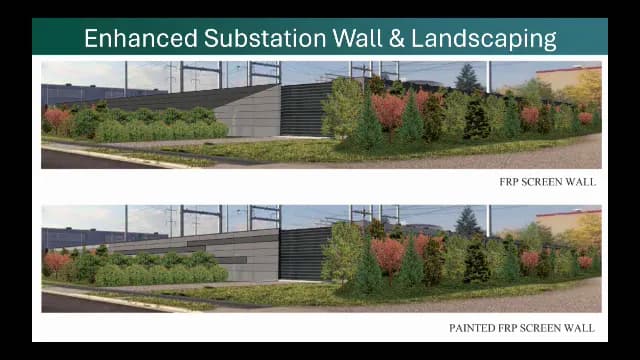
The Loudoun County Planning Commission held a work session on July 10, 2025, at 6:01 PM. The meeting covered two main legislative items, a briefing on upcoming public hearing items, and administrative updates. Commissioners adopted the minutes from the June 12 work session and heard presentations on a proffer amendment for the Commonwealth Center and a rezoning and special exception application for the Concorde Industrial Park. The commission forwarded both items to the Board of Supervisors with recommendations of approval, with notable debate on the Concorde application. Consent Calendar - Adopted the minutes from the June 12, 2025, work session (7-0-2, with Commissioners Kears and Combs absent). Discussion Items - Commonwealth Center Residential Proffer Amendment (LEGI-2025-0017): Staff presented a proposal to modify the approved proffer to align with Virginia Housing Development Authority policies for income tiers in the event of foreclosure. The amendment was limited in scope and required no public hearing. The commission voted unanimously (7-0-2) to forward the application to the Board of Supervisors with a recommendation of approval, subject to the proffer statement dated June 27, 2025. - Concorde Industrial Park (LEGI-2024-0002): Staff reviewed the application to rezone 17.2 acres from PDGI to IP, with special exceptions to increase the floor area ratio to 0.8 for data center use and to permit a utility substation. Staff initially identified five outstanding issues: the 12-year timeframe for development options, open space, pollinator plantings, substation screen wall, and proffer consolidation. The applicant submitted a memo on July 9 committing to revisions that addressed all issues, including removing the 12-year option and increasing the substation setback. Staff expressed support contingent on those revisions. After applicant presentation and commissioner questions, the motion to forward the application to the Board of Supervisors with a recommendation of approval, subject to the applicant's July 8, 2024 memo and specific findings, passed 4-2-3 (Commissioners Frank, Banks, Myers, and Motoretti in favor; Commissioners Barnes and Motoretti opposed; Commissioner Jasper recused due to stock ownership in Prologis; Commissioners Kears and Combs absent). Commissioner Barnes opposed due to the substation wall height (preferring 20 feet, applicant committed to minimum 12 feet); Commissioner Motoretti cited inconsistency with past approvals and concerns about the 12-year horizon (though it was removed). - Briefing of July Public Hearing Items: Staff briefed the commission on 11 upcoming applications, including: six AFD renewals in Western Loudoun; Oak Hill Farm early withdrawal from AFD (county purchasing the property); Valley Commerce rezoning (117 acres, two zoning modifications); West Belmont mixed-use development (361 dwelling units, limited commercial); an accessory dog kennel special exception; Pantovich property rezoning (4.48 acres to IP); Cochrane Tech rezoning with battery storage; and a stormwater handbook ordinance amendment. Commissioners raised questions about traffic, community outreach, fire marshal input on battery storage, and implications of road vacations. Staff noted continued discussions with applicants. Key Outcomes - Commonwealth Center Proffer Amendment: Approved for forwarding (7-0-2). - Concorde Industrial Park: Approved for forwarding (4-2-3) with conditions. - Upcoming Briefings: Noted that several applications will require further refinement before the July public hearing. - Administrative Items: The commission's amended bylaws and annual report will be presented to TLUC on July 28. The Board of Supervisors overturned the commission's denial of a CMPT for the Tuscarora land bay three substation, directing further design discussions.
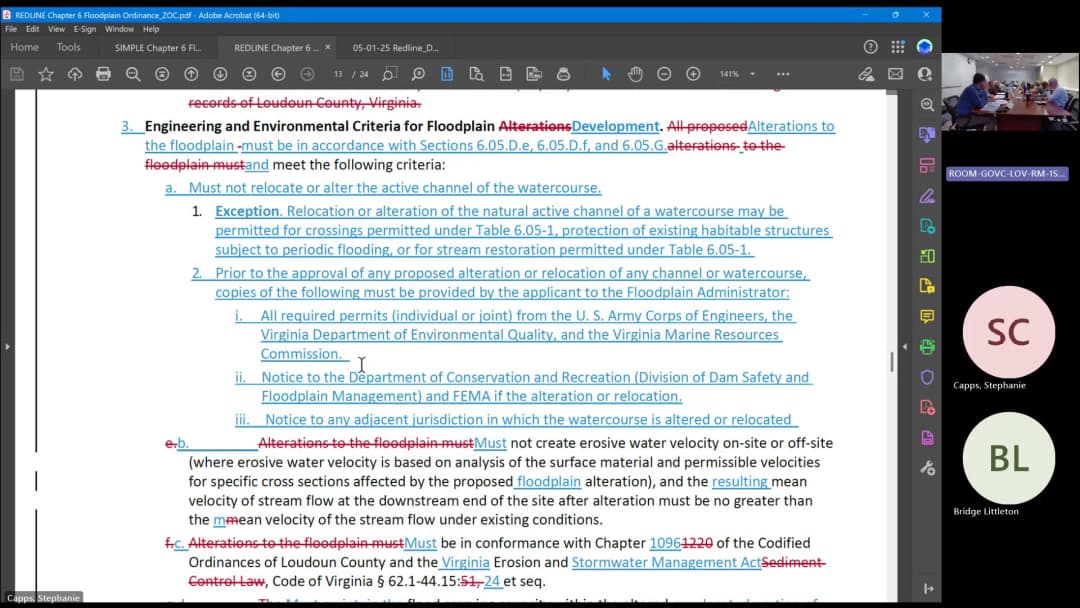
The Zoning Ordinance Committee (ZOC) met on July 2, 2025, from 9:30 to 11:00 a.m. in the Lovettsville Room. The committee reviewed status updates on several pending comprehensive plan and zoning ordinance amendments and continued its detailed discussion of the Floodplain Ordinance Update. No public comments were received. Consent Calendar - Approval of Action Report for June 4, 2025: The action report was approved without dissent. Discussion Items - Status Updates on Current and Upcoming Amendments: - CPAM-2025-0001/ZOAM-2024-0001 – Data Center Standards & Locations, Phase 2: The project remains on schedule. A Transportation and Land Use Committee (TLUC) meeting originally set for June 18 was canceled and has been rescheduled for July 28, 2025. Committee members have been individually briefed. - Zoning Ordinance Rewrite Adjustments (Clean-Up ZOAM): A resolution of intent to amend is under review by the County Attorney’s office, with a target Board of Supervisors presentation in September 2025. Draft text is expected for ZOC in October 2025, followed by Planning Commission and Board consideration. The adoption timeline remains December 2025, with a possible slip to January 2026. - CPAM/ZOAM-2024-0002 – Western Loudoun/Rural Uses and Standards (WLRUS): A special TLUC meeting on July 16, 2025 will address equine issues, livery stables, agricultural processing, and other rural uses. Staff intends to bring initial draft language to ZOC in September 2025. - Floodplain Ordinance Update: - Staff presented responses to prior ZOC comments. The committee focused on two unresolved issues: (1) notification of adjacent property owners when floodplain boundaries change, and (2) the policy of allowing active recreation in the floodplain. - A committee member expressed frustration that past floodplain alterations have enabled development (including buildings) on formerly flood-prone land, arguing such alterations should not be permitted. Staff noted this is a policy question for the Board of Supervisors. - Another member raised concerns about minor floodplain alterations (e.g., piping watercourses) being potentially prohibited by new language. Staff clarified that the intent is not to change current allowances, and they will review the language to ensure consistency. - Staff reported that over 100 parcels are currently out of sync between local floodplain maps and FEMA maps. The upcoming ZMAP update will correct this and include a public notification process for affected property owners. - Committee members requested clearer definitions for “accessory structure” in Chapter 6 to avoid confusion with the general zoning definition. Staff agreed to explore options. - The committee agreed to a process: after this meeting, members may submit only clarifications on their own previous comments within one week. Staff will then produce a cumulative redline document highlighting changes made since this meeting, due at least two weeks before the September meeting. Key Outcomes - The committee accepted staff responses on most floodplain comments, with the two outstanding issues (active recreation and minor floodplain alterations) to be revisited in September. - Staff will provide a cumulative redline of the floodplain ordinance text by August 20, 2025, highlighting all changes from the version discussed on July 2. - The next ZOC meeting is scheduled for September 3, 2025 at 9:30 a.m. in the Lovettsville Room. - Staff announced the appointment of Bradley Polk as the new Deputy Zoning Administrator.