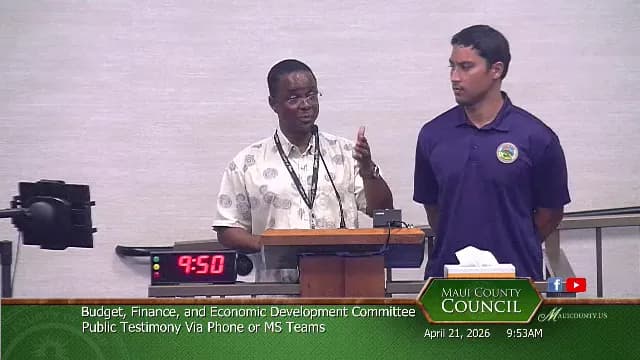
The Budget and Finance Committee met on April 21, 2026, to continue deliberations on the FY2027 budget, focusing on departments excluding countywide expenses, fire, public safety, housing, human concerns, and liquor control. The meeting began with public testimony and included council member priority amendments. Key topics included funding for early childhood education, wildfire health recovery, affordable housing, and shoreline management. Public Comments & Testimony - Tutu and Me Traveling Preschool (Partners in Development Foundation): Multiple parents and a staff member testified in strong support of county funding to preserve the program on Maui. The program serves approximately 200 children across four sites, with each teaching team costing $600,000 to support two sites. Total funding needed to sustain Maui sites is $1.2 million, of which $1.2 million is already in the mayor’s proposed budget (two-thirds of the need, with one-third match secured). Testifiers emphasized the program’s role in early childhood education, family bonding, cultural grounding, and community support, particularly for families displaced by the 2023 wildfires. The loss of federal Native Hawaiian Education Act funding was cited as the cause of planned closures in August 2026. - Ho'ala Health Initiative (University of Hawaii): Two testifiers (Alika Monakea and Ruben Juarez) requested $2 million in county co-funding to expand the Maui Wildfire Exposure Study and establish a permanent prevention and disaster recovery health system. They reported that 2,000 Maui residents have been served to date, with high rates of depression (one in two individuals) and respiratory impairment. The program aims to serve 5,000 individuals annually through screening, diagnostics, and community navigation. - Camp Maluhia (Scouting America): Glenn Katagawa and Lea Fadachi requested $500,000 for camp upkeep, repairs (roof damage, pool, painting), and continued community use. They noted the camp hosts scouting events, church groups, and programs for incarcerated youth. - Department of Housing (Director Richard Mitchell and Deputy Director Mata Afa): They testified in support of the department’s Affordable Housing Fund allocations, including $1 million for Aloha House (supportive housing for individuals below 50% AMI), $6.595 million for Habitat for Humanity’s Hana homeownership project (25 lots, ready for power connection), and $1 million for developing county-owned land. They described the rigorous RFP process used to select projects and urged the council not to cut these items. They noted the Paris (Permanently Affordable Rental Unit Strategy) program did not apply in the current cycle. - Paya Mantokuji Mission (Managed Retreat Fund): Kaina Shiki opposed the $2.5 million request, arguing the applicant lacks a defined project, is pursuing state legislation to bypass environmental review, and has compliance issues. She stated relocation of structures is feasible (previous cost estimates $2 million) and urged using the fund for retreat, not shoreline hardening. - Other testifiers: Tom Crowley spoke against proposed water rate increases and described a 90% drop in his bed-and-breakfast business. Christopher Salem reiterated concerns about unaccounted developer infrastructure agreements. Several additional parents testified in support of Tutu and Me. Discussion Items - Council members discussed the Tutu and Me funding, with Member Batangan confirming the $1.2 million in the mayor’s budget is intended to cover the two-thirds need. Members also explored options for the Paris program and the Cove Beach Village acquisition, though no formal motions were made on those topics during this session. - Member Paulton introduced an amendment to add a grant condition of up to $300,000 for the Marine Maui Ocean Center Marine Institute, to support coral reef restoration, sea turtle rescue, and heat-tolerant coral breeding. The amendment was seconded by Member Johnson and received support from Members Cook and others. Key Outcomes - Amendment adopted: The committee voted to add a new condition to environmental protection grants: up to $300,000 must be for a grant to the Marine Maui Ocean Center Marine Institute. The motion passed with 8 votes in favor and 1 excused (Chair not voting or excused). - The meeting recessed at 11:14 AM and resumed at 11:25 AM to continue the budget discussion. No further votes were taken before the break.
Public Meetings - Maui County, Hawaii
Public Meetings - Maui County, HawaiiThe Maui County Budget, Finance, and Economic Development Committee (BFED) convened on April 20, 2026, at 9:07 AM to begin decision-making on the Fiscal Year 2027 budget. Chair Yuki Lei Sugimura presided. The day focused on the real property tax (RPT) certification, public testimony, establishing member priorities, and making initial cuts and additions to the mayor's proposed budget. The meeting recessed at 5:53 PM and will continue on April 21. Public Comments & Testimony - Jeff Ueoka proposed the county purchase a one-acre parcel at 82 Kanani Road in Kihei for $8.62 million (subject to appraisal), which is fully permitted and shovel-ready for 32 affordable housing units. He asked for an appropriation to allow the administration to negotiate. - Travis Liggett advocated for a referendum to adopt a solution to stringent total nitrogen requirements in the Lahaina NPDES permit and to fund wastewater disinfection via philanthropy instead of litigation. - Mike Reyes, Executive Director of Malama Hālaʻikala Foundation, supported Councilmember Johnson's priority to remove invasive black wattle on 107 acres at Kaʻonoulu Ranch and plant 462 native ʻōhiʻa trees to restore the Naulu cloud bridge. He agreed to ensure the trees remain in perpetuity. - Christopher Salem criticized the February 2026 fraud risk assessment by Spire Hawaii LLP, arguing the county charter already gives the council, auditor, and Cost of Government Commission authority to investigate fraud, but these powers have not been used. - Kalana urged scrutiny of church property tax exemptions, suggesting some churches may be detrimental to society. - Sanoe (nonprofit shelter provider) thanked the committee for $257,500 in shelter grants, noted families are staying longer than the 120-day limit due to lack of transitional housing, and requested county support for scattered-site housing for domestic violence survivors. She also mentioned need on Molokaʻi. Discussion Items - RPT Certification (9:07 AM – 11:00 AM): Director Martin presented the 2026 real property tax certification, showing a certified value of $83.02 billion, a slight decrease of less than 1% from the prior year. Revenue projections totaled $660.37 million, about $156,548 more than the mayor's proposed budget. Discussion included the 41% share of revenue from property taxes, circuit breaker statistics (2,094 owner-occupied parcels paying minimum tax), and wildfire tax waivers covering 1,300 properties. Committee members asked about appeal trends, exempt properties (churches, credit unions), and trends in assessed values. Members submitted written questions due April 21 at 9 AM. - Budget Process and Priorities (11:00 AM – 5:53 PM): After the RPT presentation, the committee received the member priorities matrix. Chair Sugimura outlined the week's plan: first address duplicate priorities, then take up broad cuts and department-by-department reviews starting with the legislative branch. Each member was allowed up to 2 residency area proposals, 3 countywide proposals, 2 revolving fund conditions, and 2 grant conditions. Eight overlapping priorities were identified, including Maui Mediation Services, Street Medicine/Project Vision, Kaʻahumanu Church, and others. Members resolved duplicates through substitutions or withdrawal. - Broad Cuts and Department Reviews: Member Batangan proposed a 1.25% across-the-board cut to non-first-responder general fund departments (excluding police, fire, DEM) to reduce carryover savings, but the committee favored a more targeted approach. Member Sugimura proposed removing funding for all expansion positions (EPs) except the Maui United Way-funded warm body, but this was deferred to department-level discussions. The committee then proceeded department by department, making specific reductions and additions. Key Outcomes - Department of Agriculture Additions: - Approved (9-0) a condition to allocate up to $564,000 to Maui County Farm Bureau. - Approved (9-0) adding $1 million to the Farm to Family grant program (total $2 million). - Approved (9-0) a condition that grantees follow the Food and Nutrition Security Plan. - Approved (9-0) adding $500,000 for a Lokahi Pacific animal feed crop pilot program (countywide). - Approved (9-0) adding $25,000 for the Rusty Maui Cat Collective trap-neuter-release program. - Approved (9-0) adding $250,000 for a Maui Humane Society pet retention program. - Approved (9-0) adding $20,000 for a Humane Society vehicle (revolving fund). - Approved (9-0) adding $40,000 for spay/neuter services (condition). - Department of Agriculture Cuts: - Approved (8-1) a reduction of $83,723 to category A (reducing months funded for FY26/27 expansion positions not yet created). - Approved (6-2, 1 recused) a reduction of $52,656 for a secretary to boards and commissions position (later reconsidered and withdrawn after learning it was filled). - Approved (5-3, 1 recused) a reduction of $160,000 from category B contractual services (outsourced grant writing). - County Clerk: A motion to cut $86,628 from category A failed (3-6). - Office of Council Services: A motion to cut $1.5 million from CIP was amended to $1 million cut (leaving $900,000) and approved (voice vote). - Corporation Counsel: Approved (9-0) a cut of $24,884 from category A (safety specialist position). - East Maui Water Authority: Approved (9-0) adding $39,882 for a Planner V position (6 months). Also approved (9-0) a cut of $26,998 from category A (FY27 expansion positions). - Emergency Management Agency: Approved (9-0) adding $2.3 million for top two wildfire risk priorities. Approved (9-0) a cut of $129,000 from FY27 expansion positions (excluding a Maui United Way-funded position). Approved (9-0) a cut of $50,000 from category B (excessive line items). Approved (9-0) deleting $10,000 for Maui Search and Rescue (non-compliant vendor). - Procedural Motion: The committee voted (6-3) to allow departmental requests to be considered as separate from council member priorities, enabling the administration to submit items missed or changed since the mayor's proposal. The meeting was adjourned at 5:53 PM and will resume April 21 at 9:00 AM starting with the Department of Environmental Management.
On April 18, 2026, the Budget, Finance, and Economic Development Committee, chaired by Councilmember Yukile Sugimura, held a listening session in West Maui to hear community input on the Mayor's proposed budget for Fiscal Year 2026-2027. Councilmembers from across Maui County attended, and over 20 community members testified on priorities ranging from wildfire recovery and housing to transportation and public safety. No formal votes were taken; testimony will inform the committee's budget deliberations. Public Comments & Testimony - Alejandro Ayala praised the MEO paratransit service for changing her life but noted long wait times (sometimes 1–2 hours) and requested a local route to reduce travel time. - Lynn Nishikawa (Aloha Amplified) requested $40,000 for the 2026 Lights for Lahaina event, a two-day healing experience on September 11–12, citing its positive mental health impact on survivors. - Rhonda Alexander Moncres (Hoʻola LTRG) requested $500,000 for disaster case management, noting 245 families in care and 160 on a waitlist. She highlighted two homes completed and four underway. - Kelly Gisel (Hoʻola LTRG) reported that 427 volunteers contributed over 27,000 hours in nine months, creating an estimated $850,000 economic impact, and asked for continued support. - Brandi Khajadoy (Hoʻola LTRG) requested funding to address faulty contractors, describing cases where survivors were left with incomplete or dangerous homes. She said remediation costs range from $60,000 to $500,000 per household. - Rick Nava (West Maui Taxpayers Association) opposed a $60 million budget increase, citing rising costs. He requested priority funding for traffic safety improvements on Kiawe Street, pedestrian crosswalks, bus shelters, and park upgrades at Kilauea or Malka Park. He urged using CDBG-DR funds instead of county general funds. - Joseph Pluto (West Maui Taxpayers Association) emphasized health and safety, highlighted progress on a new fire station (estimated $4 million using modular construction), and called for permitting reforms and exemptions for urgent safety projects. - Theo Morrison (Lahaina Restoration Foundation) supported the $9 million in the Office of Recovery budget for rebuilding the Lahaina Courthouse and old prison, noting the foundation has managed these historic sites for decades. - Mitch Kingsley (Mennonite Disaster Service) explained that their volunteer work depends on four pillars: accommodations, volunteers, meaningful work, and material funding. He emphasized that county funding for case management and materials is critical to their ability to stay in Lahaina. - Alexandria Domingo (reading a parent's letter) expressed appreciation for MEO Head Start full-day, full-year services and urged continued funding. - Michelle Lincoln (fire survivor) requested budget recognition for park parcels from the Kahoma Village mediation, and asked for reclaimed water to be extended to Bishop Estate for fire prevention and agriculture. - Bij Yadow (Hoʻola LTRG) thanked Hoʻola and partners for helping his family rebuild and urged continued support. - Lionel Pasqual (fire survivor) described being in a “missing loop”—ineligible for FEMA and low-income assistance after exhausting insurance loss-of-use funds. He requested rental assistance for middle-income survivors. - Wilmot Kahali (Aloha Amplified) shared the origin of Lights for Lahaina and requested a specific budget allocation for mental health and wellness, noting the community’s ongoing trauma. - Kanani Higby (fire survivor) argued that mental health funding is less urgent than housing and missing persons investigations. She asked the council to support state bills (HB 2049 and SB 3028) for Hawaiian home infrastructure and called for more action on her missing brother. - Mikey Burke (Lahaina Community Land Trust) requested restoration of $6 million in unrestricted funding initially proposed by the mayor (later reduced) and retention of $2.4 million for vertical construction. She said 10 ʻohana (1,600 lived years) have been kept in Lahaina, and 20 properties are secured. She warned of a narrow 2–3 year window to buy land before settlement checks drive sales. - Jay Kamiki Carter (Hoʻola DCM) shared a kupuna’s story of receiving case management support and asked for continued funding. - Steve Fisher (fire zone resident) proposed planting pencil cactus (fire-resistant) for fire prevention and requested speed bumps on Fleming Road to address dangerous speeding. - Carolyn Alve Loa (Lahaina Community Land Trust) thanked the council for previous trust and funding ($3.5 million for an insurance gap program), reported 10 families helped and three foreclosures disrupted, and urged restoring the $6 million. She also raised concerns about an unsafe retaining wall behind a home and called for stronger enforcement by the Department of Planning (4Leaf). Key Outcomes - No formal votes were taken at this listening session. - Councilmember Tamara Paulton will report the testimony received to the committee at its next meeting on April 19 or 20, 2026. - Several councilmembers committed to following up on specific requests: rental assistance for Lionel Pasqual, speed bumps on Fleming Road (in coordination with Roland Tanner and the Department of Public Works), and the Kahoma Village park parcels (via budget amendment). - The committee will consider testimony when reviewing the Mayor's proposed budget, including possible amendments to restore funding for the Lahaina Community Land Trust ($6 million) and to address the “missing loop” for rental assistance.
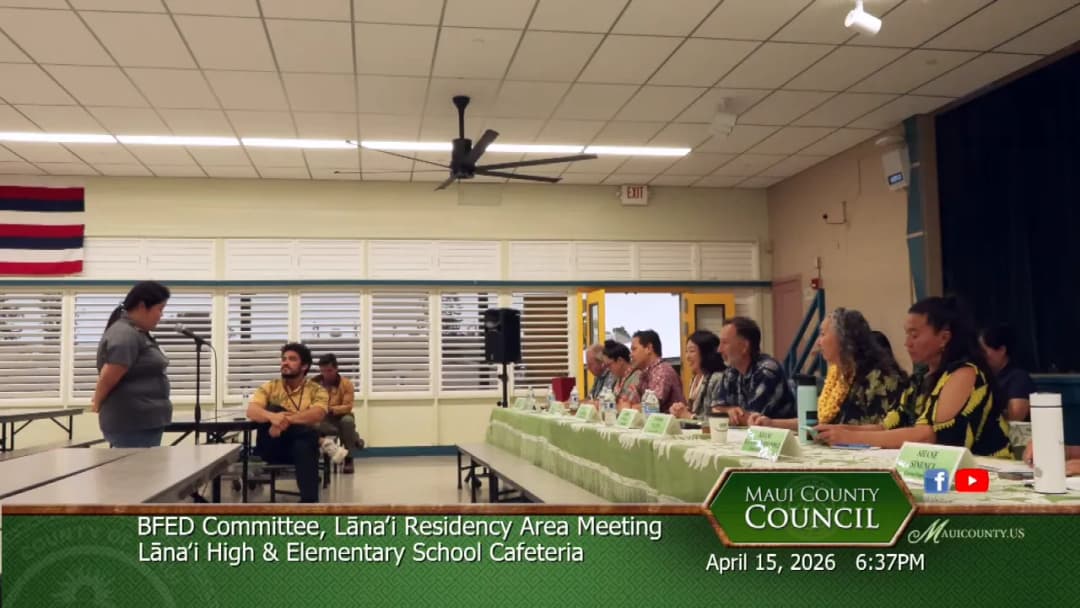
The Budget, Finance, and Economic Development Committee of the Maui County Council held a listening session on Lanai to hear community priorities for the fiscal year 2027 budget. Chair Yuki Lee Sugimura opened the meeting, and council members introduced themselves. The sole agenda item was the entire proposed county budget. Ten public testifiers spoke, and council members asked clarifying questions. No votes were taken; the committee will use the testimony in budget deliberations the following week. Public Comments & Testimony - Neil Tomashiro (representing Dr. Cook, retired professor) asked the committee to support the construction appropriation for the Lanai Field House extended roof and gutters, and requested that more sports programs (e.g., archery, golf) be allowed in the facility. In response to Councilmember Paulton, he confirmed the two currently approved sports are baseball and softball. - Heather Durham (representing Kupuna) thanked the committee for funding MEO, Kini Ole, and the community health center, and urged deeper funding to allow seniors to age in place and to train youth in healthcare careers. - Michelle Winehouse (owner, Kapua’s Farm) reported that agriculture programs (FAM, MEDB, MEO, etc.) helped her farm achieve 900% sales growth from 2024 to 2025 and increase squash production from 100 lbs to over 700 lbs in Q1 2026. She requested interim payments for the Lanai Food Stimulus Program (currently reimbursed every six months) and advocated for increasing the agriculture budget (currently 0.2% of the total). She also expressed interest in applying for the farm-to-family grant. - Natalie Ropa (UH Maui College) did not request funding but sought to repurpose the old Lanai Youth Center building for UH Maui College’s early college dual enrollment program. She noted that 30 of 50 students in the class of 2026 participated in the program, and seven earned associate degrees. She also highlighted the need for a permanent CNA/LPN lab. Councilmember Johnson offered to discuss further. - David Embrae (farmer, 50 years) criticized the small agriculture budget and called for a hotel tax to sustainably fund farmers. He said microgrants and stimulus programs do not help commercial farmers, and urged a program that pays farmers upfront to grow crops. He also noted the loss of a commercial kitchen on Lanai. - Butch Gima (Chair, Lanai Planning Commission) made six requests: (1) allocate funds for planning and permitting to convert the First Hawaiian Bank property into a multi-purpose facility with overnight stays for visiting agencies; (2) fund hybrid planning commission meetings (currently only Zoom); (3) fund public works for cemetery maintenance; (4) fund changes to boards and commissions code; (5) thanked the council for working with the administration on affordable housing; (6) criticized the Department of Agriculture for not conducting a survey of produce demand to match farmers. Councilmember Paulton asked about including a commercial kitchen. - John Janikowski (family physician) supported Lanai Kino Ole home health agency, noting a waitlist, and thanked the committee for past appropriations. He also reported that the agency’s medical assistant program led to one MA entering nursing school. - Rose Jane “Cheddar” (MEO branch manager) asked the committee to continue funding MEO’s transportation services for seniors, which provide rides to medical appointments, shopping, and the senior center. - Stan Ridis requested a community center with emergency shelter below the skate park, and a vehicle maintenance base. He emphasized that Lanai is last to receive support services. Councilmember Johnson responded that the military is considering building a Category 5 shelter on county land and that the Kaikohana affordable housing project includes a community center open to all residents. - Fran Odochi Wade (Lanai Farmers Market, Hawaii Farmers Union United) supported all previous testimony, especially Natalie Ropa’s building request. She asked for shorter payment timelines for farmers, continued funding for the Lanai Food Stimulus Program, repair of the green waste composting machine, and a commercial kitchen/processing center. Councilmember Paulton clarified the compost ask; Councilmember Sonansi suggested contacting the Department of Agriculture about an aggregation center. Discussion Items - Council members asked clarifying questions of several testifiers, including about the field house sports, stimulus payment frequency, possible building use for UH Maui College, and the First Hawaiian Bank property. No substantive debate on the budget occurred, as the session was designed for listening. Key Outcomes - The committee will use all testimony received during the listening session to inform its decisions on the fiscal year 2027 budget, which will be deliberated the following week. No formal motions or votes were taken.
The Budget, Finance and Economic Development Committee (BFED) met on April 16, 2026, at 1:05 PM to continue deliberations on the proposed Fiscal Year 2027 budget for the County of Maui. The meeting focused on the Department of Environmental Management (DEM) budget, public testimony, and council member questions. The meeting was adjourned at 4:30 PM. Public Comments & Testimony - Twenty-eight individuals testified at the South Maui residency area meeting (April 14, 2026), expressing support for funding for various organizations including Maui AIDS Foundation, MEO, Maui Green and Beautiful, and others. Requests also included South Maui infrastructure improvements (North-South Collector Road, Wailuku water system, wetland preservation, cove park pollution). - Ten testifiers spoke at the Lanaʻi residency area meeting (April 15, 2026), supporting continued funding for Maui Economic Opportunity’s Lanaʻi Grown Food Stimulus Program, farmers, boards and commissions, and acquisition/rehabilitation of the First Hawaiian Bank building for a multi-purpose community center. - Oral testimony during the meeting included: - Hallie Hunt (Adaptations Dance Theater) requested continued county funding (Bill 55) for the arts, noting the organization doubled programming and provides professional pathways for dancers. - Allie McKeon (Adaptations Dance Theater) highlighted the organization’s role in creating sustainable jobs and allowing artists to return to Maui. - Terra Sviako Summers (Mental Health America of Hawaii) described programs reaching 9,280 residents annually, including suicide prevention training and crisis intervention support for Maui Police Department. - David Whitney, Kalai, and Kugule Prince (Oni Foundation) requested $161,000 ($89,000 from OED and $72,800 from council) for a cultural center and youth ambassador program, emphasizing cultural preservation and workforce development. - Audrey Tomashiro Kami (ʻŪhai ʻo Haleakalā) supported EPNS green grants for the Nāulu Cloud Revival, a collaborative watershed restoration project. She requested $600,000 for five new positions and seed collection/outplanting. - William Spence (Hui Noʻeau Visual Arts Center) supported mayor’s proposed grants ($50,000 for Art with Aloha and $75,000 for youth/family arts), noting 339 students and 10,000 youth served. - Andrea Buckman (ʻŪhai ʻo Haleakalā) elaborated on the Nāulu Cloud Bridge initiative, requesting $600,000 for capacity building, seed sources, and erosion control to mitigate flooding and fire risks. - Travis Liggett proposed shifting funding for Kahului Wastewater Reclamation Facility disinfection design to FY2027, suggesting offsets from withdrawing a contested case or MVA grant. - Scott Warden (Haiku Community Association) advocated for a deep monitoring well at the Haiku test well and continued stream water quality testing. - Lucien Dinay (Haiku Community Association) supported restoring a $40,000 line item for stream testing, noting partnerships with Division of Aquatic Resources and UH. - Gretchen Losano supported increased DEM budget requests for composting programs and the Nāulu Cloud Bridge, citing CRB detection and fire mitigation. - JC Law (Kula) requested a cardboard dumpster at Kula Community Center and an additional trash inspector position, and noted Molokai refuse collection issues. - Christopher Salem testified about personal experiences with mental health and accountability, supporting mental health funding. Discussion Items - DEM Budget Presentation: Director Shane Agawa introduced his team and presented a 13.5% overall budget increase ($124 million in CIP for FY2027 vs. $11 million in FY2026). Key projects: Central Maui Regional Wastewater Reclamation Facility ($128 million), West Maui recycling infrastructure ($3.6 million), organics processing ($2 million), Molokai landfill scale house ($1.7 million), and Lanaʻi landfill office trailer ($1.1 million). - Operating and Revenue Changes: Administration office budget $3.35 million (including $2.5 million grant for Maʻalaea Village Association). Wastewater operating budget increased by $1.6 million; Solid Waste equipment replacement request up $2.8 million. - New Positions: Two new recycling specialist positions and one unfunded position from FY2026 to support EPNS division. - Grant Funding Increases: $1.25 million total increase for environmental protection grants ($800,000), green grants ($600,000), Maui County wetlands ($950,000), and Gold Green West Maui recycling ($240,000). - Revolving Funds: Sewer fund to fund $10.1 million in CIP; Solid Waste fund $7.2 million; EPNS fund $2 million. - Rate Increases: Wastewater average 9% increase (single-family from $92.40 to $103.75/month; multifamily from $78.60 to $89.50/month). Solid waste: $1/month increase for Maui and Molokai ($36 to $37), $0.50 for Lanaʻi ($18 to $18.50). - Council Questions: Members raised concerns about: - R1 water studies and solar energy at wastewater plants. - Maʻalaea Village Association funding ($2.5 million in FY2027) and expectations for future county contributions. - Wetlands grant competitive process and naming of organizations. - Rate calculation methodology and CIP projects tied to rate increases. - Inactive vacancies and overtime funding practices. - Coordination with MIMA on abandoned vehicle removal and fire hazards. - West Maui materials management infrastructure property selection. Key Outcomes - The committee deferred the FY2027 budget item (BFED-1) with no objections, allowing further deliberation. - Council members were reminded to submit amendment priorities and condition proposals by 4:30 PM on Saturday, April 18, 2026. - Additional questions for DEM must be submitted to staff by 9:00 AM on April 17, 2026. - The next BFED meeting is scheduled for Monday, April 20, 2026, at 9:00 AM, with a presentation from the Department of Finance on real property tax and decisions. - A public hearing on the FY2027 budget will be held at 6:00 PM on April 16, 2026, in the council chambers, serving as the Wailuku-Kahului residency area meeting. The West Maui residency area meeting is set for April 17, 2026, at 6:00 PM in Lahaina.
The Maui County Council's Budget and Finance Committee, chaired by Councilmember Yukile Sugimura, held a community meeting on Molokai on April 15, 2026, to hear public testimony on the upcoming fiscal year 2027-2028 budget. Councilmembers Nohelani Uuhajis, Kawananui Batangan, and Gabe Johnson were present, along with council staff. Over 20 testifiers spoke, nearly all urging the council to restore or maintain funding for critical local programs, with the Molokai Rural Health Community Association's Kupuna Program emerging as the most discussed issue. Testifiers also advocated for continued support for MEO Head Start, MEDB STEM Works, Molokai Community Health Center dental services, the Family Life Center homeless services, and other community organizations. Councilmembers indicated the Kupuna Program would be a priority during budget deliberations. Public Comments & Testimony - Vaugh (community member): Expressed strong support for continued funding of MEO (Maui Economic Opportunity), particularly its transportation services, calling it essential for his mobility and independence. - Clayton Ching (54-year Molokai resident, kupuna): Voiced support for kupuna programs, emphasizing the importance of elders and activities like pickleball that keep seniors active. - Kavika Gonzalez (fifth-grade teacher, with students): Presented strong support for the Maui Economic Development Board (MEDB) and its STEM Works program, noting its role in providing life-changing opportunities like the Hawaii International Film Festival selection of student films. Five students shared their favorite aspects of the program. - Mark Scott (farmer, John's Farm): Stated that the Molokai Rural Health Community Association's Kupuna Care program is not funded for 2027-2028. He noted the program serves 750 active customers (980 registered), about 10% of Molokai's 7,500 population, and requested $600,000 in funding, which is 0.0375% of the county budget. He highlighted services like podiatry and barber access. - Puolani Akaka (kupuna resident): Commended the Kupuna Program, requesting restoration of $600,000 for 2027. She personally benefits from Lomi services for severe arthritis and scoliosis. - Emma Velasco (kupuna, wife of disabled Vietnam vet): Shared how she uses the Kupuna Program for haircuts and food distribution, supporting enhanced services. - Gwendolyn Orse (outreach worker for Kupuna Program): Asked for continued funding, emphasizing the program's role in socialization and health services like diabetic foot care and haircuts. - Eugene Santiago (kupuna, Kualapuu resident): Requested approval of $600,000 for the Kupuna Program, citing professional staff and services like massage that maintain quality of life. - Barbara Bostwick (kupuna, 1960 tsunami survivor): Addressed three budget items: commended agriculture budget for feral animal control but requested more for Molokai's cat/dog population; thanked county for $2 million ferry study; and strongly urged funding for Molokai Rural Health Community Association, noting missed deadline led to its omission. She asked for specific increases for Maui Humane Society feral animal control and the Humane Society line item. - Gregory O'Shea (on behalf of wife): Presented a proposal for a mobile veterinary service nonprofit called Compassionate Animal Resources Everywhere (CARE), requesting capital investment for mobile unit, equipment duplication, and subsidized care for low-income households. - Jennifer Pupouli (parent in Halawa Valley): Expressed deep appreciation for MEO Head Start, noting it provides early childhood education when local schools are full. She credited extended hours for enabling early intervention for her dual-language child. - John Arthur Kikukawa (75-year-old kupuna, retired): Supported the Kupuna Program, describing its efficient operation and the therapeutic massage he receives. He noted his 98-year-old mother-in-law was denied services during COVID due to lack of funds. - Catherine Akee (kupuna): Supported MEO rental assistance as a landlord, then strongly criticized the budget cut to the Kupuna Program. She listed lost services: yard work (forcing her to push lawnmower at 74), Lomi Lomi, podiatrist, housekeeping. She also thanked county for repairing the electric charging station at Cook Pool. - Patty McCartney (kupuna): Thanked the council and asked for reinstatement of the Kupuna Program, noting it collaborates with other agencies to fill service gaps. She is a recent program participant in lauhala weaving and Social Security classes. - Luanne Kahiki (on behalf of Hoolehua Homesteaders Association): Thanked council for grants supporting Molokai Paniola Heritage and Prince Kuhio events. - Ivan Everhart (80-year-old widow): Expressed strong support for Kupuna Program, sharing personal benefits: nutritional classes during husband's cancer, estate planning, Lomi Lomi, haircuts, podiatry, computer classes, painting. She requested refunding. - Kuulei Arsi (program coordinator, Kupuna Program): Provided detailed overview: program serves 700+ active kupuna (nearly 1,000 registered, age 65+). Services include transportation, haircuts, Lomi Lomi, diabetic foot care, classes (hula, crafts, computer), monthly wellness calls, and social gatherings. She noted they discovered one uncle's cancer through these calls, but the caregiver auntie needed more support. She acknowledged missing the budget deadline and pleaded for reinstatement, emphasizing the program fills gaps no other organization addresses. - Milton Cortez (CEO, Molokai Community Health Center): Thanked council for past dental funding that generated 1,600 visits (1,400 patients) last year, projected 4,600 visits this year. He reported $545,000 request for 2027, noting the center faces $1.8 million in federal cuts over four years due to Medicaid changes. He also advocated for Molokai Heritage Trust to address sea rise and flooding (Kona Low event). Councilmember Rollins Fernandez indicated she would prioritize this. - Iolani Kuoha (vice principal, Maunaloa Elementary): Requested continued investment in Molokai Arts Center, MEDB (STEM), and MEO (transportation). She noted the arts center provides healing and cultural expression; STEM opens career pathways; MEO buses address transportation barriers. - Amber Nakih (program manager, Family Life Center Molokai): Requested continued county funding for homeless services. Reported working with 40+ individuals, over half now housed; assisted 20 households with prevention; currently case managing 11 households (24 individuals). County funding is essential for day-to-day operations while federal funds cover property purchase. - Courtney Demagio (community member): Thanked council for supporting Hale Makua's adult day health program, which provides respite for caregivers and an alternative to long-term care off-island. She urged continued funding for all Molokai programs, saying they work together. - Prihan Kadirikani Kamanu (volunteer, Papa Makua program under Hui Kani Connections): Testified that the parenting program, rooted in Hawaiian values, helps parents improve relationships with children. She asked for continued funding. - Hulunani Opio Campbell (parent of two autistic children): Supported continuing Maui Family Support Services' Papa Makua program, noting it taught her better parenting using Hawaiian values. She praised program leader Anakala Kavika Matos. - Matt Yamashita (filmmaker, entrepreneur, multiple board member): Expressed 100% support for kupuna and youth programs. He thanked council for $50,000 pilot film program (Maui Film Commission) that supports local filmmakers telling nonprofit stories, and advocated for expansion countywide. He also requested $130,000 matching funds from open space program for Hui Va'a O Molokai to acquire 24 acres for cultural/educational use. Councilmember Rollins Fernandez clarified the pilot is intended to expand countywide. - Nani Kahinu (Hawaii Farmers Union, Naiki LLC): Thanked council for supporting HFU Farm Apprentice Mentor program and MDOA grants for agriculture. She requested moving away from reimbursement grants, as they are burdensome for small businesses on DHHL land who cannot obtain loans. She also supported sustainable Molokai and Hui Va'a O Molokai. - Lori Buchanan (project coordinator, Molokai Maui Invasive Species Committee): Thanked council for flat budget line item. Announced detection of coconut rhinoceros beetle (CRB) on Molokai the previous week, triggering emergency response. She asked for additional resources if needed, and confirmed state Department of Agriculture is assisting. Councilmember Rollins Fernandez inquired about sufficiency of funds; Buchanan said she is seeking capacity support. - Gandharva Mahinaho Ross (taro farmer in Halawa Valley, Hawaiian immersion teacher): Supported kupuna programs, MEDB STEM (taking 20 students to conference), but raised concern about East Molokai Watershed Partnership fencing, arguing it pushes deer east, destroying understory and reefs. He advocated for north-south fencing and more support for kuleana land farmers. Filled out Kona Low disaster form seeking recovery help. - Jantel Duroalindo (CEO, Molokai Heritage Trust, and community member): Thanked council for supporting Molokai Ranch purchase efforts. She expressed strong opposition to any homeless shelter on Molokai, arguing it would attract uncontrolled population growth. She instead advocated for sealing the gates and paying for flights off-island. She praised council for using district funds to fill gaps like the Kupuna Program. Discussion Items - Councilmembers engaged in Q&A with several testifiers, primarily seeking clarification on funding amounts, program details, and policy issues. - Councilmember Rollins Fernandez indicated the Kupuna Program would be a priority item during budget decisions week, and expressed support for the Molokai Community Health Center's request. - Councilmember Batangan clarified that the feral animal control funding is a competitive pot separate from the Maui Humane Society line item. - Councilmember Uuhajis asked about the date of the Kupuna Program's budget submission; chair noted the program missed the deadline, which is why it was not in the mayor's proposed budget. - Councilmember Johnson questioned Molokai Community Health Center CEO about federal funding cuts and pressures to remove DEI language. - Councilmember Fernandez asked about readiness to expand the film pilot program; Yamashita said it should be expanded countywide. Key Outcomes - Councilmembers heard overwhelming testimony in support of restoring $600,000 for the Molokai Rural Health Community Association (Kupuna Program) in the FY27-28 budget. Several councilmembers indicated it would be a priority for them. - The Kupuna Program was omitted from the mayor's proposed budget due to a missed submission deadline; councilmembers can include it via amendments. - Councilmember Rollins Fernandez stated the Molokai Community Health Center's $545,000 request would be among her budget priorities. - No formal votes were taken at this public hearing; the council will deliberate during budget decision week. - The council received written testimony and encouraged further submissions.
On April 15, 2026, the Budget, Finance, Economic Development Committee held a public hearing at the Kihei Community Center in South Maui to receive testimony on the Fiscal Year 2027 County of Maui budget. The meeting began at 6:00 PM and was chaired by Councilmember Lee, with all council members present. The only agenda item was BFED-1, the FY27 budget. The committee heard from 27 testifiers representing community organizations, nonprofits, and residents, who shared their priorities, requested funding, and raised concerns about infrastructure, social services, environmental protection, and government transparency. Public Comments & Testimony - Maui AIDS Foundation (Linda Papolo, Walter Murphy, Carolyn Manuel, Kellen Ketchum, Sage Kim Su, Tri Sua): Thanked the council for prior funding, which expanded outreach to Molokai, Lana‘i, and Hana. Noted federal threats: $1.5 million in HOPWA housing subsidies and a $50,000 cut to Ryan White case management. Kellen Ketchum requested $331,000 for wraparound services. Tri Sua highlighted zero new HIV infections in the past two years. The organization expressed determination to continue services despite federal targeting. - MEO (Maui Economic Opportunity) (Starlin Worthington, Adele Rug, Anna Merritt): Multiple testifiers praised MEO’s Handy Van, Head Start, and community programs. Adele Rug, a board member, requested continued funding. Anna Merritt read a letter from a Head Start parent expressing gratitude and requesting sustained support. - Maui Green and Beautiful / Citizen Forester Program (Adele Rug): Thanked the council for the $77,000 allocation for the Citizen Forester program, which inventories trees in county parks. Requested continued funding. - Wailea 808 (Kay Anderson): Asked eight detailed questions about the proposed Central Maui/South Maui desalination plant, including process type, power source, location, capacity, and rate impacts. Did not make a specific funding request. - Kelly T. King (Resident): Criticized the defunding of wetland restoration projects over the past two years, urging at least $1 million annually. Also called for the North South Collector Road, immediate action on Wailuku Water Company acquisition, and prioritizing infrastructure and affordable housing before luxury development. - Ka‘ahumanu Church (George Burnett, Pastor): Requested $1.5 million for the second phase of historic restoration. George Burnett also supported Maui Nui Marine Resource Council. The pastor noted the church was not in the mayor’s budget. - Kihei Community Association (John Laney): Requested $4 million to fix the injection well at Cove Park (untreated wastewater leaks) and $5 million additional for the Open Space Fund to purchase wetlands. - Marine Institute at Maui Ocean Center (Dustin Baradis, Larissa Trees): Requested $300,000; noted risk of losing $720,000 in federal funds. Programs include sea turtle rescue, coral restoration, and monk seal response. Since 2020, they have rescued over 1,400 sea turtles, planted 2,000 coral fragments, and logged 14,000 volunteer hours in 2025. - Hui O Aina Kukoa (Tarani Richmond, Kaleo de Mello, Cody Nemet): Requested $250,000 for infrastructure and wetland restoration in Waiohuli. Currently funded at $200,000 through an OEV grant. Emphasized their work in changing community perceptions of waterways. - Maui Indivisible (Jake Carton): Called for an independent audit of MPD compliance with state transparency laws (UIPA) and quarterly reporting, citing MPD’s repeated failure to bring federal contracts to the council. Noted MPD’s requested FY27 budget is $140 million, a 10% increase. - Frank Barbosa (Resident): Requested a third Handy Van or a voucher program for Uber/Lyft, citing long waits and unsafe conditions for elderly riders. - Maui Mediation Services (Beth Ann Bowers): Requested an additional $150,000 (total $285,000) to handle increased caseloads from Act 278 (eviction prevention mediation), domestic mediations, and consumer disputes. Reported 84% client satisfaction. - Project Vision Hawaii (Robin Garrison): Requested $188,500 for street medicine and peer hygiene programs, noting the program is already in the budget and needs continued support. - Boys & Girls Clubs of Maui (Susan Ellington): Requested $280,000 for the Club on the Go mobile program, serving 60 students in Kihei and Ha‘ikū. Also noted a separate $100,000 request for workforce development stipends in the OED budget. - Gillian Soleil (Resident): Asked about the new road from the tech park to Pi‘ilani Highway, calling for an emergency exit for Kihei Charter School, which lacks a back access route. - Mary Grood (Resident): Supported water quality testing, reef restoration, and opposed the injection well at Cove Park and the aquarium trade. Urged a no-take zone for reef recovery. - Jake Amiki Carter (Multiple roles including Kihei Youth Center, Maui Rapid Response, Ho‘ola iā Maui): Thanked the council for supporting disaster case management and rebuild efforts. Noted that two homes in Lahaina have been completed and three more are underway. Asked for continued support for the Long-Term Recovery Group. Key Outcomes - No votes or decisions were taken during the hearing. The session was solely for receiving public input on the FY27 budget. - The committee will use the testimony and written submissions to inform budget deliberations in upcoming department reviews. - The meeting adjourned at 8:10 PM. The chair reminded testifiers to submit written copies of their testimony if not already provided.
The Budget, Finance, and Economic Development Committee, chaired by Vice Chair Calvin Batongan, met on April 14, 2026, to continue deliberation on the proposed fiscal year 2027 budget for Maui County. The primary focus was the Department of Police budget, with opening remarks by the police chief and detailed questioning by councilmembers. The meeting also included public testimony and a report from a prior community hearing on Molokai. Public Comments & Testimony - Kate Anderson testified in support of funding an Airborne Electromagnetic (AEM) survey of Maui's aquifers, costing less than $4 million, to improve water resource management. She urged the council to include this investment, noting that Oahu also plans a similar survey and that doing the entire island at once saves on mobilization costs. - Travis Ligett testified about accelerating wastewater disinfection at the Kahului facility, arguing that untreated wastewater may contribute to crime by causing infections that affect the nervous system. He claimed disinfection was “illegally seized” at the facility in 2018 and that no council members were informed. - Kealamauloa Tengan, executive director of Kaehu, a nonprofit on Molokai, reported that Kaehu's programs served over 5,000 participants in 2025—a 250% increase from prior years. She requested $500,000 to expand their small team (currently three people) and support food distribution, restoration, cultural education, and fire/flood mitigation work. - JC Long expressed support for the police department, asked about recycling and trash removal at the police station, and suggested meals at the jail could improve. He also apologized to the chief for a false accusation incident in Kula, referencing Mayor Bissen's comment that “don't apologize, it's a sign of weakness.” Molokai Budget Hearing Report - Councilmember Rollins Fernandez reported on a prior community hearing on Molokai (held on the evening of April 13, 2026, from 6:00 p.m. to 7:50 p.m.). Six council members attended and heard from 31 individuals. Testifiers supported various programs, including: - Molokai Rural Health Community Association (Kupuna programs: social activities, yard service, lomi, podiatry, haircuts, foot care for diabetes) - MEDB STEM works (students presenting at a conference and a film on bullying at the Hawaii International Film Festival) - MEO (transportation, community service, head start) - Family Life Center on Molokai - Molokai Community Health Center - Maui Family Support Services (Papamakua program) - Hale Makua adult daycare (first-time funding) - MOMISC (Molokai committee for Maui Invasive Species Control, especially regarding a recent coconut rhinoceros beetle finding) - Hui Volokai (matching fund under open space) - Maui Film Commission (pilot program for local filmmakers) - Sustainable Molokai and Molokai Heritage Trust Deliberation on the Police Department Budget - The police chief presented a vision of an “elite department,” emphasizing the need for technology, a real-time operations center, and the first patrol canine unit in the state's history. He argued that the police department carries the burden of maintaining radio and communications infrastructure for the entire county. - Key points from the chief's opening statement: - The department is asking for $1.7 million for the real-time op center, which uses AI anomalies to detect incidents (e.g., fires, crowds). - The department has two full-time patrol canines, two in training, two narcotic canines, and seeks four more to provide 24/7 coverage islandwide. - The department identified 102 loved ones after the 2023 wildfires—a feat never before achieved in American history (100% identification at two months, compared to 80% at four months in California's Camp Fire). - Councilmembers asked about vacancies, recruitment, telecommunicator retention, car procurement, canine usage, professional services costs, the Molokai Youth Leadership Program, permitting for CIP projects, and specific community concerns (Kalama Park, Wailuku, Hana, Kahului transit hub). Key Outcomes - Police Budget: No vote was taken; the item was deferred for further consideration. - Follow-Up Questions: Councilmembers directed the police department to provide written responses to outstanding questions by 9:00 a.m. the next day (April 15). For departments that have not yet responded, questions must be submitted by noon on April 15. - Upcoming Meetings: - April 14, 2026 (evening): South Maui residency area meeting at Kihei Community Center (dinner at 5 p.m., meeting 6–8 p.m.) - April 15, 2026 (evening): Lanai residency area meeting - April 16, 2026, at 1 p.m.: Next in-chamber meeting with the Department of Environmental Management - Police Commission Chairs: The chief defended the cost of $965 per chair for the police commission meeting room, stating they have a 15–20 year lifespan and are needed to reflect the county's standard.
The Budget, Finance, and Economic Development Committee (BFED) met in a recess session to continue deliberations on the proposed Fiscal Year 2027 budget for Maui County. The meeting featured budget discussions with the Maui Emergency Management Agency (MEMA) and a review of Bill 63, which would rename and expand the Hawaiian Cultural Restoration Revolving Fund to the Lahaina Royal Complex Restoration Revolving Fund. No public testimony was heard; oral testimony had closed on April 10, but written testimony remains open. Discussion Items - Maui Emergency Management Agency (MEMA) Budget Review - MEMA Administrator Amos Lonokailua-Hewett and his team addressed questions on hazard mitigation, response capabilities, and coordination with other county departments. - MEMA is requesting six new positions (three for hazard mitigation) and $1 million for hazardous fuels removal on 10 high-priority parcels totaling 1,100 acres. Estimated costs for full mitigation of these parcels is $3.3 million. - Community resiliency hubs: MEMA is developing a strategic plan via an RFP; a $150,000 remainder from previous funding is being used for planning. - EV battery response: $70,000 is requested for specialized consulting; MEMA, DPW, Fire, and DOH are collaborating on an end-of-life program (30,000 pounds of batteries already deconstructed at a temporary facility). - Public siren system: MEMA noted delays with HI-EMA’s process and is exploring radio caches and the “adopt a siren” program. Kuau siren has been down for years. - Training: $92,000 for travel and $30,000 for registration requested; MEMA will provide a breakdown of the training plan. - The new Emergency Operations Center (EOC) is expected to move in June, delayed due to a spectrum cable issue. Furniture and equipment are being installed. - MEMA’s coordination with the Office of Recovery (OOR) and Public Works was discussed; lines between short-term and long-term recovery remain gray, but MEMA and OOR meet regularly to ensure seamless transition. - MEMA confirmed four DM-89 positions are currently filled, two of which will be converted to full-time county positions. - The Red Cross did not apply for the $55,000 shelter operations grant; MEMA is exploring alternative sheltering options. - Bill 63 – Hawaiian Cultural Restoration Revolving Fund (Chapter 3.38 MCC) - The administration proposed renaming the fund to the Lahaina Royal Complex Restoration Revolving Fund and expanding its use to cover the entire Lahaina Royal Complex area (from Hauola to Mokuʻula, including Kamehameha III School, the old library site, and Pakala). - The fund currently holds $1.1 million but has no ongoing revenue because the 500 Front Street parking lot (approx. 30-35 stalls) is not generating income. The Department of Transportation is exploring dedicating about 120 parking stalls within the Royal Complex to generate revenue for the fund. - The fund has not had recent community outreach, but OEV Resources Director Kayla Medeiros is regularly engaging with community groups (Nā ʻOhana, Kūpuna Lahaina, etc.). - OEV Resources is not requesting general fund support for proposed EP positions (ʻAloha ʻĀina ambassadors) at this time; they intend to use the revolving fund in the future if the kuleana is assigned to their department. - A minor amendment to the bill title was noted: “Lahaina Royal Complex” instead of “Royal Lahaina Complex.” - The fund previously supported restoration of Mokuʻula and Mokuʻinia, and a $2 million National Park Service grant has been obtained for Mokuʻula restoration. - Committee members expressed support for using the revolving fund to maintain the historic and cultural significance of the Royal Complex, emphasizing that it should not be managed as ordinary parkland. Key Outcomes - MEMA’s budget requests will be further considered; follow-up questions and a request for a written breakdown of the 10 priority parcels and training costs will be provided to the committee by April 14. - Bill 63 will be taken up for a vote when the committee considers all proposed bills; exact voting date not specified. - No formal votes were taken during this recess meeting; the committee will continue budget deliberations in upcoming sessions, including a public meeting in Molokaʻi scheduled for 6:00 PM on April 13. - The committee will receive written clarification on potential double-dipping between the revolving fund and general fund for canoe restoration funding. - The Budget Director will compile and transmit requested amendments to Bill 63. Adjournment The meeting was adjourned at approximately 11:15 AM HST.
The Maui County Council Budget, Finance, and Economic Development (BFED) Committee, chaired by Yukile Sugimura, convened on April 10, 2026, to review the Fiscal Year 2027 budget proposals for the Department of Public Works (DPW) and the Department of Personnel Services (DPS). The meeting heavily emphasized critical staffing shortages, competitive compensation challenges, disaster recovery demands, and the logistical constraints of space and technology. Director Jordan Molina (DPW) and Director Cynthia Porter (DPS) led their departments in answering extensive questions from council members. Public testimony included significant concerns over Lahaina housing preservation and staffing struggles. Public Comments & Testimony - Autumn Ness (Lahaina Community Land Trust): Testified on the urgent need for land acquisition in Lahaina to combat speculative purchasing. She expressed confusion and concern that a proposed $6,000,000 general fund allocation for LCLT was replaced by a $2,461,000 award from the Affordable Housing Fund, which has stricter income limits, potentially hindering their flexibility to protect homes for moderate-income families. She requested the committee restore general fund support. - Travis Liggett: Proposed a “Maui’s First” sustainability framework seeking investment, and a Limu (algae) based biofuel solution for wastewater treatment to offset fuel costs. - Christopher Salem: Stated he wants to work with DPW Director Molina on Lahaina reconstruction but is constrained by personal litigation. He criticized developer loopholes regarding infrastructure fees. - Jim Lankford: Advocated for apprenticeship and kupuna wage protection programs linked to affordable housing developments. - Sam Small: Raised Sunshine Law concerns over the public not knowing which departments would appear, and criticized perceived systemic failures between the Planning Department and Public Works regarding developer loopholes. - Unnamed In-Person Testifier: Requested a sidewalk from Alanui to the Kula Post Office. Department of Public Works (DPW) Discussion Staffing & Efficiency Challenges: DPW Director Jordan Molina reported 60 vacancies, with only 12 considered “true” vacancies not yet in the recruitment pipeline. He highlighted the extreme difficulty in hiring engineers due to empty recruitment lists and uncompetitive pay for supervisors, causing a heavy reliance on overtime. The department identified its DSA (clerical) staff as significantly underpaid, contributing to high turnover. Budget and Priorities: Director Molina explicitly identified the DPW Base Yard Facilities program as the lowest priority and a potential area for budget cuts, stating crews have operated in outdated facilities for decades. He confirmed the North-South Collector Road remains a top priority tied to a strict September 2027 RAISE grant deadline, and that eminent domain may be necessary to acquire remaining right-of-way parcels. Storm & Flood Response: Councilmembers praised DPW crews for their response to the Conalo storms. The department discussed ongoing flood mitigation projects with NRCS and the need for pre-existing emergency contracts to quickly deploy contractors during disasters. DPW confirmed a long-term plan for the Hana base yard and cemetery operations. Technology & Customer Service: Director Molina stressed improving the utilization of existing systems like ComConnect and GIS for public reporting and internal planning, though GIS staffing remains a challenge. He acknowledged the department is slow to adopt and integrate new technological tools. Department of Personnel Services (DPS) Discussion Core Staffing & Workspace Issues: DPS Director Cynthia Porter noted a 16% budget increase primarily for document digitization, a fraud investigator, and a recruitment-focused PIO. The department operates with significant space constraints, with a planned move to the old courthouse delayed until potentially December 2027, preventing the addition of more staff despite high needs. Councilmember Batangan urged DPS to explore leasing space. Performance & Compensation Policy: This dominated the conversation. The current performance evaluation system was widely described as a “disincentive” for high performers, offering no reward. Director Porter confirmed DPW’s proposed departmental bonus program was rejected in favor of developing a countywide program, which is still in preliminary stages, taking over a year to formulate policies. The council expressed deep frustration with the pace of progress. Recruitment & Hiring Process: The council probed the distinction between active and inactive vacancies and the role DPS plays versus individual departments. DPS stated departments control interviews and selections, and that the main challenge is the timeliness of these actions. The county’s HR-to-employee ratio (27 HR staff) falls short of the national standard (50), undermining recruitment efforts. Union Negotiations & Compensation: A supplemental agreement with HGEA is under negotiation but not yet public. DPS confirmed Bargaining Unit 3 and 4 have no step movements in their contracts. The council discussed the potential for supplemental agreements to address union wages, and the option of piloting a performance bonus program for the lowest-paid workers first. DM-89 Employees: Discussion arose around the use of DM-89 temporary hires, noting that state bills regarding their use have died. DPS acknowledged some departments are using DM-89s as a permanent solution rather than filling positions from recruitment lists. Key Outcomes - Public Testimony: Oral testimony was closed. Written testimony remains open for review. - Ongoing Questions: Committee members will submit any remaining written questions to departments by Monday, April 13, at 9:00 AM. - Departmental Next Steps: DPW and DPS will provide detailed written responses to the committee’s budget questions (PW2/PS2). - Meeting Recess: The meeting recessed at 3:24 PM and will reconvene on Monday, April 13, 2026, at 9:00 AM to hear testimony from the Office of Economic Vitality (OEV) and the Maui Emergency Management Agency (MEMA) regarding the FY27 budget.