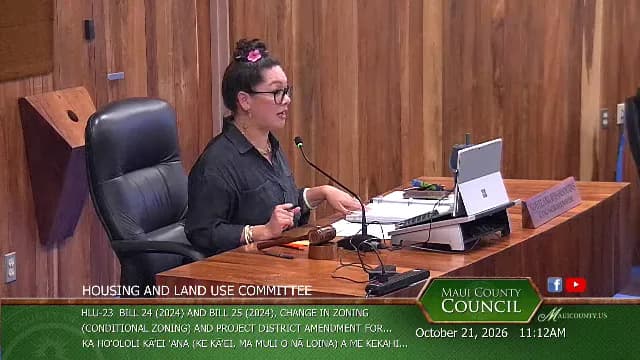
[Note: The agenda and transcript reference Wednesday, October 21, 2026, while the provided metadata specifies October 22, 2026. The metadata date is used in the title.] The Housing and Land Use (HLU) Committee of the Maui County Council considered two major land use items. The first, Bill 141 (2026), amended the Maui Research & Technology Park District to prioritize residential development and adjust standards. The second, Bills 24 and 25 (2024), substantially downzoned the Lānaʻi Project District 2 (Kōʻele) and increased open space. Following public testimony and intensive debate on specific conditions, the committee voted to advance all bills on first reading. Public Comments & Testimony - Jim Lankford expressed a neutral stance on the tech park item but suggested the committee consider incorporating safe parking concepts for homeless support. He requested the item be deferred until after the election. - A remote testifier (Dolly Lottie) provided brief remarks on Hawaiian cultural perspective in governance. - Lance testified on the Lānaʻi project, submitting documentation regarding financial allegations. Discussion Items Bill 141 (2026) – Maui Research & Technology Park District - Proposal: Pacific Rim Land presented amendments to increase residential acreage from 102.3 to 158 acres while keeping the unit cap at 1,250, enabling less dense development. The Employment/Campus district was reduced. Development standards were modified to codify a variance from the Board of Variances and Appeals. A minor medical center use was added to the Civic District, and the total non-residential build-up area cap was reduced to 1,800,000 square feet. The Maui Planning Commission unanimously recommended approval. - Discussion: Councilmember Johnson questioned transit plans; the Planning Director responded that a South Maui transit study is pending. Councilmember Rollins-Fernandez asked about data center expansion, which the developer stated was not part of the amendment. Councilmember Sinenci raised evacuation concerns; the developer cited Ninao Street as the primary collector road. Councilmember Cook expressed strong support for the project's execution. - Outcome: Motion by Vice Chair Batangan, seconded by Councilmember Cook. The motion carried with 8 ayes, 0 nays, and 1 excused (Councilmember Paltin). Bills 24 & 25 (2024) – Lānaʻi Project District 2 (Kōʻele) - Proposal: Pulama Lānaʻi presented a comprehensive downzoning including a 72% reduction in resort residential, a 77% reduction in golf course acres, and a 1,243% increase in park and open space. An 11.5-acre addition for a potential hotel expansion at Sensei Lānaʻi was included, along with housekeeping items for resort commercial. The State Land Use Commission had already approved the District Boundary Amendment. - Debate on Conditions and Specific Issues: - Condition 8 (Water Reporting): An amendment by Councilmembers Paltin and Johnson requiring quarterly reports for five years, followed by annual reports for another five years or until Phase 2 begins (whichever is sooner), was adopted (6-3). - Condition 9 (Bypass Road): A motion to strike the condition requiring a bypass road from the 1983 Community Plan was deeply debated. Opponents (Paltin, Johnson, Rollins-Fernandez) cited community safety and emergency evacuation needs. Supporters of removal (Chair Lee, Batangan, Cook, Sugimura, Uʻu-Hodgins) cited rational nexus, outdated plans, and impacts on existing homes. The motion to strike passed (5-4). - Historic Properties: The developer confirmed the commitment to relocate and preserve the Richardson House structures in consultation with the Lānaʻi Cultural and Heritage Center. - Outcome: Motion by Councilmember Sugimura, seconded by Councilmember Cook, to recommend passage of the CD1 versions with the approved amendments. The final vote was 8 ayes and 1 no (Councilmember Rollins-Fernandez). Key Outcomes - Bill 141 (2026): Recommended for passage on first reading. Reallocates land to residential while keeping the unit cap at 1,250. (Vote 8-0-1). - Bills 24 & 25 (2024): Recommended for passage on first reading as amended. Project district substantially downzoned. Condition 9 (bypass road) removed. Condition 8 (water reporting) given a defined sunset clause. (Vote 8-1). - All items will proceed to the full Maui County Council for second reading.
Public Meetings - Maui County, Hawaii
Public Meetings - Maui County, HawaiiThe Housing and Land Use Committee of the Maui County Council met on October 21, 2026, from 9:00 a.m. to 11:44 a.m. to consider two zoning-related bills: Bill 141 (2026) for the Maui Research & Technology Park and Bills 24 (2024) and 25 (2024) for the Lanai Project District 2 (Kōʻele). Both bills were recommended for passage on first reading with amendments. Key outcomes included votes, amendments to conditions, and extensive discussion on density reductions, infrastructure, and community concerns. Public Comments & Testimony - Bill 141 (2026): No oral testimony was offered; no speakers signed up. - Bills 24 & 25 (2024): One oral testifier commented on a financial transaction involving the owner of Lanai and submitted a document for the record. No other oral testimony was received. Discussion Items Bill 141 (2026) – Maui Research & Technology Park Amendments - Presentation: Aaron Mukai of Pacific Rim Land, Inc. presented the bill, which reallocates acreage to expand the Residential District from 102.3 to 158 acres while keeping the same number of dwelling units (capped), reduces non-residential build-up area from 2,000,000 to 1,800,000 square feet, and codifies previously approved variances. Changes also include allowing minor medical centers in the Civic District and adjusting development standards (e.g., lot sizes, setbacks). The Maui Planning Commission recommended approval with a cap on single-family large lots at 14,000 square feet and unit size limits. - Committee Discussion: Councilmembers questioned transit hub plans, bus stops, civic lot usage, evacuation access (via Ninao Street), and data center expansion. The applicant confirmed two bus stops under construction, a future study for a transit hub, and no current plans for the civic lots beyond one park. No concerns were raised about the density reduction. - Vote: Motion by Vice Chair Batangan, second by Councilmember Cook. Passed 8 ayes, 0 noes, 1 excused (Councilmember Paltin). The bill was recommended for passage on first reading with non-substantive revisions. Bills 24 (2024) and 25 (2024) – Lanai Project District 2 (Kōʻele) Amendments - Presentation: Kurt Matsumoto of Pulama Lanai presented the bills, which downzone the district: 72% reduction in resort residential (from 634 to 110 units), 77% reduction in golf course acres (Cavendish golf course retained as free-play), and 1243% increase in open space/park acres. An 11.5-acre hotel expansion area is included for villa-type rooms and spa facilities. The project district is also cleaned up to align with the approved community plan and State Land Use Commission approval. The applicant requested two changes to conditions from the Lanai Planning Commission: add a time frame to condition 8 (water reporting) and remove condition 9 (bypass road triggered at 50% occupancy of units). - Committee Discussion: Councilmembers discussed the bypass road (condition 9), with several noting the road would impact existing homes and the trigger would never be met. Community concerns about Richardson house relocation, cemetery maintenance, and evacuation routes were addressed. The planning department supported removal of condition 9 and recommended a five-year reporting period for condition 8. - Amendments: - Condition 8: An amendment (motion by Councilmember Cook, second by Chair Lee) to insert "for a period of five years from the effective date of this ordinance" for quarterly water reports. A second amendment (motion by Councilmember Paltin, second by Councilmember Johnson) added that after five years of quarterly reports, annual reports would be required until phase 2 development begins, whichever comes sooner. This second amendment passed 6 ayes, 3 noes (Chair Lee, Cook, Sugimura opposed). The amended condition was then adopted as part of the main motion. - Condition 9: A separate amendment to strike condition 9 and renumber condition 10 to 9. Passed 5 ayes, 4 noes (Councilmembers Johnson, Paltin, Rollins-Fernandez, and Sinenci opposed). - Final Vote: Motion by Councilmember Sugimura, second by Councilmember Cook. The bills (CD1 versions) as amended were recommended for passage on first reading. Vote: 8 ayes, 1 no (Councilmember Rollins-Fernandez). Key Outcomes - Bill 141 (2026): Recommended for passage on first reading (8-0-1). Next step: full County Council consideration. - Bills 24 (2024) and 25 (2024): Recommended for passage on first reading as CD1 versions with amendments to conditions 8 and 9 (8-1). The amendments include a sunset on water reporting (quarterly for five years, then annual until phase 2) and removal of the bypass road condition. Next step: full County Council consideration. - All votes and amendments were recorded and will be incorporated into the final ordinances.
The Disaster Recovery, International Affairs, and Planning Committee (DRIP) of the Maui County Council met on Wednesday, October 21, 2026, at 1:30 p.m. HST (agenda time) via Microsoft Teams and in-person at the Council Chamber in Wailuku. Chair Tamara Paltin presided. The committee considered two items concurrently: Bill 139 (2026) to amend the Maui Island Plan's Directed Growth Map to include 85.57 acres in the Urban Growth Boundary for the Keokea Industrial project, and Bill 108 (2026) to adopt the updated South Maui Community Plan. The committee voted to recommend passage of Bill 139 on first reading and approved several amendments to Action 1.16 of the South Maui Community Plan regarding a multimodal transportation corridor feasibility study. Public Comments & Testimony - Tova Calendar (testimony read by proxy): An environmental biologist and South Maui CPAC member submitted testimony advocating for a 100-foot buffer along gulches in South Maui to protect public safety, reduce erosion, improve water quality, and provide community amenities such as mauka-to-makai trail connections. She noted that mainland jurisdictions often require 200-foot buffers. - Thorne Abbott, Coastal Planners: Testified on behalf of Mark Turtletob, owner of 6850 Makena Road (parcel 2-2-1-006-103), whose property was designated as Park in the proposed plan. Abbott argued the designation creates a land use conflict since the state land use is Rural and zoning is Residential. He stated the owner was not notified of the designation change and requested the designation be changed to Rural Residential. He noted the property was designated Park in 1988 due to anticipated state park expansion that never occurred. - Travis Leggett: Expressed support for preserving the composting facility (Kihei Compost) on the Keokea Industrial site, stating it is a valuable community resource for green waste processing in a closed-loop system. He raised concern about potential displacement of the operator. He also testified about concerns regarding open-air sludge drying beds at the Motlawa Regional Wastewater Reclamation System project. - Unaka Kama Aina: Urged caution in using terms like "property" versus "land" and expressed support for protecting the water supply. Discussion Items - Bill 139 (2026) – Keokea Industrial UGB Amendment: Rory Frampton, planning consultant for Haleakala Ranch Company, presented the proposed amendment to include 85.57 acres (TMK (2) 2-2-002:080) in the Urban Growth Boundary (UGB) for industrial uses. The site is located mauka of the Kihei Wastewater Reclamation Facility. Existing uses include Hawaii Materials Recycling (construction recycling, approximately 10 acres) and a former composting facility (12 acres) that the ranch seeks to reestablish. The State Office of Planning submitted a letter of support citing proximity to existing UGB, soil rating E (lowest grade agricultural land), and demonstrated need. The proposal requires additional steps: state district boundary amendment (due to parcel size over 15 acres) and a change in zoning, which will allow conditions and restrictions on uses. - Planning Director Jackie Takakura supported the bill, stating it would help Kihei become less dependent on Central Maui, reduce vehicle miles traveled, provide local employment, and ease burden on the Central Maui landfill. She noted the urban growth boundary denotes where urban density development requiring full services is supported, and that community plan designations cannot be assigned to land outside the UGB. - Vacant Land Inventory: Director Takakura presented the Maui Island vacant land inventory as of 2026, showing 198 acres of heavy industrial and 271 acres of light industrial island-wide, without a breakdown by community plan area. This inventory is required under Maui Island Plan Policy 8.1.B. - Existing Residential Parcels Outside UGB: Councilmember Tom Cook raised the issue of several existing residential parcels that were left outside the Urban Growth Boundary when the MIP was updated in 2012. The committee discussed a path forward, with Corporation Counsel Michael Hopper stating that a separate process through resolution to the Planning Commission would be required to amend the UGB for those parcels. Chair Paltin noted that letters had been sent to affected property owners and that Councilmember Cook would follow up. - South Maui Community Plan – Action 1.16 Amendment: Councilmember Gabe Johnson proposed a feasibility study for a multimodal transportation corridor through South Maui to Central Maui. The committee adopted multiple amendments: changing the route from Lipoa Parkway to Kanani Road; designating the MPO as lead agency; adding county, state, and federal funding sources; and setting the study cost at $250,000. The committee also added a new implementing action for the corridor with an estimated cost of $10 million and funding sources including county, state, federal, and private. - Community Plan Designation Changes: The committee confirmed that letters were sent to properties whose designations changed during this plan update (noted on Matrix 3B), but not to properties that were designated Park in prior plan versions. - Pi'ilani Promenade Bond: Director Jordan Molina of Public Works confirmed that a $20 million subdivision bond was posted around 2009 for required improvements including the Kaono'ulu Street extension (four-lane road with sidewalks and bike lanes). Construction plans are currently under review. Key Outcomes - Bill 139 (DRIP-29) – Recommended for Passage on First Reading: The committee voted 7-0 (members Batangan and Sugimura excused) to recommend passage of Bill 139 (2026) as amended by CD1 Substitute. The CD1 version inserts a non-codified preamble with the bill's procedural history, adjusts exhibit references, and incorporates non-substantive revisions. The bill amends the Maui Island Plan's Directed Growth Map S1 (North Kihei) to include 85.57 acres in the Urban Growth Boundary for the Keokea Industrial project. The Council will need to hold a public hearing on Maui prior to second reading. - Action 1.16 Amended – Feasibility Study: The committee approved amending Action 1.16 to read: "Conduct a feasibility study for a new multimodal transportation corridor or connector road through South Maui to Central Maui, mauka of Pi'ilani Highway, connecting from Kanani Road to Maui Veterans Highway. Include in the study: alignments that could also serve as emergency evacuation routes; estimated costs; funding and financing options; easements and right-of-way needed, with a strategy for acquiring them; and an assessment of impacts on the 'āina, with recommended routes and design measures that minimize harm." Lead agency: MPO. Funding: county, state, federal. Priority: high. Timing: long. Cost: $250,000. - New Implementing Action Added: The committee added an implementing action: "Implement a new multimodal transportation corridor through South Maui to Central Maui, mauka of Pi'ilani Highway, connecting to Maui Veterans Highway." Lead agency: Public Works. Funding: county, state, federal, and private. Cost: $10 million. Priority: high. Timing: long. - Committee Adjourned: The meeting adjourned at 3:59 p.m. HST.
The Budget, Finance, and Economic Development (BFED) Committee of the Maui County Council convened on Tuesday, October 20, 2026, at 9:04 a.m. The committee discussed a new sister-city relationship with Laoag City, Philippines; advanced legislation to streamline the use of monetary donations during emergencies; and conducted a review of the county's Emergency Fund. Public Comments & Testimony - Item 1 (Sister City): Madeline Pasqua and Lawrence of the Maui Filipino Community Council testified in support of the relationship with Laoag City, describing its growing economy, its role as a travel hub, and its deep ancestral ties to Maui's Filipino community. Lawrence stated the population of Laoag is approximately 112,117. - Item 2 (Donations): No oral testimony was provided. - Item 3 (Emergency Fund): Kay Anderson testified, requesting clarification on how the South Maui Community Plan was connected to the discussion. Chair Sugimura clarified it was a reference to a pause in the committee schedule. Discussion Items Sister-City Relationship with Laoag City (Resolution 26-153) The committee discussed the already-adopted Resolution 26-153, which authorizes the Mayor to formalize a sister-city relationship. Mahina Martin, Director of Public Affairs, provided an overview of the county's 62-year-old program, which currently has 28 established sister cities. CJ Anchetta of the Maui Filipino Community Council presented on Laoag City, proposing four pillars of cooperation: tourism and culture, agriculture and sustainability, economic trade, and education and health. Multiple council members expressed strong personal support, with several noting their own Ilocano or Sakada ancestry. Member Batangan volunteered to participate in an ad-hoc committee to explore further initiatives. Mr. Anchetta inquired about seed funding for the program, a topic deferred to the budget cycle and the Sister Cities Foundation. Emergency Monetary Donations Legislation (Bills 142, 131, 132) Chair Alice L. Lee introduced a package of three bills designed to expedite the use of monetary donations during declared emergencies. Bill 142 would allow the Mayor to immediately accept and use disaster monetary donations without prior Council approval for one year following a disaster. Bills 131 and 132 amend the FY27 Budget to support this process. Budget Director Milner and Deputy Director Zelinski confirmed the administration's support for the revised package. An original amendment to change the authorized use language was withdrawn following a recess review that confirmed the existing HRS definitions were sufficiently broad. A CD1 amendment to Bill 131, making quarterly reporting mandatory and correcting a code reference, was adopted. Emergency Fund Status and Use The committee reviewed the Emergency Fund's balance ($78 million) and expenditures. Since March, the Council has authorized $42 million from the fund: $32 million for the Kona Low storms and $10 million for Hurricane Lala. John Smith (Office of Recovery) and Francis Cowell (MEMA) discussed FEMA reimbursements, debris removal logistics, pre-positioned contracts (generators and buses), and long-term mitigation strategies for chronic flooding in areas like Waipuilani and Pülehu. Member Tom Cook highlighted HRS 179D (Dam and Reservoir Safety) as a major legal obstacle to constructing detention basins for flood mitigation and advocated for legislative action. A request was made for a detailed, itemized breakdown of all emergency fund expenditures by disaster. Key Outcomes - Sister City (Laoag): No legislative action was taken. The administration will draft a Memorandum of Agreement with Laoag. Member Batangan volunteered for an ad-hoc committee. - Bill 142 (Disaster Donations): Recommended for passage on first reading. (8 aye, 0 no, 1 excused). - Bill 131 (Budget Provisions): CD1 amendment adopted. Recommended for passage on first reading as amended. (8 aye, 0 no, 1 excused). - Bill 132 (Budget Line Item): Recommended for passage on first reading. (8 aye, 0 no, 1 excused). - Emergency Fund: Information received. A detailed breakdown of expenditures was requested from the Office of Recovery. Next Steps The passage of Bills 142, 131, and 132 will be considered by the full Council. The administration will continue working on the formal agreement with Laoag City.
The Government Relations, Ethics, and Transparency (GREAT) Committee met on Tuesday, October 20, 2026, at 1:33 PM. The meeting focused on two major agenda items: advancing Bill 100 to establish comprehensive lobbyist regulations and receiving a report from the Cost of Government Commission on its review of boards and commissions. The meeting was chaired by Councilmember Kauanoe Batangan. Public Comments & Testimony - Michael Lilly (Chair, Board of Ethics): Offered brief opening remarks supporting the lobbyist ordinance but did not provide public testimony on the item. - Caller (ID 4945): Expressed general support for the ethics framework and transparency, stating the public wants to see government \"perceived to be acting fairly.\" Also commented on the need for a county-level judicial body during the second agenda item. - Kevin Spellman (Political Economist, COGC Commissioner, testifying as private citizen): Presented extensive written testimony recommending a total restructuring of the boards and commissions system, including establishing an office of the judiciary, consolidating subject-area boards into one commission per department, and centralizing governing language into a single code title. - Era Giwa (Student, Maui High School): Testified in strong support of transitioning the Commission on Children and Youth into a formal youth-led commission. Stated she gathered 56 signatures and 12 testimonies supporting the concept. Bill 100 (2026): Comprehensive Lobbyist Regulations (GREAT-16) The committee considered Bill 100, aiming to establish Maui County\'s first comprehensive lobbyist regulations. The bill requires registration for paid lobbyists meeting specific thresholds, semi-annual expenditure reporting, and includes restrictions on gifts. - Presentation and Revised CD1: Laura Naki\'eki, Executive Director of the Board of Ethics, presented the CD1 version of the bill. Changes since the July 28th hearing included: removing a formal training requirement in favor of administrative guidance; shifting the penalty reference from a specific $5,000 fine to the broader penalty structure under Section 2.56.010 (which Bill 55 caps at $1,000); and clarifying definitions for \"legislative action\" and reporting exemptions. - Penalty Discussion: Board of Ethics Chair Michael Lilly advocated for restoring the $5,000 per violation cap, arguing lobbyist violations are distinct from standard employee ethics violations and aligning with the state standard. Deputy Corporation Counsel Caleb Burrell initially raised concerns but subsequently revised the administration\'s position, stating the Council has the discretion to set the penalty at $5,000. The committee voted 9-0 to amend the bill to include a $5,000 maximum fine. - Scope and Board Coverage: Councilmember Rawlins-Fernandez raised concerns about whether lobbying before boards and commissions (specifically the Planning Commission) was covered. Corporation Counsel proposed amending the definition of \"administrative action\" to explicitly include \"matters referred to the planning commissions by the council\" and \"actions to appoint or remove department heads pending before boards and commissions.\" The committee voted 9-0 to adopt this amendment. - Thresholds and Definitions: The bill defines a lobbyist as any person paid to influence legislative or administrative action who meets specific thresholds (5+ hours/month or $1,000+ in expenditures). The committee clarified the distinction between a paid lobbyist and a community advocate. Exemptions for nonprofits lobbying on specific grant applications were discussed. - Implementation: The bill is slated to take effect July 1, 2027, to allow time for education, online registration portal development, and administrative rulemaking by the Board of Ethics. Cost of Government Commission (COGC) Recommendations for Boards and Commissions (GREAT-5(2)) The committee received a presentation from COGC Chair Goosens Larson on the commission\'s study of 15 of the county\'s over 30 boards and commissions. - Key Findings: The COGC identified seven systemic themes including: unclear mission/duplication, volunteer burnout (citing the Real Property Tax Review Board which reviews 1,000 appeals a year in 7-hour meetings, denying 95% of cases), quorum problems, recruitment difficulties due to residency requirements, conflicts of interest exposure, and lack of consistent staffing and disclosure standards. - Recommendations: The COGC recommended structural reforms such as creating periodic review/sunset dates for boards, setting minimum staff support standards, strengthening recruitment (with or without the Independent Nomination Board), and applying consistent conflict of interest and disclosure standards. - Council Feedback: Multiple councilmembers expressed support for the report\'s findings. Councilmember Gabe Johnson specifically endorsed the recommendation to create a youth-led commission. Chair Batangan noted the need to address the volunteer model\'s appropriateness for specific government functions. - No Action: The agenda noted that no legislative action would be taken on this item. It was purely for information and discussion to guide future policy. Key Outcomes - Bill 100 (Lobbyist Regulations) - Passed Amendments: - Penalty Reinstatement: Motion to amend the penalty to \"up to $5,000\" passed (9-0). - Scope Expansion: Motion to amend the definition of \"administrative action\" to include matters before the Planning Commission and boards with appointment/removal authority passed (9-0). - Passed: - Motion to adopt Bill 100 passed. - Motion to replace with CD1 version passed. - Motion to adopt CD1 as amended passed (8-0, with Councilmember Paltin briefly offline). - Final Vote: The full council package on Bill 100 (2026), as amended, was recommended for passage on first reading (votes recorded as 9-0 and 8-0). - Next Steps: Bill 100 will proceed to the full Council for a first reading vote. - Cost of Government Commission Report - Action: No formal action was taken. - Outcome: The committee received the report as information. Councilmembers indicated an appetite for future reforms based on the findings.
On October 20, 2026, the Water Authority, Social Services, and Parks (WASSP) Committee of the Maui County Council held a discussion (Rule 7B) on Bill 133 (2026). The bill proposes amending Chapter 10.76 of the Maui County Code to expand the temporary safe parking pilot program by allowing vehicle habitation on any county-owned or managed parcel (not just designated parking lots) and reducing participation barriers. The goal is to urgently address the needs of individuals living unsheltered along Pulehu Road. No legislative action was taken, but the Committee identified needed clarifications for the bill's second and final reading on Friday. Note: The agenda and transcript list the meeting date as Monday, October 19, 2026, while the assigned date for this summary is October 20, 2026. Public Comments & Testimony - Clark Johnson (Private Citizen): Expressed support for utilizing existing county parks with established infrastructure and urged clear plans for patrolling and managing safety. - Stitch Gordon: Voiced strong opposition to the proposed Pulehu Road site, deeming it unsafe and lacking amenities. Supported using existing park infrastructure and distinguished between the needs of people who work and need overnight parking versus those living full-time in non-operable vehicles. - Lisa Darcy (Board Member, Hawaii Public Housing Authority; Policy Committee, National Vehicle Residency Coalition): Expressed significant concerns about the lack of transparency and community input in the bill's development. Urged the council to slow down and incorporate bottom-up input from people with lived experience, citing the failures of the Tent City project. - Laurie J. (Former Tent City Worker): Shared ground-level concerns regarding liability for uninsured vehicles, lack of safety checks, vehicle size limits, and the need for wraparound services. She provided emotional testimony about systemic failures leading to deaths among the unsheltered population and advocated for a "sorting hat" approach to create multiple solutions for different needs. - Kanaka Kama (Calling in as 4945): Expressed full support for Director Maggie Willis and urged the council to let the administration execute the plan without obstruction from legal processes. - Travis Liggett (Formerly unsheltered): Described systemic short circuits impacting the unsheltered population and advocated for the Hanaya Kikau Act and a housing-first model. - Jim Langford: Offered neutral technical support and suggested a simple form system to track the multiple approaches required. - Faith Chase (Private Citizen): Expressed deep frustration with the county's lack of progress on homelessness, calling the proposed effort too small and demanding more creativity and urgency. Discussion Items - Bill 133 Rationale (Director Maggie Willis, Dept. of Human Concerns): Director Willis explained that the current ordinance has too high a threshold for people living along Pulehu Road. The bill seeks flexibility to allow the department to design programs tailored to specific populations without overly restrictive legislative mandates. - Temporary Site (Pulehu Road): The administration is planning a six-month, low-barrier temporary site on a county parcel south of Hansen Road. It will serve 50-60 people. It will have porta-potties, hand-washing stations, potable water, lighting, and 24/7 private security with trauma-informed training, but no cooking facilities. The administration aims to open it by the week of October 26, contingent on the bill's passage. - Permanent Site (Kahului/AGON): Director Willis confirmed the original safe parking pilot site (awarded to AGON) is separate, still in development, and serves a different population with higher thresholds (e.g., operable vehicles, IDs). - Liability & Removal of Enforcement Clauses: First Deputy Corp. Counsel Me Jardines stated the bill suspends the enforcement of certain rules to allow entry onto the lot, not the laws themselves. Detailed liability discussions were deferred to executive session or private calls with council members before the second reading. - Rulemaking Authority & Structure: Corp. Counsel noted administrative rules take time and are not feasible for this urgent pilot. Several members expressed discomfort with the lack of a structured framework for anything that extends beyond a strict temporary pilot. - Transition of Belongings: Unlike past encampment clearances, staff and providers will work with individuals on-site to sort and store belongings, offering property storage for those who decline entry into the new site. - Alternative Locations: Member Paltin suggested her district office (60 Kenui St.) as a potential pilot location with existing facilities. Director Willis agreed to tour the site. - Staffing and Capacity: Director Willis stated her Homeless Programs Division has three full-time staff leading the coordination with multiple other county departments. Key Outcomes - No legislative action was taken, as the item was noticed for discussion only (Rule 7B). - The Committee directed the Office of Council Services (OCS) to draft non-substantive, technical clean-up amendments to Bill 133 in preparation for its second and final reading on Friday. - Council members were invited to contact Corporation Counsel directly for detailed questions about liability before the Friday meeting. - The meeting highlighted the necessity for a range of distinct solutions for different homeless populations—the temporary Pulehu site targeting those with complex barriers and the AGON site targeting those with fewer barriers.
On Monday, October 19, 2026, from 9:01 a.m. to 11:32 a.m., the Maui County Council's Water, Social Services and Parks Committee met to discuss Bill 133 (2026), which would amend Maui County Code Chapter 10.76 (parking lots and piers) to expand county properties eligible for temporary vehicle habitation and reduce barriers for people experiencing unsheltered homelessness. No agenda or minutes were available in the source material; this summary is based on the raw transcript. The committee heard from Department of Human Concerns Director Maggie Willis, First Deputy Corporation Counsel Miby De Jardines, and representatives from the Maui Police Department and the Managing Director's Office. Public Comments & Testimony - Clark Johnson (private citizen) expressed support for using county parks for safe parking because infrastructure such as toilets, water, and parking already exists; recommended Department of Human Concerns manage the program; and asked how sites would be patrolled and where people would go during daytime hours. - Stitch Gordon (resident) agreed that existing beach park lots should be considered, questioned spending on a remote site, and raised safety concerns for women and children; he also asked what is being done for people whose vehicles are not operational. - Lisa Darcy (Hawaii Public Housing Authority board member, Sherry Armana director, and former Healing Solutions for Homelessness Commission member) expressed significant concerns: she said the bill removes transparency and accountability, recalled Tent City as a disaster, argued the council was not prepared to act without lived-experience input, and urged a slower, bottom-up process. - Lori J (former seven-month Tent City worker with personal connections to unsheltered people) supported safe parking but raised liability questions about waiving insurance and registration checks, asked about vehicle-size limits and transportation after hours, and promised to submit detailed written concerns. - A caller identifying as Kanaka Kamaina (last four digits 4945) offered roughly 99.9% support for Director Willis, urged letting the department act quickly without lawyers slowing the process, and included unrelated complaints about the elections office. - Travis Liggett (formerly unsheltered, 2020–2026) urged passage of the Hanai Kakou Act, said some unsheltered people were harmed by police-protected drug supplies, and argued the county should not judge people's choices given systemic failures. - Jim Langford said he was neutral on the bill, offered technical advice, and suggested assigning each council member one of about nine approaches to homelessness to create actionable follow-through. - Faith Chase expressed discouragement and frustration, criticized the effort as too small and poorly timed before an election, and pointed to lawsuits against the county and state and related settlements as models the county was ignoring. Discussion Items - Bill 133 status and purpose: The bill passed first reading on October 9, 2026, and was before the committee as a discussion item; members noted amendments could not be made in this session. Willis said the existing safe parking pilot requirements were too high for people living along Pulehu Road, so the bill would allow a temporary, lower-barrier site. - Proposed changes: De Jardines explained that Bill 133 would expand eligibility from county parking lots to county-owned or managed parcels, allow 24-hour habitation instead of only 7 p.m.–7 a.m., and remove compliance with county, state, and federal rules as a precondition for entering the site. She said HRS 291C-133 leaves regulation of vehicle habitation to the counties. - Temporary Pulehu-area site: Willis said the first temporary site is a county parcel south of Hansen Road, about three-quarters of a mile from Pulehu Road. It would include grading, porta potties, hand-washing stations, potable water, lighting, and 24/7 private security with planned trauma-informed and cultural competency training. The site is expected to serve 50–60 people; the current census along Pulehu Road is about 45–50. The program is estimated to operate for six months, with DHC managing the site and nonprofit partners providing rotating services. - Separate permanent safe parking pilot: Willis clarified that the previously awarded AGON-operated permanent safe parking site in Kahului remains in development after flood-related delays and will serve a different population with higher requirements. - Questions and concerns: Members asked about administrative rulemaking authority, liability for unregistered and uninsured vehicles, ADA accessibility and accommodations, permits and emergency declarations, zoning for transitional housing, whether parks could be used, how belongings would be handled during relocation, and how nonparticipants would be addressed. Vice Chair Johnson also cited a May 13, 2026 Maui Now article: the January 25, 2026 point-in-time count found 651 people experiencing homelessness in Maui County; unsheltered homelessness rose from 285 to 398 (a 40% increase), sheltered homelessness dropped from 369 to 253 (a 31% decrease), veteran homelessness increased 53% (from 15 to 23), and family homelessness rose from 59 to 61 families. Key Outcomes - The committee took no vote and made no amendments; Bill 133 was deferred to its scheduled second reading on the following Friday. - Staff indicated non-substantive cleanup of the bill would be prepared for second reading. - The administration agreed to clarify public confusion about the permanent Kahului safe parking site and to consider additional site suggestions, including one offered by Member Poulton. - Director Willis welcomed follow-up input and said DHC would work with providers to create pathways for obtaining IDs, insurance, and vehicle registration. - Per the ordinance, the council must review the section within 12 months after commencement of a pilot project.
The Water Authority, Social Services, and Parks (WASSP) Committee of the Maui County Council convened on October 19, 2026, to discuss Bill 133 (2026). The bill proposes amendments to Chapter 10.76 of the Maui County Code to expand the safe parking pilot program by allowing temporary vehicle habitation on additional county-owned or managed parcels. No legislative action was taken during the meeting. Discussion Items - Bill 133 (2026) – Temporary Vehicle Habitation Amendment – Committee members discussed the bill’s provisions and potential revisions. A speaker, likely a committee member or staff, referenced the legal context, stating that the bill relates to the regulation of vehicles used for human habitation under "HRS two nine one Cash One three" (appears to refer to HRS §291C-113). Key Outcomes - The committee discussed Bill 133 but took no formal action, consistent with the agenda’s note that no legislative action would be taken. - No public testimony was recorded in the available transcript. - The committee may continue deliberations at a future meeting. Additional Information - The agenda anticipated executive meetings with legal counsel, but no such meetings are recorded in the public portion. - The listed meeting start time was 9:00 a.m. HST, while the provided timestamp is 20:00 UTC (10:00 a.m. HST); the exact timing is uncertain.
The Water and Infrastructure Committee of the Maui County Council convened on Monday, October 19, 2026, at 1:34 PM. The committee addressed three agenda items: an intergovernmental agreement for temporary wastewater service to a new school, a zoning cleanup referral for the Māʻalaea Triangle, and a review of the Adopt-A-Street pilot program. Public Comments & Testimony - Kanaka Kamaina provided testimony on all three items, expressing general trust in Department of Environmental Management Director Shane Agawa and support for the Adopt-A-Street program, while also raising accessibility concerns with county services. - Travis Lickett testified on the wastewater service and zoning items. He expressed strong opposition to adding new flow to the Wailuku-Kahului facility without first implementing UV disinfection, which he stated has been offline since 2018. He urged the committee to fund disinfection design work before approving the IGA. On the zoning item, he raised concerns that the change could bypass disclosure of potential pathogen issues from the aquarium. Discussion Items Bill 116 (2026) – Temporary Wastewater Service for Central Maui School (WAI-31) The committee considered a bill to authorize the Mayor to enter into an intergovernmental agreement (IGA) with the Hawaiʻi School Facilities Authority to provide up to 14,500 gallons per day of temporary wastewater capacity from the existing Wailuku-Kahului Wastewater Reclamation Facility to the new Central Maui School. The IGA acts as a backup if the county's new Central Maui facility is not operational by the school's projected July 2031 opening. Director Shane Agawa confirmed the county is on track to meet this timeline and stated the department sees minimal risk in the arrangement. The committee adopted a CD1 amendment correcting facility names in the bill text and title. Members expressed broad support. Vice Chair Sugimura confirmed timeline alignment. Member Paltin inquired about the contingency plan. Member Rawlins-Fernandez noted the IGA creates positive pressure to complete the new facility and supports alleviating school overcrowding. Resolution 26-137 – Māʻalaea Triangle Zoning Change (WAI-26) The committee heard a presentation from consultant Will Spence and General Manager Stepani Worr proposing a referral to the Maui Planning Commission. The proposal would rezone six parcels (10.4 acres) to B-2 Community Business District to clean up non-conforming designations such as "Open Zone" and "Future Roadway" which do not exist in the county code and create legal barriers to rebuilding or subdivision. No new development is proposed. The Department of Planning confirmed the change is consistent with the community plan. The committee adopted an amendment to correct the ownership description of a small parcel co-owned by the U.S. Coast Guard and the Māʻalaea Triangle Partnership. Adopt-A-Street Pilot Program (WAI-1(11)) Deputy Director Paul Bernie of the Department of Public Works presented the pilot program, launched in July 2024. The program, managed under the stormwater division, provides supplies, safety gear, and disposal services to volunteers who collect litter along designated roadways. Current participants include Roselani Scoop Shop, Island Fresh Cafe, Maui Yoga, and Synergy. The program has internal capacity to manage about 10 active areas. Members expressed strong support for the initiative. Chair Lee, who requested the item, highlighted its importance for preventing ocean pollution and reducing flood risk by keeping drainages clear. No legislative action was taken. Key Outcomes - Bill 116 (2026): The committee voted unanimously (9-0) to recommend the bill for passage on first reading, as amended by the CD1 version. - Resolution 26-137: The committee voted (8-0, Member Rawlins-Fernandez excused) to recommend adoption of the resolution as amended, referring the zoning bill to the Maui Planning Commission. - Adopt-A-Street Pilot Program: The item was deferred without a vote. The committee expressed strong support and encouraged the Department of Public Works to continue outreach to expand volunteer engagement.
Meeting started at 9:03 AM and adjourned at 2:42 PM. Council Chair Alice Lee presided. Members present: Kiani Rollins Fernandez, Shane Sinensi, Yukile Sugimura (excused). Staff included Deputy Planning Director Ana Lillis, Senior Planner Karen Konkowich, Housing Director Remy Mitchell, Director Kapono Ay Molitao (OEV Resources), Deputy Corporation Counsel Michael Hopper, and others. The meeting continued review of Bill 108 (South Maui Community Plan Update). Discussion Items - Revisits: Senior Planner Konkowich identified the need to revisit definitions of riparian area, corridor, and buffer for policies 2.4.5, 0.6, and 0.7; this was deferred to a future meeting with Public Works. Action 3.03 (annual educational shoreline) was also deferred for replacement language. - Section 1 Review (Community Plan document): - Replaced all references of "Pu'ali Komohana" with "Wailuku" (motion passed 7-0). - Added a footnote to the community plan diagram listing current names of other island plans (e.g., Wailuku-Kahului, Kula-Upcountry-Makawao) (passed 7-0). - Changed charter requirement language from "may be updated or revised every 10 years" to "required to be updated or revised every 10 years" (passed 7-0). - Inserted historical context provided by OEV Resources (Granicus 46) into Section 1.3, including paragraphs on pre-contact land management, the overthrow of the Hawaiian Kingdom, creation of the County of Maui, and the Hawaii Admission Act (multiple motions passed). - Removed English translations in parentheses for Hawaiian terms defined in the glossary (e.g., ʻāina, ahupuaʻa, moku) (passed 7-0). - Replaced “Native Hawaiian” with “Kanaka ʻŌiwi” throughout pre-statehood references and “Kanaka Maoli” for modern references (included in above motion). - Changed references from “Great Māhele” to “Māhele” (passed 7-0). - Replaced “mainland” with “continent” (passed 7-0). - Removed reference to “La Peruse Bay” for Keoneʻōʻio Bay after a roll-call vote (6-1). - Extended footnote to clarify sub-area names (e.g., ʻĀhihi-Kīnaʻu/Kanaio). - Added specification that population projections are over a 20-year plan period (passed 7-0). - Added recognition that the community plan boundary splits ahupuaʻa, complicating resource management (moved to include in preface). - Housing Policies (with Director Mitchell): - Policy 2.2.18/2.2.19: Amended to encourage, not require, affordable and workforce housing units be spread throughout sub-areas 1–5, and to include pedestrian-oriented design. The first sentence of 2.2.18 was struck. (Passed 7-0) - Policy 2.2.26: Amended to encourage residency preference programs prioritizing current residents, those employed in South Maui, and those with generational ties. (Passed 7-0) - Action 2.19 (feasibility study for county parcel adjacent to Kihei police station): Broadened to include several uses including affordable housing, a passive park, and preservation of natural habitat. (Passed 7-0) - Glossary Definitions: Director Molitao provided clarification on “koa” (fishing sites, observation places, and places of spirituality) and “kapu” (a system of honoring resources, not just prohibition). The committee directed OEV to expand the definitions in Appendix E accordingly. - Specificity vs. Broadness: A memo from Deputy Director Wade of the Department of Management recommended broader language for action items. Members expressed preference for specificity, noting it empowers communities and provides accountability. The committee declined to revisit adopted action 3.13 (wildfire data set). Key Outcomes - Dozens of amendments to Sections 1, 2, and 3 of the South Maui Community Plan were adopted. - The committee will meet again on October 21 and November 18 to continue Section 3 review and address revisits. - A CD1 version of the plan will be prepared for transmission to the next council on December 2. - A request from Mike Nāhoʻopiʻi to advocate for Kaholāwe land for a museum/resiliency center was noted; his white paper will be distributed and may be discussed in November. - Meeting adjourned at 2:42 PM.