Browse by city
Date range
Search help

Search titles, summaries, topics and stored transcripts together. Keywords may match separately; put the whole query in double quotes for a phrase. Matching follows word analysis, so punctuation is not exact. Both dates are included. Documents are not searched.

SHOWING 81–90 ENTRIES
81
MAY 21, 2026 · MAUI COUNTY, HAWAII · COUNTY COUNCIL & COMMITTEES
Maui County Council Water Committee Discusses Noise Violation Fines on May 21, 2026

The Maui County Council's Water, Social Services, and Parks (What's Up) Committee met on Thursday, May 21, 2026, at 1:38 PM to consider Bill 119 (2025), which proposes increased fines for prohibited vehicle noise violations involving amplified sound systems. The committee heard testimony from one public testifier, discussed enforcement concerns with the Maui Police Department and the Prosecuting Attorney's office, and ultimately voted to discharge the bill to the full council for further consideration. Consent Calendar - No consent calendar items were considered. Public Comments & Testimony - Holly Stalker (anonymous, testifying from South Maui residency office): Expressed general support for the bill's intent to address noise from loud car stereos, particularly in Kihei and Wailuku. Raised concerns about potential infringement on freedom of speech (e.g., using a bullhorn outside county buildings) and asked if community service could be an alternative to fines for low-income individuals. Discussion Items - Bill 119 (2025) – Penalties for Prohibited Noise Violations: - Purpose: To amend Section 9.36.040 of the Maui County Code to increase fines and establish penalties, including possible forfeiture of sound amplification systems, for prohibited vehicle noise violations. - Background: The committee previously discussed the bill on October 20, 2025, but deferred it due to concerns from MPD and the Prosecuting Attorney about the feasibility of forfeiture. - Proposed Amendments (CD1): Chair Sin's proposed CD1 removes forfeiture for third offenses and increases fines: first offense from $100 to $250, second offense from $200 to $500, third offense remains at $1,000 (the maximum allowed under state law for these violations). - MPD Feedback (Sergeant Ryan Ellers): Supported removing forfeiture due to logistical challenges (e.g., broad definition of sound system, inconsistent enforcement, need for special court proceedings and auctions). Supported increasing monetary fines as a simpler deterrent. - Prosecuting Attorney Feedback (Deputy Prosecutor Anderson Toshima): Supported the bill's intent and the amended proposal to remove forfeiture. Noted that unpaid fines can halt driver's license renewal at the DMV, creating an effective enforcement mechanism without jail time. - Committee Members' Positions: - Chair Sin: Facilitated discussion, clarified the bill focuses on amplified sound systems (not mufflers), and asked clarifying questions about fine enforcement. - Chair Lee (introducer): Strongly supported the bill, citing noise issues in Wailuku and Kehalani. Suggested MPD use social media, press releases, and possibly audio-equipped cameras at traffic lights for enforcement. - Vice Chair Johnson: Opposed the bill, calling it a "footloose bill" and a low priority. Expressed concern that unpaid fines could lead to license suspension, then driving without a license (a criminal offense with possible jail). Argued that behavioral change should start at home, not through government fines. - Member Poulten: Expressed skepticism, noting the bill may be a "paper tiger" if enforcement is rare. Asked about citation frequency (MPD reported zero citations in 2024 for similar violations under Title 10, but those were for mufflers, not amplified sound). Noted fines go to the state, not the county. Still willing to move the bill forward. - Member Uu-Hajjens: Expressed understanding of the nuisance of loud music and supported the bill, noting that loud sound systems are expensive and fines are appropriate. Questioned logistics of forfeiture and supported sticking with fines. - Director of Council Services (David Rotts): Explained committee options: a majority vote can recommend discharge to the full council, or the council chair can place the bill on a council agenda for a motion to discharge. Key Outcomes - Motion: Chair Lee moved to discharge Bill 119 (2025) from the committee to the full council. Member Uu-Hajjens seconded. - Vote: 5-0 in favor (Chair Sin, Vice Chair Johnson, Member Lee, Member Poulten, Member Uu-Hajjens). Councilmembers Batangan, Cook, Sugimura, and Rollins-Fernandez were excused. - Next Steps: The bill will be transmitted to the full Maui County Council for further consideration and debate.
PUBLIC SAFETY 76% · PROCEDURAL 24%
82
MAY 20, 2026 · MAUI COUNTY, HAWAII · COUNTY COUNCIL & COMMITTEES
Housing Land Use Committee Meeting – May 20, 2026: EC Paia Town Project, Agricultural Subdivision Notice Bill

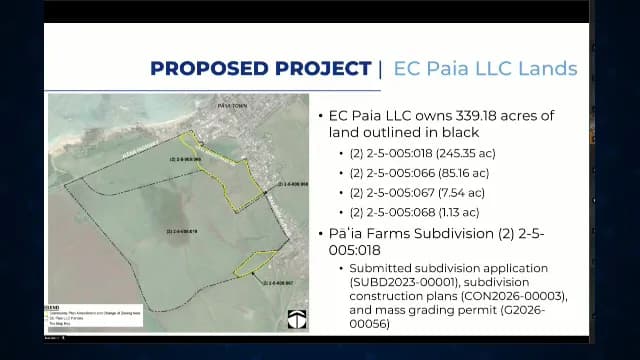
The Housing and Land Use Committee of the Maui County Council met on May 20, 2026, from 9:05 a.m. to approximately 12:20 p.m. to consider three agenda items: Resolution 26-84 (referring the EC Paia Town community plan amendment and zoning change to the Maui Planning Commission), Resolution 26-68 (requiring notice to lessees before agricultural subdivisions), and Bill 78 (accessory dwelling units), which was deferred. The committee heard extensive public testimony and debated the merits of the two resolutions before voting. The meeting was chaired by Councilmember Nohelani Uuu Hodgins. Public Comments & Testimony Resolution 26-84 (EC Paia Town Project) - Francina Rona (Auntie Mopsy) – Expressed support for smart growth in Paia, but stated she will hold the developers accountable throughout the approval process. She noted she has lived in the area for 26 years and wants local families to be able to stay. - Dano Salas – Voiced strong support for the project, citing his long experience in Maui housing and the need for workforce housing, medical facilities, and recreational fields. He noted the developer, Sam Herbot, has said he is a steward of the land. - April Soretsky – Strongly opposed the resolution, arguing the project would destroy Paia's small-town character. She expressed concern that off-island developers only care about profit and that the scale is inconsistent with preserving historic character. - Andrea Rogers – Opposed the project, stating the local community in Lower Paia does not support it. She urged keeping the 85-acre parcel in agriculture for food security. She warned that doubling Paia could damage Paia Bay and Baldwin Beach and cited the loss of Lahaina as a reason to proceed cautiously. - Panay Miyatoga – Testified in support as a representative of property engineers and as a descendant of Paia families. He argued the project is consistent with the Maui Island Plan's designation for planned growth and addresses housing, healthcare, and child care needs. - Lauren Bickley – Opposed the land use redesignation, noting she lives on Baldwin Avenue and was not informed until last week. She asked for a comprehensive update of the Paia-Haiku Community Plan before moving forward on piecemeal changes. - Lahalahi Iwohi – Supported the project as a Maui resident and a member of the project team. She stressed that local families have been forced to move away and that the project will help future generations afford to live on Maui. - Renee S. – Opposed the project as written, citing concerns about high rents in new strip malls harming local businesses and the lack of community notice. - K Apuni Kohawaii Pai Aina – Questioned the legality of the land title, asserting that the property is on Royal Patent lands and should not be developed without addressing Hawaiian land claims. - Junior Nakoa – Expressed frustration that the community was not adequately informed. He advocated for more community liaison work and for projects to prioritize local residents over market-rate housing. - Lori Nielsen – Asked the committee to require additional community meetings in Paia before advancing the project. She noted the exhaustion of Maui residents after the Lahaina fires and the need for transparency. - Christopher Salem – Supported more local input and criticized the county for labeling concerned citizens as litigants. - Margaret Shepherd – Opposed the project, fearing it would change the genre of Paia and lead to strip malls and a loss of historic character. - Albert Perez (Maui Tomorrow Foundation) – Asked for a deferral to allow the state Land Use Commission to review the project first, noting the lack of economic and cultural analysis. Resolution 26-68 (Agricultural Subdivision Notice) - Alan Lloyd – Testified in support, emphasizing that farmers need notification to protect their investments. He noted that Maui Gold Pineapple was not informed of a planned subdivision on land they lease. - No other testimony was offered on this item. Bill 78 (Accessory Dwelling Units) - Alan Lloyd – Testified in support of changing the language from "at least two accessory dwelling units" to "up to two accessory dwelling units" to align with state law. He also asked about rent ceilings and environmental review. Discussion Items Resolution 26-84 – EC Paia Town Project - The project team (Cal Chip Chase, Keola Whitaker, Matt Nakamoto) presented a detailed plan for a 40-acre mixed-use community consistent with the Maui Island Plan's Paia Expansion Area. The plan includes approximately 170 residential units (120 single-family, 50 multifamily), a 200-stall public parking lot, commercial uses (grocery, gym, medical clinic, day care, heritage hall), and a relocated bypass with a traffic signal. The applicant initially proposed 100 income-restricted units but clarified that the actual count is at least 34 workforce rental units (in perpetuity) plus 16 for-sale gap group units for households earning 120%-220% of AMI. - Planning Director Jackie Takakura noted that a council-initiated project bypasses some environmental review requirements and recommended the committee conduct thorough analysis. She also suggested taking a holistic view of Paia's development. - Committee members questioned the applicant about parking fees, water/sewer (private system with options), road widening costs (developer-funded), and commitment to local businesses. The applicant agreed to a 30-foot height limit for B2 zoning, to keep the Baldwin Avenue storefronts consistent with Paia's character, and to offer free parking and laundry facilities for workforce housing residents. - Chair Hodgins expressed that her generational family supports the project to allow their children to live in Paia. Member Cook noted that Paia has changed many times historically. - Amendments adopted: (1) add heritage hall to the description of uses; (2) correct income-restricted unit count to 34 workforce (rental, perpetuity) plus 16 gap group; (3) limit B2 height to 30 feet; (4) require free parking and laundry facilities for workforce housing. - The committee voted 7-0 to recommend adoption of Resolution 26-84 as amended, referring it to the Maui Planning Commission. Resolution 26-68 – Agricultural Subdivision Notice - Councilmember Palten explained that the bill arose because Maui Gold Pineapple was not notified that their leased land was being subdivided. The bill would require a subdivider of agricultural land to provide notice to lessees before filing subdivision permits. - Planning Director Takakura raised questions about purpose, impact, and administration, noting that subdivisions are handled by the Department of Public Works, which was not present. - Members debated the 10-business-day notice timeline and whether notification should be before filing the application. The committee added a friendly amendment to require notice by certified mail. - The committee voted 5-2 to recommend adoption (Chair Lee and Vice Chair Batanga opposed). Bill 78 – Accessory Dwelling Units - The committee deferred this item to the June 3, 2026 meeting to allow the Department of Housing to provide written comments. The planning commission's report had just been distributed. Key Outcomes - Resolution 26-84 (EC Paia Town) – Adopted as amended (7-0) and referred to the Maui Planning Commission for further hearings and community input. The applicant committed to 34 workforce rental units in perpetuity (with free parking and laundry), 16 gap group units, and a 30-foot height limit on B2 commercial. - Resolution 26-68 (Agricultural Subdivision Notice) – Adopted as amended (5-2) and referred to the Maui, Molokai, and Lanai Planning Commissions. The bill will be revised to include certified mail notice and further input from the Department of Public Works. - Bill 78 (Accessory Dwelling Units) – Deferred to June 3, 2026. The committee requested written comments from the Department of Housing and a presentation from the Department of Planning. - Written testimony on all items will continue to be accepted.

ZONING CODE REVISION 40% · HOUSING 29% · COMMUNITY ENGAGEMENT 15% · PROCEDURAL 4%
83
MAY 20, 2026 · MAUI COUNTY, HAWAII · COUNTY COUNCIL & COMMITTEES
Maui County DRIP Committee Meeting on Ho'onani Village Development - May 20, 2026

The Disaster Recovery International Affairs and Planning Committee (DRIP) of the Maui County Council met on May 20, 2026, to consider three bills (163, 164, 165) related to the Ho'onani Village Mixed Use Development Project on approximately 163.443 acres in Kahului. The committee heard presentations from county departments, received public testimony, and voted to recommend passage of Bills 163 and 164 on first reading with CD1 amendments. Bill 165 was deferred. Public Comments & Testimony - John Pele (Executive Director, Maui Hotel and Lodging Association) testified in support of Bills 163 and 164, emphasizing severe workforce housing shortages and personal story of his daughter leaving Hawaii due to lack of housing. He stated that his focus is on housing, not hospitality. - Danielle Watemar testified in strong support, describing how she and her wife housed multiple family members due to the housing crisis. She urged the committee to support the project. - Gabriel Perales (SBA) attempted to testify on disaster recovery resources but was redirected as his remarks were not on the agenda; staff offered to schedule future testimony. - Albert Perez testified in opposition, urging deferral until the final Environmental Impact Statement (EIS) is accepted by the state Land Use Commission (LUC). He cited health risks from aircraft noise (cardiovascular disease), industrial impacts, traffic hazards, questionable water quality from an old agricultural well, and long-term infrastructure burdens. He called the draft EIS "flawed" and stated that affordable housing should not mean asking low-income families to absorb those impacts. Discussion Items - Planning Director Takakura presented department concerns: the council-initiated process bypasses normal application and environmental review; the project is in an industrial corridor under the Kahului Airport flight path; M1 zoning allows a broad range of uses (including 75-foot wind turbines) unless conditioned; and the land use inventory of vacant urban land (9,352 acres islandwide, 3,042 acres in Wailuku-Kahului) may not require expansion of the urban growth boundary given projected population growth of only 0.1% per year through 2043 (UHERO data). The department recommended deferral until the final EIS is accepted. - Deputy Director Peterson (Environmental Management) stated the project is outside sewer service area; he recommended a private wastewater treatment plant or wait until the Central Maui facility expands (approx. 2030). - Director Mitchell (Housing) said the project is too early for review; housing conditions would be triggered at subdivision under Code 2.96 (workforce housing). He noted the project could add significant housing stock—potentially 1,600 units—if realized. - Jensen (Water Supply) confirmed the project is seeking private water; the county municipal system is at 98-100% of reliable capacity and cannot serve market-rate development. The department supports planning's deferral position. - Resource person Jeff Uyoka (representing Ho'onani Development LLC) argued that the project is designed primarily for workforce housing (rents at or below 140% of AMI), with light industrial and commercial as ancillary uses phased in later. He emphasized that entitlements (MIP and community plan amendments) are first steps toward securing water/wastewater infrastructure and that the developer plans to partner with the county on a private water system. He requested flexibility, noting that the project will still require future approvals (EIS, LUC district boundary amendment, change of zoning). - Committee discussion reflected a split: Members Uuhajins, Cook, Johnson, and Chair Lee supported passage to expedite housing and avoid further delays; Member Sinenti voted no; Member Batanga (area representative) favored deferral until the final EIS is complete, but was excused from the vote. Concerns about airport noise were addressed with evidence that noise levels are acceptable per the draft EIS and that modern construction can mitigate sound. The committee also requested the developer to issue press releases at future steps to enhance public participation. Key Outcomes - Bill 163 (Maui Island Plan amendment, urban growth boundary expansion): The committee adopted CD1 (correcting property size to 163.443 acres) by voice vote (6 ayes, 0 no, 3 excused). The main motion as amended passed with 5 ayes (Uuhajins, Lee, Johnson, Cook, Polton), 1 no (Sinenti), and 3 excused (Sugimura, Rollins Fernandez, Batanga). Recommended for first reading to full Council. - Bill 164 (Wailuku-Kahului Community Plan designation change to Business Multifamily): The committee adopted CD1 (same correction) by voice vote (6 ayes, 0 no, 3 excused). The main motion as amended passed with the same 5-1-3 vote. Recommended for first reading. - Bill 165 (change of zoning) was not considered and remains deferred. - The full Council may require five or six votes for passage, depending on whether the Maui Planning Commission's recommendation (deferral until draft EIS submitted and land inventory updated) is considered met; Corp Council noted uncertainty. - Next steps: Developer will address comments on the draft EIS and aim to submit the final EIS to the LUC by September 2026. The committee chair committed to working with the developer on public outreach. The Department of Housing will engage with the developer during preliminary design.

AFFORDABLE HOUSING 36% · HOUSING 24% · ZONING CODE REVISION 21% · PROCEDURAL 7%
84
MAY 19, 2026 · MAUI COUNTY, HAWAII · COUNTY COUNCIL & COMMITTEES
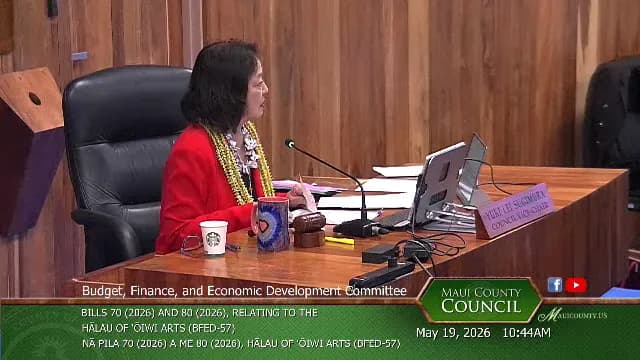
Maui County Budget Committee Meeting Summary - May 19, 2026

The Budget, Finance, and Economic Development Committee of the Maui County Council met on May 19, 2026, at 9:10 AM HST. Chair Ukile Sukimura presided. The committee considered five agenda items covering budget amendments, grant disbursement reforms, land acquisition, and property tax exemptions. Public testimony was heard on multiple items. Public Comments & Testimony - Scotty Miller opposed the acquisition of the Waiehu property, citing cultural memory and family history. He expressed concern that the church might sell the property to a non-county entity. - Travis Aaron Liggett testified on Bill 83, proposing a "Maui Living INA Sustainability Trust" to route philanthropic funding to the Department of Environmental Management for ten focus areas. - Dane Mayo, a family descendant, opposed Bill 102 (Waiehu acquisition), stating unresolved historical title questions and requesting the county not proceed until due diligence is complete. - Lala Johnson urged the council to develop long-term stewardship plans for acquired lands, criticizing the county's focus on acquisition over maintenance and community support. - Kahala Johnson demanded deferral of Bill 102, citing insufficient due diligence and legal risks due to unclear title. She requested a facilitated meeting with the 'ohana (family) before any further hearings. - Kanye Alihi testified in opposition to Bill 102, arguing that the seller (the church) does not have clear title due to restrictions in the will of the original land commission awardee (Lunalilo), and that the county should not purchase land with public funds without a clear title. - Kani Loa Kamaunu testified on the Halal OEV Arts item, expressing mixed feelings due to past desecration of iwi (burial remains) during construction and the parking structure covering the site. Discussion Items - Halal OEV Arts (Bills 70 and 80, 2026): The committee discussed a $4 million bond-funded budget amendment to restore items removed during value engineering: commercial kitchen equipment, rooftop photovoltaic system, audiovisual system, acoustic treatments, telecom/data/security infrastructure, and contract extensions. Deputy Managing Director Aaron Wade and Civil Engineer Dan Schupak presented the project status (under construction, completion summer 2027). Members raised concerns about the timing of the request and requested a detailed breakdown of all costs. The committee recommended passage on first reading (9-0) with a request for additional information before second reading. - Grant Disbursement Flexibility (Bill 69, 2026): The bill amends Maui County Code Section 3.36.190 to allow county agencies to provide advanced disbursements of 10% or more, or installment payments, based on a determination of need. Councilmember Johnson introduced the bill after surveys and cross-departmental meetings. Budget Director Milner noted the 10% is a floor, not a cap. An amendment to change the effective date to July 1, 2026 was made and then withdrawn after discussion. The bill passed on first reading unanimously (9-0). - Sewer Fund Transfer (Bill 83, 2026): The committee approved transferring $372,933 from the sewer fund to the Open Space, Natural Resources, Cultural Resources, and Scenic Views Preservation Fund for a pro-rata portion (7.13%) of a parcel originally purchased with open space funds. The land is needed for the central Maui wastewater facility. The bill passed on first reading unanimously (9-0). - Waiehu Beach Road Acquisition (Bill 102 and Resolution 25-53, 2026): The committee debated the proposed acquisition of 104A Lower Waiehu Beach Road (0.41 acres) for up to $1,480,000 plus expenses. Family members and community testified in opposition, citing unclear title and lack of due diligence. Administration stated they would support acquisition but noted that if a court determines the land belongs to the family, the county would return it. The church indicated it would put the property on the open market if the county does not act. After a lengthy discussion, the committee voted 6-3 to recommend passage on first reading, with Councilmember Rollins Fernandez volunteering to facilitate discussions with the family. - Home Exemption Increase (Bill 181, 2025): Chair Sukimura introduced the bill to increase homeowner and long-term rental real property tax exemptions, with an estimated financial impact of under $5 million per year. Due to time constraints, the committee deferred the item to the next meeting. Key Outcomes - Bill 70 & 80 (Halal OEV Arts): Recommended passage on first reading (9-0). Administration to provide detailed breakdown of all project costs. - Bill 69 (Grant Disbursements): Recommended passage on first reading (9-0). Effective date remains upon approval. - Bill 83 (Sewer Fund Transfer): Recommended passage on first reading (9-0). - Bill 102 & Resolution 25-53 (Waiehu Acquisition): Recommended passage on first reading (6-3). Councilmember Rollins Fernandez to engage with the family before second reading. - Bill 181 (Home Exemption): Deferred to next committee meeting.

HISTORIC PRESERVATION 23% · ECONOMIC DEVELOPMENT 18% · ENGINEERING AND INFRASTRUCTURE 16% · PROCEDURAL 12%
85
MAY 19, 2026 · MAUI COUNTY, HAWAII · COUNTY COUNCIL & COMMITTEES
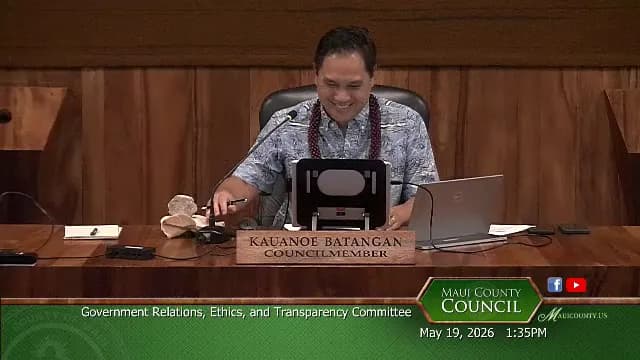
Maui County Govt Relations Committee Meeting on Litigation Settlements - May 19, 2026

The Government Relations, Ethics, and Transparency Committee of the Maui County Council met on May 19, 2026, at 1:34 PM. The meeting was called to order by Chair Colin Batongan. Two resolutions were on the agenda: Resolution 26-81 regarding a settlement for Charlotte Martin vs. the County of Maui, and Resolution 26-82 authorizing additional compensation for special counsel Myers Nave related to wildfire litigation. Due to the postponement of the underlying trial, Resolution 26-81 was deferred. Resolution 26-82 was approved unanimously. Consent Calendar - Approval of meeting minutes from previous meetings. (No actions taken.) Public Comments & Testimony - No public testimony was offered for either agenda item. Written testimony remains accepted. Discussion Items Resolution 26-81 – Settlement for Charlotte Martin vs. County of Maui - Councilmember Gabe Johnson noted his late arrival due to jet lag from travel to Japan. The Corporation Counsel stated that the trial, originally scheduled for June 8, 2026, has been postponed to June 2027, making the resolution no longer time-sensitive. The Deputy Corporation Counsel responsible was unavailable, so the item was deferred by the Chair without objection. Resolution 26-82 – Additional Compensation for Special Counsel Myers Nave (Wildfire Litigation) - Corporation Counsel Takayasu explained that Myers Nave, a Los Angeles law firm, was hired to assist with litigation related to the August 2023 Maui wildfires. The County has terminated that relationship. The resolution seeks $240,000 to cover unpaid bills from a period when the County’s excess insurance carrier, Safety National, initially reduced coverage. The original amount was $854,000; Safety National agreed to pay $521,000, and the County deducted another $93,000, leaving the $240,000 balance. Safety National is now covering all defense costs, having paid approximately $3 million to date. The County’s total spent on outside counsel for wildfire litigation is $500,000 to Myers Nave and $444,000 to McCorriston Miller Mukai LLP of Honolulu. - Questions from members: - Councilmember Nohe Uʻu-Hodgins asked about total spending and whether Safety National would cover future costs. (Yes, Safety National covers all defense costs; this is the final payment.) - Councilmember Tom Cook clarified that Safety National’s litigation guidelines, which restrict multiple attorneys per conference call, were the reason for the reduced coverage. (The guidelines were in small print.) - Councilmember Gabe Johnson asked if further funds would be requested. (No.) - Councilmember Tamara Paltin sought clarification on whether Myers Nave represented the County as defendant or plaintiff. (Only as defendant; Baron & Budd represented the County as plaintiff.) - Councilmember Yuki Lei Sugimura asked if this was part of a global settlement. (It covers litigation leading to the settlement, including mediations and court hearings.) - Chair Batongan noted that the resolution’s language references “current and anticipated legal actions,” but all billings are for past services. Key Outcomes - Resolution 26-81 (Charlotte Martin settlement): Deferred without objection. Reason: trial postponed to June 2027; Deputy Corporation Counsel unavailable. - Resolution 26-82 (Myers Nave compensation): Approved with a vote of 8 ayes (one excusal: Council Chair Alice Lee). The resolution moves to the full Council. - Chair Batongan noted that all litigation funding requests from the Corporation Counsel during the budget session have been addressed. - Meeting adjourned at 1:56 PM.

PENDING LITIGATION 81% · PROCEDURAL 19%
86
MAY 18, 2026 · MAUI COUNTY, HAWAII · COUNTY COUNCIL & COMMITTEES
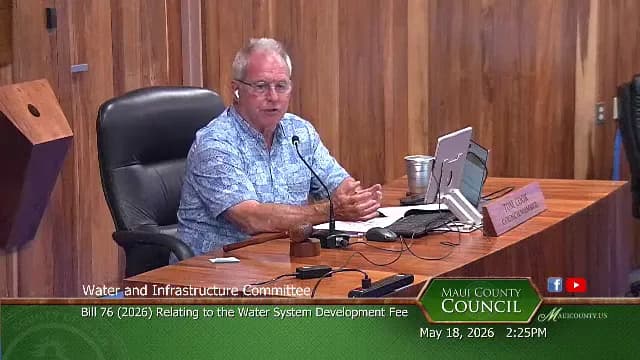
Water and Infrastructure Committee Meeting – May 18, 2026

The Maui County Water and Infrastructure Committee convened on May 18, 2026, at 1:33 PM to discuss two items: a water system development fee restructuring (Bill 76) and a parking prohibition for three Kahului streets (Bill 49). Both items were deferred after discussion and public testimony. Public Comments & Testimony - Bill 76: Tom Crowley testified in support of the shift to average daily demand methodology but requested clearer explanation of how the new fee translates to actual costs for single-family dwellings and accessory units. - Bill 49: Lisa Darcy (Share Your Mana) opposed the bill, urging the committee to pause and address root causes of vehicle residency, citing lack of safe parking alternatives and ongoing litigation. Faith Chase opposed the bill, arguing it criminalizes survival without providing safe alternatives, and noted the county's failure to establish safe sleeping/parking programs despite active lawsuits. Discussion Items Bill 76 – Water System Development Fee Restructuring - The Department of Water Supply presented proposed amendments to shift the fee calculation from meter size to average daily demand, using "equivalent single dwelling" (ESD) as a unit (300 gallons/day). The bill updates terminology, allows fee deferrals for affordable/workforce housing, and adds an exemption for legally connected properties. - Councilmembers questioned the fee's impact on different user types, enforcement of usage estimates, and the timeline for phasing in increases (2–3% annually after three years). Corporation counsel noted potential legal constraints (Nollan/Dolan) on differentiating fees by land use. - A request was made for future proposals of this magnitude to be briefed before inclusion in the budget. Bill 49 – Parking Prohibition on Lehuakona, Alamakani, and Oheikani Streets - Councilmember Batangan introduced the bill (originally sponsored by Councilmember Kama) to ban overnight parking (6 PM–6 AM) to allow police enforcement of existing, unenforceable rules. The area had experienced impacts from vehicle dwelling. - No department representatives were present. Councilmembers debated the lack of safe parking alternatives, outdated references in the bill text, and the need for coordination with the Department of Human Concerns. Several members expressed support for deferring until a safe parking program is operational. Key Outcomes - Bill 76: Deferred with no objection. No vote taken; discussion to continue at a future meeting. - Bill 49: Deferred by motion (Senansi/Sugi-mora, seconded by Batangan). The item will be rescheduled with participation from Public Works, Police, and Human Concerns, and the bill text will be updated to remove outdated references. - The committee adjourned at 3:18 PM.

WATER AND WASTEWATER MANAGEMENT 49% · HOMELESSNESS 24% · ENGINEERING AND INFRASTRUCTURE 10% · PUBLIC SAFETY 9%
87
APR 27, 2026 · MAUI COUNTY, HAWAII · COUNTY COUNCIL & COMMITTEES
Maui County BFED Committee FY27 Budget Meeting – April 27, 2026

The Budget, Finance, Economic Development (BFED) Committee of the Maui County Council met on April 27, 2026, to consider the proposed Fiscal Year 2027 budget. The meeting included public testimony, amendments to appropriations, real property tax rate adjustments, and actions on accompanying bills. After extensive deliberation, the committee balanced the general fund through a combination of spending reductions and changes to non‑owner‑occupied tax tiers, and recessed to Monday, April 27, 2026 at 10:00 a.m. to take up general budget provisions. Public Comments & Testimony - Jake Carton of Maui Indivisible testified that the county clerk rejected nearly 1,000 ballots in the last election due to signature mismatches, and urged that the FY27 budget fund voter education on signature matching. He also raised concerns about the MPD’s contract with HSI and the potential for federal election interference. - Jeff Wyoka, representing Waikapu Country Town, discussed the need for an interim wastewater treatment package plant ($500,000 for design/permitting) as insurance in case the Central Maui wastewater facility is delayed. He expressed full support for connecting to the central plant but stressed the need to keep housing development moving. - Lisa Darcy, founder of Sherry Mana, urged the committee to pause over $1 million in funding for the Clean & Safe program, arguing it criminalizes homelessness rather than providing solutions. She also opposed $750,000 for gates on Holomua Road and called for more effective problem‑solving. - Travis Liggett testified about serious illness after exposure to an illegal discharge from the Maui Ocean Center wastewater plant, and requested funding for CBS 1169 to improve wastewater disinfection. He noted that unsheltered people face structural, not just personal, challenges. - Additional testimony was offered by an individual (Mr. Langford) who thanked the committee for its work and warned about potential corruption, and another who sang a song and requested music at meetings. Discussion Items - Revisits and Amendments: Member Cook withdrew a $2 million appropriation for South Maui residents and small businesses affected by Kona low storms after federal disaster funds covered the need. Member U Hodgins moved to reduce $1 million from the Manage Retreat Revolving Fund (page 55 of budget bills, special purpose revenue funds) and use that to offset a $1 million drainage master plan project proposed by Member Cook; the motion passed 9‑0. Member U Hodgins also moved to condition up to $9 million from the GET excise tax fund for the Umani Village mixed‑use development for well and water system improvements; the motion passed 7‑1‑1 (one recusal). - Fringe Benefits Conditional Language: Member U Hodgins moved to amend conditional language under fringe benefits to reserve $1,184,375 for bargaining units 11 and 15 supplemental agreements, ensuring sufficient funds for potential wage increases. The motion passed 8‑0‑1 (one recusal). - Bills: Bill 61 (Fiscal Reserve Fund) was referred to BFED. Bill 62 (Solid Waste Management and Environmental Protection funds) passed 9‑0. Bill 63 (renaming Hawaiian Cultural Restoration Revolving Fund and expanding Lahaina Royal Complex area) passed 9‑0 with committee amendments. Bill 64 (Electric Vehicle Charging Fee) passed 9‑0. Bills 66 and 67 (sponsored by Member Johnson) were referred to the GREAT Committee. Bill 76 (Water System Development Fee) was held and later referred to the Water Committee, with the budget director requesting expedited passage by June 30. - Real Property Tax (RPT) Adjustments: The committee faced a $10.8 million general fund shortfall. Member Paulton proposed changing the non‑owner‑occupied tier thresholds: tier 2 ($1,000,001 to $2,500,000) and tier 3 ($2,500,000), with no rate changes. This generated $5,668,013. After further budget cuts (see Key Outcomes), the committee needed an additional $5.66 million. The Paulton motion passed 8‑1 (Member Sugimura voting no). Key Outcomes - Budget Cuts and Offsets: The committee approved the following adjustments (all votes 9‑0 unless noted): - Changed funding source for Office of County Council CIP renovations from general fund to bonds ($900,000). - Reduced appropriation for Lahaina Restoration Foundation (rebuild Old Lahaina Courthouse and prison) from $9.7 million to $3.9 million (amended from $3.5 million; motion passed 9‑0). - Reduced the Manage Retreat Revolving Fund transfer by $300,000 (amended from $800,000; motion passed 9‑0). - Reduced the Paris program by $1 million (new total $2 million; passed 9‑0). - Cut renewable energy program grants by $50,000 (passed 7‑2, members Johnson and Sen Nacy voting against). - Cut environmental protection grants by $50,000 (absorbed into existing $800,000; passed 9‑0). - General Fund Balanced: After the RPT tier change and the cuts above, the general fund was $166,461 over the required balance. The committee moved to transfer the excess to the open space fund and gave staff leeway to adjust for rounding (voice vote, ayes). - Meeting Recessed: The committee recessed at approximately 2:05 p.m. to reconvene at 10:00 a.m. on Monday, April 27, 2026 (the same day) via the same teams link to address general budget provisions. No additional public testimony will be taken at that session.

PROCEDURAL 25% · FISCAL SUSTAINABILITY 18% · BUDGET EQUITY ANALYSIS 18% · WATER AND WASTEWATER MANAGEMENT 7%
88
APR 27, 2026 · MAUI COUNTY, HAWAII · COUNTY COUNCIL & COMMITTEES
Budget, Finance, and Economic Development Committee FY27 Budget Meeting - April 27, 2026

This was a recess meeting of the Budget, Finance, and Economic Development Committee to continue discussion on BFED-1, approving the fiscal year 2027 budget for the County of Maui. Oral testimony had closed on April 24, but written testimony continued to be accepted. The committee addressed corrections to the budget bill, discussed general budget provisions, reconsidered Bill 76 on water system development fees, and passed the budget package for first reading. Corrections and Procedural Motions - Fringe Benefits: Staff identified fringe benefit adjustments for police and public works positions from the prior year. A motion to accept the fringe cuts corresponding to council-retained cuts of fiscal year 2026 passed unanimously (9 ayes). - Grant Conditions: Two grants under the Office of Recovery Program were conditioned: (1) J. Walter Cameron Center West Maui funds must be used for planning and pre-development; (2) Na 'Ike O Maui Inc. funds must be used for cultural education, monitoring, and support for West Maui rebuilding efforts, including the Royal Complex Master Plan. Motion adopted 9-0. - Hawaiian Cultural Restoration Revolving Fund: The fund name in Appendix A Part 2 was renamed to match Bill 63 CD1. Motion passed 9-0. - Lanai Farmer Market Exemption: The fee exemption language was moved from an asterisk under the table on page 28 to page 26, where the table is referenced, for clarity. Motion passed 8-0-1 (Member Johnson recused). - Conforming Amendments: Staff was authorized to make conforming amendments to Bills 55-60 and any other affected bills. Motion passed 9-0. Public Comments & Testimony - No oral testimony was presented at this meeting. Written testimony continues to be accepted. Discussion Items - General Budget Provisions: The committee amended Section 19, subsection H, restoring the fiscal year 2026 language requiring the Managing Director to include certain information on each CIP in the quarterly CIP report. The budget director noted the change was inadvertent. Motion passed 8-0-1 (Member Paulton excused). Discussion was deferred to first reading for potential additional language on more timely reporting. - Bill 76 – Water System Development Fees: The committee reconsidered the previous referral of Bill 76 to the Y committee due to time constraints (the bill would not return before the start of FY27). It was moved to pass the bill on first reading with non-substantive revisions. A 7B discussion (Rule 7B) will occur before second reading. Motion passed 9-0. - Final Budget Package: The chair entertained a motion to recommend passage on first reading of Bills 55 (budget), 56 (capital program), 57 (bond authorization), 58 (lapse bond), 59 (wastewater projects loan), 60 (water supply projects loan), and Resolution 26-63 (fuel tax rates), incorporating non-substantive revisions. Motion passed 9-0 after corporate counsel confirmed recused members could vote on the overall package. - Real Property Tax Rates: At the end of the meeting, Member Paulton expressed interest in adjusting the commercialized residential tax rate (Tier 1 at $225, Tier 2 at $350) to meet Mr. Crowley’s request. The budget director noted that excess from RPT changes was $108,000 for the open space fund. Member Paulton suggested offsetting the remaining $218,086.15 from the $500,000 allocation to Camp Maluhia. The committee agreed to finalize this at first reading. Key Outcomes - All corrections and procedural motions passed unanimously or with appropriate recusals. - Bill 76 was reconsidered and passed on first reading. - The budget package (Bills 55-60) and Resolution 26-63 were passed on first reading. - A preliminary agreement was reached to potentially adjust commercialized residential tax rates at first reading, using $108,000 from open space funds and $110,086.15 from the Camp Maluhia allocation as an offset. - Member Paulton was recognized for making 88 motions, with 83 passing. - The committee concluded its business and canceled the previously scheduled meeting for April 28. The next steps include first reading on May 15, 2026, where remaining amendments (including tax rates) will be considered.

BUDGET 72% · PROCEDURAL 22% · WATER AND WASTEWATER MANAGEMENT 6%
89
APR 23, 2026 · MAUI COUNTY, HAWAII · COUNTY COUNCIL & COMMITTEES
Maui County BFED Committee Advances FY27 Budget on April 23, 2026

The Maui County Budget, Finance, and Economic Development (BFED) Committee (Chair Yuki Lei Sugimura) continued its Fiscal Year 2027 budget deliberations on April 23, 2026. The committee faced a current general fund imbalance of approximately $17 million. The day-long session featured extensive public testimony on wastewater management, cultural programs, and workforce housing, followed by significant committee actions on department budgets, grants, and policy matters. Public Comments & Testimony - Wastewater and Ecosystem Restoration: Multiple testifiers spoke in support of the Maʻalaea Regional Wastewater Reclamation System (MRWRS). Peter Cannon detailed historical environmental degradation. Tapani Bori and David Whitney provided technical project details. Robin Knox, a water quality specialist with 40 years of experience, advocated for the project as a crucial demonstration of advanced treatment. - Hōʻōnani Village: Jeff Uyoka requested funding for a water system to support the workforce housing project, stating the system would ultimately be deeded to the county's Department of Water Supply. - Makahiki Season: Deputy Director of OEV Resources Kekai Robinson testified in strong support of the administration's $1M request for a countywide program, describing it as a comprehensive cultural system encompassing governance and resource management. - Algae Technology: Researchers (Travis Liggett, Dr. Peter May, Dr. David Blersch, Mark Subinovich) advocated for the use of algal turf scrubbing technology for advanced nutrient removal from wastewater. - Other Topics: Testimony was also given on tourism management, engineering contract fraud concerns, and support for specific community projects. Discussion Items - Office of the Mayor Priorities: The committee approved several grants and contracts, including $1.5 million for Kahoma Church restoration, $280,000 for countywide film production (with specific allocations for Molokai and Lanai), a $250,000 conservation plan, and funding for cultural institutions. - Office of the Mayor Cuts: A motion to cut the Makahiki season marketing budget by $300,000 was heavily amended. It ultimately reduced the appropriation by $150,000, leaving $300,000 conditioned for education, disaster preparedness, and cultural practices. The tourism management grant fund was cut from $450,000 to $150,000. - Department of Police: The committee cut over $160,000 from expansion positions across three bureaus. It also added a condition of $100,000 for a dedicated 4x4 vehicle for the CORE (Community Outreach and Response through Education) program. - Department of Public Works: A new highway utility worker position for Lānaʻi (six months funding) and $1 million for the countywide drainage and flood mitigation plan were added. The committee also approved over $1 million in cuts to various departmental programs and CIPs. - Countywide Costs: Chair Sugimura successfully moved to increase fringe benefits by $750,000 for a Fire Department (BU 11) supplemental agreement. The committee also formally reduced the emergency fund balance by $32 million to reflect authorized storm damage spending. - General Budget Provisions: A debate occurred over a provision to auto-transfer excess General Excise Tax (GET) revenues to the GET fund. A motion to delete the provision, argued as necessary for council transparency, was withdrawn for further discussion. - Bills: Bill 63 was amended to correct the name of the Lahaina Royal Complex area. Bills 66 and 67, allocating 20% of TAT revenues for climate action, were discussed but not voted upon. Key Outcomes - Budget Status: The committee enacted roughly $30 million in cuts and $40 million in additions, resulting in a $17 million general fund imbalance to be resolved. - Next Steps: The committee recessed at approximately 9:00 PM and will reconvene on April 24, 2026, to develop Real Property Tax proposals using an Excel template from staff to balance the budget. - Major Votes: The reduced Makahiki cut passed 8-1. The EV charger idle fee motion passed 6-3. The fringe benefits increase for firefighters passed.

BUDGET 39% · PROCEDURAL 19% · WATER AND WASTEWATER MANAGEMENT 15% · ENVIRONMENTAL PROTECTION 6%
90
APR 22, 2026 · MAUI COUNTY, HAWAII · COUNTY COUNCIL & COMMITTEES
BFED Committee Meeting – April 22, 2026 – Budget Deliberations

The committee met on April 22, 2026, at 10:03 AM to continue budget deliberations for the County of Maui. The meeting began with public testimony, followed by review and voting on member priorities for the Department of Human Concerns, Department of Management, Department of Parks and Recreation, and Department of Water Supply. Key decisions included funding for affordable housing, health services, youth programs, and disaster recovery, as well as several cuts to vacant positions and contingency funds. Public Comments & Testimony - Frank Barbosa (visually impaired resident) testified on the need for tactile tiles and crosswalk improvements for the visually impaired, citing a personal accident at the county building parking structure. He urged the county to install guide strips and reflectors. - Jennifer Gladwin (Executive Director, Kalei Foundation) requested $70,000 to sustain the foundation’s headquarters (HQ) in Kahului, which supports wildfire survivors with disabilities, a loan closet, and community space. She noted the foundation has not previously received county grants. - Jim Langford (Kula resident) shared negative experiences with police responses in various districts post-wildfire and raised concerns about the culture of software vendors (Palantir) proposed for police data systems. - Travis Liggett testified in support of advancing disinfection design work (CBS 1169) and tying sanitation to public health, mental health, and law enforcement issues. - Robin Danner (senior finance advisor, Homestead Community Development Corporation) and Kara Chow supported the Paris program (permanently affordable rental units), requesting $3 million for acquisitions, ADUs, and photovoltaic installations. They reported that 7 of 9 units are occupied by wildfire survivors. - Christopher Salem criticized the Public Works director’s qualifications and alleged legal issues in SMA permit enforcement. - JC Long offered a metaphorical testimony about being a “canoe bailer” and encouraged the council to watch a UHERO presentation on economic outlook. Discussion Items - Department of Human Concerns Priorities: Nineteen member priorities were discussed, including the Paris program ($3M for HCDC), special needs power supply program ($150K for backup batteries), Maui Mediation Services increase ($150K), Tutu and Me conditions ($1.2M), Kahului Hongwanji fencing ($160K), Project Vision ($188,500), Kalei Foundation ($70K, with a failed amendment to add $116K for a full-time advocate), Lana‘i Kina‘ole ($425K increase), Hospice Maui ($750K increase), Maui AIDS Foundation ($340K increase), Maui Family Support Services ($199,202), Maui Farm ($40K), Molokai Rural Health ($600K) and Molokai Community Health Center ($545K), Ho‘ala Health Outreach ($2M), MEO BEST reintegration program ($253K), Scouting America ($500K for Camp Maluhia), Pa‘ia Youth Council ($200K increase), Boys & Girls Club ($280K for mobile program), and Hana Mamas ($245,722 for behavioral health and census work). - Department of Management: Chair Lee’s proposal for a feasibility study on acquiring Wailuku Plantation parcels ($250K) passed. An upcountry wildfire rebuild fund ($3M) was approved with conditions for future guardrails. Ho‘ola Na Kama (LTRG) received $1M. South Maui recovery funding ($2M) for environmental health impacts passed. A GIS system expansion ($500K) was approved. The AEM water study ($1.8M) was moved to the Water Supply Department budget. Montokuji Mission shoreline restoration ($1.2M) was moved to the SMA Revolving Fund. - Department of Parks and Recreation: Several cuts were made, including $93,600 for trailer offices (withdrawn), $250,000 from countywide court improvements (failed on reconsideration), $250,000 from countywide fencing (passed), and $500,000 from the park adaptation plan (passed). A motion to cut $3.5M from the ‘Oma‘ole parking lot and restroom project passed. The committee also reconsidered and restored court improvements. - Department of Water Supply: The Kula Community Watershed Alliance received $450,000. Project description changes for the Waiakoa Gym and the acquisition of Maui Land & Pineapple assets were approved. Corrections to the water fund CIP program were made, including reducing special assessments by $13.9M and removing $1.5M for upcountry reliable capacity. Key Outcomes - Paris Program: $3 million grant to Homestead Community Development Corporation for permanently affordable rental units (passed 9-0). - Special Needs Power Supply: $150,000 for a special needs power supply program (passed 9-0). - Maui Mediation Services: $150,000 increase for eviction mediation (passed 9-0). - Tutu and Me: Condition added to maintain six program sites (passed 9-0). - Kahului Hongwanji Fencing: $160,000 for child care center fencing (passed 9-0). - Project Vision: $188,500 for street medicine (passed 9-0). - Kalei Foundation: $70,000 for headquarters operations (passed 9-0; amendment for $186K failed). - Lana‘i Kina‘ole: $425,000 increase (passed 9-0). - Hospice Maui: $750,000 increase for rural hospice (passed 9-0). - Maui AIDS Foundation: $340,000 increase (passed 9-0). - Maui Family Support Services: $199,202 for child abuse prevention (passed 9-0). - Maui Farm: $40,000 increase (passed 9-0). - Molokai Rural Health & Community Health Center: $600,000 and $545,000 respectively (passed 9-0). - Ho‘ala Health Outreach: $2 million for mobile clinics (passed 9-0). - MEO BEST Reintegration: $253,000 for women’s program (passed 8-0, one recused). - Scouting America: $500,000 for Camp Maluhia capital improvements (passed 8-1). - Pa‘ia Youth Council: $200,000 increase for programmatic activities (passed 9-0). - Boys & Girls Club: $280,000 for mobile club (passed 9-0). - Hana Mamas: $245,722 for behavioral health and census (passed 9-0). - Upcountry Wildfire Rebuild: $3 million for rebuild, recovery, and mitigation (passed 8-1). - Ho‘ola Na Kama (LTRG): $1 million for disaster recovery (passed 8-0). - South Maui Recovery: $2 million for environmental health impacts (passed 7-1-1). - GIS System Expansion: $500,000 for countywide GIS (passed 8-1). - AEM Water Study: $1.8 million for West Maui groundwater mapping (passed 9-0). - Montokuji Mission Shoreline Restoration: $1.2 million (moved to SMA Revolving Fund, passed 8-1). - Parks Cuts: $250,000 from countywide fencing (passed 5-4); $500,000 from park adaptation plan (passed 9-0); $3.5 million from ‘Oma‘ole parking lot (passed 8-0). - Water Supply: $450,000 for Kula Community Watershed Alliance (passed 9-0); project description and CIP corrections approved (all passed). The meeting recessed at 5:59 PM and resumed at 7:45 PM, concluding at 8:26 PM. The committee will continue with Police, Mayor, Public Works, and countywide items on April 23, 2026.

BUDGET 30% · PROCEDURAL 9% · DISASTER RECOVERY 9% · WATER AND WASTEWATER MANAGEMENT 9%
OPENPUBLICA · PUBLIC MEETING INDEXUPDATED DAILY · openpublica.com