Browse by city
Date range
Search help

Search titles, summaries, topics and stored transcripts together. Keywords may match separately; put the whole query in double quotes for a phrase. Matching follows word analysis, so punctuation is not exact. Both dates are included. Documents are not searched.

SHOWING 111–120 ENTRIES
111
MAR 19, 2026 · MAUI COUNTY, HAWAII · COUNTY COUNCIL & COMMITTEES
Water and Infrastructure Committee Meeting - March 19, 2026

(Note: The meeting transcript references March 9, 2026, but the official date provided for this summary is March 19, 2026. The committee convened at 1:36 p.m. under Chair Tom Cook to discuss two items: Y-22 (Bill 16 regulating low-speed electric bicycles) and Y-1 Print 6 (operational and budgetary review of the Department of Environmental Management).) Public Comments & Testimony - Y-22 (Electric Bicycles): Two testifiers spoke. J.C. Law from Waqua Ahoa expressed support for regulating unsafe riding like wheelies, noting that low-speed e-bikes are useful for seniors and commuting but that dangerous antics are annoying. Mike Moran, a lifelong cyclist, distinguished between low-speed e-bikes and high-speed electric vehicles (e-motorcycles), stating that the real danger comes from high-speed vehicles weaving in traffic, and that any safety regulation is positive. - Y-1 (DEM Review): Three testifiers spoke. Travis Liggett proposed a nonprofit donation model to fund 100% disinfection at Kihei and Kahului plants, suggesting a memorandum of agreement to accept donations for CBS 5521 or CBS 1169 projects. Mike Moran raised concerns about UV treatment at the South Maui (Kihei) plant, citing inconsistent information and poor water quality at Cove Park, and urged expansion of R1 irrigation to stop injection well discharge. A third anonymous testifier (identified as "Mr. Cook" in the transcript) inquired about lithium-ion battery disposal, noting they should not go to the landfill, and also commented on the exclusion of the environmental protection and sustainability division from the review. Discussion Items - Y-22 (Bill 16 – Low-Speed Electric Bicycles): The proposed bill (CD1 version) aims to mandate helmets for riders under 18, define safe riding conduct, and prohibit exhibition driving. Departments (Parks, Public Works, Transportation, Police, Prosecuting Attorney, Corporation Counsel) voiced support but raised concerns about defining "low-speed e-bike" vs. high-speed e-motorcycles (already illegal on streets). The Prosecuting Attorney suggested changing a conjunctive clause to disjunctive for enforcement. Councilmembers debated: some (Vice Chair Sugi-Mura, Member Batangan) supported regulation and parental accountability; others (Member Johnson) opposed, favoring education and bike lanes over new laws. The presentation from the DRIP committee clarified three e-bike classes (Class 1: pedal-assist ≤20 mph, no throttle; Class 2: throttle assist ≤20 mph; Class 3: pedal-assist ≤28 mph; all under 750W) and that devices without pedals or exceeding these limits are e-motorcycles and already illegal on roads. MPD Lt. Nakamura highlighted that enforcement challenges include juveniles repeat offending and the need for parental consequences. - Y-1 (DEM Operational and Budgetary Review): Deputy Director Luna-Hoomoku (and Chief Nakagawa, Chief Keanu) presented the FY2026 budget and project status. Key points: 95% of DEM's CIP budget is for wastewater; 70% of CIP is for expansion/infrastructure (especially R1 water and Central Maui facility). Major project updates: Central Maui Wastewater Reclamation Facility design at 60%, EIS published, operational target early 2030; West Maui R1 distribution construction at 80% (due by mandate); many other projects at 5% design (planning phases). Solid waste projects include landfill gas system expansion and composting permit efforts. Discussion covered funding (unknown future sources for construction, potential use of CDBG-DR funds), staff vacancies (18%, particularly engineers), contractor capacity, and green waste diversion (exploring composting but permitting obstacles). Chair Lee and others questioned the large number of early-stage projects and carryover savings; Eric Nakagawa explained that planning funds are encumbered and that any carryover reduces future sewer rates. Councilmember Sugi-Mura noted that the state bill SB 2971 (McKelvey) for universal R1 by 2040 is not moving forward. Member Paulton raised questions about R1 allocation priorities (foreign billionaire vs. county plans) and the potential for Hawaii Water Services to create a private recycling plant. Director Takamori of Transportation supported the e-bike bill but emphasized safety measures. Key Outcomes - Y-22 (Bill 16): Deferred to the Public Works Commission for review and comment. No vote taken. The committee agreed to revisit after receiving the commission's feedback. - Y-1 (DEM Review): Deferred. The committee will submit written budget-related questions to the department for detailed responses. No action taken. Chair Cook expressed support for funding projects that are ready to proceed and for assisting with personnel needs, while cautioning against funding unstarted projects.

WATER AND WASTEWATER MANAGEMENT 34% · TRANSPORTATION SAFETY 32% · PROCEDURAL 12% · SOLID WASTE MANAGEMENT 7%
112
MAR 19, 2026 · MAUI COUNTY, HAWAII · COUNTY COUNCIL & COMMITTEES
Maui County Committee on Agriculture & Environment Meeting Summary – March 19, 2026

The Committee on Agriculture and Environment of the Maui County Council convened on March 19, 2026, at 9:07 AM HST. The agenda included an update on the Agricultural Microgrant Program, a presentation on the Climate Action and Resiliency Plan (CARP) dashboard, and a discussion on the county's bilingual government transition regarding meeting agenda formats. Agricultural Microgrant Program Update Presentation: Director Kali Arcy (Department of Agriculture) outlined program funding of $3.1 million in FY26, with $100,000 dedicated to data collection. Maggie Batangan (MEO Executive Director) presented data on over 400 awardees from FY21-24, reporting positive trends in production, revenue, safety, and marketing. A new survey is being deployed for deeper impact analysis. Discussion: Member Alice Lee questioned whether the program strategically addresses the county's 90% food import reliance by targeting unmet market needs. Member Yukile Sugimura asked about resource sharing and cohort building among farmers. Vice Chair Tamara Paltin (referred to as Bolton in transcript) inquired about supporting closed-loop systems (e.g., aquaponics, livestock) and scaling farm business acumen. Chair Keani Rollins Fernandez noted the program aims to build long-term capacity, as relying solely on farm income remains a significant challenge. Key Outcomes: Item deferred. Discussion will inform budget session priorities. Climate Action & Resiliency Plan (CARP) Dashboard Update Presentation: Environmental Program Specialist William J (DEM) presented the Phase 1 public dashboard (live Nov 2025). It tracks 47 strategies and 167 action items. The dashboard is updated quarterly. Phase 2 is planned for FY27. The full CARP update RFP will be awarded in FY27. Public Testimony: Joseph McCorkle clarified the update frequency (monthly vs. quarterly). Chair confirmed the code requires quarterly updates. Kai Nishiki testified about flooding in North Kihei, urging coordinated community adaptation efforts. Discussion: Member Kawanoi Batangan inquired about tracking telework policies as a climate strategy. Vice Chair Paltin raised concerns about infrastructure design storm standards (50-year vs. 100-year) and managed retreat projects. Member Sugimura asked about stakeholder engagement for the upcoming CARP update. Key Outcomes: Item deferred. Dashboard Phase 1 is operational. Phase 2 and the full CARP update are scheduled for FY27. Maui County Bilingual Government Transition (Agenda Format) Introduction: Chair Fernandez discussed bilingual agenda formatting (Charter Section 13-17, Ordinance 5758). OCS had recently changed the format from an alternating (item-by-item) layout to a Hawaiian-first, English-follows layout. Chair Fernandez expressed concern that this format did not fulfill the ordinance's mandate to promote inclusion. Public Testimony: A significant number of educators, administrators, and community leaders (Kaala Fe Kamara, Kawaipuna Kalipi, Manuai Peters, Mailena Ehu, Lealoha Kiala Iki, Joshua Gante, Melia Kalave, and others) testified overwhelmingly in support of robust bilingual government. Testifiers uniformly argued that Olelo Hawaii carries deep cultural knowledge and identity, and its full integration into government operations is essential for equity, cultural preservation, and inspiring youth civic engagement. Discussion: Member Alice Lee clarified her request to OCS was for easier English navigation, not removal of Olelo Hawaii. OCS Director David Ratz proposed a third option: a side-by-side (dual column) format placing English and Hawaiian together. The committee reached a strong consensus in favor of this format. Members Batangan, Paltin, Sugimura, Sinenci (referred to as Senensi), and Lee expressed support, noting it places both languages on equal footing, avoids segregation, and facilitates language learning. Chair Fernandez strongly endorsed the side-by-side format, stating it best honors the charter's requirement. Key Outcomes: OCS directed to develop a side-by-side bilingual agenda format. Implementation may require technical adjustments with the vendor and might not be fully ready for the upcoming budget session, but the direction was firmly set. Item deferred. Overall Meeting Outcomes - Agricultural Microgrant Program update received and deferred. - CARP Dashboard Phase 1 acknowledged; Phase 2 and plan update scheduled for FY27. Dashboard will be updated quarterly. - OCS directed to transition official meeting agendas to a side-by-side (dual column) English/Olelo Hawaii format.

PROCEDURAL 29% · AGRICULTURE 25% · ENVIRONMENTAL PROTECTION 20% · PUBLIC ENGAGEMENT 12%
113
MAR 18, 2026 · MAUI COUNTY, HAWAII · COUNTY COUNCIL & COMMITTEES
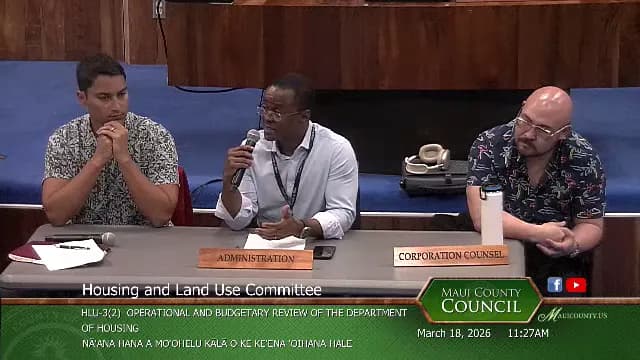
Housing and Land Use Committee Meeting – March 18, 2026

The Housing and Land Use Committee of Maui County met on March 18, 2026, from 9:14 a.m. to 12:01 p.m. to review the operations and budgetary status of two key departments: the Department of Planning and the Department of Housing. The meeting, chaired by Nohelani U Hodgins, included presentations from department leaders, public testimony, and extensive discussion among committee members. Public Comments & Testimony - Christopher Salem (via Teams) testified on systemic failures in the planning department's administration of Special Management Area (SMA) permits, alleging that engineering valuations are intentionally undervalued to classify major projects as minor, thereby bypassing public hearings. He noted that Public Works has never been asked by Planning to review these valuations and that Public Works does not route subdivision plans back to Planning for SMA condition verification. He urged the committee to close this loophole. - JC Law (in person) spoke briefly on social justice and housing needs, also mentioning a pending case involving former litigant Sonya Davis who is now living in a car. - Jim Langford (via Teams) supported earlier testimony and asked about an RFP for software to track departmental functions. - Johan Lal (via Teams) praised the Housing Department's achievements and described their work as a model for addressing the housing crisis. Discussion Items Department of Planning Review - Acting Planning Director Tako Kura presented an overview: the department has 85.5 budgeted positions across five divisions, with vacancies in Zoning (4), Current Planning (7), and Long Range (1). Key responsibilities include zoning enforcement, discretionary permits, long-range community plans, and post-fire rebuild coordination. As of February 2026, the department had processed 1,463 staff responses, 883 land use verifications, and 893 building permits. The department is also working on the South Maui Community Plan, Central Maui Community Plan, SMA boundary review, and Title 19 update. Budget status: 43% of total funds spent (salaries 49%, operations 28%, equipment 65%), with 57% remaining. - Committee members raised questions about vacancies, staff retention (recruitment incentives and health benefits), fee studies, the wetlands overlay map status (completed informational map), and the need to better implement general and community plans. Member Cook noted a disconnect between planning projections and actual infrastructure funding. Chair Alice Lee expressed frustration with the proliferation of unimplemented plans. - Director Kura responded that the department is working on retention incentives, updating administrative rules, and collaborating with other departments. She confirmed that the SMA rules' "no-needs" portion was struck by a court but the amended shoreline rules remain intact. She also addressed a testimonial concern about subdivision/SMA reviews, stating that larger subdivisions require SMA permits and that the public can search permit history via the eMaps system. Department of Housing Review - Director Mitchell reported on the department's progress since its inception on July 1, 2024: over 800 affordable rental and workforce units have been built (Kaulu o Kukuya, Kaulana Mahina, Hokua, Haliʻimaile 1 & 2, etc.). Staffing grew from 37 to 47, with nearly all positions filled after converting many to exempt status. The department implemented 7–8 office policies, set up a Housing Advisory Board, created a housing dashboard (with 100+ residential workforce housing agreements now databased), and removed 50+ steel cabinets and 150+ boxes of old documents. - Division administrators presented: - Gail Ram (Federal Housing Programs): CDBG program received $1.8M for program year 2025; HOME program $2.85M; HTF $1.45M; Maui Homeowner Assistance Fund helped over 400 households with $15M distributed. Section 8 vouchers: 1,560 vouchers at 97–98% utilization; waiting list processing positions 1,203–1,252. - Alicia Mazingo (Housing & Community Development): Five affordable housing projects in development (e.g., Kamole Hana Hale Apartments, Lānaʻi Affordable Housing Project, Kilohana Makai). The Affordable Housing Dashboard was launched. - Cassie Yamashita (County Housing Programs): FY2026 funded 16 projects totaling $68.6M assisting 959 units. Administered seven programs: First-Time Homebuyers (3 households served), Rental Assistance (231 households), Home Ownership Counseling (53 households), etc. The Molokaʻi Voluntary Deed Restriction Pilot Program (500K) will launch by end of March. - Committee questions covered collaboration with other departments (ad hoc meetings), fee waivers (Bill 48 to waive fees for partially affordable projects), administrative rules for Bill 111 (online portal for workforce housing), AMI adjustments for Lānaʻi after a wage increase, and the need for project-based vouchers. Director Mitchell supported broad fee waivers for affordable portions and suggested using Affordable Housing Funds to compensate other departments for lost fee revenue. He also described "tough love" meetings with developers to identify areas for improvement (e.g., document processing speed, digitization, clearer points of contact). Key Outcomes - The committee deferred action on both the Department of Planning and Department of Housing agenda items, as the reviews were informational to prepare for the upcoming FY2027 budget season. - No formal votes were taken. Written testimony remains open. - Director Mitchell confirmed he will testify in support of Bill 48 (fee waivers for partially affordable projects) at the upcoming Council meeting on Friday, March 20. - The committee acknowledged the progress of both departments and indicated that further written follow-up questions would be submitted.

HOUSING 23% · AFFORDABLE HOUSING 23% · LAND USE PLANNING 15% · PROCEDURAL 6%
114
MAR 18, 2026 · MAUI COUNTY, HAWAII · COUNTY COUNCIL & COMMITTEES
Maui County Council Water, Social Services, and Parks Committee Meeting - March 18, 2026

The committee met to review two items: the continuum of care for substance abuse provided by Aloha House (Maui Behavioral Health Resources) and the operational and budgetary review of the East Maui Water Authority for fiscal year 2026. The meeting included presentations, public testimony, and council questions. Public Comments & Testimony - For the first item, JC Law testified, expressing support for Aloha House's work and raising concerns about the coordinated entry system for homeless individuals, including the need for proper identification documents. - For the second item, JC Law testified again, emphasizing the importance of water infrastructure in East Maui and expressing trust in Director Young. The Royal House of Hawaii testified, advocating for recognition of original royal patents and land titles in East Maui, and questioning whether the authority will research land claims. Discussion Items - Continuum of Care for Substance Abuse (Aloha House): Nicole Hokoana, CEO of Maui Behavioral Health Resources, presented the operations of Aloha House, including its medically monitored withdrawal management program and residential treatment. She highlighted the program's partnership with the emergency department since 2000, its 24/7 nursing staff, and its role as a safety net. Hokoana noted that the program has operated with flat funding from the county and state for over a decade, while costs have risen, leading to a $500,000 annual gap. She reported that the program is 85% Medicaid-funded and discussed the impact of federal Medicaid cuts (the "Big Beautiful Bill"), including increased documentation requirements (proof of citizenship, residency, work history) and delays in enrollment. Council members asked about success rates (approximately 60-70% transition from detox to residential), the opioid settlement fund, and the need for additional funding. Acting Director of Human Concerns Jessica Krause confirmed that county grants can fund payroll. - Operational and Budgetary Review of East Maui Water Authority: Director Young and grant coordinator Leslie Tamarabucci presented the authority's FY 2026 budget, including nine staff positions (eight positions filled, one in recruitment). The budget includes $75,000 for a community grant program, which awarded five grants to community-based stewardship projects in the license area. Young discussed the authority's strategic planning process, which included 12 community meetings and 2 field trips, and coordination with the Department of Water Supply and DLNR on infrastructure acquisition. Council members inquired about grant oversight, the need for a larger grant program, and the status of the strategic plan and lease negotiations with DLNR. Young noted that the authority is seeking federal funding through programs like the Robert Wood Johnson Foundation's impact investing program. Key Outcomes - The committee unanimously approved (without objection) designating Nicole Hokoana as a resource under Rule 18A for the first item, and Leslie Tamarabucci as a resource for the second item. - Both agenda items were deferred without objection, pending further review. - The committee expressed support for Aloha House's funding needs and encouraged Director Young to continue developing the grant program and strategic plan. - The committee requested that the administration provide more information on the opioid settlement fund and its potential allocation to treatment centers.

HEALTH 39% · GRANTS 11% · PROCEDURAL 10% · WATER AND WASTEWATER MANAGEMENT 10%
115
MAR 18, 2026 · MAUI COUNTY, HAWAII · COUNTY COUNCIL & COMMITTEES
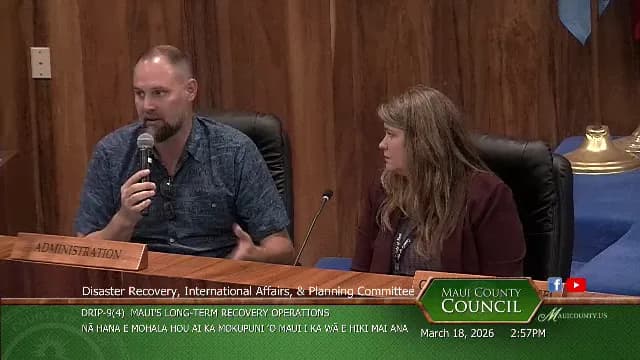
Maui County Council DRIP Committee Reviews Long-Term Recovery Operations and General Plan Implementation on March 18, 2026

The Disaster Recovery, International Affairs, and Planning (DRIP) Committee of the Maui County Council met on March 18, 2026, from 1:33 PM to 4:29 PM. The committee received two informational presentations: an update on Maui's long-term recovery operations from the Office of Recovery and the 2025 Annual General Plan Implementation Report from the Planning Department. No legislative action was taken on either item. The meeting coincided with a severe storm impacting the county, which became part of the recovery discussion. Public Comments & Testimony - Johan Lowell supported the recovery efforts and encouraged public discussion on permitting complexity, noting that county staff are working hard and that delays are due to legitimate regulatory requirements (SMA, historic districts, archaeological resources). - Jim Langford urged the committee to track performance metrics such as cost per home built, time to deliver, consultant burn rate, and local contract awards. He called for a closed-loop system connecting land, permits, financing, and occupancy. - Junior Nakoa thanked the team but stressed the need for community-led, government-supported recovery. He raised concerns about parking requirements for new housing and urged inclusion of community voices beyond advisory groups. - Royal House of Hawaii asserted that descendants of original title holders (Royal Patent holders) have not been contacted regarding land use, and that TMK records must show the original land awards. - Johan Lal (testifying on the general plan item) criticized developer-written staff reports for discretionary permits and argued community plan actions should be applied through conditions on permits (e.g., public access, parking). He emphasized that community plans, while not as rigid as zoning, are regulatory tools. - JC Law (also on the general plan) spoke about the difficulty of using state tax IDs for Hawaiian identities and urged meaningful community participation in the upcoming Upcountry Community Plan. Discussion Items - DRIP 9-4: Maui's Long-Term Recovery Operations – Deputy Managing Director Aaron Wade and Office of Recovery Administrator John Smith presented a comprehensive update. Key points included: - The Office of Recovery is coordinating with MIMA on the current storm response, especially debris management. - Permitting progress: 355 permits processed, 550 issued, 159 homes completed (people moved back). Permit time reduced to 44 days overall; residential permits average under 30 days. - 60% of single-family residential housing in the burn zone is either permitted or under construction. - 800 families remain without permanent housing; FEMA extended temporary housing through February 2027, after which county funds will be needed. - Housing programs: First-time home buyer (501 active applications, 41 shopping letters, 6 homes purchased), single-family reconstruction (59 active, 250 planned), multifamily (7 approved projects, 281 units for reconstruction, 238 new construction). - Infrastructure: 22 projects conditionally awarded, including Lahaina Bypass North extension (up to $100 million from CDBG-DR). Total infrastructure requests exceeded $1 billion; $950 million unfunded gap remains, which the office is pursuing through other federal programs (FHWA, EPA, NRCS, FEMA HMGP, etc.). - Policy updates: Council actions enabling SMA waivers, parking flexibility, height limit adjustment, factory-built housing, ADU size limits, and encroachment amendments were highlighted. - The “One Water Lahaina” initiative was introduced as a holistic, systems-based approach to water management, integrating departments and traditional ʻāina knowledge (though Councilmember Rollins Fernandez questioned its lack of credit to ʻahupuaʻa management). - Committee members asked about community engagement, local contractor preference, multifamily R1 water requirements, and fire safety compliance. The administration committed to providing a data sheet on housing demographics. - DRIP 9-10: 2025 Annual General Plan Implementation Report – Planning Program Manager Scott Forsyth presented the report, which tracks 1,261 implementing actions across the countywide policy plan, Maui Island Plan, and six community plans. Key findings: - 78% of actions are complete, ongoing, or in progress. - The Planning Department is assigned 323 actions; other departments collectively 856; 103 fall under federal/state/other entities. - The report includes color-coded status (complete, ongoing, in progress, not begun) for each action. - Councilmembers discussed the tension between aspirational plan language and implementation, the need to update the out dated Hana Community Plan, and the difficulty of measuring progress with percentages. Councilmember Rollins Fernandez suggested a performance dashboard; Forsyth noted an exploratory effort with Invisio estimated at $500,000 initial cost plus ongoing subscription, and that dedicated staff would be needed. - Acting Planning Director Jackie Takakura clarified that the Planning Department does not allow applicants to write staff reports for discretionary permits, contrary to a testifier’s claim. Key Outcomes - No legislative action was taken on either agenda item; both were deferred. - The committee received the presentations and testimony into the record. - Chair Paulton noted that an emergency appropriation request for the current storm would be before the full council on Friday, March 20, 2026, requiring seven votes. - The Planning Department agreed to provide a written list of unimplemented “good governance” action items from the countywide policy plan that could be assisted by the council. - Planning will consider incorporating Councilmember Rollins Fernandez’s data from the Molokai Community Plan (adopted 2018) into future annual reports. - The Office of Recovery committed to providing a one-sheet with detailed housing and demographic data from the CDBG-DR action plan.

DISASTER RECOVERY 23% · PLANNING 22% · HOUSING 16% · WATER AND WASTEWATER MANAGEMENT 9%
116
MAR 17, 2026 · MAUI COUNTY, HAWAII · COUNTY COUNCIL & COMMITTEES
Maui County Council BFED Committee Meeting – March 17, 2026

The Budget, Finance, and Economic Development (BFED) Committee of the Maui County Council met on March 17, 2026, beginning at approximately 9:00 AM and adjourning at 12:18 PM. The meeting focused on the Hawaii Employer-Union Health Benefits Trust Fund (EUTF) update, administration and management of grants, and preparation for the proposed fiscal year 2026 budget. Chair Sugimura presided, with members Batangan, Cook, Johnson, Lee, Paulton, Rollins Fernandez, O'Hara, and others present. Due to the recent storm, members and staff reported ongoing power outages, road closures, and recovery efforts in East Maui. Consent Calendar - No items were considered under the consent calendar. Public Comments & Testimony - Josiah Nishita (Managing Director): Provided an update on two outstanding grants under the administration's management: the Montakuji Mission Shoreline Mitigation Project ($500,000, $380,823.88 reimbursed) and the Lahaina Community Land Trust ($5 million, no reimbursements to date). Expressed appreciation for council assistance during the storm response. - Christopher Salem: Testified that the mayor's proposed budget must include revenues from developer deferral agreements, which he claims have been omitted for decades in violation of the county charter. Stated he is prepared to file a restraining order if the budget does not comply with law. Urged an independent audit of these agreements. - Johan Lal (on EUTF item): Raised concern that declining health benefits for county employees may hurt recruitment and retention compared to the private sector. - Additional testifiers: One speaker on the budget item questioned the use of a white figure (George Washington) on U.S. currency in Hawaii and advocated for Hawaiian sovereignty. Another speaker highlighted the importance of benefits for public service recruitment. Discussion Items 1. Hawaii Employer-Union Health Benefits Trust Fund (EUTF) Update - Donna Tonaki (Assistant Administrator, EUTF): Presented updates including: online open enrollment (62% in 2024, 67% in 2025); closure of HMSA HMO and 9010 plans due to low enrollment/high premiums; County of Maui's 100% premium coverage for active employees in HMSA 7525, Kaiser Standard, Vertiguard supplemental, and dental/vision plans (effective July 2025, except for bargaining units 11 and 15 still in negotiation). Reported that Maui County's OPEB (Other Post-Employment Benefits) is 93.7% funded and projected to be fully funded by FY2028, significantly ahead of the state (projected 2040). The annual required contribution (ARC) for FY2026 is $38 million, dropping to about $14 million after full funding. - Council Member Batangan: Questioned the equity of covering only certain plans (7525 and Kaiser Standard) while employees needing more coverage (e.g., 9010) received no subsidy. Director Razel Porter (Personnel Services) explained the decision was made quickly to match Kauai County, and supplemental agreements were signed with limited time. She noted the 9010 plan is being closed. Council Member Batangan requested an analysis of costs to provide a stipend or similar benefit to employees on other plans. - Council Member Johnson: Asked how EUTF benefits compare to the private sector. Tonaki responded that the 7525 plan is less prevalent in the private sector, where 8020 or 9010 plans are more common, but retirement benefits remain a strong lure. - Council Member Rollins Fernandez: Inquired about the rationale for choosing the 7525 plan over helping those in higher-coverage plans. Razel Porter reiterated time constraints and that the 7525 was most prevalent. Discussion also covered the need for collective bargaining agreements for units 11 and 15. - Council Member Cook: Requested total cost of the 100% premium subsidy and average cost per employee (to be provided in writing). - Council Member O'Hara: Asked for a cost estimate to provide a stipend to employees in the 9010 plan (similar to the $200 stipend for employees not using county health insurance). Razel Porter agreed to provide the estimate. 2. Administration and Management of Grants (BFED 12) - Purpose: To understand how departments solicit, award, monitor, and close out grants, and to identify process gaps. - Department of Agriculture: Deputy Director Anna reported 136 active grants, with challenges including upfront capital needs for farmers (reimbursement-based grants) and inconsistent reimbursement documentation requirements. - Office of Economic Development (OED): Carrie DeCoy (via text) reported 150 active grants; 112 executed in FY26. Small organizations face difficulties with recent stricter enforcement of Maui County Code 3.36, causing confusion when documentation rules changed mid-grant. - Department of Environmental Management (DEM): Deputy Director Mike Peterson and William G (EP&S) reported managing approximately 50-60 grants, with 77 currently in progress. Challenges include delays in executing agreements and hunting down proviso applications. - Office of Recovery: Managing Director Nishita earlier highlighted similar reimbursement pain points. - Administration's Plans (Chief of Staff Lalo and Budget Director Milner): Presented a countywide grants modernization plan for FY27, including: countywide administrative rules under Chapter 3.36 (with code amendment to allow one set of rules instead of department-specific); a new small grants program ($25,000 or less) with simplified application; countywide grants management software; a grants website and annual summit; standardized training; and updated general terms and conditions extending the documentation requirement for advancements from 30 to 90 days. Also proposed code changes to allow quarterly installment payments instead of a single 25% upfront disbursement. - Council Member Batangan: Asked for clarification on the difference between a contract and a grant (scope of work on county property vs. general community service). Also requested that OED focus solely on economic development grants, with arts/cultural grants moved to another department. Chief of Staff Lalo confirmed that for FY27, community grants would be moved to a general grants group. - Council Member Paulton: Expressed reluctance to support countywide rules in lieu of department-specific administrative rules, arguing that each department should have transparent, updated rules. Budget Director Milner clarified that countywide rules under HRS 91 would be accompanied by publicly available departmental policies and procedures. - Council Member Johnson: Noted he had been working with the administration for over a year on a grant reform bill, but felt the administration was introducing its own bill without collaboration. Budget Director Milner assured him she would share corporation counsel-approved language with his office before any bill is transmitted. Johnson supported the summit and small grants program but questioned the $25,000 threshold. - Council Member Rollins Fernandez: Raised the issue of rule changes midstream causing confusion for grantees. Chief of Staff Lalo attributed some changes to staffing transitions. Rollins Fernandez inquired about quarterly upfront payments under §3.36.190; Budget Director Milner confirmed this is being developed with Johnson's office. - Council Member Cook: Sought clarity on how fiscal sponsors can assist small organizations with cash flow. Chief of Staff Lalo stated a fiscal sponsor policy is being created, along with a quarterly disbursement policy, to provide necessary structure. - Council Member O'Hara: Emphasized the need for consistency and clear communication when rules change. Chief of Staff Lalo explained that changes are communicated via phone and email follow-up, and that the new grants website will include draft contracts to set expectations. 3. Proposed Fiscal Year 2026 Budget (BFED 1) & Budget Process - Budget Calendar: Chair Sugimura noted that certain departments (Council Services, Prosecuting Attorney, Corporation Counsel, Liquor, OEV Resources, County Clerk, Auditor, East Maui Water Authority) will not present unless council members request otherwise. Members were asked to review the calendar. - Council Member Johnson: Requested that the deadline for submitting budget amendments and priorities (April 14) be moved to after the district residency area meetings (scheduled through April) so community input can inform priorities. Chair Sugimura agreed to consider adjusting the deadline. - Council Member Paulton: Suggested moving the Friday evening public hearing on April 17 to Thursday April 16 to improve attendance and allow earlier submission of priorities. Members expressed support. - Council Member Paulton (continued): Asked for time during budget deliberations to discuss policy priorities (e.g., equitable health benefits for all employees) rather than just numbers. Chair Sugimura noted that countywide budget discussions begin April 1 and can serve as a forum for such policy discussions. - The item was deferred to a future meeting, with a special BFED meeting scheduled for March 25, 2026 at 12:30 PM (after the mayor's budget press conference) to continue the grants discussion and finalize budget procedures. Key Outcomes - EUTF Update: Accepted for information. Council directed Director Razel Porter to provide written responses on: total cost of 100% premium subsidy, average per-employee cost, cost to extend a stipend to employees in the 9010 plan, and cost to provide similar support to those in other plans. The administration will also provide an update on bargaining units 11 and 15. - Grants Discussion: Deferred to March 25, 2026 at 12:30 PM. The administration agreed to: (1) share corporation counsel-approved language for grant code amendments with Council Member Johnson before introduction; (2) provide written clarification on contract vs. grant distinctions; (3) provide data on the value of grants awarded but not fully paid in FY2022–2025; and (4) finalize and share the fiscal sponsor policy and updated general terms and conditions (30-day to 90-day documentation requirement). - Budget Calendar: Chair Sugimura will consider moving the public hearing from April 17 to April 16 and adjusting the April 14 deadline for budget priorities to after district meetings. Committee members will confirm availability for the March 25 special meeting. - Economic Outlook Item (BFED 2025): Cancelled due to presenter unavailability; will be rescheduled.

GRANTS 34% · HEALTH 19% · BUDGET 16% · MISCELLANEOUS 9%
117
MAR 17, 2026 · MAUI COUNTY, HAWAII · COUNTY COUNCIL & COMMITTEES
Government Relations, Ethics and Transparency Committee Meeting - March 17, 2026

The Government Relations, Ethics and Transparency Committee convened on March 17, 2026, at 1:34 PM and adjourned at 5:25 PM. The meeting covered three agenda items: a presentation from the Board of Ethics on priorities and collaboration opportunities, an update on a wrongful death lawsuit against a fire captain, and a resolution to hire special counsel for litigation challenging Ordinance 5909 (Bill 9). The committee heard public testimony, deliberated, and ultimately deferred action on the first two items; a vote on the resolution to hire special counsel resulted in a 4‑4 tie, effectively deferring the matter. Public Comments & Testimony - On Board of Ethics presentation: Chivo Chang Johnson expressed full support for the Board of Ethics and its efforts to update rules, noting that ethics violations range from minor to serious. Johan Lal spoke against over‑broad ethics rules, citing the cultural tradition of “gifts of aloha” (e.g., donuts) and raised concerns about the board’s rules regarding private hearings and restrictions on discussing complaints. Christopher Salem questioned the board’s collaborative posture, arguing it should act as an independent check, not a partner with the council; he also claimed the board improperly declined jurisdiction over a complaint involving the county auditor. - On lawsuit update (Chelsea Evans estate): JC Law from Kuko testified in support of the late firefighter Trey Evans, emphasizing his heroic actions and sacrifice. - On Resolution 26‑15 (special counsel for Bill 9 litigation): Christopher Salem testified in support of hiring the McCorstin Miller Mukai McKinnon firm, noting their prior work on county matters, but urged upfront disclosure of any prior conflicts. No other oral testimony was presented on this item. Discussion Items - Board of Ethics Vision, Priorities, and Opportunities for Collaboration: Director Lauren Aki Take presented the board’s 2026 priorities, which include adopting a countywide nepotism policy (following Hawaii County’s 2025 policy and best practices), modernizing lobbyist rules, updating gift rules (including clarifying “gifts of aloha”), extending board jurisdiction over former employees to six years, and establishing comprehensive ethics training. Statistics: 143 registered lobbyists representing 203 organizations; complaints more than doubled from 2024 to 2025; the board reviews 204 financial disclosure statements annually. The board discussed the need to balance cultural practices (e.g., omiyagi, lei) with ethical standards. Councilmembers raised concerns about protecting employees from unfounded complaints, the definition of corruption, and the need for clear guidance on implementation. The item was posted for no legislative action and was deferred. - Case Update – Estate of Trey Puvay Laahio Olopaka Amelehuanani Evans v. Scott Martin, Civil 2CCV‑24‑0000034: Deputy Corporation Counsel John Gores and special counsel Anna Ilento Sneed provided an update. The lawsuit stems from a January 2023 incident; a wrongful death claim against the county was dismissed with prejudice in January/February 2025 under the Hawaii Workers’ Compensation Act exclusivity provision. The remaining claim is against Captain Scott Martin, with trial scheduled for July 2027. The county is funding Captain Martin’s defense. The committee attempted to enter executive session to discuss legal liabilities but could not include special counsel because she represents Captain Martin, not the county. The item was deferred. - Resolution 26‑15 – Authorizing Employment of Special Counsel for Litigation Challenging Ordinance 5909: Deputy Corporation Counsel Kristen Tarnstrom and proposed special counsel David Minkin presented the resolution to authorize McCorstin Miller Mukai McKinnon LLP as co-counsel for two class‑action lawsuits challenging Bill 9 (Ordinance 5909), with compensation not to exceed $250,000. Minkin noted his experience with class actions and land‑use regulation. Councilmembers debated the need for outside counsel, citing prior assurances that corporation counsel could handle the litigation. Some members expressed concerns about the timing (just before budget season) and lack of public input. A motion to recommend adoption failed 4‑4‑1 (Councilmember Lee excused). The chair then deferred the item without objection. Key Outcomes - Board of Ethics presentation: No action taken; item deferred. Committee staff will work with the board to draft proposed code amendments (nepotism, lobbyist rules, jurisdiction over former employees) for summer 2026 consideration. - Lawsuit update (Evans estate): No action taken; item deferred after a failed attempt to go into executive session. - Resolution 26‑15: Motion to recommend adoption failed (4 ayes, 4 noes, 1 excused). The chair subsequently deferred the item without objection, effectively postponing any decision on hiring special counsel.

PENDING LITIGATION 29% · PROCEDURAL 27% · TRANSPARENCY 14% · PUBLIC ENGAGEMENT 14%
118
MAR 12, 2026 · MAUI COUNTY, HAWAII · COUNTY COUNCIL & COMMITTEES
Agriculture, Environmental, and Transportation Committee Reviews FY26 Budgets — March 12, 2026

The Agriculture Diversification, Environmental, and Public Transportation Committee met on March 12, 2026, to conduct operational and budgetary reviews of four departments under its jurisdiction: the Department of Agriculture, the watershed protection grants administered by the Department of Water Supply, the Environmental Protection and Sustainability Division of the Department of Environmental Management, and the Department of Transportation. The meeting was informational only, with no legislative action taken. A small number of public testifiers spoke, and committee members discussed departmental priorities, staffing needs, grant management, and challenges including feral chickens, watershed protection, recycling, and the planned Maui County ferry. Public Comments & Testimony - JC Law of Kulaoka testified in support of the Department of Agriculture and expressed a desire to find agricultural work, noting transportation difficulties and frustration with inconsistent government responses. He also thanked the Department of Water Supply for its work. - Johan Lal (via Teams) testified on watershed conservation, emphasizing the need for more funding to create jobs for local youth and reduce turnover, calling it a "win-win-win-win" because water supports housing and agriculture. - Royal House of Hawaii (via Teams) asked whether original title holders from the Mahele have been contacted regarding lands used for county projects, stating they have not. - M (via Teams) asked for clarification on whether funding for open space reserves would fall under EPNS. - JC Law testified on the Department of Transportation, thanking the Maui Bus operators and noting the service's importance for workers. Discussion Items Department of Agriculture - Director Kelli‘i‘e and her team presented a $16.4 million budget (a 99.5% increase from FY25). The department manages 136 active grants but has only three grants staff. A feral chicken pilot program trapped 451 birds at $30.55 each; a second round is planned. Committee members discussed: - Feral chickens: No state funding materialized due to a veto; the county is funding the pilot. Cost per chicken is high ($30.55). - Grants: 91 applications received for FY26 competitive grants, but only 61 were awarded. The department seeks an accountant and more grant managers. - Ag parks: The booster pump station ($3.96M construction) will break ground in March 2026; a $17.375M contract for a 2.4-million-gallon reservoir was awarded to Goodfellows. - Food security: The Lāna‘i Farmers Market launched October 2025; a food stimulus program for 350 low-income households began January 2026. A Food as Medicine RFP will be released in April 2026. - Code changes: Bill 160 and revisions to Chapter 22 are in progress to update agriculture codes from the plantation era. Watershed Protection Grants (Dept. of Water Supply) - Robert D. Wopeless presented the program: 10 current grantees covering hundreds of thousands of acres. FY26 awards total $3.51M; FY27 proposals total $4.64M, but requested funding is $3.86M. A new applicant (Kula Community Watershed Alliance) is pending 501(c)(3) status. Committee members discussed: - Staff turnover and wages: Hard work and low pay in watershed conservation make hiring difficult; grantees are exploring internships and endowments (Pū‘ala‘u Kui established the first private endowment). - Wildland-urban interface (WUI): Work is focused in West and East Maui; South Maui not yet included due to less direct connection to water supply sources. - Efficacy study: A consultant may be hired to evaluate grant effectiveness. Environmental Protection and Sustainability Division (DEM) - Deputy Director Mike Peterson and Manager Cecil Powell presented a $9M grant program. FY26 competitive grants received $1.8M in applications for only $460K in environmental/green grants; similar high demand for wetland restoration, renewable energy, and recycling grants. Committee members discussed: - Recycling: Commodities go off-island; the division is exploring on-island remanufacturing (e.g., glass crushing for fill, pulp for insulation). - EV battery disposal: Safety concerns with lithium-ion batteries; a solution is expected within a few months. No producer-responsibility bill has been introduced this session. - Composting: Permit application for co-composting at Central Maui Landfill (including sewage sludge) will be submitted soon. Partners include Hawaiian Compost and West Maui Green Cycle. - Grant streamlining: EPNS plans clearer guidance and standard procedures for FY27 to reduce procurement delays. Department of Transportation - Deputy Director Diane Yogi presented the department's FY26 operations, covering Park Maui, the ferry program, the Maui Bus, and human services transportation. Key points: - Ferry Program: Environmental assessment (HEPA/NEPA) is expected to take 1–2 years. An RFP for the environmental study closes April 9, 2026. The county joined the Public Ferry Coalition. - Park Maui: Paid parking launched in Wailuku (August 2025) and Lahaina Harbor. South Maui implementation is projected for April–May 2026. - Maui Bus: Driver shortages persist. New hybrid buses are arriving, but expanding frequency is challenged by a lack of CDL drivers and a west-side hub. - Air Ambulance: County share remains $672,215; DOH has not requested additional funds. Key Outcomes - All four agenda items were deferred without objection, meaning no immediate legislative action was taken; the reviews are informational in preparation for FY27 budget deliberations. - Multiple departments identified critical staffing needs: DoA requires more grant managers and an accountant; EPNS needs continued support for expansion positions; DOT has three vacancies and is recruiting for a planner, contract assistant, and grants coordinator. - The ferry program timeline is uncertain; a committee briefing may be scheduled later in 2026 to update the council on progress. - The Department of Agriculture will present testimony on state bill SB 2798 to expand agricultural crime enforcement to Maui County. - The Council Chair expressed intent to advocate for increased funding for the Nāulu Cloud Bridge (Cohoa Lave wetland restoration) and for ferry-related federal appropriations, noting alignment with Congresswoman Jill Tokuda's interest.

AGRICULTURE 26% · GRANTS 12% · PUBLIC TRANSIT 11% · BUDGET 7%
119
MAR 11, 2026 · MAUI COUNTY, HAWAII · COUNTY COUNCIL & COMMITTEES
HLU Committee Meeting: Bill 28 – Kayo Family Subdivision (March 11, 2026)

The Housing Land Use Committee of the Maui County Council met on March 11, 2026, at 9:03 AM to consider a single agenda item: Bill 28 (2026), which would allow Andrea M. Kayo, as trustee for two trusts, to subdivide a 12-acre parcel at 201 Heahea Place in Wailuku into four lots for family members, despite the property having already reached the maximum number of lots allowed under the agricultural district sliding scale. The meeting concluded at 10:14 AM with a unanimous vote to recommend passage on first reading, with an amendment incorporating a condition recommended by the Maui Planning Commission. Presentation by Applicant - Rory Frampton, planning consultant for the Kayo Ohana, presented the request for a four-lot family subdivision under Maui County Code Section 19.30A.040.F. The property was originally part of a 7-lot subdivision finalized in 2007, with lot 7 (the largest at 12 acres) retained. The Kayo family, including Andrea Kayo (a teacher of 30+ years) and her husband Kaala, purchased the property after a settlement from Kaala's stroke in 2018. Their three daughters (all teachers) wish to live on the property as a family compound. The subdivision would create three additional lots (beyond the current maximum) for the daughters, with access via Heahea Place and potentially a driveway off Kahikili Highway. The existing macadamia nut farm will continue. Infrastructure (water, utilities) is available from the prior subdivision; drinking water will be provided by county water meters under an agreement with the Department of Water Supply, and agricultural water is available from a private system. Discussion Items - Interpretation of Code: Councilmember Batangan asked whether a trust qualifies as a “parent” under the code. Corporation Counsel noted that the code section is not definitive and that interpretation is left to the council. Chair Uuhajans expressed confidence that the trust structure reinforces the family’s intent. - Conditions and Non-Transferability: Councilmember Paulton asked about the planning commission’s recommendation that the approval be non-transferable. Deputy Director Lillis initially stated that the council could adopt it, but later clarified that Corporation Counsel had legal concerns about the council’s ability to impose such a restriction without a financial interest. Director Molina of Public Works noted that the intent of the family subdivision provision is to accommodate estate matters, and encumbering heirs with restrictions may be outside that intent. - Park Fees: Councilmember Sugimura questioned the $27,000 parks dedication fee. The applicant clarified that the fee is required by the subdivision process and that exemptions for the first three lots had already been used. Councilmember Paulton proposed waiving the fee for essential workers like teachers, but Corporation Counsel stated that such a waiver would require a code amendment. Director Molina confirmed that no administrative exemption exists. - Water Conservation BMPs: Councilmember Paulton asked about the Department of Water Supply’s recommendation for best management practices. Director Staffelbean confirmed that BMPs would be enforced during the building permit process. - Precedent: Councilmember Paulton asked whether approving this bill would set a precedent that could limit future council discretion. Corporation Counsel replied that each application is reviewed on its own merits. - Lot Size and Future Use: Councilmember Cook asked about the lot sizes and whether the subdivision could be later sold to non-family members. Mr. Frampton explained that after subdivision, the lots would be individually owned by the daughters, and each could decide to sell independently. The family has no intention to sell outside the family but prefers not to have conditions limiting future sales. - Amendment: Councilmember Paulton moved to amend Section 2 of Bill 28 by adding a condition: “The property must be developed in substantial compliance with the representations made to the council in obtaining this approval.” This condition was recommended by the Maui Planning Commission. The motion was seconded by Councilmember Sananzi and passed unanimously (9 ayes). Key Outcomes - Vote on Amendment: Passed 9-0 to include condition requiring substantial compliance with representations. - Vote on Bill 28 (as amended): Passed 9-0 to recommend passage on first reading to the full council. The bill will be forwarded to the council for final consideration, where it will require five votes. - Next Steps: The applicant will proceed with the regular subdivision process (Title 18) after council approval, including compliance with all county requirements, payment of park fees, and building permits. The Department of Water Supply will enforce water conservation BMPs during permitting.

LAND USE PLANNING 63% · LEGAL COUNSEL 12% · PROCEDURAL 9% · AGRICULTURE 3%
120
MAR 11, 2026 · MAUI COUNTY, HAWAII · COUNTY COUNCIL & COMMITTEES
DRIP Committee Meeting on Kapalua Airport and Housing Parking, March 11, 2026

The Disaster Recovery, International Affairs, and Planning Committee (DRIP) of the Maui County Council convened on March 11, 2026, at 12:30 PM. Chair Tamara Paulton presided. The committee addressed conditional zoning for emergency airstrip operations at Kapalua Airport (DRIP-5) and a bill to base off-street parking requirements on bedroom counts instead of square footage for housing (DRIP-23). Public Comments & Testimony Kapalua Airport (DRIP-5): - Christopher Salem expressed frustration over the lack of emergency airlift following the 2023 Lahaina fires and criticized the recovery process. - The Royal House of Hawaii questioned the legality of the airport’s operations and whether descendants of original land title holders were consulted. Off-Street Parking (DRIP-23): - Christopher Salem spoke on the parking issue, expressing concern about being excluded from community decision-making and noting building codes already define bedrooms. - Tom Crowley, testifying on his own behalf, offered five specific recommendations: requiring more parking for large accessory dwelling units (ADUs), maintaining three parking spaces for four-bedroom homes, removing wet bar parking requirements as redundant under the new system, separating unrelated code amendments into standalone bills, and advising the council to consult plan examiners for technical feedback. - Greg Rilski, a Lahaina resident, described severe on-street parking congestion in his community caused by “monster houses,” overcrowding, and a lack of compliance with occupancy rules, calling it a fundamental quality-of-life issue. Discussion Items Kapalua Airport Emergency Airstrip Operations (DRIP-5 / Bill 21 CD1): Chair Paulton provided a detailed history of the bill, originating from a 2021 request by the West Maui Taxpayers Association. The State Department of Transportation (DOT) proposed a revised unilateral agreement requiring the County to fund a runway lighting system ($8.4 million for permanent installation, $120,000 for solar-powered). DOT Deputy Director Kurt Otaguro argued that since the County requested the extended emergency use, the County should fund lighting for safety. Corporation Counsel Michael Hopper countered that funding obligations and a duty to defend against claims are inappropriate for a unilateral agreement and beyond the scope of a zoning condition, which simply allows extended emergency operations. DOT noted the airport operates at an annual loss of $2 million and does not qualify for federal funding due to its restrictions. Committee members expressed concerns about fiscal priorities amid post-fire recovery. Member Gabe Johnson highlighted the need for reliable emergency medical access, noting that women in West Maui cannot give birth on the island due to limited life flight availability. The committee deferred the item to allow continued negotiations between the County and State DOT on the unilateral agreement language. Off-Street Parking Requirements for Housing (DRIP-23 / Bill 47): Chair Paulton introduced the bill as a public safety measure to improve fire truck access on narrow residential streets by shifting parking minimums from square footage to bedroom count. The Department of Planning presented analysis showing over 20% of housing is overcrowded, leading to street parking overflow. The department supported the bill with several recommendations: defining “bedroom,” adjusting counts, allowing tandem parking for ADUs and kitchenettes, and requiring an extra parking space for wet bars. The Fire Department (Captain Voss) strongly supported the bill, emphasizing the need for 20-foot wide access lanes. Committee members debated enforcement versus code changes. Members Cook and Batangan expressed concerns about unintended impacts on housing costs and spillover effects on Department of Health septic regulations, though staff clarified the “bedroom” definition was limited to the parking code. Based on testimony from Tom Crowley, Chair Paulton moved two successful amendments: (1) deleting the redundant wet bar parking requirement and (2) incorporating ADU parking requirements into the main housing table. Key Outcomes - Kapalua Airport (DRIP-5 / Bill 21 CD1): Deferred. The bill did not advance due to a lack of consensus on the unilateral agreement. Continued intergovernmental discussion was directed. - Off-Street Parking (DRIP-23 / Bill 47): The committee adopted the CD1 version of Bill 47 and approved two amendments based on public testimony. - Vote: The committee voted 7-1-1 to recommend passage of Bill 47 (CD1, as amended) on first reading. Member Batangan voted “No.” Council Chair Lee was excused. Member Cook voted “Aye with reservations.”

ZONING CODE REVISION 24% · TRANSPORTATION 23% · ENGINEERING AND INFRASTRUCTURE 11% · PROCEDURAL 10%
OPENPUBLICA · PUBLIC MEETING INDEXUPDATED DAILY · openpublica.com