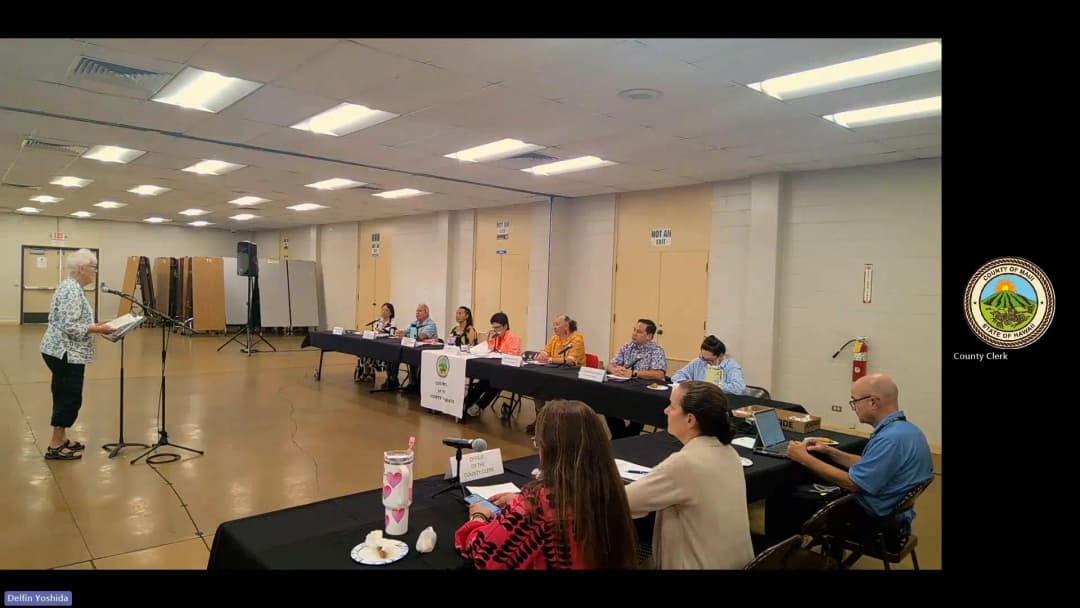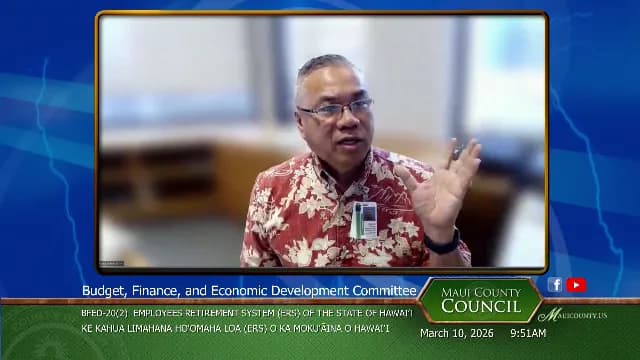
The Budget, Finance, Economic Development Committee met on March 10, 2026, from 9:08 AM to 12:04 PM, with a recess from 10:29 AM to 10:50 AM. The agenda included four items: (1) an update from the Employees' Retirement System (ERS) of the State of Hawaii, (2) Bill 102 and Resolution 25-53 to amend the FY26 budget and authorize acquisition of 0.41 acres at 104A Lower Waiehu Beach Road (Kayehu Bay), (3) administration and management of grants, and (4) the proposed FY27 budget. Public testimony was taken only on the second item. The committee deferred items 2, 3, and 4 to the next meeting on March 17, 2026. Consent Calendar - No consent calendar items were presented. Public Comments & Testimony - Scott Miller (born/raised in Waiehu) opposed the acquisition, stating the property is known as churches Low Yehu and that his Ohana have remains there. He requested a vote no. - Annadal Yahiro (born/raised in Waiehu) read a statement from cousin Charles Mauna Loa Namau Raposo opposing the acquisition. She asserted the property was gifted orally to the LDS church over 50 years ago but never legally transferred via deed; the land was given for worship, not ownership. - Dane Mayo (grandson of Henry Mayo Jr., who recently passed) opposed the acquisition, stating his grandfather spent years fighting the title in court. Mayo claimed the chain of title traces back to a 1938 indenture with Wailuku Sugar Company that did not convey lawful ownership. He requested the council verify clear title before using public funds. - Lala Johnson (Koyinoa of Wa'ehu) opposed the acquisition, pointing out that the preliminary title report (January 31, 2025) mischaracterizes a recorded instrument (Liber 1439, page 282) as a deed when it is actually an indenture (a mutual obligation, not a transfer). She urged the council to pause and verify the original record. - Jocelyn Costa opposed the acquisition, citing burials on the property and that the land is part of Lunalilo lands (foreign to the state). She provided a letter from Dr. Alfred Desias stating such land cannot be transferred, and asked the council to vacate the matter. - Cheryl Hotta (companion of Scott Miller) opposed, stating the property is a living ancestral realm with burial sites and is maintained by the Peohino family heirs. She noted cultural ceremonies are held there. - Kanye Ali Williams (public testified after the last call) argued a Sunshine Law violation because the December 26, 2025 title report and February 2, 2026 correspondence from the Director of Finance were not hyperlinked to the agenda, preventing fully informed testimony. He noted only the January 31, 2025 preliminary report was available. Discussion Items - ERS Update (BFED-20(2)): Calbert Young, executive director of the ERS, presented an update. Key statistics: total membership 162,000; active employees 66,826 (Maui County: 2,720); retirees/beneficiaries 57,000 (Maui County address: 5,100+). Total liability $40 billion, with $25 billion in assets (63.5% funded). Unfunded liability $14.4 billion. Funding period 21 years. Police and fire have a separate 69.8% funded ratio but a longer funding period (24 years). Employer contribution rates: general employees 24% of salary; police/fire 41%. County of Maui pays approximately $65–$67 million annually. Pension spiking: in FY2025, 60 Maui County retirees triggered spiking, costing the county $6.5 million. Young discussed legislative bills: SB 3096 (increase employer contribution for police/fire by 3% to 44%), HB 2358 (ERS membership for elective officers), SB 99 (return-to-work for retirees). Three other return-to-work bills did not survive the March 6 deadline. Young noted that unlike the EUTF, there is no mechanism for employers to make extra contributions to ERS attributable to their own liability. Council members asked about investment returns (7% assumed, portfolio $26 billion, $1.8 billion return last year), underperformance, risk profile, and the state's past raid of ERS funds. Young clarified the state did not take money, but allowed a contribution holiday, which worsened the funded status. - Land Acquisition (BFED-46 & Resolution 25-53): The administration proposed adding $500,000 to the FY26 budget to acquire the parcel at 104A Lower Waiehu Beach Road (TMK 2-3-3-001-034) from the LDS Church, and deleting a prior $1.3 million appropriation for 131 Shaw Street. The property is adjacent to county-owned conservation land (63 acres) managed by Kayehu Bay stewardship. Administration stated the purchase would prevent development and the property would be managed as open space. Public testimony raised serious title disputes: family members claim the land was never legally deeded to the LDS Church, only permitted for worship. Dane Mayo presented documents showing the chain of title traces back to a 1938 indenture, not a deed, and that his family has a superior claim. Lala Johnson noted the preliminary title report mischaracterizes the instrument. The managing director indicated that if the county acquired land later determined to belong to another, the county would hand it over. Council members expressed discomfort with the unclear title, and the administration agreed to meet with the family. The committee voted to defer the item to allow the family to organize documents and the administration to meet with them. - Grants (BFED-20(12)) and Budget (BFED-1): No public testimony was received. The committee deferred both items to the March 17, 2026 meeting. Member Johnson noted he will present survey findings on grantee experiences. The updated budget calendar and list of departments for questioning were provided in Granicus. Key Outcomes - Defeated/Deferred Items: - Bill 102 and Resolution 25-53 (land acquisition) were deferred to a future meeting (likely May or June) after the budget session, pending family document review and administration meeting with the family. - Grants and FY27 budget items were deferred to March 17, 2026. - No votes taken on any consent items or substantive motions. - Next Steps: The committee will continue the ERS update as informational; the EUTF presentation is scheduled for the next meeting. The committee will meet again on March 17, 2026, to address the deferred items and hear the grants survey findings.
Public Meetings - Maui County, Hawaii
Public Meetings - Maui County, HawaiiThe committee met on March 10, 2026, at 1:31 p.m. under the chairmanship of Councilmember Colin Ibatungan to consider and vote on two mayoral appointments: Jackie Takakura as Director of Planning and Maggie Willis as Director of Human Concerns. Both appointments were recommended for approval by the full council after extensive testimony, questioning, and debate. Public Comments & Testimony - On the Planning Director appointment: Nicole Huganen, Sam Small, Christopher Salem, and others testified regarding the 45-foot Nepeele structure (Greg Brown house), alleging it was permitted as an 8-bedroom single-family home but is actually a 12-bedroom duplex with two kitchens, two entrances, and two electrical systems. Testifiers claimed the permit was obtained using false information and that the previous planning director handled compliance behind closed doors rather than issuing a public notice of violation. Christopher Salem stated that the county will receive $169,000 in back taxes as a result of his investigation. One testifier, J.C. Law, expressed broad support for Ms. Takakura, noting he saw her in action at a planning meeting and thought she did a "pretty good job." - On the Human Concerns Director appointment: Nicole Huganen (Maui Rapid Response) expressed support for Maggie Willis, noting her vision aligns with community-based housing justice. Lisa Darcy (Share Your Mana) expressed caution, stating that Maui is built on relationships and that coming from the mainland presents a hurdle; she questioned how the nominee would address the county’s constitutional harm to unhoused people. Kahala Johnson, Richard Bloom (former Santa Monica mayor), Leepi Shimkada (L.A. County Department of Homeless Services), Moe Kava Akoa (Holomua Outreach), and Julie DeRose all spoke in strong support of Ms. Willis, emphasizing her collaborative leadership, integrity, and experience. One testifier from the Royal House of Hawaii called for return of land to Native Hawaiians as the greatest human concern. Discussion Items - Appointment of Jackie Takakura as Planning Director: Mayor Bissen introduced Ms. Takakura, highlighting her 27-year county career, including roles as deputy planning director and long-range division program administrator. Ms. Takakura described her background and priorities: expediting Lahaina rebuilding permits, advancing housing reforms (e.g., allowing two ADUs in residential/rural districts), completing the South Maui Community Plan, updating Title 19, and improving interdepartmental coordination. Councilmembers questioned her on: - How she would balance the director’s approval authority with community input (she said she would rely on staff expertise and consult with the mayor’s office and corporation counsel for contentious items). - Goals for the department (finishing community plans, updating land use inventory, continuing Title 19 updates). - Measuring success: "getting these projects done" – e.g., resolutions approved, community plan milestones reached. - How she would work with other departments (regular meetings already occurring with water, public works, OEV resources). - The recovery coordination directive (RCD 6) that moved historic district permits from commission to administrative review; she acknowledged the Cultural Resources Commission had not yet been formally briefed on the directive. She defined "like for like" as same use, with up to 10% change allowed. - Her interpretation of the wetlands overlay map (supportive of further discussion). - The Greg Brown house: said no open violations currently exist; if a complaint is filed, the department will investigate. - Housing affordability: freeing up zoning districts, expediting infrastructure permitting, working with DHHL. - Appointment of Maggie Willis as Human Concerns Director: Mayor Bissen acknowledged concerns about Willis not being local but argued that homelessness requires specialized expertise. Managing Director Nishita noted a waiver of HRS Section 78-1 (residency requirement) was submitted because of the position’s highly specialized nature. Ms. Willis described her 20 years of experience designing homelessness and housing programs, including diversion, multi-use facilities, and benefits advocacy. She committed to: - Developing a strategic plan for homelessness with the community. - Strengthening collaboration across service providers and between government and grassroots organizations. - Prioritizing recovery, including the Safe Places to Park program. - Ensuring contracts measure outcomes, not just presence. - Leaning on OEV Resources for culturally grounded approaches. Councilmembers questioned her on: - How she would verify outreach contractors are serving the population (outcome-based accountability, not just tracking field time). - Bill 11 (regulating sweeps): she expressed concern that legislation can be too rigid but said she would work with Councilmember Johnson on better approaches. - Housing First model: she said it works for a narrow population and that options are needed. - Her 100-day plan: meeting staff, service providers, and community members to listen before making decisions. - How she would implement indigenous-led approaches (relying on OEV Resources for cultural guidance). Key Outcomes - Resolution 26-38 (Planning Director): The committee voted 9-0 to recommend approval of Jackie Takakura as Planning Director. The motion was made by Vice Chair Hodgins, seconded by Councilmember Cook, and passed unanimously. The appointment moves to the full council. - Resolution 26-39 (Human Concerns Director): The committee voted 8-1 to recommend approval of Maggie Willis as Director of Human Concerns. Chair Ibatungan voted no, citing unresolved concerns over the legal waiver of HRS 78-1. Councilmembers Johnson and Sugimura voted yes "with reservations." The motion was made by Chair Lee, seconded by Councilmember Cook. A non-substantive revision was noted correcting the nominee’s middle initial from T to Y. The appointment moves to the full council. - Executive session: The committee did not go into executive session; Corporation Counsel answered questions on the HRS 78-1 waiver in open session.
The Special Committee on Real Property Tax Reform (RPTR) met on March 6, 2026, at 1:38 PM chaired by Alice Lee. Voting members included Vice Chair Kani Rollins Fernandez, Councilmembers Kownoi Batangan, Gabe Johnson, and Yukile Sugimura. Resource persons included Director of Finance Marcy Martin, Real Property Tax Administrator Carrie Stockwell, and Deputy Corporation Counsel Wigglesworth. Michael Williams (Maui Tomorrow) and Tom Crowley were designated as additional resource persons. The committee addressed four agenda items: a software tool for tax rate calculations, Bill 142 on homeowner and long-term rental exemptions, Bill 37 on workforce housing exemptions, and the disposition of pending bills. Public Comments & Testimony - Luna Hoomoluli testified at the start of the meeting, raising concerns about nonprofit religious organizations using property without maximum community benefit and requested the committee investigate. - Tom Crowley testified multiple times: complimenting the software tool, supporting Bill 142 but raising questions about mid-year filing for exemptions, and expressing caution about Bill 37 (incentivizing development before construction). He also urged the committee to continue its work. - Royal House of Hawaii testified on Bill 142, Bill 37, and the remaining bills, arguing that all real property is royal patent land requiring consent from descendants and that exemptions and decisions are illegal without notification of heirs. Discussion Items RPT-12: Real Property Tax Proposal Calculation Software - Presentation: Michael Williams demonstrated a new online tool allowing real-time adjustment of tier thresholds and tax rates across all 12 property classes to project revenue changes. The tool is free and will be updated with certified assessed values in April. - Discussion: Director Martin and Ms. Stockwell confirmed the tool is 98-99% accurate (appeals cause slight variance) and recommended its use as a starting point during budget deliberations, with final numbers run by the tax department. Members asked about creating new tiers or classes; the tool can accommodate them if legislated. The item was informational and no action was taken; it may be taken up by the Budget Committee. RPTR-7: Bill 142 (Home Exemption and Long-Term Rental Exemption) - Testimony: Tom Crowley supported the intent but asked about mid-year exemption eligibility. The Royal House of Hawaii objected on land rights grounds. - Administration Feedback: Director Martin and Ms. Stockwell reviewed the bill and its amended version (CD1, posted as an ASF by Member Paulton) and expressed satisfaction. - Committee Action: A motion to recommend passage of Bill 142 as amended (CD1) passed unanimously (5-0) after an amendment to adopt the ASF was approved 5-0. RPTR-18: Bill 37 (Workforce Housing Exemption) - Discussion: Chair Lee explained the bill originated to assist first-time buyers of affordable units who face high non-owner occupied taxes due to timing of purchase. Because the bill is still evolving and has not yet satisfied administration concerns, she recommended referral to the Housing, Land, and Urban Development (HLU) Committee for further work on affordable housing aspects. - Action: No objections; the bill was referred to HLU. Remaining Pending Bills - The committee considered eight bills: 110 (ʻĀina Kupuna), 112 (golf courses), 114 (non-taxable property), 143 (vacant residential), 144 (wildfire relief extension), 145 (upcountry water priority list), 146 (home exemption deadlines), and 181 (increasing exemption amounts). - Testimony: Tom Crowley urged the committee to continue its work and noted a state bill addressing similar issues. The Royal House of Hawaii again objected. - Action: The item was deferred to the next RPTR meeting for a decision on whether to file or refer each bill. Key Outcomes - Bill 142 (Home and Long-Term Rental Exemption): Recommended for passage at first reading as amended (5-0). - Bill 37 (Workforce Housing Exemption): Referred to the HLU Committee. - Software Tool: No formal action; may be used by the Budget Committee during budget session. - Remaining Bills: Deferred to the next RPTR meeting (likely March 20 or 27) for disposition. - Next Meeting: Chair Lee indicated a possible additional meeting before the committee's last day (March 27).
The Budget Finance Economic Development (BFED) committee convened on March 3, 2026, at 9:04 AM to discuss four agenda items: a budget amendment for the Central Maui Wastewater Reclamation Facility (Bill 30), a discussion on repayment to Kamalani Ventures LLC for overpayment (Bill 34), a discussion on conditional language for recovery funding for Imua Family Services and the Native Hawaiian Education Association (Bill 29), and a discussion on procedures for the Fiscal Year 2027 budget. The meeting concluded at 12:05 PM. Public Comments & Testimony - Dean Wong (CEO, Imua Family Services) testified in support of Bill 29, explaining that $758,973 is needed to replenish donor funds spent on off-site infrastructure improvements required for permits for the Imua Inclusion Preschool. He noted the project has been in permit processing for five years, with unforeseen costs including replacing a sewer line, adding fire hydrants and manholes, and filling a hollow street. - Remy Mitchell (Director of Housing) testified on Bill 34, explaining that Kamalani Ventures LLC overpaid the county $234,050 due to a miscalculation: the developer paid based on 170 workforce housing units built but the minimum requirement was 115 units. Only 30 units were sold as workforce housing, leading to a refund request for the overpayment on 55 units. - James Langford testified on Bill 30, expressing interest in the county’s planned RFP for grant software and noting he had previously submitted work on grant software. - Tom Crowley testified against Bill 34, arguing that Kamalani condos failed to provide affordable housing, with only 30 units sold as deed-restricted workforce housing. He criticized the developer for mortgage steering and urged the county to ensure no affordable housing credits were issued from the project. - A testifier (name not given) at the end of the meeting advocated for Hawaii to issue its own currency and not invest in U.S. Treasury bonds. Discussion Items Bill 30 – Amendment to FY26 Budget: Central Maui Wastewater Reclamation Facility ($3.5 million) - The bill would increase general fund carryover savings by $3.5 million and transfer the amount to the General Excise Tax (GET) fund to cover a state grant that lapsed in June 2024. The state had appropriated $3.5 million in July 2021 for the design phase, but due to miscommunication and staff turnover, the funds were not obligated in time and lapsed. - Budget Director Leslie Milner explained that the county has since improved its grant tracking process, added a grant oversight employee, and is working on an RFP for grant management software. - Director John Agawa (DEM) noted the project is on track with 60% design completed, aiming for operational in late 2029/early 2030. The total design contract is $16.7 million plus $2 million for permitting. - Council concerns: Several members expressed frustration over the lapse but acknowledged the importance of the project. Discussed whether the state’s requested $10.5 million for FY27 could be used to cover the shortfall if pre-award costs are allowable. Bill 34 – Discussion on Repayment to Kamalani Ventures LLC ($234,050) - The proposed repayment corrects an overpayment under Maui County Code Section 2.96 for market-rate units sold without deed restrictions. Kamalani Ventures paid $675,700 in 2018-2019, but the department determined only $441,650 was owed. - Director Mitchell detailed the calculation: the developer was required to build 115 workforce units but built 170. They sold 30 as workforce, leaving 85 required units sold at market. However, the developer mistakenly paid for 140 units (170 minus 30). The overpayment on 55 units resulted in the $234,050 refund. - Council members strongly criticized the developer for mortgage steering and poor outcomes—only 30 workforce units sold. Members expressed reluctance but acknowledged the refund is required by code. Councilmember Rollins Fernandes stated she would not support the bill at final reading. - This item was a 7B discussion only; no vote taken. Bill 29 – Discussion on Recovery Funding for Imua Family Services ($758,973) and Native Hawaiian Education Association ($390,000) - Office of Recovery Administrator Helene Kawa explained that $390,000 would support renovations at the Keola Ho’ola Community Resiliency Center in Lahaina, a leased space (three-year lease ending August 2027, with renewal options). The center provides behavioral health services for wildfire survivors. Construction is nearly complete but needs additional funds. - $758,973 for Imua Family Services covers unforeseen off-site infrastructure costs (sewer line, fire hydrants, road repair) required for the preschool building permit. Dean Wong had earlier testified on this. - Council concerns: Councilmember Batangan asked for confirmation that all construction contracts went out for bid, citing prior concerns about a potential sole-source contract. Councilmember Paulton questioned the wisdom of investing in a leased space when improvements become landlord property. Verbal agreement from landlord to extend lease if needed was noted. The item was a 7B discussion; no vote. BFED 1 – Proposed FY27 Budget Process and Procedures - The committee discussed the upcoming budget session schedule, including a standard questionnaire letter to departments. Key dates: questions due March 10 (standard letter), March 27 (for departments appearing April 1, 6, 7), March 30 (other chamber departments), and April 2 (excused departments). District residency meetings: Upcountry (April 1), Makawao/Haiku/Pāʻia (April 2), East Maui (April 6), South Maui (April 8), West Maui (April 9), Molokaʻi (April 13), Lānaʻi (April 15), and Central Maui public hearing (April 17). - Members provided input on which departments should appear before the committee: Emergency Management, Planning, and Personnel Services were suggested. The list is flexible. Member Johnson requested a master list of grants executed vs. held up. The calendar will be updated. Key Outcomes - Bill 30: Motion to recommend passage on first reading (with non-substantive revisions) carried by voice vote. (Members present: Vice Chair Batangan, Cook, Johnson, Lee, Paltin, Rollins Fernandes, Selenisi; absent: none noted.) The bill will proceed to full council. - Bill 34: No action taken; will be on the council’s Friday agenda for second reading. Committee discussion highlighted systemic issues with the affordable housing code. - Bill 29: No action taken; deferred for final council reading. Members requested written confirmation on bidding compliance for Keola Ho’ola construction and a status update. - FY27 Budget Process: Committee agreed to proceed with the proposed schedule. Departments will receive a standard questionnaire letter by March 10. Members to submit additional questions to BFED staff by March 10 for the standard letter, and by specified dates for department-specific questions. District meeting dates were confirmed.
The city council convened on February 12, 2026, at 19:30 UTC to address routine approvals, public concerns, and several key policy proposals regarding urban development and municipal budgeting. Consent Calendar - Routine items including budget amendments for the public works department and minutes from the January 28th meeting were approved unanimously without discussion. Public Comments & Testimony -Residents from the Northside district expressed strong opposition to a proposed rezoning application near their neighborhood, citing concerns over increased traffic congestion and strain on local schools. They requested a mandatory traffic impact study be completed before any further approval. - A local business owner representing the Downtown Merchants Association voiced full support for a small business tax incentive program, arguing it is essential for post-pandemic recovery. - A concerned citizen raised objections to the proposed zoning variance for the Westgate commercial plaza, stating the project's height exceeds the approved community vision. Discussion Items - Northside Rezoning Proposal: Council members deliberated on the request to rezone a 5-acre parcel from residential to mixed-use. The Planning Director presented a report noting the site is currently zoned for low-density housing but requested high-density mixed-use. - Downtown Tax Incentives Debate: The council reviewed a draft ordinance for the new tax incentive program. Several members questioned the long-term revenue loss, while others emphasized the potential for new employment opportunities. - Westgate Variance Request: The hearing addressed the height variance request for the Westgate plaza. Staff recommended approval with conditions, but the Planning Commission had previously recommended denial due to height discrepancies. Key Outcomes - The Council voted 5-2 to deny the Northside rezoning request pending the completion of a full traffic impact study. Councilor Johnson and Councilor Lee dissented, arguing the study would delay necessary housing development. - A motion to postpone the vote on the Downtown Merchants tax incentive program was passed; it will be referred to a subcommittee for further revenue modeling analysis with a report due by March 5th, 2026. - The Westgate commercial plaza variance request was deferred indefinitely pending a redesign that reduces building height to comply with the 40-foot limit. - No other items were brought to the floor of the meeting.
February 11, 2026 The Housing, Land Use, and (HLU) Committee of the Maui County Council met on February 11, 2026, at 9:03 AM to discuss and vote on Bill 14 (2026), which clarifies the priority order for the sale of residential workforce housing units. The bill reorders the sale priority to residents first, then the county, and then non-residents, and reinserts omitted documentation requirements. Director of Housing Remy Mitchell testified that the department supports the bill. The committee voted unanimously (6 ayes, 3 excused) to recommend passage on first reading. Public Comments & Testimony - One testifier, Luna Omolu No Helani, spoke in Hawaiian, thanking the Council Services office for improved agendas and referencing the residential workforce housing code. He reserved the remainder of his time for the Hawaiian people. No other oral testimony was offered; written testimony continued to be accepted. Discussion Items - Bill 14 (2026) – Residential Workforce Housing Priority Order - Chair opened discussion; Director Mitchell confirmed the Department of Housing is fine with the bill language. - Councilmember Cook asked how the county tracks the 90-day periods when units shift between AMI categories and the county’s purchase opportunity. Mitchell described ongoing communication between the department and developers. - Councilmember Rollins Fernandez questioned whether the department should be required to submit a final report to the council on all workforce housing unit sales for public record and long-term tracking. She expressed concern about data accessibility and deed restriction expirations. Mitchell stated he would not oppose more disclosure but noted the burden of existing reporting requirements. He mentioned the department’s efforts to build a housing tracking website and database, but acknowledged it is currently discretionary. Mitchell agreed to work with Rollins Fernandez on a future bill requiring such tracking. - No further questions were raised. Key Outcomes - Motion and Vote: Councilmember Cook moved to recommend passage on first reading of Bill 14 (2026), incorporating any non-substantive revisions. Councilmember Paulton seconded. The motion passed with 6 ayes (Councilmembers present) and 3 excused (Councilmembers Patangan, Johnson, and Sugi Mura – note: the transcript listed Bakangan and Johnson, but was corrected; exact excused members were not fully repeated). The meeting adjourned at 9:25 AM.
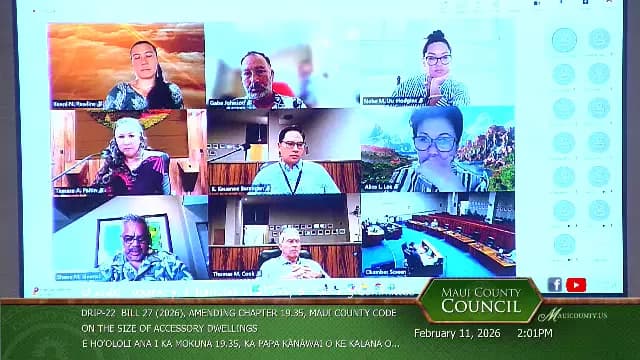
The Disaster Recovery, International Affairs, and Planning Committee of the Maui County Council met on February 11, 2026, to consider Bill 27 2026, which amends Chapter 19.35 of the Maui County Code to standardize the allowable size of accessory dwelling units (ADUs) on lots smaller than half an acre. The committee unanimously approved the bill on first reading with a CD1 amendment. Public Comments & Testimony - JC Law, from Haleakala Waacoa Ahupo'a, testified in support of the bill, thanking the chair for a clear presentation and commending the translation of agendas into Olelo Hawaiian. He made no objections. Discussion Items - Bill 27 2026 & CD1 Amendment: The bill standardizes ADU floor area to 500 square feet (covered) and 600 square feet for decks or similar structures (e.g., walkways, patios, lanais). The CD1 version simplified the preamble by removing references to Resolution 25-142 and the 120-day review period expiration, as the Maui Planning Commission had deferred review past the deadline. The Lana‘i and Moloka‘i Planning Commissions recommended approval; the Maui Planning Commission did not submit comments. - Clarifications: Councilmember Batan Gone asked if the CD1 had substantive changes; Chair Paulton and Legislative Attorney Nakata confirmed only formatting and preamble simplifications. Councilmember Cook confirmed that ADUs can be built before the main dwelling, and that setbacks are primarily for privacy and aesthetics, not fire safety. - Status of Related Bills: Chair Paulton updated on Bill 103 (density per 2,500 sq ft), noting she is waiting for a parking bill to be transmitted from the mayor before proceeding. Greg (Planning) noted that a bill implementing Act 39 (mandating two ADUs per residential lot) is being heard by planning commissions this month. Key Outcomes - Motion to replace Bill 27 with CD1 version: Moved by Councilmember Cook, seconded by Councilmember U Hodgins. Passed unanimously (8 ayes, 1 excused – Councilmember Suyimura). - Motion to recommend passage of Bill 27 2026 on first reading (as amended): Moved by Councilmember Cook, seconded by Councilmember U Hodgins. Passed unanimously (8 ayes, 1 excused). - The bill will now proceed to the full council for further consideration.
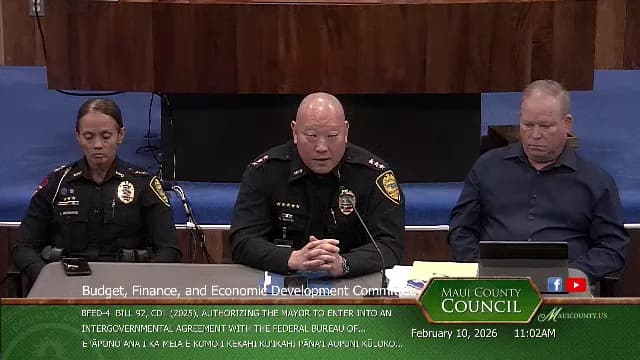
The Budget, Finance, Economic Development (BFED) Committee met on February 10, 2026, at 9:07 AM under Chair Yuki Le Sugimura. The meeting addressed three agenda items: a bill authorizing an intergovernmental agreement with the FBI for a Joint Terrorism Task Force (JTTF), amendments to streamline affordable housing lease approvals, and an update on grant administration. The committee heard extensive public testimony, deliberated on each item, and took the following actions. Public Comments & Testimony - Bill 92 (JTTF Agreement): Over 20 testifiers, many representing Maui Indivisible, spoke in strong opposition. Key points included concerns about federal overreach under the Trump administration, the risk of local police being used for immigration enforcement, the vague definition of domestic terrorism, the financial obligation placed on the county, and the lack of local control. Specific speakers: Jake Carton (Maui Indivisible) urged a no vote and termination of existing contracts; Stephen Biden, Denise LaCosta, Ann Pikately, Dr. Kahala Johnson, Shay Chan Hodges, Celine Laguerre, Reverend Dennis Barger, Lori Tanner, Patricia Pierce, David Yoshida, Dari Wood, Robert Pollock, Lori J, Alice Riddle, Gail Swanson, Kelly King, Lisa Seikai Darcy, Cesar Gaxiola, Torben Jensen, Dick Mayer, and Lala Johnson all testified against Bill 92, citing civil rights, historical parallels to Japanese internment, and fear of militarized policing. A few testifiers (e.g., Cesar Gaxiola) emphasized the fear in immigrant communities. No testifiers spoke in favor of the bill. - Bill 116 (Affordable Housing Leases): Only one testifier, Cesar Gaxiola, spoke in favor, praising the CDBG staff and supporting the bill's intent to expedite leases for kupuna housing. - Grants Administration: No public testimony was received. Discussion Items - Bill 92 CD1 2025 – JTTF Intergovernmental Agreement: Deputy Chief Wade Maeda of MPD stated the department opposes immigration enforcement, has internal orders against profiling, and currently has four part-time officers on the JTTF (with zero dedicated hours). He emphasized that the agreement is for intelligence sharing and terrorism prevention, and that MPD would retain supervisory control. Budget Director Milner confirmed the agreement creates a financial obligation requiring council approval. Corp Counsel clarified that the council cannot direct police operations. After extensive debate, the committee voted to file the bill (8 ayes), which is the procedural equivalent of disapproval. Chair Sugimura stated the committee report will clearly indicate a “no” vote. Councilmember Rollins Fernandez drafted a resolution to also rescind the existing 2007 JTTF agreement. - Bill 116 2024 – Amendments to County Code for Affordable Housing Leases: Director of Housing Mitchell and CDBG Manager Jenkins supported the bill, arguing it removes the need for council approval of individual below-market leases, thereby speeding up housing for kupuna. The committee adopted an amendment (CD1) adding annual reporting requirements for all grants, including taxpayer subsidy justifications. The bill passed unanimously on first reading (6 ayes). - Grant Administration (BFED 20): Deferred to a future March meeting due to time constraints. The chair noted a survey from Councilmember Johnson for nonprofit feedback on grant processes. Key Outcomes - Bill 92 (JTTF): Committee voted 8-0 to recommend filing the bill. This effectively disapproves the agreement and sends a committee report to the full council for its March 6, 2026 meeting. A separate resolution to terminate the existing 2007 JTTF agreement was drafted for future consideration. - Bill 116 (Affordable Housing): Committee voted 6-0 to recommend passage on first reading as amended (CD1). The amendment adds annual financial and compliance reporting. The bill will proceed to the full council. - Grant Administration: Deferred; will be taken up in March 2026. - Next Steps: The full council will consider the committee's recommendations on March 6, 2026. The public may submit written testimony at mauicounty.us/agendas.
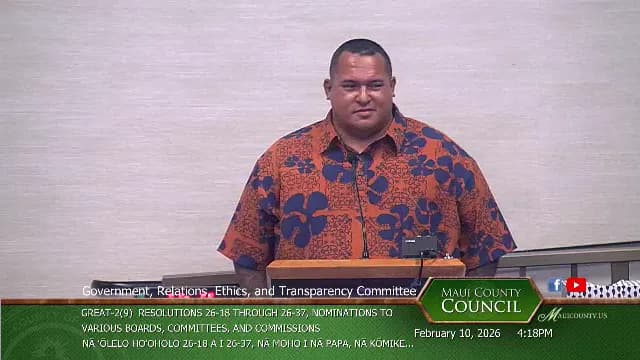
The Government Relations, Ethics and Transparency Committee, chaired by Vice Chair Nohelani Uu Hodgins (acting for Chair Batangan), met on February 10, 2026, to consider the mayor's nominations to 34 positions on various county boards, commissions, and committees (Resolutions 26-18 through 26-34). The meeting began at 1:41 PM and adjourned at 5:13 PM. The council's 30-day deadline to approve or disapprove the nominations is March 2, 2026. No votes were taken; the resolutions will be placed on the February 18, 2026, full council agenda for floor action. Public Comments & Testimony - One individual, JC Law from Kulaoka Wa Choaho, testified at the beginning of the meeting. He expressed gratitude to the committee and staff, noted that he had reviewed the nominations, and specifically supported John Howley Thomas Tomoso (nominee for the Board of Ethics), stating he had met Tomoso at church and described him as “bonus.” No other oral testimony was offered. Discussion Items - Commission on Persons with Disabilities (Resolution 26-30): Nominees Frank Barbosa (new) and Linda Popolo (reappointment, absent). Barbosa, born with a disability, emphasized safety concerns for disabled persons, including dangerous roads, inadequate transportation, and long waits for paratransit. He pledged to attend meetings if transportation is available. Members expressed support, noting his passion and community advocacy. Popolo was praised for her work with the Hayes Foundation and family caregiving. - Animal Control Board (Resolution 26-18): Nominees Wendy Hornak (new) and James Rensberger (reappointment, absent). Hornak, founder of a nonprofit for affordable spay/neuter, described her work with Maui Humane Society and stressed the need for education on animal control issues. She confirmed she could attend meetings. Rensberger was not present; his reappointment was noted. - Board of Ethics (Resolution 26-19): Nominees Brian Tanaka (new) and Johnito “Hawli” Tomoso (new). Tanaka, an injury lawyer, said he had reviewed board minutes and meetings, understands the quasi-judicial role, and can commit to monthly meetings. Tomoso, a retired county employee, priest, and social worker, spoke of his previous service on the Commission on Ethics under Mayor Lingle and his commitment to morality and ethics. Both were well received. - Civil Service Commission (Resolution 26-20): Nominee Sarah Pajimola (reappointment, absent). Members noted her dedication and past service; no questions. - Commission on Children and Youth (Resolution 26-21): Nominees Kaila Kutaka (reappointment) and Romi Medeiros (reappointment). Kutaka, a special education teacher and behavioral health clinician, highlighted her work elevating youth voices and strengthening mandated reporting awareness. Medeiros, from Maui Family Support Services, leads youth drug-prevention programs. Both were supported. - Conservation Planning Committee (Resolution 26-22): Nominee Michelle Lingold (reappointment, absent). Noted as a reappointment; no questions. - Council on Aging (Resolution 26-23): Nominees: reappointees Heather Room Durham (present) and Susan Park (absent); new nominees Belle Cox (present via Teams), King Van Nostrand (present, introduced late), and Monica Rabella (also nominee for Real Property Tax Review Board). Durham, a retired nurse, volunteers at senior centers and works with Hobby Unicode. Cox, a retired naval officer, reviewed the commission's needs assessment. Van Nostrand, executive director of Naho Aloha, stressed listening to seniors and addressing rural transportation and food access. Rabella, a retired CPA, was also heard earlier. All expressed commitment to attendance. - Fire and Public Safety Commission (Resolution 26-24): Nominee Daryl Periboro (new). Periboro, a CERT volunteer and mentor, discussed his experience post-Lahaina fire and his willingness to review budgets and oversee MEMA. He pledged to attend monthly meetings. - Housing Advisory Board (Resolution 26-25): Nominee Bill Curtis (reappointment). Curtis, a general contractor, noted the board had not yet met due to lack of quorum and pending policy legislation. He suggested streamlining permitting and pre-approved house plans. Members supported his reappointment. - Independent Nomination Board (Resolution 26-26): Nominees Dwight Burns (reappointment), Gina Gormley (reappointment, absent), and Chad Viella (reappointment). Burns, retired, described the board's intensive interview process and commitment to finding qualified volunteers. Viella, a two-year member, asked for patience as the board gains momentum and noted recruitment efforts at community events. Both were supported. - Lana‘i Planning Commission (Resolution 26-27): Nominee David Leon (new). Leon, a remote worker in food systems, spoke about balancing development with cultural and environmental stewardship. He acknowledged the influence of the island’s majority landowner (Larry Ellison) and expressed interest in ecological solutions over desalination. He committed to learning the Coastal Zone Management Act and sea level rise projections. - Liquor Control Adjudication Board (Resolution 26-28): Nominee Dustin Kaleopu (reappointment). Kaleopu, a Lahaina native, said he learned about quasi-judicial processes and public health. No questions. - Liquor Control Commission (Resolution 26-29): Nominee Christine Kahialani Silva (new). Silva, a former bartender and military spouse, expressed willingness to learn about liquor license applications and streamline processes. She supports investigating Narcan in establishments. Members appreciated her industry perspective. - Maui Redevelopment Agency (MRA) (Resolution 26-31): Nominee Stanford Linus (reappointment). Linus, a fifth-generation Kanaka Maoli, emphasized preserving culture, especially in the historic Wailuku district. He opposed height increases beyond coconut tree level. Members supported his reappointment. - Maui Planning Commission (Resolution 26-32): Nominees Kiaka Kamae (new) and Prentice Ray Noel Patel (new). Kamae, a drywall taper and union representative, stressed balance between development and cultural stewardship, acknowledging the need for housing while protecting burial sites. Patel, a field representative for carpenters, said he would bring a middle-ground perspective and is willing to obtain an ethics advisory opinion. Both were questioned about potential conflicts of interest and their lack of prior board service. - Police Commission (Resolution 26-33): Nominee Shakley Rafeto (new). Rafeto, a retired circuit court judge and drug court founder, provided detailed data on 2025 arrests (9,760 total, including 2 murders, 109 sexual assaults, 448 aggravated assaults). He highlighted the commission's need for an independent investigator and his ability to contribute to oversight and public trust. Members strongly supported his nomination. - Public Works Commission (Resolution 26-34): Nominees Jeremy Delos Reyes (reappointment, absent) and Brian Onodera (new). Onodera, a mechanical engineer at the Daniel K. Inouye Solar Telescope, committed to attending meetings and cited his professional engineering license and Ka Ipu Kukui program experience. Members supported his nomination. - Real Property Tax Review Board (Resolution 26-35): Nominee Monica Rabella (new). Rabella, a retired CPA with 40 years of tax experience, said she was familiar with the board's appeal process. She also serves on the Council on Aging. She committed to attendance. - Salary Commission (Resolution 26-36): Nominee Kavella Schultz (new). Schultz, general manager of Green Kachamano Center, noted the salary commission was not her first choice but she agreed to serve. Members supported her. Key Outcomes - No votes were taken during the committee meeting. All resolutions were deferred to the February 18, 2026, full council meeting for floor action. The council's statutory deadline to act on the nominations is March 2, 2026. - The committee noted that several nominees were absent, including Linda Popolo, James Rensberger, Sarah Pajimola, Michelle Lingold, Susan Park (Council on Aging), Gina Gormley, and Jeremy Delos Reyes. Their reappointments will be considered by the full council. - Staff (Yukari Murakami) is to follow up on inconsistent application versions and missing confidential forms; members may schedule appointments to review redacted information. - The committee will also address the need for advisory opinions from the Board of Ethics for nominees with potential conflicts (e.g., Kiaka Kamae and Prentice Patel). - The meeting was adjourned at 5:13 PM.
This public hearing was held on February 3, 2026, to receive testimony on Bill 183, an ordinance amending Ordinance 5334 (2021) related to building heights for new construction behind the National Historic Landmark District in West Maui. Seven council members were present, with two excused. Only one person signed up to testify, and public testimony was closed after no additional testifiers came forward.