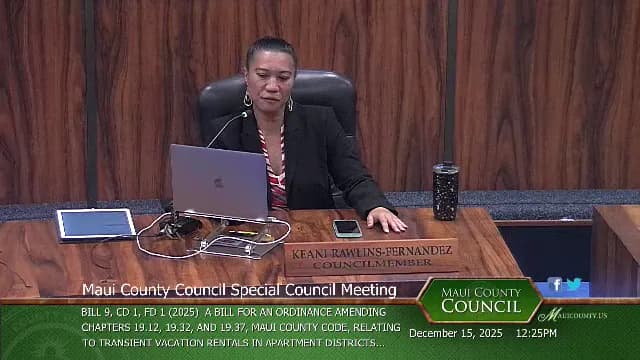
On December 15, 2025, the Maui County Council convened a special meeting to consider Bill 9, CD1, FD1, 2025, an ordinance amending the Maui County Code to phase out transient vacation rentals (TVRs) in apartment districts. Despite significant debate regarding economic risks, housing outcomes, and the implementation of temporary measures, the Council voted 5-3 to pass the bill on its second and final reading. Consent Calendar - No items listed in the consent calendar; the meeting proceeded directly to discussion of major agenda items. Public Comments & Testimony - Community Testifiers: Multiple public witnesses and community organizers (including Elikyokona, Ruides, Makocona, Lazo, and Regal) testified in support of the bill, arguing that TVRs have commodified housing, driven up prices, and displaced generational residents. They emphasized that the majority of TVR owners are non-resident investors and that the bill is necessary to "reclaim housing" and "reign in tourism." - Labor Representatives: Members of the International Longshore and Warehouse Union (ILW) testified in support, stating that hotel workers need stable housing and that the current system prioritizes profits over local livelihoods. - Economic Analysts/Advisors: Testifiers cited YouHeron analysis projecting a loss of approximately $65 million annually in real property taxes and $15 million in general excise/transit accommodation taxes. They argued the bill creates fiscal risk without a guaranteed pathway to converting units into long-term housing. - Property Owners/Business Interests: Some testifiers, including owners of small-scale businesses, expressed concern that the bill would negatively impact their operations and the local tourism economy without adequate support mechanisms. Discussion Items - Councilmember Wu Hodgens: Expressed opposition to Bill 9, citing the lack of a detailed transition plan and the absence of the Temporary Investigative Group's (TIG) recommendations within the bill itself. She highlighted that the bill could result in significant job losses and revenue declines while failing to guarantee the creation of affordable housing, noting that property owners may choose to sell units to developers like BlackRock or leave them vacant rather than convert them. She argued the proposal was incomplete and risky given the current economic recession. - Councilmember Cook: Expressed support for the TIG's recommendations but stated she would vote no on Bill 9 itself because it lacks the implementation mechanisms (such as the TIG's zoning changes) necessary to protect property rights and ensure a viable economic transition. She questioned the logic of passing a bill before establishing the zoning framework, warning that the original intent of producing housing may not be met. - Councilmember Suge Mora: Clarified a public concern regarding potential evictions in FEMA housing in February 2026, stating that this was a rumor and that no final determination for eviction had been made, though it remains under review. - Councilmember Paulton: Expressed full support for the bill, prioritizing "people over profits." He noted that the community wants the measure passed to protect generational residents and that the local desire for housing reform outweighs the uncertainty remaining in West Maui. - Councilmember Johnson: Rised in full support of the historic bill, framing it as a measure for the community and workers over corporate profits. He expressed confidence in the community's resilience and ability to pivot to a new economic age. - Councilmember Rollins Fernandez: Provided a detailed rationale for full support, citing statistics that 94% of units are owned by non-residents and that Maui's TVR density (21%) vastly exceeds that of other global cities. She presented evidence of artificially inflated housing prices and argued that the bill corrects systemic issues where tourism profits flow out of the county while residents face high costs, emphasizing that "profits are replaceable, but generational communities are not." - Councilmember Senency: Expressed support for the bill, acknowledging the economic risk but noting that Maui County still holds the largest number of legal short-term rentals in Hawaii. He stated the bill addresses only 13% of existing units and supports future legislation to create new zoning to address the remaining rentals. - Councilmember Cook (on TIG Recommendations): Clarified for the legislative record that the TIG recommendations are not a "carve-out" within the bill text themselves, but rather a separate zoning process that requires future planning commission approval. She reiterated that this process is not guaranteed. - Corporation Council (Victoria Takayesu) & Legislative Staff: Clarified that any zoning changes resulting from the TIG process would require a new public process and future council action, confirming that no automatic carve-outs exist in the current bill. Key Outcomes - Motion to Pass: Councilmember Wu Hodgens moved to pass Bill 9, CD1, FD1, 2025. The motion was seconded by Councilmember Paulton. - Vote Result: The bill passed on a 5-3 vote. - Ayes: Paulton, Johnson, Rollins Fernandez, Wu Hodgens, Senency. - Noes: Suge Mora, Cook, Chair Alice Lee. - Legislation Provisions: The ordinance disallows transient vacation rental uses in apartment districts. - Phase-out date: January 1, 2029, for the West Maui Community Plan Area. - Phase-out date: January 1, 2031, for the rest of the County. - Next Steps: The Council established a Temporary Investigative Group (TIG) to develop recommendations for phasing out the remaining allowed units, though the Council noted these recommendations were not included in the current bill text. Future zoning changes (H3/H4) would require separate public processes and approval by future Planning Commissions and Councils. - Adjournment: The meeting was adjourned following the vote.
Public Meetings - Maui County, Hawaii
Public Meetings - Maui County, HawaiiThe Special Committee on Real Property Tax Reform convened on December 9, 2025, to deliberate on four bills concerning home exemptions, long-term rental exemptions, and deadlines for affordable housing applicants. The committee heard testimony regarding the adequacy of current exemptions to stimulate affordable housing, the legality of property ownership titles in Hawaii, and the technical challenges of administering mid-year tax adjustments. While two bills received strong support and were passed, others were deferred to allow for further administrative review and data collection. Consent Calendar - No specific consent calendar items were listed in the transcript; the meeting proceeded directly to public testimony and discussion items. Public Comments & Testimony - Alan Lloyd (on behalf of Maui Democratic Socialists and Maui Tenant and Workers Association): - Expressed concern that the $100,000 exemption in Bill 168 is insufficient to incentivize landlords to lower rents to 70% of Fair Market Rent (FMR), noting that landlords could potentially earn more income without claiming the exemption. Proposed that landlords should be required to participate in the program, as voluntary participation has proven historically insufficient (citing the 6% participation rate in the Lahaina Fire Survivor exemption program). - Supported the amended version of Bill 168 regarding the affordable long-term rental section but proposed a total exemption for non-owner occupied properties renting at 70% of FMR and owner-occupied properties, regardless of property value ($500,000 vs $400,000 thresholds). - Opposed Bill 181, arguing it does not provide sufficient incentive for affordable rentals compared to Bill 168 and lacks language regarding rent certification or a deadline for landlords to state rent amounts. - Jonathan Helton (Grassroot Institute of Hawaii): - Expressed full support for Bill 181, stating the proposed increases mirror the 28% increase in assessed values for homeowner tax classes and over 50% for long-term rental classes since previous adjustments, aiming to provide relief from inflation-adjusted tax bills. - Royal House of Hawaii (Testifier representing descendants of Royal Patented Lands): - Stated a strong position that current property tax exemptions are illegal because non-descendants do not hold clear title to land under the Royal Patent system (referencing Hawaii Revised Statute 172-11). - Argued that all exemptions filed by non-descendants constitute fraud on an international level and demanded that lands be returned to the descendants of the Royal Patented Lands. - Anonymous Gallery Testifier: - Questioned why religious organizations (citing 501(c)(3) status) claim property tax exemptions since 1893, asking for a calculation of the revenue lost and a proposal to charge churches a "fair share" using mechanisms similar to federal gaming compacts. - Alleged that some religious entities, specifically the Salvation Army, were using county resources during trespassing incidents and raised questions about their exemption status. - Tom Crowley: - Highlighted the hardship affordable housing occupants face when delayed by external factors (permits, inspections), causing them to miss the December 31 deadline and face non-owner-occupied rates for a full year. Proposed granting the Board of Tax Review the authority to grant exemptions after the fact for valid claims. - Supported Bill 181 but noted that increasing exemptions disproportionately benefits higher-value properties due to the progressive tax rate structure. - Expressed concern regarding the administrative feasibility of verifying rents and the limited incentive of a $100,000 exemption increase for owner-occupied properties. Discussion Items - Bill 146 (RPTR 11) - Principal Home Exemption Deadlines: - The Chair highlighted the issue of new affordable housing buyers being charged non-owner-occupied rates for up to 12 months due to construction delays preventing them from meeting the December 31 application deadline. Suggested that exemptions should be pre-identified for affordable workforce housing. - Director of Finance Mara Martin indicated the department lacks the software to perform mid-year assessment changes due to shared software with the four counties that uses a July 1 lien date. She suggested a half-year exemption as a potential solution, similar to the Big Island, and proposed assessing properties as of January 1 and taxing them as of July 1 at an affordable tax rate. - Members discussed granting the Board of Tax Review the power to override strict deadlines, but Corporate Counsel and Chair Lee raised concerns about the legal implications and the potential for non-uniform enforcement. The committee agreed to defer the item. - Bill 142 (RPTR 7) - Home and Long-Term Rental Exemption Adjustments: - The bill proposes a "half-year exemption" allowing for mid-year adjustments to tax classifications. Director Martin expressed concern about the administrative burden and suggested piloting the program with just the home exemption first before adding the long-term rental exemption. - Member Paulton explained that the 10-year residency requirement in the draft was intended to prioritize existing local residents over new arrivals taking housing. Member Johnson supported a shorter (5-year) timeline to match existing circuit breaker programs. - The committee deferred the item to refine qualifying language and allow time to implement the half-year exemption concept. - Bill 168 (RPTR 16) - Affordable Long-Term Rental Exemption: - Vice Chair Sugimura proposed a new section creating a $400,000 exemption for properties renting at 70% or less of HUD Fair Market Rent (FMR), with a combined $500,000 exemption for owner-occupied units. The program was proposed to start in Fiscal Year 2028. - Members discussed the potential financial impact, with Director Martin estimating the cost to be roughly $1.18 million annually if all current long-term rental participants adopted the lower rent standard, a figure considered manageable. - The bill was amended to remove sections that would have increased the standard long-term rental exemption, focusing strictly on the new affordable tier. The committee voted to recommend passage. - Bill 181 (RPTR 17) - Increasing Home and Long-Term Rental Exemnptions: - The Director of Finance noted that property values are currently stagnant or decreasing, suggesting that increasing exemptions this year might be unnecessary compared to the previous year's value surges. Member Paulton emphasized that increasing exemptions must be done by the end of January to be effective for the upcoming assessment season, as rates can be adjusted later. - Due to the lack of finalized assessment data, the committee decided to defer the item to gather more information on actual valuations before proceeding. Key Outcomes - Bill 146 (RPTR 11): Deferred indefinitely until a solution is found to address mid-year assessment limitations and prevent affordable housing buyers from facing full-year non-owner-occupied tax liabilities. - Bill 142 (RPTR 7): Deferred to allow for the refinement of qualifying criteria (potentially adopting a 5-year residency lookback) and further discussion on the administrative feasibility of the half-year exemption. - Bill 168 (RPTR 16): Recommended for passage (First Reading) after amendment to establish a new tax exemption ($400,000 for affordable rentals, $500,000 combined) for properties renting at 70% of FMR, effective for Fiscal Year 2028. The committee also agreed to review the potential for increasing the exemption amount during the 2026 application period. - Bill 181 (RPTR 17): Deferred to await finalized assessment data for the current year to determine if an exemption increase is warranted or if rate adjustments should be pursued instead. - General Directive: The committee instructed the Department of Finance to provide data on the potential revenue impact of the affordable long-term rental exemption and to explore solutions for mid-year classification changes without compromising software compatibility.
The Maui County Council convened on December 5, 2025, establishing a quorum with six voting members present and one excused. The meeting featured opening remarks from Councilmember Tom Cook focusing on themes of faith, hope, and gratitude following recent personal and professional stressors. A ceremonial resolution was postponed due to a recent accident. The council reviewed committee reports regarding tax reforms, water infrastructure, and economic development zones, while addressing public concerns about neighborhood safety and the commercial recovery of Lahaina. Consent Calendar - The ceremonial resolution for a donation was postponed due to an accident. Public Comments & Testimony - Bobby Kalavi (residence of 26 Ayahi Place) expressed safety concerns regarding a blind turn on Ayahi Place, noting that large dump trailers left parking on the grass shoulder obstruct visibility and nearly caused a collision with a county rubbish truck. He requested a review of the area for safety improvements. Councilmember Rollins Fernandez suggested physical obstructions, such as stones, as a potential solution, though Kalavi had not personally spoken to the neighbor about parking. - Marcy Martin (Director of Finance) testified in full support of Bill 171 to extend property tax relief for properties damaged by the August 2023 wildfires. She stated the Department of Finance supports the bill as is without amendments and confirmed public outreach would be provided upon passage. - Leslie Milner (Budget Director) provided testimony in support of Bill 179 (additional funding for the Department of Police via Highway Safety Grants) and Bill 180 (funding for Lokahi Pacific for Kulani High School activities). She clarified that the Department would be available to answer administrative questions during deliberation. - Jonathan Hilton (Grassroots Institute of Hawaii) expressed support for the property tax waiver in Bill 171, noting it would assist residents in rebuilding. He stated he was interested in learning about a potential amendment proposed by Councilmember Poulton to ensure the bill's effectiveness. - Jade Rojas Latisi (Director of OED) offered support for CR 25-72, recommending the designation of a proposed enterprise zone for a 20-year period. She highlighted successful community outreach in West Maui and emphasized the urgency of meeting the April 30th state deadline. - McKinley Eads urged the Council to pass Bill 171 but strongly expressed concern that commercial property owners are being "forgotten" and face unique challenges, including regulatory delays and a lack of grants. He stated that without changes, commercial properties may not have certificates of occupancy by 2028. - Tom Crowley expressed support for the real property tax reform committee reports. He supported the "circuit-breaker" program in Bill 170 and the extension of tax relief in Bill 171, though he raised concerns about the administrative implementation of the latter regarding title cleanups versus actual sales. He also expressed support for Bill 169 regarding Community Land Trusts but recommended a simplification where only the building value is taxed for properties owned by trusts. - James Langford testified regarding tax bills, suggesting a software solution on Facebook to mitigate budget shortfalls and referencing specific bill numbers (e.g., Bill 160). He offered to share details for the Council to review. - Unidentified Testifier (appearing late) expressed concern regarding the frequent cancellations of the Cultural Resources Commission and the Housing Solutions committee due to lack of quorum. Additionally, they inquired about the material of water bottles donated in Resolution 25-219, asking if they were made of metal rather than plastic. Discussion Items - Safety on Ayahi Place: Councilmembers discussed adding physical obstructions (stones, balloons) to the no-parking ordinance for Bill 175. Councilmember Poulton suggested consulting Public Works for expert recommendations on obstructions that do not block sightlines further. - Bill 171 (Tax Relief): Councilmember Poulton circulated an amendment to restrict tax relief exemptions for properties sold via warranty deeds after the fire, distinguishing them from "title cleanups" (court-ordered transfers between family members). Director Martin indicated that while restricting new owners is a valid long-term goal, administering such a restriction immediately is difficult; she agreed to provide quarterly updates on the bill's administration. Councilmember Rollins Fernandez confirmed the bill was developed specifically in response to concerns from the commercial property sector. - Bill 169 (Land Trusts): Following testimony from Tom Crowley regarding the complexity of assessing properties with shared equity deed restrictions, Councilmember Rollins Fernandez clarified that the bill brings parity to properties whose deed restrictions are not currently enforced by the county. Director Martin confirmed the ordinance provides adequate guidance for the Real Property Assessment Division to implement the program without necessitating changes to the bill text. - Bill 2522 (Joint Use Development): Councilmember Cook explained that the resolution refers a proposed bill to the Lanai, Maui, and Molokai Planning Commissions to allow adjoining lots to be developed as a single entity, a measure deemed critical for the efficient rebuilding of Lahaina. Key Outcomes - Committee Report 25-83 / Bill 170 (Income-Based Tax Credit): Approved on first reading with 7 ayes; establishes an income-based circuit breaker for qualified homeowners where taxes exceed 2% of household income. - Committee Report 25-84 / Bill 171 (Wildfire Tax Exemption Extension): Approved on first reading with 7 ayes; extends temporary tax exemptions for wildfire-affected properties through June 30, 2028. - Committee Report 25-85 / Bill 169 (Shared Equity Tax Valuation): Approved on first reading with 7 ayes; allows the Director of Finance to consider resale restricted prices when assessing shared equity properties. - Committee Report 25-86 / Bill 160 (Wai 'Ohai Water Initiative): Approved on first reading with 7 ayes; authorizes the mayor to enter intergovernmental agreements for the Wai 'Ohai Fresh Water Initiative. - Resolution 25-219: Adopted with 7 ayes (after amendment); amended to reflect 363 water bottles (corrected from 372) donated by 100%. The bottles were confirmed to be large and metal. - Resolution 25-220: Adopted with 7 ayes; approves the 2026 High East State Association of Counties legislative package for all four counties. - Resolution 25-222: Adopted with 7 ayes; refers the joint use development bill to the planning commissions. - Bill 175: Passed on first reading with 7 ayes; prohibits parking on the west side of Ayahi Place for 175 feet to improve safety. - Bill 179: Passed on first reading with 7 ayes; increases the Department of Police appropriation by $495,000 for Highway Safety Grants. - Bill 180: Passed on first reading with 7 ayes; adds $15,000 for Lokahi Pacific to support Kulani High School activities. - Second and Final Reading: Bills 136, 137, 150, 151, 152, 172, 173, and 174 were approved unanimously on second and final reading with 7 ayes; these bills cover bond issuances, water supply grants, senior housing appropriations, and economic development program adjustments. - Committee Report 25-72: Adopted with 7 ayes; recommends the adoption of Resolution 25-193 (West Maui Enterprise Zone designation). Resolution 25-194 (Maui Countywide) was noted as previously adopted. - Procedural Note: A discrepancy was noted in the transcript regarding the date of the meeting (Councilmember Cook's opening remarks stated December 5th, while the transcript header and some procedural references mentioned December 5th and 8th; the summary reflects the date stated in the spoken opening remarks). - Next Steps: The Finance Director will provide quarterly updates on the administration of Bill 171. Public Works will be consulted regarding physical safety obstructions for Bill 175.
The Committee on Water, Environment, and Climate Action (WEC) convened to discuss two critical information-only items regarding the reviving of the Naulu Cloud Bridge and the implementation of aquifer mapping on Maui. The meeting featured extensive presentations from cultural practitioners, restoration experts, and scientists, alongside comments from county department directors. While no legislative action was taken, the council members expressed strong support for including both initiatives in the upcoming budget priorities, emphasizing the need for significant funding to restore watersheds and secure sustainable water resources. Consent Calendar - No routine approvals or unanimous actions were recorded for this information-only meeting. Public Comments & Testimony - Royal House of Hawaii: Expressed concern that land descendants and holders under royal patents for the area were not contacted regarding the Naulu Cloud Bridge project. They questioned the status of title changes or land sales under Hawaii Revised Statute 172-11, which mandates that lands be returned to descendants. The speaker noted that many descendants in the Ahopaka area had not been contacted. - Hina Newbull (Owke Ohina Pool Mohalan): Expressed strong support for the Naulu Cloud Bridge project. Mr. Newbull argued that restoration work is culturally aligned and necessary to combat desertification spreading across Hawaii. He clarified that desalination is not a solution to desertification; rather, large-scale restoration of a green corridor and the cloud bridge is required to draw moisture and hold the land. They emphasized that rebuilding the forest is the only method to bring fresh water back into the hydrologic system. - Robin Knox: Expressed full support for aquifer mapping, modeling, and monitoring. Ms. Knox stated that actions without knowledge are ill-advised and supported expanding the study island-wide, noting South Maui's over-pumped wells and limited sustainable yield. They advocated for proactive management over reactive measures and supported landscape-scale nature-based solutions as the only method to increase fresh water. - JC Law (Royal House of Hawaii): Re-joined the call to express interest in the Naulu Cloud Bridge project despite technical difficulties. They welcomed the Royal House of Hawaii's testimony and the council's consideration of the project. - James Langford: Supported the presentation's information, noting that he posted data on smaller-scale water production and grant opportunities (USGAP, CDVG) to help fund projects. He suggested that these smaller multiples with matching funds could help honor existing Hawaiian needs. - Richard Kikivi: Expressed support for the reforestation and restoration of Kaikinui. As a former manager of the Nakula Natural Area Reserve, they shared personal experience of the transformation from grassland to forest, calling the initiative a "missing link" for the cloud bridge. Discussion Items Agenda Item 1: Reviving the Naulu Cloud Bridge - Presenters: - Andrea Buckman (Uhivai O Haleakala): Highlighted the collaborative effort with landowners, nonprofits, and state agencies to restore Leeward Haleakala forests. She emphasized the scientific and cultural necessity of reconnecting forested areas from the mountain to the coastline across Kahoolawe to re-establish the Naulu cloud bridge. She detailed the high costs of the work ($30,000 per camping trip for a crew of six, including helicopter time, seedlings, and maintenance) and the need for stable funding and long-term leases for community partners like Akua Poe. - CJ Elizarez (Protect Kahoolawe Ohana): Described the cultural significance of the cloud bridge as a connection between Haleakala and Kahoolawe, noting that the "Naulu" is a specific part of the larger "Kaleena Ulu" cloud system. He emphasized that the restoration work is about bridging organizations and people, not just the sky. - Dr. Jonathan Price (University of Hawaii): Provided scientific context on climate change and rainfall patterns, noting the extreme dryness of the area and the reliance on cloud cover (fog drip) for water resources. He expressed commitment to partnerships to use this data to hone restoration efforts. - Paul Higashino (Kahoolawe Island Reserve Commission): Discussed the history of Kahoolawe, the impact of invasive animals (goats, sheep, cattle, and deer), and the challenge of hardpan soil that prevents digging. He noted the presence of unexploded ordinances (UXO) which limits digging but supports native planting techniques that do not require excavation (e.g., rock piles). - Alohi Farm (Kaohao O Kahiki Nui): Shared the community's perspective as independent homesteaders in the Kahiki Nui Moku. They detailed a fog drip project to collect water and their work on fire mitigation corridors, expressing a commitment to restore their Moku through both cultural and western lenses. - Akua Poe (Poe Brothers): Emphasized the immediate need for resources (water, electricity, greenhouse space, and funding) to propagate and plant native trees at scale, stating that the goal is achievable through collaboration. - Lance DeSilva (DLNR): Noted that the restoration work complements the Department of Environmental Management's climate action resiliency plan and expressed support for integrating traditional Hawaiian knowledge with science. - Cecil Powell (DEM): Confirmed the department's readiness to partner and support the initiative through sustainability grants. - Jordan Hart (Office of Recovery): Linked the project to the Lahaina Long-Term Recovery Plan, specifically regarding revegetation in the Kula and Lahaina areas. - Director Molitao (OEV): Suggested using traditional chants and oratory as a roadmap for restoration, advocating for a holistic approach looking both up from the mountain and down from the macai (coast). - Director Stuffelbean (Water Supply): Expressed support for the project as a complement to watershed protection work, noting that 4% of the water supply budget goes to watershed restoration, though this area currently has no direct nexus to existing supplies. - Council Member Responses: - Vice Chair Senensi: Expressed stoked enthusiasm, noting that conservation work is a big part of Maui Nui identity. They inquired about funding for Kahoolawe cleanup, confirming that while there is no active clearance funding, current staff are trained to handle potential UXO issues. - Councilmember Cook: Expressed strong support, describing the meeting as the most pleasant and positive in a long time. He advocated for more before-and-after photos to capture community imagination and mentioned his own experience with flood mitigation and water retention projects. - Councilmember Paulton: Asked clarifying questions regarding the fog drip project's water collection potential (claimed 2,000 gallons/day on optimal days, effective at 4,000-6,000 feet elevation) and the certification process for harvested venison. They inquired about the constant presence on Kahoolawe, noting that current funding allows for about 400-500 volunteers a year rather than the previous 800-1,000. - Councilmember Hodgins: Expressed excitement about the budget priority inclusion and appreciation for the cultural and scientific integration. Agenda Item 2: Aquifer Mapping and Long-term Monitoring of Water Resources on Maui - Presenter: Dr. John Haley (San Diego Supercomputer Center/Scripps Institution of Oceanography) presented on the Airborne Electromagnetic (AEM) imaging project. - Key Points: - Problem: West Maui faces a crisis of overpumping, with declining water quantity and quality (saltwater intrusion). Current well data is insufficient to understand the complex, heterogeneous volcanic aquifer structure. - Solution: Use a helicopter-borne AEM instrument to map the subsurface 3D structure of aquifers (fresh vs. salt/brackish water) down to 500 meters. This provides a baseline "MRI" of the aquifers to improve modeling and adaptive management. - Scope & Cost: The initial project focuses on West Maui with a non-recurring cost of $2.5 million for the helicopter flight and a recurring cost of $0.5 million annually for the long-term monitoring program. Future expansion to the rest of Maui would cost an additional $2 million. - Timeline: Helicopter flights planned for 2026, with deliverables and modeling results expected by late 2027, transitioning into long-term operations thereafter. - Goal: To provide sustainable pumping limits, identify best/worst locations for future wells, and standardize a framework for water resource management that can be applied statewide. - Council Member Responses: - Vice Chair Senensi: Clarified that the technology locates fresh vs. salt water and asked about aquifer collapse. Dr. Haley confirmed that subsidence is less likely in volcanic rock compared to sedimentary basins, though seawater intrusion is the primary risk of depletion. - Councilmember Cook: Asked about recharge rates. Dr. Haley explained that shallow recharge occurs in years/decades, while deeper water moves over centuries to millennia. He noted that artificial recharge (detention basins) could work but depends heavily on local geology and elevation. - Councilmember Paulton: Inquired about the role of ground-based surveys (like those by Tom Nance), confirming that the AEM provides a broader, higher-resolution synoptic view that complements rather than replaces ground surveys. They confirmed the 2.5M is for the one-time baseline map, while 0.5M is for monitoring. - Councilmember Hodgins: Expressed support for the budget priority and the scientific approach. Key Outcomes - No Legislative Action: Both items were designated as information-only; no motions, votes, or ordinances were passed during the meeting. - Budget Priorities: Committee Chair Gabe Johnson and Committee Member Noelani U. Hodgins explicitly stated that both the Naulu Cloud Bridge restoration and the Aquifer Mapping project should be included as priorities in the upcoming budget cycle. Chair Johnson indicated they were "planting the seed" for next year's budget discussions. - Council Support: Council members unanimously expressed strong support for the initiatives, acknowledging the high costs ($millions for cloud bridge; $3M+ for aquifer mapping) but agreeing that inaction is more costly in the long run. - Funding Pathways: Discussions highlighted potential funding sources including County budgets, USGAP/CDVG grants, state grants, and federal programs (e.g., WIOA for green jobs, REPI grants). - Next Steps: The committee will wait for the next round of budget deliberations to formally propose these projects as funding priorities. Council members are encouraged to reach out directly to presenters (Andrea Buckman, Dr. John Haley) for further technical discussions.
The Government Relations, Ethics, and Transparency Committee convened on December 3, 2025, to address eight agenda items, including three civil case settlements, the abandonment of an eminent domain action, and two legislative bills. The meeting experienced technical difficulties, including a power outage and internet failure, necessitating a brief recess, followed by lengthy executive sessions for sensitive legal matters. The committee concluded by recommending the approval of three resolutions and the first reading of one bill, while deferring a second bill to gather input from the Commission on Children and Youth regarding the limitations of the Sunshine Law. Consent Calendar - Resolution 25-191: Approved the settlement of $57,664.74 for the Bogard claim regarding property damage from a water main break in Kihei. - Vote: 7 Ayes, 0 Noes, 1 Excuse (Fernandez). - Resolution 25-192: Approved settlement authority for the Nishiama v. Maui Police discrimination case. - Vote: 6 Ayes, 0 Noes, 2 Excuse (Lee, Fernandez). - Resolution 25-196: Approved the settlement of $55,668.18 for the Fale Fale Fine claim regarding a sewer line collapse affecting a commercial gym property. - Vote: 6 Ayes, 0 Noes, 2 Excuse (Lee, Fernandez). - Resolution 25-201: Approved settlement efforts regarding the Comar Maui Properties 1 LLC eminent domain abandonment damages. - Vote: 8 Ayes, 0 Noes. Public Comments & Testimony - Tracy Long Wakua Hopua: Expressed regret regarding the police employment discrimination case and offered explicit support for the Maui Police Chief. - Kalanda Oh Luna Hoomolu: Discussed waste management alternatives, specifically advocating for gasification technology over traditional disposal methods. Discussion Items - Resolution 25-191 (Bogard Claim): Members discussed the property's status as a short-term rental and the extent of water damage. Member Pultom inquired about the inclusion of personal property (surfboards) in the valuation. - Resolution 25-192 (Nishiama Claim): The committee entered executive session to discuss the case strategy. In open session, Member Pultom questioned Assistant Chief Okamoto on internal policies regarding the investigation of rumors concerning employee personal lives and potential consequences for those spreading them. - Resolution 25-196 (Fale Fale Fine Claim): Deputy Corporation Council Clifton Song explained the claim involved lost rent and water bills due to a sewer collapse. Member Johnson questioned the significant jump in water bills ($48 to $405) during the repair period. - Resolution 25-201 (Comar Properties): Deputy Corporation Council Christian Tarnstrom explained the county abandoned an eminent domain action for the Lahaina debris site, triggering statutory abandonment damages. Member Pultom questioned the policy implications of abandoning eminent domain before taking possession. - Bill 105-2025 (Alternate Members): The bill was presented to allow alternate members to fill midterm vacancies on boards and commissions. The committee noted this would apply to the HANA Advisory Committee and Public Works boards. - Bill 118-2025 (Commission on Children and Youth): A debate ensued regarding the disbandment of the commission. - Member Pultom: Expressed concern that the Sunshine Law makes the formal commission an "unwieldy beast" that hinders effective work, arguing the original intent (grant distribution) was never fulfilled. - Member Johnson: Expressed full support for retaining the commission, citing their current work on homelessness and youth issues, and suggested expanding membership to include youth aged 14-24. - Member Rollins Fernandez: Suggested deferring the disbandment to consult with the commission members directly to understand if they feel hamstrung by the Sunshine Law and how they might proceed informally. Key Outcomes - Resolution 25-191: Motion to recommend adoption carried (7-0-1). The item moves to Full Council. - Resolution 25-192: Motion to recommend adoption carried (6-0-2). The item moves to Full Council. - Resolution 25-196: Motion to recommend adoption carried (6-0-2). The item moves to Full Council. - Resolution 25-201: Motion to recommend adoption carried (8-0). The item moves to Full Council. - Bill 105-2025: Motion to recommend passage on first reading carried (8-0-0). The item moves to Full Council. - Bill 118-2025: Motion to defer the item carried (0 objections). The committee will send correspondence to the Commission on Children and Youth to gather their input on disbandment or alternative informal structures before reconsidering.
The Budget Finance Economic Development (BFED) Committee convened at 9:04 AM to review the status of federal disaster grant reimbursements (specifically from FEMA regarding the 2023 Hawaii wildfires) and the administration and management of the Office of Economic Development (OED) grants. Chair Lee moderated the discussion, during which committee members expressed significant concern regarding cash flow pressures, the delays in reimbursement processes, and the negative impact on nonprofit partners due to restrictive funding advance policies. The Office of Recovery, Department of Finance, OED, and TetraTech provided updates, clarifying the distinction between the lengthy FEMA reimbursement model and the faster CDBG-DR HUD program. Consent Calendar - No routine approvals or unanimous actions were recorded in the transcript for this specific meeting. Public Comments & Testimony - Kalana Omawi (Citizen): Expressed uncertainty regarding the source of federal funds and asked if funds could be sought from other countries (China, Japan, Russia, Venezuela) beyond the United States/Queen Liliuokalani. Speaker stated they are generally appreciative of federal money but sought clarity. Speaker reserved time. - Susie Tiemann (Executive Director, Lokahi Pacific): Expressed strong concerns regarding the current fiscal sponsor model. Speaker positioned the County's requirement for upfront reimbursement (rather than advances) as a barrier that treats fiscal sponsors like banks, which they cannot fund. Speaker noted that recent administration changes removed historical advance mechanisms, causing delays for projects like the Feral Animal Deer Access Grant. Speaker expressed that current processes are causing stress and potential layoffs for nonprofits and offered Lokahi Pacific's services to the County to help clarify fiscal sponsorship roles and implement necessary changes. - Royal House of Hawaii (Aloli'i Lan Tenant/Heir): Expressed confusion regarding the agenda but sought information on funds for Royal Patent lands, asking if heirs were contacted and if a fund exists for these specific lands. Speaker questioned the management authority over these lands. Discussion Items - FEMA Disaster Grants (Wildfire Reimbursements): - John Smith (Office of Recovery) & Meredith Sanders (TetraTech): Stated that while $1.6 billion was allocated from CDBG-DR, FEMA public assistance is a reimbursement-only program requiring the County to front costs. - Financial Flow Positions: Members (Cook, Paulton, Johnson) expressed concern that the County must advance $40 million to $70 million in cash flow for projects before reimbursement, which can take 2-3 years. Members argued this creates a burden on department budgets and effectively allows the County to "float" federal money, potentially masking true program costs. - Reimbursement Status: Presentation indicated that of the total costs incurred for eligible projects, approximately $40 million has been obligated by FEMA (with only $2 million paid out so far), and an additional $36 million is expected to be obligated within the next year. Speaker noted that HEMA (State) has a backlog focused on closing COVID-19 claims, which delays wildfire reimbursements. - Policy & Process: Speaker (Smith) noted that new federal guidelines and the presence of a FEMA Long-Term Recovery Group (stationed on Maui) are efforts to accelerate the process, but the timeline remains multi-year. Speaker (Lee) and Member Cook expressed that the current lack of clarity on the 40 million vs. 17 million discrepancy in the provided spreadsheet was confusing, with Smith clarifying that the obligated amount exceeds incurred amounts because FEMA approves projects before all work is billed. - OED Grants Management & Policy: - Grant Efficiency: Member Johnson and Member Paulton raised concerns that the grant management process has become an "Achilles heel," citing delayed reimbursements and changing guidelines mid-stream that cause hardship for nonprofits. Speaker (Johnson) questioned if the strict internal controls were driven by actual fraud cases or fear, noting that there were no specific fraud cases cited in the presentation. - Advance Payments Debate: Member Cook and Susie Tiemann highlighted that the inability to receive quarterly advances or upfront funding forces small nonprofits into financial distress. Speaker (Maria Ornellis/OED) and Director Milner (Finance) positioned themselves as needing to enforce strict internal controls and compliance (IRS, W9, etc.) to maintain the County's credit rating and ensure legal adherence, stating that advances are only approved with strict justification and receipt submission within 30 days. - Fiscal Sponsorship: Discussion revealed a disconnect where the County's definition of fiscal sponsorship requires grantees to front costs, whereas Lokahi Pacific (and other sponsors) operate on a pass-through model without banking capacity. Speaker (Tieman) and Member Johnson argued that the County is discouraging the use of fiscal sponsors by not recognizing their role, suggesting a need for policy changes. - Report Discrepancies: Member Paulton and Member Johnson identified clerical errors in the OED "Report Card" (BFED 2012), such as grants marked as closed with balances remaining, or reporting scores conflicting with remarks. Speaker (OED staff) acknowledged these errors will be corrected. - Policy Changes: Staff from OED announced a pending working group and a list of approximately 20 proposed policy changes aimed at streamlining grant processes, including potential code changes for quarterly disbursements and the introduction of a "micro-grant" program for smaller organizations. Members requested the full list of these changes and a report on non-executed grants for the next cycle. Key Outcomes - Deferred Decisions: No votes were taken as the agenda items were designated as "7B presentations" (informational only). - Action Items Directed: - Committee will send a letter to HEMA (State) requesting updates on the deep-dive audit status for DR 4724-HI (Wildfire). - OED will provide a comprehensive list of the 20 proposed policy changes, a report on non-executed grants from previous fiscal years, and a corrected version of the Fiscal Year 2025 Grant Report Card including historical data (FY23-FY24) for performance review. - A joint committee meeting with HEMA representatives will be scheduled for the next session to address the backlog and reimbursement timeline directly. - The administration is tasked with convening a working group that includes grant recipients to discuss and implement the proposed policy changes, specifically regarding advance payments and fiscal sponsorship definitions. - OED will provide a full breakdown of departments and specific projects receiving FEMA reimbursement funds to the committee. - Next Steps: The committee will review the submitted documents prior to the upcoming FY26 budget cycle to potentially adjust allocations based on grantee performance and compliance issues.