The Merced City Council held a regular meeting on June 1, 2026, beginning at 6:00 PM after a closed session. The agenda included a public hearing on the Fiscal Year 2026-27 proposed budget, a continued public hearing on the HUD 2026 Annual Action Plan, and action items on council stipends, public participation procedures, a repeat housing code violators program, grant applications, and street maintenance. The meeting also featured ceremonial recognition of a school counselor and public comments on youth safety, budget priorities, and housing. Consent Calendar - Approved unanimously (with separate vote on I.7): - Item I.1: Waiving reading of ordinances and resolutions. - Item I.2: Information only contracts for May 2026. - Item I.3: Citizens’ Stipend Setting Commission minutes. - Item I.4: Contract for a Type 6 Fire Engine from Golden State Fire Apparatus ($388,443.98 plus 10% contingency). - Item I.5: Accept $20,000 from UC Merced for Bobcat exhibit renovations at Applegate Zoo. - Item I.6: Amendment to SART exam fee process with Forensics Nurse Specialist. - Item I.8: Purchase of survey equipment ($60,000) from California Surveying & Drafting Supply. - Item I.9: Resolution setting FY 2026-27 special tax rates for CFD No. 2003-2. - Item I.10: Purchase of one 2027 Chevrolet Traverse for Purchasing ($45,034.97 plus 10% contingency). - Item I.7 (Bellevue Ranch North Final Map) pulled: Approved 6-1 (Councilmember Zhang voting no). Public Comments & Testimony - General Public Comment (before budget): - James Moore (Director, Merced County Regional Waste Management Authority) requested citizen volunteers for the integrated waste management task force. - A resident (law enforcement veteran) and a second speaker expressed urgent concern about children riding bikes recklessly into traffic, urging enforcement and community partnership. - Rochelle (resident) criticized the council for not addressing youth violence concerns despite her repeated pleas; Mayor noted it would be placed on a future agenda. - Budget Public Hearing (J.1): - Monique Torres opposed the budget allocation, demanding $800,000 for an eviction protection program, emphasizing that existing resources exclude undocumented people and tenants with termination notices. - Ashley Marie Suarez requested $250,000 for tenant relocation assistance and $800,000 for eviction prevention, highlighting the need for the South Merced community-specific plan, sidewalk/lighting improvements, and stormwater drainage. - Rosio Pena supported the eviction protection program and called for street repairs, playground restoration, and more vegetation. - Daisy Ramos Acosta shared her personal eviction story after reporting mold, urging relocation assistance and tenant protections. - Latonya Richard directed council to allocate $607,000 from affordable housing funds for tenant relocation (15 families), and criticized eliminating peer support specialists, arguing police are not trained for mental health emergencies. - Blanca Ojeda reiterated support for tenant protections and assistance for undocumented residents. - HUD Annual Action Plan Public Hearing (J.2): - Sheila Garcia (Harvest Time) presented a video on food distribution serving 330 families biweekly. - Joe Carroll (Sierra Saving Grace) described rehabbing blighted homes into housing for homeless, veterans, and domestic violence survivors (18 units, 50 people). - Armando Valenzuela (Merced County Community Action Agency) requested $210,000 in HOME funds for major repairs (roofs, electrical panels) for low-income families. - Greg Trizakis (California Apartment Association) supported exploring HUD flexibility for tenant assistance and endorsed the enforcement ordinance. - Stipend Commission Recommendation (K.1): - Belinda Burnett (commissioner) opposed the 200% increase, suggesting $700 for council and $800 for mayor. - Lee Pesner (commissioner) noted younger commissioners supported the full increase and cited general law city comparisons ($1,900/month possible). - Repeat Housing Code Violators Program (K.3): - Blanca Ojeda and Ashley Suarez (on behalf of residents) supported the ordinance but requested amendments: 30-day cure cap, definition of good faith, criteria for red-tagging, and six-week reinspection timeline. - ATP Grant (K.5): - Juliana Stocking (Merced City School District superintendent) supported the grant for safe routes to school improvements at up to 14 school sites. - Mae Clifford (eighth grader, via Councilmember Smith) expressed student support for safer walking routes. Discussion Items - Fiscal Year 2026-27 Proposed Budget (J.1): Finance Director Venus Rodriguez presented a $461.2 million citywide budget with a $1.3 million general fund shortfall. Options to close the gap included drawing from reserve overfunding ($740,000) and Trust 115 ($153,000). After extensive discussion, council directed staff to use $740,000 from the reserve overfunding and $553,000 from Trust 115 (50-50 split) to close the shortfall. The public hearing was continued to June 15, 2026. Council also agreed to include $30,000 in community funding. A motion to allocate $250,000 for a tenant relocation program failed for lack of support. - HUD 2026 Annual Action Plan (J.2): Staff presented two options for public service funding. Option 1 (recommended) funded four projects at 83.5% of request, excluding Youth for Christ Central Valley. Option 2 funded five projects at 75% but required more staff oversight and raised concerns about religious content in Youth for Christ’s program. Council approved Option 1 (6-1, Zhang dissenting), with comments encouraging Youth for Christ to reapply next year after building CDBG experience. The resolution approving the plan was adopted. - Citizens’ Stipend Setting Commission Recommendation (K.1): Council considered the recommendation to increase council stipends to $1,000/month and mayor’s to $1,250/month. Supporters cited the ballot measure (Measure L) accountability and future council needs. Opponents cited the budget shortfall and timing. Approved 5-2 (DuPont and Zhang voting no, Councilmember Zhang voting no). - Public Participation Procedures (SB 707) (K.2): City Clerk Jennifer Parsley presented a revised process allowing registration for public comment during an item until the mayor calls for comment, mirroring in-person practice. Approved unanimously. - Repeat Housing Code Violators Program (K.3): City Attorney Craig Cornwell presented the first reading of Ordinance 2591, with minor amendments clarifying “repeat housing code violator” and prospective tenant notice duration. Approved unanimously for second reading. - Disruption of Meetings Policy (K.4): Chief Deputy City Attorney presented Policy C-10 for technical and in-person disruptions. Approved unanimously. - Active Transportation Program (ATP) Cycle 8 Grant (K.5): Staff requested authorization to apply for $7.9 million in grant funding (with $885,000 local match from Measure V) for safe routes to school improvements including hawk signals, multi-use paths, and sidewalk connectivity. Approved 6-1 (Councilmember Zhang dissenting, citing preference for physical infrastructure like curb extensions). - SB1 Project List (K.6): Resolution approving FY 2026-27 project list for Road Repair Accountability Act funds ($2.7 million anticipated). Approved unanimously. - CMAQ Grant for Sidewalks (K.7): Resolution accepting $46,920 in CMAQ grant funds for preliminary engineering on sidewalk infill on West Ave., Fig Ave., and Home Ave. Approved unanimously. - Maintenance Districts Public Hearing Schedule (K.8): Staff set a public hearing for June 15, 2026, on 39 maintenance district budgets and engineers’ reports. Some districts face service reductions (e.g., Fairway Park 1 from bi-weekly to quarterly). Approved unanimously. Key Outcomes - Budget Shortfall Closed: Council voted 5-2 to close the $1.3 million general fund shortfall by transferring $740,000 from the overfunded reserve and $553,000 from Trust 115. Community funding of $30,000 was added. The public hearing continues to June 15, 2026. - HUD Annual Action Plan: Adopted Option 1 for public services (four projects) and Resolution 2026-31 (6-1). - Council Stipend Increase: Approved (5-2) to increase council stipend to $1,000/month and mayor’s stipend to $1,250/month, effective January 1, 2027. - Repeat Housing Code Violators Ordinance: First reading of Ordinance 2591 approved unanimously; second reading set for June 15, 2026. - Grant Applications Authorized: ATP Cycle 8 grant application (6-1) and CMAQ grant acceptance (unanimous). SB1 project list approved unanimously. - Public Participation Rules: Adopted SB 707-compliant procedures unanimously. - Maintenance Districts: Public hearing scheduled for June 15, 2026. - Future Agenda: Youth violence concerns and bike safety to be addressed at upcoming meetings.
Public Meetings - Merced, California
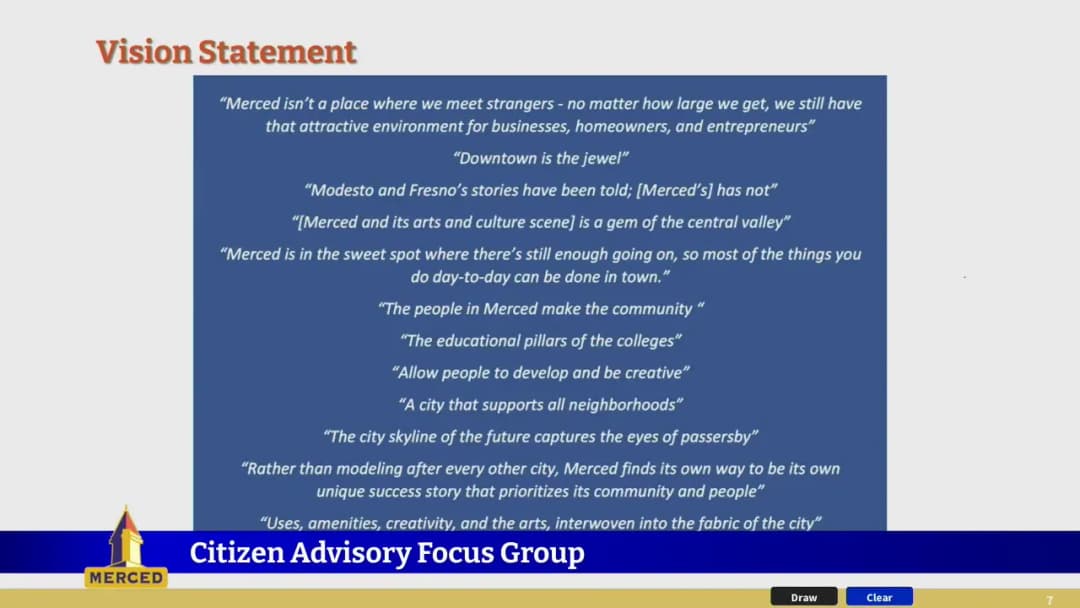
Public Meetings - Merced, CaliforniaThe Citizen Advisory Focus Group (CAFG) held a regular meeting on May 27, 2026, at 2:00 PM (PDT) to discuss and refine the draft vision statement for the Merced 2050 General Plan. The meeting included public comment, approval of previous minutes, and a detailed workshop on the vision statement. Members provided extensive feedback to make the vision more inclusive, affirmative, and actionable. Consent Calendar - Minutes from February 25, 2026: Approved unanimously on a motion by Boyle, second by Greg. Roll call vote passed without opposition. Public Comments & Testimony - Norma Cardona: Urged the group to ensure the vision reflects environmental justice, tenant protections, and investment in disadvantaged communities. She emphasized that 14 census tracts in Merced are classified as environmental justice communities and that many units are at risk for lead-based paint exposure. She requested inclusion of tenant right of first refusal, lead paint removal, and support for local businesses over large corporations. - Unnamed speaker: Described experiencing multiple hate crimes downtown and called for free public spaces, job creation for youth, and caution against expanding industrial and tech sectors that could lead to pollution or gentrification. He advocated changing language from "destination for talent and investment" to "location for talent and community investment" and adding "free" to public gathering spaces. - Marilyn Sobel: Stated that Merced mainly benefits white, middle-class retirees and urged the vision to better address disadvantaged communities, linguistic diversity, and affordable housing. She noted the city's goal of 60-70% high-end housing and only 4-6% affordable housing, calling it unbalanced and out of compliance with state mandates. Discussion Items - Visioning Exercise (Item F1): Consultants Bretton Michael and Michael Gibbons presented a draft vision statement spanning three paragraphs. The statement emphasized Merced as a forefront city, downtown as a jewel, intentional growth, and quality of life. CAFG members offered extensive feedback: - Mr. Thomas: Criticized the passive "will continue" language and observational tone; urged a testable, actionable vision with new commitments. Suggested replacing "expanding industrial and technological sectors" with growing healthcare and education. Emphasized distributed growth, neighborhood amenities, and walkable communities. - Mr. Maxie: Proposed adding a sentence emphasizing youth and family quality of life, including recreation, education, and cultural sharing. Suggested adding "realistic" or "achievable" to growth language. Agreed to remove "continue" and use affirmative verbs. - Ms. Hirsch: Questioned the phrase "will continue to stand at the forefront" as contradictory; called for more emphasis on diversity and culture. Noted that Merced should not be just a rest stop to Yosemite. - Mr. Dennis: Wanted accessible arts citywide, not just downtown. - Mr. Gregor: Clarified the process: feedback from CAFG will be incorporated, then a revised draft goes to 30-day public review, then planning commission, then city council. Confirmed consensus on the direction. - Mr. Boyle (Mayor Pro Tem): Supported adding youth, safety, tourism, and connecting North and South Merced. Emphasized quality of life as the north star. - Mr. Max: Suggested adding "gateways" to the skyline sentence to improve first impressions. Also noted the need for realistic growth and community building. - Other members: Called for inclusion of free public spaces, arts investment, affordable housing, city responsibility in investment, and recognition of Merced as a regional anchor. - Annual Attendance Report (Item F2): Reviewed and approved unanimously. Members were reminded to notify staff if unable to attend meetings. Key Outcomes - Vision Statement Revision: Consensus was reached to revise the draft vision statement based on all feedback. The consultant team will incorporate changes including removing "continue" language, adding emphasis on youth, safety, tourism, South Merced, gateways, equitable growth, local jobs, city investment, arts accessibility, and neighborhood amenities. The revised draft will be presented for public review (30-day period) before advancing to planning commission and city council (targeting September 2026). - Annual Attendance Report: Approved unanimously. - Next Steps: CAFG members with written suggestions were asked to submit them to planning staff. The group will likely review the revised vision before public release.
The Citizens' Stipend Setting Commission met at the Merced Civic Center to continue reviewing the Mayor and City Council stipend and to finalize a written recommendation to the City Council. The commission approved prior meeting minutes, discussed current and proposed stipend amounts and budget impacts, and adopted Resolution 2026-19 recommending $1,000 per month for council members and $1,250 per month for the Mayor. Note: The source agenda is dated Thursday, April 30, 2026, at 5:30 PM, while the meeting metadata supplied with this request gives the date as May 27, 2026, at 1:30 PM UTC. This summary uses the supplied date. Consent Calendar - Approved the April 16, 2026 Citizens' Stipend Setting Commission minutes unanimously on a motion by Commissioner Kelly, seconded by Commissioner Jenkins. Public Comments & Testimony - No public speakers during the public comment period. - No public testimony was offered during the public hearing; it was opened and closed at 5:48 PM. Discussion Items - Stipend review and Resolution 2026-19: The commission reviewed current stipends of $500 per month per council member and $600 per month for the Mayor, totaling $36,000 per year for the six council seats and $7,200 per year for the Mayor before employer taxes. - One commissioner cited the current total as $51,600 and the proposed total as $87,000, a $35,400 increase, and expressed concern about the impact on the city budget, including possible effects on the fire department in 2027. That commissioner said Merced does not have the income of larger cities and suggested revisiting a smaller increase, such as $700 per month or a $100 increase for each member, as more realistic and affordable. - Another commissioner presented spreadsheet calculations showing current stipends plus Social Security and Medicare employer taxes at $46,505 per year. The proposed $1,000 per month for council members and $1,250 per month for the Mayor would total $87,000 in stipends and $93,656 with employer taxes, an increase of just over $47,000. Because an approved increase would not take effect until January, the partial first-year cost was estimated at $70,080, which is $23,575 above the current budget. - A commissioner reported reaching out to five council members and not hearing back from two. Based on rough estimates, council members excluding the Mayor averaged about 55 hours per month on council business, while the Mayor reported over 100 hours per month. At current rates, that equates to roughly $9.09 per hour for council members and $6.00 per hour for the Mayor. That commissioner supported $1,000 and $1,250, citing the council's high level of community engagement, frequent attendance at events such as Bob Hart Square, Kitty Land, Red Ribbon Week, and Earth Day, and the fact that council members often do not seek reimbursement for mileage, gas, or event expenses. The commissioner also noted proposed pre-tax hourly equivalents of about $12.50 per hour for the Mayor and $18.00 per hour for council members, and after-tax monthly amounts based on single filing of $999.40 for the Mayor and $872.00 per council member. - A parliamentary question was raised about whether the commission could vote again on a previously decided item. Staff clarified that the vote was not a reconsideration but a formal written recommendation to the City Council, which is required to finalize Resolution 2026-19. - Another commissioner agreed with the higher proposed stipend, citing the value of council visibility at community events such as Mercado Nights, but cautioned that attendance should not be counted entirely as work because council members are residents attending as residents. That commissioner nonetheless stated agreement with the previously voted amounts. Key Outcomes - The public hearing was opened and closed with no public testimony. - The commission adopted Resolution 2026-19, recommending a monthly stipend of $1,000 for each City Council member and $1,250 for the Mayor, pursuant to Section 402 of the City of Merced Charter. The motion passed with Commissioner Burnett voting no. - The resolution's date typo was corrected from April 6 to April 16 before adoption. - The commission adjourned unanimously on a motion by Commissioner Kelly, seconded by Commissioner Jenkins.
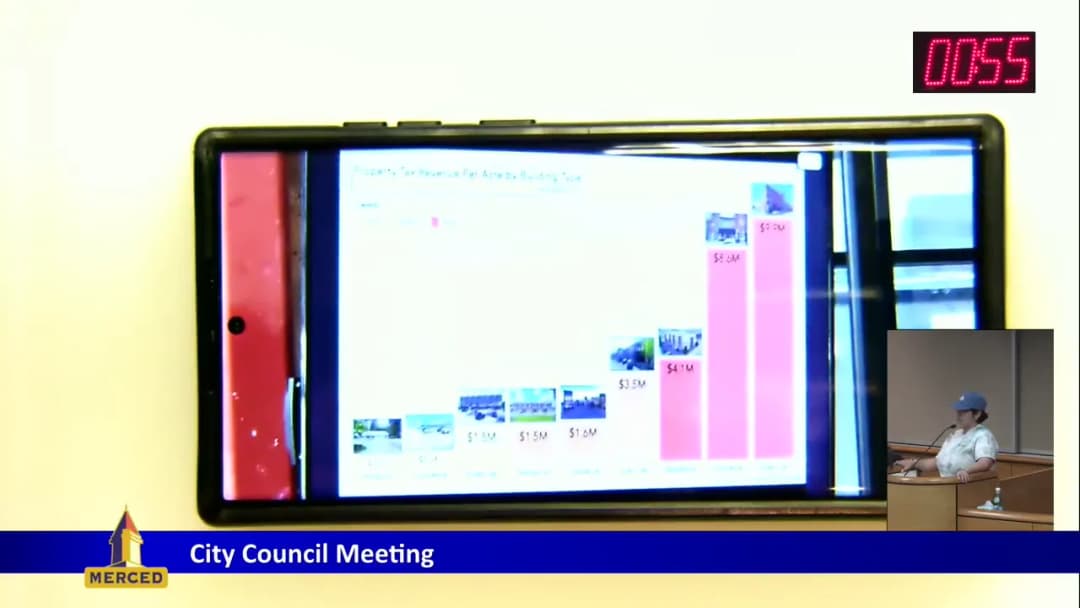
The Merced City Council and Planning Commission held a joint special study session on May 26, 2026, to receive a report on the Existing Conditions and Trends Workbook and a progress update for the Comprehensive General Plan Update. The meeting was informational, with no votes taken. Consultants from the planning team presented key findings from the 263-page workbook, followed by discussion and public comments. Public Comments & Testimony - Marilyn Sobel praised the transformation of Bob Hart Square, calling it a great asset for the community. - Norma Cardona, a downtown resident, asked about the types of knowledge-based industries being recommended, highlighted the potential of mixed-use housing to increase property tax revenue (citing a figure of $9.9 million per acre for mixed-use versus $384,000 for residential), and urged including digital literacy and device access in the digital divide discussion. - Later, Marilyn Sobel defended the environmental justice methodology used, stating that rich communities also face pollution and lead issues, and expressed concern about environmental disparities in South Merced and the need for thoughtful growth beyond single-family homes. - Norma Cardona returned to emphasize the importance of evacuation routes in flood-prone areas, the impact of short-term rentals on housing availability, extreme heat mitigation, and the need for non-traditional community engagement for limited-English residents. She shared a blurry photo illustrating property tax revenue comparisons. - Gene (affiliated with Strong Towns and Flat Valley Land Alliance) commented on the 100-year floodplain being outdated due to climate change, noted the presence of multiple streams through Merced, and advocated for downtown housing, bike/walk infrastructure, and high-speed rail connectivity. Discussion Items - Presentation on Existing Conditions and Trends: Consultant Brent provided an overview of the workbook, which covers land use, population/housing, mobility, market/economic conditions, public facilities, open space, air quality, environment, safety, and environmental justice. Key facts: Merced’s population is 98,000 (2025); annual growth rate 1.5% (2010-2025); median household income rose from $37,000 (2015) to $60,000 (2023); 65% of housing is single-family detached; 150 miles of trails in county; 14 census tracts meet state definition of disadvantaged (based on CalEnviroScreen 4.0). The consultant noted that the city has capacity for planned growth with additional groundwater wells and a 10 million gallon/day surface water treatment plant. - Visioning Process Update: The team reported on a community open house (January 2026, over 50 attendees in English, Spanish, Hmong), an online survey (75+ respondents, 90% did not attend workshop), and CFAG meetings. Key themes: downtown as an asset, aging infrastructure, housing affordability, desire for walkability and connectivity. A draft vision statement will be presented to the CFAG on May 27. - Council and Commissioner Q&A: - Commissioner Ochoa asked for clarification on water numbers. - Councilmember Tao asked about community feedback on housing affordability; the consultant confirmed it was a major concern, especially for first-time buyers and downsizing seniors. - Councilmember Smith questioned the validity of comparing Merced to coastal communities in CalEnviroScreen, arguing it forces valley communities to adopt Bay Area land use models and undermines generational wealth through homeownership. He noted that over half the town does not work and two-thirds of workers leave Merced for jobs. - Councilmember DuPont echoed concerns about state models not fitting the valley, and noted that retail sales growth (2015-2024) was below county and state averages despite UC Merced’s presence, calling it “wholly unacceptable.” - Consultant Michael and Brent defended the methodology, stating it also uses federal EJ Screen data and that air quality data is specific to the city, but acknowledged the need to consider local context. - Timeline: The consultant outlined that visioning will continue through summer, with planning commission review of the vision statement on August 5, city council adoption in September 2026, then policy drafting (10-11 months), EIR (9-10 months), and final adoption in 2028. Key Outcomes - The meeting was informational only; no votes or formal decisions were made. - Next steps: CFAG meeting on May 27 to review draft vision statement; public review period over summer; planning commission hearing on August 5; council adoption of vision statement in September 2026. - The presentation and workbook will inform future policy discussions for the general plan update.
The Merced Planning Commission held a regular meeting on May 20, 2026, at 6:00 PM in the City Council Chamber. The Commission acted on a continuation of a minor modification, pulled an annual Capital Improvement Program review, and voted to recommend a temporary moratorium on new food trucks in fixed locations due to concentration and land-use concerns. No public comments were received. The meeting adjourned at 6:24 PM. Public Comments & Testimony - No members of the public spoke during the public comment period or on any agenda item. Discussion Items - Item D.1 (26-440): Minor Modification and Environmental Review – Staff requested a continuation to June 3, 2026, for additional research. Without public comment, the Commission unanimously voted to continue the item to that date. - Item E.1 (26-314): Annual Review of Five-Year Capital Improvement Program (2026-2031) – This item was pulled from the agenda and not discussed. - Item E.2 (26-435): Recommendation to City Council for a Temporary Moratorium on Food Trucks in Fixed Locations – Staff presented a resolution to recommend the City Council adopt an urgency ordinance under Government Code Section 65858. The presentation highlighted that 34 food truck entitlements have been approved (26 single-use, 8 multi-use), with 18 concentrated within a 2.5-mile radius downtown, raising concerns about land-use compatibility, traffic, noise, and equitable distribution. Commissioners expressed support for the moratorium, noting the need to study the issue and align with the General Plan. Commissioner Ochoa suggested potential code changes such as a “use-it-or-lose-it” provision, limiting downtown locations, pay requirements similar to PBIDs, and tying entitlements to specific vendors and vehicles. After discussion, the Commission voted unanimously (4–0, with Commissioner Swigger absent excused) to adopt the resolution recommending the Council adopt an urgency ordinance and direct staff to prepare comprehensive amendments to Merced Municipal Code Chapter 20.44.020. Key Outcomes - Item D.1 continued to the June 3, 2026, Planning Commission meeting. - Item E.1 pulled from the agenda; no action taken. - Item E.2 approved – The Commission adopted a resolution recommending the City Council adopt an urgency ordinance establishing a temporary moratorium on new food truck fixed-location approvals. The initial moratorium would last 45 days, with potential extensions up to 10 months and 15 days. Staff will bring a draft amended ordinance back to the Planning Commission for review. - Upcoming meetings announced: June 1 (City Council), June 3 (Planning Commission – CIP, continued item, vacation request), and a joint study session on the General Plan update on Tuesday, May 21, 2026, at 6:00 PM.
The Merced City Council held its regular meeting on Monday, May 18, 2026, at 6:00 PM in the City Council Chamber. The meeting included special presentations, a ceremonial proclamation, public comments, consent calendar approvals, public hearings, discussion items on remote participation and energy efficiency, a budget review, and a council request to discuss upcoming birthday celebrations. Key actions included adopting an urgency ordinance extending a moratorium on street closures and approving a remote participation accommodation policy. Consent Calendar - Items J.1–J.4 were approved unanimously by motion (Boyle/DuPont). J.4 (Resolution 2026-22, Administrative Policy C-9 for remote participation accommodation) was pulled for separate consideration and passed unanimously after public comment. - Item J.5 (Final Map for Bellevue Ranch North, Village 24A) could not be considered due to a lack of quorum after two council members recused themselves. The item will be rescheduled to a future meeting. Public Comments & Testimony - Glenn Gallman (District 6 resident, military retiree) highlighted Memorial Day and Mental Health Awareness Month, urging a community approach to reduce veteran suicide and noting a growing local coalition. - Eli Sachs (registered nurse, bike advocate) criticized the city for not spending 20% of Measure V funds on bike/pedestrian safety, citing a crater on the Bear Creek bike path and adversarial treatment by the city engineer at BPAC meetings. - Gloria Sandoval expressed concerns about global dangers, voting rights, and the budget process, urging the city to educate the public on potential impacts of federal policy changes. - Steve Russos (Hlu Monk Center) thanked the city for supporting the May 9th Hmong American Day at Bob Hart Square and highlighted the event's success in reaching a broader audience. - E.J. Lorenzi invited the council to a booster club function on May 27th and praised Bob Hart Square as the center of downtown. - Joe Brasello (retired educator) requested a bike etiquette education program and better communication with citizens. - Marcus Ariano (Tree House Tutoring) thanked the city for the Hmong American Day venue and urged council to consider event vibrancy in upcoming street closure legislation. - Gino Kue advocated for community walks with council members to see issues firsthand and noted bike safety concerns. - Aggie Freeman (District 6 community leader) criticized Councilmember Zhang for remaining seated during the Pledge of Allegiance, stating it showed disrespect to veterans and the flag. - Letitia Luquet and Sheila Garcia (Harvest Time food ministry) presented a video and statistics about their food distribution program, serving 330 families every two weeks and recovering 50,000 pounds of food monthly. - Gloria Valvinos (Downtown Merced Partnership/Visit Merced) supported extending the street closure moratorium timeline but urged continued consideration of events using parking structures to maintain downtown activation. - Eli Torres (super flea organizer) advocated for allowing parking lot events, noting they can be successful without street closures, and offered to pay higher fees for maintenance. - Ashley Marie Suarez (District 5 resident) opposed rigid cutoff times for public comment under SB 707, urging continuous acceptance of e-comments and maintenance of email options. - Andrea Uribe (Leadership Council for Justice and Accountability) requested $350,000 for a South Merced community specific plan and $5 million for local street improvements in South Merced. Discussion Items - Project Update from RACE Communications (F.1): Jim Miller apologized for communication lapses and weather-related construction delays. He reported that half of nine sections are ready for final walkthrough, with restoration targeted by end of July, initial activation mid-to-late summer in downtown/west side, and substantial completion by end of December. Council members raised concerns about asphalt patches, sidewalk repairs, and signal damage at Olive and Austin Avenue. - Merced Arts Festival Presentation (F.2): Patricia Pratt and Earvin Mendoza described a week-long festival starting May 18, featuring five large-scale murals, a photo exhibit, workshops, and a downtown takeover on May 23 with over 200 artists and 41 businesses. A documentary will premiere in September. Council commended the effort and community engagement. - Merced Fire Department ALS Update and EMS Week Recognition (F.3): Battalion Chief Mickey Brunelli reported that since January 2025, the department has expanded Advanced Life Support to four stations, with two more coming soon to make all stations paramedic-staffed by mid-July 2026. In 2025, ALS was provided to over 1,500 patients; in 2026 (Jan–Apr) to over 1,000 patients with nearly 1,200 ALS interventions. Three paramedics were recognized for clinical excellence. - Bike Month Proclamation (G.1): Carolina Moraz, chair of the Bicycle and Pedestrian Advisory Commission, accepted the proclamation. She emphasized clean transportation and ongoing city efforts. - Street Closure Moratorium Extension (K.3): Staff presented concepts for a new ordinance focusing on the nature of events rather than street closures, including one-stop shopping, standardized fees, limiting parking structure use for events, and requiring events to use reservable city spaces when available. Council discussed parking lot usage, maintenance costs, and the need for nuance. The extension was supported unanimously. - Remote Participation Process for SB 707 (L.1): Staff asked for direction on e-comment cutoff times and telephonic registration deadlines. Council members expressed varied views, with a rough consensus to not implement e-comments initially and to set the registration cutoff at the beginning of each agenda item. Formal action was delayed to the June 1 meeting. - Energy Efficiency Upgrade Projects (L.2): Energy Systems Group presented a $14 million package of energy efficiency projects (lighting, HVAC, solar, battery storage, EV chargers, biogas generator) that would save $7.4 million over 20 years using Inflation Reduction Act grants and lease financing without general fund impact. Council directed staff to continue studying the proposal. - FY 2026-27 Budget Review (L.3): Finance Officer Venus Rodriguez presented the city manager's recommended budget of $446.1 million, with a $1.3 million general fund shortfall. Staff proposed options to balance using reserve funds and transfers from trust 115. Public speakers requested funding for tenant protections, eviction defense, South Merced specific plan, and street improvements. Council members discussed priorities, community funding, and expressed support for a relocation program for displaced tenants. - America's 250th and California's 175th Birthday (M.1): Mayor Pro Tempore Boyle suggested a mural showcasing Yosemite or state symbols, and festive decorations for downtown. Council supported a mural and flags, with staff to begin procurement and coordinate with community groups. Key Outcomes - Consent Calendar approved except J.5 (rescheduled). - Resolution 2026-22 (Remote Accommodation Policy) adopted unanimously. - Urgency Ordinance 2592 (Moratorium on Street Closure Encroachment Permits) extended for 10 months and 15 days, passed unanimously. - Public Hearing K.1 (HUD Annual Action Plan) continued to June 1, 2026. - Public Hearing K.2 (Self-storage facility) continued to June 1, 2026, due to lack of quorum. - SB 707 Remote Participation direction: staff to prepare for a formal vote on June 1; current inclination is no e-comments and registration cutoff at start of each agenda item. - Energy Efficiency Projects accepted; staff to continue feasibility work. - Budget first hearing held; further hearings on June 1 and June 15. - Birthday Celebrations staff directed to proceed with a mural and coordinate flag displays with the Boy Scouts and Sunrise Rotary.
The Merced Tax Transparency Commission met on May 12, 2026, at 6:00 PM in the City Council Chamber. The meeting covered consent calendar approvals, quarterly financial reports for Measure C and Measure Y, review of the City Manager's recommended budgets for fiscal year 2026/2027, and updates on road pavement and street lighting projects. All votes were unanimous, with no public comments received. Consent Calendar - Minutes Approval (26-415): Approved the Tax Transparency Commission minutes from February 10, 2026. - Attendance Report (26-422): Approved and filed the annual attendance report. Public Comments & Testimony - No public comments were submitted electronically or presented in person. Discussion Items - Measure C Revenue and Expense Reports (F.1): Staff presented the quarterly update as of March 31, 2026. Revenue for the fourth quarter of 2025 was $2.5 million, representing 27.9% of the annual budget of $9.1 million. Quarter-over-quarter cash basis revenue was up 9.6%, and economic basis up 9.1%. Revenue increases were attributed to new retail openings. - City Manager Recommended Measure C Budget for FY 2026/2027 (F.2): The proposed budget includes three funds (Fund 2001 old Measure C, and two new special tax funds for public safety and roads). Beginning balance estimated at $6.4 million with $9.3 million in projected sales tax revenue. Personnel costs account for 63.7% of expenditures. Highlights include funding for four part-time code enforcement positions ($105,000 for duty weapon replacements), a shared boom truck ($200,000 for streets division), a 10-wheel dump truck ($250,000), and capital carryovers for quiet zones and safe streets lighting. A budget shortfall is expected; staff noted that seven positions were moved from the general fund into Measure C in the prior year, and an additional $2,500 in operating costs may be transferred. - Measure Y Revenue and Expense Reports (F.3): Updated quarterly financials for cannabis tax. Revenue continues to decline, with a decrease of over $50,000 in the first quarter of 2026 compared to the same quarter in 2025. The last cannabis store on Motel Drive has not yet opened but is expected by June 2026. - City Manager Recommended Measure Y Budget for FY 2026/2027 (F.4): Estimated FY 2025/2026 revenue is revised downward to about $1.6 million (from $1.68 million). Proposed spending allocations: Police (20%) – five part-time code enforcement officers ($100,000), fleet repairs ($75,000); Fire (20%) – cardiac monitors ($120,000), weed abatement ($80,000), narcotics kits ($11,000); Parks and Recreation (20%) – equipment purchases (mule gator, tractor, lawnmower, etc.) and programming, supplemented by grants (Central Valley Opportunity Fund, Merced City School District contract for youth sports), rate increases, and a special tax from 6,423 parcels. The remaining 40% discretionary is split between parks maintenance (tree trimming $100,000, bike path maintenance $53,000, playground deductibles $25,000) and fences at McNair and Ada Givens pools ($35,000 each). Ending balance projected at $406,000. - Update on Road Pavement Projects (G.1): City Engineer Daryl Jordan presented a spreadsheet of road projects. Three projects are funded by Measure C: Safe Streets Light Retrofit ($735,000 remaining for 8–900 additional lights), R Street (Olive to Northwood) intersection upgrade and rehabilitation, and BNSF Quiet Zones (Highway 59, Canal Street, Glenn Avenue, M Street, K Street) to reduce train horn noise. McKee Road is under construction with concrete work and pavement rehabilitation expected over the next two months. - Update on the Street Light Project (G.2): The LED retrofit project has replaced 2,500 lights in the first phase, added 800 lights via a previous change order, and plans a third change order for 8–900 more lights using remaining Measure C funds. Focus areas include dim neighborhoods and arterial corridors. Key Outcomes - All consent calendar items and action items (F.1–F.4) were approved unanimously by voice vote: Commissioners Murphy (moved), Johnson, Takar, Kistecki, and others. - For Measure C and Measure Y budget items (F.2 and F.4), the commission voted to accept the reports as information only, rather than adopting a formal recommendation to the City Council as suggested in the agenda. This discrepancy between the agenda (which called for a recommendation) and the commission's action was noted. - No items were added to future agendas (H.1), and commission comments were limited to a clerical remark about voting. - The meeting adjourned at approximately 7:15 PM.
The Merced Planning Commission met on May 6, 2026 at 6:00 PM in the City Council Chamber. The meeting included approval of two conditional use permits for multi-food truck parking areas, a public comment on city planning, and discussion of a potential moratorium on food truck permits. Consent Calendar - The Commission unanimously approved the Planning Commission Minutes of April 8, 2026 (Consent Item D.1). Public Comments & Testimony - Arturo Martinez Jr., a resident of District 6, spoke during general public comment. He expressed support for more dense, mixed-use development rather than single-family homes, citing the need for a 30-year plan to accommodate UC growth and other changes. He asked commissioners to consider zoning changes to allow more multi-family and mixed-use housing. Discussion Items - Item E1: Conditional Use Permit 25-0020, Site Plan Review 25-0015, and Environmental Review 25-0047 – Staff presented a proposal for two food trucks and a drive-thru for tortilla trailers at 131 West Main Street on a vacant lot. The site plan includes 14 parking spaces, six picnic tables, office/bathroom, and 33 conditions. The Commission unanimously approved the permits. - Item E2: Conditional Use Permit 26-0021 and Environmental Review 26-0051 – Staff presented a proposal for two food trucks at 402 Mercy Avenue in the parking lot of Merced Heart Associates. This would be the 10th multi-food truck location in the city. The Commission unanimously approved the permits. - Item F1: Report by Planning Manager of Upcoming Agenda Items – Following the approval of E2, Commissioner Swigger raised concerns about the concentration of food truck permits in certain areas (e.g., Main and 16th Street). The Planning Manager suggested a potential moratorium on the existing food truck ordinance to allow staff to study the issue. The Commission discussed the need to evaluate the ordinance, consider sunset clauses for approved but unbuilt permits, and ensure monitoring. The City Attorney advised that the discussion was not agendized and could not result in action, but directed that the topic be agendized for the next Commission meeting. Key Outcomes - Approval (5-0, with Chairperson Gonzalez absent): Conditional Use Permit 25-0020, Site Plan Review 25-0015, and Environmental Review 25-0047 for a multi-food truck site at 131 West Main Street, subject to 33 conditions. - Approval (5-0): Conditional Use Permit 26-0021 and Environmental Review 26-0051 for a multi-food truck site at 402 Mercy Avenue, subject to 33 conditions. - Directive: Staff will agendize a discussion on a potential moratorium on food truck permits for the next Planning Commission meeting to examine the ordinance and address concentration concerns.
The Merced City Council held a regular meeting on May 4, 2026, at 6:00 PM in the City Council Chamber. The meeting included ceremonial proclamations, a real estate update, public comments, a consent calendar, and several action items. Key actions included the first reading of an ordinance creating a Repeat Housing Code Violators Program, authorization of up to $50 million in state revolving fund financing for wastewater treatment improvements, and a referral to study downtown parking options. Votes were taken on multiple items, with some council members dissenting or abstaining. Consent Calendar - Approved unanimously, with the exception of items J.7 (General Vang Pao Park construction contract) and J.8 (restroom purchase for Community Park 42), which were pulled and discussed separately. J.7 was approved with Councilmember Smith recusing himself. J.8 (purchase of a restroom for $129,355.90 via cooperative purchasing) was approved unanimously. Other consent items included routine contracts, minutes, a public hearing setting, veterinary services, engineering services for a municipal well, and an ERP system support contract. Public Comments & Testimony - Rosie Campana asked for a transparent breakdown of Measure V transportation sales tax spending on local road repair, including criteria for prioritization and a public schedule. The City Engineer was noted as ready to provide information. - Arturo Martinez urged equitable development across all districts, cautioning against over-reliance on national retailers and annexation of agricultural land, and asked for support of small businesses and diverse housing options. - Kim Garner (Opportunity Merced) promoted the upcoming Merced Arts Festival (May 18–23), highlighting large-scale murals and over 80 participating artists as a boost to civic pride and the Arts and Culture District. - Gloria Sandoval noted a lack of public restrooms at Bob Hart Square during a May Day event and raised concerns about the human aspect of downtown improvements. - Monica Villa encouraged residents to contact council members about their needs and called for kindness toward homeless individuals. - Camille Fagundis and Dwayne Habecker (Merced County Office of Education) described a successful Wonderworks Field Lab partnership with the Merced Applegate Zoo, engaging students in place-based learning. - Jebjeet Singhupal asked for a public, side-by-side cost-benefit analysis of the downtown vs. south Merced high-speed rail station options, emphasizing the need for data-driven decisions. - Karthiq Prasad (representing Congressman Adam Gray) reported four bills that passed the U.S. House, including the Farm Bill, the HEATS Act, the FIRE Act, and a telehealth reauthorization. - Ashley Marie Suarez and Latanya Richard called for a $2 million eviction protection program and a $500,000 tenant relocation assistance fund, citing unsafe housing conditions and retaliation against tenants who report violations. They urged the city to prioritize housing safety in the budget. - Robert Delino (property owner) raised concerns about tenants who deliberately damage units or block repairs, asking for safeguards to prevent abuse of the ordinance by tenants not paying rent. - Aaron Hamm (Rental Zebra) expressed broad support for the Repeat Housing Code Violators Program as a targeted approach, but cautioned that a $1,000/day fine might be excessive and could hinder rehabilitation. - Daisy Ramos Acosta shared a personal story of mold exposure and subsequent eviction after reporting conditions, urging strong enforcement and anti-retaliation protections. - Blanca (reading a tenant's comment) asked for an emergency relocation fund because landlords often refuse to pay relocation assistance, leaving tenants without recourse. - Greg Terzakis (California Apartment Association) supported the ordinance as written, citing success in Fresno where violators sold properties. He opposed adding further protections, urging vigorous enforcement. Discussion Items - K.1 – Repeat Housing Code Violators Program (First Reading): City Attorney Craig Cornwell presented the ordinance, which targets landlords with a pattern of health and safety violations. The ordinance includes designation as a repeat violator, escalating fines, tenant relocation assistance per state law, possible business license revocation, and a public list of non-compliant properties. Council debated the length of tenant retaliation protection (six months vs. twelve months) and fine amounts. Councilmember Harris moved to extend protection to 12 months and set an initial fine of $5,000 (with $1,000/day thereafter). Councilmember Smith urged caution, warning against losing consensus. The motion was seconded and passed, with Councilmember DuPont and Mayor Pro Tem Boyle voting no. The ordinance will return for a second reading, with staff working to expedite. - K.2 – Wastewater Treatment Financing: Authorized a Construction Installment Sale Agreement with the State Water Resources Control Board for up to $50 million (expected to be reduced to $32 million with pending FEMA grant) for rehabilitation of aeration basins, UV channels, and other upgrades. Unanimously approved. - K.3 – HOME-ARP Funds for Mercy Village Apartments: Accepted an additional $2,970 in federal funds, updated a conditional commitment letter for the project (total budget $37 million). Unanimously approved. - K.4 – Fire Station 56 Construction Management: Approved a $676,190 agreement with Kitchell Corporation for a progressive design-build approach. Councilmember Zhang voted no. - K.5 – Transit Joint Powers Agreement: Approved a restated JPA for the Transit Powers Authority for Merced County. Councilmember Zhang voted no. - K.6 – Trailblazers Outdoor Recreation Grant: Accepted $124,725 from Central Valley Community Foundation to fund outdoor recreation, mentorship, and workforce development for youth. Unanimously approved. - K.7 – Bob Hart Square Clock Replacement: Accepted $27,000 grant, $16,000 in donations, and $1,738 from T-shirt sales for a new clock. Unanimously approved. - K.8 – Youth Sports Partnership with Merced City School District: Approved a $231,588.05 agreement for free participation in Jr. Giants, NFL Flag Football, and Jr. NBA/WNBA for up to 500 students. Unanimously approved. - L.1 – Arts and Culture Commission Report: Presented selected mural design "Bajo el Mismo Cielo" (by Saul Gonzalez Lauriano) for the R Street undercrossing, and a recycled blue heron sculpture design by Merced County Juvenile Court School students. Informational only. - M.1 – Downtown Parking on 18th Street: Mayor Serratto requested study of options (do nothing, add diagonal parking, or one-way with diagonal parking on both sides). After discussion, the matter was referred to the Public Works and Transportation Committee. Motion passed 5-1-1 (Councilmember Zhang no, Councilmember Harris abstained). Key Outcomes - Repeat Housing Code Violators Program (K.1): First reading approved with amendments to extend tenant retaliation protection to 12 months and set a $5,000 initial fine (with $1,000/day) to be set by resolution. Ordinance will return for second reading expedited as soon as possible. - Wastewater Treatment Financing (K.2): Approved up to $50 million in low-interest state loans, with expected reduction pending FEMA grant. - Mercy Village Apartments (K.3): Additional HOME-ARP funds accepted; project budget now $37 million. - Fire Station 56 (K.4): Construction management contract awarded to Kitchell Corporation ($676,190). Councilmember Zhang voted no. - Transit JPA (K.5): Restated agreement approved. Councilmember Zhang voted no. - Trailblazers Program (K.6): Grant accepted; program expands outdoor recreation for youth. - Clock Replacement (K.7): Funding accepted; clock to be installed at Bob Hart Square. - Youth Sports Partnership (K.8): Agreement with MCSD approved for free sports programs. - Downtown Parking (M.1): Referred to Public Works and Transportation Committee for study and community input. - Future Agenda Items: Councilmember Zhang requested a general discussion on tenant protections for the first meeting in August. Councilmember Boyle requested a discussion on celebrating America's 250th birthday at the May 18 meeting, unanimously approved.
The Bicycle and Pedestrian Advisory Commission (BPAC) met on April 28, 2026, at 4:00 PM in the City Council Chamber. The meeting included public comments, a presentation on a grant application for the Active Transportation Program (ATP), and extensive discussion on future agenda items and BPAC’s role. The commission approved the consent calendar and set several items for future meetings. Consent Calendar - E.1 26-320: Bicycle and Pedestrian Advisory Commission Annual Attendance Report. Approved unanimously without discussion. Public Comments & Testimony - Joe Brucha (resident near Black Rascal Creek entrance) expressed concern about unsafe behavior on bike paths, particularly by e-bike and scooter riders on the way to UC Merced. He recommended education campaigns for children, such as teaching riders to announce “on your left,” and suggested placing a safety newsletter in utility bills. - Eli Sachs (public health nurse, resident near Bear Creek) described dangerous road conditions for pedestrians and cyclists, especially the Yosemite Parkway/16th Street overpass near the 99 on-ramp. He highlighted that Measure V requires 20% of funds for active transport but said far less has been spent, citing only $250,000 spent in the last year (with $211,000 for repaving Yosemite). He also noted the Bear Creek bike path at R Street has been sunken since 2023, and he asked which agency is responsible for repairs. Discussion Items - F.1 Engineering Report - Active Transportation Plan Grant Application Project Scope: Management Analyst Laura Ivancich and City Engineer Daryl Jordan presented the ATP grant application due June 22, 2026. The city is pursuing a medium-sized grant ($3.5M–$10M) for a citywide Safe Routes to School project. Outreach meetings had low attendance (12-15 people each). Commissioners discussed: - Project selection: Engineering staff will prioritize projects based on scoring criteria, community input, and school district suggestions. The current list includes multiple school zones and intersections. - Hawk systems vs. physical traffic calming: Several commissioners (Shu, Thomas, Watkins) argued for curb extensions, speed tables, elevated crosswalks, and pedestrian islands over Hawk signals, citing higher effectiveness and lower cost. Commissioner Thomas noted Hawk systems often require education/enforcement and may be overkill in residential areas. - Multi-use path design: Commissioner Grant urged 10-foot minimum width for multi-use paths to accommodate e-bikes and pedestrians separately. Commissioner Thomas suggested dividing paths with greenways for faster and slower traffic. - Measure V funding for match: Commissioner Grant asked if Measure V funds could be reserved for matching this grant. Daryl Jordan said they are considering using Measure V for match in the next fiscal year (2027-28), but noted that funds are sometimes absorbed by street projects. - Engagement and outreach: Commissioner Thomas noted he only learned of the outreach meetings from the agenda, and that his son’s school (Farmdale) had no flyers. Laura Ivancich said flyers were sent to schools and posted on social media, but acknowledged timing was tight. - Data and safety: Commissioner Shu referenced TIMS data showing accidents near schools (e.g., V & 11th, R & 11th, Childs Avenue) and recommended prioritizing those. Commissioner Chambers requested fatality/injury data for pedestrians and cyclists, including collisions between cyclists and pedestrians. - Enforcement: Commissioner Martinez asked about coordination with police for new infrastructure. Jordan noted new signals get enforcement initially, and speed cameras are not grant-eligible. - Committee selection: Jordan explained that project selection is done by engineering staff with planning input, not a formal public committee. - Future interaction: BPAC members expressed desire for earlier notice of workshops and a clearer role in project development. Jordan said input is needed immediately, as after the application, the scope is fixed. Key Outcomes - Consent Calendar approved (unanimous). - Future Agenda Items Requested (to be added to upcoming meetings): - Presentation from engineering/planning on how bike design standards are included in developer requirements and enforced (Commissioner Grant). - Presentation on Measure V funds: a compiled list of bike/pedestrian projects specifically earmarked for Measure V and evidence of saving Measure V funds for match or complete projects (Commissioner Grant). - Discussion on bike path safety communications, revisiting previous education campaign (Commissioner Grant). - Updated list of prior agenda requests from October 2025 (Commissioner Grant). - Goals and priorities for BPAC 2026-2027 (Commissioner Shu). - Brown Act training and BPAC role discussion (Commissioner Thomas; staff noted a city council presentation might be available). - Multi-use path design standards to separate faster and slower traffic (Commissioner Thomas). - Standing agenda item to follow up on previous agenda requests (Commissioner Watkins). - Data on pedestrian/cyclist fatalities and injuries in Merced, including collisions between cyclists and pedestrians (Commissioner Chambers, Harmelin). - Invitations for regular updates from Merced City School District, MCOE, CHP, Merced Police Department, Planning and Engineering, Downtown Neighborhood Association, and UC Merced (Commissioner Chambers). - Discussion on meeting frequency (monthly vs. every other month) (Commissioner Chambers). - Changing meeting time to 6:00 PM to increase public attendance (Commissioner Shu). - Educational campaign for safer bike path usage (Commissioner Shu, referencing Joe Brucha’s comments). - Staff commitment: Senior Planner Leah Brown (new staff) will coordinate with commissioners to add items, noted that previous requests may have been lost due to staff changes. She will also forward planning commission and city council agendas to commissioners. - Commissioner Comments: Several commissioners shared activities, including a ride-along with engineering, UC Merced placemaking events, a Jane Jacobs Day walk (May 4), and the Merced Bicycle Coalition meetings. Commissioner Grant noted she may be terming out early due to a partial-term reappointment. - Proclamation: City Council will issue a proclamation for Bike Safety Month on May 18 (rescheduled joint study session), and commissioners were invited to attend. Adjournment The meeting adjourned at approximately 5:50 PM.