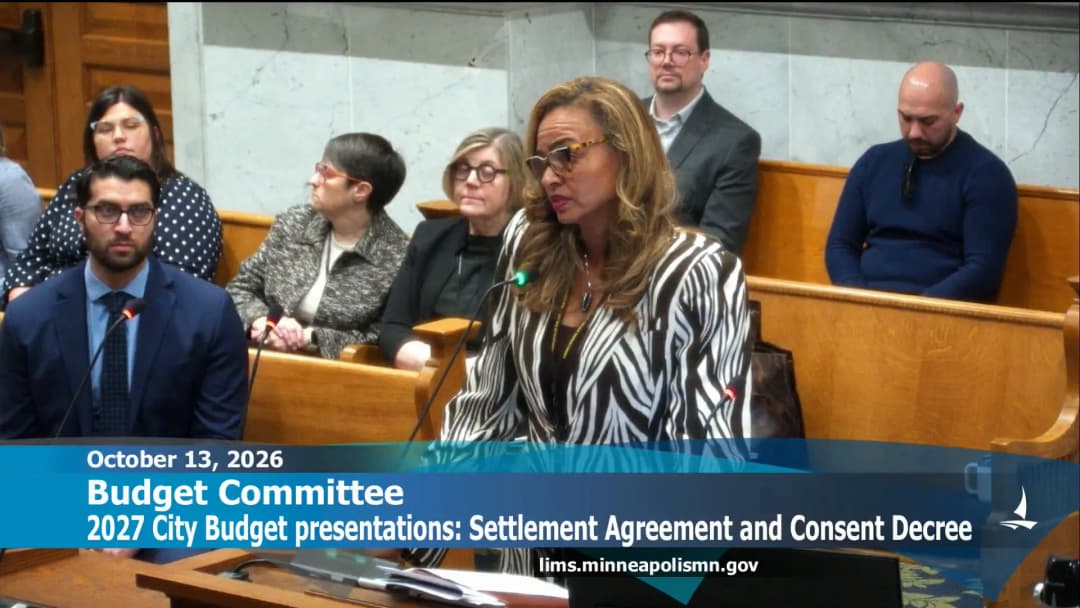
The Minneapolis City Council Budget Committee met on Tuesday, October 13, 2026, with Chair Aisha Chugtai presiding. A quorum was confirmed after roll call. The committee received two staff presentations: the mayor's recommended 2027 Human Resources department budget and a financial review of settlement agreement/consent decree work related to the Minneapolis Police Department. No formal votes were taken; both presentations were filed. A technology improvement plan presentation was rescheduled to the afternoon of October 26. The committee adjourned until Monday, October 19, 2026, at 6:05 p.m. for the second public hearing on the 2027 budget. Human Resources Department 2027 Recommended Budget Chief Human Resources Officer Nikki Odom presented the mayor's recommended 2027 HR budget. The recommended 2027 operating budget is approximately $11.2 million; recommended 2027 expenses total approximately $11.24 million, compared with $11.45 million in the 2026 adopted budget, a decrease of about $203,000. The recommendation removes six positions and approximately $899,000 from HR, representing six of 62 positions, or roughly one-tenth of the department. Revenue is unchanged from 2026 and includes partner-agency contributions supporting Urban Scholars. The budget also includes about $2.3 million in fringe benefits and about $1.7 million in contractual services. Odom reported that HR turnover has fallen from about 40% when she started to about 4%, and the city's overall turnover rate is 8%. The share of separations involving BIPOC employees fell from 56% in 2025 to 44% in 2026, a 12-percentage-point decrease. She noted recognition including the 2026 Finance and Commerce Empowering Women Award, with women holding 45% of executive leadership roles and 50% of director roles, and a state pay equity score that improved by 5% to 97%. Odom said Workday implementation is HR's top 2027 priority; design, architecture, and implementation work will occupy 50%, sometimes 60% or more, of time for many HR staff. Testing is expected to begin around mid-Q2 and continue through at least Q3. With fewer staff, departments should expect longer turnaround times for some requests, and some activities may be deferred. Staffing-reduction placement is not finalized, so division allocations may change. She also said the Racial Equity, Inclusion, and Belonging (REIB) office will move to OPS rather than HR because most REIB work does not align with HR. Council members' questions and positions included: - Councilmember Palmisano asked why REIB was not in the presentation and requested a written list of HR's major contracts. Odom agreed to provide the list. - Councilmember Chavez expressed strong support for Urban Scholars and concern about the program shrinking; Odom said there is a direct correlation between external partnerships and the number of scholars supported. - Councilmember Wita praised the improvements in HR turnover and BIPOC separation rates and asked where the six position cuts would be made; Odom said decisions are close but not finalized. - Vice Chair Schaefer asked about vacancies; Odom said the department has about three vacancies, one when the report was completed, not 14. She clarified that HR business partners are the strategic conduit to departments, with HR representatives in a more operational support role. - Councilmember Chowdhury asked about Workday governance; Odom said the CFO, CHRO, and CIO are project sponsors, supported by a project team of more than 20 people across involved departments and specialties, an external implementation partner, and Workday as the HCM/ERP vendor. The 2028 budget increase to about $11.7 million is driven by salary, rent, and insurance inflation, not new resources. She expected OPS or the CAO's office to notify council about the six FTE decisions next week. - The Chair noted park board data showing city HR costs per FTE of about $11,200 versus the park board's $3,500, within an industry range of $9,000-$14,000; Odom said she could not speculate without knowing what the park board included and offered to investigate. Settlement Agreement and Consent Decree Financial Review Deputy Commissioner of Community Safety Jared Jeffries led a cross-departmental presentation with representatives from the City Attorney's Office, Civil Rights, IT, and MPD. Jennifer Saunders explained that the settlement agreement with the Minnesota Department of Human Rights was issued as a court order on July 13, 2023; it is 144 pages with over 400 paragraphs. Topic areas include non-discriminatory policing, use of force, stops, searches, arrests, citations, body-worn and in-car cameras, training, officer support and wellness, behavioral crisis response, accountability and oversight, and data systems and transparency. The independent evaluator, LIFA (Effective Law Enforcement for All), has issued an updated two-year evaluation plan and semi-annual reports; the court ultimately decides compliance, followed by one- or two-year sustained compliance periods. Ganesha Martin, MPD Bureau Chief of Constitutional Policing, described the reform framework: policy, training, data/technology, audits, and wellness. Over 14 use-of-force policies have been approved, with training effective January 2026 and audits underway. Policies for stops, searches, citations, and arrests have been approved, and training is being developed. The hours-worked policy has been approved but is not yet effective because training has not been delivered; monitoring is being developed because some officers are currently working more than the current limit. Financial highlights: - Most settlement spending comes from the general fund, with a small internal-service-fund portion for IT personnel and services. - Personnel figures reflect FTEs specifically created and funded for the settlement agreement; they do not include staff who split time between settlement and other duties. - Civil Rights expanded its investigator complement from 8 to 11 in 2024. - Contract spending was previously handled through department reimbursement; the 2027 recommendation shifts to a dedicated Finance-held fund. Recommended additions total roughly $4 million: $1.5 million for the LIFA contract, about $2.4 million for ongoing needs such as training, system improvements, and internal affairs supervisory review, and $100,000 in one-time implementation assistance; $3.95 million is recommended as ongoing. - Civil Rights' outside investigator contract, begun in 2024, is expected to close by the end of 2026; total spend by then is about $1 million and outside partners will have completed more than 70 misconduct investigations. The 2027 recommendation includes $386,000 to continue the three in-house investigators added in 2024. - The City Attorney's Office 2027 budget includes $471,000 in personnel and $1.5 million in contractual funding for the LIFA contract. - IT's recommended 2027 budget is just under $511,000 for FTEs focused on data, process, and project management. - Capital work includes the South Minneapolis Community Safety Center, planning for the North Minneapolis Community Safety Center, and facility improvements under the facilities improvement plan. CLIC has recommended $19 million in capital funding through 2030 for a new community safety training and wellness center; 2027 funding supports planning and design. Council members' questions and positions included: - Council President Payne asked how MPD's divestment of 17 non-sworn vacant positions, including seven in constitutional policing and four in professional standards, affects settlement work. Martin said the positions are still being identified. Jeffries said the city contracts out for some training development, misconduct investigations, and certain IT implementations, while aiming to build long-term in-house capacity in internal affairs and the Office of Police Conduct Review (OPCR). - Payne asked about the $100,000 OCS administrative contract; Jeffries confirmed it is an anticipated continuation of the Danny Murphy contract, subject to procurement, for high-level implementation comparison and change management. - Payne said the city has spent about $20 million on implementation over 2023-2025 and that the visible impact so far was four pieces of policy trained on, while acknowledging the staff's hard work. Martin responded that use-of-force policy and training have been significant and that policy, training, and accountability processes are essential baseline work. Payne repeated his ongoing concern about the return on investment. - Vice Chair Schaefer asked whether current technology supports the audit work; Martin said no. The current RMS vendor was assessed as unable to demonstrate compliance, an RFI for a new RMS is underway, and a federal funding request has reached the second tier. More detail is expected at the technology improvement plan presentation on October 26. - Schaefer asked which positions are required by the settlement agreement; Martin said assessments identified a health and wellness director plus an analyst and a program manager. Jeffries said the community safety training/wellness center planning report should be completed by the end of 2026 or early 2027. - Councilmember Palmisano summarized recommended 2027 settlement-related spending as about $5.8 million in capital costs, $5.865 million in personnel, and $4.05 million held by Finance for contracts, totaling about $16 million. Jeffries said this captures most of the settlement-related work, possibly excluding some IT system funds. - Councilmember Chavez said the city is not in alignment with year-one and year-two settlement requirements, called that unacceptable and, in her opinion, out of compliance, and said residents will not receive the police services they deserve. Key Outcomes - No formal votes were taken; both presentations were filed. - HR's 2027 recommended budget with six FTE reductions was presented; final division-level placement is pending, with council notification expected from OPS or the CAO's office next week. - HR will provide a written list of major contracts; Odom will look into the park board per-FTE comparison. - The settlement agreement presentation outlined a recommended shift to a dedicated Finance-held contract fund and continued capital planning for a training/wellness center. - The technology improvement plan presentation is rescheduled to October 26; the committee's next meeting is October 19, 2026, at 6:05 p.m.
Public Meetings - Minneapolis, Minnesota
Public Meetings - Minneapolis, MinnesotaThe Budget Committee, chaired by Aisha Chugtai, convened on October 9, 2026, to hear three presentations on the mayor's recommended 2027 budget from the Mayor's Office, the Office of City Auditor, and the Office of City Clerk. The meeting focused on proposed staffing reductions, service impacts, and the balance between executive and legislative branch funding. Public Comments & Testimony - No public comments were offered during the meeting. Discussion Items - Mayor's Office Presentation (Grace Waltz, Chief of Staff): Waltz outlined the office's restructuring into communications/engagement and policy/government affairs verticals, achieved within existing FTE counts. The mayor's priorities remain affordable housing, economic development, public safety, climate action, and good governance. Constituent outreach reached over 38,000 calls and emails as of September 29, 2026 – a 287% increase from 2025, with 71% of that volume occurring in January and February. The proposed 2027 budget reduces the office's FTE count from 16 to 15 (eliminating a vacant position) and shows a slight increase in operating costs due to internal service charges. Councilmembers questioned the role of policy aides versus department heads and the 2% increase in the mayor's office budget compared to a 21% decrease for the legislative department. - City Auditor Presentation (Robert Timmerman, City Auditor): Timmerman detailed the mayor's proposed $125,000 net decrease in the auditor's budget, which includes a reduction of two FTEs (from 14 to 12) and elimination of $105,000 in professional services. He emphasized that these cuts would reduce capacity for planned and unannounced oversight, increase enterprise-wide governance risk, and threaten the office's charter-required independence. The auditor noted that his office has already absorbed contracting costs and built in-house solutions to avoid software expenses. He also highlighted the value of independent audits, referencing the after-action review of the shooting of Davis Maturi and the death of Alice Lucher, which yielded 37 findings and recommendations. Councilmembers expressed concern about the threat to independence and the potential for increased fraud, waste, and abuse risks. - City Clerk Presentation (Casey Carl, City Clerk; Destiny Zhang, Director of Administration; Christian Rommelhoff, Assistant City Clerk; Katie Smith, Director of Elections and Voter Services): The clerk's office presentation outlined a 21% reduction in the legislative department's budget, driven by a $5.6 million decrease in non-election year funding, $1.3 million in personnel reductions (6 FTEs, reducing from 70 to 63 authorized positions, plus an administrative funding equivalent for one additional FTE), and $437,000 in contractual services cuts. The records and information management division reported a surge in data requests: citywide requests are projected to more than double between 2022 and 2027 (117% increase), and police-related requests handled by the clerk's office are projected to increase by 270% over the same period. With proposed staffing reductions, requests per staff member for the police team would triple to 870 per year. The elections division requested funding for election management software upgrades, automated vote-by-mail printing and inserting equipment, and a mobile voting trailer – none of which were included in the mayor's proposed budget. Councilmembers noted the unsustainability of data practices staffing given demand and called for a deeper analysis of request drivers, including potential use by AI companies. Key Outcomes - No formal votes were taken during this session. The committee received the presentations and filed them for further deliberation as part of the overall 2027 budget process. Chair Chugtai adjourned the meeting without objection.
The Enterprise and Labor Relations Committee of the Minneapolis City Council convened on October 5, 2026, with Chair Linne Palmasano presiding. The meeting addressed a consent calendar of routine items and discussed a contract amendment for architectural design services. Consent Calendar - The committee approved a consent agenda consisting of 10 items without discussion or opposition. Items included approving a winter work reserve pool letter of agreement for Labor's Local 363, contract amendments with Keystone Compensation Group, Goodworks, The Aliveness Project, Cordia, and Suez SES North America, authorizing a contract with Principal Financial Solutions, a legal settlement for the claim of Alice Na, referring ethics updates to staff, and setting a public hearing for October 19th on appointments to the Ethical Practices Board. Discussion Items - Contract Amendment with LSE Architects: Arthur Maya from Finance and Property Services presented a request to increase the contract with LSE Architects for additional architectural and engineering services for the Minneapolis Democracy Center. The amendment was necessitated by greater-than-anticipated programming requirements, design complexity, and the need for redesign of mechanical, electrical, and plumbing systems. The redesign also enabled pursuit of LEED certification and geothermal assessment, including a Darcy well on the property. Chair Palmasano noted that while the extra cost was due to reworking systems, it would lead to a LEED-certified building. Councilmember Chavez expressed support, particularly for the geothermal component. Key Outcomes - The consent calendar was approved unanimously. - The contract amendment with LSE Architects was moved by Councilmember Chavez and approved with all in favor.
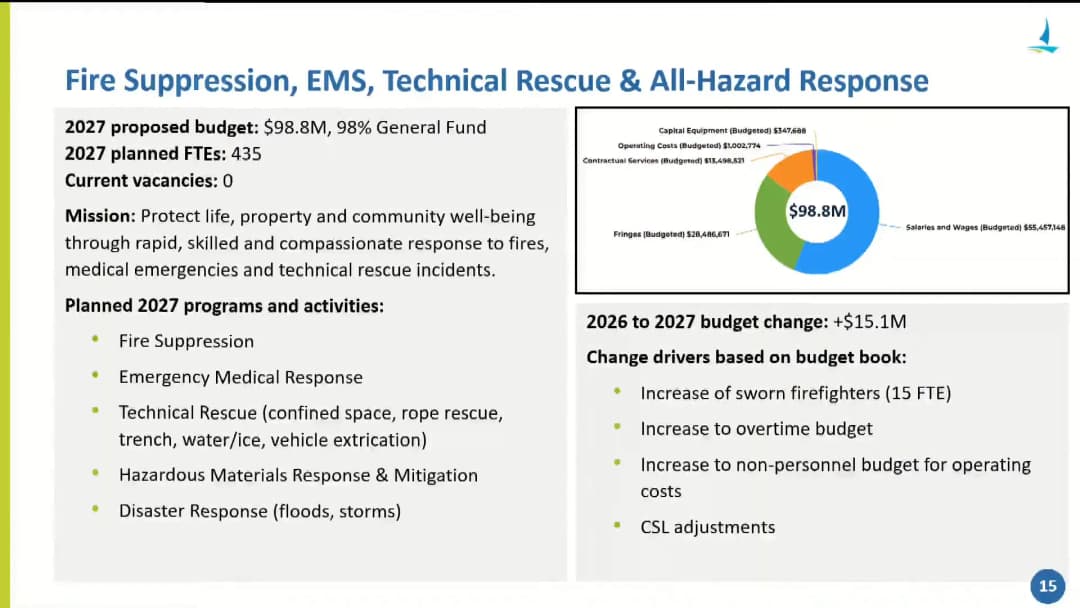
Chair Aisha Chugtai called the adjourned meeting of the Budget Committee to order on Monday, October 5, 2026, at 15:08 UTC. Nine members were present, establishing a quorum. The committee received two presentations on the mayor's recommended 2027 budget: from the Minneapolis Fire Department (MFD) and the Emergency Management Department. Following the presentations, the committee discussed a memo on Minneapolis Police Department (MPD) overspending in fiscal year 2025 and continued that item to the next regular committee meeting. Consent Calendar - No items were listed or approved. Public Comments & Testimony - No members of the public spoke. Discussion Items Fire Department Budget Presentation - Presenter: Chief Reginald Freeman, MFD. He outlined the department's $110.2 million proposed budget for 2027, covering 441 full‑time equivalent (FTE) staff (424 in suppression, authorized 434.7). Key objectives included increasing diversity, pursuing resources for rising demand, improving mental health and wellness, and reducing preventable fires and injuries through community risk reduction. - Call Volume & Staffing: Over five years, authorized staffing increased 3.5% (from 419 to 434) while call volume rose 22%. The department meets the NFPA standard of 4‑minute response time only about 70% of the time (vs. 90% goal). Four‑person crews complete critical tasks 25% faster than three‑person crews (NIST data). Chief Freeman noted that only 390 suppression personnel are currently assigned, and 70 firefighters are eligible to retire. - Investments: The mayor's budget includes $1.8 million for 15 new sworn firefighters (funded by $450,000 general fund and $1.35 million SAFER grant), $3.4 million additional overtime, $700,000 non‑personnel operating costs, and $163,000 for technology. Total overtime budget would reach $3.8 million. A $5.9 million contract supports the mobile crisis response team. - Fire Station & Infrastructure: The last fire station (Station 12) built in 1962. The department plans a standards‑of‑response coverage analysis to determine future needs. To meet national staffing standards, MFD estimates needing 576.45 firefighters (currently 105 per shift minimum, ideal 135 per shift). A three‑to‑five‑year strategy is envisioned. - Pathways Program: 40% of the 20 annual EMS pathways interns can enter cadet classes, with roughly six per class joining suppression. The program likely expands via a Minneapolis Public Schools public safety pathway. - Reimbursements: Chief Freeman intends to propose an ordinance charging non‑Minneapolis residents for motor vehicle accident response (common elsewhere). Currently no chargebacks exist. - Questions from Council: Councilmember Rainville asked about PTSD leave reimbursement (state covers base pay, not overtime). Councilmember Palmasano inquired about SAFER grant longevity (three years, graduated funding). Councilmember Chowdhury asked about the fire alerting system (in RFP process). Councilmember Votaw raised wellness spending (considered adequate for now). Vice Chair Schaefer asked about overtime drivers (PTSD, sick leave, military leave, etc.). Emergency Management Department Budget Presentation - Presenter: Director Rachel Sayre. The department has 9.5 FTE and a relatively flat budget (mostly personnel at 64%, contracts 35%). Revenue comes from federal grants passed through the state. No investments or divestments are proposed; operations remain steady. - Key Activities: Maintaining city sirens, training city staff for disaster response, running the Emergency Operations Center, and updating continuity plans. - State/Federal Funding: The department works weekly with the state. Federal thresholds for disaster aid are very high; Minneapolis has not met them in years. - Upcoming Events: Planning is underway for the 2028 NFL Draft and midterm elections. The department has run exercises with Election and Voter Services, finding them extremely well‑prepared. - Questions: Councilmember Rainville asked about impacts of federal cuts; Director Sayre noted strong local support. Councilmember Stevenson asked about NFL reimbursement (deferred to budget team). Vice Chair Schaefer asked about state disaster funds (pooled fund exists but hard to access). Councilmember Palmasano praised the department's trauma‑informed response to the Annunciation mass shooting and Operation Metro Search. MPD Fiscal Year 2025 Overspending Memo - Item Continued from September 29, 2026: Staff were not present to present the memo. Councilmember Chowdhury highlighted overexpenditures in contractual services ($666,000+), miscellaneous ($894,000+), parking ($287,000), and travel ($189,000+). He asked about budget controls and how the Mayor's Office monitors overspending. - Councilmember Stevenson noted MPD's own description of the overspending as “mismanagement” and asked which line items were affected. - Budget Director Response: Sean Green explained the legal level of control is the department‑level appropriation; monthly line‑item reviews occur but no action until the total department budget is exceeded. For 2026, finance is implementing closer monitoring with the CAO. Ongoing written responses to detailed questions were promised. Key Outcomes - Fire Department Report Filed: The presentation was received and filed; the clerk will provide a response memo on follow‑up questions (notably Councilmember Chowdhury's query on the fire alerting system additional funding request). - Emergency Management Report Filed: The presentation was received and filed. - MPD 2025 Overspending Memo: Continued to the next regular Budget Committee meeting (approximately three weeks from October 5, 2026). The committee directed staff to provide written answers regarding the miscellaneous and travel overexpenditures, line‑item mismanagement, and controls for 2025–2026. - Next Meeting: Adjourned until Tuesday, October 6, 2026, at 10:00 a.m. (local time) for presentations from 911, Neighborhood Safety, and Arts and Cultural Affairs departments.
The Minneapolis City Council convened its regular meeting on October 1, 2026, under President Elliot Payne. The meeting opened with several honorary resolutions recognizing National Disability Employment Awareness Month, 140 years of Mexican music/art/culture, Food Waste Prevention Week, Indigenous Peoples Day, and Workforce Development Month. The council then adopted a consent agenda and heard reports from standing committees. Key discussions centered on an ordinance regulating autonomous vehicles, a conditional gift acceptance for MPD travel to a conference, and a resolution calling for the removal of Flock safety cameras by Hennepin County and the University of Minnesota. Consent Calendar - Approved 13 items from the Business, Housing & Zoning Committee, including liquor license renewals, gambling licenses, development rights agreements, and demolition contracts. - Approved 20 items from the Climate & Infrastructure Committee, including sewer service charges, bike infrastructure studies, greenway projects, and a block party permit (item 20 sent forward without recommendation but approved). - Approved 2 items from the Committee of the Whole (brownfield grant round and mortgage release), with item 1 (AV ordinance) pulled for separate discussion. - Approved 8 items from the Enterprise & Labor Relations Committee, including election judge appointments, contracts, and several legal settlements; item 9 (gift acceptance) pulled for separate vote. - Approved 10 items from the Public Health, Safety & Equity Committee, including grants, interlocal agreements, and appointments; items 9 and 11 pulled for separate votes. - Adopted all honorary resolutions and approved minutes and referrals. Discussion Items Autonomous Vehicle Regulation Ordinance (Item 1, Committee of the Whole) Councilmember Wansley moved approval of an interim ordinance requiring a human safety monitor for all autonomous vehicles (AVs) used for commercial transportation network services in Minneapolis, effective October 2027. Supporters argued the ordinance protects rideshare drivers (60% immigrants, 40% below poverty line) from job displacement, provides baseline safety standards, and positions the city to develop comprehensive regulations after the 2027 state legislative session. Opponents cited safety data showing zero fatal AV crashes nationwide, argued the ordinance stifles innovation and consumer choice, and noted the city had not completed requested research. Mayor Frey has indicated a potential veto. The vote was 7-6 in favor (Ayes: Chowdhury, Stevenson, Chavez, Wandsley, Shugti, Osman, Payne; Nays: Whiting, Rainbow, Vita, Palmasano, Warren, Schaefer). MPD Gift Acceptance for Leadership Conference (Item 9, ELR Committee) Councilmember Chavez offered a compromise amendment conditioning acceptance of a $16,000 gift from the Minneapolis Police Foundation for Inspector Kelly’s recognition at a Florida conference. The amendment requires that if MPD exceeds its 2026 authorized budget, no city funds beyond the donation may be used for the trip; otherwise, the donation must be returned in 2027. Supporters emphasized fiscal responsibility given MPD’s projected $19M overtime overrun and the need to prioritize public safety spending. Opponents argued that sending the full command team (nine people) to honor Inspector Kelly’s heroism at the Enunciation school shooting was a justified morale investment and that the $14,000 in additional city funds was minimal. The amendment passed 11-2 (Ayes: Whiting, Chavez, Stevenson, Vita, Palmasano, Wansley, Shugti, Osman, Payne; Nays: Warren, Schaefer). With the amendment, the gift acceptance was approved. Resolution Calling for Removal of Flock License Plate Readers (Item 11, PHSE Committee) Councilmember Chavez moved a resolution urging Hennepin County Sheriff’s Office and the University of Minnesota to terminate contracts with Flock Safety for automated license plate readers. Supporters cited Fourth Amendment concerns, documented misuse of ALPR data, and the threat to immigrant communities given ICE access to Flock data. The University of Minnesota had previously pledged to remove its cameras, but the resolution asks for immediate action. Opponents argued the council should not dictate to other jurisdictions, noted the University’s ongoing transition, and praised the Sheriff’s oversight and the cameras’ role in solving crimes. The resolution passed 9-4 (Ayes: Whiting, Chowdhury, Stevenson, Chavez, Warren, Wandsley, Shugti, Osman, Payne; Nays: Rainbow, Vita, Palmasano, Schaefer). Key Outcomes - Autonomous vehicle ordinance approved (7-6); subject to mayoral veto. - MPD gift acceptance approved with condition (11-2); Inspector Kelly and partial command team can attend conference using dedicated funds. - Flock camera resolution adopted (9-4); calls on Hennepin County and U of M to remove all Flock cameras. - All other committee reports and resolutions adopted unanimously. - Ordinance introductions: cable franchise amendment and smokeless tobacco prohibition in stadiums noted for next meeting. - Council announcements included recognition of the City’s Women Empowerment Award, community events, and traffic safety camera program updates.
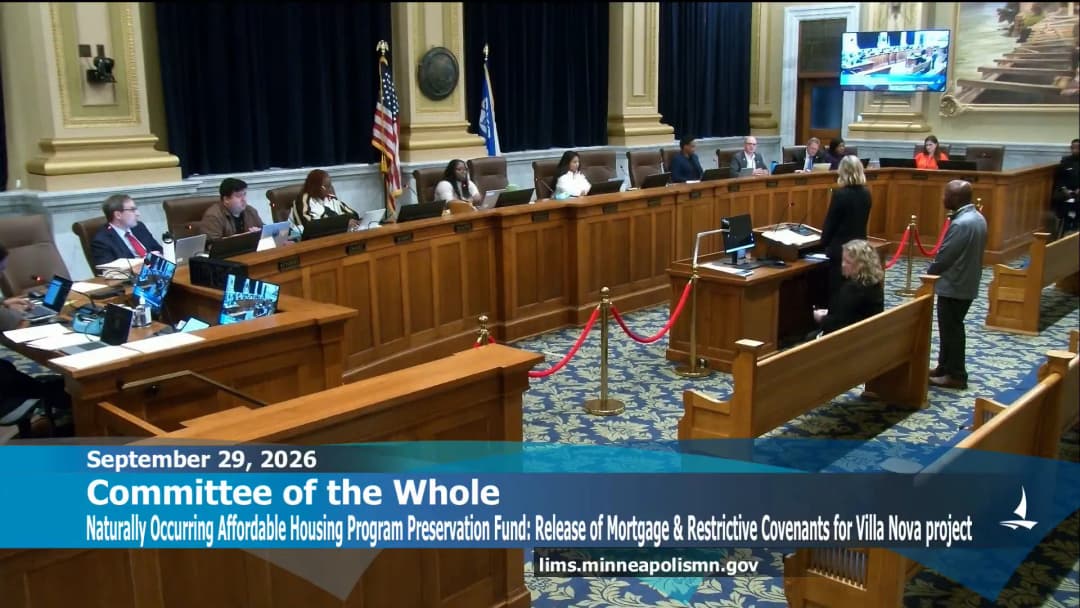
The Minneapolis City Council Committee of the Whole met on Tuesday, September 29, 2026, with Chair Orreen Chowdhury presiding. The meeting opened with a continued public hearing on the 'Workers Drive Minneapolis' autonomous-vehicle ordinance, followed by council discussion and a vote. It then took up Brownfield grant awards and the Villanova NOAA housing loan release before considering a receive-and-file item on Minneapolis Police Department FY2025 spending. Standing committee reports were skipped and the meeting was adjourned after the final votes. Public Comments & Testimony - Ricky Halgren spoke in support of the ordinance, describing big tech as a threat to immigrant workers and saying residents should decide the future of their streets. - Jennifer Dunham, president of the National Federation of the Blind Minnesota Metro chapter, urged a no vote on the human-monitor mandate, saying AVs would provide independence and safer options for blind riders if the requirement were not imposed. - A speaker listed as Smith said she supported Lyft and human drivers and asked the council to listen to residents who do not want driverless cars. - Wade, a Ward 13 resident, supported the ordinance, saying drivers provide safety and care in winter and that Waymo's savings would go to shareholders rather than the community. - Jim Hammond, a University of Minnesota student, opposed the ordinance, citing Uber sexual-assault claims, Waymo's safety record, and market-expansion data from other cities. - Mike Bartos, a Ward 10 resident and SEIU Local 26 member, supported the ordinance and urged the council to side with 10,000 drivers and families rather than California tech companies. - Mohammed Warsame, an Uber/Lyft driver with technology degrees, asked for drivers and community members to be included in AV decision-making and made safety a priority. - Mohammed Aden, from Denver, opposed Waymo, describing accidents and unsafe experiences in Denver and urging Minneapolis not to bring Waymo in. - Judy Sanders, a blind downtown Minneapolis resident, urged a no vote on the human-monitor version, citing her positive driverless ride in Austin and calling for independence for blind people. - Abdekhan Ali, a rideshare driver and SEIU Local 26 organizer, supported the bill, saying AV profits would not stay in local restaurants, groceries, or entertainment and that drivers' income matters. - Jack Brunel said job-loss fears were not supported by data, citing the growth of the rideshare market after taxis and the continued presence of Uber/Lyft drivers in San Francisco alongside Waymo. - Alex Smith, father of a daughter with Angelman syndrome, urged a no vote, saying the human-monitor requirement would force vulnerable people to ride with strangers and reduce independence. - Hamse Hussein, a SEIU Local 26 member and driver organizer, supported the ordinance, said AVs are not safe yet, and called for union recognition and driver training. - Ayan, a wheelchair user speaking through an interpreter, supported the ordinance, saying Uber/Lyft drivers provide essential accessibility for her and other disabled community members. - David Stigers, president of ATU Local 1005, supported passage, saying AV safety is overstated, human safety operators are vital, and AVs should pay fees for the infrastructure they use. - Emma Cleveland, ATU state political coordinator, supported the bill, questioned AV industry job-replacement promises, and called for local safety operators and skepticism of Waymo's self-reported data. - Abdi Rashad Mohammed, an SEIU Local 26 Uber/Lyft driver, supported the ordinance, describing help he gives elderly riders and saying drivers can be deactivated for canceling on riders with service animals. - Ben Shermock, a Ward 3 resident, supported the bill, saying AVs are not ready for construction zones or snow and that oversight can create jobs. - Jeff Whitman, a longtime Minneapolis resident, opposed the ordinance and asked the council not to limit his transportation options; he described his positive Waymo experience in San Francisco. - Gavin Chibor, a Minneapolis resident and rideshare driver, opposed the bill, saying it protects existing rideshare companies and that more options would benefit passengers and drivers. - Abdirahman, an Uber/Lyft driver speaking through an interpreter, supported the bill, citing winter weather, sensor limitations, and the need to keep drivers who support their communities. - Marise Washington, a 12-year Uber/Lyft driver, asked that drivers not be left behind and that innovation move forward in a way that includes Minnesota drivers. Discussion Items - Autonomous-vehicle ordinance: Councilmember Robin Wansley presented the 'Workers Drive Minneapolis' ordinance, explaining it would require commercial autonomous-vehicle operators to employ, contract with, or retain a human safety monitor and meet baseline local regulations before obtaining a Minneapolis license. She said it is not a ban, would not take effect until October 2027, and is intended as an interim protection while the council uses 2027 to develop broader AV rules on traffic management, safety, liability, fees, surveillance, and data. She cited a Minnesota Department of Labor estimate of up to 10,000 metro rideshare drivers, with 90 percent living in the Twin Cities metro, and said the ordinance responds to big tech companies testing AVs in Minneapolis without state regulation. Wansley moved substitute language changing 'employed or retained' to 'employ, contract, or retain' and changing 'human monitor' to 'human safety monitor'; it was seconded. Councilmembers debated process, data, worker protections, disability access, and consumer choice. Schaefer objected that the council was voting before receiving a staff report requested in June; Palmasano and Vita said they needed more data and saw the issue as about options; Warren defended personal choice and AV benefits for some riders; Stevenson, Chavez, Osman, and Wansley emphasized worker displacement risk, the lack of state regulation, and prior failures to regulate Uber and Lyft. The chair later warned members to focus on the issue and avoid personal attacks. - Spring 2026 Brownfield grants: Kevin Carroll, CPED principal project coordinator, presented seven grants totaling $3,789,602 for five projects, including 250 Fremont Avenue, the Grain Exchange building, Seven Points at Lake and Hennepin, Inner-City Tennis, and Minnesota Brownfields investigation grants. Total development value was about $311 million. Vice Chair Chughtai asked about soil and vapor mitigation at Seven Points; Carroll explained Minneapolis's industrial legacy, MPCA oversight, and vapor-mitigation systems. The motion to approve carried by voice vote. - Villanova NOAA project: David McKunza, CPED residential finance supervisor, presented a proposal to release the city's $4.5 million zero-interest deferred NOAA loan and affordability restrictions for Aeon's 16-building scattered-site portfolio. The portfolio has faced COVID impacts, civil unrest, Operation Metro Surge, high vacancies, security costs, and depleted reserves. Key Bank, as special servicer, holds a roughly $15.5 million first mortgage; a broker's opinion of value was about $17.54 million, and staff said foreclosure would wipe out the city's subordinate loan. Under the negotiated terms, the city would receive $100,000 upfront, possible excess proceeds after Key Bank is paid, and a commitment to double renter-protection notice and relocation-assistance periods from three to six months. Rachel Robinson, Aeon president and CEO, answered questions about buyer vetting, vacancy, security costs, and tenant transition. Councilmembers expressed concern about the loss of affordability protections and the broader NOAA market outlook. The motion to approve carried by voice vote. - Minneapolis Police Department FY2025 spending: Chair Chowdhury moved to refer the receive-and-file item to the October 5 budget committee meeting; the motion was seconded. Councilmember Chavez announced she intends to request a city auditor audit of MPD overtime management controls. Councilmembers differed on whether moving the item would resolve the lack of MPD and mayoral attendance. The council voted 6-3 to call the question and then 6-3 to refer the item to the Budget Committee. Key Outcomes - The agenda was adopted by voice vote. - The autonomous-vehicle ordinance was approved as amended, with the chair announcing a roll-call tally of seven ayes and four nays. - The Brownfield grant package was approved by voice vote. - The Villanova NOAA loan release and associated terms were approved by voice vote. - The MPD FY2025 spending item was referred to the Budget Committee on October 5 by a 6-3 roll-call vote; a preceding motion to call the question also carried 6-3. - Standing committee reports were not taken up because of the length of the meeting, and the meeting was adjourned.
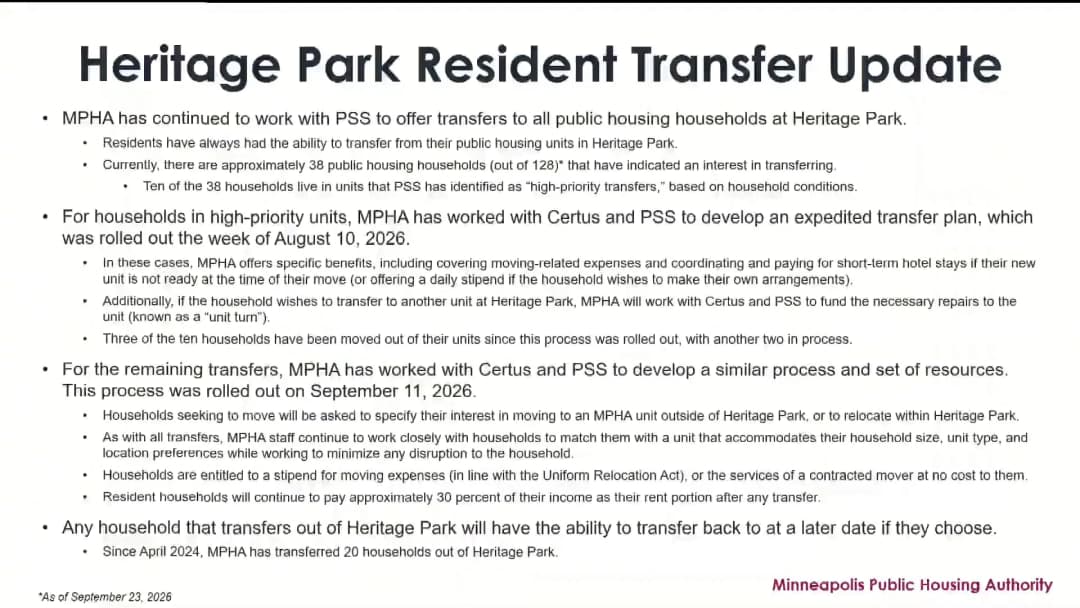
The Minneapolis City Council Budget Committee, chaired by Councilmember Aisha Chugtai, met on September 29, 2026, to hear the Minneapolis Public Housing Authority's presentation on the mayor's recommended 2027 budget. Eight members were present, establishing a quorum. The meeting was broadcast live with real-time captioning. MPHA leadership, including Executive Director Abdi Warsami, presented on operations, capital funding, Glendale redevelopment, and Heritage Park stabilization; members then questioned MPHA on oversight, financing, and tenant protections. MPHA Overview and Capital Needs - MPHA serves about 26,000 residents on any given night, roughly 5% of the city's population, through public housing in 42 high-rises, 800 deeply affordable family scattered-site homes serving 3,300 residents, and housing choice vouchers serving 18,500 residents. It serves more than 10,000 children per day across the portfolio. - MPHA estimated its capital backlog at $320 million for its 6,000 units, compared with a $169.1 billion national public-housing capital backlog. HUD has historically funded approximately 10 cents per dollar of need. MPHA said it faces an additional $2.9 million federal operating cut in 2026. - Recent achievements highlighted included: $4.3 million in 2025 to repair and upgrade 100 family homes; breaking ground on the $78 million Spring Manor redevelopment in Ward 3 to rehabilitate 221 units and add 15 deeply affordable units; $8.2 million from Minnesota Housing for electrical systems in three high-rises; $5 million annually from the city housing tax levy; and $1.4 million annually plus $1.4 million one-time for Stable Home Stable Schools. - MPHA said a $2 million biennial Stable Home Stable Schools request and a $7 million housing infrastructure bond request for Glendale did not pass because of the legislative impasse. MPHA received a two-year, $21 million state award expected to create 600-700 new housing vouchers. - MPHA outlined a five-year levy plan that would gradually raise its annual levy amount to $8 million over three years, support city-issued bonding debt service for Glendale, and help construct more than 300 new deeply affordable units. Stable Home Stable Schools and Emergency Housing Vouchers - Stable Home Stable Schools has operated since 2019 with MPHA, the city, Hennepin County, Minneapolis Public Schools, and the YMCA, and has assisted 7,994 children and 2,865 families. MPHA later gave its estimated annual budget as $7.8 million. - The city-funded Emergency Housing Voucher program, formally launched in August 2026 after a June contract signing, provides 36 months of rental assistance through Hennepin County's coordinated entry system, split roughly between individuals and families. As of the report, MPHA had received 24 referrals, with 9 in intake, 7 vouchers issued, and 2 households placed. First-year budgeted authority is just over $2 million, with about $300,000 expected to be spent this calendar year. Glendale Redevelopment and City Bonding Request - Glendale Townhomes consists of 184 townhomes built in 1952, serving about 600 low-income residents on 12 acres in the Prospect Park neighborhood. MPHA estimates about $23 million in capital needs, representing 3% of its portfolio but 7% of its capital backlog. - The redevelopment plan, shaped by 11 resident priorities, would replace all 184 existing homes and add 100 new deeply affordable family homes in two phases. It includes 300 parking spaces, accessibility and single-level units, and increased counts of larger bedrooms, including five-bedroom units rising from 0 to 12 and four-bedroom units from 18 to 32. - Residents would retain the right to return, continue paying 30% of income, and MPHA would continue to own and operate the site. MPHA said construction would be managed by MPHA with passive tax-credit investors. - MPHA is seeking city bonding authority to generate approximately $38-42 million in proceeds per phase, combined with $40-50 million of MPHA capital and other financing, to deliver 284 deeply affordable units. MPHA would pay debt service, with no city general fund cost. The request was not included in the mayor's 2027 budget; MPHA hopes to close phase one in late 2028 or early 2029. Heritage Park Stabilization and Oversight - Heritage Park has 440 units: 300 income-restricted tax-credit units administered by the city, including 200 public-housing units, plus 140 market-rate units. It was created through an early-1990s consent decree to deconcentrate racially segregated public housing. MPHA was the landowner but a for-profit developer, McCormick Barron Salazar, had operating control; MPHA's main obligation was to pass through the public-housing operating subsidy, now about $85,000 per month, or less than $500 per unit. - HUD inspection scores fell from 94 in 2015 to 70 in 2018, 68 in 2019, and 61 in 2020. Rental licenses at Heritage Park lapsed from 2019 to 2025; MPHA said a city staff member had told the owner licenses were no longer required. The property has been in receivership since December 2025, managed by CERTIS Financial and Property Solutions and Services. - MPHA reported approximately 38 of 128 public-housing households at Heritage Park had asked to move; 10 were classified as high priority, and 3 had been relocated since early August. All households retain a right to return, and households continue to pay 30% of income. MPHA said no units have been condemned by the city. - MPHA is repurposing $3 million from 2026 levy and capital funds and proposing $3 million from its 2027 public-housing tax levy for Heritage Park, a $6 million proposed investment, plus a previously available $1.1 million. The state has committed about $5 million. Capital needs are estimated at $55-65 million. MPHA has also delayed Glendale phase one by at least one year to prioritize Heritage Park and repurposed funds from the scattered-sites missing-middle project. - Councilmember Warren was highly critical, citing a receiver's report of widespread water damage, mold, and 3,700 failing windows, and pressed MPHA on why households were placed without pre-move-in inspections. MPHA maintained it was not the owner or operator, did not lease to residents, had limited authority under regulatory and operating agreements, and was the largest contributor to stabilization since 2022. Councilmembers Palmasano, Schaefer, Chavez, and Chowdhury raised separate concerns about rental-license payments, city inspection responsibilities, and the need for city accountability. Financial and Accountability Questions - Vice Chair Schaefer asked for MPHA's overall budget and funding sources. MPHA reported a total budget of approximately $210 million, with federal funds accounting for about 96-97%; there is no ongoing city general fund support, but the city housing tax levy provides about $5 million annually. MPHA agreed to provide written follow-up on Emergency Housing Voucher and Stable Home Stable Schools budgets and on state capital investment history. - On rental licensing, MPHA representatives initially said they held no city rental licenses, then clarified they currently maintain licenses required by a 2024 state law but have not made payment because of a dispute over using federal funds; the issue is in litigation. - Councilmember Stevenson expressed anger about decades of disinvestment in public housing and asked what lessons MPHA had learned from Heritage Park. MPHA answered that the split-ownership, for-profit manager model had failed nationally and should be replaced by a single local owner responsible for operations and inspections; it also argued the city bonding tool could be repeatable for other deeply affordable housing transformations. - Councilmember Vita raised tenant complaints at Hamilton Manor, saying maintenance, management, parking, elevator, and odor issues persisted. MPHA acknowledged a roughly $10-11 million recent renovation but noted ongoing staffing, security, and capital constraints and agreed to follow up. - Councilmember Chavez asked when the city resumed inspections at Heritage Park and what the city should do differently. MPHA said the city always had jurisdiction, complaint inspections occurred, and city inspection activity resumed after receivership, with a formal follow-up memo requested. Councilmember Chowdhury asked for clarity on housing-code enforcement and said the city attorney's office should review the prior court case and rental-license litigation. Key Outcomes - No formal vote was taken on MPHA's budget request; the committee accepted the presentation and filed it without objection. - The committee requested follow-up materials from MPHA, including written budget and funding details, and a memo on Heritage Park inspection history. A councilmember also planned to consult the city attorney on housing-code enforcement. - The meeting adjourned to Monday, October 5, 2026, when the committee will receive 2027 budget presentations from the fire department and emergency management department.
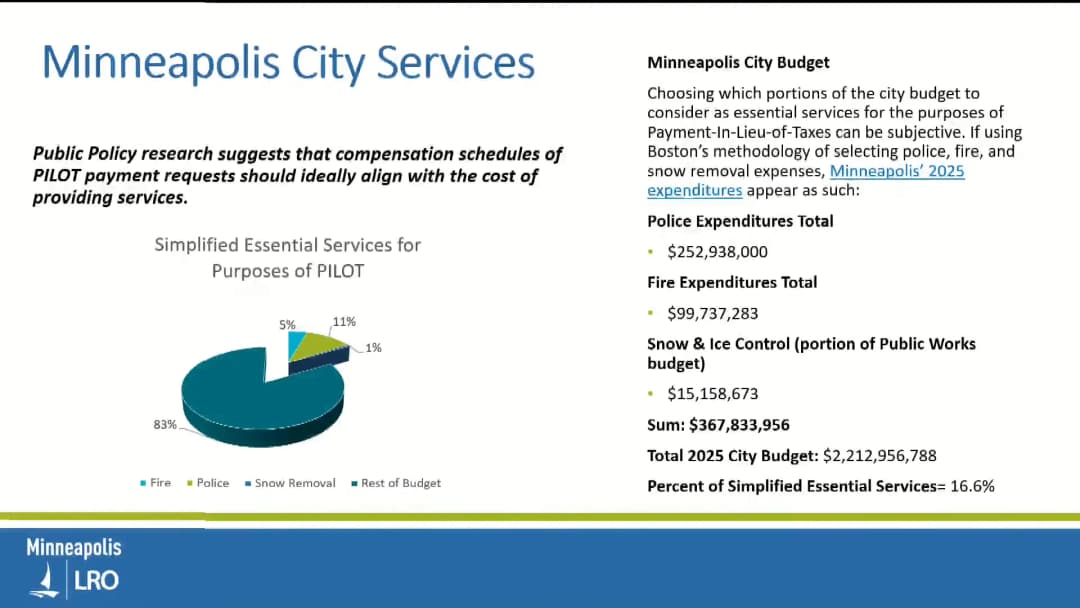
On Monday, September 28, 2026, the Minneapolis Budget Committee met to review analysis and budget presentations related to the mayor's recommended 2027-2028 budget. No agenda or minutes were provided in the source materials, so this summary is based on the raw transcript. Roll call showed seven members present, establishing a quorum; Councilmembers Wandsley, Vita, Warren, Osman, and Whiting were marked absent. The roll call initially listed Councilmember Palmasano absent, but Palmasano later participated in discussion. Chair Aisha Chuktai presided. Payment in Lieu of Taxes (PILOT) Analysis - Christina Keterling, senior advisor to the Board of Estimate and Taxation, presented an analysis prepared with Legislative Research and Oversight and the city assessor's office. Minneapolis has more than 6,000 tax-exempt properties; 1,625 are non-government-owned, held by roughly 770 unique entities, and 704 of those properties have an estimated market value of $1 million or more. - The assessor's office produced preliminary estimates for the top 50 most expensive exempt properties of what they would pay in 2026 if taxable. The gap between the top three properties and the 48th-50th properties is about $26 million. The University of Minnesota has nearly $4.3 billion in Minneapolis land assets; Keterling noted it is a land grant university with its own police force and land care operations. - Keterling explained PILOTs are voluntary payments that typically generate less than 1 percent of municipal revenue. Boston's routine annual model asks nonprofits with property valued over $15 million for 25 percent of the estimated taxable amount, allows up to 50 percent of that to be covered by community benefits, and received 76 percent of requested payments in 2024. Providence's long-term contract model produces about 2.7 percent of city revenue from PILOTs. Boston has begun moving toward negotiated long-term agreements. Keterling also noted criticisms that nonprofits have already earned tax exemption and that some fear voluntary payments could endanger their status. - Councilmembers asked about state-law authority, University of Minnesota street and emergency-call costs, corruption risks in negotiated agreements, and whether publicly funded institutions should be excluded. Councilmember Chavez said the city should consider PILOTs to help with budget constraints and requested a city attorney memo on whether either model is legal in Minneapolis. The committee received and filed the report. Regulatory Services Proposed 2027 Budget - Director Enrique Velasquez presented Regulatory Services' proposed 2027 budget: 195.9 current FTE and a $31.7 million 2026 budget, rising to $35.1 million in the mayor's proposal. The $3.4 million net increase is mostly required internal service charges, liability allocation, contractual COLA and step increases, overtime, on-call, parking, and custodial costs; Velasquez said the proposal does not increase discretionary spending. Revenue is projected to decrease by $163,000. - The proposal includes $278,000 for overtime and on-call, $130,000 for parking and custodial costs at inspection services' new facility, and $458,135 to continue the traffic safety camera pilot. Proposed divestments total $1,177,199, including eight general fund FTEs and one special revenue FTE; exact position decisions were still in flux. One vacant housing liaison position would be repurposed to maintain an inspector II assigned to vacant, condemned, fire-damaged, and open-to-trespass buildings. - Division figures in the proposal: Code Compliance and Traffic Control, $10.1 million; Inspection Services, $14.1 million; Animal Care and Control, $5.7 million; Operations and Engagement, $3.8 million; and Homeless and Encampment Program, $1.3 million. Planned 2027 FTEs were pending further budget decisions. - Velasquez said Public Works will stop rubbish abatement service in March 2027, requiring a new $300,000 external contract at roughly twice current costs. Other contracts include $300,000 for yard maintenance, $335,000 for board-up services, and $250,000 for the Hennepin County winter warming center. Animal Care and Control will lose an ASPCA grant-funded foster coordinator at the end of December 2026; the department warned this could reduce foster capacity, lengthen shelter stays, and lower its 90-plus-percent live release rate. - Councilmember Chavez supported increasing rental license fees to preserve inspection capacity and asked for a breakdown of the $268,000 projected decline in inspection licenses and permits. Councilmember Rainville asked about license plate reader technology; staff said LPR is not currently allowed for regulatory parking enforcement without a state law change. Councilmember Chowdhury opposed outsourcing rubbish abatement and requested a Public Works follow-up. Chair Chugtai said the council needs clearer information about FTE cuts well before budget markup and called the initial budget book's lack of that information unacceptable. Homelessness Response Budget - The final special-topic presentation covered the city's cross-departmental homelessness response. The proposed 2027 enterprise-wide budget is $12,426,518. Regulatory Services is proposed at $1.3 million, up 28 percent; Health at about $835,000, down 4 percent; Public Works at $200,000, up 100 percent; CPED at $9.8 million, down 46 percent; and MPD up 10 percent to fund one lieutenant assigned to homeless response. Chair Chugtai noted this is down from roughly $20 million in 2026. - Regulatory Services said its five-person homeless response team responded to more than 1,000 311 requests in 2026, later cited as 1,316; made nearly 2,000 engagements with unsheltered residents; and completed 275 housing referrals. Health's mobile medical unit served more than 900 people in 2026, about one-third with unstable housing, and made more than 600 referrals for housing, substance use treatment, dental care, primary care, and other services. Public Works will continue encampment cleanup and disposal. - CPED's housing director said the 46 percent decline reflects 2026 one-time funding that does not continue: $1.8 million for emergency housing vouchers, $3.8 million for emergency rental assistance, $2.0 million in Affordable Housing Trust Fund dollars for homelessness response, and $1.4 million for Stable Homes Stable Schools. CPED plans to provide more detail at the September 29 budget presentation. Councilmember Stevenson asked about the $2 million AHTF allocation; CPED said $1 million had been contracted with the county and $1 million was going through a county RFP process. - Councilmember Wandsley objected that emergency housing voucher funding was not carried forward despite a prior three-year commitment and asked what tools the council has to enforce budget commitments. Councilmember Chavez said the vouchers support 50 families and 50 adults and that she does not see a budget agreement without addressing the funding, adding trust has been broken. Councilmember Stevenson deferred detailed CPED questions to the next day's budget meeting. Health staff said the mobile medical unit's 4 percent reduction is a cost refinement, not a service cut. MPD reported it has not spent significant overtime on encampment closures in 2026 because there have been no large-scale encampments; Commander Monica Hansen said she would provide the exact figure as a follow-up. Key Outcomes - The committee received and filed the PILOT report, the Regulatory Services budget presentation, and the homelessness response special-topic presentation; no formal roll-call vote was taken on their substance. - Staff follow-ups were directed on: city attorney review of PILOT legality; University of Minnesota land care, street maintenance, and 311/911 call data; exclusion of publicly funded institutions from PILOT estimates; a breakdown of the $268,000 inspection license and permit revenue decline; Public Works rubbish abatement transition details; MPD's exact 2026 encampment-related overtime figure; emergency housing voucher referral data; and whether the Health Department could hold medical records for a behavioral crisis response program. - The committee adjourned to Tuesday, September 29, 2026, for CPED and Minneapolis Public Housing Authority budget presentations.
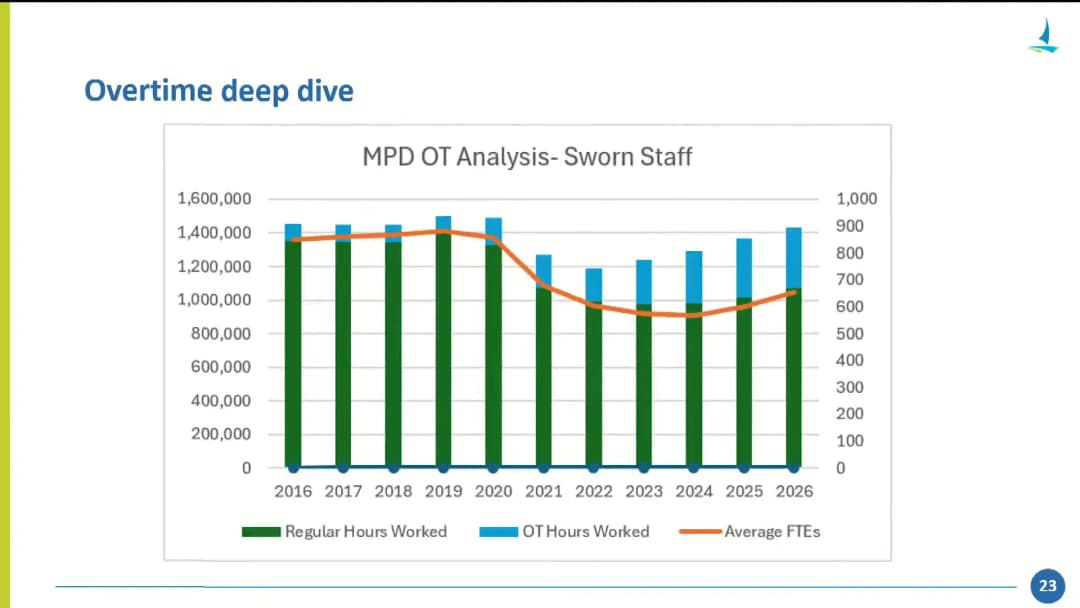
The Budget Committee of the Minneapolis City Council met on September 28, 2026 to review the Mayor's proposed 2027 budget for the Minneapolis Police Department. The meeting featured a presentation from Interim Chief Bill Peterson, financial staff, and deputy chiefs, followed by extensive questioning from council members. No votes were taken; the item was continued to a later date. Key topics included a proposed $250 million budget, a $20.3 million (9%) increase, overtime management, recruitment investments, staffing cuts, and accountability measures. Discussion Items - Presentation of Mayor's Proposed 2027 MPD Budget: Interim Chief Bill Peterson presented the department's mission and budget overview. The total proposed budget is $250 million, with salary and fringe comprising 79% ($198 million), contractual services 17% ($41 million), and operating costs 4% ($9.8 million). The budget includes a net increase of $20.3 million (9%) over 2026, driven largely by overtime, cadet/CSO funding, and contractual services. The department has 991 FTEs (731 sworn, 260 non-sworn), with 82 vacant sworn and 25 vacant non-sworn positions. Proposed investments include $13.1 million in new overtime funding (plus $12 million from vacancy savings, totaling $25.1 million), $6.4 million for cadets and CSOs (up from $2.1 million), and $3.1 million for professional services. The department plans to cut 17 non-sworn FTEs and one FTE via administrative adjustment, targeting vacant positions in constitutional policing, investigations, and professional standards. - Reform and Operations Updates: Deputy chiefs reported on progress under the settlement agreement: 64 policies approved by the independent evaluator, new use-of-force training, and planned stops/searches training in early 2027. The Investigations bureau highlighted the FAST team (non-fatal shooting unit) which initiated 150 cases (64 closed, 41 open), a 27% decrease in homicides year-to-date, and an 83% homicide clearance rate (up from 70% in 2024). Non-fatal shooting clearance rates rose to 41%. Domestic violence reports increased 10%, prompting expanded response protocols. The Professional Standards bureau discussed technology upgrades, wellness initiatives, and recruitment pathways (lateral, recruit, cadet, CSO). - Overtime Deep Dive: Assistant Chief Mark Kluko presented a 10-year overtime trend showing an inverse relationship between sworn staff numbers and overtime hours. Despite staffing recovery in 2025-2026, overtime remains high. A new dashboard provides bi-weekly overtime tracking by category. Management pledged tighter controls: overtime approval limited to the executive team, weekly reviews, and planned reductions in minimum staffing levels in the fourth quarter of 2026. The department acknowledged that $33 million in overtime in 2025 was partially due to mismanagement. - Councilmember Questions and Concerns: - Councilmember Chavez: Pressed for a commitment not to overspend the adopted budget. Interim Chief Peterson stated the department will do "everything possible" but cannot guarantee due to unforeseen events, leading Chavez to note no firm commitment was made. Chavez also requested a detailed breakdown of overtime spending by category, a public-facing overtime dashboard, and an itemized list of contractual services. - Councilmember Wandsley: Questioned the dual funding streams for settlement agreement contracts (Finance Dept. and MPD), and opposed cuts to civilian case investigator positions that were funded in the prior budget. She requested a staffing analysis, geographic data on response times and clearance rates, and rationale for focusing on new recruits versus more cost-effective lateral hires. She also questioned the decision to cut civilian positions from Investigations when the council had allocated ongoing funding for three case investigators. - Councilmember Osman: Criticized the lack of oversight that allowed $33 million in overtime overspend in 2025, calling it a failure of leadership and bookkeeping. He asked about the vehicle fleet and take-home vehicles, and urged the department to budget like every other household. He noted the council is not trying to cut funding but expects fiscal responsibility. - Councilmember Stevenson: Inquired about cost implications of the next police contract, potential salary increases, and the per-CSO cost ($100,000 per year, averaging $250,000-300,000 over 2.5-3 years). He questioned the impact of cutting civilian investigator positions, understanding that while those positions support low-level investigations, their elimination could delay service for crimes like stolen property. He also asked about standby time reimbursement and management controls. - Council President Payne: Sought clarification on academy start times (February, June, October) and requested five-year data on CSO and cadet matriculation. He noted that the average overtime per officer per pay period (83.42 hours) would imply half the force is working beyond policy limits, but was told standby hours skew the average. - Vice Chair Schaefer: Asked about MPD's revenue sources (mostly state aid) and the anticipated trajectory of overtime if the budget is right-sized, hoping for a decline as hiring progresses. - Councilmember Rainville: Praised the budget as the most honest and detailed he has seen in five years, acknowledging reforms and improved clearance rates. - Councilmember Chowdhury: Raised concerns about the mounted patrol unit being closed (no funding in 2027) despite a contract line item, and asked about increased phone service costs due to body cameras and VPN requirements. - Chair Chugtai: Asked about controls for officers using PTO and then picking up overtime; was told the timekeeping system prevents double payment, but parental leave may allow overtime. She requested a global number on unsolved investigations and better tracking of domestic violence. She noted that municipal and state recommendations for treating the MPD budget as a work session due to its complexity and the historic overspend. - Settlement Agreement and Investment Details: The $3.1 million in professional services is for non-MDHR contracts that were underfunded. Councilmember Wandsley noted confusion over $4 million dedicated to settlement agreement contracts managed by Finance and Property Services. MPD representatives explained that some ongoing requirements are not covered by settlement funds. Key Outcomes - No votes taken: The item was continued to a later date (as of meeting close, a follow-up date was not set). - Commitment on budget: Interim Chief Peterson committed to doing everything possible to stay within the adopted 2027 budget, but stopped short of an unconditional pledge, noting that unforeseen events (e.g., mass casualty incidents) could necessitate additional spending. - Administrative follow-ups requested: Council members requested multiple staff memos and special topics presentations on: - Detailed breakout of overtime spending by category (e.g., 911 response, investigations, standby, training, special events). - Public availability of the new overtime dashboard. - Itemized list of all contractual services in 2027. - Breakdown of settlement agreement funding alignment with independent evaluator recommendations. - Geographic breakdown of response times and clearance rates. - Five-year data on CSO and cadet matriculation rates and costs. - Impact of proposed civilian investigator cuts on case processing. - Rationale for not seeking council approval for reallocating case investigator funds. - Status of a comprehensive staffing study (not currently being pursued). - Charges for standby time and vehicle fleet needs. - Management controls: MPD outlined new controls including a dashboard, weekly executive meetings, and planned reduction in minimum staffing levels to curb overtime. - Program changes: The mounted patrol unit is being closed and will not appear in the 2027 budget. The department is evaluating standby time usage more closely. - Next steps: The chair will work with MPD to schedule a continued discussion to address outstanding questions and special topics.
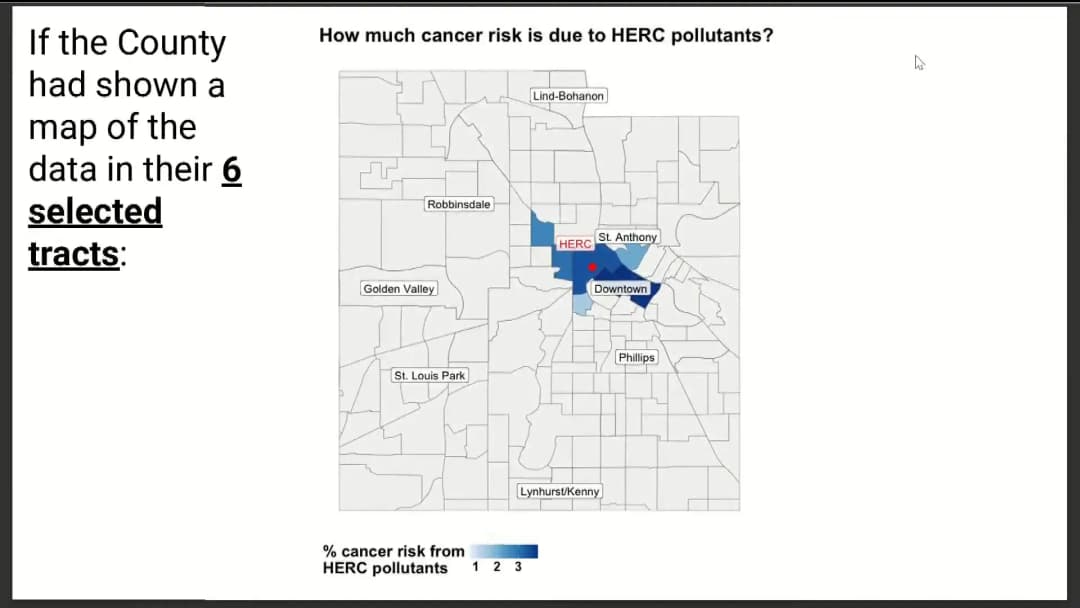
Climate and Infrastructure Committee Meeting - September 24, 2026\n\nThe Climate and Infrastructure Committee met on Thursday, September 24, 2026, at 6:32 PM. Chair Robin Wandsley presided, with five members present (Vito, Vice Chair Stevenson, Chughtai, and Wandsley) and two absent (Warren and Chowdhury, the latter excused for a League of Minnesota Cities commitment). The meeting began with the chair addressing Mayor Fry’s recent memo restricting staff presentations, which she argued undermines legislative oversight and public transparency. She pledged to continue open dialogue and collaboration with staff. The agenda included three public hearings, followed by a lengthy discussion section covering items 5–22, and a community presentation on HERC and zero waste.\n\n Public Hearings\n- Sanitary Sewer Service Charges (SAC): Steve Poor, Director of CPED Development Services, presented the annual resolution adopting assessments. 14 properties were assessed: 10 triggered by audits or building permits, and 4 SAC deferrals that failed. No public testimony was given. The committee unanimously approved the resolution.\n- Downtown Improvement District: Continued from a prior meeting due to a noticing error, this hearing had no public testimony and was unanimously approved.\n- Commercial and Multifamily Energy Disclosure Repeal Ordinance: Sustainability Manager Alice Frelick presented a comparison of the city’s benchmarking program (since 2013) and the state’s program (since 2024). Key differences: the city requires water use data, audit requirements for low-performing buildings, and fines (collections: 2023 – $5,980; 2024 – $12,200; 2025 – $26,960). Staff argued the state program allows streamlining and shifting staff to direct engagement. Chair Wandsley and several members expressed concerns about losing stronger local requirements, especially for water data and audits. A motion to delay the item by one cycle (to October 8, 2026) was made by Chair Wandsley, seconded by Councilmember Chughtai, and passed unanimously.\n\n Discussion Items\nAll consent items (5–22) were moved to discussion per committee request. Public Works Director Tim Sexton noted the importance of advance notice for staff attendance. Key items included:\n- Item 5 – Areaway Removal (1800 1st Ave S): Approved unanimously after clarification that costs ($584,371.30) will be specially assessed to the property owner.\n- Item 6 – Metro H-Line BRT Comments: Approved unanimously; Chair Wandsley thanked staff for incorporating community feedback on student transit access.\n- Item 8 – Uniform Assessment Rates: Director Don Elwood explained the dollar-per-square-foot rate used for road projects. Vice Chair Stevenson asked about an ongoing evaluation of special assessments; Sexton confirmed it continues. Approved unanimously.\n- Item 9 – Hoff Ramp Vehicle Door Installation: Vice Chair Stevenson raised questions about parking revenue vs. land opportunity cost. Sexton said no study on tax revenue potential had been done. Approved unanimously.\n- Item 10 – Hauling and Disposal of Waste Materials: Councilmember Chughtai clarified the contract does not cover encampment debris. Approved unanimously.\n- Item 13 – Citywide Traffic Signal Retiming: Engineers Ben Brasser and Don Elwood described the first comprehensive retiming in over a decade, covering 800+ signals. They confirmed inclusion of light rail, bus priority, and engagement with disability and senior communities. Approved unanimously.\n- Item 19 – Legislative Directive on Bike Lane Conflicts: Co-authored by Chair Wandsley, Vice Chair Stevenson, and Councilmember Chavez. Director Sexton noted the scope was narrowed to two-way bikeways at signalized intersections in agreement with Councilmember Chavez. Approved unanimously.\n- Item 20 – Green Cost Share Program Guideline Updates: Staff explained the program will move from PRC process to council approval of guidelines and awardees. Approved unanimously.\n- Item 21 – Pedestrian Advisory Committee Appointments: Approved Eli Harvey and Michelle Einstein.\n- Item 22 – Dakota Black Party Block Event Permit (Sept 26, 2026): Approved without recommendation due to late permit timeline.\n\n Key Outcomes\n- SAC Resolution: Approved unanimously.\n- Downtown Improvement District: Approved unanimously.\n- Energy Disclosure Repeal: Delayed by one cycle to October 8, 2026, via unanimous vote.\n- Items 5–21: All approved unanimously except item 22 (approved without recommendation).\n- Receive and File – HERC/Zero Waste Presentation: The Zero Burn Coalition (led by Leslie Mint of MN Environmental Justice Table) presented updated health impact data: HERC contributes to 1–2 premature deaths/year and $18–32 million in health damages, with disparities in BIPOC communities. They advocated for closure by Dec 31, 2027, a clean community fee, zero waste ambassador program, and city-county negotiations on HERC conversion. The presentation was received and filed; no vote taken.\n\nThe meeting adjourned without further business.