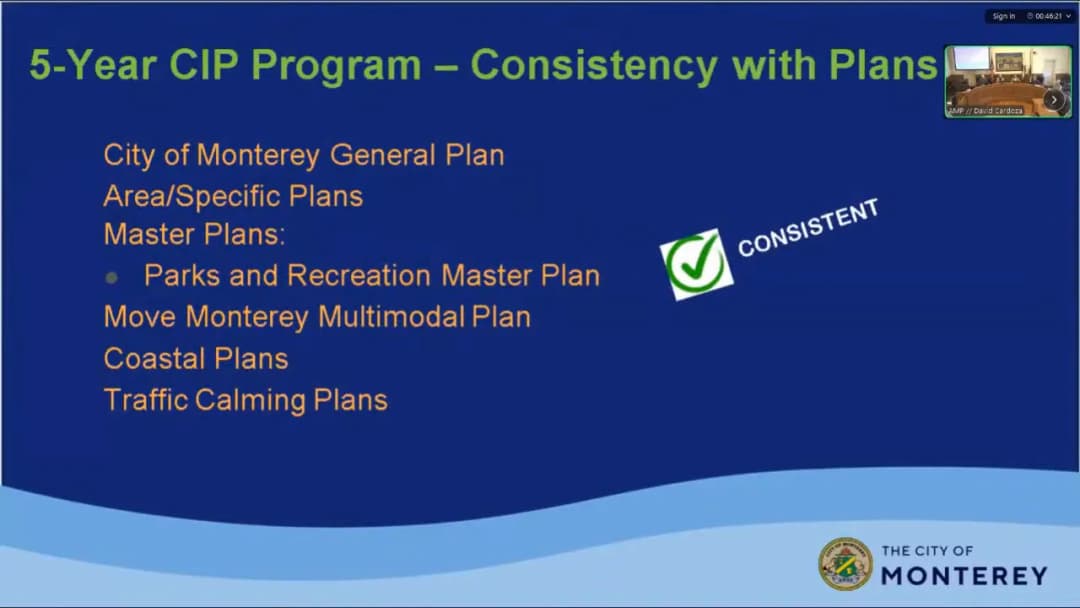
The Montey Planning Commission held a public hearing to consider whether the five-year Capital Improvement Program (CIP) for fiscal years 2025-2026 is consistent with adopted city plans. The commission reviewed staff's analysis, discussed project funding and overlapping programs, and voted unanimously to recommend approval to the City Council. The meeting also included an update on a recently adopted zoning clearance permit ordinance. Public Comments & Testimony - No members of the public spoke during the public comment period or during the hearing on the CIP item. Discussion Items - CIP Consistency Finding: Senior Associate Planer Mathew Bugert presented the Cip list (Exibit A). Staff found all projets consistent with the General Plan, area plans, master plans, specific plans, Coastal Plan, Traffic Calming Plan, and Move Montey Multimodal Plan. The CEQA review classified 28 projects as not a project under CEQA, 57 as exempt (existing facities, replacement/reconstruction, information coltction), 11 requiring future additional review, and 3 wth already adopted Initil Studies/Mitigated Negative Declarations. - Commissioner Questions on Program Overlap: A comissioner questioned the difference between the CIP and the Neighborhood/Neighborhood Commercial Improvement Program (NCIP/NIP), noting that some projects (e.g., the Herman-Madison-Larkin-Via Del Rey intersction) appear on multiple lists without apparent progress. City Engineer Andrew Estling clarified that overlapping projects may track different fundng sources (e.g., Measure PS vs. SB1) and that the intersction project has a grant-funded CIP account. - Wharf Repairs: In reponse to a comissioner's query, staff confirmed that warf repairs are included in the CIP via two programmatic accounts for structur assessments and critcal maintenance. - Fundng Concers: A commissioner expressed concern about the lack of identified revenue sources for major projects (e.g., rebuilding works, police and fire sttions, tunnel repairs). Staff acnowledged the challenge, noted that the CIP often funds preliminary studies that enable grant applitions, and stated that the Finance Director will present funding strateges to the City Council in the folowing weeks. Key Outcomes - Unanimous Vote: The commission voted 5-0 to adopt a resolution recommending that the City Council find the five-year Capital Improvement Program (fiscal year 2025-2026) consistent with al adopted plans. - Staff Update: Levi (staff) reported that on May 6, 2025, the City Council completed the second reading and adopted an ordinance amending Chapter 38 of the zoning code to require new businesses and existing businesses changing use or location to obtain a zoning clearance permit. The ordinance will take effect 30 days from May 6 (approximately June 5 or June 6). - Future Meeting: The comission was informed that a tentative agenda for the May 27 meeting includes one item, which may change.
Public Meetings - Monterey, California
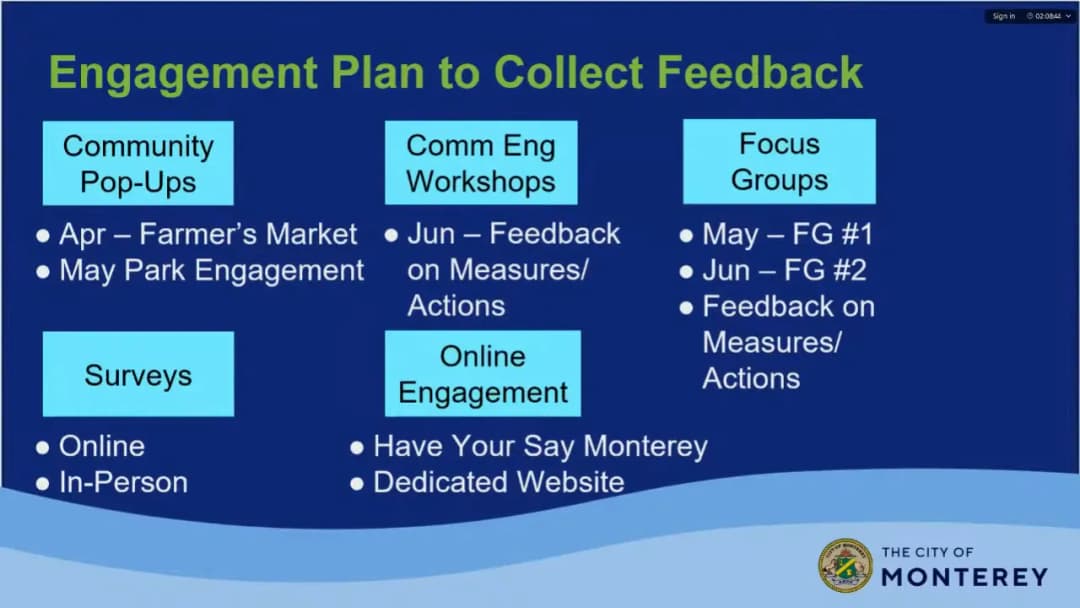
Public Meetings - Monterey, CaliforniaThe Monterey Planning Commission met on the evening of April 8, 2025, to conduct public hearings on the draft 2025-2029 Consolidated Plan and the Analysis of Impediments to Fair Housing Choice, and to receive a presentation on the development of the 2025 Climate Action Plan. The meeting included public comments, commissioner discussion, and votes on resolutions recommending city council approval. The meeting adjourned at approximately 6:00 PM. Consent Calendar - The commission considered approval of minutes from two previous meetings. - February 25, 2025 minutes: Motion carried with a roll call vote of 3-0-2 (Chair Blue yes, Vice Chair Silva abstained, Commissioner Brasfield abstained, Commissioner Dawson yes, Commissioner Freeman yes). - March 11, 2025 minutes: Motion carried with a roll call vote of 4-1 (Chair Blue yes, Vice Chair Silva yes, Commissioner Brasfield yes, Commissioner Dawson abstained, Commissioner Freeman yes). Public Comments & Testimony (Non-Agenda Items) - Brian Rosen urged the commission to support bringing back passenger rail service to Monterey (e.g., a train to San Francisco) as a way to reduce traffic and emissions. He noted that a proposed surf busway project is now estimated at over $103 million and argued that a train would be more popular and effective. - Lorna Moffitt opposed the removal of eucalyptus trees, stating that science shows they act as fire breaks and windbreaks. She cited the example of Angel Island where a remaining eucalyptus grove stopped a fire, and argued that thinning makes forests more vulnerable to fires. Public Hearing: Draft 2025-2029 Consolidated Plan, FY 2025 Annual Action Plan, and 2025 Citizen Participation Plan (CDBG) - Staff Presentation: Jacob Barania (HCD Coordinator) and Veronica Tam (consultant) presented the federal CDBG requirements. The draft plan allocates approximately $1.3 million for housing preservation (safety/health grants/loans for low-income homeowners), public services (grants to nonprofits like Alliance on Aging, Gathering for Women, etc.), and public facility improvements. The city expects about $240,000 in annual entitlement and program income, with final HUD allocation unknown until May. The citizen participation plan was also reviewed. - Commissioner Discussion: Commissioner Silva asked about qualifications for housing preservation program applicants; staff explained it targets low-income single-family homeowners and includes purchase/resale of units. Commissioner Brasfield requested that future presentations include data on accomplishments from the previous year’s funding to allow comparison and measure success. Chair Blue noted the small funding relative to need but acknowledged the positive impact. - Public Comment: One speaker (self-identified as a long-time taxpayer) expressed concern about federal spending and questioned the use of funds for bike trails on Fremont Street, calling it a waste. - Motion and Vote: Commissioner Brasfield moved to approve the resolution recommending city council adoption, with the added recommendation that the council be provided with information on the previous year’s accomplishments and results. The motion was seconded and passed unanimously (5-0). Public Hearing: Draft FY 2025 Analysis of Impediments to Fair Housing Choice (AI) - Staff Presentation: Mahno Abbasi (HCD Coordinator) and Karen Chavez (consultant) presented the AI report, which identifies four key impediments to fair housing: (1) housing supply and affordability, (2) displacement risk and supportive services, (3) discrimination, and (4) regional collaboration. The report includes an action plan with specific actions such as collaborating with the housing authority to expand Section 8 vouchers, expanding rental assistance, conducting fair housing workshops, and partnering with real estate professionals. A new baseline 2023 greenhouse gas inventory shows on-road transportation remains the largest source, with building energy also significant. Initial community survey results (83 respondents) indicate high engagement in waste reduction and interest in solar/battery storage. - Commissioner Discussion: Commissioner Brasfield again requested that staff include results from previous fair housing actions to inform council decision-making. Staff agreed to include a link to the annual CAPER report. Commissioner Silva supported the need for data. - Public Comment: Thomas Lampier (Veterans Transition Center) noted that the federal “Pit Count” found 144 homeless veterans in Monterey County, and that Veteran Transition Center has already served over 40 veterans in Monterey city this year. He stressed the need for housing and supportive services. Another speaker described difficulty contacting shelters and urged opening an armory-style facility (as in Santa Cruz) for homeless with tents and pets, or using trailers. - Motion and Vote: Commissioner Brasfield moved to adopt the resolution recommending council approval, with the addition that the staff report include a summary of previous year’s accomplishments. The motion was seconded and passed unanimously (5-0). Presentation: 2025 Climate Action Plan (CAP) Update - Staff and Consultant Presentation: Ted Terrasis (Sustainability Manager) and Erica Lenard (RinCon Consultants) provided an informational overview. The CAP focuses on mitigation (reducing greenhouse gas emissions) to meet state targets: 40% reduction below 1990 levels by 2030 (SB 32) and carbon neutrality by 2045. A 2023 baseline inventory has been drafted using updated methods, including big data for vehicle miles traveled. - Key Discussion Points: Commissioner Brasfield asked about the target audience (individual residents vs. city ordinances). Staff explained the CAP includes both city-led structural changes (e.g., building codes) and community education/rebate programs. Commissioner Dawson inquired about energy retrofits already completed; staff noted about 2 million kWh saved since 2007 but that an update is due. Commissioner Freeman questioned the scale of local action compared to global emissions; staff emphasized leading by example. - Public Comment: Brian Rosen spoke again, advocating for train, bicycles, clothesline ordinances, and tree planting. Laura Davis (Landwatch) supported the CAP goals and recommended using an origin-destination VMT model and evaluating how housing to address the jobs-housing imbalance could reduce VMT. A third caller urged planting eucalyptus and cypress trees along the coast to cool the bay. - No Action Taken: The presentation was for informational purposes only; no vote was required. Key Outcomes - Consent Calendar: Minutes for February 25 and March 11, 2025, approved with split abstentions. - Resolution on CDBG Consolidated Plan: Unanimously approved (5-0) with recommendation to council to include prior year accomplishments. - Resolution on Fair Housing AI: Unanimously approved (5-0) with recommendation to council to include prior year results. - Climate Action Plan: Informational only; next steps include continued engagement, measure development, and a city council meeting in the coming months. - Commissioner Comment: Commissioner Brasfield suggested agendizing a presentation from city parking staff on new parking technologies and policies, especially as they relate to high-density housing. Staff will explore options.
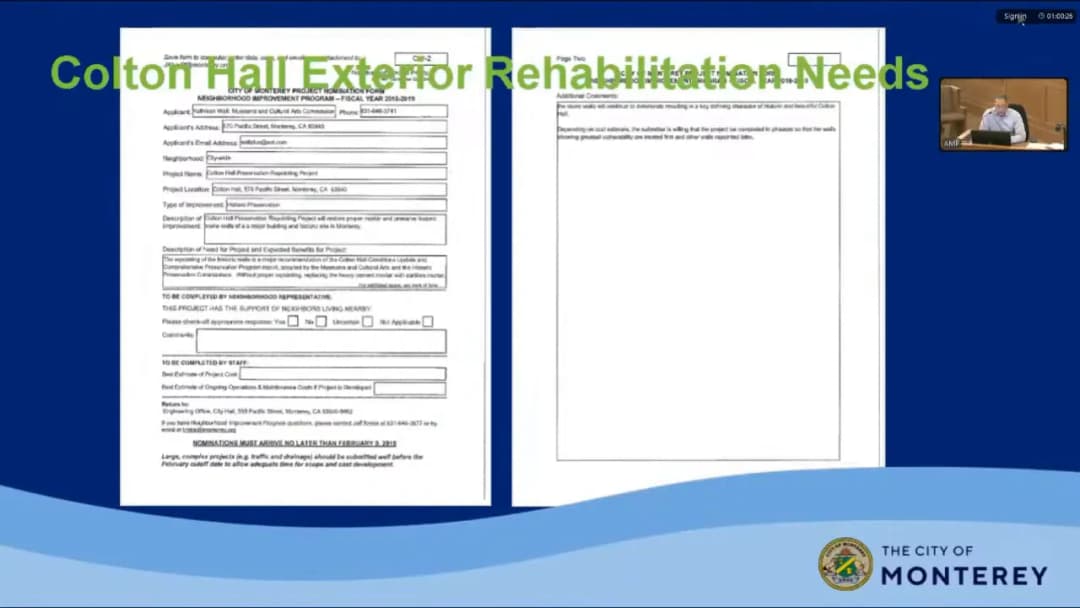
The Museums and Cultural Arts Commission of Monterey met on April 3, 2025, to discuss the restoration of Colton Hall, the revival of the concert series, and staff updates on various museum projects. The meeting included a presentation by Reggie Paulding on the deterioration of Colton Hall's exterior and proposed next steps. Consent Calendar - Unanimous approval of the minutes from the February 6, 2025 meeting. Public Comments & Testimony - No public comment was received. Discussion Items - Colton Hall Restoration (Item 3): Brian and Reggie Paulding presented on the history and current condition of Colton Hall, highlighting damage from improper drainage, Portland cement mortar, and backsplash from adjacent hardscaping. The remaining NCIP funding of approximately $144,000 is available. A phased approach was discussed: prioritizing drainage improvements (estimated $200,000–$250,000) before repointing ($50,000–$75,000) and other repairs. Total project cost is estimated at $500,000–$750,000. Commissioner Bob Evans volunteered to represent the commission at the NCIP committee. The commission agreed to work with staff to develop a phased funding request. - Concert Series at Colton Hall (Item 3 continued): Staff proposed resuming the concert series with 3–4 concerts in fall 2025, with an estimated budget of $500–$1,500 per concert. The last series in 2019 cost $4,395.50. Commissioners suggested afternoon Sunday concerts and community sponsorship. Staff will issue a call for musicians and bring proposals to the June 5, 2025 meeting. - Staff Updates (Item 4): Brian reported on the Expanded Path of History (letters to property owners, website development), budget discussions to increase Colton Hall hours to seven days a week, the California Supreme Court oral arguments scheduled for October 2025 at Colton Hall, successful purchases from the Western Flyer auction (three documents: a statement of assets/liabilities, letters from Ed Jr., and a bound volume), and a new film permit fee schedule. Lower Presidio Historic Park planning involves an online survey and community charrettes. Pacific Biological Laboratories accessibility estimates range from $1.8 million to $2 million. Emile Norman panels have been installed at the Stanton Center. Collections management improvements include updating loan agreements and testing a new catalog system. Key Outcomes - Approval of the February minutes. - Commissioner Evans designated as the commission liaison to the NCIP committee for Colton Hall. - Staff directed to issue a call for musicians for the Colton Hall concert series, with proposals due at the June 5, 2025 meeting. - Staff will continue developing a phased plan for Colton Hall restoration, beginning with drainage improvements using the remaining NCIP funds. - Progress on the path of history, film permits, and collections management will continue, with updates at future meetings.
The Monterey City Council met on April 1, 2025, in afternoon and evening sessions to receive presentations on pension management, the public safety facility feasibility study, police annual reports, and other items. The council approved consent items, an urgency ordinance on firearms retail, fee schedule updates, and military equipment renewals, while also discussing long-term financial planning and facility needs. Consent Calendar - Consent Agenda (Items 5-7): Approved with exceptions. Item 5 (Rental Registry) passed 3-2 (Councilmembers Rash and Smith voting no); Councilmember Smith noted a separate no vote. Item 7 (Midpen housing project) approved after discussion on environmental clearance and potential federal voucher challenges. Public Comments & Testimony - Whale Fest Recognition: Speakers supported the event and urged volunteering. Others raised environmental concerns about the bay, including high-decibel sonar surveys and tree planting needs. - Pension Management: Public comments addressed overtime pension impacts, CalPERS investment risks, and confusion around the pension system. - Consent Agenda / Rental Registry: Multiple speakers opposed the rental registry, arguing it burdens small landlords, fails to address housing supply, and creates government overreach. Concerns included lack of proper noticing and fear of future fee increases. - Forest Management (Item 6): One speaker opposed further funding, alleging harm to wildlife and fire safety risks, and called for independent expert review. - Firearms Urgency Ordinance (Item 8): A gun store owner opposed the extension, stating the city should be more business-friendly and that state law already covers insurance requirements. - Fee Schedule Update (Item 9): A property owner opposed the new zoning clearance permit fee until the ordinance is formally discussed, arguing it gives staff too much authority over principal permitted uses. - Public Safety Facility (Item 11): Speakers supported a new facility, highlighted the need to prioritize public safety over road projects, and raised concerns about bond costs and tax burdens. One suggested creative funding and tent structures. - Police Annual Report (Item 12): Multiple speakers thanked Chief Hobert for his service and praised the department's outreach and professionalism. - ALPR Report (Item 13): Speakers generally supported the system's effectiveness, though one voiced privacy concerns. The public noted the system's success in catching criminals. - Military Equipment Report (Item 14): One speaker opposed the acquisition of additional drones, citing militarization concerns and suggesting resource sharing. Discussion Items - Item 1: Whale Fest 15th Anniversary Recognition: Mayor read a proclamation; public comments noted the event's importance and environmental issues. - Item 2: Pension Management Strategy: Consultants from Weiss Law and CalMuni presented options including a 115 trust, fresh start programs, and long-term financial planning. Council discussed funding reserves, the 115 trust investment strategy, and the need for proactive management. - Item 6: Forest Management Fund Allocation: Council approved an $800,000 appropriation from NCIP ending balance for fuel reduction projects, despite public opposition. - Item 8: Firearms Urgency Ordinance Extension: Council extended the temporary prohibition on new firearms retailers for 10 months and 15 days to allow development of a permanent ordinance. - Item 9: Master Fee Schedule Update: Council approved fee adjustments across departments, including removal of library late fines, following public comments about zoning clearance permit concerns. - Item 11: Public Safety Facility Feasibility Study: Core Design Group presented options (Option 1 with below-grade parking $108M; Option 2 $92M). Council discussed consolidation of city offices, site alternatives, and funding challenges. Staff directed to return with additional options (including renovation, off-site locations, and second-floor expansion). - Item 12: Police Department Annual Report: Chief Hobert reported on 2024 activities: 45,000 calls, 1,000 arrests, 193 DUI arrests, 30 use-of-force incidents, and staffing challenges due to vacancies. Council praised the department's work, especially outreach programs. - Item 13: ALPR Annual Report: Chief Hobert reported 12,500 vehicles/day captured, 366 searches/month, and successes in criminal investigations. Policy updates included tightening documentation requirements. Council supported the system and requested future transparency on camera locations. - Item 14: Military Equipment Use and Renewal: Council approved renewal of the ordinance and authorized acquisition of a command vehicle, 8 patrol rifles, and 4 drones, after reviewing annual usage statistics and holding a public town hall. Key Outcomes - Consent Agenda Approved: Items 5-7 passed with Item 5 passing 3-2 (Rash/Smith opposed). - Item 6 Passed 5-0: $800,000 allocated for forest management. - Item 8 Passed 5-0: Urgency ordinance extended. - Item 9 Passed 5-0: Fee schedule updated. - Item 14 Passed 5-0: Military equipment ordinance renewed and acquisitions authorized. - Directives for Staff: For the public safety facility, staff will explore additional options (renovation, off-site, second-floor expansion) and return with detailed analysis; a broader infrastructure funding discussion is scheduled for May 6. For ALPR, staff will provide camera location details and district breakdowns.
The Monterey Public Library Board of Library Trustees met on Thursday, March 27, 2025, at 4:01 PM to discuss and develop a recommendation on library capital improvements. The board reviewed the 2020 Group 4 (G4) feasibility study, which outlined four levels of renovation and expansion ranging from $12 million (Level 1) to $42 million (Level 4). The board previously recommended Level 3 ($36.4 million) in 2020, but lack of funding has stalled progress. The discussion focused on revisiting these options, considering current facility needs, funding constraints, and potential partnerships with public safety for a bond measure. Consent Calendar - The consent agenda included approval of events and authorizing the Library and Museums Director to sign letters on behalf of the city. A trustee raised a concern about the director signing on behalf of the city, suggesting the board chair should sign instead. After discussion, it was agreed to modify the wording to authorize the board chair or director (and vice chair in the chair's absence). The consent agenda was then accepted unanimously. Public Comments & Testimony - Jim Thompson (former library board trustee) spoke in support of retaining Level 3 as the desired goal, noting that it provides about 5,000 more square feet for youth, children, and local history. He suggested a two-tier approach: pursuing Level 3 via a public bond measure (possibly combined with public safety facilities) while addressing immediate, smaller-scale needs in the short term. He also noted that fundraising for $36 million alone is unrealistic without a bond. Discussion Items - Staff Report and Context – Library Director Brian (last name not stated) presented an overview of the G4 study, highlighting that the facility condition analysis now shows $4.5 million in capital maintenance needs (plus $421,000 for ADA compliance). He noted that many building systems (windows, HVAC, electrical) are past their expected life cycles. The board discussed whether the G4 proposals remain valid post-pandemic, with staff noting that usage patterns have largely returned to pre-pandemic levels and that the community still values physical materials and quiet space. - Options Reevaluation – Trustees debated the feasibility of Level 3 ($36.4 million), Level 2 ($29 million), and Level 1 ($12 million). Level 1 focuses on basic facility improvements without triggering full code compliance, but has a shorter useful life. Level 2 and 3 involve demolition of the 1983 addition and significant expansion. Trustees expressed concern about losing parking, the historic nature of the building, and the high cost of Level 3. Some favored a phased approach, while others argued for starting with Level 1 as a realistic step, keeping Level 3 as the long-term vision. - Funding Challenges – The board acknowledged that the city’s capital improvement program (CIP) is underfunded compared to neighboring cities, and that competing priorities (e.g., public safety, wharf repairs) make it difficult to secure funding. The city manager indicated commitment to funding immediate needs (about $200,000–$300,000), but larger projects require new revenue sources. A bond measure (possibly combined with police/fire) was discussed as a potential solution, though the board noted that the library ranked low in a recent city survey on public priorities. - Next Steps – The board agreed to formalize a recommendation: reaffirm Level 3 as the desired future, identify immediate projects that would not be wasted if Level 3 proceeds (e.g., ceiling tiles, carpeting, FF&E), and present this to the city council and city manager. They also discussed the need for a professional fundraising coordinator or contract for a capital campaign, and the possibility of inviting city council for a tour of the library. The board did not take a formal vote, but directed staff to prepare a written proposal for the next meeting. Key Outcomes - The board reached consensus in principle to recommend Level 3 as the long-term vision, while pursuing Level 1 (or a subset) for immediate needs, provided those improvements do not conflict with future demolition. - Staff will develop a written proposal identifying specific short-term projects that are compatible with Level 3, and present it to the board at the next meeting for formal approval. - The board will seek to engage the city council and city manager, including possibly a tour of the library, and will monitor the council’s public safety facility discussions for potential joint bond measure opportunities. - No formal votes were taken on specific funding sources or plans; decisions are deferred to the next meeting.
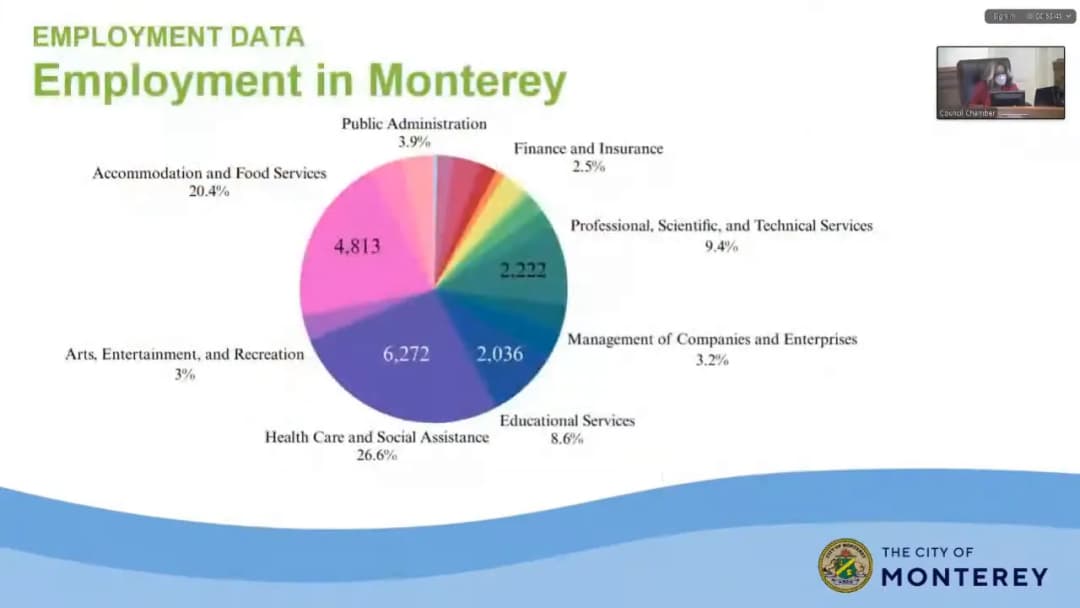
The Monterey City Council held a study session on March 26, 2025, to review and gather feedback on the draft 2025 Economic Development Strategy. City staff Nat presented an extensive overview of economic data, including employment, revenue sources, hotel tax reliance, SWOT analysis, and proposed goals. The council asked questions and provided feedback, and public comments were heard from community members and industry representatives. The meeting adjourned early due to a loss of quorum when Councilmember Smith left. Public Comments & Testimony - Monica Lull (Monterey Peninsula Chamber of Commerce): Expressed support for the strategy and offered to partner with the city. Highlighted opportunities for women-owned businesses and creating bridges with entrepreneurs. - Janine Chakov (Portola Hotel & Spa): Encouraged the city to "dream big" and consider outside expertise. Pointed to opportunities at Heritage Harbor, Alvarado Street, and Wharf 2. - Rob O'Keefe (C Monterey): Commended the planning and emphasized the power of possibility. Noted the importance of international travelers, upcoming major events, and resident sentiment. Expressed commitment to collaboration. - Rick Aldinger (Monterey County Hospitality Association): Supported the vision and stressed the need to include residents in discussions to ensure they understand the benefits of tourism. - Brian Rosen: Expressed concerns about environmental impacts, traffic, and social equity. Urged caution with development, called for bringing back the train, planting trees, and ensuring benefits reach all workers. - Nina Beattie: Critiqued the plan as aggressive fast-track policy making. Questioned data accuracy and overstatements (e.g., regarding Montage Health). Advocated for reducing reliance on tourism, supporting local businesses, and addressing environmental and social issues. - Lorna Moffin: Urged prioritizing environment over tourism. Criticized tree removal at Fisherman's Wharf. Called for mass transit, tree planting, and keeping the bay healthy. Presentation of Draft Strategy Nat presented the draft 2025 Economic Development Strategy. Key data points included: - Employment: 24,944 individuals employed in non-military industries; majority commute in. - Revenue reliance: Hotel Transient Occupancy Tax (TOT) accounts for 28% of city revenue, property tax only 15%, and sales tax 15%. In comparison, typical California cities rely on property tax at 47% and TOT at 7%. Later, TOT was cited as 30% of general fund revenue. - Sales tax: 62% paid by non-residents; total sales tax revenue $15.528 million to general fund plus $11.849 million from Measure S. - Property tax: City receives only 6 cents of every dollar collected; median home ($1.3M) yields $865.80 city property tax. - Existing hotel inventory: 4,713 rooms; only 40 new rooms proposed, while neighboring cities are adding over 1,800 rooms. - The draft strategy proposes five goals: 1) Remain competitive in hospitality marketplace; 2) Sustainable redevelopment of underutilized properties; 3) Business retention, attraction, and promotion; 4) Economic diversification; 5) Affordable workforce housing solutions. - Financing tools discussed: Enhanced Infrastructure Financing Districts (EIFDs), Community Revitalization and Investment Authorities (CRIAs), Climate Resilience Districts, federal/state grants, and options like increasing Tourism Improvement District (TID) funding. - Next steps: conduct focus groups and town halls in spring/summer 2025, potentially engage an economic development firm, and bring a final strategy to council for adoption later in 2025. Council Discussion and Feedback Council members asked clarifying questions and offered feedback: - Councilmember Barber: Asked about direct revenue from healthcare vs. hospitality; noted healthcare nonprofits pay no property tax. Suggested adding lack of water as a weakness in SWOT. - Councilmember Rash: Inquired about Measure S sales tax compared to pre-COVID; requested total sales tax figure. - Councilmember Smith: Emphasized balance, resident inclusion, and proactive business retention. Suggested a "My Monterey" campaign and an adult behavioral health center at Ryan Ranch. Clarified "low complexity" not equal to low priority. - Councilmember Garcia: Expressed excitement about the strategy. Highlighted opportunities beyond hospitality, including land use/zoning and infrastructure. Supported bringing in an economic development professional early. - Councilmember Rash (further): Called for activating temporary uses of vacant spaces, liberal pop-up event approvals, requiring future rehab funding for public dollars, caution on density zoning fees, and focus on eco-tourism, public art, workforce development, and transportation. Supported considering a vacancy tax for affordable housing. - Mayor Williamson: Thanked staff, highlighted CIP funding disparity (2% vs. typical 13-25%) and deferred maintenance. Endorsed pedestrianizing Alvarado Street on trial basis. Stressed arts, history, and diversification. Key Outcomes - The study session was the first step in developing a long-term economic development strategy. - No formal votes were taken; the meeting was discussion-only. - The meeting adjourned early due to loss of quorum after Councilmember Smith left. - Next steps scheduled: community engagement (focus groups/town halls) in spring/summer 2025, possible hiring of economic development professional, and final strategy adoption later in 2025.
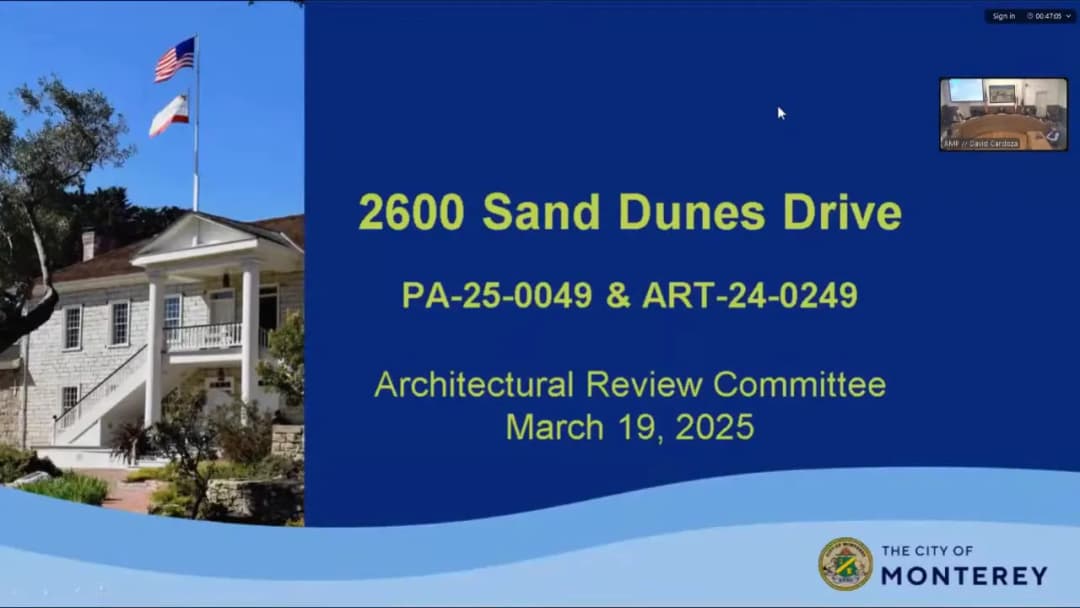
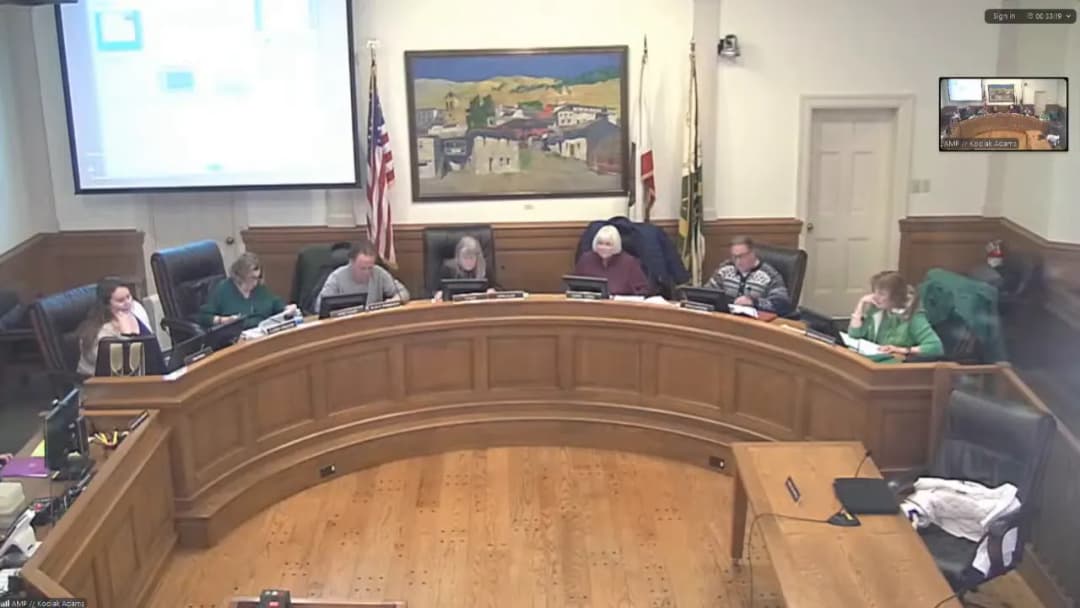
The Architectural Review Committee (ARC) of Monterey, California met on March 19, 2025, to consider two items: a sign permit application for a hotel on Munras Avenue and a permit amendment with tree removal for the Monterey Beach Hotel. Committee members present: Hunter, Ostabar (Chair), Palmer, Sanders, and Polly; member Turgeon was absent. Staff included Planning Manager Hill, Principal Planner Roveri, and Recording Secretary Argonbright. Public Comments & Testimony - No general public comments were made. During the second item, applicant representatives spoke: Jeremy Ross, Vice President of Construction at KD Landscaping, acknowledged the accidental removal of four trees and expressed willingness to work with the city on replacement or fines. Steve Alan clarified that the horizontal slats on the fence were not climbable due to minimal spacing and that the sauna equipment is not under health department purview for pool fencing requirements. Discussion Item 1: 1150 Munras Avenue – Sign Permit Application SI-24-0239 - Staff presented a request to replace two of four existing vehicle-oriented signs at America’s Best Value Inn with new square wood signs (5 ft by 5 ft, 25 sq ft, at 8 ft height) and remove the other two. The only guideline inconsistency was that the sign did not have a full-width solid base. Staff recommended approval. - Committee members expressed mixed feelings about the design (“feels cheap,” “unappealing”) but noted the reduction from four to two signs and compliance with most guidelines made approval appropriate. A motion to approve carried unanimously. Discussion Item 2: 2600 Sand Dunes Drive – Permit Amendment PA-25-ARP-24-0028 and Tree Removal Permit TR-24-0249 - Staff described unpermitted work at the Monterey Beach Hotel: new fencing with horizontal slats, sauna equipment, lighting, speakers, furniture, relocated parking, and removal of four magnolia trees. The applicant corrected fencing to vertical slats to meet health standards. Staff recommended approval with a condition authorizing the city forester to determine replacement tree requirements (zero to three per tree removed). - Committee members praised the hotel’s overall improvements, acknowledged the tree removal as a good-faith mistake, and supported adherence to city rules. A motion to approve with conditions carried unanimously. Key Outcomes - Sign Permit Approved: The ARC approved sign permit SI-24-0239 for two replacement signs at 1150 Munras Avenue. The decision is appealable to the planning commission within 10 days. - Permit Amendment and Tree Removal Approved: The ARC approved permit amendment PA-25-ARP-24-0028 and tree removal permit TR-24-0249 with conditions, including city forester determination of tree replacements. The administrative penalty of $1,000 per illegally removed tree may be applied separately. The decision is appealable to the planning commission within 10 days. - Next Meeting: Scheduled for April 2, 2025 (note: committee member Hunter will be absent).
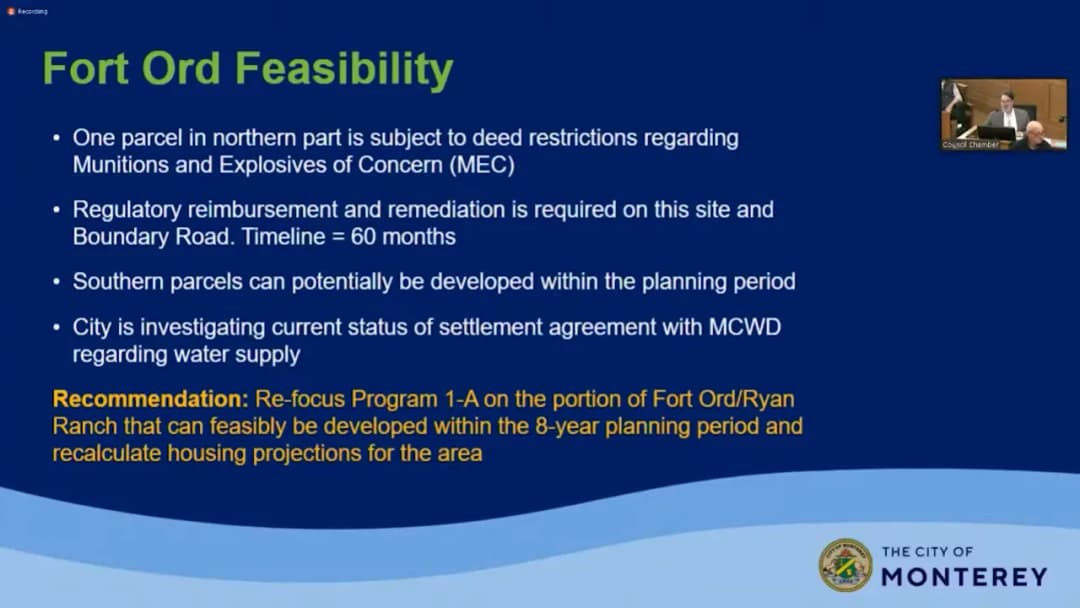
The Monterey City Council held a regular meeting on March 18, 2025, starting at approximately 10:06 PM (after a closed session earlier in the evening). The meeting included approval of the consent calendar (with three items pulled for separate discussion), public comments on non-agenda items, and major discussions on a rental registry ordinance and the draft 2023-2031 Housing Element. The council approved the rental registry with amendments and voted to authorize funding for iHelp homeless services. The housing element was reviewed in a joint session with the Planning Commission, but no final vote was taken; the item was tabled along with other agenda items due to the late hour and disruptive public comments. Consent Calendar - The consent calendar was approved unanimously minus items 4, 6, and 7, which were pulled for separate discussion. Item 14 (agreement with C Monterey for $1.8 million in services) was included in the consent approval. Public Comments & Testimony - Non-agenda items: Several residents spoke on various topics, including: - Jean Rash (Monterey Vista) urged that board/commission interviews not be conducted by a single person (the mayor). - A resident from Marina criticized MST's Surf Project ridership projections as misleading. - A landscaper reported ongoing gang activity and drug sales at the MST center, requesting a city ordinance against panhandling and stolen carts. - Bob (owner of Canary Row Plaza) requested a city letter of support to the Coastal Commission for his development project. - Rental registry: Over 20 public comments were heard, both in favor and opposed. Supporters argued it would provide data to address the housing crisis and help tenants. Opponents (including landlords, realtors, and the Chamber of Commerce) argued it would increase costs, reduce rental inventory, and lead to rent control. Many requested exemptions for small 'mom and pop' landlords. Some tenants expressed fear of retaliation if they spoke in support. - Housing element (public comment period): Over 77 letters were received. During the meeting, many online commenters made antisemitic and hateful remarks, which the mayor condemned. Other commenters (including representatives from the Chamber, Monterey Bay Economic Partnership, and LandWatch) offered substantive feedback. Discussion Items - Item 7 – iHelp funding ($29,874): Tony Finnegan, board chair of iHelp, explained the organization provides emergency homeless shelter (men and women) and is facing a funding shortfall after FEMA funds were redirected to South County flood recovery. The council unanimously approved the contribution. - Item 4 – Board/commission procedures: The second reading of an ordinance updating procedures passed unanimously. Jean Rash commented on the need for more than one council member in interviews. - Item 6 – Rental registry ordinance: Staff presented a revised ordinance incorporating amendments from the September 5 meeting: 50/50 fee split between landlord and tenant, exemptions for ADUs/JADUs and owner-occupied rentals, and no criminal penalties. Council debated: - Exempting 'mom and pop' landlords (3 or fewer units, self-managed). - Adding a 5-year sunset. - Requiring a 30-day notice from tenants before civil action for non-registration. - The role of the registry in data collection vs. rent control fears. After a substitute motion to remove the exemption failed, the main motion passed 4-1 (Councilmember Smith dissenting). - Housing Element (Joint Session with Planning Commission): Consultant Andrew Hill presented the draft housing element, including site inventory, community feedback, and recommended revisions (e.g., reducing Fort Ord capacity from 2,100 to 1,660 units due to feasibility constraints; adding three new sites; removing Heritage Harbor). Key themes included parking reductions, permit streamlining, employer-sponsored housing, and moderate-income capacity. Planning Commission members asked questions about density, water supply, and traffic. The council did not take a final vote due to late hour and disruptive public comments; the item was tabled until a future meeting. Key Outcomes - Rental registry (Ordinance) passed 4-1 with the following amendments: - Five-year sunset. - Exemption for self-managed properties with 3 or fewer rental units within the city (landlords must claim the exemption). - Tenants must give a 30-day notice to landlords before filing civil action for non-registration. - The ordinance will return for a second reading at a future meeting. - iHelp funding approved unanimously ($29,874). - Board/commission procedures ordinance approved unanimously. - Housing element discussion was tabled (along with items 19 and 20) due to late hour and after the council took a recess. No vote was taken. The item is expected to be reconsidered at a later date.
The Monterey City Council held a regular meeting on March 18, 2025, addressing a wide range of topics including employee milestone anniversaries, a presentation on unfunded pension liabilities, a second reading of a camping ordinance, proposed amendments to the rental inventory program, a public engagement approach for Lower Presidio Historic Park, and a pathway for utility undergrounding. The meeting included public comments on multiple items, council deliberations, and several votes. Consent Calendar - The consent agenda was approved with the exception of Item 6, which was pulled for discussion. Item 6, regarding council member travel to a sister city (Dubrovnik, Croatia), was tabled after a motion passed 4-1, with council members expressing that city funds should not be used for such travel and that a formal policy should be developed. Public Comments & Testimony - Sister City Travel (Item 6): Multiple residents spoke against using taxpayer money for the trip, citing the city's $200 million unfunded pension liability and urging private funding. Some noted past practices where travel was privately financed. One resident questioned the timing of the item on the consent agenda. - Camping Ordinance (Item 13): Speakers addressed the 30-day warning provision, with one resident urging a shorter period and another expressing concern about enforcement on Navy property. Another resident asked that an area near Ramona and Roberts be included. A caller urged compassion and provision of shelters. - Rental Inventory Program (Item 16): Several landlords opposed the expansion of the registry, citing costs, privacy concerns, and the risk of driving small owners out of the market. A tenant advocate supported the registry as necessary for data collection and protection. Some asked for a family exemption and for the program to be decommissioned. - Lower Presidio (Item 17): A representative from the Old Monterey Foundation supported public engagement and suggested involving neighborhood associations and seeking Congressman Panetta's help. Another resident recommended reaching out to the Big Sur Land Trust. - Undergrounding (Item 18): Supporters emphasized the need for a project manager to utilize $4.7 million in Rule 20A credits for North Fremont before expiration. Some residents urged caution on costs and suggested starting with a feasibility study and community survey. Discussion Items - Employee Milestone Anniversaries and Retirements: The council recognized several employees for 20 to 30 years of service, with presentations from department heads. Public comment was opened and closed with no speakers. - Pension Obligation Strategies: Actuary Drew Ballard presented the city's unfunded pension liability (about $200 million) and forecasted contribution requirements. Options included using a Section 115 pension trust or making additional discretionary payments to CalPERS. Public comment was received; one speaker advocated paying down the liability directly. Council discussed the flexibility of the trust and potential for additional payments. - Second Reading – Camping Ordinance (Chapter 23 amendments): The ordinance prohibits camping in high/very high fire hazard zones, within 1,000 feet of schools, and in recreation areas. Staff confirmed that the updated CalFire maps will be incorporated via the general plan update. Council discussed jurisdiction, private schools, and Navy property. Public comment was mixed. The ordinance was adopted. - First Reading – Rental Inventory Program Amendments: Staff proposed requiring all rental property owners to register (removing the exemption for owners of 3 or fewer units) but exempting them from fees, and eliminating the 50% fee passthrough to tenants. Public comment was extensive. Councilmember Smith moved to decommission the rental registry; the motion failed (2-3). Councilmember Garcia then moved to approve the amendments as recommended; the motion passed (3-2). The item will go to a second reading. - Public Engagement Approach for Lower Presidio: Staff presented a roadmap for community engagement, including surveys, workshops, and commission presentations, with a report back to council in 2026. Council discussed options such as a national monument designation and collaboration with the Army. The motion to approve the approach passed unanimously. - Pathway for Undergrounding Implementation: Staff recommended hiring a senior project manager to advance undergrounding, starting with the North Fremont corridor to utilize $4.7 million in Rule 20A credits. Council debated between hiring a full-time employee or a consultant. A substitute motion to hire a contract consultant to focus on North Fremont passed 4-1. The city manager will proceed with the contract approach. Key Outcomes - Sister City Travel (Item 6): Tabled by a 4-1 vote to await a formal council travel policy. - Camping Ordinance (Item 13): Adopted on second reading (voice vote, unanimous). - Rental Inventory Program Amendments (Item 16): First reading approved 3-2. A motion to decommission the program failed 2-3. The ordinance will return for a second reading. - Lower Presidio Engagement (Item 17): Motion to approve the public engagement approach passed unanimously. - Undergrounding Implementation (Item 18): Motion to hire a contract consultant to focus on North Fremont passed 4-1. Staff will bring recommendations for a project manager or consultant approach in the budget. - Pension Obligation Strategies: No formal vote; the presentation was received as information. Council directed staff to continue exploring options and bring recommendations during budget discussions. - Consent Calendar: Approved with item 6 pulled and tabled.
Introductory Paragraph The Historic Preservation Committee (HPC) met on March 13, 2025, at 15:54 UTC. All seven members were present. The meeting covered approval of previous minutes, receipt of the Certified Local Government (CLG) annual report for the period October 2023 to September 2024, and committee discussion on training topics for the upcoming year. Consent Calendar - The committee unanimously approved the minutes from the December 12, 2024 meeting. No public comments or corrections were offered. Public Comments & Testimony - No members of the public provided comment during the public appearance item or during discussion of the CLG report. Discussion Items - CLG Annual Report Presentation: Fernando Roveri, Principal Planner, presented the Certified Local Government annual report (October 2023 – September 2024). The presentation covered the CLG program’s purpose (partnership between local, state, and federal governments for historic preservation), requirements for maintaining CLG status (e.g., a preservation commission, survey/inventory procedures, public participation), benefits (state subgrants, technical assistance, higher property values in historic districts), and highlights from the reporting period. The HPC reviewed historic zoning requests and Mills Act contracts. Training participation was noted, including Secretary of the Interior Standards training. - Commissioner Training Suggestions: During discussion, commissioners raised the following topics for future training: - Commissioner Rodriguez requested training on Mills Act contracts, specifically how to modify them (e.g., include provisions for emergency access to properties with absent landlords to prevent neglect). - Chairman and Commissioner Hawk expressed interest in “demolition by neglect” – how to address deterioration of historic resources that are not under a Mills Act contract, since the city lacks an inspection program for non-Mills Act properties. - Commissioner Gerilyn noted a training on women of Monterey County history (presented by Meg in 2016-2017) and offered to share it. - Commissioners discussed access to the SEQUO training recording; it was noted that paid registrants may receive a recording that could be shared. - Corrections to Report: Chair noted that hours were missing for a training she attended (the library training). Commissioner Hawk asked about a delisted Roosevelt property; staff clarified that the delisting occurred after the reporting period (September 30, 2024) and will be included in the next annual report. Key Outcomes - The committee received the CLG annual report and forwarded it to the State Office of Historic Preservation by the March 28, 2025 deadline. - Staff will consider corrections to the report regarding missing training hours (to be provided before March 28). - No formal motions were required; the report was accepted as presented. - The meeting adjourned after commissioner comments and the staff report on local events.