Browse by city
Date range
Search help

Search titles, summaries, topics and stored transcripts together. Keywords may match separately; put the whole query in double quotes for a phrase. Matching follows word analysis, so punctuation is not exact. Both dates are included. Documents are not searched.

SHOWING 1–10 ENTRIES
01
OCT 27, 2026 · NAPERVILLE, ILLINOIS · CITY COUNCIL
Naperville City Council Budget Workshop II on 2027 Operating Budget, October 27, 2026

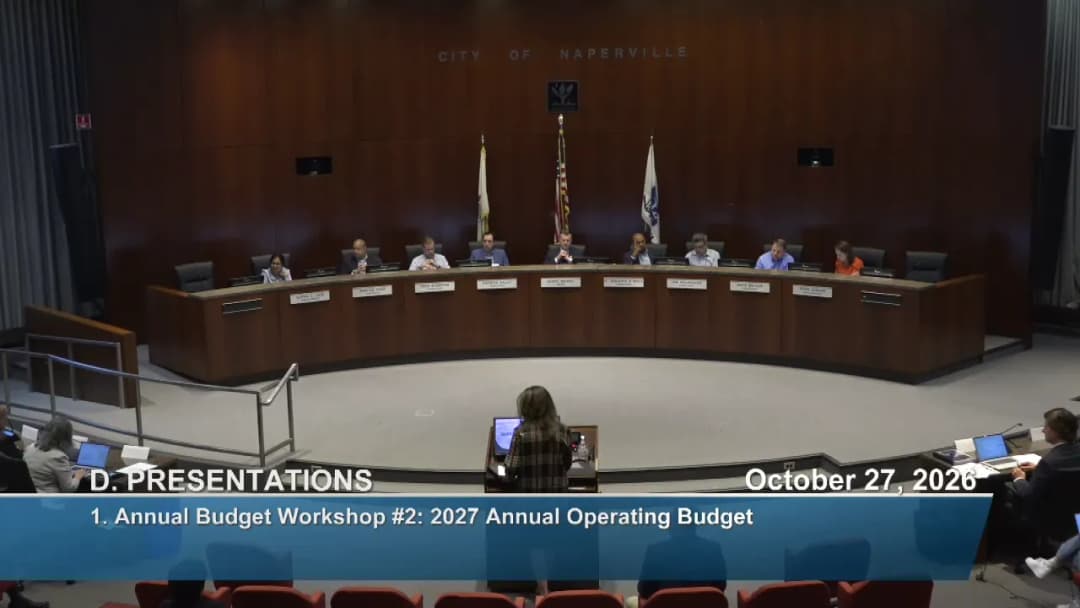
The Naperville City Council met on Tuesday, October 27, 2026, for the second of three 2027 budget workshops. No final actions were taken. Staff reviewed the proposed 2027 operating budget, a 9.375 FTE staffing package, agency budgets for Naper Settlement and Naperville Public Library, and downtown parking options. The proposed 2027 budget totals $724 million, a 5.6% increase over 2026, with $677 million in projected revenues; the city property tax rate is again projected to decline from its 50-year low. Public Comments & Testimony - Bill Simon, president of Naperville Preservation Inc., expressed support for increasing historic preservation staffing to at least a half-time position and for obtaining national preservation training, citing national statistics of 116,000 new jobs, $6.8 billion in rehabilitation investment, and $1.8 billion in government tax receipts. He mentioned a $15,000 consultant proposal as an alternative. - Steve Rubin, representing downtown advisory and neighborhood organizations, expressed support for building the Nichols Library parking deck, arguing downtown restaurants are funding roughly two-thirds of the project and that about 160,000 square feet of additional downtown development is expected. He called the $90,000-per-space estimate unreasonable and urged a growth mindset. - Katie Wood, Downtown Naperville Alliance, expressed support for the Nichols Library deck, citing about 325 downtown businesses, $300 million in annual sales, $22 million in sales tax revenue, $7-8 million in property tax revenue, 3,500 parking spaces, and 9.5 million annual visits, with 65% of visitors from out of town. She said option C's 30-space surface lot is disappointing after nearly 20 years of restaurant-funded parking contributions. - Chris Mason, chef/owner of Allegory, expressed support for constructing the Nichols Library Parking Deck, noting more than 9 million visitors and 65% nonresident visitors, and noting downtown restaurants have contributed $15 million to the food and beverage fund since 2008. He asked the city to honor the commitment to use those funds for parking. - Mary Lou Worley, a resident, questioned the proposed 9.375 FTEs plus an indirectly funded FTE for the Riverwalk South extension, the $6.8 million construction estimate, the city's 100% reimbursement of added park district costs, and whether the Riverwalk extension is a want rather than a need. She urged the council to balance taxpayer spending. Discussion Items 2027 Budget Overview - The 2027 recommended budget is $724 million, up 5.6% from 2026, including $703 million in expenses and $21 million in transfers. Total revenues are projected at $677 million, up 3.1%. Charges for services remain the largest revenue source, with public utilities generating about 44%, or nearly $300 million. - General fund revenues are estimated at about $181 million excluding interfund transfers, a 4.8% increase. State-shared taxes are up $3.7 million, grocery tax is projected at $7.2 million, and property tax is forecast to rise $2 million as equalized assessed value grows. - General fund expenses increase 4.5% excluding transfers; personnel is the main driver. The budget assumes a 3% COLA and 1% merit pool for non-union staff, plus $413,000 for the next phase of compensation-study adjustments. - Health insurance premiums are budgeted to rise 6.7% and dental premiums 4.8%; employer medical contributions are $16.2 million, a 5.3% increase. Pension contributions exceed $25 million: $11.4 million for police, up 4.5%; $9.3 million for fire, up 1.7%; and about $5 million for IMRF. The IMRF rate drops from 7.8% to 6.29%. The 2025 audit reported police and fire pensions 95% funded. Proposed Staffing - Departments requested 20 FTEs; the proposed budget includes 9.375 FTEs: 5.375 in the general fund, 3 in the water utility fund, and 1 in the electric utility fund. Utility-funded positions would be paid by ratepayers, not property tax. - Proposed general fund positions include a senior traffic engineer ($160,000), code enforcement officer ($146,000 plus $40,000 vehicle), DRT project manager ($150,000), forestry field supervisor ($141,000 plus $74,000 vehicle), assistant city attorney for FOIA, and conversion of a part-time fire communications specialist to full-time ($67,000 net). - Staff said the code enforcement team has four employees for 153,000 residents, below the 6-7.5 officers benchmarked for a city of that size. Forestry requests have increased 37% since 2021. FOIA requests are increasingly complex, driven by body-worn camera footage and AI-assisted requesters. - A council member cited a slide figure of $140,000 for the FOIA attorney position, while the budget figure discussed was $90,584 in salary and benefits; the transcript does not show staff explicitly reconciling the two figures. - Council discussion included skepticism about adding an attorney for FOIA, with one council member urging AI-based tools and saying technology should be the answer from here. The city attorney said Naperville has explored software options and is pursuing legislative reform. - Council members also noted historic preservation currently receives only 15% of one assistant planner's time, and several members asked staff to examine whether historic preservation staffing should be increased. The city manager said preservation has not risen to the level of reallocating resources, but staff could evaluate it after the budget process. - One council member said he generally opposes recurring general fund obligations but supported the traffic, code enforcement, DRT, and forestry investments, while expressing dislike for the FOIA position and questioning the fire communications role. Fire and communications staff explained the fire communications position would support public information, emergency management, and public education, following the police department's embedded-communicator model. Other Operating Fund Requests - Downtown Naperville Alliance marketing funding totals just over $520,000, a 2% increase, plus a proposed $100,000 general fund supplement for marketing in the Jefferson Avenue and Main Street construction area. Precedent includes $50,000 in 2022 and $100,000 in 2024. - Neighborhood Development Partnership requests $1.4 million, a 3.3% increase, including a $550,000 economic development grant. The SECA-funded restaurant marketing grant remains flat at $185,000. - NCTV funding is $918,000, an increase of $3,000, with declining PEG cable revenue offset by general fund support. Naper Settlement - Naper Settlement presented a balanced 2027 operating budget, a projected 13.5% increase in earned operating revenue, and a property tax levy request of $4,094,549, a 2.5% increase. Operating expenses rise 2.9%, driven by personnel, with no new positions requested. - Highlights included the Inventing Agriculture exhibit, the 250th anniversary exhibit, Camp Naper at 110% capacity, and grants supporting intergenerational programs, teacher institutes, and free or reduced-cost field trips for about 4,600 students. - The Heritage Society requested $145,000 for a facility condition assessment and feasibility study of more than 30 historic buildings. The board chair said there is no plan to move buildings, but the assessment is needed because the structures have never been comprehensively evaluated. The request had passed the Naperville Settlement Museum Board by 5-1. One council member said she voted no on the museum board and would support the $50,000 site assessment portion, but not the full $145,000 feasibility study at this time. Naperville Public Library - The library is requesting an 8% increase to its property tax levy, with a proposed 8.1% expense increase. Property taxes fund 96% of the library budget. - Survey results showed 97% of respondents rated the library excellent/good; 81% of Naperville households have a library card; the library sees about 1.2 million visits per year. - Planned changes include consistent Sunday hours of 11 a.m. to 7 p.m. year-round, adding about 300 open hours annually, and a new internship program for adults with developmental and intellectual disabilities. - Capital work includes HVAC replacement at the 95th Street Library, with 60% from the city capital fund and 40% from a $550,000 state DCEO grant secured by State Representative Janet Yang Rohr. The library director said parking at Nichols Library remains the number one complaint from patrons. Downtown Parking Options - Staff presented three options: - Option A: complete the remaining downtown streetscape by 2031, then build the Nichols deck by 2032; total cost $62.4 million. - Option B: advance the Nichols deck to completion by 2030 and delay streetscape to 2033; total cost $62.2 million, relying on prior concept design. - Option C: replace the deck with a surface lot west of the library, adding about 30 spaces by 2028, with about $50,000 in engineering and $500,000 construction, and a total streetscape-and-surface-lot investment of $25.3 million. The deck would add about 500 spaces. - Several council members said they could not make a decision until the downtown parking study data is released in November. One council member leaned toward the surface lot, noting the loss of about 130 existing library parking spaces during deck construction would be hard on downtown businesses. A downtown business representative acknowledged that two years of lost spaces would be difficult and would require creative mitigation. - Another council member asked for historical garage occupancy data to inform the decision. The mayor noted the parking fund is restricted and the food-and-beverage tax that funds it sunsets in 2033, with more than $20 million potentially needing to be used only for parking. - No straw poll was taken on parking. Key Outcomes - No binding votes were taken at the workshop. - A nonbinding straw poll showed support for the following proposed positions: senior traffic engineer; code enforcement officer; DRT project manager (9 hands); assistant city attorney for FOIA (9 hands); full-time fire communications specialist (8 hands); electric system controller (8 hands); two wastewater treatment operators (9 hands); and water utility supervisor (9 hands). - The forestry field supervisor position was deferred to Budget Workshop III for additional information after council discussion about whether the $200,000 might be better spent accelerating tree trimming. Staff agreed to provide more details. - The downtown parking decision was deferred until the parking study and historical usage data are available; staff may bring back a placeholder option and a decision in January 2027. - Staff will bring follow-up material on the Naper Settlement feasibility study, including whether the settlement buildings could be included in the city's broader facility condition assessment. - Next steps: Budget Workshop III on November 10, 2026; the 2027 budget public hearing and vote on December 1, 2026; and the property tax levy approval at the last council meeting in December 2026.
PUBLIC ENGAGEMENT 14% · HISTORIC PRESERVATION 14% · PARKING REGULATIONS 10% · PERSONNEL MATTERS 10%
02
OCT 20, 2026 · NAPERVILLE, ILLINOIS · CITY COUNCIL
Naperville City Council Meeting - October 20, 2026: Proclamation, Public Forum, Bike Plan Adoption, and Consent Agenda

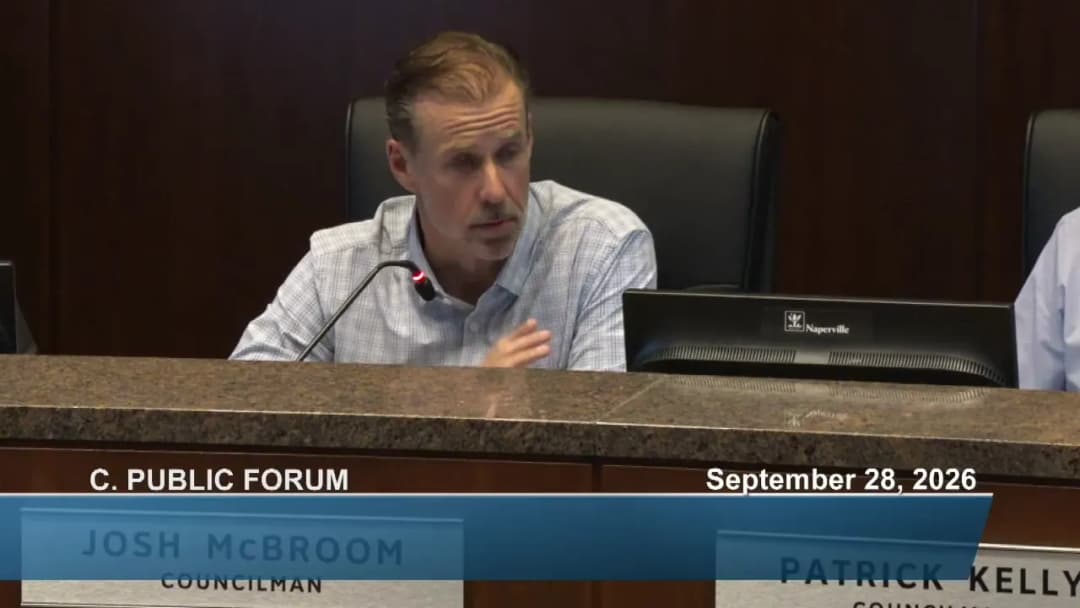
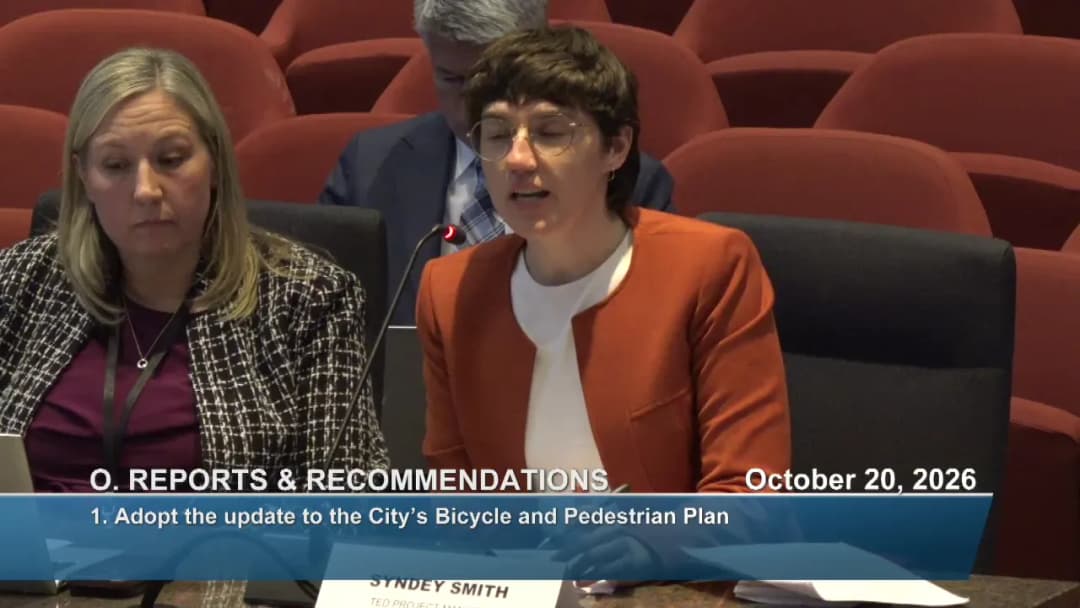
The Naperville City Council met on October 20, 2026, at 7:00 PM (presumed from "Good evening") to discuss a proclamation, hear public comments, approve a consent agenda, award a contract for underground utility work, and adopt an updated Bicycle and Pedestrian Plan. All votes were 9-0 unless noted. Consent Calendar - Approved unanimously (9-0) using the omnibus method: September cash disbursements ($49,298,656.70), minutes of October 6, 2026, meeting schedule for Oct–Dec 2026, year-to-date budget report through September 30, 2026, waiver of procurement code for electric utility executive search ($65,000), cooperative procurement for Verizon cellular ($338,000) and mobile broadband ($28,000), option year one for external auditing ($222,800), option year three for civil/ductwork ($400,000), bid for electric equipment painting ($168,290), change order for Navistar OEM parts ($80,000), and change order for flow meter maintenance ($81,000). Public Comments & Testimony - Peggy Frank (AAUW President) accepted a proclamation celebrating the Naperville Area Branch's 70th anniversary, highlighting scholarship awards over $175,000 and used book sales. - Ted Boulard criticized a climate science denier who spoke at an Affordable Neighborville town hall, citing 99.5% peer-reviewed paper consensus on human-caused climate change and disputing the Spain/Portugal blackout attribution to solar/wind. - Teresa Haas (NEST leadership) thanked council for the new energy vision statement, emphasized the UN Brundtland definition of sustainability, and urged competitive bidding before signing a long-term IMEA agreement, noting IMEA's history of cost overruns. - Barbara Benson (NEST volunteer) promoted winter energy efficiency tips (sealing leaks, thermostat settings, furnace filters) and offered climate coaching resources. - Tim Farido (Director of Affordable Neighborville) opposed the electric vision statement, arguing sustainability elevates carbon reduction over reliability/affordability and that flexibility/local control serve sustainability, not independent goals. - James Fuller argued Naperville's electricity is already virtually carbon-free due to surrounding nuclear plants, so supply decisions have zero climate impact but significant ratepayer cost. - Bob (no last name) criticized sanctuary policies, citing the Kate Steinle and Sheridan Gorman cases, and urged council to oppose Illinois' Safety Act. - Richard Stark outlined a project plan for electricity strategy development, warning that five of nine major deliverables are behind schedule with high risk, and called for additional staffing and a completed decision framework. - Louis Fleikius (PUAB Chair) clarified that Naperville does not uniquely subsidize electric bills; rates are 20–30% lower than surrounding communities even after accounting for cost-of-service variations, and urged council to utilize PUAB expertise. - Paul Lundy described flooding from a neighbor's concentrated water drain, arguing the city's drainage code should be updated to require minimum setbacks, as other DuPage County municipalities do. Discussion Items - Drainage Concerns (Public Forum Follow-up): Councilman Holzhauer asked about Mr. Lundy's flooding issue. City Engineer Andy Hines explained that the city does not have a minimum setback for discharges, but recommends pulling drains back. Code official and deputy engineer had already met with Lundy. Mayor urged investigation of other communities' ordinances. - Sustainability & Energy Vision: Councilman Wilson questioned the UN Brundtland definition as arbitrary/subjective. Councilman White said sustainability is necessary due to state mandates to wean off coal. Councilman Sayed thanked Barbara Benson for energy saving tips. - Bus Stops: Councilman White requested staff explore covered bus stops, especially for winter, noting many Pace bus users have disabilities. Director Loudon said the city could work with Pace under state permit for Route 59 stops. - Construction Project Map: Councilman White proposed a centralized online map showing all active construction projects with contacts. Director Loudon agreed to improve the current website map. - Jefferson Avenue Speeding: Councilman White asked about continued speeding concerns. Director Loudon reported traffic calming measures reduced 85th percentile speeds to about 31 mph (a 1 mph reduction). Deputy Chief Bissiger confirmed extra patrols. - Renewable Energy Program: Mayor noted a renewable energy opt-in program has been available for 1.5 years, but only one customer has enrolled. - Website Redesign: Communications Director Linda LaCloche announced the city's redesigned website launches October 21, 2026, with improved accessibility (WCAG 2.1 AA compliant) and usability based on surveys. - Bicycle & Pedestrian Plan Update (Item O1): The council heard from two public speakers. Brian Bohr (Jefferson Avenue homeowner) opposed proposed bike lanes on Jefferson, citing loss of residential parking, insufficient crash data, and a 2021 FHWA study finding no statistically significant reduction in injury/fatal crashes. Catherine Clarkin (Accelerate Climate Solutions) supported the plan, noting interns' Naperville Bikeability Report and arguing $1.9M/year (vs. $12M for roads) is a worthwhile investment. - Council discussion: Councilman Kelly asked about implementation—staff explained the plan is a high-level roadmap; individual projects (like Jefferson) would require further engineering, public input, and future council votes, especially where parking removal is needed. Councilman McBroom expressed concern about parking removal but acknowledged the plan's flexibility. Councilman Wilson preferred to table pending more parking data. Councilwoman Gibson supported adoption as a guidepost. Councilman Holzhauer highlighted a "missing mile" gap between north and south bike trails and proposed a feasibility study for a pedestrian/bicycle tunnel under railroad tracks between Washington and Mill Street. - Councilman Kelly moved to adopt the plan with an added feasibility study for the tunnel. Motion seconded by White. Passed 9-0. Key Outcomes - Consent Agenda: Approved 9-0. - M1 (Option year three for underground directional boring to Met Electric, $19,867,145.69): Approved 9-0. - O1 (Bicycle & Pedestrian Plan Update): Adopted 9-0 with a condition to add a feasibility study for a pedestrian/bicycle tunnel under the railroad tracks between Washington and Mill Street. - New Business: Councilman White requested staff move forward on improving the construction project map; no formal vote needed. Meeting adjourned.

ACTIVE TRANSPORTATION 27% · ENERGY PLANNING 15% · PROCEDURAL 11% · ENVIRONMENTAL PROTECTION 9%
03
OCT 7, 2026 · NAPERVILLE, ILLINOIS · CITY COUNCIL
Naperville Planning and Zoning Commission Meeting - October 7, 2026

The Planning and Zoning Commission convened on Wednesday, October 7, 2026, at 6:00 PM in the City Council Chambers. The meeting focused on a single public hearing for a proposed residential development at 1960 Lucent Lane, followed by approval of the August 19, 2026 meeting minutes. Public Comments & Testimony - No members of the public signed up to speak during either the public forum or the public hearing for the proposed development. Discussion Items - 1960 Lucent Lane (Towns at Naper Commons) – DEV-0042-2026: The petitioner, Pulte Home Company, seeks to rezone 40 acres from ORI (Office Research and Light Industry) to R2 (Medium Density Residential) to build 262 townhomes (6.4 units/acre) with three building types. The project also requests conditional use approval for townhomes in R2, and variances to reduce front yard setbacks, reduce parkway trees, and allow height measurement from grade and a fourth story in certain units. Staff presented the proposal, noting that the rezoning is consistent with the Comprehensive Plan's medium-density residential designation. The petitioner highlighted the housing shortage, compliance with the land use plan, and community benefits. Commissioner questions addressed the parkway tree variance, school impacts, affordable housing, ORI inventory loss, buffering, and traffic. The petitioner agreed to continue working with staff on parkway trees internal to the development, buffering to the north, and forest preserve concerns. No public testimony was offered. Key Outcomes - The Commission voted 6-3 to recommend approval of DEV-0042-2026, including rezoning, conditional use, and variances, subject to conditions that the petitioner work with staff to: (1) meet city parkway tree requirements internal to the development; (2) improve buffering between the development and the Nokia building to the north; (3) improve buffering between residential units and Warrenville/Naperville Roads; and (4) address the DuPage Forest Preserve's comments on invasive plants and dark-sky compliant lighting. Commissioners Bonzo, Longenbach, Namas, Robins, Wright, and the Chair voted in favor; Commissioners Castanoli, McDaniel, and McGowan voted against, citing concerns over loss of ORI-zoned land and a lack of affordable units. - The minutes of the August 19, 2026 Planning and Zoning Commission meeting were approved unanimously.

ZONING REGULATIONS 54% · HOUSING AFFORDABILITY 14% · PROCEDURAL 12% · SCHOOLS 8%
04
OCT 6, 2026 · NAPERVILLE, ILLINOIS · CITY COUNCIL
Naperville City Council Meeting - October 6, 2026

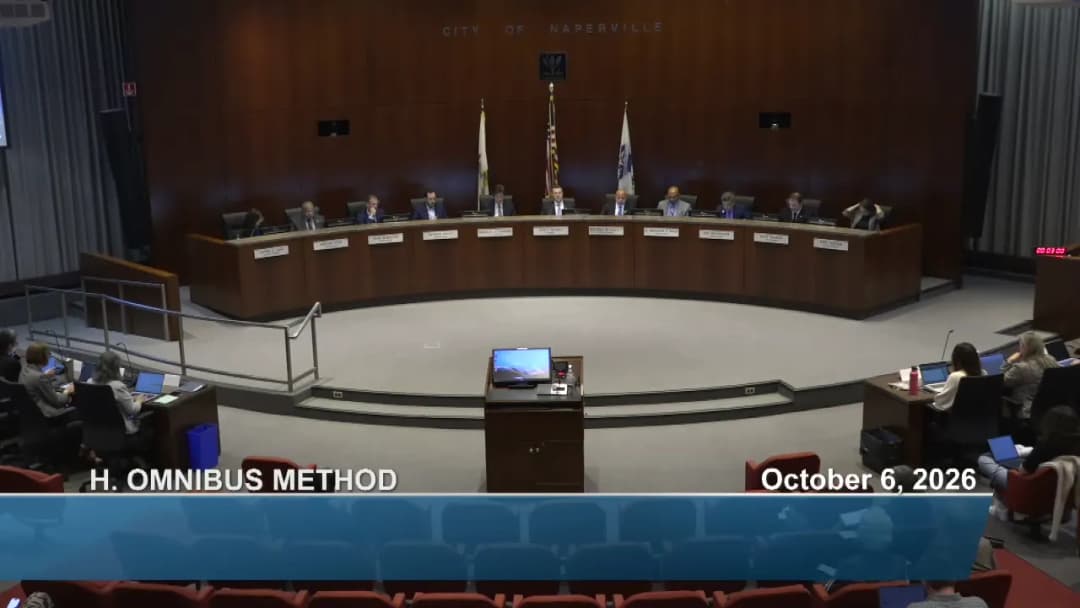
The Naperville City Council met on Tuesday, October 6, 2026 at 7:00 PM in the Council Chambers, with Mayor Scott Wehrli presiding. The meeting featured the withdrawal of the controversial Naperville Ridge development petition by Pulte Home Company, approval of a height adjustment for the Everly Trace townhome development, and various consent agenda and expenditure items including storm cleanup costs and seasonal roadway salt procurement. Significant attention was also given to ongoing traffic disruptions caused by DuPage Water Commission construction. Awards and Recognitions - Senior of the Year Awards: Presented to Mary Ann Bobosky and Rodney Randall for their decades of community service. - Proclamation: Celebrated the 175th Anniversary of the Euclid Chapter No. 13, Royal Arch Masons. Consent Calendar - The Consent Agenda was approved 9-0 with item I9 (Everly Trace) pulled for separate discussion. - Storm Restoration: Emergency procurement for the August 2026 storm cleanup was accepted at an amount not to exceed $554,463. - Downtown Brick Paver: Bid awarded to Copenhaver Construction Inc. for $123,582.50 plus a 5% contingency. - Municipal Center Blinds: Phase 1 replacement awarded to ODP Business Solutions for $265,007. - Civil/Duct Work: Change Order to Meade Electric Company approved for $644,000 (total contract $1,044,713.08). - Tree Trimming: Change Order for Parkway Tree Trimming Services approved for $70,000 (total contract $570,000). - Atlas Subdivision: Final plat of subdivision and Owner's Acknowledgement and Acceptance approved. - Turkey Trot 5K: Ordinance passed for temporary traffic controls and special event/amplifier permits. Public Comments & Testimony - Rita Treonis (Naperville): Thanked the Council and staff for their diligence on the Naperville Ridge issue, informing the Council that nearly 3,700 people signed a petition against the development. She advocated for a conservation-minded solution for the publicly-owned green space. - Traffic Congestion (Council Discussion): Councilmembers McBroom, Sayed, Wilson, and Gibson expressed frustration over the lack of coordination and significant disruption caused by the DuPage Water Commission's road construction on Book Road, 75th Street, and 95th Street. City Manager Doug Krieger noted the City lacks authority over the project but will improve communication, stating Book Road is expected to open to 83rd Street later that week. Councilman Wilson noted that a meeting with the DuPage Water Commission had occurred and that the timeline for opening 75th to 87th was anticipated by October 17. - Community Opposition (Naperville Ridge): The Council received 80 written positions of opposition and 13 written comments regarding the Naperville Ridge petition. Commenters cited the destruction of a mature oak forest (850-1,000 trees), critical habitat for state-threatened and federally endangered species, increased flood risks, traffic hazards, and a strong preference for the land to be preserved or transferred to the Forest Preserve District of DuPage County. - Marilyn Schweitzer (Naperville): Spoke regarding the Naperville Ridge withdrawal, arguing the development would have permanently destroyed 47% of a healthy woodland and wetland ecosystem, displacing wildlife and providing insufficient community benefit. Discussion Items 1. Everly Trace Minor Change to Conditional Use (Item I9) - Proposal: M/I Homes requested approval of a Minor Change to a Conditional Use to adjust the height of the townhome buildings at 25013 and 25035 West 111th Street by approximately 4 feet taller than originally approved. - Resident Concerns (Jyothsna Kasu): The adjacent homeowner expressed strong privacy concerns, stating the 2-story townhomes would now be 28'5" and 36'10" tall, with windows directly facing her property. She reported cracked windows and vibrations from construction. She requested three conditions: accelerated planting of an evergreen buffer, a privacy fence, and pre-construction inspections with vibration monitoring. - Developer Response (Russell Whitaker, representing M/I Homes): Stated the original elevation plans contained a typographical error and the buildings are standard two-story structures well under the 43-foot zoning limit. He agreed to expedite the evergreen planting but declined a fence for a single property, citing existing landscaping plans. He noted the heavy utility construction adjacent to the property line has been completed. - Outcome: The Council approved the ordinance 9-0. 2. Naperville Ridge Petition Withdrawal (Item O1) - Background: Mayor Wehrli announced that the City received a letter from counsel for Pulte Home Company withdrawing the Naperville Ridge petition. Under the Municipal Code, the withdrawal is final and the case is closed. Any future proposal must start the application process over from the beginning. - Council Action: The Council voted unanimously (9-0) to remove the item from the agenda. Key Outcomes - Naperville Ridge Petition Withdrawn: Pulte Home Company withdrew its petition. The item was removed from the agenda without a vote on the merits. Future proposals must be submitted as a new petition. - Everly Trace Height Adjustment Approved: Ordinance 26-99 was passed unanimously, permitting the increased building height. - Roadway Salt Procured: Approved the award of Cooperative Procurement 26-243 to Morton Salt and Compass Minerals America, Inc. for an amount not to exceed $1,211,916 (9-0). - Employee Insurance Benefits Renewed (All Approved 9-0): - Medical Claim Administration renewal with BCBSIL ($2,390,921.73). - Stop Loss Reinsurance with BCBSIL ($1,900,871.96). - Pharmacy Benefit Manager continuation with CVS/Caremark (no change). - Dental Claim Administration renewal with Delta Dental ($41,696 for three years). - Future Traffic Coordination: City Manager directed staff to improve public communication regarding the DuPage Water Commission's construction schedule.

PROCEDURAL 28% · COMMUNITY ENGAGEMENT 18% · ZONING REGULATIONS 16% · PUBLIC ENGAGEMENT 11%
05
OCT 1, 2026 · NAPERVILLE, ILLINOIS · CITY COUNCIL
Naperville Transportation Advisory Board Meeting – October 1, 2026

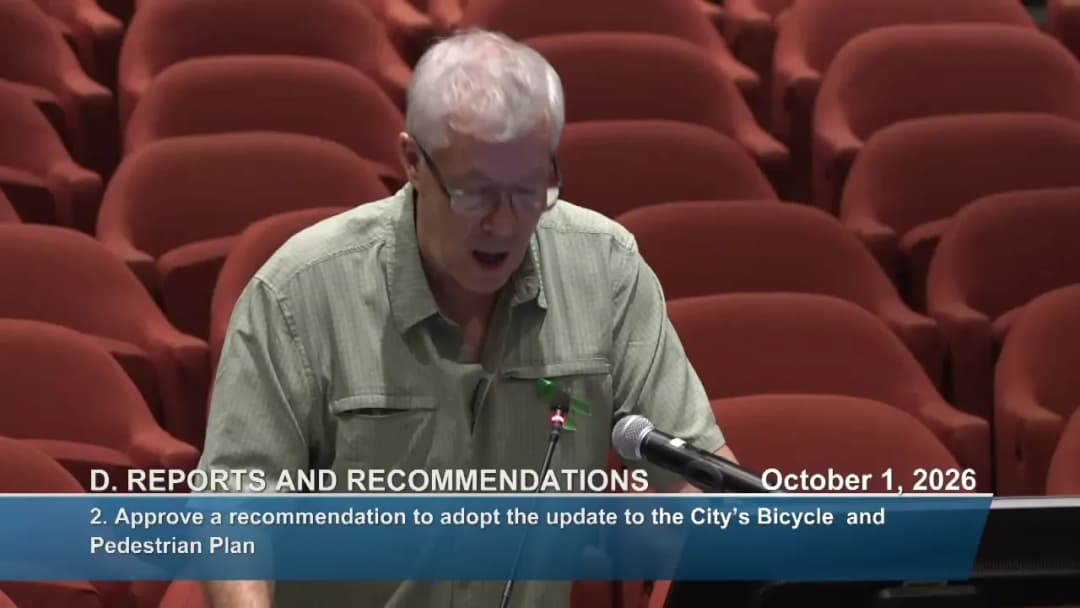
The Naperville Transportation Advisory Board (TAB) met at 7:00 PM on October 1, 2026, in Council Chambers. The board approved the minutes from the September 3, 2026 meeting, received a year-end police department report, and voted unanimously to recommend adoption of the updated Bicycle and Pedestrian Plan. The meeting also included an update on the overnight parking survey. Consent Calendar - The board unanimously approved the minutes of the September 3, 2026 Transportation Advisory Board meeting as submitted. Public Comments & Testimony - No members of the public signed up to speak during the open Public Forum; however, written comments were submitted and provided to the board in advance. - In connection with the Bicycle and Pedestrian Plan update (Item 26-1152), three speakers addressed the board: - Ted Borlard, representing NES (Naperville Environmental Society), expressed strong support, stating the plan should be viewed as an investment that improves safety, accessibility, connectivity, and quality of life for all residents. - Nick Falk, a resident, advocated for studying the use of Riverwalk-adjacent public land (e.g., Centennial Beach) to solve the downtown bicycle "missing mile" connection, rather than relying solely on on-road signage. He asked that the plan preserve options for further study. - Justin White, representing the Naperville Bicycle Club, Naperville Outdoor Alliance, and NES, emphasized the plan's importance for residents of all ages and abilities and commended the revisions made after public feedback. Discussion Items - Police Department Report: Sergeant Musca reported final 2026 STEP grant enforcement numbers: 849 total stops and 625 enforcement hours, with 198 seat belt, 298 speed, and 223 distracted driving violations. Budget for 2027 is expected to roughly double, leading to increased enforcement. Enforcement visibility will increase in areas affected by south-end construction (Book Road/Route 59 and Wolf's Crossing/248th corridor). - Bicycle and Pedestrian Plan Update: Mr. Prusa presented the final draft update, noting key additions: a feasibility study for an off-street downtown bicycle connection, an implementation framework, and clarifications on protected bike lanes and cost estimates. Board members asked whether the plan constituted enforceable policy or guaranteed specific projects. Mr. Prusa explained it is a 30-year planning document that guides investments but requires future budgeting and City Council approval. Potential funding sources, including grants, are outlined in the plan. Board members also inquired about requirements for new developments to provide bicycle and pedestrian access; Mr. Prusa stated that the plan does not specify such requirements but offered to follow up. Councilman Brown noted the plan's $54 million estimated cost over 30 years and emphasized that it remains aspirational until funded. The board unanimously voted to recommend adoption of the plan. - Old Business: Mr. Prusa provided an update on the overnight parking survey. The survey ended on September 18 with over 2,000 responses, including 1,800 written comments. Staff continues to analyze the data and will present results at a future TAB meeting. Key Outcomes - Approved the September 3, 2026 meeting minutes. - Recommended adoption of the Bicycle and Pedestrian Plan update to the City Council. - Police Department will focus enforcement on construction-impacted areas. - The overnight parking survey results are pending analysis and will be reported at a later meeting.

ACTIVE TRANSPORTATION 53% · PUBLIC ENGAGEMENT 23% · PROCEDURAL 12% · PUBLIC SAFETY 9%
06
SEP 28, 2026 · NAPERVILLE, ILLINOIS · CITY COUNCIL
Naperville City Council Electric Strategy Workshop Selects Vision Statement and Reviews Power Options — September 28, 2026

On Monday, September 28, 2026, at 6:00 PM in Council Chambers at 400 S. Eagle Street, the Naperville City Council held an Electric Strategy Workshop (agenda item 26-1147). City Manager Doug Krieger and staff presented the city's power procurement history, draft vision statements, a proposed decision framework, and a recap of four long-term electricity procurement options. Because the session was a workshop, no final actions or binding votes were taken. Eight members of the public provided comment during the Public Forum. Public Comments & Testimony - Richard Stark (Naperville resident for 8 years; member of the strategy team supporting Doug Krieger) described the due diligence process used to check AI-generated research. He played an AI-generated audit by Gemini Pro of a 28-page ChatGPT electricity strategy analysis containing 59 citations; all 59 citations passed verification, and a flagged reference to the "National Laboratory of the Rockies" turned out to be the correct new name for the National Renewable Energy Laboratory. Stark's position: the report provides a reliable foundation for the council's electricity strategy. - James Fillar argued against leaving the Illinois Municipal Electric Agency (IMEA) on cost and ratepayer-impact grounds. He noted that only 6% of utility customers subscribe to the city's energy efficiency program, that residents collectively paid $700 million over 24 years with a promised 25% price reduction that did not materialize, and that 62,000 utility account holders have not been heard from. He expressed concern about 2035 bills for retired couples on fixed incomes and families already struggling financially. - Joe Huss (volunteer with NEST) raised concerns about the presentation's claims on options two and three: he said the city could hire experienced power marketers rather than new staff, that "immediate action" is not required (citing Earthwise Energy's 600 MW Will County solar farm, which began construction in 2026 and plans delivery in 2028—three years), and that assets serve as a physical hedge against rate volatility rather than causing fluctuations. He advocated hiring outside independent expertise and a diverse, flexible solution. - Tim Farrito (Forbull Naperville Director and Naperville resident) presented a cost comparison showing solar PPA costs roughly three times IMEA Prairie State power after bond retirement ($105/MWh vs. $35/MWh, using actual 2025 invoices and generation reports). He warned of isolation risk from the state's plan, noted that businesses consume 50% of Naperville's power and that cost increases pass through to customers, and observed that 80% of ComEd customers still use standard bundled service. - Robert Geese (Affordable Naperville; PhD in physics from Stanford; 26 years at Argonne National Laboratory studying electric utilities and energy storage) urged the council not to accept the phrase "climate crisis" uncritically, citing natural climate variability, the logarithmic relationship between CO2 and temperature, and natural CO2 removal mechanisms. His position: examine the science and policy choices independently. - John Doyle (Naperville resident) reviewed procurement history: since 2004, ComEd was cheaper than Naperville in only three years, all during the IMEA era; Naperville was 17% cheaper than ComEd under J. Aaron vs. 8% under IMEA. He suggested merging options two and three into a single market participation option and adding "autonomy" and "flexibility" as evaluation metrics. - Lewis Halkeus offered brief comments during the Public Forum (the transcript records only his introduction). - Roger Bloomquist (lifelong engineer; former operator of a nuclear submarine microgrid; briefly served on the NEST Energy Committee) said the traditional priority order—reliability, affordability, environmental—has been reversed, making electricity more expensive and less reliable. He criticized NEST's partnership with the Rocky Mountain Institute and urged the council to apply "the laws of physics and economics" rather than aspirations. Presentation: Procurement History and Market Context - City Manager Doug Krieger recapped the timeline: 2007 IMEA contract approved (expires September 30, 2035); 2007–2011 power supplied by J. Aaron Goldman Sachs with IMEA performing administrative duties; June 1, 2011 IMEA power deliveries began; late 2023 post-2035 discussions began; IMEA extension offer declined in 2025 after the April 30 deadline was extended to August, with negotiations continuing on 10 specific areas plus a power sales contract; February 2026 council formally paused contract extension negotiations; spring 2026 new educational presentations began. - Market shifts noted: a shift from energy concerns to capacity concerns, continued renewable price reductions, the December 2025 Illinois Power Agency warning of potential PJM reliability/capacity shortfalls beginning in 2030, slow PJM addition of new energy sources, potential exponential demand growth from data center proliferation, and current volatility complicating long-term contracts. - Councilwoman Gibson clarified that IMEA's 2007–2011 administrative role (FERC/NERC/PJM reporting) could be performed by staff or outsourced. Krieger confirmed that grid reliability for Naperville would not depend on which procurement option is chosen; the larger effect would be on pricing. Vision Statement Discussion - Staff presented five draft vision statements (with statement two repeated as six as an attention check) and four criteria: long-term/future-focused over a 20-year horizon, inspirational and directional, defining the final destination, and anchored in decision-making values. - Councilwoman Jane and Councilwoman Gibson offered a new statement, designated number six: "To secure an energy future that prioritizes reliability, sustainability, affordability, flexibility, and local control." - Councilman McRoom offered number seven: "To maintain a financially strong technologically adaptable electric utility capable of meeting Naperville's future energy needs while preserving flexibility for generations to come." - Council members debated whether "sustainability" was undefined or a "code word" (McRoom, Moore) vs. important to the community and required by state law (White), and whether "affordability" should be listed first (Mayor) vs. treated as one of five interconnected, non-hierarchical pillars (Holzar, Gibson). - A straw poll by show of hands selected number six: "To secure an energy future that prioritizes reliability, sustainability, affordability, flexibility, and local control." Numbers seven and eight were also tested but did not achieve a simple majority. Decision Framework Discussion - Staff proposed a decision framework with four categories: affordability (measured by total cost per kWh vs. ComEd and by wholesale cost), reliability/resilience (measured by SAIDI—System Average Interruption Duration Index—the minutes or hours the average customer is without power), sustainability (metric tons of carbon from generation sources, plus solar installations, EV chargers, and program participation), and "custom programs," which staff revised to "flexibility" after noting that no one liked the original title. - Councilman Holzar asked that flexibility also cover city-level choices such as battery storage, and that wholesale costs be compared on an apples-to-apples basis. Councilman White asked that affordability benchmarks be expanded beyond ComEd to include other joint action agencies in the region. Options Review and Council Direction - Staff recapped four options: (1) joining or creating a joint action agency; (2) market participation with asset ownership; (3) market participation without asset ownership; and (4) sale of the electric utility. - Staff recommended focusing on option one (narrowed to joining an existing joint action agency rather than creating one) and option three (using power purchase agreements to dictate generation sources without ownership, similar to the 2007–2011 J. Aaron arrangement), and not focusing on options two or four. They noted option three does not prevent battery energy storage systems and that any option could be revisited as markets and technologies change. - Council discussion covered: the buy-vs-lease distinction between options two and three (asset ownership entails 15–20 year commitments; PPAs are typically 3–5 years); the need for some form of hedge under either approach; small modular reactors as a possible future asset (Krieger said it is too early, and the city could buy power blocks from such a reactor rather than owning a share); and Councilman Wilson's concern that sustainability goals could conflict with affordability, citing prior NEST-referenced Lazard figures of roughly $167 vs. $30–35 per MWh for coal generation. - Councilman McRoom questioned why IMEA representatives have never presented to the council despite two years of debate; Krieger responded that IMEA's absence likely reflected respect for the council's pause on negotiations and that IMEA would probably be happy to present if invited. Councilman White echoed interest in formally inviting IMEA. - Councilman Kelly said he preferred to eliminate option four entirely; staff responded that they would not perform additional analysis of option four unless directed by council. Councilwoman Gibson said she was only comfortable eliminating option four and wanted the other three kept open until the decision framework is finalized. - Krieger confirmed the pending rate study is expected in June 2027 and will forecast rate impacts (including possible 2028 increases and cash reserve or debt needs) for the various options. Staff will continue refining the decision framework and mission statement before the rate study. Key Outcomes - Selected vision statement by straw poll (simple majority): "To secure an energy future that prioritizes reliability, sustainability, affordability, flexibility, and local control." - Agreed in principle on decision framework categories—affordability, reliability/resilience, sustainability, and flexibility (renamed from "custom programs")—with further council discussion to follow before adoption. - Straw polls were conducted by show of hands on each of the four procurement options (one, two, three, and four); the transcript does not record the individual tallies or resulting guidance. Staff stated they will present recommendations in conjunction with the evaluation of the remaining options and will not pursue additional option-four analysis unless directed. - Next steps: staff will continue the battery energy storage system cost-benefit analysis, refine the decision framework and mission statement, and return to council ahead of the June 2027 rate study that will inform further option evaluation. - No formal actions were taken; the workshop was informational only.

ENERGY PLANNING 76% · ENERGY PROCUREMENT 10% · PROCUREMENT 4% · ENVIRONMENTAL PROTECTION 3%
07
SEP 21, 2026 · NAPERVILLE, ILLINOIS · CITY COUNCIL
City Council Budget Workshop #1: 2027-2031 Capital Improvement Program - September 21, 2026

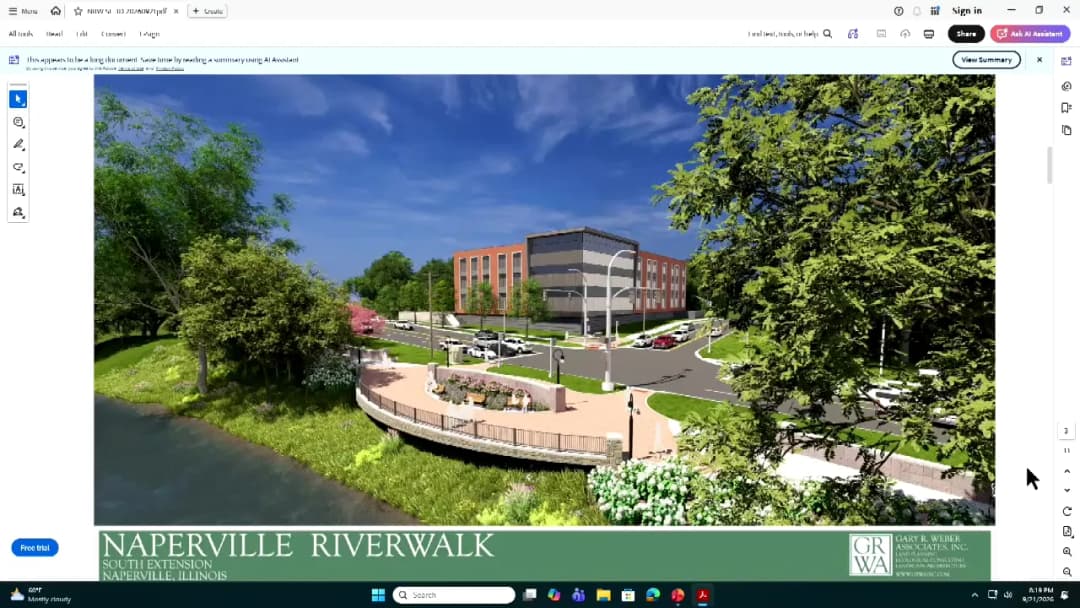
The Naperville City Council held its first budget workshop on September 21, 2026, from 6:00 PM to approximately 8:30 PM, focusing on the proposed 2027-2031 Capital Improvement Program (CIP). The preliminary 2027 CIP totals $211 million, an 11% increase over 2026. No final actions were taken; the workshop was for discussion and direction. Councilman Sayed participated by phone initially, then joined in person. Public comments covered the climate action plan, battery storage, the Riverwalk South Extension, the electric utility debt strategy, and the Nichols Library parking deck. Public Comments & Testimony - Teresa Huss (NEST member, longtime resident) urged funding a climate action plan, calling it a one-time cost of 0.015% of the annual budget. She cited the 2025 greenhouse gas inventory and resident survey showing sustainability as a high priority. - Joe Huss (27-year resident, NEST volunteer) recommended including battery storage in the capital budget and using a competitive process for operator selection. He argued a battery would quickly pay for itself, reduce electricity bills, and address reliability violations, and warned that delay risks losing federal investment tax credits. - Pat Kennedy (former Riverwalk Commission chair) provided context on the Riverwalk South Extension, noting the project was planned since 2015, master plan endorsed in 2021, design/permitting in 2023, and deferred due to the 430 South Washington bridge delay. He stated $1.5 million in private donations (Edward Hospital $800,000, Rep. Yang Rohr $700,000) were secured, originally covering half of a $3 million project. - John Doyle (resident) questioned the electric utility's debt strategy, asking about planned borrowing beyond 2027, how borrowing vs. rates decisions are made, the target debt coverage ratio, and the reason for a sudden change in funding philosophy (first new debt since 2011). He also noted a $10 million gap in the electric project list and requested more detail on the tollway substation project. - Katie Wood (Downtown Naperville Alliance) requested keeping Nichols Library deck design in 2027, moving construction significantly sooner than 2031-32 by readjusting streetscape priorities, and reconsidering use of downtown parking fund dollars for the municipal deck. She stated that 60% of downtown visits come from outside Naperville (per Placer AI) and that 160,000 sq ft of new commercial space is on the horizon. - Chris Hartner (Naperville Running Company owner, downtown property owner) reiterated that the food and beverage 1% tax was never intended for the municipal deck. - Monica Connors (Naperville Development Partnership president) emphasized downtown's economic contribution (property tax, sales tax, jobs). She noted construction costs have increased 68-80% since 2008 and that parking is a top factor for retailers choosing a location. - Neil Malone (Chamber of Commerce) supported accelerating the Nichols deck, citing long-standing need, location importance, support for downtown businesses, and cost escalation (original estimate $18.9M, now $37.7M). Discussion Items - Climate Action Plan: Council discussed but did not act; it will be addressed in the operating budget workshop. - Battery Storage: City Manager Krieger explained that under the full-requirements contract with IMEA (Illinois Municipal Electric Agency), a battery's value is limited because IMEA is 100% hedged; payback is likely north of 10 years. Staff will bring a financial analysis regardless of CIP inclusion. Councilwoman Jane asked about timing given falling battery prices. - Riverwalk South Extension: Councilman Holzar raised process concerns, noting that the project was ready in 2023 and deferred multiple times, and that stakeholders invested years of design. Director Heinz reported the latest cost estimate is $1 million over the $6.8 million budget due to structural elements. Staff indicated the Riverwalk Commission is reviewing options, but the commission had not voted on alternatives. Councilman Kelly asked whether the commission recommended the full project; no formal vote had been taken. - Water Utility: The 2027 water CIP is $98.8 million, driven by Springbrook revitalization (total $198 million, about halfway complete) and water main replacements (goal of 10 miles/year). Councilman Kelly asked about cost inflation; staff confirmed the $198 million is the best current estimate. Councilwoman Gibson inquired about sewer main lifespans. - Electric Utility: 2027 electric CIP is $30 million, including SCADA/Durham's upgrade, substation work, and tier one undergrounding ($1.3 million in 2027, down from original plan due to lost federal grant). Councilman White praised progress (94% underground) but urged continuing toward 100%. Councilman Kelly confirmed tier one scope is unchanged, just delayed. - Transportation: $41 million in 2027 projects including North Aurora Road underpass, 87th Street Bridge ($5.7M total, $3M federal), and White Oak roadway improvements. Councilman Wilson expressed concern about construction impacts south of 75th Street; staff noted coordination efforts. - Downtown Parking: The proposed schedule sequences municipal deck rehab (2027-28) with Jefferson Streetscape, then Nichols deck construction in 2031-32. Staff cited logistics and avoiding overburdening downtown. The Nichols deck concept design ($100K) remains in 2027. Funding split for municipal deck: 50% downtown parking fund, 50% capital projects. For Nichols deck: two-thirds downtown parking fund, one-third capital projects. Councilman Kelly expressed skepticism about need, citing lack of data; he wants a full public meeting before deciding on $40M project. Mayor questioned using downtown parking fund for municipal deck, noting city/settlement/library employees use it heavily. Councilman McRoom supported getting data and a staff recommendation. - Debt and Funding: The 2027 CIP assumes $50M in new utility debt ($10M electric, $40M water), with no new general fund bonds. Home rule sales tax projected at $24.8M (+3%). Motor fuel tax at $7.6M (+4.8%). Downtown food and beverage tax projected at $1M (-2%). Councilman White raised electric vehicle registration fee not being collected locally; staff said they are waiting on state action. Key Outcomes - No votes or formal decisions were taken; this was a workshop. - Council provided direction on several items: support for continuing Nichols deck design but with data-driven decision on construction; interest in receiving the downtown parking study results before finalizing the deck timeline; concerns about the Riverwalk process and cost overrun; and desire for a project-by-project breakdown of the CIP. - The proposed budget will be published on October 9, 2026. The next workshop (operating budget) is scheduled for October 27, 2026, with a potential third workshop on November 10, 2026. Public hearing and adoption are in December. - Staff will return with updated information on battery financial analysis, Riverwalk options, downtown parking study (October/November), and a detailed reconciliation of the electric utility project list.

CAPITAL PROJECTS 26% · ENGINEERING AND INFRASTRUCTURE 12% · PARKING REGULATIONS 10% · BUDGET EQUITY ANALYSIS 10%
08
SEP 15, 2026 · NAPERVILLE, ILLINOIS · CITY COUNCIL
Naperville City Council Meeting – September 15, 2026: Proclamations, Public Forum on Energy, and Unanimous Approvals

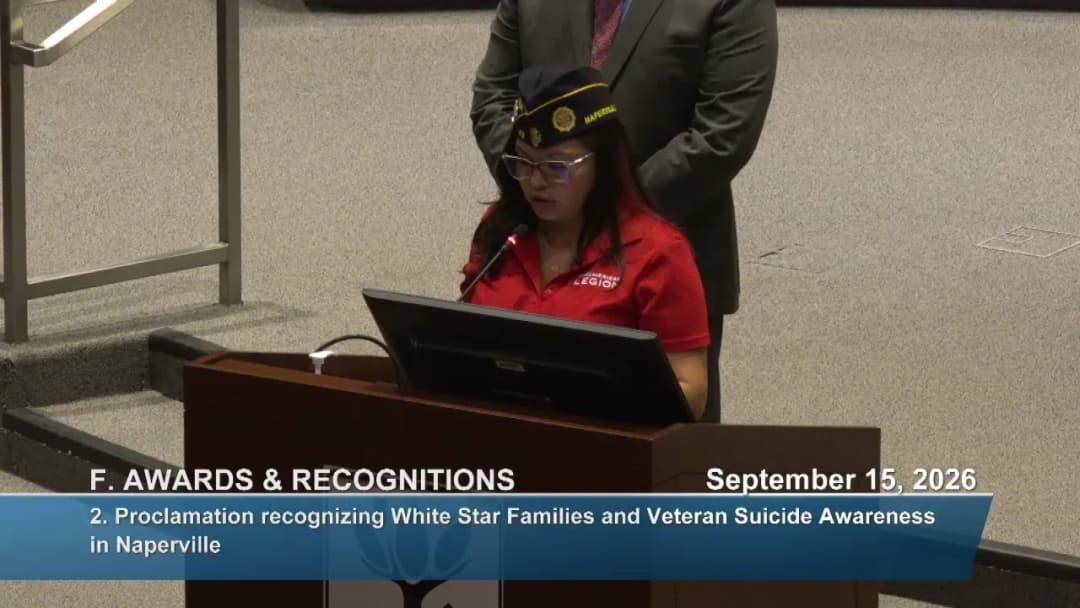
Mayor Scott Wehrli called the September 15, 2026 City Council meeting to order at 7:00 PM in Council Chambers. All nine council members were present (Councilman Kelly arrived at 7:03 PM). The meeting adjourned at 7:44 PM. Key actions included two proclamations, a public forum with six speakers raising energy transparency, historic preservation, and communication concerns, approval of a consent agenda with one item pulled for discussion, and unanimous approval of two bid awards. Awards & Recognitions - Hispanic Heritage Month Proclamation (September 15 – October 15): Presented by Councilman Syed. A representative from ALMAS (Alliance of Latinos Motivating Action in the Suburbs) spoke, emphasizing that recognition must extend beyond a single month to ensure belonging, representation, and leadership opportunities for the Latino community. - White Star Families and Veteran Suicide Awareness Proclamation: Presented by Councilman Syed. A representative from the Naval North American District spoke, thanking the city for formally recognizing families who have lost a veteran to suicide, and noted that a commitment walk honoring those lost continued in 2025 and 2026. Consent Calendar The council approved the consent agenda (minus Item I-12) by a 9–0 vote. The following items were approved unanimously: - Cash disbursements for August 1–31, 2026, totaling $53,572,043.47 - Regular City Council meeting minutes of September 1, 2026 - City Council meeting schedule for September, October, and November 2026 - Year-to-date budget report through August 31, 2026 - Cooperative procurement for fire personal protection gear (W.S. Darley & Co., up to $120,000) - Cooperative procurement for refuse and recycling carts (Rehrig Pacific Company, up to $150,000) - Cooperative procurement for enterprise data storage solution for CAD/RMS (Xerox IT Solutions, up to $252,549.50) - Change Order 1 for police department uniforms and equipment (Galls LLC, up to $93,000, total award $291,000) - RFP for employee benefits broker (Segal Group, Inc., up to $248,460 for three-year term) - Ordinance for temporary traffic controls and special event/amplifier permits for Naperville Half Marathon, 10K, and 5K (October 18, 2026) - Ordinance for temporary traffic controls and special event permit for Downtown Naperville Trick-or-Treat (October 25, 2026) - Ordinance approving a major change to Railway Plaza Commercial PUD for Weston Ridge Apartments (540 Weston Ridge Drive) – noted a written comment from Wanda Wohead raising density and parking concerns - Ordinance approving a minor change to Fox River Commons PUD for a building addition at 796 S. Route 59 (Entourage) - Resolution approving workers’ compensation settlement between Ryan Jordan and the City of Naperville - Resolution approving workers’ compensation settlement between Kate Koziol Lindgren and the City of Naperville - Resolution approving an intergovernmental agreement with Naperville Park District for a temporary construction easement for 87th Street Bridge reconstruction - Resolution approving a joint funding agreement with IDOT for $2,700,000 for 87th Street Bridge construction costs - Award of RFQ for Phase III – 87th Street Bridge Over Springbrook Creek to Civiltech Engineering, Inc. (up to $549,653) Public Comments & Testimony Six residents addressed the council during Public Forum: - John Doyle (Naperville resident): Discussed findings from the building/feasibility study, noting that multiple reliability violations were already present and that a single point of failure (a double-circuit power outage) could cut power to two-thirds of the city. He criticized the lack of transparency regarding consideration of a natural gas plant and requested that all studies related to the energy evaluation be made public before the upcoming electricity strategy workshop. - Richard Stark (Naperville resident): Presented a conceptual “outside the box / inside the box” framework for the city’s long-term electricity strategy. He showed an example portfolio including wind, solar, battery storage, nuclear power purchase agreements (outside), and long-duration storage, virtual power plants, demand response, small modular reactors or enhanced geothermal (inside). He stated that the council’s role in the first workshop is to approve a vision and decision framework to guide staff toward an optimal solution balancing affordability, reliability, sustainability, and resilience. - Theresa Hus (Naperville NEST): Expressed surprise and concern that the city had explored the feasibility of a natural gas electricity generation plant. She noted that the study language suggested a plant could be within city limits, and that such a plant would increase Naperville’s already-high emissions (twice the DuPage average and significantly higher than the Illinois average), negatively affect air quality for those with asthma or lung disease, and raise questions about property values and price instability due to volatile gas prices. She requested clear answers on why the option was explored, whether it is still under consideration, under what circumstances it might resume, and whether conversations with IMEA about gas generation occurred. - Bill Simon (Naperville Preservation Inc.): Highlighted national benefits of historic preservation (116,000 new jobs, $6.8 million in rehabilitation investment, $1.8 billion in tax receipts in 2024). He urged council to include increased staffing (from 0.1 FTE to 0.5 FTE) and training for historic preservation in the 2027 municipal budget. - Marilyn Schweitzer (Naperville resident): Raised five points: (1) concern that City Manager Doug Krieger is overburdened with three roles (city manager, finance director, electric utility director) during budget season and energy decision-making; (2) the RFQ for the I-88 special study may not be complete until end of month, and piecemeal planning minimizes community involvement; (3) a proposed downtown parking deck costing $36 million (approx. $95,000 per space) prioritizes visitors over historic preservation, bicycle access, and gathering spaces as called for in the 2011 downtown plan, and she called for a new downtown plan; (4) the city website was revised in the 2026 budget but the open data portal and help center remain deficient, making it difficult for residents to get information; (5) she raised personal easement and permit issues that have gone unanswered for over a month, requesting staff attention. - Ted Bourlard (Naperville NEST): Offered gratitude for sustainability achievements: a styrofoam recycling event on July 18, 2026 saw 158 vehicles dropping off 31 cubic yards of foam (up from 63 vehicles and 18 cubic yards in April); the food scrap composting program collected 578 carts through early September 2026, on pace to significantly exceed 2025’s 793 total; during International Compost Awareness Week, approximately 40 cubic yards of finished compost were distributed; and 36,201 pounds of clothing/textile recycling collected so far in 2026 (over 18 tons). Following public forum, Councilman White asked City Manager Doug Krieger to address the gas plant comments. Krieger stated that natural gas plants were discussed very briefly when considering market participation, but personally he does not think it is a good fit for Naperville, and staff will recommend that the council take that option off the table moving forward. He confirmed that no discussions with IMEA about a gas plant have occurred. Discussion Items - Item I-12 – Variance for Detached Garage at 151 N. Wright St. (DEV-0039-2026): Councilman Kelly requested the item be pulled from the consent agenda for discussion. He shared his initial hesitation regarding the hardship standard but after walking the neighborhood noted: (1) newer precedent exists for tall garages in the area (e.g., a property on Columbia); (2) the proposed garage orientation may improve the site; (3) across the street at Heritage Place, buildings are nearly 40 feet, so denying a 26-foot garage might be inequitable. He indicated he would support the variance. The council voted 9–0 to pass the ordinance approving a variance to the height limitation for the proposed detached garage. Key Outcomes - Consent Agenda: Approved (minus I-12) by a 9–0 vote. - Item I-12: Ordinance approving a height variance for a detached garage at 151 N. Wright St. – passed 9–0. - M1 – Parking Lot Maintenance Program: Award of Bid 26-016 to Denler, Inc. for $1,156,778.19 plus 3% contingency – approved 9–0. - M2 – SEL Equipment Procurement: Single Source Procurement 26-226 to A Star Electric Inc. for $1,500,000 for a one-year term – approved 9–0. - No New Business was raised. - Adjournment: Motion carried unanimously at 7:44 PM.

ENERGY PLANNING 21% · VETERAN RECOGNITION 14% · PROCEDURAL 13% · HISPANIC HERITAGE MONTH 10%
09
SEP 3, 2026 · NAPERVILLE, ILLINOIS · CITY COUNCIL
Transportation Advisory Board Meeting - September 3, 2026

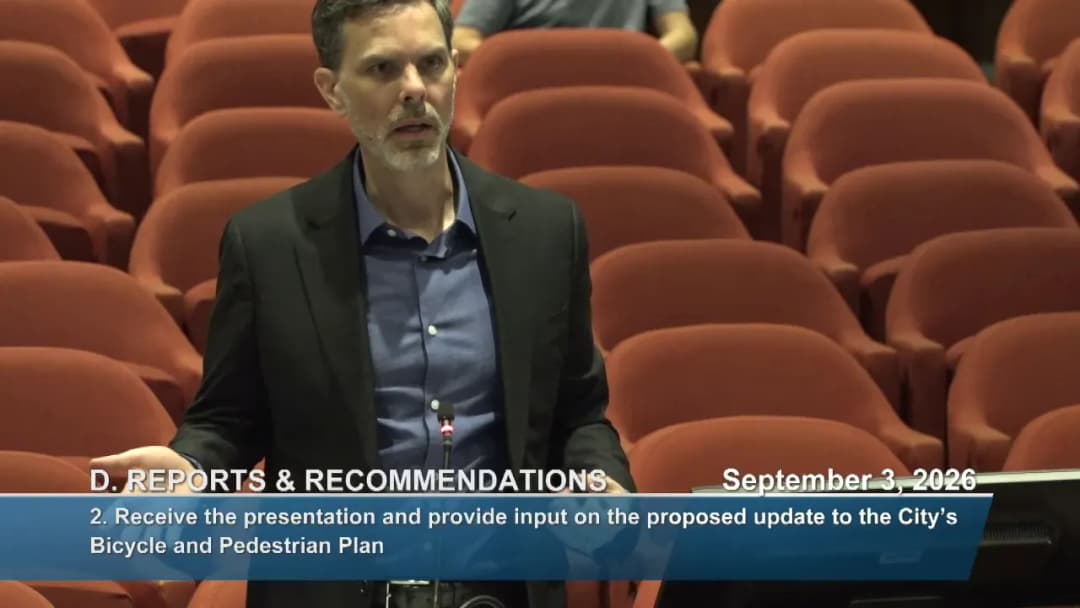
The Transportation Advisory Board (TAB) met on September 3, 2026, at 7:00 PM in the Council Chambers. The primary agenda item was receiving a presentation and providing input on the proposed update to the City’s Bicycle and Pedestrian Plan, including public comments and board discussion. The meeting adjourned at 7:54 PM. Consent Calendar - Approve minutes of August 6, 2026 TAB meeting: Motion by Ulger, seconded by Krzywinski, approved 7-0 (3 absent: McBroom, Rose, Webb). Public Comments & Testimony - Councilman Ian Holzhauer: Requested the addition of a recommendation for an off-street bicycle route through Downtown for the DuPage River Trail, highlighting a "missing mile" connection between the Illinois Prairie Path and the river trail. Noted city leaders and civic leaders support this idea. - Rick Hitchcock (retired urban designer, former Riverwalk commissioner): Expressed overall support for the plan. Asked that the plan reflect upcoming Riverwalk 2031 updates that will accommodate cyclists in two new sections. Also requested the plan explicitly name Downtown Naperville Alliance, Downtown Advisory Committee, and Naperville Riverwalk Commission as future partners. - Catherine Clarkin (Founder, Accelerate Climate Solutions): Expressed overall support but stated the plan does not go far enough to protect cyclists. Advocated for protected bike lanes over unprotected ones on roads with speed limits above 25 mph, citing fatality risk statistics. Noted intersection solutions such as bike boxes, all-way stops, and no turn on red were underutilized. - Bill Simon (32-year resident): Spoke in support of expanding citywide bicycle and pedestrian facilities, citing the success of the DuPage River Trail. Supported investment despite seasonal usage. - Justin White (resident): Acknowledged victims of bicycle accidents, including a family member. Emphasized the need to improve safety, comfort, and accessibility to prevent fatalities. - Ernest Oxenkuechot (resident, avid cyclist): Expressed safety concerns about speed differentials between cars and cyclists, north-south connectivity on the east side of Naperville, crossing IL Route 59, and the negative impact of traffic calming designs on Jefferson Ave that force cyclists into traffic. Discussion Items - Presentation by Consultants: Greg Osborne and Stephanie Nappa (A. Epstein and Sons International) presented the draft Bicycle and Pedestrian Plan update, covering goals (safety, comfort, connectivity), community engagement (over 90 open-house attendees, over 500 interactive map comments, over 850 likes), existing conditions analysis (strengths: extensive sidewalk, low-stress residential streets; challenges: barriers from rivers, railroads, high-speed streets), and recommendations (over 100 infrastructure projects, policy/program recommendations). The total cost estimate is $54 million through 2050, with projects broken into short-, medium-, and long-term. - Board Questions and Comments: - Member Hanley: Expressed concern about speed and visibility of cyclists at trail crossings, citing Conan Doyle Rd and Plainfield-Naperville Rd. Suggested safety elements should be considered more closely. Asked about motion-activated beacons; staff indicated current use of push-activated beacons and that a crossing toolkit will guide future treatments. - Member Hurley: Asked whether recommendations are aspirational or realistic. Consultants stated they are somewhere in between, with costs not capped but derived from recommendations. Staff noted coordination with other jurisdictions and constructability as variables. - Chairwoman Nair: Asked about current spending for bicycle/pedestrian infrastructure and whether the $54 million is incremental. Staff explained projects are integrated into existing CIP and roadway maintenance, making annual costs difficult to estimate; a request for feasibility study funding is in the 2027 budget. Nair also asked about further refinement of the downtown bicycle connection; staff said a feasibility study will explore options. - Member Hurley: Asked how public forum feedback will be incorporated. Staff stated edits will be made and brought back to TAB at a later meeting. Old Business - Overnight Parking Survey: Transportation Manager Michael Prousa provided an update. The survey is open through September 18, 2026, and has received approximately 2,000 responses. Recommendations on the Overnight Parking Program will be brought to TAB in the fall. Key Outcomes - The presentation on the Bicycle and Pedestrian Plan update was received by the board. Staff will incorporate feedback from the meeting and public comments, and will return with a revised plan for TAB consideration at the October 2026 meeting, aiming for city council approval in late October/early November 2026. - The board will receive updates on plan implementation every six months. - The meeting adjourned by motion of Strom, seconded by Hanley, approved 7-0.

ACTIVE TRANSPORTATION 67% · PUBLIC SAFETY 15% · TRANSPORTATION SAFETY 9% · PROCEDURAL 5%
10
SEP 1, 2026 · NAPERVILLE, ILLINOIS · CITY COUNCIL
Naperville City Council Meeting Summary – September 1, 2026

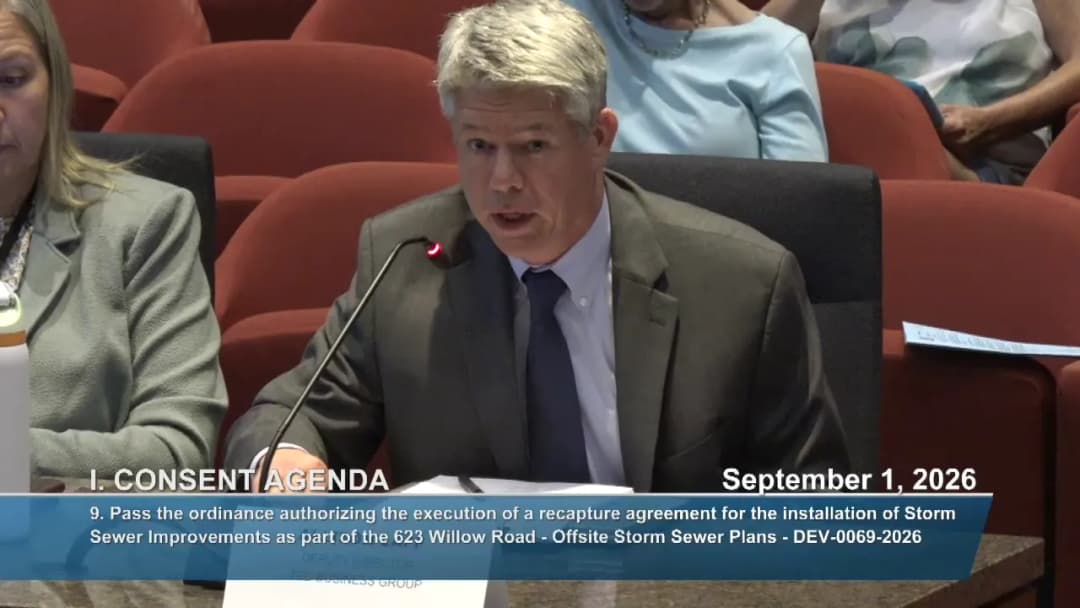
The Naperville City Council met on Tuesday, September 1, 2026, at 7:00 PM in the Council Chambers. Mayor Scott Wehrli called the meeting to order, and after roll call (8 present, Councilman Kelly absent), the council conducted a full agenda including public forum, consent agenda items, public hearings on a major development, and several expenditure approvals. The meeting adjourned at 10:14 PM. Consent Calendar - Meeting Minutes (August 18, 2026): Approved 7–1 (Councilman McBroom opposed) after discussion on the accuracy of parking fund language in the minutes. - Council Meeting Schedule (Sept–Nov 2026): Approved unanimously. - Fire Station 4 Garage Floor Restoration (Garland/DBS Inc., $119,824): Approved unanimously. - Debtbook Financial Software (Fifth Asset Inc., $137,326.03, two-year term): Approved unanimously. - Tyler PACE and Tyler Assist Basic (Tyler Technologies, $100,851.07, one-year term): Approved unanimously. - Change Order 2 – Central Elevated Water Tank Relocation Engineering (Baxter & Woodman, $8,505, total $300,647, additional two years): Approved unanimously. - Change Order 1 – PayByPhone Mobile Application (PaybyPhone Technologies, $51,000, six-month term): Approved unanimously. - Change Order 1 – Architectural & Engineering Services (Kluber Inc., $52,800, total $1,332,800): Approved unanimously. - Temporary Traffic Controls – Naperville Central High School Marching Band Competition (October 10, 2026): Ordinance 26-085, approved unanimously. - Closed Session Minutes Resolution (RES. 26-25): Approved unanimously. Public Comments & Testimony - Bus Routes (District 203): Shannon Cottrell raised concerns about elementary students spending up to 2 hours 15 minutes on school buses, safety for special needs children, and lack of response from the district. Council expressed support and noted the city’s autism-friendly goals. - Electric Utility Rates: John Doyle questioned discrepancies between rate studies and actual financials, arguing that Naperville’s lower rates come from operational choices, not the IMEA deal. He opposed a $4 million transformer purchase until clearer financial reporting. - Climate Change: Bob Carlson criticized climate alarmism, citing historical false predictions and urging a balanced approach. - Energy Strategy: Joe Huss (Naperville NEST) recommended hiring an expert to guide the city’s energy procurement decision, emphasizing criteria for flexibility and sustainability. - Naperville Ridge Development: Scott Li (neighbor) opposed the development, citing unidentified wetlands and stated that an online petition had grown from 2,700 to over 3,100 signatures. - Storm Sewer Recapture (623 Willow Road): Richard Phillips and Patricia Pfister opposed the recapture agreement, arguing that neighbors should not pay for problems caused by a new home’s construction. The council denied the ordinance 1–7. - Kratom Ban: Seven speakers testified, plus 17 written comments. Most speakers opposed a total ban, advocating regulated access for natural leaf kratom while banning synthetic compounds. One speaker (Todd McCartney, submitted in writing) shared a personal tragedy of his son’s death allegedly linked to kratom. Council ultimately voted 8–0 to prohibit retail sale, with the mayor citing a local death and four overdoses this year. - Happy Hour Ordinance: Speakers generally supported allowing happy hour with a 7:00 PM cutoff. John Doyle opposed the arbitrary 7:00 PM deadline; Neil Malone (Chamber of Commerce) and others highlighted benefits for local businesses. Council passed 8–0 with amendments retaining restrictions on multiple drinks at once (except wine) and a 50% discount cap. - NorthGate of Naperville Development: Attorney Vince Rosanova presented the 171-townhome project (starting at $575,000), targeting seniors and active adults. John Doyle opposed, urging instead a focus on affordable housing. Council approved all five related items (J1–J5) with unanimous 8–0 votes. - Citywide Camera Access (SDI Presence, $8.29M+): John Doyle questioned necessity and transparency, asking to table until a third-party report was shared. Police Chief Arres presented the project, emphasizing aging equipment (442 existing cameras, 404 access readers), safety benefits, and governance policies. Several written comments raised privacy and cost concerns. The motion failed 2–6. Discussion Items - Parking Fund Precedent: Council debated whether the August 18 vote on elevator maintenance funding from the parking fund set a broader precedent. City Manager Krieger stated it was specific to that item. - Kratom Ban Debate: Council considered the difficulty of distinguishing natural vs. synthetic kratom in enforcement. Police Chief Arres confirmed labs cannot test for ordinance violations, but DEA scheduling of synthetic compounds may facilitate future enforcement. Councilwoman Jain expressed concern for youth safety; Councilman McBroom noted the lack of local businesses speaking in opposition. The ordinance passed 8–0. - Happy Hour Restrictions: Council added back three provisions from the existing liquor code (no two drinks at once, max 50% discount, required price posting) after they were omitted in the Liquor Commission motion. The 7:00 PM cutoff was retained. - NorthGate Development: Questions centered on the target market (seniors/active adults), pricing ($575,000 starting), and the candace Parker street naming. Council approved the street name exception as part of the plat. - Camera System Scope: Council debated the $8.3 million cost vs. hiring additional officers. Chief Arres provided examples of camera use in solving crimes. Councilwoman Gibson requested more detail on policies and location justification before approving. The motion failed 2–6. Key Outcomes - Storm Sewer Recapture Agreement (I9): Rejected 1–7. - Kratom Retail Sale Ban (I11): Ordinance 26-086, passed 8–0. Prohibits retail sale, not possession or consumption. - Happy Hour Ordinance (I12): Ordinance 26-087, passed 8–0. Allows happy hour specials until 7:00 PM, with retained state-level restrictions. - NorthGate of Naperville (J1–J5): All five ordinances passed 8–0: - J2: Fifth amendment to annexation agreement (release age restriction on Lot 1B). - J3: Major change to Monarch Landing PUD and conditional use. - J4: Preliminary plat of subdivision, including naming a street Candace Parker Drive. - J5: Temporary marketing sign permit. - Power Transformer (M1): Awarded to WEG Transformer USA LLC, $4,096,400 plus 3% contingency, passed 8–0. - Citywide Camera Access (M2): Award to SDI Presence LLC for $8,293,111 plus 3% contingency; motion failed 2–6. Staff may bring back future options. - Energy Workshop: Staff is developing an agenda; materials will be sent to council in advance. No external consultant hired yet.

PUBLIC SAFETY 16% · CANNABIS REGULATION 14% · PROCEDURAL 9% · ENGINEERING AND INFRASTRUCTURE 9%
0102
NEXT →
OPENPUBLICA · PUBLIC MEETING INDEXUPDATED DAILY · openpublica.com