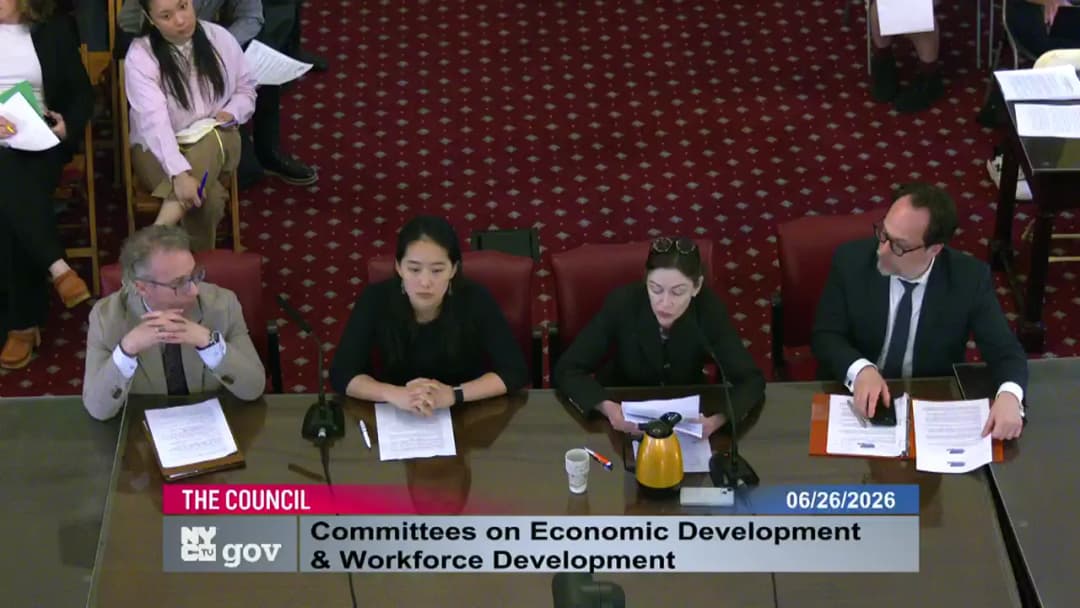
This joint hearing of the New York City Council Committees on Economic Development and Workforce Development, chaired by Virginia Maloney and Julie Wan, assessed the progress of the Green Economy Action Plan (released February 2024). The plan projected 400,000 green jobs by 2040, but chairs raised concerns about slow job growth (2,000 net new green jobs since 2023 per the Center for an Urban Future), federal policy rollbacks, offshore wind uncertainty, and unmet workforce training targets. Public Comments & Testimony - Gregory Morris (CEO, NYC Employment and Training Coalition) stressed the complexity of workforce development and called for a permanent EDC president. - Carrie FallHaber (Senior VP, Jobs First NYC) recommended a workforce authority within City Hall, better school-industry coordination, and making industry a full partner. - Angela Sun (CEO, Green Launchpad) urged treating workforce as a business competitiveness issue and investing in sustained employer-provider partnerships. - Dr. Christopher Malone (Consortium for Worker Education) proposed a 10-point green workforce acceleration strategy including scaling pre-apprenticeships, a public dashboard, and a near-term surge. - Jonathan Sroener (Co-founder, Stax and Jewels) highlighted building automation in nonprofit real estate as a dual opportunity for energy savings and job creation. - Sindri Manzanares (COO, Green City Force) requested holistic pathways targeting NYCHA residents and frontline communities. - Jacob Douglas Bourne (Hope Program) called for requiring city-subsidized developers to hire from community-based training programs. - Sophia Oliveira Ritchie (Andromeda Community Initiative) urged expanded funding for green construction training and better hiring pathways. - Travis Prolox (Fordham University) outlined the Bronx Green Job Center and advocated for a citywide investment strategy. - Michaela Crater (SBIDC) stressed leveraging existing industrial infrastructure and continuing green economy investments. - Stephen Levin (CEO, Solar One) commended EDC projects and urged engagement with building management firms to align training with employer needs. - Vinny Dong (student) emphasized youth internships and sustainability programs in public schools. Discussion Items - Job Projections and Methodology: Chairs pressed EDC on the 400,000 job projection, noting only 70% are transitioning jobs and federal cuts have undermined assumptions. EDC and NYC Talent stated it is too early to revise the projection, possibly waiting until 2030. No updated job count was provided. - Offshore Wind and South Brooklyn Marine Terminal (SBMT): Construction is 98% complete, with 2,500 union workers on site. Empire Wind One is on track for first power by end of 2026, but Empire Wind Two was canceled and Beacon Wind is inactive. The city has lease guarantees and a $20 million penalty clause, but the reduced scope raised questions about return on investment. - Workforce Training Commitments: The plan aimed for 12,000 New Yorkers trained through apprenticeships/pre-apprenticeships by 2040. To date, 2,300 adults and 750 young people have been served (including 1,500 through the Pink program and 350 pre-apprenticeships). Only one of five planned green collar training centers is open (Solar One in Manhattan); others are late 2028 (Brooklyn), end of 2026 (Bronx), and timelines unknown for Queens and Staten Island. - Funding and Budget: The $600 million youth action plan funding is not exclusively green; NYC Talent could not provide a breakdown. A new $4.5 million DEP pilot (GROW) is separate. There was no commitment that all $600 million would continue in FY27. EDC noted $7 million to CUNY and $3 million to Fordham. - Community Hiring and Inclusion: NYC Talent reported 275+ procurements with community hiring goals ($14 billion in projected contract value), but no specific green jobs data. There are no benchmarks for participation of people with disabilities; the Mayor's Office for People with Disabilities was not actively involved. - Local Law 97 and Building Retrofits: DOB reported 90% compliance with the first milestone, but job creation numbers from retrofits were not provided. Chairs noted no dedicated funding for implementation. - EDC Leadership: No permanent president has been appointed; interim president Jeanine Pack is in place. Chairs expressed concern about long-term vision. Key Outcomes - No formal votes or decisions were taken; the hearing was for oversight. - Committees directed EDC and NYC Talent to provide follow-up data by end of July 2026 on: a breakdown of $600 million youth funding for green-specific programs; updated figures on NYCHA Clean Energy Academy participants and placements; list of schools in the HVAC/decarbonization pathway; number of MWBEs qualified for green initiatives; timelines for green training centers in Queens and Staten Island; and total FY27 city funding commitments to the Green Economy Action Plan. - EDC and NYC Talent did not commit to annual projections but noted a legislatively mandated climate plan is due next year. - Public testimony urged creating a centralized workforce authority, sustained investment, and public accountability dashboards.
Public Meetings - New York City, New York
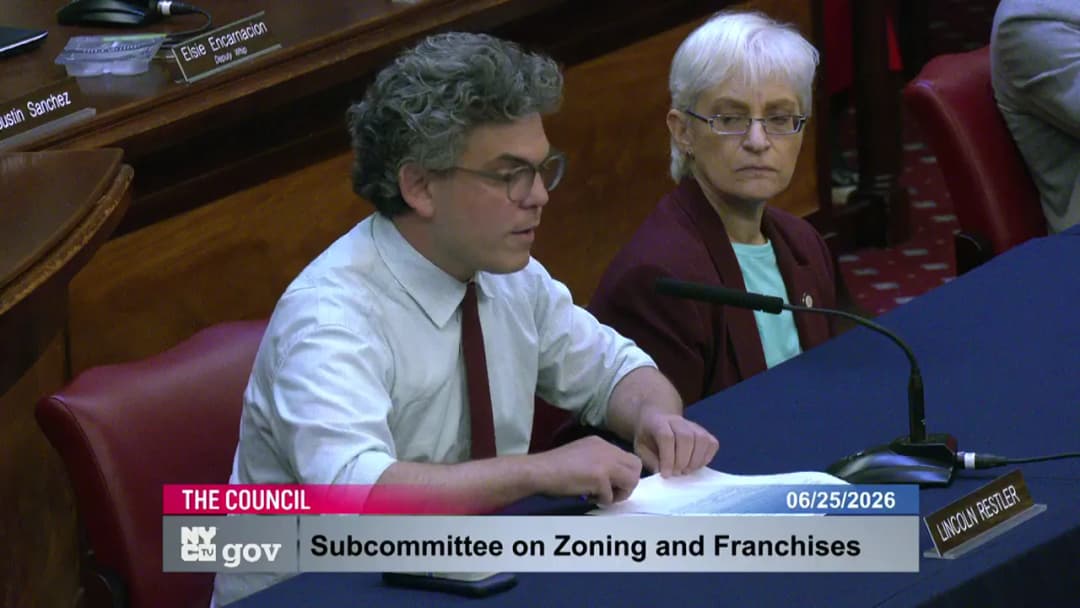
Public Meetings - New York City, New YorkThe New York City Council Subcommittee on Zoning and Franchises, chaired by Councilmember Farah N. Louis, met on June 25, 2026, at 12:30 PM in Council Chambers at City Hall. The subcommittee voted on two major land use proposals: the Monitor Point rezoning in Greenpoint, Brooklyn, and the DeWitt Clinton Park North rezoning in Midtown Manhattan. All items were approved with modifications and referred to the full Land Use Committee. One application was withdrawn. Discussion Items Monitor Point (Greenpoint, Brooklyn) – LU 0067-0071 Chair Louis introduced the Monitor Point proposal, submitted by GoQuay LLC and the MTA. The project includes a mixed-use development with a museum, market-rate building (West Building), and a 100% affordable building (East Building). Originally proposed with 1,150 apartments (40% affordable), modifications increased affordable units by 202 for a total of 662 permanently affordable units (50% of total). The modifications included converting commercial space to residential, reallocating museum space, extending the development site to include all MTA-controlled land, and adding height to the East Building. The waterfront esplanade was widened to 40 feet, adding 52,000 square feet of publicly accessible space. The developer will contribute $300,000 annually for 99 years to Bushwick Inlet Park maintenance. The MTA will relocate its emergency response unit from Box Street Park to East Williamsburg, and the Nassau Avenue G station will receive a new elevator (approx. $60 million project). Councilmember Lincoln Restler expressed support, stating that the project will provide 662 affordable apartments, 50% deeply affordable, with 110 supportive housing units for formerly homeless individuals, and 161 senior-designated units. He noted that the negotiations were the hardest he had faced and thanked the MTA, Gotham (applicant), and community advocates. DeWitt Clinton Park North (Manhattan) – LU 0072-0077 Chair Louis described two separate sites: 801 11th Avenue (477 apartments, 125 affordable) and 629 West 54th Street (617 apartments, 162 affordable). Both involve zoning map amendments from manufacturing to commercial, a Mandatory Inclusionary Housing area, and special permits for floor area transfer from Hudson River Park Trust in exchange for a $29.7 million payment. Modifications included removing the street wall waiver for the 11th Avenue site and reducing the height of the 54th Street building from 550 to 520 feet. Councilmember Gale Brewer expressed support but criticized the negotiation process as "nickeling and diming," noting that the community board wanted more height reduction and additional workforce housing. She secured an extra 1.25% workforce housing (12–13 units) at 165% AMI, which will be permanently affordable and rent-stabilized. She also raised concerns about the developer’s reliance on the 485x property tax exemption and noted that the sites are currently active with union jobs. Key Outcomes - LU 0067-2026 (Zoning Map amendment) – Approved with modifications and referred to CPC by a vote of 9-0. - LU 0068-2026 (Zoning Text amendment for MIH) – Approved with modifications and referred to CPC by a vote of 9-0. - LU 0069-2026 (Special permit for bulk modifications) – Approved with modifications and referred to CPC by a vote of 9-0. - LU 0070-2026 (Special permit for loading berth modifications) – Withdrawn by the applicant; filed by subcommittee by a vote of 9-0. - LU 0071-2026 (City Map amendment for park designation) – Approved with modifications and referred to CPC by a vote of 9-0. - LU 0072-2026 (Zoning Map amendment for 801 11th Ave) – Approved with modifications and referred to CPC by a vote of 9-0. - LU 0073-2026 (Zoning Text amendment for MIH) – Approved with modifications and referred to CPC by a vote of 9-0. - LU 0074-2026 (Special permit for floor area transfer and bulk waivers) – Approved with modifications and referred to CPC by a vote of 9-0. - LU 0075-2026 (Zoning Map amendment for 629 W 54th St) – Approved with modifications and referred to CPC by a vote of 9-0. - LU 0076-2026 (Zoning Text amendment for MIH) – Approved with modifications and referred to CPC by a vote of 9-0. - LU 0077-2026 (Special permit for floor area transfer and height modifications) – Approved with modifications and referred to CPC by a vote of 9-0. All votes were unanimous (9 ayes, 0 nays, 0 abstentions). The subcommittee adjourned after completing its business.
The New York City Council Committee on Criminal Justice, chaired by Councilmember Selvena N. Brooks-Powers, held an oversight hearing on June 25, 2026, to examine how court operations, discovery compliance, scheduling practices, and interagency coordination affect the jail population. The hearing focused on reducing pretrial detention and improving case processing efficiency to meet the legal mandate to close Rikers Island. Panelists included Chief Administrative Judge Joseph Zayas, representatives from the Mayor’s Office of Criminal Justice (MOCJ) and the NYPD, public defenders, and community advocates. District attorneys did not attend, and their absence was noted. Public Comments & Testimony - Helen Skipper (Executive Director, NYC Justice Peer Initiative; Vice Chair, NYC Board of Correction) urged investment in community-based alternatives, the Treatment Court Expansion Act, and hiring people with lived experience. She stressed that the jail population exceeds 6,600 and that closing Rikers requires reducing criminalization of behavioral health issues. - Zachary Katzenelson (Independent Rikers Commission) proposed six actionable steps: require NYPD to give DAs database access, mandate evidence upload within 48 hours, fully staff discovery liaison units, set deadlines for data management systems, set turnaround times for OCME forensic testing, and require Correctional Health Services to complete competency assessments within 14 days. - Jennifer Parrish (Jails Action Coalition, Treatment Not Jail, Urban Justice Center) highlighted that people with mental health conditions spend more time in jail and called for adequate funding of community programs and adoption of the Treatment Court Expansion Act. - Ryan Aquata (Freedom Agenda, Urban Justice Center) described obstacles to diversion, including lack of treatment program capacity and waitlists for mobile treatment teams, and called for funding crisis respite centers, Harbor House expansion, and an outpatient competency restoration pilot. - Michelle Evans (formerly incarcerated journalist) criticized vendor excuses for delayed data systems, shared her own experience of being denied discovery access while at Rikers, and stressed that defendants often cannot make informed decisions without discovery. - Jonah Seitz (CATAL Center for Equity, Health and Justice) urged the council to use budgetary powers to hold the mayor accountable for a measurable Rikers closure plan, noting nearly 80 deaths since the 2019 closure plan. - Michael Tucker (speaking for the Grimes Fuller family) described a case of a pretrial detainee with severe mental health issues held for over eight years without trial or adequate services, and called for investigations and subpoenas of DOC and CHS. - Dr. Victoria Phillips (Visionary V Ministries, Jails Action Coalition) testified about systemic failures in producing detainees for court, false refusal write-ups, inadequate mental health care, and rising deaths on Rikers, noting that 68% of detainees with mental health concerns do not receive adequate treatment. Discussion Items - Chief Administrative Judge Joseph Zayas testified that case processing efficiency is critical for credibility and reducing the jail population. He highlighted scheduling order initiatives, pretrial suppression hearings, increased problem-solving court staffing, and a 10% citywide increase in dispositions in 2025. He identified discovery non-compliance (average times for filing certificates of compliance ranged from 46 days in Richmond to 145 days in New York County), delayed plea offers by prosecutors, under-resourced assigned counsel (ACP), and lack of community program capacity as key barriers. He advocated for earlier discovery disclosure, more trial-ready judges, and adequate funding for alternative-to-incarceration programs. - Councilmember Frank Morano questioned whether a predetermined jail population goal (4,000) might compromise justice; Judge Zayas responded that the goal is aspirational and not a reason to release people unsafely. Morano also asked about OCA’s process for assigning judges to criminal court; Zayas acknowledged occasional shortages but noted efforts to assign experienced judges. - Councilmember Gale A. Brewer raised issues with detainee transportation from Rikers to court (often cited as 99% on-time, but she disputed this) and technology problems. Zayas acknowledged the need for improvement and stated that liaisons track production times and coordinate with DOC. - Councilmember Tiffany Cabán criticized the absence of district attorneys and questioned judges setting bail at Supreme Court arraignment for defendants who appeared voluntarily. Zayas defended judicial independence but affirmed that bail law requires consideration of appearance risk. Cabán also pressed for weekend/holiday bail processing and training on out-of-state fugitive warrants; Zayas said plans are in place for the former and that judges are trained to consider release. - Councilmember Yusef Salaam asked about population projections and the impact of reducing adjournment intervals. Zayas said the current population is around 6,000 and doubted projections of 8,800, noting that dispositions are outpacing filings (clearance rate 125%). He explained that adjournment length depends on case stage and that judges are encouraged to set shorter dates when cases are trial-ready. - NYPD Representative Andrew Batello described processes for evidence upload: automatic transmission via DA portal, ECMS, and evidence.com for body-worn cameras, with a centralized Discovery Liaison Unit (DLU) of 31 uniformed personnel (1 lieutenant, 5 sergeants, 25 officers/detectives) embedded in each DA’s office. He acknowledged that not all materials are accessible within statutory deadlines (e.g., 911 records have backlog) and that some materials take longer to produce. He could not definitively say evidence is always transmitted within required timelines. - MOCJ Director Deanna Logan and First Deputy Jill Starashevsky addressed the assigned counsel plan (ACP) underfunding, stating that $50 million in allocated funds were not drawn down because budgets must match approved spending. They also discussed delays in the 730 competency restoration process (outpatient restoration is stymied by DA consent refusal), data management system procurement issues (vendor capacity failure), and efforts to improve OCME report turnaround. - Public Defenders Panel (Tina Luongo, Legal Aid; Wes Keynes, Bronx Defenders; Elizabeth Fisher, Neighborhood Defender Service; Stan German, NY County Defender Services; Young Me Lee, Brooklyn Defenders) criticized the absence of DAs and NYPD accountability. They argued that the root cause of delay is over-policing and over-prosecution, not just court operations. They highlighted that low-level arrests are rising sharply (e.g., drug possession arrests up over 200% since 2021), that bail is often set unnecessarily (over 50% of bail cases end in dismissal or ACD), and that defense offices are understaffed due to low salaries and high attrition. They called for an end to broken-windows policing, funding for community services, and reduction of the volume of cases entering the system. Key Outcomes - The committee filed the oversight hearing (T2026-1957) as a formal record. - No votes were taken, but the chair committed to continuing the conversation and scheduling future hearings with district attorneys, who were notably absent. - Judge Zayas committed to providing the committee with a county-by-county breakdown of discovery compliance data and data on sanctions for late discovery. - The committee urged OCA to continue expanding scheduling orders, pretrial hearings, and problem-solving courts. - The committee called on the mayor’s office and NYPD to improve evidence transmission, fully staff discovery liaison units, and implement data management systems. - The council was urged by advocates to use its legislative and budgetary powers to enforce the Rikers closure plan, fund community-based alternatives, and require NYPD to provide DAs access to databases.
On Thursday, June 25, 2026, the New York City Council's Committee on Transportation and Infrastructure, chaired by Councilmember Shaun Abreu, held a hearing to examine five pieces of legislation. The bills addressed lighting under elevated train lines (Int 0845), notification signs for disruptive construction work (Int 0866), seasonal enclosures for sidewalk cafes (Int 0894), sanitation and cleanliness requirements for outdoor cafes (Int 0917), and quarterly installment payments for revocable consent fees (Int 0918). All five introductions received hearings and were laid over by the committee; no votes were taken. Public Comments & Testimony - Andrew Rigie (Executive Director, NYC Hospitality Alliance): Expressed support for Int 0894 (seasonal enclosures), stating restaurants pay year-round for sidewalk cafe licenses but cannot fully use them in cold months, and that enclosures would protect jobs and revenue. Supported Int 0918 (quarterly fee payments) as a small-business-friendly option, noting the past DCWP program used quarterly payments. On Int 0917 (cleanliness), requested that first-time violations carry a warning or cure period before monetary penalties, advocating for education over fines. - Vinny Don (student, Queens High School for the Sciences): Testified in support of Int 0845 and Int 0866, emphasizing that students travel citywide at early and late hours and that dark, unsafe streets and uncertain transportation deter participation in extracurriculars and pose safety risks, especially for students with disabilities. - Blake Walker (Brooklyn resident): Spoke about a non-agenda issue—proposing a signed bike loop connecting Prospect Park, Coney Island, and Bay Ridge to boost bicycle tourism, noting existing infrastructure but missing signage. Discussion Items Int 0845-2026 (Lighting Under Elevated Train Lines) – Sponsored by Councilmember Thomas Henry - Sponsor’s Position: Councilmember Thomas Henry stated that residents in her district (under the 7 train on Roosevelt Avenue) have long raised safety concerns about dark underpasses linked to illicit activity. The bill would require DOT to assess and install lighting under elevated infrastructure within a defined timeframe, creating accountability and reporting. - DOT Testimony: Deputy Commissioner Monty Dean said DOT maintains nearly 400,000 streetlights and enhanced lighting at nearly 2,500 locations citywide in 2025, but lighting under elevated trains is uniquely challenging due to shadows, vibration, structural limits, and coordination with utilities and MTA. DOT expressed concern that the bill’s requirement for “distinctive” lighting could slow implementation and increase costs, and preferred to continue addressing requests on a complaint basis. DOT noted they would need separate surveys to assess additional fixture needs beyond LED replacements. - Q&A: Councilmember Thomas Henry asked about current practices—DOT confirmed lighting upgrades are complaint-driven. Councilmember Justin Sanchez asked about attaching lights to elevated rail structures; DOT cited vibration and power issues but agreed to explore possibilities. Councilmember Phil Wong raised concerns about trestles (e.g., CSX, LIRR) and long repair times; DOT acknowledged delays and committed to faster responses. Int 0866-2026 (Notification Signs for Disruptive Work) – Sponsored by Councilmember Epstein - Sponsor’s Position: Councilmember Epstein’s written remarks (read by Chair Abreu) said the bill would require posted signs within 500 feet of planned disruptive work at least 48 hours in advance, including contact info, to increase transparency and accessibility. She noted ongoing discussions with DOT to amend the bill to require the permit holder (not DOT) to post signs. - DOT Testimony: Jeffrey Malamy (Director of Street Improvement Projects) said DOT already uses multiple notification tools (flyers, street ambassadors, variable message signs, community board outreach) and believes existing practices meet the bill’s goals. He expressed concern that additional signage requirements could slow construction and raise costs, and that the bill’s definition of “disruptive work” is overly broad. DOT is open to further conversations to refine triggers for notice. - Q&A: Councilmember Thomas Henry asked about current notice for work lasting seven days; DOT described its suite of outreach methods. DOT acknowledged no standard definition of “disruptive work” but said outreach is tailored to project scope. DOT estimated that additional signage would require printing, installation, and removal resources, potentially diverting staff from other engagement. Int 0894-2026 (Seasonal Enclosures for Sidewalk Cafes) – Sponsored by Councilmember Brewer - Sponsor’s Position: Councilmember Brewer said the bill, suggested by the Hospitality Alliance, would allow restaurants to install high-quality winter vestibules (removable vertical screenings and overhead coverings) from October 1 to March 31, providing clear guidance for businesses currently unsure of what is allowed. - DOT Testimony: DOT expressed support for the bill’s goals and noted that sidewalk cafes are already permitted to use overhead coverings under existing rules. However, DOT suggested modifying the timeline to align with broader winterization discussions for roadway cafes, and recommended treating sidewalk and roadway requirements consistently to avoid confusion. DOT anticipated no significant implementation costs. - Q&A: Councilmember Christopher Marte asked about replicating sidewalk winterization on the roadway; DOT said early discussions are exploring temporary siding for wind and snow protection, with matching dates and materials. On enforcement of SLA agreements or community board stipulations, DOT clarified that state SLA requirements are outside its jurisdiction and that it cannot enforce hours-of-operation conditions that conflict with city rules. Int 0917-2026 (Cleanliness Standards for Outdoor Cafes) – Sponsored by Councilmember Justin Sanchez - Sponsor’s Position: Councilmember Sanchez said the bill codifies existing DOT cleanliness rules and raises maximum civil penalties to $300 for first violations and $600 for subsequent violations at the same business, aiming to improve cleanliness as the outdoor dining program expands. - DOT Testimony: DOT noted that the existing permanent outdoor dining program has generated very few cleanliness complaints (unlike the emergency program), and that its inspectors currently enforce for waste, debris, graffiti, and food scraps. DOT stated that the bill would not change enforcement substantially because the rules are already in place, and anticipated no additional implementation costs. On fines, DOT preferred uniform violation amounts across all program requirements and expressed openness to working with the council on appropriate levels. - Q&A: DOT confirmed that a 1.5-foot radius around setups is enforced by the Department of Sanitation, while DOT enforces interior cleanliness. The most common complaint is garbage or debris dumped outside the cafe area. Int 0918-2026 (Quarterly Payment of Revocable Consent Fees) – Sponsored by Councilmember Thomas Henry - Sponsor’s Position: Councilmember Thomas Henry argued that quarterly installments would ease financial burdens on small businesses, especially amid an affordability crisis. She noted that during tours, restaurants expressed frustration with upfront fees and that some had paid fees without receiving their license. The bill would allow the option to pay the annual revocable consent fee in four quarterly installments. - DOT Testimony: DOT opposed the bill, raising concerns that quarterly payments would increase administrative burdens and lead to collection difficulties after businesses commence operations. DOT said the annual fee is already the final step before licensing, and that few restaurants have requested quarterly payments. DOT noted that automated billing would require portal changes and could slow application approvals due to limited staff. Annual fees range from a few hundred dollars to several thousand dollars (e.g., in sector four). DOT also stated that if an application does not go through, the fee is not paid, contrary to some anecdotal reports. - Q&A: Councilmember Thomas Henry questioned DOT about the concern over non-payment after licensing, noting that businesses already make quarterly payments to landlords. DOT clarified that the revocable consent fee is paid after all reviews are complete, so there is no risk of paying without receiving a license. DOT acknowledged that other city programs (e.g., DCWP) used quarterly payments but argued DOT’s lower fees make quarterly installments less relevant. Key Outcomes - All five introductions (Int 0845, 0866, 0894, 0917, 0918) received hearings and were laid over by the committee—no votes were taken. - DOT indicated willingness to continue discussions with the council on several bills, including amending Int 0866 to shift sign-posting responsibility to permit holders, aligning Int 0894’s timeline with roadway cafe winterization, and refining fine amounts for Int 0917. - Committee members committed to follow-up with DOT on specific data (e.g., number of lighting upgrades under elevated trains in 2025, repair timelines, and street ambassador deployment in districts). - The public hearing portion included testimony from three individuals; written testimony may be submitted within 72 hours.
The Committee on Land Use, chaired by Councilmember Kevin C. Riley, met on June 25, 2026, to vote on two major land use proposals: the Monitor Point development in Brooklyn (Council District 33) and the Dewitt Clinton Park North development in Manhattan (Council Districts 3 and 6). The committee approved all actions with modifications, and one application was withdrawn. Monitor Point (Brooklyn) – LU 0067-0071 - Proposal: A mixed-use waterfront development on publicly owned MTA land in Greenpoint/Williamsburg, including a museum for the USS Monitor, a market-rate building with Mandatory Inclusionary Housing (MIH) affordable units, and a 100% affordable housing building. The project required a zoning map amendment (LU 67), zoning text amendment (LU 68), a large-scale special permit for bulk and waterfront modifications (LU 69), a special permit for loading berth modifications (LU 70), and a city map change to eliminate a portion of Inlet Park (LU 71). - Council Modifications: Added 202 permanently affordable apartments for a total of 662 affordable units; modified the large-scale special permit drawings and the waterfront public access waiver to maximize open space (over 1 acre). - Withdrawal: LU 70 (loading berth special permit) was withdrawn by the applicant and filed by the committee. - Vote: All remaining applications (LU 67, 68, 69, 71) were approved with modifications by a roll call of 12 in favor, 0 against, with one absence (Councilmember Zhuang). Dewitt Clinton Park North (Manhattan) – LU 0072-0077 - Proposal: Two development sites: 801 Eleventh Avenue (477 apartments, 125 permanently affordable) and 629 West 54th Street (617 apartments, 162 permanently affordable). Facilitated by floor area transfers under the Special Hudson River Park District, with approximately $29.7 million in improvements and maintenance funds for the Hudson River Park Trust. Each site required a zoning map amendment, zoning text amendment, and a special permit for floor area distribution and bulk modifications. - Council Modifications: For 801 Eleventh Avenue, removed a street wall waiver to ensure consistent streetscape frontage. For 629 West 54th Street, reduced maximum building height from 550 feet (as approved by the City Planning Commission) to 520 feet to improve transition between 11th and 12th Avenues and reduce the waterfront barrier effect. - Vote: All six applications (LU 72, 73, 74 for 801 Eleventh Avenue; LU 75, 76, 77 for 629 West 54th Street) were approved with modifications by a roll call of 12 in favor, 0 against, with one absence (Councilmember Zhuang). Key Outcomes - Monitor Point: Approved with modifications (LU 67, 68, 69, 71) and LU 70 filed (withdrawn). - Dewitt Clinton Park North: Approved with modifications (LU 72–77). - Vote Tally: 12 affirmative, 0 negative, 1 absent (Councilmember Zhuang) on all coupled items. - Next Steps: The approved actions will be referred to the City Planning Commission (CPC) for final approval, as noted in the minutes.
The Committees on General Welfare (Chair Crystal Hudson) and Women and Gender Equity (Chair Amanda Farías) held a joint oversight hearing on June 24, 2026, to examine housing instability among LGBTQ+ individuals in New York City. The hearing featured testimony from the Mayor’s Office of LGBTQI Affairs, the Department of Social Services (DSS), the Department of Youth and Community Development (DYCD), and 14 public witnesses. No legislation was voted on. Public Comments & Testimony - Alex Guevara (Ali Forney Center) shared personal experience of homelessness and described Marsha’s House (a DHS shelter) as feeling “like a prison,” with deadnaming and disrespectful staff. They urged hiring LGBTQ+ staff and expanding voucher access. - Chaitanya Gudrati (Youth Action Board) cited that 40% of homeless youth identify as LGBTQ+ despite being 5–10% of the general youth population. They called for a $15 million LGBTQ+ immigrant fund. - Nedalyn Helena Diaz (Housing Works) referenced Trevor Project data that 28% of LGBTQ+ youth have experienced homelessness or housing instability. She supported a $10 million fund for those involved in the sex trade and the $15 million immigrant fund. - Brian Ellicott Cook (Sage) noted that 40% of LGBTQ+ older adults live below the poverty line and that the number of adults 55+ in shelter increased 250% from 2004 to 2017. He recommended proactive safety signals to encourage self-identification. - Nadia Swanson (Ali Forney Center) reported 400 youth on a waitlist for crisis beds, up from 300 last year, and a 0 waitlist when vouchers were available. She called for raising the per-bed rate from $50K to $80K and for restoring voucher access. - Ava Jacru (case manager) described an administrative barrier: IDNYC requires a photo ID to get a photo ID. She proposed adding DHS to the list of agencies that can vouch for identity, as many clients lack documents. - Ethan Lowe (Legal Aid Society) recommended expanding affirming shelter capacity, increasing awareness of TGNC placement rights, and expanding the capacity of DSS LGBTQ+ Affairs. - Timothy Pena (Navy veteran) testified about unsafe conditions at Borden Avenue Veterans Residence, including 1,365 emergency calls in 16 months (one every nine hours). He called for better oversight. - Dr. Henry Love (Point Source Youth) urged funding for the Targeted Housing Assistance Program (TAP), citing a Johns Hopkins evaluation showing 98% of TAP recipients had no shelter contact in six months. He shared personal stories of friends who died due to housing instability. - David Miranda (Manhattan Legal Services) described a client (Ms. W) denied a HASA voucher for five years due to rent being too low, forcing her and her daughter into shelter. He highlighted the foster-care-to-homelessness pipeline for LGBTQ+ youth. - Mateo Guerrero (Make the Road NY) recounted three stories of trans migrant clients facing discrimination, police involvement, and housing loss. He urged the city to end its lawsuit against the CityFHEPS expansion and to allocate more housing vouchers. - Virtual Testimony: Atta Multone (Project Renewal) noted that Marsha’s House placed 28 residents into permanent housing in FY26. Erica Larshbaugh (Interact) reported that intersex people are 4x more likely to need housing assistance and urged passage of Intro 131 to add explicit intersex protections to the Human Rights Law. Discussion Items - Mayor’s Office of LGBTQI Affairs (Director Taylor Brown) testified that the office is two months old and still in a planning phase. Planned work includes agency policy audits, program evaluations, stakeholder convenings, and executive-level strategy. Brown stated the office will absorb the Unity Project and keep its housing guide up to date. Budget negotiations are ongoing; the office has allocations for staffing and some programmatic work. - Department of Social Services (Commissioner Aaron Dalton and Deputy Commissioner Sonia Russell) reported: All DSS/DHS/HRA staff must complete LGBTQ+ inclusion training within 90 days and every two years thereafter. There are 192 dedicated TGNC beds across four boroughs (21 in Bronx, 5 in Brooklyn, 159 in Queens, 7 in Manhattan). ACES Place (the first TGNC-specific shelter) has 150 beds but currently houses 109 individuals. A TGNC client advisory group will begin meeting later in 2026. DSS tracks complaints: in FY25-26 (through June 16, 2026), there were 92 reports of gender discrimination, TGNC discrimination, harassment, or retaliation across DHS and HRA shelters. Regarding data, a voluntary sexual orientation and gender identity survey at intake yields low participation, so official counts (e.g., 478 LGBTQ+ individuals in DHS shelters on a typical day) are acknowledged as severe undercounts. - Department of Youth and Community Development (Associate Commissioner Wanda Asherill) reported: 38% of youth in residential RHY programs and 42% in drop-in centers identify as LGBTQ+. DYCD serves over 40,000 young people annually across 863 beds for 16–24 year olds and an additional 160 beds for 21–24 year olds (50 beds opening soon). Street outreach teams cover parks, subways, and other areas based on real-time data. Of youth exiting RHY programs, 15% return home, 20% go to friends/relatives, 12% move to independent living, and 42% go to other services (crisis, foster care, DHS shelters, supportive housing). Family reunification services are driven by youth choice. - Councilmembers questioned the effectiveness of trainings, the low self-identification rates, the need for proactive outreach, and the oversight of ACES Place following reports of subpar conditions and harassment. They also discussed the lack of dedicated beds in Staten Island and the need for better data collection while protecting privacy. Key Outcomes - No votes were taken. - Committee chairs directed agencies to provide follow-up data, including five-year trends on youth housing outcomes, breakdowns of entry pathways into RHY shelters, and incident data from 911 calls and provider-level complaints. - Councilmembers urged agencies to be more proactive in encouraging self-identification at intake and to assess training effectiveness with post-training evaluations. - DSS committed to launching the TGNC client advisory group in Fall 2026 and to continuing work on the Shelter Accessibility Advisory Board’s recommendations (e.g., escorts to transit for TGNC clients). - The hearing will inform future budget and policy decisions, including potential funding for the $15 million LGBTQ+ immigrant fund, the $4.7 million TAP program, and increased per-bed rates for RHY providers. - The committee expressed interest in legislative action, such as adding DHS to the list of agencies that can vouch for IDNYC and passing Intro 131 for explicit intersex protections.
The Committees on Technology and Education, chaired by Council Members Carmen N. De La Rosa and Eric Dinowitz, held an oversight hearing on artificial intelligence, student data, and privacy in NYC public schools. The hearing examined the Department of Education's (DOE) March 2026 AI guidance, the rapid proliferation of AI tools, data privacy concerns, and proposed legislation requiring studies on access to gifted and talented and special education programs, as well as reporting on algorithmic tools and data breaches. No votes were taken; all introductions were laid over. Public Comments & Testimony - Students (NYCLU Teen Activist Project): Multiple students testified against the use of generative AI in schools, citing concerns about cognitive offloading, loss of critical thinking, privacy risks, and the need for human teachers. Students emphasized that AI literacy should not mean replacing human interaction and that many peers use AI to cheat. - Parent and Community Advocates: Parents and representatives from organizations such as the Parent Coalition for Student Privacy, AQE, NYCLU, and Dignity in Schools NY testified in support of a two-year moratorium on student-facing AI. They raised issues of data breaches (PowerSchool, Illuminate), lack of transparency, vendor NDAs, racial bias in AI tools, and the collection of biometric and behavioral data without consent. - Education Nonprofits (Mouse, Urban Assembly, Fordham University): Representatives supported AI use when implemented with strong safeguards and human guidance, urging investment in teacher training and ethical AI frameworks rather than a blanket ban. Fordham stressed the need for citywide AI literacy and discernment training. - Disability and Language Access Advocates (NYLPI, Place NYC, Homecrest Community Services): Testified in support of Int 684 and Int 853, citing disparities in access to gifted and special education programs for multilingual learners, low-income families, and black and brown students. They called for objective evaluation measures and better data collection. - Tech Industry (Tech NYC): Supported the goals of preconsidered bills 2129 and 2130 but recommended clarifying definitions and ensuring coordination with existing frameworks. Discussion Items - AI Guidance and Oversight: DOE First Deputy Chancellor Danielle Janta presented the March 2026 AI guidance, which prohibits student data for AI training, requires human review of AI outputs, and mandates ERMA privacy review for all AI tools. A 45-day feedback period yielded 6,491 responses, with top concerns being cognitive development, privacy, and data security. DOE acknowledged the guidance must be strengthened and noted they are delaying the planned playbook to incorporate feedback and national developments. - DOE Responses to Council Questions: - Council members questioned the evidence base for AI tools; DOE cited peer-reviewed studies on intelligent tutoring systems but acknowledged limited long-term data. - DOE stated that student-facing Gemini is only enabled in 35 high schools upon principal request, but several council members and parents disputed this, claiming Gemini is widely used on Chromebooks. - DOE confirmed that no AI detection tools are approved for academic integrity, and that behavioral monitoring is prohibited. - DOE reported that training for staff on AI reached 8,300 employees, and data privacy training completion is at 138,000 of approximately 160,000 staff (not 100%). - Chief Privacy Officer Dennis Doyle testified about data breach reporting, including delays in vendor notifications and the 2024 state controller audit finding 141 data breaches with 67 reported late. DOE accepted audit recommendations and is working on a formal data classification policy. - Legislation Discussed: - Int 684-2026 (Council Member Zhuang): Requires a study on how language access, income, and geography affect access to early elementary gifted and talented programs. DOE did not bring data to answer questions but pledged follow-up. - Int 853-2026 (Council Member Zhuang): Similar study for special education programs. Council members expressed frustration that DOE was unprepared to discuss the bills. - Preconsidered Int 2129-2026 (Chair De La Rosa): Requires annual reporting on algorithmic tools approved for schools. - Preconsidered Int 2130-2026 (Chair De La Rosa): Requires quarterly reporting on data breaches of algorithmic tools. - Bias and Equity Reviews: DOE acknowledged that the IRMA process does not currently evaluate algorithmic bias or instructional effectiveness. The website incorrectly stated the legal team reviews bias; DOE said it will correct this. DOE is developing a tool scorecard but has not completed it. Key Outcomes - No votes were taken; all four introductions (Int 0412, 0684, 0853) and two preconsidered items (2129, 2130) were laid over by committee. - The oversight (T2026-2085) was filed by committee. - DOE committed to providing written answers to follow-up questions from council members, including data on gifted and talented demographics and specifics on surveillance software. - Council members expressed strong intent to advance the preconsidered bills on algorithmic tool reporting and breach notification, with potential amendments to include bias and efficacy evaluations. - The hearing reinforced broad council support for a two-year moratorium on student-facing AI, with 29 council members signing a letter to the mayor and chancellor prior to the hearing. - Parents and advocates continue to demand greater transparency, enforceable privacy protections, and an immediate halt to AI deployment until stronger guardrails are in place.
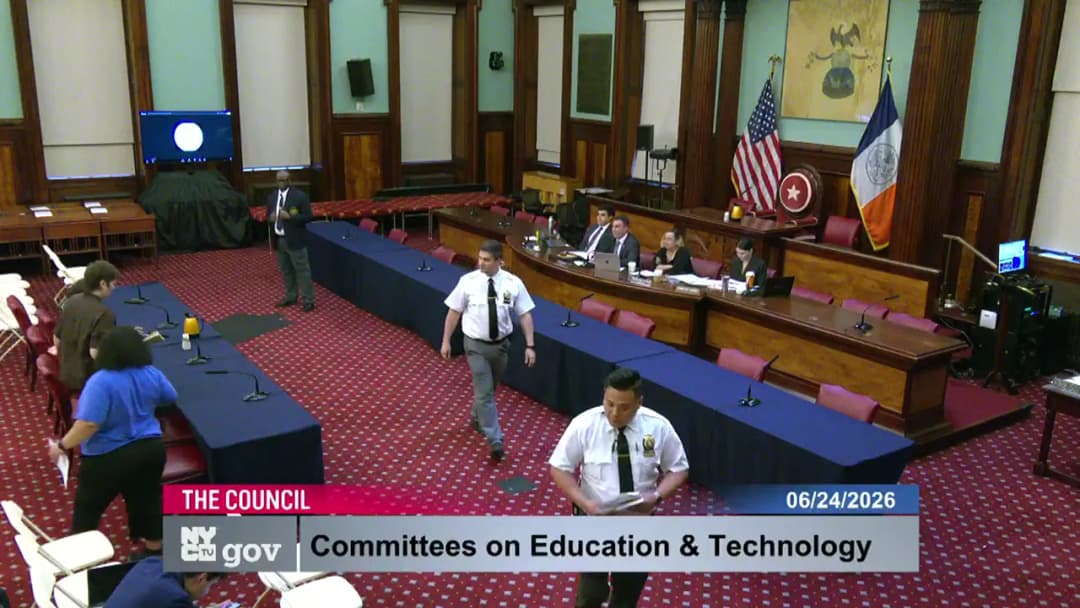
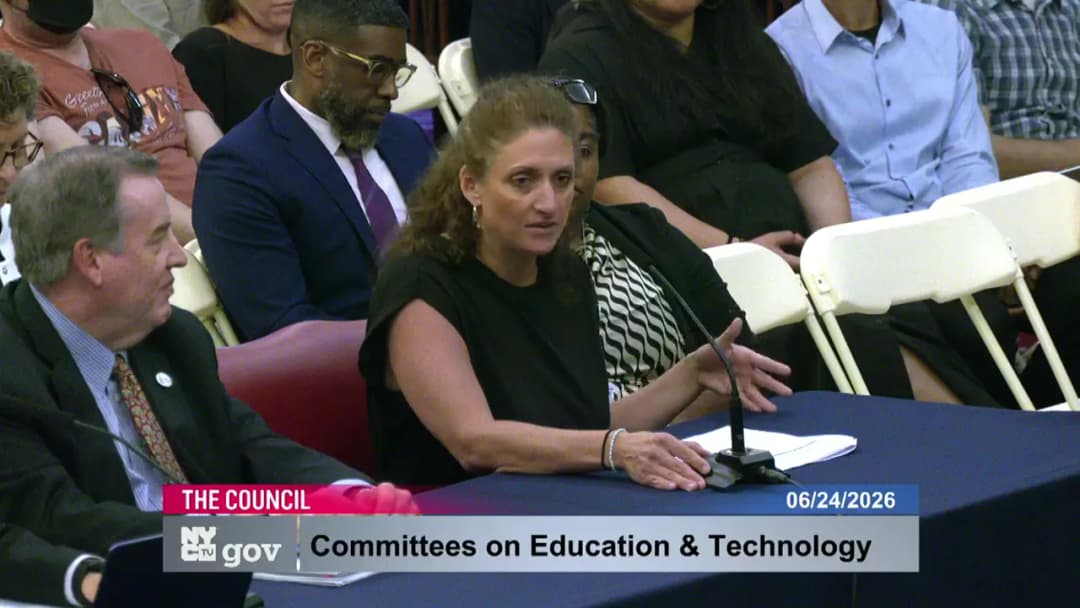
The New York City Council Committees on Education and Technology held a joint oversight hearing on June 24, 2026, to examine the use of artificial intelligence, student data privacy, and related policies in NYC public schools. The hearing also considered several pieces of legislation, including introductions on algorithmic tool reporting, data breach reporting, and studies on access to gifted and talented and special education programs. No votes were taken; all legislation was laid over. A two-year moratorium on student-facing AI was a central topic, supported by many council members and public testimony. Public Comments & Testimony - Student Panel: Students from the NYCLU Teen Activist Project and other schools expressed strong opposition to AI in classrooms, citing concerns about cognitive offloading, loss of critical thinking, privacy, and bias. They called for human-centered education and transparency. - Parents and Advocacy Groups: Speakers including members of the AI Moratorium Coalition, Fairplay, and local parent organizations urged a moratorium on AI tools. They highlighted data breaches (e.g., PowerSchool, Illuminate), lack of transparency, vendor NDAs, and the risk of student data being used for surveillance or profit. Several supported Int 684 and Int 853 on access to gifted and special education programs. - Educators and Experts: Testimony from Fordham University, Mouse, the Center for Democracy and Technology, and others emphasized the need for evidence-based, equitable AI adoption with strong guardrails. Some argued for a pause to develop standards; others warned against a blanket ban, advocating for teacher-guided AI literacy. - Disability and Equity Advocates: NY Lawyers for the Public Interest and Dignity in Schools NY highlighted disparities in access to special education services and the disproportionate impact of surveillance and AI bias on Black, Brown, and immigrant students. Discussion Items - Oversight of AI in Schools: Council members questioned DOE officials about AI guidance, data privacy, breach reporting, and vendor oversight. Key issues included: - Lack of a comprehensive list of approved AI tools; DOE admitted it does not fully track all tools used in schools. - Inconsistencies in testimony: DOE said Gemini is only used in 35 high schools, but parents reported widespread use in elementary grades. - The IRMA review process does not evaluate algorithmic bias, equity, or instructional effectiveness, despite language on the DOE website suggesting otherwise. - Data breaches: The State Comptroller's audit found DOE failed to report 67 of 141 breaches on time. DOE cited vendor delays and staff training gaps. - Training: Only 138,000 of 160,000 employees completed required privacy training; DOE could not confirm all staff with access to PII are trained. - Legislation Considered: - Int 0412-2026: Requires disclosure of school admissions policies. DOE said information is already public. - Int 0684-2026 (Zhuang): Study on language access and geographic barriers to gifted programs. Supported by Place NYC and others; opposed by AQE who argued there is no evidence young children can be reliably identified as gifted. - Int 0853-2026 (Zhuang): Study on access to special education services. Supported by many testimony; NYLPI suggested existing data already shows gaps. - Pre-considered T2026-2129 (Dinowitz): Annual reporting on algorithmic tools. Tech NYC supported but recommended clarifying definitions. - Pre-considered T2026-2130 (Dinowitz): Quarterly reporting on data breaches of algorithmic tools. Supported broadly; concerns about timeline feasibility. - DOE Testimony: First Deputy Chancellor Danielle Junta stated the agency supports the goals of the bills and is finalizing updated AI guidance based on 6,491 survey responses. She emphasized that current guidance prohibits student data from training AI models and requires human review. However, council members pressed on lack of transparency, specific vendor details, and the gap between policy and classroom reality. Key Outcomes - No votes were taken on any legislation; all introductions were laid over for future consideration. - Council members called for a two-year moratorium on student-facing AI, with 29 members signing a letter to the Mayor and Chancellor. The DOE did not commit to a moratorium but acknowledged the need to strengthen guidance. - DOE pledged to improve data privacy training, update data classification policies, and work with the council on reporting requirements. They also committed to developing a tool scorecard for bias and efficacy evaluation. - Next steps: The council will follow up in writing on outstanding questions, including data processing agreements, vendor lists, and progress on the State Comptroller's audit recommendations. Public testimony will remain open for 72 hours. - Legislative status: All bills (Int 0412, 0684, 0853, T2026-2129, T2026-2130) were heard and laid over.
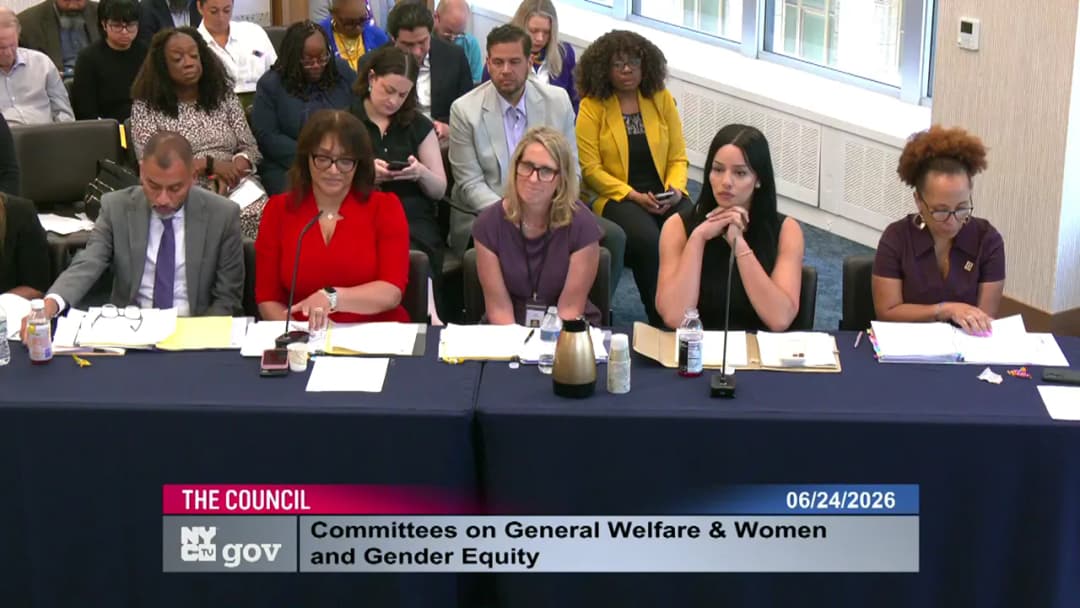
This joint oversight hearing of the Committees on Women and Gender Equity and General Welfare examined housing instability among LGBTQ+ individuals in New York City. The hearing featured testimony from the Mayor's Office of LGBTQI Affairs, the Department of Social Services (DSS), the Department of Youth and Community Development (DYCD), and multiple public witnesses. Key topics included data collection barriers, dedicated shelter beds, staff training, discrimination complaints, and funding needs for youth and older adults. Public Comments & Testimony - Alex Guevara (Ali Forney Center) – Shared personal experience of family rejection and shelter conditions at Marsha's House, including deadnaming and staff hostility. Stressed need for LGBTQ+ staff and housing vouchers. - Chaitanya Gudrati (Youth Action Board) – Noted that LGBTQ+ youth make up 40% of homeless youth despite being 5-10% of the overall youth population. Called for expanding housing options and creating a $15 million LGBTQI+ immigration fund. - Nedelyn Helena Diaz (Housing Works) – Cited Trevor Project data: 28% of LGBTQ youth experienced homelessness; among those kicked out, 40% cited LGBTQ identity. Supported $15M immigration fund and $10M for persons in sex trade. - Brian Ellicott Cook (Sage) – Reported that 40% of LGBTQ+ older adults live below poverty; 49% own homes vs. 65% of general population. Urged more affirming housing and better safety signals for self-identification. - Nadia Swanson (Ali Forney Center) – Stated 400 youth on waitlist for crisis beds; vouchers reduced waitlist from 300 to under 100. Called for raising RHY bed funding to $80K/year, additional crisis beds, and $5M baseline for speaker initiative. - Ava Jacru (Safe Haven case manager) – Described IDNYC photo ID barrier for clients without documents; proposed adding DHS to caretaker list to waive photo requirement. - Ethan Lowe (Legal Aid Society) – Recommended expanding affirming shelter capacity across all boroughs, proactive outreach about rights, and expanding DSS LGBTQ Affairs capacity. - Timothy Pena (Navy veteran) – Described unsafe conditions at Borden Avenue Veterans Residence, including frequent emergency calls (1,365 in 16 months) and high costs. - Dr. Henry Love (Point Source Youth) – Advocated for Targeted Housing Assistance Program (TAP) providing $3,700 cash assistance; 98% of recipients had no shelter contact within 6 months. Requested $4.7M city council funding. - David Miranda (Manhattan Legal Services) – Highlighted HASA administrative delays causing homelessness (example: 5-year wait for voucher). Called for better data collection on hidden homelessness. - Mateo Guerrero (Make the Road NY) – Shared stories of trans migrants facing shelter violence, police harassment, and immigration complications. Urged ending lawsuit against CityFEPS expansion and increasing housing voucher funding. - Erica Larshbaugh (Interact) – Reported intersex people face 4x the housing discrimination of other LGBTQ+ individuals; urged passage of Intro 131 to make anti-discrimination protections explicit. Discussion Items - Mayor's Office of LGBTQI Affairs (Taylor Brown) – Outlined plans for agency audits, stakeholder convenings, and policy innovation. Office is two months old; budget negotiations ongoing. Will absorb Unity Project and maintain resource guides. - DSS (Commissioner Aaron Dalton) – Described required LGBTQIA+ training for all staff (initial within 90 days, refresher every 2 years). Noted voluntary gender identity screening at shelter intake leads to low data – only 1% of shelter population identified as LGBTQ+ in Local Law 95 report. Reported 192 dedicated TGNC shelter beds across 4 boroughs (Queens: 159, Bronx: 21, Brooklyn: 5, Manhattan: 7). ACES Place has 150 beds (109 occupied as of last week). Marsha's House has 80 beds. DSS tracks discrimination complaints: 92 total (FY26 to date), including 61 gender discrimination, 24 TGNC discrimination, 5 TGNC harassment, 2 TGNC retaliation. Commissioner noted forthcoming TGNC advisory group. - DYCD (Associate Commissioner Wanda Asherill) – Serves 40,000 young people annually. 38% of residential program youth and 35% of drop-in center youth identify as LGBTQ+. 700 LGBTQ+ youth in residential programs, 564 in drop-in centers. Housing outcomes: 15% returned home, 20% with friends/family, 12% independent living, 42% other services. Noted 500 youth not placed due to bed unavailability (36% of those were LGBTQ+). - Councilmember Questions – Farías and Hudson probed data collection, training effectiveness, coordination with other agencies (Veterans Services, Aging), complaint response, and proactive outreach for self-identification. Hudson emphasized need for staff accountability over resident transfers. - Public Advocate Williams – Highlighted disparities: 40% of homeless youth are LGBTQ+, higher suicide risk, discrimination in senior housing. Called for more affordable housing. Key Outcomes - No votes were taken; hearing was informational oversight. - Funding requests from advocates: $15M for LGBTQI+ immigration fund, $10M for sex trade support, $5M baseline for speaker initiative, $4.7M for Targeted Housing Assistance Program (TAP), and increased RHY bed funding from $50K to $80K/year. - Data improvement acknowledged as critical; DSS will explore better methods to encourage self-identification while protecting privacy. - Future steps: Mayor's Office of LGBTQI Affairs to continue agency audits, conduct site visits to all TGNC shelters, and report on rights and resources for migrant LGBTQ+ New Yorkers by November 2026. DSS to launch TGNC advisory group later in 2026. - Commitment to collaboration across agencies and with City Council on budget and policy solutions.
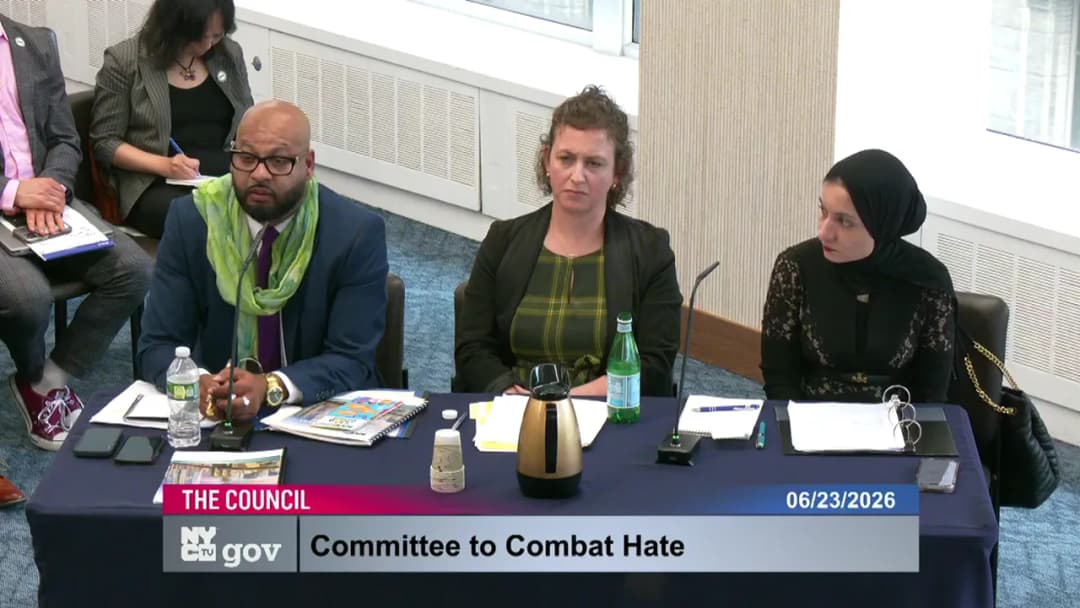
The New York City Council Committee to Combat Hate, chaired by Yusef Salaam, held an oversight hearing on community-based prevention and response to hate and bias on Tuesday, June 23, 2026. The hearing examined progress in reducing hate crimes citywide (a 20% drop in 2025), persistent challenges including underreporting and spikes in certain communities, and the roles of three city offices: the Office for the Prevention of Hate Crimes (OPHC), the Mayor's Office to Combat Antisemitism (MOCA), and the Office of Faith-Based and Community Partnerships (OFCP). Councilmembers present: Salaam, Mealy, Sanchez, and Wilson. Absent: Krishnan, Schulman, and Won. Public Comments & Testimony - Scott Richman (ADL New York/New Jersey): Reported that 2025 was the third highest year for antisemitic incidents since ADL began tracking, with New York state recording 1,160 incidents (nearly one in five nationwide), 74% within NYC. Urged the council to promote community-based education programs such as ADL's No Place for Hate initiative and to support educator training. - Julio Cesar Herrera (Hispanic Federation): Described the PATH initiative, where Hispanic Federation serves as an anchor organization since 2021, reaching millions through culturally responsive anti-bias education. Noted that 78% of surveyed New Yorkers who experienced a hate crime never reported it. Urged sustained investment, warning that reduced funding would force subgrantees to scale back. - Mo Olik (Sikh Coalition): Supported OPHC investments, emphasizing the need for better reporting pathways (especially for immigrants, workers, elders, and limited-English speakers), additional funding for community organizations, proactive relationship building, accurate anti-bias education, and rapid survivor support. - Hillary Stutchin (UJA Federation of New York): Noted that Jewish institutions have operated at heightened vigilance since October 2023. Urged the city to invest the proposed $29 million for OPHC in effective programming, improve reporting systems with language access, invest in school-based prevention, and view educator preparedness as essential. - Sophia Tobia Gage (CAIR New York): Reported a 130% national rise in hate crimes against Muslims between 2020 and 2025, with 64% of Muslims having experienced a hate crime or bias incident (only 4% reported to law enforcement). Noted that official NYPD data (43 anti-Muslim hate crimes in 2024) severely undercounts actual incidents. Urged the council to match the mayor's commitment and ensure resources reach community-based organizations. - Madison Mounty (Simon Wiesenthal Center): Highlighted two initiatives: Combating Hate in Digital Spaces workshops for grades 7–12 (reaching thousands of NYC public school students) and Mobile Museums of Tolerance. Urged sustained city investment in mobile accessible education and digital literacy workshops. - Marissa Barak (AJC New York): Noted that 56% of Jewish New Yorkers changed their behavior due to fear of antisemitism, and antisemitism fuels hate beyond extremists. Recommended strengthening government-community relationships, improving education on contemporary antisemitism, increasing coordination, and ensuring policymakers have information to respond. - Leslie Claire Allen (New York City Anti-Violence Project): Emphasized the need for survivor support alongside prevention, citing a 24/7 crisis hotline and extensive waitlists for legal services for LGBTQ+ communities. Thanked the administration for increased funding and hoped city council would match it. - Additional testimony was submitted in writing by several organizations. Discussion Items - OPHC Testimony (Executive Director Vijay Ramjatin): OPHC is now part of the Office of Community Safety, reflecting a priority on prevention. The administration increased OPHC funding by $26 million (an 800% increase, from $3M to $29M annually). Key programs: PATH (six anchor organizations, 60+ sub-vendors, 20+ languages, nearly 700 events, 62,000 participants in FY25); Unity in the Community 7 on 7 initiative on the 7 train corridor (six events completed, one culminating event planned); Youth Ambassador Leadership Program (YALP) launched October 2025 for ages 8–18; NYC Youth Moving Forward Against Hate program in schools. Reported 35% of students now know the difference between hate, bias, and discrimination post-survey. OPHC does not enforce but works preventively with NYPD data. - MOCA Testimony (Executive Director Felisa Wisdom): Over 50% of reported hate crimes target Jewish community; nearly every visibly Jewish person has experienced an antisemitic incident. MOCA is conducting a listening tour across all five boroughs, developing the first municipal strategy to combat antisemitism (to be released end of summer). Currently has two staff, growing to three or four. Revitalized the interagency task force on antisemitism (previously met only once). MOCA focuses on prevention, policy, and programming—not enforcement. Clarified that the term “antisemitism” is historically specific to Jews, but all forms of hate are combated across city offices. - OFCP Testimony (Executive Director Alia Teeth): OFCP is under the Office of Mass Engagement. Has three staff (plus executive director), hiring a fifth. Engages faith leaders broadly, hosted an interfaith breakfast with 400+ faith leaders, distributed 30,000 know-your-rights flyers, coordinated cooling centers, and conducted a listening tour. No dedicated website—public access via Office of Mass Engagement site. - Councilmember Q&A: - Chair Salaam asked about OPHC partnership selection, funding allocation (historically equal among six anchors), underserved areas (targeted Queens, Brooklyn, Manhattan; expanding to all boroughs), youth program feedback, school incident responses, and tracking impacts. OPHC noted the interagency committee meets quarterly. - Councilmember Mealy raised concerns about underrepresentation of African American Christian clergy and communities in PATH programming, questioned the 7 on 7 selection (only Roosevelt Avenue), and noted a lack of notification of hate crimes to her office. OPHC agreed to review notification lists and expand programming to all transit lines. Mealy also questioned how schools report bullying/hate incidents and suggested possible legislation to mandate reporting. - Councilmember Wilson asked about LGBTQ+ hate prevention: OPHC highlighted work with Anti-Violence Project, Vos es Latina, seed grants (e.g., Bridging Cultures for anti-Islamophobic hate toward women), and the Unity Grants project with the Mayor's Office of LGBTQIA+ Affairs. - Councilmember Sanchez inquired about successful programs for scaling (PATH and youth initiatives were priorities), responding to spikes (seed grants for specific communities), and OPHC staffing (currently three: executive director, deputy, senior programs manager; plans to add borough-based liaisons). Key Outcomes - The hearing was filed by the committee; no formal votes were taken. - The administration proposed a historic $26 million increase (over 800%) for OPHC in the FY27 budget, which has not yet been finalized. - MOCA committed to releasing the first municipal strategy to combat antisemitism by end of summer 2026. - OPHC will work to improve hate crime notification to councilmembers and expand community project grant outreach, including to underserved areas like Brownsville and East New York. - The committee received extensive public testimony urging sustained investment in community-based prevention, improved reporting systems, and expanded educational programming. - Next steps include continued budget negotiations, monitoring of OPHC expansion, and potential legislation to mandate school reporting of hate incidents.