Browse by city
Date range
Search help

Search titles, summaries, topics and stored transcripts together. Keywords may match separately; put the whole query in double quotes for a phrase. Matching follows word analysis, so punctuation is not exact. Both dates are included. Documents are not searched.

SHOWING 181–190 ENTRIES
181
JUN 23, 2026 · NEW YORK CITY, NEW YORK · CITY COUNCIL
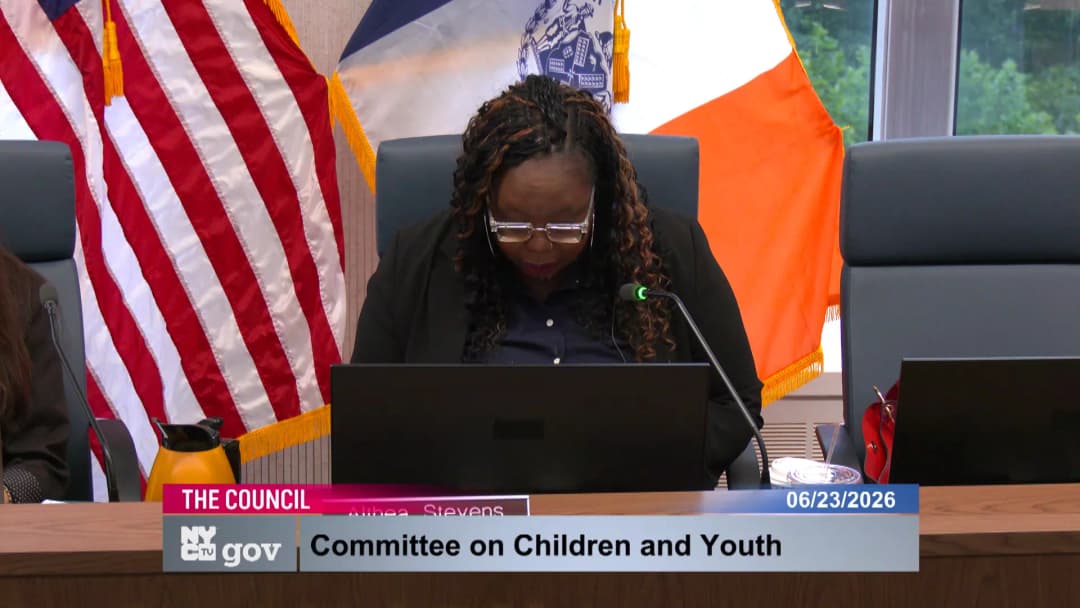
New York City Council Committee on Children and Youth Hearing on Beacon and Cornerstone Programs - June 23, 2026

The New York City Council Committee on Children and Youth, chaired by Councilmember Althea V. Stevens, held an oversight hearing on June 23, 2026, to evaluate the Department of Youth and Community Development's (DYCD) Beacon and Cornerstone community center programs. The hearing also considered seven resolutions on topics including youth sports funding, fatherhood initiatives, baby bonds, predatory marketing, guaranteed income, and children's savings accounts. Committee members present included Stevens, Felder, Joseph, and Williams; Ossé was absent. Councilmember Brewer also attended. All resolutions were heard and laid over without a vote. Public Comments & Testimony - Assemblymember Landon Dais testified in strong support of Resolution 0142-2026, calling for the establishment of a Center for Fatherhood Initiatives under the Office of Children and Family Services. He shared personal experiences and emphasized the need for resources, legal support, and workforce development for young fathers. He urged the committee to build a broad coalition to support the state legislation. - Christy Mansell (Division Director, Center for Family Life) spoke about the critical role of Beacon programs in Sunset Park, highlighting their flexibility, community-building, and the need for adequate funding to reflect current costs, invest in staff, and allow stipends for interns. - David Garcia (former Beacon participant, now co-director) shared how Beacon programs provided him with a safe space and opportunities, leading him to a career in youth development. He urged continued investment. - Pedro Pez (likely Pedro Perez, a Beacon participant and now staff) expressed gratitude for the program, noting its impact on his family and his full-circle journey from participant to employee. - Annie Nelson (Policy Analyst, Children's Aid) recommended structured engagement with providers and families before issuing a new RFP, establishing base contract rates reflecting true costs, and including cost-of-living adjustments. - Kay Connolly (Senior Policy Analyst, United Neighborhood Houses) called for increased funding, allowing stipends for interns, addressing mental health needs on-site, and improving NYCHA facility maintenance and communication. - Vincent Price, Leonard Richards, and Chris Pena (members of Father Speaks Up) testified about challenges with parental alienation, lack of court support, and the need for fatherhood resources. They shared personal struggles with custody and visitation. - Vinning Dong (student, Queens High School for the Sciences) supported Resolution 0032-2026 on youth sports funding, citing inequities in PSAL and the need for improved facilities and programming. - Amanda Wilkinson (via Zoom) spoke as a single mother about bullying in schools and the need for support for both fathers and mothers, but was reminded to stay on topic. Discussion Items - Oversight of DYCD's Beacon and Cornerstone Programs: Chair Stevens led extensive questioning of DYCD Associate Commissioner Wanda Asherill and Assistant Commissioner Theresa Harris. Key topics included: - Procurement Timelines: The last Beacon RFP was issued in 2017 and Cornerstone in 2015, both expired. DYCD stated they are studying the models and plan to release a concept paper but provided no firm timeline. Chair Stevens stressed the need for updated RFPs to reflect current costs and community needs. - Funding and Staffing: Providers reported that contracts do not cover true operational costs, leading to burnout and understaffing. Many sites have only one full-time director. DYCD acknowledged the need to evaluate funding formulas and staffing structures. - Facility Conditions: Cornerstone programs in NYCHA developments face severe maintenance and security issues. DYCD has started tracking maintenance tickets and contracting vendors for triage, but structural repairs remain under NYCHA's purview. Chair Stevens noted a future joint hearing with NYCHA is planned. - Saturday Night Lights (SNL): Chair Stevens criticized the SNL program as a standalone initiative and urged DYCD to integrate it into the broader Beacon/Cornerstone model. DYCD indicated they are considering this alignment. - Community Partnerships and Outreach: DYCD requires programs to maintain partnerships and advisory councils. Providers reported success but need more support. DYCD plans deeper evaluation of the 2017 RFP requirements. - Enrollment and Waitlists: Councilmember Brewer raised the issue of long waitlists at the Goddard Beacon site, citing 20 families unable to enroll. She pressed for interim funding to add slots. DYCD said they are conducting a geographic assessment to identify high-demand areas and determine funding needs. - Measuring Outcomes: Councilmember Joseph asked how DYCD measures academic improvement, workforce readiness, and civic engagement. DYCD responded that they do not directly measure academic gains but rely on provider-level assessments and program quality monitoring tools. - Stipends for Workforce Development: Chair Stevens questioned why stipends for youth interns are not allowable costs. DYCD promised to follow up on that policy. - Resolutions: The committee heard testimony on the following resolutions, all of which were laid over without a vote: - Res 0032-2026 (youth sports betting revenue) - Res 0142-2026 (fatherhood initiative) - Res 0161-2026 (baby bond pilot for foster youth) - Res 0217-2026 (predatory marketing prevention) - Res 0276-2026 (guaranteed income) - Res 0277-2026 (American Opportunity Accounts Act) - Res 0278-2026 (state-funded savings accounts for children) Key Outcomes - All seven resolutions were hearing held and laid over by the committee, meaning no final action was taken. - The oversight hearing on T2026-1962 (Evaluation of DYCD’s Beacon and Cornerstone Programs) was filed by committee, concluding the hearing without official recommendations. - DYCD committed to releasing a concept paper and future RFP for community centers, but provided no specific timeline. They will conduct internal assessments on funding, staffing, and program design. - Chair Stevens requested that DYCD provide a list of all sites with waitlists and explore interim measures to address overcrowding. - DYCD agreed to follow up on the policy disallowing stipends for youth interns and to connect Assemblymember Dais with city fatherhood programs. - A future joint hearing with NYCHA on facility conditions in Cornerstone centers is planned.
YOUTH PROGRAMS 80% · WORKFORCE DEVELOPMENT 8% · PROCEDURAL 4% · COMMUNITY ENGAGEMENT 4%
182
JUN 22, 2026 · NEW YORK CITY, NEW YORK · CITY COUNCIL
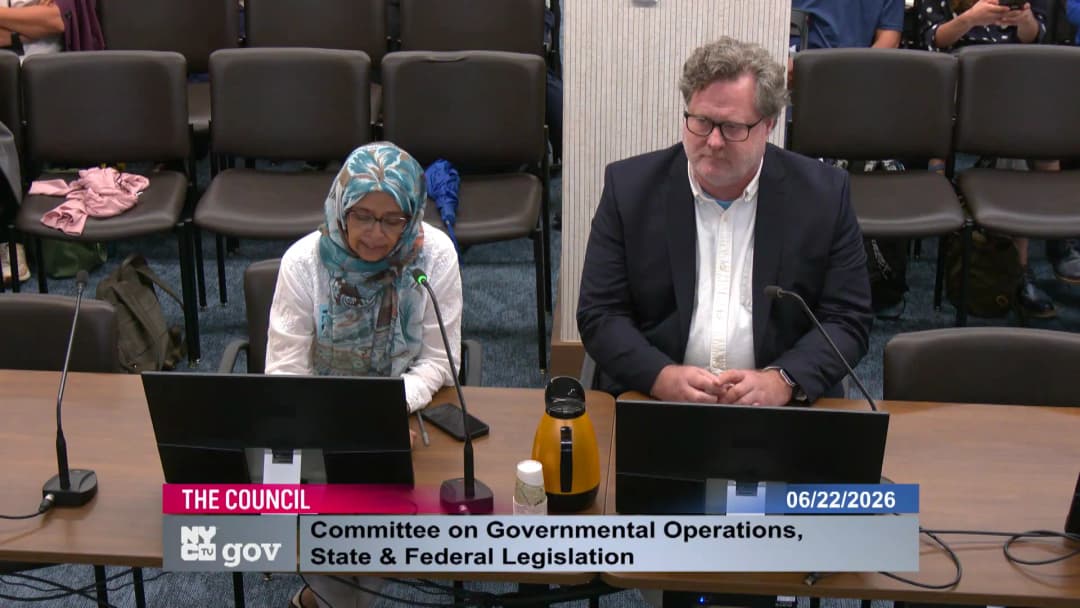
NYC Council Governmental Operations Committee Hearing on Community Boards and Ethics Bills – June 22, 2026

The Committee on Governmental Operations, State & Federal Legislation, chaired by Council Member Gale A. Brewer, held an oversight hearing on community board resources and structure, and considered five proposed local laws. Topics included disclosure of AI-generated content in elections, codifying the Staten Island flag, council member appointments to community boards, district manager term limits and removal authority, and prohibiting insider trading on prediction markets by policymakers. Testimony was heard from agency representatives, borough presidents, community board members, district managers, and good government groups. All introductions were heard; some were amended and all were laid over for further consideration. Public Comments & Testimony - Community Board Resources and Structure Oversight: Chair Brewer noted community boards are the most local form of government, stressed the importance of institutional knowledge, and expressed concerns about upcoming term limits for board members. She also voiced opposition to giving council members binding appointment power (Int 0322) and to district manager term limits (Int 0501). - Int 0320-2026 (Staten Island Flag): Sponsor Council Member Frank Morano described the bill as a way to recognize borough identity and make Staten Island feel more part of the city. Amo Micah from the Staten Island Borough President’s office presented the design and symbolism of the flag, which includes historical allegory. - Int 0322-2026 (Council Member Appointments to Community Boards): Council Member Morano argued the bill would give voters the choice to allow council members binding appointment power over half of community board members, preventing borough presidents from ignoring nominations. Chair Brewer expressed concern that council members lack the staff to properly vet candidates. - Int 0501-2026 (District Manager Term Limits): A statement from Council Member Natasha Williams was read in support, arguing it would establish clear expectations and accountability. However, overwhelming opposition came from district managers, community board chairs, and the Manhattan Borough President’s office (joined by Bronx and Queens BPs). They argued the bill would politicize the position, undermine institutional knowledge, and create instability—especially as board members themselves face term limits. Several district managers (Susan Stetzer, Mark Diller, Laura Singer, Celestina Leong, Irsa Weatherspoon, etc.) testified that existing charter provisions already give boards authority to hire and fire, and that a four-year term would deter qualified candidates and weaken continuity. Robert Camacho (CB4) stressed that term limits for board members and district managers together would cripple boards. - Int 0951-2026 (Prediction Markets Insider Trading): Sponsor Council Member Thomas Henry emphasized the need to prohibit public officials from profiting from non-public information via prediction markets. The Conflicts of Interest Board (COIB) testified that existing law (Chapter 68 of the Charter) already prohibits use of confidential information for private gain, and that the bill’s reporting requirements are overly broad and burdensome. They opposed the provision allowing COIB to remove public servants from office and to sanction relatives. Citizens Union and Reinvent Albany also recommended amending existing law rather than creating a separate framework, and cautioned against extending penalties to relatives. - Int 0012-2026 (AI Disclosure in Elections): The Campaign Finance Board (CFB) supported the shift from a prohibition to a disclosure model, but recommended narrowing the scope to avoid requiring disclosure of innocuous uses (e.g., AI in fundraising emails). CFB noted implementation would require at least a year and significant vendor support. Reinvent Albany called for disclosure on the communication itself and alignment with state law. - Civic Engagement Commission (CEC): Provided data on training efforts: 29 workshops, 11 topics, 703 registered, 298 attended, and 22 videos with 12,894 views. They discussed collaboration on member term limits transition but took no position on pending bills. Discussion Items - The committee reviewed each bill in detail, with debate on scope, enforcement, and alignment with existing laws. Chair Brewer raised practical concerns about vetting and staffing for appointment changes. Council members asked questions about penalties, implementation timelines, and resource needs. Key Outcomes - Oversight T2026-2007 (Community Board Resources): Hearing held; item filed. - Int 0012-2026 (AI Disclosure): Hearing held; amendment proposed and adopted by committee; then laid over. - Int 0320-2026 (Staten Island Flag): Hearing held; laid over. - Int 0322-2026 (Council Appointments to Community Boards): Hearing held; laid over. - Int 0501-2026 (District Manager Terms): Hearing held; amendment proposed and adopted by committee; then laid over. - Int 0951-2026 (Prediction Markets): Hearing held; laid over (agency rule-making required noted in minutes). - No final votes were taken; all matters were laid over for future consideration.

COMMUNITY ENGAGEMENT 50% · TECHNOLOGY AND INNOVATION 29% · MISCELLANEOUS 5% · DATA PRIVACY AND SECURITY 5%
183
JUN 22, 2026 · NEW YORK CITY, NEW YORK · CITY COUNCIL
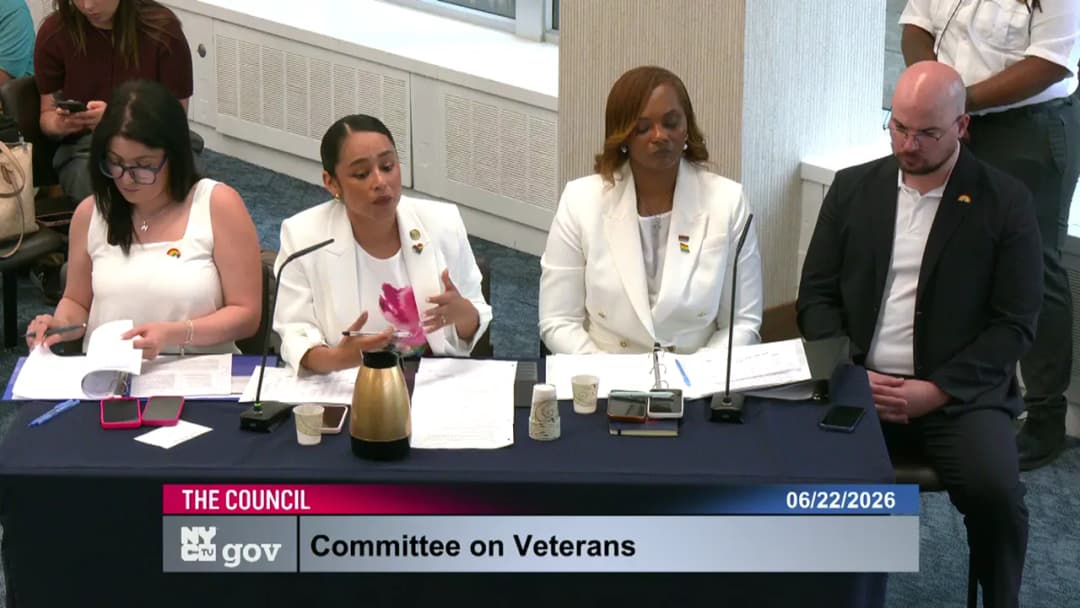
NYC Council Veterans Committee Hearing on LGBTQ+ Veterans Support - June 22, 2026

The New York City Council Committee on Veterans, chaired by Councilman Frank Morano, held an oversight hearing on June 22, 2026, to examine support and programs for LGBTQ+ veterans. The committee also heard testimony on two piece of legislation: Intro 0914 (requiring a study on reconsolidation of traumatic memories therapy) and Intro 0928 (establishing an LGBTQ liaison within the Department of Veterans Services). Both bills were laid over without a vote. Public Comments & Testimony - Brian Ellicott Cook (SAGE) supported both bills but recommended amendments to Intro 0914. He shared stories of LGBTQ+ veterans helped by SAGE's programs, which hosted 118 events with over 4,000 attendees in the past year. - Amelia Cobbs (New York Health Foundation) highlighted data gaps, rising suicide rates among LGBTQ+ veterans (more than double the overall veteran population), and recent federal policy changes (trans ban, closure of the NYU military family clinic) that threaten access to care. She urged the city to close data gaps and strengthen peer support. - Coco Colhane (Veteran Advocacy Project) opposed Intro 0914, citing lack of scientific evidence for reconsolidation of traumatic memories (RTM) therapy, conflicts of interest with its inventor, and the need to fund proven treatments instead. She noted that three large mental health programs for veterans are closing. - Joe Bellow (New York Metro Vets) opposed both bills. He argued Intro 0914 would inappropriately task DVS with evaluating a specific medical modality, and Intro 0928 would set a precedent for codifying liaisons for every subgroup, diluting DVS's core mission. He questioned the need for a statutory liaison when DVS already has two. - Timothy Pena (Veterans Justice Project) shared personal experiences of stigma, fear of disclosure, and unsafe conditions at the Borden Avenue veterans shelter. He emphasized that privacy, dignity, and trust are as important as housing, and criticized institutional indifference. Discussion Items - Oversight – Support and Programs for LGBTQ+ Veterans - Chair Morano opened by highlighting bipartisan interest in veterans' issues and specific challenges facing LGBTQ+ veterans: higher rates of PTSD, sexual assault, and data invisibility (89% of VA records lack gender identity). He noted estimates of 1 million LGBTQ+ veterans nationally, with up to 70,000 in New York State, mostly in NYC. - Commissioner Yesanya Mata and DVS staff testified that the agency already has two LGBTQ liaisons (since 2024) and supports Intro 928. DVS is exploring a certificate of eligibility for LGBTQ+ veterans to access city benefits without exposing discharge status. In FY26, 38 LGBTQ+ veterans sought discharge upgrade assistance; 20 cases are pending and 8 have resulted in upgrades. The process takes 1-3 years. - DVS acknowledged major data gaps and is working on better intake processes. They partner with SAGE, the Stonewall Veterans Association, and the Veteran Advocacy Project for outreach. - Councilmembers questioned DVS on outreach effectiveness, data collection, and coordination with other agencies. DVS reported three targeted events for LGBTQ+ veterans in the last fiscal year and monthly mental health coalition meetings. - Intro 0914-2026 – Study on Reconsolidation of Traumatic Memories (RTM) Therapy - Chair Morano explained the bill was carried over from the prior council and expressed openness to amendments based on testimony. - Commissioner Mata said DVS supports the goal but a pilot study is not feasible for the agency; a partnership with Health + Hospitals might be better suited. - Public testimony was sharply divided. Coco Colhane and Joe Bellow opposed, citing lack of evidence and DVS's role. Amelia Cobbs and Brian Ellicott Cook supported with reservations, while Timothy Pena did not address it directly. - Intro 0928-2026 – LGBTQ Liaison in Department of Veterans Services - Councilman David Carr, the sponsor, argued the liaison would help realize the goals of Local Law 4 (2022) by coordinating discharge upgrades, outreach, and reporting. - DVS fully supports the bill, noting it already has two liaisons (outreach and claims/benefits). Commissioner Mata said the bill would push the agency to improve data collection and reporting. - Joe Bellow raised concerns about codifying a single liaison, questioning why other veteran subgroups would not then demand similar positions. He suggested DVS should focus on universal intake instead. Key Outcomes - Both Intro 0914 and Intro 0928 were laid over by the committee (no final vote). - The oversight hearing on LGBTQ+ veterans support was filed. - Chair Morano directed DVS to provide follow-up data on liaison interactions and outreach events. - The committee committed to revisiting these issues in future hearings and encouraged broader public input from the veterans community. - No consent calendar items were presented.

VETERANS AFFAIRS 43% · VETERANS SERVICES 19% · COMMUNITY ENGAGEMENT 11% · MENTAL HEALTH AWARENESS 9%
184
JUN 17, 2026 · NEW YORK CITY, NEW YORK · CITY COUNCIL
Committee Hearing on Surveillance Pricing and Grocery Price Stability Bills - June 17, 2026

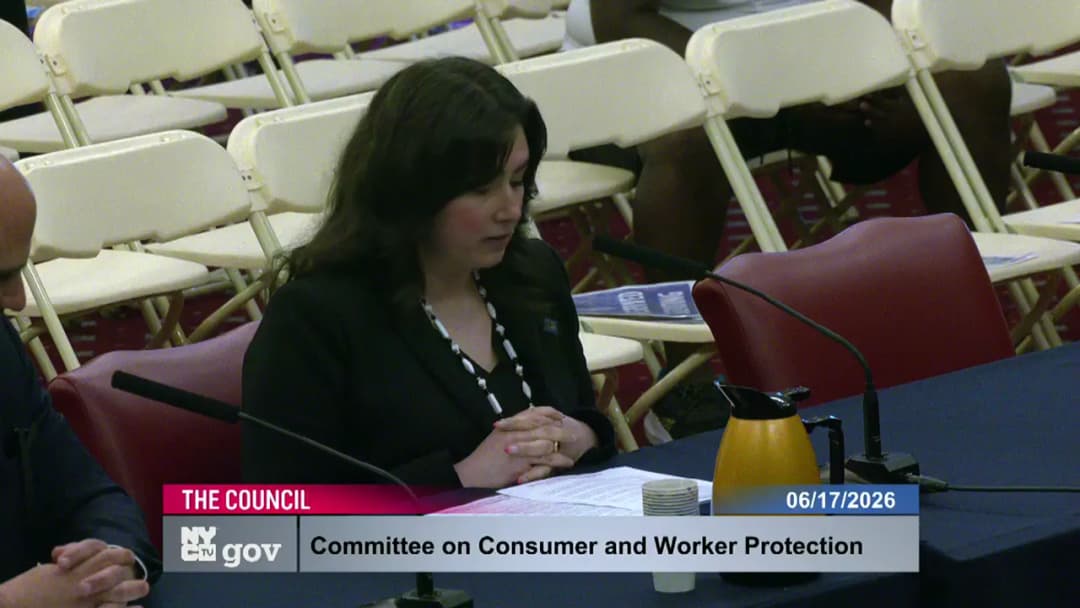
The New York City Council Committee on Consumer and Worker Protection, chaired by Harvey D. Epstein, held a hearing on June 17, 2026, primarily to discuss two legislative proposals: Int. No. 0891 (prohibiting surveillance pricing) and Int. No. 0892 (restricting grocery price increases to once per 24-hour period). The committee also briefly addressed Int. No. 0813 (tobacco retail dealer licensing related to cannabis law), which was laid over. The hearing featured testimony from Commissioner Sam Levine of the Department of Consumer and Worker Protection (DCWP), representatives from the New York State Attorney General's office, labor unions, industry groups, and privacy advocates. Key themes included the need to protect consumers from opaque, data-driven pricing while preserving legitimate discounts and loyalty programs, as well as enforcement challenges and the importance of coordination with state law. Public Comments & Testimony - New York State Attorney General’s Office (Jared Hova): Expressed strong support for a ban on surveillance pricing, noting that disclosure laws have limited utility because consumers often cannot detect when they are being surveilled. Supported Int. 0891 and emphasized that discounts should be genuine and not tied to personal data. Stated the AG's office would coordinate with DCWP and had no objection to a private right of action. - Local 338 RWDSU UFCW (Nikki Cateman): Supported the bills’ intent but urged closing loopholes. Called for banning electronic shelf labels (ESLs) in Int. 0892 and for Int. 0891 to explicitly address data collection via loyalty programs. Noted that frontline workers often bear the brunt of customer frustration over changing prices. - RWDSU (Debbie Wright): Supported the bills but stressed that ESLs are infrastructure for dynamic pricing and must be banned. Also called for a private right of action and stronger enforcement. Emphasized that loyalty programs should not become a loophole for individualized pricing. - UFCW International (Jeremy Espinosa): Echoed support for banning ESLs and warned that without such a ban, companies could circumvent restrictions by changing prices on days like SNAP disbursement. Recommended that loyalty discounts be uniform and not based on personal data. - Chamber of Progress (Jabari Cooper and Kelsey Dorado): Opposed the bills as drafted, arguing that the definitions are too broad and would ban discounts, coupons, and targeted promotions that benefit consumers. Cited examples like cart abandonment discounts and registry completion discounts. Recommended aligning with Maryland’s law that only bans price increases from personal data, not discounts. - Tech NYC (Matt Henning): Shared concerns that Int. 0891 would prohibit personalized discounts that lower prices. Noted that Colorado’s governor vetoed a similar bill. Suggested waiting for the state's One Fair Price Act to be finalized before creating local law. - Hotel Association of NYC (Nikki Franzita): Warned that the “uniformly made available” provision would outlaw hotel loyalty programs and personalized discounts (e.g., birthday discounts). Provided specific language amendments to allow tiered rewards. - Bronx Chamber of Commerce (Lisa Sorin): Emphasized that tiered loyalty programs are essential for small businesses to retain customers. Urged protecting all forms of loyalty and rewards programs. - NYC Central Labor Council (Alexander Gleason): Supported the bills in principle but asked for stronger alignment with the state’s Protecting Consumers and Jobs from Discriminatory Pricing Act. Raised concerns about automation and self-checkout displacing workers. - Electronic Privacy Information Center – EPIC (Mayu Tubin Mayahi): Strongly supported Int. 0891, arguing that surveillance pricing is unfair and deeply unpopular. Recommended removing references to “surveillance technology” and adding a private right of action. - AARP New York (Kristen McManus): Supported the bills, noting that older adults on fixed incomes are especially vulnerable to surveillance pricing when shopping online. - American Economic Liberties Project (Lee Hefner): Argued that there is no such thing as a “personalized discount” that isn’t price discrimination; urged tighter definitions and a private right of action. Cautioned against allowing discounts based on personal data. - Christopher Leon Johnson: Expressed support for both bills and warned that nonprofit organizations funded by ride-sharing and delivery apps may lobby against the legislation. Discussion Items - Definition and scope of surveillance pricing: Speaker Julie Menon and Commissioner Levine provided examples, including ride-sharing apps quoting different prices to different users at the same time, grocery chains using digital shelf labels to change prices rapidly, and airlines raising prices based on browsing history. They emphasized that the practice is often invisible to consumers. - Enforcement challenges: Commissioner Levine noted that DCWP has not received any complaints about surveillance pricing because consumers rarely detect it. He advocated for a private right of action and partnerships with investigative organizations. The council’s own investigation found price variations of up to 23% on grocery delivery platforms. - Discounts and loyalty programs: Multiple industry witnesses argued that the bill’s language would inadvertently prohibit common discounts (e.g., cart abandonment, registry completion, tiered hotel rewards). They urged exemptions for discounts based on voluntarily provided data that are not used to increase base prices. Labor and consumer advocates countered that loyalty programs can be a “backdoor” to surveillance pricing and that discounts should be uniform to prevent abuse. - Electronic shelf labels (ESLs): Union representatives called for a ban on ESLs in Int. 0892, claiming they enable dynamic pricing even without surveillance. Industry witnesses opposed a ban, arguing that ESLs simply replace manual price changes and that the bill already limits price changes to once per day. - Coordination with state law: Commissioner Levine and the AG’s office confirmed they are working to align the city bills with the state’s pending One Fair Price Act. Several industry witnesses urged the council to wait for the state law to avoid a patchwork of conflicting regulations. - Worker impacts: Testimony from labor groups highlighted that frontline workers face customer anger when prices change rapidly, and that technologies like ESLs can reduce staffing and shift risks onto workers. Key Outcomes - No vote was taken on Int. 0891, Int. 0892, or Int. 0813. The committee heard testimony and is expected to consider amendments before advancing the bills to a full council vote. - Int. 0813 was laid over by the committee, with no additional discussion at this hearing. - Commissioner Levine committed to working with the council on amendments, including adding a private right of action to Int. 0891 and clarifying language on discounts. He also stated that DCWP would need additional funding (approximately eight total new lines) to enforce the bills. - Stakeholders from both the industry and labor sides were encouraged to continue providing input. The chair and speaker indicated they would consider proposed changes, particularly around the definition of discounts and the treatment of electronic shelf labels.

CONSUMER PROTECTION 83% · DATA PRIVACY AND SECURITY 8% · WORKFORCE DEVELOPMENT 3% · SMALL BUSINESS 2%
185
JUN 17, 2026 · NEW YORK CITY, NEW YORK · CITY COUNCIL
New York City Council Committee on Higher Education Oversight Hearing on Racial Equity at CUNY - June 17, 2026

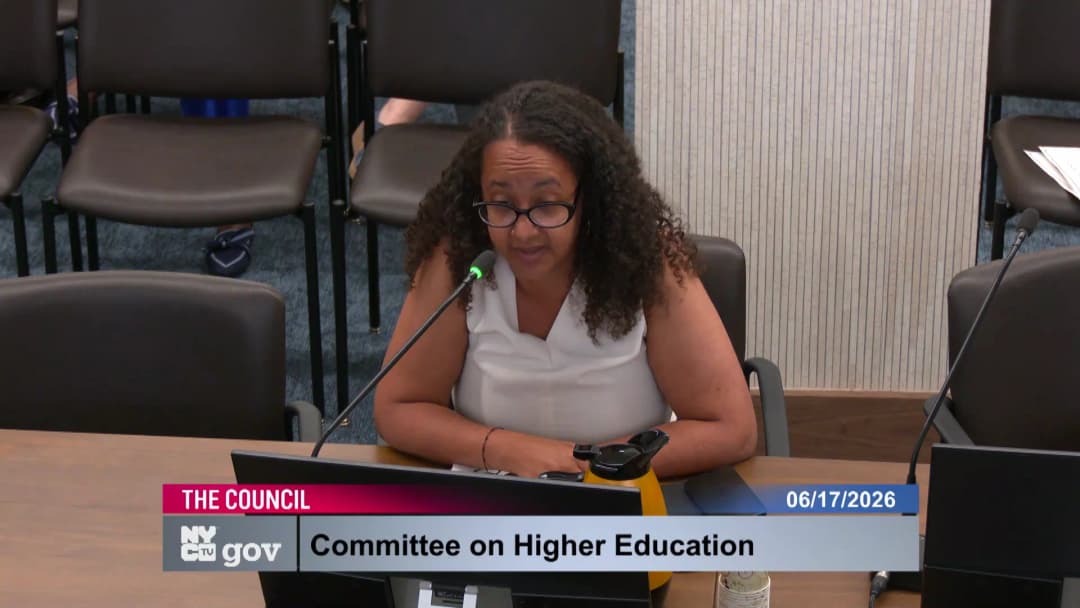
On June 17, 2026, the New York City Council Committee on Higher Education, chaired by Councilmember Rita C. Joseph, held an oversight hearing on racial equity at the City University of New York (CUNY). The hearing examined racial and ethnic disparities among students, faculty, staff, and administrators across CUNY's 26 campuses, and assessed the university's efforts to fulfill its legal and moral commitment to diversity and inclusion. Key topics included faculty hiring and retention, graduate enrollment disparities, the SEEK program, support for Black studies and centers, the impact of federal attacks on DEI, and barriers such as transportation costs and mental health access. Chair Joseph opened by defending CUNY's Black Male Initiative (BMI) against a DOJ investigation, asserting the program is open to all and critical to the university's mission. Public Comments & Testimony - Akeem Polak (Chair, University Student Senate & CUNY Trustee): Emphasized that transportation is an equity issue and proposed a $1.4 million pilot omnicard program to assist low-income students, students with disabilities, and others. Called for holistic support beyond representation. - Dr. Brenda Green (CUNY Association of Black Faculty and Staff): Asserted that Black faculty, staff, and students are essential to CUNY's legal obligations under state law, and urged preservation and promotion of Black studies programs against national efforts to dismantle DEI. - Dr. Anthony Brown (Professor of Africana Studies, Hunter College): Documented how post-2000 admission policy changes (e.g., increased SAT requirements) reduced Black and Latino enrollment at selective senior colleges, with Black student percentages falling below 14% at several campuses. Highlighted severe underrepresentation at Macaulay Honors College (7% Black). - Dion Bennett (Faculty, City Tech): Criticized the concentration of Black faculty at 12% full-time versus 26-27% of students, and noted racial segregation in adjunct roles. Recommended a comprehensive strategy including cluster hires, targeted faculty initiatives (like the Latino Faculty Initiative), and expanded Black studies departments. - Donna Hill (Executive Director, Center for Black Literature): Argued that CUNY centers and institutes are under-resourced despite being essential infrastructure. Called for equitable funding and recognition of their role in community engagement and student success. - Ralisa Galloway Perry (John Jay College): Stressed the importance of Black staff for student mentorship and navigational support. Said Black staff are concentrated in lower tiers, and post-pandemic attrition has left gaps. Called for investing in staff to fill vacancies and provide professional development. - Dr. Randall Clark (SEEK Director Council): Expressed concern over stagnation in the SEEK program, which has not updated its guidelines in 30 years. Called for strategic growth, public awareness campaigns, and staffing parity with programs like ASAP. - Felicia Wharton (PSC Treasurer): Presented data showing Black faculty representation increased only 0.1% from 2022 to 2024 (15.0% to 15.1%), calling it unacceptable. Cited excessive workload and low pay as barriers to retention, and urged full-time hiring and reduction of executive bloat. - Robert Echevaria (Brooklyn College Student Government): Requested $700,000 in city budget for free OmniCards for CUNY students and $1 million to support AAPI-serving programs (Anapeezy projects) after federal MSI grants were terminated. - Tia Poquet (Young Invincibles): Shared personal experience of transportation costs forcing a shift to online learning. Supported the omnicard pilot as a racial equity measure. - Lisa (Young Invincibles): Cited low graduation rates (27.5% for Black/Hispanic, 17.8% for Black men) and noted that programs like ASAP and ACE eliminate equity gaps. Called for protecting and expanding wraparound resources. - Jerved Ward (Chair, Black Studies, CCNY): Urged CUNY to match its strategic plan goals with resources for Black studies, faculty hiring, and support for marginalized students. - Jillian Abbott (Adjunct, York College): Criticized exploitation of adjuncts and administration waste. Alleged that vulnerable students are misled into enrolling in courses they cannot pass. Called for restructuring CUNY to convert experienced adjuncts into full-time faculty. - Additional testimony from NYC CORE (Commission on Racial Equity) noted that CUNY did not submit a required racial equity plan under Local Law 2022, and raised concerns about the hiring process for CUNY TV's executive director. Discussion Items - Faculty Diversity: Councilmembers Dinowitz and Epstein questioned why white full-time faculty are overrepresented compared to Black, Hispanic, and Asian students. EVP Albero stated CUNY has no numeric goals or quotas for diversity, but focuses on broad recruitment, cluster hires (e.g., Black Race and Ethnic Studies Initiative), and feedback from surveys and affinity groups. Councilmember Dinowitz pressed for specific retention and promotion benchmarks, especially for underrepresented faculty in STEM. - Graduate Enrollment: Councilmembers noted that CUNY graduate students are 42% white, more than twice any other racial group. Albero reported that CUNY achieved its 2030 goal early by eliminating the gap in graduate enrollment for minority students who earned CUNY baccalaureates. - SEEK Program Updates: Chair Joseph asked about outdated SEEK guidelines (30 years old). Albero confirmed that a dean is finalizing revisions, which will go through board approval. Directors expressed skepticism about the timeline. - Hiring Practices: Detailed discussion on search processes, diversity officer training, and use of search firms. CUNY tracks applicant pools (currently 54% people of color for faculty). Councilmembers requested reports on retention data and anonymous exit surveys. - Support for Students: The committee discussed mental health counselor shortages (ratios as high as 7,000:1 at some campuses), transportation costs, and the need for sustained funding for ASAP, CUNY CARES, and other equity programs. Key Outcomes - The hearing was informational; no formal votes were taken. - Chair Joseph directed CUNY to provide follow-up data on faculty retention by race/ethnicity, gender composition of senior leadership, and results from the COACHE faculty survey. - CUNY committed to providing the committee with a copy of the COACHE survey and links to public reports on leadership hiring and retention. - The committee urged CUNY to finalize and share updated SEEK guidelines and a five-year enrollment plan. - Councilmembers emphasized the need for CUNY to participate in the city's racial equity plan process under Local Law 2022. - The chair requested that CUNY report back on AI cluster hire demographics and on efforts to recruit Black faculty in STEM disciplines.

RACIAL EQUITY 69% · PERSONNEL MATTERS 18% · PROCEDURAL 4% · YOUTH PROGRAMS 2%
186
JUN 17, 2026 · NEW YORK CITY, NEW YORK · CITY COUNCIL
NYC Council Subcommittee on Zoning and Franchises Hears Three Queens and Staten Island Rezonings – June 17, 2026

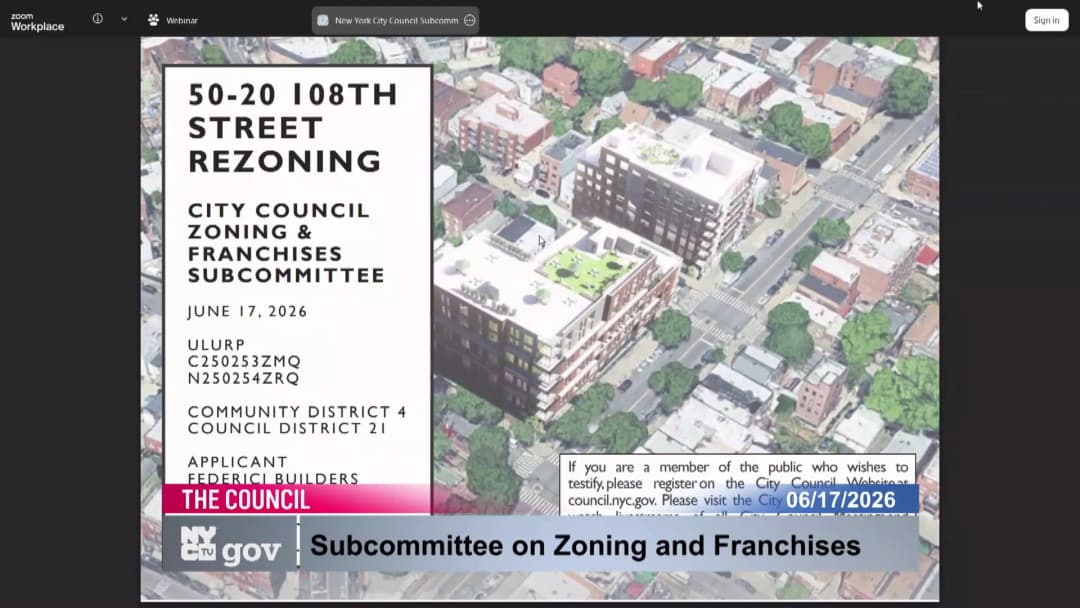
The New York City Council Subcommittee on Zoning and Franchises, chaired by Council Member Farah N. Louis, held a hybrid hearing on Wednesday, June 17, 2026, to consider three mixed-use residential rezoning proposals. The subcommittee heard presentations from applicants, public testimony, and remarks from local council members. All six land use applications (LU 0094-2026 through LU 0099-2026) were laid over without a vote, meaning they will be taken up at a later date. Consent Calendar - No items were listed on the consent calendar. Public Comments & Testimony - 164th Street Rezoning (LUs 94-95): Marva Dudley, president of the Flushing Suburban Civic Association, testified in opposition, disputing the applicant’s claims about express bus service and outreach. She stated the applicant had not contacted civic leaders and that the project represented spot zoning. Joe, a long-time resident, also opposed the rezoning, arguing it was spot zoning in a non-transit area, that street widths were exaggerated, and that the building height was inappropriate for the low-density neighborhood. He raised concerns about displacement and increased taxes. - 50-20 108th Street Rezoning (LUs 96-97): Maria Silva, representing SEIU Local 32BJ, testified in support, noting the developer’s commitment to prevailing wages and benefits for building workers and the provision of 51 permanently affordable units. - 198-208 Richmond Terrace Rezoning (LUs 98-99): No members of the public testified. Discussion Items 164th Street Mixed-Use Residential Rezoning (Fresh Meadows, Queens – Council District 24) - Applicant: Leah Vallone and Steve Sinacori of Ackerman LLP, representing 88-66 Myrtle LLC. - Proposal: Rezone from R3-2 to R6A with a C2-4 overlay on a 24,000 sq ft site at 164th Street between 75th Road and 76th Avenue. A six-story mixed-use building with approximately 80 residential units, 24 permanently affordable under MIH Option 1 (25% of floor area at 60% AMI), plus a daycare expanded from 85 to roughly double the capacity. 50 accessory parking spaces proposed. - Council Member James Gennaro read a statement noting community concerns about density and height in a low-scale neighborhood of one- and two-family homes, and infrastructure capacity. He committed to working toward a solution. - Questions: Chair Louis asked about engagement with civic associations (applicant said they had reached out but received no response). Council Member Gennaro questioned the appropriateness of a six-story building amid small homes, the lack of step-down height (applicant noted setbacks), and water/sewer costs (applicant deferred). Parking count was corrected from 37 to 50. - Public Opposition: Testifiers challenged transit access, outreach claims, street width data, and called for a community plan. 50-20 108th Street Mixed-Use Residential Rezoning (Corona, Queens – Council District 21) - Applicant: Same representatives for Federici Builders Corp. - Proposal: Rezone from R6B/C2-3 to R7A/C2-4 on two sites (28,000 sq ft and 15,000 sq ft) along 108th Street and Corona Avenue. Two buildings (seven and eight stories) with 196 total units, 51 permanently affordable under MIH Option 1. 95 parking spaces, local retail, community facility space. Sites are within outer transit zone. - Council Member Shanel Thomas-Henry emphasized the need to align growth with community benefits, affordability for residents (median income $55,000), and community-serving spaces. She highlighted that Community District 4 is 54% rent-burdened. - Questions: Chair Louis asked about unit breakdown (applicant confirmed MIH Option 1) and engagement with non-applicant site owners regarding displacement. The EIS estimated a 1% population increase from the rezoning. Council Member Thomas-Henry pressed for lower AMI levels and more two- and three-bedroom units; applicant committed to exploring both and working with her office to tenant the community facility space with a local nonprofit. She also asked about temporary relocation for existing commercial tenants; applicant said they would work with tenants to return after construction. Council Member Thomas-Henry requested support for nearby parks (William F. Moore Park and Flushing Meadows Corona Park); applicant agreed to consider. - Public Support: SEIU 32BJ testified in favor, citing good jobs and affordable housing. 198-208 Richmond Terrace Mixed-Use Residential Rezoning (St. George, Staten Island – Council District 49) - Applicant: Eric Palatnik, representing Economic Development Opportunity Zone Fund 1 LLC. - Proposal: Rezone from R6/C2-2 to R7-3/C2-4, extending adjacent R7-3 zoning, on a hillside site. A 14-story, 97,000 sq ft building with 118 units (30–36 affordable under MIH), 10,000 sq ft community facility space, and only 4 parking spaces (no parking required under City of Yes). The site is in the outer transit zone near Staten Island Ferry and bus routes. - Council Member Kamillah Hanks read a statement of general support, noting the potential for housing and community space, and expressing interest in streetscape improvements. - Questions: Chair Louis asked about relationship to the adjacent River North project (applicant said it’s analogous) and benefits of the Special St. George District over Hillsides Preservation District (building designed around rock outcropping, avoiding hillside cutting). Council Member Hanks sought details on public realm improvements (widened sidewalks, street trees, ornamental lighting) and commitment to tenant the community facility space with community use; applicant agreed and submitted an affidavit. Council Member Simcha Felder queried about parking; applicant explained physical constraints (rock outcropping) and noted the nearby former Wheel parking lot could be leveraged. - Community Board Objection: The only objection from Community Board 1 was due to insufficient parking, though they otherwise supported the project. Key Outcomes - All six land use applications (LU 0094-2026 through LU 0099-2026) were heard and laid over by the subcommittee. No votes were taken. The items will be considered again at a future subcommittee meeting. - Next Steps: Applicants were asked to provide additional information in writing (parking costs, affordability details, tenant relocation plans, etc.) and to continue community engagement. The subcommittee will revisit the applications after further review and responsive materials.

HOUSING 57% · HOUSING AND INFRASTRUCTURE 19% · COMMUNITY ENGAGEMENT 8% · PROCEDURAL 6%
187
JUN 17, 2026 · NEW YORK CITY, NEW YORK · CITY COUNCIL
NYC Council Committee on Public Housing Oversight Hearing on EHV Program End - June 17, 2026

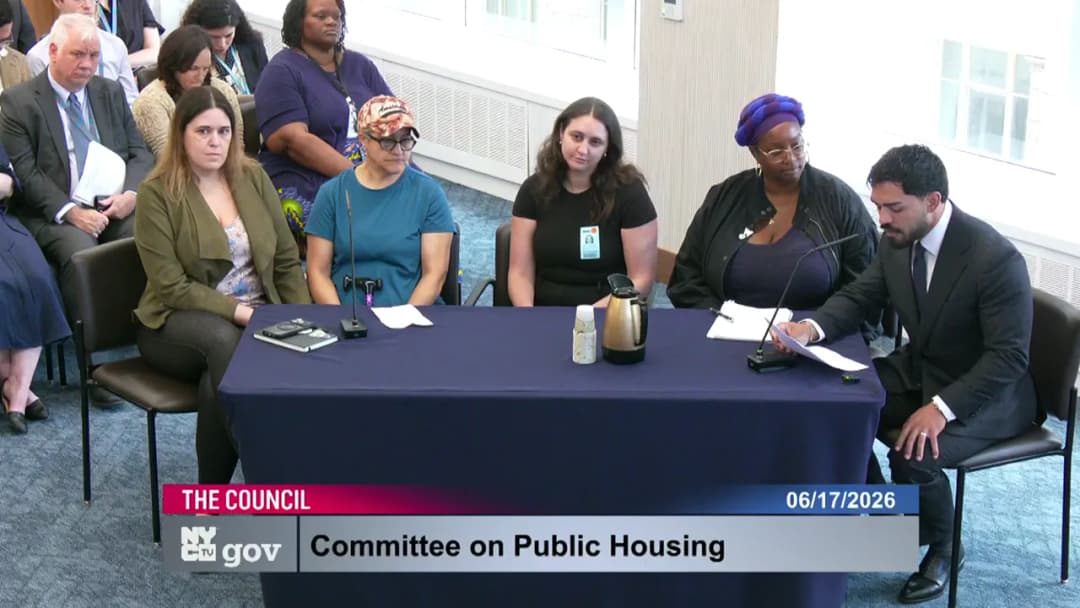
The New York City Council Committee on Public Housing, chaired by Councilmember Chris Banks, held an oversight hearing on June 17, 2026, to examine the premature termination of the federal Emergency Housing Voucher (EHV) program and to consider Resolution 495, which calls on the state to expand the Housing Access Voucher Program (HAVP). The hearing focused on the impact on nearly 5,000 NYCHA-administered and 2,000 HPD-administered EHV households facing loss of rental assistance by the end of 2026, and the transition plans to alternative subsidies. Public Comments & Testimony - Affected Residents: Multiple speakers who are domestic violence survivors, parents of children with disabilities, and formerly homeless individuals expressed that the EHV program provided life-changing stability. They described panic, stress, and fear of returning to homelessness or abuse. Several stated they were not adequately informed by NYCHA about the program's end or alternative options. One speaker noted NYCHA sent a letter only in March 2026 with no prior notice. - Advocacy Organizations: Representatives from New Destiny Housing, Safe Horizon, WIN, Legal Aid Society, New York Housing Conference, and the Coalition for the Homeless urged the city to expand CityFEPS eligibility to all EHV households and fund it in the FY2027 budget. They argued the current transition plans (project-based Section 8 and two-year Home TBRA) are insufficient for survivors, homeless youth, and people with disabilities who need tenant-based vouchers to remain in place. - Property Owner Representative: Kenny Burgos (NY Apartment Association) expressed support for Resolution 495 and voucher programs generally, but stressed that the process must be streamlined with timely inspections and payments. He stated that owners do not reject vouchers but are burdened by bureaucracy, and that rents must cover rising costs. Discussion Items - Transition Plans: NYCHA (Lakeisha Miller, EVP of Leased Housing) and HPD (First Deputy Commissioner Adam Phillips) testified that: - NYCHA initially planned to transition EHV households to Section 8 but was denied a waiver by HUD in January 2026 due to Section 8 funding shortfall. - NYCHA is now offering project-based Section 8 units (PAC/PBV) and is partnering with HPD to transfer up to 1,700 households to HPD's Home TBRA program (temporary, two-year funding). As of June 9, 3,350 EHV households (67%) have completed a public housing application; 568 have been matched to units; only 14 have moved in. - HPD is transitioning all of its 2,000 EHV households to Home TBRA, with 80% of applications returned. No households will be required to move; this is a voucher-to-voucher transition. HPD estimates Home TBRA funding will last about two years. - Challenges and Gaps: Chair Banks and Councilmembers pressed on the low number of actual moves (14), the 1,000 NYCHA EHV households out of compliance with program requirements, and the lack of units: NYCHA has about 700 move-in-ready PAC/PBV units but needs roughly 3,500 more to cover the remaining households. Councilmember Marte questioned why NYCHA does not use Section 9 (public housing) vacancies, which number about 6,200 citywide but only 4,700 are move-in-ready due to repairs. Councilmember Sanchez noted 84% of NYCHA EHV households were homeless or at risk prior to receiving the voucher and average household income is $22,500. - Resolution 495: Chair Banks sponsored the resolution urging the state legislature to pass and the governor to sign A.10992/S.9430-A, which would prioritize EHV households for HAVP and allow unit inspections under state standards. The resolution was heard and laid over by the committee. - Federal Responsibility: Both NYCHA and HPD emphasized the problem originated from the federal government prematurely ending the EHV program and repeatedly called for renewed federal Section 8 funding. They noted that stopgap local measures are not sustainable. Key Outcomes - No final vote taken on Resolution 495; it was laid over by the committee. - Oversight hearing on the EHV program termination was filed by the committee. - Commitments: NYCHA agreed to provide monthly updates to the committee on the number of EHV households matched and moved into alternative housing. HPD committed to continuing outreach to the remaining 20% of EHV households who have not yet returned Home TBRA applications. - Next Steps: The committee expects concrete answers within five months before EHV funding expires (NYCHA by mid-November 2026, HPD by end of September 2026). Advocates and council members called for the city to expand CityFEPS eligibility and fund it in the FY2027 budget to provide a permanent tenant-based option for all EHV households.

HOMELESSNESS 53% · AFFORDABLE HOUSING 46% · PROCEDURAL 1%
188
JUN 17, 2026 · NEW YORK CITY, NEW YORK · CITY COUNCIL
NYC Council Committee Hears Bills on Surveillance Pricing and Grocery Price Hikes – June 17, 2026

The New York City Council Committee on Consumer and Worker Protection, chaired by Harvey D. Epstein, held a hearing on Wednesday, June 17, 2026, to discuss two proposed local laws: Introduction 0891 (prohibiting surveillance pricing) and Introduction 0892 (restricting the frequency of price increases in grocery stores to no more than once per 24-hour period). Both bills received extensive testimony from the administration, public advocate, state attorney general’s office, labor unions, business groups, and consumer advocates. The committee heard the bills and laid them over for further consideration. Opening Statements - Chair Harvey D. Epstein opened the hearing, emphasizing the need to protect consumers from price manipulation based on personal data and real-time price changes. - Speaker Julie Menon, sponsor of Int 0891, defined surveillance pricing as setting prices using consumer personal data collected via surveillance technology, leading to different prices for different consumers. She cited examples including grocery chains changing prices up to 2,000 times per day, ride-share apps raising prices when a phone battery is low, and a grocery delivery platform showing price differences as high as 23% for the same products at the same time. Her own investigation across 370 pricing checks found consistent variation in discounts among ride-share accounts. She stated the bills aim to bring transparency and lower costs for New Yorkers. - Public Advocate Jumaane Williams voiced support, highlighting how surveillance pricing can discriminate against people of color and low-income communities, citing a 2022 investigation where internet providers charged higher prices in less white, lower-income areas. Discussion Items - Testimony from Commissioner Sam Levine (DCWP): Commissioner Levine supported both bills but recommended amendments. For Int 0891, he proposed adding a private right of action and ensuring that data collected for discount programs is not used for harmful purposes. For Int 0892, he suggested additional record-keeping requirements. He noted that the agency would need additional funding—approximately eight new positions total (four for each bill)—to enforce the legislation effectively. - Questions from Council Members: Speaker Menon asked about enforcement challenges due to the invisibility of surveillance pricing. Commissioner Levine emphasized partnerships with groups like Consumer Reports and the need for private litigation. Councilmember De La Rosa inquired about electronic shelf labels (ESLs); Levine confirmed that inspections found ESLs at chains like Lidl, Aldi, ShopRite, and Food Bazaar, raising concerns about rapid price changes and potential disadvantage to small businesses. Councilmember Ariola suggested requiring stores to post information about pricing complaints. Councilmember Wilson asked about third-party pricing services; Levine noted that an FTC study found such consultancies offering surveillance pricing to over 250 companies. - Testimony from New York State Attorney General’s Office: Jared Hova supported an outright ban on surveillance pricing, noting that disclosure laws have limited utility because consumers cannot easily detect the practice. He emphasized that legitimate discounts—uniformly offered—can coexist with a ban. - Public Testimony: - Labor Unions (Local 338 RWDSU/UFCW, RWDSU National): Supported the bills but urged strengthening them by banning electronic shelf labels, addressing data collection in loyalty programs, and protecting workers from customer backlash. They argued that ESLs are the infrastructure enabling predatory pricing even without explicit surveillance. - Business Groups (Chamber of Progress, Tech NYC, Hotel Association of NYC, Bronx Chamber): Expressed concern that Int 0891’s broad definitions could ban discounts, coupons, and loyalty programs that rely on purchase history or voluntary data (e.g., cart abandonment discounts, completion discounts on registries). They urged the council to allow the state’s similar bill (One Fair Price Act) to finalize first to avoid a patchwork of regulations. Some supported a prohibition on using data to increase prices but not to lower prices. - Consumer Advocates (EPIC, AARP, American Economic Liberties Project): Strongly supported the bills, arguing that personalized discounts are a veiled form of price discrimination. EPIC recommended removing references to surveillance technology and adding a private right of action. AARP highlighted vulnerability of older adults on fixed incomes. The Economic Liberties Project warned that allowing discounts based on personal data would create a loophole for discrimination. - Individual Testifier: Christopher Leon Johnson supported both bills, warning that nonprofits funded by ride-share and delivery apps may lobby against the legislation. Key Outcomes - Both Introduction 0891 and Introduction 0892 were heard and laid over by the committee. No vote was taken. - The Department of Consumer and Worker Protection (DCWP) indicated it would need additional staff (approximately eight positions) for enforcement and community outreach, funding not yet in the budget. - Several speakers recommended amendments: adding a private right of action to Int 0891, banning electronic shelf labels in Int 0892, clarifying definitions to protect uniform loyalty discounts while preventing individualized price discrimination, and aligning with the state’s One Fair Price Act. - The committee will continue to work with stakeholders, including DCWP, the Attorney General’s office, labor unions, and industry representatives, to refine the bills before a future vote.

DATA PRIVACY AND SECURITY 49% · MISCELLANEOUS 25% · TECHNOLOGY AND INNOVATION 16% · CONSUMER PROTECTION 6%
189
JUN 17, 2026 · NEW YORK CITY, NEW YORK · CITY COUNCIL
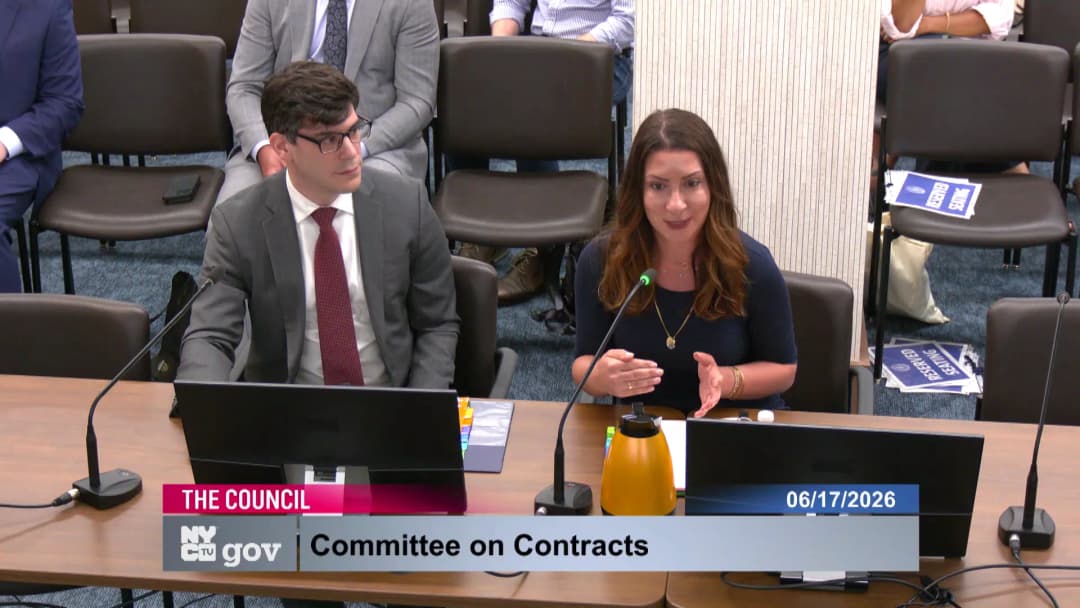
Oversight Hearing on Master Agreements Transparency – June 17, 2026

The New York City Council Committee on Contracts, chaired by Lincoln Restler, held an oversight hearing on transparency and accountability in the city's use of master agreements (MA1s and MMA1s). The hearing examined spending of over $8.8 billion through these contracts between fiscal years 2022 and 2025, with 28,000 delivery orders per year, and focused on the lack of public visibility into what is purchased, at what price, and by which agency. The committee heard from the Mayor's Office of Contract Services (Mox), the Department of Citywide Administrative Services (DCAS), the Office of Technology and Innovation (OTI), the New York City Comptroller's Office, and members of the public. Public Comments & Testimony - Charles Diamond (former city official, personal capacity) argued that the lack of delivery order tracking stems from procurement rules emphasizing procedural compliance over value for money. He called for investing in Passport enhancements and warned that proposed cuts to Mox's budget (18.8%) would hinder progress. He noted that passport enhancements require funding to close the information gap. - Mike Hickey (Chief of Strategy and Operations, Citizens NYC) described their master contract with NYC Emergency Management as a successful tool for quickly funding over 750 community-based organizations ($12 million annually). He highlighted that data on purchases exists but is not transmitted through Passport, and that agency procurement cultures vary widely. - Christopher Leon Johnson (public) criticized perceived favoritism toward Working Families Party-affiliated nonprofits and called for equal scrutiny across all organizations receiving city contracts. He also raised concerns about the homeless industrial complex and requested a non-bid contract for a table outside a community hub. - Hayden B. Siegel (NYC Health + Hospitals IT worker, via Zoom) advocated for increased pay and expanded roles for his department's overnight IT staff, noting that they handle critical biomedical equipment and require higher qualifications. He emphasized that data on supply orders is captured in ServiceNow but not integrated into central reporting. Discussion Items - Chair Lincoln Restler opened with statistics: master agreements made up 17% of city contract spending over four years ($8.8 billion), with agencies issuing more than 28,000 delivery orders annually. He highlighted the Garner Environmental Services contract, originally estimated at $30 million but resulting in $675 million in spending (20 times the estimate), with agencies paying vastly different rates for security guards ($24/hr under a union contract vs. $117/hr paid by Health + Hospitals). - Administration panel (John Kitsoris, Deputy City Chief Procurement Officer, Mox; Roman Goffman, Deputy Commissioner, DCAS; Gail Tang, Deputy Commissioner, OTI; Chantal Santas, Deputy Commissioner for Legal Matters) explained the difference between MA1s (goods, direct orders) and MMA1s (services, task orders). They acknowledged that downstream usage data is captured in various systems (FMS, DCAS direct order system, Passport) but not in a unified way. Only 30% of DCAS's master agreements are in Passport, though efforts are ongoing to move contracts there as they are reprocured. They noted that line-item details (quantity, price) are not centrally available because FMS does not capture item-level data. - Council Members Gale Brewer, Kamillah Hanks, and Inna Vernikov pressed for detailed spend reports by agency, line-item tracking, and integration with Checkbook NYC. Deputy Commissioner Goffman stated that DCAS can produce spend reports by agency but not by line item without manual review of invoices. OTI's Gail Tang confirmed that for their citywide IT contract (covering 740 manufacturers), OTI has records for its own purchases but not for those made by other agencies. The chair expressed frustration that billions of dollars in spending lack centralized tracking. - Comptroller's office (Deputy Controller Charlotte Hamangian and Dan Roboff) presented findings from a recent report. They noted that one in three MA1s is overspent or underspent by more than half, with cumulative overspend of $1.6 billion since 2015. Citywide IT contracts were overspent by nearly $2 billion. They recommended expanding Passport catalog/punch-out tools (currently covering <10% of active master agreements), enhancing FMS/Passport to capture delivery order details (product, quantity, unit price), improving demand estimation methodologies, and proactively seeking savings—especially in IT. They argued that the lack of data prevents the city from using its full purchasing power. - Charles Diamond (public testimony) echoed the need for technology investment, noting that delivery orders are not tracked because procurement rules focus on competitiveness rather than value. He stated that the current executive budget proposes reducing Mox's budget by 18.8%, which would hinder Passport enhancements. He urged funding for procurement systems. - Accelerated procurements were discussed: these account for nearly 40% of MA1 registrations since FY22 ($625 million spent). DCAS uses accelerated procurement for food and chemicals (fuel, heating oil). Council members questioned whether the city could reduce spend and get better pricing through this method. - OTI's CDW contract was examined: a $142 million purchase of 350,000 Chromebooks for schools, with ongoing cellular service costs. OTI is considering savings opportunities but could not provide the monthly cost of the cellular service. Chair Restler noted that the mayor's savings plan includes renegotiating technology contracts. - Citizens NYC's master contract was highlighted as a positive example of using master agreements to quickly fund hyperlocal organizations, with payments reaching vendors in about 45 days. The contract is in the process of being moved from NYCEM to OTI. Key Outcomes - The committee filed the oversight (as per meeting minutes). No formal votes were taken. - Chair Restler indicated that if administrative solutions are not achieved, the council may pursue legislative action to mandate transparency. He called for continued collaboration with Mox, DCAS, OTI, and the Comptroller's Office. - Administration witnesses committed to following up with more detailed spend reports and to exploring technology improvements to centralize delivery order data, including expanding Passport usage and enhancing data capture. - The hearing underscored the need for investment in procurement systems (Passport enhancements) to close the information gap and enable better cost control and negotiation leverage.

FISCAL SUSTAINABILITY 50% · ENGINEERING AND INFRASTRUCTURE 26% · TECHNOLOGY AND INNOVATION 22% · PERSONNEL MATTERS 2%
190
JUN 16, 2026 · NEW YORK CITY, NEW YORK · CITY COUNCIL
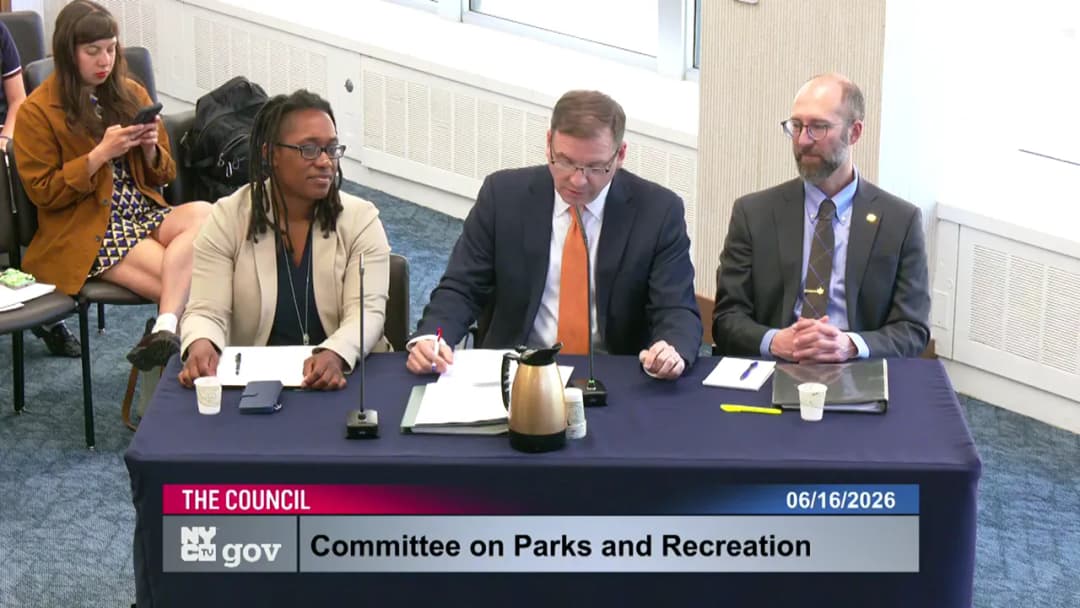
NYC Council Parks Committee Hears Six Bills on Tree Transparency, Dog Waste, and Street Naming on June 16, 2026

The New York City Council Committee on Parks and Recreation, chaired by Councilmember Ty Hankerson, held a hearing on Tuesday, June 16, 2026, at 1:00 PM in Hearing Room 1 at 250 Broadway. The committee considered six pieces of legislation addressing tree pit identification, tree removal permits, tree maintenance prioritization ratings, street/ park co-naming biographical information, a pilot program for composting dog feces from dog runs, and signage regarding dog waste. Representatives from the NYC Department of Parks and Recreation (DPR) and the Department of Records and Information Services (DORIS) testified, and public testimony was heard. All six bills were held in committee and laid over for further consideration. Public Comments & Testimony - Matt Molina (NYCH2O), Seth, Henry Villa, David Chichuka, Nikosi Newton, Sophia Hart, and Jordan Castelanovo testified in support of obtaining written authorization from DPR to resume restoration work at Ridgewood Reservoir in Highland Park. They highlighted that the work, which includes removing invasive Phragmites and planting native species, is fully permitted, funded, and conducted by paid interns, many of whom are local youth. They noted that every week of delay erodes years of progress and prevents young people from gaining paid environmental training and a sense of community. The group urged the committee to help expedite the authorization process. - Oliver Rivera testified in favor of increased funding for the Parks Department, stating that the current 1% annual budget target (with actual funding around 0.5%) is insufficient. He advocated for 3% of the annual budget to support maintenance, enforcement (including PEP officers), and park operations across the five boroughs. - Scott Kearney spoke about the underutilized Marine Park Nature Center in District 46, noting it is open only five hours on weekends. He suggested that the council push for a concession process to increase access and proposed posting a scannable sign directing visitors to alternative nature centers when closed. Discussion Items - Int. No. 0089-2026 (Councilmember Brewer) : Would require DPR to identify and map all tree pits on streets and in landscaped parks within three years, noting whether each contains a tree and the reason for disuse if empty. The sponsor argued it would increase transparency for tree planting opportunities. DPR opposed the bill, stating that a citywide canvas would be a massive undertaking with little practical benefit because planting standards change and the data would quickly become outdated. They noted that empty tree beds are not necessarily viable for planting, and their new neighborhood tree planting program aims to address this by assessing each block comprehensively. - Int. No. 0576-2026 (Councilmember Gennaro) : Would require tree removal permit applicants to provide the name of a certified arborist and require DPR to report annually on trees removed. DPR expressed concerns that requiring a certified arborist for removal work (as opposed to care/ maintenance) might inadvertently encourage unauthorized removals. They noted they are open to discussing reporting improvements but opposed the certified arborist requirement as drafted. - Int. No. 0666-2026 (Councilmember Williams, presented by Chair Hankerson) : Would require DPR to publish tree maintenance prioritization ratings and their reasons on the interactive tree map. DPR supported the intent but noted that a 30-day compliance timeline is too tight for website development. They stated that residents already receive risk assessment notifications when they submit service requests. - Int. No. 0859-2026 (Councilmember Brewer) : Would allow DORIS to independently research and post biographical information for street/ park co-namings when such information is not in the legislative record. DPR and DORIS both expressed support. Commissioner Smith Cruz reported that DORIS has created an interactive map of over 4,200 co-namings and completed 393 biographies for 9/11-related names, plus 28 others dating back to 1940. - Int. No. 0864-2026 (Councilmember Epstein) : Would require DPR to establish a two-year pilot program collecting dog feces from dog runs for composting, including collection bins, compostable bags, and reporting on compost outcomes. DPR opposed the bill, citing that processing organic waste is outside their mission and expertise, and that the pilot would be resource-intensive. They noted that dog run waste is currently placed in adjacent trash bins and collected by DSNY. - Int. No. 0880-2026 (Councilmember Narcisse) : Would require DPR and DOT to post signs at park entrances, dog runs, and other facilities stating the prohibition on leaving dog waste and associated penalties. DPR supported the intent but raised concerns about open-ended signage requirements via 311 complaints, which could overwhelm DOT's capacity for life-safety signage. DOT reportedly shared severe operational concerns. Councilmember Narcisse noted that only 22 summonses for dog waste were issued citywide from 2021-2025, indicating enforcement gaps. - Additional Discussion: Councilmember Nurse raised concerns about rodent abatement and park maintenance at Kelly Callahan Playground, near the Broadway Junction construction project. DPR committed to escalating the issue. Key Outcomes - All six introductions (Int. 0089, 0576, 0666, 0859, 0864, 0880) were Hearing Held by Committee and Laid Over by Committee, meaning no final vote was taken. The bills remain under consideration and may be amended before any future vote. - The committee did not take any votes on the Ridgewood Reservoir authorization request or on funding allocations. Public testimony was accepted for the record; written testimony may be submitted within 72 hours to testimony@council.nyc.gov.

PARKS AND RECREATION 87% · HISTORIC PRESERVATION 6% · YOUTH PROGRAMS 3% · WORKFORCE DEVELOPMENT 2%
OPENPUBLICA · PUBLIC MEETING INDEXUPDATED DAILY · openpublica.com