Browse by city
Date range
Search help

Search titles, summaries, topics and stored transcripts together. Keywords may match separately; put the whole query in double quotes for a phrase. Matching follows word analysis, so punctuation is not exact. Both dates are included. Documents are not searched.

SHOWING 11–20 ENTRIES
11
OCT 27, 2026 · NEW YORK CITY, NEW YORK · CITY COUNCIL
Joint Oversight Hearing on Older Adult Centers at NYCHA Facilities - October 27, 2026

Public Comments & Testimony - Sarah Morgridge (Riverstone Senior Life Services): Morgridge detailed severe problems following her center's NYCHA building converting to RAD/PACT with a private landlord (PRC). She stated the landlord caused them to lose their property liability insurance twice (first by demanding they claim PRC's water damage on their policy, and second due to illegal fire panels PRC refused to remove). PRC is pressuring them to sign a license agreement containing an eviction clause for failure to maintain insurance, a situation PRC themselves caused. She characterized non-profit providers as an afterthought in the RAD program. - Patricia Lynch (Millennium Development): Lynch described struggling to provide basic services amidst unresolved leaks, lack of heat, and broken elevators. She stated that when issues are reported, responsibility is often passed between agencies, leading to significant delays. She noted that many OACs lack formal MOUs or lease agreements, impairing their ability to make improvements and leading to FDNY citations. She called for clear ownership and urgency in resolving building issues. - Bridget Lee (Weinberg Center for Elder Justice): Expressed support for Int. 1083 but urged the council to strengthen it by requiring advisor training in elder abuse and financial exploitation red flags. - Anita Kwok (United Neighborhood Houses): Testified that the promised interagency coordination between DFTA and NYCHA has not materialized effectively, leading to prolonged repair timelines and providers being asked to undertake maintenance without funding or site control. - Rosemary Salazar (University Settlement): Described a specific case where NYCHA refused to connect a fire panel to the FDNY alarm system, deferring responsibility to the provider despite historical practice. Discussion Items - Repair Protocols & Coordination: DFTA Comm. McKenzie and NYCHA COO Trimble described the repair workflow (provider calls NYCHA CCC, ticket assigned, NYCHA fixes building systems, providers fix interiors). They reported bi-weekly and quarterly meetings to review open tickets. Chair Zhuang raised a specific example of a leak at LaGuardia/Dykeman OAC that providers reported as ongoing for two years. Chair Banks questioned the effectiveness of the process, noting the absence of a formal written maintenance agreement between NYCHA and DFTA, which he argued contributes to responsibility being passed between agencies. - Infrastructure & Capital Needs: NYCHA stated it received 1,700 work orders from OACs in the past year, with approximately 250 still open and an average 12.8-day response time. NYCHA identified 60 current FDNY violations and 2 DOB violations at OACs. Officials acknowledged the closure of Latimer Gardens OAC due to a roof leak, stating the required roof replacement is an unfunded capital project with roughly a 4-year timeline if funded. DFTA stated they rely almost entirely on discretionary funding from elected officials for capital improvements, having completed 56 projects in FY26 thanks to a $5M Council grant. Councilmember Restler highlighted stalled $6M in capital funds from the Brooklyn Borough President, which NYCHA attributed to past staffing shortages now resolved. - RAD/PACT Conversions: Chair Banks queried whether OAC rehabilitation is guaranteed in PACT deals. COO Trimble noted that while it is always the intent, Section 8 funds cannot be used for community spaces, making such renovations dependent on available city subsidy. She confirmed that Council capital funds allocated for OACs in developments that later convert to PACT are evaluated on a case-by-case basis. - Financial Literacy Bill (Int. 1083): Councilmember Hudson, the bill's sponsor, discussed implementation with the administration. DFTA supports the intent but estimates the cost for an advisor at every OAC for 20 hours per month to be between $2-3 million. Comm. McKenzie suggested shared or mobile advisors could be an alternative. Public testimony supported the bill while requesting amendments for specific elder abuse training. - Safety, Compliance, and Security: Councilmember Ossé raised ADA compliance. The agencies could not provide a count of non-compliant centers or a total cost estimate but committed to surveying the 105 OACs. Chair Banks stressed that the 60 open FDNY violations are unacceptable and providers should not face penalties for NYCHA's infrastructure failures. NYCHA and DFTA committed to working actively to cure the violations. Key Outcomes - Legislative Status: Introduction 1083 (Financial Literacy Advisors) was heard and laid over by the committee. Oversight Resolution T2026-2463 (OACs in NYCHA Facilities) was heard and filed. - Data Commitments: NYCHA and DFTA committed to providing the committees with a comprehensive breakdown of open repair tickets, a list of needed capital projects across the 105 OACs, an assessment of ADA compliance status and costs, and a follow-up report on specific facilities like LaGuardia/Dykeman and William Hodson. - Directives for Agencies: Chair Zhuang and Chair Banks directed the agencies to develop clearer protocols for maintenance responsibility to ensure providers are not fined or forced to close due to unresolved NYCHA infrastructure problems. They emphasized the need for a formalized repair agreement. - Future Policy: The committees expressed intent to explore dedicated capital funding streams for OACs in upcoming budgets and to continue refining Int. 1083 based on testimony submitted.
PUBLIC HOUSING 37% · SENIOR SERVICES 34% · INTERAGENCY COORDINATION 12% · PUBLIC SAFETY 7%
12
OCT 27, 2026 · NEW YORK CITY, NEW YORK · CITY COUNCIL
NYC Council Committee on Workforce Development Oversight Hearing on the Office of Community Hiring - October 27, 2026

The New York City Council Committee on Workforce Development, chaired by Julie Won, met at 1:00 PM on October 27, 2026, in Hearing Room 2 at 250 Broadway for an oversight hearing on the Office of Community Hiring (OCH). Councilmembers Cabán, Epstein, Hanif, and Wong were present. NYC Talent Executive Director Doug LeHarry and OCH Executive Director G. Lee testified. The committee examined OCH quarterly reports, hiring data, procurement coverage, staffing, outreach, and accountability. The hearing was held and the committee filed the oversight report for T2026-2532. Discussion Items - Program overview and reported progress: NYC Talent reported that community hiring, authorized by state legislation in 2023, embeds workforce goals into city contracts. Rules went into effect January 23, 2025. As of the hearing, 528 registered contracts totaling $13.3 billion carried community hiring goals, and about 1,200 community hires had been employed, with roughly 1,136 income-based and almost 70 residence-based hires. LeHarry also reported 362 procurements released totaling $18.4 billion. He said nearly all mayoral agencies, more than 20, were participating. - Chair Won’s concerns about data and reporting: Chair Won noted OCH’s latest quarterly report showed 179 contracts worth about $3 billion, up from 60 contracts and about $1 billion in March, but only 8 of 83 construction contracts reported progress, and 6 of those 8 were below the 30% community hiring goal. All five apprenticeship-goal contracts reporting progress showed zero community-hire apprentice hours. Of 94 service contracts with combined goals of more than 3,000 hires, more than half reported no progress. Won flagged an apparent anomaly: a DSS PACE workforce program contract in Queens with a goal of 31 hires reported 1,229% progress. She said OCH reports still do not state total hires, pay, or demographics as required by law, and the first announced community hiring procurement, $1.2 billion in security guard and fire safety services from June 2024, still does not appear in OCH reports. - Administration explanation of anomalies: LeHarry said the 1,229% figure was confirmed and reflected a vendor hiring above its formula-based goal. He estimated it could represent a couple hundred hires but did not provide exact figures. He said many contracts are newly registered and hiring needs vary over contract terms, so lack of reported progress does not necessarily mean no hiring. The city was using certified payroll reports for construction and a mix of vendor and referral-source data for non-construction, with a digital tool being implemented. - Outreach and referral network: LeHarry and Lee described a referral network of 81 organizations, including 28 community-based organizations funded through DYCD, plus SBS Workforce1, HRA Business Link, and labor unions. LeHarry read the list of 28 CBOs. Councilmember Epstein asked why council offices were not enlisted as partners and cited settlement houses like Henry Street and Grand Street Settlement. LeHarry welcomed council partnership and agreed to provide the CBO list. Councilmember Wong asked about reaching young people; LeHarry highlighted a September 30 HRA community hiring job fair with 25 employers, 388 job seekers, and 16 conditional job offers. Wong invited the office to hold a job fair in his district. - Jobs NYC center and agency roles: Councilmember Cabán raised complaints about the September 28, 2026 Jobs NYC center opening at 2 Lafayette Street, including reports of more than 50,000 applications with very few hires. LeHarry said the center focuses on city jobs while community hiring covers jobs with city vendors; SBS staff at the center can route job seekers to Workforce1 services. He said his office would supply details on staffing and hours. - Staffing and budget: Chair Won noted the FY2027 adopted budget provides $1.7 million and 16 positions for OCH, including $388,200 for contractual services. G. Lee said the OCH team currently has eight people, six full-time employees, one Civic Corps member, and one intern, plus two headcount at SBS, and three vacancies. Won questioned the discrepancy with 16 authorized positions; Lee said no active postings exist for OCH vacancies. LeHarry said the $388,200 is for technology investment and there is a consultant firm, JK Consultant, supporting technical implementation. - Penalties and accountability: LeHarry said OCH has not issued any notices of non-compliance or assessed penalties. The best-efforts standard, rooted in state law, is applied case by case. Penalties can begin at $2,500 plus $1,000 per week for failing to take corrective action, and can scale over time. Vendors’ community hiring performance can be considered in future contract performance evaluations. Chair Won and public witness Gregory Morris both questioned whether the penalty is a meaningful deterrent. - Income threshold and language access: LeHarry defended the 300% federal poverty guideline threshold, saying it was chosen with agency and CBO input and intentionally expands eligibility; many hires are public-assistance recipients. Language access for OCH outreach is currently English only, with referral partners providing other languages. Chair Won urged expansion to at least five languages. - Other administration commitments: LeHarry agreed to follow up within two weeks with information on potential job opportunities tied to the 528 registered contracts and to provide more data internally, including demographic breakdowns. He also committed to providing details on PLA versus non-PLA construction metrics, pre-apprenticeship data, and the construction hours figure, which he later gave as 23.75% of hours worked by community hires. Public Comments & Testimony - Gregory Morris, CEO, NYC Employment and Training Coalition: Morris expressed strong support for community hiring as the right use of public spending but raised concerns about accountability, noting prior HireNYC failed when entities were not held responsible. He called the $2,500 penalty unlikely to deter, said NYC Talent is under-resourced given its vacancies, and noted agencies not participating miss opportunities. He cited hiring hall data: nearly 20,000 individuals served over the past year and about 2,000 conditional offers, with more than half of attendees holding bachelor’s or master’s degrees. He asked whether the model solves unemployment, underemployment, or wage transition and said the administration has not clarified its workforce development investment. - Anthony DeCarlis, former hospitality worker, Clear the Records: DeCarlis highlighted New York Labor Law Section 210B, effective November 8, giving workers the right to access personnel files, and asked the committee to make this right part of the community hiring pipeline so workers can review and dispute records before being screened out. Key Outcomes - The Committee on Workforce Development held the oversight hearing and filed the oversight report for T2026-2532. - NYC Talent/OCH committed to provide: the list of 28 CBO referral partners; a two-week update on estimated job opportunities from the 528 registered contracts; demographic and placement data shared internally with the Council; and follow-up data on PLA construction metrics, pre-apprenticeship placements, and construction hours. - No legislation was introduced and no council votes were taken. Chair Won indicated the Council may need to advocate for expanding OCH staffing.

WORKFORCE DEVELOPMENT 84% · PUBLIC HOUSING 6% · PUBLIC ENGAGEMENT 4% · PERSONNEL MATTERS 2%
13
OCT 27, 2026 · NEW YORK CITY, NEW YORK · CITY COUNCIL
NYC Council Transportation Committee Hearing on Vision Zero and Street Safety Legislation - October 27, 2026

On Tuesday, October 27, 2026, at 9:30 AM in Hearing Room 3 at 250 Broadway, the New York City Council Committee on Transportation and Infrastructure, chaired by Councilmember Shaun Abreu, held an oversight hearing on Vision Zero and six street-safety measures. Members present included Brooks-Powers, Dinowitz, Hanif, Krishnan, Louis, Marte, Justin Sanchez, Pierina Ana Sanchez, Won, and Wong; Councilmembers Restler and Santosuosso and Public Advocate Williams also attended. The committee heard from DOT, NYPD, and the Business Integrity Commission (BIC), followed by public testimony. Under the minutes, the oversight item was filed and all bills were laid over. Oversight: Vision Zero Reimagined and Enforcement - Chair Abreu opened by citing progress: 205 traffic fatalities in 2025, a 31% reduction from 2014. He also noted that Vision Zero-related moving summonses fell from nearly 700,000 annually in FY2018-2019 to about 300,000 in FY2021, and rose to just over 413,000 in FY2026 - still about 40% below pre-pandemic levels. NYPD later cited 210 traffic fatalities for 2025, a discrepancy with the Chair's 205 figure. - DOT Commissioner Mike Flynn said the first three quarters of 2026 were the second-safest on record since 1910, with pedestrian fatalities at an all-time low. He described Vision Zero Reimagined as a 10-year strategy released by the Mamdani administration, and said DOT is hiring roughly 200 new staff, with more than 100 already in the pipeline, and will launch a Vision Zero dashboard and an updated Streets Plan. - NYPD defended lower summons counts as data-driven and said it does not set ticket-number goals. It reported that 81.2% of 2026 year-to-date moving enforcement targeted cars and SUVs; noted large increases in micromobility enforcement, including moped seizures rising from 1,610 in 2019 to 14,421 in 2025; and cited 2,200 speed cameras in 750 school zones and 600 red-light cameras. - On hit-and-runs, NYPD said its Collision Investigation Squad handles fatalities, likely-fatal and critical injuries. Year-to-date through October 18, 2026, CIS had 212 cases, 167 fatal and 45 non-fatal, with 77 deemed criminal and 40 fatal criminal cases closed with arrest. Last year, 75% of hit-and-run vehicles were identified, with about two-thirds of those cases resulting in arrest. - NYPD reported 271 documented car meetups and street takeovers citywide from January 1 to October 18, 2026, up 11%, with 170 arrests, up 161%; 1,572 summonses, up 246%; and 291 vehicle seizures, up 104%. Legislation - Int 0046-2026, sponsored by Councilmember Ariola, would allow parents and guardians of children with autism to request warning plaques. DOT supported the intent but did not endorse the mandate, citing federal MUTCD guidance, visual clutter, research that such signs do not change driver behavior, and staffing costs. Councilmember Ariola criticized DOT for calling the signs clutter. - Int 0113-2026, sponsored by Councilmember Brooks-Powers, would require an annual study of dangerous driving behavior. DOT said it supports the study concept and will work with the council on amendments, noting limited access to insurance and conviction data. - Int 0613-2026, sponsored by Councilmember Joseph, would require 100 miles of protected bike lanes per year for six years. DOT supported the goal but cautioned that rigid mandates can reduce flexibility. Delivery-worker advocates strongly supported the bill. - Int 1070-2026, sponsored by Chair Abreu, would create a two-year low-traffic neighborhood pilot in five neighborhoods across at least three boroughs. DOT supported the goals but said it wants to define and structure LTNs; Chair Abreu stressed this should be the first true neighborhood-scale LTN in the country. - Int 1153-2026, sponsored by Councilmember Santosuosso, known as the Stop Super Speeders Act, would create an intelligent speed assistance demonstration program targeting drivers with 16 school-zone speed-camera violations in 12 months. DOT supports the bill and said it will stand up the program as quickly as possible; Public Advocate Williams and advocates urged implementation by spring 2027. - Res 0687-2026, sponsored by Chair Abreu, calls on the state to pass S.1768/A.2585, the Drag Racing and Speeding Enforcement Act, adding five license points for speed-contest and drag-racing convictions. Other Discussion Items - DOT committed to daylighting or better at 1,000 intersections per year, expects to meet the target this year, and reported over 6,000 leading pedestrian intervals installed. It also discussed protected intersections for bike lanes, SAMI's law slow zones, including over 200 school zones done this year and about 800 expected by year-end, and a Streets Plan due by December 1, 2026. - On SAMI's law neighborhood slow zones, 17 community boards representing nearly 2.5 million New Yorkers and 63 elected officials have requested them. DOT said the details are in development and will be included in the Streets Plan. - Lighting was a recurring concern: the Mayor's Management Report showed street-light repair time increased from 5.3 to 8.5 days; DOT acknowledged contract challenges, including with Highland, and a future council hearing on public realm and street lights was announced. - BIC defended its side-guard waiver for a hydro-excavation truck involved in the fatal September 18, 2026 East Village crash, saying the vehicle's fuel tank and toolbox eliminated the gap side guards address. BIC said about half of its roughly 7,000 regulated trucks have waivers, mostly dump trucks, and there have been fewer than 80 side-guard violations since the rule took effect. Chair Abreu said he was disappointed BIC did not have data on collision involvement by waiver trucks. - Other issues raised included ghost-plate enforcement, with 31 joint operations in 2026 resulting in 440 arrests, 18,008 summonses, and 1,937 vehicle seizures; towing capacity; NYPD parking around precincts; the open-data crash portal not being updated since June 2026; and delivery-truck curb management and microhubs. Public Comments & Testimony - Transportation Alternatives said New Yorkers are killed in traffic at double the rate of peer cities and supported Int 1070, Int 1153, Int 613, and Res 687, along with SAMI's law, daylighting, side guards, and city-fleet safety upgrades. - Streets PAC, represented by Eric McClure, said a New Yorker is killed about every 44 hours and urged a bold streets plan, SAMI's law, hardened daylighting, Stop Super Speeders, side guards, and targeted enforcement. - Open Plans, represented by Sarah Lynn, supported LTNs, citing London evidence that they reduce cut-through traffic without increasing boundary-road traffic or emergency response times and without removing parking. - Families for Safe Streets, represented by Amber Adler and Julianne Williams, shared personal loss and survivor testimony, named victims, and urged SAMI's law and implementation of the Stop Super Speeders program by spring 2027. - Workers Justice Project and Los Deliveristas Unidos, along with many delivery workers, strongly supported Int 613 and called for protected bike lanes, secure bike parking, e-bike charging, rest areas, and an end to policing and ticketing of delivery workers. Ligia Guaipa cited a WJP/CUNY report finding that 53% of delivery workers reported work-related injuries, mostly from car crashes or traffic. Several speakers described unsafe working conditions and account deactivations and invited councilmembers to ride with them. - NYLCV supported Int 1070 and Int 1153 and urged funding for Vision Zero. Former fleet-safety official Eric Richardson said ISA works and should be implemented by May 2027. A wheelchair user testified about unsafe and inaccessible wheelchair-accessible vehicle rides. Several residents described dangerous intersections and the need for accountability, including one crash survivor who urged stronger daylighting. Key Outcomes - No final votes were taken. The oversight item, T2026-2614, was filed by the committee; Int 0046, Int 0113, Int 0613, Int 1070, Int 1153, and Res 0687 were each heard and laid over. - DOT and NYPD committed to follow up on specific data requests, including crash-data portal timing, SAMI's law spending, daylighting decision processes, hit-and-run case information, side-guard waiver collision data, and enforcement and towing data. - The administration said the updated Streets Plan is due by December 1, 2026, and will include more detail on neighborhood slow zones and other Vision Zero Reimagined commitments.

TRANSPORTATION SAFETY 48% · PUBLIC SAFETY 24% · DELIVERY WORKER RIGHTS 12% · PROCEDURAL 5%
14
OCT 27, 2026 · NEW YORK CITY, NEW YORK · CITY COUNCIL
Joint Council Committee Hearing on Maternal Health and Criminal Justice, October 27, 2026

The New York City Council Committees on Women and Gender Equity and on Criminal Justice met jointly on October 27, 2026, at 10:00 AM at 250 Broadway, Hearing Room 2, for an oversight hearing on maternal health and criminal justice. Chair Amanda C. Farías and Chair Sylvina Brooks-Powers led the hearing. Present were Councilmembers Aldebol, Gutiérrez, and Santosuosso; Schulman was absent. Other attending members included Brooks-Powers, Morano, Cabán, Hudson, Feliz, and Narcisse, along with Public Advocate Williams. The committees examined prenatal and postpartum care, mental health services, restraint policies, and nursery and doula programs for pregnant and postpartum people in New York City jails, and heard testimony on Intro 0902-2026, Intro 1144-2026, and Resolutions 464, 497, and 498. No votes were taken. Discussion Items - Oversight: Maternal Health and Criminal Justice. Chair Farías stated that the intersection of maternal health and criminal justice is a public health and human rights crisis. She cited data that 90% of New York City jail admissions are people of color, although people of color are 52% of the city’s general population; that Black women are three times more likely than white women to die from pregnancy-related causes; and that a 2025 Arnold Institute report identified 52 incarcerated people reported as pregnant by Correctional Health Services. She noted gaps in mattresses, food, outdoor time, lactation support, and pregnancy information. Chair Brooks-Powers described the need for timely care, coordination between DOC and CHS, and attention to mental health in pregnancy and postpartum. - Intro 0902-2026 – Mental health protocols for pregnant and postpartum people in DOC custody. This proposal would require DOC to establish written protocols for identification, screening, referral, monitoring, and follow-up care for pregnant and postpartum individuals with mental health needs. CHS Chief of Nursing Nancy Arias testified that CHS largely already follows these practices, but asked to refine the language to avoid legislating clinical decision-making and raised concerns about requiring identification of postpartum status when a patient does not disclose it voluntarily. - Intro 1144-2026 – Gender-based violence report. The committees heard that this proposal, listed as T2026-2561 on the agenda and as Int 1144-2026 in the minutes and transcript, would require a report analyzing gender-based violence in New York City. Her Justice expressed support and recommended including data from service providers and family courts. - Res 0464-2026 – Postpartum mental illness as a sentencing mitigating factor. The resolution calls on the State Legislature and Governor to recognize postpartum mental illness as a mitigating factor in criminal sentencing. Public witnesses supported the measure; one witness urged broader coverage of perinatal mood and anxiety disorders. - Res 0497-2026 – Prohibiting restraints during labor and custodial interrogation. Councilmember Hudson urged passage of the state anti-shackling bill. Public Advocate Williams and multiple advocates supported it, citing the May 2026 case of a person who gave birth while restrained in a Brooklyn courtroom and prior reports of full-body restraints on Rikers Island. New Hour asked that no chapter amendments be made. - Res 0498-2026 – Postponing court proceedings in late pregnancy. Councilmember Hudson explained that people late in pregnancy should be able to postpone court proceedings rather than choose between their health and court obligations. New Hour also supported this proposal and noted the need for virtual court options. Agency Testimony - Correctional Health Services (CHS). Nancy Arias, Chief of Nursing, reported that women are about 8% of the jail patient population; as of September 2026, 82% of women in CHS care were enrolled in mental health services, 47% had serious mental illness, and 34% had opioid use disorder. She described pregnancy testing at intake, referrals to CHS obstetrics, joint telehealth visits with Elmhurst Hospital, ultrasounds, prenatal education, mental health screening, and discharge planning. CHS does not budget by diagnosis; the prenatal nurse position was vacant for more than a month. - Department of Correction (DOC). DOC officials described a doula contract with the Caribbean Women’s Health Association (two doulas, at least twice weekly, with an approximately $200,000 contract spanning four years, about $50,000 per year), 20 women served and more than 400 hours of doula support from January to June 2026, and the Rose M. Singer nursery. DOC reported that 52 pregnant individuals were in care last year; 15 people gave birth while in DOC custody from 2023 to 2025; and no reports of restraints on pregnant or postpartum people were filed in the past three years. Missed obstetrics appointment non-production rates were: 2023 on-island 27% and off-island 69%; 2024 on-island 37% and off-island 43%; 2025 on-island 53% and off-island 40%. DOC policy treats restraints as an absolute last resort for known pregnancy or eight weeks postpartum, uses front restraints only, and requires a report. - Nursery and housing. DOC stated the nursery is fully operational, has a maximum occupancy of about 15 mother-infant pairs, currently houses one mother with an infant, and has housed eight infants since 2022. Pregnant people in custody are offered voluntary transfer to the nursery; one application was pending, and others had refused or anticipated release. DOC reported 482 women currently in custody, while the planned borough-based capacity for women in the Queens detention complex is about 450 beds. DOC was open to discussing whether women could be housed in more than one borough. - Board of Correction. Interim Executive Director Melissa Cinton Hernandez and colleagues testified that the board received complaints from pregnant people about beds, food, healthy food, and access to care. Director Chency Augustin described two pregnant people in general population who were present during incidents involving chemical agents, one while showering and one with asthma. The board recommended reopening or creating a dedicated dormitory for pregnant people, updating the nursery application process, and strengthening the board’s data access. It also noted that minimum standards do not address infant clothing. A board representative said there were five women in custody who were pregnant or receiving postpartum care, plus one mother with an infant in the nursery, and mentioned one person who disclosed a stillbirth and had not met with a mental health professional since. - Deadlocking questions. Chair Brooks-Powers also questioned DOC about individualized lock-ins, white paper tags on cell door switchboards, prior Department of Investigation findings, and Board of Correction recommendations. DOC declined to comment on pending litigation and said it would follow up on the status of tags, potential discipline, and audits. Public Comments & Testimony - Brooklyn Borough President’s Office (Hannah Mae Powers): Expressed full support for Intro 902 and Resolutions 464, 497, and 498. Stated that perinatal mood and anxiety disorders affect about one in five perinatal women; that among reproductive-age women in the carceral population, studies show 43% meet lifetime criteria for serious mental illness, 53% for PTSD, and 82% for substance use disorder; and that over 80% of women in New York City jails have mental health concerns. - Her Justice (Rachel Bronstein): Supported Intro 1144 and urged an expansive definition of gender-based violence data, including data from legal service providers and divorce proceedings. - Brooklyn Defender Services: Supported compassionate care and opposed forcing people to give birth behind bars or in restraints. A representative highlighted the need for trauma-informed gynecological care and noted that many clients are afraid to seek gynecological exams. - New Hour (Isabella Seda): Supported Resolutions 497 and 498, asked for expansion of postpartum mental health categories in Res 464, and urged that health protocols in Intro 902 be established by health professionals rather than DOC. - VOLS Incarcerated Mothers’ Law Project (Olivia Pickard): Supported Intro 902 and described clients experiencing intense anxiety about parental rights, including a client asked to sign away parental authority hours after birth without speaking to a lawyer. - Women’s Prison Association (Liz Suavola): Supported the legislation and urged reducing incarceration and closing Rose M. Singer Center. She stated it costs about $500,000 per year to incarcerate someone at Rikers and that the number of women incarcerated at Rikers recently surpassed 500, nearly double the number from five years ago. - Community members: A member of the Cattell Center for Equity, Health and Justice and Khalil Tucker of the Community Hub called for closing Rikers Island, holding hearings on the island, auditing DOC and CHS, freezing funding, and holding leadership accountable. Key Outcomes - The oversight hearing was held and the oversight report was filed by committee. - Int 0902-2026, Int 1144-2026, Res 0464-2026, Res 0497-2026, and Res 0498-2026 were heard and laid over by the committee; no votes were taken. - The committees requested DOC and CHS to follow up in writing on several items, including the written restraint policy, data on deadlocking and white tags on cell door switchboards, racial demographic data for pregnant patients, nursery application and review timelines, and unanswered operational questions. Chair Brooks-Powers said a follow-up letter would be sent. - Written testimony may be submitted to testimony@council.nyc.gov within 72 hours of the hearing.

PUBLIC HEALTH 37% · CRIMINAL JUSTICE REFORM 35% · MENTAL HEALTH AWARENESS 11% · MATERNAL HEALTH AND INCARCERATION 7%
15
OCT 27, 2026 · NEW YORK CITY, NEW YORK · CITY COUNCIL
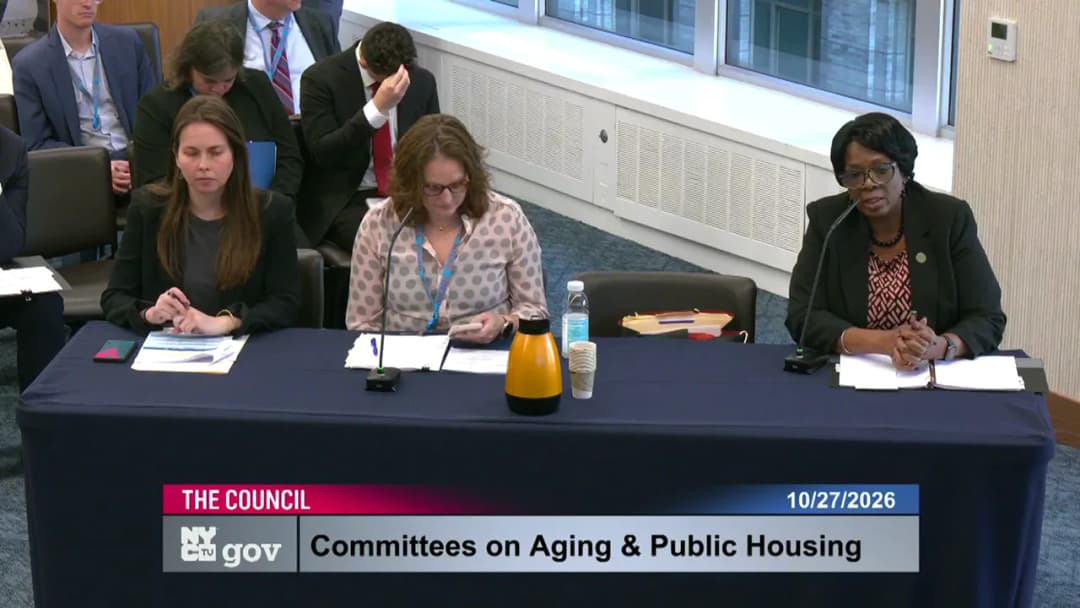
Oversight Hearing on Older Adult Centers at NYCHA Facilities and Introduction 1083, October 27, 2026

On Tuesday, October 27, 2026, at 10:00 AM, the New York City Council Committees on Public Housing and Aging held a joint hearing in Hearing Room 1 at 250 Broadway, New York, NY. The agenda was T2026-2464, an oversight review of Older Adult Centers (OACs) located in NYCHA facilities, and Int 1083-2026, a bill that would require the Commissioner of Aging to designate at least one financial literacy advisor to serve in each OAC for at least 20 hours per month. Public Housing Committee Chair Chris Banks and Aging Committee Chair Susan Zhuang presided. Roll call showed six members present and one member excused. The hearing included opening statements, provider testimony, agency testimony from NYC Aging and NYCHA, council questioning, and public testimony. Public Comments & Testimony - Sarah Morgridge, board member of Riverstone Senior Life Services, testified that Riverstone has been housed at NYCHA's senior development at 99 Fort Washington Avenue for 40 years and described severe difficulties after the building entered the RAD/PACT program with a private landlord she referred to as PRC. She stated that PRC's actions caused Riverstone to lose property liability coverage twice, that PRC refused to remove outdated and illegal fire panels, and that PRC was pressuring Riverstone to sign a license agreement containing conditions such as eviction for failure to maintain insurance. She also said PRC required investor approval to replace a faulty HVAC system in the memory center, and Riverstone paid for that repair. She called on the council to include nonprofit providers in forming next steps. - Patricia Lynch, older adult supervisor at Millennium Development, testified that her organization operates three OACs in NYCHA facilities with a fourth opening next month. She described leaks, lack of heat, difficulty getting repair tickets resolved, unclear responsibility, lack of formal MOUs or leases, and lack of place-of-assembly designations. She said providers are written up by NYC Aging and FDNY and asked for better communication, clear ownership of issues, and a commitment to resolving problems rather than passing responsibility around. - Bridget Lee, on behalf of the Weinberg Center for Elder Justice, supported Int 1083. She stated that more than one in five older New Yorkers live in poverty, 45% of NYCHA households are headed by someone 62 or older, financial exploitation occurs at a rate of 41 per 1,000 older adults in New York State, only 1 in 24 elder abuse cases is reported, and 67% of verified financial exploitation perpetrators are family members. She noted that Americans age 60 and older reported nearly $8 billion in losses to the FBI in 2025, a nearly 60% increase, with an average loss of about $38,000 per person. She urged four amendments to Int 1083: require training on elder abuse and financial exploitation, require scam intervention training, require advisors to share contacts with elder abuse service providers, and require NYC Aging to consult elder justice providers on advisor qualifications and training. - Anita Kwok, policy analyst at United Neighborhood Houses, testified that OAC providers in NYCHA facilities face unresolved repairs, unclear site control, and repair projects paused for years. She said NYC Aging and NYCHA often defer responsibility to each other, providers are sometimes asked to take on responsibilities such as extermination or to sign leases without city funding for rent, and a dedicated funding stream for fully funded capital services is needed. - Christopher Leon Johnson testified in support of Int 1083 but asked that the required advisor time be increased from 20 hours per month to at least 40 hours per month. He also raised concerns about poor Wi-Fi and cell signal at NYCHA community centers and asked the city to invest in connectivity infrastructure. - Rosemary Salazar, program director at University Settlement's older adults program, testified that the fire panel at the Neighborhood Center is not connected to the FDNY alarm system or any monitoring company and that NYCHA has refused to correct the issue, saying responsibility lies with the community-based organization. She stated that FDNY inspectors repeatedly reported the need to repair or replace the panel to NYCHA in 2024. Agency Testimony - Dr. Lisa Scott McKenzie, Commissioner of the New York City Department for the Aging (NYC Aging), testified that there are 105 OACs primarily serving NYCHA residents across the five boroughs, that nearly 150,000 older adults attended an NYC Aging OAC in FY 2026, and that about one-third of those attendees were at centers serving NYCHA residents. She said NYC Aging provided more than 6.3 million meals at OACs in partnership with the council, and that 12,686 older adults receiving NYC Aging services are known to live in NYCHA across all programs. She described the complaint process through NYCHA's Customer Contact Center, regular review of open tickets by the NYC Aging-NYCHA liaison, and quarterly leadership meetings. She said NYC Aging completed 56 projects in FY26, many made possible by a $5 million Council grant, including a kitchen renovation at Bronx River OAC and a roof and AC replacement at Samuel Tilden OAC. On Int 1083, she said NYC Aging agrees with the intent of the bill but is reviewing its implications and preliminary rollout costs. - Eva Trimble, Chief Operating Officer of NYCHA, testified that NYCHA's campuses are home to 77 older adult centers, with an additional 28 centers at PACT developments. She said NYCHA and service providers share responsibility for maintaining centers, with NYCHA generally responsible for building systems and providers generally responsible for interior maintenance and minor repairs. She highlighted the reopening of the Edenwald Senior Center after it had been inoperable for 25 years. She reported that over the past year OACs submitted approximately 1,700 work orders, almost all of which were closed and completed by NYCHA, with about 250 still open. She said the average response time was about 12 days and the average days to close a work order was 12.8 days. She said NYCHA estimates approximately $900 million in capital need for older adult centers, and that there are currently 60 FDNY violations and two DOB violations at OACs. She also said NYCHA does not have a formal repair agreement with NYC Aging, although staff meet biweekly and leadership meets quarterly. - Abigail Fradkin, NYCHA Deputy Chief Asset and Capital Management Officer, testified that NYCHA is again accepting council-allocated capital funding after a temporary pause due to staffing shortages, and that the pause was lifted. She said NYCHA has completed seven discretionary-funded OAC projects, has 16 active projects with a total budget of about $57 million, and has six planned projects currently in discussion. Discussion Items - Chairs Banks and Zhuang raised concerns about long-standing leaks, including a reported two-year leak at the LaGuardia and Dykeman older adult center. Commissioner Scott McKenzie said she had recently visited Dykeman and saw no active leak there, but NYCHA and NYC Aging committed to follow up on LaGuardia and report back. - Council members asked repeatedly about the division of responsibility between NYCHA and NYC Aging. Agency officials said NYCHA handles roof leaks, major plumbing, HVAC systems, and building envelope issues, while providers handle minor interior repairs such as broken doorknobs, minor painting, and small ceiling tiles. NYC Aging said it does not perform direct repairs outside of small items funded by council allocations. Several members pressed the agencies to reduce finger-pointing and give providers clear instructions. - Council members raised the lack of leases or MOUs at many OACs. NYCHA stated that OAC providers are not tenants, that OAC spaces are treated as community spaces rather than commercial spaces, and that only a handful of license agreements are in place at PACT sites. NYCHA said it encourages providers and PACT partners to sign license agreements but does not require them. - The hearing included substantial discussion of RAD/PACT conversions. NYCHA said PACT conversions generally include modernization of community centers when funding allows, but that Section 8 rents cannot be used for community center renovations, so city subsidy is needed. Councilmember Banks asked whether OACs could lose previously allocated capital funds after a conversion; NYCHA said it is handled case by case and could not guarantee that no site has ever lost money. - Council members asked about closed OACs. NYCHA said three centers were closed over the past year due to unsafe conditions: Glebe Avenue, Lattimer Gardens, and Randall Avenue/Balcom. Regarding Lattimer Gardens, which served about 700 seniors, NYCHA said the center closed because of persistent roof leaks, the roof replacement is not currently funded, and if funding were confirmed the project would take about four years. - Council members raised ADA compliance. NYCHA said not all OACs are ADA compliant, no complete count was available on hand, and bringing all centers up to standard would require significant capital investment. - On Int 1083, Commissioner Scott McKenzie said the bill would likely require new financial literacy staff rather than relying on case managers, and gave a preliminary rollout cost estimate of $2 million to $3 million. She said NYC Aging is exploring alternatives such as advisors shared across centers or mobile services. - Councilmember Brewer asked how NYCHA plans for future needs such as kitchen upgrades and proactive projects. NYC Aging said it maintains a running list of desired projects and will share that list with the council. - Councilmember Restler raised a $6 million Brooklyn borough president allocation for older adult center upgrades and said his office had received no updates from NYCHA. NYCHA said it would look into the specific allocations and provide updates. - Councilmember Hudson asked about capital improvement pipelines for OACs, specifically the William Hodson OAC. NYC Aging said there is no standing capital pipeline and that funding for comprehensive improvements generally comes from direct allocations by elected officials and from PACT conversions. Key Outcomes - The oversight resolution T2026-2464 was held and filed by the committee. - Int 1083-2026 was heard and laid over by the committee for further consideration; no vote was taken. - NYC Aging and NYCHA committed to provide follow-up data and reports, including the status of the LaGuardia/Dykeman leak, a breakdown of the approximately 1,700 OAC work orders and 250 open tickets, borough-level OAC statistics, the number of OACs that are ADA-compliant, the list of completed and planned OAC projects, funding information for the William Hodson OAC, and updates on the Brooklyn borough president's $6 million allocation. - NYC Aging stated it would continue biweekly ticket reviews with NYCHA and quarterly leadership meetings, and would continue sharing a joint tracker of repair requests. - Written testimony was accepted for the record until 72 hours after the hearing by email to testimony@council.nyc.gov.

SENIOR SERVICES 37% · PUBLIC HOUSING 34% · INTERAGENCY COORDINATION 7% · PUBLIC ENGAGEMENT 6%
16
OCT 26, 2026 · NEW YORK CITY, NEW YORK · CITY COUNCIL
City Council Hearing on DOP Strategy and Youth Info Bill - Oct 26, 2026

The New York City Council Committee on Criminal Justice, chaired by Councilmember Selvena N. Brooks-Powers, held a hearing on October 26, 2026, to review the organizational strategy of the Department of Probation (DOP) and proposed Introduction 1104. Chair Brooks-Powers opened by noting the DOP's high vacancy rate and the importance of evidence-based practices. Commissioner Sharon Goodwin testified that the agency's strategy centers on "what works," including a significant focus on reducing vacancies, right-sizing caseloads, and restoring community partnerships. Public Comments & Testimony - Young Mee Lee (Brooklyn Defender Services) raised concerns that Pre-Sentence Investigation (PSI) reports often recommend incarceration despite plea agreements. She called for streamlined attorney access during DOP interviews, routine inclusion of Certificate of Relief from Disabilities (CRD) recommendations, and expansion of early termination programs. - Natalie Peoples (Legal Aid Society - Juvenile Rights Practice) argued that Introduction 1104 does not go far enough and that counsel should be required at intake interviews. She stated the DOP's culture remains punitive despite new leadership. - Dalvin Powell (President, United Probation Officers Association) detailed a staffing crisis driven by pay inequity, noting a starting salary of approximately $61,000 for POs vs. $81,000 for parole officers. He reported approximately 449 separations from 2023 to August 2026 and urged the Council to extend collective bargaining protections to the workforce. - Prince Obang Junior emphasized the need for mentorship and community investment to address the 50% increase in juvenile rearrests. - Theodore Hayward (Osborne Association) highlighted the success of previous community-based programs like NEON and described his Bogap gun diversion program, voicing optimism about the DOP's renewed commitment to partnerships. - Christopher Leon Johnson supported Introduction 1104 but recommended extending its protections to individuals up to 24 years old. Discussion Items - Staffing and Vacancies: Chair Brooks-Powers noted the DOP vacancy rate was 23% (255 vacancies, 210 POs) as of March. Commissioner Goodwin reported the rate has decreased 8% with 171 total vacancies, including 134 POs. The DOP reinstated the Probation Officer Trainee title, shortened the academy from 5.1 to 3.5 months, and has graduated 57 officers in 2026, with 50 more expected. Four more academies are planned for 2027. - Caseload Management: DOP has reassessed all cases and is right-sizing caseloads by risk level after finding that the prior mixed approach led to misallocated supervision resources. - Juvenile Adjustment and Recidivism: DOP reported roughly 9,000 juvenile intake cases in FY2026 with about 1,400 adjusted. The juvenile rearrest rate increased 50%. DOP set a goal of reaching a 20% adjustment rate. Councilmember Restler emphasized the urgency of reducing the juvenile detention population, which has more than doubled. - Court Liaison Officers (CLOs): DOP now employs 13 CLOs (8 family court, 5 youth part). Commissioner Goodwin noted that some boroughs still need additional CLOs. The return of court liaison functions has been well-received by judges. - Early Termination of Probation: DOP confirmed it has resumed filing motions for early termination. Deputy Commissioner McKenzie stated there are no blanket objections from the general counsel, and every case is assessed on its merits (e.g., rearrest status, employment, stability). - Guns Policy: DOP is moving away from the previous administration's policy of mandatory firearm carry. A new written policy is being drafted for executive approval and union review. - Introduction 1104 (Youth Legal Process Information): Commissioner Goodwin expressed support for the bill's intent, noting it aligns with current practice, but recommended technical adjustments to align terminology with the Family Court Act (e.g., avoiding the term "PSIs" for juvenile cases). She stated the department could be ready within the 90-day effective date after operational tweaks. Key Outcomes - Decisions: The oversight resolution (T2026-2514) was Filed by the Committee. Introduction 1104 was Laid Over by the Committee for further work with the administration. - Next Steps: DOP committed to providing the committee with written data on early termination motions and the new firearms policy. Chair Brooks-Powers committed to working with the DOP and UPOA on budget proposals for officer compensation ahead of the next fiscal cycle. The hearing record will remain open for 72 hours for written testimony.

CRIMINAL JUSTICE REFORM 46% · PUBLIC SAFETY 17% · YOUTH PROGRAMS 14% · PERSONNEL MATTERS 8%
17
OCT 22, 2026 · NEW YORK CITY, NEW YORK · CITY COUNCIL
NYC Council Committee Votes to Declare October as Reggaeton Heritage Month on October 22, 2026

The Committee on Cultural Affairs, Libraries and International Relations of the New York City Council held a meeting on Thursday, October 22, 2026, at 10:30 AM in Committee Room at City Hall. The committee considered a single resolution, Proposed Res. No. 625-B, which would declare October as Reggaeton Heritage Month in New York City to honor the genre's Afro-Caribbean and Latin American roots and recognize the city's role in its cultural fusion. The resolution passed unanimously in a 7-0 vote. Public Comments & Testimony - Dr. Mita Leacock, a Brooklyn native of Panamanian heritage, music executive and producer, testified in strong support of the resolution. She highlighted her personal and professional connection to reggaeton, including her career as a dancer and her current role at Avenida World Records. She urged the council to adopt the resolution to preserve history, honor pioneers, and acknowledge the contributions of Caribbean and Latino communities to New York City's cultural identity. Discussion Items - Councilmember Farah N. Louis, the sponsor, delivered remarks on the resolution. She explained that reggaeton traces its roots to Afro-Caribbean communities in Panama and evolved through Puerto Rico's underground scene before being shaped by Caribbean and Latino artists in Brooklyn and across New York City. She emphasized that declaring October as Reggaeton Heritage Month would ensure recognition of the Panamanian, Hispanic, and Caribbean communities whose creativity helped create the global phenomenon. - Chair Nantasha M. Williams thanked staff and introduced the resolution, noting the legislative history (including prior amendments from Res. No. 625 to Proposed Res. No. 625-B). After testimony, she called for a vote. Key Outcomes - The committee voted 7-0 in favor of Proposed Res. No. 625-B, declaring October as Reggaeton Heritage Month in New York City. All seven members present—Williams, Hudson, Louis, Maloney, Ossé, Stevens, and Ung—voted aye. The resolution was adopted by the committee. - The minutes indicate that the resolution had been amended prior to the vote (Proposed Res. No. 625-A and 625-B), and the final version passed by roll call.

ARTS AND CULTURE 82% · PROCEDURAL 18%
18
OCT 22, 2026 · NEW YORK CITY, NEW YORK · CITY COUNCIL
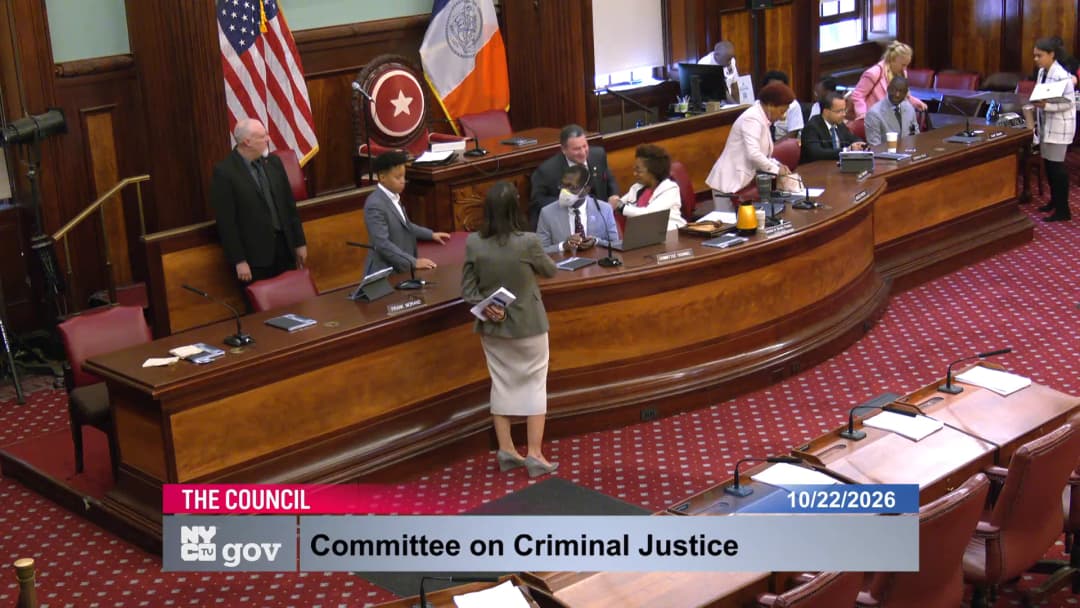
NYC Council Criminal Justice Committee Votes on Jail Ballot Access Bills - October 22, 2026

The New York City Council Committee on Criminal Justice, chaired by Councilmember Selvena N. Brooks-Powers, met on October 22, 2026, to vote on two bills aimed at improving voting access for eligible individuals in Department of Correction (DOC) custody. The committee approved both bills, with one passing 5-1 and the other passing 6-0, following discussion of low voter participation in city jails. Discussion Items - Intro 786-A (sponsored by Chair Brooks-Powers): A local law to amend the NYC charter to establish procedures for early mail and absentee ballots for voters in DOC custody. The legislation requires the DOC to review completed ballot affirmation envelopes for correctible errors before transmitting them to the Board of Elections, providing voters an opportunity to fix defects. - Intro 797-A (sponsored by Public Advocate Williams): A local law to amend the NYC charter to require annual reporting on voter registration and voting in city jails. Reports must include the number of registration forms collected, absentee ballots distributed by facility, and events promoting voter registration, with data disaggregated by facility and demographic characteristics (race, age, gender, disability status, veteran status). Chair Brooks-Powers noted that while individuals serving time for felony convictions are ineligible to vote under state law, those held pretrial or serving misdemeanor sentences retain the right to vote. She cited statistics from the June 2024 primary election: 364 individuals on Rikers Island requested absentee or early mail ballots, only 155 ballots were delivered, and just 72 were returned and counted. The bills aim to address these gaps in ballot access and public information. Key Outcomes - Intro 786-A: Approved by roll call vote. Affirmative (5): Brooks-Powers, Brewer, Feliz, Narcisse, Salaam. Negative (1): Morano. Medical (absent): Cabán. The bill was amended by committee before approval. - Intro 797-A: Approved by roll call vote. Affirmative (6): Brooks-Powers, Brewer, Feliz, Morano, Narcisse, Salaam. Negative (0): None. Medical (absent): Cabán. The bill was amended by committee before approval. Both bills now advance to the full City Council for consideration.

CRIMINAL JUSTICE REFORM 81% · VOTING RIGHTS 19%
19
OCT 22, 2026 · NEW YORK CITY, NEW YORK · CITY COUNCIL
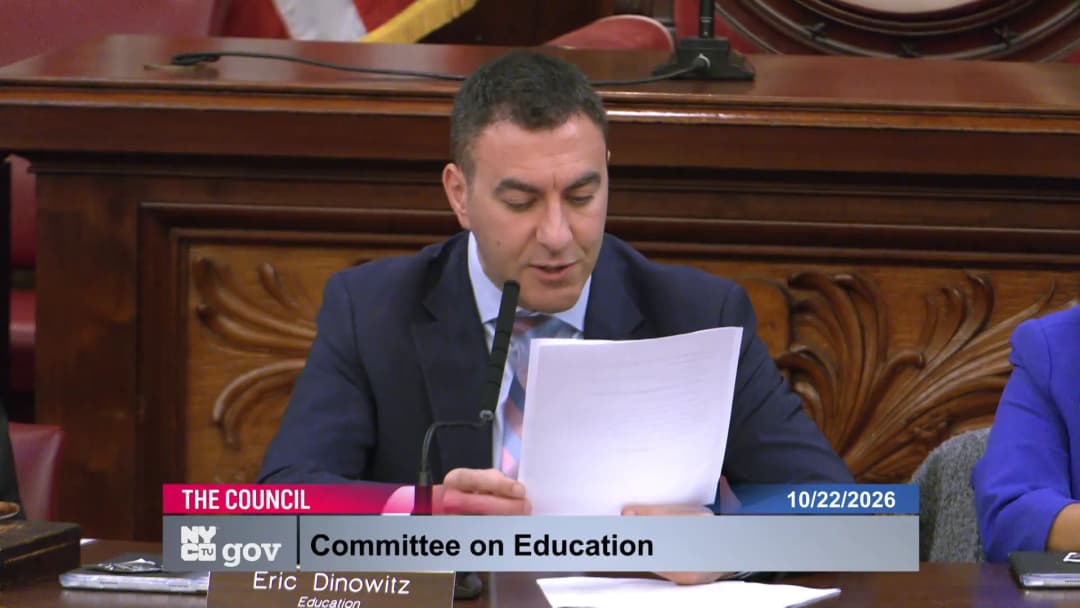
Education Committee Votes on Special Education and Head Start, October 22, 2026

The Committee on Education, chaired by Councilmember Eric Dinowitz, met on October 22, 2026, to vote on two pieces of legislation: a local law requiring a study on social and economic factors affecting access to special education services, and a resolution opposing federal changes to Head Start program standards. The committee heard opening remarks from Chair Dinowitz and then proceeded to a roll-call vote. Discussion Items - Int. No. 853-A (Sponsored by Councilmember Susan Zhuang): This bill would require the Department of Education to study how social and economic factors affect access to special education programs and services. Chair Dinowitz noted that New York City operates the largest special education system in the United States, with approximately 24.2% of K-12 students classified as having a disability in the 2025–2026 school year, and cited a 2023 Controller’s report finding that the DOE failed to deliver mandated services to thousands of students. He expressed his support as a former special education teacher and co-sponsor. - Res. No. 650 (Sponsored by Councilmember Jennifer Gutiérrez): This resolution opposes the federally proposed rule change titled “Reducing Federal Burden for Head Start Programs,” which would allow larger class sizes, reduce teacher qualification requirements, cut health and family support requirements, and restrict non-English instruction. Chair Dinowitz stated that the changes could lower quality and safety for thousands of New York children. Key Outcomes - Int. No. 853-A was approved by a roll-call vote of 11 in the affirmative, 0 in the negative, with 0 abstentions. (Councilmembers Brewer and Joseph were absent.) - Res. No. 650 was approved by a roll-call vote of 10 in the affirmative, 1 in the negative (Councilmember Wong), with 0 abstentions. (Councilmembers Brewer and Joseph were absent.) - Both items were adopted by the committee.

PROCEDURAL 66% · SPECIAL EDUCATION 24% · EARLY CHILDHOOD EDUCATION 10%
20
OCT 22, 2026 · NEW YORK CITY, NEW YORK · CITY COUNCIL
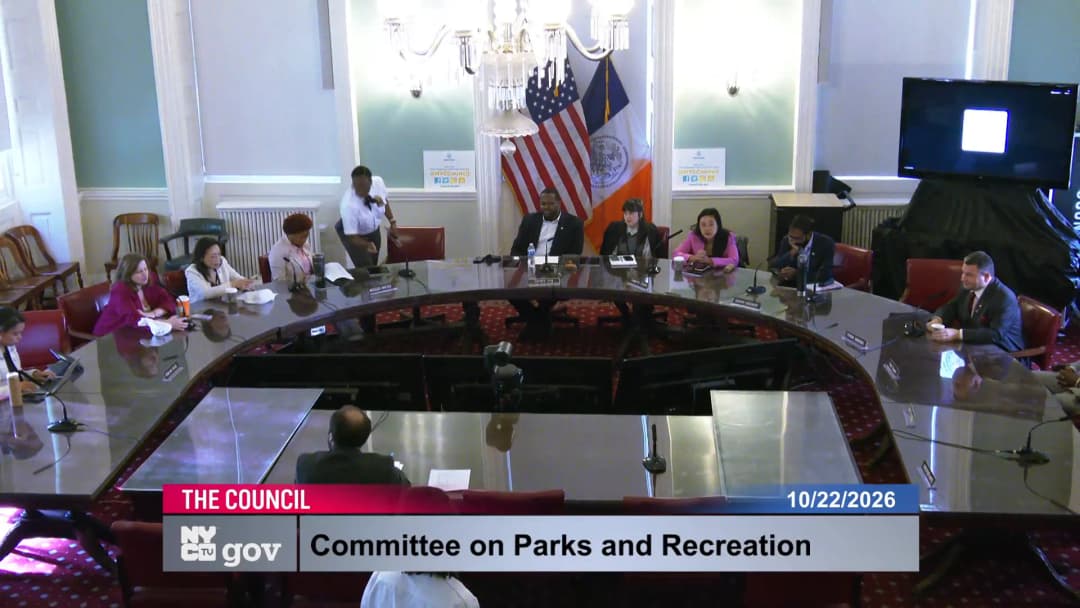
NYC Council Parks Committee Meeting on Edgemere Avenue Renaming – October 22, 2026

On Thursday, October 22, 2026, the New York City Council Committee on Parks and Recreation, chaired by Councilmember Ty Hankerson, met to consider a single agenda item: Proposed Int. No. 927-A, a local law to rename Edgemere Avenue and amend the official map of the city of New York in the Borough of Queens. Voting & Outcomes - The committee voted unanimously (11-0) to approve Proposed Int. No. 927-A. All 11 members present—Hankerson, Krishnan, Lee, Marte, Morano, Narcisse, Nurse, Salaam, Sanchez, Santosuosso, and Ung—voted in the affirmative. No negative votes or abstentions were recorded. - The approved introduction will now proceed to the full City Council for consideration. No public comments, testimony, or additional discussion were recorded during the meeting. The meeting adjourned following the vote.

PROCEDURAL 100%
OPENPUBLICA · PUBLIC MEETING INDEXUPDATED DAILY · openpublica.com